“Why are you quitting?” my boss asked. I didn’t argue or explain. I simply reached into my bag, pulled out my latest paycheck, and slid it across her desk. She glanced at the number—and stopped. Then she checked it again. “Is this what they’ve been paying you?” she asked. I nodded. Her expression changed instantly. She picked up the phone. “HR? Come to my office. Now. And bring her payroll records.” That was when I realized my boss hadn’t known either.

My Boss Asked Why I Was Quitting. Then She Saw One Code on My Pay Statement and Called HR, Legal, and Security at Once.

“Why are you quitting?”
Diane Mercer’s voice carried across the glass walls of her corner office.
I did not answer immediately.
I stood on the other side of her black marble desk with my handbag still over one shoulder, my coat folded across my arm, and three years of exhaustion pressed into every muscle of my body.
Then I placed two sheets of paper in front of her.
The first was my resignation letter.
Two sentences.
Professional.
Final.
The second was my year-end compensation statement.
Diane skimmed the resignation first.
Her eyebrows came together.
Then she picked up the pay statement.
Her eyes moved down the page.
Base salary.
Federal withholding.
State taxes.
Health insurance.
Retirement contribution.
Then she reached the bottom.
I had circled one line in red.
AX7204.
Beside it was a negative amount large enough to erase almost my entire performance bonus.
Diane stopped breathing for a second.
I watched her read the code again.
Her expression changed.
Until that moment, I had been an unauthorized employee standing in the private office of the CEO of Apex Marketing, one of the largest analytics-driven marketing firms in Chicago.
Now I was something else.
A witness.
Diane placed the paper flat against her desk.
“Where did you get this?”
“My employee portal.”
“Is this the original PDF?”
“Yes.”
“Has anyone altered it?”
“No.”
“Who else has seen it?”
“My attorney.”
That made her look up.
“Your attorney.”
“Yes.”
The silence lasted two seconds.
Then Diane reached for the private phone on her desk.
“Martin, I need corporate counsel upstairs immediately.”
She listened.
“No. Immediately.”
Another button.
“Internal audit.”
Pause.
“And have IT preserve payroll authorization logs for the year-end compensation cycle. No deletions. No routine archiving until legal clears it.”
She hung up.
Then pressed another line.
“Security?”
I felt my shoulders tighten.
Diane looked directly at me.
“Not for you.”
Into the phone she said, “I want discreet security coverage outside the executive suite. No one leaves with company equipment until legal says so.”
She put the receiver down.
For the first time since I entered the office, she leaned back.
“Now,” she said, “tell me everything.”
My name is Catherine Reynolds.
I was thirty-four years old when one payroll code changed almost every part of my life.
At the time, I worked as a strategic data analyst at Apex Marketing in downtown Chicago.
People outside the industry thought we made advertisements.
That was the visible part.
The real money was in data.
Consumer behavior.
Pricing patterns.
Market expansion.
Retention modeling.
Demand forecasting.
If a company wanted to know which customers were about to leave, where its next profitable market was, or whether a new product would survive six months after launch, Apex wanted the contract.
We occupied more than thirty floors of a glass tower near the river.
Our lobby had polished stone floors, a coffee bar that served drinks with oat milk before most of my relatives knew oat milk existed, and a wall displaying awards for being one of the city’s “Best Places to Build a Career.”
I used to walk past that wall at seven in the morning and feel proud.
By the end, I barely saw it.
For two years, I averaged close to seventy hours a week.
That number was not official.
Apex did not say, “Catherine, you must work seventy hours.”
That would have been easier to recognize as unhealthy.
Instead, the pressure came through compliments.
“You’re the only one I trust with this client.”
“Can you give us one more pass before morning?”
“You have executive potential.”
“This quarter will determine the next promotion cycle.”
Nobody orders ambitious people to sacrifice themselves.
They simply make the sacrifice feel temporary and meaningful.
I missed my father’s birthday dinner one year because a retail client changed its regional segmentation model at five on a Friday.
I missed Thanksgiving dessert another year because Richard Montgomery, our vice president of operations, decided a presentation scheduled for Monday needed to be “board-ready” before midnight Saturday.
I stopped seeing friends during the week.
My groceries came through an app.
The front desk staff at my South Loop condo knew I was alive because packages disappeared from the mailroom.
My place was nice.
Nothing extravagant.
One-bedroom plus den.
Good view.
A narrow balcony facing east.
I bought it after my second year at Apex because I wanted proof that all the hours were becoming something permanent.
The mortgage bothered me.
Not because I could not afford it.
Because debt felt like a hand on the back of my neck.
My year-end performance bonus was supposed to remove that hand.
My employment agreement included a formula tied to revenue from new accounts I helped optimize.
I knew the numbers.
I built numbers for a living.
Three large accounts had crossed their contractual thresholds that year.
I had calculated my expected bonus several times.
Even after taxes, it would leave me enough to pay off the remaining principal on the condo and still retain an emergency fund.
For months, that was what I pictured when I stayed late.
Not a Porsche.
Not designer clothes.
Not a bigger title.
A paid-off home.
I imagined walking into the bank branch on Roosevelt Road, signing the final paperwork, then going back to my condo knowing no employer could threaten my housing with one bad quarter.
The morning bonuses posted, Apex felt almost cheerful.
People checked accounts between meetings.
One analyst brought doughnuts.
Someone from finance opened champagne before lunch and got told to put it away until five.
I waited until the noise settled.
Then I logged into the employee portal.
My expected bonus should have been a little over $130,000 before withholding.
The amount displayed was barely enough to cover a modest cost-of-living adjustment.
I refreshed the screen.
Same number.
Logged out.
Back in.
Same.
My stomach tightened.
I downloaded the detailed statement.
At first, everything looked ordinary.
Then I saw it.
Performance allocation: $132,480.
Internal adjustment: AX7204, negative $119,000.
Final bonus payout: a fraction of what had been allocated.
I stared at the screen.
The important fact was not that my bonus had been reduced.
Companies dispute bonuses all the time.
Revenue calculations change.
Customers receive credits.
Contracts contain conditions.
The important fact was that the money had first been calculated as earned and then moved through a separate adjustment.
Someone had touched it after allocation.
I searched our employee compensation policies.
No AX7204.
I searched internal HR FAQs.
Nothing.
I checked the annual compensation memorandum.
Nothing.
I asked myself the question I had learned to ask whenever a data point did not belong.
Is this error, policy, or intent?
I could not answer yet.
So I did not send an angry email.
I did not storm into payroll.
I printed the statement.
Saved the original PDF to my permitted personal compensation archive.
Then sat quietly at my desk while people around me laughed about vacations and student loans.
The woman three rows over, Maya Ortiz, was twenty-seven and brilliant.
She had been at Apex less than a year.
She spun in her chair toward me.
“You look like somebody died.”
“Payroll math.”
She grimaced.
“Worse.”
I almost told her.
Then stopped.
If I was wrong, spreading suspicion would be reckless.
If I was right, I needed to understand the size of the problem before anyone had time to clean it up.
That evening was our monthly family dinner.
Normally I dreaded those dinners because my younger sister Amanda and I had spent most of our lives occupying roles our parents assigned before either of us knew enough to object.
Amanda was the charming one.
I was the responsible one.
Amanda needed support.
Catherine would be fine.
Amanda was three years younger.
She was beautiful in an effortless way as a teenager and a very calculated way as an adult.
She knew how to enter a room.
She knew names.
Birthdays.
Spouses.
Where someone vacationed.
What university their children attended.
Those skills made her excellent in human resources.
At thirty-one, she was director of HR at Apex Marketing.
That fact had never bothered me.
People assumed she helped me get the job.
She did not.
We worked in different divisions and I had joined through a recruiter before she became director.
Still, our parents loved telling people that “the girls work together downtown.”
We did not.
We occupied the same building.
That was different.
My father, Thomas, was proud of Amanda in the easy, public way parents sometimes find difficult with quieter children.
He understood her work.
People.
Hiring.
Management.
He could tell friends at the Oak Brook golf club that his daughter ran HR.
My work sounded less interesting.
“So you make charts?”
That was Dad’s description.
My mother Patricia was worse.
Not malicious.
Not consciously.
She simply believed Amanda’s life required applause and mine required maintenance.
If Amanda bought a new dress, Mom wanted pictures.
If I paid off a student loan, Mom said, “That’s smart.”
If Amanda received a promotion, family dinner.
If I received one, she asked whether it meant I would have to work even more.
By thirty-four, I told myself I had stopped caring.
That was not entirely true.
The drive from downtown to Oak Brook took over an hour in the rain.
By the time I turned onto my parents’ street, the pavement shone black under the streetlights.
I intended to pull into the driveway.
Then my headlights caught something red.
A brand-new Porsche Panamera.
Dealer plates.
Perfect paint.
Parked directly in front of my parents’ garage like an advertisement.
I stopped the Honda at the curb.
I knew roughly what a fully loaded Panamera cost.
Not because I cared about sports sedans.
Because I analyze consumer pricing.
Depending on options, well into six figures.
Amanda made a strong HR director salary.
She did not make cash-Porsche money.
Of course, people finance cars.
People receive bonuses.
People use stock.
People inherit money.
I repeated every reasonable explanation while walking toward the front door.
Inside, Dad held the key fob.
“Look who finally made it.”
“Traffic.”
Amanda turned from the fireplace.
Silk blouse.
Black trousers.
Expensive boots.
Champagne.
“Catherine. I was starting to think Apex had chained you to the desk.”
“Some days.”
Mom kissed my cheek.
“You look tired.”
“I am.”
“You need balance.”
This from a woman who had spent twenty years praising me for being hardworking.
Dad lifted the Porsche key.
“Your sister rewarded herself.”
Amanda smiled.
“Little year-end upgrade.”
“Little?”
Dad laughed.
“Hard work pays off.”
Then he looked at me.
“You should learn from her. Amanda knows how to make leadership notice.”
The comment landed exactly where he intended without him realizing it.
I was the one who had spent seventy hours a week building models for clients whose names he recognized from television.
Amanda had purchased a Porsche the same day my bonus disappeared through a code only her department should understand.
Still, I said nothing.
“Congratulations.”
“Thank you.”
We moved into the dining room.
Roast lamb.
Garlic potatoes.
Green beans.
Wine.
Jamal sat across from me.
He had married Amanda seven years earlier.
They had two boys, eight and ten.
Jamal was a senior forensic auditor for a financial advisory firm in the Loop.
He was quiet around my parents.
Not uncomfortable.
Observant.
He had the habit of pausing before answering simple questions, as if even casual conversation deserved a control test.
That evening, he barely spoke.
Mom noticed my silence first.
“So, Catherine, are you still just crunching numbers?”
I looked at her.
“Pretty much.”
“Amanda says your group was buried this quarter.”
“We were.”
“At least you get overtime.”
“Salaried.”
“Oh, right.”
Amanda lifted her wine.
“But bonuses were today.”
Her eyes met mine.
“I hope yours was decent.”
Decent.
Not good.
Not huge.
Decent.
Something in the word bothered me.
I said, “Interesting year.”
Amanda sighed sympathetically.
“Corporate tightened bonuses.”
“Did they?”
“Yes. Revenue is strong, but costs are up.”
Jamal looked down at his plate.
I noticed.
Amanda continued.
“I fought hard for the analysts.”
“How generous.”
Mom put down her fork.
“Catherine.”
“What?”
“You could say thank you.”
Amanda smiled.
“No, Mom. It’s okay. Catherine is disappointed.”
I looked toward the window where the red Porsche sat under the exterior lights.
“It’s amazing how tight the budget gets for analysts on the exact day an HR director buys a six-figure car.”
Silence.
Dad’s expression hardened.
“Don’t do that.”
“Do what?”
“Turn Amanda’s success into something ugly because you’re unhappy.”
“I asked an observation.”
“You made a nasty comment.”
Amanda gave me the look I had known since childhood.
Forgiving.
Superior.
The kind older relatives always interpreted as maturity.
“I financed responsibly.”
Jamal looked up.
Amanda noticed.
“What?”
“Nothing.”
He took a drink of water.
Dinner moved on.
I let it.
Afterward, Dad wanted pictures beside the Porsche.
Of course he did.
Mom went outside too.
I stayed inside clearing dishes because I needed two minutes without my family.
I was stacking plates near the sink when Jamal entered carrying wine glasses.
He placed them on the island.
Then looked through the kitchen window.
Dad was photographing Amanda beside the hood.
Jamal said, “She didn’t finance it.”
I turned.
“What?”
“The car.”
He kept his eyes outside.
“She paid cash.”
My fingers tightened around the dish towel.
“How do you know?”
“We share household accounts.”
“Maybe she had a bonus.”
“That’s what she told me.”
He finally looked at me.
“The money did not come from Apex payroll.”
I stayed quiet.
“Where?”
“An entity I don’t recognize.”
“What kind?”
“Distribution account. Corporate descriptor.”
Jamal folded his arms.
“I already contacted my attorney because I don’t want to access anything I’m not entitled to investigate.”
That was Jamal.
The man’s marriage might be collapsing in front of him and his first instinct was still clean evidence handling.
“You think it’s dirty.”
“I think I cannot reconcile it.”
I took out my phone.
Opened my compensation PDF.
Handed it to him.
His eyes moved down.
Stopped.
“AX7204.”
“You know it?”
“Not specifically.”
He enlarged the page.
“But the format looks like an internal accounting route, not a normal payroll deduction.”
“That’s what I thought.”
“How much did you expect?”
I told him.
He did the subtraction silently.
Then looked toward Amanda.
“Do not accuse her.”
“I wasn’t planning to.”
“Get independent counsel.”
“I will.”
“And do not go digging through HR systems because you work in analytics.”
I gave him a look.
“I know.”
“I know you know. I also know angry smart people become very creative.”
“Fair.”
He gave the phone back.
“You have the original contract?”
“Yes.”
“Performance reports?”
“Yes.”
“Keep them.”
Dad opened the back door.
“Jamal, get out here. We need one with everybody.”
Jamal straightened.
Before leaving, he said, “Numbers first.”
That became our rule.
I left my parents’ house forty minutes later.
Amanda hugged me at the door.
“I hope you’re not upset about the bonus thing.”
I looked at her.
“I’m sure it’ll work out.”
She smiled.
“That’s the spirit.”
Driving home through the rain, I felt less angry than I expected.
Anger came later.
At first, I felt insulted by the mathematics.
A compensation adjustment I could not reconcile.
A large unexplained cash purchase.
An HR director sister who knew more about the bonus cycle than she was saying.
The pattern was too clean.
That frightened me.
At home, I called Evelyn Park.
Employment lawyer.
Whistleblower specialist.
I knew her through a professional association.
She answered at nine thirty.
“This sounds serious.”
“I don’t know if it is.”
“Good answer.”
I told her everything.
The contract.
The statement.
The code.
Amanda’s position.
The Porsche.
Jamal’s observation.
Evelyn asked whether I had accessed anything beyond normal employee permissions.
“No.”
“Keep it that way.”
“I will.”
“You are a data analyst?”
“Yes.”
“So you know systems.”
“Yes.”
“That makes you dangerous to your own case.”
I almost laughed.
“Explain.”
“You are going to be tempted to investigate.”
“Probably.”
“Don’t.”
She became very clear.
“No bypassing permissions. No copying restricted company data. No installing software. No logging into somebody else’s account. If misconduct exists, preserve what you legitimately possess and use compliance channels.”
That was less exciting than revenge.
It was also correct.
She asked about Apex’s ethics program.
Independent hotline.
Audit committee access.
External provider.
I checked the handbook while we spoke.
“Yes.”
“Good.”
“Should I report now?”
“First, tomorrow, ask management for an explanation in writing.”
“Richard?”
“Yes.”
“And HR?”
“Because your sister is HR, disclose the conflict.”
“What if they retaliate?”
“Document.”
The next morning, I sat across from Richard Montgomery.
He had been with Apex twelve years.
Vice president of operations.
Silver hair.
Custom suits.
A corporate smile that managed to look warm while communicating hierarchy.
I placed the compensation statement in front of him.
“I’m hoping you can explain AX7204.”
He barely glanced at it.
“Temporary capital reallocation.”
“Where is that policy documented?”
“Executive level.”
“My employment agreement defines the bonus formula.”
“Subject to company discretion.”
“Where?”
He smiled.
“Catherine, compensation documents are not contracts in the way analysts think they are.”
Mine was.
But I let him continue.
“We had to respond to changing economic conditions.”
“Apex reported record revenue.”
“Revenue and cash flow are different.”
“Were all bonuses adjusted?”
“I cannot discuss other employees.”
“Was this approved by the board?”
His smile disappeared.
“You’re getting very technical.”
“I work here because I’m technical.”
Before he could answer, Amanda entered.
Tablet in hand.
“Oh. Catherine.”
Fake surprise.
Richard said, “Perfect timing.”
Of course.
He explained my question.
Amanda sat on the edge of a side chair.
“AX7204 is a valid executive compensation adjustment.”
“Can I see the policy?”
“No.”
“Why?”
“Confidential.”
“How can an employee be bound by a confidential policy that overrides written compensation terms?”
Amanda’s eyes cooled.
“You’re not a lawyer.”
“No.”
“Then perhaps don’t turn routine payroll administration into a legal seminar.”
Richard leaned forward.
“You are valued here.”
There it was.
The compliment before the threat.
“You’re in line for bigger responsibility. I’d hate to see you develop a reputation for becoming distracted by short-term compensation frustrations.”
I looked at him.
Then Amanda.
My sister smiled faintly.
They expected surrender.
So I gave them something that looked like it.
“I understand.”
Richard relaxed.
“Good.”
“Thank you for explaining.”
I collected the statement.
Amanda said, “I’m glad we cleared this up.”
“We did.”
I left.
Went downstairs.
Closed myself in a restroom stall.
Sent Evelyn my notes while they were fresh.
Then filed a report with Apex’s external ethics hotline.
No accusations.
No dramatic language.
I described the unexplained adjustment.
Documented my contractual formula.
Reported management’s refusal to provide supporting policy.
Disclosed Amanda’s familial relationship.
Disclosed the Porsche only as potential context requiring independent review.
Attached the compensation statement and my original agreement.
Then I went back to work.
That might be the least satisfying sentence in the story.
I went back to work.
No secret hacking.
No digital ambush.
No brilliant midnight attack.
That is what responsible professionals do when serious allegations touch systems they could technically manipulate.
You create distance between suspicion and proof.
The next week was almost unbearable.
Richard became nicer.
Amanda became warmer.
That worried me more than hostility.
Amanda brought me coffee one morning.
“Peace offering.”
“For what?”
“You’ve seemed stressed.”
“Work.”
“We’re family.”
I looked at her.
“Yes.”
The word tasted strange.
At lunch, Maya rolled her chair toward mine.
“Can I ask something?”
“Sure.”
“Did your bonus get adjusted?”
I stared at her.
“Why?”
She opened her statement.
Different amount.
Similar internal adjustment family.
Not identical code.
But same section.
“How many people have this?”
“I know of four.”
“Do not send me anyone’s documents.”
“Why?”
“Because I have my own compensation dispute.”
Her eyes widened.
“You think this is wrong.”
“I think you should use the ethics hotline.”
She looked nervous.
“HR told me the adjustment was normal.”
“Then independent compliance should be able to confirm that.”
Maya swallowed.
“I need that money.”
“I know.”
“My student loan payment goes up in January.”
“I know.”
“Is the company broke?”
“I don’t know.”
That was the moment my fear changed.
Until then, the missing bonus was personal.
Now I could see the human scale.
Maya had counted on $18,000.
Another analyst was trying to put a down payment on a house.
A senior researcher had twin daughters in college.
If compensation was being manipulated systematically, it was not corporate drama.
It was rent.
Tuition.
Debt.
Retirement.
Ordinary lives.
More complaints reached the hotline.
I did not know how many.
But two weeks after my report, a message arrived from outside counsel representing Apex’s audit committee.
Mandatory interview.
Document preservation notice.
Confidentiality request.
That was when I knew the board had taken it seriously.
I called Evelyn.
“Good.”
“Good?”
“Yes.”
“I feel sick.”
“That’s different.”
The interview lasted nearly three hours.
Outside counsel.
Independent forensic accountant.
IT security representative.
I walked them through everything.
The compensation formula.
My calculation.
The code.
My meeting with Richard and Amanda.
The family relationship.
The Porsche observation.
Jamal’s household concern.
“Did Mr. Washington provide you with any confidential third-party records?”
“No.”
“Did you access HR or payroll data outside your normal permissions?”
“No.”
“Did you attempt to investigate the code yourself through restricted systems?”
“No.”
The lawyer nodded.
That answer mattered.
They already had logs.
They did not need me to become a vigilante inside the network.
The company could preserve records lawfully.
A week later, Amanda was placed on paid administrative leave pending investigation.
She called me fourteen times.
I answered none.
Mom called fifteen minutes later.
I answered once.
“What did you do?”
“I reported a payroll discrepancy.”
“Amanda has been suspended.”
“I heard.”
“She is hysterical.”
“I’m sorry.”
“You’re sorry?”
Mom’s voice sharpened.
“You did this to your sister.”
“No.”
“You accused her.”
“I asked for an independent review.”
“You knew what would happen.”
“No.”
“You’ve always resented her.”
I closed my eyes.
Childhood arrived immediately.
“You’re tired because you choose to work too much.”
“Amanda has people skills.”
“Why can’t you be happy for your sister?”
I said, “Mom, if the company finds nothing, she goes back to work.”
“And if they find something?”
“Then that is not my fault.”
She went silent.
Then said, “Family doesn’t do this.”
That sentence stayed with me.
Not because I believed it.
Because it revealed the rule.
Family, in my mother’s mind, meant private correction.
Not outside accountability.
Even when the alleged harm involved other employees.
“I have to go.”
“You’re choosing a corporation over your sister.”
“No.”
I ended the call.
Jamal moved out two days later.
He called me from an extended-stay hotel near Oak Brook.
“The boys are with me.”
“Are they okay?”
“Confused.”
“Does Amanda know?”
“Yes.”
“Did you take household records?”
“Copies of records I am legally entitled to.”
“You spoke with counsel?”
“Yes.”
His voice sounded hollow.
“I thought maybe I was wrong.”
“About what?”
“Her.”
I did not know what to say.
“She told me the Porsche money came from a special retention payment.”
“Maybe some of it did.”
“No.”
“How do you know?”
“She showed me a document after suspension.”
“And?”
“My attorney had it reviewed.”
He paused.
“It was created after the payment.”
I closed my eyes.
“Jamal.”
“I know.”
There is no satisfaction in being proven right about someone you love.
That lesson came early.
Apex’s investigation widened.
External auditors arrived.
Payroll access was restricted.
Vendor payments were reviewed.
Richard Montgomery stopped appearing in regular leadership meetings.
Then came the Horizon Dynamics account.
The largest project of my career.
A global logistics company wanted an integrated market-demand forecasting platform.
I spent three months building the model.
Late nights.
Client calls.
Data cleaning.
Regional adjustments.
Richard presented progress to senior leadership.
My name appeared in technical appendices but rarely in executive communications.
That used to infuriate me.
Now I documented everything and kept working.
When the model was completed, I sent it through the official project system.
Within twenty minutes, Richard sent a companywide email.
He praised his own operational vision.
Thanked executive leadership.
Mentioned the analytics division generically.
No Catherine.
Maya appeared at my desk.
“You saw it?”
“Yes.”
“He took the whole thing.”
“Yes.”
“Aren’t you furious?”
“I was furious the first hundred times.”
“What are you now?”
“Finished.”
That afternoon, the audit committee summoned me again.
This time Diane attended.
So did outside counsel.
The findings were preliminary but serious.
Dozens of compensation adjustments.
Irregular vendor structures.
Manual overrides.
Payments flowing through entities with weak business justification.
Some tied to Richard.
Some tied indirectly to Amanda.
Estimated exposure above two million dollars.
My specific adjustment had been manually approved using Amanda’s credentials with Richard’s secondary authorization.
There was the answer.
My sister had taken part.
Not suspected.
Not maybe.
Documented.
I sat very still.
“Did she change my contract?”
The auditor answered carefully.
“A version of your employment record was modified after execution to insert language purporting to authorize high-tier bonus holds.”
“By whom?”
“We have logs linking the change to an HR administrative session associated with Ms. Washington.”
My hands became cold.
“And Richard?”
“Secondary approval appears under his credentials.”
I looked at Diane.
She looked older than she had a month earlier.
“I am sorry,” she said.
I almost laughed.
Not because it was funny.
Because CEOs say sorry differently when legal counsel is listening.
Diane seemed to know what I was thinking.
“This is not a legal statement.”
She leaned forward.
“I personally failed to understand what was happening beneath my leadership team.”
That landed differently.
She continued.
“I trusted performance. Revenue. Retention. Executive recommendations.”
“What about complaints?”
Her face tightened.
“That is the worst part.”
Several employees had disputed compensation before me.
Local HR had resolved the complaints.
Local HR meant Amanda’s department.
The system had sent concerns back toward the very structure being questioned.
“What happens now?”
Diane looked toward counsel.
“Full external forensic review. Law-enforcement referral where appropriate. Tax counsel. Restitution analysis.”
“And my bonus?”
“Restored with interest.”
I nodded.
Then she said, “I want you to stay.”
I looked at her.
“Why?”
“Because you’re one of our strongest people.”
“That was true before the code.”
“Yes.”
“Before the audit.”
“Yes.”
“Before you knew my name well enough to call me upstairs.”
Her expression tightened.
Fair.
“I can fix that.”
“No.”
“Catherine.”
“I’m resigning.”
Everyone went quiet.
Diane leaned back.
“You don’t have to decide today.”
“I decided before this meeting.”
“You don’t know what role I’m willing to offer.”
“That is exactly the problem.”
“What do you mean?”
“For three years, I believed if I became valuable enough, this company would eventually see me.”
My voice stayed calm.
“I was wrong.”
“You were seen.”
“Richard took credit for Horizon this morning.”
Diane looked toward counsel.
Nobody answered.
I continued.
“I do not want another title inside a structure where I had to become a whistleblower before leadership noticed the value I had already created.”
That was the truth.
Not rage.
Not revenge.
Clarity.
Diane said, “Give me forty-eight hours.”
“No.”
Then she surprised me.
“All right.”
She looked at my resignation letter.
“I won’t insult you by pretending I don’t understand.”
I stood.
“I will complete a lawful transition.”
“Paid.”
“Yes.”
“Under separate written terms.”
Outside counsel almost smiled.
“You brought your lawyer into your personality.”
“Occupational hazard.”
For one week, I transitioned Horizon.
No sabotage.
No hidden passwords.
No data held hostage.
Every company file stayed with Apex.
My proprietary knowledge remained mine, but I documented the existing model properly.
That mattered to me.
Leaving ethically was part of taking myself back.
Then I walked out.
No dramatic cheering.
Security did not escort me.
Maya hugged me near the elevators.
“Take me with you.”
“Not yet.”
She frowned.
“What does that mean?”
“It means I’m going to figure out what I’m doing before inviting people into it.”
“Boring.”
“Yes.”
I liked boring.
At home, I filed the paperwork for Catalyst Data Analytics.
People imagine starting a company feels powerful.
The first afternoon felt like filling out forms.
LLC registration.
Federal tax ID.
Business bank account.
Insurance applications.
Accounting software.
Service agreements.
Website domain.
Office address decision.
My first office was the den in my condo.
Desk.
Two monitors.
Whiteboard.
Folding table for paperwork.
I wrote CATALYST on a yellow legal pad and stared at it.
No empire.
No corner office.
Just a company name and a woman with a mortgage.
Then the criminal investigation accelerated.
Apex terminated Richard and Amanda for cause.
The company sued to recover funds.
Government investigators began reviewing bank records and vendor activity.
The Porsche became evidence of something humiliatingly simple.
Amanda had received money routed through an entity connected to the fraudulent vendor structure.
She used a significant portion to buy the car.
Not my exact bonus dollar flowing magically into the dealership.
Money does not usually trace that neatly once pooled.
But the timing and source were damning.
Jamal filed for divorce.
Family court issued temporary custody arrangements based on the circumstances, not some cinematic emergency seizure.
Their sons remained primarily with him during the case.
Amanda moved in with my parents after losing access to the family house under the separation agreement.
That lasted four days.
Then my parents appeared at my condo.
I saw them on the security camera.
Mom crying.
Dad angry.
I considered not opening.
Then I did.
I stayed inside the doorway.
“Catherine.”
Mom reached toward me.
I stepped back.
“Please don’t.”
She froze.
Dad said, “This has gone too far.”
“What has?”
“The investigation.”
“I don’t control it.”
“You started it.”
“I reported missing compensation.”
“You could tell Apex it was a misunderstanding.”
“It wasn’t.”
“Amanda says Richard designed everything.”
“Investigators will determine responsibility.”
“She is your sister.”
“Yes.”
“Then help her.”
“How?”
“Pay for an attorney.”
There it was.
Money.
Always eventually money.
“No.”
Mom gasped.
“You can afford it.”
“That is irrelevant.”
“She could go to prison.”
“That depends on the case.”
“You would allow that?”
“I’m not a judge.”
Dad stepped closer.
“You always hated being second to her.”
I almost laughed.
Even now.
“You think this is about childhood.”
“It is.”
“No.”
I looked at him.
“This is about employees losing earned compensation.”
“She made a mistake.”
“Mistakes do not usually last eighteen months.”
Mom cried harder.
“She’s terrified.”
“So was I when I learned my sister helped take my money.”
“She would give it back.”
“That doesn’t erase what happened.”
Dad’s face became red.
“We raised you better than this.”
That hurt.
More than I expected.
“Better than what?”
“Better than abandoning blood.”
I looked at both of them.
“I think you raised me to solve problems quietly so nobody else had to feel uncomfortable.”
Neither spoke.
“And I’m done.”
Dad’s jaw tightened.
“If you do this, do not expect to be welcome in our home.”
My whole childhood fit inside that sentence.
Approval.
Conditional.
Family access in exchange for obedience.
The old version of me would have panicked.
Argued.
Explained.
Tried to make him understand.
Instead, I said, “All right.”
His expression changed.
He had expected a fight.
“Catherine.”
“You should go.”
Mom whispered, “You don’t mean that.”
“I do.”
I closed the door.
Then I sat on the floor.
And cried.
For nearly an hour.
That part matters.
People love stories about a calm woman who closes a door on toxic relatives and feels nothing.
That woman does not exist.
At least I wasn’t her.
My parents hurt me.
Losing them hurt too.
Two truths.
No contradiction.
Catalyst landed its first client three weeks later.
A regional transportation company.
Their CFO knew my work from a previous Apex project.
We were careful about conflicts.
No Apex confidential information.
No poached intellectual property.
Fresh data.
Fresh model.
Fresh contract.
The engagement was worth less than a quarter of my former salary.
I celebrated with grocery-store sushi.
That was my glamorous CEO life.
Then came a second client.
Then a third.
I hired a part-time bookkeeper.
Then Maya called.
“I’m leaving Apex.”
“Why?”
“I got another adjustment.”
“Was it corrected?”
“Yes.”
“Then why leave?”
“Because I don’t trust them.”
I understood.
She joined Catalyst two months later.
Not because she was loyal to me.
Because we negotiated.
Salary.
Benefits.
Bonus structure.
Work hours.
Remote days.
Everything in writing.
The first bonus formula at Catalyst fit on one page.
Jamal reviewed it.
“Too simple.”
“That’s the goal.”
“People will know exactly what they’re owed.”
“Yes.”
He looked at me.
“You’re dangerous.”
“So I’ve heard.”
Jamal did not join Catalyst immediately.
He needed distance from Amanda’s case and his own firm had conflict rules.
He stayed where he was.
Helped only as a friend when legally appropriate.
One year later, after his divorce was final and professional conflicts cleared, I offered him a partnership.
CFO and head of risk.
He read the agreement twice.
“Family discount?”
“No.”
“Good.”
He signed.
Catalyst grew.
Not overnight.
Slow growth is less exciting and much safer.
We rented four desks in a West Loop coworking space.
Then six.
Then a small office with exposed brick and terrible heating.
Our first winter, Maya wore fingerless gloves at her computer until the landlord fixed the boiler.
I bought a space heater for everyone.
Jamal told me that was probably a fire-code issue.
He ruined many good moments.
By the end of year one, we had twelve employees.
Apex became our client during that period.
That surprised everyone.
Diane called me personally.
“Horizon wants you.”
“Catalyst.”
“Excuse me?”
“Horizon wants Catalyst, not me personally.”
A pause.
Then she said, “Fine.”
We negotiated a consulting agreement.
Market-rate.
Premium because the work was difficult.
Not five times my old salary just to humiliate anyone.
I wanted a real company, not revenge pricing.
Diane signed.
Catalyst helped stabilize Horizon’s predictive model and rebuild governance around the analytics infrastructure.
The account stayed with Apex.
We got paid.
That arrangement became symbolic for me.
I did not need Apex to collapse for me to win.
I needed a fair contract.
That was healthier.
Amanda’s criminal case resolved months later.
So did Richard’s.
The findings involved wire fraud, false vendor payments, payroll manipulation, and tax issues.
Both entered plea agreements rather than take every charge to trial.
Richard received a longer custodial sentence because investigators determined he had designed much of the vendor scheme and benefited substantially.
Amanda received less, though still significant, reflecting her role and cooperation.
Assets connected to the scheme were recovered where possible.
Apex created a restitution fund for affected employees, including amounts beyond what the government directly recovered.
My bonus had already been restored.
Maya’s too.
Others received payments.
I attended one hearing.
Only one.
Amanda looked smaller.
Not physically.
Psychologically.
No corporate armor.
No silk blouse.
No title.
When she saw me, she cried.
I did not.
Not then.
Months later, she called from custody.
Collect call.
I accepted.
“Catherine.”
“Hi.”
“Mom said your company is doing well.”
“Fine.”
“She said Apex hired you.”
“Catalyst has a contract.”
Silence.
Then:
“Can you help me with a lawyer?”
“No.”
“Catherine.”
“You already have counsel.”
“A public defender.”
“A federal public defender is a lawyer.”
“I need somebody better.”
“You need somebody representing you competently. I’m not funding your defense.”
She started crying.
“We are sisters.”
The sentence made me unexpectedly sad.
“Yes.”
“How can you say no?”
“Because being your sister does not make me responsible for fixing this.”
“Richard manipulated me.”
“Maybe.”
“He did.”
“Then your lawyer can present that.”
“You want me here.”
“No.”
“You always hated me.”
“No.”
“Then why won’t you help?”
I took a breath.
“Because if I pay to remove every consequence from your life, I become part of the same pattern Mom and Dad built.”
She went quiet.
That landed.
Then she said, “Do you know what it was like being compared to you?”
I leaned against the kitchen counter.
“No.”
“You were perfect.”
“I was not.”
“To me you were.”
Her voice shook.
“You got grades. Jobs. Condo. Everything.”
“And you got praise.”
“I know.”
“Constantly.”
“I know.”
“Then why did you hate me?”
“Because praise didn’t turn into competence.”
That honesty surprised me.
She continued.
“They kept telling me I was special.”
I said nothing.
“Then we grew up and I had no idea how to be normal.”
My anger softened slightly.
Not enough to erase what she did.
Enough to hear her.
“Richard made the scheme sound like executive accounting.”
“Did you believe him?”
“At first.”
“And later?”
“No.”
There it was.
“When did you know?”
“Months before your bonus.”
“Why keep going?”
She cried.
“Money.”
Simple.
Ugly.
True.
“And mine?”
A long silence.
“Why did you take mine?”
“Because I could.”
My throat tightened.
“I hated that you were going to pay off your condo.”
“How did you know?”
“Payroll projections.”
“And?”
“You had this plan.”
Her voice broke.
“You always have a plan.”
I said nothing.
“I wanted something that looked bigger.”
“The Porsche.”
“Yes.”
The absurdity almost made me laugh.
One woman wanted to eliminate debt.
Another wanted to display success.
Both were trying to quiet the same insecurity.
“I’m sorry,” Amanda whispered.
“For what?”
She cried harder.
“You’re doing that thing.”
“What thing?”
“Making me say it.”
“Yes.”
She took a breath.
“I’m sorry I helped take your bonus.”
I waited.
“I’m sorry I lied at Mom’s house.”
Another breath.
“I’m sorry I told them you were jealous.”
Better.
“And I’m sorry I let Richard convince me that because you were strong, hurting you mattered less.”
That one got me.
I closed my eyes.
“Thank you.”
“Do you forgive me?”
“No.”
She made a small sound.
“Maybe someday.”
That was honest.
After the call, I cried.
Again.
Healing was annoying like that.
It refused to follow the satisfying version of the story.
My parents remained out of my life for almost a year.
Then Dad had a minor stroke.
Mom called.
I almost let it go to voicemail.
Didn’t.
“He’s at Elmhurst Hospital.”
“Is he conscious?”
“Yes.”
“Any permanent damage?”
“They don’t know.”
“I’m coming.”
I drove from the city through evening traffic.
Hospitals have a way of shrinking family history.
Dad looked small in the bed.
Hospital gown.
Blood pressure cuff.
One hand resting awkwardly on the blanket.
He saw me.
His eyes filled.
“You came.”
“Of course.”
That sentence came out before I could stop it.
Of course.
Family was complicated.
Love did not vanish just because boundaries appeared.
Mom left the room.
Dad stared at the television.
Muted baseball highlights.
“I was wrong.”
I sat beside him.
“About the Bears?”
He smiled weakly.
“You.”
I waited.
“And Amanda.”
Silence.
“I thought defending her meant being a good father.”
“That was easier than admitting she did something wrong.”
“Yes.”
He looked at me.
“I thought you didn’t need defending.”
That hurt more than his anger ever had.
“Why?”
“You always handled things.”
“I learned to.”
“I know.”
He stared at his hand.
“We were proud of you.”
“You had an unusual way of showing it.”
He laughed once.
Then winced.
“I know.”
Tears came to his eyes.
“I am sorry.”
I took his hand.
“I hear you.”
Not “it’s okay.”
Not “I forgive you.”
I hear you.
Enough for that day.
Mom apologized months later.
At my condo.
She sat at my kitchen island twisting a paper napkin.
“I made Amanda’s needs more important than your pain.”
Specific.
Good.
“I praised that car.”
“Yes.”
“I called you bitter.”
“Yes.”
“I believed her before asking you.”
“Yes.”
She looked at me.
“You don’t have to say yes to everything.”
“I’m aware.”
“I deserve that.”
We both smiled slightly.
Then she said, “I’m sorry.”
I believed her.
Trust returned more slowly.
That was fine.
Amanda served her sentence and eventually came home.
Jamal had primary custody during incarceration.
After release, she had supervised and then gradually expanded parenting time based on the family court process and what was best for the boys.
We did not rush into sisterhood.
First coffee lasted forty minutes.
Second lasted an hour.
Third included laughter.
Months later, she came to Catalyst.
Not for a job.
Never HR.
She wanted to see the office.
Maya recognized her.
That was awkward.
Amanda stood near reception.
“You don’t have to let me in.”
“I know.”
“I mean it.”
“I know.”
I gave her a visitor badge.
“Stay out of payroll.”
She stared at me.
Then laughed.
A few people turned.
Good.
Tension needed somewhere to go.
I showed her the office.
Not enormous.
Thirty-two employees by then.
Glass meeting rooms.
Open desks.
Quiet booths.
Kitchen.
No slogans about being a family.
On the wall near accounting was a framed one-page bonus policy.
Amanda stopped.
“You framed it?”
“Yes.”
“That is the most Catherine thing I’ve ever seen.”
“Thank you.”
She looked at the page.
“Everybody sees the formula?”
“Yes.”
“Even junior analysts?”
“Especially junior analysts.”
She became quiet.
Then said, “I wish I had worked somewhere like this.”
I looked at her.
“You could have helped build somewhere like this.”
She nodded.
“I know.”
That was enough.
Catalyst’s biggest success did not arrive through some dramatic $40 million rescue contract.
It arrived through consistency.
Clients renewed.
Employees stayed.
People referred talented friends.
A transportation company recommended us to an insurer.
The insurer introduced us to a retailer.
Revenue grew.
Slowly.
Then meaningfully.
Jamal created controls so strict that even I complained.
“No founder override?”
“No.”
“I’m the founder.”
“Exactly.”
“Rude.”
“Effective.”
We required dual approval on compensation changes.
Vendor ownership screening.
Independent review of executive expenses.
Employees could escalate pay disputes outside management.
No secret codes.
No undocumented exceptions.
Transparency was not a cultural slogan.
It was infrastructure.
That mattered.
Because I learned the hard way that ethics is easier to advertise than to operationalize.
A company can have beautiful values printed in the lobby while the complaint system routes an employee directly back to the person causing the harm.
Integrity lives in boring places.
Permissions.
Logs.
Review.
Separation of duties.
Document retention.
People empowered to ask questions without fearing their careers will disappear.
Years after the case, Diane invited me back to Apex for a leadership session.
I almost declined.
Then agreed.
I stood in a conference room three floors below her office.
Forty executives.
I displayed one slide.
AX7204.
Silence.
I said, “This code was not the problem.”
People looked confused.
“The code was where the problem became visible.”
Next slide.
Control failures.
Concentrated authority.
Weak independent review.
Complaints routed through compromised management.
Executive deference.
Compensation complexity employees could not verify.
I looked around the room.
“The fraud did not exist because two people were unusually evil.”
No one moved.
“It existed because ordinary controls failed around them.”
Diane sat in the first row.
I continued.
“If your ethics program requires an employee to be unusually brave, unusually technical, unusually wealthy, or unusually well-lawyered in order to be heard, you do not have an ethics program.”
That room became very quiet.
Afterward, Diane found me near the elevator.
“You could have embarrassed us more.”
“Would that improve controls?”
“No.”
“Then why?”
She smiled.
“You’ve become annoyingly reasonable.”
“I hired a CFO who drains joy from everything.”
“I heard that.”
“Good.”
She pressed the elevator button.
Then said, “You know, the vice president offer is technically still open.”
I laughed.
“No.”
“Had to ask.”
The elevator arrived.
Before stepping in, she asked, “Why did you really leave?”
I looked at her.
“You know why.”
“I know the operational reason.”
“What’s the other one?”
I thought about it.
“For years, I believed being indispensable would make me safe.”
Diane’s expression changed.
“And it didn’t.”
“No.”
That might have been the most important lesson Apex gave me.
Hard work creates value.
It does not create immunity.
A company can value your output while undervaluing you.
A family can depend on your stability while ignoring your needs.
Being useful is not the same thing as being loved.
Being essential is not the same thing as being respected.
That realization changed how I ran Catalyst.
At first, I was terrible at it.
Not financially.
Culturally.
I sent messages at midnight.
Expected immediate responses.
Called things urgent that were merely important to me.
Praised people for “ownership” when what I really meant was sacrificing personal time.
Jamal called me into our conference room one Tuesday.
“You are doing Apex.”
“I am absolutely not.”
“You emailed Maya at eleven forty-six last night.”
“She was awake.”
“How do you know?”
“She replied.”
“That proves nothing.”
“The client needed an update.”
“The client meeting was at two today.”
“I wanted it early.”
He folded his arms.
“You escaped a seventy-hour culture and recreated it with better bonus formulas.”
That hurt.
Because it was true.
So we changed.
No after-hours expectations except genuine emergencies.
Clear escalation standards.
Managers evaluated partly on turnover and workload.
Mandatory vacation minimums.
Not unlimited vacation.
Real days.
Tracked and protected.
If someone worked late for a deadline, they recovered the time.
Catalyst became better.
So did I.
Three years after founding it, I took a two-week vacation.
No laptop.
Phone mostly off.
Maine.
A rental cottage.
Cold ocean.
Books.
The first morning I woke at five because my body thought I was behind.
By day four, I slept until eight.
That felt more like success than the magazine profile someone published about us that year.
My mortgage disappeared around the same time.
Not in one cinematic payoff.
My restored bonus helped.
Business distributions helped.
Savings helped.
One ordinary Friday, I made the last payment.
The bank representative slid a receipt toward me.
“Congratulations.”
I looked at it.
“That’s it?”
She smiled.
“What were you expecting?”
“I don’t know.”
“Confetti costs extra.”
I laughed.
Outside, buses moved along Roosevelt Road.
People carried groceries.
A delivery rider nearly hit a taxi.
No one knew Catherine Reynolds owned her condo outright.
Perfect.
I called Amanda.
“Guess what?”
“What?”
“Paid off.”
She went quiet.
Then said, “You did it.”
“Yes.”
“I’m really happy for you.”
No bitterness.
No comparison.
I believed her.
That might have been worth more than the mortgage receipt.
Our parents changed too.
Slowly.
Dad stopped comparing us.
Not perfectly.
Habits built over thirty years do not disappear because someone has a stroke and apologizes.
But he noticed when he did it.
Once at Thanksgiving he said, “Amanda always had better people skills than Catherine.”
Silence fell.
Then Dad stopped himself.
“No.”
He looked at me.
“That sounded like the old thing.”
“It did.”
“Sorry.”
Amanda smiled.
“Dad, I literally committed payroll fraud. You can stop protecting my special talents.”
Everyone laughed.
Even Mom.
That Thanksgiving felt different.
No performance.
No Porsche.
No hidden resentment disguised as jokes.
Jamal did not attend because he and Amanda maintained separate holiday schedules for the boys.
That was healthier.
The children were not forced to participate in some adult fantasy of instant family healing.
They had dinner with him first.
Dessert with Amanda later.
Life became practical.
Practical is underrated.
Amanda eventually found work at a nonprofit arts organization.
Operations coordinator.
Lower salary.
No executive title.
She loved it.
That surprised her most.
One afternoon, we met for lunch.
She said, “Nobody cares what car I drive.”
“What do you drive?”
“Used Subaru.”
“Scandalous.”
“I know.”
She stirred her soup.
“I used to think if people were impressed by me, I was safe.”
I looked at her.
“Same.”
She laughed.
“No, you thought if people needed you, you were safe.”
That stopped me.
She was right.
Different strategies.
Same fear.
Growing up, attention in our house felt limited.
Amanda learned to capture it.
I learned not to require it.
Both of us carried that into adulthood.
She chased status.
I chased indispensability.
Neither was healthy.
The fraud was hers.
I will never blur that responsibility.
But understanding why someone became vulnerable to a bad choice is not the same thing as excusing the choice.
That distinction saved our relationship.
I could say:
You hurt me.
You chose money.
You lied.
You deserved consequences.
And still say:
You are my sister.
I hope you become better.
Those truths can coexist.
Jamal and Amanda developed a functional co-parenting relationship over time.
Not friendship.
Professional courtesy.
Schedules.
School events.
Medical decisions.
Basketball practices.
Their boys became teenagers.
One was obsessed with robotics.
The other played point guard.
They knew their mother had been in legal trouble.
They did not know every humiliating detail.
Good.
Children do not need to inherit evidence files.
Jamal became a full partner at Catalyst in our fourth year.
He had been acting like one for years.
At his partnership dinner, I gave a short toast.
“To the man who looked at a Porsche and asked where the money came from.”
He shook his head.
“I hate this story.”
“You love this story.”
“I hate your version.”
Amanda, who attended with the boys, lifted her water glass.
“My version is worse.”
Everyone laughed.
That kind of laughter still surprises me.
Not because the past stopped mattering.
Because sometimes people survive enough truth to laugh near it.
Catalyst now employs more than sixty people.
Not an empire.
I refuse to call it one.
Empires usually make me nervous.
We do data strategy, predictive modeling, risk analytics, and governance work.
The revenue is strong.
The office overlooks the river.
My name appears on the lease.
Not in giant letters on the building.
I don’t need that.
Near our accounting department hangs one framed document.
Not my first contract.
Not an award.
Not a magazine cover.
The one-page bonus policy.
Employees joke about it.
New hires ask why it is framed.
Maya tells them:
“Long story.”
Sometimes I tell it.
Sometimes I don’t.
My original Apex compensation statement stays in my desk drawer.
AX7204 circled in red.
The code looks small now.
Almost meaningless.
That is appropriate.
It was never really about the code.
It was about assumptions.
Richard assumed executive authority would protect him.
Amanda assumed family history would make me easier to exploit.
My parents assumed the daughter who always coped would continue coping quietly.
Apex assumed strong revenue meant strong leadership.
I assumed sacrifice purchased security.
Every assumption survived until evidence challenged it.
That is what I tell young analysts.
Do not fall in love with the story before checking the data.
A client says sales fell because consumers changed?
Check.
A manager says costs require cutting employee bonuses?
Check.
A sister says a Porsche came from a legitimate bonus?
Check.
A parent says one daughter is too sensitive and the other needs nothing?
Check that too.
Not everything important fits in a spreadsheet.
Patterns still leave records.
Who calls when they need something?
Who asks how you are without asking for a favor afterward?
Who celebrates your success?
Who minimizes it?
Who respects no?
Who punishes boundaries?
Who changes when shown evidence?
Who simply changes the story?
For years, I was brilliant at finding corporate patterns and terrible at recognizing family ones.
That irony is still embarrassing.
But useful.
The last family dinner at my parents’ house before everything happened remains vivid.
Dad holding the Porsche key.
Mom telling me not to be bitter.
Amanda smiling.
Jamal silent.
Me sitting at the far end of the table, still hoping maybe the numbers did not mean what I feared.
I no longer hate that memory.
It was the night reality finally became visible.
Sometimes we need a visible thing.
A red car.
A missing check.
A strange code.
Something concrete enough to force us to stop explaining away what we already know.
Years later, Amanda and I drove past a Porsche dealership.
She pointed toward a red Panamera in the window.
“Still hate those?”
“No.”
“You should.”
“It’s a car.”
She looked at me.
“Growth.”
“Therapy.”
“Same thing, more expensive.”
I laughed.
Then she said, “I am sorry about Mom and Dad.”
“For what?”
“I knew they would choose me.”
That was not something we had discussed directly.
“I used it.”
I stayed quiet.
“When I called them after I was suspended, I knew exactly what I was doing.”
“You wanted them against me.”
“Yes.”
“Why?”
“Because if they believed you, I would have nobody.”
There was the frightened child again.
Not excuse.
Context.
“You made sure I had nobody instead.”
She nodded.
“I know.”
I looked out the passenger window.
“That hurt more than the bonus.”
“I know.”
We drove in silence.
Then she said, “I’m sorry.”
“I know.”
This time, I reached over and squeezed her hand.
Not because everything was forgiven.
Because enough had been repaired to touch.
My father died several years later.
Not from another stroke.
Cancer.
Fast.
Amanda and I were both there.
Mom sat between us in the hospital room.
Dad looked at us and said, “My girls.”
That phrase used to annoy me.
Too sentimental.
Too simplistic.
At the end, I was grateful for it.
He apologized again before he died.
I told him I forgave him.
I meant it.
Not because what he did stopped mattering.
Because forgiveness had eventually become mine to give without pressure.
Timing changed everything.
At his funeral, a former colleague from his small manufacturing business approached me.
“Your father talked about Catalyst constantly.”
I stared at him.
“What?”
“He was proud.”
That hurt.
Because of course he had finally learned to say it when I wasn’t in the room.
Parents remain annoying until the end.
Mom moved to a smaller condo after Dad died.
Amanda helped.
So did I.
We found boxes of photographs.
School awards.
My college graduation.
Amanda’s wedding.
A clipping from the business journal about Catalyst.
Dad had kept it in a folder labeled GIRLS.
Not Amanda.
Not Catherine.
Girls.
I cried sitting on his basement floor.
Family rarely resolves into one clean judgment.
Good people fail.
Bad choices happen inside loving relationships.
People who hurt you may also have loved you.
You do not have to simplify them to protect yourself.
You only have to be clear about what behavior you will accept.
That is what took me years to learn.
The same is true at work.
Apex was not evil.
Richard and Amanda committed wrongdoing.
Controls failed.
Leadership failed to see it.
Then leadership corrected.
Some employees left anyway.
Some stayed.
Diane changed policies.
Apex eventually became a better organization.
I still would not go back as an employee.
Both things can be true.
I can respect what Diane fixed and still know I belong outside her hierarchy.
Catalyst remains a vendor.
Every year we renegotiate.
No loyalty discounts.
No revenge premiums.
Market terms.
Clear deliverables.
Professional respect.
That is healthier than the emotional relationship I once had with my employer.
I used to think a company should love me back.
Ridiculous, when I say it now.
Companies do not love.
People do.
Organizations can behave ethically or unethically.
They can honor agreements.
They can create good environments.
They can compensate fairly.
But the minute employees start expecting corporate affection to substitute for protections, they become vulnerable.
Get it in writing.
Know your compensation formula.
Understand your benefits.
Save your own employment records.
Ask questions.
Use independent channels when conflicts exist.
And if something feels wrong, do not assume silence is professionalism.
Sometimes professionalism is exactly the opposite.
It is calmly asking:
What is this?
Who approved it?
Where is the policy?
Why does the number not reconcile?
Those questions changed my life.
Not because they destroyed Apex.
They did not.
Not because they sent my sister to prison.
The justice system did what it did based on evidence and law.
The questions changed my life because they ended my habit of surrendering my own judgment whenever someone with more authority told me not to worry.
My mother had done that.
Dad.
Amanda.
Richard.
Even Diane in smaller ways.
Trust us.
We know.
You’re being difficult.
Don’t get bogged down in details.
The details were where the truth lived.
Today, when an employee at Catalyst asks an uncomfortable question, my first instinct is still defensive sometimes.
I am human.
Then I remember AX7204.
I say, “Show me.”
That may be the most important leadership habit I have.
Show me.
Not because I assume the employee is right.
Because they deserve an answer grounded in something better than my title.
Last quarter, a junior analyst challenged a bonus calculation.
She was wrong.
We walked through the formula.
She saw the difference.
Then our payroll manager found a separate $380 reimbursement error while reviewing the account.
We corrected it.
No punishment for asking.
No reputation for being difficult.
No manager whispering that she was “not a team player.”
Just math.
Afterward, she emailed me:
Thanks for not making me feel stupid.
I stared at that line for a while.
The company I wanted was not the one where leaders never made mistakes.
Impossible.
It was the one where employees could point at a mistake without becoming the problem.
That was worth building.
On the anniversary of my resignation, Maya brings doughnuts.
It started as a joke.
Now it is tradition.
Last year, she placed one beside my coffee and said, “Happy Quit Day.”
“That sounds unhealthy.”
“It was your best career move.”
“Fair.”
Jamal walked past.
“Your best career move was hiring me.”
“No one asked.”
He kept walking.
I looked at the doughnut.
Then out across the Chicago skyline.
Somewhere beyond the river stood Apex.
The building still caught the afternoon sun the same way.
For years, I thought reaching the top of that building would prove I had succeeded.
I wanted the title.
The office.
The recognition.
Then a missing bonus forced me to ask whether I actually wanted any of those things or merely wanted the people withholding them to admit I deserved them.
That was a brutal question.
The answer set me free.
I did deserve more.
I just did not need it from them.
That distinction changed everything.
My boss asked why I was quitting.
At the time, I gave her a pay statement instead of an answer.
Years later, if Diane asked again, I would know exactly what to say.
I quit because I finally understood that working until people cannot function without you is not the same thing as being valued.
I quit because a promotion offered after betrayal would not restore the years I had already spent shrinking myself into a useful shape.
I quit because my sister’s theft exposed more than missing money. It exposed a family pattern in which my ability to endure became everybody else’s excuse not to protect me.
I quit because I was tired of confusing endurance with strength.
And I quit because sometimes the most important number in your career is not the salary, the bonus, the stock grant, or the revenue target.
Sometimes it is the number that does not belong.
The code on the page.
The line that refuses to reconcile.
The small piece of data telling you the story everyone else wants you to accept is wrong.
AX7204 was four letters and four numbers.
Nothing more.
Yet it forced me to look.
At my paycheck.
At my sister.
At my employer.
At my parents.
At myself.
Once I did, I could not go back to pretending.
That was not the destruction of my life.
It was the first honest audit of it.
News

At 3 a.m., the hospital called to congratulate me on becoming a father. “Your wife just gave birth, sir. You need to come meet your baby.” I turned toward my wife, who was sound asleep beside me. “There must be a mistake,” I whispered. “My wife is right here.” The woman on the phone went quiet for a moment. Then her voice changed. “Sir, please come to the maternity ward immediately. If you refuse, we’ll have to contact the police.” I sat up, staring at my sleeping wife. Why would the hospital threaten to call the police over a baby that couldn’t possibly be ours? But when I arrived and saw who was holding that newborn, I stopped in the doorway. It was the last person I ever expected to see.
The Hospital Called at 3 A.M. to Say My Wife Had Just Given Birth. She Was Asleep Beside Me. At 3:07 on a cold Friday…

I told my daughter-in-law I had an early flight and went to bed. Just after midnight, my bedroom door slowly opened. Through barely open eyes, I watched her unzip my carry-on, slip something into the hidden inner pocket, and carefully close it again. Then she made a phone call. “It’s in her carry-on. Tip off airport security at six.” My heart started pounding, but I kept pretending to sleep. She had no idea I’d heard every word. And when morning came, I knew there was one thing I absolutely couldn’t do: take that suitcase to the airport.
At Midnight, My Daughter-in-Law Hid a Stolen Museum Pistol in My Carry-On. She Thought Airport Security Would Find It Before I Ever Knew. At 11:58…
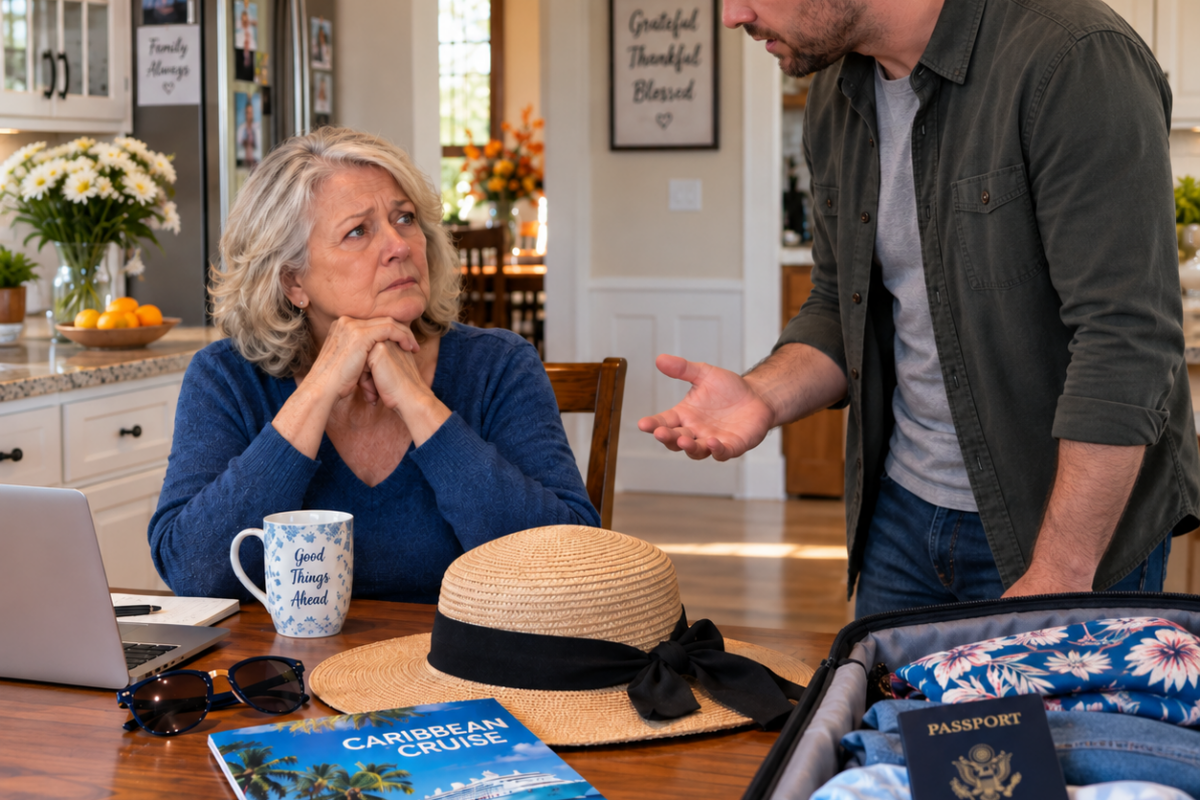
“Thanksgiving is just for my wife’s family,” my son told me. “You’ll have to make other plans.” So I did. I booked a cruise, packed my favorite wide-brimmed hat, and turned off my phone the moment the ship left port. By Thanksgiving afternoon, I was sitting on deck with lobster on my plate, watching the ocean instead of wondering why my own son didn’t want me at his table. I didn’t turn my phone back on until that night. There were 37 missed calls. My son. His wife. Her parents. Even neighbors I barely knew. Then I opened the last voicemail. After hearing the first six words, I put down my fork. Suddenly, I understood why their Thanksgiving dinner had ended early—and why everyone was looking for me.
My Son Told Me Thanksgiving Was Just for His Wife’s Family. So I Took a Cruise, and Eleven Days Later Their Lie Collapsed in Front…

“Henry gets everything—all $80 billion,” Dad announced. “As for you, you’re out of the family. Leave.” I stared at my parents for a moment. “You already sold the company?” Mom smiled. “Every last piece of it.” I slowly closed the folder in front of me. “Without my patents?” Her smile faltered. Dad frowned. “What are you talking about?” I stood up and reached for my coat. “You might want to read page forty-seven of the sale agreement.” For the first time that night, nobody told me to leave.
My Family Said They Were Giving My Brother the Entire $80 Billion Company and Exiling Me. Then the Buyer Asked One Question About My Patents….

My Husband Left Our Children Millions. He Left Me Only His Locked Phone—Then Someone Called It During the Will Reading.
My Husband Left Our Children $8.4 Million and Me an Old Black Phone. Then It Rang. My husband had been dead for twelve days when…

A CEO Dumped Coffee on a Black Temp in Front of the Entire Office—Then She Made One Phone Call
The CEO Poured Coffee Over My Head and Fired Me. He Had No Idea the “Temp” He Humiliated Was Quietly Buying His Company. “You’re the…
End of content
No more pages to load
You Might Also Enjoy




My Husband Left Our Children Millions. He Left Me Only His Locked Phone—Then Someone Called It During the Will Reading.