“You’re grounded until you apologize to my son!” my husband shouted in front of his whole family. His twenty-six-year-old son had just broken my grandmother’s crystal glass because I refused to give him $40,000. I placed the pieces on the table and said, “Fine.” By morning, my side of the bedroom was empty, my suitcase was gone, and our family attorney was standing at the front door.


“You’re grounded until you apologize to my son!”
Richard shouted it from the head of the dining table, with his mother seated to his right and his sister staring down at her plate. His twenty-six-year-old son leaned back in his chair, wearing the satisfied smile of someone who had successfully arranged for another person to be punished.
I stood beside the kitchen island holding the broken pieces of my grandmother’s crystal glass.
For several seconds, I couldn’t make the sentence fit the room.
Grounded.
I was Richard’s wife. I had been married to him for seven years. I had paid off the mortgage on the house where he was standing, supported his business when the bank refused further credit, and helped his son through more emergencies than I could readily count.
Yet he was speaking to me as though I were a disobedient child.
Tyler laughed.
“You heard him.”
I looked at my husband. His face was flushed, his hands planted on the table. He expected an argument. Perhaps tears. Perhaps an apology offered because having everyone watch was more painful than surrendering.
I placed the pieces of glass carefully on a folded napkin.
“Fine.”
The dining room went quiet.
Richard straightened, mistaking my answer for obedience.
That was his first mistake.
His second was assuming I had nowhere else to go.
The argument had begun twenty minutes earlier, before dinner was served. Tyler had arrived late, dropped his keys beside my laptop, and announced that he needed forty thousand dollars.
He said it with the easy confidence he brought to most requests involving someone else’s money.
“A friend is opening a luxury dealership,” he explained. “I can get in early.”
I was checking an invoice in my home office when he appeared in the doorway. He didn’t knock. He rarely did anymore.
“What kind of dealership?”
“High-end cars.”
“That doesn’t answer the question.”
He gave an impatient sigh.
“Used luxury cars. Imports. There’s a huge market.”
“Where’s the business plan?”
“Dad’s seen it.”
“Then your father can discuss it with you.”
Tyler glanced at my desk, at the laptop, at the framed photograph of my grandmother beside the window.
“I’m discussing it with you.”
“I know.”
“Forty thousand isn’t that much.”
“It’s forty thousand dollars.”
He laughed as though I had deliberately misunderstood him.
“I mean for you.”
There was a time when that phrase made me feel guilty. If I could afford to help, refusing seemed ungenerous. Richard had encouraged that interpretation without ever stating it quite so plainly.
You know what it was like starting out, Helen.
He’s trying to find his footing.
We can’t let one mistake define him.
But Tyler’s mistakes had begun to resemble a way of life, and my help had become the surface he landed on every time.
“What happened to the money from the online business?” I asked.
“That was different.”
“How?”
“The supplier screwed us.”
“And the money you borrowed to cover your apartment deposit?”
“I told you I’d pay that back.”
“You told me eight months ago.”
He looked toward the hallway.
“I don’t need a lecture.”
“Then don’t ask me for money without being prepared to answer questions.”
His expression hardened.
I recognized the moment when a request became a challenge.
“So that’s a no?”
“Yes. It’s a no.”
He stood there for another second, waiting for me to soften it.
I didn’t.
At dinner, he raised the subject again.
Richard’s mother, Evelyn, had come over with his sister, Caroline. Evelyn liked family dinners because they allowed her to speak about togetherness while making sure everyone understood whose preferences mattered most.
Caroline was different. She noticed things. She usually said very little about them.
That night, she sat between her mother and Tyler while I carried the salad to the table.
“Helen doesn’t believe in helping family,” Tyler announced.
I set down the bowl.
“That’s not what I said.”
Richard looked up.
“What happened?”
“Your son asked me for forty thousand dollars. I declined.”
Tyler spread his hands.
“For an investment. Not a vacation.”
“What investment?” Caroline asked.
“A dealership.”
“Which dealership?”
“It isn’t open yet.”
She nodded slowly.
Richard turned toward me.
“We can talk about this later.”
“We already talked about it.”
“Helen.”
The warning in his voice was familiar. Usually, it meant he wanted me to stop saying things that made his son uncomfortable.
Tyler reached for the water pitcher.
“It’s not even really your money.”
I looked at him.
“Excuse me?”
“Dad’s money. Family money.”
Richard should have corrected him immediately.
Instead, he said, “Don’t make this bigger than it needs to be.”
I sat down.
“Then clarify it. Tell him whose money he’s asking for.”
Evelyn gave a soft, disapproving sound.
“A marriage shouldn’t have all these little divisions.”
“Then perhaps your grandson shouldn’t have introduced one.”
Richard’s jaw tightened.
Tyler smiled at me across the table.
For a few minutes, everyone ate. Forks touched plates. Evelyn described a neighbor’s kitchen renovation. Richard asked Caroline about work.
I could feel the conversation moving around the unresolved question, trying to bury it beneath ordinary things.
Then Tyler stood to refill his glass.
He passed the island, where I had left my grandmother’s crystal tumbler after washing it by hand. It was one of the few pieces from her house I used regularly.
I saw his eyes move toward it.
I saw his hand.
The glass hit the tile and broke.
“Oops,” he said.
He didn’t sound surprised.
I stood so quickly that my chair scraped against the floor.
Richard looked up.
“What now?”
I stared at Tyler.
“That was deliberate.”
“Oh, come on.”
“You looked at it before you knocked it over.”
“I caught it with my sleeve.”
“You’re wearing short sleeves.”
Caroline lifted her head.
Tyler looked down at his arm, then shrugged.
“Whatever. It’s a glass.”
It wasn’t the value that hurt. My grandmother had used it when she read on the porch, putting a folded paper towel beneath it because she didn’t want rings on the table.
When she died, I took the glass and her old gardening gloves. Not because either was valuable, but because both held the shape of her ordinary life.
I crouched to collect the larger pieces. Caroline started to rise, but Evelyn touched her wrist.
I noticed that too.
When I stood, I told Tyler to leave the room.
Richard pushed back his chair.
“You don’t order my son around!”
“He destroyed something that belonged to me.”
“He made a mistake.”
“No. He made a point.”
Richard’s face turned red.
Then he announced my punishment.
“You’re grounded until you apologize to my son!”
Tyler laughed.
Evelyn looked pleased.
Caroline stared down at her plate.
And I understood, with a clarity that frightened me, that this family had become comfortable with my humiliation.
My quiet answer surprised them.
It surprised me too.
“Fine.”
I went upstairs without collecting my plate.
Behind me, Richard said, “We’ll discuss your attitude when you’ve calmed down.”
I kept walking.
In the bedroom, I locked the door.
The room was familiar enough that I could find things without turning on every lamp. My suitcase stood beneath the bed, packed with clothes I had put there six weeks earlier after another conversation I had never told anyone about.
Richard had been angry that I questioned a transfer connected to his business. He told me that if I didn’t trust him, perhaps I didn’t belong in his life.
That night, I packed.
The next morning, he apologized for his tone, kissed my forehead, and said he was under pressure.
I unpacked most of the suitcase.
Not all of it.
For six weeks, the remaining clothes had waited beneath the bed like a question I was afraid to answer.
Now I pulled it out.
Then I called Martin.
He had been the family attorney for years. He helped with estate planning, reviewed property arrangements, and handled some matters for Richard’s company. He knew the distinction between my assets and Richard’s, even if Richard’s family preferred not to discuss it.
“Martin,” I said, “I need the separation documents activated.”
He was quiet.
We had discussed those documents privately after the transfer dispute. He had explained that preparing did not oblige me to leave, but that leaving without a plan could create problems I didn’t need.
“Are you certain?”
I looked at the locked door.
“Yes.”
“What happened?”
“My husband just told me I was grounded until I apologized to his adult son.”
Martin said nothing for a moment.
Then he asked, “Are you safe?”
“Yes. I’m upstairs. I’m leaving tonight.”
“Do you want someone there?”
“I want a car. I don’t want to drive while I feel like this.”
“I’ll help arrange it.”
“And Martin?”
“Yes?”
“No one is to tell Richard where I’m going.”
“Understood.”
He reminded me that the documents did not make every part of the separation immediate. Formal filings, notices, financial disclosures, and decisions about shared obligations would follow. He also reminded me that his work for different family interests meant he could not represent both sides in a contested separation.
I knew.
He had already referred me to Vivian Hart, an attorney who would represent me independently if I decided to proceed.
“Send Vivian what she needs,” I said.
“You’ll need to confirm that authorization.”
“I’ll confirm it.”
We spoke for twelve minutes.
When the call ended, I sat on the edge of the bed and waited for my hands to stop shaking.
I did not feel triumphant.
I felt sick.
Seven years of marriage were ending in a bedroom I had paid to renovate, while my husband sat downstairs convinced he had restored order.
I called my friend Nora.
She answered with television noise in the background.
“Helen?”
“I’m leaving Richard.”
The television stopped.
“Where are you?”
“Home. Upstairs.”
“Do you want me to come?”
“No. A car is being arranged. I’m going to the lake house.”
There was a pause.
Then Nora said, “All right. What do you need from me?”
That question nearly made me cry.
No advice before the facts.
No reminder that marriage was difficult.
No instruction to wait until morning.
“I need you to stay on the phone while I pack.”
“Of course.”
So she did.
I put documents, medication, clothes, and the small things I would miss into the suitcase. My passport. My mother’s ring. The notebook where I kept passwords and reminders in a way Vivian would later tell me to improve.
I removed two photographs from their frames because the frames were heavy.
I left the wedding photograph on the dresser.
Nora talked about ordinary things when I needed ordinary things. She told me her neighbor’s dog had escaped again. She described the dinner she had burned because she was reading a book.
When I became quiet, she waited.
“What if I’m overreacting?” I asked.
She did not answer immediately.
Then she said, “What would you tell me if my husband punished me for refusing to give his son forty thousand dollars?”
I zipped the suitcase.
“I’d tell you to leave.”
“All right.”
At ten-thirty, someone knocked.
Richard.
“Helen, open the door.”
“I’m busy.”
“We need to talk.”
“We can talk tomorrow.”
“Don’t behave like this.”
I looked at my phone. Nora remained on the line.
Richard tried the handle.
“Why is the door locked?”
“Because I want privacy.”
“You’re my wife.”
“Yes.”
The word hung between us.
Then he said, “Come downstairs and apologize. This has gone far enough.”
I closed my eyes.
For years, I had waited for the right explanation to persuade him that I deserved consideration.
I had mistaken his refusal to understand for my failure to explain.
“No.”
He was silent.
“What did you say?”
“No. I’m not apologizing to Tyler.”
The handle moved again.
Then stopped.
“You’re making a serious mistake.”
I looked at the suitcase.
“I’ll decide that.”
His footsteps moved away.
Nora exhaled through the phone.
I realized she had been holding her breath too.
The car arrived shortly after eleven.
Martin had arranged it through a service we used for airport trips. The driver knew only that he was collecting me and taking me to a property near Lake Arrowhead.
I waited until the house was quiet.
Evelyn and Caroline had left. Tyler’s door was closed. Richard was in the downstairs den, where the television glowed blue against the hallway wall.
I carried the suitcase to the stairs.
For a moment, I stopped beside the bedroom doorway.
The lamp was still on.
The room looked strangely bare even before the rest of my belongings were removed. My clothes were gone from the open section of the closet. The photographs I cared about were gone from the dresser. The jewelry tray held only pieces I no longer wanted to take that night.
I had not emptied the room completely.
I had removed the part of my life I would need immediately.
Professional movers would collect the rest under documented arrangements.
But by morning, Richard would see enough absence to understand.
At the bottom of the stairs, I paused.
The den door stood partly open.
Richard sat in an armchair, looking at his phone.
He didn’t look up.
I walked past the front hall, opened the door, and stepped outside.
The driver took my suitcase.
“Good evening.”
“Good evening.”
He held the rear door open.
I got in.
By midnight, I was gone.
The lake house was mine before I married Richard.
It was not enormous. A two-story house with cedar siding, a narrow deck, and windows that faced the water through a stand of trees.
I had bought it after years of working as a financial consultant to family-owned businesses. Much of my career involved helping people understand why a company that looked prosperous could still run out of cash.
I was good at it.
I was less good at applying the same clarity to my own marriage.
The property had belonged to an older couple who wanted to move closer to their children. I liked the way the kitchen faced the morning light and the fact that the house didn’t look designed to impress anyone.
Richard called it our vacation place.
I usually let him.
His family used it often.
Tyler brought friends there without asking. Evelyn rearranged kitchen cupboards because she said my system made no sense. Caroline once apologized for a broken porch light her son had damaged, and I told her accidents happened.
That apology stood out now.
The house was dark when I arrived. I turned on the kitchen light, checked the locks, and put my suitcase in the bedroom.
My phone showed four messages.
Richard.
Where are you?
Helen, answer.
This isn’t funny.
Come home.
I placed the phone face down on the table.
Then I filled the kettle.
At one in the morning, I sat beside the window with tea I barely tasted.
The lake was black.
A distant porch light reflected across the water.
I had wanted silence for months.
Now that I had it, I could hear how tired I was.
Richard called at six-thirty.
I let it ring.
At seven, Vivian called.
“Martin told me you left safely.”
“Yes.”
“How are you?”
“I don’t know.”
“That’s a reasonable answer.”
We discussed the next few days. She asked what I had taken, what remained, and whether Richard had access to the lake house.
“He has a key.”
“Does he live there?”
“No. We use it for visits.”
She arranged for me to speak with someone about security and advised me not to rely on assumptions about what Richard would or would not do.
We reviewed the financial steps I had authorized.
My personal accounts would remain mine. Permissions I had granted could be revoked through the proper process. Shared obligations required review. Existing business loans could not simply be erased because my marriage ended.
I wanted that clarity.
I did not want a revenge plan that would collapse the moment someone examined it.
“What about Richard’s company?” I asked.
“We’ll separate what you are obliged to do from what you have been choosing to do.”
That sentence became the foundation of everything that followed.
Richard’s company, Ridgeway Commercial Interiors, had been struggling for almost two years.
He renovated offices, retail spaces, and small commercial properties. He was talented at the work and charming with clients. He was less disciplined about estimating costs, collecting invoices, and accepting when a project could not support another favor.
I entered the marriage with more assets than he did.
That had never bothered me until he began allowing his family to pretend otherwise.
When the company needed money, I funded it through a trust I controlled. Some advances were loans. Some had specific security. Others were limited commitments structured after independent review.
Almost sixty percent of the cash supporting the company’s operations during the worst period had come through those arrangements.
That did not mean I owned sixty percent of the company.
It meant Richard had depended on capital he did not control.
He had confused my willingness to provide it with his right to expect it forever.
That morning, Martin went to the house.
I learned the details later from several sources, including Richard himself.
Richard had found the bedroom emptied of the things I used every day. My suitcase was gone. My office laptop was gone. The folder containing copies of my personal documents was gone.
He called Martin repeatedly.
At first, he said I was being dramatic.
Then he asked whether Martin knew where I was.
Then Martin told him that the separation plan we had previously reviewed was now proceeding, that Vivian represented me independently, and that financial permissions and future funding arrangements were being reassessed.
Richard demanded an immediate meeting.
Martin arrived carrying a folder and looking shaken.
He had known us for years. He had attended dinners at the house. He had seen Richard kiss my cheek and call me the sensible one.
He had not known how often that description meant the one expected to absorb everything.
Richard met him in the front hall.
“Where is she?”
Martin looked past him at the stairs.
Then back at Richard.
“Sir,” he said quietly, “what exactly did you do to her?”
Richard later repeated that question to me as though Martin had been unfair.
I thought it was the most useful question anyone had asked him in years.
When I finally answered Richard’s call, it was nearly noon.
“Where are you?”
“I’m safe.”
“Helen, this is absurd.”
“No.”
“You left in the middle of the night.”
“Yes.”
“You scared me.”
I looked out at the lake.
“You told me I was grounded.”
“I was angry.”
“I noticed.”
“You know what I meant.”
“What did you mean?”
He was silent.
I waited.
Finally, he said, “Tyler was upset. You embarrassed him.”
“He broke my grandmother’s glass.”
“He says it was an accident.”
“I was there.”
“So was I.”
“Yes,” I said. “You were.”
The silence changed.
Then Richard exhaled.
“Come home. We’ll talk.”
“I’m not coming home today.”
“You can’t just decide this without me.”
I held the phone away from my ear for a moment, then brought it back.
“I can decide where I spend the night. I can decide whether I remain in a room where I’m being humiliated. The legal arrangements will involve both of us. My decision to leave does not require your permission.”
His voice hardened.
“Who’s putting this in your head?”
“No one.”
“Vivian?”
“No.”
“Nora?”
I closed my eyes.
“Richard, I am capable of thinking.”
“I didn’t say you weren’t.”
“You asked who had supplied my decision because you couldn’t imagine it belonged to me.”
He started to answer.
I interrupted him.
“Anything necessary can go through the attorneys for now.”
Then I ended the call.
Afterward, I sat so still that the tea in front of me cooled without my noticing.
Leaving had been decisive.
Living with the decision would require a different kind of strength.
Nora arrived that afternoon with groceries.
She carried the bags into the kitchen, opened cupboards until she found bowls, and made soup without asking me to explain the marriage while she chopped vegetables.
I sat at the counter.
At some point, I began crying.
She put down the knife.
“I’m here.”
“I thought he loved me.”
“He may have.”
“Then how could he do that?”
Nora considered the question.
“I don’t know. But whether he loved you isn’t the only question anymore.”
I wiped my face.
“What is?”
“Whether living with him was allowing you to remain yourself.”
I looked at the kitchen around me.
For months, I had been smaller at home than anywhere else.
At work, I asked difficult questions.
At home, I rehearsed them first.
At work, I refused arrangements that made no sense.
At home, I paid because Richard said another refusal would hurt Tyler.
I had spent years helping people separate emotional pressure from financial judgment.
Then I married a man who taught me to feel cruel whenever I used my judgment with him.
The next morning, Tyler called.
I almost let it go to voicemail.
Then I answered.
“Where’s Dad’s card?”
I looked at the phone.
“What?”
“The card I use. It’s not working.”
“That account is mine.”
“Well, it declined.”
“I removed your authorization.”
“You can’t do that.”
“I can.”
He laughed sharply.
“This is because of forty thousand dollars?”
“No.”
“Then what?”
“Because I no longer choose to finance your personal spending.”
“Dad said you’d calm down.”
I set my cup on the table.
“Your father can make arrangements with you using money he controls.”
“Wow.”
I said nothing.
“You’re really doing this.”
“Yes.”
There was a pause.
Then he said, “You know you’ll never replace us.”
The words hurt.
He intended them to.
I looked at the sunlight moving across the floor.
“I’m not shopping for a family, Tyler.”
Then I ended the call.
Within an hour, Evelyn called.
“Helen, we need to talk.”
“I don’t think we do today.”
“You’ve put Richard in a terrible position.”
I leaned back in my chair.
“What position?”
“He’s trying to keep his business running.”
“I know.”
“And now you’re threatening everything because of a dinner argument.”
“I have not threatened to violate any agreement.”
“You know what I mean.”
I was becoming familiar with that phrase.
It usually appeared when someone wanted me to accept an accusation they couldn’t accurately explain.
“No, Evelyn. Tell me what you mean.”
She sighed.
“You’re punishing my family.”
“I’m separating from my husband.”
“Over Tyler.”
“Over how Richard treated me.”
“You always were sensitive about not having children of your own.”
The sentence landed hard enough that I stopped breathing for a moment.
Evelyn had used that subject before, usually with an expression of sympathy that made objecting feel impolite.
That morning, she did not bother with sympathy.
I looked at my reflection in the window.
“I’m ending this conversation.”
“Helen—”
“No. You don’t get to use my private life as an explanation for your son’s behavior.”
I hung up.
Then I cried again.
Leaving did not make every word harmless.
It only meant I could stop listening.
Caroline sent a message that evening.
I’m sorry I didn’t speak up.
I read it several times.
Then another message arrived.
I saw Tyler move his hand toward the glass. I didn’t see the exact moment it fell, but I know what I saw before it. I should have said something.
I appreciated the precision.
She did not claim to have witnessed more than she had.
She did not tell me I had misunderstood.
I replied:
Thank you for telling me.
A few minutes later, she asked whether I wanted to talk.
I said not yet.
She answered:
Whenever you’re ready.
She did not call anyway.
That was the first thing she did that helped restore my trust.
During the next week, Vivian arranged the formal steps.
I reviewed statements, gathered documents, and made an inventory of belongings. A professional moving company collected the rest of my clothes and office equipment with advance notice and a neutral person present.
Richard did not attend the collection.
Tyler did.
He stood near the garage and watched the movers carry boxes.
One of the boxes contained the remaining pieces of my grandmother’s glass. I had asked Caroline to put them in a container rather than throw them away.
Tyler laughed when he saw it.
“Seriously?”
The mover didn’t answer.
Caroline told me later that she said, “Yes. Seriously.”
I was glad.
The suburban house was owned through arrangements established before the marriage, and the mortgage had been paid with my separate funds. But Richard had lived there as my spouse. That meant deciding what happened next required proper advice and procedure, not a declaration shouted through a locked door.
I did not change the locks while he was still residing there.
I did not put his clothes on the lawn.
I asked Vivian to handle the occupancy arrangements and the eventual division of anything that needed division.
The same applied to the lake house.
We reviewed access, clarified permissions, and arranged security based on the actual ownership and residency facts.
I wanted peace.
I also wanted decisions I could defend without relying on how angry I was when I made them.
The business situation became more difficult.
Richard’s first instinct was to treat the company’s funding as a marital argument.
He called me from the office.
“Payroll is next week.”
“I know.”
“You can’t leave eighteen people wondering whether they’ll be paid.”
I sat at the desk.
“Are you asking about an existing commitment or requesting new funding?”
“Helen.”
“Which?”
He exhaled.
“We need an advance.”
“Then send the request to the trust administrator with the supporting documents.”
“You are the trust administrator.”
“I control the trust. That doesn’t mean we skip the review.”
“You never made it this difficult before.”
“Yes,” I said. “That was a mistake.”
His anger increased.
“So you’re going to destroy the company.”
“No. I’m not going to keep funding it informally while you tell your son the money belongs to you.”
He was quiet.
Then he said, “That was a stupid thing for him to say.”
“Yes.”
“I should have corrected him.”
“Yes.”
For a moment, I thought we were getting somewhere.
Then he added, “But you know how Tyler gets when he feels cornered.”
I looked at the ceiling.
“And you know how I feel when you make me the person he gets to hurt.”
Richard didn’t answer.
The call ended without a new advance.
Existing obligations were honored. Independent accountants reviewed the company’s cash flow. Some funding remained available under previously agreed terms. New discretionary support stopped.
It was not enough to restore the company comfortably.
It was enough to prevent Richard from claiming I had simply switched off a business on a whim.
He would need to collect overdue invoices, reduce expenses, sell equipment he wasn’t using, and renegotiate work he had priced badly.
In other words, he would need to manage.
The review also revealed how often business money had been diverted toward Tyler’s problems.
Not every payment was improper. Some reflected legitimate work Tyler had done briefly.
Others were personal expenses recorded in ways that obscured their purpose.
A vehicle payment.
Travel.
Equipment bought for an online venture that never became part of Ridgeway’s operations.
When the accountant asked Richard about them, he said he had intended to reimburse the company.
Intended.
I had heard that word many times.
The accountant documented the issue.
Richard’s counsel advised him.
I did not become the investigator, the judge, and the spouse in the same conversation.
Vivian insisted on that separation.
“You need facts,” she told me. “You also need a life that isn’t consumed by collecting them.”
She was right.
I returned to work.
At first, I struggled to concentrate. I read emails twice. I forgot appointments unless I wrote them down. I felt embarrassed by how much a family dinner could disrupt a competent adult’s mind.
My colleague, Denise, noticed.
She asked whether I needed her to cover a meeting.
“I can do it.”
“I know you can. That wasn’t the question.”
I looked at her.
Then I said yes.
The meeting went well without me.
The world did not collapse because I accepted help.
That evening, I walked along the lake.
The air smelled of damp wood and cold water. A man on a nearby dock was persuading his dog to get out of a boat.
I watched the dog ignore him.
Then I laughed for the first time in days.
It startled me.
I had begun to feel that enjoying anything would mean the marriage hadn’t mattered.
But the marriage had mattered.
So did the evening.
Three weeks after I left, Richard asked for a meeting.
He sent the request through Vivian rather than calling repeatedly.
I agreed.
We met in a conference room at her office. Richard’s attorney attended for the first part. The purpose was practical: temporary arrangements, property access, financial responsibilities.
The room was plain.
Water bottles.
A clock.
A table large enough to keep us from touching by accident.
Richard looked tired.
His tie was loose, and there were shadows beneath his eyes.
Seeing him hurt me.
I still knew the shape of his face when he was worried.
I still remembered the man who brought coffee to my office during our first year together because he said I forgot to eat when I was working.
He had been kind then.
That memory was real.
It was not enough to erase the dining room.
After the practical discussion, the attorneys asked whether we wanted a brief conversation without them, with Vivian remaining nearby.
I agreed.
Richard turned his water bottle between his hands.
“I’m sorry.”
I waited.
“For what?”
He looked up.
“For what I said.”
“What did you say?”
He winced.
“Helen.”
“I need to know whether you understand it.”
He set down the bottle.
“I told you that you were grounded.”
“And what did that mean?”
“I was trying to stop the argument.”
“By assigning me a punishment.”
“Yes.”
“Because I refused to give your son money.”
He looked away.
“Because everything was getting out of control.”
I sat back.
“What was out of control?”
“Tyler was angry. You were angry. Mom was upset.”
“And you decided the person who needed to be controlled was me.”
He was silent.
I could see him working toward an answer that would make him sound less responsible.
Finally, he said, “I didn’t think.”
“I believe that. But you had years to think about the pattern.”
He rubbed his face.
“I know.”
“Do you?”
He looked at me.
“I’ve been going through the accounts.”
“Good.”
“I didn’t realize how much you covered.”
That sentence hurt in a different way.
I had not hidden the bills.
I had not paid them in secret.
He had simply stopped seeing them.
“You knew enough to ask,” I said.
He nodded.
“Tyler knows he went too far.”
“How?”
“I talked to him.”
“What did he say?”
Richard hesitated.
I waited.
“He says the glass was an accident.”
I stood.
Richard looked alarmed.
“Wait.”
“I’m not going to spend the rest of my life debating what I saw so you can keep both versions comfortable.”
He rose too.
“He’ll apologize.”
“I didn’t ask for an apology arranged by you.”
“What do you want?”
I looked at him.
“I wanted a husband who heard his son call me a gold digger and corrected him. I wanted a husband who understood that refusing forty thousand dollars was a decision, not an offense. I wanted someone who saw me holding broken glass and wondered whether I was hurt.”
Richard’s eyes filled.
“I did wonder.”
“Then you should have asked.”
I left the room.
Outside, Vivian waited without speaking.
I sat in a chair beside the window.
For a long time, I looked at the parking lot.
Then I said, “I don’t think he can give me what I needed before I left.”
Vivian nodded.
“You don’t have to decide everything from one meeting.”
“I know.”
But I was beginning to understand that the decision had started long before the glass broke.
The following week, Tyler sent a message.
Sorry about the glass. Didn’t think you’d take it this far.
I read it.
Then I put the phone down.
Nora was visiting that afternoon. I showed it to her.
She looked at the screen.
“He’s apologized to the consequence.”
“Yes.”
“What will you do?”
“Nothing.”
For years, I would have written a long reply explaining why the glass mattered, why his tone hurt, and what an actual apology might look like.
I no longer wanted to coach him through caring.
He was twenty-six.
He could choose to learn.
I could choose not to remain his instructor.
Richard began counseling.
He told me through an email.
I’m not telling you this to ask you to come back. I want you to know I’m trying to understand.
I appreciated the distinction.
I replied:
I hope it helps.
That was all.
Several days later, he wrote again.
My counselor asked me what I meant when I said keeping the peace. I realized I meant keeping Tyler calm.
I sat with that sentence.
Then I replied:
That is what it felt like to me.
His answer came the next morning.
I’m sorry I made you pay for that.
It was the first apology that reached the real problem.
I cried when I read it.
Then I went to work.
An apology could matter without becoming a contract requiring me to return.
Caroline came to the lake house a month after I left.
She brought the broken crystal pieces in a padded box. The movers had left them with her because she wanted to make sure they weren’t damaged further.
“I looked for someone who might repair it,” she said.
I opened the box.
“Thank you.”
“There’s a conservator who works with glass. She says it won’t be usable again, but she may be able to stabilize the larger pieces.”
I touched the edge of one fragment carefully.
“I don’t know yet.”
“That’s fine.”
We sat on the deck.
Caroline looked toward the water.
“I should have spoken.”
“Yes.”
“Mom would have been furious.”
“Yes.”
“That isn’t a reason.”
“No.”
She nodded.
I liked that she didn’t make me supply the conclusion for her.
After a while, she said, “I’ve been doing it my whole life.”
“What?”
“Waiting for the angry person to calm down.”
I looked at her.
She gave a small, sad smile.
“First Mom. Then Richard when he became protective of Tyler. I learned to disappear from the conversation.”
“That worked for you.”
“For a while.”
“It didn’t work for me.”
“I know.”
We were quiet.
Then Caroline told me that Evelyn had been asking relatives to persuade me to return.
“I told her I wouldn’t.”
“What did she say?”
“That I was choosing sides.”
“And?”
“I said I was choosing not to lie about what happened.”
I looked at her.
“Thank you.”
She cried.
I did too.
Not because everything had been repaired.
Because she had finally done something that cost her comfort without asking me to pay for it.
The glass conservator visited two weeks later.
Her name was Miriam. She examined the pieces beneath a lamp and asked whether I wanted restoration or a display that acknowledged the damage.
I considered the question.
“Something I can keep,” I said. “I don’t need it to pretend it’s unbroken.”
She nodded.
“That can be done.”
Months later, she returned it on a small clear support. The larger pieces formed enough of the original shape to recognize the glass. The missing sections remained visible.
I placed it on a shelf in my office at the lake house.
Not as a warning.
As something of my grandmother’s that I still wanted near me.
Tyler’s proposed dealership never opened.
I learned that through Richard’s financial disclosures and the documents supplied when the forty-thousand-dollar request became relevant to our discussions.
There was no lease.
No completed license application.
No reliable projection.
His friend had located cars he hoped to buy and resell, but the operation existed mostly in messages and optimism.
Some of the money Tyler requested would have covered debts from earlier ventures.
That was why he resisted questions.
I was not delighted to discover I had been right.
Being right did not return the glass.
It did not change Richard’s response.
But it confirmed that my refusal had been sensible even under the narrow financial terms they tried to use against me.
The broader question remained: why did they believe an unreasonable request entitled them to punish me?
Richard eventually answered that more honestly.
We met again, this time in a counselor’s office. I agreed to one session because I wanted to speak without financial documents between us.
The counselor, Dr. Lewis, asked each of us what we hoped to accomplish.
Richard said he wanted to understand whether repair was possible.
I said I wanted to know whether he understood what had happened beyond losing my funding.
Dr. Lewis nodded.
Richard looked at me.
“I kept thinking you could afford it.”
“The forty thousand?”
“All of it. The business. Tyler. The house.”
“And?”
“So I treated your refusal as emotional.”
I felt something settle inside me.
He continued.
“If you had enough, I thought saying no meant you were withholding because you were angry.”
I looked at Dr. Lewis, then back at Richard.
“My money doesn’t become less mine because I have enough.”
“I know.”
“And my refusal doesn’t require a financial emergency to be valid.”
“I know now.”
Dr. Lewis asked what Richard had believed his role was during family disagreements.
He looked down.
“To keep everyone together.”
“How did you do that?”
“Usually by asking Helen to be reasonable.”
I gave a small, humorless laugh.
Richard looked at me.
“You were reasonable most of the time.”
“So you chose me because I was the easiest person to pressure.”
He closed his eyes.
“Yes.”
The word came without a defense.
It hurt.
It also freed me from wondering whether I had imagined the pattern.
Dr. Lewis asked whether I wanted to respond.
I sat for a while before speaking.
“I loved you. I wanted your son to feel welcome. I wanted your mother to stop thinking I was an outsider. Every time I made an accommodation, I thought it would bring us closer.”
Richard listened.
“Instead, you learned that I would move.”
He nodded.
“And when I stopped moving, you tried to punish me.”
“Yes.”
Tears ran down his face.
I felt tenderness toward him.
I did not feel the urge to go home.
That distinction was painful and clear.
After the session, Richard walked with me to the parking lot.
“Do you think there’s any chance?”
I looked at him.
“I don’t know whether I can live with you again.”
He swallowed.
“What if I change?”
“I hope you do.”
“For us?”
“For yourself. For Tyler. For whoever shares your life.”
He looked away.
Then he nodded.
It was the first time he accepted that change might not be rewarded by my return.
The separation moved toward divorce.
I had resisted that word at first. It sounded final in a way leaving did not.
But time clarified things.
I slept better away from Richard.
I made decisions without rehearsing them.
I stopped listening for the front door to determine what kind of evening I would have.
When my phone rang, I no longer assumed someone wanted money.
Those changes were not dramatic.
They were cumulative.
One morning, I poured coffee and realized I had been singing under my breath.
I stopped.
Then I started again.
Vivian prepared the next documents.
We reviewed the property interests, legitimate shared obligations, and claims that required resolution. My separate assets were documented. Payments made during the marriage were examined according to the actual agreements and records.
Nothing about the trust made every question disappear.
Nothing about Richard’s embarrassment entitled him to a share of assets he had never owned.
We worked through the details.
Some agreements required compromise.
Compromise felt different when it occurred between adults with information, representation, and the ability to say no.
Richard eventually moved out of the suburban house voluntarily under a written agreement.
He took his belongings.
Tyler moved into an apartment with a roommate.
Evelyn was furious.
I did not attend the conversations where she expressed it.
When the house was empty, I went back once.
Caroline came with me.
The dining room looked ordinary.
The table stood where it had always stood. A chair was slightly crooked. Light fell through the window onto the place where the glass had broken.
I expected to feel overwhelmed.
Instead, I felt tired.
Caroline stood beside the doorway.
“Do you want to leave?”
“Not yet.”
I walked to the island.
I put my hand on the marble.
For years, I had prepared meals there. Signed checks. Opened invoices. Set down flowers Richard brought when he wanted an argument to be over.
It was a countertop.
It did not own the history.
I could leave.
Upstairs, the bedroom was empty of Richard’s clothes.
The wedding photograph remained in a drawer where he had placed it.
I took it out.
We looked happy.
We had been happy that day.
I did not need to deny that.
I placed the photograph in a box with other things I would decide about later.
Then I closed the drawer.
The house went on the market in spring.
I had once imagined growing old there with Richard.
Now I wanted a smaller place near my work and the lake house for weekends.
I did not need every room that belonged to an abandoned future.
The sale proceeded quietly.
No public announcement.
No dramatic message to the family.
Just inspections, paperwork, and a date when the keys passed to someone else.
A young couple bought it.
They had two children and asked whether the hummingbird feeder could stay.
“Yes,” I said.
I liked that question.
It made the kitchen belong to another story.
Richard’s company survived, though it changed significantly.
He sold unused equipment, collected receivables more aggressively, and reduced the work he accepted merely to please clients who paid late.
Several employees left.
Others stayed.
The company became smaller and more disciplined.
The trust’s existing loans were managed according to their terms. New funding came from sources Richard negotiated without relying on me to make every problem disappear.
I did not attend the meetings.
I received what I needed through the proper channels.
One afternoon, Richard sent a message.
We met payroll without an advance.
I looked at it.
Then I replied:
I’m glad.
A minute later, he wrote:
You were right that I needed to manage, not just ask.
I did not answer again.
The acknowledgment mattered.
I did not need to keep the conversation open to make it real.
Tyler took a job with a parts distributor.
Not a glamorous job.
Regular hours.
Regular pay.
A supervisor who did not care that his father once ran a larger company or that his stepmother could have funded his ideas.
I heard about it from Caroline.
“Do you want details?” she asked.
“Only if he wants me to know.”
She nodded.
Several weeks later, Tyler emailed me himself.
He did not ask for money.
He wrote that he was working, paying his bills, and beginning to understand how often he treated help as something due.
Then he addressed the glass.
I knocked it over because I was angry that you said no. I knew it mattered to you. I wanted you to feel bad. Saying “oops” was another part of it.
I read that paragraph three times.
At last, the truth.
He continued.
Dad defended me because he always did. I used that. I’m sorry for what I did and for how I spoke to you before that night.
The email was not perfect.
It included a few explanations I thought he still relied on too heavily.
But it did not say he was sorry I had taken things this far.
I replied the next day.
Thank you for telling the truth. I hope you continue doing the work to become someone who can hear no without trying to hurt the person saying it.
I did not promise a close relationship.
He did not demand one.
Months later, he asked whether I would meet for coffee.
I declined.
Not angrily.
I told him I was not ready.
He answered:
I understand.
I hoped he did.
I was no longer willing to find out by putting myself in a room before I wanted to be there.
Evelyn never offered a clear apology.
She sent a card saying she regretted that family disagreements had caused so much pain.
The card included a photograph from a holiday dinner.
I looked at it.
Everyone smiled.
I remembered spending the afternoon cooking.
I remembered Evelyn criticizing the tablecloth.
I remembered Richard asking me to let it go because she was old-fashioned.
I placed the card in a drawer.
I did not respond.
Age had not prevented me from being expected to change.
I saw no reason it should exempt her from understanding what she had done.
Caroline and I remained in contact.
Without Richard’s household between us, we discovered that we liked each other.
We met for lunch.
We talked about books.
She asked about my grandmother, and I told her stories I had never shared during family dinners because there always seemed to be something more urgent Richard’s family wanted to discuss.
Caroline told me about her childhood.
The expectations.
The need to avoid upsetting Evelyn.
The way Richard became the family’s protector after his father died, and how protecting gradually became controlling.
Understanding that history did not excuse him.
It helped us recognize how long the pattern had existed.
One afternoon, she said, “I used to think you were fortunate because you had enough money to ignore things.”
I looked at her.
“What changed?”
“I saw how much you were giving away to avoid being made uncomfortable.”
I nodded.
“I thought I was buying peace.”
“Did you?”
“Only short leases.”
She laughed.
Then she cried a little.
So did I.
The divorce became final on an ordinary Tuesday.
Vivian called in the late morning.
“The court has entered the final order.”
I was at my office, reviewing a client’s cash-flow projection.
For a moment, I stared at the spreadsheet.
“All right.”
She asked whether I had questions.
I did.
Practical ones.
She answered them.
When the call ended, I sat quietly.
I had expected a feeling large enough to identify immediately.
Relief.
Grief.
Victory.
Instead, I felt the absence of waiting.
There would still be details to finish, but the question of whether I was leaving had become a fact.
I called Nora.
“It’s final.”
She was quiet.
Then she said, “Do you want dinner?”
“Yes.”
“Your place or mine?”
“Mine.”
“What should I bring?”
“Something that doesn’t require me to explain how I feel.”
“Perfect. I make several dishes like that.”
We laughed.
That evening, we ate pasta in my smaller home near work. Boxes still stood against one wall because I had refused to hurry through unpacking.
Nora opened a cupboard.
“Where are the plates?”
“Second shelf.”
She found them.
“Excellent system.”
“I’m considering a family rule requiring written approval before anyone rearranges it.”
“Very sensible.”
After dinner, we sat outside.
The evening was cool.
I wore a sweater and felt comfortable in a way that seemed almost extravagant.
Nora looked at me.
“What do you miss?”
I considered the question.
“The person I thought would be beside me.”
She nodded.
“And what don’t you miss?”
I laughed softly.
“Being afraid of the next request.”
We sat until the sky darkened.
Then she helped with the dishes.
I began spending more weekends at the lake house.
Sometimes alone.
Sometimes with Nora.
Occasionally with Caroline.
I worked in the garden, replaced a worn chair, and finally painted the small bedroom a pale blue I had wanted for years.
Richard had disliked the sample.
He said it looked cold.
I found it peaceful.
The painter finished on a Friday afternoon.
I stood in the doorway, looking at the walls.
There was no argument attached to the color.
No compromise needed.
I had forgotten how simple a preference could be.
The glass from my grandmother sat in my office, where morning light caught the remaining facets.
People noticed it.
Some asked.
I told them it had belonged to her and had been damaged.
I did not always tell them how.
The object did not require me to retell the marriage whenever someone entered the room.
It could be hers.
It could be mine.
It could remain beautiful without becoming whole again.
Almost a year after the dinner, Richard asked to meet once more.
He made clear that he was not asking me to reconsider.
I agreed to coffee in a public place.
He looked healthier.
Less hurried.
We spoke about the company, then about ordinary things.
Finally, he said, “I’ve thought about that word.”
“Grounded?”
He nodded.
“I was embarrassed when you left. At first, that was all I could think about. You made me look foolish. You made everyone see I didn’t control the situation.”
I listened.
“Then I realized that was exactly the problem. I thought I should control it.”
“Yes.”
He looked at the cup between his hands.
“I didn’t understand how humiliating it was until I imagined someone saying it to Caroline.”
I took a breath.
“I wish you hadn’t needed another woman to make it understandable.”
He nodded immediately.
“I know.”
For a moment, we were quiet.
Then he said, “You deserved better from me.”
The sentence came without a request.
I appreciated it.
“Thank you.”
He looked up.
“I’m not asking you to forgive everything.”
“Good.”
He gave a small smile.
“I’m learning.”
“I hope so.”
When we left, he asked whether he could hug me.
I considered it.
“Yes.”
The hug was brief.
Familiar.
Sad.
Then we stepped apart.
He went toward his car.
I went toward mine.
Neither of us asked the other to turn around.
I drove to the lake house afterward.
The trees had begun to change color.
A few leaves lay on the deck, and the water reflected a sky full of thin clouds.
I unlocked the door and carried in groceries.
For a moment, I stood in the kitchen.
Almost a year earlier, I had arrived after midnight with a suitcase and a phone full of demands.
Now I had bread, coffee, vegetables, and a book I wanted to finish.
The difference made me smile.
I unpacked slowly.
I poured a glass of water into an ordinary tumbler.
Then I went outside.
The air was cool.
Across the lake, a family was closing up a boat for the evening. Someone laughed. A dog barked once and settled.
I thought of the dining room.
Richard at the head of the table.
Tyler leaning back.
Evelyn pleased.
Caroline silent.
The broken crystal in my hands.
For a long time, I had remembered my answer as the moment everything changed.
Fine.
But the real change was what I did afterward.
I made the call.
I packed.
I accepted help.
I left.
Then, in the months that followed, I continued leaving the habits that had kept me there.
The reflex to explain a refusal until it sounded like permission.
The urge to fund a problem because watching someone struggle made me anxious.
The belief that keeping everyone together was proof of love.
I had loved Richard.
I had tried to care for Tyler.
I had wanted a place in their family.
None of that required me to accept a punishment for using my own judgment.
On the table beside me, my phone lit up.
A message from Caroline.
Hope you’re having a peaceful weekend.
I replied:
I am.
Then I set the phone down.
No one needed forty thousand dollars.
No one wanted access to my office, my car, or my accounts.
No one was waiting for me to apologize so the household could return to normal.
The normal life was here now.
A quiet deck.
Water moving beyond the trees.
A woman who could decide whether to go inside or stay another hour.
I stayed until the first lights appeared across the lake.
Then I went into my house, closed the door, and made dinner.
News

At my seventy-second birthday party, my daughter-in-law knocked a crystal vase off its pedestal with her elbow, watched it shatter, and smiled. “Oops.” Her own parents had given it to her and my son on their wedding day six years earlier. I looked at Frank, waiting for him to say something. All he managed was, “Mom…”
I watched my daughter-in-law break her own parents’ wedding gift with one elbow and a smile. For months afterward, people asked me whether I was…

I came home three hours early and found my sixty-eight-year-old mother on her knees scrubbing my mother-in-law’s bathroom. When I helped her stand, her sleeve slipped back, revealing dark marks around her wrist. My husband stepped into the doorway. “Daniela, don’t make a scene.” That was when I remembered my father’s last warning: “If you ever see your mother hurt, don’t argue with anyone. Open the hidden compartment in her sewing machine.”
I came home three hours early and found my sixty-eight-year-old mother on her knees beside a toilet. Her hands were stiff with arthritis. One gripped…

“I already promised your house to your sister,” my father told me four days after I bought it. “They’re moving in Monday. Rent-free for three years.” I was thirty-one, had saved for nine years, and had bought the five-bedroom home entirely in my own name. When I said no, he threatened to tell the family I had abandoned my sister’s children. Days later, he took the microphone at my grandmother’s seventy-fifth birthday dinner and did exactly that.
My father called twelve times in forty minutes after discovering I had bought a house without consulting him. When I answered, he didn’t ask whether…

My mother leaned across the restaurant table, looked at my thirteen-year-old adopted daughter, and whispered, “We don’t sit with mistakes.” I took Sole’s hand and walked her out. That night, my father texted, “You’re still making the car payment tomorrow, right?” By midnight, I had canceled the payments I’d been making for my family. Then I remembered something Sole had told me about her grandmother.
My mother looked at my thirteen-year-old daughter and whispered, “We don’t sit with mistakes.” She said it softly enough to avoid attracting attention from the…
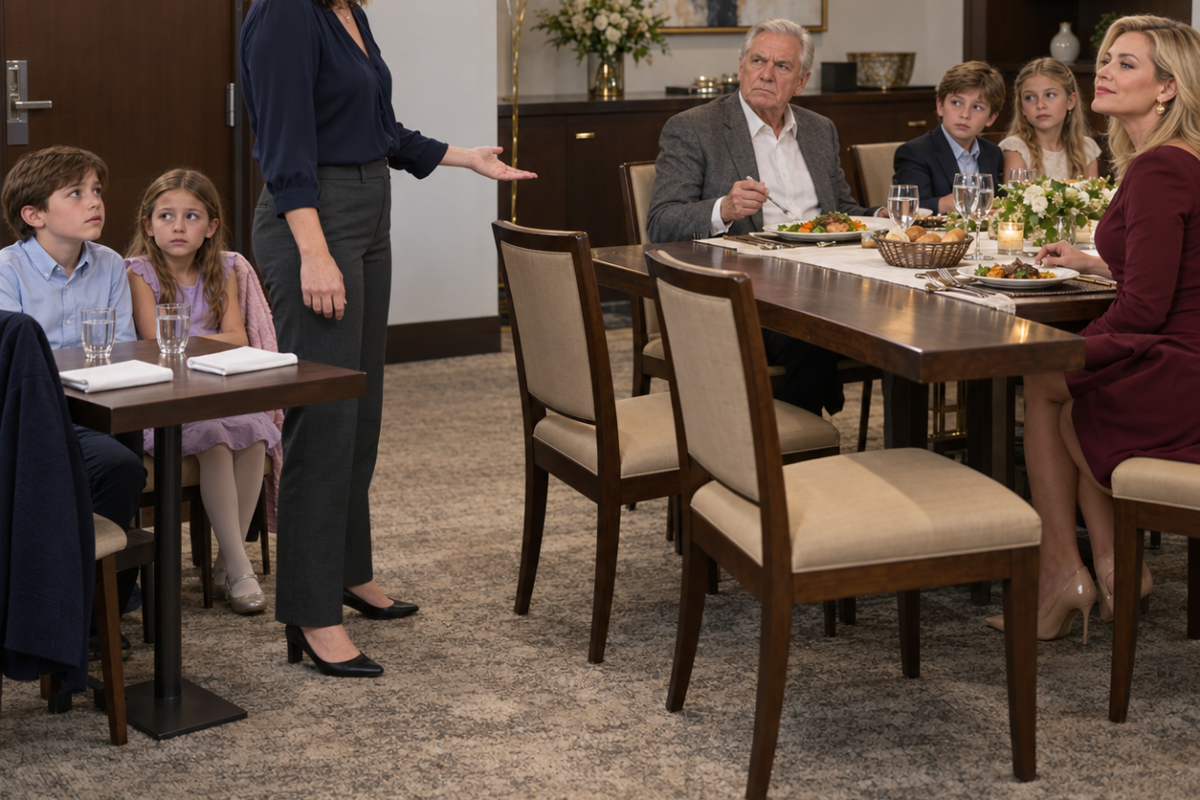
At my father’s seventieth birthday dinner, my eleven-year-old son and eight-year-old daughter were seated beside the service door with water glasses—but no dinner plates. Their cousins sat beside Grandpa with warm bread and full place settings. “They’ll eat after everyone else,” my sister said. I turned to my father, expecting him to object. “They can wait another hour,” he replied. There were two empty chairs at his table.
At my father’s seventieth birthday dinner, the first thing that stopped me wasn’t the cake or the gold balloons. It was my children. Ethan and…
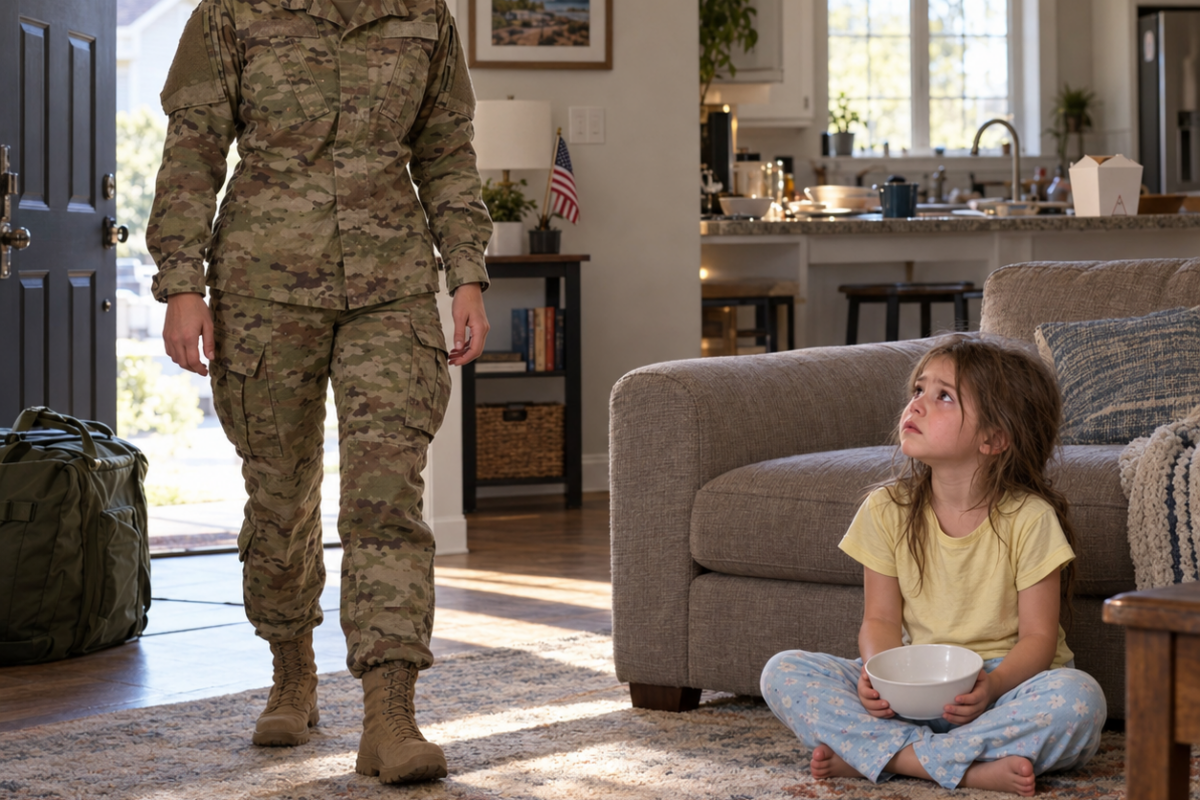
“Mommy, are you real?” my four-year-old daughter whispered when I came home from deployment three weeks early. She was sitting alone on our living room floor with an empty cereal bowl. My husband was on a Caribbean cruise with his mother and sister. Twenty-two minutes earlier, they had posted a photo captioned “Family time.” I was still in uniform when Sophie asked if she could have something to eat.
The first thing my daughter said when I found her was, “Mommy, are you real?” She was sitting cross-legged on our living room floor with…
End of content
No more pages to load