My mother leaned across the restaurant table, looked at my thirteen-year-old adopted daughter, and whispered, “We don’t sit with mistakes.” I took Sole’s hand and walked her out. That night, my father texted, “You’re still making the car payment tomorrow, right?” By midnight, I had canceled the payments I’d been making for my family. Then I remembered something Sole had told me about her grandmother.
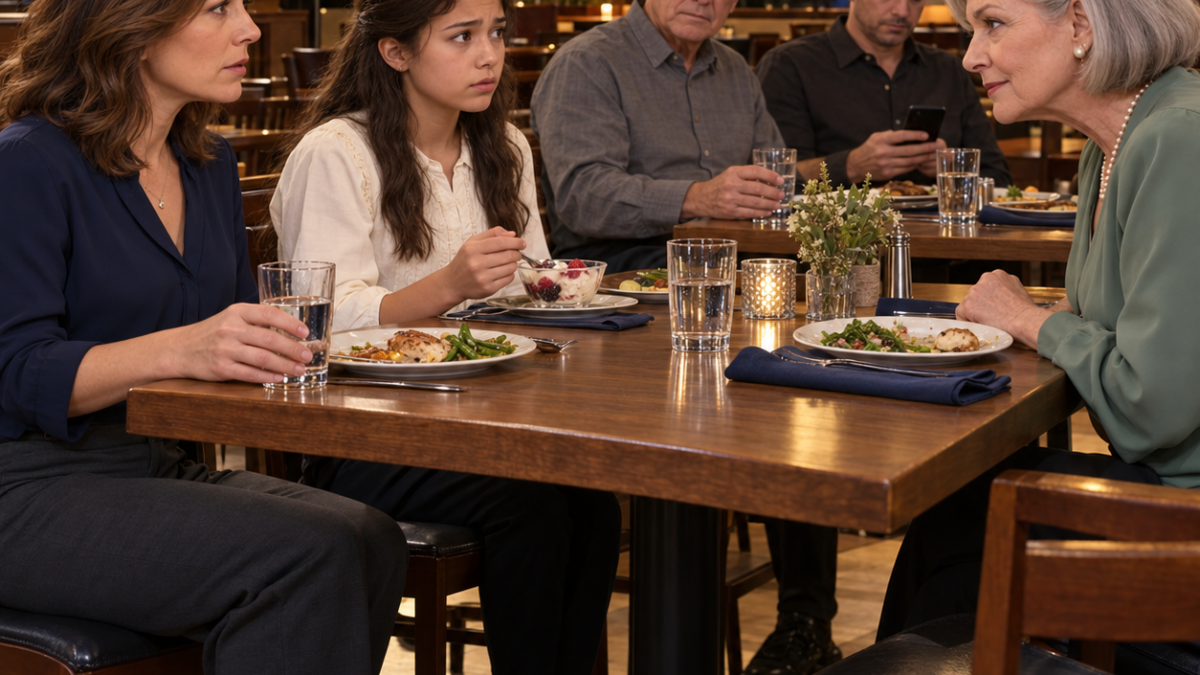

My mother looked at my thirteen-year-old daughter and whispered, “We don’t sit with mistakes.”
She said it softly enough to avoid attracting attention from the other tables, but clearly enough for everyone at ours to hear.
My father kept his hand around his drink.
My brother Chris looked up from his phone.
Sole’s fingers tightened around her spoon until it clicked against the bowl. Her shoulders moved inward, and her eyes dropped to the table.
I stood, took her hand, and walked her out.
That night, at 10:14, my father sent me a message.
*You’re still making the car payment tomorrow, right?*
He didn’t ask whether Sole was all right. He didn’t apologize for remaining silent while his wife called my child a mistake.
He asked about the bill.
Before morning, I stopped the voluntary payments I had been making for my parents and brother for three years. I removed my cards from their accounts, canceled future transfers, and secured the accounts that belonged to me.
I thought that was the last difficult decision I would need to make that night.
Then I looked at the messages on Sole’s phone.
There were three from my mother, sent during the previous month.
*Do kids at school ever make you feel different?*
*Do you ever worry your mom regrets taking on so much?*
*Do you ever wonder where you really belong?*
I sat at my kitchen table reading them while my daughter slept upstairs.
The restaurant had not been the beginning.
It had been the first time my mother said plainly what she had been trying to teach Sole in private.
My name is Marlo. I adopted Sole when she was seven, after she had lived with me as a foster child for eleven months.
By the time the paperwork was complete, she already knew which kitchen drawer held the Band-Aids and which floorboard creaked outside my bedroom. She knew I drank my coffee before answering complicated questions in the morning, and I knew she preferred the cereal that stayed crunchy longest.
She knew the sound of my car in the driveway.
I knew that thunderstorms frightened her more when she couldn’t see the window.
She knew where I kept the extra blankets.
I knew that when something was genuinely funny, she laughed with her whole face.
Our life together was already full of those things before a judge finalized the adoption.
The legal process mattered. It gave permanence to responsibilities I had already accepted and a relationship I had already chosen.
But I didn’t start being her mother when someone stamped a document.
I was her mother when she called from the bathroom because she couldn’t reach the towel. When she came home angry about a school disagreement. When she fell asleep on the couch and I carried her to bed, trying not to bump her feet against the doorframe.
She was my daughter.
Not almost.
Not a substitute for a family I might otherwise have had.
Not a generous project.
My daughter.
I thought my parents would learn to understand that once they knew her.
For years, I arranged opportunities for them to know her.
I brought her to dinners. I invited them to birthdays. I sent photographs from school events and told them about the books she liked, the drawings she made, and the small things she said that made me laugh.
I believed familiarity would do what arguments could not.
I believed that if they spent enough time with her, their discomfort would become affection.
What I failed to consider was that Sole would spend those years waiting alongside me.
She would be the one sitting across from them, trying to become familiar enough to count.
My parents were not people strangers easily identified as cruel.
My mother made casseroles for church fundraisers. She remembered who needed a ride to an appointment and who had recently lost a spouse.
My father coached Little League for fifteen years. He could speak warmly about helping children develop confidence and learn teamwork.
In photographs, they looked like the family people wanted to have.
My mother stood close to Dad, her hand resting on his arm. Chris smiled beside his boys. I stood at the other end, often holding a coat or someone’s phone because I had been helping arrange the picture.
When Sole entered that arrangement, my parents made room for her body.
They did not make room for her place in the family.
It happened through small distinctions.
My mother asked what Chris’s boys wanted for their birthdays weeks in advance. She asked Sole what grade she was in even after I had told her several times.
Dad remembered my nephews’ sports schedules. He forgot the name of Sole’s teacher.
When we arrived for dinner, my mother greeted the boys with questions about things they had done. Sole received, “Well, hello there,” followed by a glance toward me.
I told myself she wasn’t accustomed to having a granddaughter.
Then I noticed how easily she asked detailed questions about other girls in the family.
The first birthday they missed, I supplied an explanation before Sole asked for one.
“Grandma and Grandpa have had a lot going on.”
Sole nodded.
She was still young enough to accept an adult explanation without examining it.
I mistook that acceptance for the absence of hurt.
The next year, my mother mailed checks to my nephews and sent nothing to Sole.
I mentioned it privately.
Mom sighed.
“I didn’t know what she liked.”
“She likes art supplies, mystery books, and movies with animals.”
“Well, now I know.”
“I’ve told you before.”
“Marlo, don’t turn a forgotten gift into a problem.”
I left the conversation feeling unreasonable, although the facts had not changed.
At home, Sole had a good birthday. There was cake, a friend from school, and a stack of books she insisted on opening in a particular order.
She thanked me several times.
I remember being grateful that she hadn’t asked about my parents.
Now I wonder whether she had already learned which questions would make me sad.
When she was nine, she heard Dad call her “that girl.”
He was annoyed about something ordinary. I no longer remember what. The phrase stayed with me because of what followed.
Later that evening, Sole stood beside me while I loaded the dishwasher.
“Does Grandpa know my name?”
I turned toward her.
“Of course he does.”
“Then why doesn’t he say it?”
I closed the dishwasher.
“He was probably distracted.”
She nodded and went back to the living room.
I should have stayed with the question.
I should have said that I heard it too and that it wasn’t acceptable.
Instead, I protected my father’s meaning at the expense of my daughter’s understanding.
I did that more than once.
I told myself I was keeping her from feeling rejected.
What I was actually doing was asking her to disregard evidence she had noticed correctly.
Christmas made the distinctions harder to explain.
My nephews received carefully chosen gifts with their names stitched on them or written in my mother’s neat handwriting. There were questions about sizes, interests, and favorite colors.
Sole received a soap set one year.
A candle another.
Both were still wrapped in the plastic used on the store shelf.
She was a child who wanted books and drawing pencils.
She thanked them anyway.
Afterward, she sat at our kitchen table and wrote a handwritten note because that was the habit I had taught her.
“Should I say the soap smells nice?” she asked.
“If you think it does.”
She opened the box, sniffed, and considered.
“It smells like the bathroom at a hotel.”
I laughed.
She smiled, pleased to have amused me, then wrote a polite note that avoided mentioning hotels.
My parents never wrote back.
I didn’t expect a formal reply to every thank-you card. I did expect signs that they saw a child trying to reach them.
Instead, they accepted her gratitude as another thing she owed.
Their questions about her came when she was elsewhere.
Usually, my mother lowered her voice over coffee.
“Does trauma stay with children like her?”
“If you have questions, we can talk about them without saying ‘children like her.’”
“You know what I mean.”
“I know how it sounds.”
Then I was sensitive.
Then she was only trying to understand.
Then I found myself explaining things calmly enough that she could remain comfortable asking.
Another time, she asked, “Do children from those situations really attach the way regular children do?”
I put my cup down.
“Sole is a regular child.”
“You’re deliberately misunderstanding me.”
“No. I’m asking you not to speak about my daughter as though she’s a different category of person.”
My father interrupted from the other side of the kitchen.
“Your mother means well.”
That sentence ended more conversations than any apology ever did.
Intentions became the shield around every choice.
If Mom meant well, I was supposed to stop discussing what she said.
If Dad didn’t intend to hurt anyone, I was supposed to stop discussing what he did.
Meanwhile, Sole had to live with the words whether or not anyone intended them.
After my divorce, my finances became more stable than my parents’ and Chris’s.
I had a steady income, kept a careful budget, and had begun rebuilding savings. I didn’t have unlimited money, but I could help when something came up.
At first, the requests were occasional.
A car payment during a difficult month.
Part of a utility bill.
A gap at the pharmacy my mother said would be temporary.
Chris needed help keeping his phone active.
I had been raised to believe taking care of family was a virtue.
I still believe helping people can be a virtue.
The problem was how quickly help became an expectation and how little room remained for me to reconsider it.
One month became another.
The pharmacy gap stayed temporary in every conversation and permanent on my bank statement.
The car payment arrived on the same date.
Chris stopped explaining why he needed help and began texting when the charge was due.
Three years passed.
I kept paying.
Some months, I had to move things around in my own budget to do it. Nothing essential went unpaid at home, but activities and purchases Sole wanted were postponed more often than they should have been.
“We’ll go to that museum another time.”
“Let me check the schedule.”
“Maybe the next session of the art class.”
I didn’t connect those delays with the transfers I made for my family.
I treated the transfers as fixed obligations and the things Sole wanted as optional.
That distinction embarrassed me later.
My daughter wasn’t asking for extravagance.
She wanted time, books, paint, and experiences we could have shared.
I was spending part of our capacity trying to preserve relationships that kept asking her to accept less.
About a month before the restaurant dinner, I gave my mother a clear warning.
We sat in her kitchen. Sole was not there.
I had reached the point where the small incidents no longer felt small, and I was tired of having every conversation end with my sensitivity.
“One more cruel thing toward Sole,” I said. “One more, and we’re done.”
My mother stirred her coffee.
“Don’t threaten me.”
“I’m telling you what will happen.”
“You can’t expect everyone to say everything perfectly.”
“I don’t. I expect you to treat my daughter with basic kindness.”
She looked toward the window.
I continued.
“I’m not talking about a break while everybody calms down. I’m talking about ending contact if this continues.”
She nodded as though I had said something mildly excessive that could be allowed to pass.
I don’t think she believed me.
Neither did Dad, when I repeated the boundary to him.
He said family relationships couldn’t be managed with ultimatums.
I asked how they should be managed when the same hurtful behavior continued after repeated conversations.
He didn’t answer that question.
Instead, he told me I would regret being stubborn.
I left knowing the warning had been heard.
I did not leave believing it had been taken seriously.
That is part of what I had to face afterward.
I saw the pattern and still accepted another invitation.
I wanted the dinner to be ordinary.
I wanted one more piece of evidence that my family could behave better.
I didn’t realize that I was asking Sole to attend the experiment.
The restaurant was one of those places where the room itself seemed designed to reassure you.
Warm string lights.
Old music played quietly.
Small candles on the tables.
A front window reflected the street and made everyone inside look softer than they were.
On the way, Sole asked whether her cream blouse looked too formal.
“No. It looks nice.”
“Are these shoes okay?”
“Yes.”
She glanced down at them.
At home, she didn’t ask those questions repeatedly. She wore what she liked and occasionally argued with me about whether a sweatshirt counted as clean if it had only been worn once.
Around my parents, she checked herself.
Her clothes.
Her posture.
Her voice.
I had noticed and called it shyness.
That evening, as she smoothed her blouse in the car, I felt a familiar discomfort.
“You don’t have to be perfect,” I told her.
“I know.”
She said it quickly.
She did not stop smoothing the fabric.
Dad had already sent back his drink when we reached the table.
He said it had too much ice.
My mother adjusted her silverware, moving the knife a fraction of an inch before setting it down again.
Chris sat across from me, checking his phone beneath the table and smiling at something he didn’t share.
Sole sat beside me.
Her back was straight.
Her napkin was neatly folded in her lap.
I watched her place both hands beside her water glass and felt tired before dinner began.
The conversation moved through ordinary subjects.
Traffic.
The weather.
Someone from church.
Dad’s car.
Chris’s boys.
Mom asked about a school event one of my nephews had attended.
I mentioned a project Sole had completed.
“She drew the illustrations herself,” I said.
Sole looked at me, embarrassed but pleased.
My mother nodded.
“That’s nice.”
Then she asked Chris another question.
Sole looked down.
I tried to bring the conversation back.
“She worked on it for several weeks.”
“Marlo, I said it was nice.”
“I know.”
There it was again.
The quick correction.
The implication that wanting my daughter noticed was a demand for excessive attention.
I drank water and reminded myself that one response didn’t have to define the evening.
Dinner arrived.
Sole thanked the waiter.
She cut her food carefully and waited until everyone else had begun eating.
At home, she would have asked whether I wanted to trade a bite of mine for a bite of hers. She would have told me something strange she had learned that day or complained about a teacher’s unreasonable expectation.
At that table, she spoke when someone addressed her.
No one addressed her much.
I began wondering whether leaving early would seem abrupt.
That was the wrong question, but it was the question I had been trained to ask.
Not whether Sole was comfortable.
Whether my response would inconvenience the adults making her uncomfortable.
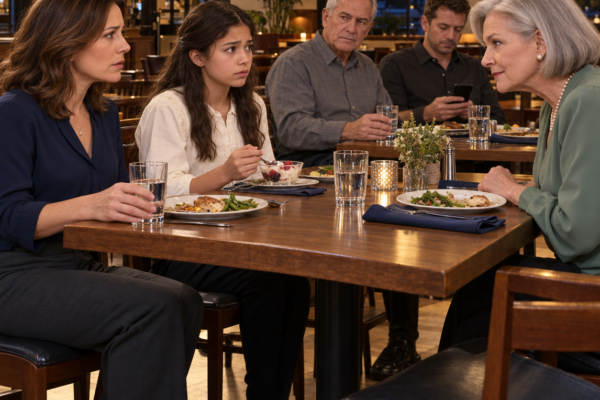
When the waiter brought dessert menus, my mother leaned toward her.
It was the movement she used when she wanted a comment to sound private and caring.
Her voice became gentle.
“We don’t sit with mistakes.”
I heard the spoon click.
For a moment, I thought I might have misunderstood.
Then Sole’s shoulders folded inward.
My mother watched her.
There was no confusion in my mother’s face.
No startled realization that she had used the wrong word.
No attempt to correct herself.
My hand tightened around my water glass.
I wanted to make her repeat it.
Loudly.
I wanted the restaurant to hear what the warm lights and polite voice had concealed.
I wanted every person who praised her kindness to see the child beside me.
Then I looked at Sole’s hand.
It was shaking.
My anger did not get to become another event she had to endure while waiting to leave.
I set down the glass.
I stood and took her hand.
“We’re leaving.”
Dad looked offended before he looked surprised.
Chris finally put his phone away.
Mom blinked up at me.
“Don’t be dramatic.”
“You just called my daughter a mistake.”
“She knows what I meant.”
“No,” I said. “You know what you meant.”
I picked up our things.
I made sure our portion of the meal was accounted for before we left. I wasn’t going to give them a separate argument about a restaurant bill.
Then I walked Sole past the other tables, the hostess stand, and the small flag tucked into the holiday arrangement near the door.
Some people looked away.
Others watched.
I barely noticed them.
Outside, the cold felt sharp against my face.
Sole moved carefully toward the car, holding herself as though she were trying not to disturb anything.
I unlocked the doors.
She climbed in, fastened her seat belt, and stared through the windshield.
I sat behind the wheel but didn’t start the engine.
For a while, neither of us spoke.
Then she whispered, “Am I?”
I turned toward her.
“Are you what?”
“A mistake?”
The question hurt more than the words in the restaurant.
My mother had spoken them.
My daughter was considering believing them.
“No,” I said. “Never.”
Her mouth trembled.
“You are the best decision I have ever made.”
She stared at her hands.
I reached across and took one.
“They’re wrong. They don’t get to decide who you are.”
Her fingers slowly uncurled.
“Did she mean the adoption?”
“I don’t know every thought she had. I know what she said was cruel and wrong.”
“Maybe she thinks—”
“Whatever she thinks does not change that you’re my daughter.”
I waited until she looked at me.
“You belong with me. You don’t have to earn that by being quiet or careful or easier for someone else.”
That was when she cried.
I stayed beside her until she was ready to go home.
I didn’t tell her to stop crying.
I didn’t tell her not to let them get to her.
I didn’t ask her to remember the good things Grandma had done.
There was no balancing statement that needed to be placed beside what had happened.
At home, I made hot chocolate.
Sole barely touched it.
I settled beside her on the couch under two blankets and put on a familiar movie.
She watched without seeming to see much.
I stayed quiet.
I did not trust myself to talk about my parents without giving her more anger to carry.
After a while, she leaned against me.
“Are we going back?”
“To the restaurant?”
“To see them.”
“No.”
She looked up.
“Because of tonight?”
“Because of tonight and because this has happened in other ways too.”
She nodded slowly.
I could see relief, then uncertainty.
“Did I make it worse?”
“No.”
“I could have just—”
“No, Sole.”
I softened my voice.
“You did not make this happen.”
She looked at the television.
I let the silence return.
Eventually, she finished a little hot chocolate and asked if she could go to bed.
I walked upstairs with her.
At thirteen, she usually wanted privacy around her bedtime routine. That night, she let me sit on the edge of her bed while she pulled the blanket up.
“Can you leave the door open?”
“Of course.”
“The hall light too?”
“Yes.”
I kissed her forehead.
“I’m right downstairs.”
She nodded.
When I came back to the kitchen, my phone was lit on the counter.
Dad’s message had arrived at 10:14.
*You’re still making the car payment tomorrow, right?*
I read it once.
Then again.
There were several things he could have said.
He could have asked whether Sole had stopped crying.
He could have told me my mother was wrong.
He could have apologized for doing nothing.
He could have asked to speak when we were ready.
Instead, he checked whether the payment schedule would continue.
I sat down at the kitchen table.
Until then, part of me had still expected someone to recognize what happened.
Not a grand apology.
A sign.
One sentence that placed my daughter above their convenience.
The message told me where his attention was.
I opened my banking app.
For three years, I had supported the car payment, contributed to utilities, paid Chris’s phone bill, and covered the pharmacy gap.
I reviewed each payment before changing it.
I was not taking money from their accounts.
I was stopping future use of mine.
There was a difference, and I made sure I understood it.
The car loan was theirs. I had been sending money to help pay it.
The utilities were their accounts.
Chris’s phone was in his name, although my card had been saved for payment.
The pharmacy arrangement used my payment information to cover charges they were responsible for.
I removed the future transfers and my saved payment methods.
I did not cancel anyone’s medical care or telephone service. I ended my funding and sent brief written notice that they needed to use their own payment arrangements going forward.
There were details I would have reviewed with an attorney the next day.
That night, I kept records of every change.
I saved confirmations.
I checked for linked access to accounts that belonged solely to me.
I changed passwords and secured recovery information.
I made sure bills already properly owed by me would still be paid.
Then I looked at the list of future payments that no longer existed.
I felt no pleasure in imagining them inconvenienced.
I felt the exhaustion of realizing how long I had kept money moving toward people who could not bring themselves to ask whether my child was all right.
By midnight, I had blocked my mother’s number on my phone.
At 12:07, my father’s.
At 12:11, Chris’s.
I knew blocked calls could still leave voicemail through my carrier, and unfamiliar numbers could still come through. I silenced those too.
I wasn’t arranging a confrontation.
I was ending a channel that had brought enough into my house for one night.
Then I picked up Sole’s phone.
We had an agreement about safety checks, and she had mentioned before that Grandma sent occasional messages. At the time, she had described them casually.
I had asked whether everything was okay.
She said yes.
I let it go.
Sitting at the table that night, I couldn’t let it go again.
I looked at the recent conversation.
Three messages appeared over the previous month.
They were phrased as questions.
Concern.
Interest.
The kind of language my mother used when she wanted to remain innocent of the answer she was encouraging.
*Do kids at school ever make you feel different?*
*Do you ever worry your mom regrets taking on so much?*
*Do you ever wonder where you really belong?*
I read Sole’s brief replies.
She had not argued.
She had tried to answer politely.
That was what made it worse.
My mother had found a private path to a child who had been taught to respect her.
The messages asked Sole to examine whether she was too much for me.
Whether I regretted her.
Whether the home she knew was truly hers.
I thought about the careful posture at dinner.
The repeated questions about her clothes.
The way she thanked my parents for gifts chosen without knowing her.
She had been doing more than trying to make a good impression.
She had been trying to avoid confirming the things they implied about her.
I put the phone down and pressed my palms against the table.
For a long time, I had treated my parents’ behavior as a problem between adults.
Their beliefs.
My choices.
Our disagreements.
I had assumed I could absorb the hurt and explain it away before it reached Sole.
The phone showed me where it had reached her without me.
I took screenshots and preserved the original conversation.
I did not delete the messages.
I did not reply as Sole.
I didn’t send my mother an angry statement from my daughter’s account.
The next step needed to protect Sole, not satisfy the part of me that wanted my mother to feel exposed.
I went upstairs and looked through Sole’s open door.
She was asleep on her side.
The light from the hallway touched the edge of her blanket.
I stood there remembering the child who first arrived at my door with one bag and a stuffed rabbit missing an eye.
I didn’t know everything she needed then.
No parent knows everything.
I had promised to learn.
Somewhere in the effort to preserve my family, I had stopped listening closely enough to the person I was raising.
That was a truth I could not put entirely on my parents.
They were responsible for their cruelty.
I was responsible for what I did after seeing it.
I stayed in the doorway until Sole shifted in her sleep.
Then I went back downstairs and put the phone beside my notebook.
I did not sleep much.
By morning, the call log showed twenty-nine attempts from blocked, withheld, and unfamiliar numbers. There were several voicemails.
I listened to them while Sole was still upstairs.
Dad wanted an explanation for the canceled payment.
Mom cried about betrayal and ingratitude.
Chris said I was destroying the family over one comment.
None of the messages asked whether Sole was all right.
None said her name.
One comment.
I heard the phrase and looked at the screenshots beside me.
The dinner had given them an event they could minimize.
The phone showed a pattern they didn’t know I had discovered.
Sole came downstairs in a sweatshirt, carrying the rabbit she rarely brought out of her room anymore.
“Did they call?”
“Yes.”
“A lot?”
“Yes.”
“Are they mad?”
“They’re upset about changes I made.”
She sat at the table.
“What changes?”
“I’m not going to keep paying some of their bills.”
Her face changed.
“Because of me?”
I turned away from the counter and sat across from her.
“Because I decided I shouldn’t keep supporting an arrangement that hurts our home.”
She looked at the rabbit.
“That sounds because of me.”
“I understand why it sounds that way.”
I waited.
“You are not responsible for their bills. You’re not responsible for my decisions. They’re adults. They can make their own arrangements.”
“What if Grandma says I did it?”
“Then she’ll be wrong.”
Sole nodded, but I knew one conversation wouldn’t make that fear disappear.
I made breakfast.
We ate slowly.
Afterward, I told her about the phone.
“I looked at the recent messages from Grandma last night.”
She went still.
“You’re not in trouble,” I said immediately.
“Okay.”
“I should have followed up when you mentioned them before.”
She stared at the table.
“I thought she was asking.”
“Asking questions?”
She nodded.
“Sometimes people ask questions that suggest an answer. The messages about whether I regret being your mother were not appropriate.”
Sole’s eyes filled.
“I didn’t think you did.”
“I’m glad.”
“But sometimes I wondered if you got tired.”
“Parents get tired. That doesn’t mean they regret their children.”
She looked at me.
“I get tired from work. From not sleeping enough. From a hundred ordinary things. You don’t have to make yourself smaller to keep me from having a tiring day.”
She wiped her face with the sleeve of her sweatshirt.
“I didn’t want you to fight with her.”
“I know.”
“I thought if I answered nicely, she’d stop.”
I closed my eyes for a moment.
Then I said, “That was too much for you to have to manage.”
She nodded.
“I’m sorry I didn’t notice sooner.”
I did not ask her to tell me I had done my best.
I did not make the apology so emotional that she needed to comfort me.
She deserved to hear it without receiving another task.
“I should have acted sooner,” I said. “I’m acting now.”
Her phone lit on the table.
Another message from my mother.
Sole looked at the screen and then at me.
“Can you read it?”
“Yes.”
I read it without repeating the wording aloud.
It asked Sole to help me calm down and suggested that families should not be separated by hurt feelings.
My mother had moved directly from questioning Sole’s belonging to asking her to preserve the relationship.
I saved it with the others.
Then I showed Sole how to block the number.
She did it herself.
“Can Grandpa message me?”
“He can try. We can block his number too.”
She nodded.
We reviewed the contacts together.
I told her she could show me any future attempt, including through another person, without worrying that she had done something wrong.
She asked whether she needed to tell Grandma goodbye.
“No.”
“What if that’s rude?”
“Protecting yourself from hurtful messages is not rude.”
She looked at the blank space where the conversation had been closed.
Then she put the phone facedown and asked whether we could make more hot chocolate later.
“Yes.”
It was an ordinary request.
I was grateful for it.
That morning, I called an attorney.
Not because I wanted a dramatic legal fight.
I wanted someone qualified to review the actual arrangements and tell me whether ending the payments created obligations I hadn’t considered.
I described the car, utilities, phone account, pharmacy payments, and the access I had removed.
I gathered statements and agreements.
I didn’t rely on the fact that I felt morally certain.
Being certain about my daughter’s worth did not answer questions about contracts.
The attorney reviewed what I provided and asked careful questions.
Was I on the car loan?
No.
Had I signed a written promise to continue paying?
No.
Were the utility accounts mine?
No.
Was I terminating services or removing my funding?
Removing my funding.
Had I authorized charges that had already been incurred?
We went through those separately.
She advised me on what needed to be honored, what could be stopped, and how to keep the records clear.
The arrangement was what I believed it to be: voluntary support, not a set of debts legally assigned to me.
“You’re free to stop this support,” she said.
I sat very still.
Free was a large word for what appeared on the surface to be a series of canceled transfers.
It meant I didn’t need to keep paying until my parents agreed I had a good reason.
I didn’t need their approval to reconsider how I used my income.
I could meet my obligations and still stop being available for every expectation they had built around me.
I asked about the messages to Sole.
The attorney gave practical advice about documenting contact, making our preferences clear, and responding if the situation changed.
There was no need to pretend ordinary boundaries were court orders.
There was no promise that my parents would never attempt contact again.
There was a plan.
That was enough.
For the next several days, I moved through life with more energy than I felt.
Breakfast.
Work.
Laundry.
Checking that Sole had what she needed for school.
I answered necessary calls and ignored the ones that came only to carry my parents’ feelings into our house.
When the phone rang, Sole watched my face.
I began placing it away from us during meals.
Not secretly.
Not dramatically.
Just where it couldn’t interrupt every bite.
At night, I sometimes heard her moving around after bedtime.
I would knock.
“Can I come in?”
Usually, she said yes.
Once, she sat on the bed with the rabbit beside her and asked, “Do you wish I’d told you sooner?”
I sat in the chair near her desk.
“I wish I’d asked better questions sooner.”
“That’s not the same.”
“No.”
She thought about it.
“I didn’t know it was bad enough.”
The sentence stayed with me.
Bad enough.
She had been measuring what happened against an invisible threshold, waiting for permission to call it hurtful.
“You don’t have to know whether something is bad enough before telling me,” I said.
“Even if it’s small?”
“Even if you’re not sure what it means.”
She nodded.
“I might not always know the answer right away,” I added. “But we can look at it together.”
That was a promise I could keep.
Two weeks passed.
Dad tried reaching me through a cousin.
The cousin called kindly, asking whether I might consider a conversation because Dad thought everything had gotten out of hand.
“Did he tell you what happened?”
“Some of it.”
“What did he say?”
“That there was a disagreement at dinner and you stopped helping with the bills.”
I looked toward the living room, where Sole was sketching.
“That leaves out the part involving my daughter.”
The cousin became quiet.
I gave a brief account without sending screenshots or making Sole’s private messages a family exhibit.
“I’m not available for this conversation,” I said.
“Do you want me to tell him that?”
“Yes.”
“Anything else?”
“No.”
It felt abrupt.
It also felt clean.
I didn’t need to argue with a cousin who hadn’t been there.
My mother tried a different route.
She contacted a woman from church who knew both of us and hoped she would intervene.
When the woman called, her voice was gentle.
“Marlo, are you all right?”
The question surprised me.
It was the question my parents hadn’t asked.
“I’m handling things,” I said.
“Your mother sounds very upset.”
“I know.”
“She said you’ve cut everyone off.”
“I ended contact after she called Sole a mistake.”
There was silence.
Then I described the messages.
Not every detail.
Enough.
The woman didn’t tell me families should forgive.
She didn’t say my mother came from another generation or that she probably hadn’t meant it.
She said, “I had no idea. I’m sorry, Marlo.”
I sat down.
“I’m trying to keep Sole from having to explain herself to people.”
“That’s understandable.”
“If Mom asks you to pass along another message, please don’t.”
“I won’t.”
Afterward, I cried.
Not because I missed my mother.
Because someone had heard the truth without asking me to improve it until it became comfortable.
Chris sent one final text from an unfamiliar number.
*You think you’re better than us. You always have. Enjoy your perfect little life.*
I read it once.
There was no question to answer.
No attempt to understand.
No mention of Sole.
I saved it, blocked the number, and put the phone down.
I had spent years responding to messages that were not invitations to talk.
They were demands that I defend myself until the person sending them felt powerful again.
I didn’t need to accept the assignment.
The financial adjustments were more ordinary than the opening night suggested.
I updated my budget.
I verified that my cards were no longer saved where they shouldn’t be.
I watched statements for unexpected charges.
I kept enough records to know what had happened without opening the folder every day.
The money didn’t transform our lives overnight.
There was no sudden fortune.
There was room.
Room in the monthly budget.
Room in my attention.
Room to consider something Sole wanted without first deciding which relative’s expectation needed to be met.
That was more valuable than I expected.
The harder work involved my daughter.
Not because she argued with me.
She didn’t.
In some ways, she seemed relieved.
She no longer asked repeatedly whether her clothes were right before an outing. She didn’t check the calendar for another dinner at my parents’ house.
But relief did not erase what she had absorbed.
Sometimes she went quiet in the middle of a meal.
Sometimes she stopped doing homework and looked toward me as though a question had arrived that she wasn’t sure she could ask.
I tried not to rush her.
One evening, she asked, “Are you sad about it?”
I thought before answering.
“I’m sad about what I thought they could be,” I said. “I’m not sad about what I did.”
She nodded slowly.
“Me neither.”
Then she looked at her notebook.
“I thought maybe if they knew me better…”
“I thought that too.”
“Maybe I wasn’t very interesting.”
I moved closer.
“Sole, this was never about you needing to become more interesting.”
“I know.”
But her voice said she didn’t fully know.
I didn’t argue her into agreement.
I stayed.
We spoke about the things she liked and the things she had hidden around them because they didn’t seem interested.
She admitted that she had stopped mentioning art.
“Grandma always changed the subject.”
“I noticed some of that.”
“Why didn’t you say anything?”
It was a fair question.
I answered it honestly.
“Sometimes I did, but not enough. Sometimes I told myself it would be easier to talk later. I should have protected you better.”
She looked at me.
I let her see that I could hear the criticism without becoming someone she needed to reassure.
“I’m not mad at you,” she said.
“You’re allowed to be.”
She considered that.
“I’m a little mad.”
“Okay.”
“Not all the time.”
“You don’t have to feel one thing all the time.”
She nodded.
The conversation hurt.
It also felt healthier than the years when we had both pretended not to notice.
I arranged support with someone experienced in working with families formed through adoption, and I sought support for myself as well.
I wanted Sole to have space that didn’t depend entirely on protecting my feelings.
I wanted help understanding how to respond without turning every ordinary teenage mood into evidence of damage.
She was thirteen.
Sometimes she would be quiet because she was hurt.
Sometimes she would be quiet because she wanted me to stop asking questions.
I needed to learn the difference without assuming I always could.
The appointments were not dramatic.
There were conversations.
There were suggestions about language, routines, and giving Sole control over what she wanted to discuss.
I learned to ask, “Do you want help, company, or some space?”
Sometimes she said company.
Sometimes she said space.
Once, she said, “I want you to stop making that worried face.”
I laughed.
“Fair.”
She smiled.
It was a relief to be corrected about something ordinary.
We discussed what she wanted people to know.
She did not want teachers, friends, or distant relatives given the story unless there was a reason.
I agreed.
Her adoption was part of her life.
The restaurant dinner was part of her experience.
Neither was public property simply because adults had opinions.
When someone asked nosy questions, I learned to say, “That’s private.”
I did not need to provide a moving explanation to make privacy seem reasonable.
Sole noticed.
One afternoon, she said, “You didn’t tell her everything.”
“No.”
“Good.”
I hadn’t realized how often she worried about that.
The first holiday without my parents passed more easily than I expected.
I made food we both liked instead of trying to satisfy everyone.
Sole helped, although her version of helping involved tasting things and leaving measuring spoons in places that made no sense.
“Why is this in the fruit bowl?” I asked.
“I was finished.”
“With the fruit bowl?”
“With the spoon.”
I stared at her.
She grinned.
I had missed that version of her.
The one who expected a mildly exasperated answer rather than a judgment about whether she belonged.
We ate at our own table.
No one compared her to my nephews.
No one asked a question about her past while looking toward me for approval.
No one made a distinction between the family and the child sitting beside it.
After dinner, she suggested watching a movie with animals.
“Again?”
“It’s a holiday.”
“Apparently that makes repetition mandatory.”
“Yes.”
We watched it.
She fell asleep near the end with a blanket partly covering her face.
I let her sleep for a while before waking her to go upstairs.
There was no grand sense of triumph.
There was peace.
I began noticing how much of our former routine had involved preparing for other people’s reactions.
Before a visit, I reminded Sole to say thank you.
To be patient.
To remember Grandma sometimes asked strange questions.
To give Grandpa a chance.
Those instructions had sounded like ordinary manners.
Taken together, they asked her to arrive ready to absorb things.
At home, I stopped rehearsing her for people.
We still practiced kindness.
We still wrote thank-you notes.
We still talked about patience and respect.
But I paid attention to whether those values were being used evenly.
Respect was not a one-way task assigned to the youngest person in the room.
Sole could be polite and still decline a conversation.
She could thank someone for a gift without pretending it made her feel seen.
She could ask me to leave without presenting a case strong enough to satisfy every adult.
I tried to teach those things through my behavior rather than speeches.
When I made a mistake, I apologized.
When I said no, I explained what needed explaining and stopped.
When I was upset, I didn’t tell her my feelings were her responsibility.
None of that made me a perfect mother.
It made our house more honest.
A few months after the dinner, we began redoing her room.
I had promised for a long time that she could choose a new paint color.
We finally went to the store and brought home so many sample cards that they looked like a deck of unusual playing cards.
She spread them across the kitchen table.
“Not pink.”
“You’ve made that very clear.”
“Not because pink is bad.”
“Understood.”
“I just want something different.”
She narrowed the choices, then changed her mind.
We painted samples on the wall and watched them look entirely different at night.
“Why do they do that?” she asked.
“Lighting.”
“That seems dishonest.”
“It is a common problem with paint.”
She laughed.
The final choice mattered less than the fact that she chose it.
We planned shelves for her books and looked at lamps.
She selected a light that made the room glow soft gold after sunset.
The first night we turned it on, she stood in the doorway.
“It feels like mine.”
“It is yours.”
“I know. I mean…”
“I understand.”
We worked over several weekends.
She was enthusiastic during the interesting parts and mysteriously unavailable when it was time to wipe dust from the baseboards.
I called her back.
She complained.
I let her complain.
A teenager being mildly annoyed about cleaning was not a threat to our relationship.
When we put the books on the shelves, she organized them according to a system I couldn’t understand.
“These are mysteries.”
“I see.”
“These have animals.”
“Okay.”
“These feel like rainy days.”
I looked at the third group.
“That’s a category?”
“It is now.”
The rabbit went beside the rainy-day books.
It still had one missing eye.
I had offered to repair it before, and she had declined.
This time, she positioned it carefully and stepped back.
“He looks good there.”
“He does.”
The room wasn’t a replacement for what had happened.
I didn’t think new paint could heal a cruel sentence.
It was a way of giving her ordinary ownership over a space where she didn’t need anyone else’s permission to feel at home.
The museum came next.
She had asked about it for two years.
Every time, I had found a reason to postpone.
Some reasons were real.
Some were habits.
We put a date on the calendar and went.
She carried a small notebook because she wanted to draw things she saw.
I expected her to move quickly from exhibit to exhibit.
Instead, she stopped in front of one piece and stayed so long that I began to appreciate how little I understood about looking at art.
“What do you like about it?” I asked.
She pointed.
“The part that looks unfinished.”
“Why?”
“Because it makes you keep looking.”
I studied it.
She was right.
We sat on a bench nearby while she sketched.
People walked past.
A child asked a loud question, and an adult shushed him.
Sole kept drawing.
For a while, I did nothing.
No phone call.
No reminder about a payment.
No effort to fit the afternoon around someone else’s demands.
I watched my daughter work.
At lunch, she talked so quickly about the exhibits that I had to ask her to slow down.
“Sorry.”
“You’re not in trouble. I want to hear it.”
She started again.
On the drive home, she fell asleep with the notebook resting against her leg.
I kept the radio low.
There were days when I felt angry about the time I had wasted.
That afternoon, I let myself be grateful for the time we were using.
We enrolled her in an art class.
She was excited until the first session approached.
Then she began asking whether everyone else would be better.
“Some people will know things you don’t,” I said. “You’ll know things they don’t.”
“What if I’m the worst?”
“Then you’ll still be allowed to learn.”
She looked unconvinced.
I remembered the straight back at the restaurant.
The effort to arrive already acceptable.
“You don’t have to be impressive to belong in a class,” I said.
“I know.”
“We can leave if the class isn’t a good fit. But being new isn’t the same as not fitting.”
She nodded.
The first afternoon, she came out carrying her supplies and trying not to look pleased.
“How was it?”
“Fine.”
“Fine good or fine disappointing?”
“Fine good.”
By the third week, she was talking about the class without being asked.
By the sixth, her teacher pulled me aside.
“She has something real,” she said. “I want you to know that.”
I already knew Sole paid attention in a particular way.
I knew she saw things I missed.
Hearing another adult notice felt good.
I thanked the teacher.
Then I made sure not to turn the compliment into pressure when I told Sole.
“She likes how you look at things.”
“What does that mean?”
“I think it means you have your own way of seeing.”
She considered that.
“Good.”
We kept the class.
When a project didn’t work, she sometimes became frustrated.
I let her be frustrated.
Talent did not mean every attempt needed to succeed.
Belonging did not mean she had to justify the cost of the class with achievement.
She was allowed to enjoy something and improve slowly.
One evening, she brought home a piece she disliked and wanted to throw away.
“What don’t you like?”
“The middle.”
“Do you want to change it?”
“I don’t know.”
“Then put it aside.”
“I can do that?”
“It’s paper, Sole. It can wait.”
She smiled.
The drawing stayed on her desk for a week.
Then she worked on it again.
I liked watching her discover that not everything needed to be decided while it still hurt.
We also drove three hours to see a band she loved.
It required planning.
Tickets.
A place to stay.
Making sure the timing worked with school and work.
We didn’t do it impulsively to prove how happy we were.
We planned, saved, and went.
She spent the drive explaining songs to me.
“I’ve heard this one.”
“Not this version.”
“Apparently I’m behind.”
“You are.”
At the concert, she looked happier than I had seen her in months.
Not because she had forgotten everything.
Because she was occupied by something she loved.
On the way home, we sang badly enough that I was glad no one else was in the car.
When the weather and road allowed, I lowered the windows for a while.
She laughed as the wind moved her hair across her face.
Then she asked me to turn the music up.
I did.
Those experiences mattered.
So did the quieter ones.
The afternoon we stayed home because she was tired.
The morning she burned toast and blamed the toaster.
The evening she left her shoes in the middle of the floor and argued that moving them six inches would not improve anyone’s life.
“It would improve mine,” I said.
She sighed dramatically and moved them.
I was careful not to confuse freedom with never correcting her.
She was still a child who needed guidance.
She still had chores, schoolwork, and limits.
What changed was the meaning around those limits.
A misplaced pair of shoes did not call her place in the family into question.
An argument did not suggest she was too much.
A difficult mood did not become evidence that adoption had been a mistake.
She could be thirteen in my house.
Then fourteen.
She did not have to be endlessly grateful for being there.
Four months after the dinner, my father sent a handwritten letter.
I recognized his writing before opening it.
For a moment, I thought he might finally have understood.
I sat at my desk and unfolded the pages.
He said he was sorry about the car payment situation.
He said Mom had been under stress.
He said family was family and nobody was perfect.
He asked whether we could stop letting one difficult evening damage everything.
He never mentioned what my mother said to Sole.
He never mentioned the messages.
He never wrote Sole’s name.
I read it once.
Then I looked back at the first sentence.
The car payment situation.
That was still the event he could identify as needing repair.
I folded the letter and placed it in the folder with the other records.
I did not write back.
I didn’t need to tell him again what mattered.
He had been told.
He had been present.
He had received my explanation.
At some point, repeating the truth becomes another way of waiting for permission to act on it.
I was finished waiting.
Sole saw the envelope on my desk later.
“From Grandpa?”
“Yes.”
“What did he say?”
“He wants contact again.”
She went quiet.
“Are we?”
“No.”
She looked relieved.
“Was he sorry?”
“He didn’t address what happened to you.”
She nodded slowly.
I did not show her the whole letter.
She didn’t need to read another adult explaining why her hurt should be made smaller.
She asked whether I would keep it.
“Yes. With the records.”
“Not on the refrigerator?”
I laughed.
“No.”
“Good.”
Then she went to get a snack.
I watched her open the cupboard without hesitation.
It was an ordinary movement.
For a long time, I had watched her ask before taking things in my parents’ home, even things offered to everyone.
Now she reached for what she knew was hers.
At work, people noticed I seemed less distracted.
I didn’t tell everyone why.
I said I had made some changes in my family responsibilities.
That was enough.
The details belonged to Sole and me.
A colleague asked whether I missed my parents.
I considered the question.
“I miss what I hoped the relationship could be,” I said.
“But not the relationship as it was?”
“No.”
She nodded.
I appreciated that she didn’t argue.
People often expect a particular emotional ending to estrangement.
Grief that becomes forgiveness.
A moment of regret.
An apology that allows everyone to return.
I did not experience the longing they expected.
I felt relief.
There were memories I valued from my childhood. I did not need to erase them to understand the present.
My mother had comforted me when I was sick.
My father had taught me practical things.
Those memories were real.
They did not create a permanent entitlement to hurt my daughter.
I could acknowledge what they had once given me without continuing to offer Sole as the cost of gratitude.
That was difficult to explain to people who believed family history settled every present question.
I stopped trying to explain it to everyone.
Some conversations needed only, “We aren’t in contact.”
If someone asked why, I could decide how much to say.
If someone pressed, I could end the conversation.
I did not need to make my decision sound universally agreeable.
It needed to protect our life.
Sole’s fourteenth birthday approached.
She asked for a small celebration.
A few people she liked.
Food she chose.
No complicated arrangements.
I asked whether she wanted to invite anyone from my family.
She looked at me.
“No.”
“Okay.”
“Are you sure?”
“Yes.”
“I don’t want you to feel—”
“You don’t need to manage that.”
She breathed out.
We planned the day.
She wanted to help make the cake, then changed her mind when she realized how much waiting baking involved.
“You said you wanted to make it.”
“I wanted to decorate it.”
“An important distinction.”
She grinned.
The cake leaned slightly.
The frosting did not look like the picture she had shown me.
She declared it better because it looked real.
We ate it anyway.
During the celebration, I noticed how she moved through the room.
She didn’t keep her hands folded.
She interrupted a story to correct a detail.
She laughed too loudly and then laughed again when someone teased her about it kindly.
No one treated the sound as evidence she needed to be more careful.
At the end of the evening, she sat beside me on the couch.
“That was good.”
“It was.”
“Fourteen seems old.”
“You may revise that opinion later.”
She leaned her head against my shoulder.
For a while, we watched the room without speaking.
Then she said, “I don’t think about the restaurant every day anymore.”
I turned toward her.
“I’m glad.”
“Sometimes I still do.”
“That’s okay.”
“It’s usually the car.”
“What about it?”
“When you said I wasn’t.”
A mistake.
She didn’t repeat the word.
Neither did I.
“I meant it.”
“I know.”
Her voice was certain enough that I let the sentence rest.
I had once believed the important thing was to convince my parents.
Now I understood that my daughter believing me mattered far more.
Our life did not become perfect.
There were bills.
There were work deadlines.
There were mornings when Sole couldn’t find something that was directly in front of her.
There were evenings when I was impatient and had to apologize.
There were arguments about bedtime, homework, and whether a flashlight under the covers counted as going to sleep.
She still made hot chocolate she didn’t always finish.
She still left books open facedown in ways that made me wince.
She still sang off-key.
Those were not flaws I needed to present carefully to anyone.
They were parts of living with a teenager.
Some nights, I walked past the couch and found a book covering her face.
I would lift it gently.
One eye opened.
“I wasn’t asleep.”
“Of course not.”
“I was thinking.”
“Very quietly.”
She would smile and close her eyes again.
I let her rest for a while.
For the first time in years, our house felt as though neither of us was waiting for the next unpleasant thing to enter it.
That feeling did not arrive because I canceled payments.
Money helped by creating room and ending one form of obligation.
The deeper change came from not asking Sole to prepare herself for people who had repeatedly made her feel uncertain.
We were no longer arranging our weekends around whether my mother might behave differently.
We weren’t rehearsing how to respond if Dad used the wrong phrase.
We weren’t hoping Chris would look up from his phone and notice.
The effort had stopped.
I hadn’t realized how much air it consumed until we could breathe without it.
I thought often about the warning I gave my mother a month before dinner.
One more cruel thing.
I had meant it.
But why had Sole needed to endure enough incidents for me to reach that warning?
That question didn’t disappear.
I brought it to the support I had arranged for myself.
I spoke about it without making my daughter sit through my guilt.
I learned that regret could guide me if I used it to change behavior.
It became harmful when I used it to demand reassurance.
Sole did not owe me forgiveness for failing to act sooner.
She also did not need a mother permanently frozen in shame.
She needed someone who listened better now.
I tried to become that person.
When she told me about a difficult interaction, I didn’t immediately supply the other person’s possible intentions.
I asked what happened.
How she felt.
What she wanted to do next.
Sometimes the answer was that someone had made an ordinary mistake.
Sometimes she had misunderstood.
Sometimes she needed to apologize too.
Taking her seriously did not mean declaring her right about everything.
It meant not dismissing her before looking.
She began telling me more.
Not everything.
She was a teenager, not an open book.
But enough.
One evening, she mentioned that someone had asked whether I was her “real mom.”
“What did you say?”
“I said yes.”
“How did it feel?”
“Annoying.”
“Do you want to talk more about it?”
“No. I just wanted to tell you.”
“Okay.”
She returned to her homework.
I didn’t turn the conversation into a speech about adoption.
She had already answered the question.
I could trust her answer.
Sometimes I thought about my mother’s claim that Sole knew what she meant.
Perhaps she did.
Perhaps that was why the sentence hurt so much.
Children understand more than adults want to admit.
They notice whose interests are remembered.
Whose gifts are chosen carefully.
Whose name is spoken.
Whose absence creates concern.
They may not have language for the pattern, but they live inside it.
Sole had spent years trying to become the exception to my parents’ beliefs.
I had helped her keep trying by returning.
That was the part I could no longer avoid.
I had been late.
But I left.
And afterward, I stayed gone.
Not to punish my parents until they used the right words.
Not to create leverage for a better offer.
Because my daughter’s place in our life was not a subject for negotiation.
I did not need a final confrontation.
I did not need my mother to confess the purpose of every message.
The facts I had were enough to make a decision.
For years, I thought certainty required understanding every motive.
Why did she resent the adoption?
Why did Dad defend her?
Why did Chris reduce it to one comment?
Those questions could keep me occupied forever.
None needed to be answered before I protected Sole.
I could know less than everything and still know enough.
At the end of her fourteenth birthday, after the dishes were done, Sole came into the kitchen to get water.
She stood barefoot beside the counter, wearing an old T-shirt and the expression of someone who had remembered a question at the last moment.
“Do you think they’ll ever get it?”
“Maybe.”
“What if they do?”
“I can think about that if it happens.”
“Do we have to do something?”
“No.”
She nodded.
“I don’t want to.”
“Then we don’t need to decide anything tonight.”
She filled her glass.
On the way out, she stopped.
“I’m glad you came with me.”
I knew she meant the restaurant.
“I’m glad I did too.”
She went upstairs.
I stood in the kitchen, listening to her steps.
When I first brought her home, I thought the hardest part would be convincing her that she could stay.
I didn’t expect to spend years learning that other people’s conditional welcome could weaken that certainty even inside a permanent home.
I couldn’t undo those years.
I could make the years ahead different.
I could stop describing tolerance as patience when my daughter paid the cost.
I could stop describing financial support as family duty when it moved only in one direction.
I could stop treating a shared history as proof that future access was owed.
Those changes were quieter than the night I made them.
They lived in the calendar.
The phone settings.
The budget.
The way I answered a question.
The fact that Sole could sit at our table without preparing herself.
A few weeks later, on an ordinary evening, she was drawing while I made dinner.
Music played from her phone.
She sang along badly.
I asked whether she wanted to set the table.
“In a minute.”
“That minute has already been used twice.”
She rolled her eyes, then got up.
She took two plates from the cupboard and placed them at our usual seats.
Then she moved one.
“What are you doing?”
“I want to sit by the window.”
“Okay.”
She carried her drawing supplies to the other end of the table, put down the forks, and returned to singing.
I watched her for a moment.
No question about whether the seat was hers.
No careful check of my face.
No need to be grateful for taking up space.
Just a girl changing where she wanted to eat.
Dinner was ready.
She served herself, told me about her day, and disagreed with me about a movie we had watched.
Later, she left her shoes in the middle of the floor.
I told her to move them.
She complained and moved them.
The house remained hers.
That was the ordinary life I had wanted for her all along.
Not a place where she was praised for being easy.
A place where she could be known.
My mother’s sentence had tried to make her identity something the family could judge.
My father’s message had tried to keep my role unchanged after the judgment.
The messages on the phone showed how far both arrangements had reached.
I ended them.
The money was not the point.
It was the last thing I had continued giving while hoping the people receiving it would become kinder to my child.
Once I stopped waiting, our life grew larger in practical ways.
A room she chose.
A class she enjoyed.
A museum visit.
A concert.
Time at the table.
There was no dramatic reward beyond that.
There didn’t need to be.
Sole is fourteen now.
She still laughs with her whole face when something is genuinely funny.
She still reads past bedtime with a flashlight she thinks I don’t notice.
She still leaves half-finished hot chocolate beside a book and tells me she was going to drink it before it got cold.
She is not a mistake.
She is my daughter.
And when she sits across from me at dinner, there is no question waiting between us about where she belongs.
News
At my seventy-second birthday party, my daughter-in-law knocked a crystal vase off its pedestal with her elbow, watched it shatter, and smiled. “Oops.” Her own parents had given it to her and my son on their wedding day six years earlier. I looked at Frank, waiting for him to say something. All he managed was, “Mom…”
I watched my daughter-in-law break her own parents’ wedding gift with one elbow and a smile. For months afterward, people asked me whether I was…
I came home three hours early and found my sixty-eight-year-old mother on her knees scrubbing my mother-in-law’s bathroom. When I helped her stand, her sleeve slipped back, revealing dark marks around her wrist. My husband stepped into the doorway. “Daniela, don’t make a scene.” That was when I remembered my father’s last warning: “If you ever see your mother hurt, don’t argue with anyone. Open the hidden compartment in her sewing machine.”
I came home three hours early and found my sixty-eight-year-old mother on her knees beside a toilet. Her hands were stiff with arthritis. One gripped…
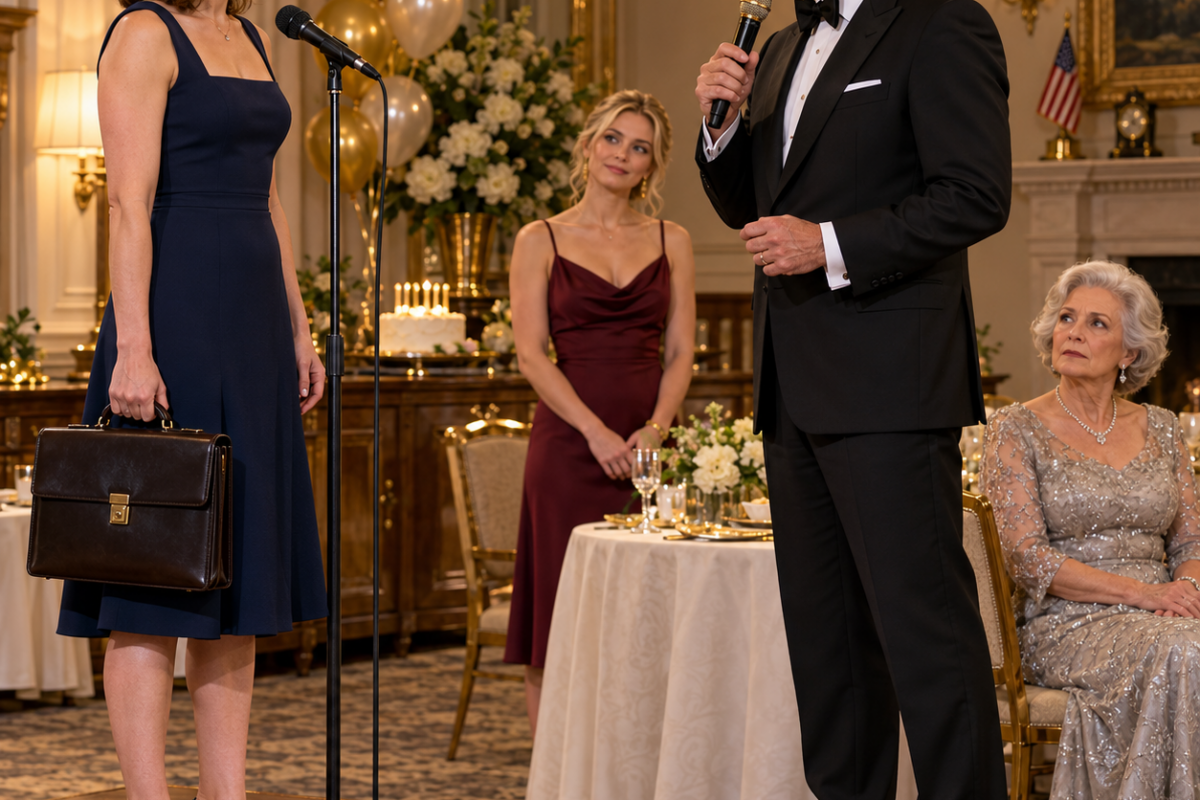
“I already promised your house to your sister,” my father told me four days after I bought it. “They’re moving in Monday. Rent-free for three years.” I was thirty-one, had saved for nine years, and had bought the five-bedroom home entirely in my own name. When I said no, he threatened to tell the family I had abandoned my sister’s children. Days later, he took the microphone at my grandmother’s seventy-fifth birthday dinner and did exactly that.
My father called twelve times in forty minutes after discovering I had bought a house without consulting him. When I answered, he didn’t ask whether…
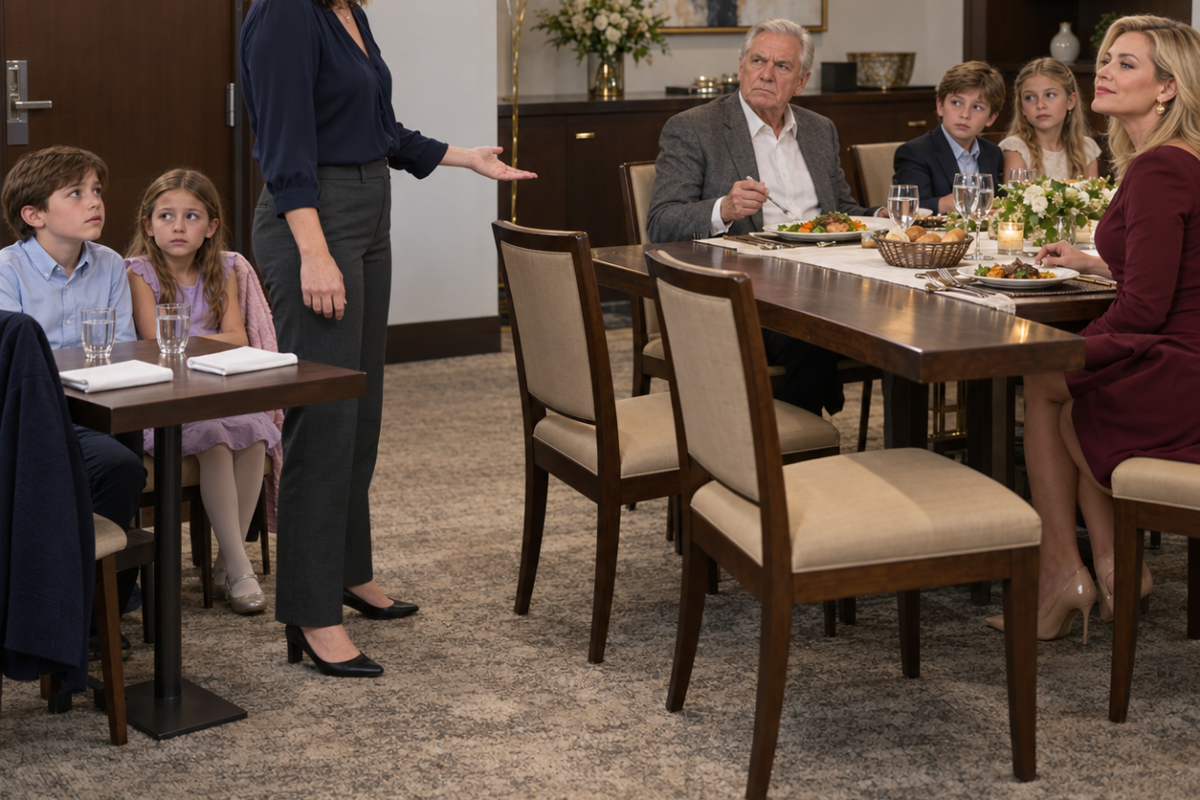
At my father’s seventieth birthday dinner, my eleven-year-old son and eight-year-old daughter were seated beside the service door with water glasses—but no dinner plates. Their cousins sat beside Grandpa with warm bread and full place settings. “They’ll eat after everyone else,” my sister said. I turned to my father, expecting him to object. “They can wait another hour,” he replied. There were two empty chairs at his table.
At my father’s seventieth birthday dinner, the first thing that stopped me wasn’t the cake or the gold balloons. It was my children. Ethan and…
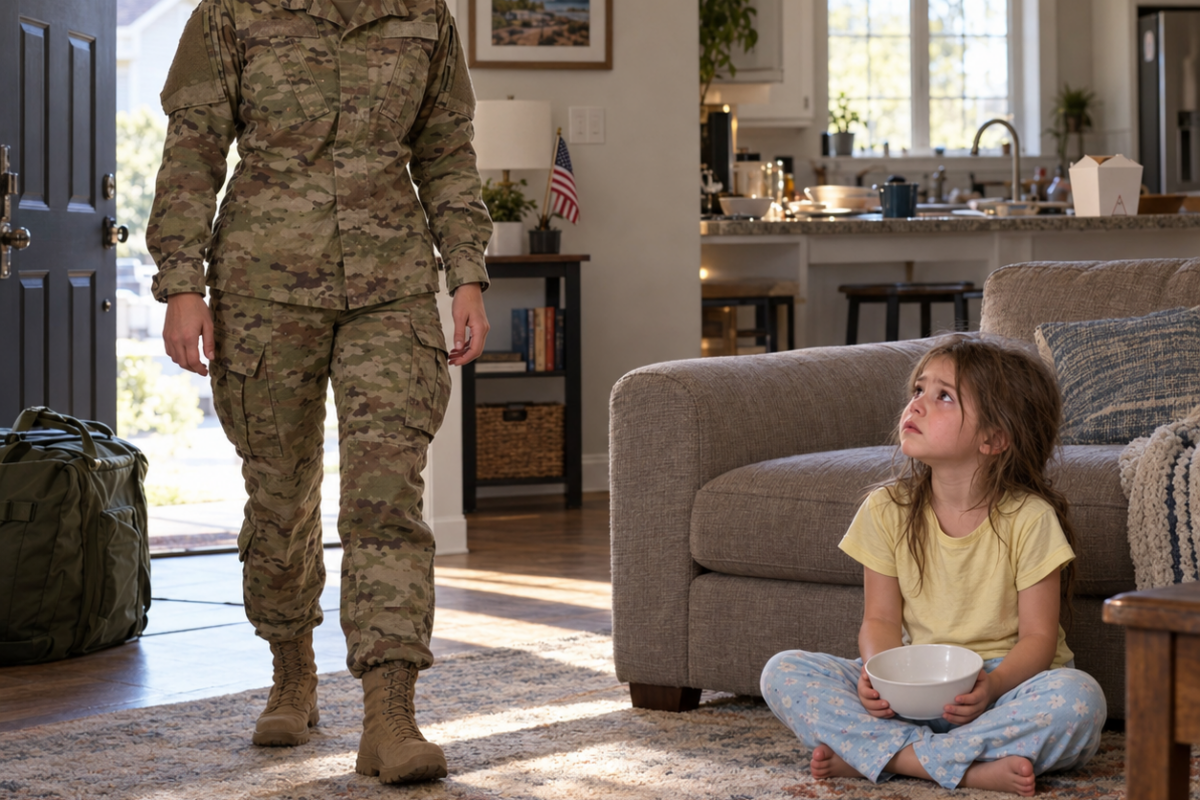
“Mommy, are you real?” my four-year-old daughter whispered when I came home from deployment three weeks early. She was sitting alone on our living room floor with an empty cereal bowl. My husband was on a Caribbean cruise with his mother and sister. Twenty-two minutes earlier, they had posted a photo captioned “Family time.” I was still in uniform when Sophie asked if she could have something to eat.
The first thing my daughter said when I found her was, “Mommy, are you real?” She was sitting cross-legged on our living room floor with…
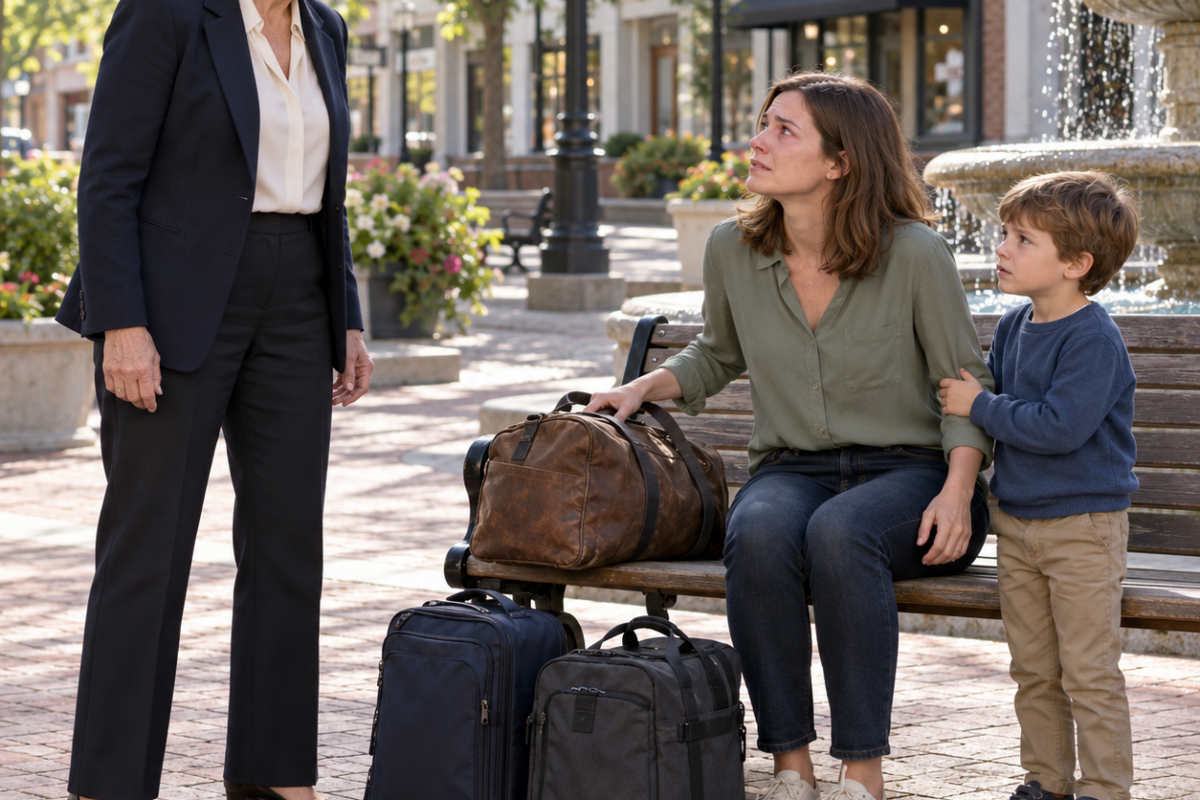
I found my daughter sitting beside the town-square fountain with my five-year-old grandson and three bags at her feet. “Why aren’t you at work?” I asked. She looked down. “My mother-in-law fired me. She said our family name brought nothing of value to the company.” I stared at her. It was my company. I had built it from $62 and a borrowed sewing machine. “Get in the car,” I said. “It’s time I spoke to Adelaide.”
The bag tipped first. It was a brown duffel, worn at the corners, and it slid off the bench onto the brick sidewalk with a…
End of content
No more pages to load