“I don’t want you at the wedding. Drew agrees,” my daughter-in-law texted twelve days before my son’s wedding. I had committed $86,000 toward the celebration. When I called Drew, he suggested I watch the livestream from home. Then I asked whether he still expected me to pay for the catering, chairs, lighting, and staff. “Mom,” he said, “you promised.”


Twelve days before my son’s wedding celebration, my daughter-in-law sent me a text that made forty years of motherhood feel strangely negotiable.
I was standing in my kitchen in Scottsdale, Arizona, rinsing blueberries when my phone lit up beside the sink.
Lina’s message was brief.
“I need to be very clear. I don’t want you at the wedding. Drew agrees.”
I read it twice.
The first reading did not seem large enough to contain the words.
My only son was forty years old. He and Lina had already married legally seven months earlier in a small civil ceremony. The wedding we had spent nearly a year planning was the formal ceremony and reception, the occasion when relatives would gather, photographs would be taken, and I would finally watch him exchange vows.
I had a blue silk dress hanging in my closet.
I had shoes still wrapped in tissue.
I had imagined standing when the music began, seeing Drew at the front of the courtyard, and feeling that complicated mixture of pride and grief mothers understand without needing to explain.
Before I could decide whether to call Lina, another message appeared.
“Paige already knows, so please don’t drag her into this.”
That was when the first wound became two.
My daughter knew.
Someone had discussed excluding me with my younger child before anyone thought I deserved to hear it.
The blueberries continued filling with water beneath the running faucet. I turned it off, set the colander down, and dried my hands slowly.
For thirty-two years, people had paid me to remain calm when an event threatened to collapse.
Apparently, my own family had decided that skill would be useful here, too.
My name is Cynthia Barrett, although almost everyone who knows me calls me Cindy. I was sixty-eight then, divorced for twenty-seven years, and living in a comfortable house I had bought after my children were grown.
I did not have marble lions at the entrance or a car that made strangers look twice.
I liked good coffee, comfortable furniture, and clothes that didn’t require someone else to help me get dressed.
That modesty had apparently encouraged a few misconceptions.
At thirty-six, after years coordinating hotel banquets and managing other people’s impossible expectations, I founded Mesa and Willow Event Group with one rented storage unit, fourteen folding tables, and more determination than money.
The early years were not glamorous.
I answered calls while loading chairs.
I collected linens after midnight.
I learned which suppliers could be trusted, which customers would pay, and how much rain it took to ruin a dance floor.
When my marriage ended five years after I started the company, Drew was thirteen and Paige was ten. I raised them while building a business that eventually handled catering, rentals, lighting, floral production, transportation, staffing, and event coordination throughout Phoenix and Scottsdale.
Three years before Drew’s wedding, I stepped away from daily operations.
I did not sell the company.
I still owned seventy-four percent of its voting shares.
Monica Reyes, our chief operating officer, ran the business with a team I trusted. I attended board meetings, reviewed reports, and occasionally offered opinions that nobody had requested.
That last habit would matter.
So would the fact that my children understood my strength far better than they understood my limits.
I called Paige first.
She answered on the second ring.
“Hi, Mom.”
Her voice was cautious.
“Did you know Drew and Lina didn’t want me at the wedding?”
A pause.
Then the soft exhale Paige used when she needed time to assemble an answer that would leave every door open.
“Drew mentioned it last week.”
“How long ago?”
“Six days.”
I looked at the blueberries.
“Why didn’t you call me?”
“He said he would talk to you himself.”
“And when he didn’t?”
“Mom, I didn’t want to get in the middle.”
Paige was thirty-seven and worked as a regional account director for a medical equipment company. She could handle demanding clients, complicated budgets, and rooms full of people who disagreed.
Inside our family, however, she preferred to step sideways when anything became uncomfortable.
For years, I had described that as maturity.
That morning, it sounded more like leaving the wounded person alone.
“Knowing your mother is going to be excluded from her son’s wedding isn’t quite the same as overhearing an argument about Christmas dinner.”
“I know. But they’re under so much stress.”
“So am I.”
“I’m not saying you aren’t.”
“Are you still going?”
She sounded surprised.
“Of course. He’s my brother, Mom. I can’t skip his wedding because you and Lina are having problems.”
I closed my eyes.
“I didn’t ask you to skip it.”
“I know, but—”
“No. You’ve answered a request I haven’t made because it’s easier than answering the one I did make.”
She went quiet.
“I just wanted to know why you didn’t think I deserved a phone call.”
“I’m sorry.”
The apology came quickly, then acquired explanations.
Drew should have told me.
Lina was anxious.
Paige had assumed the situation would change.
She didn’t know what to say.
I believed most of that.
Believing it did not make it hurt less.
By the time we hung up, I felt less angry than lonely.
I called Drew.
He didn’t answer.
Ten minutes later, he called back, and I could hear traffic behind his voice.
“Mom?”
“Did you know what Lina sent me?”
“Yes.”
“Do you agree with it?”
He hesitated.
The hesitation was long enough to contain my hope.
Then he said, “I think it’s better this way.”
I sat down at the kitchen table.
“What does better mean?”
“Lina feels watched around you.”
“Watched?”
“Judged. Like every choice is being evaluated.”
I looked toward the window, where the morning light lay across the patio.
“I’ve already offered to stay out of the bridal suite. I said I wouldn’t go near the vendor areas. I said you could sit me wherever you wanted.”
“It’s bigger than logistics.”
“I’m not asking to manage the wedding. I’m asking to attend it.”
“She wants one day where she doesn’t have to wonder whether you approve.”
I let the sentence settle.
“And what do you want?”
“I want her to enjoy the day.”
“So do I.”
“She doesn’t think she can relax with you there.”
I had spent a career solving problems before guests saw them. Timing, lighting, staffing, delivery routes, seating arrangements. There was almost always something practical you could adjust.
My son was telling me that, this time, the adjustment was my removal.
“You’ve done hundreds of weddings,” he continued. “This feels different to her because you know how everything works.”
“I was your mother before I became her event-industry problem.”
“Mom.”
“I’m trying to understand.”
“You can watch the livestream. We’re streaming for my aunt in Oregon anyway.”
For a moment, I could not answer.
A link.
My son had offered me a link instead of a seat.
“Do you hear what you’re saying?”
“Yes. But I need you not to turn this into a test of how much I love you.”
“I didn’t create the test. Someone removed me from the room.”
“You’ll still be my mother the day after.”
He meant it to comfort me.
I knew that.
It still sounded like a reason I could lose one important day because I possessed all the ordinary ones around it.
I had attended school plays where he forgot his lines. I had sat through football games with numb fingers. I had driven him to college with boxes blocking the rear window.
I had watched him buy his first house, build a career, and become a senior civil project manager for an engineering firm in Phoenix.
I had never expected him to organize his adulthood around me.
I had expected to be allowed to witness it.
“Why did Paige know before I did?”
“We wanted to avoid surprises at the wedding.”
“Then why was I the last person told?”
He sighed.
“I knew this conversation would be long and emotional.”
That hurt differently.
He had not feared an explosion.
He had feared having to stay on the phone while I felt the pain he was causing.
“So you let Lina text me because my reaction would be inconvenient.”
“That’s not fair.”
“What would be fair wording?”
He didn’t offer any.
I should explain something before going further.
Lina’s complaints were not entirely invented.
During the planning, I had overstepped.
She asked once whether ivory linens looked warmer under the venue lights, and I gave her a ten-minute explanation when a normal mother-in-law might have said they were pretty.
I questioned whether eight minutes between the ceremony and cocktail service gave the staff enough time to reset a courtyard.
I suggested moving the head table to improve the photographs.
When she chose a floral installation over the dance floor, I mentioned sight lines.
I thought I was helping.
Sometimes I was.
Sometimes I was showing her that every choice had a better version waiting inside my head.
I had not meant to make her feel inexperienced.
Meaning well had not prevented it.
“I can apologize,” I told Drew. “I can acknowledge where I intruded, and I can stop.”
“I don’t think that changes her decision.”
“Would it change yours?”
Another pause.
“I just need to get through this wedding without everybody falling apart.”
“What do you think I’m doing right now?”
“That’s not what I meant.”
I looked at my hands on the table.
He had weighed Lina’s distress against mine.
Mine was the more manageable expense.
Then I asked the question I had been avoiding.
“What happens to the services I’m paying for?”
Silence.
Mesa and Willow was providing most of the catering, rentals, lighting, staffing, transportation, coordination support, and part of the rehearsal dinner.
Some services came through our own departments. Others were subcontracted through companies with which we had long relationships.
My personal sponsorship, including legitimate owner benefits and internal pricing, totaled roughly $86,000.
Lina’s parents, Paul and Meredith Prescott, had contributed about $28,000 toward the dress, photographer, flowers, and other personal elements.
Drew and Lina had budgeted roughly the same amount themselves.
I had never attached an attendance condition to every dollar.
I had also never imagined they would keep the gift while removing me from the celebration.
“Mom, don’t make this financial.”
“It already is financial. You’re expecting my money at a wedding you don’t want me to attend.”
“We’re twelve days out. Changing anything would be catastrophic.”
“That wasn’t my question.”
“You promised us that help.”
He was right.
I had promised.
In his mind, my promise remained sacred even after my place beside him did not.
“I understand what I promised,” I said. “Do you understand what you’re asking now?”
“You’re twisting it.”
“Then explain it plainly.”
“The services are arranged. The guest count depends on them. Pulling anything would punish everyone.”
“And keeping them while excluding me hurts no one?”
“You can afford it.”
That sentence chilled me more than Lina’s text.
“The money doesn’t frighten me, Drew. The fact that you think you get to decide how little my generosity should matter does.”
He sounded tired.
“If you want the day to be peaceful, let the plans stay in place and stay home.”
I pictured the version of me he wanted.
She would sign the checks, keep the vendors moving, make sure the chairs arrived, make sure the food was hot.
Then she would sit alone twelve miles away while a livestream showed her son exchanging vows.
My resources were welcome.
I was not.
“I need time to think,” I said.
“Mom—”
“I’ll speak to you later.”
I ended the call before anger made me careless.
For several minutes, I stayed at the table.
I had negotiated six-figure contracts, carried a company through a recession, raised two children after divorce, and once saved an outdoor wedding after a monsoon warning turned the lawn into mud.
None of it had prepared me for being told that my own family considered my hurt survivable enough not to interrupt their plans.
An hour later, Paige arrived.
I opened the door expecting an apology.
She carried a small garment bag.
She hugged me quickly, then said, “I need to pick up the bracelet.”
I stared at her.
The bracelet had belonged to my mother. I had worn it at my own wedding, years before that marriage became something we discussed politely.
Months earlier, Paige admired it and asked whether she could wear it with her navy dress for Drew’s reception.
I said yes.
Now she stood in my entryway, six days after learning I would not be allowed inside that reception, checking whether the promise still stood.
She noticed my expression.
“Mom, please don’t make the bracelet part of this, too.”
“I haven’t said anything about withholding it.”
Her shoulders relaxed.
That tiny movement hurt.
She had come prepared for my feelings to interfere with something she wanted.
I went to the bedroom, opened the jewelry drawer, and brought back the velvet box.
Paige thanked me.
Then she said, “I know this is awful. I just hope you won’t do anything that makes the wedding harder.”
“Did you call Drew and say that about excluding me?”
She looked away.
“You’ve always been the strong one, Mom. You’ll get through it.”
I handed her the bracelet.
For the first time, I understood how dangerous a compliment could become.
If I was strong enough to survive a wound, apparently that made it easier to assign one to me.
After she left, I went into my bedroom.
The blue dress hung beside a jacket I wore to business dinners.
It was soft silk with sleeves, chosen after far too much thought because I wanted to look elegant without looking as though I needed attention.
Paige had helped me choose it.
We laughed in the fitting room about the shoes.
She said she would physically remove me from the reception if I changed into flats before dinner.
Now she would carry my mother’s bracelet into a room where I had no place.
I sat on the edge of the bed and let myself cry.
Not elegantly.
Not usefully.
There was no one to reassure, no staff member waiting for instructions, and no problem I could solve while keeping my voice steady.
I cried because I loved my son.
I cried because my daughter had known.
And I cried because some part of me was still waiting for the phone to ring with an apology that would make the morning an awful mistake.
It did not ring.
Late that afternoon, I called Monica.
We had worked together for twenty-two years. She was fifty-four, practical, loyal, and careful enough to tell me things I disliked hearing.
When I called her personally instead of emailing, she knew something mattered.
“Cindy?”
“Do you have every agreement connected to my sponsorship of Drew’s wedding?”
“Yes.”
“I need them reviewed.”
“What happened?”
I told her.
She was silent for a moment.
Then she said, “I’m sorry.”
It was the first apology that day which asked nothing of me.
I had to swallow before continuing.
“I want to end the commitments held under my personal sponsorship, to the extent the agreements allow. I want every legitimate cost already incurred handled properly.”
“All right.”
“Do not cancel anything belonging to Drew, Lina, or the Prescotts. Do not contact Saguaro Ridge to interfere with their venue agreement.”
“I understand.”
“If they want to keep Mesa and Willow’s services, prepare replacement agreements at the normal commercial rates. Give them the options promptly. No surprise on the wedding day.”
Monica took a breath.
“Twelve days out, this is going to cause disruption.”
“I know.”
“Do you want to wait until tomorrow before making the instruction final?”
“I’ve thought about it all afternoon.”
“We still need counsel to review what’s cancellable and what’s already committed.”
“Yes. Follow the agreements. I don’t want ownership mistaken for permission to ignore contracts.”
That mattered.
I had spent decades insisting a company’s promises survive inconvenient circumstances. I was not going to abandon that principle because the pain was personal.
The sponsorship agreements included termination provisions and scope-change procedures. Some money had already gone into work that could not simply be undone.
I would absorb what properly remained my responsibility.
What I would not do was continue authorizing future services as though nothing had changed.
“Ordinary fees,” I told Monica. “No special punishment. No invented charges.”
“And the owner benefits?”
“They belong to the sponsorship. If I’m no longer sponsoring, they end under the usual policy.”
She paused.
“Does Lina know you still own seventy-four percent?”
I thought about the way Lina referred to my old industry connections.
The way she thanked me for pulling strings.
The way Drew had said I “used to run” Mesa and Willow without explaining the difference between management and ownership.
“I don’t think so.”
“That could be a surprise.”
“It doesn’t change the issue.”
“No.”
“They’re entitled to decide who attends. I’m entitled to decide what I continue paying for, within the commitments I’ve signed.”
Monica promised to have the options ready the next morning after the legal review.
When we hung up, I did not feel powerful.
I felt like a mother whose son believed peace required her absence.
The money was simply the first thing I could control.
The grief would take longer.
That night, I heated soup and ate very little.
I rinsed the blueberries and put them in the refrigerator.
Then I wrote a short message to Drew and Lina.
I will respect your decision that I not attend. Because that materially changes the celebration I agreed to sponsor, I have asked Mesa and Willow to review and conclude my sponsorship under the agreements. You will receive options to retain services through your own contracts. I will honor costs that remain my responsibility. I will not interfere with your venue or independently contracted vendors.
I read it twice.
It sounded formal.
I could not find a softer version that remained clear.
I sent it.
Drew called almost immediately.
I let it go to voicemail.
Not to punish him.
I had no more conversation in me.
His message began, “Mom, please don’t do anything until we talk.”
We had talked.
That was why I was doing something.
I slept badly.
At two in the morning, I found myself replaying every planning meeting.
Was there a moment I had missed?
A look.
A silence.
Something Lina had tried to say that I translated into an event question rather than a personal one.
There were moments.
I could remember them more clearly now.
When I corrected a delivery sequence, she had said, “I think the coordinator has it handled.”
When I offered a lighting suggestion, she had smiled tightly.
When a staff member asked my opinion before asking hers, I answered instead of redirecting the question.
I had made mistakes.
I could acknowledge them without agreeing that exclusion was the only possible remedy.
At three, I got up for water.
The house was quiet.
I thought of Drew as a little boy, coming into my room after a bad dream, certain I could make the dark less frightening.
I had loved being able to do that.
Somewhere along the way, he had begun believing my ability to withstand difficulty meant difficulty could be assigned to me without much concern.
At 8:14 the next morning, Lina called.
Monica’s team had sent the revised notices less than twenty minutes earlier.
“What did you do to the catering contract?”
No good morning.
No question about whether I had slept.
I set down my coffee.
“I asked to conclude the services held under my sponsorship.”
“The whole package is being repriced.”
“The company is offering you commercial agreements for whatever you want to retain.”
“You can’t do this eleven days before the wedding.”
“The review has confirmed what can be ended under my agreements. Costs that remain mine are being handled.”
“This is retaliation.”
“I’m not interfering with your venue, your photographer, your dress, or the flowers your parents paid for.”
“You’re taking away almost the entire wedding.”
“Most of the portion I was funding.”
“That’s the same thing.”
“It isn’t.”
She began reading the replacement estimate aloud.
To preserve the same service level, they would need nearly $96,000 in new commitments. The difference reflected ordinary commercial pricing, the end of owner-sponsored benefits, and the costs of retaining the customized scope.
Monica had confirmed the estimate contained no anger fee.
No punishment disguised as a surcharge.
It was simply what the package cost without my subsidy.
“That number is insane,” Lina said.
“It’s the rate for that scope.”
“You used to work there. Can’t you tell them—”
“I still own most of the company.”
Silence.
“What?”
“I own seventy-four percent of the voting shares.”
“Drew said you used to own it.”
“I founded it. I stepped away from daily management. I didn’t sell my controlling stake.”
I could hear Drew in the background.
Then Lina said, more quietly, “So you can make one call and change everything because you own it?”
“No. I made one call as the contracting sponsor to request the changes permitted under my agreements. The company reviewed them. My ownership doesn’t erase anyone else’s contract.”
“But you’re the majority owner.”
“Yes.”
For a moment, she seemed less angry than disoriented.
A version of me had failed to match the one she had built.
Perhaps she had imagined a retired woman with good connections and a comfortable income.
Perhaps it was easier to dismiss my contribution when she thought somebody else was actually providing it.
“You’re proving why I didn’t want you there,” she said finally. “Everything becomes about power.”
“If I wanted an invitation purchased with pressure, I would offer to keep paying only if you let me attend.”
She went quiet.
“I’m not doing that. Your decision remains yours.”
Drew took the phone.
“Mom, this is ridiculous.”
“I don’t agree.”
“You can afford eighty-six thousand dollars without it changing your life.”
“The amount does not decide whether you’re entitled to it.”
“We built the wedding around your commitment.”
“You built it around my attendance, too.”
“That’s different.”
“Explain the difference without telling me I can afford to be hurt.”
He breathed hard.
“You promised.”
“I did. And I’m honoring what remains legally committed while ending what can be ended. I’m not pretending there are no consequences.”
“You’re punishing Lina for being honest.”
“She can be honest. I can be honest about what I will fund.”
“This wedding is supposed to be about us.”
“It still can be. You’ll need to choose the version you can pay for.”
He said they didn’t have another hundred thousand dollars sitting in cash.
I knew that.
Drew earned well. Lina worked, too. Neither was helpless.
But a large wedding assembled around someone else’s generosity could become unmanageable when that generosity ended.
“Then you may need a smaller event,” I said.
“You sound like you’re enjoying this.”
“I have never enjoyed a conversation less.”
He did not answer.
At ten, Paige called.
“Mom, can you please not make this worse?”
I looked at the phone for a moment before putting it back to my ear.
“Which part?”
“Drew and Lina are panicking. Meredith’s crying. The whole reception might have to change.”
“Did you call me six days ago?”
“Mom.”
“Did you call last night to ask if I was all right?”
She was quiet.
“But this morning, after the money changed, you found time.”
“That’s unfair. I didn’t know what to say before.”
“I believe you.”
“The budget is something practical we can solve.”
“Yes.”
I looked out the kitchen window.
“My pain was complicated, so you avoided it. Their budget is concrete, so you’re here.”
“That isn’t what I meant.”
“It may be what happened anyway.”
She tried another approach.
“You always say money isn’t important to you.”
“I say I don’t need to display it. That isn’t the same as saying I have no right to choose where it goes.”
“You could help without feeling the loss.”
I closed my eyes.
Both children had reached the same argument.
If I could survive losing something, they considered that permission to take it.
Then Paige called me strong again.
I told her I had begun to dislike the compliment.
“Everyone uses it when they want me to absorb something they wouldn’t ask of someone they consider fragile.”
“I never meant it that way.”
“I know.”
Most family thoughtlessness is not carefully designed.
It grows through repetition, convenience, and confidence that the person who always forgives will keep doing so.
After we hung up, I sat alone and thought about how wealthy I was.
My net worth fluctuated with the business and investments, but it was roughly twelve and a half million dollars.
I had security.
Options.
A house I liked.
Money for healthcare, travel, and the ordinary worries that become less frightening when the bills can be paid.
Within twenty-four hours, however, neither child had called first to ask whether I was all right.
Drew called about contracts.
Paige called about the budget.
Lina called about catering.
There was one small question I wanted, and all the money I had built could not purchase it.
The first budget meeting happened that afternoon.
Monica insisted that the options be documented clearly. Drew and Lina came to the Scottsdale office, and I met them in a small conference room.
I did not use the boardroom.
I did not want staff gathering interpretations from who sat at the head of a table.
Lina wore a pale blazer and carried a folder thick with estimates.
Drew looked as though he had slept as badly as I had.
Monica joined us to explain the available routes.
They could keep the original service level under commercial agreements.
They could reduce scope.
They could release portions of the package.
Work already performed and legitimate cancellation obligations would be handled according to the documents.
No one was being charged for imaginary services.
No one was losing a date simply because I was angry.
As Monica spoke, Lina kept looking at me.
Finally, she asked, “Every discount we got was because of Cindy?”
“Some came from our volume relationships,” Monica said. “Some were benefits of the owner-sponsored arrangement.”
“I thought she was calling in favors.”
Monica’s face remained professional.
“Cindy’s role here is ownership. The sponsorship was her gift.”
I was glad she chose those words.
The staff should not have to defend my status to make basic respect seem reasonable.
When Monica left to prepare several narrower estimates, Lina asked how much of the company I owned again.
I told her.
Then she asked whether it was the main part of my wealth.
“Yes.”
“How much wealth?”
Drew said, “That’s none of our business.”
I almost appreciated it.
Then he added, “Mom has more than enough.”
I looked at him.
He looked down.
I could have refused to answer.
Instead, I decided the number might remove one illusion while allowing me to state the more important truth.
“Roughly twelve and a half million, depending on the company valuation and markets.”
Lina’s expression changed.
Drew knew I was comfortable, but I could see that he had underestimated the scale.
For a few seconds, they both seemed to be recalculating me.
I waited.
Then I said, “None of that makes you owe me an invitation.”
Lina looked surprised.
“And none of it makes me owe you this wedding.”
The number should not have been the lesson.
I could have owned twelve dollars or twelve million.
Respect was not supposed to adjust with the balance.
We discussed practical changes.
The original guest list was 118.
They could bring it down to roughly sixty, simplify dinner, remove private transportation, use standard rentals, cut premium lighting, and rely more heavily on Saguaro Ridge Estate’s basic coordination package.
They could preserve the date and hold a smaller reception elsewhere, though some deposits would be lost.
Lina hated every option.
I understood the disappointment.
She had imagined a specific celebration for nearly a year. Each cut felt like losing another piece of it.
Understanding did not make the bill mine again.
Halfway through the meeting, Meredith Prescott arrived.
Lina had called her.
Nobody had explained that I would be there.
Meredith was sixty-one, warm by nature, and visibly embarrassed before she even sat down.
“Cindy,” she said, “is it true you’ve been told not to attend?”
“Yes.”
She turned toward Lina.
“And you still expected her to keep paying?”
“It’s more complicated.”
“The relationship may be complicated,” Meredith said. “This expectation isn’t.”
Lina’s cheeks reddened.
“You’re taking her side.”
“I’m asking you to consider what you’re requesting.”
Drew shifted in his chair.
“We need to stop discussing attendance and keep the event together.”
I looked at him.
He still regarded my absence as the settled part.
The money was the part requiring repair.
When Monica returned, Drew asked whether they could assume the contracts while keeping my owner-sponsored rates.
I answered because it was my benefit he was asking to retain.
“No.”
“It doesn’t cost you anything to leave the discount.”
“It does. The pricing reflects a subsidy and ownership benefit I chose to extend. Ending my sponsorship ends that benefit under the policy.”
“You’re being rigid.”
“I’m being clear.”
The meeting ended with forty-eight hours for them to choose a service package.
Meredith walked into the hallway with Lina.
Drew asked me to stay.
For a moment, he looked exhausted rather than angry.
I almost softened.
Then he said, “You could still take the high road.”
“What road?”
“Pay for what you promised. Stay home. Let this one day be about us.”
I looked at him for several seconds.
He said it calmly.
That made it worse.
He genuinely believed the mature solution was for me to finance the celebration and remove the uncomfortable person who happened to be providing it.
“The version of me you want has my signature, my money, and my absence.”
“You’re being dramatic.”
“I’m describing it.”
He rubbed his forehead.
“You could fix everything with one decision.”
“No. I could fix the budget.”
He looked up.
“That isn’t everything.”
He stood slowly.
“You know this is going to change things between us.”
The sentence once would have frightened me into surrender.
This time, I heard the pressure inside it.
“Things changed when you decided my place was optional and my payment wasn’t.”
He gathered the estimates.
Before leaving, he asked again about the owner rate.
I said no.
For once, I did not provide another explanation.
I remained seated until I could no longer hear him walking down the hallway.
That evening, I put my wedding folder in a drawer.
It contained notes about guest transport, meal preferences, rehearsal timing, and the hundred small details I had once enjoyed collecting.
I did not throw it away.
I also did not open it again.
The next two days were full of information I did not want.
Guest numbers changed.
Rental orders shrank.
Transportation was dropped.
The terrace lounge furniture was released.
Scottsdale is not so large that an expensive wedding can unravel without word traveling. Still, I asked Monica to tell me only what affected agreements I needed to conclude.
“No gossip,” I said.
“Understood.”
“I don’t want my company becoming a listening post.”
She respected that.
Staff who worked with Drew and Lina continued doing their jobs. They had no obligation to adopt my family pain as a professional grievance.
That mattered to me.
I had spent thirty-two years building a company that could function without my feelings deciding how clients were treated.
I would not undermine it now.
Paige called the second evening.
This time, she asked, “Are you all right?”
The question surprised me enough that I almost answered automatically.
“I’m functioning.”
“That doesn’t sound like all right.”
“It isn’t quite.”
She was quiet.
Then she said Drew was furious and Lina devastated.
“I think people need to calm down before this becomes irreversible.”
“What do you believe is reversible?”
“Maybe all of it, if everyone stops proving points.”
“I’m not proving a point.”
“Mom.”
“I’ve accepted their decision. I’m no longer financing it.”
“You know the money escalated things.”
“Yes. It changed what they could expect from me.”
She sighed.
I told her I understood that the financial decision had consequences.
I was not trying to make those consequences sound painless.
I was simply refusing to call them proof that I had no right to decide.
After a while, she said, “The bracelet isn’t payment for anything, is it?”
“No.”
“Then I can still wear it?”
“Yes.”
She sounded relieved.
“I promised you a loan of a bracelet. I’m keeping that promise.”
“Thank you.”
I looked toward the bedroom.
I was not going to turn every relationship into an accounting exercise because one gift had become impossible to continue.
My daughter could wear something I had offered her.
My hurt would not improve by making the jewelry another argument.
The following morning, I asked Lina to meet me.
Drew could not adequately carry an apology between us. It would arrive mixed with whatever he hoped it might solve.
I chose a café in Old Town Scottsdale, far from the company office and the venue.
No staff who knew me.
No professional world surrounding us.
I arrived early and sat by the window.
Lina came in wearing a pale gray dress and sunglasses. She looked tired beneath careful makeup.
We ordered separately.
When she sat down, I began without asking for anything.
“I’ve reviewed our messages. I can see where I overstepped.”
Her expression stayed guarded.
“I corrected details you hadn’t asked me to correct. I offered professional answers when a personal answer would have been enough. I sometimes treated efficiency as more important than letting you enjoy a choice.”
She looked down at her cup.
“I should have stopped behaving like an event consultant when you needed a mother-in-law. I’m sorry.”
For a few seconds, her face softened.
Then she said, “Every decision felt graded.”
I listened.
“When I walked into vendor meetings, people greeted you first. They asked what you thought. Sometimes I felt like I was borrowing your wedding.”
“That wasn’t what I wanted.”
“It’s what happened.”
“Yes.”
She seemed surprised that I did not argue with the distinction.
I could see the meetings now through her eyes.
My ease had been her discomfort.
My quick answers had made her feel slow.
My familiarity with staff had made her feel like a guest in the planning of her own celebration.
“I understand why you became defensive,” I said. “I should have noticed sooner.”
She nodded.
“But there were choices between asking me to stop and removing me entirely.”
Her eyes moved toward the window.
“I tried hints.”
“I missed some of them.”
“I didn’t think you would listen.”
“Did you ever say plainly that you wanted no event advice unless you asked?”
She shook her head.
“You deserved to make that request. I deserved the chance to hear it.”
“I still would have known you were watching.”
That sentence changed the conversation.
“Watching what?”
“Everything.”
“What did you think I would do?”
“Notice what was wrong.”
“I would have noticed things. I can’t erase thirty years of experience. But noticing and interfering are different.”
“To you.”
I waited.
Then she said, “I didn’t want to walk down the aisle wondering whether you approved of the flowers, the timing, the dress.”
She paused.
“Or me.”
The last word mattered.
“This is about more than the planning.”
“You walk into a room and people assume you know what you’re doing. At Saguaro Ridge, everyone knows your name. I felt like a junior employee.”
“I never saw you that way.”
“That doesn’t mean I didn’t feel it.”
“I know.”
She took a breath.
“I wanted one room where you weren’t the person with the most authority.”
Her honesty stunned me.
“So you chose the room where I had the strongest reason to belong?”
She looked down.
For the first time, she seemed ashamed rather than angry.
I did not rush to relieve that.
“I can understand insecurity,” I said. “I can understand resentment. I still don’t understand expecting my sponsorship after deciding my presence was intolerable.”
“I separated the two.”
“How?”
“The services felt committed. Institutional. Your attendance felt personal.”
I looked at her.
“My company could come. My staff could come. My money could come. I was the only part that had to stay home.”
She closed her eyes briefly.
“I know how it sounds.”
“Do you still want me excluded after this conversation?”
She looked up.
I hated how much hope remained in me.
I had apologized.
I had offered the exact behavioral change she needed.
Some small, foolish part of my heart believed accountability might reopen the door.
“Yes,” she said.
“The conflict has gone too far. Having you there would make the day emotionally unbearable.”
I let the answer settle.
Then I nodded.
“I respect that decision.”
She looked surprised.
“Respecting it doesn’t mean it isn’t painful.”
“I never wanted to hurt you this much.”
“I believe that. I’m more interested in the choices now.”
We sat quietly.
There was no more negotiation to have.
I paid for my coffee and left.
In the parking lot, I sat in the car with both hands on the steering wheel.
I had been wrong in identifiable ways.
I had admitted them.
I had offered change.
She still wanted me gone.
That clarity hurt.
It also ended the question of whether one more apology could purchase a place in the room.
Drew came over that evening.
He looked tired enough that I almost offered dinner before remembering he had come to talk.
I told him about the café.
He knew.
“Did Lina tell you I apologized?”
“Yes.”
“And that she still doesn’t want me there?”
“Yes.”
“Do you still agree?”
He sat down and rubbed his face.
“I just need to get through the wedding.”
I stood by the counter.
“Where am I in that plan?”
“You’ll be fine afterward.”
“How do you know?”
“Because you’re you.”
I looked at him.
“You get through things, Mom.”
There was the compliment again, carrying an assignment.
“You keep saying I’ll survive it as though survival is permission.”
“I don’t mean it like that.”
“Have you imagined me waking up that morning?”
He did not answer.
“Have you imagined the dress in the closet? The pictures online? Paige sitting near the front with my mother’s bracelet?”
He looked at the table.
I knew the answer.
He had considered Lina.
The guests.
The budget.
The schedule.
He had not pictured me alone because that picture would make the decision harder.
“You didn’t decide I wouldn’t hurt. You decided you wouldn’t have to watch it.”
He flinched.
For a moment, I thought he might finally understand.
Then he asked why the sponsorship couldn’t remain if I truly believed attendance was a separate choice.
“The gift belonged inside a relationship,” I said. “The relationship changed. I’m using the options my agreements allow.”
“You sound like a lawyer.”
“In business, nobody has ever expected eighty-six thousand dollars from me while asking me to disappear.”
“This isn’t business.”
“That’s what makes it hurt more.”
He stood and walked toward the window.
“The wedding is becoming a disaster.”
“Do you blame me?”
“I blame everyone.”
That was at least honest.
Lina was crying.
Meredith was furious with her.
Paige had begun avoiding calls.
Drew felt caught between people who all expected him to make something impossible happen.
“You aren’t caught between weather systems,” I told him. “You’re living inside decisions.”
He turned.
“Why did you agree to exclude me?”
“She cried for two days after the planning meeting. She kept asking whether I was willing to put her first.”
“And?”
“I tried telling her you’d behave.”
The word landed badly.
Behave.
As though I were a troublesome child being considered for a family outing.
“She said she couldn’t relax.”
“So you removed me.”
“I knew you would be hurt. I thought you’d understand eventually.”
That was the truth.
It was not hateful.
It was convenient.
He considered my pain survivable and hers urgent.
“You chose the pain you thought would be easiest not to watch,” I said.
For a second, he looked younger than forty.
“I don’t know what you want me to do.”
“I’m no longer asking you to do anything.”
That frightened him more than anger.
I had spent his life asking him to call, think, reconsider, remember, come home, slow down, or take a coat.
He knew how to resist persuasion.
He did not know what to do when I stopped persuading.
“Would you refuse to come if she changed her mind?”
“I haven’t decided that. I’m simply done asking.”
Before leaving, he asked whether I would watch the livestream.
“I don’t know.”
He looked hurt.
I realized he had imagined my watching as proof that I still approved of the arrangement.
“Watching from my couch might comfort you,” I said. “I’m not sure what it would do to me.”
He nodded slowly.
For the first time, he left without asking for money.
The next afternoon, Paige came by to try the bracelet with her altered dress.
She turned in the bedroom mirror, and I saw the little girl who used to spin in fitting rooms while I tried to check a hem.
Then she opened the velvet box.
The bracelet caught the light.
Her smile disappeared when she saw my face.
“You don’t have to lend it if it hurts too much.”
“I said you could.”
She fastened it carefully.
After a while, she asked, “You really aren’t going?”
“I haven’t been invited.”
“I thought maybe after you talked—”
“I apologized. I offered to stay out of every planning detail. The answer is still no.”
She sat on the bed.
“I thought everyone would compromise once the money cooled down.”
“You treated my boundary as temporary and hers as settled.”
Paige looked at her wrist.
“I think I handled this badly.”
I stayed quiet.
She continued.
“I knew for six days. I didn’t tell you because I didn’t want Drew angry with me. I told myself he would do it.”
“Yes.”
“And when the money changed, I called because that felt like something I could solve.”
I nodded.
“I thought if you weren’t asking me to choose, I wasn’t choosing anything.”
“Silence can still be a choice.”
Her eyes filled.
I loved my daughter.
I did not immediately make the tears disappear.
She needed to remain with the truth long enough to understand it.
“I’m sorry.”
“Thank you.”
“Do you want me to stay home?”
“No.”
She looked surprised.
“I don’t want another empty chair as a demonstration. Attend if that’s what you believe is right.”
“Then what do you need?”
“Stop pretending it has no emotional meaning because I haven’t asked you to boycott.”
She cried quietly.
I hugged her.
Motherhood did not stop at the moment she disappointed me.
It also did not require me to erase the disappointment before she had learned anything from it.
That night, Monica confirmed the new agreements.
Sixty-two guests.
A simplified dinner.
Standard rentals.
Basic lighting.
No private transportation.
Drew and Lina had signed and paid the required deposits themselves.
I thanked her.
“Treat them like any other clients from here.”
“Of course.”
“No more updates unless something requires me.”
She understood.
On paper, things were clean.
My sponsorship had ended through the proper process.
My remaining obligations were accounted for.
The couple had chosen services they could purchase.
Emotionally, nothing felt clean.
My company would still help create the celebration.
I would still be excluded.
Learning how much I owned had not restored my seat.
The hardest part of a boundary, I discovered, is that it can protect your dignity without returning what you lost.
Three days before the scheduled ceremony, I woke before sunrise.
The house was quiet.
My body had kept the countdown even after I stopped discussing it.
I knew when I would have had my hair done.
When I would have left for Saguaro Ridge.
When the music would have begun.
I knew how the desert light would move across the courtyard that afternoon because I had worked enough events there to picture it without looking.
I made coffee and sat outside.
The citrus tree near the patio needed water.
A neighbor’s sprinkler clicked on.
There was nothing dramatic happening.
That almost made it harder.
Grief does not always look like something has happened. Sometimes it looks like an ordinary morning with nowhere you were supposed to be anymore.
I considered leaving town.
Monica offered to help arrange a quiet weekend elsewhere.
I thanked her and declined.
I did not want to spend the whole time deciding whether travel was a healthy distraction or another way to organize myself around the wedding.
I could stay home.
I could make plans.
I could survive the day without turning survival into evidence that they had been right.
Thursday morning, Paige called with information about another guest-list argument.
I stopped her gently.
“Why are you telling me?”
She hesitated.
“I thought you should understand how tense it is.”
“I do understand. I don’t want to monitor a crisis I’ve been removed from.”
“I’m sorry.”
“Ask Drew what he needs. Don’t make me the control room.”
She understood enough to change the subject.
That afternoon, Drew asked whether he could come by.
He arrived thirty minutes later.
He stood in the kitchen for nearly a minute before sitting.
“I don’t know what to do.”
“Do you want advice, or do you want me to know?”
“I don’t know.”
“That’s an honest beginning.”
He described the arguments.
Money.
Guests.
Meredith.
The reduced reception.
Whether people would notice something had gone wrong.
For the first time, he did not begin with what I could afford.
He simply looked exhausted.
“Lina thinks you could restore everything with one call.”
“She knows the sponsorship has ended.”
“She says you could start it again.”
“I could choose to offer another gift. I’m not choosing that.”
He looked at his hands.
“Technically, you could fix it.”
“Technically, I could buy sixty-two guests matching cars. Ability doesn’t create an obligation.”
He almost smiled.
Then he told me what changed the conversation.
The previous night, Lina said he needed to make me understand that my refusal would have consequences after the wedding.
“What consequences?”
He hesitated.
“She thinks if you expect us to have a normal relationship afterward, you should restore the package.”
I sat very still.
“My relationship with you is being offered back to me for eighty-six thousand dollars?”
“That’s how it sounded when she said it.”
“Is that why you’re here?”
He shook his head.
“I argued with her.”
I waited.
“She said you were using money as leverage, so using family contact was answering you.”
“And what do you think?”
“I don’t think that’s what you’re doing anymore.”
The word anymore mattered.
It acknowledged how he had interpreted the previous days.
“What changed?”
“Hearing it said that way.”
He rubbed his forehead.
“When I told you this would change things between us, I thought I was warning you. Now I can hear how it sounded.”
I did not rescue him by saying he hadn’t meant it.
Intent had already done too much work.
“I think I made a terrible mistake,” he said.
“With the ceremony? Or with Lina?”
He looked startled.
Then he shook his head.
“With what I allowed myself to become trying to get through it.”
I listened.
Every time Lina became distressed, he had chosen the fastest way to calm her.
When she worried about me, he removed me.
When the budget changed, he pressured me.
When Paige objected, he told her not to make the situation harder.
He had been managing discomfort instead of making decisions he could defend.
“I kept calling it peace.”
“Was it?”
“No.”
That single answer mattered more than a speech.
Then he asked, “Do you think I should cancel?”
The old version of me would have answered quickly.
I would have tried to make the hardest decision easier for him.
Instead, I said, “I’m not deciding that.”
“What would you do?”
“That’s another way of asking me to carry it.”
He looked down.
“You’re already legally married. Canceling Saturday won’t erase the marriage. It will stop the ceremony and reception. What happens afterward belongs to both of you.”
“I know.”
“Then separate those questions.”
He stayed nearly an hour.
He admitted he dreaded the ceremony.
He did not know whether he wanted it or simply feared the humiliation of canceling.
He worried about the guests.
The money.
Lina’s parents.
The photographs that would never happen.
“Embarrassment isn’t a reason to stand up and make a promise you don’t believe you’re living,” I said.
“We already made the promise legally.”
“Then the marriage deserves honesty more than the celebration deserves a performance.”
He sat quietly.
I did not tell him to leave his wife.
I did not tell him to choose me.
I told him to decide what he could stand behind when the room was empty and nobody else was asking for reassurance.
After he left, I expected relief.
Instead, I felt frightened for him.
I had wanted him to recognize the hurt.
Now that he was beginning to see it, the view was not satisfying.
My son looked like a man who had switched on a light and discovered he disliked where he was standing.
I had never wanted his marriage to fail.
I wanted him to stop calling it peace when one relationship after another was being asked to absorb the damage.
The next morning, Lina called.
“Was Drew at your house?”
“Yes.”
“What did you tell him?”
“That’s his conversation to share.”
“You’re turning him against me.”
“I declined to decide whether he should cancel.”
“You don’t have to say it directly. You know how to make people feel they’ve disappointed you.”
Part of me wanted to defend every expression I had worn for twelve days.
Instead, I asked a simpler question.
“Did he tell you he won’t threaten our relationship to restore the sponsorship?”
She went quiet.
Then she said, “That isn’t what I meant.”
“What did you mean?”
“If you want the family repaired, you should show goodwill.”
“Goodwill doesn’t require eighty-six thousand dollars.”
“To you, that amount is nothing.”
“It is not nothing. More importantly, you don’t get to define what I should give by how easily I can survive giving it.”
“You could fix this.”
“I could change the budget.”
“You’re making that distinction to avoid responsibility.”
“I’m making it because it’s true.”
Her voice shook.
“I’ve spent a year planning Saturday.”
“I know.”
“Everyone is letting it disappear over one bad decision.”
“I don’t think this is one decision anymore.”
She cried softly.
For one dangerous moment, my old instinct returned.
I wanted to soothe.
Offer a compromise.
Make the crying stop.
I knew how easy it would be to call Monica, restore the package, and allow everyone to mistake relief for repair.
Then I remembered that relieving a crisis is not always solving it.
“I’m sorry this is painful,” I said. “I’m not restoring the sponsorship.”
She ended the call without saying goodbye.
An hour later, Paige asked whether something had happened.
Drew had told her the rehearsal dinner was uncertain.
“Ask your brother,” I said.
“I don’t want us splitting apart over a wedding.”
“Neither do I.”
“Would you attend a smaller dinner if he canceled the formal event?”
“I can’t decide about plans that don’t exist.”
She sighed.
“I want him to make decisions because he believes they’re right,” I added. “Not because everyone is afraid of the next argument.”
Friday evening was supposed to be the rehearsal.
At 5:42, I was watering the citrus tree when my phone rang.
Drew.
I turned off the hose.
Behind his voice, I could hear other people.
Lina crying.
Meredith saying something softly.
Movement.
A door closing.
“I need you to hear this from me,” he said.
I sat in the patio chair.
“What happened?”
They had been at Saguaro Ridge with the coordinator, Paige, the Prescotts, and the officiant.
The argument returned.
The smaller reception was humiliating.
The missing upgrades were visible.
I could restore the sponsorship.
Drew needed to stand up to me.
He told me that, finally, he stopped trying to manage the room.
“I asked whether she really wanted me to threaten my relationship with you to make you pay.”
I closed my eyes.
“She said I should prove my wife came first.”
“What did you say?”
“That putting her first didn’t mean everyone else had to become collateral.”
The argument escalated.
The coordinator offered them a private room.
Drew looked at her instead.
“Cancel the wedding,” he said. “We’re not doing this Saturday.”
I listened without moving.
Lina accused him of choosing me.
He told her, “I’m choosing not to stand in front of sixty-two people and pretend we’re fine.”
I asked whether he was safe.
Whether Lina was safe.
“Yes.”
Meredith had taken Lina home.
Paul was helping with immediate calls.
Drew was arranging notification to the guests and vendors through the proper channels.
Their legal marriage remained.
Saturday’s ceremony would not.
“I’m sorry,” I said.
He sounded surprised.
“Why?”
“Because even when stopping is the right decision, losing something you spent a year planning is still a loss.”
He was quiet.
“I thought you’d say you told me so.”
“I never wanted to be right about something that hurt you.”
His breath caught slightly.
Then he apologized for excluding me.
It was not the full apology our relationship would need.
It was honest enough to begin.
“I thought the easiest way through was the best way.”
“I know.”
“I was wrong.”
I let him finish.
After we hung up, I sat outside for a long time.
The tree dripped onto the soil.
A car passed.
The sky changed color.
Nothing about the cancellation felt like victory.
I had not regained a seat.
There was no room anymore.
My son’s marriage was in trouble.
People had spent money, made plans, and taken time off.
Lina was grieving a celebration she had imagined for a year.
I could be relieved that Drew stopped something he no longer believed in without being glad that it had come to this.
Monica called shortly afterward.
She already knew through the venue’s coordinator.
“Do you want us to waive the cancellation provisions?”
I thought carefully before answering.
“No special punishment. No special rescue.”
“All right.”
“Refund anything refundable. Charge only what the agreements properly require. Treat them as you would other clients.”
“And staff?”
“Follow the normal reassignment process. Anyone owed pay for committed work gets paid.”
She understood.
My company’s employees were not going to finance my family’s emotional emergency.
She asked whether the date could be released for any other legitimate use.
“Yes.”
For months, Saturday had been Drew’s wedding day in my mind.
Then it became the day I would be excluded.
Now it was returning to the calendar.
I went into the bedroom and opened the closet.
The blue silk dress still hung there.
I touched the sleeve.
Then I took it down, laid it across the bed, and decided I would deal with it later, when it could be only a dress again.
Paige came over around nine.
Her eyes were swollen.
She had been at the rehearsal.
The bracelet was in its box, not on her wrist.
She hugged me and said she was sorry.
I told her we did not need to turn Drew and Lina’s crisis into an evening of apologies to me.
“I understand,” she said. “But I need to say one thing.”
I waited.
“I kept telling myself it wasn’t my fight. I never asked whether that made you feel like you were fighting alone.”
That acknowledgment mattered.
“We’ll talk more when everyone isn’t standing in the wreckage,” I said.
She nodded.
Then she asked, “Are you happy it’s canceled?”
“No.”
“Relieved?”
“About some things.”
We sat at the kitchen table.
Relief was not joy.
Drew and Lina were still married.
The problems still existed.
Deposits were lost.
People were hurt.
Paige stayed until almost midnight.
For the first time in nearly two weeks, neither of us discussed what I owned.
Saturday dawned bright and cloudless.
Exactly the weather Lina had worried about for months.
At the hour I would have been getting my hair done, I made coffee.
At the hour I would have been checking my handbag for tissues, I watered the plants.
At the hour guests would have begun arriving, I took a long walk through the neighborhood.
I did not open social media.
I did not drive past Saguaro Ridge.
I did not ask Monica whether the date had found another use.
Drew had asked people to give him and Lina space.
I respected that.
The world continued without the wedding.
That felt both cruel and merciful.
A woman walked a small dog past me.
Someone washed a car.
A child rode a bicycle with a helmet slightly too large for his head.
Ordinary Saturday things.
I had spent years making other people’s important days feel separate from ordinary life.
Now ordinary life was what helped me through the important day that never happened.
When I got home, I made lunch.
I ate at the table instead of standing.
Then I called a friend who knew the story and said I didn’t want to discuss it.
She told me about a book she was reading.
We talked for twenty minutes.
It was a kindness.
By evening, I understood that withdrawing the money had not been the real turning point.
The money drew the boundary clearly enough for everyone to reveal what they believed.
Lina believed my resources could remain available even when I was not.
Drew believed my strength made my pain easier to assign.
Paige believed avoiding conflict meant she had made no choice.
I believed my experience gave me permission to keep helping after help had become intrusion.
None of us emerged entirely innocent.
That did not mean our actions were equal.
It meant repair would require more than deciding who had won.
Over the following weeks, I heard from Drew intermittently.
I did not call every morning to ask what would happen to the marriage.
I did not ask whether Lina had apologized.
I did not suggest an attorney.
They chose counseling.
I said I hoped it helped.
When he asked how I was, I answered truthfully without making him responsible for managing every feeling.
Some days were easier.
Some were not.
I missed him.
I was angry.
I loved him.
Those facts did not cancel one another.
I also began paying closer attention to my own habit of solving.
At board meetings, I let Monica finish before asking questions.
When Paige described a work problem, I asked whether she wanted advice or a listener.
When a friend mentioned planning a birthday dinner, I resisted the urge to discuss flow, timing, or table spacing.
It was almost comical how often expertise tried to escape me.
I had built a life around noticing.
I needed to learn that not every noticed problem was mine to correct.
That change was not a concession to Lina.
It was something I owed the people around me and myself.
There was relief in discovering I did not have to improve every room I entered.
Nine months after the canceled ceremony, Drew invited me to breakfast.
He chose a small place near his office.
When I arrived, he stood and hugged me.
He looked tired but steadier.
After we ordered, he told me he and Lina were living separately.
They were meeting with attorneys about ending the marriage.
I put down my cup.
“I’m sorry.”
He nodded.
They had tried counseling for almost six months.
There were better weeks.
For a while, both believed canceling the celebration would become the shock that forced them to rebuild.
But the same difficulties returned in different forms.
Lina often heard disagreement as abandonment.
Drew tried to make discomfort disappear instead of addressing it.
They learned names for the patterns.
Naming them did not always change them.
“I don’t want you thinking you caused it,” he said.
“I don’t.”
He looked relieved.
“I also don’t want you thinking I’m glad.”
“I know.”
He had rented a furnished apartment near his office.
He had not moved into my house.
That mattered.
I would have helped in a true emergency.
This was an adult man with a career, resources, and difficult decisions.
He could carry them without my turning every consequence into a maternal failure.
He paid his own legal bills.
He and Lina handled the event losses according to their obligations.
Some deposits had been returned.
Others were legitimately gone.
Drew reimbursed Paul and Meredith for part of an unused expense after the guest count changed.
I knew enough about his salary to understand that the costs hurt without ruining him.
For once, I let hurt be hurt.
I did not confuse it with disaster.
Over breakfast, we also talked about work.
A difficult bridge project.
A subcontractor delay.
A meeting he had handled badly and was trying to repair.
I told him about a watercolor class I had started.
He laughed when I described my first attempt at a desert landscape.
“Could people identify it?”
“Some thought it was a beach.”
“That’s versatile.”
“It’s something.”
We laughed.
It was not forgiveness wrapped in a perfect conversation.
It was a mother and son beginning to discover they could occupy the same table without a problem waiting for my signature.
Paige and I repaired things more quietly.
She began calling for reasons that had nothing to do with Drew.
Sometimes she told me about a client.
Sometimes she asked whether I wanted dinner.
Sometimes she simply said, “I was thinking about you.”
I noticed.
One evening, she arrived with takeout and returned the bracelet in its velvet box.
She said she had not wanted to keep borrowing it while we were still discussing what happened.
“You can have it someday if you still want it,” I told her.
She shook her head.
“I don’t want it to become a reward for apologizing.”
That answer told me she had been thinking.
We ate at the kitchen table.
Then she returned to the difficult part.
“I thought not choosing sides meant I was innocent.”
I listened.
“I didn’t ask Drew to exclude you. I didn’t send the text. I kept thinking that meant I wasn’t doing anything.”
“You knew.”
“Yes.”
She looked down.
“I was more afraid of him being angry than of you being hurt.”
The admission stung.
Then she added, “I assumed your love was less fragile.”
This time, she was not using my strength as permission.
She was naming how she had used it.
“I don’t need you to become the family police,” I said.
“I know.”
“I don’t want you declaring winners in every disagreement. But if you see me being erased or used, I need you to care before money makes the problem visible.”
She cried.
I did not rush to comfort her out of the conversation.
We stayed with it.
After a while, she asked what she should have done.
“Called me. Asked what I knew. Told Drew he needed to speak to me himself. You could have done those things without promising to boycott.”
She nodded.
“I made it all-or-nothing because then doing nothing felt safer.”
“Yes.”
We sat until the food grew cold.
Then we warmed it and finished dinner.
Repair did not require the entire evening to remain solemn.
It required the truth to have a place in it.
Lina contacted me about a month later.
By then, she and Drew had moved toward divorce mediation.
Her message said she was not asking for money, help, or reconciliation.
She wanted to say something she should have said earlier.
She asked to meet at the same café.
I almost declined.
The symmetry made me wary.
Still, something in the message felt different.
I agreed.
She was already there when I arrived, seated by the window.
She looked less polished than I remembered.
Not careless.
Simply less arranged for an audience.
After we ordered, she began.
“I’ve spent a long time saying the planning made me feel small.”
I nodded.
“It did. But that wasn’t the whole truth.”
I let her continue.
She had been in therapy.
At first, she blamed my advice, the staff familiarity, and the way vendors seemed to know me before knowing her.
Those things were real.
She had also wanted to feel completely in control, and being near someone who seemed comfortable in that world made her feel inexperienced.
“I wanted you to be smaller so I could feel bigger.”
She looked directly at me.
That made the admission harder to dismiss as something rehearsed.
“I should have asked you clearly to stop. Instead, I let resentment build until removing you felt like proof I could make a decision.”
I stayed quiet.
“When you apologized, I still said no because I’d made the exclusion into something I needed to defend.”
“I wondered about that.”
She nodded.
Then she addressed the money.
“I told myself it was separate because it had been promised.”
“The services felt institutional.”
“Yes.”
She looked down at her hands.
“I wanted the version of you that solved problems without the part that made me uncomfortable.”
“That’s close to how it felt.”
“I know.”
Her voice shook slightly.
“When you withdrew, I called it control because that made it easier to ask Drew to pressure you.”
I waited.
“I used your relationship with your son as leverage.”
She did not replace the word.
Did not say misunderstanding.
Did not say she had only been upset.
“I thought your money was leverage first. That didn’t make what I asked him to do right.”
“No.”
“I was frightened and embarrassed. I wanted the wedding back. None of that gave me the right.”
I felt something ease.
Not disappear.
Ease.
She apologized for specific choices.
Excluding me after I offered to step back.
Expecting the sponsorship to remain.
Pressuring Drew to threaten future contact.
Calling my refusal controlling because that explanation was easier than examining her own expectation.
“And I didn’t need to know what you owned to know you deserved respect,” she said.
“Thank you.”
I accepted the apology.
I did not tell her everything was healed.
Trust and forgiveness were separate.
Our future relationship would also be shaped by the fact that she and Drew were no longer building a life together.
Before we left, she asked, “Do you believe the marriage ended because of you?”
“No.”
Her shoulders loosened.
“The ceremony exposed problems that already existed. The financial change made some of them visible quickly. It didn’t create them.”
She nodded.
“I wanted one person to blame.”
“I understand.”
“Divorce feels less frightening if there’s a villain.”
“Most endings are less tidy.”
She smiled sadly.
“My therapist said that, too.”
“It’s disappointing advice.”
“It really is.”
We left without hugging.
I did not mind.
The conversation had been honest.
It did not need a gesture to prove it.
Drew’s fuller apology came two months later.
By then, the divorce paperwork was nearing completion, and the immediate emotional emergency had faded enough for him to look backward.
He came to my house on a Sunday carrying a bakery box.
I looked at it.
“No estimates?” I asked.
“Only cake.”
“That’s progress.”
He smiled.
We ate lemon cake at the kitchen table.
For a while, he talked about work.
Then he put down his fork.
“I’ve been thinking about those six days.”
I knew which days.
The ones when he knew I would be excluded and continued speaking to me as though nothing had changed.
“I found our messages,” he said.
“What messages?”
“You asked whether I wanted the navy tie or the charcoal one for the rehearsal dinner.”
I remembered.
“I answered normally. I knew you weren’t going to be there.”
I looked at him.
His face had changed.
Not dramatically.
He was finally seeing the ordinary interactions surrounding the decision, the places where trust continued while he withheld the truth.
“I kept hoping it would somehow resolve itself.”
“Without you telling me.”
“Yes.”
He swallowed.
“The worst part wasn’t believing you’d survive. It was using that belief to excuse what I was asking you to survive.”
I stayed quiet.
He needed to finish without my helping him find the language.
He had grown up seeing me solve problems, survive divorce, build a company, and keep functioning.
Somewhere along the way, he confused resilience with immunity.
When Lina cried, he felt urgency.
When I hurt, he assumed recovery.
He treated one relationship carefully because he feared losing it.
He treated another carelessly because he assumed it could not be lost.
“I put you through something I would never have asked of someone I thought might leave.”
I looked toward the window.
“I survived it.”
“I know. That’s the point.”
“Surviving never made it yours to choose for me.”
He nodded.
He apologized for the livestream.
For telling me I would still be his mother the next day.
For expecting the sponsorship.
For suggesting that money mattered less because I had enough.
Then I asked the question I had carried for nearly a year.
“When you told me to pay and stay home, did you hear how cruel it sounded?”
“No,” he said. “Not then.”
I believed him.
“I was thinking in outcomes. Lina calm. Wedding intact. You hurt, but eventually better.”
He looked ashamed.
“I reduced everybody to what I thought I could manage.”
We sat quietly.
Then I told him his apology was enough.
Not because the past disappeared.
Because once the truth arrived, I did not want to turn accountability into an endless requirement for new words.
What mattered next would be behavior.
He understood.
We finished the cake.
Before leaving, he asked whether I wanted to come see the apartment.
“I’d like that.”
“No planning advice?”
“Only if the building is actively collapsing.”
“I work in engineering. I can handle that.”
“Then I’ll just bring coffee.”
He hugged me at the door.
For the first time in a long while, the hug did not feel like something we were using to move past a conversation too quickly.
It came after the conversation.
That made it different.
By the anniversary of the canceled ceremony, Drew’s divorce was final.
He was not seriously dating.
I did not ask when he would be ready.
Paige had become more direct, sometimes irritatingly so.
I considered that progress.
Mesa and Willow continued growing without my daily management.
My ownership stayed the same.
Neither child received shares because of the conflict.
Drew never asked.
Paige never hinted.
The wealth that had shocked Lina became almost irrelevant once everyone stopped using it to calculate what I could afford to lose.
I used the blue dress eventually.
Not at a replacement wedding.
Not for a public statement.
A friend invited me to a formal dinner, and I took it from the closet.
I tried it on.
It still fit.
For a moment, I remembered Paige in the dressing room and the day I had pictured.
Then I chose comfortable shoes.
The dress became a dress again.
That small recovery pleased me more than I expected.
The following autumn, Mesa and Willow sponsored a charity dinner at Saguaro Ridge Estate for a local employment program helping women return to work after long caregiving gaps.
The cause mattered to me.
I knew what it meant to begin building something while other people depended on you.
Monica asked whether I would attend as founder and majority owner.
I said yes.
She invited Drew and Paige as my guests.
Both accepted.
Walking into Saguaro Ridge was stranger than I expected.
The desert light turned gold across the mountains.
Servers moved through the courtyard.
The fountain stood near the entrance, just as it had during all those planning meetings.
For a moment, I remembered the blue dress.
The empty Saturday.
The twelve miles between my house and the ceremony that never happened.
Then Paige slipped her arm through mine.
“Are you all right?”
She asked before assuming.
That was enough to make me smile.
“Yes.”
Drew arrived a few minutes later and kissed my cheek.
He did not apologize again.
I was glad.
I wanted our relationship to contain more than a permanent reenactment of his worst decision.
At dinner, he asked about my watercolor class.
I told him my mountains now looked more like mountains.
Paige said that was a promising development.
Drew talked about a bridge project his firm had won.
Paige complained about a client who had rescheduled three meetings in one week.
We sounded ordinary.
After everything, ordinary felt like a privilege.
Near the end of the evening, a young coordinator named Sophie approached with a tablet.
“Monica said you might have thoughts about the seating for an upcoming fundraiser. Would you like to take a look?”
A year earlier, I would have leaned over the screen before she finished.
I looked at the tablet.
Then at my children.
They were both watching me.
I smiled.
“It’s not my wedding.”
Sophie laughed, though she did not know why the answer mattered.
“If you and Monica need a review, email me tomorrow,” I added. “Tonight, I’m having dinner.”
“Of course.”
She went back to work.
Drew raised his glass slightly.
Paige smiled.
Nobody needed to say more.
When we left, Drew held the glass door open.
It was a tiny courtesy.
The kind nobody should turn into a grand symbol.
I noticed it anyway.
A year earlier, he had believed I could be kept outside a room because I would still be his mother afterward.
Now he stood beside me without needing anything I owned.
Paige walked on my other side, no longer treating avoidance as the same thing as innocence.
In the parking lot, she searched her purse for her keys while Drew asked whether I wanted breakfast the following weekend.
I said yes.
He did not have an estimate.
A contract.
A problem.
Just a time he wanted to spend with me.
Lina had been shocked to learn how much I owned.
In the end, the company was not the most important thing she misunderstood.
She thought having more made taking from me matter less.
Drew thought being strong made losing a day with him hurt less.
Paige thought not demanding loyalty meant silence cost nothing.
They had measured my limits by my ability to endure what crossed them.
I had made a mistake of my own.
I believed generosity could keep a relationship warm even when the people inside it stopped noticing the giver.
I believed being useful was a reliable way to remain included.
It wasn’t.
The money gave me options.
The boundary gave me back a choice.
I could admit I had overstepped without accepting exclusion as the only remedy.
I could love my children without financing every decision.
I could remain their mother without making myself smaller whenever somebody else felt uncomfortable.
Paige found her keys.
Drew walked me to my car.
Neither asked for anything.
No wedding needed saving.
No check waited for my signature.
We stood together for another minute, talking about nothing important, unwilling to end a pleasant evening too quickly.
Then my son hugged me.
My daughter kissed my cheek.
And I drove home knowing that, for the first time in a very long while, my children had been beside me simply because they wanted me there.
News
At my seventy-second birthday party, my daughter-in-law knocked a crystal vase off its pedestal with her elbow, watched it shatter, and smiled. “Oops.” Her own parents had given it to her and my son on their wedding day six years earlier. I looked at Frank, waiting for him to say something. All he managed was, “Mom…”
I watched my daughter-in-law break her own parents’ wedding gift with one elbow and a smile. For months afterward, people asked me whether I was…
I came home three hours early and found my sixty-eight-year-old mother on her knees scrubbing my mother-in-law’s bathroom. When I helped her stand, her sleeve slipped back, revealing dark marks around her wrist. My husband stepped into the doorway. “Daniela, don’t make a scene.” That was when I remembered my father’s last warning: “If you ever see your mother hurt, don’t argue with anyone. Open the hidden compartment in her sewing machine.”
I came home three hours early and found my sixty-eight-year-old mother on her knees beside a toilet. Her hands were stiff with arthritis. One gripped…
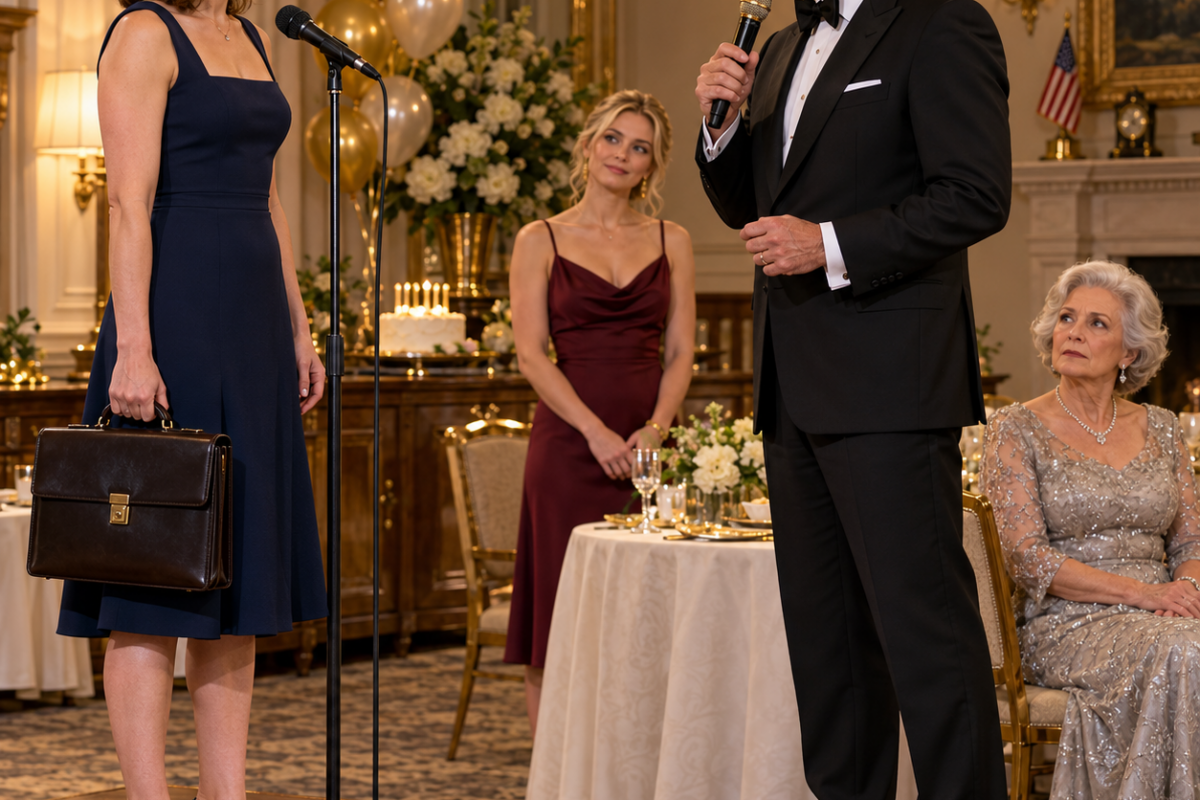
“I already promised your house to your sister,” my father told me four days after I bought it. “They’re moving in Monday. Rent-free for three years.” I was thirty-one, had saved for nine years, and had bought the five-bedroom home entirely in my own name. When I said no, he threatened to tell the family I had abandoned my sister’s children. Days later, he took the microphone at my grandmother’s seventy-fifth birthday dinner and did exactly that.
My father called twelve times in forty minutes after discovering I had bought a house without consulting him. When I answered, he didn’t ask whether…
My mother leaned across the restaurant table, looked at my thirteen-year-old adopted daughter, and whispered, “We don’t sit with mistakes.” I took Sole’s hand and walked her out. That night, my father texted, “You’re still making the car payment tomorrow, right?” By midnight, I had canceled the payments I’d been making for my family. Then I remembered something Sole had told me about her grandmother.
My mother looked at my thirteen-year-old daughter and whispered, “We don’t sit with mistakes.” She said it softly enough to avoid attracting attention from the…
At my father’s seventieth birthday dinner, my eleven-year-old son and eight-year-old daughter were seated beside the service door with water glasses—but no dinner plates. Their cousins sat beside Grandpa with warm bread and full place settings. “They’ll eat after everyone else,” my sister said. I turned to my father, expecting him to object. “They can wait another hour,” he replied. There were two empty chairs at his table.
At my father’s seventieth birthday dinner, the first thing that stopped me wasn’t the cake or the gold balloons. It was my children. Ethan and…
“Mommy, are you real?” my four-year-old daughter whispered when I came home from deployment three weeks early. She was sitting alone on our living room floor with an empty cereal bowl. My husband was on a Caribbean cruise with his mother and sister. Twenty-two minutes earlier, they had posted a photo captioned “Family time.” I was still in uniform when Sophie asked if she could have something to eat.
The first thing my daughter said when I found her was, “Mommy, are you real?” She was sitting cross-legged on our living room floor with…
End of content
No more pages to load