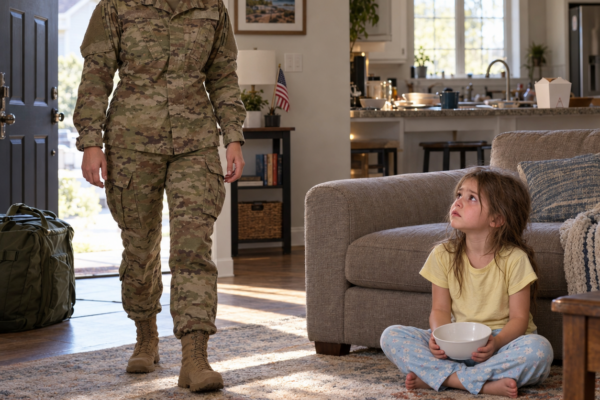
“Mommy, are you real?” my four-year-old daughter whispered when I came home from deployment three weeks early. She was sitting alone on our living room floor with an empty cereal bowl. My husband was on a Caribbean cruise with his mother and sister. Twenty-two minutes earlier, they had posted a photo captioned “Family time.” I was still in uniform when Sophie asked if she could have something to eat.
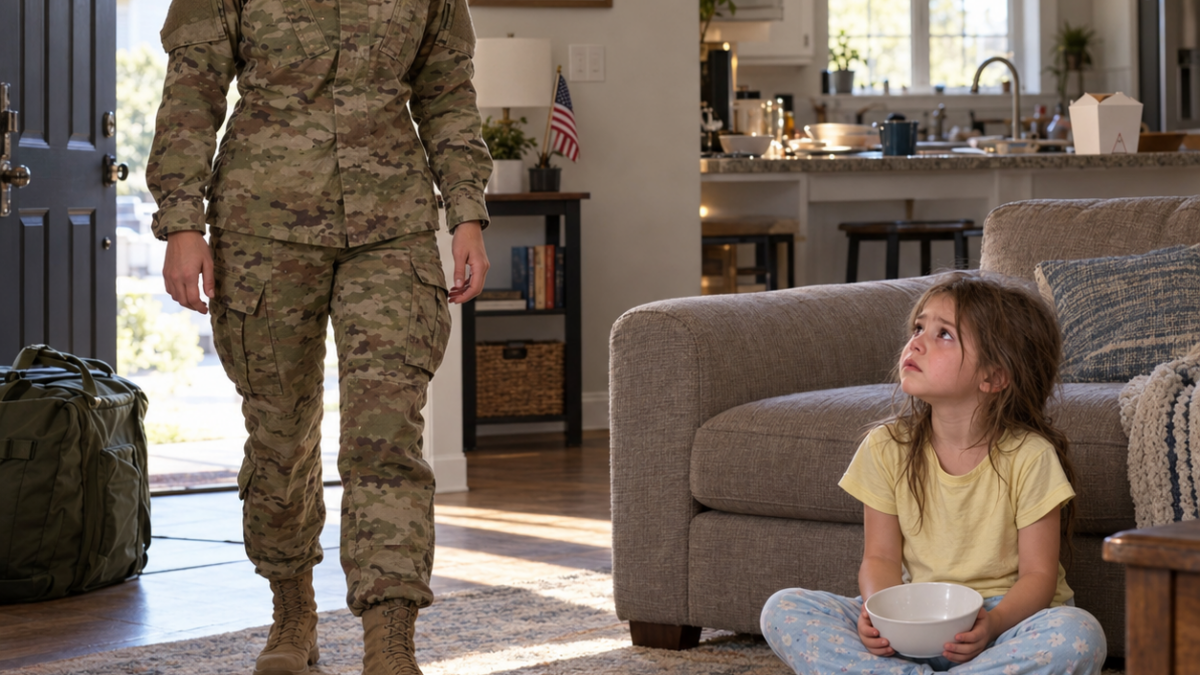
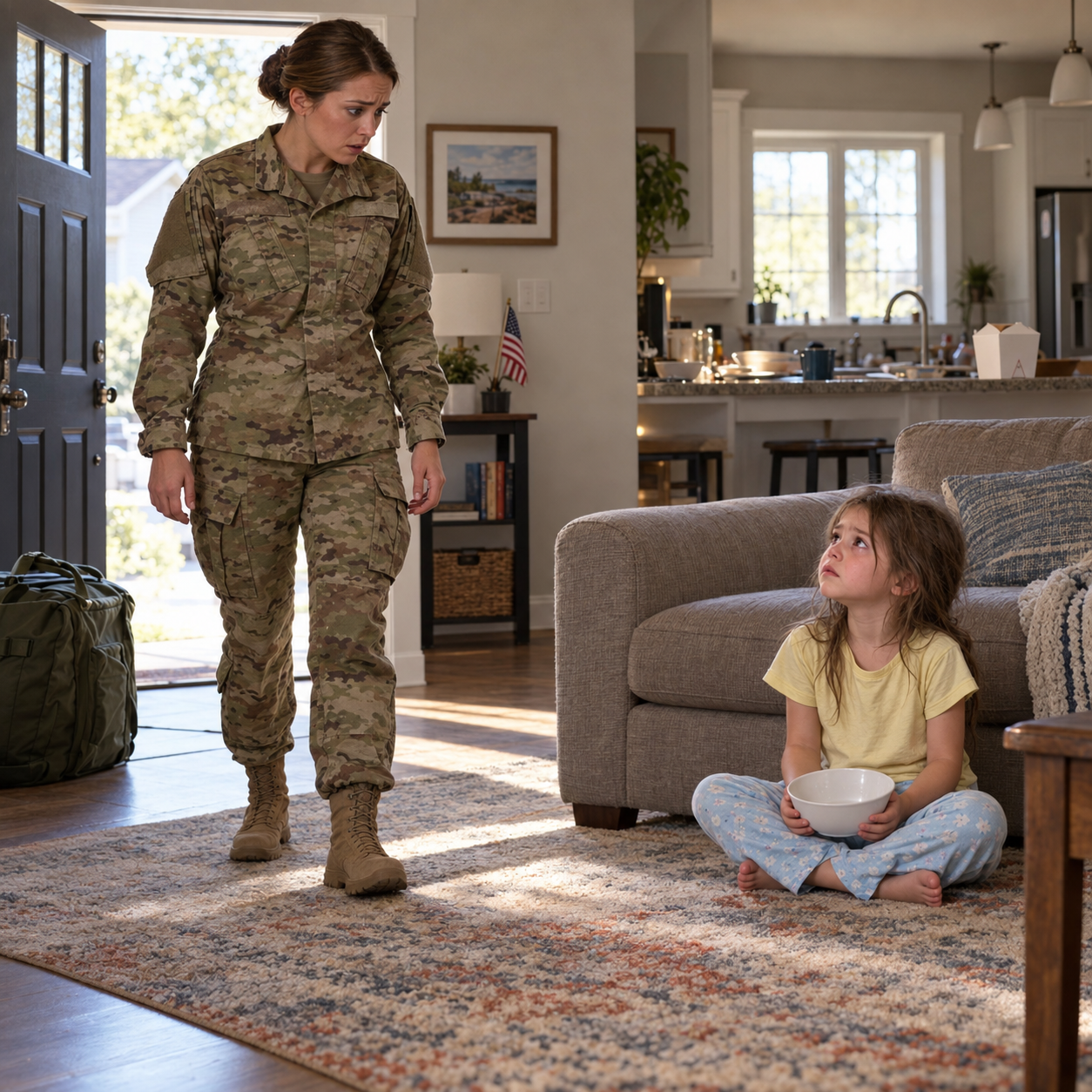
The first thing my daughter said when I found her was, “Mommy, are you real?”
She was sitting cross-legged on our living room floor with an empty cereal bowl in her lap. Her T-shirt had slipped off one shoulder, and her hair was tangled around her face. The television was playing a cartoon she used to love, but she wasn’t watching it.
She was watching me.
For a moment, neither of us moved.
I had spent almost six months imagining this reunion. In every version, Sophie came running. She shouted my name, wrapped herself around my legs, and demanded to know what I had brought her.
Instead, she asked whether I existed.
Three thousand miles away, my husband was raising a champagne glass on a Caribbean cruise.
I knew because his sister had posted the picture twenty-two minutes earlier.
I stood there in my uniform, with my duffel bag still beside the front door, and looked at the little girl I had trusted him to protect.
That was the moment my marriage ended.
Ryan just didn’t know it yet.
Three weeks earlier than expected, my supervisor had told me I was going home. I stared at him long enough that he repeated himself, probably wondering whether exhaustion had finally affected my hearing.
“Your return date changed, Claire. Start getting ready.”
I thanked him, walked outside, and cried behind a building where nobody would see.
Deployment had been difficult in ways I expected and ways I hadn’t. There were long days, bad coffee, and nights when I was so tired that taking off my boots felt like another assignment. There were also ordinary moments that hurt more than the difficult ones.
Someone would mention a child’s birthday, and I would remember missing Sophie’s.
A coworker would complain about stepping on a toy, and I would find myself wishing there were toys under my feet.
Video calls helped until they didn’t. Sometimes the connection froze with Sophie’s mouth open in the middle of a sentence. Sometimes she wandered away before I could ask her to show me the picture she was holding.
I saved screenshots anyway.
There was one of her laughing with yogurt on her chin that I looked at almost every night.
Ryan and I had been married seven years. We lived outside Newport News, Virginia, in a modest three-bedroom house with gray siding, a small backyard, and two crepe myrtles beside the driveway.
My aunt Margaret had left me the house before we married. She had owned it outright, and I inherited it without a mortgage.
I had never called it my house.
When Ryan brought his boxes through the door, it became our home. When Sophie arrived, it became the place where we learned to function on very little sleep and argued about whose turn it was to wash bottles.
The kitchen needed work. One cabinet wouldn’t close unless you lifted it slightly, and the dishwasher made a noise Ryan described as “a helicopter having a bad day.”
We kept saying we would remodel someday.
I thought we had plenty of time.
Before I deployed, we sat at the kitchen table with a notebook between us.
I wrote down the pediatrician’s number, preschool contacts, medication instructions, and the name of the stuffed rabbit Sophie needed when she had nightmares. We reviewed grocery money, utilities, insurance, and the property taxes I set aside each month.
Ryan watched me write until he finally covered my hand with his.
“Claire, stop worrying.”
“I’m her mother.”
“And I’m her father.”
“I know.”
“I’ve got this.”
I wanted to believe him. More than that, I needed to believe him.
His mother, Linda, lived less than fifteen minutes away. His sister, Melissa, was nearby too. Linda promised to help with preschool pickup and meals when Ryan’s work schedule ran late.
“You’ve got an entire family here,” she told me. “That baby won’t want for anything.”
On the day I left, she stood beside Ryan at the airport and cried while Sophie held my neck.
I thanked her for being there.
For months afterward, money went into our household account. Ryan handled the bills, and whenever I asked, he assured me everything was covered.
“Sophie’s doing great.”
“Preschool’s fine.”
“Mom took her to the park.”
I heard those sentences so often that they became part of the routine that allowed me to get through my own days.
Over the final month, though, calls with Sophie became less frequent.
She was asleep.
She was at Linda’s.
She had a cold.
She was being stubborn and didn’t want to talk.
Once, I asked Ryan to call me when she woke up. He said he would, then sent a message hours later apologizing because the day had gotten away from him.
I was disappointed, but I didn’t want every conversation to become an accusation.
Trusting someone means accepting that you cannot supervise every moment of their life.
I understood that.
What I didn’t understand was how easily Ryan had turned that trust into privacy for his mistakes.
When I learned I could come home early, I decided not to tell him.
For once, I wanted to be the surprise.
During the journey, I pictured Ryan opening the door and laughing. I imagined Sophie clinging to me while I tried to take off my boots. I imagined ordering pizza and listening to every story I had missed.
At the airport, I bought her a small stuffed bear.
It wasn’t expensive. It had soft brown fur, a blue ribbon, and an expression that looked mildly worried.
I thought Sophie would name it something ridiculous.
A friend dropped me at the house shortly after noon. Ryan’s SUV wasn’t in the driveway, but that didn’t concern me immediately. He might have been at work. Linda might have taken Sophie somewhere.
I thanked my friend, lifted my bag, and unlocked the front door.
The smell was the first thing I noticed.
Stale air. Old food. A house that had been closed up and neglected.
“Sophie?”
No answer.
I set my duffel down.
Dirty dishes filled the sink. A pizza box lay open on the kitchen counter. Two trash bags leaned against the back door.
Then I heard the television.
I walked into the living room and found my daughter on the floor.
For half a second, my mind refused to make sense of her.
Sophie had always been sturdy, with round cheeks and enough energy to wear out every adult around her. Now her pajama pants sagged at the waist. Her cheeks looked narrower. She was barefoot, and one sock lay beneath the coffee table.
“Mommy?”
I dropped to my knees.
“Baby.”
She ran into me so hard that I almost fell backward.
I held her against my chest. She smelled like sleep and unwashed hair. Her hands gripped my uniform with a strength that frightened me.
“Are you real?”
“Yes, sweetheart. I’m real.”
She began crying.
So did I.
I wanted to ask a hundred questions. Where was Ryan? How long had she been alone? Had she eaten? Had anybody slept in the house with her?
But she was four.
She didn’t need to be questioned while she was trying to believe her mother had come back.
I carried her to the couch and held her until her breathing slowed.
Every time I moved, she tightened her grip.
“I’m here,” I told her.
After a while, she leaned back enough to look at my face.
“You came early.”
“I did.”
“Daddy said lots more sleeps.”
“I got to come sooner.”
She pressed her cheek against me again.
“Good.”
I sat there longer than I intended, afraid that putting her down would feel like leaving her all over again.
Eventually, I carried her into the kitchen.
The refrigerator held milk, ketchup, two yogurts, cheese, and a container of takeout I didn’t trust. The pantry wasn’t empty, but most of what remained required cooking or reaching shelves well above Sophie’s head.
There were crackers on the counter.
An open cereal box sat beside them.
My hands began shaking.
“Sweetheart, where’s Daddy?”
She rubbed the bear’s ear between her fingers.
“On the big boat.”
“What big boat?”
“The vacation boat.”
I kept my face still.
“Who went with him?”
“Grandma.”
She thought for a moment.
“Aunt Melissa too.”
I took out my phone.
There was no message explaining that Ryan had left town. No itinerary. No caregiver’s number. Nothing telling me that our daughter was being cared for by someone other than her father.
I opened Melissa’s social media page.
There they were.
Ryan. Linda. Melissa and her husband. Two cousins.
Bright sky. Blue water. Drinks with pieces of fruit balanced on the rims.
The caption said, *Family time. Finally.*
I looked at the date.
Then I opened our bank account.
Several withdrawals and transfers appeared that I didn’t recognize. There were travel charges, hotel charges, and amounts large enough that I checked whether I had selected the wrong account.
Behind me, Sophie spoke.
“Mommy, can I have something to eat?”
I put the phone down.
That question mattered more than everything on the screen.
I made her a small sandwich, cut up an apple, and sat beside her while she ate. I offered water and checked the milk before pouring any.
She ate carefully at first.
Then faster.
Then she looked at the plate.
“Can I have the other half?”
“Of course.”
I made more.
I didn’t tell her to slow down. I didn’t ask whether Daddy had fed her. I didn’t say anything that might make her feel she needed to explain what adults had done.
I called Dr. Patel’s office from the kitchen while she finished.
The nurse listened as I described finding Sophie alone and noticing that her clothes fit differently.
She asked about symptoms, how alert Sophie was, and whether she was drinking. After speaking with the doctor, she arranged an appointment that afternoon and told me what changes would mean we needed urgent care sooner.
I wrote everything down.
Then I called the local nonemergency number and explained that I had returned unexpectedly to find my four-year-old daughter without an adult in the house.
Saying those words aloud made the situation real in a different way.
The person on the line asked whether Sophie was safe now.
“Yes. She’s with me.”
I was given instructions, and a report was made. I would speak with a child-protection worker later that afternoon.
I didn’t know exactly what would happen next.
I knew that deciding to handle this privately would not make it safer.
After lunch, I helped Sophie into the bath.
I worked conditioner through her hair while she played with an old plastic cup. She poured water from the cup into her hand and announced that she was making soup.
“That sounds good.”
“It’s pretend soup.”
“I figured.”
“You can’t eat bathwater.”
“Very good rule.”
She smiled, and I nearly cried again.
Up close, I could see the changes I had tried not to measure in the living room. I kept my voice steady.
“Who’s been here with you, sweetheart?”
“Miss Carol.”
Carol lived two houses down. She was a retired elementary school secretary in her late sixties and one of the kindest people I knew.
“Anybody else?”
“Daddy’s cousin.”
“Okay.”
“He was watching his phone.”
I nodded.
Sophie tipped the cup into the bath.
“Grandma said I had to be good.”
“You don’t have to earn someone taking care of you.”
She looked at me.
I softened my voice.
“Grown-ups are supposed to help you. Even when you’re having a hard day.”
She considered that, then returned to her soup.
I didn’t keep asking.
Later, with Sophie dressed and sitting near the open kitchen doorway, I called Carol.
She answered on the second ring.
“Claire?”
Something in the way she said my name made me grip the phone harder.
“I’m home.”
“Oh, honey.”
“I found Sophie by herself.”
Carol was quiet.
Then she said, “I thought you knew about the trip.”
“No.”
“Oh, Claire.”
She explained that two days earlier, she had noticed Sophie sitting near our front window for an unusually long time. When she came over, Sophie opened the door.
Ryan wasn’t home.
Carol made dinner and stayed until nearly ten that night. Ryan’s cousin eventually arrived and told her he was staying with Sophie.
The following afternoon, Carol saw Sophie at the window again.
She came back.
“I kept asking when her daddy was coming,” Carol said. “She said he was on a ship. I thought maybe I wasn’t understanding her.”
“You were.”
“I called the number I had for Ryan. He told me his cousin was nearby and everything was arranged.”
“Did the cousin come back?”
“For a little while. I should have insisted on knowing more.”
Her voice broke.
I closed my eyes.
Carol had trusted adults who told her a parent had made a plan. That trust had helped conceal how little of a plan existed.
“Will you write down what happened?” I asked. “Just what you saw and what they told you. Dates and times, if you remember.”
“Yes.”
“And I’ve reported it. Someone may need to speak with you.”
“I’ll tell them everything.”
I thanked her for feeding Sophie.
I didn’t tell her everything was all right.
It wasn’t.
At Dr. Patel’s office, Sophie held the bear under one arm while the nurse measured her.
I watched the numbers appear on the scale.
Dr. Patel compared them with her previous visits, then asked when I had returned.
“Today.”
“How long were you away?”
“Almost six months.”
He examined her carefully and spoke to her in the same calm voice he had used since she was a baby.
“Can you show me how big a breath you can take?”
Sophie inhaled dramatically.
“That’s a very impressive breath.”
She seemed pleased.
When he spoke to me privately, he explained that she was stable, but her weight loss required attention. He arranged testing and close follow-up, gave me instructions for meals and fluids, and said that the change likely reflected more than a couple of bad days.
That sentence stayed with me.
More than a couple of bad days.
I had returned in time to discover the worst part, but the worst part had not begun when Ryan boarded the ship.
Dr. Patel explained that the circumstances also required a report from his office.
“I’ve already called,” I said.
He nodded.
“Good. They’ll need accurate information. And you’ll need support too.”
“I’m fine.”
He looked at me kindly.
“Right now, you’re functioning. That’s useful. It isn’t the same thing.”
I didn’t answer because I knew he was right.
A child-protection worker spoke with me that afternoon. She asked practical questions and explained the immediate steps. Sophie was safe with me, but there would be an assessment of what had happened.
I gave her Ryan’s information, the names I knew, and the cruise details I had found.
She told me not to repeatedly question Sophie.
“Let her talk if she wants to,” she said. “Keep your responses simple. We’ll handle the interviews we need.”
For the first time since opening my front door, I felt that someone had taken one small piece of the responsibility from my hands.
Not enough to make me relax.
Enough to help me breathe.
That evening, Sophie fell asleep beside me.
One fist stayed closed around my sleeve.
I waited until she was sleeping deeply before easing away and opening my laptop at the kitchen table.
Ryan and I shared an email account for household bills. I had access to it during deployment but rarely checked beyond the messages he forwarded.
Now I searched for travel confirmations.
The first cruise deposit had been paid three months earlier.
Then airfare.
A hotel in Miami.
Additional payments.
Six passengers were listed on the reservation. Ryan Bennett. Linda Bennett. Melissa Carter. Melissa’s husband. Two cousins.
Sophie’s name wasn’t there.
Mine wasn’t either.
I sat staring at the screen.
Ryan hadn’t impulsively decided he needed a weekend away. He had planned this for months.
He had made payments while telling me that preschool was covered and the emergency savings were fine.
I downloaded statements from accounts I was authorized to access and saved the reservation emails. I made a timeline.
As I compared dates, another pattern became visible.
Preschool payments had stopped.
Grocery spending had dropped.
Transfers into unfamiliar accounts had increased.
There were still ordinary purchases mixed among them, enough to make the statements look normal if you didn’t examine them carefully.
I remembered asking Ryan whether Sophie was enjoying preschool.
He had said she was going through a clingy phase.
“She cries at drop-off. We’re taking a little break.”
I had suggested talking to her teacher before withdrawing her.
He said he would.
He hadn’t.
I emailed the director, asking for a call the next morning and a copy of the account history.
Then I sat back.
The house was quiet except for the refrigerator and the old dishwasher.
I could hear both now.
There had been years when those sounds meant the day was finished, our daughter was asleep, and everything important was where it belonged.
That night, they sounded like machinery in a place I didn’t recognize.
The family tablet lay on the sideboard.
Ryan had left a messaging account open. Notifications were visible on the screen.
I hesitated.
I wasn’t interested in reading every private conversation he had ever had. But a family thread showed my name beside a message about the cruise, and I had already found our daughter alone.
I photographed what was visible and made a note to ask an attorney how to handle the device.
Linda had asked whether using that much money for the vacation was a good idea.
Ryan’s answer was beneath it.
*Claire’s overseas. She won’t know.*
Melissa had responded with a laughing emoji.
*Military money finally buying us something fun.*
I read that line three times.
There was another exchange.
Linda: *Who has Sophie while we’re gone?*
Ryan: *It’s handled. Stop worrying.*
No caregiver’s name.
No schedule.
No emergency plan.
At eleven forty-three, I called a family-law attorney whose number another military spouse had given me months earlier.
Rebecca Sloan’s answering service picked up.
I briefly described what had happened.
An appointment was arranged for nine the next morning.
I closed my laptop and went back upstairs.
Sophie had rolled into the space I left.
I lay beside her.
She reached for me without waking.
For the first time in months, I was exactly where I had wanted to be.
I had never felt less certain about the rest of my life.
Carol came over early the next morning so I could meet Rebecca. I explained the appointment to Sophie without giving her adult details.
“Miss Carol will stay here while I talk to someone who’s helping me.”
“Are you coming back?”
“Yes. After my appointment.”
“Before lunch?”
“Before lunch.”
I showed her the clock and explained where the hands would be when I expected to return. Carol stayed beside her, and I kissed her forehead three times because she requested three.
Then I drove to Rebecca’s office.
I brought bank statements, medical instructions, reservation confirmations, and the notes I had made about the house.
Rebecca listened without interrupting.
When I finished, she asked whose name was on the deed.
“Mine.”
“Only yours?”
“My aunt left it to me before we married.”
“And there’s no mortgage?”
“No.”
She made a note.
Then she looked directly at me.
“Ownership matters. So do marital occupancy, finances, and custody. We handle all of them correctly.”
“I don’t want him coming home and pretending this didn’t happen.”
“That doesn’t mean you should try to solve it by yourself.”
She asked whether I had reported the neglect.
I told her about the calls, the pediatrician, and the assessment.
“Good. We’ll coordinate with the appropriate process. My job is to advise you, not replace it.”
I felt myself beginning to shake.
I pressed my palms against my knees.
Rebecca waited.
Then she said, “What do you need most urgently?”
“For Sophie to be safe.”
“That’s first.”
“And I need to know I can stay in my house.”
“We’ll address that.”
“And the money.”
“We’ll document it. Don’t empty the joint account. Don’t hide assets. Redirect future deposits into an account you control, and preserve records.”
She paused.
“Claire, you don’t have to prove you’re calm by doing nothing. But everything you do should have a purpose.”
I nodded.
She explained that we would seek appropriate temporary arrangements regarding Sophie and the home. She would contact Ryan and make clear what was being requested and what needed to happen when he returned.
He was entitled to seek his own advice.
I was entitled to seek mine.
Neither entitlement erased what he had done.
“What about his mother and sister?” I asked. “They both have keys.”
“They don’t live there?”
“No.”
“Then we can address their access separately. But don’t assume changing a lock settles Ryan’s right to enter. We need an agreement or an order governing that.”
It wasn’t the dramatic answer someone might have given me over coffee.
It was better.
I left with a plan instead of a speech.
When I returned, Sophie was waiting near the window.
“You came before lunch.”
“I said I would.”
She wrapped both arms around my leg.
Carol and I exchanged a look over her head.
That afternoon, I spoke with the preschool director.
She sounded relieved to hear from me.
“We tried contacting you through the numbers on file,” she said. “Ryan told us your availability was limited overseas.”
She explained that Sophie’s attendance had become irregular before stopping. Staff had noticed that she was quieter and more tired. They had asked Ryan questions.
He said she wasn’t sleeping well because she missed me.
My absence had become the explanation for everything.
The director sent records and offered to arrange a gentle return once Sophie’s doctor agreed.
“We can start with shorter mornings,” she said. “There’s no rush.”
I thanked her.
After the call, I sat on the kitchen floor beside Sophie while she built a tower.
“Are you doing work?” she asked.
“Some.”
“Can you do blocks?”
“Yes.”
I put the phone face down.
We built until the tower collapsed, then built again.
Later, after discussing access with Rebecca and putting the necessary arrangements in motion, I called a locksmith.
A man named Dennis came the following afternoon.
Sophie sat on the front steps with Carol, eating strawberries from a plastic bowl, while he replaced the exterior locks.
I watched him remove the old deadbolt.
Linda had let herself into our house for years.
Sometimes she knocked. Sometimes she didn’t. Once, she arrived while I was in the shower and started reorganizing a kitchen drawer because she thought I kept the utensils in the wrong place.
Ryan told me she was trying to help.
I had said it wasn’t about the drawer.
He said I was making a small thing difficult.
After enough conversations like that, I started choosing silence.
Standing beside Dennis, I realized how often silence had been mistaken for permission.
He handed me the new keys.
“Need extras?”
“Three is enough.”
I didn’t feel triumphant.
I felt tired.
A lock was a simple object. The reasons I needed a new one were not.
Rebecca made sure Ryan was informed through the proper channels about access and the temporary arrangements being sought. I did not pretend that a new deadbolt gave me powers the law hadn’t granted.
It did, however, mean Linda and Melissa could no longer walk in simply because they were accustomed to it.
I opened an individual account for future deposits and changed passwords on accounts that belonged solely to me.
The bank reviewed unfamiliar transactions. A card on which Ryan was only an authorized user was suspended while I discussed the account with the issuer.
I kept records of every step.
By evening, the dining table was covered with documents.
Carol arrived with chicken soup and cornbread.
“You need to eat.”
“I’m fine.”
“That’s what exhausted people say right before they discover they’ve been living on coffee and indignation.”
Despite everything, I laughed.
She placed a bowl in front of me.
“Eat.”
Sophie sat between us and dipped cornbread into her soup. She asked whether bears liked chicken.
“Some probably do,” Carol said.
Sophie held the stuffed bear near the bowl.
“He’s just smelling.”
“That’s very considerate.”
At seven eighteen, my phone buzzed.
Ryan.
*Hey, babe. Everything’s good here. Sophie misses you like crazy.*
Our daughter was sitting beside me.
My husband was at sea.
He was still telling me everything was good at home.
I showed Carol the screen.
She covered her mouth.
Another message appeared.
*Wish you were here. We’ll do something together when you get back.*
I read it until the words began to look strange.
Rebecca had advised me to keep communication brief while immediate safety and legal arrangements were being organized. Records had been preserved, and the people handling the neglect assessment were making their own contacts.
I didn’t want to start an argument with Sophie sitting at the table.
I typed, *We need to speak about Sophie. Please make yourself available.*
Then I put the phone away.
I wasn’t going to reassure him that his lie had worked.
I also wasn’t going to conduct the collapse of our marriage over my daughter’s soup.
That night, Sophie asked me to leave her bedroom door open.
“Of course.”
“And the light?”
“The hallway light?”
She nodded.
I turned it on.
When I returned to her bed, she was sitting upright.
“What happens if I wake up?”
“You can call me.”
“What if you don’t hear?”
“I’m right across the hall. I’ll check on you too.”
She looked unconvinced.
I sat beside her.
“We’ll practice.”
I walked into the hall.
“Mommy?”
“I’m here.”
Again.
“Mommy?”
“I’m here.”
She made me do it four times.
On the fifth, she smiled.
I stayed until she fell asleep.
Then I went into the bathroom, turned on the fan, and cried where she couldn’t hear.
The next morning, I took her grocery shopping.
It should have been ordinary. A cart with one wheel that pulled left. A crowded produce section. Someone blocking the eggs while they compared prices.
After months away, it felt almost sacred.
Bananas. Oatmeal. Yogurt. Chicken. Peanut butter. The fruit Dr. Patel suggested. Foods I knew how to prepare and knew Sophie would eat.
She pointed at a box of chocolate cereal.
“Daddy says that costs too much.”
I stopped the cart.
There are things children repeat without understanding their weight.
That was one of them.
“We can get some today.”
Her face brightened.
“For my bowl?”
“For your bowl.”
At home, she watched me put groceries away.
“This stays here?”
“Yes.”
“And tomorrow?”
“Yes.”
I kept unpacking because I didn’t want her to feel watched.
“There will be food tomorrow too, sweetheart.”
She picked up an orange and carried it to the fruit bowl with great care.
While she colored later, I sorted additional household records and sent material to Rebecca. I did not keep searching through Ryan’s accounts on my own. The device and the records already preserved would be handled with guidance.
One set of messages concerned Linda’s apartment.
She wasn’t planning to renew her lease.
She was planning to move into our house after the cruise.
Ryan had said he would “handle Claire” when I returned.
Melissa had written that I was barely home anyway, so why would I care?
Linda replied that it was basically Ryan’s house too.
There was discussion of turning the downstairs office into Linda’s room. Our three bedrooms were upstairs, but she didn’t like the stairs. Ryan suggested moving my desk into a corner of our bedroom.
My desk held photographs, work documents, and the sewing basket Aunt Margaret had left me.
It wasn’t irreplaceable furniture.
It was space I had been allowed to believe was mine.
They had made decisions about it while I was away and reduced my possible objection to a problem Ryan could manage.
I called Rebecca.
“There’s something else.”
I sent the messages.
She called back after reviewing them.
“Don’t argue with his mother about this,” she said. “She can make housing arrangements somewhere else. We’ll keep the questions about your home in the proper process.”
I packed Linda’s belongings from the guest room carefully.
A robe. Slippers. Toiletries. A framed photograph.
I labeled two boxes and placed them in the garage, making a list of what they contained.
I didn’t throw anything out.
There was no pleasure in touching her things.
Mostly, I wondered how a woman could leave her slippers in my house, take my money for a vacation, and fail to ask who would hold my daughter if she woke up frightened.
A family friend called that evening.
She had heard from Melissa that I was “upset about the cruise.”
That description almost made me laugh.
“I’m dealing with a serious situation concerning Sophie,” I told her. “I’m not discussing details socially.”
“Of course. I just thought perhaps everyone could sit down.”
“Not right now.”
“She’s always been such a close family.”
I looked toward the living room, where Sophie was lining up stuffed animals.
“Then they have a lot to think about.”
After we hung up, I understood that another task had begun.
I would have to refuse the version of events that made other people comfortable.
Not by posting everything online.
Not by turning Sophie’s medical information into evidence for an audience.
By saying enough to stop the story from being reduced to a wife resenting a vacation.
The call from Ryan came the next afternoon.
Sophie was coloring on the living room rug. I was folding towels when my phone began vibrating across the coffee table.
I watched his name appear.
Then I answered.
“Hello.”
“What did you do?”
No greeting.
No question about the message I had sent.
“What are you talking about?”
“My card got declined.”
Music played behind him. I could hear glasses and conversation.
“I tried paying for Mom’s spa package, and it wouldn’t go through.”
I looked at Sophie.
She held up a purple horse.
“It’s beautiful,” I told her.
Ryan went quiet.
“Who are you talking to?”
I set down the towel.
“Where is Sophie, Ryan?”
“What?”
“Where is our daughter?”
“She’s fine.”
“That wasn’t my question.”
“She’s being taken care of.”
“By whom?”
“My cousin. Mom arranged some things.”
“Where is Sophie right now?”
A door opened on his end. The music became quieter.
“Claire, what’s going on?”
“She’s sitting twenty feet away from me.”
For several seconds, I heard nothing.
“You’re home?”
“Yes.”
“But you weren’t supposed to be.”
“I came home early.”
“Why didn’t you tell me?”
I almost laughed.
Instead, I walked into the kitchen where Sophie could still see me but wouldn’t hear every word.
“I found her alone.”
“She wasn’t alone.”
“Yes, she was.”
“No, that’s not—”
“I took her to Dr. Patel.”
His breathing changed.
“She’s lost weight. There are reports. The situation is being assessed.”
“You’re making this sound worse than it was.”
There it was.
Not *Is she okay?*
Not *Who was supposed to be there?*
An argument about how his actions sounded.
I leaned against the counter.
“You don’t know how it was. You weren’t here.”
“I had people checking on her.”
“She is four.”
“I know how old she is.”
“Then you know checking on her isn’t a care plan.”
Linda’s voice sounded in the background.
“What’s happening?”
Ryan muttered something.
Then Linda was on the phone.
“Claire, what have you done to the bank cards?”
“You haven’t asked how Sophie is.”
“What?”
“Your granddaughter. You haven’t asked.”
“Of course I care about Sophie.”
“Then ask.”
There was a pause.
“Is she all right?”
“She needs medical follow-up. She was alone when I arrived.”
“Ryan told us everything was arranged.”
“Apparently it wasn’t.”
“Well, I don’t appreciate you disrupting our vacation over some misunderstanding.”
I looked at the wall above the stove.
A small framed drawing hung there. Sophie had made it before I deployed. Three people beneath a yellow sun.
“This isn’t a misunderstanding.”
“We planned this for months.”
“I know.”
That stopped her.
“What do you mean?”
“I saw the reservations and the payments.”
“That money belongs to Ryan too.”
“Some of it does. My attorney is reviewing the finances.”
“Your what?”
“Attorney.”
Behind her, Ryan said, “Give me the phone.”
Linda ignored him.
“You hired a lawyer?”
“Yes.”
“For what?”
“To protect Sophie and deal with what’s happened.”
“This is ridiculous.”
“No, Linda. A four-year-old being left with uncertain care while her father vacations out of the country is serious.”
“She had people checking—”
“That isn’t enough.”
Linda began talking faster.
“Ryan said his cousin was staying. We didn’t know—”
“Then cooperate with the people asking questions. Give them accurate information.”
“Claire, wait.”
“I’m ending this call. Rebecca will communicate about the next steps.”
I hung up.
My hands were shaking.
I stood still until I could trust my voice.
Then I went back into the living room.
Sophie looked up.
“Daddy?”
“Yes.”
“Is he coming home?”
“In a few days.”
“Are you going away again?”
I sat on the floor beside her.
“Not today.”
“Tomorrow?”
“No.”
She leaned into me.
I wanted to promise forever.
I couldn’t make a promise my job and the rest of life might not allow me to keep.
So I made the promise I could keep.
“I will tell you what’s happening. You’ll know who’s taking care of you. You won’t be left to figure it out by yourself.”
She was too young to understand every word.
She understood that I stayed beside her.
That night, Ryan called eleven times.
I didn’t answer while Sophie was awake.
His messages moved through several versions of the same event.
We needed to talk.
I was overreacting.
Linda hadn’t known.
Then it was his fault, and I should leave his mother out of it.
Then he loved us.
Then he asked whether I had told anyone.
I forwarded the messages to Rebecca and kept a copy.
The final question told me something the earlier ones hadn’t.
Even then, he was trying to measure the damage to himself.
Rebecca sent formal correspondence the next morning. It addressed immediate concerns, requested preservation of relevant records, and set out the temporary arrangements we were seeking.
Ryan had already been contacted as part of the child-safety assessment. Now there was no way to pretend the matter would disappear when he came home.
He called.
Linda called.
Melissa called.
Around noon, Melissa sent a message.
*You ruined the last three days of Mom’s vacation. She’s been crying all morning.*
I read it twice.
Through the kitchen window, I could see Sophie helping Carol water flowers.
She wore pink shorts and a sun hat. Carol pretended to be shocked each time Sophie sprayed her shoes.
My daughter laughed.
It was a real laugh, sudden and unguarded.
I started typing a response to Melissa.
Then I deleted it.
There was nothing I could explain to someone who still thought the important injury was a spoiled vacation.
That evening, Ryan left a voicemail.
His voice sounded different.
“Claire, I know you’re upset. We can fix this. Just don’t do anything until I get home.”
I listened once.
Then I sent it to Rebecca.
The ship was scheduled to return to Miami the following morning. Ryan apparently believed being back in Virginia would restore his ability to manage the conversation.
He would sit across from me.
He would apologize just enough.
He would say he had been stressed.
He would say Linda meant well.
He would say Sophie was all right now.
And I would do what I had done in smaller situations for years: absorb the consequences so the family could return to its preferred shape.
But I wasn’t waiting for him to fix anything.
I was arranging care, keeping appointments, answering questions, and learning how much had been hidden.
By the time he reached port, the version of me he expected to return to was gone.
Ryan did not come straight to the house after landing in Norfolk.
Through counsel, we had agreed on immediate practical arrangements while the requested temporary measures were addressed. He stayed at a hotel near the airport.
That distance mattered.
Sophie didn’t need her father arriving with luggage and an argument.
I didn’t need to negotiate in the doorway of the place where I had found her alone.
Rebecca arranged a meeting for the following morning. Ryan was encouraged to obtain his own legal advice, and the meeting was voluntary.
There would be no Linda.
No Melissa.
No Sophie.
I arrived ten minutes early.
Ryan came five minutes late, wearing jeans and a navy polo shirt. His face was tired, and the color he had acquired on the trip seemed wrong in the quiet conference room.
He looked at the folders in front of me.
“Is this really necessary?”
“Yes,” Rebecca said.
He sat down.
For a few seconds, nobody spoke.
Then he looked at me.
“How’s Sophie?”
It was the first time he had asked me directly without being prompted.
“She’s eating regularly. We have follow-up appointments.”
His face tightened.
“I never meant for her to—”
“Don’t start there.”
He leaned back.
“Where do you want me to start?”
I opened the first folder.
Bank statements.
Cruise deposits.
Airfare.
The hotel.
Additional travel charges.
“Start with the money.”
He glanced at Rebecca.
“It was our account.”
“I know.”
“So I didn’t steal from you.”
“I’m not making a legal conclusion. I’m asking why money intended for our household and our child paid for a family vacation you concealed.”
“It wasn’t all your money.”
“No. But some of it was. And you repeatedly told me the bills and preschool were covered.”
He rubbed his jaw.
“Mom had wanted this trip for years.”
“And you decided that made it more important than paying preschool?”
“It wasn’t like that.”
“What was it like?”
He didn’t answer.
I moved to the next folder.
The preserved messages.
*Claire’s overseas. She won’t know.*
His expression changed.
“Where did you get that?”
“The tablet.”
“Those were jokes.”
“Which part?”
He stared at the page.
“The part about me not knowing? Or the part about using military money for something fun?”
“I shouldn’t have said that.”
“No.”
Rebecca let the silence remain.
I showed him the question about Sophie’s care.
He looked down.
“My cousin was supposed to stay.”
“For the entire trip?”
“Yes.”
“Did you get confirmation?”
“We talked.”
“Did you give him emergency contacts?”
“He knows where Mom lives.”
“Your mother was on the ship.”
Ryan shut his eyes briefly.
I kept going.
“Did you tell him when you would return? Did you leave a schedule? Did you check with the preschool? Did you have a backup adult who had agreed to take over?”
“I thought—”
“What did you verify?”
He said nothing.
That was the answer.
Later interviews and records would help clarify who had been present and when. The cousin had stayed for part of the time, then left after communicating that he could not continue. There were disputed details about what Ryan understood and when he understood it.
What wasn’t disputed was that he had no confirmed replacement.
He kept enjoying his vacation anyway.
I slid Dr. Patel’s documentation across the table.
Ryan stopped touching the other papers.
“She’s going to be okay?”
“We’re doing what she needs.”
“I didn’t know it was that bad.”
I believed him.
That was one of the hardest things to accept.
He hadn’t needed to know precisely how bad it was in order to prevent it.
He had needed to act like her father before reaching the point where a medical report could frighten him.
“I thought Mom handled it,” he said.
“Did your mother tell me Sophie was safe during our calls?”
He looked up.
“No.”
“Did your mother say preschool was paid?”
“No.”
“Did your mother decide to stop putting Sophie on video calls?”
His jaw tightened.
“No.”
“You did.”
He stared at his hands.
“I was trying not to stress you out.”
“You were trying not to answer questions.”
He flinched.
For years, I had interpreted Ryan’s behavior as conflict avoidance.
He hated disappointing Linda.
He disliked uncomfortable conversations.
He would promise one thing to her and another to me, then act surprised when those promises collided.
I had called it weakness because weakness sounded easier to forgive.
Sitting across from him, I saw something more specific.
He avoided responsibility.
He told each person what they wanted to hear, then expected someone else to handle the result.
Usually, that person was me.
I showed him the messages about Linda moving in.
“That wasn’t final,” he said.
“She wasn’t renewing her apartment.”
“She was considering—”
“You discussed where her bed would go.”
“She’s my mother.”
“And you were supposed to discuss our home with your wife.”
He looked at Rebecca as though there might be a way to translate this into a smaller problem.
Rebecca remained quiet.
“I didn’t mean ‘handle Claire’ like that,” he said.
“How did you mean it?”
He had no answer.
I remembered every time I had worked late and still made dinner because he didn’t feel like deciding what to cook. Every form I completed because paperwork stressed him out. Every conversation with Linda I softened because he didn’t want anyone upset.
None of those things alone had destroyed our marriage.
Together, they had taught him that discomfort was something other people would remove for him.
And I had helped teach that lesson by doing too much.
Recognizing my part in a pattern did not make me responsible for what he had done to Sophie.
It did tell me what I could no longer continue.
Ryan covered his face.
“Mom pushed hard for the cruise.”
“Explain your choices.”
He lowered his hands.
“I knew it was too much money.”
I waited.
“I knew I should have stayed.”
Still, I waited.
“Everybody kept saying Sophie would be fine.”
“And you wanted to believe them.”
“Yes.”
The word came out quietly.
It was the most honest thing he had said.
“Thank you,” I told him.
He looked confused.
“For admitting there was a choice.”
His eyes filled.
“I love you.”
I felt real sadness then.
Once, those words could have changed the direction of an argument. They could have reminded me why I was trying.
Now they couldn’t change the next five minutes.
“Love has to include taking care of the people who depend on you.”
“I know.”
“I don’t know whether you do yet.”
He looked at the folders.
“What happens now?”
“We separate.”
His head lifted.
“Claire—”
“You participate in the assessment. You get whatever help is required. We establish a safe arrangement for Sophie, and you follow it.”
“And us?”
“I’m not making promises about us.”
He nodded slowly.
Rebecca explained the practical next steps. There would be more paperwork, more discussion, and decisions that could not be settled by a single meeting.
Ryan listened.
When I gathered the folders, he stayed seated.
At the door, he said my name.
I turned.
“I thought you’d always fix things.”
I looked at the man I had trusted for seven years.
“That was never a plan for taking care of our daughter.”
Then I left.
For the first few weeks after he came home, people asked whether I felt better.
They meant well.
Carol asked.
A friend from my unit asked.
Rebecca asked after we finished reviewing another group of records.
I gave them the same answer.
“I feel clear.”
Better was something else.
Better would take time.
The assessment involved interviews, records, and uncomfortable questions. I answered them as accurately as I could, including questions about why I hadn’t become more concerned during deployment.
I described the missed calls and Ryan’s explanations.
I didn’t improve my own version to make myself look more attentive.
There were things I wished I had questioned sooner.
That was painful enough without pretending otherwise.
The worker who spoke with me was careful.
“You relied on the child’s other parent,” she said. “That matters. What matters now is having a plan that does not rely on assumptions.”
I carried that sentence home.
I updated emergency contacts. I made sure the preschool had my current information and knew how to reach another trusted adult if I was unavailable.
I reviewed my military family-care arrangements with the appropriate people.
I spoke with my leadership about the situation and requested the leave and support available to me.
I didn’t expect anyone to erase my obligations.
I needed to organize them around the fact that the arrangement I had relied on was no longer safe.
A friend from my unit came over one afternoon and brought dinner.
She didn’t ask whether I should have trusted Ryan.
She asked whether I needed someone to sit with Sophie during an appointment.
I nearly cried from gratitude.
There is a particular kind of help that feels like an accusation because it arrives with advice about what you should have done.
Hers arrived with a casserole and a calendar.
Ryan moved into a small furnished apartment about fifteen minutes away.
His contact with Sophie began under a structured arrangement informed by the assessment and professional guidance. There were conditions, clear schedules, and supervision where required.
I did not decide casually that an apology made him safe.
I also did not make Sophie carry the weight of my anger.
Before her first visit, she asked whether Daddy was still on the boat.
“No.”
“Does he have a house?”
“He has an apartment.”
“Do I have to sleep there?”
“Not now.”
She looked relieved, then guilty.
“Is Daddy sad?”
“Daddy can talk to grown-ups about his feelings. You don’t have to fix them.”
She nodded.
I wondered how many years earlier someone should have said the same thing to Ryan.
The first visit was difficult.
Sophie went quiet when she saw him.
He crouched and opened his arms, but she stayed beside the supervising adult.
He looked toward me.
I didn’t tell her to hug him.
I didn’t say, “Don’t hurt Daddy’s feelings.”
She was allowed to decide whether she wanted physical affection.
Ryan lowered his arms.
“Hi, sweetheart.”
“Hi.”
He brought a coloring book and asked whether she wanted to show him how to make a dinosaur.
After several minutes, she sat beside him.
It was a small beginning.
It did not erase anything.
When she came home, she asked for soup and wanted the hallway light on again.
I gave her both.
Linda sent messages for almost three weeks.
Some were angry.
Some were apologetic until the next sentence explained why she wasn’t really responsible.
One was six paragraphs long and described what she had sacrificed while raising Ryan.
I read enough to understand what she was asking me to do.
Remember her suffering.
Consider her intentions.
Recognize her age.
Then return to the family arrangement that made her comfortable.
I didn’t answer.
Rebecca handled necessary communication. Information relevant to Sophie’s care went through the appropriate channels.
The rest could wait.
Melissa sent one more message telling me that Linda was “falling apart.”
I replied once.
“Please direct practical matters to Rebecca. I’m focused on Sophie.”
After that, I stopped engaging.
At night, however, the messages still lived in my head.
I would wake and remember the photograph.
Six smiling adults.
A caption about family.
My daughter alone with a bowl.
I began speaking with a counselor.
The first session felt awkward. I had spent years being useful in stressful situations. Sitting in a room while someone asked how I felt seemed like a poor use of time.
I told her that.
She smiled slightly.
“Do you believe your feelings only deserve time when they interfere with your work?”
I looked away.
“I don’t know.”
We started there.
I talked about guilt.
About the video calls I should have insisted on.
About deciding to surprise Ryan.
About leaving in the first place.
She did not tell me that every decision I had ever made was perfect.
She helped me distinguish regret from responsibility.
“You can wish you had known sooner,” she said. “That does not mean you caused what happened.”
I needed to hear that more than once.
Sophie began seeing a professional experienced in working with young children. Some sessions looked like play. Some involved me learning how to respond when she asked the same question repeatedly.
“Are you staying?”
“Yes.”
“After dinner?”
“Yes.”
“After I sleep?”
“I’ll be here when you wake up.”
There were days when I answered calmly ten times and then had to step into the laundry room after the eleventh.
I didn’t resent her.
I resented the fact that reassurance had become work she needed to request.
Her appetite improved gradually.
Her sleep took longer.
At the follow-up appointment, Dr. Patel explained what progress he saw and what he still wanted to monitor.
I listened without trying to hurry him toward an all-clear.
Sophie asked whether the scale knew her name.
“No,” he said. “It just tells us a number.”
“Then how do you know it’s mine?”
“Because you’re the person standing on it.”
She thought that was very funny.
I laughed with her.
A month earlier, I wouldn’t have believed I could laugh in that office.
One Saturday morning, Linda appeared on my porch.
I checked the camera before opening the door.
For once, she waited.
There was no key turning in the lock.
No cheerful call announcing she was already inside.
Sophie was with Carol, making paper flowers at Carol’s kitchen table.
I opened the door but stayed in the doorway.
“Hello, Linda.”
“Can I come in?”
“What do you want to discuss?”
Her lips tightened.
“I’d like to talk.”
I considered saying no.
Then I told her she could come in for a short conversation.
She walked into the living room and looked around as though she expected the furniture to have changed.
Her gaze stopped on a photograph of Ryan holding newborn Sophie.
“I miss her.”
“I know.”
Linda sat on the couch.
I took the chair across from her.
“I know you think I’m a monster.”
“I think you went on vacation without making sure your granddaughter had reliable care.”
“Ryan said his cousin was staying.”
“And when you asked during the cruise?”
“He said everything was fine.”
“You accepted that.”
She looked at her hands.
“Yes.”
I did not show her every medical page. Sophie’s privacy mattered, even within the family. I explained the documented concerns and showed her a limited summary of the information relevant to what had happened.
Then I showed her Carol’s factual account.
Linda read slowly.
Her face changed.
“She was alone?”
“Yes.”
“More than once?”
“Yes.”
She put a hand over her mouth.
“I didn’t know.”
“You didn’t check.”
Her eyes lifted sharply.
I kept my voice steady.
“You asked one question. He said it was handled. You had reasons to ask more, and you didn’t.”
Tears filled her eyes.
“You think I wanted Sophie to go hungry?”
“No.”
She looked startled.
“I think you wanted the trip so badly that you accepted answers that let you enjoy it.”
She stared at the page.
After a long silence, she said, “Ryan told us you were doing very well financially.”
“What does that have to do with Sophie being alone?”
“Nothing.”
She wiped her face.
“I know. I’m explaining what he told us about the money.”
I waited.
“He made it sound like there was extra. Deployment benefits. Savings. He said it wouldn’t affect anything.”
“And you didn’t ask me.”
“No.”
“Even though you knew I didn’t know about the trip.”
She nodded.
That was different from her earlier messages.
There was no speech about how much she had sacrificed.
No complaint that I misunderstood her intentions.
No attempt to make me apologize for her embarrassment.
“I was selfish,” she said.
“Yes.”
She flinched, but I did not soften the answer.
“I wanted that vacation. When Ryan offered to help pay, I didn’t ask enough questions.”
“No.”
“And when he said Sophie was taken care of, I accepted it because that was convenient.”
I breathed out slowly.
There it was.
Responsibility.
Not complete repair.
Not enough to restore access.
But something I could recognize.
“I’m sorry, Claire.”
“I hear you.”
“Can you forgive me?”
I looked toward the kitchen.
For years, that question would have trapped me. I would have felt compelled to answer quickly, worried that anything less than forgiveness made me cruel.
Now I knew I could take time.
“I hope I can,” I said. “But forgiveness won’t make the arrangements go back to what they were.”
“I want to see her.”
“That has to happen safely, with the right guidance and boundaries.”
“I’m her grandmother.”
“Yes. That means your decisions matter.”
She looked down.
After a moment, she nodded.
We discussed her belongings in the garage. She arranged a time to collect them.
She did not ask about moving in.
I did not offer.
When she left, she paused beside the new lock.
I saw her notice it.
Neither of us said anything.
Later that afternoon, Carol brought Sophie home.
My daughter carried a paper flower with seven uneven petals.
“This is yours.”
“It’s beautiful.”
“Miss Carol said flowers don’t all look the same.”
“She’s right.”
Sophie placed it in a cup on the table.
I looked at it for a long time.
That evening, I told Carol about Linda’s visit.
“Do you think she means it?” she asked.
“I think she meant it today.”
Carol nodded.
That was all I could honestly say.
Change would have to continue after the shame became less immediate.
The financial work took months.
There was no single meeting where every dollar was returned and everyone admitted every mistake.
Rebecca helped trace expenditures and distinguish ordinary household spending from travel payments and disputed transfers.
Some charges belonged to Ryan.
Some involved relatives.
Some questions were resolved through records, and others required discussion between attorneys.
I learned to stop expecting the numbers to provide an emotional answer.
A statement could tell me where money went.
It couldn’t tell me why Ryan thought our daughter’s needs could wait.
The house required its own careful handling.
The inheritance documents and title records mattered, but Rebecca still reviewed whether there were claims related to marital contributions or other issues.
I gave her what she requested.
I did not confuse being right about the betrayal with being automatically right about every legal question.
That distinction saved me from decisions I might have regretted.
Ryan cooperated more than I expected.
At first, I wondered whether cooperation was another strategy.
Perhaps it was partly fear.
Perhaps counseling helped.
Perhaps hearing adults outside the family describe his conduct made it impossible to keep calling it a misunderstanding.
I didn’t need to settle the question immediately.
I watched what he did.
He attended appointments he was required to attend.
He provided records.
He stopped asking me to conceal the situation from people involved in assessing it.
He began counseling and completed the parenting work recommended to him.
He did not become a different man in a week.
There were still defensive moments.
Once, he said, “I’m being treated like I never loved her.”
I answered, “Love isn’t the question being assessed. Safety is.”
He looked away.
Then, instead of arguing, he said, “Okay.”
It was a small word.
I had learned to value small words followed by useful actions more than long speeches.
Sophie returned to preschool on shortened mornings.
The first day, she stood beside my car and held the strap of her backpack.
“You’ll be here?”
“At pickup.”
“What if the clock breaks?”
“The teachers know when pickup is. They can call me too.”
“What if your phone breaks?”
“I’ve given them another number.”
She examined me.
I realized she was checking the plan in the only way she knew.
I crouched.
“You’re allowed to ask.”
“Lots?”
“Lots.”
Her teacher met us at the door and invited her to help put paper on the art table.
Sophie glanced back three times.
I waved each time.
Then I sat in the car until I could drive without crying.
At pickup, I arrived early.
I waited where she could see me when the classroom door opened.
She came out holding a drawing.
“You were here.”
“Yes.”
“Before me.”
“Yes.”
She smiled.
That night, she slept almost until morning before calling my name.
I began making changes around the house, but slowly.
I cleared old papers from the office.
I washed curtains.
I replaced a cracked laundry basket.
Nothing dramatic.
I wasn’t trying to erase seven years with paint.
There were good memories in those rooms. Pretending otherwise would have made the truth easier to tell and harder to live with.
Ryan had once danced with Sophie in the kitchen while waiting for pancakes.
He had taught her to balance on a bicycle.
He had sat awake with her when she had a fever.
Those memories were real.
So was what happened while I was away.
I did not need to choose one set and destroy the other.
One afternoon, I found the cereal bowl from the day I came home.
It had been washed and stacked with the others.
I held it longer than necessary.
Then I put it back.
The bowl had not done anything wrong.
It was still a bowl.
I wanted my daughter to have a home where ordinary objects could become ordinary again.
Spring became summer.
Sophie’s cheeks began filling out. Her energy returned in bursts that left toys in every room and questions in every quiet moment.
Why did ants walk in lines?
Could the moon see our backyard?
If a dinosaur wore shoes, would it need four or two?
I answered what I could.
Sometimes I said I didn’t know.
She seemed pleased by that too.
“Grown-ups don’t know everything.”
“No, we don’t.”
“Then I can learn first.”
“You certainly can.”
Ryan’s visits progressed only as the safety concerns were addressed and the arrangements permitted. The details were reviewed carefully, and I followed professional guidance rather than guessing.
He began arriving early.
If pickup was at ten, his car appeared at nine fifty-five.
He carried the correct bag.
He remembered the snack instructions.
He stopped expecting me to pack everything without being asked.
Once, I handed him a written schedule.
He read it.
Then he said, “I already put the appointment in my calendar.”
I nodded.
It was something any parent should do.
It still mattered because he was finally doing it.
After one visit, Sophie told me Daddy had made grilled cheese.
“Did you like it?”
“One side was dark.”
“Oh.”
“He said he’s practicing.”
“That sounds reasonable.”
She laughed.
“He cut the dark part off.”
I did not use the moment to tell her that he should have learned sooner.
She was allowed to enjoy lunch with her father.
My anger belonged with other adults.
That was harder on some days than others.
There were mornings when I woke feeling almost peaceful, then remembered what I had found and became angry all over again.
My counselor helped me understand that progress did not require a steady improvement in mood.
I could feel better and then feel worse.
I could accept Ryan’s improvement and still want distance.
I could be relieved Sophie loved him and still hate what he had risked.
All of those things could exist together.
One evening, after a scheduled handoff, Ryan stood on the porch while Sophie went inside to show Carol a drawing.
“I spent my whole life trying to keep everyone happy,” he said.
I looked at him.
“You didn’t keep everyone happy.”
“I know.”
“You kept people from being angry with you in the moment.”
He nodded.
“My counselor said almost the same thing.”
“Then listen.”
He gave a tired smile.
“I’m trying.”
For a second, I recognized the man I had once loved without having to defend him.
It was a strange feeling.
Not desire.
Not regret.
Something closer to grief with the edges worn down.
He asked whether I would consider counseling together.
I told him I was willing to discuss communication about Sophie, but I was not agreeing to work toward resuming the marriage.
He looked disappointed.
Then he said, “All right.”
He didn’t argue that his effort deserved more.
That was another change.
Linda found a smaller apartment about twenty minutes away.
She collected her boxes at the arranged time and brought no audience. She checked the inventory, thanked me for keeping everything together, and left.
Later, she began seeing Sophie in short visits consistent with the care arrangements.
The first visit took place with me nearby.
Linda brought a picture book.
Sophie asked whether Grandma was going on another boat.
Linda’s face changed.
“No, sweetheart.”
“Good.”
Linda swallowed.
“I should have made sure you were taken care of.”
I watched carefully.
Sophie looked at her.
“Mommy came.”
“Yes,” Linda said. “She did.”
She did not ask Sophie to forgive her.
She did not begin explaining what Ryan had told her.
She opened the book when Sophie moved closer.
I appreciated that restraint more than I would have appreciated tears.
Over time, Linda learned to ask before making plans.
Could she bring cupcakes?
Would Saturday afternoon work?
Was there a food Sophie should avoid?
She waited for answers.
Sometimes the answer was no.
She accepted it.
One afternoon, she helped Sophie plant marigolds beside the porch.
I stood in the kitchen watching through the window.
Linda showed her how to loosen the roots gently before placing the plant in the soil.
Sophie patted the dirt too hard.
Linda smiled.
“Just a little softer.”
I remembered Linda telling me years earlier that I worried too much.
Now she moved carefully around a child whose trust she had helped damage.
I did not feel satisfied by that.
I felt grateful she was finally paying attention.
Melissa took longer.
She did not send a meaningful apology while the crisis was fresh. Instead, there were messages about family division and how upset Linda had been.
I left them unanswered.
Months later, a handwritten letter arrived.
I recognized her handwriting before opening it.
She admitted that the joke about military money had been cruel.
She said she knew I hadn’t been told about the trip and had avoided thinking about why.
She acknowledged accepting Ryan’s explanation of Sophie’s care because it allowed her to enjoy the vacation without uncomfortable questions.
There was no request that I call her.
No statement that I owed the family reconciliation.
I read it once.
Then I read it again.
I put it in a drawer.
A week later, I sent a brief response thanking her for acknowledging those things.
I did not offer closeness.
She did not demand it.
Some relationships do not need to return to what they were.
They need to stop requiring you to pretend the past was smaller than it was.
My own recovery came in ordinary pieces.
I learned to eat before paperwork.
I learned to answer messages during designated times instead of whenever my phone lit up.
I learned to say, “I need to think about that,” without immediately following it with an apology.
Carol and I began having coffee on Friday mornings when our schedules allowed.
Sometimes we discussed Sophie.
Sometimes we discussed the neighbor who mowed his lawn as though he were competing for a regional title.
Sometimes we talked about nothing important.
Those mornings helped me remember that my life did not have to remain a continuous response to what Ryan had done.
One day, Carol apologized again.
“I should have called sooner.”
I looked at her over my cup.
“Yes. I wish you had.”
She nodded.
“But I also know you kept coming back. You fed her. You stayed. You told the truth when I asked.”
“I’ll never assume something like that again.”
“Neither will I.”
We sat quietly.
It was possible to hold someone accountable without placing them in the same category as everyone else.
Carol had made an error in trusting Ryan’s reassurances.
She had also been the person who noticed Sophie.
Both mattered.
By late summer, the legal process had settled into the pace such things often have: slower than the emotions and faster than I sometimes felt ready for.
There were documents to review, proposals to consider, and practical decisions about property and parenting.
I asked questions when I didn’t understand.
Rebecca answered them without making me feel foolish.
One afternoon, I told her I was tired of discussing dates and numbers.
“I know,” she said. “But getting them clear now can reduce arguments later.”
I signed the papers in front of me only after reading them.
That was a habit I intended to keep.
When people asked whether Ryan and I might reconcile, I stopped giving them a long answer.
“No.”
Some looked disappointed.
A few seemed almost offended, as though his improvement had obligated me to provide the ending they preferred.
“But he’s doing so much better.”
“I’m glad.”
“Doesn’t that count for something?”
“It counts for Sophie.”
I didn’t need to explain the rest.
Ryan eventually understood that better than some people outside the marriage did.
One evening, he stood beside his car after bringing Sophie home.
“I finally get that changing doesn’t mean you owe me another chance.”
I looked at him.
“No. It doesn’t.”
“I wish I’d understood that sooner.”
“So do I.”
There was no cruelty in the answer.
Only truth.
Our marriage ended.
He remained Sophie’s father.
Over time, under the arrangements that developed as concerns were addressed, he became a more dependable one.
I could recognize that without returning to him.
I could allow my daughter a healthier relationship with her father without rebuilding a marriage I no longer trusted.
Those were separate decisions.
Learning to keep them separate gave me room to breathe.
Sophie started becoming interested in dinosaurs.
Interested was too mild a word.
She developed firm opinions.
A Triceratops was better than a Stegosaurus, unless the Stegosaurus was purple.
A Tyrannosaurus rex needed help putting on a jacket.
And any dinosaur invited to our house would have to wipe its feet.
I bought a book and found myself corrected every time I mispronounced a name.
“You have to practice, Mommy.”
“I’m trying.”
“Daddy said that about grilled cheese.”
“Apparently we’re both learning.”
She laughed so hard she leaned against the refrigerator.
I looked at her face.
Rounder.
Brighter.
Completely occupied by something that had nothing to do with being alone.
That was the kind of progress I could not put in a folder.
There were still difficult nights.
A storm could wake her.
An unexpected change in plans could make her ask more questions.
Once, my return from an appointment was delayed by traffic. Carol was with her, and I called to explain, but Sophie waited at the window until I arrived.
I found her standing there with the bear.
“You said after the little hand moved.”
“I know. The cars were stopped.”
“You called.”
“Yes.”
“Miss Carol told me.”
I knelt beside her.
“I’m sorry I was later than I expected.”
She touched my sleeve.
“But you told.”
“Yes.”
That seemed to settle something.
Not because I had never disappointed her.
Because disappointment no longer arrived with silence.
I thought about that for days.
Safety wasn’t a promise that nothing inconvenient would happen.
It was having adults who communicated, followed through, and took responsibility when things changed.
I wanted her to grow up knowing the difference.
I reviewed future care plans with more attention than I had ever given them before.
Names.
Phone numbers.
Written agreements.
Backup arrangements.
School access.
Medical consent where appropriate.
What would happen if someone became ill or could not continue.
I did not make Sophie responsible for checking those plans.
I made sure the adults understood them.
When she was old enough, we practiced how to call for help and which neighbors were trusted. I explained that if an adult told her not to tell me something that made her uncomfortable, she could always tell me anyway.
She listened.
Then she asked whether surprise birthday presents counted.
“No. Those are happy surprises that don’t stay secret forever.”
She looked relieved.
“I know something about yours.”
“Oh?”
“I can’t tell.”
“That sounds very serious.”
She ran off giggling.
For a moment, I let myself enjoy having a child who worried about spoiling a birthday surprise.
The house slowly became comfortable again.
The office stayed an office.
The kitchen still needed remodeling.
The dishwasher still sounded like a troubled helicopter.
I kept the family photographs that mattered to Sophie. I put others away.
I didn’t hold a ceremony for any of it.
One Sunday afternoon, Linda and Sophie made cupcakes in the kitchen.
Flour covered the counter.
There was a little on Linda’s sleeve and considerably more on Sophie’s nose.
I came in while they were discussing frosting.
Sophie held up a spoon with an enormous mound of pink icing.
“Grandma said you’d say no.”
Linda immediately looked at me.
“I said we should ask your mother.”
I raised an eyebrow.
She gave a small, embarrassed smile.
“I corrected myself.”
“Good.”
Sophie frowned at the spoon.
“Is it too much?”
“About twice as much as we need.”
She groaned.
Linda helped scrape some back into the bowl.
It was a tiny moment.
No one cried.
No one thanked anyone for forgiveness.
But Linda had stopped treating me as an obstacle to be worked around.
She had made room for my answer.
That mattered.
Later, while Sophie carried cupcakes to Carol, Linda stood beside the sink.
“Thank you for letting me be here.”
I dried a plate.
“Thank you for respecting the arrangements.”
She nodded.
We didn’t need to say more.
My counselor once asked what I wanted my life to look like when I was no longer organizing every day around the crisis.
I had trouble answering.
For so long, I had wanted only immediate things.
Food.
Sleep.
Medical improvement.
A safe schedule.
Accurate records.
A closed door.
Now she was asking about a future.
“I want to stop waiting for the next problem,” I said.
“That may take time.”
“I know.”
“What else?”
I thought about the house.
“I want to enjoy being home.”
It sounded simple.
It wasn’t.
For months, being home had meant remembering what I found there.
I began deliberately making other memories.
Saturday pancakes.
A movie with blankets piled on the couch.
Carol coming over for dinner.
Sophie helping me wash the car and soaking both of us.
A picnic in the backyard because she declared the dining room “too normal.”
We sat on a blanket beside the crepe myrtles and ate sandwiches.
She gave the bear a plate.
“Is he eating today?” I asked.
“He’s smelling.”
“Still very considerate.”
She smiled.
I had once imagined that recovery would be a point I reached, like arriving at a destination after a long drive.
Instead, it was made of afternoons like that.
Nothing dramatic happened.
Nothing needed to.
The anniversary of my return approached before I felt ready for it.
I thought I might spend the day remembering every minute.
The door.
The smell.
The empty bowl.
The question.
I arranged a counseling appointment for that week and kept the day itself ordinary.
Breakfast.
Errands.
A walk.
Dinner.
Sophie didn’t know it was an anniversary.
I was glad.
It did not need to become a date she carried through her life simply because I would always remember it.
In the afternoon, she asked to use sidewalk chalk.
I opened the garage and brought out the bucket.
She chose pink, yellow, blue, and a piece of green worn almost to nothing.
I sat on the porch while she worked.
Virginia evenings have their own sound. Cicadas in the trees. A lawn mower farther down the street. Screen doors opening and closing. Someone calling a child home for dinner.
A year earlier, those sounds had been around the house too.
I wondered how much quiet suffering could exist beneath an ordinary neighborhood afternoon.
Then I watched Sophie bend over her drawing.
She was healthy again.
Her hair was tied back.
Her shorts fit.
There was a glass of water beside the porch steps, and dinner was waiting in the refrigerator.
I let those facts matter.
She drew a crooked pink house with a large door.
Then two stick figures.
“That’s us.”
“Which one am I?”
“The tall one.”
“Very flattering.”
She giggled.
Above the house, she drew an enormous yellow sun.
I looked at our actual home.
Same gray siding.
Same windows.
Same two crepe myrtles.
But it no longer felt like the house I had entered that day.
I didn’t feel like the woman who had entered it either.
I had once thought the hardest part of serving was leaving home.
At the airport, with Sophie clinging to my neck, it had felt as though someone were pulling something out of my chest.
Coming home taught me another kind of courage.
It meant seeing something I desperately wanted to misunderstand and refusing to explain it away.
It meant asking for help when pride suggested I should manage alone.
It meant making decisions without waiting for the people who hurt us to agree that the hurt was real.
None of that looked impressive from the outside.
Much of it looked like paperwork.
Appointments.
Groceries.
A woman answering the same bedtime question with the same patient voice.
But that was the work that brought my daughter back to herself.
Later that summer, as kindergarten approached, Sophie chose a purple backpack almost as large as her body.
She put it on in the store and turned around.
“Do I look like a school person?”
“Very much.”
“Like a big one?”
“Definitely.”
At home, she practiced packing it.
A folder.
A pencil case.
The stuffed bear, which we agreed would stay home after the first practice run.
“What if he wants to learn?”
“I can teach him while you’re gone.”
She considered that.
“He needs dinosaurs.”
“I’ll do my best.”
On her first morning, she stood on the porch while I adjusted a strap.
“Too tight?”
“No.”
“Too loose?”
“No.”
“Do you have your lunch?”
She sighed dramatically.
“Mommy.”
I laughed.
“All right. I’ll stop.”
She reached for my hand.
We walked toward the bus stop together.
Ryan met us there at the arranged time. He had asked beforehand whether it would be all right for him to come.
I had said yes.
Sophie showed him her backpack.
“Purple.”
“I can see that.”
“And dinosaurs inside.”
“Sounds perfect.”
There was no photograph of a reunited family.
No pretending that the year had unfolded differently.
There were two parents standing where their daughter needed them, following a plan they had discussed.
That was enough.
When the bus arrived, Sophie squeezed my hand once.
Then she climbed the steps.
She looked back through the window.
I waved.
Ryan waved too.
The bus pulled away, and I stood watching until it turned the corner.
“Are you okay?” he asked.
I took a breath.
“Yes.”
For once, it was true enough to say.
I went home to a quiet house.
The quiet felt different now.
No unanswered question.
No child waiting at a window because nobody had told her when an adult would come.
Just the ordinary quiet of a school morning.
I made coffee.
I sat at the kitchen table.
For a while, I did nothing.
There had been months when sitting still felt dangerous, as though stopping would allow everything I was holding together to fall apart.
That morning, I let the house hold itself.
The refrigerator hummed.
A car passed outside.
The dishwasher began its familiar complaint.
I smiled into my cup.
I didn’t need a new house to know that my life had changed.
I needed to be able to sit in the one I had and feel that the people inside it were safe.
People sometimes asked whether changing the locks was my revenge.
It wasn’t.
Neither was hiring Rebecca.
Neither was separating from Ryan.
Those decisions had practical purposes, and I followed them through with the help I needed.
The parts that mattered most were quieter.
Sophie asking for breakfast because she was hungry, without wondering whether she was allowed to want more.
Her sleeping through the night.
Her teacher telling me she had started volunteering answers in class.
Ryan remembering an appointment without waiting for my reminder.
Linda knocking.
Me letting a message remain unanswered while I finished dinner with my child.
I had wanted consequences when I first discovered the cruise.
There were consequences.
The marriage ended.
Access changed.
Money had to be accounted for.
Trust had to be rebuilt where rebuilding was possible.
But none of those consequences, by themselves, made Sophie feel safe.
Meals did.
Reliable adults did.
Accurate plans did.
Time did.
The truth helped because it stopped us from organizing our lives around a lie.
I no longer needed everyone who had hurt us to suffer enough for the damage to count.
It already counted.
I could move forward without reducing it.
I could acknowledge improvement without handing back everything that had been lost.
I could be civil without being close.
And I could love people in the complicated, limited ways that remained without giving them authority over my home.
That evening, after her first day of kindergarten, Sophie sat at the kitchen table eating dinner and telling me about a classmate who had a red backpack and a teacher who knew a song about days of the week.
She spoke so quickly that I had to ask her to slow down.
“Sorry.”
“You’re not in trouble. I want to hear all of it.”
She grinned.
Then she started again.
After her bath, I tucked her into bed.
The bear sat beside the rabbit.
The hallway light remained on, though she no longer asked me to check it every night.
“Mommy?”
“Yes?”
“Are you here in the morning?”
“Yes.”
She smiled and closed her eyes.
I stood in the doorway for a moment.
A year earlier, she had asked whether I was real.
Now she asked about morning with the expectation that an answer meant something.
I went downstairs and picked up the cereal bowl from the drying rack.
I put it in the cabinet beside the others.
Then I turned off the kitchen light and went to bed in a house where my daughter was sleeping, dinner leftovers were waiting for tomorrow, and every adult entrusted with her care knew exactly what was expected.
The next afternoon, Sophie added something to the chalk drawing in the driveway.
She called me from the porch.
“Come see.”
I walked down the steps.
The pink house was still there, though the lines had faded slightly. The enormous sun remained above it.
Beside the two stick figures, she had drawn a small brown shape.
“The bear,” she explained.
“Of course.”
“And look.”
She pointed to the door.
It was open.
“What do you think?”
I took her hand.
“I think it looks like home.”
She leaned against my side.
This time, neither of us needed to wonder whether it was.
News

At my seventy-second birthday party, my daughter-in-law knocked a crystal vase off its pedestal with her elbow, watched it shatter, and smiled. “Oops.” Her own parents had given it to her and my son on their wedding day six years earlier. I looked at Frank, waiting for him to say something. All he managed was, “Mom…”
I watched my daughter-in-law break her own parents’ wedding gift with one elbow and a smile. For months afterward, people asked me whether I was…
I came home three hours early and found my sixty-eight-year-old mother on her knees scrubbing my mother-in-law’s bathroom. When I helped her stand, her sleeve slipped back, revealing dark marks around her wrist. My husband stepped into the doorway. “Daniela, don’t make a scene.” That was when I remembered my father’s last warning: “If you ever see your mother hurt, don’t argue with anyone. Open the hidden compartment in her sewing machine.”
I came home three hours early and found my sixty-eight-year-old mother on her knees beside a toilet. Her hands were stiff with arthritis. One gripped…
“I already promised your house to your sister,” my father told me four days after I bought it. “They’re moving in Monday. Rent-free for three years.” I was thirty-one, had saved for nine years, and had bought the five-bedroom home entirely in my own name. When I said no, he threatened to tell the family I had abandoned my sister’s children. Days later, he took the microphone at my grandmother’s seventy-fifth birthday dinner and did exactly that.
My father called twelve times in forty minutes after discovering I had bought a house without consulting him. When I answered, he didn’t ask whether…
My mother leaned across the restaurant table, looked at my thirteen-year-old adopted daughter, and whispered, “We don’t sit with mistakes.” I took Sole’s hand and walked her out. That night, my father texted, “You’re still making the car payment tomorrow, right?” By midnight, I had canceled the payments I’d been making for my family. Then I remembered something Sole had told me about her grandmother.
My mother looked at my thirteen-year-old daughter and whispered, “We don’t sit with mistakes.” She said it softly enough to avoid attracting attention from the…
At my father’s seventieth birthday dinner, my eleven-year-old son and eight-year-old daughter were seated beside the service door with water glasses—but no dinner plates. Their cousins sat beside Grandpa with warm bread and full place settings. “They’ll eat after everyone else,” my sister said. I turned to my father, expecting him to object. “They can wait another hour,” he replied. There were two empty chairs at his table.
At my father’s seventieth birthday dinner, the first thing that stopped me wasn’t the cake or the gold balloons. It was my children. Ethan and…
I found my daughter sitting beside the town-square fountain with my five-year-old grandson and three bags at her feet. “Why aren’t you at work?” I asked. She looked down. “My mother-in-law fired me. She said our family name brought nothing of value to the company.” I stared at her. It was my company. I had built it from $62 and a borrowed sewing machine. “Get in the car,” I said. “It’s time I spoke to Adelaide.”
The bag tipped first. It was a brown duffel, worn at the corners, and it slid off the bench onto the brick sidewalk with a…
End of content
No more pages to load