When my daughter was born prematurely, my in-laws refused to help with her NICU bills. ‘She’s too weak to survive anyway. Why waste money?’ My husband heard every word and stayed silent. I ended the call, sold my wedding ring that night, and walked into the hospital alone. Ten years later, my mother-in-law called asking for help with her husband’s medical expenses. ‘Family helps family,’ she said.

“She’s too weak to survive anyway. Why waste the money?”
My mother-in-law said it while my daughter lay in an incubator a few feet down the hospital hallway.
Everly weighed one pound, eleven ounces.
She was four days old.
My husband held the phone between us, and I watched his face as his mother finished speaking. I waited for him to tell her that was his daughter she was talking about. I waited for him to say her name, to remind his mother there was a child at the other end of this conversation, not an investment she could decide was unlikely to pay off.
Callister said nothing.
There were sounds all around us. A cart rolling over a seam in the floor. A nurse calling another nurse. The elevator announcing its arrival.
I remember those sounds because the silence beside me was so complete.
His father came on the line next.
“Maybe when things are more stable,” Wendell said. “We’ll have another conversation.”
I looked through the window in the door behind us.
I could not see Everly’s face from there. Only the curved edge of the incubator, a corner of the pale blanket beneath her, and the monitor that seemed to occupy more space than she did.
More stable.
Apparently, our daughter needed to become a better prospect before her grandparents would consider helping.
I took the phone from Callister.
“You will never speak about my daughter that way again.”
I did not raise my voice.
I ended the call and handed the phone back.
Then I went into the bathroom at the end of the hallway, locked the door, and sat on the closed toilet lid until my legs stopped shaking.
That night, I sold my wedding ring.
Ten years later, Harriet called asking me for a loan.
By then, Everly was sitting at our kitchen table with a pencil behind her ear, trying to understand why two fractions that looked different could mean the same thing.
I let the telephone ring.
For once, somebody else could wait while I finished taking care of my daughter.
Everly arrived on a Tuesday afternoon in March, fourteen weeks before she was supposed to.
I had been folding baby clothes.
That detail stayed with me because it was so ordinary. The washing machine had finished. There was a basket on the couch. I had washed the little onesies twice because I kept taking them out, touching them, and imagining the child who would wear them.
We had no reason to believe we would need them that soon.
When I called Callister at work, I tried to sound calm.
“I think my water broke.”
For a second, he did not speak.
Then he said, “I’m coming.”
He drove me to the hospital with both hands clamped around the steering wheel.
I remember watching his knuckles.
I remember telling him to slow down.
I remember thinking, even in the middle of my fear, that at least he was frightened for the right reason.
That was before I learned how different being frightened could be from being dependable.
The hours that followed came back to me in fragments.
A nurse adjusting the bed.
A doctor explaining things while I tried to hold every word.
Callister standing against the wall, looking younger than he had that morning.
The realization that we could not postpone this by wanting more time.
Everly was born weighing one pound, eleven ounces.
There was no long moment with her on my chest. No photograph of the three of us smiling through tears. No quiet introduction to the person we had spent months imagining.
The medical team went to work, and I lay there listening.
Later, a doctor explained what the next hours might involve.
Her lungs were not ready.
There were other concerns they would monitor.
She was critically ill.
The doctor was careful. She did not promise us an outcome, and she did not tell us to give up.
“We will take this one step at a time,” she said.
At the time, I wanted a different sentence.
One that ended with certainty.
There was no such sentence available.
When I first saw Everly in the neonatal intensive care unit, I stopped at the doorway.
I had seen photographs of premature babies. I thought those photographs had prepared me.
They had not.
She seemed impossibly small beneath the equipment required to help her live. I could see her face, but the rest of her was partly hidden by blankets, lines, and the careful arrangement of things whose purposes I was only beginning to understand.
A nurse stood beside me.
“Would you like to come closer?”
I nodded.
Callister followed.
He put a hand on my back.
For a few minutes, I believed we would move through whatever happened as two people holding each other upright.
I wish I could say that belief was entirely foolish.
It was not.
There were moments when he tried.
He brought clean clothes. He drove me when I was too tired. He worked overtime. He stood beside the incubator and watched his daughter with tears in his eyes.
Those things were real.
So were the choices that came afterward.
A person could love a child and still fail to do the work that love required. I did not understand that clearly then. I kept treating his feelings as evidence that his actions would eventually follow.
For eleven days, I was not able to hold Everly.
I could sit beside her.
I could reach through the openings in the incubator when the staff told me it was all right.
I could place two fingers against her tiny hand and watch her curl them around nothing larger than a promise.
I learned to keep my touch steady.
I learned which questions to ask.
I learned that monitors could make a room feel louder than any crowded street.
I also learned how quickly a parent could become familiar with terror.
On the second morning, a nurse asked whether I had eaten.
“Yes,” I said.
She looked at the untouched crackers beside my chair.
“Anything besides those?”
I shook my head.
She sent me downstairs for breakfast.
I resisted until she said, “You are not leaving her. You are taking care of the person who comes back.”
I went.
At the cafeteria counter, I could not decide between toast and eggs.
The woman behind me gently said, “Get both.”
I did.
I sat alone at a table beside the window and cried into a paper napkin before taking the first bite.
Nobody stared.
I remember being grateful for that.
The financial fear began almost as soon as the medical fear.
At first, it was vague.
We knew our insurance.
Or we thought we did.
We knew there would be deductibles, coinsurance, and expenses associated with being away from work. We did not yet understand the claims that would arrive, the questions about which providers were covered, or how much time it would take to distinguish a hospital charge from an amount we actually owed.
I worked part-time as a payroll coordinator.
The job had provided insurance, but the arrangement had become complicated during my pregnancy. Callister worked as a warehouse supervisor at a logistics company. His pay was decent for our ordinary life.
Our ordinary life had not included ninety-one days in intensive care.
The early charge estimates terrified us.
Later, the total billed charges passed two hundred thousand dollars.
That was not the same as our final responsibility, though in the first weeks I did not always understand the difference. Some amounts were adjusted, some were paid by insurance, and some became disputes I would spend months trying to resolve.
At the beginning, everything looked like a number we could not survive.
There were also immediate costs nobody had placed in a neat summary.
Parking.
Gas.
Meals away from home.
Lost wages.
Prescriptions for me.
The rent that still came due while our daughter lay in a hospital room.
We started moving money between accounts that did not contain enough to make moving it meaningful.
Then we called family.
My parents lived in another state.
They were retired and careful with every dollar.
My father had spent years working in a parts warehouse. My mother had worked in a school office until her knees became too painful for the stairs.
They sent what they could.
My father apologized for the amount.
I told him not to.
My mother came for two weeks.
She arrived with a carry-on bag, a folded sweater, and the firm expression she used when she had decided she was needed somewhere.
“Where do I sit?” she asked.
I pointed toward the waiting room.
She sat.
The chairs hurt her knees. I could see it every time she stood. She never mentioned it unless I asked.
She washed our clothes.
She brought food.
She listened to updates and asked me whether I understood what the doctors had said.
When I did not, she helped me write down questions for the next conversation.
She could not pay a hospital bill.
She could make sure I was not alone when I opened it.
Callister’s parents had more money.
Wendell had built an insurance brokerage over thirty years. It was not a national company or a business whose name appeared on towers downtown, but it had given them a comfortable life.
They owned a large house.
They traveled.
Harriet bought things without checking whether the purchase would interfere with groceries.
I did not resent that.
Before Everly was born, I had been happy for them.
What I resented later was being told their comfort was necessity while our crisis was something we should handle privately.
Harriet had never liked me very much.
She did not say so directly.
She said I was sensitive.
She said I worked too hard at a job that did not pay enough.
She said keeping my own last name professionally suggested I was not fully committed to the marriage.
At Sunday dinners, she corrected my cooking while serving herself a second helping.
If I brought dessert, she explained how hers was different.
If I did not, she asked whether work had kept me too busy to think about family.
I learned to let things pass.
Callister encouraged that.
“She doesn’t mean anything by it.”
“She grew up differently.”
“It’s easier not to argue.”
We had been married six years when Everly was born.
For six years, I had mistaken avoiding an argument for preserving peace.
Then Harriet spoke about our child, and there was nothing in me willing to make that sentence smaller.
Callister had called from the hospital hallway because I wanted to hear the conversation myself.
I was tired of receiving his softened versions afterward.
He explained that we needed practical help.
He did not ask them to take over every expense.
He asked whether they could lend us money, help with the immediate costs, or cover something while we worked through insurance and payment arrangements.
There was a pause.
Then Harriet said it.
“She’s too weak to survive anyway. Why waste the money?”
My body went cold.
I waited for Callister.
He looked at the floor.
Not at me.
Not toward the room where his daughter lay.
At the floor.
When Wendell began explaining that perhaps we could revisit the matter later, Callister nodded as though they could see him.
That nod hurt almost as much as the words.
He was accepting their terms.
I took the phone.
I spoke.
I ended the call.
Afterward, he followed me toward the bathroom.
“Mom’s scared,” he said.
I stopped.
“So am I.”
“She doesn’t know how to handle this.”
“I don’t either.”
“Then you understand.”
I looked at him.
No.
I understood that fear could make people clumsy.
I understood that no one owed us money simply because we were desperate.
But refusing a loan and dismissing a child’s life were different things.
He seemed unable, or unwilling, to separate them.
I went into the bathroom and closed the door.
That evening, Callister went home to shower and change.
He said he would return in a few hours.
He did return later.
I do not want to make his absence sound longer than it was.
But during those hours, I sat beside Everly and looked at my ring.
It was a modest half-carat diamond in a setting I had loved.
When Callister proposed, I had kept turning my hand under the kitchen light, astonished that a small object could make an ordinary room feel full of possibility.
Now it felt heavy.
Not because the gold weighed much.
Because I had begun to understand that a symbol could remain intact long after the promise beneath it cracked.
I took it off.
The pale mark on my finger surprised me.
I had not seen my hand without it in years.
I looked at Everly.
Her little hand rested near her face.
Mine lay open on my knee.
For the first time since I had married Callister, I considered doing something that he would not understand and decided his understanding could come later.
A nurse told me where I could find a late-night gold buyer.
She did not ask why.
I called first.
Then I took a cab to a shop nine minutes from the hospital.
It had bars over the front windows, a bright sign, and a little bell that rang when I opened the door.
The man behind the counter looked up from a television.
“What do you have?”
I placed the ring on the pad between us.
He examined it, weighed it, and asked whether I had identification.
I handed him my license.
He offered eleven hundred dollars.
I did not negotiate.
I knew resale value was not what we had paid.
I knew I might get more somewhere else if I had the time and energy to search.
I had neither.
He counted the money.
I counted it again because numbers were the one thing I could still make myself check.
Then I stepped outside.
The night air was cold.
I walked part of the way back before finding another cab, past a closed pharmacy and a bus stop where nobody waited.
I kept my hand around the envelope in my coat pocket.
I remember thinking the money might buy us a few days of breathing room.
At the time, I imagined that almost literally.
As though eleven hundred dollars could purchase three more days for my daughter.
Later, a financial counselor explained that Everly’s care was not being offered one day at a time in exchange for whatever I could bring to the desk. The doctors were treating her because she needed treatment.
I was grateful for that explanation.
I also remember wishing someone had made it clear before fear sent me out into the night believing a mother had to keep buying time.
The money still mattered.
It helped cover the immediate expenses and part of what we would owe.
It was not wasted.
When I returned to Everly’s room, I washed my hands and sat down.
I reached through the opening and rested two fingers near her palm.
“I’m here,” I told her.
It was the only promise I could make with certainty.
Callister noticed the missing ring four days later.
We were in the cafeteria.
He reached across the table for a napkin, saw my hand, and frowned.
“Where’s your ring?”
“I sold it.”
He stared.
“When?”
“Tuesday night.”
“Why didn’t you tell me?”
I looked at him.
There were several answers.
Because I was tired.
Because I did not want another conversation about waiting.
Because I had already heard him remain silent while somebody suggested our daughter was not worth helping.
Instead, I said, “We needed money.”
“We could have discussed it.”
“We discussed needing help.”
“That’s different.”
“Yes,” I said. “It is.”
He leaned back.
For a moment, I thought he might ask what the night had been like.
How I had gotten there.
Whether I had been frightened.
He asked how much I received.
“Eleven hundred.”
“That’s all?”
I folded the napkin.
“Yes.”
He looked frustrated.
Not cruel.
Just frustrated that something meaningful had become practical without his approval.
“I would have found another way,” he said.
“I needed a way that existed.”
He did not answer.
The weeks that followed were both endless and strangely quick.
Each day seemed to contain enough fear for a month.
Then I would look at the calendar and realize another week had passed.
I learned the names of the nurses.
Their shift patterns.
Which chair in the family room had a cushion that did not flatten completely.
Which vending machine accepted wrinkled bills.
I learned to carry a notebook because exhaustion made memory unreliable.
I wrote down weights, questions, instructions, and things I needed to bring from home.
Sometimes I wrote only, Today was better.
Sometimes, Today was hard.
My mother stayed until she had to return home.
The morning she left, I cried before she reached the elevator.
“I should stay longer.”
“No.”
“I could change the ticket.”
“Dad needs you too.”
She looked toward Everly’s room.
“So do you.”
I nodded.
We did not pretend otherwise.
After she left, she called every evening.
Some nights, I had words.
Some nights, we stayed on the phone while I listened to her wash dishes.
That sound became a kind of shelter.
Harriet and Wendell did not call.
Not once during Everly’s ninety-one days in the hospital did they ask me for an update.
I do not know how often Callister spoke to them about her.
When I asked, his answers were vague.
“They know what’s going on.”
“Mom’s thinking of us.”
“Dad said to keep him posted.”
I stopped asking for descriptions of concern nobody directed toward me.
Concern that never reached the people carrying the crisis did not lighten it.
In the fifth week, Everly developed an infection.
The medical team responded promptly.
By the next day, we had a clearer picture and reasons to hope the setback would be manageable.
But that first night terrified me.
Her support needs increased.
Nurses moved around her with a speed that made me understand how much I still did not know.
A resident asked me to step into the hallway for a few minutes.
My legs felt unreliable.
He held my elbow.
I called Callister at eleven.
He came.
He did come when I called him directly.
That was one reason it took me so long to accept what was missing.
He could respond to an immediate emergency.
He could stand in the room when the fear was visible.
What he could not seem to do was carry the responsibility into the conversations that made him uncomfortable.
Later, we sat in the family room with coffee neither of us drank.
“Did you tell your parents?”
He rubbed his eyes.
“No.”
“Why not?”
“I didn’t want to worry them.”
I looked at him.
Our daughter had frightened us both that night.
I had been shaking so badly a doctor helped me walk.
And his instinct was to protect his parents from worry.
Not to ask them to share ours.
I did not argue.
For once, I did not have the strength.
I put the coffee in the trash and went back to Everly.
The first time I held her, I was afraid to breathe too deeply.
A nurse arranged the lines, helped me settle, and placed my daughter against my chest.
Everly was warm.
So warm.
Until then, so much of knowing her had happened through barriers: plastic, equipment, instructions, the distance between what I wanted and what was safe.
Now she was there.
Her body rose and fell against me.
The nurse stayed close.
I cried without making a sound.
Callister took a photograph.
In it, my hair was unwashed, my eyes were swollen, and my face looked older than it had three weeks earlier.
For years, I thought it was the most beautiful photograph anyone had taken of me.
Not because I looked beautiful.
Because I was holding my daughter.
I whispered her name.
Everly.
We had chosen it before she was born.
Now it sounded less like a choice and more like a person I was finally allowed to meet.
I did not promise her that everything would be easy.
I had no right to make that promise.
I told her I would keep coming back.
The financial counselor’s name was Denise.
She met with me in a little office where the printer made a grinding noise every time it started.
I brought a folder full of statements and notices.
She asked me to place them in separate piles.
“What you have here are different things,” she said.
“Different kinds of debt?”
“Different kinds of information.”
She explained charges, insurance decisions, patient balances, and notices that required action.
I wrote everything down.
She helped me identify assistance applications and review options.
Some claims were corrected.
Some amounts were reduced.
Some we still had to pay.
None of it happened quickly enough to remove the fear, but the fear became more specific.
Specific fear was easier to work with.
I could call about a claim.
I could submit a document.
I could negotiate a payment arrangement.
I could not solve a page of numbers that looked like the price of my daughter’s life.
Denise took that idea away from me.
I remain grateful for it.
I sold other things.
A watch Callister had given me.
Some vintage china my grandmother left me.
Not all of it.
I kept one serving bowl and two cups because I could not bear to turn every memory into money.
I took freelance bookkeeping work.
A former colleague referred me to a small contractor whose records were several months behind.
I worked on them in the cafeteria while waiting for a quieter time to return upstairs.
Sometimes I sent invoices after midnight.
Sometimes I fell asleep with my phone in my hand.
The contractor paid promptly.
I remember his name more clearly than I remember some of the people who congratulated us at our wedding.
Practical kindness had become easier to recognize.
A check that arrived when promised.
A nurse who made sure I ate.
My mother calling without demanding I sound hopeful.
A neighbor leaving groceries outside our apartment.
None of those people required me to prove the outcome would be good before deciding we deserved help.
Six weeks after Harriet’s phone call, I saw photographs of her and Wendell at a resort in Turks and Caicos.
I had not gone looking.
A relative commented on a photograph, and it appeared while I was checking messages.
Blue water.
White sand.
Harriet holding a drink beside a pool.
The caption said she felt blessed.
I looked at the image for a long time.
Then I closed it.
That afternoon, I had been trying to decide whether to pay a bill or replace the rear tires on our car.
Callister said the trip had been planned for months.
Perhaps it had.
People did not have to cancel every pleasure because someone else suffered.
I understood that.
What I could not forget was the claim that money was too tight to help, paired with the sentence about why helping might be wasteful anyway.
I did not need their vacation to be canceled.
I needed my daughter not to have been dismissed.
Callister asked me not to mention the photographs.
“Why?”
“It won’t help.”
“Help whom?”
He looked away.
That question followed us for years.
In the seventh week, Dr. Akonquo told me Everly had made encouraging progress.
She was the neonatologist I saw most often, a soft-spoken woman who never seemed hurried even when I knew she was busy.
She spoke carefully.
She explained what was improving and what still needed watching.
I had learned enough by then not to turn one good afternoon into certainty.
Still, when she said she was encouraged, I laughed.
A short, broken laugh.
Dr. Akonquo smiled.
“It’s all right to have a good moment.”
I nodded.
I had become superstitious about hope.
As though feeling relieved might somehow invite the next setback.
The staff helped me understand that I could love the good hours without betraying the difficult ones.
I began keeping two lists in my notebook.
Things to ask.
Things to remember.
The second list included the first time Everly opened her eyes long enough for me to feel she had looked at me.
The first feeding that went better.
The first day I went home for three hours and did not call twice from the parking lot.
The first time Callister laughed at something beside her bed.
That sound startled me.
For a moment, we resembled the couple we had been before March.
I held on to that moment longer than I should have.
Everly came home at ninety-one days old, weighing five pounds, three ounces.
Her preemie outfit was still loose.
I had washed it three times before discharge because I wanted something about the day to be entirely under my control.
The staff checked the car seat.
We went through instructions.
There were follow-up appointments, monitoring arrangements, and more information than I could absorb in one conversation.
I had my notebook.
I had a folder.
I had my daughter.
In the lobby, I stopped walking.
Callister looked at me.
“What?”
“I don’t know how to leave.”
For three months, the hospital had been the place where Everly was safest.
I had wanted to bring her home every day.
Now I was frightened of doing it.
A nurse who had come down with us put a hand on my shoulder.
“You know more than you think.”
I looked at Everly.
Then I kept walking.
The first night at home, I sat beside her bassinet until sunrise.
Callister slept for part of it.
He offered to take a turn.
I could not surrender the watch.
That was not entirely his failure.
Some of what happened to me during those months would take time to understand.
I had become so accustomed to vigilance that ordinary rest felt like neglect.
My counselor would help me with that later.
At the time, I counted breaths, checked instructions, and tried to believe the silence meant peace.
The hospital stay had ended.
The work had not.
There were appointments.
Calls.
Bills.
An infant whose needs made every ordinary errand a planning exercise.
My freelance work continued.
Callister kept working overtime.
I do not want to erase his contribution.
I want to place it accurately.
He worked hard at the part of fatherhood he understood: providing what he could through his job.
He did not understand why I needed him to provide protection in his family too.
When I brought up Harriet’s words, he said I was refusing to move on.
When I asked him to tell her they were unacceptable, he said she already knew I was upset.
Upset.
As though the issue was a temporary feeling rather than something she had chosen to say.
We attended one gathering during Everly’s first year.
I did not want to go.
Callister asked for the sake of peace.
By then, I had learned to distrust that phrase, but I was tired and hoped perhaps seeing Everly would change something.
Harriet held her briefly.
She asked someone to take photographs.
Then she handed Everly back and began discussing a cruise.
There was no question about the ninety-one days.
No apology.
No acknowledgment that the baby in her arms was the same child she had dismissed.
A relative said, “Look how well she’s doing.”
Harriet smiled.
“We’re very grateful.”
I looked at her.
We.
She had joined the outcome without participating in the uncertainty.
I took Everly home before dessert.
Callister complained in the car.
“You didn’t have to make it obvious.”
“I didn’t say anything.”
“You left early.”
“She was tired.”
“So was everybody.”
I watched our daughter in the mirror.
Her little face was turned toward the window.
That was the last gathering I attended for a long time.
Our marriage did not collapse in one dramatic evening.
It became smaller.
We discussed schedules.
Groceries.
Bills.
The next appointment.
There were evenings when we watched television together and almost forgot what lay between us.
There were mornings when he kissed my forehead before work.
Sometimes I wondered whether I was asking too much by needing him to say a sentence to his mother.
Then I imagined Everly grown, hearing a person speak about her child that way.
I knew what I would want for her.
That helped me understand what I was allowed to want for myself.
At eighteen months, Everly was curious, busy, and delighted by ordinary objects we had never thought to appreciate.
A plastic cup.
A drawer handle.
The sound of a spoon falling.
She was doing well.
We still had appointments and concerns to track, but our days were beginning to resemble the days of other families.
That should have been a time when Callister and I recovered.
Instead, we ran out of crisis to hide behind.
On an ordinary Thursday, I asked him again to speak to Harriet.
Not to cut her off.
Not to demand money.
Just to tell her that dismissing Everly’s life had been unacceptable and that she could not expect us to pretend otherwise.
He stood beside the refrigerator.
“That happened a long time ago.”
“It happened.”
“Mom’s not going to remember the wording.”
“I do.”
He sighed.
“You have to let things go for the family.”
I looked toward Everly, who sat on the floor examining a board book.
“What family?”
He frowned.
“You know what I mean.”
Yes.
I did.
That was the problem.
Three weeks later, I learned Wendell had given him four thousand dollars toward a used truck.
I found out because Callister left the paperwork on the counter.
At first, I thought it was a loan from the bank.
Then I saw the note beside the payment.
Dad.
I asked.
He did not deny it.
“Dad offered.”
“When?”
“This month.”
I looked at the folder of specialist bills beside the telephone.
I had split the latest costs across two credit cards.
I had spent the previous evening deciding how much I could move without creating another late payment.
“And you didn’t tell me.”
“I didn’t want to complicate it.”
“With what?”
He rubbed his face.
“You would have brought up Mom.”
“You’re right.”
He looked irritated.
I continued.
“We asked them for help when our daughter was critically ill. They said money was tight. Now there’s four thousand dollars for a truck.”
“Dad can decide how to spend his money.”
“Yes.”
The answer seemed to surprise him.
“He can,” I said. “And I can decide what his choices tell me.”
The truck mattered.
But not only because of the money.
It showed that help existed when the person needing it occupied the right place in their family.
Callister had accepted that arrangement without asking why Everly and I were standing outside it.
I filed for divorce four months later.
By then, the decision no longer felt sudden.
It felt like the end of waiting.
I met with an attorney.
I collected statements.
I made copies.
I learned what support, parenting arrangements, and shared expenses might look like.
I did not tell Callister until I had enough information to speak calmly.
He sat at the kitchen table.
Everly was asleep.
“I’m filing,” I said.
He looked at me for a long time.
“Because of my mother?”
“Because of our marriage.”
“That’s the same thing to you.”
“No.”
I had rehearsed many explanations.
In the moment, I needed only one.
“I can’t keep being the person who is asked to absorb what you won’t confront.”
He stared at his hands.
He did not fight the divorce much.
There were disagreements.
There were practical difficulties.
But he did not suddenly become the man I had hoped he would discover under pressure.
Part of him seemed relieved.
Perhaps we both were.
The sadness came afterward.
Signing papers did not make six years of believing in someone disappear.
It did not remove the memory of his shaking hands on the drive to the hospital.
It did not erase the photograph he had taken when I first held Everly.
It only changed what those memories could require of my future.
Everly and I moved into a modest two-bedroom apartment.
The carpet was worn near the living room door.
The kitchen drawers caught if I opened them too quickly.
But there was sunlight in her bedroom during the afternoon, and the landlord allowed me to paint one wall a pale yellow.
My father drove out to help.
He assembled her toddler bed while I unpacked dishes.
My mother lined the bathroom drawer with paper and arranged the medicine cabinet.
They stayed three days.
Before leaving, my father put an envelope in my hand.
I tried to refuse.
He closed my fingers around it.
“This is help, not an invitation to worry about us.”
I cried after they drove away.
Then Everly asked for a banana.
Life had a way of requiring the next ordinary task before grief finished speaking.
I found a full-time bookkeeping job with better benefits.
The pay was not enough to make everything easy.
It made things possible.
Callister paid the support required under our agreement, though some expenses still required reminders and documentation. I kept records because vague conversations had cost me enough.
His parenting time began regularly.
Every other weekend.
Calls during the week.
He loved Everly.
I believed that.
But regularity became less reliable as his life changed.
A missed pickup.
A work obligation.
A text asking to switch weekends.
I tried to keep my disappointment out of the way when he did come.
Everly did not need to manage my feelings about her father.
That was a rule I gave myself and kept, even when it was difficult.
There were lean years.
I ate cereal for dinner more often than I care to count because Everly’s meals came first.
I repaired coats.
I bought shoes during sales and guessed carefully about the next size.
I learned which grocery store reduced bread in the evening.
I kept freelance clients because one unexpected expense could disturb an entire month.
Once, our heat failed during a cold spell.
Everly was almost three.
The landlord promised someone would come.
Then he promised again.
I borrowed safe portable heaters, followed the instructions carefully, and kept us together in the warmest room while pushing for a repair.
I called an emergency service myself when the delay became intolerable.
The repair and the final resolution took eleven days altogether.
During the first nights, we slept beneath several blankets.
I called it camping.
Everly thought it was wonderful.
She brought her stuffed dinosaur and asked whether we needed a flashlight.
I said yes.
After she fell asleep, I lay awake listening to the heater and wondering which bill could wait.
The next morning, I called the landlord again.
My voice did not shake.
Fear had begun teaching me how to be precise.
I had neighbors who helped.
Leah, across the hall, had a son two years older than Everly and a collection of plastic containers she never expected back.
She sometimes watched Everly while I met a client.
I helped her organize receipts for her small cleaning business.
Neither of us called it a debt.
We called when we needed something and said thank you when it was done.
That was how I began rebuilding my understanding of family.
Not by pretending relatives did not matter.
By noticing that care was also a practice people chose.
My parents called.
Friends remembered appointments.
A coworker brought a bag of outgrown clothes without making the gift feel like a public announcement of my need.
I accepted help more easily over time.
At first, every offer made me ashamed.
Then I remembered my mother sitting in the hospital waiting room with aching knees.
She had not wanted my shame.
She had wanted a chair near me.
I began finishing the accounting degree I had left incomplete in my twenties.
One class at a time.
Then two when I could manage them.
I studied after Everly went to bed.
Sometimes I fell asleep with a textbook open against my chest.
Sometimes she woke and climbed beside me, resting her head on my arm while I read.
I worried I was missing too much of her childhood.
My mother said, “She’s watching you build something.”
I hoped that was true.
At five, Everly became fascinated with dinosaurs.
She corrected adults who used the wrong names.
At six, she wanted to know why the moon followed our car.
At seven, she began asking for a dog with the persistence of a person preparing a legal case.
She made a chart.
It included food, walks, and a section labeled love.
I pinned it to the refrigerator.
“We need a yard first,” I told her.
She added yard to the chart.
Nothing about her resembled the weak little prospect Harriet had dismissed.
But I did not need her to become extraordinary to prove Harriet wrong.
That was important.
Everly did not owe anybody intelligence, athletic ability, or a remarkable story in exchange for deserving to live.
She could have needed more support.
She could have faced lasting difficulties.
She would still have been worth caring for.
I understood that more clearly as she grew.
I did not want her childhood turned into an argument she had to win.
When she asked about her early arrival, I told her the truth in pieces she could carry.
“You came sooner than we expected.”
“The doctors and nurses helped you.”
“I stayed with you.”
She liked the photographs.
Especially the one where I held her.
“You look tired,” she said once.
“I was.”
“Was I heavy?”
I laughed.
“No.”
She looked at the photograph again.
“I’m bigger now.”
“Yes,” I said. “You are.”
She sometimes touched the little scar from a procedure during her hospital stay.
It became one detail of her body, no more shameful than a freckle.
I wanted it to remain that way.
Callister remarried three years after our divorce.
His wife was polite to me.
I had no reason to dislike her.
I also did not make her responsible for repairing things she had not caused.
Everly visited them.
Sometimes the visits went well.
Sometimes she came home quiet.
I listened without asking questions designed to confirm my own opinion.
If she said she missed him, I acknowledged it.
If he canceled, I did not tell her that people always disappointed you.
I said we could be sad and still make a plan for the afternoon.
I was learning that steadiness did not mean pretending nothing hurt.
It meant staying available while it did.
When I finished my degree, I called my mother from the parking lot.
“I did it.”
She began crying immediately.
So did I.
For once, our tears had nothing to do with a hospital.
My father took the phone.
“Your mother’s having a moment.”
“So am I.”
He cleared his throat.
“Well. We’re proud.”
He always became brief when he felt deeply.
I understood.
I completed the additional requirements for the work I wanted to do and prepared for the CPA exams while gaining the supervised experience I needed.
I passed each section on my first attempt.
That did not mean I was naturally brilliant.
It meant I studied whenever I could, asked for help, and treated the work as something that could change our lives.
Everly made me a card.
It said CONGRADULATIONS in large uneven letters.
I still have it.
The spelling mattered less than the fact that she understood something good had happened.
A senior accountant position followed.
Then, after more experience and careful planning, I began my own bookkeeping and tax practice.
I did not rent a beautiful office.
I rented a small room in a building with a dentist, a travel agent, and a vending machine that was usually empty.
There was space for a desk, two chairs, and a folding table where Everly did homework after school.
I brought snacks.
She wore headphones when she needed quiet.
Some afternoons, I felt guilty.
Some afternoons, she liked being there.
Both could be true.
I started with clients who valued accuracy more than appearances.
A contractor.
A florist.
A small repair shop.
A woman who made custom cakes and had kept her receipts in grocery bags.
I explained things without making them feel foolish.
I knew how expensive confusion could become.
The first year required long days.
Not every day was eighteen hours, though enough were that I remember the period that way.
I answered emails after Everly slept.
I reviewed accounts on weekends.
I turned down work that required promises I could not responsibly make.
That was difficult when I needed money.
It was also how the practice survived.
Eventually, I hired Odalis.
She was young, quiet, and sharper than people expected because she did not fill every silence with speech.
During her interview, she asked how I handled corrections when a client had made the same mistake repeatedly.
I liked the question.
“Without making accuracy negotiable,” I said. “And without confusing embarrassment with instruction.”
She smiled.
I hired her.
The first time I signed her paycheck, I sat for a minute afterward looking at the record.
For years, I had barely managed to pay myself.
Now someone else trusted me to provide a reliable place to work.
I wanted to deserve that trust.
We grew slowly.
Odalis helped me improve systems.
A second accountant joined later.
Then a part-time office manager.
I did not become wealthy in the dramatic way people sometimes imagine when they hear a woman rebuilt her life.
I became secure.
There is a difference.
Secure meant the car repair did not threaten groceries.
Secure meant I could book Everly’s appointment without first deciding which account to disturb.
Secure meant I paid the last of the debt left from those early years and did not owe anybody an explanation for the relief I felt.
The day I made the final payment, I printed the confirmation.
Then I drove to the grocery store and bought strawberries that were not on sale.
Everly thought the celebration was odd.
“It’s fruit, Mom.”
“Yes,” I said.
We ate them standing at the counter.
A year later, I bought a small house.
It had two bedrooms, a narrow porch, and a yard large enough for the dog Everly had been campaigning for.
The inspection found ordinary problems.
I negotiated what I could.
I paid for the rest carefully.
When we moved in, Everly ran from room to room.
“Can we paint mine?”
“Yes.”
“Can we get the dog?”
“Yes.”
She stopped.
“Really?”
“Really.”
She threw her arms around me.
I thought of the little hand in the incubator.
Then I let that memory pass.
There were new things to remember.
We adopted a dog with oversized paws and uncertain manners.
Everly named him Scout.
He ate part of her original dog chart.
She said that proved he was committed to the plan.
I laughed so hard I had to sit down.
By then, I no longer cried every time the telephone rang unexpectedly.
I no longer assumed every envelope meant disaster.
The practice had clients.
The house had warmth.
Everly had friends.
I had people I could call.
My life was not perfect.
It was mine.
Ten years after Harriet’s phone call, Wendell’s brokerage began failing.
Callister mentioned it during a pickup.
He stood on the porch while Everly searched for her swim bag.
“Dad’s having some business problems.”
“I’m sorry to hear that.”
He looked at me as though he was trying to decide whether I meant it.
I did.
I did not want Wendell to suffer.
I also did not experience his trouble as an invitation to become responsible for it.
“What kind of problems?”
“Accounts. Clients. Some investments.”
I nodded.
He said his father had expected the business to recover.
It did not.
Over the next eight months, the problems became larger.
There were expenses the brokerage could no longer support, clients who had left, and financial decisions that had worked only while the income remained steady.
An outside review uncovered bookkeeping shortcuts that required correction.
I learned the details in fragments.
I did not request the records.
I had spent enough years arranging my emotions around that family.
I did not need to turn their hardship into another occupation.
The brokerage closed.
Wendell and Harriet had less retirement security than they expected.
Their house still carried a mortgage.
Medical expenses had increased.
The life they considered ordinary had become difficult to maintain.
When Callister told me, I felt mostly still.
No triumph.
No urge to repeat Harriet’s words back to her.
I had imagined that possibility years earlier, during nights when anger was the only thing keeping exhaustion from swallowing me.
By the time the moment arrived, revenge seemed like another way to remain tied to them.
I wanted something quieter.
I wanted not to be pulled back into the calculation.
Harriet called on a Tuesday evening.
Everly was ten.
We sat at the kitchen table working through a fraction worksheet.
She had written a large question mark beside one problem and decorated it with angry eyebrows.
My phone lit up.
Harriet.
I let it ring.
Everly glanced over.
“Who is it?”
“Someone I’ll call later.”
She returned to the worksheet.
Twenty minutes later, Harriet called again.
I let that call go too.
On the third attempt, I took the phone into my bedroom.
“Hello.”
“Searsha.”
Her voice was smaller than I remembered.
But the careful warmth was familiar.
She used to sound that way before asking me to change a holiday plan.
Or bring a dish.
Or accept a criticism as advice.
“I hope I’m not interrupting.”
“We’re doing homework.”
“Oh. Everly’s such a clever girl.”
I sat on the edge of the bed.
Harriet had not seen much of Everly in years.
The sudden familiarity landed awkwardly.
“How are you?” I asked.
She began with Wendell’s health.
Then the business.
Then the house.
She spoke for several minutes before reaching the request.
“We wondered whether you might be able to help.”
“With what?”
“Just a loan.”
I looked at the doorway.
Beyond it, my daughter was erasing something carefully.
“Until things stabilize,” Harriet continued.
“How much?”
She named an amount large enough to matter.
Large enough to disturb plans I had made for repairs, savings, and Everly’s future.
Not a request for groceries.
A request to help preserve the life they were trying not to surrender.
I asked what the money would cover.
She gave a general answer.
Payments.
Expenses.
Breathing room.
Those were words I understood.
“Family helps family,” she said.
I closed my eyes.
Ten years had passed.
Everly had grown from one pound, eleven ounces into a child who could argue about fractions and swim the length of a pool.
I had sold a ring, completed a degree, built a practice, and paid debt.
And Harriet had returned to the word family as though it were a key she had kept in a drawer for whenever she needed a door opened.
“I need to think,” I said.
She sounded relieved.
“Of course.”
“I’m not promising anything.”
“I understand.”
I was not certain she did.
I ended the call.
When I returned to the kitchen, Everly looked up.
“Was it bad?”
“No.”
“Then why do you look like that?”
I pulled out my chair.
“Because adults sometimes need time to decide what to say.”
She considered that.
Then she pointed to the worksheet.
“So do I.”
I smiled.
We finished the fractions.
I thought about Harriet’s request for three days.
I did not want to answer with the voice I heard in my head during the first hour.
That voice wanted a perfect sentence.
Something that would make her feel what I had felt.
There was no sentence that could accomplish that.
Even if she felt ashamed, it would not bring my ring back.
Even if she cried, it would not place her in the waiting room where my mother sat.
Even if she finally understood, I would still have lived those years.
I needed an answer I could respect after the anger quieted.
I opened my own budget.
That was not because I was considering whether I had enough to make the decision easy.
It was because I wanted to be honest about what the decision would cost.
The money existed.
So did its purposes.
Emergency reserves.
Taxes.
The house.
Everly’s future.
The practice and the employees who depended on it.
For years, I had confused being able to give with being obligated to give.
I could move money.
I did not have to.
The second evening, I called my mother.
She listened.
Then she said, “What do you want?”
“I don’t want to help them financially.”
“Then you know something important.”
“I don’t want to be cruel.”
“Refusing a loan is not what she did to you.”
I looked at the kitchen wall.
My mother continued.
“She could have said they couldn’t help. She said your child wasn’t worth helping.”
“Yes.”
“You don’t have to repeat her cruelty to avoid becoming responsible for her comfort.”
I cried.
Not for long.
Just enough to release something I had been carrying since the telephone rang.
My father joined the call.
He heard the summary and became quiet.
Then he said, “Your money has work to do.”
I smiled through the tears.
That was exactly how he would describe it.
On Friday evening, I called Harriet.
She answered quickly.
“Searsha.”
“I’ve thought about the request.”
“Yes?”
“I won’t be lending you or Wendell money.”
There was a silence.
“How much could you manage instead?”
“Nothing.”
I kept my voice level.
“I’m not offering a smaller amount.”
She breathed in.
“We’re not asking for charity.”
“I understand you asked for a loan.”
“Then what’s the problem?”
“I don’t want to make it.”
She seemed startled by the absence of an excuse she could negotiate.
I had not said the bank would not allow it.
I had not said every dollar was unavailable.
I had said no.
“We’re family.”
“We are connected through Everly.”
“She’s our granddaughter.”
“Yes.”
“You can’t hold one unfortunate conversation against us forever.”
I looked at my daughter’s swim schedule on the refrigerator.
“It wasn’t only one conversation.”
Harriet went quiet.
“It was ninety-one days without a call to me. It was years when you did not ask what help looked like. It was the decision to take photographs with her after refusing to acknowledge what had happened.”
“You don’t know everything we were feeling.”
“No,” I said. “I know what you did.”
She began explaining.
Fear.
Age.
Uncertainty.
The difficulty of watching a grandchild struggle.
I let her speak.
Then I said, “You were allowed to be afraid. You were allowed to refuse money. You were not required to call her life a waste.”
Her voice hardened.
“So this is revenge.”
“No. Revenge would be trying to make you suffer. I hope you find a way through this.”
I meant it.
“I’m simply not financing it.”
“What about Wendell?”
“He was on the call too.”
“He didn’t say those words.”
“He accepted them.”
Harriet began to cry.
I felt the old instinct to comfort her.
It rose automatically.
Then I remembered that an instinct was not an instruction.
“I hope you get appropriate advice about the business and the house,” I said. “But my answer is final.”
She said my name again.
I ended the call.
Quietly.
Just as I had ended the first one.
The difference was that this time, I did not go into a bathroom and fall apart afterward.
I stood in my kitchen.
I listened to Scout scratching at the back door.
Then I let him outside.
Callister called two days later.
“Mom says you were harsh.”
“I was clear.”
“She’s frightened.”
“I understand.”
“Dad’s in a bad position.”
“I understand that too.”
“You could help.”
“I could.”
He stopped.
I continued.
“I’ve decided not to.”
For years, he had lived comfortably inside the difference between what I could absorb and what I would object to.
He did not seem to know what to do when I acknowledged both and still refused.
“This affects Everly,” he said.
I looked toward her room.
“Then don’t make it her responsibility.”
“That’s not what I meant.”
“What did you mean?”
He had no precise answer.
I gave him one.
“Her grandparents’ financial problems are not a reason for anyone to ask a ten-year-old to persuade her mother.”
“I wouldn’t do that.”
“Good.”
He sounded offended.
I did not apologize.
Harriet sent a message the following week.
It contained a photograph of Everly as a baby.
The one she had taken at the gathering.
Underneath it, she wrote, We have always loved this little girl.
I looked at the photograph.
Then I put the phone down.
There were many ways to love someone.
Some were not enough to make them safe with you.
I did not respond.
A month later, Wendell sent a brief email.
He did not ask for money directly.
He said he was sorry circumstances had become difficult.
He hoped there were no hard feelings.
I read it twice.
It was the closest he had come to acknowledging anything.
I answered politely.
I wished him well.
I did not reopen the request.
Their situation eventually improved in the practical way situations often improve when people stop trying to preserve every part of their old life.
They sold the house.
They moved into a smaller condo.
Wendell took consulting work.
Harriet reduced expenses.
There were negotiations, adjustments, and choices they had once believed belonged only to people less fortunate than themselves.
I did not monitor the process.
Callister mentioned things occasionally.
I listened when they affected Everly.
I let the rest remain theirs.
About a year after Harriet’s call, he asked once more.
“For Dad,” he said.
As though changing the name changed the history.
I told him no.
Then I said something I had not spoken so plainly before.
“I waited years for you to apologize.”
He became quiet.
“For Mom?”
“For your choices.”
“I worked overtime.”
“You did.”
“I was there.”
“Sometimes.”
He exhaled.
“That’s unfair.”
“I’m not denying the things you did. I’m asking you to stop using them to erase the things you didn’t.”
The conversation slowed.
I could hear him moving somewhere on the other end.
“I wanted you to tell your mother that Everly mattered,” I said. “I wanted you to stop explaining why I should accept what she said. I wanted you to tell me about money that could have changed decisions I was making alone.”
He said nothing.
“The truck wasn’t the whole problem. The phone call wasn’t the whole problem. It was every quiet decision afterward.”
“I didn’t know how to fix it.”
“You could have started by admitting it.”
A long silence followed.
Then he said, “I’m sorry.”
I sat down.
The words mattered.
They did not change the loan.
“I hear you,” I said.
He did not ask again.
Everly learned the full story when she was sixteen.
Until then, she knew she had been born early.
She knew the hospital had been part of the beginning.
She knew my parents had helped.
She knew her relationship with her father’s parents was distant.
I had not made Harriet’s sentence part of her childhood.
There were things an adult could carry that a child should not be handed simply because the truth existed.
But at sixteen, Everly began asking different questions.
She was a competitive swimmer by then.
She loved biology.
She had started talking about marine science with the enthusiasm she once reserved for dinosaurs.
One evening, after practice, she sat at the kitchen table eating reheated pasta.
“Why don’t I really know Dad’s parents?”
I looked at her.
“What made you ask?”
“A girl on the team was talking about her grandmother coming to every meet.”
She twisted a strand of hair around her finger.
“I know mine are older. But they always have been.”
I put away the dish towel.
“What do you know already?”
“That you don’t get along.”
“That’s part of it.”
“Did something happen?”
“Yes.”
She watched me.
I had thought about this conversation for years.
There were versions in which I told too much.
Versions in which I told too little.
I wanted to give her the truth without asking her to become responsible for my pain.
So I began with the hospital.
The ninety-one days.
Her weight.
The help my parents gave.
The fear.
Then I told her about the call.
I did not imitate Harriet’s voice.
I did not dramatize it.
I repeated the words because softening them would have changed the explanation.
Everly’s fork stopped moving.
For a long time, she said nothing.
Then she asked, “She said that about me?”
“Yes.”
“Did Dad hear?”
“Yes.”
“What did he say?”
I looked at my daughter.
“Nothing during the call.”
She lowered the fork.
I continued before the silence became something she had to interpret alone.
“He loved you. He worked hard. He came when I called. Those things were real. He also failed to set boundaries that mattered.”
Everly stared at the table.
“Those can both be true?”
“Yes.”
She nodded slowly.
I told her about the ring.
The shop.
The eleven hundred dollars.
The financial counselor who helped me understand the bills.
The people who showed up.
I told her about the truck and the end of the marriage in terms she could understand without needing every argument.
Then I told her Harriet had asked me for money when Everly was ten.
“And you said no.”
“Yes.”
Everly looked up.
“Good.”
I let the answer stand.
She reached across the table and took my hand.
“You didn’t need them.”
I smiled sadly.
“I needed help.”
“But not them.”
“No,” I said. “Not only them.”
She held my fingers.
“You just needed you.”
I shook my head gently.
“I needed doctors. Nurses. Grandma and Grandpa. Friends. People who gave us practical help when I couldn’t do everything.”
She listened.
“I don’t want you to think strength means doing life alone.”
“I know.”
“But I understand what you mean.”
Her eyes filled.
So did mine.
“Thank you,” I said.
She stayed there holding my hand.
It was strange to feel the hand that had once barely closed around my fingertip now steadying mine.
Later, she asked about the ring.
“Do you regret selling it?”
“No.”
“Not even a little?”
I thought carefully.
“I regret what made me feel I had to. I don’t regret the choice.”
She considered that.
“Was it pretty?”
“Yes.”
“Do you have a picture?”
“I probably do.”
“Not at the shop?”
I smiled.
“No one took a photograph at the shop.”
She looked surprised.
Her generation had grown up with nearly every ordinary moment documented.
I understood why she expected something so important to have an image.
“There are moments,” I told her, “that only exist in the memory of the person who lived them.”
She nodded.
“Does that make them harder?”
“Sometimes.”
“Do you still remember the counter?”
“Yes.”
“The man?”
“Parts of him.”
“What do you remember most?”
I looked at my hand.
“Taking it off.”
She waited.
“I thought I was giving up something I needed to remain myself.”
“And you weren’t.”
“No.”
I looked at her.
“I was learning which promise I could keep.”
She touched the small scar near her chest.
“Did Grandma really think I wouldn’t live?”
“I don’t know.”
“Or was she just being mean?”
“I don’t know that either.”
Everly frowned.
“Doesn’t that bother you?”
“It used to.”
“Why not now?”
“Because understanding her reason wouldn’t change what I needed to do.”
She sat with that.
Then she asked the question I had feared most.
“Do I have to hate her?”
“No.”
I answered immediately.
“No, sweetheart. You don’t have to hate anybody for me.”
“What if I want to know her?”
I took a breath.
“Then we’ll think carefully about what that could look like. You’re allowed your own feelings. We’ll also pay attention to how people treat you.”
She nodded.
I was grateful she asked.
I had spent years protecting her from one family’s demands.
I did not want my pain to become a different demand.
The next weekend, she visited Callister.
I knew she might ask him about the story.
I did not coach her.
When she returned, she was quiet.
I gave her time.
After dinner, she came into the living room.
“Dad said he should have said something.”
I looked up.
“What did you think?”
“That he should have.”
I nodded.
“He said he thought keeping everybody calm was helping.”
“That sounds like him.”
“It wasn’t helping you.”
“No.”
She sat beside me.
“He cried.”
I did not speak.
“He said he wished he’d understood sooner.”
“How did that feel?”
“Sad.”
I put my arm around her.
That was an honest answer.
Not every realization produced a villain and a victory.
Sometimes it produced an older man finally looking at a choice his daughter had grown up around.
Everly continued seeing him.
Their relationship was theirs to build.
I hoped he would do better.
I did not require hope to erase memory.
At sixteen, Everly was not fearless.
She worried before meets.
She struggled with chemistry some weeks.
She could be stubborn, impatient, and certain I had never been her age.
She left wet towels where they did not belong.
She forgot to unload the dishwasher.
She was an ordinary teenager in all the ways I had once been afraid I would never get to experience.
I loved those ordinary frustrations more than she could understand.
One evening, she called from school because she had forgotten something.
“Mom, I know you’re busy.”
“I am.”
“Can you still help?”
I looked at the appointment on my calendar.
“I can work something out.”
She paused.
“Thank you.”
I heard the sincerity.
Then I said, “You can need help without apologizing for existing.”
There was silence.
Finally, she said, “I know.”
I hoped she did.
I had spent years learning it.
I wanted her to begin earlier.
The practice now employs two other accountants and a part-time office manager.
Odalis is still with me.
She no longer sits quietly in meetings when she has something important to say. I like to think working together helped her learn that a careful voice can still be a firm one.
We have a larger office.
Nothing extravagant.
A conference room.
A kitchen with decent coffee.
A place for employees to leave before exhaustion becomes a badge of loyalty.
I built the business partly because I needed security.
I kept building it because I wanted a place where other people’s responsibilities were taken seriously.
If someone needs to leave for a child’s appointment, we arrange it.
If a deadline creates a problem, we discuss the problem.
I do not ask people to prove their families will be fine before deciding they deserve time to care for them.
That is one of the ways the hospital stayed with me.
Not only as a wound.
As instruction.
I still have the pawnshop receipt.
It sits in a folder with Everly’s early photographs and the discharge papers I could not bring myself to discard.
I do not take it out often.
The paper has faded.
The amount remains legible.
Eleven hundred dollars.
Once, that number felt like both a failure and a rescue.
Now it is a record of something I did with the choices available.
I would do it again.
Not because sacrifice is beautiful.
There was nothing beautiful about being frightened enough to leave a hospital at night with a ring in my pocket.
I would do it again because, in that moment, the ring was something I could turn into help.
The marriage was not.
Harriet and Wendell are older now.
Their lives are smaller than they expected.
From what I hear, they manage.
I hope they are treated kindly when they need care.
I have never wished otherwise.
But kindness does not require me to become their lender, their emergency reserve, or the person who protects them from every consequence of their choices.
They had a right to decide what they would give.
So did I.
The difference was that I refused their request without dismissing their lives.
That distinction is enough for me.
Last spring, Everly competed at a regional swim meet.
The pool was loud.
Whistles.
Applause.
Parents shouting names that blurred together beneath the high ceiling.
I sat in the bleachers with my mother, who had brought a cushion for her knees.
My father held the program and pretended he understood every event.
Callister came too.
He sat a few rows away.
When Everly stepped onto the starting block, all of us became quiet.
For a moment, I saw the incubator.
The openings.
My two fingers against her palm.
Then the whistle sounded, and the memory gave way to the girl in front of me.
She dove.
She swam.
She did not win that race.
She finished, looked at the board, and made a face at her time.
Then she found me in the bleachers and lifted one hand.
I waved back.
My mother leaned toward me.
“Look at her.”
“I am.”
Everly climbed out, took a towel from a teammate, and laughed at something the girl said.
That was the part I watched.
Not the score.
Not the proof of strength.
The laughter.
The ordinary ease of a child who had become a person with her own day, her own disappointments, and her own reasons to be happy.
Afterward, she came over dripping water from her hair.
“That turn was terrible.”
My father said, “Looked fast to me.”
She laughed.
“Grandpa, you say that every time.”
He nodded.
“And I’m consistently correct.”
She hugged him.
Then she hugged my mother carefully.
When she reached me, she rested her chin briefly on my shoulder.
“You okay?”
“Yes.”
“You look emotional.”
“I’m your mother. It’s an occupational hazard.”
She groaned.
But she stayed for another second.
On the drive home, she fell asleep beside me.
Her swim bag lay at her feet.
The late afternoon light moved across her face.
I thought about Harriet’s sentence.
Not because it still controlled the day.
Because it no longer did.
For years, I believed the story would end when someone apologized properly, when the debt disappeared, or when I became successful enough that nobody could look down on me again.
Those things mattered in different ways.
They were not the ending.
The ending was my daughter asleep in the passenger seat after an ordinary disappointment, safe enough to rest while I drove.
It was a house waiting for us.
A dog who would meet her at the door.
Work I could return to on Monday.
People who had helped us and people I could help in turn.
I reached a red light and looked at Everly.
One pound, eleven ounces had become a sixteen-year-old girl who wanted to study the ocean.
She shifted in her sleep.
Then she settled again.
When the light changed, I drove us home.
News
At my seventy-second birthday party, my daughter-in-law knocked a crystal vase off its pedestal with her elbow, watched it shatter, and smiled. “Oops.” Her own parents had given it to her and my son on their wedding day six years earlier. I looked at Frank, waiting for him to say something. All he managed was, “Mom…”
I watched my daughter-in-law break her own parents’ wedding gift with one elbow and a smile. For months afterward, people asked me whether I was…
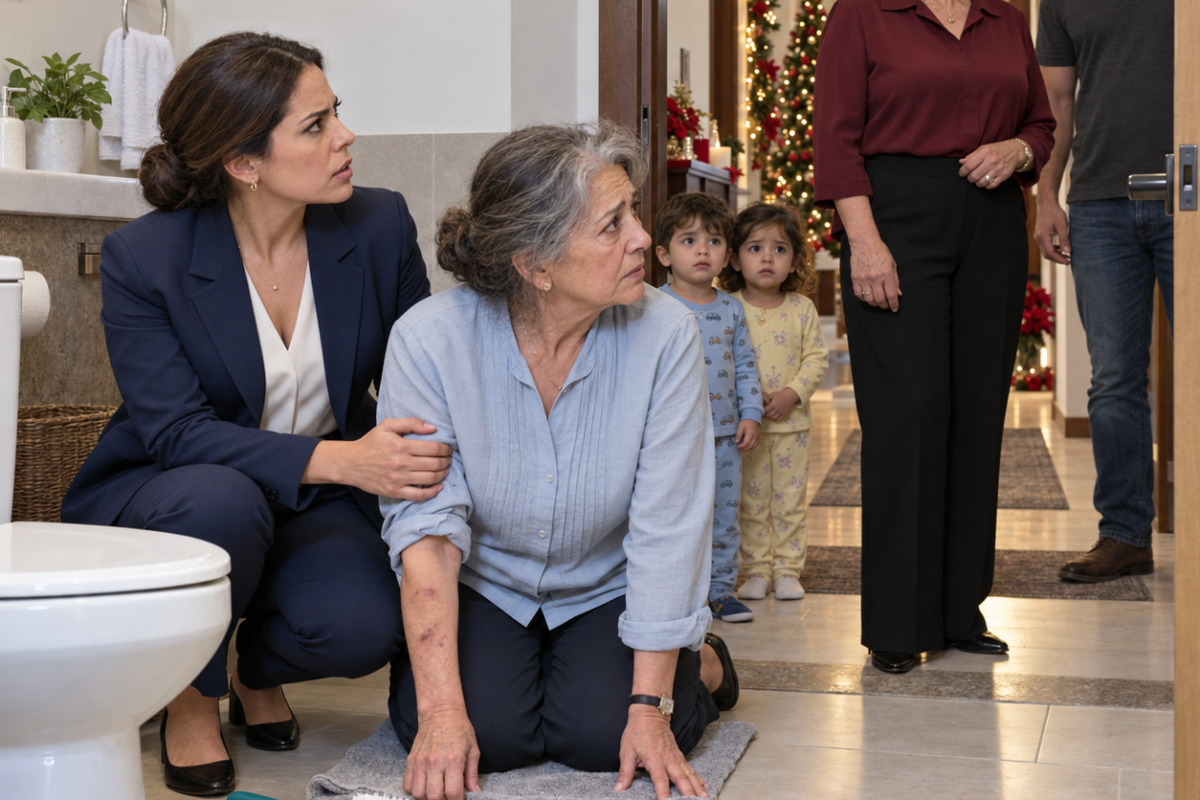
I came home three hours early and found my sixty-eight-year-old mother on her knees scrubbing my mother-in-law’s bathroom. When I helped her stand, her sleeve slipped back, revealing dark marks around her wrist. My husband stepped into the doorway. “Daniela, don’t make a scene.” That was when I remembered my father’s last warning: “If you ever see your mother hurt, don’t argue with anyone. Open the hidden compartment in her sewing machine.”
I came home three hours early and found my sixty-eight-year-old mother on her knees beside a toilet. Her hands were stiff with arthritis. One gripped…
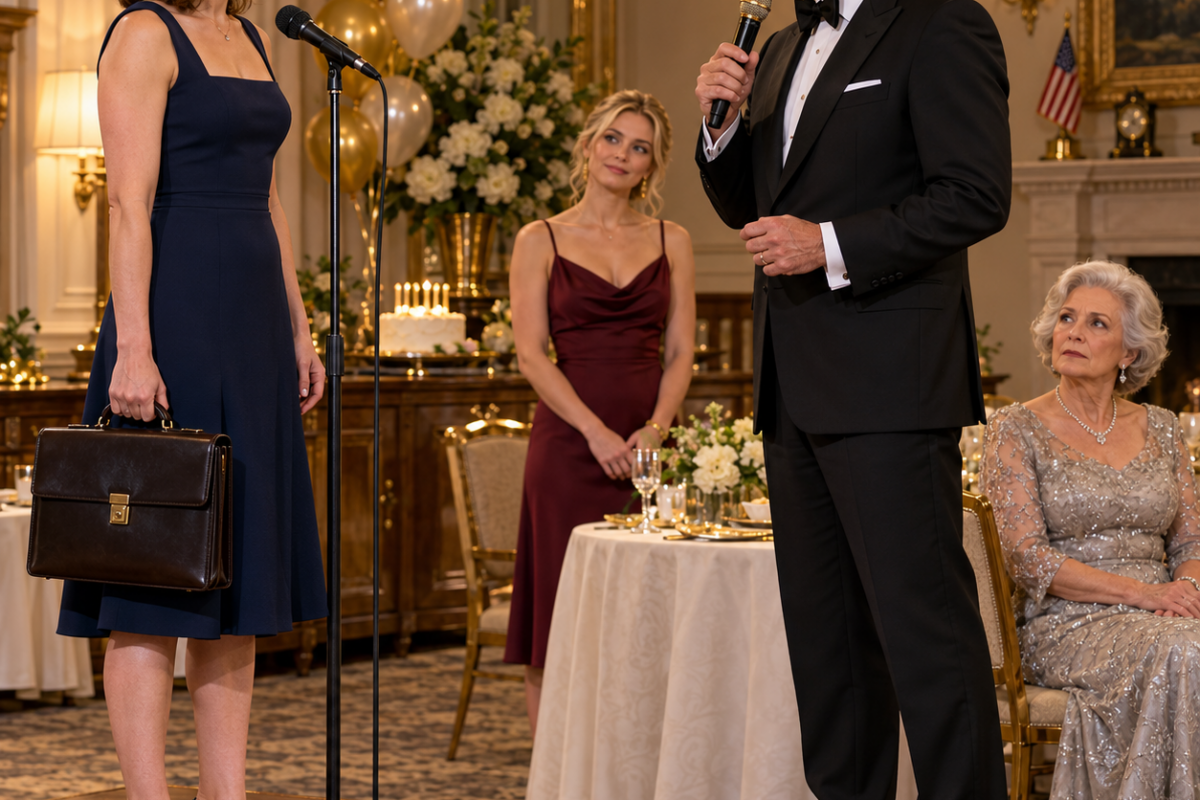
“I already promised your house to your sister,” my father told me four days after I bought it. “They’re moving in Monday. Rent-free for three years.” I was thirty-one, had saved for nine years, and had bought the five-bedroom home entirely in my own name. When I said no, he threatened to tell the family I had abandoned my sister’s children. Days later, he took the microphone at my grandmother’s seventy-fifth birthday dinner and did exactly that.
My father called twelve times in forty minutes after discovering I had bought a house without consulting him. When I answered, he didn’t ask whether…
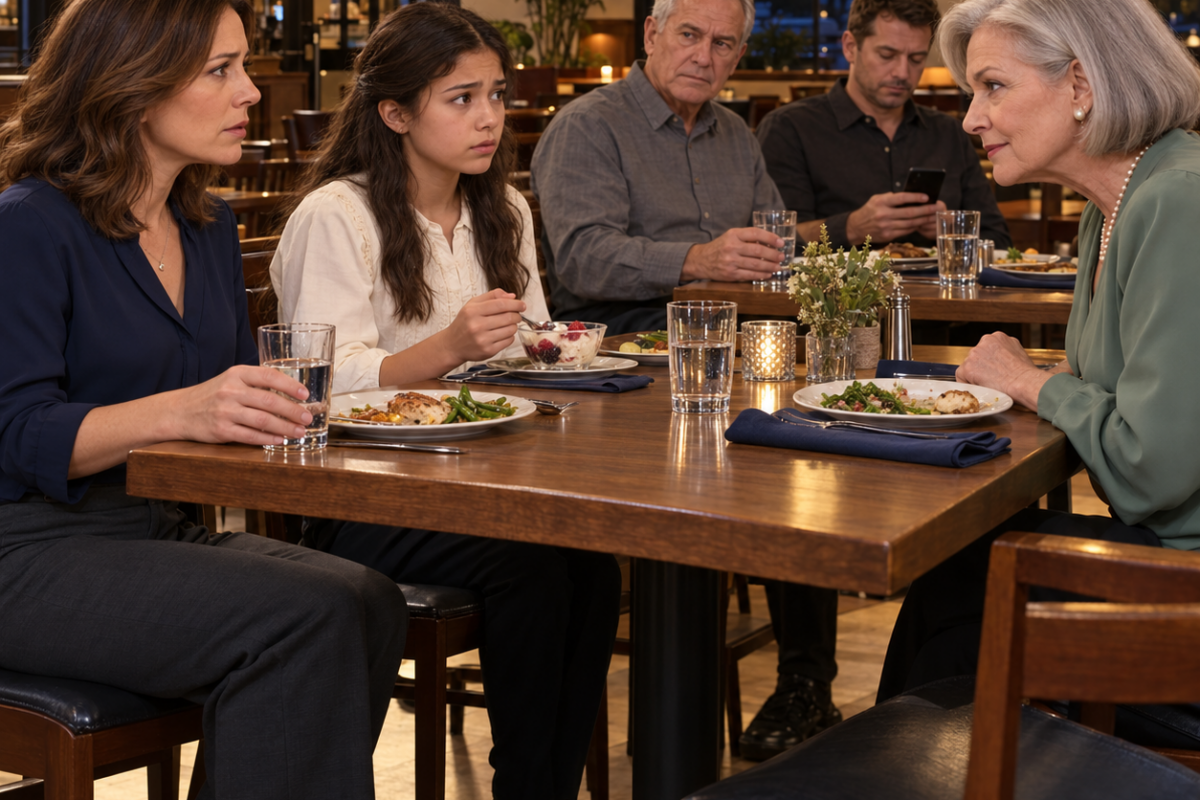
My mother leaned across the restaurant table, looked at my thirteen-year-old adopted daughter, and whispered, “We don’t sit with mistakes.” I took Sole’s hand and walked her out. That night, my father texted, “You’re still making the car payment tomorrow, right?” By midnight, I had canceled the payments I’d been making for my family. Then I remembered something Sole had told me about her grandmother.
My mother looked at my thirteen-year-old daughter and whispered, “We don’t sit with mistakes.” She said it softly enough to avoid attracting attention from the…
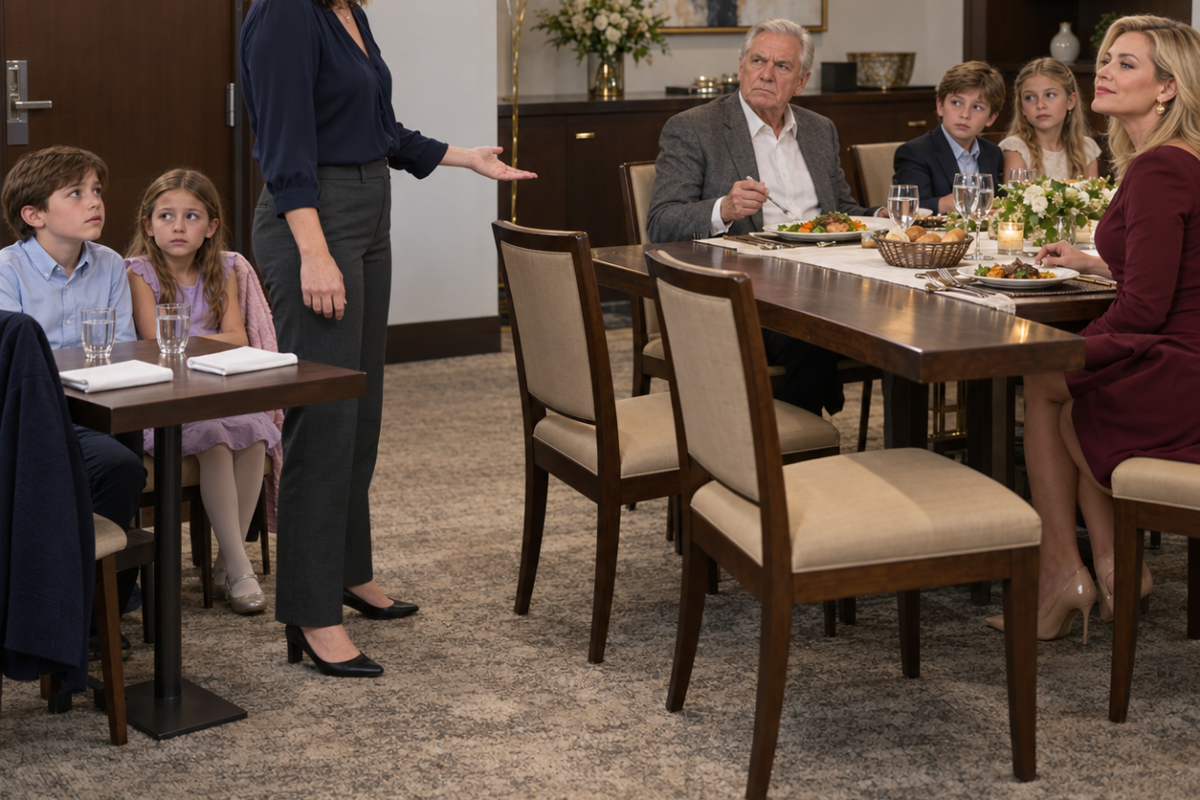
At my father’s seventieth birthday dinner, my eleven-year-old son and eight-year-old daughter were seated beside the service door with water glasses—but no dinner plates. Their cousins sat beside Grandpa with warm bread and full place settings. “They’ll eat after everyone else,” my sister said. I turned to my father, expecting him to object. “They can wait another hour,” he replied. There were two empty chairs at his table.
At my father’s seventieth birthday dinner, the first thing that stopped me wasn’t the cake or the gold balloons. It was my children. Ethan and…
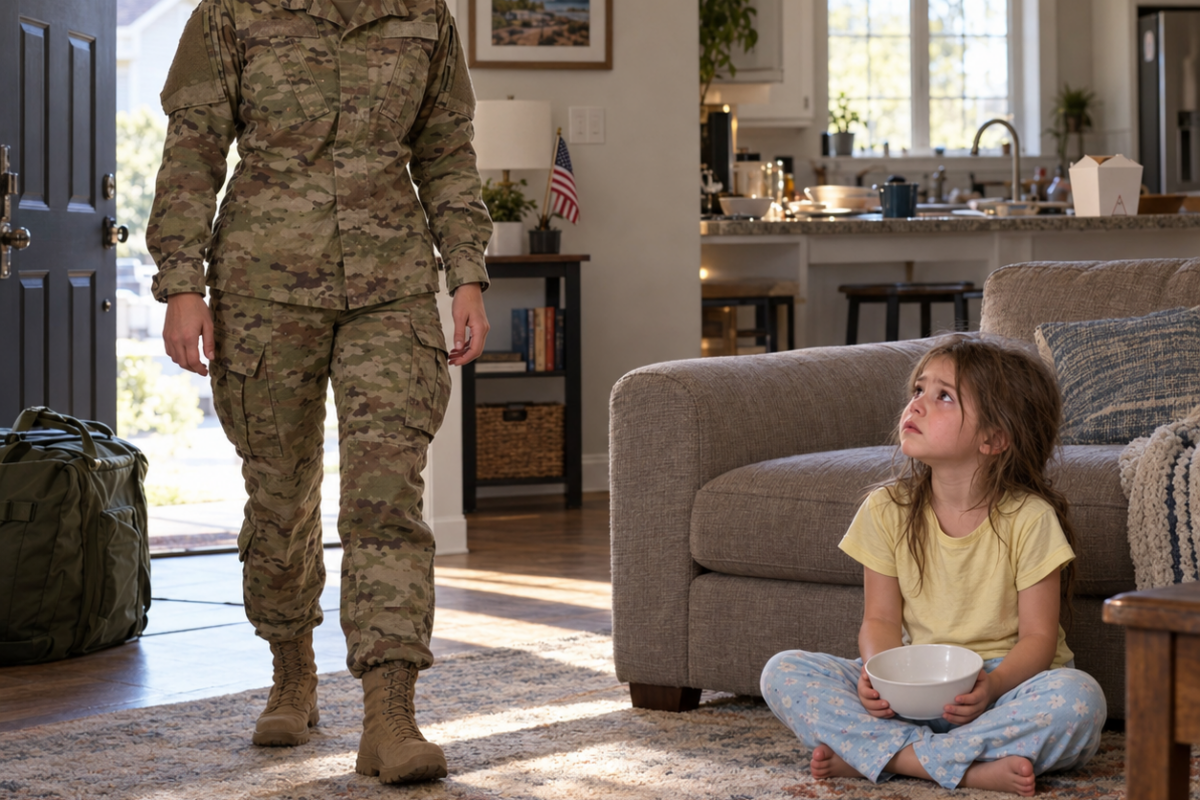
“Mommy, are you real?” my four-year-old daughter whispered when I came home from deployment three weeks early. She was sitting alone on our living room floor with an empty cereal bowl. My husband was on a Caribbean cruise with his mother and sister. Twenty-two minutes earlier, they had posted a photo captioned “Family time.” I was still in uniform when Sophie asked if she could have something to eat.
The first thing my daughter said when I found her was, “Mommy, are you real?” She was sitting cross-legged on our living room floor with…
End of content
No more pages to load