“We used your savings and sold your Bronco to pay for your sister’s wedding,” my mother told me. Together, they had taken just over $62,000. Before I could answer, Dad called from behind her, “You can just walk from now on, sweetheart.” Then they hung up. By Saturday, my mother was smiling into a microphone, asking me to present my sister’s wedding gift in front of more than 150 guests. I brought one white envelope.
The call came at 8:17 on a Tuesday morning.
I remember the time because I had just poured my coffee. My phone was beside the mug, and when my mother’s name appeared on the screen, I glanced at the clock above the stove before answering.
“Good morning, sweetheart,” Pauline said.
Her voice was cheerful, almost festive.
I stood at the kitchen counter in my Calgary condo, looking at a thin line of sunlight moving across the floor.
“Morning.”
“We wanted to make sure you knew the wedding details. Saturday, Rosemont Estate. The ceremony starts at four.”
“I have the invitation.”
“Yes, well. We’ve made some changes.”
There was a pause that sounded rehearsed.
“The wedding is fully paid for now.”
I took a sip of coffee.
“That’s good.”
“We used your savings and the money from the Bronco.”
I set down the mug.
From somewhere behind her, my father called, “You can just walk from now on, sweetheart.”
My mother laughed softly.
The total, she told me, was just over sixty-two thousand dollars.
Then she said, “Bye, darling,” and ended the call.
I remained at the counter with the phone against my ear.
There was nothing left to hear.
I lowered it, looked at the time again, and let out a short laugh.
Not because it was funny.
Because, after weeks of watching my parents hide what they had done behind excuses and silence, my mother had finally called to describe it herself.
They thought they were informing me of something irreversible.
They had no idea how much I already knew.
My name is Vivien. I was thirty-four that September, and I had lived in Calgary for seven years, working as a structural engineer for a consulting firm that handled commercial and infrastructure projects across Alberta.
My condo was on the fourteenth floor of a building in the Beltline.
On clear mornings, I could see the mountains.
I liked my work, my home, and the life I had built.
I had built it carefully.
There had been university exams that left me studying at the kitchen table until sunrise, job applications that received no answer, and early professional years when I worried that everyone else understood something I had somehow missed.
Eventually, experience replaced some of that fear.
I learned how to ask good questions.
I learned that confidence was useful only when it rested on something sound.
And I learned that a problem did not become smaller because someone disliked discussing it.
At work, those lessons came naturally.
At home, with my family, I had spent most of my life pretending they did not apply.
We grew up in Red Deer, my younger sister Cassie and I.
There were four years between us.
When we were children, that felt like a great distance. By the time she started school, I was old enough to walk her there, help with her shoes, and explain why she could not take the same lunch every day if she kept bringing it home untouched.
I loved her.
That is important.
This was not a story that began with me resenting a little sister.
Cassie was funny and affectionate when she was young. She followed me around the house carrying a stuffed rabbit, asking questions without pausing long enough for answers.
She wanted to sit beside me while I did homework.
Sometimes she fell asleep with her head against my arm.
I remember those things as clearly as I remember what came later.
The problem was not that my parents loved her.
The problem was what they decided their love entitled them to demand from me.
My mother was skilled at appearing generous.
She volunteered at the church rummage sale. She brought casseroles to neighbors who were ill. She remembered birthdays, wrote thoughtful cards, and spoke warmly about the importance of family.
People trusted her.
I did too, for longer than I should have.
Inside our house, generosity worked differently.
Cassie needed things.
I was expected to provide things.
Cassie was sensitive.
I was expected to understand.
Cassie had dreams.
I was expected to be realistic.
Whenever I objected, my mother used the same gentle tone.
“The ones who are strong have a responsibility to carry a little more. That’s what love looks like, Vivien.”
As a child, I liked being called strong.
It made me feel useful.
It took years to notice how often the compliment arrived immediately before a request.
If Cassie forgot an assignment, I helped her finish it.
If my father was frustrated, I learned not to ask for anything that evening.
If my mother was overwhelmed, I took over the dishes, the laundry, or whatever task would make the house feel calmer.
None of those things was terrible by itself.
Children contribute to families.
Siblings help each other.
But the expectations did not change as we grew older.
They expanded.
By university, I worked part-time and budgeted carefully.
Cassie called when she needed money for books.
My parents called when her tuition bill was due.
They described the requests as temporary, unusual, and urgent.
I paid part of her second-year tuition.
I told myself it would help her finish without the stress I had known.
When my father asked for twenty thousand dollars because a business venture had gone wrong, I lent it to him.
He promised to repay me.
He shook my hand across the dining table as though that made the arrangement more serious.
I believed him.
Months passed.
Then a year.
Whenever I brought it up, he became distracted, irritated, or vaguely optimistic.
“We’re getting there.”
“Things are complicated.”
“You know I haven’t forgotten.”
I eventually learned that some of the money had gone toward a new sectional sofa and a kitchen renovation, not the debt he had described.
My mother said the house needed work.
My father said I was making assumptions.
Neither of them offered a repayment schedule.
I stopped asking as often because every conversation left me feeling mean for wanting back what they had promised to return.
That was how it worked.
Not through one enormous demand.
Through a hundred smaller negotiations in which my discomfort became the problem, while their use of my money remained unquestioned.
For a while, I paid Cassie’s car insurance.
She worked part-time in retail then.
I knew her income was limited.
I also knew she seemed able to afford weekends away, new clothes, and expensive dinners.
When I asked whether she could take over the payments, she sounded hurt.
“I thought you wanted to help.”
I did.
Wanting to help was not the same as wanting to be responsible forever.
But I had not learned to say that clearly.
My mother intervened.
“Don’t make your sister feel bad about something you offered.”
So I continued.
At Christmas dinners, Pauline toasted family loyalty while Terrence filled his glass.
I sat there knowing that loyalty usually meant I had paid for something nobody mentioned.
There were good moments too.
My father could tell a story that made the whole table laugh.
My mother remembered how I liked my tea.
Cassie sent photographs when she saw something that reminded her of me.
Those things complicated my judgment.
They made it easier to believe that the next request would be different.
I did not want to become cynical.
I did not want to measure every interaction.
So I kept trying to be generous without becoming guarded.
What I failed to see was that my family had become guarded only about one thing: any suggestion that I might stop.
The Bronco was the first significant purchase I made that belonged entirely to me in a way I could feel.
A 1969 Ford Bronco.
It was not in beautiful condition when I found it.
The paint was faded. The seats needed work. There were mechanical issues I understood only partly and others I would learn about at considerable expense.
A friend from work had sent me the listing because I once mentioned liking old vehicles.
I went to look at it on a Saturday.
The seller opened the garage, and there it was, boxy and tired and somehow full of possibility.
I stood beside it longer than I expected.
I liked that nothing about it pretended to be effortless.
It needed time.
Attention.
Money, certainly.
But there was an honesty to the work.
If a part was worn, I could replace it.
If something was misaligned, I could measure it.
A problem did not become an insult because I wanted to understand it.
I bought it.
For three years, I worked on it on weekends and some evenings.
I rented a bay at a local garage where an experienced mechanic let me ask questions without making me feel foolish.
At first, I mostly watched.
Then I learned to do more.
There were weekends when all I accomplished was removing something stubborn without damaging the part beside it.
There were evenings when I left with grease on my wrists and a sense of satisfaction that no spreadsheet had ever provided.
I kept receipts.
Photographs.
Notes about what had been done and what remained.
The project became a record of my own patience.
My family found it mildly amusing.
My father said I should have bought something practical.
My mother said it seemed like an expensive hobby for a woman living alone.
Cassie asked whether I planned to drive it or just keep fixing it.
I answered all three.
Sometimes with humor.
Sometimes with silence.
The truth was simpler than the explanations I gave them.
I liked it.
That should have been enough.
By the time Cassie became engaged to Grant, the Bronco ran well.
It was not finished.
There were details to complete, interior work to do, and adjustments I wanted checked professionally.
But it had become recognizably mine.
I knew the small resistance in the driver’s door.
I knew the smell inside after a warm afternoon.
I knew where the paint had been carefully matched and where I had decided to preserve a little wear.
Then our condo building began upgrades that temporarily disrupted underground parking.
Equipment occupied spaces. Access changed. The management office sent notices with timelines that kept shifting.
I could leave my everyday car elsewhere.
The Bronco was more difficult.
My parents offered their garage in Red Deer.
They had space.
Terrence said he would keep an eye on it.
Pauline said it would be nice having me visit more often.
I accepted.
I drove it there on a Sunday and left the keys with my father.
He opened the garage door and waved me in.
“Look at that,” he said. “You’ve actually got it going.”
I smiled.
“Yes.”
He walked around it, examining the bodywork.
For a moment, I thought he understood.
Then he asked what I had spent.
I gave him a general answer.
He whistled.
“Must be nice.”
I did not respond.
Before leaving, I took a photograph of it in the garage.
Not as evidence.
As a little reminder that it was safely stored.
Later, I would look at that picture many times.
Cassie’s wedding planning began in the spring.
Grant’s family had money.
More importantly, they seemed accustomed to spending it in ways that looked natural to them and intimidating to my mother.
There were discussions about venues, guest lists, flowers, and people flying in from Toronto and the Okanagan.
Cassie wanted a beautiful wedding.
There was nothing wrong with that.
But wanting a beautiful wedding soon became needing a wedding that would convince another family she belonged among them.
The venue changed twice.
The guest list grew.
The gown became custom.
Every decision arrived with an explanation.
This florist was the one Grant’s mother recommended.
That photographer was only available if they booked immediately.
The first venue was too small.
The second did not have the right atmosphere.
Rosemont Estate, a heritage property outside Calgary, was perfect.
It cost close to eight thousand dollars before the catering and other services were added.
My mother told me about it as though the price confirmed its suitability.
“It’s exactly what Cassie deserves.”
I asked what the budget was.
She paused.
“We’re working through that.”
I knew what that meant.
A week later, they asked me for forty thousand dollars.
The request came over dinner in Red Deer.
Cassie was there.
My father sat at the end of the table.
My mother had prepared my favorite meal.
I noticed that too late.
Pauline explained the costs, the deposits, and the importance of making a good impression.
Cassie watched me.
Terrence said, “You’re doing well.”
I set down my fork.
“No.”
The room went quiet.
My mother smiled faintly.
“No to which part?”
“To contributing forty thousand dollars.”
Cassie looked away.
My father leaned back.
“You haven’t even thought about it.”
“I have thought about how much I can give. That isn’t an amount I can contribute.”
My mother’s voice softened.
“This is a once-in-a-lifetime occasion.”
“I understand.”
“Your sister would do the same for you.”
I looked at Cassie.
She did not meet my eyes.
I had no desire to embarrass her by asking for examples.
Instead, I said, “I’m not debating what she might do. I’m telling you what I can do.”
Terrence became impatient.
“You don’t have children. You don’t have a family to support.”
“I have a life to support.”
He laughed.
A small dismissive sound.
I remained still.
My mother said, “We’re not asking you to put yourself in hardship.”
“You’re asking for forty thousand dollars.”
“You have savings.”
“They have purposes.”
“What purposes?”
I looked at her.
For the first time, I recognized the question as one I did not owe her an answer to.
“They’re mine.”
She stared.
Cassie pushed food around her plate.
“I didn’t want this to become a fight,” she said.
“Then don’t make my answer into one.”
Nobody spoke for several seconds.
I finished what I could of dinner and drove back to Calgary.
On the way home, I felt both relieved and unsettled.
I had said no plainly.
Without making a joke.
Without promising to reconsider.
I thought the difficult part was over.
I did not understand that my parents had begun treating my answer as an obstacle to bypass.
Six weeks before the wedding, I attended a professional conference in Vancouver.
My parents stayed at my condo while I was away.
They said they wanted a few days in Calgary and could check on the place.
I had let them stay before.
They had a spare key.
I did not imagine I needed to guard my home from them.
There was a small storage room at the back of the unit.
It was normally locked, more for keeping clutter out of sight than for serious security.
Inside were old files, a box of family photographs, spare household items, and a checkbook associated with a secondary account I had maintained since my early twenties.
The account held just over twelve thousand dollars.
It was not my main banking account.
I used it infrequently.
I had intended to reorganize my finances and close it, but had not done so.
An old account is still an account.
An old checkbook still requires care.
I learned that the hard way.
My parents had access to the condo.
My father had access to the Bronco.
Between those two things, they found a way to take more than I had refused to give.
The money disappeared through a forged authorization and a cheque transaction that the bank later reviewed in detail.
The vehicle was sold using paperwork bearing a signature that was not mine.
The combined proceeds came to just over sixty-two thousand dollars.
That total mattered because my mother later described it as though it had been a family contribution.
It was not sixty-two thousand dollars drawn from one savings account.
It was the balance of that account and the money from selling my Bronco.
Two pieces of my life converted into a wedding budget.
I learned about the bank transaction first.
It was a Wednesday afternoon, several weeks before the wedding.
I was at my desk, reviewing a drawing, when my phone rang.
The bank representative asked whether I could speak privately.
I stepped into a small meeting room.
She verified my identity and asked about an authorization affecting the secondary account.
I did not recognize it.
She described the amount.
My stomach tightened.
“No,” I said. “I did not authorize that.”
She repeated the question in another form.
I gave the same answer.
Then she explained that the transaction had been flagged for review.
We began the fraud process.
While I was on that call, a message arrived from my insurance provider asking me to contact them about an apparent change involving the Bronco.
At first, I thought the timing was coincidence.
Then I opened the message.
I remember looking through the glass wall of the meeting room at my colleagues working quietly at their desks.
Someone was laughing near the printer.
A phone rang.
Everything outside the room remained normal.
Inside, I was learning that my father had sold the vehicle I left in his care.
I called the insurer.
Then I called my father.
He did not answer.
I called my mother.
She sent a message.
Busy right now, darling. Everything okay?
I did not respond immediately.
There were moments in structural work when the shape of a problem became clear before every measurement was available.
You knew something did not line up.
You knew the explanation being offered would not carry the weight placed on it.
That was how I felt.
Not calm exactly.
Focused.
I called Oliver, the lawyer who had previously helped me with a contract matter.
I told him I needed advice urgently.
He made time that afternoon.
I drove to his office with a notebook, my identification, and the first documents the bank had sent.
I had not eaten lunch.
I had not finished the drawing review.
I was still wearing the cardigan I kept at work because the office was always too cold.
Oliver listened without interrupting.
Then he asked practical questions.
Who owned the account?
Was anyone else authorized?
Whose name was on the vehicle records?
What permission had I given my parents?
Where was the Bronco now?
I answered what I could.
“No one else was authorized,” I said.
“And you did not consent to the sale?”
“No.”
He nodded.
“Then we need to protect your position immediately and preserve the records.”
I said I wanted proof.
Not a family argument.
Not another situation in which my mother cried and my father said I had misunderstood.
Proof.
Oliver agreed that documentation mattered.
He also made clear that we would not knowingly permit further unauthorized transactions just to create a more dramatic case.
I needed to report what had happened.
The bank needed to secure my accounts.
The authorities needed accurate information.
Whatever had already cleared could be traced.
Whatever remained vulnerable needed protection.
That was the first important correction he gave me.
I had been so focused on making the evidence impossible to dismiss that I briefly imagined I needed to let the whole plan unfold.
I did not.
The conduct had already happened.
There was enough to investigate.
The rest of my money did not need to become bait.
We contacted the bank’s fraud team again.
I changed access credentials, replaced account information where appropriate, and reviewed every account I held.
I revoked the practical access I had previously given my parents.
I arranged to recover the spare key.
When it became clear that would not happen promptly, I changed the lock in accordance with the condo’s procedures.
I reported the vehicle matter.
The report described the facts rather than assumptions about the buyer.
I owned the Bronco.
I had stored it at my parents’ home.
I had not sold it.
I had not signed a transfer.
I did not know where it had gone.
The investigators began tracing it.
Oliver reminded me that a buyer could have been deceived too.
I kept that in mind.
My father’s conduct did not mean every other person in the chain was involved knowingly.
That distinction would matter later.
When my mother called that evening, I let it go to voicemail.
She sounded concerned.
“Vivien, your father says you called. What’s going on?”
I saved the message.
Then I cried for the first time.
Not because of the money alone.
Because I had trusted them with keys.
A garage.
The ordinary access people give their parents without imagining it will be used against them.
I sat on the floor beside my bed until the room grew dark.
Eventually, I stood, drank water, and wrote down everything I remembered.
Dates.
Calls.
Where the vehicle had been.
When I last saw it.
What they had asked me for.
What I had refused.
It was not a beautiful moment of strength.
It was work I could do while everything else felt uncertain.
For the next few weeks, I learned how much of an investigation consisted of waiting for other people to do careful things.
The bank obtained records.
Investigators sought documents through the appropriate channels.
The sale paperwork was located.
The account receiving the proceeds was identified.
The money had gone into an account associated with Cassie and the wedding.
That did not establish, by itself, what Cassie knew.
It established where the money went.
I asked Oliver the question I dreaded.
“Could she really not know?”
He looked at me.
“She may have known nothing, some things, or everything. We need evidence before deciding.”
I nodded.
I wanted the truth.
I also wanted not to know it.
Both feelings were present.
The signature comparisons took time.
I provided verified examples.
The relevant documents were reviewed.
A forensic examiner assessed the questioned signatures.
There were differences consistent with my statement that I had not signed them.
Bank branch records and available security footage helped establish who had presented the paperwork.
The private buyer provided information about the Bronco sale.
The price.
The communications.
The documents my father had shown him.
The details accumulated.
Not all at once.
Enough that I no longer needed to ask whether I was imagining something.
My mother continued contacting me about wedding details.
What time should she expect me?
Had I chosen a dress?
Would I be willing to help collect something?
I kept my replies brief.
I did not discuss the investigation beyond what my lawyer and the authorities advised.
I did not lie about giving permission.
I did not send threats.
My father left one message saying I needed to answer my mother.
He sounded annoyed.
I saved that too.
At work, I tried to remain functional.
I told my manager that I was handling a personal matter involving fraud and might need time for calls.
She did not ask me to prove it was serious enough.
She said we would manage the schedule.
A colleague noticed I had stopped joining the others for lunch.
She brought a sandwich to my desk.
“You don’t have to explain,” she said. “But you do have to eat.”
I thanked her.
She waited until I opened it.
That small act of care made me cry again after she left.
There was no request attached.
No reminder that strong people should carry more.
Just lunch.
I began noticing the difference.
Cassie called on a Sunday evening.
I was standing near the window watching rain move across the glass.
“Are you mad at me?” she asked.
I took a breath.
“Why do you ask?”
“You’ve been distant.”
“I’m dealing with some things.”
“Mom says you’re being difficult about the wedding.”
I looked toward the kitchen counter.
“What exactly did she tell you?”
“That you felt pressured to contribute.”
“I did feel pressured.”
“I didn’t ask you for forty thousand dollars.”
“You were at the table.”
“I didn’t want to upset everyone.”
Neither did I.
For most of my life, I had organized my choices around that concern.
I said, “I told them no.”
“I know.”
“Do you?”
She paused.
“What is that supposed to mean?”
I could hear irritation entering her voice.
I asked a careful question.
“How was the wedding funded after I said no?”
“Mom and Dad handled it.”
“With what?”
“I don’t know all their finances.”
“Did they tell you the money came from me?”
Silence.
A long one.
Then she said, “Mom said you came around.”
I closed my eyes.
“I didn’t.”
Cassie breathed out sharply.
“Then why would she say that?”
“That is something you need to ask her.”
“Vivien, please. I can’t deal with this right now.”
I looked out at the rain.
That sentence had followed me through years of family life.
Other people could not deal with the problem.
So I was expected to deal with the consequences quietly.
“I can’t make that true for you,” I said.
“What?”
“That I changed my mind. I didn’t.”
She ended the call soon afterward.
I wrote down what she said while it was fresh.
I sent the relevant information to Oliver.
Then I sat at my table and ate dinner alone.
I had cooked more than I wanted.
I put the leftovers away.
Those ordinary tasks helped me stay in the present when the rest of my mind kept returning to the garage in Red Deer.
The Bronco was located through the investigation.
It had been sold to a private buyer through one of my father’s old industry contacts.
The buyer had not hidden it.
He had paperwork he believed was legitimate.
He was understandably distressed when contacted.
He had paid a substantial amount for a vehicle he thought he had purchased honestly.
I felt sympathy for him.
I also wanted my Bronco back.
Oliver explained that recovery, ownership questions, and the buyer’s financial losses had to be handled properly.
The man cooperated.
He provided communications and made the vehicle available as required.
Nobody told him he had to surrender it in exchange for not being charged with something he had not knowingly done.
He was treated as a person whose own position needed assessment.
That mattered to me.
I did not want my family’s dishonesty to become an excuse for another injustice.
When I first heard the Bronco had been found, I put my head down on the office table and stayed there for a moment.
Then I asked whether it had been damaged.
The answer was reassuring.
It appeared largely as I had left it.
The buyer had begun making plans for it, but had not substantially altered it.
I thanked the investigator.
After hanging up, I called the garage where I had worked on it.
The mechanic listened.
Then he said, “We’ll get you back to it.”
I nodded, although he could not see me.
That was all I wanted at that moment.
The wedding approached.
Charges and enforcement decisions were not mine to direct.
Oliver was very clear about that.
I could cooperate.
I could provide evidence.
I could seek civil recovery.
I could make decisions about my attendance.
I could not arrange a criminal case around a satisfying moment at a reception.
The authorities worked on their own timetable.
We knew the file had progressed significantly.
We knew there were formal steps underway.
We did not know precisely how every interaction with my parents would happen.
Then came the Tuesday call at 8:17.
My mother told me they had used the money.
My father told me I could walk.
They said it as though they had won.
I did not shout.
I did not demand an immediate explanation.
I let my mother finish.
After she hung up, I wrote down the exact words as accurately as I could.
The time.
Who spoke.
What she said about the total.
What my father called from behind her.
Then I called Oliver.
He listened.
“Send me the note,” he said.
“I will.”
“How are you?”
I looked at my coffee.
“Angry.”
“That makes sense.”
“I think she expected me to cry.”
“Perhaps.”
“She called to make sure I knew.”
He was quiet for a moment.
Then he said, “You don’t have to decide what she expected. We have what she said.”
I appreciated the distinction.
For years, I had been trapped in arguments about intentions.
The facts were finally enough.
I spent the next few days preparing to attend the wedding.
Some people would have stayed home.
I understand that.
I considered it.
But I had an invitation, and there were people attending who had known me for years. My parents were already describing my supposed generosity as part of the celebration.
I did not want my absence converted into another story about my jealousy, instability, or lack of family feeling.
I wanted to be present.
Quietly.
With the ability to leave.
Oliver and I discussed what I could responsibly say if the subject arose.
We reviewed a short factual summary of the reported transactions and the status that could appropriately be disclosed.
I did not include private banking details.
I did not include the buyer’s information.
I did not write an accusation against Cassie that the evidence did not support.
The page stated what had happened to my account and vehicle, that I had not authorized either transaction, and that the matters were subject to formal legal action and police investigation.
As the status changed, we updated the language accurately.
I printed one copy.
I placed it in a plain white envelope.
It was not a wedding gift.
It was a boundary in writing.
The night before the wedding, I took a black dress from my wardrobe and hung it on the bedroom door.
I had worn it to my firm’s annual dinner two years earlier.
It fit well.
It did not ask for attention.
I chose simple earrings.
Comfortable enough shoes.
A small bag.
Then I arranged a rental car.
My everyday vehicle was available, but I wanted no conversation about where I parked or who could ride with me afterward. I wanted the trip to feel separate from the ordinary routes of my life.
I told a friend where I was going and when I expected to return.
I gave myself permission to leave at any point.
That was new.
At family events, I had always stayed until my mother decided I had done enough.
This time, I decided.
Rosemont Estate stood at the end of a long gravel drive lined with poplars.
It was about an hour southwest of Calgary.
The September afternoon was bright, but there was already a cool edge in the air.
The property looked almost unreal in its careful beauty.
Stone wings extended from a restored Victorian center.
The lawn had been trimmed so precisely that it seemed to hold its own boundaries better than I ever had.
Cars filled the parking area.
People in formal clothes walked toward the entrance, laughing and holding their wraps against the breeze.
I sat in the rental car for a minute before getting out.
My hands were steady.
My stomach was not.
I opened my bag and checked the envelope.
Then I closed it.
Inside, the reception room was filled with white and blush roses.
Gold-rimmed place settings.
Candles.
Linen.
A string trio played near the French doors.
There were more than a hundred and fifty guests.
Grant’s family had brought people from Toronto and the Okanagan.
They moved through the room with the ease of people who had attended many events like it.
I recognized a few relatives.
A family friend hugged me and said it was wonderful I had come.
I thanked her.
Then my mother saw me.
Her expression changed before she regained control of it.
She moved toward me with her arms open.
“Vivien.”
She hugged me.
I let it last only a moment.
“I wasn’t sure you’d make it.”
“I said I would.”
“Well, you’ve been so busy.”
I looked at her.
She smiled more brightly.
“Doesn’t everything look beautiful?”
“Yes.”
It did.
That was not in dispute.
She glanced at my bag.
For a second, I wondered whether she recognized that I had brought something she could not control.
Then Terrence appeared beside her.
He wore a suit I had not seen before.
He leaned toward me.
“You behave yourself tonight.”
His voice was low.
There was no warmth in it.
“Not one word.”
I looked at him.
“Enjoy the ceremony, Terrence.”
He frowned at the use of his name.
I had spent most of my life calling him Dad, even while asking him to repay money he had taken under false pretenses.
That afternoon, the familiar title did not come easily.
I did not force it.
My mother touched his sleeve.
“Let’s not start anything.”
She said it while looking at me.
I moved away.
Cassie found me before the ceremony.
She wore a lace gown that had been fitted beautifully.
Her hair was arranged with small flowers.
For a moment, I saw my little sister in the adult face.
The girl who followed me around asking questions.
The girl who once cried because I was leaving for university.
Then she hugged me while a photographer stood nearby.
“So glad you came,” she said.
I stepped back.
“You look lovely.”
“Thank you.”
She searched my expression.
“Can we not do anything difficult today?”
I held her gaze.
“What do you think is difficult?”
Her smile faltered.
“Vivien.”
I waited.
She lowered her voice.
“I talked to Mom.”
“And?”
“She said you were upset about how they arranged things.”
“How they arranged what?”
“The contribution.”
“I did not contribute.”
She looked away.
“Please.”
I felt a deep sadness then.
Not because she knew every detail.
I still did not know the full extent of her knowledge.
Because she knew enough to ask me not to speak, rather than ask whether I was okay.
I said, “I’m not going to interrupt your ceremony.”
Her shoulders relaxed.
She thanked me.
I did not promise anything else.
I sat in the fourth row.
The ceremony was tender.
That is another thing I will not pretend otherwise about.
Grant looked moved.
Cassie looked nervous and happy.
There were vows about honesty, partnership, and choosing one another.
I listened.
I did not turn every sentence into a private accusation.
Their marriage, whatever happened afterward, was theirs.
My parents’ conduct remained my parents’ conduct.
The fact that the money paid for the room did not make every person in it guilty.
I held on to that distinction.
It kept my anger from spreading until there was no room left for anything else.
After the ceremony, people went outside for photographs.
The air had cooled.
A relative asked where the Bronco was.
He had followed my restoration project through photographs I occasionally posted.
I looked at him.
“It’s involved in a legal matter at the moment.”
His smile faded.
“Oh.”
“It’s being handled.”
He nodded.
I did not explain in the middle of the lawn.
But I also did not invent a cheerful excuse.
The reception began.
Canapés.
Wine.
Music.
Guests finding their tables.
I sat toward the back.
I ordered ginger ale.
A woman beside me asked about my work.
We discussed a project her husband had noticed downtown.
For twenty minutes, I was simply an engineer having a conversation at a wedding.
I enjoyed that small return to myself.
Then the speeches began.
Grant’s father spoke warmly.
Cassie’s friend told a story from university.
My father thanked the guests and said family had come together to make the day possible.
I looked at my glass.
He did not mention my name.
Not yet.
My mother did.
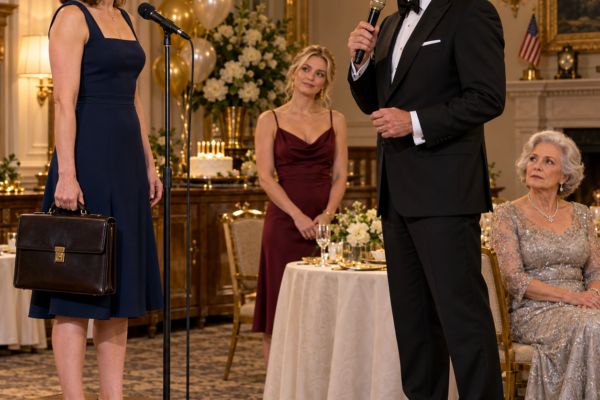
During a pause in the dancing, Pauline took the microphone.
She had arranged the moment with the entertainment staff.
I learned that later.
She wanted to acknowledge contributions.
She wanted people to see her as a gracious mother.
And she wanted, somehow, to control the meaning of what they had taken.
“I just want to recognize the people who made today possible,” she said.
The room quieted.
She thanked friends.
Relatives.
People who had helped with arrangements.
Then she smiled toward my table.
“And my eldest daughter, Vivien, who is here with us tonight.”
Heads turned.
I sat still.
“Vivien, sweetheart, would you come up? I believe you brought something for your sister.”
The invitation was public.
The pressure was familiar.
If I stayed seated, I would look difficult.
If I came forward and smiled, she could complete the story she had been telling.
I stood.
I picked up my bag.
I walked toward her.
Not quickly.
Not dramatically.
My heart was beating hard enough that I could feel it in my throat.
Cassie rose from her seat.
She held out a hand.
I took the envelope from my bag and gave it to her.
Her smile remained for the first few seconds.
Then she opened it.
She unfolded the page.
Read.
Her expression changed.
“What is this?”
My father moved closer.
He took the paper and read it.
My mother leaned over his shoulder.
I watched both of them understand that the envelope contained something beyond a private complaint.
There were reference details.
A lawyer’s contact.
An accurate summary of formal allegations and the steps already taken.
The story could no longer be ended by hanging up a phone.
My mother whispered, “Not here.”
I looked at her.
“You asked me to come up.”
Cassie’s hand trembled.
Grant approached from the other side.
He looked at the page, then at her.
“What’s happening?”
My father began speaking.
Too quickly.
Something about family arrangements.
Something about misunderstanding.
I held out my hand for the microphone.
My mother did not immediately release it.
Then she looked at the guests watching us and let go.
I did not make a long speech.
I had no desire to tell strangers every painful thing that had happened in my childhood.
I said the facts.
“I need to correct something. I did not agree to fund this wedding. Money was taken from an account in my name using paperwork I did not sign. My 1969 Ford Bronco was also sold without my permission, using a signature that was not mine.”
The room became still.
“The combined proceeds were just over sixty-two thousand dollars. I reported both matters. They are being dealt with formally.”
My father stepped toward me.
“Give me that.”
He reached for my arm.
His grip was hard.
For a second, I was a child again, trying to decide whether making a sound would make things worse.
Then I said, clearly, “Let go of my arm.”
A venue staff member moved toward us.
Grant said, “Terrence.”
My father released me.
I stepped back.
My mother began saying my name.
Not angrily now.
Urgently.
The sound carried years of training.
Vivien, fix this.
Vivien, be reasonable.
Vivien, make everyone comfortable.
I put the microphone down.
I did not fix it.
What happened next was not something I had scheduled.
Oliver had been in contact with the investigators and knew there were enforcement steps underway. He was nearby because I had asked him to be available if the situation became unsafe or legally complicated.
Venue staff had also become involved when my father grabbed me.
Officers arrived while the room was still trying to understand what had been said.
They spoke with staff.
Then they approached my parents.
Oliver came in shortly afterward.
I did not watch every exchange.
I had no interest in turning procedure into entertainment.
The officers identified themselves.
They explained why they were there.
My parents were advised of their rights.
The formal action was not based solely on my speech. It arose from the evidence already gathered and decisions made through the investigation.
That mattered.
A microphone does not establish a criminal case.
Records do.
My mother remained rigid.
My father became loud, then quiet.
When the handcuffs were applied, the sound seemed much sharper than it should have in such a large room.
Pauline looked at me.
“Vivien, please. I’m your mother.”
I met her eyes.
“I know.”
There was nothing more useful to say.
I knew who she was.
That had been the reason I trusted her.
It had also been the reason she expected me not to report what she did.
Grant’s mother stood near the head table holding her wrap.
Guests began moving.
Some toward the doors.
Some toward people they knew.
Some remained seated, stunned.
Cassie stood beside her chair with the white envelope in one hand.
Grant was a few feet away.
I looked at my sister.
For a moment, I wanted to go to her.
The old instinct.
My sister was upset.
I should comfort her.
Then I saw the page in her hand and remembered the phone call.
Can we not do anything difficult today?
I did not go.
That was not punishment.
It was recognition that I could not be the person she turned to for comfort while still being expected to carry the cost of what happened.
Oliver asked whether I wanted to leave.
“Yes.”
He walked with me to the entrance.
We did not discuss sentencing.
We did not congratulate one another.
He asked whether I was safe to drive.
I stood outside in the cold September air and took several slow breaths.
“I think so.”
“Take your time.”
I nodded.
The gravel drive was lit by small lanterns.
Behind me, music had stopped.
Ahead of me, the rental car waited exactly where I had left it.
Something about that simple fact steadied me.
I had keys.
I had somewhere to go.
I did not have to wait for anyone’s permission.
I sat in the car for several minutes.
Then I drove back toward Calgary.
The road was dark.
The city lights appeared gradually.
I stopped at a diner on the south end, near Macleod Trail.
Inside, a server asked whether I wanted a booth.
I said yes.
She brought coffee.
Dark roast.
Nothing in it.
I ordered toast because I realized I had barely eaten.
The diner was nearly empty.
A couple sat near the counter.
A man in a work jacket read something on his phone.
Traffic moved beyond the window.
Nobody knew me.
Nobody expected me to rescue the evening.
I sat with my hands around the mug.
I did not feel triumphant.
I felt tired.
Sad.
Relieved.
A little frightened by how much would come next.
When the server asked whether everything was all right, I said, “It’s been a long day.”
She nodded.
“I’ll keep the coffee coming.”
That was enough.
My phone filled with messages.
I did not read them all.
Some relatives had seen what happened.
Others had already heard partial versions.
There were accusations.
Questions.
Concern.
One message said I had ruined my sister’s wedding.
Another asked whether my parents were really being charged.
A cousin wrote, I’m sorry. I had no idea.
I put the phone face down.
I finished the toast.
At home, I took off the black dress and hung it over a chair.
There was a faint mark on my arm where my father had gripped it.
I photographed it and sent the information through the appropriate channel.
Then I showered.
For a long time, I stood under warm water doing nothing.
The next morning, I slept late.
When I woke, the mountains were visible beyond the city.
I made coffee.
The mug was the same one I had used Tuesday morning.
My life had not transformed overnight.
There were dishes in the sink.
Work waiting Monday.
Legal matters that would take months.
But the call I had dreaded for years had finally happened.
They had crossed a line so clearly that I could no longer explain it away.
And I had stayed on my side of it.
The weeks after the wedding were difficult in ways I had not fully anticipated.
People who had never asked how much I supported my family suddenly had opinions about whether I should have involved the authorities.
Some said I should have handled it privately.
I asked what privately meant.
A repayment promise?
Another family dinner?
Another explanation that nothing had been intended to hurt me?
Most did not answer.
A few said parents deserved special consideration.
I agreed that family relationships could matter.
I did not agree that they erased ownership, consent, or accountability.
Oliver advised me to limit discussions about the active case.
I followed that advice.
When relatives pressed, I said the matters were being handled through the proper process.
I did not argue in group chats.
I did not post the evidence online.
I did not turn the wedding into a series of public updates.
What strangers believed was less important than what the records established.
At work, I took a few days off, then returned.
My manager checked in privately.
I said I was managing.
She asked whether I needed adjustments.
I accepted some.
That was new too.
I had always associated being capable with not needing anything.
Now I was learning that accepting help could be different from being made responsible for someone else’s comfort.
My colleague continued inviting me to lunch.
I went.
Sometimes we talked about the case.
Usually we talked about work, a television show, or something ridiculous somebody’s dog had done.
I needed those conversations.
I did not want my parents’ conduct to become the only story I had left.
I also began counseling.
Not because I was unable to function.
Because I was functioning in a way that left very little room to feel anything until I was alone.
My counselor asked how I had learned to respond when someone wanted something from me.
I gave examples.
The tuition.
The insurance.
The loan.
The wedding.
She listened.
Then she asked, “What happened when you said no as a child?”
I thought for a long time.
Usually, my mother became disappointed.
My father became dismissive.
Cassie became upset.
The house changed temperature.
Eventually, I said yes to make it normal again.
My counselor nodded.
“That sounds exhausting.”
It was such a simple observation that I almost missed its importance.
For years, the exhaustion had been treated as a feature of my personality.
I was strong.
I could manage.
I was good in a crisis.
Now someone was describing the burden instead of complimenting how quietly I carried it.
I cried.
Then I laughed a little at myself.
She waited.
There was no deadline for becoming reasonable.
Cassie and Grant separated before the month ended.
I learned about it from Cassie herself.
She sent a short message.
I’m in Edmonton for a while. Grant and I aren’t living together.
I stared at it.
Then I replied.
I’m sorry things are difficult.
She answered quickly.
You could have waited.
I put the phone down.
For a while, I considered all the explanations I could send.
That the investigation did not belong to me.
That the timing was not a theatrical choice.
That my mother had brought me forward publicly.
That I had not authorized the money.
Then I realized Cassie already knew the central fact.
I had not agreed.
I wrote only that.
I did not consent to the use of my money or the sale of my vehicle. I’m not going to debate whether I should have accepted it to protect the event.
She did not reply that day.
Later, she sent a longer message.
She said my parents had told her I changed my mind.
She said she had suspected I was unhappy but wanted to believe them.
She said the wedding costs had become overwhelming.
She said Grant felt she had concealed things.
I read it twice.
There were admissions.
There were excuses.
There was a young woman who had been raised to receive and was finally experiencing the cost of accepting a story she had not examined.
I did not wish her harm.
I also did not rush to rescue her.
That distinction became one of the hardest things I learned.
Love did not require me to make every consequence temporary.
Sometimes I could care about someone and allow them to do their own work.
Cassie began working in property management in Edmonton.
She sent occasional updates.
I answered some.
Our relationship became quieter and more careful.
I did not know whether it would become close again.
I still do not.
But I stopped making closeness my responsibility alone.
The criminal proceedings took months.
There were appearances, discussions through counsel, and periods when nothing seemed to happen from my perspective.
Then something moved.
Oliver explained what he could.
The prosecution made its own decisions.
My parents had legal representation.
They were entitled to advice and a defense.
The evidence did not remove those rights.
It gave the case substance.
Both eventually entered guilty pleas to the charges resolved through the proceedings.
The relevant conduct included fraud over five thousand dollars and the use of forged documents.
I did not attend every appearance.
I attended the ones where my presence was needed or useful.
I provided a victim impact statement.
Writing it was harder than writing a technical report.
In engineering, I could separate observations, assumptions, calculations, and recommendations.
In this statement, the damage was financial and personal.
I described the lost savings.
The vehicle.
The time spent securing accounts and recovering documents.
The difficulty of knowing my parents had entered my home as guests and used that access to take from me.
I also described the effect on my ability to trust ordinary acts of family care.
I did not write that they had destroyed my life.
They had not.
I did not write that I would never recover.
I intended to recover.
I wrote what had happened and what it had cost.
That was enough.
Pauline received a suspended sentence, two years of probation, and a restitution obligation as set out by the court.
Terrence received an eight-month conditional sentence to be served under restrictive conditions in Red Deer, including house arrest.
There were differences in their circumstances, roles, and histories that the court considered.
A prior civil fraud dispute involving my father had surfaced during the wider examination of his affairs, but I did not treat it as though it were automatically a criminal conviction or a simple explanation for the sentence.
The court made its decision on the material properly before it.
I was relieved the case reached a resolution.
I was not suddenly satisfied with everything that had happened.
A sentence does not return the years before the offence.
A restitution order is not the same as money appearing immediately in your account.
Recovery required further steps.
The bank completed its process.
The vehicle matter was resolved.
Funds and repayment obligations were accounted for so that I was not paid twice for the same loss.
Oliver helped me understand the details.
There were numbers I still checked more often than necessary because I wanted certainty.
He was patient.
Eventually, the financial picture became clear enough that I could stop waking in the night to review it.
The Bronco returned to my possession.
The private buyer cooperated throughout the process.
He had his own losses and claims to pursue.
I thanked him for providing the information he had.
We spoke only briefly.
He looked at the vehicle and said, “Your father told me you wanted it sold.”
I swallowed.
“I didn’t.”
He nodded.
“I know that now.”
There was nothing more either of us needed to add.
When I first saw the Bronco again, I stood beside it for a long time.
It looked the same.
Mostly.
A little dust.
A different paper tucked inside.
Small evidence that it had spent time somewhere I had not chosen.
I touched the driver’s door.
Then I opened it.
The familiar resistance was still there.
I sat behind the wheel and put my hands on it.
I did not start the engine immediately.
I simply sat.
Mine.
That was the word.
Not valuable.
Not impressive.
Not something I had worked on because I needed to prove I was unusual.
Mine.
The work remaining was taken to a qualified restoration shop off Macleod Trail.
For four months, the mechanic finished the things I had planned to complete slowly.
I still visited on weekends.
Sometimes I brought coffee.
Sometimes I stood in the bay and asked questions.
Sometimes we discussed a detail that would have bored anyone else.
I enjoyed being boring about something I loved.
There was freedom in that.
My life did not need to justify itself as generosity toward another person.
A hobby could remain a hobby.
Savings could remain savings.
An empty Saturday could remain mine.
My parents contacted me through the channels permitted by the legal arrangements.
Most of the communication was practical.
Restitution.
Records.
Questions passed through lawyers.
There was one letter from my mother.
She wrote that she regretted how things had turned out.
She said she had wanted Cassie to have a beautiful day.
She said families sometimes made mistakes when emotions were high.
I read it at my kitchen table.
Then I put it down.
There was no clear acknowledgment that I had said no.
No recognition that she had used access to my home to obtain documents she had no right to use.
No explanation of why my father thought telling me to walk was appropriate after selling my vehicle.
The letter wanted to begin with the aftermath.
I needed any meaningful apology to begin with the act.
I did not answer immediately.
When I did, I kept it brief.
I said I was not ready for personal contact and would maintain the arrangements already in place.
I did not write a list of conditions for winning me back.
I was not ready to manage another project centered on their improvement.
I needed distance.
So I took it.
At first, distance felt unnatural.
I had always answered.
Always noticed when my mother’s voice sounded strained.
Always wondered whether Cassie needed something.
Always tried to determine whether my father’s anger meant I should make a call.
Without those tasks, there was space in my mind I did not know how to use.
I filled some of it with work.
Then I caught myself doing that and stopped.
I walked.
I cooked.
I called friends without a reason.
I bought flowers for the table near my window.
I had once considered those things indulgent because they served no obvious family purpose.
Now I understood that enjoyment did not require an application.
On Sunday evenings, I cooked something substantial.
Soup.
Roasted vegetables.
A meal I could take to work the next day.
I ate at the table rather than standing at the counter.
I watched the city lights come on.
Sometimes the loneliness was real.
I will not pretend boundaries made me immune to wanting a family that behaved differently.
There were evenings when I missed the version of my mother I had believed in.
The one who said sweetheart and meant care.
The father who could have been proud of the Bronco without asking what it cost.
The sister who could have asked about my distress before asking me not to complicate her wedding.
I grieved those people even while recognizing that some of them had existed mostly in my hope.
That was work too.
My counselor helped me stop treating grief as evidence that I had made the wrong decision.
I could miss them and still need distance.
I could love them and still report what happened.
I could wish the wedding had ended differently without accepting responsibility for the acts that made it end that way.
Those ideas became less theoretical over time.
One afternoon, Cassie called.
I answered.
She asked whether I had a few minutes.
I said yes.
She sounded different.
Less polished.
Less prepared.
“I should have asked more questions,” she said.
I remained quiet.
“When Mom said you came around, I knew you hadn’t sounded like that.”
I looked out the window.
“I wanted it to be true,” she continued.
“I understand that.”
“But it wasn’t.”
“No.”
She took a breath.
“I’m sorry I asked you to stay quiet.”
The apology was specific.
That made it different.
I said, “Thank you.”
She began crying.
I did not rush to tell her everything was fine.
It wasn’t.
I listened.
Then I said, “We don’t have to solve everything in this call.”
She agreed.
We talked about her job.
The apartment she had found.
A practical problem with a tenant that she was trying to understand.
For a few minutes, we were sisters speaking about ordinary life.
I appreciated it.
I did not turn it into a promise that the past no longer mattered.
Seven months after the wedding, a friend visited my condo for dinner.
She had known me through work for years.
We sat near the window while the sky darkened.
She looked around the room.
“You seem lighter.”
I laughed.
“I’ve probably just stopped carrying half the furniture.”
She smiled.
“No. I mean it.”
I thought about the previous year.
The money.
The vehicle.
The phone calls.
The legal work.
There had been nothing light about any of it.
But she was right.
I no longer woke each morning expecting a request I would feel unable to refuse.
I no longer confused being available with being loved.
I no longer needed to prepare explanations for every choice that did not benefit someone else.
There was more room to breathe.
A week later, I went to the restoration shop.
The mechanic had finished a section of the interior.
He opened the door and showed me.
I leaned in, asked about the stitching, and listened to the answer.
Then he stepped back.
“Want to take it out?”
I looked at him.
“Now?”
“It’s ready for a proper drive.”
I stood still for a moment.
Then I smiled.
“Yes.”
We completed the practical checks.
He gave me instructions.
I listened carefully.
When I climbed into the driver’s seat, the familiar smells and sounds settled around me.
The engine started.
I put my hands on the wheel.
For three years, this vehicle had represented something I was building for myself.
For months, it had represented something taken.
That afternoon, it became a vehicle again.
Something I could drive.
Not an exhibit in a case.
Not a lesson.
Not proof of anything.
I pulled away from the shop.
Calgary traffic moved around me.
At a light, a man in the next lane glanced over and gave a small appreciative nod.
I nodded back.
Then the light changed.
I drove.
My father had told me I could walk from now on.
For a long time, I thought about that sentence because of its cruelty.
Now, behind the wheel, it seemed smaller.
A man making a joke because he believed my property and my patience were both his to spend.
He had been wrong about the property.
Eventually, I had made him wrong about the patience too.
I did not drive to Red Deer.
I did not pass my parents’ house.
I did not imagine them seeing me and understanding what they had lost.
That would still have made the afternoon about them.
Instead, I chose a road I wanted to take.
The city thinned.
The sky opened.
There were foothills ahead and a clear stretch of pavement.
I stopped later at a place with coffee and a view.
I parked carefully.
I sat outside with the keys on the table.
No one called.
No one needed an answer.
For once, I did not reach for my phone to check whether I had missed something.
I watched the light move over the landscape.
The life I had built was still there.
My work.
My home.
My friends.
My sister, at a distance we were learning to manage honestly.
The Bronco.
And the savings I could rebuild without pretending someone else’s plans were more legitimate than mine.
I had not become fearless.
I still disliked disappointing people.
I still felt the old urge to explain when a simple answer would do.
But now I recognized the urge.
I could pause.
I could ask whether a request was mine to meet.
I could say no and let the room remain uncomfortable.
That was not hardness.
It was a skill I should have learned long before I turned thirty-four.
On the way home, I drove with the afternoon sun behind me.
When I reached the condo, I parked the Bronco in the space that was finally available again.
I turned off the engine.
For a moment, I stayed in the driver’s seat.
Then I took the keys, locked the door, and went upstairs.
My condo was quiet.
The table near the window was exactly where I liked it.
There was food in the refrigerator.
A drawing I needed to review Monday.
A message from a friend asking about lunch.
I opened the curtains.
The mountains were visible.
I made coffee, carried it to the table, and sat down.
Nothing extraordinary happened.
That was the part I had worked so hard to recover.
An ordinary evening in a life that belonged to me.
News
At my seventy-second birthday party, my daughter-in-law knocked a crystal vase off its pedestal with her elbow, watched it shatter, and smiled. “Oops.” Her own parents had given it to her and my son on their wedding day six years earlier. I looked at Frank, waiting for him to say something. All he managed was, “Mom…”
I watched my daughter-in-law break her own parents’ wedding gift with one elbow and a smile. For months afterward, people asked me whether I was…
I came home three hours early and found my sixty-eight-year-old mother on her knees scrubbing my mother-in-law’s bathroom. When I helped her stand, her sleeve slipped back, revealing dark marks around her wrist. My husband stepped into the doorway. “Daniela, don’t make a scene.” That was when I remembered my father’s last warning: “If you ever see your mother hurt, don’t argue with anyone. Open the hidden compartment in her sewing machine.”
I came home three hours early and found my sixty-eight-year-old mother on her knees beside a toilet. Her hands were stiff with arthritis. One gripped…
“I already promised your house to your sister,” my father told me four days after I bought it. “They’re moving in Monday. Rent-free for three years.” I was thirty-one, had saved for nine years, and had bought the five-bedroom home entirely in my own name. When I said no, he threatened to tell the family I had abandoned my sister’s children. Days later, he took the microphone at my grandmother’s seventy-fifth birthday dinner and did exactly that.
My father called twelve times in forty minutes after discovering I had bought a house without consulting him. When I answered, he didn’t ask whether…
My mother leaned across the restaurant table, looked at my thirteen-year-old adopted daughter, and whispered, “We don’t sit with mistakes.” I took Sole’s hand and walked her out. That night, my father texted, “You’re still making the car payment tomorrow, right?” By midnight, I had canceled the payments I’d been making for my family. Then I remembered something Sole had told me about her grandmother.
My mother looked at my thirteen-year-old daughter and whispered, “We don’t sit with mistakes.” She said it softly enough to avoid attracting attention from the…
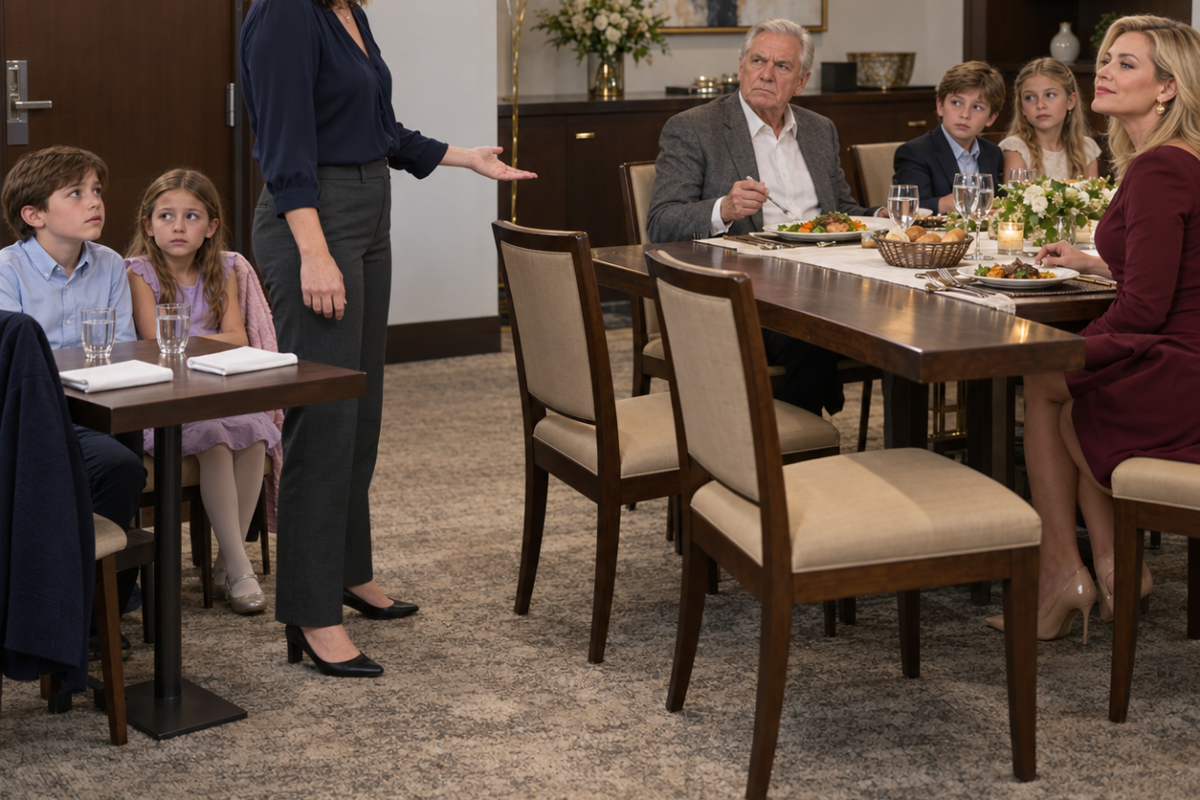
At my father’s seventieth birthday dinner, my eleven-year-old son and eight-year-old daughter were seated beside the service door with water glasses—but no dinner plates. Their cousins sat beside Grandpa with warm bread and full place settings. “They’ll eat after everyone else,” my sister said. I turned to my father, expecting him to object. “They can wait another hour,” he replied. There were two empty chairs at his table.
At my father’s seventieth birthday dinner, the first thing that stopped me wasn’t the cake or the gold balloons. It was my children. Ethan and…
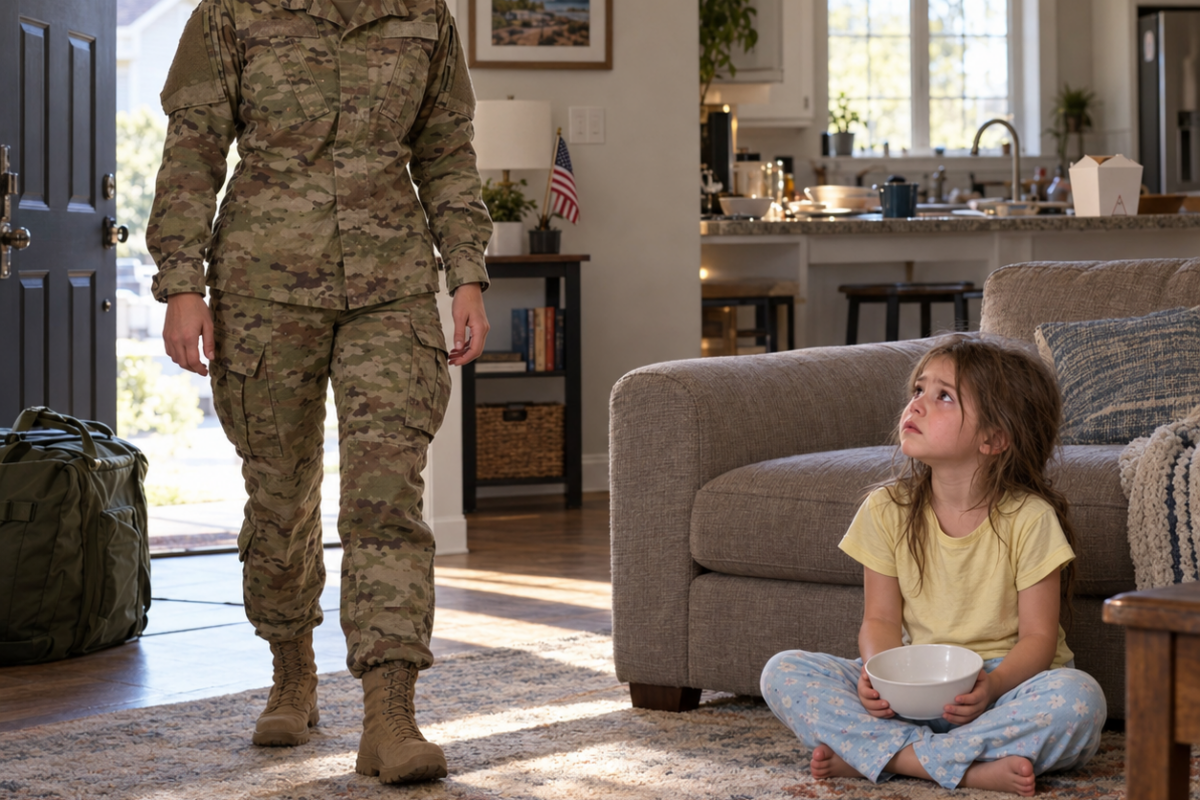
“Mommy, are you real?” my four-year-old daughter whispered when I came home from deployment three weeks early. She was sitting alone on our living room floor with an empty cereal bowl. My husband was on a Caribbean cruise with his mother and sister. Twenty-two minutes earlier, they had posted a photo captioned “Family time.” I was still in uniform when Sophie asked if she could have something to eat.
The first thing my daughter said when I found her was, “Mommy, are you real?” She was sitting cross-legged on our living room floor with…
End of content
No more pages to load