“We know this beach condo is yours, Barbara, but you need to go to a hotel,” my daughter-in-law said. Her parents wanted privacy, and my son had already agreed that I should leave. When I reminded her my name was on the deed, she replied, “It’ll belong to Caleb eventually, meaning it’ll be ours.” I said, “Understood,” and made one phone call before packing.


“Barbara, we know this beach condo is yours, but we want to be alone with my parents, so you need to go to a hotel.”
For a moment, I thought I had misunderstood her.
I had been sitting on my balcony with a glass of iced tea, watching the afternoon light spread across the Gulf. Below me, a little boy was chasing a seabird that seemed entirely unconcerned about being caught. Two floors down, an American flag snapped in the breeze.
I had arrived at the condo on Wednesday. It was now Friday.
For the first time in months, my shoulders had stopped aching.
“My condo,” I said. “My name is on it.”
Harper gave a small laugh.
“Let’s be realistic. This place will belong to Caleb eventually, meaning it’ll be ours. You can stay anywhere simpler. You’re not that demanding.”
Behind me, the sheer curtain lifted through the open balcony door, then settled against the frame.
I watched it for a second.
There are moments when a person says something so revealing that answering immediately would only give them time to cover it.
So I let the silence stretch.
Harper mistook that silence for hesitation.
“My parents have come all this way,” she continued. “Catherine and Richard need somewhere comfortable. They’re not used to those little roadside places. And we’d really like some privacy with them.”
“You knew I was here.”
“Yes, Barbara. That’s why I’m calling.”
I set my glass on the iron table.
That table had taken three people to carry upstairs when the elevator was being repaired. I had found it at an estate sale, sanded the rust off myself, and painted it a blue that reminded me of the water on a clear winter morning.
My curtains were handmade. My kitchen cabinets were the original ones, repaired rather than replaced. The flowerpots along the balcony rail had belonged to a woman in the next building who moved north to live near her grandchildren.
Nothing in that condo had arrived because I was careless with money.
Nothing had arrived easily.
“I came here to rest,” I said.
“Don’t make this difficult.”
She said it with the weary patience people use when they believe they are explaining something to a child.
“Catherine and Richard are accustomed to a certain level of comfort. They can’t just stay at any random hotel. And I already spoke with Caleb. He agrees. It’s best for everyone.”
Caleb.
My only son.
I looked through the doorway at the framed photograph on the bookshelf. He was twelve in that picture, standing beside a lake with a fishing pole and an enormous grin. The fish he was holding could have fit in my hand, but he had been proud of it all afternoon.
His father had left when he was seven.
For years afterward, our household had run on my wages, carefully stretched groceries, and the belief that someday the hard part would be behind us.
I worked as a nurse for thirty-eight years. When Caleb needed braces, I took weekend shifts. When he was accepted into college, I picked up nights. I paid what I could and helped him understand the loans he needed for the rest.
I never expected him to repay his childhood.
But I had expected him to remember that I was a person.
“Does Caleb understand you’re asking me to leave?” I asked.
“Of course he does.”
Then, as though she were offering a generous compromise, Harper added, “You could go to that budget motel off the highway. That kind of place is fine for you.”
I felt something change inside me.
It wasn’t a flare of anger.
It was quieter than that.
For several years, I had been trying to preserve a comfortable explanation for Harper’s behavior. She was particular. She was stressed. She came from a different kind of family. She didn’t always realize how she sounded.
That afternoon, I ran out of explanations I could believe.
“Understood,” I said.
Her voice brightened immediately.
“Wonderful. We’re about twenty minutes away.”
“I’ll need an hour.”
“Fine. We can get coffee nearby.”
She hung up without saying goodbye.
I remained on the balcony until the little boy below finally abandoned the bird and ran back to his mother.
Then I picked up my phone and called Patrick.
He answered with the familiar warmth of a man who had known me long before I became useful to other people.
“Barbara. How’s the beach?”
“I need your help.”
His tone changed.
“What happened?”
I told him everything.
I didn’t soften Harper’s words. I didn’t insert excuses. I didn’t say that perhaps she had meant something else.
When I reached the part about the motel, Patrick was quiet.
Then he asked, “What do you want to happen?”
It was such a simple question that I almost cried.
Nobody had asked me that.
Not Harper. Not Caleb. Not even me.
“I want to stop pretending this is acceptable,” I said. “And I want to make sure nobody is planning my life around what they expect to inherit.”
“All right.”
“I have the documents we discussed last month.”
“Good.”
“Tomorrow morning,” I said. “I want everything ready.”
“Tomorrow at ten. I’ll bring everything.”
I put the phone down.
Then I went into the bedroom and packed two dresses, a cardigan, sandals, and toiletries.
I was moving slowly, but I wasn’t confused.
There was a difference.
***
I bought the condo when I was fifty-nine.
It wasn’t a grand purchase. It was a two-bedroom unit in an older building with an elevator that complained before it reached the third floor. The kitchen was narrow, the bathroom tile was an unfashionable shade of beige, and the sliding balcony door needed both hands to open.
But from the living room, I could see the water.
That was enough.
For almost twenty years, I had kept a picture torn from a travel magazine inside the drawer where I stored our bills. It showed a woman reading on a balcony overlooking the ocean.
I didn’t know who she was.
I knew I wanted to sit where she was sitting.
When Caleb was little, vacations meant visiting my sister in Georgia or taking a day trip to a lake with sandwiches packed in a cooler. There wasn’t money for beachfront hotels.
After he finished college and found work, I began saving in earnest.
I didn’t tell many people.
Dreams can become surprisingly fragile when everybody has an opinion about whether you deserve them.
My sister, Miriam, knew.
So did Patrick.
Patrick had been a patient on my floor years earlier after a complicated surgery. His wife, Ellen, brought him crossword puzzles and complained that he was trying to negotiate with the nurses over how soon he could go home.
After he recovered, she invited me to lunch.
A friendship grew from there, slowly and without a dramatic reason.
Patrick was an attorney. Ellen taught elementary school. They were the sort of couple who remembered birthdays and returned borrowed dishes with something homemade inside.
When I started looking at condos, Patrick reviewed the paperwork.
When I worried that buying a place for myself was selfish, Ellen said, “Barbara, you’re allowed to have a chair with a view.”
She died three years later.
I still heard that sentence sometimes when I sat outside.
The condo became my place to recover from long months of being needed.
At first, I visited three or four times a year. After I retired, I came more often, sometimes for a weekend, sometimes for two weeks.
Caleb loved it when I bought it.
He helped me carry in the first mattress. We ate takeout on the floor because I didn’t have a dining table yet.
“This is good for you, Mom,” he said.
I believed him.
And perhaps he had meant it then.
Harper entered his life two years later.
She was attractive, organized, and confident in a way I had never been at her age. At our first dinner, she asked thoughtful questions about my work and remembered that I preferred tea to coffee after six.
I liked her.
When Caleb proposed, I was pleased.
I wanted him to have companionship. I wanted somebody to notice when he was tired, to laugh at his jokes, to care whether he got home safely.
The difficulties didn’t begin with anything large enough to name.
They began with corrections.
Harper suggested that my living room would look better without the old rocking chair. She explained that the dishes I used for holidays were too busy. She said the family photographs in my hallway made the space feel cluttered.
Sometimes she was right about the room.
She was never curious about why those things mattered to me.
At the condo, she disliked the flowered quilt on the guest bed.
“That’s easy,” I told her. “There’s a plain coverlet in the closet.”
The next time I came down, the quilt was gone.
Harper had donated it.
“I thought you’d appreciate not having to deal with it,” she said.
I had made that quilt while Caleb was in high school.
I told her so.
She looked embarrassed for a moment, then said, “Well, you never mentioned that.”
As though meaning had to be declared in advance to deserve consideration.
Caleb said he was sure she hadn’t intended any harm.
I let the matter go.
There were other things.
My preferred week in June became inconvenient because Harper’s friends wanted to visit.
The balcony plants disappeared because they made a mess.
The spare key I had given Caleb became a key Harper’s mother borrowed.
Each incident came with a small, reasonable explanation.
Each time, I made room.
By the time Harper told me to leave my own condo, she had years of evidence that I would complain softly, accept the explanation, and adjust.
I had helped teach her that.
Recognizing my part did not excuse hers.
It gave me something I could change.
***
I was standing beside my suitcase when their SUV pulled into the parking lot.
Harper got out first.
She wore a coral beach outfit, oversized sunglasses, and a smile that looked generous from a distance.
Caleb followed with his shoulders tight and his eyes down.
Catherine and Richard emerged from the back seat. Catherine carried a white handbag she held away from her body as if the world might stain it. Richard wore a linen shirt and had already begun studying the building.
“Barbara!” Harper called. “You’re already ready. Great.”
She reached for the suitcase handle.
I kept my hand on it.
“Where are you staying?” Caleb asked.
“I’ve made arrangements.”
His eyes flicked toward Harper.
“We could help you find something.”
“I’ve already found it.”
Catherine stepped forward and kissed the air beside my cheek.
“Such a lovely place,” she said. “Harper has told us so much about it.”
“It’s been good to me.”
“Hopefully we won’t inconvenience you too terribly.”
There was an opening there.
A chance to say that I was being inconvenienced very much.
I looked at her face. I couldn’t tell whether she knew what Harper had said or had been given a more flattering version.
“You’ll have an opportunity to discuss that tomorrow,” I said.
Harper’s smile tightened.
“Discuss what?”
“Patrick is coming at ten.”
Caleb looked up.
“Patrick?”
“My attorney.”
Richard stopped looking at the balcony.
For a moment, nobody spoke.
Then Harper laughed.
“Oh, Barbara. We’re not signing a lease. It’s just a family visit.”
“I know.”
“Then why would your attorney need to come?”
“Because I asked him to.”
I lifted my suitcase.
Caleb stepped toward me.
“Mom, let me carry that.”
I gave it to him.
I wasn’t interested in refusing ordinary kindness simply because he had failed at something larger.
He put the bag in my trunk.
While he did, Harper took her parents toward the elevator. She was speaking brightly about restaurants, as though my mention of Patrick had been an awkward sound she could talk over.
Caleb remained beside my car.
“Are you upset?”
I looked at him.
He had asked the question in a cautious tone, as if my answer might create a problem that had not existed before.
“Yes.”
He exhaled.
“I thought you wouldn’t mind. You’re so flexible.”
“I’m flexible about restaurant reservations. I’m not flexible about being told to leave property I own.”
“I didn’t realize she put it that way.”
“What did you realize?”
He rubbed the back of his neck.
“Her parents came down unexpectedly. She asked if they could use the condo.”
“While I was here?”
“Yes.”
“And you said?”
“I said we should ask you.”
“Did you?”
He looked away.
“No.”
“Did you tell her I would probably agree?”
A pause.
“Yes.”
There it was.
Not the clean betrayal I had feared. Something more familiar and, in its own way, just as painful.
He had avoided an uncomfortable conversation by making my consent sound inevitable.
“She said you were fine with it,” he added.
“She told you that after she called?”
“Yes.”
“I said one word. Understood.”
He closed his eyes briefly.
“Mom.”
“Tomorrow at ten,” I said. “Please be there.”
I got into the car.
He stood beside the window while I started the engine.
“Where are you going?”
“To rest.”
For the first time that afternoon, I said it without explaining why I deserved to.
***
I did not go to the motel off the highway.
I checked into a small waterfront hotel about fifteen minutes away.
I had stayed there once when the condo’s plumbing needed work. The rooms were comfortable, the staff were kind, and the restaurant served breakfast without rushing people out of their chairs.
I paid with my own credit card.
It was a practical purchase, not a performance.
I didn’t need Harper to learn that I could afford a nice room.
I needed myself to remember that I was allowed to choose one.
The young woman at the desk asked whether I wanted help with my suitcase.
“Yes, please,” I said.
That small answer nearly undid me.
For years, I had considered carrying everything myself a form of good manners.
I went upstairs, washed my face, and sat on the edge of the bed.
The room was quiet.
No one wanted a favor. No one was rearranging my plans. No one was explaining that I should be grateful to be useful.
My phone began vibrating.
Harper had sent a photograph of the balcony.
Lovely evening here!
Beneath it was another message.
Where are the extra beach towels?
I put the phone facedown.
A few minutes later, Caleb called.
I let it ring, then sent him a message.
I’m safe. I’m resting. We’ll talk tomorrow.
My sister called shortly afterward.
I answered her.
“Tell me you’re having a wonderful time,” Miriam said.
“I’ve had an interesting afternoon.”
“Barbara.”
She knew me too well.
I told her what happened.
When I finished, she was silent for several seconds.
Then she said, “I have a very strong opinion, but you probably know it already.”
“I do.”
“Are you all right?”
“I think so.”
“Do you want me to drive down?”
She lived four hours away.
For a moment, the thought of her sitting beside me in that hotel room was so comforting that I almost said yes.
Then I looked at the balcony outside my room and the fading light beyond it.
“Not tonight. Patrick is coming in the morning.”
“Good.”
“I should have dealt with this sooner.”
“Probably,” Miriam said. “You’re dealing with it now.”
That was one of the things I loved about my sister.
She could tell me the truth without using it as a weapon.
We spoke for half an hour.
When we hung up, I ordered dinner and ate it on the little table beside the window.
At nine, Patrick called.
He wanted to confirm the time and review the documents I had requested.
“Before we go further,” he said, “I want to be clear about tomorrow. You’re not selling a property overnight, and signing new estate documents doesn’t transfer anything out of your hands.”
“I understand.”
“And you can ask guests to leave. If there’s a dispute, we handle it through the proper process. No theatrics with locks while people’s belongings are inside.”
“I don’t want theatrics.”
“I didn’t think you did.”
“What I want is clarity.”
“That we can provide.”
We had discussed my estate plan the previous month.
I had put it off for years because thinking about death seemed unpleasant, and because I assumed the simple arrangement I made when Caleb was young remained good enough.
But retirement had made me reconsider several things.
My original documents named Caleb as executor and left nearly everything to him.
That had seemed sensible at forty-two.
At sixty-eight, with a different life and a more complicated family, it deserved another look.
Patrick had suggested that I separate practical responsibilities from family expectations. He had also asked whether there were causes I wanted to support and whether I truly wanted someone who rarely asked about my finances to be responsible for them if I became ill.
I had taken notes.
Then I had gone home and let the folder sit on my desk.
Harper’s call had not created those questions.
It had answered several of them.
“I don’t want to do this solely because I’m angry,” I told Patrick.
“Then don’t make a decision tonight that requires anger to sustain it.”
I considered that.
“I want a professional executor. I want my care and living expenses protected. And I want the condo treated as something I can use, sell, or give away while I’m alive.”
“That last point is already true.”
“I know. I’d like my family to know it too.”
“Fair enough.”
“As for what Caleb eventually receives, I want time to think.”
“Then we leave that question open until you’ve had time.”
My chest loosened.
I didn’t need a dramatic punishment.
I needed to stop living under an arrangement that everybody else seemed to understand better than I did.
***
I slept badly.
At three in the morning, I woke convinced that I had done something terrible.
It was an old feeling.
When Caleb was young and his father failed to pick him up for a visit, I used to wonder whether I had said something wrong during the last phone call.
When my supervisor asked me to cover a shift I couldn’t manage, I felt guilty before I declined.
When Harper seemed disappointed, I reviewed my behavior first.
I lay still in the dark, listening to the hotel’s air-conditioning unit.
Then I named what had happened as plainly as I could.
My daughter-in-law had told me to leave my property.
She had chosen my replacement.
She had suggested a cheap room because, in her judgment, I needed less comfort than her parents.
My son had allowed her to present my consent as a certainty.
None of those facts changed because I was frightened of disappointing them.
I got up, drank water, and opened the curtains a few inches.
The beach outside was almost invisible.
I thought of the first night Caleb and I spent in our apartment after his father left.
He had fallen asleep on the couch with his sneakers still on. I sat on the floor beside him, surrounded by boxes, and tried to figure out how to make one income do the work of two.
I had promised myself that he would never feel unwanted.
It was a promise I kept as well as I could.
But somewhere along the way, I had confused making him feel loved with making myself permanently available.
Those were different things.
I went back to bed.
In the morning, I had breakfast outside.
For the first time all week, I tasted the food.
***
Patrick arrived at the hotel at nine fifteen.
He carried a worn leather briefcase and wore a blue shirt beneath a summer jacket.
At seventy-one, he moved a little more slowly than he once had, but his eyes were as sharp as ever.
He hugged me.
“Before we go,” he said, “what outcome are you hoping for?”
“I want them to leave.”
“When?”
“Today. I want the rest of my week back.”
He nodded.
“And afterward?”
“I want them to ask before using the condo. I want the keys returned. I want Caleb to understand that an inheritance is not present ownership.”
“That’s reasonable.”
“I don’t need you to tell them I’m rich.”
“Good. I wasn’t planning to.”
“I don’t need you to embarrass anyone.”
“I’ll explain the facts. What they feel about the facts is their responsibility.”
We drove separately to the condo.
When I pulled into the lot, Richard was standing beside the SUV with a coffee cup.
He saw Patrick’s car and straightened.
Inside, the living room smelled of toast and sunscreen.
Harper had moved the bowl of seashells from my dining table onto the kitchen counter. A large arrangement of grocery-store flowers stood in its place.
Catherine sat at the table.
Caleb was by the balcony door.
Nobody seemed quite sure how to greet me.
“Morning,” I said.
Harper looked at Patrick.
“This really wasn’t necessary.”
Patrick gave her a courteous nod.
“Barbara asked me to come.”
“I know, but it’s a misunderstanding.”
“Then this should be straightforward.”
I put my handbag on the chair where I always put it.
Harper noticed.
Such a little thing, reclaiming the place where I set my bag.
Yet her expression changed.
Patrick waited until everyone was seated.
He did not stand at the head of the table. He did not open with a threat.
He placed a slim folder in front of me and a single page beside it.
“Barbara would like to clear up several assumptions,” he said.
Harper folded her arms.
“About a family weekend?”
“About her property and the terms under which people may use it.”
Richard cleared his throat.
“We were told Barbara offered us the condo.”
I looked at him.
“Were you?”
“Yes,” Catherine said. “Harper said you preferred a hotel this time because you wanted more services.”
Harper’s face flushed.
“I said she wouldn’t mind a hotel.”
“No,” Catherine replied. “You said she wanted one.”
Caleb looked at his wife.
For a moment, I almost felt sorry for her.
Then I remembered the motel.
“I did not offer to leave,” I said. “I was told to leave.”
“That’s an unfair way to describe it,” Harper said.
“You told me your parents needed privacy. You told me Caleb agreed. You told me the condo would eventually be yours, so my ownership was a technicality.”
“I didn’t say technicality.”
“No. That was the meaning.”
She turned to Caleb.
“Are you going to let her do this?”
He swallowed.
“Mom is telling us what happened.”
“And you’re just going to sit there?”
“I told you we needed to ask her.”
“You said she’d be fine.”
“I shouldn’t have.”
Those four words did not solve anything.
They mattered anyway.
Patrick spoke before Harper could answer.
“For clarity, Barbara is the sole owner. Neither Caleb nor anyone else has a present ownership interest. An expectation about a future inheritance does not give someone authority to occupy, remodel, or make decisions about the property.”
Richard nodded.
“That’s understood.”
Harper stared at the paper.
“What is that?”
“A written notice of Barbara’s wishes,” Patrick said. “She is ending permission for this visit and requesting that everyone depart by two this afternoon. It also states that future visits require her express agreement.”
“You’re evicting us?”
“I’m asking guests to leave my home,” I said.
“We drove all this way.”
“I know.”
“My parents have nowhere to go.”
Richard set down his cup.
“We can book a hotel.”
Harper looked at him in disbelief.
“Dad.”
“We can book a hotel,” he repeated.
Catherine was studying me now.
Not dismissively.
Carefully.
“Barbara, I owe you an apology.”
Harper made a small sound.
Her mother ignored it.
“We wouldn’t have come under these circumstances,” Catherine said. “I’m embarrassed that you were put in this position.”
“Thank you.”
It would have been easy to punish her for what her daughter had done.
It would also have been unfair.
I knew what it was like to discover that your child had represented you badly.
Patrick slid the page toward Caleb.
“There’s no need for a confrontation. Barbara would like the keys returned when you leave. Afterward, she’ll update the entry arrangements.”
Caleb nodded.
Harper did not touch the paper.
Then she looked at the folder in front of me.
“And what’s that?”
“My private paperwork.”
“About the condo?”
“Among other things.”
She sat back.
“You’re changing your will.”
The room went quiet.
I could have denied it.
I could have let Patrick answer.
Instead, I met her eyes.
“I’m reviewing my estate plan.”
“Because of one conversation?”
“Because I should have reviewed it some time ago.”
“You know exactly how that sounds.”
“Yes,” I said. “It sounds like I’m responsible for my own affairs.”
Caleb looked down at the table.
Harper gave a short, incredulous laugh.
“So now we’re being threatened with losing our inheritance.”
“No,” I said. “You’re being told you don’t have one in your possession.”
***
That was the moment the conversation changed.
Until then, Harper had been treating the situation as an inconvenience she could argue away.
Now she understood that I was no longer going to reassure her about a future she had already claimed.
She looked at Caleb.
“Say something.”
He raised his eyes.
“What do you want me to say?”
“That this is ridiculous.”
“It isn’t.”
His voice was quiet.
Harper stared at him.
He continued, “We shouldn’t have come without asking. We definitely shouldn’t have expected Mom to leave.”
“You were fine with it yesterday.”
“I avoided dealing with it yesterday.”
She pushed her chair back.
“This is unbelievable.”
Richard stood.
“I’m going to see what rooms are available.”
“Dad, please.”
He looked at her.
“We were invited under false pretenses. I’m not staying in somebody’s home after they’ve asked us to leave.”
He stepped onto the balcony with his phone.
Catherine remained at the table.
For the first time since I met her, she looked tired rather than polished.
“Harper,” she said, “come help me pack.”
But Harper was looking at me.
“You’ve never liked me.”
The old trap.
If I defended my affection, the conversation would move away from what she had done. I would become the one on trial.
“I have liked you,” I said. “I have also let things pass that I should have addressed.”
“Such as?”
“This isn’t going to become a list.”
“You can’t accuse me and then refuse to explain.”
“I’ve explained today’s problem.”
She glanced at Patrick.
“Is this what you advised her to say?”
“No,” he replied. “Barbara is speaking for herself.”
That seemed to bother her more than anything else.
She had come prepared to argue with a difficult mother-in-law.
She had not prepared for a woman who could make a decision without requiring her approval.
Harper left the table.
Catherine followed her into the guest bedroom.
Richard came back inside a few minutes later.
He had found two rooms at a hotel nearby.
“We’ll be out before noon,” he said.
“Thank you.”
He hesitated.
“About the condo eventually belonging to them—Harper mentioned that to us too. I should have questioned it.”
“Yes,” I said.
He accepted the answer.
“I’m sorry.”
There were no speeches about his embarrassment, no effort to make me comfort him.
I appreciated that.
***
Caleb asked whether we could speak alone.
Patrick offered to wait downstairs.
I told him I would call when I was ready.
The guest bedroom door was closed. We could hear a suitcase being zipped.
Caleb and I went onto the balcony.
For years, this had been our favorite place to talk.
Sometimes we discussed serious things. Often we discussed nothing at all.
He leaned against the railing.
“I’m sorry.”
I waited.
He looked toward the water.
“I thought if everybody was comfortable, it would be easier.”
“For whom?”
He didn’t answer immediately.
“For me,” he said at last.
That was more honest than I expected.
I sat down.
He pulled out the other chair.
“I knew you’d be upset,” he continued. “I told myself you wouldn’t stay upset. And Harper was already worried about her parents.”
“So you decided my disappointment was the easier one to manage.”
His face tightened.
“Yes.”
There it was, without decoration.
I took a breath.
“Do you know how often that has happened?”
He rubbed his hands together.
“Probably more than I want to admit.”
“I’m not asking you to choose between your wife and your mother.”
“I know.”
“I’m asking you not to volunteer me as the person who gives way.”
He nodded.
“And I need you to stop treating my life as something temporary that will eventually become yours.”
He looked at me then.
“I don’t think that.”
“Harper does. You’ve allowed it to sound like a shared plan.”
“We’ve talked about the condo someday.”
“I’m sure you have.”
His cheeks reddened.
“I didn’t mean—”
“What did you mean?”
He struggled with that.
Finally, he said, “I assumed you’d leave it to me.”
“I might.”
His expression shifted.
“I might sell it,” I continued. “I might live here full-time. I might use the money for help if I need care. I might decide I want something else entirely.”
“I understand.”
“I need you to understand it when I’m not sitting in front of you.”
He lowered his head.
For a while, we listened to the water.
Then he said, “Are you taking me out of your will?”
I didn’t answer quickly.
It wasn’t an unreasonable question after what he had heard.
It was simply painful that it arrived before several others.
“I’m not discussing the contents of my will today.”
He nodded, embarrassed.
“You’re right. I shouldn’t have asked.”
“You can ask. I can decline to answer.”
His eyes filled.
“Mom, I don’t want this to ruin us.”
“Then don’t ask me to pretend it didn’t happen.”
He covered his face briefly with one hand.
When he lowered it, he looked younger.
“I’ll do better.”
“I hope so.”
“You don’t believe me.”
“I believe you want that to be true.”
He sat with the difference.
It was the first conversation in a long time where I hadn’t hurried to make him feel better.
***
They left at eleven forty.
Catherine returned the key herself.
She handed it to me rather than putting it on the counter.
“I hope the rest of your week is peaceful,” she said.
“So do I.”
Richard carried the luggage down.
Caleb checked the bedrooms to make sure they hadn’t left anything.
Harper stood by the door.
She had changed out of the coral outfit into a white blouse and shorts. Her sunglasses were on top of her head.
“This could have been handled privately,” she said.
“It was.”
“You brought a lawyer.”
“After you told me I didn’t have authority over my own home.”
“That is not what I said.”
“I’m not going to argue about the wording anymore.”
Her mouth tightened.
“I hope you’re happy.”
I looked at the room behind her.
My room.
My quiet.
“I’m relieved,” I said.
She left.
Caleb lingered for a moment.
“Can I call you tonight?”
“Not tonight.”
He swallowed.
“Tomorrow?”
“I’ll call you when I’m ready.”
It hurt him.
I could see that.
I also knew I had spent too much of my life treating his hurt as an emergency and mine as something that could wait.
He nodded.
Then he went downstairs.
When the door closed, I stood very still.
I expected triumph.
Instead, I felt exhausted.
Patrick came back up a few minutes later.
He found me in the kitchen, holding the key.
“They’ve gone?”
“Yes.”
“Would you like to go over the papers now?”
I looked at the folder on the table.
“Not immediately.”
“Good choice.”
He made tea while I put the seashell bowl back where it belonged.
Then we sat on the balcony.
He told me a story about Ellen trying to grow tomatoes in a pot too small for them.
I laughed.
That was when I cried.
***
The crying embarrassed me.
Patrick let it happen without giving it a speech.
When I apologized, he said, “You don’t need to make this comfortable for me.”
I wiped my face.
“I thought I’d feel stronger.”
“You did something difficult. That can leave you tired.”
“I feel as though I’m losing my son.”
“You may be losing an arrangement that wasn’t good for either of you.”
I looked toward the beach.
“I don’t know what comes next.”
“Then don’t decide all of it today.”
We reviewed only the practical matters that afternoon.
I authorized an update to the condo’s access arrangements. I changed the emergency contact with the management office. I asked that nobody receive a replacement key or information about my visits without my approval.
Those were modest steps.
They felt enormous.
Patrick also helped me separate the roles in my planning documents.
I wanted someone dependable to handle administrative matters if I became unable to do so. I wanted clear instructions about my care. I wanted to review who could make decisions and under what circumstances.
That work took more than one afternoon.
We arranged follow-up appointments.
As for the condo and the rest of my estate, he encouraged me to think beyond the argument.
“What would you want if Harper had never made that call?” he asked.
I considered the question.
“I would want to keep living my life.”
“Start there.”
He left around four.
I walked down to the beach.
The sand was warm, and the water reached my ankles in small, steady waves.
A woman nearby was helping her husband fold a beach chair. Farther down, teenagers were arguing over whose turn it was to carry a cooler.
Ordinary life continued all around me.
I found that comforting.
My family’s conflict was real.
It was not the whole world.
***
On Sunday morning, my neighbor Leona knocked.
She lived across the hall and had a habit of knowing when someone needed company without insisting on being told why.
She held a plate of sliced peaches.
“I saw the luggage parade yesterday,” she said.
“Come in.”
We ate at the dining table.
Leona was seventy-four, widowed, and incapable of making a compliment she didn’t mean.
She looked around.
“Nice to have your house back?”
“Yes.”
“Then enjoy it.”
I told her some of what happened.
She listened without interrupting.
When I mentioned the motel, she shook her head.
“Well. That answers a few questions.”
“I keep wondering whether I overreacted.”
“Did you?”
“I don’t think so.”
“Then that may be your answer.”
Leona had three children.
One lived nearby. One lived in Colorado. One called mostly when he needed money.
She loved all of them.
She also kept her financial documents in a locked drawer and had learned to say no without presenting a medical excuse.
“How did you get good at this?” I asked.
“I’m not good at it. I just got tired of the same argument.”
She picked up a peach slice.
“My youngest once told me I didn’t need my car because I hardly went anywhere.”
“What did you say?”
“That I might go somewhere if people stopped deciding I shouldn’t.”
I laughed.
She smiled.
Then her expression softened.
“Barbara, you can miss someone and still need distance from how they treat you.”
I looked down at my plate.
That was exactly what I was struggling to understand.
***
Caleb sent several messages over the next few days.
The first was an apology.
The second asked whether I had received the first.
The third said Harper was very upset.
I did not answer the third.
Eventually, he wrote again.
I shouldn’t have made her feelings your responsibility. I’m sorry.
That one I answered.
Thank you for recognizing it.
He asked whether we could talk before I drove home.
I said we could speak Tuesday afternoon.
I needed the remaining days of my vacation to become a vacation again.
On Monday, I did almost nothing.
I read a novel. I ate lunch at a small restaurant where nobody knew my family. I bought two new flowerpots.
I called Miriam and told her I had slept until eight thirty.
“Scandalous,” she said.
“I may do it again.”
“Now you’re getting reckless.”
We laughed.
On Tuesday, Caleb called at the time we agreed.
He sounded tired.
“I talked to Harper.”
“All right.”
“She says she felt ambushed.”
“I’m sure she did.”
“She thinks you were waiting for a reason to shut her out.”
“That isn’t true.”
“I told her that.”
I let him continue.
“I also told her I shouldn’t have allowed any of it.”
“Thank you.”
He was quiet for a moment.
“Her parents weren’t happy with her.”
“That’s between them.”
“Yes.”
I heard the care he was taking.
He was trying not to bring me a report designed to make me feel victorious.
“I’d like to apologize properly,” he said.
“You’ve apologized.”
“I know. I mean, I want to do something.”
“Then do something different next time.”
He exhaled.
“That sounds so simple when you say it.”
“It won’t always feel simple.”
He admitted that he and Harper often avoided disagreement until it became impossible to avoid.
He let small things pass. She interpreted his silence as agreement. Then, when someone objected, he tried to smooth it over.
I recognized the pattern.
It was painfully familiar.
“I’ve done some of that too,” I said.
“I learned it from you?”
“Maybe some of it. You’re still responsible for what you do now.”
“I know.”
We spoke for nearly an hour.
We did not resolve the future of his marriage, my estate, or every hurt from the past.
We talked honestly.
That was enough for one afternoon.
***
When I returned home, the house looked different.
Not because anything had moved.
Because I could suddenly see how much of it had been arranged around other people’s comfort.
The guest room held clothes Harper had left during visits.
A kitchen drawer contained a specialty appliance she preferred.
The calendar on the refrigerator had three weekends marked for family obligations I had agreed to before checking what I wanted to do.
I did not throw anything out.
I made a list.
Then I called Caleb and arranged for him to collect the things that belonged to them.
He came the following Saturday.
Alone.
He carried the boxes to his car, then came back inside.
“Would you like lunch?” I asked.
He looked surprised.
“Yes.”
We made sandwiches.
For a few minutes, the old ease returned.
Then he glanced at the calendar.
“You took the September weekend off.”
“I’m going away with Miriam.”
“Oh.”
“We’ve talked about a trip for years.”
“Where?”
“Charleston.”
He smiled faintly.
“You’ll like that.”
“I think so.”
He looked at the calendar again.
“That was Harper’s birthday weekend.”
“Yes.”
There was a pause.
“I wasn’t asking you to change it,” he said.
“I know.”
It was a small moment.
It mattered.
A month earlier, I would have canceled my trip before anyone asked, because disappointing Harper felt like starting a problem.
Now I was learning to let other people experience an ordinary disappointment.
Caleb took a bite of his sandwich.
Then he asked about the book I was reading.
I nearly cried again.
Not because the question was remarkable.
Because it shouldn’t have been.
***
Harper did not contact me for three weeks.
I wasn’t surprised.
I knew she was waiting for the situation to return to a shape she recognized.
Perhaps Caleb would persuade me to apologize.
Perhaps I would miss them enough to offer the condo.
Perhaps the whole thing would be reduced to an unfortunate misunderstanding.
I missed them.
I did not offer the condo.
During those weeks, I met with Patrick twice.
I also met with a financial adviser who had no connection to my family.
We reviewed my income, savings, health coverage, the costs of maintaining two properties, and what I might need in later years.
It was less dramatic than Harper would have imagined.
There were spreadsheets. There were questions. There were explanations I asked to hear twice.
I learned that I could afford several things I had been postponing.
I could also see the limits.
I wasn’t wealthy in the way people sometimes assume when they see a second property. I had a pension, retirement savings, and a condo bought before prices rose sharply.
I needed to be careful.
Careful did not mean denying myself every comfort so someone else could inherit more.
That realization took longer to settle than I expected.
At one meeting, the adviser asked about my spending priorities.
I began listing maintenance, insurance, and gifts.
She waited.
Then she said, “And for yourself?”
I laughed awkwardly.
“Those are for me too.”
“Some of them. What do you enjoy?”
I thought about the question all the way home.
I enjoyed the beach.
I enjoyed my sister.
I enjoyed learning things without needing to become good enough at them to be useful.
I enjoyed music, gardens, old houses, and dinners where I wasn’t the person watching the oven.
It was a modest list.
It was mine.
***
Harper finally sent an email.
It began with an apology and ended with an explanation.
She said the visit had been stressful. Her parents had made a last-minute decision. She had been trying to make everyone comfortable. She had assumed I would prefer a hotel because I valued quiet.
Then she wrote that involving an attorney had made her feel unwelcome in the family.
I read the email twice.
The first time, I felt the familiar urge to reassure her.
The second time, I noticed that she still had not acknowledged what she said about the motel or the inheritance.
I waited a day before answering.
Harper,
I appreciate that you contacted me.
I understand that arranging a visit can be stressful. That does not explain telling me to leave my own property or speaking about it as though it already belonged to you.
I did not invite Patrick to end your place in the family. I invited him because my ownership and authority were being dismissed.
I am willing to have a conversation when we can discuss what happened directly.
Barbara
I kept it short.
I did not add a paragraph assuring her that she was a wonderful person.
I did not provide five examples of my own mistakes to make the response feel balanced.
She did not reply immediately.
When she did, she asked whether we could meet.
I agreed to a café halfway between our homes.
***
She arrived ten minutes late.
Normally, I would have told her not to worry before she apologized.
This time, I waited.
“I’m sorry,” she said, taking the chair opposite mine. “Traffic.”
“All right.”
She ordered sparkling water.
I had tea.
For several minutes, we discussed neutral things.
Her work. The weather. A restaurant that had closed.
Then she put her hands flat on the table.
“I don’t know how to do this.”
I believed her.
“Start with what you want to say.”
She looked toward the window.
“I was rude.”
“Yes.”
“I was more than rude.”
I stayed quiet.
“I treated the condo as though it was already part of our life.”
“It had been part of your life. You were welcome to use it when I agreed.”
“I know.”
“That didn’t make it yours.”
Her eyes filled.
For a moment, I wondered whether the tears were another attempt to change the subject.
Then I reminded myself that I did not have to decide what every expression meant.
I could listen and still keep my judgment.
She admitted that she had told her parents I wanted to leave.
She admitted that Caleb had not agreed to the arrangement in the way she represented it.
Then she said something I had not expected.
“I liked being the person who could offer it.”
I looked at her.
“My parents have always been the ones with the nice place. The good reservations. The better plan. I wanted to tell them they could stay somewhere because of me.”
“So you offered something that belonged to someone else.”
“Yes.”
There was no excuse after the word.
That helped.
“And the motel?” I asked.
She closed her eyes briefly.
“That was ugly.”
“It was.”
“I was trying to make it sound practical.”
“By deciding I deserved less.”
She looked down.
“Yes.”
We sat quietly for a while.
Then she said, “I’m not proud of this.”
“You shouldn’t be.”
She gave a small, startled laugh.
“I thought you might say everyone makes mistakes.”
“Everyone does. That doesn’t mean every mistake needs to be made smaller.”
She nodded.
For the first time since the beach, I felt I was talking to Harper rather than negotiating with a position she needed to defend.
It did not restore trust.
It made a beginning possible.
***
Near the end of that meeting, she asked about the will.
I had expected it.
She seemed to know the question could undo some of what she had just said.
“I’m not asking what’s in it,” she added quickly. “I’m asking whether you think I only apologized because of it.”
“I don’t know all your reasons.”
“That’s honest.”
“Yes.”
“I understand why you wouldn’t trust me.”
“I hope your apology means you understand the problem whether or not there is anything to inherit.”
She looked at me steadily.
“I’m trying to.”
I nodded.
Then I told her what I had told Caleb.
“My finances are private. My plans can change. Nothing I own is available for somebody else to schedule around.”
“All right.”
“And I’m not going to use money to manage your marriage.”
She frowned.
“What does that mean?”
“It means I’m not offering a reward for treating me well. I’m also not going to issue threats every time we disagree.”
She considered that.
“I suppose I expected that.”
“I don’t want that kind of relationship.”
“Neither do I.”
We finished our drinks.
When we stood, she asked whether she could hug me.
I appreciated that she asked.
“Yes,” I said.
The hug was awkward.
It was real enough.
***
The trip with Miriam happened in September.
We stayed in a small inn, walked until our feet hurt, and argued cheerfully about whether we needed another meal after eating so much at lunch.
On the second morning, she found me on the porch with a book.
“You look different,” she said.
“Older?”
“Less available.”
I laughed.
“That sounds terrible.”
“It isn’t.”
She sat beside me.
We had both been raised to believe that a good woman noticed what needed doing and did it before anyone asked.
That training had served us in some ways.
It had also made us easy to overlook.
Miriam had been married for forty-three years to a man who loved her and still required occasional reminders that his socks did not walk themselves to the hamper.
I had been single for most of my adult life and still found myself managing the comfort of people who did not live with me.
“You don’t have to become hard,” she said.
“I’m afraid that’s what they think.”
“They may.”
“I don’t want to be the bitter mother.”
“You’re drinking tea on vacation. That’s not bitterness.”
We watched a couple cross the street below.
The man was carrying two bags. The woman was studying a map.
Miriam nudged my foot with hers.
“What would you have done if Caleb called last year and asked you to come home early?”
“I’d have gone.”
“Even if it wasn’t an emergency?”
“Probably.”
“And now?”
“I’d ask what he needed.”
She smiled.
“Progress.”
***
In October, Caleb asked to borrow money.
I remember the exact moment because I had just begun to believe the difficult part was over.
He called on a Thursday evening.
He and Harper had an unexpected expense related to their house. Their savings were smaller than they wanted, and they were considering how to manage it.
He asked whether I could lend them fifteen thousand dollars.
His tone was careful.
He did not mention the condo.
He did not say that the money would eventually be his anyway.
Still, my stomach tightened.
“I need to think,” I said.
“Of course.”
I wanted to say yes.
That was the truth.
Part of me wanted to help because he was my son.
Part of me wanted proof that refusing the condo had not made me ungenerous.
The second reason concerned me.
I called Patrick, not to ask permission, but to hear my own thinking aloud.
He asked whether I could afford to lose the money.
“Yes, though I wouldn’t enjoy it.”
“Do you want to make a gift?”
“No.”
“Do you want to be a lender?”
“Not especially.”
“Then there’s your difficulty.”
I spoke with Caleb two days later.
I told him I would not make the loan.
He was silent.
Then he said, “All right.”
I almost filled the silence with an offer of a smaller amount.
I stopped myself.
“I’m happy to help you think through options,” I said. “If you want that.”
He let out a slow breath.
“I do.”
We discussed the repair estimates and whether all the work needed to happen at once.
He had already obtained several bids.
They had choices.
They weren’t easy choices, but they existed.
Afterward, I sat in my kitchen, waiting for a punishing message from Harper.
None came.
The next evening, she sent a photograph of the repaired section and thanked me for suggesting a second assessment.
I wasn’t sure whether she was disappointed about the money.
She probably was.
We survived it.
That, too, was progress.
***
Christmas was different that year.
For the first time in nearly a decade, I did not host the entire holiday.
Caleb and Harper invited me to their house.
I accepted.
Harper asked whether I would bring my cranberry bread.
I said yes.
Then she added, “Only if you feel like making it.”
It was a small phrase.
I noticed.
Catherine and Richard were there when I arrived.
Richard took my coat.
Catherine asked about Charleston.
Nobody mentioned the condo until after dinner, when Richard asked whether I planned to go down for the winter.
“I’m considering it,” I said.
“That sounds pleasant.”
“It does.”
He did not ask whether they could use it.
Harper was helping Caleb clear the table.
At one point, she looked toward me.
“You should stay seated, Barbara.”
I almost stood anyway.
Then I didn’t.
I sat with my tea and watched my son rinse dishes.
There was affection in that ordinary sight.
There was also sadness.
It had taken a painful confrontation for us to reach something that should have been normal.
I allowed both feelings.
Later, Caleb walked me to the car.
“Was tonight okay?”
“Yes.”
He looked relieved.
“Good.”
I touched his arm.
“You don’t have to make every visit a test.”
“I know. I’m still afraid of getting it wrong.”
“You will sometimes.”
He smiled faintly.
“Thanks, Mom.”
“So will I.”
We hugged.
When I drove home, I did not replay the evening searching for hidden insults.
I listened to music.
***
During the winter, I began volunteering at a local organization that helped older adults navigate practical problems.
I did not become an expert in legal or financial matters.
I helped with forms, appointment reminders, and the sort of patient explanation that I had practiced for years as a nurse.
Some people needed transportation.
Some needed help understanding a letter.
Some simply needed someone to let them finish a sentence.
I met a woman named Joyce who was eighty-two and had moved in with her daughter after a fall.
She loved her daughter.
She hated having to ask where her own mail had been put.
“I know she’s trying to help,” Joyce said. “But sometimes I feel as though I’ve been packed away.”
I thought about that for days.
I thought about how easily care could become control when one person stopped asking what another wanted.
I had spent the summer protecting my authority over the condo.
Now I was considering how to protect my voice if I ever genuinely needed help.
Those conversations were more difficult than the argument with Harper.
They required admitting that independence was not permanent.
Patrick helped me document my preferences.
Caleb participated in one meeting at my invitation.
He listened while I explained that I might need assistance someday, but I wanted decisions made with me whenever possible.
He asked thoughtful questions.
He did not joke about selling the condo to pay for a retirement community.
He did not reassure me that I would never need care.
He took the matter seriously.
Afterward, he said, “I wish we’d talked about this before.”
“So do I.”
“Would you have listened?”
I considered the question.
“Maybe not as well as I did today.”
He nodded.
It was good to admit that I had room to change too.
***
In February, Harper asked whether she and Caleb could spend a weekend at the condo in April.
She sent the request in a message.
She included the dates.
She asked whether they conflicted with my plans.
I read it while sitting at my kitchen table.
The old version of me would have said yes immediately, then rearranged my own schedule if necessary.
Instead, I checked my calendar.
I had planned to go that weekend.
I wrote back.
I’ll be there then, so those dates won’t work. The following weekend is available if you’d like me to consider it.
She replied a few minutes later.
We can do the following weekend. Thank you for checking.
No argument.
No statement that my schedule was more flexible.
No suggestion that I could stay somewhere else.
I agreed.
I sent the guest instructions, including how to collect the temporary access code and what to do before leaving.
They were simple instructions.
Take the trash out. Leave the keys where requested. Tell me if something breaks. Don’t invite additional guests without asking.
Harper thanked me.
I stared at the message for a long moment.
A part of me wanted to treat it as proof that everything was healed.
I knew better.
Respect had to become ordinary before trust could become comfortable.
Still, I was glad.
***
They left the condo cleaner than they found it.
Caleb called to tell me that the bathroom faucet was dripping.
He asked whether I wanted him to arrange a repair or leave it for me.
“Leave it for me,” I said. “I have someone who handles those things.”
“All right.”
Harper sent a photograph of the sunset.
This time, the message beneath it was different.
Thank you for letting us stay. I understand now that it’s a place you choose to share.
I sat with that sentence.
Then I replied.
You’re welcome.
I did not need to add more.
***
Catherine called me in May.
I was surprised.
We had spoken at Christmas, but we had never been close.
She asked whether I would have lunch with her when she came through town.
I agreed.
At the restaurant, she seemed less formal than I remembered.
She wore a simple blouse and had left the white handbag at home.
We talked about ordinary things first.
Then she said, “I’ve wanted to apologize more fully.”
“You apologized at the condo.”
“I know. I also realized afterward that I helped create some of that thinking.”
I waited.
She explained that she and Richard had often spoken as though things owned by parents naturally belonged to the children next.
Not in a legal sense.
In the careless way families make assumptions.
“When Harper said she and Caleb would have the condo eventually, I didn’t question it,” Catherine said. “I asked what they would change.”
The admission surprised me.
“She told me that,” I said.
Catherine winced.
“I’m sorry.”
“It wasn’t pleasant.”
“No.”
She looked down at her plate.
“I also think I’ve taught her that hosting means impressing people. Sometimes more than making them comfortable.”
“You can talk with her about that.”
“I have.”
We didn’t become best friends over lunch.
But I saw more of her.
She saw more of me.
That was useful.
At the end, she offered to pay.
I thanked her.
I did not assume it was a debt being settled.
It was lunch.
We were allowed to let it be lunch.
***
As the anniversary of that Friday approached, I began to feel uneasy.
The condo remained beautiful to me.
It also held the memory of being told to leave.
For a while, I considered selling it.
Not to punish Caleb and Harper.
Not to make a point.
I wondered whether the place had become too entangled with the conflict.
I asked a local agent for an opinion about its value.
She visited, walked through the rooms, and gave me a realistic range.
It was worth substantially more than I paid.
She said there would likely be interest if I decided to list.
For three days, I imagined a sale.
I imagined the relief of no association fees, no maintenance calls, no need to coordinate visits.
I also imagined losing the balcony.
The iron table.
The sound of the water when I opened the door in the morning.
I called Miriam.
“What would you do?” I asked.
“I don’t know. What do you want?”
I laughed.
“Everybody keeps asking me that now.”
“You’re finally giving us an answer.”
I told her I thought I still wanted the condo.
“Then keep it.”
“It feels like I should make a bigger change.”
“Why?”
I didn’t have a good answer.
Perhaps because the story had been dramatic, I thought the ending needed to be dramatic too.
A sale. A permanent rupture. A decisive gesture nobody could misunderstand.
But my life wasn’t an argument I needed to win in public.
I wanted to sit on my balcony.
That was enough reason to keep the place.
I thanked the agent and told her I wasn’t ready to sell.
She said to call if that changed.
I appreciated the absence of pressure.
***
I returned to the Gulf in June.
This time, I planned ten days.
Miriam came for the first three.
We bought groceries, complained about the heat, and spent an entire morning debating whether the chairs on the balcony needed cushions.
She said yes.
I said the existing cushions were perfectly good.
Then we both admitted they were flatter than pancakes.
We bought new ones.
On her last evening, we sat outside until the sky turned dark.
The American flag below us moved in the wind.
Miriam lifted her glass.
“To the chair with the view.”
“To Ellen,” I said.
We drank.
I thought about how many people had helped me reach that place.
Not only financially.
Emotionally.
A sister who told me the truth. A friend who asked what I wanted. A neighbor who brought peaches without demanding details.
I had spent years thinking independence meant managing alone.
It did not.
It meant having a say in the help I accepted.
After Miriam left, I slept late.
I swam.
I read.
I went to dinner alone and did not bring a book as camouflage.
The waiter asked whether I was visiting.
“Yes.”
“First time?”
“No. I have a place nearby.”
“That must be nice.”
“It is.”
I said it without qualifying how hard I worked for it.
***
Caleb called on the seventh evening.
He asked whether I was having a good week.
“I am.”
“What have you been doing?”
“Very little.”
“That sounds good.”
“It does.”
We talked about his work.
Then he said he and Harper had begun seeing a counselor.
I was careful with my answer.
“How is that going?”
“Uncomfortable. Useful.”
He laughed softly.
“We realized we spend a lot of time trying to keep each other from being upset instead of saying what we actually think.”
“That sounds familiar.”
“Yes.”
He told me that Harper had been working on how she reacted when something didn’t go according to plan.
He was working on how often he agreed outwardly and resented it privately.
I did not ask for details.
Their marriage was theirs.
I was pleased they were doing something with what they had learned.
Before we hung up, he said, “I’ve been thinking about last year.”
“So have I.”
“I’m sorry you had to leave before I understood.”
“I’m glad you understand more now.”
“You shouldn’t have had to teach me.”
“No.”
He let that stand.
Then he asked whether we could have dinner when I came home.
“I’d like that.”
“Just dinner. No favor attached.”
I smiled.
“Good.”
***
On my last morning, I opened a drawer in the guest bedroom and found an old photograph.
It had slipped behind a stack of extra pillowcases.
Caleb was standing in the empty living room on the day we brought in the mattress.
He was smiling at the camera.
I had forgotten taking it.
For a moment, I felt a sharp grief for the ease of that day.
He had been proud of me.
I had felt seen.
Then I reminded myself that people are not one thing forever.
He had been that young man.
He had also been the man who let his wife speak for me.
Now he was trying to become someone who could tell the truth before a situation required an attorney.
I could love him without pretending those versions were identical.
I put the photograph in a frame.
Not the one on the main bookshelf.
A small frame on the guest-room dresser.
The condo held more than the worst thing that happened there.
I wanted to remember that too.
***
When I came home, Caleb and Harper met me for dinner at a neighborhood restaurant.
They arrived on time.
Harper asked about Miriam.
Caleb asked whether I had enjoyed the extra days.
I told them about the new cushions.
Harper laughed when I described how long we argued over them.
“Were they really that bad?”
“Terrible.”
“I remember them.”
“You could have said something.”
She looked at me, uncertain whether I was joking.
I smiled.
“About the cushions, Harper. You could have said something about the cushions.”
She laughed then.
The sound was lighter than I had heard from her in a long time.
Later, when Caleb went to wash his hands, she looked at me.
“Can I ask something?”
“Yes.”
“Do you think we’ll ever be normal again?”
I considered the question.
“I think we can be comfortable again.”
“Is that different?”
“It is to me.”
She nodded slowly.
“I don’t want normal to mean we all avoid things.”
“Neither do I.”
When Caleb returned, we talked about a movie.
The conversation moved on.
That felt healthy.
We did not have to turn every meal into a review of the beach weekend.
We also did not have to pretend it had never happened.
***
I completed my estate planning that summer.
The final decisions were considered, not hurried.
I provided for my own needs first.
I chose people and institutions for practical roles based on their ability to carry them out.
I made room for causes that mattered to me.
I also made decisions about Caleb that belonged to me.
I did not announce percentages at dinner.
I did not send Harper a copy.
I told Caleb where the documents could be found if they were ever needed and whom to contact.
He asked whether I wanted to explain anything further.
“No,” I said.
“All right.”
That was one of the clearest signs of change.
He accepted an answer that did not satisfy every question he had.
After the documents were signed, Patrick and I went to lunch.
He asked how I felt.
“Prepared.”
“Good.”
“And a little sad.”
“About?”
“How much of this I avoided because I thought it would make the family feel secure.”
He nodded.
“Sometimes vague arrangements feel secure only to the people who assume they’ll benefit.”
I looked out the restaurant window.
“I don’t want Caleb to feel unloved.”
“Your will is not the only place your love exists.”
That stayed with me.
It was easy to confuse leaving something behind with giving everything away while I was still here.
I had loved my son through scraped knees, school plays, broken hearts, and uncertain beginnings.
I could keep loving him.
I did not have to offer my chair, my week, or my peace as proof.
***
There were setbacks.
Of course there were.
Harper once asked about a holiday weekend in a way that sounded more like a claim than a request.
I said, “Please ask me rather than tell me.”
She stopped.
Then she tried again.
Caleb once told me about plans he assumed I would join.
I reminded him that I had other plans.
He looked disappointed.
I let him.
I also caught myself slipping.
One afternoon, I offered to change a medical appointment so I could help them with something that did not need to happen that day.
Then I heard myself.
“Actually,” I said, “I need to keep that appointment. We’ll find another time.”
Nobody argued.
The world did not fall apart.
Sometimes I wondered why I had made ordinary boundaries seem so dangerous.
Then I remembered all the years when keeping things smooth felt necessary to keep people close.
Habits built over decades do not vanish because you have one good afternoon.
You practice.
You notice.
You try again.
***
The condo remained mine.
Not merely in the county records.
In daily life.
I decided when to visit.
I chose what to repair.
I invited people because I wanted their company.
I declined requests when they did not suit my plans.
Caleb and Harper stayed twice more over the next year.
Both visits were arranged in advance.
Both ended with the condo left in good order.
The second time, Harper replaced a chipped mug with one from a local pottery shop.
She included a note.
I broke the blue one washing it. I’m sorry. I hope you like this one.
No explanation about why the original had been old.
No suggestion that she had improved my kitchen.
Just an acknowledgment and a replacement.
I liked the mug.
I liked the note more.
***
One evening, almost two years after the phone call, I found myself on the balcony at the same hour of the afternoon.
The light was soft and blue.
A child was chasing a bird on the sand.
The flag below moved steadily in the breeze.
My phone lit up.
Harper.
For a moment, my stomach tightened out of memory.
Then I answered.
“Hello.”
“Hi, Barbara. Are you having a good time?”
“Yes.”
“Good. We were looking at dates for next spring, but I wanted to ask about your plans before we got too far.”
I leaned back in my chair.
“I haven’t decided yet.”
“No rush. Let us know when you do.”
We talked for a few minutes.
She told me about a work project.
I told her Leona had convinced me to join a painting class despite my complete lack of talent.
“Are you enjoying it?”
“Yes.”
“Then talent may not be required.”
I smiled.
When we hung up, I sat quietly for a while.
There was no victory speech to make.
No final punishment.
No moment when every complicated feeling disappeared.
There was only a conversation that had once seemed impossible.
A request.
An answer.
Room for me to decide.
I picked up my tea.
The mug was the one Harper had bought.
Inside, my curtains moved with the breeze. The seashells sat where I wanted them. My sandals were beside the door, and a half-finished book lay open on the table.
I had spent a long time believing peace was what happened when everybody else was satisfied.
Now I knew what it felt like when my own life had room in it.
I stayed on the balcony until the sun went down.
News
At my seventy-second birthday party, my daughter-in-law knocked a crystal vase off its pedestal with her elbow, watched it shatter, and smiled. “Oops.” Her own parents had given it to her and my son on their wedding day six years earlier. I looked at Frank, waiting for him to say something. All he managed was, “Mom…”
I watched my daughter-in-law break her own parents’ wedding gift with one elbow and a smile. For months afterward, people asked me whether I was…
I came home three hours early and found my sixty-eight-year-old mother on her knees scrubbing my mother-in-law’s bathroom. When I helped her stand, her sleeve slipped back, revealing dark marks around her wrist. My husband stepped into the doorway. “Daniela, don’t make a scene.” That was when I remembered my father’s last warning: “If you ever see your mother hurt, don’t argue with anyone. Open the hidden compartment in her sewing machine.”
I came home three hours early and found my sixty-eight-year-old mother on her knees beside a toilet. Her hands were stiff with arthritis. One gripped…

“I already promised your house to your sister,” my father told me four days after I bought it. “They’re moving in Monday. Rent-free for three years.” I was thirty-one, had saved for nine years, and had bought the five-bedroom home entirely in my own name. When I said no, he threatened to tell the family I had abandoned my sister’s children. Days later, he took the microphone at my grandmother’s seventy-fifth birthday dinner and did exactly that.
My father called twelve times in forty minutes after discovering I had bought a house without consulting him. When I answered, he didn’t ask whether…
My mother leaned across the restaurant table, looked at my thirteen-year-old adopted daughter, and whispered, “We don’t sit with mistakes.” I took Sole’s hand and walked her out. That night, my father texted, “You’re still making the car payment tomorrow, right?” By midnight, I had canceled the payments I’d been making for my family. Then I remembered something Sole had told me about her grandmother.
My mother looked at my thirteen-year-old daughter and whispered, “We don’t sit with mistakes.” She said it softly enough to avoid attracting attention from the…
At my father’s seventieth birthday dinner, my eleven-year-old son and eight-year-old daughter were seated beside the service door with water glasses—but no dinner plates. Their cousins sat beside Grandpa with warm bread and full place settings. “They’ll eat after everyone else,” my sister said. I turned to my father, expecting him to object. “They can wait another hour,” he replied. There were two empty chairs at his table.
At my father’s seventieth birthday dinner, the first thing that stopped me wasn’t the cake or the gold balloons. It was my children. Ethan and…
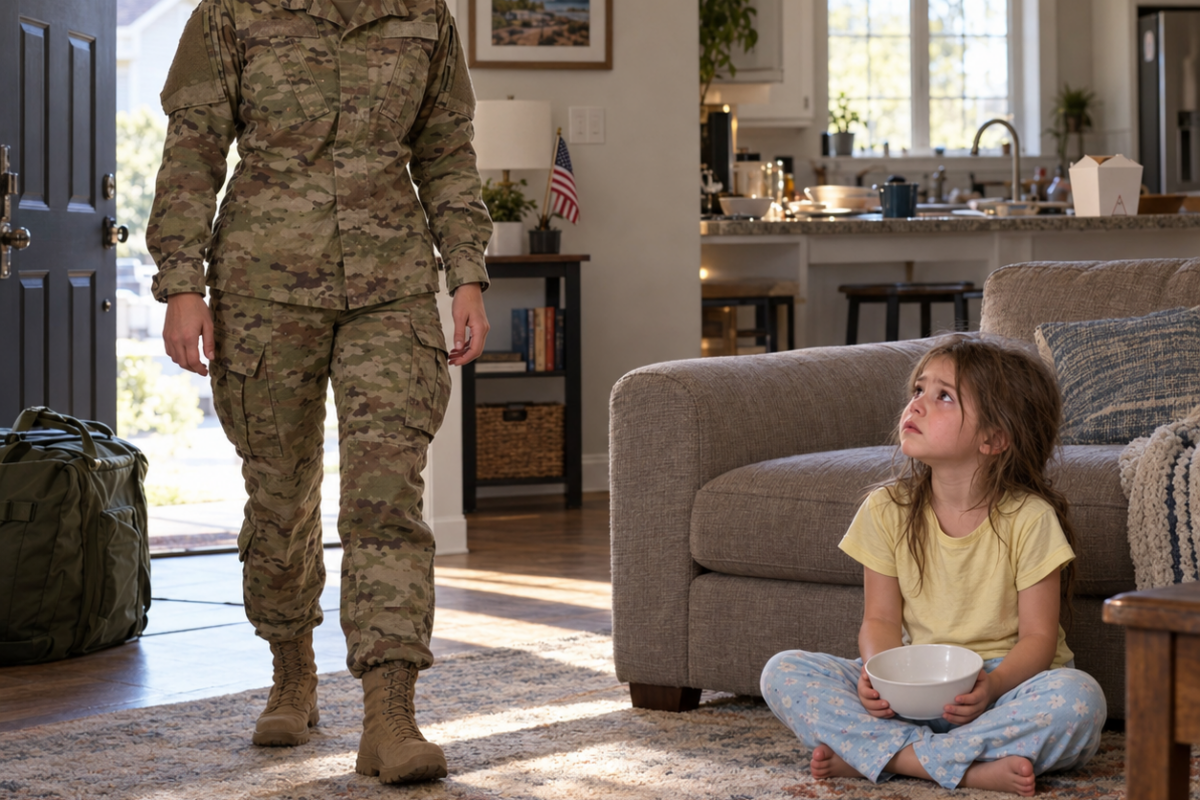
“Mommy, are you real?” my four-year-old daughter whispered when I came home from deployment three weeks early. She was sitting alone on our living room floor with an empty cereal bowl. My husband was on a Caribbean cruise with his mother and sister. Twenty-two minutes earlier, they had posted a photo captioned “Family time.” I was still in uniform when Sophie asked if she could have something to eat.
The first thing my daughter said when I found her was, “Mommy, are you real?” She was sitting cross-legged on our living room floor with…
End of content
No more pages to load