“We heard you bought a penthouse. We came to move in and make things right,” my son said six months after giving me seven days to leave the home I had shared with his father for forty-five years. His wife stood beside him, the same woman who had texted, “We don’t want anything to do with you,” while I slept in a damp Philadelphia motel. I opened the door wider. Neither of them noticed the folder waiting on my dining table.


“We heard you bought a penthouse. We came to move in and make things right.”
Justin said it with a hopeful smile, as though he were offering me something I had been waiting to receive.
My son stood just inside my new home, his wife beside him. The elevator doors remained open behind them, chiming softly because Megan’s suitcase blocked the sensor.
For a moment, neither of them seemed to hear it.
They were looking at the windows.
Philadelphia stretched beyond the glass in the late afternoon light. From where they stood, they could see the long curve of the river, the rooftops, and the buildings beginning to turn gold as the sun moved lower.
Megan’s eyes traveled from the view to the living room, then to the pale wood floors and the kitchen beyond.
Justin looked at me.
“Mom,” he said, “how did you afford this?”
I reached around Megan’s suitcase and pressed the elevator’s close button. The doors slid shut with a soft mechanical sigh.
Six months earlier, neither of them had asked where I would sleep.
“Would you like coffee?” I asked.
Megan recovered first.
Her mouth curved into a smile that arrived a little too late.
“Well, you certainly landed on your feet.”
There was something accusatory in her voice, as though my ability to survive had spoiled an arrangement she considered settled.
“I did,” I said.
She shifted her handbag onto the marble console table beside the entrance. It was an expensive bag, pale beige with polished hardware. I remembered seeing it in photographs she posted during the weeks I spent trying to decide whether I could afford a better motel.
“We didn’t really come for coffee,” she said.
“No. You came to move in.”
Justin rubbed the back of his neck.
It was a habit he had developed as a boy whenever he had done something wrong and hoped I would make the uncomfortable part disappear.
“Mom, that came out badly.”
“It came out clearly.”
He looked toward Megan.
She sighed.
“We’re trying to fix things, Diana. The last few months have been stressful. The baby, the house, expenses. We thought being together might be good for everyone.”
The baby.
That word still reached the softest part of me.
I had never seen an ultrasound photograph. Nobody had told me the due date. I had not been invited to help choose a crib or fold tiny clothes or discuss names.
I had imagined doing all those things.
Then Megan had told me to stop contacting them.
“How far along are you now?” I asked.
Her hand moved toward her stomach.
“Almost eight months.”
I nodded.
“And how long had you been planning to come here?”
“We thought we’d surprise you,” Justin said.
I looked at the suitcase.
“You certainly did.”
On the dining table, a cream-colored folder waited beside three empty cups.
Justin noticed it before Megan did.
His eyes stopped there.
“What’s that?”
“Something we need to discuss.”
Megan gave a short laugh.
“If this is going to be a lecture, we really don’t have time.”
“You came with luggage because you intended to live here,” I said. “I think you have time to sit down.”
Outside, a siren traveled along the avenue and faded between buildings.
Justin pulled out a chair.
Megan remained standing for another moment, then sat beside him.
I went to the kitchen and started the coffee.
My hands were steady.
That surprised me.
For months, I had imagined this conversation ending in shouting, tears, or a triumphant speech in which I finally made them understand what they had done.
Now that they were here, all I wanted was the truth.
Six months earlier, I had not believed I would ever want anything from my son except his affection.
Frank’s death had changed the shape of every day.
For forty-five years, we had shared a house, a kitchen, a bed, and a thousand habits so ordinary that I never thought to treasure them until they were gone.
He died suddenly from a heart attack.
One morning, he complained that he felt strange. By afternoon, people were speaking gently around me in a hospital room, and I knew before anyone said the words.
Afterward, our house became painfully quiet.
The refrigerator made noises I had never noticed. The stairs creaked differently when only one person used them. At dinner, I kept taking out two plates before remembering.
Justin promised I would never be alone.
“We’re family, Mom.”
He said it in the kitchen while holding my hand.
I believed him because he was my son.
During the first weeks, he came often. He changed a lightbulb, brought groceries, and helped me sort the mail. Megan came too, carrying flowers and asking whether I had eaten.
I appreciated all of it.
I was so grateful for company that I did not notice how often their conversations drifted toward the house.
It needed modernizing.
The upstairs rooms were being wasted.
The kitchen layout would be better if the wall near the pantry came down.
I thought they were trying to keep me occupied.
I thought we were discussing possibilities for a future I could not yet imagine.
Then the visits became less frequent.
Calls grew shorter.
Justin began letting my messages go unanswered. When he did answer, I could hear Megan in the background asking how long he would be.
I told myself they were busy.
A grieving person can become very skilled at supplying explanations that make abandonment feel temporary.
One afternoon, they arrived carrying papers.
Justin stood in my living room with his shoulders stiff. Megan sat on the edge of Frank’s chair, holding a folder against her knees.
“We have news,” Justin said.
I looked at them.
“She’s pregnant.”
I cried.
I stood and hugged my son, then Megan, who accepted the embrace without returning it fully.
A grandchild.
For a moment, the future opened.
I imagined a baby sleeping beneath the quilt my mother made. I imagined Frank’s face in a child who would never meet him. I imagined the house filled with voices again.
Then Justin said they needed more space.
I nodded, still smiling.
“Of course. Babies take up more room than people expect.”
He looked at Megan.
Then back at me.
“The house is too big for you, Mom.”
I stopped smiling.
Megan opened the folder.
“We think it’s time for you to find somewhere more manageable.”
I looked around the living room.
The curtains I had hemmed.
The fireplace Frank repaired himself.
The doorway where Justin stood every birthday while we marked his height.
“What are you saying?”
Justin took a breath.
“Dad put my name on the deed years ago.”
“I know.”
“So this makes sense.”
“What makes sense?”
“You moving somewhere smaller.”
It took me a moment to understand that they were not offering to help me choose.
They were telling me to leave.
I asked where they expected me to go.
They had suggestions.
An apartment complex they had not visited.
A senior community whose brochure Megan printed.
A room with a woman one of her coworkers knew.
None of those places had space for the life I had spent forty-five years building.
“Justin,” I said, “this is my home.”
“It’s my house too.”
“Yes. Your father added your name because he wanted things to be easier someday.”
“Well, someday is here.”
I remember that sentence more clearly than I wish I did.
I looked at him.
His face was familiar.
His expression was not.
I begged him to reconsider.
I had never imagined begging my own child for permission to remain beside the walls where I raised him.
Megan gave a short, impatient laugh.
“Stop acting like a victim. You’ve always been a burden.”
The room went still.
I turned toward Justin.
He did not correct her.
He looked at the papers.
Then he said I had a week.
One week.
Seven days to turn a marriage, a childhood, a household, and a lifetime of ordinary memories into whatever would fit in a rented storage unit.
I did not understand my legal position then.
I understood only that my son wanted me gone.
That distinction mattered later.
At the time, grief and shock made every piece of paper look more powerful than my own memory.
I packed slowly.
I kept stopping.
A drawer held birthday candles.
A cupboard held the chipped mug Frank refused to throw away.
Behind a stack of towels, I found Justin’s red blanket, the one he dragged through the house when he was small.
I sat on the floor holding it.
Then I folded it and placed it in a box.
Neither Justin nor Megan came to help.
They sent messages asking whether I had arranged movers.
On the seventh morning, I put my keys on the kitchen table.
Beside them, I left a note.
Be happy.
I did not know what else to write.
Then I walked out.
The motel was in a part of Philadelphia I barely knew.
It was not the cheapest room I found, but it was the cheapest one that seemed safe enough when I looked at the photographs online.
The photographs did not show the damp smell.
They did not include the air conditioner that rattled even when it was off, or the noise that traveled through the walls, or the way headlights moved across the curtains every time someone parked outside.
The bed nearly filled the room.
I put my suitcase on the chair and the banker’s box of Frank’s papers beneath the small desk.
For days, I barely ate.
I bought crackers, yogurt, and fruit from a convenience store because going anywhere unfamiliar felt like too much effort.
At night, I watched the ceiling.
I tried to identify the moment when my son stopped seeing me as his mother and started seeing me as something standing between him and a house.
I called him anyway.
No answer.
I sent messages about the pregnancy.
Was Megan feeling all right?
Had they had an appointment?
Did they know whether the baby was a boy or a girl?
Hours later, Megan replied.
Stop bothering us. We don’t want anything to do with you.
I read the message until the words lost their shape.
Then I put the phone on the nightstand.
There was a stain on the motel ceiling near the smoke detector.
I stared at it.
For the first time, I stopped asking what I could do to make them want me back.
I asked what I could do to get myself out of that room.
The answer began with the banker’s box.
Frank handled our long-term investments.
That had been an arrangement, not a rule.
I paid household bills, kept records, and understood our ordinary finances. He liked reading annual reports and discussing companies whose products he had never personally used.
Every few months, he told me we were secure.
Sometimes he offered to go through the accounts in detail.
I usually said we could do it another day.
I trusted him.
After his death, the papers became one more thing I could not bear to examine.
At two in the morning, while someone argued in the parking lot, I pulled the box onto the bed.
There were statements.
Letters from a financial adviser.
Investment certificates.
Account summaries.
At the top of one folder, Frank had clipped a handwritten note.
Diana, start here. Call Ellen before you move anything. Ask every question you need to ask.
I sat with that note in my hand.
He had not hidden the information.
He had tried to organize it.
I had simply been too overwhelmed to look.
The first call I made the next morning was to Ellen.
She answered with the calm voice of someone who had already been expecting to hear from me.
“Diana. I’m glad you called.”
“I don’t understand these accounts.”
“That’s all right.”
“I’m in a motel.”
There was a pause.
Then she asked, “Would you like me to come to you?”
I began crying before I could answer.
Ellen arrived that afternoon.
She did not look around the room with disgust. She did not ask why I had allowed myself to end up there.
She sat at the little desk, cleared a space, and began making lists.
What was mine.
What belonged to Frank’s estate.
What required paperwork.
What was already accessible.
What should remain untouched until we obtained proper advice.
The numbers were larger than I expected.
Much larger.
Not imaginary wealth.
Not a secret chest of money.
Years of investments, careful decisions, reinvested returns, and assets I knew existed without understanding how substantially they had grown.
“You have options,” Ellen said.
I looked at the motel window.
“I don’t feel as though I do.”
“I know. We’ll make them practical.”
She helped arrange a meeting with an estate attorney named Arthur Shaw.
Arthur reviewed the papers Justin brought to the house and the title records we obtained independently.
He explained that adding Justin to the deed had not automatically erased my interests.
Ownership and occupancy were not the same as whatever Justin and Megan said they were.
There were questions to clarify.
There were rights I had not understood.
There were actions we could take.
I listened.
Then I asked whether I could return to the house.
Arthur answered carefully.
“Possibly. But before we discuss that, do you want to?”
I looked at Ellen.
Then at him.
I thought of the kitchen table.
The note.
The way Justin looked away when Megan called me a burden.
“No,” I said.
The answer frightened me.
It also relieved me.
Arthur nodded.
“Then we’ll protect your position without making going back the only way forward.”
That was the first professional conversation in months in which nobody treated my life as a problem with one convenient solution.
I left the motel for a short-term apartment two weeks later.
I was still grieving.
I still woke expecting Frank.
I still checked my phone too often.
But the room was clean, the lock worked properly, and I could make tea without balancing the kettle beside a television.
Those things mattered.
I began eating again.
I began walking.
I began reading the documents until the terms stopped looking like a foreign language.
The penthouse came later.
At first, Ellen suggested that I rent for a year before making a large decision.
I agreed.
Then a real-estate agent showed me the building where I eventually bought.
I had expected to dislike it.
Too modern.
Too much glass.
Too far from the little garden I thought I could not live without.
Then I stood inside the apartment and saw the light.
The living room faced the city, but a small terrace had enough room for plants. The kitchen was manageable. The bedroom was quiet. Building staff were nearby if I needed help, without being inside my life every hour.
The apartment did not ask me to become a different woman.
It gave the woman I already was somewhere to live.
I visited three times.
I reviewed the costs with Ellen.
I hired an independent inspector and asked questions about the building’s reserves, fees, maintenance, and access.
Then I bought it.
Paid for.
Not because debt was shameful.
Because the purchase fit my situation, and I wanted to know that the place where I slept would not depend on someone else’s monthly decisions.
On moving day, I carried Frank’s old reading lamp in my own car.
The movers thought it was ugly.
One of them did not say so, but I saw the way he studied the faded shade.
I smiled.
“It stays.”
He nodded.
“Then we’ll find it a good place.”
We did.
That first evening, I turned it on beside the sofa.
Beyond the windows, the city glittered.
I sat beneath the warm circle of light and finally felt that I had arrived somewhere rather than merely escaped.
Three months after I moved into the motel, a mortgage notice reached me through redirected mail.
At first, I thought it was a mistake.
The house had always been described in our family as nearly paid off.
Nearly was doing more work than I knew.
Frank and I had taken out a loan against the property years earlier, partly for renovations and partly to consolidate an expense at a rate that made sense then.
Most of it had been repaid.
Not all.
The notice referred to missed payments.
I called the servicer, identified myself properly, and obtained information I was entitled to receive because the original arrangements still involved me.
Then I called Arthur.
He did not tell me to panic.
He asked for the notice.
We reviewed the loan, the title, the payment history, and what Justin had been told when his name was added.
It became clear that he had treated the property as a debt-free inheritance before anyone had died who could properly leave it to him.
I considered calling him.
Then I remembered the unanswered calls.
The message.
Stop bothering us.
Arthur contacted the necessary parties through formal channels.
Justin received information.
Megan apparently handled the mail.
Later, he would tell me she said everything was on autopay.
It wasn’t.
Two payments had been missed.
A third was partial.
Other expenses were being paid freely.
The servicer was also in the process of transferring a portfolio of loans.
That fact led to a financial opportunity that required more advice than anything else I had done.
Ellen knew an investment company that acquired mortgage debt as part of a larger portfolio. I had sufficient capital to participate substantially in that company, and the house loan could be included within a properly documented transaction.
I did not simply call a bank and announce that I wanted to buy my son’s mortgage.
There were eligibility requirements, due diligence, negotiations, independent servicing arrangements, and questions about conflicts that had to be addressed.
Arthur insisted on separate professional review.
So did Ellen.
I listened to both.
By the time the transaction closed, I held a controlling interest in the investment company that owned the debt attached to the house.
The note and mortgage did not become a private weapon I could rewrite whenever I felt angry.
The borrower’s rights remained.
The servicing rules remained.
The actual ownership of the house remained a separate issue.
But I no longer had to wait helplessly while other people pretended that the financial structure beneath their comfort did not exist.
I understood it.
I had a say in how the investment was managed.
And I had enough information to recognize that the house Justin and Megan considered theirs was not nearly as secure as they imagined.
There was another problem.
An emergency savings account Frank and I maintained began showing transactions I did not recognize.
At first, I assumed they were old charges posting late.
Then Ellen asked me to review the dates.
Several occurred after I left the house.
The account contained funds that were not intended for Justin or Megan’s private use. Old household records included information that should have been updated immediately after Frank’s death.
I had not done that.
Now someone had used it.
Arthur helped me report the transactions to the bank. We preserved statements, changed access information, and allowed the bank’s fraud team to do its work.
I did not know everything.
I had suspicions.
I refused to call suspicion proof.
The account was restricted while the bank investigated.
The next day, Justin called for the first time in weeks.
His voice was warm.
Too warm.
“Mom. We heard you found a wonderful place.”
I looked around the living room.
“Yes.”
“We should come see you.”
I considered saying no.
Then I asked, “What do you want to discuss?”
“Just family.”
The word hurt.
It also made me angry.
I agreed to one visit.
I told the building staff their names and the time.
I did not agree to overnight guests.
I did not know they were bringing luggage.
Now they sat across from me, coffee cooling between us, and the folder rested beneath my hand.
“It’s about the house,” I said.
Megan’s posture changed.
“The house is fine.”
“No. It isn’t.”
Justin looked at her.
I opened the folder.
“A mortgage notice reached me three months after I left.”
He frowned.
“What mortgage notice?”
“The one concerning the loan your father and I took against the property.”
“Dad paid that off.”
“He paid most of it.”
Justin stared at me.
“Not all?”
“No.”
Megan crossed her arms.
“So?”
I looked at her.
“So his name on the deed did not create a debt-free property.”
Justin leaned forward.
“You told me it was handled,” he said to her.
“It was.”
I slid the payment history across the table.
“No,” I said. “It wasn’t.”
His eyes moved over the figures.
Megan looked toward the windows.
“Two missed payments,” I said. “Then a partial payment.”
Justin lifted the page.
“Megan.”
“We had expenses.”
“You said everything was on autopay.”
“It should have been.”
“That isn’t the same.”
She reached for her coffee and put it down without drinking.
I watched my son try to make the numbers fit what he had been told.
There was no satisfaction in it.
Only exhaustion.
He had hurt me.
He was still my child.
Those facts continued to exist together, however inconvenient they were.
“What happened after the payments were missed?” he asked.
“I called the servicer. Then I called my attorney.”
“Your attorney?”
“Yes.”
Megan gave a brittle laugh.
“You suddenly have lawyers?”
“I have advice.”
“And now you’re going to lecture us about bills?”
“No. I’m going to explain the position you’re in.”
I took out another document.
“The loan was acquired through an investment company in which I hold the controlling interest.”
Justin stared.
Megan became completely still.
“That’s impossible.”
“It isn’t.”
“How?”
“Your father left more behind than you understood.”
Justin’s eyes widened.
“What do you mean?”
“Investments. Accounts. Assets that took time to review properly.”
He looked around the room.
“How much?”
“Enough that I never needed to live in that motel.”
Megan leaned forward.
“Then why did you?”
I looked at her.
For a moment, I could not speak.
The answer seemed so obvious and so humiliating that I resented having to give it.
“Because grief does not make people efficient,” I said. “Because my husband died, and my son gave me seven days to leave my home, and I believed the papers he put in front of me meant I had no choice.”
Justin lowered his head.
“I was frightened,” I continued. “I was lonely. I had spent forty-five years trusting that my family would not require me to defend myself against it.”
Megan said nothing.
I placed another document on the table.
“This apartment is paid for.”
Justin looked up.
“Paid for?”
“Yes.”
“And the old house?”
“I did not buy it back.”
I let the sentence settle.
“The company acquired the debt. The title questions are separate.”
Megan stood so quickly that the chair scraped across the floor.
“You can’t do that to us.”
“Do what?”
“You know what.”
“Expect a loan to be honored?”
“This is revenge.”
I looked at her.
“You came here intending to occupy my home without asking. You thought saying we should be together would make the past disappear. Now you’re angry because there are things you didn’t know.”
“You planned this.”
“I planned to survive.”
Justin covered his mouth.
Megan pointed toward the folder.
“You’re trying to take our house.”
The words reached a place in me that had been hurting for months.
“Our house,” I repeated.
She stopped.
I stood slowly.
“You stood in the living room where I spent forty-five years with Frank and told me I was a burden. You watched me pack. You never asked whether I had found somewhere safe.”
Her face tightened.
“And when I asked about the baby, you told me you wanted nothing to do with me.”
“I was stressed.”
“I know. You’ve said so.”
“The baby needs stability.”
“So did I.”
Nobody spoke.
Then Justin asked, “Mom, what happens now?”
I sat again.
“I haven’t initiated foreclosure. I haven’t asked anyone to invent a consequence the documents don’t permit. The company and the servicer will follow their obligations.”
Megan’s shoulders lowered.
“So we can work this out.”
“Perhaps. But first, I want an honest answer.”
Justin looked at me.
“To what?”
“Why did you really come here today?”
“We told you,” Megan said.
I opened the last section of the folder.
“You came the day after access to the emergency account was restricted.”
Justin turned toward her.
“What account?”
Megan’s face changed.
I could see her deciding whether denial would still work.
“The account Frank and I maintained for emergencies,” I said. “The one neither of you was authorized to use the way it has been used.”
Justin pushed his chair back.
“Megan?”
She clasped her hands.
“There’s an explanation.”
“How did you access it?”
“I was trying to keep us afloat.”
“That isn’t what I asked.”
She looked at me with anger stripped of its usual politeness.
“You left paperwork behind.”
I stayed still.
“Frank kept information in the desk,” she continued. “I found it.”
Justin stared.
“You used Dad’s information?”
“We needed money.”
“You told me your parents were helping.”
“They couldn’t.”
“You said the nursery money came from them.”
Megan’s eyes filled.
“Would you rather your child sleep in a closet?”
Justin stepped back.
The question was designed to make him abandon the facts.
I recognized it because similar questions had been used against me.
Would you rather we struggle?
Would you rather be alone?
Would you rather make this difficult?
He did not abandon the facts.
“What else did you use it for?” he asked.
I slid copies of the disputed transactions across the table.
The bank’s review was still ongoing. The pages showed withdrawals, transfers, and payments requiring explanation. Some were linked to the house.
Others were not.
Justin looked through them.
“Three thousand. Five thousand. Twelve hundred.”
Megan reached for the papers.
He held them away.
“These aren’t all house expenses.”
She stared at the table.
“Boutiques,” he said. “A hotel. Spa charges.”
“It got out of control.”
He looked at her for a long moment.
Then he turned toward me.
There was shame in his face.
Not embarrassment about being caught in an uncomfortable conversation.
Something deeper.
He looked back at Megan.
“You let me tell Mom we couldn’t afford things unless she left.”
“That wasn’t the only reason.”
“What was the other reason?”
She wrapped her arms around herself.
“I wanted the house.”
The sentence was quiet.
It was worse for that.
“I was tired of apartments,” she continued. “Tired of waiting. Your father put your name on the deed. I thought it was supposed to be yours.”
“My mother lived there.”
“She would have figured something out.”
“She went to a motel.”
“I didn’t know it was that bad.”
“You didn’t ask.”
Megan wiped at her face.
“I was angry.”
Justin gave a short, disbelieving laugh.
“Every cruel thing happened because you were angry?”
She said nothing.
Then he looked at me.
“Mom.”
I waited.
He came closer but stopped several feet away.
“I knew she wanted it.”
His voice broke.
“I knew what we were doing.”
Megan looked up sharply.
He did not look at her.
“I told myself it made sense. I told myself you would be okay. I told myself Dad adding my name meant he wanted me to have it now.”
He pressed his fingers against his eyes.
“But I knew you didn’t want to leave.”
I swallowed.
“That is the first honest thing you’ve said to me in a long time.”
He nodded.
“I’m sorry.”
I looked toward the city.
For months, I had wanted to hear those words.
Now they were here, and the motel still existed in my memory.
The unanswered calls still existed.
The seven days still existed.
“I hear you,” I said. “But hearing you does not mean it is repaired.”
“I know.”
Megan picked up her handbag.
“I’m not staying here for this.”
Justin turned.
“Where are you going?”
“Anywhere else.”
“You came to move in.”
“Clearly that’s not happening.”
She walked toward the elevator.
Before she pressed the button, I said her name.
She turned.
“The account access was reported.”
Her hand stopped.
“To whom?”
“The bank. My attorney. The appropriate authorities for the parts that require review.”
Her face lost color.
“You said you hadn’t started foreclosure.”
“I haven’t.”
“That’s not what I’m asking.”
“I know.”
Justin looked at her.
“Did you sign anything?”
She stared at the elevator doors.
“Did you?” he repeated.
“I was going to fix it.”
“With what?”
She covered her face.
The elevator arrived.
For a moment, nobody moved.
Then she stepped inside.
Justin remained where he was.
Megan looked at him through tears.
“You’re staying?”
He took a breath.
“I need to finish talking to my mother.”
“I’m your wife.”
“Yes,” he said. “And that doesn’t make what we did to her right.”
The doors closed.
I was relieved he said it that way.
I did not want to become the woman who won a contest against his wife.
I wanted him to understand that marriage was not permission to abandon decency.
After the elevator left, Justin sat down.
He bent forward with his elbows on his knees.
I remained near the table.
Neither of us knew how to cross the distance.
Finally, he said, “I thought you would hate me.”
“I did, sometimes.”
He looked up.
The answer surprised him.
“I hated you in the motel when people shouted outside my door. I hated you when I called and heard your voicemail again.”
His eyes filled.
“Then morning came, and I remembered you asleep with that red blanket.”
A broken sound escaped him.
“That was worse,” I said.
He covered his face.
I let him cry.
There was a time when I would have rushed toward him, placed my hands on his shoulders, and told him he was not a bad person.
Perhaps he was not.
But I was no longer willing to rescue him from understanding what he had done.
When he lowered his hands, he looked exhausted.
“Can you ever forgive me?”
“I don’t know.”
He nodded.
“That’s fair.”
“I can tell you what rebuilding would require.”
He straightened.
“Time. Truth. Consistency. No demands. No assumption that being my son gives you access to my home or my accounts.”
He listened.
“And the baby will not become part of a negotiation.”
“Never.”
“If I am involved, it will be because it is healthy for the child and for us. Not because you need housing, money, or a babysitter.”
“I understand.”
I looked at him.
“I hope you will.”
That night, Justin did not move in.
His suitcase remained in the car.
He checked into a hotel.
I did not ask which one.
I did not ask whether the room was comfortable.
He was an adult.
He could arrange where he slept.
The next morning, he called.
“I’ve contacted an attorney.”
“All right.”
“I need to understand the house and the accounts.”
“Yes.”
“I’m not asking you to fix it.”
I sat at the kitchen counter.
“That’s important.”
He was quiet.
Then he said, “Can I call you again tomorrow?”
“Yes. Tomorrow evening.”
He called at the time we agreed.
That small act did not repair six months.
It gave us one new fact.
He said he would call.
He did.
During the following weeks, the financial situation became less mysterious and more difficult.
Justin obtained independent advice. Megan did too.
The bank reviewed access logs, records, and submitted documents. Some funds were recovered. Other amounts became part of repayment and legal discussions.
I was asked questions.
I answered them.
I supplied documents through Arthur rather than responding to emotional messages from Megan.
That boundary helped everyone.
I did not want to become the person whose anger decided whether a financial offense mattered.
I wanted the facts reviewed by people whose responsibilities did not depend on loving anyone involved.
Megan eventually acknowledged that she used information she found in the house to obtain access she did not have permission to use.
Other documents required further explanation.
There were legal consequences.
There was no dramatic arrest in my living room.
No scene in which I watched my pregnant daughter-in-law led away while neighbors applauded.
There were interviews, correspondence, restrictions, and signatures.
There were uncomfortable days when the truth became too well documented to deny.
Megan moved to her parents’ home before the baby was born.
Justin rented an apartment nearby.
Their separation was not something I celebrated.
A marriage ending was still painful, particularly with a child about to arrive.
But preserving the appearance of a family had already cost too much.
The old house stood empty.
For the first time, it belonged to nobody’s daily routine.
Arthur helped clarify the ownership interests and the steps required for a voluntary sale. The mortgage was only one part of that process.
I did not acquire the right to sell the property merely by holding an interest in the company that owned its debt.
Justin had to participate.
Estate issues had to be resolved.
Documents had to reflect the actual title.
I insisted that every part be handled properly.
After being frightened out of my home by an inaccurate explanation, I did not intend to frighten someone else with one.
We agreed to market the house once the arrangements were complete.
It took months.
I almost rushed it.
Then I remembered how badly rushing had served me after Frank died.
I could afford time.
I used it.
My granddaughter arrived before the sale was finished.
That chronology mattered to me.
The baby was not waiting for a house closing, an apology, or a financial settlement to become real.
One evening, Justin called.
His voice shook.
“She’s here.”
I closed my eyes.
“Is she healthy?”
“Yes.”
“And Megan?”
“Tired. But all right.”
I sat down.
For a moment, I could not speak.
Then Justin said, “Megan asked whether you would come.”
I looked around my quiet kitchen.
“Do you want me there?”
“Yes.”
The answer was immediate.
It mattered.
I called Arthur only to confirm that a hospital visit would not require me to discuss the unresolved financial matters.
He almost sounded relieved.
“You may visit your granddaughter, Diana. You don’t have to make every part of your life a case meeting.”
I laughed through tears.
Then I drove to the hospital.
The room was dim except for a lamp near the bed.
Megan looked exhausted.
Without careful clothes and an argument prepared, she looked younger. More frightened.
The baby slept against her chest beneath a white blanket.
Justin stood when I entered.
“Mom.”
I hugged him briefly.
Then I looked at Megan.
“Hello.”
“Hello, Diana.”
For a while, we did not say anything else.
There was a chair beside the bed.
I sat.
The baby made a tiny sound in her sleep.
Megan looked down at her.
Then back at me.
“I don’t expect you to forgive me.”
I waited.
“I kept thinking I deserved things because I wanted them. The house. Money. Control.”
Her voice trembled.
“I told myself you had already had your life.”
I looked at her.
“That was very wrong.”
She nodded.
“I know.”
There was no demand in her answer.
No request that I reassure her before she continued.
“I’m going to repay what I took,” she said. “Whatever the arrangements require. I know saying it isn’t the same as doing it.”
“No,” I said. “It isn’t.”
She looked down again.
Then she shifted the baby carefully.
“Would you like to hold her?”
My breath caught.
“Yes.”
Megan placed my granddaughter in my arms.
She was warm and impossibly small.
Her mouth moved in sleep.
One hand slipped from the blanket and closed around my finger.
I had imagined that moment so often that its quietness almost overwhelmed me.
No music.
No perfect speech.
A hospital room.
A tired mother.
My son crying near the window.
And a child who knew nothing about the history in the room.
“What is her name?” I whispered.
Megan looked at Justin.
He nodded.
“Frances Diana.”
I lifted my eyes.
“Frances?”
“For Dad,” Justin said.
“And Diana for you,” Megan added.
I looked down at the baby.
I was moved.
I was also careful.
A name could be a loving gesture.
It could not be repayment.
I did not say that aloud.
It did not need to become another lesson at the bedside.
I kissed my granddaughter’s forehead.
“Hello, Frances.”
She slept through the introduction.
That seemed sensible.
After the birth, life became more ordinary and more demanding for Justin and Megan.
They had separate homes.
They had a newborn.
They had unresolved questions about their marriage.
Their attorneys helped with the legal arrangements. A counselor helped them discuss parenting without making every disagreement an extension of the financial betrayal.
I remained outside those discussions unless something directly involved me.
That was difficult.
I wanted to know whether Frances was sleeping.
Whether Megan had enough help.
Whether Justin understood how much work a baby required.
But wanting to know everything did not make everything my responsibility.
I offered specific help.
A meal delivered.
A visit at an agreed time.
An afternoon holding Frances while Megan rested, if Megan wanted that and if I felt comfortable.
I did not offer my home as a solution to their housing problems.
I did not provide access to accounts.
I did not allow the baby’s arrival to turn the clock back to the woman who would do anything to avoid losing contact.
Sometimes Megan accepted help.
Sometimes she declined.
I respected both answers.
Justin called twice a week.
We agreed on that schedule because constant contact felt too much, and uncertain contact reminded me of the months he ignored me.
He kept it.
When he could not, he sent a message rather than disappearing.
I noticed.
Over time, noticing became less painful.
At first, every decent act reminded me how easily he could have done it before.
Later, it became possible to appreciate the act itself.
The house sold six months after the penthouse visit.
By then, Frances was several months old.
The process was quiet.
A family viewed the property and liked the garden.
They asked whether the magnolia tree bloomed heavily in spring.
“It does,” I said.
The question moved me more than their offer.
Frank planted that tree when Justin was little. He had stood back after digging the hole and said it looked too small to justify the effort.
For years, I teased him when it bloomed.
The buyers also asked about a line of pencil marks inside the pantry doorway.
Justin’s height.
Birthdays.
Small dates in Frank’s handwriting.
I considered asking that the section be preserved.
Then I decided not to place my memories inside someone else’s obligations.
We photographed it carefully.
The new owners would have their own child to measure.
On the morning of closing, Justin handed me an envelope.
Inside were the old keys.
Beside them was my note.
Be happy.
I looked at him.
“You kept it?”
He nodded.
“I found it the night we moved in.”
“Why did you keep it?”
He looked down.
“Because I knew.”
I waited.
“I knew you were being kinder to me than I deserved.”
My hand tightened around the paper.
For a moment, I could not speak.
Then Justin reached into his coat.
“There’s something else.”
He handed me another envelope.
The handwriting on the front was Frank’s.
I recognized it before I saw my name.
“Where did you find this?”
“In his desk. Behind the bottom drawer.”
I looked at the envelope.
“When?”
“While we were emptying the house.”
I sat down.
My son remained standing.
The letter was dated years before Frank died.
It was not a secret financial instrument or a document that changed the legal title.
It was a husband trying to put something into words.
Diana,
If you find this before I give it to you, it means I have once again made something simple unnecessarily difficult.
I smiled through tears.
That sounded like Frank.
He wrote about adding Justin’s name to the deed and wanting our son to inherit easily someday.
He admitted that he sometimes worried Justin confused being given something with having earned it.
He also admitted that worrying privately did not excuse failing to discuss the arrangement clearly with all of us.
The house, he wrote, was supposed to protect me first.
The investments were meant to give me choices.
Not simply comfort.
Choices.
Near the end, he wrote one sentence that made me press the paper to my mouth.
If this house ever stops feeling like home, Diana, leave it. Home was never the walls. Home was you.
I cried.
Justin sat beside me.
“I read it once.”
I nodded.
“I’m glad you gave it to me.”
“I should have given you a lot of things sooner.”
“Yes.”
He looked at his hands.
“Dad knew I could become selfish.”
I considered the letter.
“He knew people can become selfish. He also knew he needed to be clearer.”
Justin looked up.
“I wish he had been.”
“So do I.”
We were quiet.
Then I folded the letter carefully.
I loved Frank.
I missed him.
I also understood, now, that preparation helped only when people knew how to use it.
His records saved me from prolonged uncertainty.
His incomplete explanations had contributed to it.
I could hold both truths without making our marriage less real.
After closing, the sale proceeds were distributed according to the actual ownership, estate, debt, and agreed settlement arrangements.
Justin did not receive a magical punishment in which every legal interest vanished because he had behaved badly.
He also did not receive the debt-free windfall he imagined.
He signed what was required.
He did not ask me to improve the outcome.
That restraint mattered more than any dramatic surrender would have.
I went home with the keys, the note, and Frank’s letter.
For several days, I placed the keys on the kitchen counter.
I kept expecting to need them.
Then I put them in a small wooden box.
I did not throw them away.
I did not need to carry them in my purse.
The difference felt important.
Justin and Megan eventually divorced.
There was no grand courtroom confrontation in which one of them emerged victorious.
There were difficult meetings, reasonable disagreements, and decisions about how to raise Frances from separate homes.
Megan’s repayment obligations continued.
She found work, moved into a modest apartment, and gradually made her finances less dependent on other people’s generosity.
I did not inspect her life.
I received the information relevant to the arrangements through the proper channels.
Our relationship remained cautious.
We were not friends.
We became civil.
Then, in certain conversations, honest.
One afternoon, when Frances was old enough to sit on the floor and study a wooden block as though it held the secrets of the universe, Megan said, “I used to think saying I was stressed explained everything.”
I looked at her.
“It explains some things.”
“But not permission.”
“No.”
She nodded.
“I’m trying to remember that before I speak.”
I did not congratulate her as though she were a child.
I said, “That would be good.”
Later, she asked whether she could take a photograph of Frances near the windows.
“Yes.”
“May I post it?”
I considered the question.
“Just Frances. No address, no building name, and nothing that identifies where I live.”
“All right.”
She followed the request.
Small acts.
Clear permissions.
A different way of sharing space.
That was how peace began.
Justin rebuilt our relationship over two years.
Not with one apology repeated often enough to become a ritual.
With things I could observe.
He arrived when he said he would.
He called without asking for money.
He listened when I described something important rather than waiting to explain his own problem.
He learned to apologize without making my response the measure of whether his apology was successful.
Sometimes he failed.
Once, he canceled a visit at the last minute because a friend wanted help moving.
I was upset.
He said, “I figured you would understand.”
I looked at him.
“I understand the situation. I also made plans.”
He went quiet.
Then he said, “You’re right. I treated your time as easier to replace.”
He came the next day, but only after asking whether that worked for me.
It did.
The correction was not spectacular.
It was useful.
Another time, he brought groceries.
I looked at the bags.
“You know I can afford food.”
He laughed.
“I know.”
“Then why?”
“Because I was at the store and remembered you like those pears.”
I stared at him.
For a moment, I could not explain why that moved me.
Then I understood.
He was thinking of my preference.
Not my usefulness.
Not my money.
Not what I would give him in return.
He remembered the pears.
I let him put them in the kitchen.
The penthouse changed too.
At first, I kept everything almost painfully neat.
I think I wanted the apartment to prove I had recovered.
A person who had landed on her feet should apparently have no clutter.
Then Frances began visiting.
A basket of toys appeared beside the sofa.
A small cup lived in my cupboard.
A soft blanket stayed on the chair where Frank’s lamp stood.
I discovered that a home could look less impressive and feel more welcoming.
Ellen visited one afternoon and laughed when she saw a toy duck beneath the dining table.
“A significant new asset.”
“Highly volatile.”
She smiled.
“How are you?”
I considered it.
“Better.”
She nodded.
“Not just financially?”
“No. Not just financially.”
We reviewed my plans that day.
I had updated estate documents, account access, trusted contacts, and practical instructions.
Justin knew where relevant information was kept.
He did not have broad authority over it merely because he was my son.
I explained that to him directly.
He listened.
“I understand.”
I watched his face.
He did understand, at least enough not to argue.
That was progress.
I also wrote letters.
Not letters hidden behind drawers.
Letters given to people while I was alive to answer questions.
I told Justin what I intended and why.
I told him that love and ownership were different.
I told him I wanted him in my life, but not as the person who decided what I could manage.
He read the letter in my living room.
Then he looked up.
“Thank you for telling me.”
I nodded.
“You can ask questions.”
He did.
I answered.
There was no crisis required to open the folder.
That, more than anything, felt like an improvement over the past.
I found a life outside my family.
That was something I had neglected after Frank died.
For years, my days revolved around us, our home, our son, and the habits we built together.
When Frank was gone and Justin withdrew, I felt as though the entire structure of my life had disappeared.
Now I joined a reading group at the library.
I took a class about gardening in containers because my terrace was smaller than the old yard.
I discovered that lavender did not care how much I wanted it to thrive if I watered it too often.
A woman named Ruth helped me understand that.
She became a friend.
We had lunch.
We complained about restaurant noise.
We discussed books without either of us asking what the other owned.
Those ordinary relationships helped me stop treating family as the only place I could belong.
Arthur once asked whether I wanted to pursue further remedies related to the way I was pressured from the house.
We reviewed the options.
I made decisions based on advice, cost, emotional energy, and what would actually improve my position.
I did not need every possible action to prove that what happened was wrong.
I needed enough protection to move forward.
He respected that.
So did Ellen.
I became better at asking questions before feeling frightened.
I learned that an official-looking document was something to read, not something to surrender to.
I learned that being overwhelmed did not mean I was incapable.
It meant I needed information in a form I could use.
Those lessons arrived late.
They still arrived.
Frances took her first steps across my living room rug.
Justin sat several feet away with his arms open.
I was on the floor beside her.
Megan had left after bringing her over, having agreed on the visit in advance.
Frances stood with one hand on the sofa.
She looked at Justin.
Then at me.
Then she took one uncertain step.
We both held our breath.
She took another.
Her knees bent.
She stumbled directly into my arms.
Justin laughed.
I laughed too.
Frances looked pleased with herself, though I suspected she had not yet decided whether walking was worth the effort.
For one impossible second, I could hear Frank laughing with us.
Not as a voice from somewhere mysterious.
As a memory so familiar it belonged in the room.
Later, Justin sent Megan a photograph and a short message.
She replied with delight.
No argument about who should have been there.
No accusation about missing something.
They were learning to let their daughter’s life remain larger than their disagreements.
That helped me trust the future a little more.
On Frances’s second birthday, we had a small gathering in the penthouse.
Ruth came.
Ellen came briefly.
Justin brought the cake.
Megan brought balloons, having asked first whether I wanted them tied to chairs or weighted on the floor.
I chose the chairs.
Frances spent half the afternoon ignoring the balloons and playing with a spoon.
Children have useful opinions about what adults consider impressive.
We laughed.
Before the guests arrived, Justin helped me place a small framed line from Frank’s letter on a shelf near the windows.
Home was never the walls. Home was you.
Not the whole letter.
Some things remained private.
Frances pointed at Frank’s photograph beside it.
“Who?”
“Your grandfather,” I said.
She studied his face.
“Grandpa?”
“Yes.”
“Where?”
I took a breath.
“He died before you were born, sweetheart.”
She looked at me.
Then at the photograph.
“Nice?”
Justin turned toward us.
I smiled.
“Very nice.”
She nodded, satisfied for the moment, and went back to the spoon.
Later, after the cake had been cut and most people had gone, Megan stood beside me in the kitchen.
“Thank you for having us.”
“You’re welcome.”
She looked toward Frances, who was half asleep against Justin’s shoulder.
“I know this doesn’t make everything right.”
“No.”
She nodded.
Then she said, “I’m glad she has you.”
The words were simple.
No request followed.
I looked at her.
“I’m glad I have her.”
We stood quietly for a moment.
Then Megan gathered the things she brought, checked the next parenting arrangement with Justin, and left.
I did not watch her depart with anger.
I did not feel close to her.
Peace did not require closeness.
That was another thing I learned.
Afterward, Justin joined me at the window.
The city lights shone below us.
Frances slept against his shoulder, one hand resting beneath his collar.
“Do you miss the old house?” he asked.
I thought about the kitchen.
The magnolia tree.
Frank’s chair.
The pencil marks beside the pantry.
“Yes.”
Justin lowered his eyes.
I touched his arm.
“But I don’t want it back.”
He looked at me.
“I understand.”
I smiled.
“I think you do now.”
He nodded.
For a while, we watched traffic move through the streets.
Then he said, “Sometimes I think about that first night after you left.”
I waited.
“The house felt huge. I thought that meant we finally had room.”
He looked down at Frances.
“Now I know what was missing.”
I did not supply an answer.
He had found one himself.
After a moment, he carried Frances toward the guest room, where she could rest until they were ready to go home.
Halfway across the living room, she stirred.
Her eyes opened.
She reached toward me.
“Grandma.”
I walked over.
Justin lowered her carefully into my arms.
She rested her cheek against my shoulder and went back to sleep.
My son stood beside us.
Neither of us spoke.
Then he kissed my forehead.
“Thank you, Mom.”
“For what?”
He looked at the sleeping child.
“For letting me try.”
I swallowed.
“I’m glad you did.”
He went to the kitchen and began washing the birthday dishes.
I carried Frances toward the window.
Philadelphia stretched beneath us, glowing in the night.
Six months earlier, Justin and Megan stood in this room believing my new life was something they could move into.
They saw space.
Comfort.
A solution.
I had seen my son and the woman who told me she wanted nothing to do with me.
I had wanted them to understand the folder.
The mortgage.
The account.
The consequences.
Those things mattered.
They helped make the truth impossible to avoid.
But they were not the whole story.
The whole story included the motel and the woman who finally opened a box.
The financial adviser who came without judgment.
The attorney who asked what I wanted instead of assuming.
The clean apartment.
The first dinner I cooked for myself.
The lamp beside the sofa.
The friends who knew me beyond my role as someone’s wife or mother.
The son who learned that returning required more than arriving.
And the granddaughter whose life would not become payment for an adult’s forgiveness.
Frances breathed deeply against my shoulder.
One tiny hand curled into the fabric over my heart.
In the glass, our reflection rested over the city lights.
For the first time since Frank died, I did not look at that reflection and see only what I had lost.
I saw a woman who had survived a terrible misunderstanding of love.
I saw a child who would grow up knowing that affection did not require surrender.
Behind us, Justin put away a plate.
The sound was ordinary.
The evening was ordinary.
That was what made it precious.
I turned from the window and carried Frances to the guest room.
I laid her down carefully, covered her with the little blanket I kept there, and stayed until her breathing settled.
Then I returned to the kitchen.
Justin handed me a clean cup.
“Tea?”
“Yes.”
He filled the kettle.
I sat at the table.
There was no cream folder waiting between us now.
No suitcase by the elevator.
No demand that I make room because someone else had decided where I belonged.
Just tea.
A quiet conversation.
And a home I had chosen for myself.
News

At my seventy-second birthday party, my daughter-in-law knocked a crystal vase off its pedestal with her elbow, watched it shatter, and smiled. “Oops.” Her own parents had given it to her and my son on their wedding day six years earlier. I looked at Frank, waiting for him to say something. All he managed was, “Mom…”
I watched my daughter-in-law break her own parents’ wedding gift with one elbow and a smile. For months afterward, people asked me whether I was…
I came home three hours early and found my sixty-eight-year-old mother on her knees scrubbing my mother-in-law’s bathroom. When I helped her stand, her sleeve slipped back, revealing dark marks around her wrist. My husband stepped into the doorway. “Daniela, don’t make a scene.” That was when I remembered my father’s last warning: “If you ever see your mother hurt, don’t argue with anyone. Open the hidden compartment in her sewing machine.”
I came home three hours early and found my sixty-eight-year-old mother on her knees beside a toilet. Her hands were stiff with arthritis. One gripped…

“I already promised your house to your sister,” my father told me four days after I bought it. “They’re moving in Monday. Rent-free for three years.” I was thirty-one, had saved for nine years, and had bought the five-bedroom home entirely in my own name. When I said no, he threatened to tell the family I had abandoned my sister’s children. Days later, he took the microphone at my grandmother’s seventy-fifth birthday dinner and did exactly that.
My father called twelve times in forty minutes after discovering I had bought a house without consulting him. When I answered, he didn’t ask whether…
My mother leaned across the restaurant table, looked at my thirteen-year-old adopted daughter, and whispered, “We don’t sit with mistakes.” I took Sole’s hand and walked her out. That night, my father texted, “You’re still making the car payment tomorrow, right?” By midnight, I had canceled the payments I’d been making for my family. Then I remembered something Sole had told me about her grandmother.
My mother looked at my thirteen-year-old daughter and whispered, “We don’t sit with mistakes.” She said it softly enough to avoid attracting attention from the…
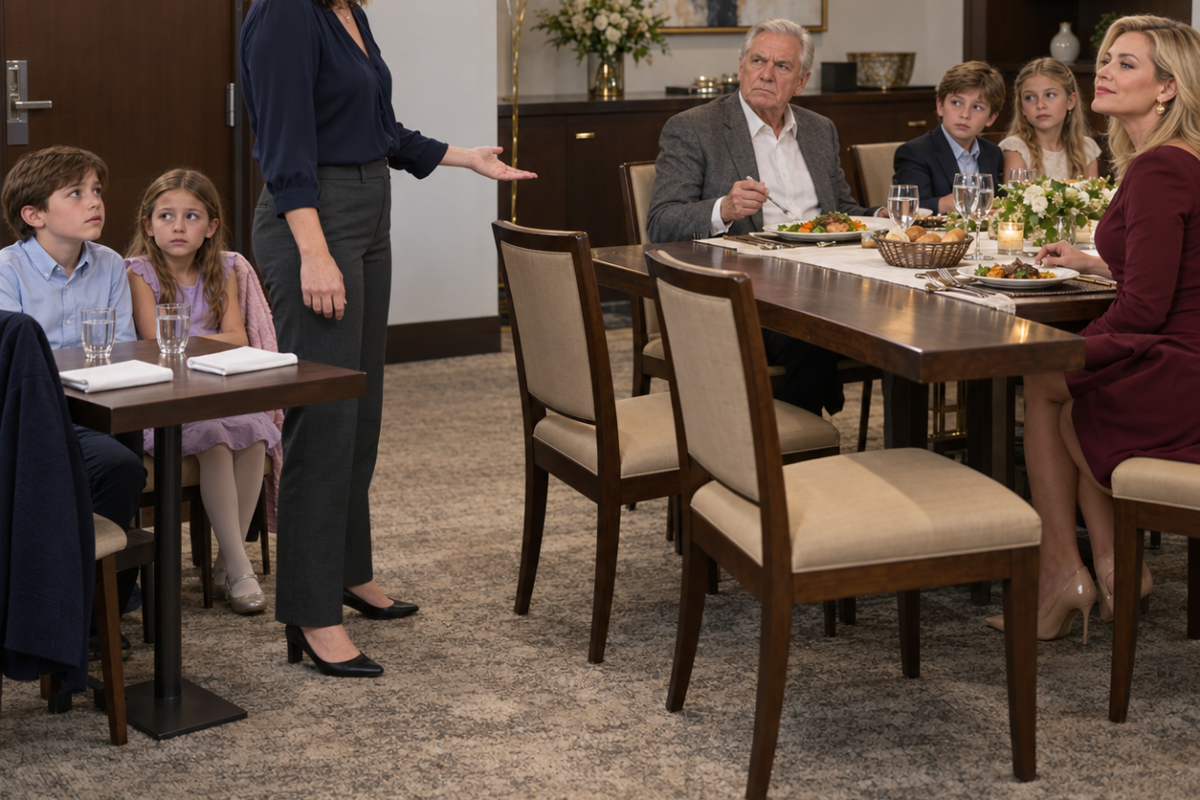
At my father’s seventieth birthday dinner, my eleven-year-old son and eight-year-old daughter were seated beside the service door with water glasses—but no dinner plates. Their cousins sat beside Grandpa with warm bread and full place settings. “They’ll eat after everyone else,” my sister said. I turned to my father, expecting him to object. “They can wait another hour,” he replied. There were two empty chairs at his table.
At my father’s seventieth birthday dinner, the first thing that stopped me wasn’t the cake or the gold balloons. It was my children. Ethan and…
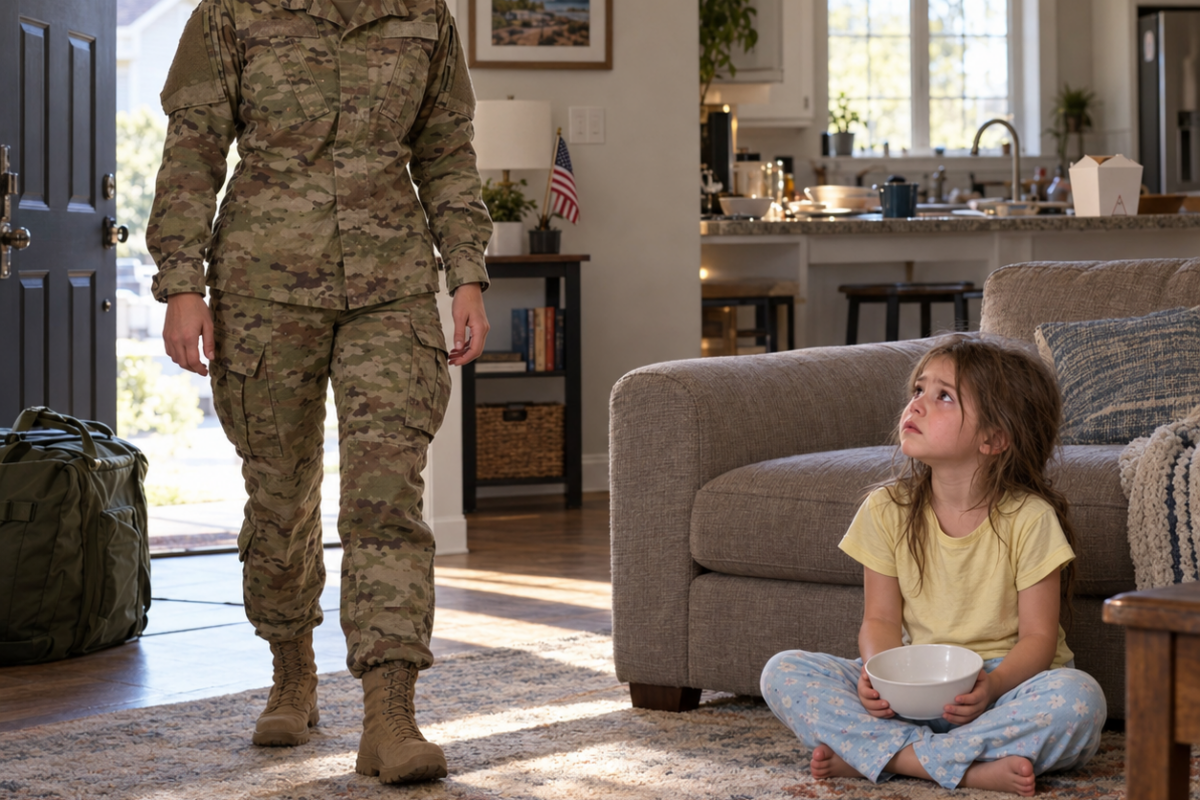
“Mommy, are you real?” my four-year-old daughter whispered when I came home from deployment three weeks early. She was sitting alone on our living room floor with an empty cereal bowl. My husband was on a Caribbean cruise with his mother and sister. Twenty-two minutes earlier, they had posted a photo captioned “Family time.” I was still in uniform when Sophie asked if she could have something to eat.
The first thing my daughter said when I found her was, “Mommy, are you real?” She was sitting cross-legged on our living room floor with…
End of content
No more pages to load