Twenty minutes before our wedding, my fiancé left me in my wedding dress and rushed to Vanessa, the woman my parents had raised instead of me. “Tell everyone we’re doing it tomorrow,” he said from the hospital, while hundreds of guests waited for us. When I objected, he told me to “be mature.” I ended the call, found another man’s number, and said four words: “I need a groom.”
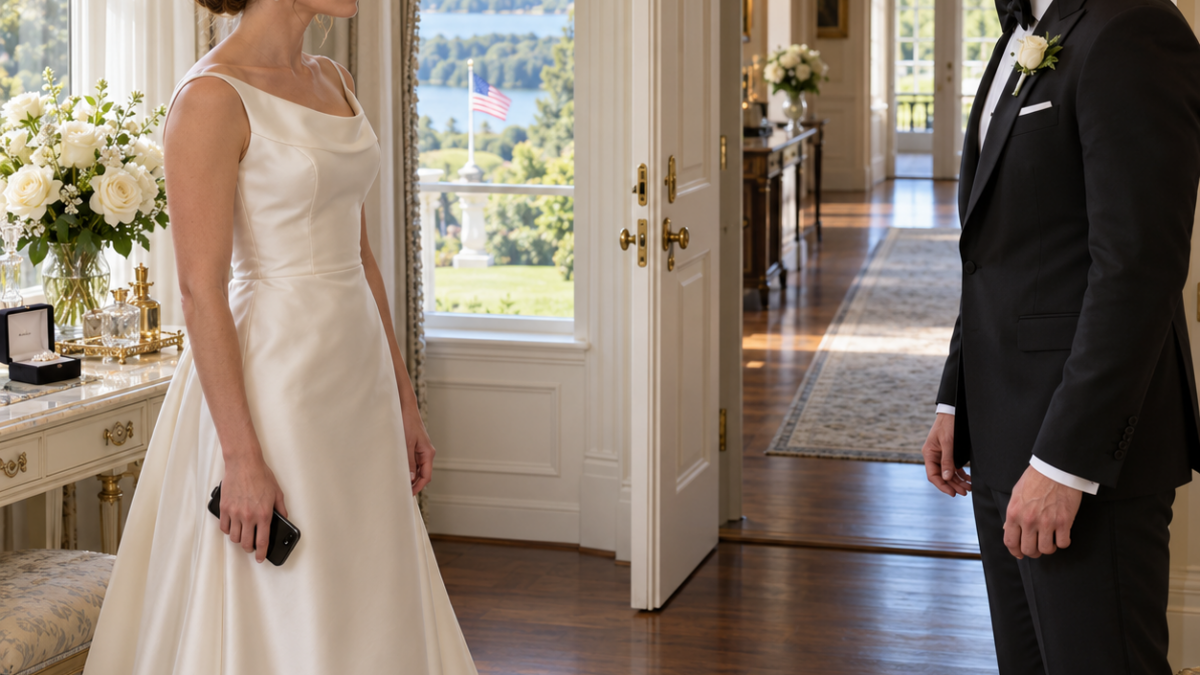
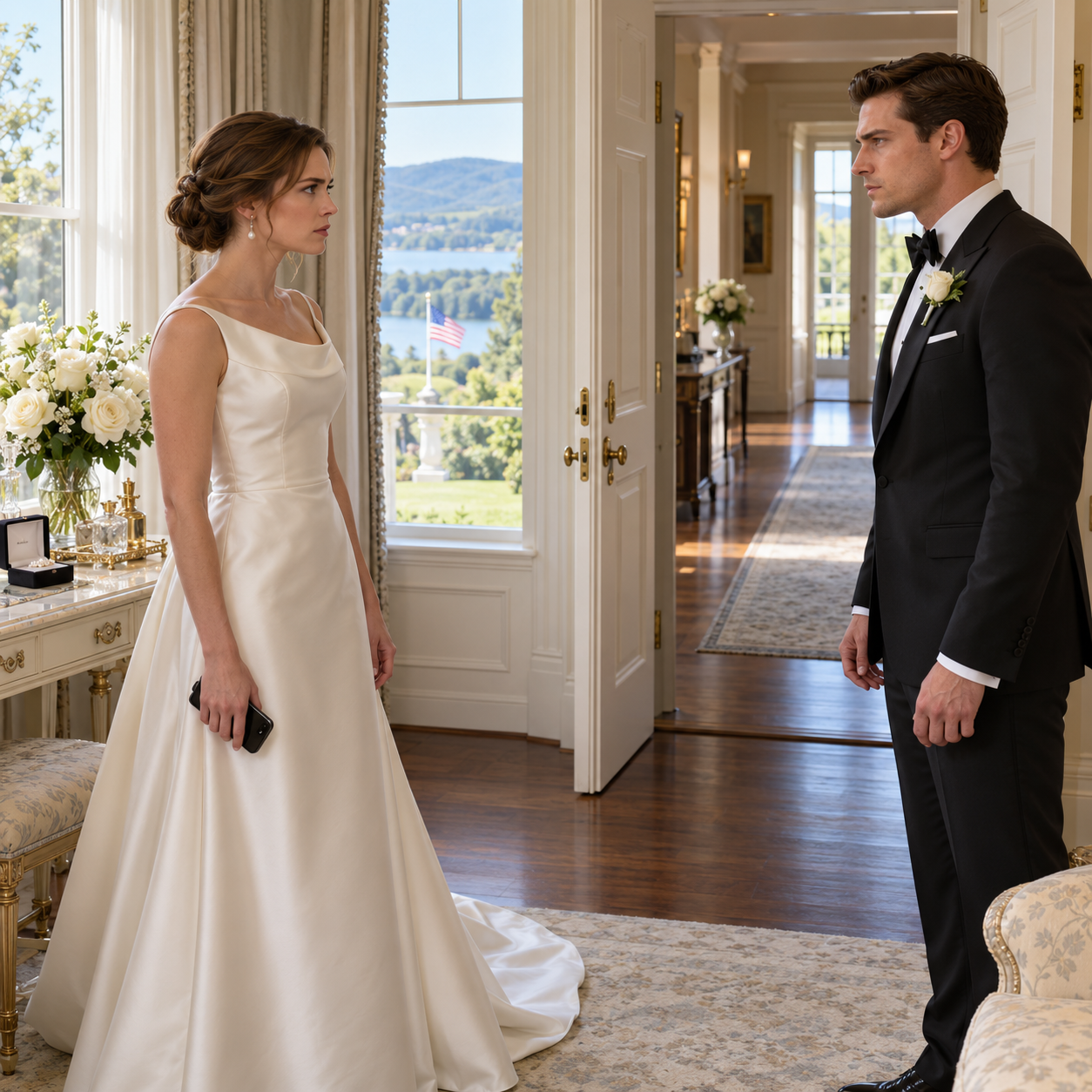
Twenty minutes before I was supposed to marry Ryan Whitmore, our wedding planner walked into the bridal suite and shut the door with both hands.
That was how I knew something was wrong.
For five hours, people had been coming and going with garment bags, makeup brushes, bottled water, and questions about photographs. They knocked lightly, spoke brightly, and left the door open behind them.
Now Patricia stood with her back against it.
“Claire,” she said, “Ryan has left the estate.”
I was fastening the second pearl earring my mother had given me. In the mirror, my hand stopped beside my face.
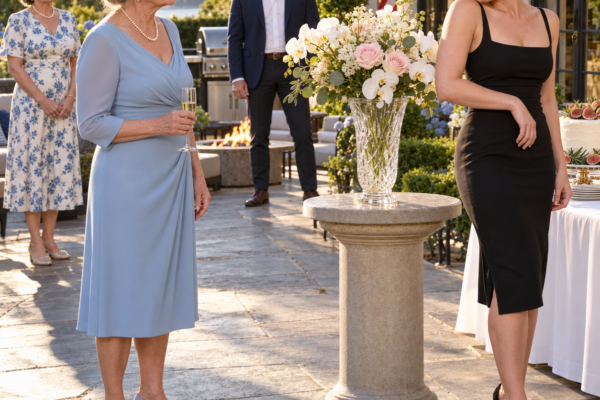
Outside the windows, the Hudson Valley lay under the pale gold light of an early winter afternoon. Hundreds of guests were already seated in the estate chapel. The last shuttle from the hotel had arrived. Somewhere beyond the dressing room, a violinist was rehearsing the opening measures of the processional.
I had been awake since four that morning.
My wedding dress had been steamed twice. My flowers had been photographed from three angles. A woman I had never met had spent forty minutes making my skin look as though I had slept peacefully.
“Left to go where?” I asked.
Patricia’s eyes moved toward my friend Maya.
“Vanessa was in a car accident. He received a call and went to the hospital.”
Maya set my bouquet on the dressing table so abruptly that water spilled from the little vase beside it.
“Of course she was.”
Patricia looked uncomfortable.
“We don’t have all the details.”
But I had seven years of details.
There had been Vanessa’s heart scare on my birthday, the sudden illness during our anniversary dinner, the evening she stopped answering her phone just as Ryan and I were leaving for the celebration of my promotion at Northstar News.
The night he had planned to propose, she had cut her hand and needed him to take her to urgent care.
He proposed three weeks later.
I said yes.
That was the part of the story I could no longer blame on anyone else.
“Where are my parents?” I asked.
“Your mother is trying to reach Vanessa. Your father is speaking with the guests.”
“Of course he is,” Maya said.
She had worked beside me in the newsroom long enough to recognize the difference between a family emergency and a family pattern.
My phone began vibrating.
Ryan’s name filled the screen beneath a photograph from a trip to Maine. In the picture, his arm was around my shoulders. I remembered setting the camera on a picnic table, running back to him, and thinking we looked like people who knew where they belonged.
I answered.
“Claire, I’m sorry.”
His voice was hurried but not frightened. I knew what he sounded like when he was frightened. This was the voice he used when he had already made a decision and wanted me to make it easier for him.
“Vanessa’s car hit a guardrail. There could be internal bleeding. They might need to operate.”
“Has a doctor told you that?”
“She called me from the ambulance. Everything happened so fast.”
“Are you at the hospital?”
“Yes.”
“The ceremony starts in fifteen minutes.”
“I know. Mark will notify everyone. We’ll move it to tomorrow.”
For a moment, I thought I had misunderstood.
“Tomorrow?”
“I’ll cover the extra costs. Tell Patricia to speak with the caterer. Explain it to Grandpa Henry for me.”
Beyond the door, someone laughed. It was a brief, ordinary sound, probably a bridesmaid responding to a joke. The world had not yet learned that mine had stopped.
“And if Vanessa feels sick tomorrow?”
“Don’t do this.”
“Do what?”
“Attack her when she’s hurt. She’s your sister.”
I looked at the pearls in the mirror.
“She is not my sister.”
Maya went still.
It was the first time I had said those words without lowering my voice.
Vanessa had been raised as Charles and Eleanor Bennett’s daughter. I had been raised in a narrow house outside Scranton by a man whose drinking determined the temperature of every room.
A hospital mistake had sent two newborn girls home with the wrong families.
For twenty-two years, nobody knew.
Then a consumer DNA test, an unexpected match, and months of medical records uncovered the truth.
My mother cried when she first saw me. My father held my hands and said they had been robbed of a lifetime.
For a little while, I believed finding them meant the worst part of my life was over.
I did not understand that a family could have room for my blood and still be unwilling to make room for me.
Vanessa kept her bedroom, her name, her place in every photograph, and the affection of people who had loved her since infancy.
I never asked them to stop loving her.
I asked, eventually, whether loving her required treating me as an unwelcome correction.
Nobody liked that question.
“Claire,” Ryan said, “this is not the time to drag up old resentments.”
“No. It’s the time we were supposed to get married.”
“Be reasonable.”
There it was.
For seven years, reasonable had meant accepting that Vanessa’s feelings were immediate and mine could be handled later.
“I’ll make this up to you,” he said.
“How?”
“We’ll have the wedding tomorrow. Whatever you want.”
I watched my own face become unfamiliar.
“I want a husband who won’t leave me on our wedding day.”
He exhaled sharply.
“You can’t throw away seven years because of one emergency.”
“It wasn’t one emergency.”
“You’re upset.”
“It was every time you chose her and told me I was wrong for noticing.”
“Let’s talk when I get back.”
“Ryan, we’re over.”
He said my name again, louder this time.
I ended the call.
For several seconds, nobody moved.
Then I removed the pearl earrings and placed them in their velvet box.
Maya came to stand beside me.
“I’ll help Patricia cancel everything.”
I nodded, but the motion did not feel connected to a decision.
I could imagine the next morning already.
Not because I cared deeply about society columns or strangers with opinions, but because I knew how the people in that chapel would tell the story.
Vanessa had suffered a crisis. Ryan had behaved nobly. Claire had reacted badly.
By Monday, my mother would be asking me to apologize for the embarrassment. My father would say the family needed to move forward. Ryan would arrive with flowers and wait for me to become the woman he understood again.
The woman who waited.
The woman who explained.
The woman who made room.
I picked up my phone.
Three years earlier, at a charity gala in Manhattan, a fire had started in a service corridor.
Most guests had reached the street before the smoke spread. I had been near the rear staircase when I heard a young server calling for help behind a jammed door.
I went back because I could hear her.
That was all.
Later, people called it courage. At the time, it was simply impossible to keep walking while someone was still asking.
After helping her into the stairwell, I found a man on the landing below. He had been overcome by smoke while trying to get another guest out.
He was too heavy for me to carry.
I dragged him far enough from the worst of it to reach an open window and stayed there until firefighters found us.
His name was Adrian Sterling.
I had known the name before I knew the man. Sterling Capital appeared regularly in the business coverage at Northstar. He was the person whose photograph newspapers used when they wanted to illustrate money that did not need to explain itself.
At the hospital, after the oxygen mask came off, he asked a nurse to bring me to his room.
“You stayed,” he said.
“There wasn’t anywhere useful to go.”
He watched me for a moment.
“I owe you my life.”
“You don’t owe me anything.”
He gave me his private number anyway.
“If you ever need something, call.”
I had never used it.
Now I scrolled until I found his name.
Maya looked at the screen.
“Claire?”
“I need a minute.”
I stepped into the adjoining sitting room and closed the door.
He answered after one ring.
“Claire.”
I had expected an assistant, a voicemail, or the awkward pause of someone trying to remember who I was.
“You saved my number?”
“I said you could call.”
His voice was low and steady. Behind it, I heard an airport announcement.
“Where are you?”
“Teterboro.”
“Have you taken off?”
“Not yet.”
I pressed my free hand against the windowsill.
“I was supposed to get married today.”
“I know.”
Of course he knew. The wedding had become a business event long before it became a family celebration.
“The groom left.”
The silence changed.
“Where did he go?”
“To Vanessa.”
He did not ask who she was.
For reasons I could not have explained then, that almost made me cry.
“You told me I could ask you for anything.”
“Yes.”
I looked through the window toward the chapel.
“I need a groom.”
The words sounded astonishing once they were outside my mouth.
For a moment, I wished I could pull them back.
Adrian did not laugh.
“Do you need someone to stand beside you today,” he asked, “or are you asking me to marry you?”
“I don’t know.”
It was the first honest answer I had given all day.
“I know this is unfair. I know you have a flight. I know I shouldn’t—”
“Claire.”
I stopped.
“You can finish a sentence without explaining why you’re allowed to say it.”
I closed my eyes.
“I don’t want to spend another year being told I should have waited.”
Somewhere on his end, a door opened.
I heard him say, away from the phone, “Ethan, cancel Zurich. Find out whether the helicopter is still available.”
Then he returned.
“What time is the ceremony?”
“Six.”
“Ask the planner for forty minutes.”
“You’re coming?”
“Yes.”
“Adrian, you don’t have to do this.”
“I know.”
When I returned to the bridal suite, Maya was holding the bouquet in both hands as though she had considered using it as a weapon.
“Who did you call?”
“Adrian Sterling.”
Her expression emptied.
“Sterling Capital Adrian Sterling?”
“Yes.”
“What did you ask him?”
“To come.”
“Come and do what?”
I looked at Patricia.
“Can we delay the ceremony forty minutes?”
Patricia had spent fifteen years arranging weddings for people accustomed to getting their way. Even so, she took a moment.
“Claire, I need to understand what you’re asking.”
“So do I,” I said. “But please ask the officiant to wait.”
My father arrived before she left.
He did not knock.
“What is going on?”
“Ryan has gone.”
“We know that. Your mother says Vanessa may be seriously injured.”
“Has anyone spoken to her doctor?”
He looked irritated.
“This is not the moment for an interrogation.”
“It seems like a useful moment for information.”
“We have guests in there.”
“I’m aware.”
He lowered his voice.
“You cannot let this turn into a spectacle.”
I stood in a dress that had required three fittings while he spoke to me about embarrassment.
For years afterward, that was the detail I remembered most clearly.
Not the call.
Not the empty place beside the altar.
My father looking at me and seeing a problem he needed contained.
“Then you should speak to Ryan,” I said.
“He did what he believed was necessary.”
“And I’m doing the same.”
“What does that mean?”
“Adrian Sterling is coming.”
My father stared at me.
Behind him, Maya folded her arms.
Nobody spoke until he said, “You cannot be serious.”
“I’ve never been more serious.”
He began explaining consequences. Family consequences, financial consequences, the consequences of decisions made in distress.
I listened until he paused.
“Dad, I told Ryan the relationship was over. That part is finished.”
“You don’t end an engagement over the phone.”
“He postponed our wedding over the phone.”
My father’s mouth tightened.
For the first time, I did not try to soften what I had said.
Patricia stepped between us with the practiced composure of a woman who had rescued more than one expensive day.
“Mr. Bennett, I need to speak with you about an announcement to the guests.”
She led him out.
Maya waited until the door closed.
“Are you sure?”
“No.”
She nodded.
“All right.”
“You’re not going to tell me this is insane?”
“It is fairly unusual.”
I laughed once, unsteadily.
She took my hands.
“But you’re allowed to make a choice that isn’t designed around keeping everyone else comfortable. Just promise me you’ll keep choosing after today.”
“I promise.”
My grandfather came next.
Henry Bennett entered slowly, his cane tapping against the hardwood. At eighty-one, he had outlived most of the men who had once mistaken his courtesy for weakness.
He looked at my bare ears, then at the velvet box on the table.
“Your mother’s pearls?”
“Yes.”
He nodded.
“Would you like your grandmother’s?”
I had to sit down.
He waited without pretending not to notice.
“They’re in the safe,” he said. “Maya can fetch them. Small diamonds. Nothing that will fight with the dress.”
“Grandpa, do you think I’m making a mistake?”
“I think you’ve made several mistakes by staying where you weren’t treated well.”
“That isn’t an answer.”
“No,” he said. “It’s the only part I know for certain.”
He lowered himself into the chair opposite mine.
“You don’t owe these people a wedding. You don’t owe Ryan forgiveness because his intentions sound respectable. And you don’t owe Adrian a marriage because he answers his telephone.”
I looked up.
“If you want to stop, I’ll walk out with you.”
I could have loved him for that sentence alone.
“But if you want to go into that chapel,” he continued, “I’ll be there.”
Outside, the light was fading.
Inside me, something had become very quiet.
“I want to go in.”
“All right.”
He stood and kissed my forehead.
“Then let them wait.”
Adrian arrived a little under an hour later.
The helicopter landed at a nearby property where the owner had agreed to let him use the private landing area. Ethan met a car there with a tuxedo borrowed from the estate’s emergency wardrobe and a bag from a jeweler.
None of it happened gracefully enough to resemble a movie.
Adrian’s cuff caught on a sleeve button. Ethan had to help him straighten the collar. Patricia was on the telephone arguing about the revised timing of dinner.
I learned those details later.
At the time, I was standing outside the chapel doors with my grandfather.
“Do you want my arm?” he asked.
“I think I need to walk in myself.”
He smiled.
“I thought you might.”
When the doors opened, the whispers reached me before the music.
People turned.
Some looked sorry. Others looked eager in a way that made me understand how easily another person’s pain could become an evening’s entertainment.
I kept walking.
My father sat beside my mother in the first row. She was holding a tissue, but neither of them stood.
Halfway down the aisle, the doors opened again.
Adrian entered without looking at the guests.
His bow tie was slightly crooked. His hair had not quite recovered from the wind. There was a thin scrape across one knuckle, probably from the hurry of getting dressed.
He stopped beside me.
“I’m sorry,” he said. “I’m late.”
I looked at him, and for the first time that day, the room seemed smaller than the choice before me.
“You still have time to regret this.”
“I’ve had time.”
“That isn’t the same thing.”
“No,” he agreed.
He offered his hand.
“Would you like me to stand beside you?”
“Yes.”
The officiant met us at the front.
Patricia had explained the situation. His expression suggested he would be discussing it with his wife for years.
Before anything began, Adrian asked for a moment.
He turned toward the guests.
“The license prepared for today names another groom. Nothing we do this evening will change that.”
A murmur moved through the chapel.
“We can make promises here,” he continued. “A legal marriage will require a new license and another decision. Claire will have the time to make that decision.”
He looked at me.
“So will I.”
I felt my shoulders loosen.
He was not turning a public rescue into a private obligation.
The officiant asked whether we wished to proceed with a commitment ceremony.
Adrian waited.
“Yes,” I said.
Then he answered.
Our vows were simple because neither of us wanted to pretend we knew the whole future.
He promised honesty.
I promised the same.
He promised to listen when I spoke, including when what I said was inconvenient.
My voice nearly failed when I answered.
The ring Ethan had brought fit a little loosely. Adrian noticed immediately.
“We can have it adjusted,” he whispered.
Such a small, practical thing.
No declaration about destiny. No performance for the cameras.
Just a ring that needed to fit the person wearing it.
When the officiant invited him to kiss me, he bent his head.
“May I?”
“Yes.”
The kiss was brief.
My grandfather began clapping.
Maya followed.
The sound moved slowly through the chapel until even the people who had come hoping for a scandal had to decide whether to join it.
At the hospital, Ryan still believed he was dealing with a delayed wedding.
Vanessa lay in a private room with a small bandage above her eyebrow. The imaging had been completed. A doctor had found no sign of internal bleeding and recommended observation for a mild concussion.
“You should go back,” she told him.
Her fingers tightened around his hand.
“Claire must be so upset.”
He glanced at the clock.
“I’ll stay until we know you’re all right.”
“I feel terrible.”
“You had an accident.”
“That isn’t what I meant.”
He told her not to worry.
His assistant, Mark, called twice. Ryan silenced the first call and stepped into the corridor for the second.
By then, the reception at the estate had begun.
“Did she make a scene?” Ryan asked.
Mark did not answer quickly enough.
Ryan loosened his tie.
“Claire knows I’ll make it right. Tell Patricia to keep the flowers. We’ll use them tomorrow.”
“The wedding wasn’t canceled.”
Ryan stopped moving.
“What?”
“The ceremony went ahead.”
“How could it go ahead without a groom?”
Mark’s voice became careful.
“She chose someone else.”
Ryan stared at the hospital wall.
“With whom?”
“Adrian Sterling.”
For the first time all evening, Ryan forgot what he had been about to say.
I did not know that conversation was happening.
I was sitting at the head table beside a man who had canceled a flight to Europe, trying to eat a piece of fish while people approached us with congratulations that ranged from sincere to professionally interested.
My mother came first.
“Claire,” she said softly, “we need to talk.”
“Tomorrow.”
Her expression flickered.
I had never used that word with her before.
My father shook Adrian’s hand and asked about Zurich.
Adrian replied politely.
He did not offer an explanation for why my father’s abandoned daughter had suddenly become worthy of his full attention.
Later, when the speeches had ended and the musicians had shifted to quieter songs, Adrian led me into the bridal lounge.
Ethan had left a folder on the table.
“What’s that?” I asked.
“A draft.”
“Of what?”
“Terms we might want to discuss before making this legal.”
I looked at him.
“Terms.”
“I don’t want you waking up tomorrow wondering what today has cost you.”
I sat.
The document was not romantic. That was part of its appeal.
Our existing property would remain separate. We would retain control over our careers and finances. Neither of us would incur obligations for the other’s business.
Either could ask to end the arrangement.
A proposed two-year period would give us time to decide whether the relationship could become something we wanted to keep.
There were provisions about privacy, living arrangements, and independent legal advice.
One paragraph made clear that a marriage did not create any obligation to physical intimacy.
I read that paragraph twice.
“You asked an attorney to put this together while you were traveling?”
“I asked for a starting point. It isn’t something you should sign tonight.”
“Why two years?”
“Because a public reversal tomorrow would invite another round of speculation. Two years gives the story time to become ordinary.”
“And what does it give you?”
He leaned against the table.
“A stable public image. We’re negotiating a cross-border acquisition. Some people would like to believe I make impulsive decisions.”
“Do you?”
“Occasionally.”
I looked up.
He was almost smiling.
“Does your board know you’ve solved that problem by replacing a groom?”
“They may notice an inconsistency.”
I laughed.
It surprised both of us.
Then I looked back at the pages.
He was presenting it as an exchange. An arrangement between equals. Something from which he might benefit, so I would not have to think of myself as a burden.
At the time, I was too tired to understand how much of that explanation he had invented for my comfort.
“I need my own lawyer.”
“Absolutely.”
“I want to keep my apartment until I decide how living together would work.”
“Of course.”
“And I don’t want to become someone who attends luncheons because her husband’s office put them on a calendar.”
“Neither do I.”
I closed the folder.
“I’ll read it tomorrow.”
“Good.”
He took off his jacket and put it over the back of a chair.
For the first time, I noticed how tired he looked.
“Adrian?”
“Yes?”
“Thank you for coming.”
“You called.”
He said it as though that explained everything.
By the time I reached my Manhattan apartment, it was past midnight.
Adrian had insisted only that I not travel alone while exhausted. Ethan arranged a car, Maya rode with me, and nobody attempted to decide where I would sleep.
Maya stayed until I had changed into sweatpants and washed the wedding makeup from my face.
“You can still change your mind,” she said at the door.
“I know.”
“About all of it.”
“I know.”
She studied me.
Then she hugged me without asking another question.
I was putting the dress over a chair when the doorbell rang.
Ryan stood outside.
His tie hung loose. His hair was flattened on one side. He looked angry in the particular way people do when an event has occurred without their permission.
“What are you doing with Adrian?”
I kept the door partly closed.
“It’s late.”
“This isn’t funny.”
“I haven’t laughed.”
“You replaced me.”
“You left.”
“Vanessa was in the hospital.”
“And her doctor said she was stable.”
His expression sharpened.
“How do you know that?”
“Your assistant told Patricia when he finally called.”
“That doesn’t change what could have happened.”
“No. It changes what you chose to tell me.”
He stepped closer.
“I made a judgment in an emergency.”
“You told me to move our wedding to tomorrow before you had spoken to her doctor.”
“I thought you would understand.”
There was grief in that sentence. I could hear it.
But it was grief for the woman he had expected me to remain.
“I understood for seven years.”
“You don’t know Adrian.”
“I know he asked what I wanted.”
“You’re making a point.”
“At first, part of me was.”
He seized on the admission.
“Then this is about punishing me.”
“No. It’s about discovering that my life can continue after I stop waiting for you.”
He reached toward my arm.
I stepped back.
“Don’t.”
His hand fell.
“You’re not legally married.”
“Not yet.”
He stared at me.
“You can’t actually be considering it.”
“I am.”
“Claire, listen to yourself.”
“I have been. That’s the difference.”
For a moment, I saw the man I had loved. The one who had helped me move into this apartment, carried a heavy bookcase up two flights when the service elevator broke, and once driven through a snowstorm to bring me medicine.
Those memories were real.
So were the evenings he had left and the apologies he expected me to supply.
I had spent years using the good memories to excuse the rest.
“I’ll give you time,” he said finally.
“I’m not asking for time.”
“You’ll calm down.”
I looked at him until he stopped speaking.
Then I closed the door.
The lock made a small sound.
I stood there listening to it settle into silence.
Over the next week, my attorney reviewed the proposed agreement.
She removed language that treated the two-year period as an obligation and replaced it with a date for review. She clarified that ending our private arrangement would not itself dissolve a legal marriage. Any divorce would require the ordinary process.
Adrian accepted the revisions without argument.
That mattered more to me than the original draft.
It was easy to promise choice when nobody exercised it.
It was harder to remain pleasant when someone crossed out your words.
We applied for a new marriage license and waited through the required period. A week after the ceremony at the estate, we went to the Manhattan City Clerk’s Office with Maya and Ethan.
There were no reporters.
A little girl in a red coat sat near the entrance eating crackers while her parents waited for their appointment. A man ahead of us had forgotten his identification and was quietly arguing with himself.
The ordinary setting helped.
Nothing in that room suggested I owed anyone a performance.
Before we were called, Adrian turned to me.
“Are you sure?”
“No,” I said.
He nodded.
“Would you like to leave?”
“No.”
“That’s a different answer.”
“It’s the one I have.”
“All right.”
When the clerk asked whether we were entering the marriage voluntarily, I answered for myself.
So did he.
Outside, Maya took one photograph on her phone.
In it, Adrian and I were standing too far apart, smiling a little awkwardly, while Ethan held my coat because I had forgotten it on a chair.
I liked that photograph more than any from the estate.
Adrian handed me a key when we reached his building.
“The main bedroom is yours.”
“Where will you sleep?”
“The room beside the study.”
“You live here.”
“So will you, if you decide you want to.”
I turned the key in my hand.
“Thank you.”
He looked at me.
“You don’t have to thank me for basic respect.”
I did not know what to say.
That evening, I put my own shampoo in the bathroom and left my suitcase open on the floor.
For years, I had packed lightly for family visits. I never wanted to create the inconvenience of having too many things in a place where I might not be wanted.
Now there were empty drawers.
Nobody had cleared half a drawer while explaining how generous they were being.
There was room.
Marrying Adrian did not turn me into a different woman.
On Monday morning, I still woke before seven. I still checked messages from sources before getting out of bed. I still forgot to eat breakfast when a story occupied my mind.
At Northstar News, my editor, Ruth Gallagher, closed her office door and pointed to a chair.
“I am not going to ask whether you’re in love,” she said.
“Good.”
“I am going to ask whether we need to anticipate any professional conflicts.”
“That’s fair.”
I explained the marriage, the agreement, and Adrian’s business interests as plainly as I could.
Ruth listened without giving me the expression people wore when they were trying to decide whether I was foolish.
“We’ll document the relevant disclosures,” she said. “You’ll stay away from stories involving his firm unless we have a very clear arrangement.”
“I expected that.”
“Your personal life is not an editorial assignment.”
“Please tell the rest of the internet.”
“I’m an editor, Claire. My authority has limits.”
I smiled for the first time that morning.
The newsroom felt like solid ground.
There were monitors with the sound turned low, old coffee in the pot, and a producer near the assignment desk asking why a city agency had sent the same useless response three times.
Nobody needed me to be a Bennett daughter there.
They needed me to make telephone calls, check documents, and notice what did not add up.
At home, Adrian and I learned each other slowly.
He liked the apartment cooler than I did.
I worked best with papers spread across a table.
He put his keys in the same shallow bowl every night. I lost mine at least twice a week.
The housekeeper, Mrs. Alvarez, asked what I wanted in the refrigerator.
I told her not to make special arrangements.
She looked at me for a long moment.
“Milk is not a special arrangement.”
“Oat milk,” I corrected.
“Then oat milk.”
Three days later, it was there.
Adrian did not ask me to report my schedule. He did not send a driver to follow me. When I said I needed a quiet night, he accepted the sentence without searching for an insult inside it.
Sometimes we barely saw each other.
Sometimes we met in the kitchen at eleven and ate toast while discussing things that had nothing to do with our marriage.
He knew an astonishing amount about transit systems.
I knew an unnecessary amount about a city contractor who had billed for street repairs nobody could find.
He listened when I talked.
Not with the patient expression Ryan had worn until I finished, but with questions that proved he had followed.
One night, I found a lamp on above the dining table.
Beside it was a bowl of soup and a note.
Mrs. Alvarez said you missed dinner. It reheats well.
There was no instruction to call him. No reminder of what he had done.
I ate the soup standing beside the counter.
Then I sat down because I realized there was no reason to hurry.
Three days after our legal wedding, I visited my grandfather at the estate.
I went alone because Adrian was scheduled to leave for Zurich, and I had not thought to ask him to rearrange an international trip for lunch.
Vanessa photographed me as I came through the front hall.
I noticed her phone, but not quickly enough.
By the time I reached Henry’s study, the photograph was online.
My sister’s first visit home after her wedding. Unfortunately, her new husband is too busy to come. Any suggestions for cheering her up?
The words were gentle.
The comments were not.
A replacement groom was never going to take her seriously.
How convenient that she had another billionaire ready.
Poor Ryan.
I set the phone facedown.
Henry watched me over his reading glasses.
“Do you want to talk about it?”
“No.”
“All right.”
He returned to the document in his lap.
For several minutes, the only sounds were the clock and a groundskeeper’s leaf blower beyond the window.
Then I said, “I don’t know whether I’m happy.”
Henry put down the document.
“With Adrian?”
“With any of this.”
“Does he treat you kindly?”
“He respects me.”
“That’s a good place to start.”
“It feels strange.”
“Being respected?”
I looked at my hands.
He did not make me answer.
At lunch, Vanessa placed her phone beside her plate with the comments still visible.
My mother glanced at it.
“Claire, what exactly is happening with this marriage?”
“I married him.”
“We know what happened at the clerk’s office.”
“Then I’m not sure what you’re asking.”
“If this is an attempt to provoke Ryan, you should end it before anyone else gets hurt.”
I set down my fork.
“Anyone else?”
“Don’t deliberately misunderstand me.”
My father leaned back.
“Adrian’s acquisition is significant. You should be thinking about how this relationship could benefit both families.”
“Both families.”
“Marriage is a partnership.”
“It is.”
“We can arrange a meeting with Sterling’s people.”
“No.”
The word landed harder than I intended.
My father’s expression changed.
“No?”
“Adrian didn’t marry Bennett Group.”
Vanessa touched my mother’s wrist.
“I think Claire is just overwhelmed.”
“I’m sitting right here.”
“I know. I’m worried about you.”
“Then you could take down the photograph.”
“I didn’t write those comments.”
“You gave them a place to gather.”
She lowered her eyes.
“I can’t say anything without you assuming the worst.”
My mother turned toward me.
“She’s trying.”
At twenty-two, I had apologized after hearing that sentence.
At twenty-five, I had gone home and cried.
At twenty-nine, I was married to someone who did not demand that I confuse politeness with care.
“Has anyone asked whether I’m all right?” I said.
The table went quiet.
My father reached for his glass.
“Claire—”
“Ryan left our wedding. Vanessa posted a photograph inviting people to speculate about my marriage. You’ve asked about scandal and business. Has anyone asked how I am?”
My mother looked wounded.
It was an expression I knew too well.
Before she could answer, a voice came from the doorway.
“I was hoping we might.”
Adrian stood there in a charcoal overcoat.
Ethan was behind him holding a small suitcase.
I rose.
“You’re supposed to be on your way to Zurich.”
“There’s a later flight.”
Ethan’s expression suggested this was a technically accurate description of an expensive inconvenience.
Adrian came to my side.
“May I sit?”
I nodded.
Vanessa smiled quickly.
“Adrian. It’s been so long.”
He acknowledged her without warmth.
My father immediately began discussing business.
Adrian answered general questions and declined specific invitations with such quiet precision that there was nothing to argue with.
My mother changed subjects.
“Given the circumstances, we should revisit Claire’s shares.”
My grandfather looked up.
Before the wedding, he had transferred a ten percent stake in Bennett Group to me. He had made the gift privately, with my own lawyer present.
“Revisit them how?” I asked.
“It might be sensible for the family trust to manage them until things settle.”
“They are settled,” Henry said.
“Dad, we’re thinking about protection.”
“So was I when I gave her independent ownership.”
My mother’s face tightened.
Adrian did not interrupt Henry.
He waited until my grandfather finished, then said, “Claire has her own advisers. She’s capable of consulting them.”
Vanessa gave a nervous little laugh.
“Of course. Though she did say earlier that if this didn’t work out, she might reconcile with Ryan.”
I stared at her.
“When did I say that?”
“In the kitchen.”
“We weren’t in the kitchen together.”
“You may not remember.”
Adrian turned to me.
“Did you say it?”
“No.”
“Then I believe you.”
Five words.
No hearing. No demand that I prove the contents of a conversation that had never happened.
My mother opened her mouth and closed it again.
Adrian placed his hand near mine on the table, leaving me room to decide whether to take it.
I did.
After lunch, my mother went into Henry’s study to look for a family photograph. Vanessa followed her.
I thought nothing of it then.
My bag was on the sofa. Inside it was a copy of the agreement I had brought because Henry had asked, privately, whether the terms protected me.
I had shown it to him.
Then I had put it away.
On the drive back to Manhattan, I watched Ethan’s suitcase in the space behind the front seat.
“You came back from the airport.”
“Yes.”
“Because of the post?”
“Because I saw you being described as alone and realized I hadn’t asked whether you wanted company.”
“I didn’t want you to lose a day.”
“Claire.”
I turned.
“You can ask. I can say yes or no.”
“That sounds simple when you say it.”
“It should be.”
I looked out at the river.
A few minutes later, he adjusted the temperature because my hands were cold.
He did it without announcing that he had noticed.
That evening, Ryan finally began asking questions.
Vanessa had given him a copy of her discharge paperwork because she expected it to reassure him.
Instead, he read it.
He called her from his apartment.
“Where does it say you might need surgery?”
“It doesn’t include every conversation.”
“Which doctor said it?”
“I don’t remember.”
“Did a doctor speak to you, or did someone tell you what a doctor might say?”
“Ryan, I was frightened.”
He looked at the photograph on his desk.
Claire in Maine. His arm around her shoulders.
“Why didn’t you call your parents?”
“I called the person I trusted.”
It would once have ended the conversation.
Now he remembered Claire asking whether he had spoken to a doctor.
He remembered being annoyed by the question.
“You knew what day it was,” he said.
Vanessa’s voice softened.
“I told you to go back.”
“Yes.”
“You chose to stay.”
He could not answer that.
She had left him exactly enough truth to hide behind.
At Northstar, another story had begun taking shape.
One of our reporters, Daniel Ruiz, had been examining youth mental health grants after a county program lost funding.
A small nonprofit listed as a beneficiary of the Bennett Family Foundation appeared to have no working telephone number.
Its website showed photographs that belonged to a program in another state.
Two other organizations had nearly identical language in their filings.
Daniel came to my desk.
“I need to flag something before this goes further.”
He set down three printed records.
All three organizations had received foundation money.
Nearly two million dollars in total.
I looked at the names.
One director had appeared at Vanessa’s birthday party.
Another address belonged to a business-services office used by her publicist.
I took the records into Ruth’s office.
“This involves my family.”
She read them.
“Then we handle that now.”
I disclosed everything I knew. Ruth assigned another senior producer to oversee the work, and an outside standards editor would review the finished reporting.
I could assist with records and leads, but I would not control the conclusions or final presentation.
The arrangement was written down.
I wanted it written down.
I had spent too many years being told what I felt to let anyone confuse feeling with evidence.
When Adrian asked about the late nights, I told him the broad outline.
“Do you need counsel?” he asked.
“The network has counsel.”
“All right.”
“And I can’t use your company’s resources.”
“I understood.”
Three days later, I found a folder on the dining table.
Inside were a public-records guide and three business identification numbers.
A note lay on top.
These are public filings. I noticed the addresses overlap. Use them only if your editor thinks they’re useful.
I took the folder into his study.
“Did you have someone investigate?”
“No. I checked a database we use for ordinary due diligence.”
“You should have asked.”
He paused.
“You’re right.”
I had expected a defense.
He did not offer one.
“May I give you public leads if I find them?”
“I’d rather you give them to Ruth. Then she decides where they go.”
“Send me her office number.”
I did.
The next morning, Ruth called me in.
“Your husband knows how to write an admirably boring disclosure email.”
“That sounds like praise.”
“It is.”
The story moved slowly because real investigations do.
People did not confess on the first call.
Documents arrived with pages missing. A program director in Albany explained that her organization had never received the grant advertised in the foundation’s annual report.
A landlord confirmed that an address was a mail drop.
An accountant asked for two days and took nine.
At home, Adrian and I became less careful about enjoying each other’s company.
One Sunday, I found him trying to make pancakes from a recipe on his phone.
The first one was burned.
The second had become several small pancakes against its will.
“You can stop,” I said.
“I haven’t produced enough evidence to conclude failure.”
“You’re holding a spatula over a crime scene.”
He looked at the pan.
Then he laughed.
It was an unguarded sound, nothing like the restrained amusement he offered at dinners.
We ate toast.
I washed the mixing bowl while he dried it.
He asked about the town where I had grown up, and I told him things I rarely told anyone: the diner where I worked after school, the neighbor who sometimes left groceries on our porch, the guidance counselor who helped me apply for scholarships.
I did not give him a complete account of the house.
He did not demand one.
“My father used to say I was expensive,” I said eventually.
Adrian stopped drying the bowl.
“He meant food. Shoes. A winter coat.”
“Children need those things.”
“I know that now.”
He set the bowl down.
I waited for outrage, a promise, or a declaration about how differently he would treat me.
Instead, he asked, “What helped you get out?”
“Work.”
“Tell me.”
So I did.
Later that week, I attended a charity dinner with him.
I chose my own dress and arrived directly from the newsroom with my laptop bag still in the car.
During dessert, a Sterling director leaned across the table.
“You two have certainly attracted attention.”
“We’ve noticed,” Adrian said.
“A dramatic beginning for a marriage.”
The man’s eyes moved to me.
I set down my water glass.
“Beginnings matter less to me than whether someone keeps showing up.”
Adrian looked at me.
The director smiled as though the answer had been a pleasant social remark.
It had not been intended for him.
On the drive home, Adrian said, “I went to the hospital to find you after the fire.”
“You were already in the hospital.”
“After I was discharged.”
I turned toward him.
“Why?”
He looked out through the windshield before answering.
“I wanted to ask you to dinner.”
The traffic moved around us.
I could hear the turn signal.
“Why didn’t you?”
“You’d gone home. The next morning, I saw the announcement that you and Ryan were engaged.”
I thought of the proposal that had finally happened three weeks after Vanessa’s urgent care visit.
“You could have called.”
“Yes.”
“Why didn’t you?”
“You’d made a choice. I didn’t think my interest entitled me to complicate it.”
For a long time, I said nothing.
Then I asked, “Was that why you came to the wedding?”
“It was one reason.”
“And the other?”
“You sounded as though everyone had left you alone with something they expected you to carry.”
I looked at him.
He met my eyes briefly.
“I could come. So I did.”
That night, I lay awake in the main bedroom listening to the faint sounds of him moving in the room beside the study.
For the first time, the distance between the rooms felt like something I might someday want to change.
I did not act on it.
I had spent years mistaking urgency for intimacy.
I wanted to learn what could grow without either.
The agreement became public on a Monday morning.
Maya called before six.
“Don’t open anything until we talk.”
Naturally, that was too late.
Three entertainment sites had posted photographs of selected pages.
The two-year review language had been cropped to look like a fixed expiration date. The separate-property provisions were framed as proof that Adrian expected me to take his money.
The paragraphs protecting our independence had disappeared.
A headline called the wedding a staged transaction.
Another suggested I had been involved with Adrian before Ryan left.
Vanessa published a statement an hour later.
She said she had worried about my emotional state. She said she had tried to protect me from a decision made in anger. She said she had remained silent because she feared making the family conflict worse.
I recognized the desk beneath the photographed pages.
Henry’s study.
The green leather blotter had a small pale scratch near one corner.
I had rested the agreement there while he read it.
At Northstar, security forwarded messages from people demanding my suspension.
At Sterling, the board requested an emergency meeting.
By noon, somebody had posted my old apartment address.
I turned off my phone.
Not because I had stopped caring, but because I could no longer distinguish information from noise.
Ruth called through the newsroom line.
“Your work status hasn’t changed.”
“You’re getting complaints.”
“We get complaints.”
“This is different.”
“Yes. And we’re handling it differently. You aren’t assigned to coverage of your marriage. The foundation story continues under the team we established.”
“What if I’m damaging the network?”
“Claire, give me the courtesy of letting me make decisions about my newsroom.”
After she hung up, I sat with the receiver in my hand.
It should have helped.
Instead, it sharpened the fear I had been trying not to feel.
People were spending time defending me.
People were paying lawyers.
An acquisition Adrian had worked on for months was being discussed alongside photographs of a private agreement I had left in my bag.
By evening, I had converted all that fear into a plan.
When Adrian came home, he looked exhausted.
He set his briefcase beside the door.
“My attorneys are contacting the sites about the stolen material and the false claims.”
“We need to be careful.”
“We will be.”
“A lawsuit can make it look like you’re suppressing criticism.”
“We can distinguish criticism from publishing private documents.”
I had already printed the pages.
I placed them on the table.
He looked down.
“What is this?”
“A proposed separation.”
His face changed.
“I had my attorney prepare it.”
“When?”
“This afternoon.”
“While I was at the board meeting.”
“Yes.”
He read the first page.
“You’ve signed it.”
“It seemed simplest.”
He looked up.
“For whom?”
“For you. For Sterling. For Northstar.”
He placed the page back on the table.
“You left yourself out.”
“I’m trying to be practical.”
“No. You’re trying to remove the person you think is causing trouble.”
I folded my arms.
“You don’t know what I’m thinking.”
“Then tell me.”
“If we end this, you can explain that you were helping me. The story stops following your company. My work can stand on its own.”
“Your work already stands on its own.”
“The public doesn’t think so.”
“The public isn’t sitting at this table.”
I looked away.
He spoke more quietly.
“You decided what I should be willing to bear without asking me.”
I felt cornered, and because I felt cornered, I reached for the sharpest thing I could find.
“You decided plenty without asking me. The lawyers. The airport. Showing up at lunch.”
He went still.
“I asked whether you wanted me beside you at the ceremony.”
“You also gave me a reason to believe this marriage was useful to your business.”
He looked at the agreement.
I noticed the hesitation.
“What?”
“The board didn’t ask me to marry.”
The room seemed to tilt.
“You said they wanted a stable public image.”
“Some directors had concerns about how I handled the acquisition. I made that sound like a reason for the arrangement.”
“So I wouldn’t feel indebted.”
“Yes.”
“You could have told me the truth.”
“I should have.”
I did not know whether I was angrier at the explanation or at how badly I wanted to believe the feeling beneath it.
“I need to go home.”
“This is your home.”
“My apartment.”
He nodded once.
“All right.”
I packed while he remained in the living room.
He did not stand in the doorway. He did not tell the building staff to stop me. When I came out, he was holding the unsigned separation pages.
“I won’t sign these tonight.”
I waited.
“Not to keep you here. You can leave. But I won’t agree that this is what I want because you decided it would be easier for me.”
I took my bag.
At the elevator, I nearly turned back.
I was afraid that if I did, I would stay without saying what needed to be said.
So I went.
Inside my apartment, I set the suitcase beside the same chair where my wedding dress had rested weeks earlier.
The familiar room looked smaller.
I sat on the floor because sitting anywhere else felt like admitting I intended to remain.
Then I cried.
Not because the arrangement might end.
Because I had finally understood that I wanted the marriage to continue.
Adrian sent one message the next morning.
I’m here. No response required.
I read it several times.
I did not answer.
For two weeks, we gave each other more silence than either of us wanted.
I continued working.
That was not bravery. It was the place where I knew what to do next.
Ask a question.
Check an answer.
Make another call.
The foundation records began connecting.
Payments from the three supposed youth organizations had gone to communications vendors. Those vendors had invoices for reputation management, audience engagement, and digital response campaigns.
Some services were legitimate in name.
The campaigns attached to them were not what the charitable grants had promised.
One former employee agreed to speak with Daniel.
Then another.
The reporting team traced payments to accounts that had circulated the marriage agreement and attacked my credibility before the leak.
The financial story and the personal story were no longer separate.
That did not make every allegation automatically true.
It meant we had more work.
The most difficult source came through a message to the network’s tip line.
A nurse from the hospital wanted to speak with counsel before she spoke with a reporter.
She had been contacted by Vanessa’s publicist on the day of the wedding.
She said she had accepted five thousand dollars to help make Vanessa’s condition sound more urgent during a telephone conversation with Ryan.
She had used phrases such as possible internal bleeding and surgery might be necessary before the examinations were complete.
Those phrases could be medically possible after an accident.
That was what made them useful.
The nurse had not invented a diagnosis. She had deliberately encouraged a frightened conclusion she had been paid to encourage.
Northstar did not ask her to steal patient records.
Our attorney made that clear at the first meeting.
Her account would need corroboration through her own communications, payment records, and the people involved.
She provided messages from the publicist and a bank deposit.
Ryan, when approached by Daniel, agreed to an interview and supplied the discharge papers Vanessa had already given him, along with the messages she had sent that afternoon.
He believed the truth would bring me back.
I knew that before he said it.
He asked Daniel to pass along a note.
Daniel declined.
“This interview concerns the reporting,” he told him. “It isn’t a channel to Claire.”
I was grateful.
The driver came forward last.
He had been hired through a service Vanessa’s publicist used. He had kept a copy of the dashboard recording because the description given to the insurer did not match his recollection of the conversation in the car.
In the recording, his voice was audible.
“Are you sure this has to happen today?”
Vanessa answered, “Today is the only day Ryan will come without hesitation.”
The footage established that the collision was planned.
It did not make the risk disappear.
It showed how far she had been willing to go to interrupt a wedding she could not control.
Daniel watched the recording with Ruth and the network attorneys.
I was not in the room.
Later, Ruth called me in and described what they had verified.
I sat very still.
For years, I had suspected Vanessa’s emergencies were designed to pull Ryan away.
Suspicion had become a kind of private shame.
I worried I was jealous. I worried that growing up without enough kindness had made me unable to recognize somebody else’s distress.
Now there was evidence.
It did not feel triumphant.
It felt cold.
Ruth leaned forward.
“You don’t need to do anything with this today.”
“I need to tell my grandfather.”
“Counsel will discuss what can be shared.”
“I know.”
She watched me.
“Claire, you’re allowed to have a reaction before you have a plan.”
I nodded.
Then I went into an empty edit room and sat in the dark until my breathing settled.
We sent detailed questions to Vanessa, her publicist, the foundation, and my parents.
The deadline was generous enough for a meaningful response.
The answers were not.
Vanessa called the allegations a vindictive distortion.
Her publicist said payments were for ordinary promotional work.
The foundation said it had relied on grant recipients to carry out services and would review its procedures.
My father called me directly.
“You need to stop this.”
“I don’t control the story.”
“You work there.”
“I disclosed the conflict. Other people are making the decisions.”
“Then tell them you object.”
“To what?”
“To destroying your own family.”
I closed my eyes.
Behind me, somebody in the newsroom was asking for the spelling of a town official’s name.
The ordinary sound helped me stay in the conversation.
“Dad, did those programs receive the money?”
“We are looking into it.”
“Did you know charitable funds were paying for attacks on me?”
He did not answer.
That silence became its own grief.
I had spent years longing for the people who had lost me.
Now I was asking one of them whether he had noticed where I was being hurt.
“I won’t discuss editorial decisions with you,” I said.
“Claire—”
“Please respond to the questions they sent.”
I hung up before I could become twenty-two again.
Henry read the verified material with his attorney present.
The attorney left us alone after explaining what the foundation board and the company board could do.
My grandfather stared at the fireplace.
“I thought I was keeping peace,” he said.
“You helped me.”
“Not enough.”
I sat beside him.
It would have been easy to reassure him. That was what I had been trained to do when an older person’s remorse became uncomfortable.
Instead, I said, “Sometimes you let things go because you didn’t want another fight.”
He nodded.
“Yes.”
“I did too.”
“That doesn’t make our responsibilities equal.”
We sat quietly.
Then he opened a drawer and removed a folder.
“I’ve been planning this since before the wedding.”
Inside were documents assigning voting authority over his twenty-five percent block in Bennett Group to me, subject to the formal arrangements his lawyers had prepared.
I looked up.
“Grandpa, I don’t need more shares to win an argument.”
“This isn’t an argument.”
“I don’t want people thinking you’re rewarding me for exposing Vanessa.”
“I’m asking you to take responsibility for something I built.”
“That’s a larger request.”
“It is.”
He placed his hand on the folder.
“You’ll need advice. You’ll need directors willing to disagree with you. You’ll need to understand that being right about one scandal doesn’t qualify you to run every part of a company.”
I smiled despite myself.
“That sounds more like you.”
“I’m old, not dazzled.”
I looked at the papers again.
“Why me?”
“Because you kept asking questions when silence would have been easier.”
I did not accept immediately.
We met twice more with his attorney and an independent governance adviser. I made clear that my work at Northstar would require further separation from coverage of Bennett Group.
The responsibilities could not be allowed to blur just because the family had spent years blurring everything else.
Henry approved.
It was the first major family decision I had participated in without being asked to trust someone instead of understanding the terms.
The annual shareholders dinner was scheduled for the following Thursday.
My mother had planned to announce Vanessa’s appointment as executive chair of the foundation.
According to the invitation, Vanessa would bring fresh leadership and a renewed focus on young people.
By then, Northstar had notified the foundation that the investigation was complete and would be published.
The proposed appointment had not been formally approved.
Still, my mother wanted the announcement to proceed.
She believed a room full of donors, shareholders, and polite applause could restore order.
Henry thought otherwise.
At his request, an independent foundation board meeting was convened before the dinner. The directors reviewed the evidence with counsel, voted to suspend Vanessa from her existing role, and authorized an outside audit.
The company’s directors separately reviewed her advisory position.
Those decisions were made before anyone entered the ballroom.
I insisted on that.
A microphone should not be the place where somebody discovers whether a family patriarch’s anger has become corporate policy.
The evening at the hotel would be public because the money had been public in purpose, the attacks had been public, and the invitation had promised an announcement about leadership.
There would be no surprise verdict.
There would be facts, documented decisions, and room for people to answer.
Vanessa arrived in a silver gown.
Ryan came separately.
She met him near the entrance and slipped her arm through his.
“After tonight,” she said, “we can finally move on.”
He withdrew his arm.
“Move on to what?”
She glanced toward the ballroom.
“Something better than this.”
“Did you arrange the accident?”
Her expression changed.
“Who told you that?”
“Answer.”
For several seconds, she said nothing.
Then her voice hardened.
“I wanted to know whether you would come.”
Ryan looked at her.
“It was my wedding.”
“It was supposed to be mine.”
“No.”
“You were with me before she came back.”
“We were children.”
“You chose me that day.”
He could no longer pretend that was somebody else’s decision.
“Yes,” he said.
She stared at him.
“And I have to live with that.”
He walked into the ballroom without her.
I arrived ten minutes later wearing a white suit.
Maya had helped me choose it.
“You don’t have to look like a verdict,” she said while I stood in front of the mirror.
“I’m trying to look like myself.”
“Then keep the flat shoes.”
I did.
Northstar’s attorney and Daniel attended as invited observers. The report was scheduled to publish independently that evening.
I would address the personal allegations. Henry and the board’s representative would explain the governance decisions.
The documents shown to the room had been reviewed and redacted. No private medical details beyond what was necessary and authorized would appear on a screen.
I had spent weeks insisting that the truth did not need to become cruelty to be effective.
My father met me near the door.
“Claire, we can still avoid making this worse.”
I looked past him at the room.
Women in evening dresses stood beside men checking their phones. Servers moved between tables carrying trays. On the stage, the foundation’s logo glowed above a lectern.
“How much of this did you know?” I asked.
His face changed.
“Not here.”
“That has always been your answer.”
“We’re your parents.”
“Yes.”
The word hurt more than I expected.
“That’s why I kept asking.”
I walked past him.
Vanessa stood near the stage with my mother.
When she saw me, her fingers tightened around her glass.
“You have the nerve to come here.”
“I’m a shareholder.”
“You know what I mean.”
“I do.”
My mother stepped between us.
“Tonight is not the place.”
“Then why were you planning to announce her appointment?”
Eleanor’s lips parted.
Before she answered, Henry approached with the board representative.
“We’re beginning,” he said.
My grandfather did not shout.
He did not need to.
The room quieted when he reached the lectern.
He described the independent review, the suspended appointment, and the audit.
There were murmurs.
My mother stood motionless near the stage.
Vanessa looked toward my father.
Then the board representative explained the grant discrepancies and the transfer of nearly two million dollars to organizations whose documented activities did not match the foundation’s promises.
A short portion of the dashboard recording played.
Not the impact.
Only the conversation that established intent.
The silence afterward was different from the silence at my wedding.
There, people had waited for entertainment.
Here, they were beginning to understand what they had funded.
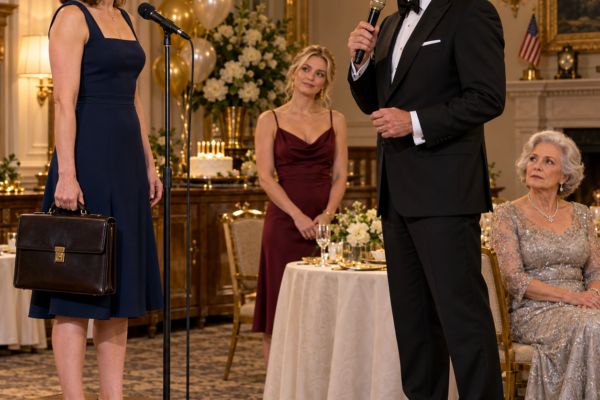
I stepped to the microphone.
“My former fiancé left our wedding because he believed Vanessa was in danger,” I said. “I did not know that day what the reporting has since established.”
Ryan stood at the edge of the room.
“I also did not know that charitable funds were being directed toward campaigns attacking my work and my marriage.”
Vanessa moved forward.
“You came back and took everything.”
My mother reached for her arm.
Vanessa shook her off.
“My parents. My name. My life.”
I looked at her.
“I did not choose what happened in that hospital.”
“You could have stayed away.”
There it was.
Not insecurity dressed as concern.
Not a misunderstanding.
The belief that my existence had become an intrusion.
For years, I had tried to make it easier for her to tolerate me.
I had accepted smaller holidays, careful introductions, and family photographs in which I stood near the edge.
I could not make myself any smaller without disappearing.
“I never asked them to stop loving you,” I said.
“You didn’t have to. You were the real daughter.”
My mother began crying.
I did not look away from Vanessa.
“You had every right to grieve what you learned. You had no right to use that grief to decide what I was allowed to have.”
“You married Adrian to humiliate Ryan.”
“I married Adrian after I ended my relationship with Ryan.”
“You had him waiting.”
“No.”
She laughed sharply.
“You expect anyone to believe that?”
“I expect them to examine evidence. That’s what I’ve done.”
The attorney stepped forward before the exchange could become a spectacle.
The financial presentation resumed.
Contracts. Transfers. Messages. Enough to establish what the report would say, without filling the room with every ugly thing anyone had written.
Vanessa stopped speaking.
When it was over, Ryan approached.
He looked older than he had a month earlier.
“Claire.”
I waited.
“I didn’t know.”
“I believe you.”
Hope moved across his face so quickly that it hurt to watch.
“Then you understand I was deceived.”
“Yes.”
“If I had known—”
“You might have come back.”
“I would have.”
I looked at him for a long moment.
“Ryan, you never needed a staged accident to leave me waiting.”
He lowered his eyes.
“Sometimes it was a telephone call. Sometimes it was tears. Sometimes it was just her saying she needed you.”
“I thought she was alone.”
“So was I.”
The words came out quietly.
He looked up.
I could see that he finally understood them.
It did not repair anything.
For years, I had imagined understanding would be the end of the hurt. If I could explain myself perfectly, if he could see the pattern, if the right facts arrived, we would become the people in the photograph from Maine.
Now he saw it.
And I did not want him back.
“You didn’t lose me because of one lie,” I said. “You lost me because you kept asking me to live around choices you made for someone else.”
“I loved you.”
“I know.”
That was harder to say than an accusation.
“I needed more than that.”
I took the engagement ring from the small pocket inside my jacket.
I had not worn it since the wedding.
For weeks, it had sat in a dish beside the sink at my apartment, a valuable object with no useful place.
I held it out.
Ryan looked at it before opening his hand.
“You always said I would wait,” I told him.
His fingers closed around the ring.
“I’m sorry.”
I nodded.
I did not offer forgiveness to make the room more comfortable.
My mother approached after he stepped away.
“We can handle the rest privately.”
“The board has already voted.”
“I’m talking about the investigation.”
“That isn’t mine to stop.”
“She could lose everything.”
I looked at the woman whose face I had once studied for proof that I belonged to her.
“When I came home, you asked me to protect Vanessa from feeling replaced.”
“We were all struggling.”
“I know.”
“You don’t understand what it was like to learn that the child we raised—”
“I understand that you loved her.”
My mother fell silent.
“I never asked you not to.”
Tears moved down her face.
“But you kept treating my hurt as the cost of keeping her safe. I can’t carry that anymore.”
“I never meant—”
“I believe you didn’t mean to become this kind of mother.”
The sentence seemed to reach her in a place anger had not.
“I still need you to see that you did.”
She lowered her head.
For once, I did not rush to reassure her.
Henry returned to the microphone.
He announced the assignment of voting authority over his twenty-five percent block and explained the governance safeguards we had agreed upon.
I would represent his interests at the board level. Independent directors and advisers would remain in place. My ten percent ownership remained mine.
It was not a coronation.
It was work.
The applause began quietly.
I could accept it because I understood what I had agreed to do.
Then I saw Adrian at the back of the ballroom.
He stood alone.
No assistant was clearing a path. No attorney carried a folder for him.
For a moment, I forgot the room.
He had respected the distance I asked for.
I had mistaken that respect, some nights, for proof that he could live without me.
Now he was there, looking at me with the same steady attention he had brought into the chapel.
Henry noticed him.
“Adrian,” he said, “did you wish to say something?”
Adrian looked at me first.
I nodded.
He walked to the stage.
The microphone looked too small in his hand.
“Some reporting about our marriage agreement is accurate,” he said. “We signed an agreement. It protected our separate property and gave us room to reconsider a decision made under unusual circumstances.”
Nobody moved.
“The suggestion that Claire deceived me is false. The suggestion that she pursued a relationship with me before ending her engagement is false.”
He paused.
“I proposed the agreement.”
I felt the room recede.
“I also gave her an explanation that made the marriage sound more useful to my business than it was. That was my decision. She shouldn’t have to defend it.”
He looked toward the people from Sterling seated near the front.
“My company did not require me to marry.”
Then he turned back to me.
“I wanted to ask Claire to dinner three years ago. I didn’t. When she called me on her wedding day, I was given another chance to show up.”
My eyes burned.
He did not make the moment into a proposal before I had a chance to speak.
Instead, he set down the microphone.
“Could we talk?”
I nodded.
We stepped into a small room beside the ballroom.
Through the closed door, I could hear Henry resuming the dinner.
For a few seconds, Adrian and I simply looked at each other.
“I’m sorry,” he said.
“For what?”
“For making a story about the board instead of telling you why I wanted to stay.”
I swallowed.
“I’m sorry I signed those papers without talking to you.”
“I know why you did.”
“That doesn’t make it fair.”
“No.”
The answer steadied me.
He was not offering the kind of forgiveness that erased the need to change.
“I thought leaving would protect you,” I said.
“I know.”
“And I was afraid you’d eventually decide I was too much trouble.”
He looked down briefly.
“I can’t promise we’ll never cause each other trouble.”
I laughed through the tears I had been trying to stop.
“That’s a terrible speech.”
“It’s an honest one.”
He stepped closer, then waited.
“I can promise I want to make those decisions with you.”
I reached for his hand.
“I don’t want to leave.”
His fingers closed around mine.
“All right.”
“And I don’t want a marriage whose purpose is waiting for the end of a term.”
“Neither do I.”
He took a small ring box from his pocket.
My wedding ring was inside.
I had left it on the dining table the night I went back to my apartment.
He opened the box but did not remove it.
“Would you like this back?”
“Yes.”
He held out the box.
I took the ring myself.
It had been resized weeks earlier and now fit properly.
Such an ordinary detail.
After everything, it was the detail that made me cry.
Adrian touched my cheek.
“May I?”
I nodded.
The kiss was not a promise that our lives would become easy.
It was a beginning we had both chosen with more knowledge than we had the first time.
When we returned to the ballroom, he walked beside me.
Neither of us made another speech.
The weeks that followed were less satisfying to describe than the dinner and more important to live.
The audit took months.
The foundation reorganized its oversight and made emergency grants to legitimate programs left waiting for money they had been promised.
Investigators reviewed the financial records.
Vanessa’s publicist retained counsel.
The driver and the nurse gave formal statements through their attorneys.
There was no instant sentence, no single newspaper headline that tied every consequence into a bow.
There were appointments, documents, and people trying to explain decisions they had once believed would remain hidden.
Vanessa remained under investigation for fraud and misappropriation of charitable funds.
My parents stopped asking me to interfere.
That did not mean our relationship healed.
For a while, my mother sent messages about the weather, a neighbor’s surgery, or flowers she had planted. Small offerings that avoided the thing between us.
I answered some.
When she asked me to lunch, I told her I would come if we could speak honestly.
She agreed.
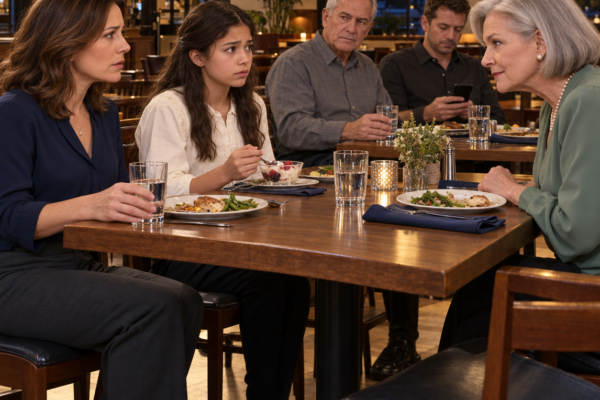
At a restaurant near her apartment, she placed her napkin on her lap and said, “I don’t know how to do this.”
“Neither do I.”
She stared at her water glass.
“I thought bringing you home would make up for what you lost.”
“It couldn’t.”
“I know that now.”
“No,” I said gently. “I don’t think you do yet.”
Her face tightened, but she stayed.
That mattered.
I explained what it had felt like to enter a house where every room told the story of another girl’s childhood.
The photographs.
The vacation jokes I did not understand.
The Christmas ornament with Vanessa’s name.
None of those things should have been removed.
I had never wanted them removed.
I had wanted somebody to notice that I was standing among them without a childhood anyone there remembered.
My mother cried.
This time, she did not ask me to comfort her.
My father took longer.
He wanted to apologize once and move forward efficiently.
I told him that trust would not improve on his preferred schedule.
He disliked the answer.
Then, eventually, he began calling without asking for anything.
It was a small change.
I allowed it to remain small.
At Northstar, I reduced my involvement in stories related to Bennett Group and disclosed the new voting role.
Ruth made the arrangements explicit.
“You can keep doing good work,” she said. “You just don’t get to be casual about your conflicts.”
“I don’t want to be.”
“Good. Now we have a school district that appears to have bought four hundred laptops nobody can locate.”
I smiled.
There was always another question.
Adrian and I revised the agreement with separate counsel.
We kept the financial protections because loving someone did not make clarity unnecessary.
We removed the idea of a scheduled review of whether we would remain together.
We talked about privacy, work, family visits, and what we would do when one of us wanted to fix something the other had not asked to have fixed.
That last conversation took several evenings.
He was accustomed to solving problems.
I was accustomed to disappearing inside them.
Neither habit vanished because we named it.
Sometimes he started making calls before I had finished explaining what I needed.
Sometimes I said everything was fine when it was not.
We learned to stop.
“What are you asking for?” he would say.
Or I would ask, “Do you want help, or do you want me to listen?”
The first time he answered, “I don’t know,” I smiled.
“That’s allowed.”
We did not move into the same bedroom immediately.
When we did, it was after dinner on an ordinary Wednesday.
There was no event, no legal deadline, and no room full of people waiting to see what I would choose.
I carried my book into his room.
He looked up from the bed.
“Staying?”
“If you’d like me to.”
He put his book down.
“Yes.”
It was enough.
Ryan resigned from his position in the family company the following spring.
He moved away from New York.
Before he left, he wrote me a letter.
There were more after that.
I read the first one.
He apologized without blaming Vanessa. He admitted that he had enjoyed being needed by two women and had mistaken my patience for evidence that I was receiving enough.
For a long time, I held the letter.
Then I put it away.
I did not answer.
An apology could be real without becoming an invitation.
I hoped, eventually, that he would become the man he had finally learned to describe.
I did not need to be there to witness it.
A year after the wedding at the estate, Adrian and I held a small ceremony beside the Hudson River.
We were already legally married.
We did not need another license, another announcement, or another explanation.
We wanted a day that belonged to the life we had made.
There was no livestream.
The flowers were seasonal and slightly uneven because the florist used what looked best that week.
Maya insisted on being maid of honor.
Ethan guarded the rings with the seriousness of a man who had once transported one across half the region while answering six telephone calls.
Henry sat in the front row beneath a wool blanket he complained about until somebody tried to remove it.
My parents were invited.
They sat farther back.
That was not punishment.
It was where the relationship stood.
My mother hugged me before the ceremony and said, “You look happy.”
“I am.”
She nodded.
She did not add anything about how things had worked out for the best.
I appreciated that more than she knew.
My father shook Adrian’s hand.
Then he turned to me.
“Is there anything you need?”
The question startled me.
“Yes,” I said. “Enjoy the day.”
He smiled awkwardly.
“I can do that.”
When the music began, I walked toward Adrian with the river beyond him.
There were fewer than thirty people watching.
Nobody whispered about whether I would make a scene.
Nobody checked a telephone to see whether another woman needed him somewhere else.
Adrian’s attention stayed on me.
Not because I had become the center of his entire world.
Because, at that moment, I was the person he had chosen to meet.
We had written our own vows.
Mine were not about being rescued.
His were not about protecting me from everything.
We promised to tell the truth before resentment made it harder.
We promised to ask rather than assume.
We promised to leave room for each other to change.
When the officiant asked whether I chose him, I did not hesitate.
“I do.”
Later, we ate dinner at one long table.
Henry told a story about my grandmother getting lost on a drive to Vermont and refusing to admit it until they crossed into Canada.
Ethan finally relaxed enough to set the empty ring box down.
My father listened more than he spoke.
Maya slipped her arm through mine while Adrian went to fetch my coat.
“Have you ever wondered what really changed everything?” she asked.
I looked at her.
“Ryan leaving? The call to Adrian?”
Across the lawn, my husband thanked a server, took the coat, and turned toward us.
He was not hurrying because I had been left somewhere.
He was coming back because that was what he did.
“Neither,” I said.
Maya waited.
“It was the moment I stopped agreeing that my life could always happen tomorrow.”
She squeezed my arm.
Then Adrian reached us and held the coat open.
I put my arms into it.
The river moved quietly beyond the lawn. Someone at the table called our names. Henry wanted another photograph before the light disappeared.
This time, I did not stand at the edge.
Adrian took the place beside me.
And nobody had to ask him to stay.
News
At my seventy-second birthday party, my daughter-in-law knocked a crystal vase off its pedestal with her elbow, watched it shatter, and smiled. “Oops.” Her own parents had given it to her and my son on their wedding day six years earlier. I looked at Frank, waiting for him to say something. All he managed was, “Mom…”
I watched my daughter-in-law break her own parents’ wedding gift with one elbow and a smile. For months afterward, people asked me whether I was…
I came home three hours early and found my sixty-eight-year-old mother on her knees scrubbing my mother-in-law’s bathroom. When I helped her stand, her sleeve slipped back, revealing dark marks around her wrist. My husband stepped into the doorway. “Daniela, don’t make a scene.” That was when I remembered my father’s last warning: “If you ever see your mother hurt, don’t argue with anyone. Open the hidden compartment in her sewing machine.”
I came home three hours early and found my sixty-eight-year-old mother on her knees beside a toilet. Her hands were stiff with arthritis. One gripped…
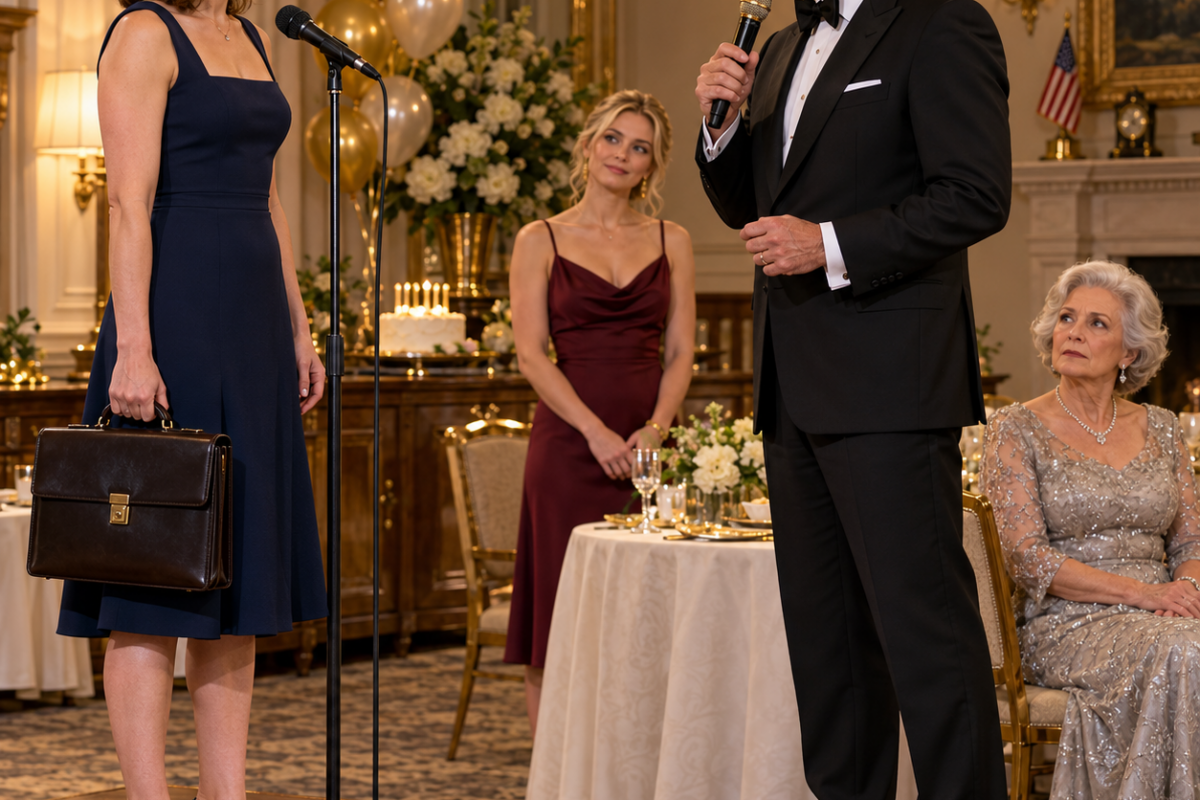
“I already promised your house to your sister,” my father told me four days after I bought it. “They’re moving in Monday. Rent-free for three years.” I was thirty-one, had saved for nine years, and had bought the five-bedroom home entirely in my own name. When I said no, he threatened to tell the family I had abandoned my sister’s children. Days later, he took the microphone at my grandmother’s seventy-fifth birthday dinner and did exactly that.
My father called twelve times in forty minutes after discovering I had bought a house without consulting him. When I answered, he didn’t ask whether…
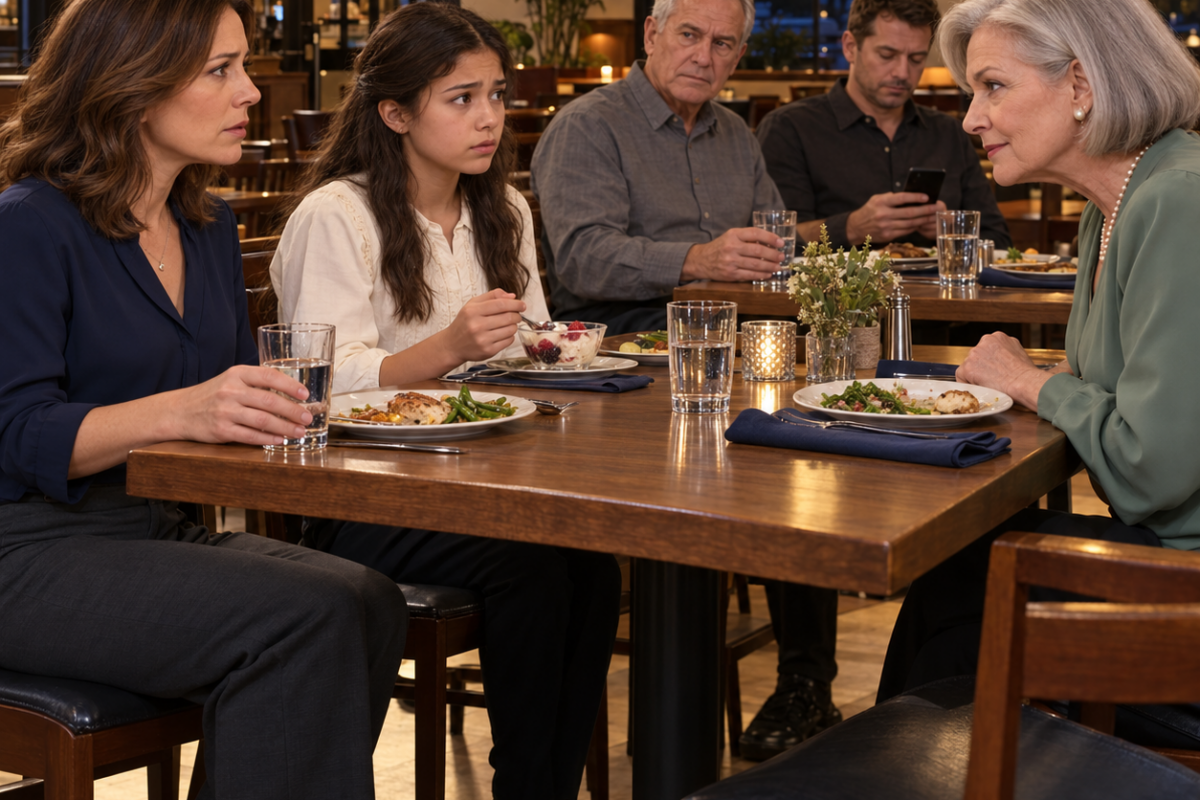
My mother leaned across the restaurant table, looked at my thirteen-year-old adopted daughter, and whispered, “We don’t sit with mistakes.” I took Sole’s hand and walked her out. That night, my father texted, “You’re still making the car payment tomorrow, right?” By midnight, I had canceled the payments I’d been making for my family. Then I remembered something Sole had told me about her grandmother.
My mother looked at my thirteen-year-old daughter and whispered, “We don’t sit with mistakes.” She said it softly enough to avoid attracting attention from the…
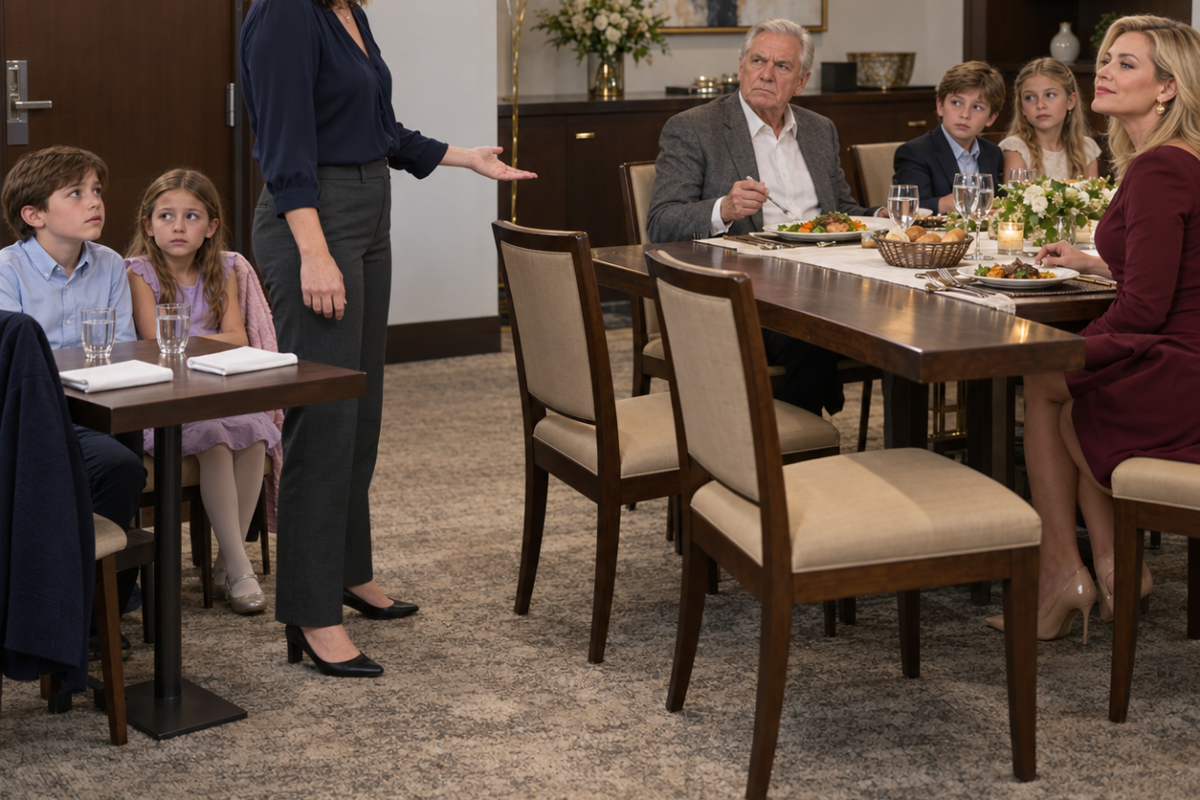
At my father’s seventieth birthday dinner, my eleven-year-old son and eight-year-old daughter were seated beside the service door with water glasses—but no dinner plates. Their cousins sat beside Grandpa with warm bread and full place settings. “They’ll eat after everyone else,” my sister said. I turned to my father, expecting him to object. “They can wait another hour,” he replied. There were two empty chairs at his table.
At my father’s seventieth birthday dinner, the first thing that stopped me wasn’t the cake or the gold balloons. It was my children. Ethan and…
“Mommy, are you real?” my four-year-old daughter whispered when I came home from deployment three weeks early. She was sitting alone on our living room floor with an empty cereal bowl. My husband was on a Caribbean cruise with his mother and sister. Twenty-two minutes earlier, they had posted a photo captioned “Family time.” I was still in uniform when Sophie asked if she could have something to eat.
The first thing my daughter said when I found her was, “Mommy, are you real?” She was sitting cross-legged on our living room floor with…
End of content
No more pages to load