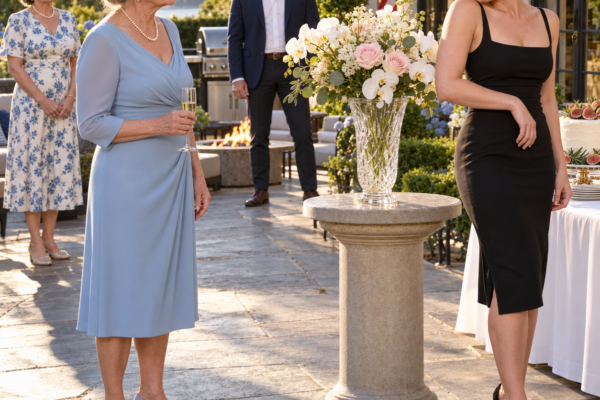
“This resort is for people who’ve actually made something of themselves,” my mother said at our family reunion. My sister glanced at me. “Not people who work in warehouses.” I said nothing. Minutes later, the general manager walked past them and opened a leather folder in front of me. “Ms. Williams, we need your approval before we finalize your family’s reservation.” Mom lowered her champagne. “Her approval?”
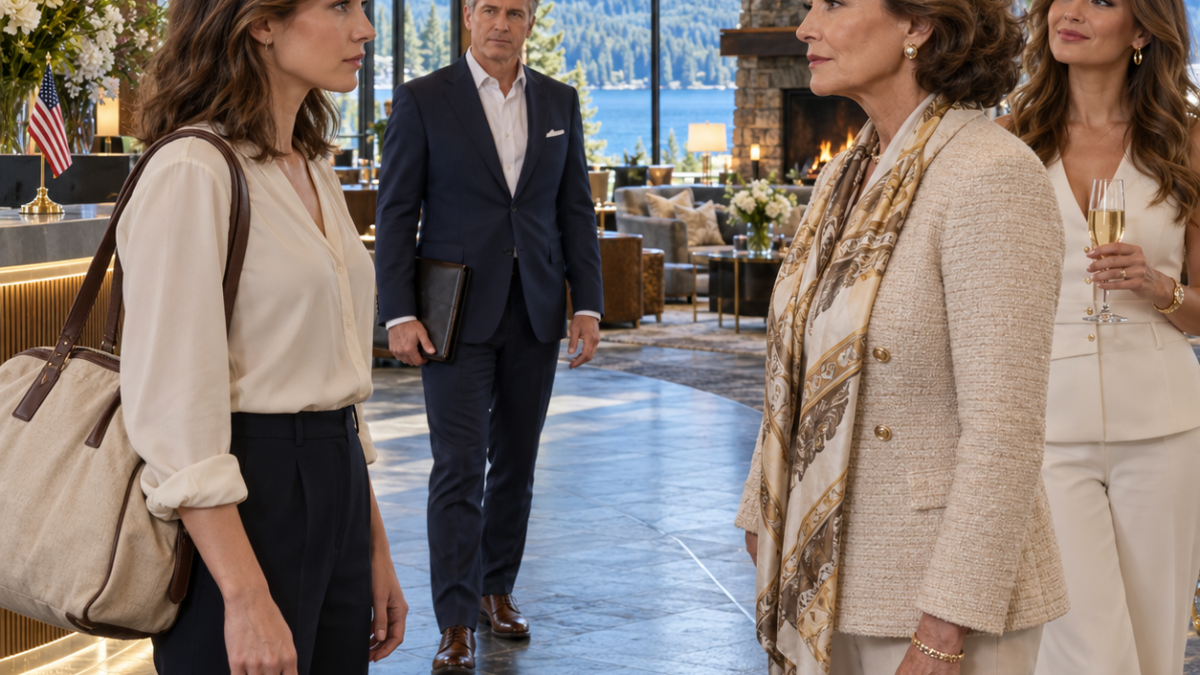
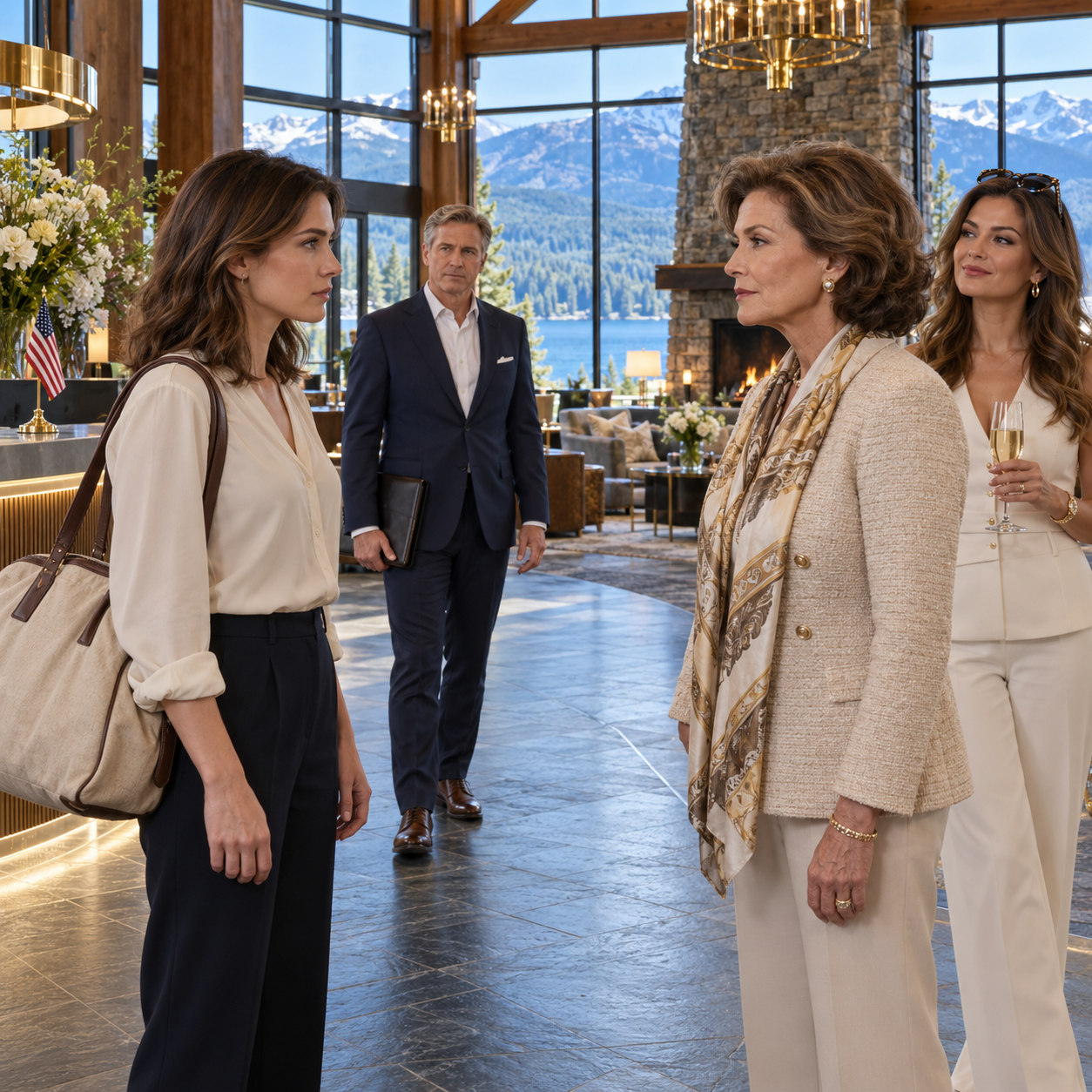
The transmission in my seven-year-old Honda Civic gave a miserable little whine as I eased into the visitor parking area at Azure Heights Resort.
Even before I turned off the engine, I recognized my mother’s black Mercedes and my older sister’s white BMW. Both were parked in the VIP valet section, gleaming beneath the sharp mountain sunlight.
I sat for a moment with my hands on the steering wheel.
The drive had taken almost four hours. I had stopped once for coffee and once because a shipment coordinator called about damaged packaging at our distribution building. My canvas overnight bag rested on the passenger seat beside a folder I had brought from the office.
Beyond the windshield, Azure Heights rose from the hillside in pale stone, dark timber, and glass. Fifteen acres of lakefront property stretched behind it. The terraces followed the natural slope toward the water, and the building’s long western windows reflected a sky so blue it looked artificial.
For three years, I had imagined this arrival.
I had imagined parking, stepping out, and watching my mother and sister see something I had helped create.
I had not imagined needing to prepare myself before opening the car door.
“Well, look who actually made it.”
Vanessa’s voice reached me across the gravel.
My sister stood beside the entrance in oversized sunglasses, white trousers, and a silk blouse that moved gently in the breeze. She had perfected the expression on her face years earlier: amused, indulgent, and certain that everyone around her understood the joke.
“We were taking bets,” she said. “I honestly thought that thing would break down before you reached the mountain.”
I opened the trunk. The hinges complained.
“Traffic leaving the city was awful.”
“You mean traffic leaving the warehouse district.”
I pulled out my overnight bag.
Before I could answer, my mother appeared beside her.
Patricia Williams never simply entered a place. She arrived as though somebody had announced her.
She adjusted her tortoiseshell sunglasses and let her gaze travel from the Honda to my jeans, my plain blue shirt, and the work boots I had forgotten to change.
“I’m surprised you managed the fuel cost, Maya.”
“I survive somehow.”
Vanessa slipped her arm through our mother’s.
“Don’t worry about the rooms. Mother and I already checked into the Premier Suites. I’m sure they have something simpler available for you.”
She glanced toward the side of the building.
“Maybe near the service corridor.”
A valet approached with a professional smile. His name was Owen. I knew because six months earlier I had sat across from him during a staff lunch and listened to him describe the difficulty of finding housing close enough to work.
I handed him my scratched plastic key fob.
“Thank you.”
His eyes moved toward the Honda, then back to me. Recognition appeared briefly before he remembered the instruction our general manager had given the staff: I was here as a guest this weekend.
“Of course,” he said.
Mom was already walking toward the entrance.
“We’ll need separate charges,” she called over her shoulder. “I wouldn’t want you worrying about splitting restaurant and spa expenses with us. This weekend is supposed to celebrate success.”
I followed them inside.
The first thing I noticed was the light.
It fell exactly as our architect had promised it would, entering through the western glass wall and moving across the slate floor without glaring into the eyes of people seated near the fireplace.
Reclaimed timber beams crossed the ceiling. A four-sided stone hearth anchored the lobby. The reception desk curved gently toward the entrance, its walnut surface polished but not so shiny that it looked untouchable.
For months during construction, that desk had existed only in drawings, samples, and arguments about whether the curve would create an awkward corner for the people working behind it.
I had insisted we build a mock-up.
The carpenter had laughed at first.
Then Jessica, who would eventually become our front-office supervisor, walked around it and pointed out that the original design left no convenient place for the printer.
We changed the drawings.
Now a guest stood comfortably at the counter while Jessica printed something without turning away from the conversation.
It was a tiny success.
I felt it anyway.
“Beautiful, isn’t it?” Vanessa said.
She turned slowly, taking in the fireplace, the lake, the arrangements of branches and white flowers.
“This, Maya, is what actual achievement looks like.”
I looked at the ceiling.
“Yes,” I said. “It is.”
My mother stopped to straighten her scarf.
“You sound tired.”
“It’s been a long week.”
“Every week seems to be a long week for you.”
She sighed in the way she always did before delivering advice she considered too obvious to need permission.
“I warned you years ago. You insisted on chasing unrealistic ideas instead of building a sensible life.”
I knew what came next.
“You should have married Richard.”
“Mom, I never wanted to marry Richard.”
“His dental practice is opening another location.”
“That’s good for him.”
“What you wanted was to be difficult.”
She gestured toward Vanessa.
“Your sister sells luxury property worth millions.”
Then toward herself.
“I run a successful consulting business.”
Finally, her hand moved in my direction.
“And you spend your days moving boxes around an industrial building.”
A server passed carrying champagne.
Vanessa stopped him and lifted three glasses from the tray. One went to Mom. She kept two.
“Oh, sorry, Maya.”
She looked at the extra glass in her hand as though she had only just noticed it.
“You probably don’t want to deal with the tipping expected around here.”
“The champagne is complimentary.”
“Even better.”
She took a sip.
“Free has always suited your budget.”
The server stood still for half a second. I could see him deciding whether to offer me another glass.
I gave him a small smile.
“I’m fine, thank you.”
He nodded and continued.
We moved toward reception.
Jessica looked up.
Her expression changed when she saw me, but she recovered quickly.
“Good afternoon. Welcome to Azure Heights.”
Mom stepped forward before anyone else could speak.
“We’ve already checked in. Patricia Williams and Vanessa Williams. Premier Suites.”
“Yes, Ms. Williams. I hope everything is comfortable.”
“The rooms are lovely,” Vanessa said. “Although Mother’s view would be better from the other side.”
Jessica checked the screen.
“Both suites overlook the lake.”
“Mine has a tree,” Mom said.
“A tree,” Jessica repeated gently.
“In the view.”
I looked through the glass wall toward the terrace.
That tree was a hundred-year-old ponderosa pine. During construction, I had stood in the rain while two engineers debated whether moving the access road would cost too much. We moved it.
Mom leaned closer to the counter.
“If there’s a more suitable room available, I’m sure you can make an adjustment.”
“I can review the options.”
“And my daughter needs whatever your most affordable accommodation is.”
She pointed at me without turning around.
“She didn’t book early enough, I assume.”
Jessica’s eyes moved to mine.
I saw the question.
I gave a slight nod.
She smiled.
“Welcome back, Ms. Williams. Would you like your usual suite, or would you prefer the cottage you reserved?”
Vanessa lowered her champagne.
“My usual suite,” I said. “The cottage can stay available for the accessibility inspection tomorrow.”
Jessica typed.
“Certainly. The owner’s suite is ready.”
For a moment, neither my mother nor my sister moved.
Then Vanessa laughed.
“The owner’s suite? That’s quite a name for a room.”
Jessica looked politely puzzled.
“It’s Ms. Williams’s private suite.”
Mom turned toward me.
“What is she talking about?”
I set my canvas bag on the floor.
“I own Azure Heights.”
The lobby seemed to become strangely quiet, though the conversations around us continued.
Vanessa stared.
“No, you don’t.”
“I do.”
“You mean you work here.”
“I work here sometimes.”
My mother’s eyes narrowed.
“Maya, don’t embarrass yourself.”
Jessica’s fingers stopped over the keyboard.
I watched her face change from professional neutrality to discomfort, and I understood that I had allowed this scene to move too far into her workplace.
“I’m sorry, Jessica,” I said. “We don’t need to discuss this at your desk.”
She nodded gratefully.
“Your key is ready.”
She placed it in a small paper sleeve and slid it toward me.
Then our general manager appeared from the corridor behind reception.
“Everything all right?”
His name was Nathan Bell. He had worked in hospitality for twenty-two years and possessed the rare ability to sound calm without making anyone feel dismissed.
I picked up the key.
“Yes. We’re going to find somewhere private to talk.”
Nathan glanced at my mother and sister.
“Would you like the library?”
“That would be helpful.”
He nodded, then looked back at me.
“Before you go, the final occupancy report is in your folder. The board packet for Monday has also been uploaded.”
Vanessa’s expression shifted.
Not belief yet.
Something closer to alarm.
Mom looked from Nathan to Jessica to me.
“The board?”
I bent to lift my bag.
“Yes.”
Nathan held out a hand.
“Let me take that.”
“I can carry it.”
“I know.”
His answer was so ordinary that it almost made me cry.
He took the bag because it was his job to help a guest, and because I had driven four hours and looked tired. There was no lesson hidden in the gesture.
My mother watched him as though he had just performed a miracle.
I followed him toward the library.
Mom and Vanessa came behind me.
For once, neither had anything to say.
The library overlooked a smaller garden on the eastern side of the building. It had shelves of regional history, hiking guides, novels, and children’s books. The chairs were comfortable enough to sit in without feeling as though you were ruining a display.
I had insisted on that too.
Nathan placed my bag beside a chair.
“Coffee?”
“Yes, please.”
He looked at Mom and Vanessa.
“Anything for you?”
Mom said no too quickly.
Vanessa asked for sparkling water.
When Nathan left, my mother closed the door.
“What exactly is going on?”
I sat.
“What I told you.”
“You never told us you owned a hotel.”
“It’s a resort.”
“Don’t be clever.”
“I’m not trying to be.”
Vanessa placed her champagne on a side table.
“How could you possibly afford this?”
“Not by writing one personal check for the entire project.”
She folded her arms.
“So there are investors.”
“Yes. There’s financing. There are partners in the property structure. I founded the company that developed it, I control the operating business, and I’m the managing owner.”
Mom looked relieved for an instant.
“So it isn’t really yours.”
I watched her search for a version of the explanation that returned us to familiar ground.
“It is mine, Mom. Other people having interests doesn’t erase mine.”
Vanessa sat across from me.
“What company?”
“Northline Development and Hospitality.”
“The warehouse company?”
“The company whose distribution building you keep calling my warehouse job.”
She stared.
I had mentioned Northline for years.
I had talked about refinancing, supplier problems, planning approvals, and construction delays.
They had heard the parts that fitted the version of me they preferred.
“You said you handled logistics,” Mom said.
“I do.”
“You said you were at the warehouse.”
“I often am.”
“You never said you were rich.”
There it was.
The real accusation.
I looked toward the garden, where a groundskeeper was moving a hose away from the path.
“I didn’t know that was the information I needed to provide before you treated me respectfully.”
Mom flinched.
Vanessa gave a short, impatient laugh.
“Oh, come on. Don’t turn this into a speech about our feelings.”
“I wasn’t planning to.”
Nathan returned with coffee and sparkling water. He placed the tray on the table and asked whether we needed anything else.
I thanked him.
Before he left, Vanessa leaned forward.
“Nathan, how long have you known Maya?”
“Since the preopening phase.”
“And she’s actually the owner?”
He looked at me.
I nodded.
“She’s the managing owner of Azure Heights and founder of Northline.”
“Thank you,” I said.
Nathan left quietly.
Mom sat down.
She looked suddenly older, though nothing about her clothes or posture had changed.
“Why would you hide this from your family?”
I wrapped my hands around the coffee cup.
The answer was more complicated than I wanted it to be.
“I didn’t begin by hiding it. I stopped explaining it.”
Neither of them spoke.
So I told them where it had started.
At twenty-four, I worked for a regional building-supply company. My title sounded dull, and much of the work was. I tracked deliveries, argued about damaged materials, and learned that a project could look profitable on paper while losing money every time a truck took the wrong route.
I liked solving those problems.
I liked knowing why a contractor needed three shipments on Tuesday and none on Friday. I liked finding a supplier who could deliver what they promised. I liked discovering that a supposedly unavoidable expense was usually a decision someone had stopped questioning.
The building-supply company closed after its owner became ill and his children couldn’t agree about the business.
I had enough savings to survive for a few months.
Instead of applying immediately for the same job somewhere else, I offered logistics services to three contractors I already knew.
My office was a secondhand desk behind a rented storage unit.
That was the beginning of Northline.
I told Mom about it over dinner.
She asked whether I had benefits.
I said not yet.
She told me Richard’s practice had excellent insurance.
Vanessa asked whether my “little delivery thing” meant I drove a van.
I laughed then because I still believed laughing would make the conversation kinder.
It didn’t.
For the next two years, every discussion about work ended the same way.
Mom advised me to get a real job.
Vanessa compared my plans with her commission checks.
When I hired my first employee, Mom asked whether he was being paid on time.
When I signed a lease on a small distribution building, Vanessa said I was brave to commit to something so ugly.
When I won a contract large enough to hire four more people, Mom told me not to mistake one good month for a career.
Eventually, I stopped announcing each milestone.
I told myself it was easier.
I was right about that.
I was wrong about what the silence cost.
“I remember those dinners,” Mom said.
“I know.”
“You were always so vague.”
“I was specific until being specific became another opportunity for you to explain why I was failing.”
Vanessa looked down at her hands.
For the first time, her expression was less certain.
Then she said, “You could have corrected us.”
“I corrected you outside.”
“You made it sound like a joke.”
“No. You decided it was one.”
My coffee had cooled.
I took a sip anyway.
“I didn’t bring you here because I wanted to humiliate you at reception.”
Mom looked skeptical.
“Then why?”
“Because I wanted you to see it.”
The words came out more quietly than I intended.
“I wanted to show you something I’m proud of. I booked dinner for tonight. I planned to tell you there.”
Vanessa glanced toward the door.
“So the staff were all in on it?”
“No. They were asked to treat me as a guest because I wanted a weekend with my family.”
Mom looked at the floor.
I waited for an apology.
Instead, she said, “Well, you certainly gave us a shock.”
I set down the cup.
“Yes,” I said. “I suppose I did.”
Our family weekends had begun after my father died.
Dad had loved small trips. He would choose an inn or a cabin within driving distance and make the planning sound like an adventure even when all we did was walk around a lake and eat breakfast somewhere unfamiliar.
He had been a municipal engineer. Not glamorous work. Bridges, drainage systems, road repairs, arguments about budgets.
He came home tired and smelling faintly of dust, but he never treated ordinary work as something to apologize for.
When Vanessa got her real-estate license, he framed it.
When I completed a certification in supply-chain management, he framed that too.
Both hung in his office.
After he died, Mom kept Vanessa’s frame in the study.
Mine disappeared during a redecoration.
I had never asked where it went.
For several years, Vanessa chose the location of our family weekends. They became increasingly expensive and increasingly focused on photographs, shopping, and restaurants where Mom knew someone important.
I attended when I could.
I missed one during Northline’s first year because I couldn’t afford to leave.
Vanessa told everyone I was becoming antisocial.
I missed another because a major client’s contractor abandoned a project and we had to find replacement materials over a holiday weekend.
Mom said I needed to learn that family came first.
Last winter, I offered to organize the next gathering.
Azure Heights had just completed its first full operating season.
I thought the timing was right.
I imagined telling them at dinner, after they had experienced the place without knowing the connection.
Perhaps that had been naïve.
Perhaps a part of me wanted them to praise it before they discovered they would have to revise their opinion of me.
Sitting in the library, I could admit that to myself.
I wanted their approval.
I had built a life without it, but wanting it had not disappeared.
Vanessa stood and walked toward the bookshelves.
“Why here?” she asked.
“What do you mean?”
“Why build a resort? You could have stayed with warehouses.”
I looked through the window.
“The property was going to be broken into private lots.”
Mom raised her head.
“That sounds profitable.”
“It probably would have been.”
“Then why not?”
“Because it wasn’t what I wanted to do.”
Three years earlier, I had driven past the lake on my way to visit a contractor. The old lodge on the property had been closed for more than a decade. Its roof sagged, its windows were boarded, and weeds had reached the lower porch.
But the shoreline was beautiful.
I stopped.
At first, I imagined restoring the lodge as a small inn.
Then I learned the structure was too damaged to save safely.
I spent six months deciding whether the idea was foolish.
Another year proved that parts of it were.
We revised the design, lost a financing commitment, found another, negotiated environmental requirements, and discovered that the water system would cost more than our first consultant had estimated.
Northline’s logistics business supported me while I pursued the project.
I kept my old car because it worked.
I wore boots because I walked through muddy construction sites.
I kept using the distribution office because it was where most of our staff worked.
None of those choices meant I lacked ambition.
They meant I understood that looking successful and keeping a business alive were different tasks.
“Our architect wanted the building to sit with the landscape,” I told Vanessa. “Not dominate it.”
She looked out at the garden.
“It does.”
The compliment was small and reluctant.
I accepted it anyway.
“Thank you.”
Mom stood.
“Well, we should see your suite.”
I looked at her.
“Later. I need to unpack and take a shower.”
She blinked.
“We’re your family.”
“Yes.”
“So?”
“So I’ve been driving all morning, and I want an hour to myself.”
Vanessa reached for her water.
“I suppose we should let the owner get settled.”
The old edge returned to her voice.
I stood.
“That would be nice.”
Nathan was waiting near the corridor when we left the library. He gave Mom and Vanessa directions back to their rooms, then walked with me toward the private elevator.
When the doors closed, I let my shoulders drop.
“Did you hear any of that?” I asked.
“Only what happened at reception.”
“I’m sorry.”
“For what?”
“Making Jessica uncomfortable.”
Nathan nodded.
“She’ll appreciate you checking in with her.”
I leaned against the wall.
“She shouldn’t have to manage my mother.”
“No,” he said. “She shouldn’t.”
That was all.
No flattering speech. No attempt to convince me that I had handled everything perfectly.
I trusted him more for it.
My suite was on the top floor, with a small terrace overlooking the lake. It wasn’t the largest accommodation on the property. I had chosen it because the morning light reached the kitchen nook, and because the bedroom stayed quiet during events below.
My canvas bag looked perfectly at home beside the sofa.
I kicked off my boots and stood at the window.
Down by the water, a family was helping a little boy into a life jacket. He protested until his father pointed toward a kayak. Then he threw both arms up, delighted.
I watched them for a while.
The resort had become real in the lives of people who knew nothing about my family.
That mattered more than I had allowed myself to remember that morning.
I showered, changed into a simple green dress, and called my business partner.
Leah answered from the distribution building.
“How’s the glamorous weekend?”
“I’ve been insulted six times and identified as the owner once.”
“Only six?”
“I may have lost count.”
Leah had joined Northline after my third year. She managed operations and possessed a practical mind, a dry sense of humor, and very little patience for self-pity.
“Are you all right?”
“I don’t know yet.”
“Fair answer.”
I sat on the sofa.
“They’re shocked.”
“I imagine so.”
“Mom asked why I hid it.”
Leah was quiet for a moment.
“What did you tell her?”
“That I stopped explaining.”
“Did she hear you?”
“I think she heard the part about the money.”
Leah exhaled.
“Maya, you don’t have to turn this weekend into a successful family project.”
I looked at the view.
“I know.”
“You say that the way people say they know they should floss.”
I laughed.
“There you are,” she said.
We talked about a delayed shipment, a staffing question, and a supplier whose invoice didn’t match the purchase order.
Ordinary work steadied me.
Before hanging up, Leah said, “Enjoy the place you built. You’re allowed.”
I put down the phone.
Then someone knocked.
Mom and Vanessa stood outside.
Vanessa held her phone.
“Just one quick picture,” she said.
I looked at the clock.
They had given me forty-three minutes.
I stepped aside.
They entered without waiting for an invitation, and Mom walked directly to the terrace.
“Oh, Maya.”
For a moment, her voice sounded almost like wonder.
Then she turned.
“You should have put us up here.”
Vanessa was already filming the living room.
“Beautiful natural finishes, private lake views, exceptional attention to detail,” she murmured toward her phone.
“Vanessa.”
She stopped recording.
“What?”
“Please ask before filming my room.”
“It’s a hotel.”
“It’s my private accommodation.”
She rolled her eyes, then lowered the phone.
Mom opened a cabinet.
“There’s a kitchen.”
“A kitchenette.”
“This would be much easier for us. My suite doesn’t have one.”
“You’re here for two nights.”
“Yes, and I enjoy coffee before getting dressed.”
“There’s a coffee machine in your suite.”
She looked disappointed by my failure to understand.
Vanessa walked onto the terrace and held her phone up again.
“I’m not filming the room now.”
I watched her frame the view.
“What are you posting?”
“Just that I’m here.”
“Then please say you’re here as a guest. Don’t imply you represent the property.”
Her head turned.
“Why would you say that?”
“Because you’re using your work account.”
She lowered the phone slowly.
“So now you’re monitoring me?”
“I’m asking you to be accurate.”
Mom stepped between us with a smile that didn’t reach her eyes.
“Let’s not ruin a lovely surprise.”
I looked at the open cabinet behind her.
“Then let’s stop treating my surprise as an invitation to take over.”
Neither of them liked that sentence.
But Mom closed the cabinet.
That evening, I arrived at the restaurant ten minutes before our reservation.
The dining room looked west over the lake. At sunset, the water turned copper and the mountains darkened into layers.
I had asked the staff to give us a quiet table.
Nothing extravagant.
No special menu printed with my name.
I wanted dinner, not a ceremony.
Jessica was helping a guest near the entrance when she saw me.
I waited until she finished.
“Do you have a minute?”
“Of course.”
“I’m sorry about this afternoon.”
She looked surprised.
“You didn’t do anything wrong.”
“I allowed a family conversation to happen at your desk, and you had to manage it.”
She hesitated.
“It was a little awkward.”
“I know. It won’t become part of your job this weekend.”
Her shoulders relaxed.
“Thank you.”
I asked how her shift was going. She told me a guest had left a stuffed dinosaur behind, and housekeeping had found it before the family drove away.
“They were already at the highway,” she said. “The father came back.”
“Good.”
She smiled.
“It was apparently a very important dinosaur.”
I laughed.
Mom arrived in a black dress, wearing the pearl necklace she saved for occasions she considered worthy of it. Vanessa wore pale blue and carried a small designer bag.
They looked at the table, then at me.
“This is lovely,” Mom said.
I waited until we sat down.
“I’m glad.”
For the first few minutes, we talked about the drive, the weather, and the menu. The server introduced herself as Elena and described the evening’s specials.
Mom asked whether there was a table closer to the window.
“This one is quiet,” I said.
“There’s an empty one over there.”
“It’s reserved for a couple celebrating their fortieth anniversary.”
Mom glanced toward it.
“How do you know?”
“Because I asked Nathan whether our table would interfere with anyone’s reservation.”
Vanessa smiled at Elena.
“We’ll stay here.”
It was the first time all day she had helped make a conversation easier.
I noticed.
After we ordered, Mom lifted her glass.
“Well. To Maya.”
I looked at her.
“To a remarkable achievement.”
“Thank you.”
Vanessa touched her glass to mine.
“I honestly had no idea.”
“I know.”
Mom took a sip.
“You always were determined.”
The sentence sounded generous.
It also rewrote years of calling me stubborn, difficult, and unrealistic.
I didn’t challenge it immediately.
I wanted to see whether she could get further without being led.
Vanessa leaned forward.
“Tell us how it happened. Properly.”
So I did.
I told them about the first clients, the distribution building, Leah, and the contracts that allowed us to expand. I told them about the property purchase, the financing, and the long months when I wasn’t sure Azure Heights would ever open.
They listened.
Really listened, for perhaps the first time.
Mom asked questions about the lake access.
Vanessa asked about room rates, seasonality, and the cost of maintaining the grounds.
Her professional knowledge appeared without the usual need to demonstrate that she knew more than I did.
For a little while, we were three adults discussing work.
I enjoyed it.
That made what happened next more disappointing.
“We should arrange something together,” Vanessa said.
“What?”
“A private client weekend. Luxury buyers, investors. People with real money.”
I set down my fork.
“We have an events team.”
“I know, but I’m your sister.”
“Yes.”
“It could be mutually beneficial.”
“It could. You can submit a proposal.”
She stared.
“A proposal?”
“Dates, expected attendance, what you want to book, and who is paying.”
Mom laughed lightly.
“Maya, surely you don’t need to be formal with Vanessa.”
“I need to be clear.”
Vanessa leaned back.
“I was thinking more of a family arrangement.”
“What does that mean?”
“We wouldn’t pay standard rates.”
“Depending on the date and group size, there may be a published group rate.”
“You’d charge me?”
I watched the warmth leave her face.
“This is a business, Vanessa.”
“So is mine.”
“Then you understand why the staff and operating costs still exist when the guest is my sister.”
Mom placed a hand on the table.
“Let’s not discuss money over dinner.”
Vanessa looked at her.
“She started.”
I almost smiled.
For an instant, we sounded thirteen and sixteen again.
Then I said, “You proposed a business event. I answered as though it was one.”
Our food arrived.
Elena set the plates down carefully, sensing the change in the table’s mood.
I thanked her.
Mom waited until she left.
“We’re proud of you, Maya. Don’t make it difficult for us to show that.”
I looked at her.
“I’m not asking you to buy anything.”
“No, but you’re acting as though we’re strangers.”
“Strangers don’t expect an entire business to become theirs for the weekend because they know the owner.”
Mom’s mouth tightened.
Vanessa picked up her wine.
“Well,” she said, “this is certainly a new side of you.”
I took a breath.
“No. It’s a side you haven’t needed to listen to before.”
We finished dinner politely.
That was the word I would have used in the past.
Now I recognized how often politely meant that everyone had stopped saying what they actually thought.
When the dessert menus arrived, Mom said she was tired.
Vanessa left with her.
I stayed for coffee.
Across the room, the anniversary couple held hands beside a small chocolate cake.
The man said something that made his wife laugh. She covered her mouth, then shook her head as though he had been telling the same joke for forty years.
I watched them for a moment.
Then Elena returned.
“Would you like dessert?”
“Yes,” I said. “The lemon tart.”
“Good choice.”
She didn’t ask whether I was all right.
She simply brought the tart.
I was grateful.
The next morning, I woke early and walked down to the lake.
The air was cold enough that I wore a sweater over my clothes. Mist hovered near the water, and the dock moved slightly beneath my feet.
I sat on a bench facing the mountains.
Dad would have liked it there.
He would have asked whether the dock supports were properly anchored, whether the drainage held during heavy rain, and why one section of railing had a different finish.
Then he would have told me it was beautiful.
I missed the order of those questions.
Practical interest first.
Pride afterward.
My phone vibrated.
A message from Mom.
We should have breakfast in your suite. Vanessa wants to bring her friend.
I read it twice.
Then I typed:
I’m having breakfast downstairs at eight. You’re welcome to join me. My suite isn’t available for a gathering.
Three dots appeared.
Disappeared.
Then:
You’re making everything unnecessarily complicated.
I put the phone in my pocket.
For once, I didn’t answer.
At breakfast, Mom and Vanessa were already seated with a man I didn’t recognize.
He stood when I approached.
“Maya. Wonderful to meet you.”
Vanessa smiled brightly.
“This is Grant. He works with one of the investment groups I know.”
I looked at her.
“I thought this was our family weekend.”
“It is. He was nearby.”
Grant offered his hand.
“Grant Whitfield.”
I shook it.
He was well dressed, perhaps in his late forties, and his expression suggested that he knew enough about business to understand he had walked into an awkward introduction.
“Vanessa said you were looking at expanding the resort brand,” he said.
“I haven’t discussed expansion with Vanessa.”
His eyes moved toward her.
She gave a small laugh.
“I said you might be interested.”
I sat.
“What exactly did you tell him?”
Mom reached for her coffee.
“Maya, he’s a guest.”
“I’m asking a reasonable question.”
Grant cleared his throat.
“Perhaps there’s been a misunderstanding.”
“Perhaps.”
He sat down more carefully.
“Vanessa described a family-owned hospitality opportunity. She mentioned that she might be involved in bringing investors to the next phase.”
I looked at my sister.
“There is no next phase she’s involved in.”
Her cheeks flushed.
“I was opening a conversation.”
“Then you should have opened it with me.”
Grant raised a hand slightly.
“I don’t want to create a problem.”
“You haven’t,” I said. “But I should clarify that Vanessa doesn’t represent Northline or Azure Heights.”
The silence that followed was uncomfortable.
I let it remain.
A server arrived with menus. I asked for coffee and oatmeal.
Grant looked relieved to have something ordinary to do.
Over breakfast, he told me about his work without assuming I owed him a meeting. I explained that any investment inquiry would need to go through the company’s established process.
He accepted that immediately.
When he left, he gave me his card.
“If it’s useful, call. If not, enjoy your weekend.”
“Thank you.”
He turned to Vanessa.
“We’ll speak later.”
The moment he was out of earshot, she leaned toward me.
“You made me look ridiculous.”
“I corrected something inaccurate.”
“You could have done it privately.”
“You brought him to breakfast without asking.”
Mom folded her napkin.
“I thought you’d be grateful Vanessa wanted to help.”
“Help with what?”
“Your business.”
“My business is not something you suddenly need to rescue now that it interests you.”
Mom looked hurt.
Vanessa looked angry.
I felt both reactions reach for familiar places inside me.
The place that apologized quickly.
The place that made a joke.
The place that explained everything again until everyone else was comfortable.
I stayed seated.
“I’m going to the accessibility inspection,” I said. “We can talk this afternoon if you want to.”
Vanessa pushed back her chair.
“I’m going to the spa.”
“Enjoy it.”
She looked at me, waiting for another sentence.
I didn’t provide one.
The accessibility inspection had been planned weeks earlier.
We were reviewing several parts of the property with a consultant, a contractor, and two guests who had agreed to give detailed feedback about their experience.
One of them was a retired teacher named Mrs. Daniels. She used a wheelchair and had stayed with us twice.
The other was a young father whose daughter used mobility aids.
We walked through routes that looked perfectly manageable on paper and discovered three things that needed changing.
A door closer was too heavy.
A dining-room table arrangement narrowed a route during busy service.
The viewing area near the lake had a surface that became difficult after rain.
None of the fixes made for an impressive photograph.
All of them would matter to someone arriving tired and hoping not to spend a weekend asking for help with preventable obstacles.
Mrs. Daniels rolled toward the cottage entrance and looked at me.
“Much better than the first time.”
“Still not finished.”
“No building ever is.”
I smiled.
“That sounds like something my father would have said.”
“Was he sensible?”
“Usually.”
“Then listen to him.”
We stopped for coffee on the terrace.
Nathan joined us and took notes. The contractor gave realistic estimates instead of pretending every correction would be cheap.
For two hours, I barely thought about my family.
Then my phone rang.
Vanessa.
I let it go to voicemail.
She called again.
Nathan glanced at the screen.
“Do you need a minute?”
“Apparently.”
I stepped aside.
“What’s wrong?”
“The spa says my treatments aren’t covered.”
I looked toward the water.
“Covered by what?”
“The family booking.”
“Rooms and Friday’s dinner are covered. I sent that information when I made the reservation.”
“You own the spa.”
“The resort operates it, yes.”
“So why are they trying to charge me?”
“Because you booked services.”
Her voice hardened.
“You could fix this in thirty seconds.”
“I could pay for it. That’s different.”
“You know what I mean.”
“Yes. I do.”
There was a pause.
Then she said, “Forget it.”
She ended the call.
I stood for a moment with the phone in my hand.
Nathan approached.
“Everything okay?”
“Was there a problem at the spa?”
“I’ll check.”
“Please don’t waive anything because of my sister.”
He looked at me.
“I won’t.”
“Thank you.”
He hesitated.
“Staff may need clearer guidance about family requests.”
I felt embarrassment rise.
“You’re right.”
We agreed on a simple instruction: my relatives were guests with the same service standards and the same responsibility for additional charges as anyone else. Questions about special arrangements should come to management. Staff were not expected to negotiate their way through claims of family authority.
I should have made that clear before they arrived.
I had wanted the weekend to feel easy.
That wish had created work for other people.
After the inspection, I went to the spa.
Not to confront Vanessa.
To speak to the manager.
Her name was Sophie, and she looked wary when I entered.
“I understand there was confusion about my sister’s booking.”
Sophie nodded.
“She thought the services were included.”
“Were you able to explain the charges?”
“Yes.”
“Did she treat you respectfully?”
Sophie paused.
I waited.
“She was upset.”
“What did she say?”
“She mentioned that she was your sister and that she could speak to you about whether we understood hospitality.”
My stomach tightened.
“I’m sorry.”
Sophie looked startled.
“You don’t need to apologize for a guest.”
“I need to make clear that nobody’s employment is at risk because they accurately explain a charge to my family.”
Her expression softened.
“Thank you.”
“Please document the conversation normally. No special version because she’s related to me.”
Sophie nodded.
As I left, I understood something uncomfortable.
The reveal at reception had changed my family’s assumptions about money.
It had not changed their assumptions about people.
They still expected someone they considered beneath them to absorb whatever they chose to say.
That afternoon, Mom asked to meet me in the library.
I arrived to find her sitting alone.
For the first time all weekend, she wasn’t wearing sunglasses, and her phone was face down on the table.
“Where’s Vanessa?”
“In her room.”
I sat across from her.
Mom looked at the shelves.
“This is a pleasant room.”
“It is.”
“You always liked books.”
“Yes.”
The conversation felt strange, as though she was searching for facts about me she could still safely use.
She turned back.
“I need to tell you something.”
I waited.
“My consulting business hasn’t been doing as well as I said.”
I kept my expression still.
“How badly?”
She looked down.
“I lost a major client last year. Another reduced their contract.”
“That happens.”
“Yes, but I expected to replace them.”
“Have you?”
“Not yet.”
The silence changed.
I realized that her Mercedes, her clothes, and her confident talk about success had been carrying more weight than I knew.
“How much trouble are you in?”
She pressed her lips together.
“I’m managing.”
“Mom.”
“I have some debt.”
“What kind?”
“Business expenses. Personal expenses. It’s not all separate the way it should be.”
I leaned back.
There were so many things I could have said.
You warned me about sensible lives.
You told me I was unrealistic.
You mocked my fuel cost while worrying about your own accounts.
Instead, I asked, “Have you spoken with an accountant?”
“Yes.”
“And?”
“He thinks I need to reduce expenses.”
“Do you disagree?”
She looked toward the window.
“I don’t want people to think I’ve failed.”
The sentence was so plain that it startled me.
For a moment, I saw the fear beneath her judgments.
It didn’t excuse them.
But it explained their intensity.
“You don’t have to perform success for everyone,” I said.
She smiled sadly.
“That sounds easier when you own somewhere like this.”
“I spent years being called unsuccessful while building it.”
Her smile disappeared.
“I know.”
I waited.
She looked at me directly.
“I said unkind things yesterday.”
“Yes.”
“About your car.”
“And my work.”
She nodded.
“And your work.”
“Why?”
She rubbed a thumb along the edge of her napkin.
“Because I thought I understood your situation.”
“That explains why you were mistaken. It doesn’t explain why you were cruel.”
Mom’s eyes filled.
I had rarely spoken to her that directly.
Neither of us knew what to do with it for a few seconds.
Then she said, “I suppose I wanted to feel that at least one of us still knew how life was supposed to go.”
I looked at her.
“You had Vanessa.”
“I had the version Vanessa showed me.”
“And the version you wanted.”
She nodded slowly.
“Yes.”
We sat quietly.
Then Mom asked the question I had expected.
“Would you help me?”
I didn’t answer immediately.
“What help do you need?”
“A loan, perhaps.”
“How much?”
She named a figure.
It was not enough to endanger me personally.
That made the decision harder, not easier.
I could solve the immediate pressure.
I could also help her avoid understanding how she had arrived there.
“I’m not agreeing to a loan today,” I said.
Her face tightened.
“Maya.”
“I will pay for an independent financial review if you want one. Someone who can help you separate the business from your personal spending and work out your options.”
“I already told you what the problem is.”
“You told me part of it.”
“So you don’t trust me?”
“I don’t understand the full situation. I don’t lend money without understanding the situation.”
She looked away.
For a moment, I expected anger.
Instead, she said, “Your father would have understood that.”
“Yes,” I said. “He would.”
We did not hug when the conversation ended.
But Mom agreed to consider the review.
I took that as more useful than a hug she didn’t yet mean.
Vanessa found me later on the terrace.
She had changed into a loose sweater and looked less polished than usual.
“Mother says you know.”
“About her business?”
She nodded.
“I didn’t know the details.”
“Neither did I until today.”
Vanessa sat.
For a while, we watched a pair of kayaks move across the water.
Then she said, “I’ve had a bad year too.”
I turned toward her.
She kept looking at the lake.
“Three major sales fell through. One client switched agents after I spent months working with him. I still have listings, but they’re sitting.”
“I’m sorry.”
She gave a short laugh.
“You don’t have to sound pleased.”
“I’m not pleased.”
“No?”
“No.”
Her shoulders dropped slightly.
“I thought you’d enjoy hearing it.”
“I don’t enjoy people I love being in trouble.”
The words surprised us both.
Vanessa looked down.
Then she said, “You certainly enjoyed that moment at reception.”
I considered it.
“I enjoyed not pretending your insults were harmless.”
“That sounds like a carefully worded answer.”
“It’s an honest one.”
She picked at the edge of her sleeve.
“Grant was a mistake.”
“Yes.”
“I wanted to make something happen.”
“I understand that.”
“I thought if I could bring you an opportunity, you’d see me as useful.”
I looked at her.
“You don’t need to create a deal without my permission to have a place in my life.”
She swallowed.
For several seconds, neither of us spoke.
Then I asked about the spa.
Her expression closed.
“I paid.”
“That isn’t what I’m asking.”
She looked away.
“Fine. I was rude.”
“You suggested Sophie’s job might be affected because she explained a charge.”
“I didn’t say it exactly like that.”
“What did you expect her to hear?”
Vanessa was silent.
A breeze moved across the terrace.
At last she said, “I’ll apologize.”
“To her.”
“Yes.”
“Not through me.”
“Yes, Maya.”
There was irritation in her voice.
But there was also an agreement.
I accepted it.
That evening, we did not eat together.
Mom ordered room service. Vanessa said she wanted to rest. I joined Nathan and two department managers for a working dinner they had already planned.
We discussed staff housing, an equipment replacement, and whether the winter shuttle schedule would work.
The conversation was useful and occasionally funny.
One manager described a guest who had tried to reserve the same fireplace chair every afternoon.
“Can we charge a chair rate?” Nathan asked.
“Only if we explain it before arrival,” I said.
Everyone laughed.
After dinner, I walked past the restaurant terrace.
Vanessa stood near the host station speaking to Sophie.
I didn’t go closer.
I saw my sister’s hands move once, then settle at her sides.
Sophie listened.
Vanessa nodded.
When she turned, she saw me across the lobby.
Neither of us waved.
But she did not look away.
On Sunday morning, Mom asked whether we could walk together before checkout.
I met her near the garden path.
She wore sensible shoes I hadn’t seen before.
“New?”
She looked down.
“Vanessa made me buy them after I nearly fell on the gravel.”
I smiled.
We walked slowly toward the lake.
Mom asked about the trees, the original lodge, and the people who had worked on the project. I answered without simplifying everything into a story about perseverance.
I told her about mistakes.
The first consultant who underestimated the utilities.
The contract I should have negotiated more carefully.
The financing delay that cost us months.
The night I sat in my car outside the distribution building and wondered whether I had put too many people’s livelihoods at risk.
Mom listened.
“Why didn’t you tell me that?”
“I didn’t want to hear that you had warned me.”
She looked down at the path.
“I probably would have said it.”
“Yes.”
We reached the bench on the dock.
Mom sat beside me.
After a while, she said, “Your father used to worry about whether I understood you.”
I turned.
“He told me you needed to do things your own way.”
“What did you say?”
“That he indulged you.”
She gave a sad little smile.
“He said I confused agreement with respect.”
I looked across the lake.
That sounded like Dad.
Mom touched the bench beside her.
“I’ve been thinking about it.”
I waited.
“I can’t promise I’ll suddenly become a different person.”
“I’m not asking for suddenly.”
She nodded.
“Good.”
Then she looked at me.
“I am proud of this.”
I felt the words land.
I had wanted them for years.
They still mattered.
But they no longer had the power to tell me what my work was worth.
“Thank you,” I said.
Mom hesitated.
“And I should have been interested before I knew what it was worth.”
I looked at her.
“Yes.”
She accepted the answer without arguing.
That was new.
Checkout was uneventful.
No demands for additional nights.
No attempt to move unpaid charges.
Vanessa settled her spa account. Mom thanked Jessica for helping with a dinner reservation she had made for herself.
I watched those small acts more closely than I watched their apologies.
At the entrance, Owen brought my Honda.
The transmission made its familiar unhappy sound when I started it.
Vanessa glanced toward the car.
I waited.
She said, “You should probably have that checked.”
“I have an appointment next week.”
“Good.”
No joke followed.
Mom stood beside the Mercedes.
“Will you call when you get home?”
“Yes.”
Vanessa leaned into the driver’s window.
“I deleted the video from your suite.”
“Thank you.”
“And the post with the terrace.”
“You didn’t have to delete the terrace. You just needed to describe it accurately.”
She nodded.
“I know.”
There was a pause.
Then she said, “Can I still post a picture of the place?”
“Of course.”
“What should I say?”
I smiled.
“Whatever is true.”
She looked at the resort.
Then back at me.
“All right.”
I drove away before either of us could make the goodbye more meaningful than we were ready for.
For the first hour, I listened to the radio.
Then I turned it off.
The weekend had not become the celebration I imagined.
It had become something more uncomfortable and more useful.
I knew more about my family.
They knew more about me.
Knowing was not the same as changing.
I would have to remember that.
Back in the city, I went straight to the distribution building.
Leah was in the office, wearing jeans and eating soup from a mug.
She looked up.
“Still own the resort?”
“Apparently.”
“Did they survive?”
“Yes.”
“Did you?”
I placed my bag beside the desk.
“I think so.”
She studied me.
“Better or worse than you expected?”
“Different.”
“Usually the honest answer.”
I sat across from her and told her about breakfast with Grant, the spa, Mom’s business, and the conversation by the lake.
Leah listened.
When I finished, she said, “You know what I’m impressed by?”
“The fifteen acres?”
“No. You ate your lemon tart.”
I laughed.
“You used to go without things when they made an evening unpleasant. As though being miserable was your part of keeping the peace.”
I thought about the restaurant.
The warm lights.
Elena bringing dessert.
The anniversary couple laughing near the window.
“It was a good tart.”
“Then excellent decision.”
On Monday, work resumed.
A supplier missed a delivery window.
A contractor wanted revised terms.
Nathan sent photographs showing the accessibility corrections underway.
Life did not stop because my mother finally understood my job.
That was reassuring.
On Wednesday, Mom called.
“I spoke to the accountant you recommended.”
“How did it go?”
“He asked questions.”
“That’s generally encouraging.”
She sighed.
“Questions I didn’t enjoy.”
“Also generally encouraging.”
For a moment, she sounded offended.
Then she laughed.
“He thinks I need to sell the Mercedes.”
I waited.
“I haven’t decided.”
“All right.”
“You aren’t going to tell me what to do?”
“You have the information. You’re deciding.”
She was quiet.
Then she said, “I suppose that’s fair.”
Over the following weeks, the review revealed a business that could survive if Mom reduced expenses, changed pricing, and stopped using personal borrowing to preserve the appearance of stability.
I paid for the review, as promised.
I did not take over her accounts.
I did not become her unpaid business manager.
When she wanted advice, I gave it if I understood the question. When I didn’t, I told her to ask the accountant.
She didn’t always like that.
But she kept attending the meetings.
A month later, she sold the Mercedes.
She called me from the dealership.
“They gave me less than I expected.”
“I’m sorry.”
“The smaller car is perfectly respectable.”
“I’m sure it is.”
She paused.
“It also uses less fuel.”
I smiled.
“An excellent feature.”
She heard the smile in my voice.
“I deserved that.”
“Yes,” I said gently. “A little.”
Vanessa’s changes were less orderly.
For two weeks after the resort, she was friendly.
Then she called to ask whether Azure Heights would host a brokerage dinner at a deeply reduced price because the exposure would be valuable.
I told her to contact the events team.
She became angry.
“You’re making me jump through hoops.”
“I’m asking you to use the same process as other clients.”
“I’m not other clients.”
“Then submit a better proposal than other clients.”
She hung up.
Three days later, the events manager received a complete inquiry from her.
Dates.
Attendance.
Budget.
Clear responsibility for payment.
They found a weekday option within her budget.
The dinner went well.
I did not attend.
Afterward, Vanessa sent a message.
Your team was excellent.
I replied:
I’m glad.
Then, after a moment, she sent another.
Thank you for not interfering.
I looked at that sentence for a while.
It was the first time she seemed to understand that my refusal to arrange everything privately had protected her too.
She had hosted a successful event.
It belonged to her work.
She did not need to pretend it was a favor granted because she was close to the owner.
Months passed.
Mom began asking about projects without assuming a complication meant failure.
Vanessa occasionally sent me listings she thought I might genuinely find interesting. Sometimes she included a commission disclosure before I had to ask.
There were setbacks.
Mom told a friend that she had always encouraged my entrepreneurial spirit.
I corrected her gently in front of the friend.
“You were worried about it for a long time.”
Mom’s face reddened.
Later, she called.
“You could have let that go.”
“I could have.”
“Why didn’t you?”
“Because you don’t need a better past to have a better relationship with me now.”
She was quiet.
Then she said, “I’m trying.”
“I know.”
That conversation would once have ended with me apologizing for embarrassing her.
It didn’t.
Vanessa also slipped.
At a family dinner, she made a joke about my boots.
Then she stopped halfway through the sentence.
I looked at her.
She looked at me.
“Old habit,” she said.
“Yes.”
She changed the subject.
It was not a grand transformation.
It was a choice made in time to prevent another small injury.
I could work with that.
The Honda’s transmission did need repairs.
The mechanic called with a figure that made me wince, even though I could afford it.
Leah asked whether I would finally buy another car.
“Maybe.”
“What’s stopping you?”
“Nothing sensible.”
I had kept the Honda partly because I liked it, partly because replacing it never seemed urgent, and partly because I had become attached to being the person who didn’t care what anyone thought.
That last part deserved examination.
Not caring could become its own performance.
I didn’t need to keep an inconvenient car to prove I was practical any more than Mom needed a Mercedes to prove she was successful.
I repaired the Honda and drove it for another winter.
In spring, I bought a comfortable used SUV with good mileage, heated seats, and enough room for site samples.
I called Mom on the drive home.
“What color?” she asked.
“Dark blue.”
“Leather seats?”
“Some sort of very convincing material.”
She laughed.
“Do you like it?”
“Yes.”
“Then good.”
That was the entire conversation.
I sat at a red light and realized how unusual it felt to describe a decision without preparing to defend it.
Azure Heights completed its second full season with results better than our conservative projections.
Not perfect.
The winter heating costs were higher than we wanted. A storm damaged part of the dock. Staffing remained difficult, especially for employees who lived too far from the property.
We invested in housing partnerships and adjusted shuttle schedules. We improved training and reviewed workloads instead of treating every staffing problem as evidence that people didn’t want to work.
Nathan sent me a photograph of Owen standing beside a shuttle with three other employees.
New route starts Monday, the message said.
I thought of the first afternoon at the entrance.
The scratched key fob.
My mother’s comments.
Owen trying to remain professional while recognizing the owner whose family was mocking her.
I hoped the new route would make his mornings easier.
That was a more useful concern than whether my sister’s friends believed I was important.
The following summer, Mom asked where we were going for our annual weekend.
I looked at the calendar.
“I haven’t planned anything.”
“We could return to Azure Heights.”
“We could.”
She hesitated.
“Would you want us there?”
The question surprised me.
Not because I wanted to say no.
Because she had finally understood that I could.
“Yes,” I said. “If we all agree it’s a visit.”
“What else would it be?”
I laughed softly.
“You know.”
She sighed.
“I do.”
Vanessa joined the call.
“Can we have the same suites?”
“I’ll check availability.”
“At the family rate?”
“At whatever rate we agree on before booking.”
There was a pause.
Then she said, “Fair.”
We returned in early September.
This time, Mom drove her smaller car. Vanessa arrived in the BMW, which was fine. The problem had never been the BMW.
I arrived in the blue SUV.
At the entrance, Owen greeted all three of us.
“Welcome back.”
Mom handed him her key.
“Thank you.”
Vanessa carried her own bag inside.
Jessica stood behind reception.
She smiled.
“Good afternoon.”
Mom gave her name and waited while she checked the reservation.
No interruption.
No demand for a better view.
No attempt to speak for me.
Vanessa looked toward the glass wall.
“The tree’s still there.”
I turned.
“So it is.”
Mom smiled.
“I’ve decided I like it.”
“An excellent development.”
She nudged my arm.
I laughed.
The sound came easily.
Our rooms were ready. My mother and sister went upstairs, and I stayed for a few minutes to ask Jessica how things were going.
She told me about a busy weekend ahead and a guest who had returned specifically because the resort had made traveling with his elderly father easier.
“The lower cottage worked well for them,” she said.
I thought of the inspection and the heavy door closer.
“Good.”
She smiled.
“And no missing dinosaurs this week.”
“Still time.”
That evening, we ate at the same restaurant.
Our table was not the one nearest the window.
Nobody asked to move.
Vanessa told us about a difficult sale she had finally closed. Mom described a client she had declined because the proposed work wasn’t worth the fee.
I told them about the shuttle and the staff-housing arrangement.
They asked questions.
Not every question was insightful.
Not every answer was easy.
But nobody treated my work as a consolation prize.
After dinner, we walked onto the terrace.
The lake was dark, holding the last traces of sunset. Lights glowed along the path to the dock.
Mom stood beside me.
“Your father would have loved this.”
I looked at the water.
“Yes.”
“He would have checked the drainage.”
“Immediately.”
“And asked why the railing cost so much.”
“Also immediately.”
Vanessa laughed.
“He’d have found somebody to talk to about concrete.”
“He always did,” I said.
For a while, we remembered him together.
Not as evidence in an argument.
Not as someone who would have taken a side.
Just Dad.
The man who packed sandwiches for trips because roadside food was expensive, then bought us ice cream anyway.
The man who believed a person’s work deserved interest even when it didn’t sound impressive at a dinner party.
The man who hung both his daughters’ certificates in his office.
Later, when Mom went upstairs, Vanessa remained on the terrace.
She leaned against the railing.
“I found your certificate.”
I turned.
“What?”
“The one Dad framed.”
She looked embarrassed.
“It was in a box in Mother’s storage room. She didn’t throw it away.”
I swallowed.
“All right.”
“I brought it.”
“Why?”
She shrugged.
“Because I thought you might want it.”
I looked toward the lobby.
For years, I had told myself the missing frame didn’t matter.
It was just paper.
Just a qualification.
Just one more thing I should be grown-up enough to ignore.
But it had mattered.
“Thank you,” I said.
Vanessa nodded.
Then she added, “I was awful to you outside last year.”
“Yes.”
“I’ve apologized around it. About the spa, Grant, the video. Not really about that.”
I waited.
She looked at me.
“I thought if your life was smaller than mine, I wouldn’t have to feel frightened about mine.”
The honesty was painful.
It was also hers.
“I’m sorry, Maya.”
I took a breath.
“Thank you.”
She nodded again.
We did not embrace immediately.
Then she held out her arms awkwardly.
“Are we doing this?”
I laughed.
“We can.”
Her hug was brief and genuine.
When we stepped apart, she looked toward the lake.
“I still hate that you’re better at business than I am.”
“That’s promising.”
She smiled.
“I’m working on it.”
“Good.”
In my suite that night, I placed the framed certificate on the desk.
The wooden frame had a small scratch on one corner. Dad had chosen it himself at a store where he insisted the more expensive version wasn’t better, just shinier.
I ran a finger along the edge.
Outside, the resort settled into evening.
A door closed in the corridor.
Someone laughed on the terrace below.
The lake moved beyond the glass.
I thought about how much I had wanted the first weekend to end with one dramatic revelation.
My mother and sister would discover what I owned.
They would understand.
They would become proud.
The truth had been slower.
Ownership forced them to reconsider a fact.
It did not automatically teach them kindness.
That required uncomfortable conversations, limits they disliked, and decisions made after the surprise stopped being exciting.
It required work from me too.
I had to stop hiding information merely because explaining it might hurt.
I had to stop imagining that enough success would make criticism impossible.
I had to learn that a family conversation could end without everyone agreeing, and that I could leave a table without leaving the relationship behind.
The next morning, I went down to the lake before breakfast.
Mist moved across the water.
The bench was damp, so I sat on the dry end and tucked my hands beneath my sweater.
A few minutes later, Mom appeared on the path.
She carried two coffees.
“One of these is yours,” she said.
I moved over.
She sat beside me and handed me the cup.
“How did you know I’d be here?”
“You mentioned you came down early last time.”
I looked at her.
She had listened.
We sat quietly.
Then she said, “I’ve been thinking about something.”
I smiled.
“That sounds dangerous.”
“Very.”
She looked across the water.
“When you were little, you used to bring me things you’d made. Drawings, school projects, terrible clay bowls.”
“My bowls were excellent.”
“One was a plate with walls.”
“Ahead of its time.”
She laughed.
Then her expression softened.
“I used to ask you to explain them.”
I waited.
“Somewhere along the way, I stopped asking. I started telling you what they should have been.”
I looked down at my coffee.
Mom continued.
“I can’t undo that.”
“No.”
“But I can remember to ask now.”
The lake brightened as the sun rose.
I let the silence remain between us, comfortable for once.
Then Mom pointed toward the far shore.
“What made you choose the stone?”
I looked at the building behind us.
“Do you really want to know?”
“Yes.”
So I told her.
About the local quarry.
The samples.
The cost difference.
The way one finish looked wrong when it was wet.
The argument with the architect.
The morning we finally found the right combination.
Mom listened.
When I finished, she looked back at the resort.
“I see it now.”
I smiled.
For once, she wasn’t talking about the money.
Later, at checkout, Vanessa handed Jessica her key and thanked her. Mom asked Owen whether the new shuttle route was working well.
He looked surprised, then pleased.
“It is, thank you.”
We said goodbye in the parking area.
No one compared cars.
No one made a joke about fuel.
Vanessa hugged me, and Mom held my hand for a moment before letting go.
“Call when you get home,” she said.
“I will.”
I drove slowly toward the entrance road.
In the rearview mirror, Azure Heights rose above the lake, its glass catching the morning light.
The property still carried debt.
The business still required attention.
There would be invoices, weather problems, difficult guests, and mistakes I had not yet made.
My family would not become perfect because we had managed one good weekend.
But I no longer needed perfection to recognize progress.
At the gate, I stopped while a groundskeeper moved a wheelbarrow across the drive.
He lifted a hand.
I lifted mine.
Then I turned onto the mountain road and headed toward the city.
The woman who had arrived in an old Honda a year earlier had hoped that revealing what she owned would finally settle the question of who she was.
She had learned something better.
I could own a resort and still wear work boots.
I could love my family and still refuse their demands.
I could want their pride without surrendering my judgment to obtain it.
And I could drive away from a beautiful place I had built without feeling that leaving meant becoming smaller again.
At the first overlook, I pulled over.
Not because the car was making a noise.
Not because someone had called.
Because the view was worth stopping for.
I stepped out, rested my coffee on the roof, and looked back toward the lake.
For a long moment, I simply enjoyed it.
Then I got back in and continued home.
News
At my seventy-second birthday party, my daughter-in-law knocked a crystal vase off its pedestal with her elbow, watched it shatter, and smiled. “Oops.” Her own parents had given it to her and my son on their wedding day six years earlier. I looked at Frank, waiting for him to say something. All he managed was, “Mom…”
I watched my daughter-in-law break her own parents’ wedding gift with one elbow and a smile. For months afterward, people asked me whether I was…
I came home three hours early and found my sixty-eight-year-old mother on her knees scrubbing my mother-in-law’s bathroom. When I helped her stand, her sleeve slipped back, revealing dark marks around her wrist. My husband stepped into the doorway. “Daniela, don’t make a scene.” That was when I remembered my father’s last warning: “If you ever see your mother hurt, don’t argue with anyone. Open the hidden compartment in her sewing machine.”
I came home three hours early and found my sixty-eight-year-old mother on her knees beside a toilet. Her hands were stiff with arthritis. One gripped…
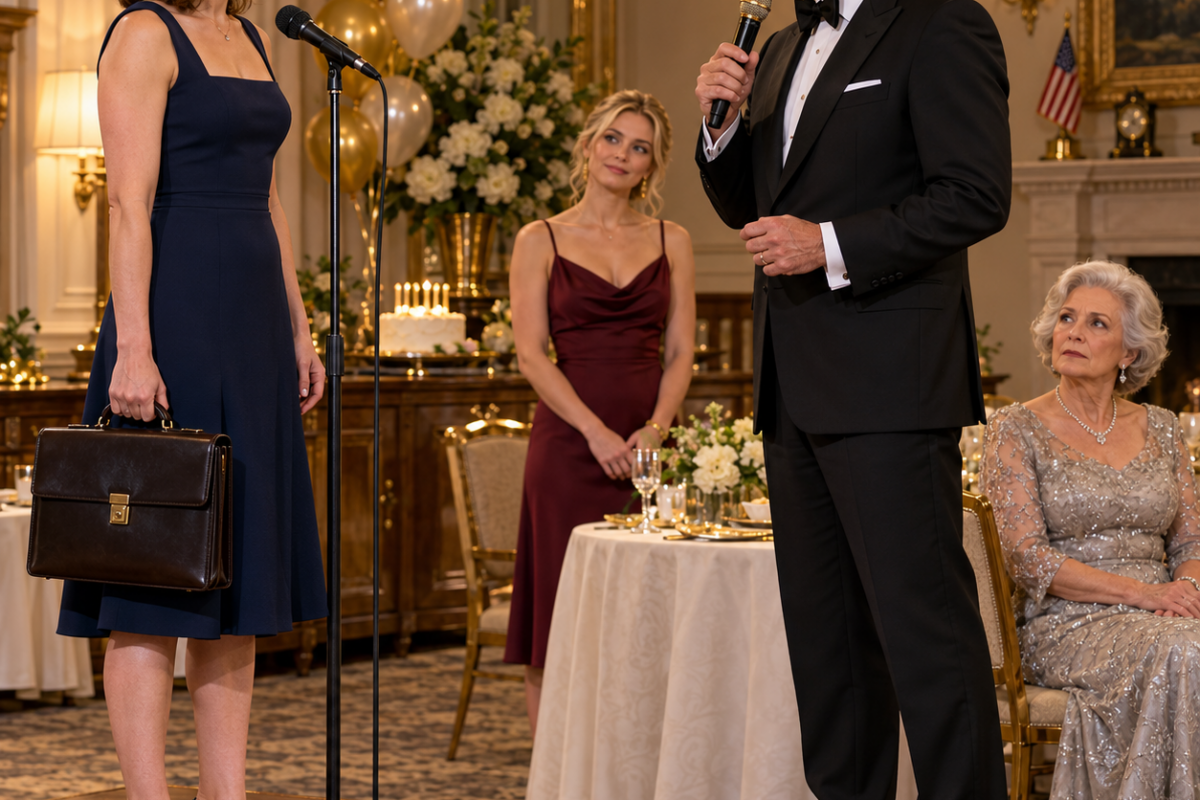
“I already promised your house to your sister,” my father told me four days after I bought it. “They’re moving in Monday. Rent-free for three years.” I was thirty-one, had saved for nine years, and had bought the five-bedroom home entirely in my own name. When I said no, he threatened to tell the family I had abandoned my sister’s children. Days later, he took the microphone at my grandmother’s seventy-fifth birthday dinner and did exactly that.
My father called twelve times in forty minutes after discovering I had bought a house without consulting him. When I answered, he didn’t ask whether…
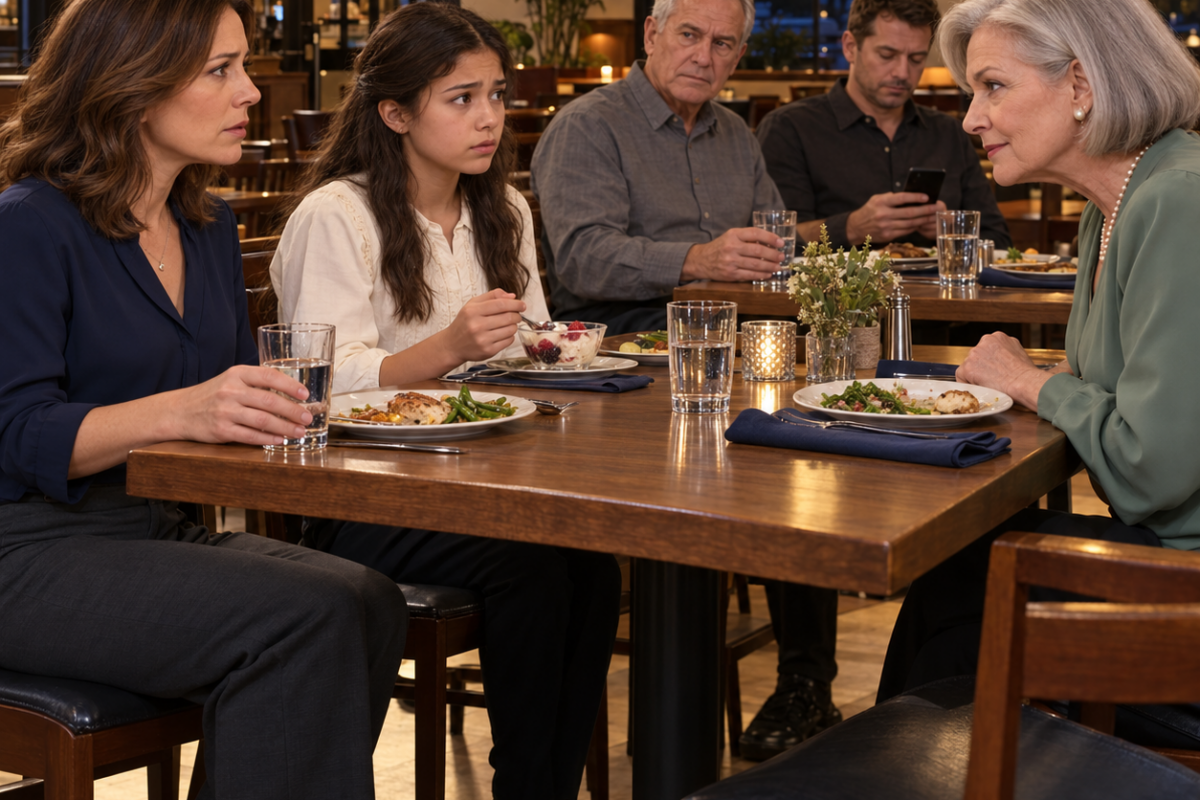
My mother leaned across the restaurant table, looked at my thirteen-year-old adopted daughter, and whispered, “We don’t sit with mistakes.” I took Sole’s hand and walked her out. That night, my father texted, “You’re still making the car payment tomorrow, right?” By midnight, I had canceled the payments I’d been making for my family. Then I remembered something Sole had told me about her grandmother.
My mother looked at my thirteen-year-old daughter and whispered, “We don’t sit with mistakes.” She said it softly enough to avoid attracting attention from the…
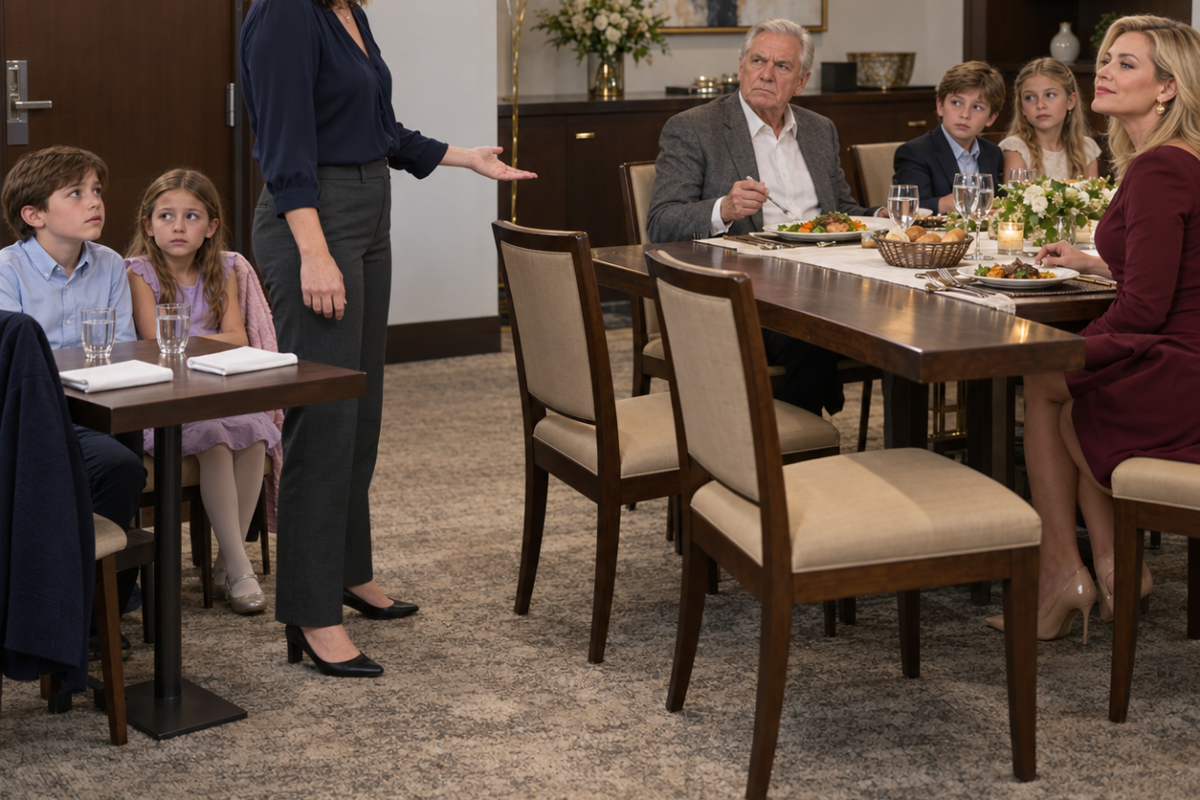
At my father’s seventieth birthday dinner, my eleven-year-old son and eight-year-old daughter were seated beside the service door with water glasses—but no dinner plates. Their cousins sat beside Grandpa with warm bread and full place settings. “They’ll eat after everyone else,” my sister said. I turned to my father, expecting him to object. “They can wait another hour,” he replied. There were two empty chairs at his table.
At my father’s seventieth birthday dinner, the first thing that stopped me wasn’t the cake or the gold balloons. It was my children. Ethan and…
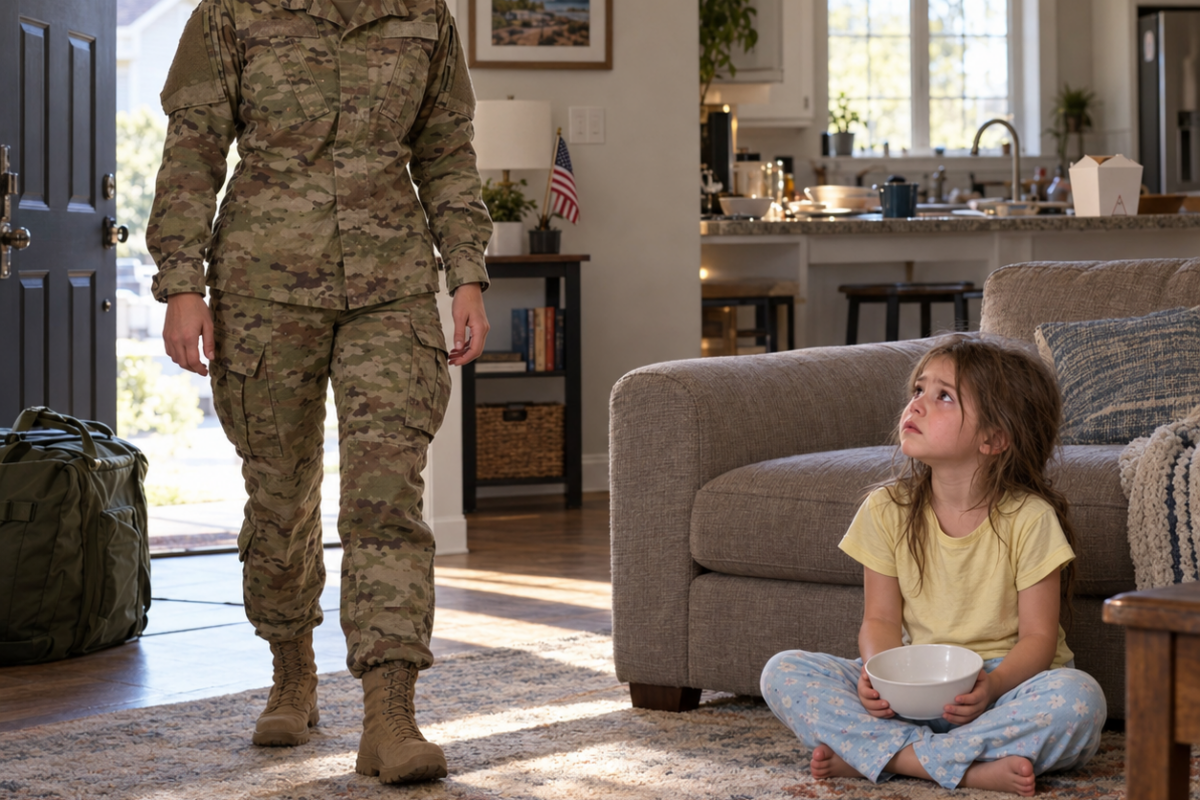
“Mommy, are you real?” my four-year-old daughter whispered when I came home from deployment three weeks early. She was sitting alone on our living room floor with an empty cereal bowl. My husband was on a Caribbean cruise with his mother and sister. Twenty-two minutes earlier, they had posted a photo captioned “Family time.” I was still in uniform when Sophie asked if she could have something to eat.
The first thing my daughter said when I found her was, “Mommy, are you real?” She was sitting cross-legged on our living room floor with…
End of content
No more pages to load