The hospital director’s wife called security to remove me and the baby I was holding, convinced I had come to demand child support. My sister had been missing for four days, and her husband’s office had ignored three certified letters. Then Dr. Grant Holloway saw the second hospital band on my nephew’s wrist and stopped cold. His wife followed his gaze. “Why is your name on that baby?”
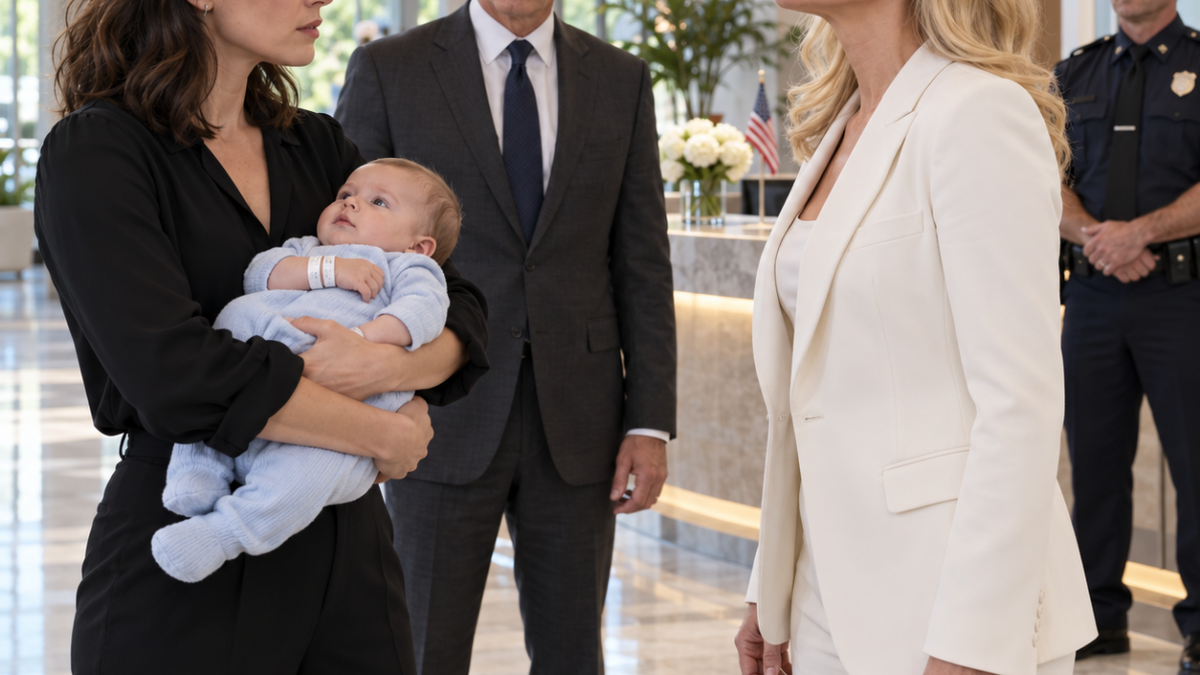
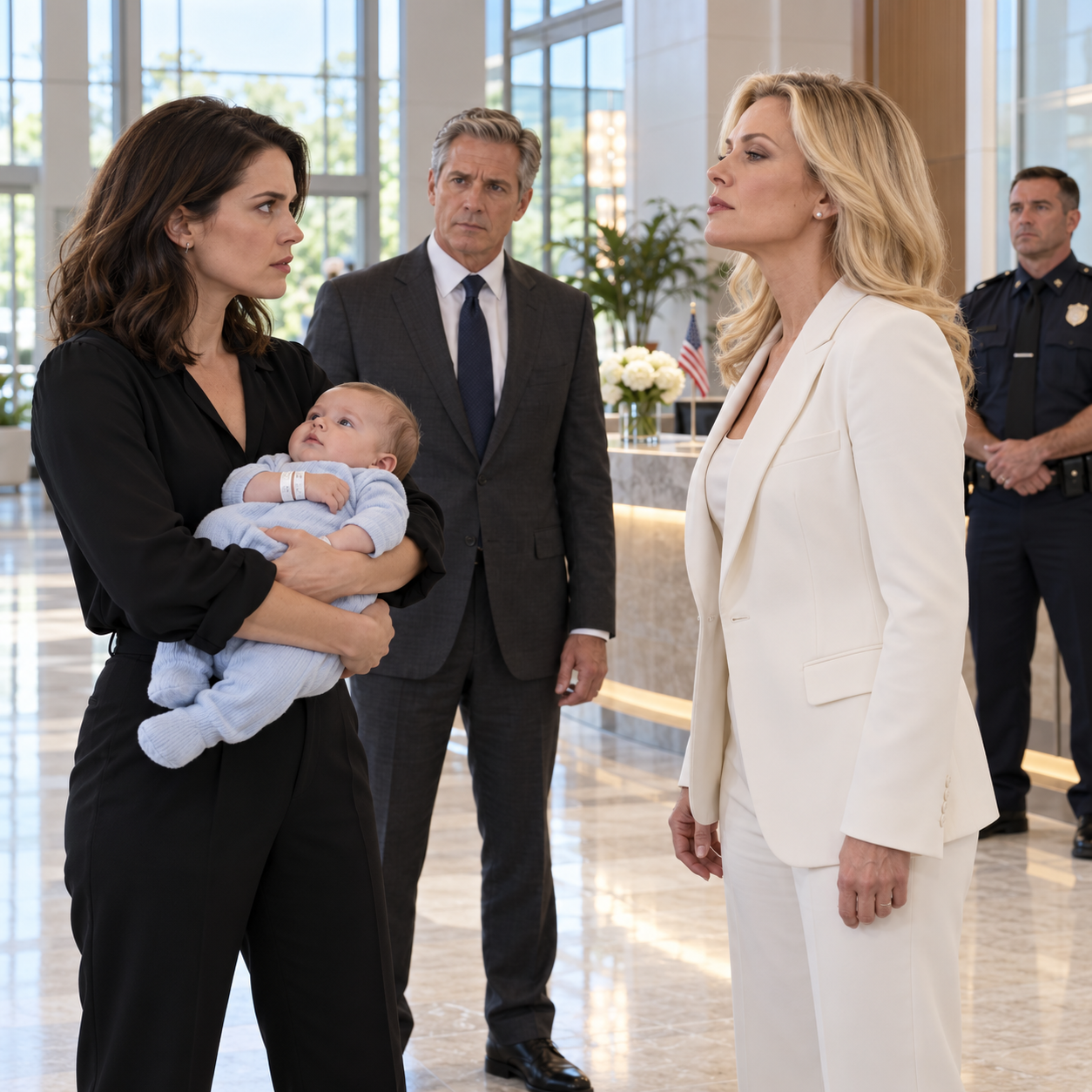
The woman in the cream coat looked at my nephew, then at the envelope in my hand, and decided she understood why I was there.
“How much?” she asked.
For a moment, I thought she was speaking to someone behind me.
The lobby of St. Matthew’s Medical Center was crowded that morning. Employees crossed the marble floor carrying coffee. A delivery driver waited beside the security desk. Two men in suits stood near the executive elevators, speaking quietly enough to suggest that whatever they discussed mattered more than the people around them.
I had been waiting for twenty-three minutes.
Owen slept against my shoulder.
His stroller stood beside me, one wheel refusing to point in the same direction as the other three.
“I’m sorry?” I said.
The woman folded her arms.
“How much money are you asking for?”
I stared at her.
“I’m here to deliver legal documents.”
“Of course you are.”
Her eyes moved to Owen again.
He was six months old, warm from sleep, with one small hand caught in the collar of my sweater.
“This is a hospital,” she said. “Not a place to embarrass people over private mistakes.”
I understood then.
Not the reason I was there.
The reason she believed I was there.
“My name is Nora Bennett. I have an appointment request with Dr. Holloway’s office.”
“You don’t have an appointment.”
“No. I’ve been trying to get one.”
She gave a humorless smile.
“I’m Lila Holloway.”
I recognized the name.
It appeared on donor walls, foundation announcements, and photographs of people presenting oversized checks.
Grant Holloway was the medical executive overseeing the hospital network.
Lila was his wife.
I shifted Owen carefully.
“I need five minutes with your husband.”
“I’m sure you do.”
The receptionist looked down at her screen.
A security guard began walking toward us.
My face grew hot.
“Mrs. Holloway, this is not what you think.”
“Women always say that when they arrive with a baby and paperwork.”
Someone nearby stopped moving.
A phone rose slowly in the reflection of the glass doors.
I had spent four days imagining what could have happened to my sister.
I had slept in pieces.
I had answered questions from police, argued with people who would not return calls, and carried a feverish baby to a pediatric appointment that morning because his mother was missing and someone still needed to make sure he was all right.
I did not have enough energy left to survive being mistaken for a scandal politely.
“My sister is missing,” I said.
Lila’s expression did not change.
“That isn’t my husband’s responsibility.”
“I didn’t say it was. I said I need to speak with him.”
The guard reached us.
“Ma’am, if you could come with me.”
“I haven’t caused a disturbance.”
“We need to keep the entrance clear.”
I looked around.
There were several feet of open floor on every side of me.
The stroller was nowhere near the doors.
Lila stepped closer.
“You should be ashamed of using a child this way.”
I had heard cruel things before.
People can become astonishingly careless when they believe they are protecting something respectable.
But that sentence reached me in a place I could not easily steady.
I looked down at Owen.
His mother had left him with me four days earlier.
Not casually.
Not because she wanted a weekend away.
She had held him for so long before handing him over that I teased her about needing a crowbar.
Now I understood that she might have been memorizing the weight of him.
“I’m not using him,” I said.
The guard moved a hand toward the stroller.
I stepped between them.
“Please don’t touch it.”
His expression hardened.
“Ma’am.”
“He’s with me. I’m not leaving him with anyone.”
“No one asked you to.”
“Then don’t reach for his stroller.”
The executive elevator opened.
A man emerged with a woman carrying a tablet and the two board members I had seen earlier.
I recognized him from the hospital’s website.
Dr. Grant Holloway.
He looked toward us because Lila said his name.
“Grant.”
Then he saw me.
Owen.
The envelope.
He stopped.
Lila walked toward him.
“She came here demanding to see you.”
Grant did not answer.
His eyes had gone to Owen’s wrist.
A fresh hospital band lay beneath the sleeve of his little sweater. A second, narrower band had been attached below it during the pediatric visit that morning because a restricted marker remained connected to his birth file.
The nurse had called it a duplicate administrative identifier.
I had asked why it carried a name that was not ours.
She said a supervisor would need to explain.
Then the clinic got busy, Owen’s examination was finished, and I carried another unanswered question into the lobby.
Grant stared at the smaller band.
At the printed authorization line.
His own name.
For several seconds, nobody moved.
Lila followed his gaze.
She saw the second band and stepped closer.
“Why is your name on that baby?”
Grant looked as though the building had disappeared around him.
I tightened my hold as Owen stirred.
“Dr. Holloway,” I said, “I came here because my sister is missing, because your legal department has not responded to three notices, and because one of your hospitals attached your name to my nephew’s records without explaining why.”
Lila looked at me differently then.
Not kindly.
As though I had become dangerous.
“What legal notices?” she asked.
Grant blinked.
“We should go upstairs.”
“No,” Lila said. “You’re going to tell me what this is.”
One of the board members moved away.
The receptionist stopped pretending to work.
Grant looked at the phones pointed in our direction.
“Not here.”
Ten minutes earlier, his wife had been comfortable humiliating me in public.
Now privacy mattered.
“I asked for five minutes privately,” I said. “Your wife made that difficult.”
He looked at her.
Then at me.
“Please.”
There was fear in his face.
Not merely fear of embarrassment.
Recognition.
I nodded toward the elevator.
“Then five minutes.”
My sister, Emma, had never been mysterious.
That was one of the reasons her disappearance frightened me so badly.
She was the person who texted when she left the grocery store so our mother would know approximately when to start worrying if she did not arrive.
She kept receipts.
She wrote appointment times on paper even when they were in her phone.
She could tell you where every important document lived.
She also cried during advertisements involving old dogs.
I loved that combination.
Careful and soft.
She was twenty-nine, two years younger than I was, and had spent most of her working life in health-information departments.
People thought medical records meant filing.
Sometimes it did.
More often, it meant noticing when a date, name, number, or signature did not match the story a chart claimed to tell.
Emma noticed things.
She did not go looking for danger.
She went looking for errors.
That distinction became important later, when people tried to describe her as someone who had deliberately put herself in the middle of an investigation.
She had taken a six-month contract in pediatric records at North Ridge Women’s Center, part of the network Grant oversaw.
The contract began when she was still pregnant.
She needed the income.
She liked the work.
She believed the larger institution would provide stability.
North Ridge was new enough to have bright corridors, expensive equipment, and speeches about patient-centered care displayed near the elevators.
Our mother admired it.
I did too.
We trusted buildings like that.
Most people do.
We assume that when an institution has enough glass, enough credentials, and enough money to put a fountain in its entrance, someone must be checking the details.
Emma learned how dangerous that assumption could be.
Owen was born there six months before the morning in the lobby.
I was with her.
Our mother arrived later, carrying flowers and a bag full of food nobody had time to eat.
Owen was healthy.
Small, loud, and unimpressed by the world.
Emma held him as though every uncertainty in her life had become something she could protect by keeping her arms in the right position.
His father had been a man she dated briefly.
The relationship ended before the birth.
There were legal matters concerning parentage and custody, handled through counsel, but no hidden executive, secret affair, or wealthy man waiting to be identified.
Emma was his mother.
That was the fact around which our family organized itself.
We helped.
Our mother took afternoons.
I took evenings when I could.
Emma returned to contract work long enough to finish her obligations, then began looking for another position with a better schedule.
She became tense during those last weeks.
At first, I blamed exhaustion.
A new baby.
Work.
Money.
Those explanations fit.
They also prevented us from asking enough questions.
Once, she called late at night.
“Can a hospital change a birth record after discharge?”
I sat up.
“What kind of change?”
“A correction.”
“Probably. Why?”
“No reason. I’m checking something.”
“Emma.”
“I’ll tell you when I understand it.”
I accepted that.
People have work problems they cannot explain in a sentence.
I knew that.
Another time, she asked whether I remembered the name on a nurse’s badge the morning Owen was discharged.
I did not.
She looked disappointed, then apologized.
“It’s nothing.”
It was not nothing.
But she was still trying to find a shape for it.
Four days before I went to St. Matthew’s, she brought Owen to our mother’s house.
Mom had arthritis that made lifting him difficult, so I was there too.
Emma carried a diaper bag, a folder, and enough bottles to suggest she expected to be gone longer than the afternoon she mentioned.
She said she needed to deal with something.
“What?”
“Paperwork.”
I smiled.
“Your natural habitat.”
She did not smile back.
That should have been enough to make me stop.
Instead, I was fastening Owen’s bib and listening for the kettle.
Emma placed temporary caregiving documents on the table. Our attorney had helped arrange them because she had been considering travel connected to a job.
The authority was specific.
Medical decisions.
Care.
Dates.
Not an adoption.
Not the surrender of motherhood.
“I don’t expect you’ll need them,” she said.
“Then why bring them?”
“Because if something happens, it’s easier if you have them.”
Our mother looked up.
“What would happen?”
Emma kissed her cheek.
“Nothing. I’m being organized.”
She held Owen again.
For a long time.
Then she handed him to me.
“I love you,” she said.
“I love you too.”
She left.
At first, we thought she was busy.
Then her phone went unanswered.
By evening, I had called six times.
At midnight, a message arrived.
If I don’t answer, take Owen somewhere public and make sure people see you.
I read it in bed.
Then I called again.
Nothing.
The next morning, I contacted our attorney, Aaron Bell.
He had known Emma for years and had recently helped with the record-preservation petition she filed.
Until then, I knew only that she was trying to correct something in Owen’s hospital file.
Aaron became very quiet when I read the message.
“Has she contacted your mother?”
“No.”
“Any friends?”
“No.”
“Come to my office.”
That was when he gave me the envelope.
Copies of the court filing.
Independent lab results Emma obtained because she wanted a documented biological link to Owen.
Affidavits about records she had seen and communications she had received.
And a separate notarized letter intended for Grant if we could get him to receive it through a reliable channel.
Aaron did not claim the seal gave the envelope magical legal power.
It preserved the record of what Emma prepared.
It also kept sensitive allegations from being circulated casually before the correct recipients were involved.
He explained what I could disclose.
What investigators needed.
What should remain private.
We contacted the police.
Emma was an adult.
She had taken money from her account.
Her car was found in a grocery-store parking structure.
There was no visible evidence of violence.
The missing-person report was taken, but the initial response reflected the possibility that she had chosen to leave.
I understood why officers needed facts.
I also understood that choice could exist inside fear.
Someone could leave voluntarily because she believed staying was dangerous.
I tried to explain that.
The message.
The caregiving documents.
The hospital petition.
Some people listened carefully.
Others heard an anxious sister describing a woman under stress.
We kept calling.
Aaron sent notices to the hospital network.
Three.
One had been signed for by Grant’s office.
No meaningful response came.
Then Owen developed a fever.
That ended any thought that I could spend the morning simply waiting by a telephone.
I took him to a pediatric appointment at St. Matthew’s, which was in the same network but separate from North Ridge.
The clinician examined him promptly.
A common infection.
He was drinking, responsive, and stable.
I received instructions, warning signs, and a follow-up plan.
I did not take an ill baby to a confrontation instead of care.
I took him for care.
The confrontation came afterward because the executive offices were in the adjoining tower and I could not bear another unanswered notice.
At registration, the clerk struggled with his file.
A restricted banner appeared.
She asked a supervisor to confirm something.
Two bands printed.
The ordinary patient identifier.
And a smaller internal routing band carrying Grant’s authorization name.
I asked about it.
The staff member looked puzzled.
“It may be an old administrative restriction.”
“From when?”
“The birth record.”
“What does that mean?”
She said someone from health information would need to clarify.
I kept both bands.
Not because I understood their importance.
Because by then I had learned not to throw away a question just because somebody called it administrative.
Upstairs, Grant led us into a conference room.
It was large enough for twelve people, with a polished table and windows looking over the city.
He asked security to remain outside.
Lila insisted on entering.
I did not object.
She had made herself part of the morning.
I settled Owen in his stroller.
He slept with his mouth slightly open, one fist beside his cheek.
Then I placed the envelope on the table.
Grant looked at the return address.
He knew what it was.
“You received these,” I said. “Three notices. One was signed for by your office.”
Lila’s eyes narrowed.
“Regarding what?”
Grant ran a hand over his face.
“Emma.”
My stomach tightened.
“How do you know my sister?”
He looked at me properly then.
For the first time.
“She worked here.”
“I know she worked in pediatric records. That wasn’t the question.”
Lila turned toward him.
“You told me she was a contract employee who left.”
“She was.”
“And?”
He said nothing.
I opened the main envelope.
Not the separate letter.
The documents Aaron authorized me to share.
“Emma filed a petition eleven days ago asking that records connected to Owen’s birth be preserved,” I said. “She believed his file had been altered.”
Grant’s face tightened.
Lila looked between us.
“Altered how?”
I slid the first report across the table.
“Owen was born at North Ridge. His discharge paperwork did not identify a father. Emma wanted that information handled through the proper legal process. But she found other things in the file she could not explain.”
Lila stared at Grant.
“Is he yours?”
“No.”
The answer came immediately.
I watched him.
“Then why is your name on the second band?”
He looked toward Owen.
“Because a restricted marker was left attached to his chart.”
“That is not an explanation.”
He stood.
For a moment, he looked as though he wanted to move far enough away that the question could not reach him.
Then he returned.
“It isn’t a paternity identifier.”
“Then what is it?”
“An internal record-control designation.”
He explained carefully.
The band was not a standard newborn band used to identify a mother and child.
It was an additional routing marker generated by the network’s system when certain restricted files were accessed.
It could relate to legal review, custody documentation, or a protective hold.
The name identified the administrative authority associated with the restriction.
Not a parent.
I looked at the little strip.
“Owen has never been in a custody dispute involving the hospital.”
Grant did not answer immediately.
Lila sat down.
“What are you saying?”
He looked at the petition.
“Emma came to me seven months ago.”
“About what?”
“Discrepancies in neonatal records.”
I felt cold.
“Before Owen was born?”
“Yes.”
At first, she thought it was billing.
Duplicate identifiers.
Charts linked incorrectly.
Corrections made after discharge.
The sort of thing a conscientious employee would flag and expect someone to fix.
Then she found a pattern.
Maternal charts that did not match the infant records attached to them.
Discharge summaries revised without clear supporting documentation.
Amendments restricted after the fact.
Payments connected to a private adoption consultant.
Lila whispered his name.
He kept speaking.
“She believed some records were being changed to conceal transfers that had not been properly authorized.”
I looked at him.
“Transfers of what?”
He glanced toward Owen.
“Infants.”
The word entered the room and seemed to change the air.
I stared.
“No.”
Grant lowered his eyes.
“We did not know the extent.”
“What extent?”
“Emma identified three files initially. The review has found others requiring examination.”
Lila put a hand over her mouth.
I looked down at the lab report.
“We had independent testing. Emma is Owen’s biological mother.”
“Yes.”
“How do you know?”
“She told me she was arranging it.”
“Then what was she afraid of?”
“That the hospital file did not accurately show what happened around his birth.”
I shook my head.
“It does. I was there.”
“The physical birth is not the question.”
He spoke slowly.
“The records may have been used to support a different event.”
I looked at the stroller.
Owen slept.
Safe.
Here.
My sister had insisted on tests because she needed a fact the system could not rewrite.
That realization made my hands shake.
Lila stood abruptly.
“How long have you known?”
Grant looked at her.
“Seven months.”
“Seven months?”
“I opened an internal review.”
“You buried it.”
“I tried to verify the records.”
“You buried it.”
His voice sharpened.
“Public accusations without evidence could have harmed patients and compromised the review.”
I leaned forward.
“What review? What outside investigation?”
He stopped.
The pause answered enough.
“There is an outside investigation,” I said.
“Yes.”
“Since when?”
“State and federal authorities were notified three months ago.”
I put both hands on the table.
“Then why were our attorney’s notices ignored?”
Grant looked at the papers.
“Legal was told to route anything connected to Emma directly to me.”
“By you?”
“Yes.”
“And you did not respond.”
“She asked me to be careful about direct communication.”
“That is not the same as disappearing behind your office.”
He closed his eyes.
“No.”
I took out my phone and showed him Emma’s last message.
He read it.
Then he sat heavily.
“She believed you would come.”
“What?”
“She told me if contact broke down, you would keep trying.”
“Did she tell you she planned to disappear?”
“No. She said she might need to protect herself if someone realized what she had preserved.”
I stared at him.
“You knew she was frightened.”
“Yes.”
“And you let me spend four days begging your office to answer.”
His face changed.
He did not offer a quick excuse.
That mattered.
It was still nowhere near enough.
Lila looked at him.
“Why didn’t you tell me?”
“I couldn’t discuss the details.”
“Because of the hospital?”
He hesitated.
Her expression hardened.
“No. Because of my family.”
I looked between them.
Lila’s family foundation had funded the women’s center expansion.
Her brother, Andrew Holloway, served on the advisory board of the adoption organization partnered with North Ridge.
I knew the foundation name.
I had seen it on the wall.
Grant had worried that discussing the allegations at home might warn someone involved.
He did not know what Lila knew.
So he kept the review hidden.
She sensed distance and secrecy.
She built another explanation.
An affair.
Emma.
Then me, arriving with a baby.
That did not excuse her.
It explained why her cruelty had been so ready.
She had spent months rehearsing an accusation against the wrong person.
“And you came home every night pretending everything was normal,” she said.
Grant looked at her.
“Yes.”
The word was almost inaudible.
I had no sympathy available for their marriage.
Not then.
My sister was missing.
My nephew’s chart carried a restriction no one explained.
Whatever they needed to tell each other could wait.
“What happened to Owen’s file?” I asked.
Grant looked at the band.
“An administrator override associated with my executive credentials was used.”
“By you?”
“No.”
“Then by whom?”
“We’re still verifying.”
“Who had access?”
He looked at Lila.
She went pale.
“Andrew requested temporary access during the North Ridge transition,” Grant said. “He was listed as a liaison between the foundation and the adoption partnership.”
“He doesn’t work in clinical records.”
“I know.”
“You approved it?”
“For limited transition functions.”
“Then why could it be used this way?”
Grant looked exhausted.
“The access should have expired. The review found that it did not.”
I sat back.
Something in me wanted the wrongdoing to belong to one person.
One cruel administrator.
One dishonest intermediary.
One executive who knowingly approved it.
Instead, the picture grew through layers.
An access request.
An account not disabled.
A correction nobody questioned.
A confidential review routed through one man.
A woman whose warnings did not receive urgency until she vanished.
None of those pieces needed to look enormous alone.
Together, they made a system capable of hiding a child.
The next hour moved quickly.
Not magically.
There were calls.
Outside counsel.
The board’s independent review team.
The investigators already handling the records allegations.
Aaron joined us by phone and insisted that my role be kept clear.
I was Owen’s temporary caregiver.
A witness.
Emma’s sister.
Not someone authorizing the hospital to take possession of him or speak for her.
I was grateful he said it.
A room full of professionals can make a frightened person agree to things simply because everyone sounds certain.
I asked questions.
I took notes.
I called our mother.
She began crying when I said there was an investigation.
“Have they found Emma?”
“Not yet.”
“Then what do they know?”
“Enough to take her disappearance seriously.”
Mom was quiet.
Then she said, “Bring him home when you can.”
“I will.”
One of the attorneys asked whether I would allow the bands to be photographed and scanned.
“Yes. But they stay with me until investigators tell me how they should be preserved.”
He nodded.
“No one is removing them without your agreement.”
That was the first institutional answer that morning that felt entirely plain.
The code on the smaller band matched a restricted amendment connected to Owen’s neonatal chart.
His birth record had been changed fourteen hours after delivery.
The access event came from a workstation assigned to Celeste Ward, a maternity-services administrator.
Emma had mentioned her before.
Months earlier.
“She smiles before asking you to delete things,” my sister said.
I thought it was office gossip.
I hated remembering that now.
Aaron authorized release of the separate letter through the appropriate recipients.
Grant opened it with counsel present.
I watched his face.
Then he handed it to me.
The first paragraph addressed him.
The second addressed me.
Nora, if you are reading this because I have not been able to explain, I am sorry. Owen is mine. Nothing about that is uncertain. The uncertainty is what someone used his record to hide.
I pressed my hand against my mouth.
Emma wrote that another baby was born six hours before Owen.
The child’s mother had later been told he died after a serious respiratory emergency.
Emma found references to that event.
She could not find the expected documentation supporting the death.
Instead, another infant file had been amended and restricted.
A payment connected to an adoption intermediary appeared shortly afterward.
She did not claim one missing document proved everything.
She listed discrepancies.
Dates.
Statements.
Records requiring preservation.
She believed Owen’s chart had been used as a cover record to reconcile numbers and obscure the identity of the other baby.
Owen was not taken.
His identity became part of the paperwork concealing someone else’s child.
I read the passage twice.
Then I looked at him.
His feet moved beneath the blanket.
He made a small sleeping sound.
For days, I had imagined a custody claim.
A father.
A threat to Emma’s right to keep him.
The truth was stranger.
And worse for people I had never met.
I did not want to know the name of the other mother yet.
I could barely carry the fact that she existed.
Grant asked where Emma might have gone.
“I don’t know.”
“Friends?”
“We’ve called them.”
“Family?”
“We are her family.”
I heard the anger in my voice.
I did not soften it.
He nodded.
The investigators received the letter.
The missing-person information.
The withdrawal of four thousand dollars.
The car in the parking structure.
The message.
The caregiving papers.
Details that had seemed like the behavior of an adult choosing to leave took on a different meaning beside the documented hospital concerns.
Her case was escalated.
I did not need someone to announce that she was certainly a victim.
I needed someone to stop assuming uncertainty meant safety.
By late afternoon, I was interviewed in a quiet room with Aaron present.
I described Emma’s calls.
The questions about discharge.
The last evening.
The way she held Owen.
I cried at that part.
The investigator waited.
He did not rush me.
Then he asked whether she had seemed frightened.
“Yes.”
“Did she say of whom?”
“No.”
“Did she mention Celeste Ward?”
I nodded.
He wrote it down.
I understood that he needed facts.
I also understood that some facts arrived in fragments we did not recognize until afterward.
No one had a complete story yet.
That made the process slow in ways my fear hated.
Owen woke hungry.
I fed him while Aaron spoke with the investigators.
The bottle warmed his little hands.
For ten minutes, my job became simple.
Hold him.
Feed him.
Check the blanket.
The world had become too complicated, but the child still needed ordinary care.
I was grateful for the ordinary.
I also resented how much of it Emma was missing.
That evening, we went home.
Not to a secret location arranged by the hospital.
To our mother’s house, after discussing practical safety steps with investigators and counsel.
Who could come.
Who should be called if someone appeared.
How to preserve messages.
What not to post.
The hospital offered a family room the next day for follow-up care and interviews, but Owen remained with us.
I did not want anyone assuming the institution’s concern entitled it to custody.
Mom stood at the door when we arrived.
She took one look at my face.
Then she touched Owen’s head.
“Come in.”
The house smelled of soup.
I had not realized how hungry I was.
She made me eat.
Not with a speech.
With a bowl placed in front of me while she sat beside the stroller.
I described what I could.
She grew pale.
Then she asked, “Was Emma trying to protect him?”
“Yes.”
“Then we’ll protect him until she comes back.”
She said it as though she could establish the ending by speaking clearly.
I wanted to borrow that certainty.
For the next forty-eight hours, I barely left Owen’s side.
His fever came down.
We followed the pediatric plan.
He drank.
Slept.
Cried at the usual things.
A wet diaper.
Being placed somewhere he did not prefer.
The extraordinary fear belonged to the adults.
For him, the day still turned on warmth, milk, voices, and the comfort of being picked up.
I tried not to let my shaking reach him.
Sometimes it did.
Mom would take him while I stepped into the hallway.
I called Emma.
Left messages.
Angry ones.
Gentle ones.
Practical ones.
Please contact Aaron.
You don’t have to tell us where you are yet.
Owen is all right.
I love you.
I’m furious.
Please call.
Grant stayed away unless I requested information.
That was wise.
He called through counsel with updates he was permitted to share.
The neonatal records department was being examined.
Access logs were preserved.
Certain systems were restricted to prevent further changes.
Celeste did not report for work.
Her phone was off.
Her home appeared empty when the appropriate people went to locate her.
Andrew responded through an attorney.
Lila called no one in my presence.
I learned later that counsel advised her not to contact people connected to the review casually.
For once, she listened.
She came to the family room at St. Matthew’s during a follow-up appointment.
No cream coat.
No dramatic entrance.
She stood in the doorway looking tired.
“I owe you an apology.”
I looked at her.
“Yes.”
She swallowed.
“What I said was cruel.”
“Yes.”
“I thought—”
“I know what you thought.”
Her eyes filled.
“I spent months convincing myself Grant was having an affair. He was secretive. Distracted. Meeting people I didn’t know. Then I saw you with a baby.”
“And you decided I should pay for your fear.”
She nodded.
“Yes.”
“You asked security to remove me before asking my name.”
“I know.”
I believed she was ashamed.
I did not confuse shame with a repaired relationship.
She looked at Owen.
“Is he better?”
“His fever is down.”
“Good.”
For a moment, we were simply two women looking at a baby.
Then the lobby returned to my mind.
The phones.
The accusation.
The guard reaching toward the stroller.
“I’m more interested in finding my sister than forgiving you.”
“I understand.”
She left.
I was glad she did not try to comfort me.
Emma contacted Aaron on the third day after the lobby confrontation.
He called while I was sitting on Mom’s living-room floor.
Owen lay on a blanket beside me, studying a cloth toy as though it required his full professional attention.
Aaron said my name carefully.
“We’ve heard from her.”
I stopped moving.
“Alive?”
“Yes.”
“Is she hurt?”
“She says she isn’t.”
“Where?”
“We’re confirming arrangements. She’s outside Santa Fe.”
I stared at the rug.
For a moment, I could not make the distance fit inside the sentence.
Denver to New Mexico.
A motel.
A borrowed name.
My sister had crossed a state line while I checked hospital corridors and parking structures.
“Can I speak to her?”
“Yes.”
A pause.
Then her voice.
“Nora?”
I sat on the floor and cried so hard I could not answer.
She began apologizing.
Again and again.
I heard a door close somewhere on her end.
A television.
Ordinary sounds.
Proof of a place where she was breathing.
At last, I managed, “You don’t ever get to do that to me again.”
“I know.”
“No, you don’t know.”
“I’m sorry.”
“Owen is here.”
She made a sound I had never heard from her.
“Is he all right?”
“Yes.”
“Can I hear him?”
I held the phone close.
Owen waved the toy.
It crackled.
He made a pleased little noise.
Emma cried.
Mom came into the room.
I handed her the phone.
She sat down slowly.
“My girl.”
Those two words finished what remained of my composure.
I pressed my face into my hands.
For the first time in days, the fear had somewhere to go.
Emma was not kidnapped.
She was not harmed.
She had gone into hiding because Celeste confronted her in the employee parking garage after the preservation petition was filed.
“You have a baby,” Celeste said. “Think about what you’re risking.”
There was no explicit description of violence.
There did not need to be for Emma to hear a warning.
She knew someone had accessed records connected to her.
She knew the people she questioned had more authority than she did.
She knew reports had gone unanswered or returned to the same internal channels.
She believed she needed distance before someone prevented her from creating it.
She left Owen with us because she thought anyone watching her would assume he remained with her.
She did not tell us the plan because she feared information might travel through people who thought they were helping.
That explained it.
It did not make it kind.
I told her so later.
At first, I only needed her voice.
She contacted Aaron after seeing a report that investigators had searched North Ridge’s records department.
The public development told her the material had reached people outside the internal chain she no longer trusted.
She had been hiding in a motel under a name borrowed from a college friend.
The friend helped her travel.
Not knowing every detail.
Knowing enough to believe she needed somewhere quiet.
Investigators arranged to speak with her.
They examined the threat, the travel, the records, and what she had preserved.
Later, surveillance confirmed that a vehicle connected to a private investigative company had appeared near one place she stayed.
The company had been hired through an entity associated with the adoption foundation.
That fact did not tell investigators everything about intent.
It told them Emma’s fear had not arisen in an empty room.
Someone had been trying to locate her.
She was not imagining all of it.
We still had to wait.
Finding Emma did not end the investigation.
It did not immediately make Denver feel safe.
It did not tell us where Celeste was.
Emma remained away while investigators worked through practical arrangements.
I wanted her home.
I also wanted someone competent to explain when home could be reached safely.
For once, I accepted that wanting an answer did not create one.
Emma and I spoke every day.
Some calls were painful.
I was angry.
She was ashamed.
We had both spent days making decisions under fear and now had to look at the damage those decisions caused.
“I thought I was protecting you,” she said.
“You left me without enough information to protect anyone.”
“I know.”
“I had a baby with a fever, police asking questions, an envelope I barely understood, and people treating me like I was confused.”
She cried.
I did not stop.
“Then Lila accused me of bringing him for money.”
Emma went quiet.
“What?”
I told her.
She apologized again.
“That wasn’t your choice,” I said. “Lila owns that.”
Then I took a breath.
“But you own leaving without a way to contact you.”
“Yes.”
The conversation changed after that.
We separated responsibility.
It was the only way not to turn every hurt into something one person had to carry.
Emma could have been frightened and still have hurt us.
Grant could have notified authorities and still have failed to respond.
Lila could have been deceived and still have chosen cruelty.
I could have been overwhelmed and still have needed to keep asking careful questions.
The investigation lasted almost a year.
There was no single night when every door opened and every family received an answer.
There were searches.
Interviews.
Technical reviews.
Court proceedings.
Records that contradicted other records.
People who remembered a nurse’s words but not the date.
People who signed forms believing they meant something they did not mean.
People who knew enough to be concerned and told themselves someone above them must understand.
Celeste eventually surrendered through counsel.
She admitted altering records in exchange for payments routed through an adoption intermediary.
That admission did not resolve every question.
It established deliberate conduct where the institution had initially described inconsistencies.
Andrew Holloway was charged in connection with financial transactions and conspiracy involving falsified records.
The proceedings continued through the proper process.
Lila did not get to decide that her brother was innocent because the family foundation had funded good things.
Nor did every person connected to the foundation become guilty by association.
The investigators had to establish acts.
Documents.
Knowledge.
Money.
I learned to respect that precision even when impatience made it difficult.
Four infants were confirmed as connected to unlawful record manipulation over six years.
Other files remained unresolved.
Some children had been placed through adoptions that appeared legitimate to the receiving parents but began with illegal changes to medical records.
One case involved a mother falsely told her baby had died.
That child was located in another state.
The adoptive parents had not known the documents were fraudulent.
The people involved needed more than a dramatic reunion.
They needed legal advice, medical information, counseling, time, and decisions centered on children who were not evidence bags or symbols.
I did not meet that mother.
I was not entitled to her pain simply because Owen’s file helped reveal it.
I thought about her often.
Sometimes while washing bottles.
Sometimes when Owen laughed.
The contrast was almost unbearable.
We had feared losing Emma for days.
She had been told to live without her child indefinitely.
I could not imagine it fully.
I stopped trying to turn imagination into understanding.
Some things deserve respect even when they remain beyond us.
Grant was not charged.
Investigators concluded his credentials had been misused after temporary access he approved was not properly ended and controlled.
That did not mean he kept his job.
The board reviewed his response.
He had delayed disclosure.
Restricted reporting.
Kept too much information moving through himself.
He believed he was protecting the institution while facts were verified.
In practice, secrecy protected people exploiting the gaps.
His resignation statement acknowledged that.
I read it at Mom’s kitchen table.
He did not blame Emma.
He did not describe the families as confused.
He said he had placed too much confidence in managing the problem internally.
I respected the accuracy.
It did not erase the four days I spent trying to get his office to respond.
Lila resigned from the foundation board when the charges against her brother became public.
Her marriage to Grant continued for several months, then ended quietly.
I learned that through Emma.
I did not ask for details.
Their private life had already occupied too much space in ours.
Emma returned to Denver after investigators arranged the necessary safeguards and confirmed Celeste was in custody.
Mom and I met her at the airport.
I held Owen.
He had grown.
That was the first thing she noticed.
“He’s bigger.”
I nodded.
“He does that.”
She laughed and cried at the same time.
Then I handed him to her.
She buried her face against his hair.
Her shoulders shook.
Owen looked surprised.
Then he touched her cheek.
I turned away.
Not because I did not want to see.
Because the sight hurt in too many directions.
When she could breathe, I hugged her.
Hard.
Then I stepped back.
“I’m still angry.”
“I know.”
“I’m also very glad you’re here.”
“I know.”
She smiled through tears.
We went home.
The first weeks were not easy.
Emma expected Owen to settle into her arms as though no time had passed.
Sometimes he did.
Sometimes he reached for me.
She tried not to show how much that hurt.
I tried not to become possessive.
I had cared for him every day.
Learned his sounds.
His feeding patterns.
The way he liked the corner of a blanket between his fingers.
Then his mother returned.
The right thing was clear.
The feelings were not always tidy.
One evening, she stood in the kitchen after he cried until I took him.
“He doesn’t know me the same way.”
I looked at her.
“He knows you.”
“Not like before.”
“He’s had a frightening change in the people around him. He doesn’t understand it. Neither do we, completely.”
She wiped her face.
“I did this.”
“Some of it.”
She looked up.
I continued.
“You made a decision. Other people made the situation dangerous. Don’t turn all of it into your failure. Also don’t pretend your decision had no cost.”
She nodded.
We had learned to hold both truths.
It was not comfortable.
It was better than choosing whichever one hurt less.
She began rebuilding routines.
Baths.
Walks.
Bedtime.
Ordinary repetition.
Owen adjusted.
Children do not heal according to the speed adults want.
Neither do adults.
Emma never returned to medical records.
At first, she tried.
She looked at job listings.
Updated her résumé.
Took a call from a recruiter.
Then she closed the laptop and began shaking.
Every chart reminded her of the garage.
Of Celeste’s smile.
Of someone asking her to delete something before she understood why.
She worked with a counselor.
She found a different administrative role later, in an organization that had nothing to do with patient files.
Less money at first.
A quieter room.
People who knew enough about her absence not to ask casual questions over lunch.
I was glad.
A person does not owe an institution continued service merely because she was good at the work before it harmed her.
She testified before a state legislative committee after the criminal investigation had progressed enough for her to speak without compromising it.
I sat behind her.
She wore a plain dark jacket.
No dramatic expression.
No attempt to become a public figure.
She described safeguards.
Access limits.
Independent reporting channels.
The danger of leaving external partners with credentials after the purpose ended.
The need to protect people who raised concerns.
She also described what it felt like to be told a discrepancy was administrative while knowing a family’s life might depend on it.
I watched the committee members listen.
Some carefully.
Some distractedly.
I wanted to shake the distracted ones.
I did not.
Emma finished.
A chairperson thanked her.
She nodded.
Then she stepped down and came toward me.
“Was that all right?”
“Yes.”
“I felt like I was reading a grocery list.”
“Sometimes the facts deserve a steady voice.”
She smiled faintly.
We went outside.
The air felt cold and clean.
Then we called Mom to ask what Owen had eaten.
That ordinary question was the best part of the day.
For months, I questioned my own decisions.
Should I have opened the letter sooner?
Gone to police again?
Refused to leave the pediatric desk until someone explained the band?
Posted Emma’s message publicly?
Stopped Lila before she finished the first accusation?
The questions came at night.
When the house was quiet.
When nothing needed doing.
I had become good at finding one decision that might have made everything simpler.
The counselor I eventually saw called that understandable.
Then she asked whether simplicity had actually been available.
I did not know.
That was the problem.
I could imagine a better choice only by giving my earlier self information she did not have.
I knew my sister was missing.
I knew Owen needed care.
I knew an envelope existed.
I did not know the structure behind it.
Neither did most people in the lobby.
That did not excuse every decision.
It meant I had to assess them honestly.
I preserved records.
I asked for help.
I protected the baby.
I kept trying.
That was what I could say without turning myself into either the hero or the fool.
Both roles were too simple.
Aaron told me much the same thing.
“The envelope was not a weapon,” he said. “It was a record. Getting it to the right people mattered more than creating a scene.”
“I still wonder whether I should have read everything.”
“You were allowed to ask questions. You also had advice about preserving a sensitive package. We can learn from what happened without pretending you should have understood the whole case.”
I nodded.
I needed that distinction.
Learning did not require punishing myself forever.
Lila wrote to me once.
Not through a public statement.
A letter.
She named what she did.
The money question.
The accusation.
The instruction to security.
The assumption that a woman carrying a baby must be trying to embarrass a man.
She wrote that she had allowed fear in her marriage to become certainty about a stranger.
She did not ask me to contact Grant.
She did not ask to meet Owen.
She did not describe her brother as misunderstood.
At the end, she said I did not need to reply.
I kept the letter for a week on the counter.
Then I put it in a drawer.
I did not answer.
Not out of spite.
Because I did not have anything to offer that would make the relationship useful to either of us.
An apology can be real without creating a friendship.
It can matter without granting access.
I hoped she understood that.
Grant sent Emma a letter after his resignation.
He apologized for believing he could control the investigation from inside the institution.
He wrote that hospitals taught people to trust systems, but a system remained vulnerable when authority could override accountability.
Emma kept it.
I would have thrown it away.
That was one of the differences between us.
She wanted a record that someone understood.
I wanted fewer reminders in the house.
Neither approach was entirely wrong.
We learned to stop making every difference a test of who had suffered more.
Owen became a toddler.
He learned to point.
To object.
To laugh at our mother’s exaggerated sneezes.
He hated one particular pair of shoes and loved a saucepan more than any toy bought for him.
He did not become the child from the investigation in our home.
He was Owen.
Sticky hands.
Loud opinions.
A remarkable belief that every closed cupboard contained something he needed.
We kept the relevant records secure.
We would explain what he needed to know when he was old enough.
Not as a secret.
Not as a bedtime story.
As part of his history, handled with care.
Emma sometimes watched him playing and grew quiet.
I knew what she was thinking.
That another child had begun life nearby.
That paperwork had altered a family’s reality.
That she might have missed it if one number had not bothered her enough to check again.
I touched her shoulder when she let me.
Sometimes she wanted to talk.
Sometimes she wanted to watch him.
I learned not to make every silence require an explanation.
Mom struggled too.
She had spent years believing hospitals were places where people knew what to do.
Afterward, every appointment made her anxious.
She checked names on forms.
Asked for copies.
Read discharge instructions twice.
At first, staff occasionally seemed impatient.
Then she learned to speak plainly.
“I’m asking because I need to understand.”
I liked hearing that.
She was not demanding perfection.
She was refusing to confuse confidence with clarity.
We all learned something similar.
Not to reject institutions entirely.
That would have made life impossible and ignored the people who helped us.
The pediatrician who treated Owen.
The investigator who listened.
Aaron.
The staff who preserved access logs.
The employees who eventually spoke.
Trust needed to become specific.
Earned by acts.
Supported by records.
Not handed over to a name on a building.
Almost eighteen months after the lobby confrontation, I returned to St. Matthew’s.
Emma had agreed to speak at a patient-safety conference.
I promised to bring Owen so she did not have to arrange childcare.
He was two now.
Healthy.
Loud.
Determined to press every elevator button within reach.
The marble looked the same.
The security desk had moved.
The donor wall no longer displayed the Holloway foundation name.
There were new signs explaining where patients could raise concerns outside the department involved.
Signs were not enough.
I knew that.
They were still better than silence.
Owen held my hand as we crossed the lobby.
He stopped to inspect the wheels of a delivery cart.
“Big,” he announced.
“Yes. Very big.”
The driver smiled.
Owen smiled back.
I stood near the place where Lila confronted me.
For a moment, the old scene returned with painful clarity.
Her coat.
The envelope.
The phones.
The guard.
Grant staring at the band.
I felt my shoulders tighten.
Then Owen tugged my hand.
“Up.”
I lifted him.
He rested his cheek briefly against mine.
The lobby remained a lobby.
Not only the place where I was humiliated.
A place where people arrived frightened, distracted, hopeful, ill, busy, and uncertain.
We had been some of those people.
Other people would be too.
I hoped the institution had learned enough to ask before deciding.
A staff member approached.
“Are you here for the conference?”
“Yes.”
“Can I help you find the registration desk?”
“Please.”
She asked my name.
She listened to the answer.
It was such a small courtesy.
I noticed.
Upstairs, Emma waited near the meeting room.
Owen saw her.
“Mama.”
She smiled.
“There’s my boy.”
He reached for her.
I handed him over.
For a second, I remembered the airport.
The shaking.
The fear that he had grown too much.
Now he settled against her naturally, then immediately pointed at the microphone he wanted to touch.
She laughed.
“No.”
He frowned.
The ordinary disappointment of a child denied equipment.
I loved it.
Emma’s talk was not about being brave.
She spoke about limits.
Records.
Reporting.
The danger of assuming a person with little institutional power must misunderstand what she found.
She did not share names or private details of families.
She did not turn the other infants into examples for applause.
She explained the process.
What failed.
What changed.
What still needed scrutiny.
I sat at the back with Owen and a bag of snacks.
He dropped crackers.
I picked them up.
The room listened.
At the end, people applauded.
Emma nodded.
Then she came toward us and asked whether he needed a diaper change.
“Yes,” I said. “Very much.”
We laughed.
That was our ending for the moment.
Not a final triumph.
A mother with work to finish and a child who still needed care.
After the conference, we sat outside on a bench.
Owen chased the shadow of a pigeon under Mom’s supervision.
Emma leaned back.
“Do you ever think about that first morning?”
“Yes.”
“Me too.”
She looked toward the hospital.
“I thought if I preserved enough proof, everything would become clear.”
“Did it?”
“Some things.”
We sat quietly.
Then she said, “I didn’t understand how many people could be hurt by the same record.”
I nodded.
A chart was not only a chart.
A surname was not only a surname.
A corrected date could alter custody.
A restriction could prevent a question.
A missing certificate could turn a mother’s uncertainty into years of grief.
We had learned those things slowly, through people whose lives could not be reduced to a case summary.
Owen ran back.
He held a leaf.
“For you,” he said.
Emma took it.
“Thank you.”
He handed me a smaller one.
Fairness mattered to him in ways he could not yet explain.
I smiled.
“Thank you.”
He ran off again.
Emma looked at the leaf.
Then at me.
“I’m sorry I made you carry so much.”
I thought before answering.
“You can thank me.”
She blinked.
“I am thankful.”
“I know. I don’t want every good thing between us to become another apology.”
Her eyes filled.
“Thank you, Nora.”
I nodded.
“You’re welcome.”
The words felt simple.
They had taken us a long time to reach.
I still think about Lila sometimes.
Not because I need her to apologize again.
Because her mistake was ordinary compared with the truth behind it.
She saw a woman carrying a baby into her husband’s workplace and built the easiest story available.
Affair.
Money.
Embarrassment.
She never considered that the woman might be looking for a missing sister.
That the child might be connected to altered records.
That the envelope might contain questions no one had answered because the people who should answer controlled the route those questions traveled.
I had built simpler stories too.
Work stress.
A custody problem.
A frightened new mother.
We all used explanations we recognized.
The danger came when certainty made us stop asking.
That morning, everyone in the lobby thought they understood why I was there.
Lila thought I wanted money.
Security thought I was creating a disturbance.
Grant thought the second band meant Emma’s evidence had finally reached him in a way he could not contain.
I thought five minutes might bring my sister home.
None of us understood everything.
Owen understood least of all.
He wanted to be held.
Fed.
Kept warm.
The adults had attached a scandal to him because we did not know what the paperwork meant.
He was never the scandal.
He was a child whose record had been used to make another story look complete.
The discrepancy helped expose it.
But he did not exist to prove anything.
He existed because Emma loved him before she knew his face.
That was what we protected afterward.
His right to be more than the worst thing that happened around his birth.
On the drive home from the conference, he fell asleep.
Mom sat beside him in the back.
Emma watched the road.
I held the leaves on my lap.
At a red light, she glanced over.
“Dinner at Mom’s?”
“Only if nobody asks me to explain another envelope.”
She laughed.
“No envelopes.”
“Then yes.”
The light changed.
We drove on.
Behind us, the hospital grew smaller.
Not erased.
Not forgiven into harmlessness.
Simply no longer filling every window.
Ahead was our mother’s kitchen, a tired toddler, a pot of soup, and an evening whose most urgent question would be whether Owen could stay awake long enough to eat.
I wanted that evening.
I wanted hundreds like it.
And when we arrived, I carried him inside without checking the band on his wrist, because there was no band anymore.
There was only his small hand resting against my shoulder.
His mother opening the door.
And our family, finally able to answer when he woke and called for us.
News
At my seventy-second birthday party, my daughter-in-law knocked a crystal vase off its pedestal with her elbow, watched it shatter, and smiled. “Oops.” Her own parents had given it to her and my son on their wedding day six years earlier. I looked at Frank, waiting for him to say something. All he managed was, “Mom…”
I watched my daughter-in-law break her own parents’ wedding gift with one elbow and a smile. For months afterward, people asked me whether I was…
I came home three hours early and found my sixty-eight-year-old mother on her knees scrubbing my mother-in-law’s bathroom. When I helped her stand, her sleeve slipped back, revealing dark marks around her wrist. My husband stepped into the doorway. “Daniela, don’t make a scene.” That was when I remembered my father’s last warning: “If you ever see your mother hurt, don’t argue with anyone. Open the hidden compartment in her sewing machine.”
I came home three hours early and found my sixty-eight-year-old mother on her knees beside a toilet. Her hands were stiff with arthritis. One gripped…
“I already promised your house to your sister,” my father told me four days after I bought it. “They’re moving in Monday. Rent-free for three years.” I was thirty-one, had saved for nine years, and had bought the five-bedroom home entirely in my own name. When I said no, he threatened to tell the family I had abandoned my sister’s children. Days later, he took the microphone at my grandmother’s seventy-fifth birthday dinner and did exactly that.
My father called twelve times in forty minutes after discovering I had bought a house without consulting him. When I answered, he didn’t ask whether…
My mother leaned across the restaurant table, looked at my thirteen-year-old adopted daughter, and whispered, “We don’t sit with mistakes.” I took Sole’s hand and walked her out. That night, my father texted, “You’re still making the car payment tomorrow, right?” By midnight, I had canceled the payments I’d been making for my family. Then I remembered something Sole had told me about her grandmother.
My mother looked at my thirteen-year-old daughter and whispered, “We don’t sit with mistakes.” She said it softly enough to avoid attracting attention from the…
At my father’s seventieth birthday dinner, my eleven-year-old son and eight-year-old daughter were seated beside the service door with water glasses—but no dinner plates. Their cousins sat beside Grandpa with warm bread and full place settings. “They’ll eat after everyone else,” my sister said. I turned to my father, expecting him to object. “They can wait another hour,” he replied. There were two empty chairs at his table.
At my father’s seventieth birthday dinner, the first thing that stopped me wasn’t the cake or the gold balloons. It was my children. Ethan and…
“Mommy, are you real?” my four-year-old daughter whispered when I came home from deployment three weeks early. She was sitting alone on our living room floor with an empty cereal bowl. My husband was on a Caribbean cruise with his mother and sister. Twenty-two minutes earlier, they had posted a photo captioned “Family time.” I was still in uniform when Sophie asked if she could have something to eat.
The first thing my daughter said when I found her was, “Mommy, are you real?” She was sitting cross-legged on our living room floor with…
End of content
No more pages to load