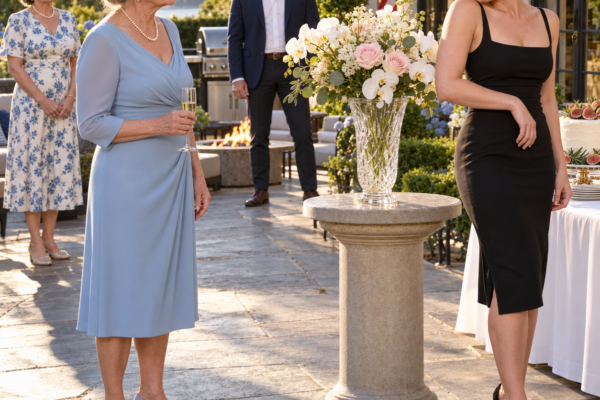
The bride slapped me at the wedding entrance, knocking my glasses onto the marble floor. “This isn’t a shelter,” she had told me moments earlier. I was sixty-nine, holding a small gift bag, and no one stepped forward to help. Then the groom appeared behind her and asked, “What did you just do to her?”
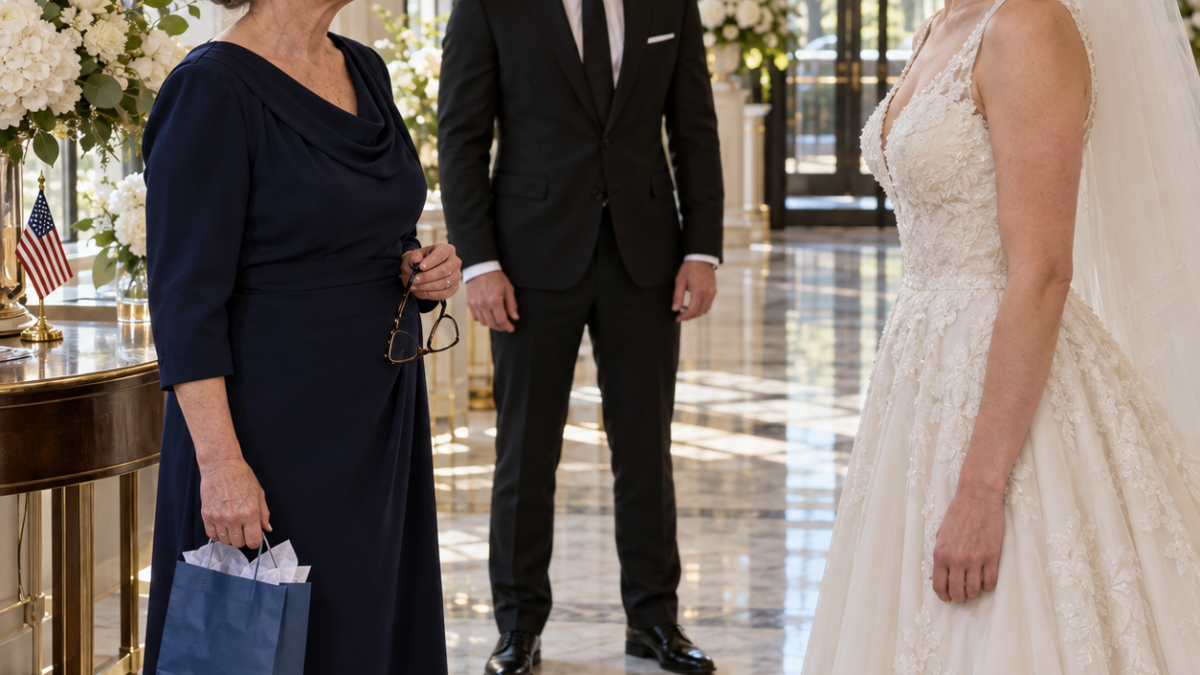
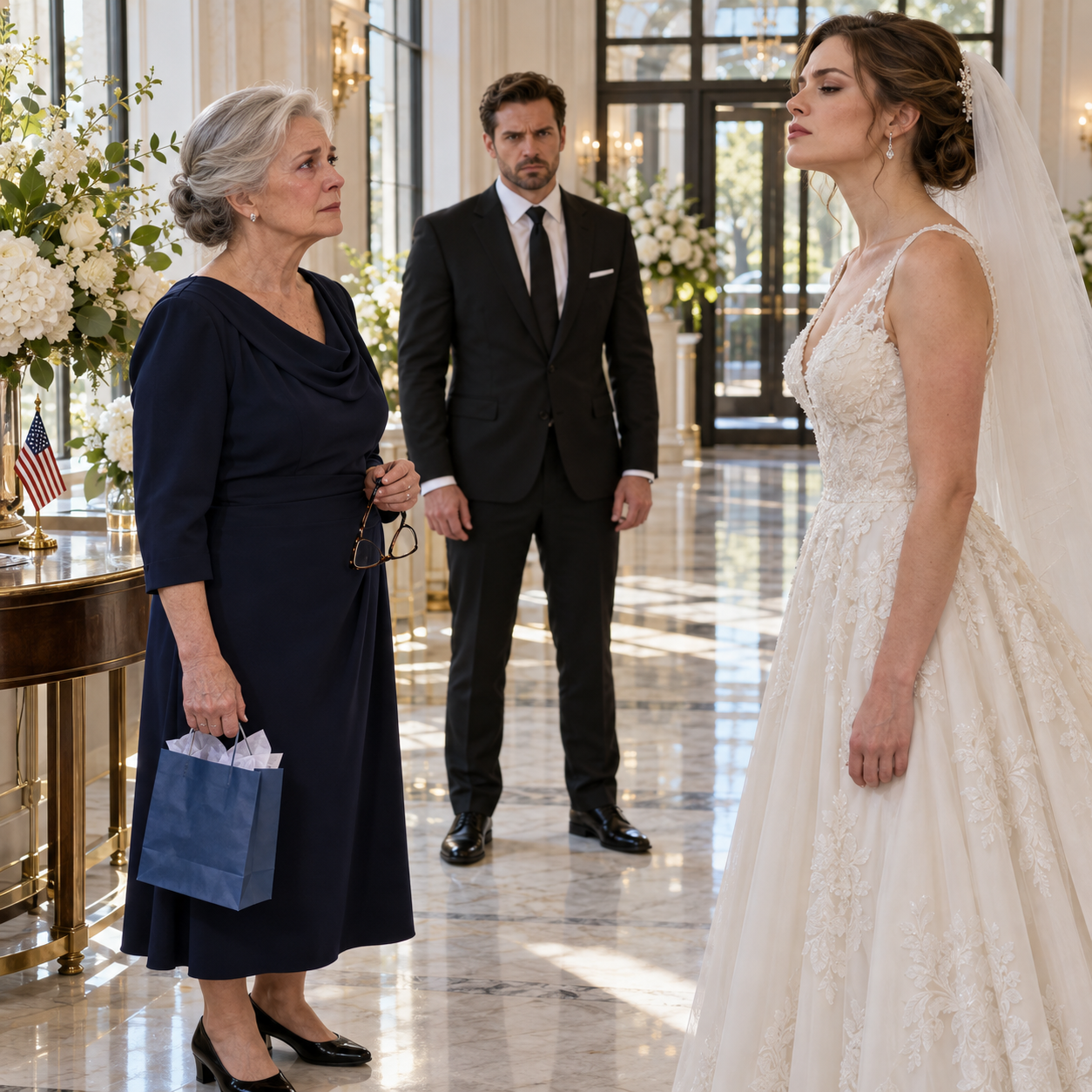
The bride slapped me before I had even made it through the wedding entrance.
My glasses flew from my nose, struck the marble floor, and skidded beneath the edge of the welcome table.
For one strange second, nobody moved.
Then the whispering began.
I could feel heat spreading across my cheek, but the humiliation hurt more than the sting. It was the sudden awareness of all those eyes, all those people waiting to see what an old woman in an ordinary dress would do after being treated like something that had wandered in through the wrong door.
Claire Weston stood in front of me in an ivory gown that probably cost more than my first car. Her veil floated over one shoulder. Her makeup was immaculate.
Her expression was not.
She looked irritated.
Not frightened by what she had done. Not sorry.
I had apparently become a problem she believed she had solved.
“Someone get her out,” she said.
A bridesmaid near the flower wall covered her mouth. I could not tell whether she was hiding a smile or her shock, and at that moment the distinction seemed painfully small.
Another woman lifted her phone.
My left hand still held the little blue gift bag I had brought for Marcus.
I was sixty-nine years old, wearing a navy dress I had bought four years earlier for a colleague’s retirement dinner. That morning, I had polished my black shoes, pressed the dress myself, and pinned my silver hair back with the tortoiseshell clip my husband gave me when our daughter was still in elementary school.
I had not come to impress anyone.
I had come because a boy I once taught to read without hiding his mistakes was getting married.
Claire looked at the gift bag, then at me.
“I said move.”
I stared at her.
Not because I failed to understand.
Because I understood far too clearly.
Ten seconds earlier, a photographer had been arranging people beside the welcome table. I had stopped a few feet away to speak with three former students who recognized me.
One of them, Rachel, had been showing me a photograph of her little girl.
We were not blocking the doors. There was enough room for guests to pass on either side.
Claire had approached with the impatient walk of someone who expected people to rearrange themselves before she needed to ask.
“Who even allowed this woman in here?” she said.
A few people laughed uncertainly.
“This isn’t a shelter.”
At first, I thought I had misheard.
There are moments when cruelty sounds so absurd that the mind offers the speaker a second chance before admitting what has been said.
“I’m here for Marcus,” I told her.
She rolled her eyes.
“Of course you are. People like you always know someone.”
People like me.
Thirty-eight years in a classroom had taught me that people often reveal their deepest beliefs in the little phrases they consider harmless.
“I’m one of his guests.”
“You’re blocking the entrance.”
“I’ll move. I was just speaking to—”
Her hand struck my face before I finished.
Now my glasses lay beneath a table decorated with roses and a sign welcoming everyone to a celebration of love.
I bent carefully.
My knees were not as forgiving as they used to be.
Someone behind me drew a sharp breath, but nobody reached down.
I found the glasses by one bent arm and stood.
The right lens had a long scratch across it.
My hand trembled as I unfolded them.
Claire adjusted her veil.
“Can we please get on with the pictures?”
Then I heard footsteps behind me.
Fast footsteps.
And a man’s voice.
“What did you just do?”
I knew that voice.
I had known it when it was high and uncertain, when it cracked through adolescence, when it belonged to a seventeen-year-old sitting in my classroom after everyone else had gone home.
Now it belonged to Marcus Reed, thirty-four years old, six feet tall, dressed in a black wedding suit.
His face looked nothing like the smiling photograph on the invitation.
Claire turned.
“Baby, I was just dealing with—”
“What did you just do?”
The greeting area seemed to shrink around us.
She glanced at the guests.
Then she lowered her voice.
“She wouldn’t move.”
Marcus looked at my glasses.
At my cheek.
Something changed in him.
“Ms. Carter?”
I tried to smile.
“I’m fine.”
“No, you’re not.”
“I’m all right, Marcus.”
Claire looked between us.
“You know her?”
Marcus turned slowly.
“Know her?”
Her confidence wavered.
“I didn’t mean—”
“That woman raised me.”
The whispers stopped.
Claire blinked.
“What?”
“That is Evelyn Carter.”
My name clearly meant nothing to her.
It meant something to several people standing nearby.
One of the former students beside the table whispered, “Mrs. Carter,” as though saying it aloud could put me back where I belonged.
Marcus continued.
“She was my teacher. She paid for my school uniforms when my mother couldn’t. She tutored me every Saturday for two years without charging us. She gave me books because I was too embarrassed to say I couldn’t afford them.”
“Marcus—”
“She wrote the recommendation letters that helped me get into college. She sat with me when I thought I should drop out. She is the reason I learned to walk into a room and believe I belonged there.”
I touched his arm.
“That’s enough.”
He shook his head.
“No.”
His voice broke on the word.
Claire looked at me again.
This time, there was fear in her face.
Not concern.
Fear of what she had done to herself.
That distinction mattered.
“I didn’t know,” she said.
Marcus stared at her.
“What exactly didn’t you know?”
“Who she was.”
The words hung between us.
Marcus looked almost stunned.
“So if she weren’t important to me, this would have been acceptable?”
“No. That isn’t what I meant.”
“Then what did you mean?”
Claire glanced toward the photographer, the bridesmaids, the doorway where more guests were arriving.
“This is our wedding day.”
“I know what day it is.”
“Everything has been going wrong all morning. The flowers were late. My mother has been asking me questions every ten seconds. We’re twenty minutes behind. I saw someone standing here, and I—”
“You hit her.”
“I lost my temper.”
“You said this wasn’t a shelter.”
Claire opened her mouth.
Nothing came out.
Her mother appeared through the crowd.
Helen Weston was a thin woman with smooth blond hair and the composed expression of someone accustomed to solving expensive problems discreetly.
“What’s happening?”
“Nothing, Mom,” Claire said immediately.
Marcus turned toward her.
“Your daughter struck Ms. Carter.”
Helen’s expression changed.
“She what?”
“It was an accident,” Claire said.
I finally spoke.
“No.”
Everyone looked at me.
I pushed the bent glasses higher on my nose.
“It wasn’t an accident.”
My voice was quieter than theirs, but it carried.
“She meant to hit me.”
Claire’s jaw tightened.
“Mrs. Carter, I said I’m sorry.”
She had not.
Not once.
Marcus noticed too.
“No, you didn’t.”
Claire looked trapped.
“I’m sorry.”
The apology landed between us like something she had dropped because she no longer wanted to carry it.
I nodded.
I did not tell her it was all right.
Because it was not.
Marcus looked at me.
His eyes were wet.
“I should have been out here.”
“You had other things to do.”
“Not more important things.”
I wanted to help him. That old instinct rose before I could stop it.
Weddings were stressful. People behaved badly under pressure. Perhaps there was a way to let everyone regain their dignity and continue.
Older women were expected to find that way.
Smooth the cloth.
Absorb the injury.
Protect everyone else from the consequences.
I had spent enough years doing that.
So I said nothing.
Marcus’s mother arrived a moment later.
Denise Reed had been twenty-eight when I first met her, already exhausted from raising two children alone and working nights at a nursing home.
At fifty-one, she still had the same quick, worried eyes.
She saw me.
Then my glasses.
Then my face.
“Evelyn?”
She hurried forward.
“What happened?”
Marcus exhaled.
“Claire hit her.”
Denise stopped.
Her expression frightened me more than anger would have.
It was disappointment, deep and immediate.
Claire folded her arms.
“I’ve apologized.”
Denise looked at me.
“Did she?”
“After Marcus asked her to.”
Denise closed her eyes.
For two or three seconds, nobody spoke.
Then she turned toward the ceremony room.
“Everyone, please go inside.”
“We’re supposed to be taking pictures,” Claire said.
Denise’s voice remained calm.
“We’re starting late.”
The photographer lowered his camera.
Helen began ushering relatives toward the open doors.
Guests moved reluctantly, glancing back.
Rachel stayed beside me.
“Are you okay, Mrs. Carter?”
“I’m fine.”
She frowned.
“You don’t have to say that.”
Teachers have very little defense against hearing their own lessons returned to them.
I smiled despite myself.
“Thank you, Rachel.”
Through the ceremony doors, I could see rows of white chairs and eucalyptus tied with cream ribbon.
Everything had been prepared for a perfect beginning.
Marcus held out his hand.
For a moment, I did not understand.
Then I gave him mine.
Claire whispered his name.
He did not turn.
He led me across the marble lobby, his grip careful, making sure I did not have to walk alone.
At the end of the hallway was a little sitting room reserved for the wedding party.
Denise followed us.
Marcus closed the door.
For the first time since the slap, there was silence.
Real silence.
Denise touched my cheek lightly.
“Oh, Evelyn.”
“I’m all right.”
She gave me the same look Rachel had.
I sighed.
“Fine. I’m embarrassed.”
Marcus turned away.
His shoulders moved once.
I realized he was crying.
Not loudly.
Marcus had never cried loudly.
Even at thirteen, after boys made fun of his secondhand shoes, he waited until the classroom emptied before letting a tear fall.
I remembered sitting beside him.
I remembered telling him there was no shame in having less money than someone else. The shame belonged to anyone who thought money gave them permission to be cruel.
I had forgotten those exact words.
Apparently, he had not.
“She called you a shelter case,” he said.
“I’ve been called worse by eighth graders.”
“This isn’t funny.”
“I know.”
“I invited you.”
“I know.”
“I told her about you.”
That surprised me.
“About me?”
“More than once.”
He paced beside the window.
“Maybe I never showed her a picture. Maybe I should have. But she knows your name. She knows what you did.”
“She didn’t recognize me.”
“That isn’t the point.”
No.
It was not.
There was a knock.
Claire’s voice followed.
“Marcus? Can I come in?”
He stood motionless for a moment.
Then he opened the door just far enough to step into the hallway.
Before leaving, he looked back.
“Please don’t go.”
“Where would I go?”
His face crumpled.
“Just stay.”
The door closed.
Denise took my hand.
Neither of us said what we were thinking.
Two hundred guests were waiting.
An officiant stood near the flowers.
Meals had been paid for.
Names had been printed together on signs, menus, place cards, and little boxes of sugared almonds.
But somewhere between the entrance and that sitting room, something larger than a wedding schedule had broken.
I had the terrible feeling that Marcus had finally heard it crack.
I first met him on a Tuesday afternoon in September.
He was eleven.
His mother arrived at my classroom carrying a grocery bag full of school supplies and an apology she had apparently been rehearsing all day.
“I know I missed the orientation,” she said. “They changed my shift.”
“You’re here now.”
Marcus stood beside her, narrow-shouldered and watchful, with a haircut that looked as though somebody had done their best in a kitchen.
His sister, Tessa, waited in the hallway with a paperback.
Denise set the bag on my desk.
“I got what I could from the list.”
Inside were pencils, a spiral notebook, glue sticks, and a box of crayons intended for much younger children.
Marcus noticed me notice.
His face closed.
I put the crayons back without comment.
“We’ll make sure he has what he needs.”
Denise exhaled.
I had been teaching long enough to recognize that particular breath.
Relief mixed with shame.
It always troubled me that a parent could work until her feet swelled, keep two children fed, and still enter a school apologizing because she had bought the wrong notebook.
Marcus was bright.
That became obvious quickly.
He could explain how a bicycle brake worked after examining it once. He understood fractions better when I gave him something physical to measure. He remembered conversations almost word for word.
But reading in front of other children frightened him.
He would reach a difficult word, stop, and make a joke before anyone else could laugh.
Then he would spend the rest of class pretending not to care.
One afternoon, I asked him to stay.
He stood at my desk with his backpack already on.
“Am I in trouble?”
“No.”
“Then why am I here?”
“Because you’re working too hard at convincing me you aren’t trying.”
He looked toward the door.
I placed a short passage in front of him.
“Read it to yourself first.”
He stared at the page.
After a while, he said, “I’m stupid at this.”
I pulled a chair beside him.
“No. You’re having difficulty. Those are different things.”
He did not believe me immediately.
Children who have been embarrassed often need more than one adult’s sentence to undo it.
I spoke with Denise, arranged the support the school could provide, and began meeting with him after class.
Saturday tutoring came later, when his mother told me she could not get him to the library program because she slept between shifts.
My husband, Arthur, drove us the first few times.
Then Marcus learned the bus route.
He arrived carrying a notebook, a peanut-butter sandwich, and the expression of someone determined not to owe anybody too much.
“You don’t owe me,” I told him.
“I know.”
“You don’t look like you know.”
He shrugged.
“People usually say that before they tell you what they want.”
I had no quick answer.
Sometimes a child says something that reveals so much of his life that the kindest thing is to resist asking for the rest of it.
So I opened the book.
“Today I want you to finish this chapter.”
That, he understood.
Over the next two years, we worked through stories, articles, spelling patterns, and the peculiar embarrassment of being clever enough to know what you could not yet do.
He improved slowly, then all at once.
The day he read a full page aloud without stopping to insult himself, he looked up as though something had unlocked.
“I did it.”
“Yes.”
He grinned.
Then he immediately tried to hide the grin.
I pretended not to notice.
I bought his school uniforms after Denise mentioned that the required shirts were more expensive than she expected.
I told her they were extras from a donation.
That was not entirely true.
At the time, I thought I was preserving her dignity.
Years later, she told me she had known.
“I let you have your little lie,” she said. “I needed the shirts.”
We laughed about it then.
But sitting beside her in the wedding room, I remembered how many people had mistaken her exhaustion for carelessness.
Claire had never known Denise at twenty-eight, standing beneath the classroom lights in shoes softened by too many hours on her feet.
She knew Denise as the groom’s mother, dressed beautifully for the ceremony.
I wondered whether that was the only version she considered worthy.
A soft knock interrupted us.
This time, it was the venue coordinator.
Her name was Julia. She had a radio clipped to her waist and the calm face of someone who had expected late flowers and missing boutonnieres, not this.
“Mrs. Carter, may I come in?”
I nodded.
She carried a small first-aid kit and a bottle of water.
“I’m sorry this happened in our building.”
“You didn’t do it.”
“No. But I can help now.”
She asked whether I wanted medical attention.
I said I did not think so.
Denise gave me a look.
Julia did not argue.
“Would you mind letting us check that you’re steady before you leave?”
“That’s reasonable.”
She offered a wrapped cold pack.
I held it against my cheek.
The kindness of such an ordinary object made my eyes fill unexpectedly.
Julia noticed.
She looked away while I composed myself.
“We’re preserving the lobby camera recording,” she said. “Our security manager is documenting what happened. Nobody is being asked to pretend it didn’t.”
I lowered the pack.
“Thank you.”
She glanced toward the door.
“Marcus has asked us to hold the ceremony. Guests have water, and the officiant knows there’s a delay.”
Denise nodded.
Julia left quietly.
I looked down at my gift bag.
The tissue paper had been crushed where my hand tightened around it.
Inside was a little wooden box Arthur made years earlier, with a brass hinge and a smooth lid.
After Arthur died, I kept several of his smaller pieces.
I had chosen this one for Marcus because he remembered helping Arthur sand the edge.
He was fourteen then.
Arthur had paid him for an afternoon of work, though the work could have been finished in half the time without him.
Marcus insisted on using the money to buy his mother groceries.
Arthur told me afterward, “That boy thinks every dollar has to justify him.”
We tried, in our small ways, to teach him otherwise.
I had put a fountain pen inside the box and a note beneath it.
For the promises you choose carefully.
Now the words seemed almost unbearable.
Denise saw me looking.
“What did you bring him?”
“Something of Arthur’s.”
She pressed her lips together.
“He’ll treasure it.”
“I hope he still wants to open it.”
“He will.”
Outside, footsteps passed the door.
I could hear voices, low and strained.
Then Claire’s voice rose enough to carry.
“You’re letting her ruin everything.”
Denise went still.
I closed my eyes.
Marcus answered, too softly for me to hear.
Claire spoke again.
“It happened. I apologized. What else am I supposed to do?”
The words reached us clearly.
I did not want to listen.
It felt indecent, sitting behind a door while a couple’s future came apart in the hallway.
But there was nowhere else for the sound to go.
Denise stood.
“I’m going to ask Julia to move them somewhere private.”
“Please.”
She stepped out.
When she returned, her expression had hardened.
“They’ve gone into the office.”
I looked at the gift bag again.
“I should leave.”
“No.”
“Denise, this is your son’s wedding. I don’t want to become the reason—”
She sat beside me.
“Evelyn. Look at me.”
I did.
“You didn’t strike anyone. You didn’t insult anyone. You didn’t make her do what she did.”
“I know.”
“Then don’t give her the comfort of calling you the cause.”
I held the cold pack in both hands.
Knowing a lesson and living it can be very different things.
I had told children for decades that another person’s cruelty did not define them.
Yet there I sat, wondering how to make myself smaller so the room could become comfortable again.
Denise understood.
She had been apologizing for things she had not done almost as long as I had.
“Let him make his own decision,” she said.
I nodded.
The minutes passed.
The cold pack warmed.
My cheek no longer stung as sharply, but the inside of me felt shaken.
I looked around the sitting room.
A vase of white flowers stood on a low table. Someone had arranged bottled water in a silver bucket. A garment bag hung behind the door.
There was a small smear of lipstick on a napkin.
Ordinary traces of a morning that had been moving toward something.
I thought of Marcus at seventeen.
By then, he read well and wrote with the blunt clarity of someone who had spent years choosing words carefully.
He wanted to study engineering.
His school counselor agreed he had the ability.
Money frightened him more than the coursework.
He came to my classroom one afternoon after graduation rehearsals and said he might work for a year first.
“What would you do?”
“Anything.”
“And after that year?”
“Go to school.”
I waited.
He looked down.
“Maybe.”
I knew that maybe.
It was the word young people used when their future had become too expensive to say aloud.
Denise needed help.
Tessa was still in school.
Marcus had a job stocking shelves and felt useful when he brought home wages.
He could not imagine leaving.
I told him responsibility did not require him to abandon every opportunity.
He looked unconvinced.
Arthur helped him compare costs. His counselor found scholarships. I wrote letters that described the boy I knew, not the polished version students thought adults wanted.
Marcus applied.
He was accepted.
When the financial package arrived, he brought the envelope to my kitchen.
He read it three times.
Then he said, “I think I can go.”
Arthur patted his shoulder.
“That seems to be what the paper says.”
Marcus laughed and cried at the same time.
At college, he struggled during the first semester.
Not because he lacked ability.
Because he had entered a world where other students talked casually about ski trips, summer homes, and parents who knew department chairs.
He called me one Sunday.
“I don’t know how to be like them.”
“You don’t have to.”
“They know things.”
“You know things too.”
“Not the same things.”
“No,” I said. “That’s why the room needs more than one kind of person.”
He was quiet.
Then he said he might come home.
I asked whether he was failing.
“No.”
Whether he hated the work.
“No.”
Whether he wanted the degree.
“Yes.”
“Then don’t let somebody else’s ease become evidence that you don’t belong.”
He stayed.
Years later, when he earned his professional license, he sent me a photograph.
He stood outside the testing center holding a coffee cup.
The message said, Still in the room.
I printed it.
It remained on my refrigerator until the paper curled at the corners.
Now I wondered how long he had been trying to belong in Claire’s rooms.
Marcus returned nearly forty minutes after he left.
His tie was loosened.
He closed the door carefully.
For a moment, he stood with one hand still on the knob.
Denise rose.
“Marcus?”
“I’m not getting married today.”
The words were quiet.
They changed the whole room.
I set the cold pack down.
“Marcus.”
He looked at me.
“I need you not to talk me out of it.”
I swallowed.
“All right.”
Denise touched his arm.
“Are you certain?”
“No,” he said. “Not about everything. I’m certain I can’t stand in front of those people and promise something I don’t believe anymore.”
His mother nodded slowly.
He sat in the chair opposite us.
“I asked her one question.”
“What question?” Denise said.
“Whether she would have apologized if I hadn’t come out.”
Neither of us answered.
“She said I was putting her on trial.”
I looked at his hands.
He had pressed them together so tightly that his knuckles were pale.
“She kept saying she didn’t know who you were. Then she said you looked as though you weren’t supposed to be there.”
Denise inhaled.
Marcus continued.
“I asked what made someone look as though they belonged at our wedding.”
His voice thinned.
“She said I knew what she meant.”
I did.
So did Denise.
Marcus looked toward the window.
“And I realized I did know. I’ve known for a while. I just kept finding better explanations.”
He told us about a dinner months earlier, when Claire complained that the server seemed unpolished.
About the contractor repairing their apartment, whom she addressed without learning his name.
About a conversation over the guest list, when she asked whether he truly needed to invite so many people from his old neighborhood.
“She never said it the way she said it today,” he added. “Or maybe I didn’t hear it that way.”
Denise sat down.
“Sometimes we don’t want to.”
He nodded.
“I thought she was particular. I thought she was nervous about appearances. I thought if she knew people, she’d be kinder.”
He looked at me.
“But you shouldn’t have to be introduced properly to be safe near someone.”
I felt tears rise again.
“No,” I said. “You shouldn’t.”
There was a knock.
Julia entered after Marcus called to her.
He stood.
“I need to cancel the ceremony.”
Her expression remained professional, but her eyes softened.
“All right. We’ll help you handle it.”
He asked what should happen to the guests.
Julia outlined choices.
A brief announcement.
Separate spaces for the families.
Food already prepared could still be served if they wanted.
The officiant would be informed.
No one had to make a scene.
Marcus nodded.
“I want to tell them myself.”
Denise looked worried.
“You don’t owe two hundred people an explanation.”
“I know. But they came because I invited them.”
He turned to me.
“Will you stay here?”
“Yes.”
He hesitated.
“I don’t want your name used in the announcement.”
I looked up.
“It shouldn’t be.”
“I know.”
For the first time since entering the lobby, I saw a little of the boy I remembered.
Not because he was young or uncertain.
Because he was listening.
He left with Julia.
Denise remained beside me.
We could not hear the announcement clearly, only the low shift of a room full of people receiving news they did not expect.
Later, Rachel told me exactly what he said.
“I’m sorry, but the ceremony will not take place today. I’ve made this decision because I cannot enter this marriage honestly. Please respect everyone’s privacy. The venue will help with arrangements, and food will be available shortly. Thank you for being here.”
That was all.
He did not name me.
He did not invite the guests to judge Claire.
He did not turn my injury into a performance proving what a decent man he was.
I was grateful for that.
What happened at the entrance had already made me visible in ways I never wanted.
I did not need another stage.
Helen came to the sitting room before Marcus returned.
Denise opened the door.
Helen stood there with her shoulders drawn tightly back.
“May I speak to Evelyn?”
I nodded.
She entered alone.
For a moment, she looked at my cheek.
Then she looked at the glasses resting crookedly on my face.
“I’m sorry,” she said.
I waited.
“What Claire did was unacceptable.”
“Yes.”
She clasped her hands.
“This has been a very stressful day.”
Denise’s expression changed.
Helen saw it.
“No,” she said quickly. “I’m not excusing it.”
I hoped that was true.
She sat on the edge of a chair.
“Marcus is understandably upset. Perhaps, with a little time, everyone can consider whether postponing rather than canceling—”
“That is his decision,” I said.
“Of course.”
But she kept looking at me.
I recognized the request before she stated it.
An older woman had been hurt.
An expensive event was falling apart.
Surely the older woman could help restore order.
“Evelyn, he clearly respects you. If you could reassure him that you don’t wish this to determine his future—”
“I don’t wish to determine his future.”
Relief crossed her face.
Then I continued.
“And I won’t tell him what to do.”
Her relief disappeared.
Denise leaned forward.
“He’s spoken with Claire. He’s making his own decision.”
Helen looked down at her hands.
“There are contracts. Guests have traveled. Her father—”
“I understand there are consequences,” I said.
The words sounded colder than I intended.
I softened my voice without changing them.
“I’m sorry this is painful. But I cannot make what happened smaller so it will be less expensive.”
Helen stared at me.
For the first time, her composure slipped enough that I saw a tired mother rather than a woman managing a room.
“I taught her better,” she whispered.
I had heard that sentence from parents for decades.
Sometimes it was true.
Sometimes it meant they taught good manners without teaching what manners were for.
I did not know which was true of Helen.
“That is something you and Claire will have to talk about,” I said.
She nodded.
Before leaving, she offered to pay for my glasses.
“Please send the bill.”
“I’ll handle the replacement through the proper arrangements.”
“All right.”
She stood.
At the door, she turned.
“I am sorry for you.”
I nodded.
“Thank you.”
After she left, Denise let out a breath.
“You shouldn’t have had to do that.”
“I’ve had practice.”
“I know.”
We sat quietly.
Then I said, “That’s the trouble with practice. People start assuming you don’t mind.”
Marcus returned with his younger sister, Tessa.
She had been one of the bridesmaids.
Now she carried her shoes in one hand and looked furious.
When she saw me, she began crying.
“Oh, Mrs. Carter.”
I opened my arms.
She knelt beside the sofa and hugged me carefully.
“I wasn’t in the lobby.”
“You don’t have to explain.”
“I should have been.”
“Tessa.”
She looked up.
“You are not responsible for being everywhere at once.”
She laughed through her tears.
“That sounds familiar.”
“It should.”
Tessa had sat in my classroom too.
Not for tutoring.
For quiet.
She was a clever girl who had learned early to make herself easy because her mother already had enough to manage.
Sometimes she stayed after school simply because the classroom was warm, the lights were on, and nobody needed her to solve anything.
Arthur called her our unofficial third grandchild.
We had no grandchildren then.
He enjoyed getting ahead of the facts.
Tessa touched my bent glasses.
“Can you see?”
“Enough to know you’ve ruined your makeup.”
She laughed again.
Marcus stood by the door.
“I’m sorry,” he said.
I held out my hand.
He came closer.
“I need you to listen carefully.”
He crouched beside the sofa.
“You did not hit me.”
“I invited you into this.”
“You invited me to your wedding. That was a kindness.”
He shook his head.
“I should have noticed more.”
“Perhaps. But that is something to understand, not a debt you owe me forever.”
His eyes filled.
I squeezed his hand.
“Don’t turn me into another reason you must earn your right to be happy.”
He looked at me for a long time.
Then he nodded.
I hoped he understood.
I knew understanding would take more than one afternoon.
The security manager came in next.
His name was Paul.
He asked whether I would be willing to describe what happened.
I said yes.
He listened without interrupting and wrote down the sequence.
The comment.
My answer.
The demand that I move.
The slap.
The glasses.
He asked whether I wished to make a police report.
I had not yet thought beyond getting through the next minute.
My instinct was to say no.
No trouble.
No more attention.
No reason for people to accuse me of making a bad day worse.
Then I looked at the scratch across my lens.
I thought of how quickly Claire called it an accident.
“I would like it documented,” I said.
Paul nodded.
“We can contact them. You can decide what information you want to provide when they arrive.”
Denise stayed beside me.
No one cheered.
No one called it revenge.
A uniformed officer came later, after most guests had moved into the reception room or begun leaving.
He spoke with me in a separate office.
His questions were plain.
He asked whether I knew Claire beforehand.
No.
Whether I had touched her.
No.
Whether I was hurt.
My cheek was sore, and I felt shaken.
He looked at the glasses, noted the witnesses, and explained that the report would be reviewed through the usual process.
He did not promise an arrest.
I did not ask for one.
I wanted a record that did not depend on my willingness to accept someone else’s better version of events.
Afterward, Paul provided the information I would need to request a copy.
I put it in my purse.
That small piece of paper felt strangely heavy.
The room was not comfortable after that.
Neither was the truth.
But comfort had already been broken.
I did not see Claire again that day.
Julia arranged for the families to use different rooms.
Marcus removed his boutonniere.
Tessa changed out of her bridesmaid dress.
The food was served, though the reception no longer resembled a celebration.
Some guests left immediately.
Others stayed because they had traveled and did not know what else to do.
I learned all of that later.
At the time, I was sitting with Rachel while Denise called her sister to arrange a ride for an elderly aunt.
Rachel had been one of the three former students beside the welcome table.
Her face was pale.
“I should have stepped in sooner.”
“You were surprised.”
“That isn’t enough.”
I looked at her.
“What would you tell your daughter if something happened so quickly that she didn’t know what to do?”
Rachel swallowed.
“That she could help afterward.”
“And you did.”
She shook her head.
“I let you bend down for your glasses.”
I remembered.
It had hurt.
But I also remembered the strange paralysis that sometimes takes hold when a person behaves beyond the rules everyone else assumes are in place.
“I wish someone had helped,” I said honestly.
Rachel closed her eyes.
“So do I.”
I reached for her hand.
“Then remember. Next time, help.”
She nodded.
No absolution.
No punishment.
A lesson.
Teachers rarely stop being teachers, even when they are tired of having to teach.
Marcus came to take me home shortly after five.
The wedding should have been over by then.
People should have been eating cake.
Arthur would have danced with me if he were alive, though he had always claimed his knees objected on principle.
Instead, Marcus carried the blue gift bag while Denise helped me into my coat.
“You don’t need to drive me,” I told him.
“I’d like to.”
Tessa took his car to follow us.
Denise rode in the back seat of mine.
I was not going to drive with the damaged glasses.
That was another small fact I could not politely ignore.
We left through a side entrance.
The air was cool.
There had been rain that morning, and the pavement smelled damp.
For a moment, I stood looking at the trees beyond the parking lot.
The world had not changed.
That seemed both comforting and unfair.
Marcus opened the passenger door.
He waited until I was settled, then closed it gently.
During the drive, none of us spoke much.
We passed a grocery store, a pharmacy, a row of houses with pumpkins on their steps.
Ordinary Saturday evening.
I thought of the meal I had left in the refrigerator for myself.
A little chicken.
Rice.
Peas.
I had expected to come home too full to eat it.
That detail made my eyes fill again.
Grief often arrives through things too small to explain.
At my house, Marcus carried the gift bag inside.
Denise made tea.
Tessa found an extra lamp and turned it on because the living room seemed dim.
They knew the house.
They had been in it many times.
Still, that evening their familiarity moved me.
Claire had treated me as someone who belonged nowhere.
Here were three people who knew which cupboard held the mugs.
I sat in Arthur’s old chair.
Marcus remained standing.
“Sit down,” I said.
He obeyed.
Denise brought the tea.
After a while, Tessa said she could order dinner.
“There’s food in the refrigerator.”
“Enough for one.”
“We can add something.”
She found eggs and bread.
Denise warmed the chicken and rice.
Marcus set the table.
Within twenty minutes, four people were eating a meal I had planned for one.
No speeches.
No wedding music.
Just plates, forks, and the sound of Tessa asking whether I still put too much pepper in the peas.
“Only for people who complain.”
She smiled.
For the first time that day, the room felt like a room instead of the place where something terrible had happened.
After dinner, Marcus opened the gift.
He lifted the wooden box carefully.
Then he went still.
“Arthur made this.”
“Yes.”
He ran his thumb over the lid.
“I sanded that corner.”
“You certainly did.”
“Badly.”
“He fixed it after you went home.”
Marcus laughed.
Then he read the note.
For the promises you choose carefully.
His expression changed.
“I wrote it before today,” I said.
“I know.”
He closed the box.
For a long time, he held it in both hands.
Then he looked at me.
“Can I still keep it?”
“Of course.”
“It was a wedding present.”
“It was a present for you.”
He nodded.
Something in his face loosened.
That night, after everyone left, I called my daughter.
Caroline lived two states away.
She answered cheerfully.
“How was the wedding?”
I sat on the edge of my bed.
For a moment, I almost said it had been complicated.
I almost protected her from the truth because she could not do anything about it from where she was.
Then I heard Rachel’s voice.
You don’t have to say that.
So I told Caroline.
She went silent.
Then she said, “Mom.”
“I’m home.”
“Are you hurt?”
“A little. I’m going to have my glasses replaced.”
“That isn’t what I meant.”
I closed my eyes.
“I know.”
She wanted to drive through the night.
I asked her not to.
We talked for nearly an hour.
At the end, she said, “Please don’t spend tomorrow worrying about everybody except yourself.”
“I’ll try.”
“No. Promise me you’ll eat breakfast, call the eye doctor, and let somebody check on you.”
I smiled.
“You sound like me.”
“Good. Then maybe you’ll listen.”
I promised.
After we hung up, I washed my face carefully.
In the mirror, one cheek looked pinker than the other.
I touched the tortoiseshell clip.
Arthur had bought it at a little shop during a trip we could barely afford.
I wore it because I liked it.
Not because I had no better options.
But even if I had worn it for that reason, what difference should it have made?
I removed it and set it beside the sink.
Then I took off the navy dress.
For years, it had been an ordinary garment.
Comfortable.
Appropriate.
Now I could not decide whether I ever wanted to see it again.
I hung it in the closet.
I would decide later.
Not everything needed an answer that night.
By Sunday morning, a video had begun circulating.
I learned that from Caroline.
Someone had filmed the last part of the confrontation, including Marcus identifying me.
The slap itself appeared in another short clip.
People were sharing both.
Some praised Marcus.
Some insulted Claire.
Some wanted my name, my address, my entire history.
I did not want any of it.
My telephone rang repeatedly.
Former students called.
Friends called.
One local reporter left a message asking whether I would be willing to discuss the incident.
I sat at the kitchen table with toast going cold.
The whole world seemed to have discovered me on the worst afternoon of my life.
Marcus called just after ten.
“I’m sorry about the video.”
“You didn’t post it.”
“No. But I’m asking people not to share it.”
“Thank you.”
“I haven’t spoken publicly. I don’t intend to use your story.”
I exhaled.
“That matters.”
He was quiet.
Then he asked whether he could come by later.
“Yes.”
He arrived carrying groceries and a bouquet small enough to fit in my old blue vase.
I appreciated that.
A huge arrangement would have felt like another thing I needed to manage.
He put the groceries away while I made coffee.
Then he sat across from me.
“I need to say something I got wrong yesterday.”
I waited.
“When I told her who you were, I listed everything you did for me.”
“Yes.”
“I meant to make her understand.”
“I know.”
“But I’ve been thinking. You shouldn’t have needed a résumé.”
I looked at him.
My throat tightened.
“No,” I said. “I shouldn’t.”
He nodded.
“You could have been someone’s neighbor. Or a guest I barely knew. Or a woman who had come to the wrong place. It still would have been wrong.”
“Yes.”
“I’m sorry I made it sound as though your importance came from what you did for me.”
“You were frightened and angry.”
“That doesn’t mean I can’t correct it.”
I smiled.
“No. It doesn’t.”
He looked down at his coffee.
“I think that’s what I was waiting for from her. Not perfection. Just the ability to say what she actually did.”
I understood.
A mistake can be faced.
A cruelty that keeps changing its name is harder to trust.
Monday morning, Denise drove me to the optician.
The right lens needed replacing.
The frame had been bent enough that the repair would be temporary.
The woman behind the counter recognized me from years of appointments.
“What happened?”
I hesitated.
Then I told her I had been struck and the glasses fell.
Her face changed.
“I’m sorry.”
She did not ask for a story.
She did not tell me she had seen the video.
She simply helped me choose a similar frame and adjusted a loaner pair I could use in the meantime.
Afterward, Denise took me to a clinic because I had promised Caroline.
The clinician checked my cheek, asked about dizziness and headaches, and made notes.
I was all right.
Shaken, sore, but all right.
Having that confirmed felt different from saying it automatically.
On the drive home, Denise asked whether I wanted lunch.
I said yes.
We stopped at a diner Arthur loved.
The waitress called me honey and brought the coffee before I asked.
Denise sat across from me in a booth patched with silver tape.
“I keep thinking about the first time you met him,” she said.
“Marcus?”
She nodded.
“I was so embarrassed about those supplies.”
“You didn’t need to be.”
“I know that now.”
She smiled faintly.
“Mostly.”
I looked at her.
“You raised two good children.”
“You helped.”
“I helped with reading.”
“You helped with more than reading.”
I stirred my coffee.
For years, I had accepted thanks by reducing it.
It was nothing.
Anybody would have done it.
Just part of the job.
Sometimes those phrases were humility.
Sometimes they were a way to keep affection at a distance because accepting it felt too vulnerable.
“That’s kind of you,” I said.
Denise smiled.
“There. Was that so difficult?”
“Yes.”
We both laughed.
The laughter surprised me.
It did not erase what happened.
It reminded me that the incident had not taken every part of my life.
Marcus’s decision created consequences that lasted far longer than the wedding afternoon.
There were bills.
Travel arrangements.
Gifts to return.
An apartment he and Claire shared.
Furniture neither of them could look at without thinking about the life they had expected.
He stayed with Denise for the first week.
Then he found a short-term rental near his office.
He was a project engineer, accustomed to schedules, permits, drawings, and problems with measurable causes.
This was not that kind of problem.
He called one evening after work.
“I can calculate how much everything cost. I can’t calculate how I missed it.”
I sat in my chair by the window.
“Maybe you didn’t miss everything.”
“What do you mean?”
“Maybe you noticed things and hoped they meant something else.”
He was quiet.
“Yes.”
“That is not the same as having no judgment. It means your feelings influenced it.”
“That sounds generous.”
“It sounds human.”
He exhaled.
“I keep remembering good days.”
“You’re allowed to.”
“She wasn’t cruel every minute.”
“I wouldn’t expect she was.”
“I don’t know what to do with that.”
“You don’t have to turn her into someone you never loved in order to accept what you saw.”
He did not answer immediately.
Then he said, “I think I needed to hear that.”
I did not want him to build his recovery on hating Claire.
Hatred could become another way of organizing his life around her.
I wanted him to understand why he had left.
That would take time.
A week later, Helen sent me a letter.
It contained an apology, an offer to reimburse my medical and glasses expenses, and a request that I consider whether further public discussion might harm both families.
I read it twice.
There had been no public discussion from me.
The videos were not mine.
The interviews were not mine.
Still, the request revealed the old assumption that the injured person controlled the discomfort.
I answered briefly.
I acknowledged the apology.
I stated that I had not spoken to reporters and did not intend to.
I would not withdraw an accurate account of what happened.
Any reimbursement arrangements could be handled through the people reviewing the matter.
I did not write a page explaining why.
At sixty-nine, I was learning the value of a short answer.
Claire contacted me three weeks after the wedding.
Her message arrived through Helen, asking whether I would meet privately.
I did not respond at once.
Caroline thought I should decline.
Denise said the choice was mine.
Marcus was careful.
“You don’t owe her a meeting,” he told me.
“I know.”
“If you want one, I won’t interfere.”
I considered it for several days.
Part of me wanted nothing to do with her.
Another part wanted to hear whether she had found words that did not begin with stress, misunderstanding, or not knowing who I was.
I agreed to meet at a quiet café.
Not my home.
Not hers.
I asked Rachel to sit at another table.
She agreed without making it dramatic.
When Claire arrived, she wore jeans and a dark sweater.
Without the gown and veil, she looked younger.
That did not make me forget.
It made the scene more ordinary.
People who do cruel things often look entirely ordinary once the setting is gone.
She sat across from me.
“Thank you for coming.”
I nodded.
She looked at my new glasses.
“Are those—”
“Yes.”
Her eyes lowered.
“I’m sorry.”
I waited.
“For hitting you,” she continued. “For what I said. For assuming I could decide whether you belonged there.”
I looked at her carefully.
That was better than the apology in the lobby.
It was also late.
“I appreciate you saying it clearly.”
Her shoulders eased slightly.
Then she said, “I’ve never done anything like that before.”
I did not answer.
She looked at me.
“I know you probably don’t believe me.”
“I don’t know your history.”
She swallowed.
“The video makes me look like a monster.”
I felt something close inside me.
“The video shows what happened.”
She stared at the table.
“I know.”
For a while, neither of us spoke.
The café machine hissed behind the counter.
A spoon clinked against a cup.
Then Claire said, “Everything I worked for is gone.”
I looked at her.
“The wedding?”
“Marcus. The apartment. People I thought were friends. My job is uncomfortable now because everyone saw it.”
“I’m sorry that your life is painful.”
She looked up hopefully.
“But I am not the person who can make those consequences disappear.”
Her face changed.
“I didn’t ask you to.”
“Not directly.”
She pressed her lips together.
I could see the struggle in her expression.
She wanted forgiveness to function as a repair order.
One signature from me, and everyone could begin restoring what she lost.
“I hoped,” she said slowly, “that you might tell Marcus I’m not a terrible person.”
I kept my voice quiet.
“I cannot tell Marcus who you are. You have been doing that for three years.”
Her eyes filled.
“That sounds harsh.”
“It is honest.”
She wiped beneath one eye.
“I loved him.”
“I believe you.”
“Then why won’t you help?”
There it was.
I sat back.
“I am sitting here because you asked to apologize. I am not here to help you regain a relationship.”
She looked away.
I let the silence remain.
Eventually, she said, “I keep coming back to what I lost.”
“I can hear that.”
“How do I stop?”
It was the first question she asked that did not demand something from me.
“I’m not sure,” I said. “But you might begin by thinking about what you did when you believed there would be no consequence.”
She stared at me.
I continued.
“You saw an older woman in a plain dress. You did not know whether I had money, status, or someone who would stand beside me. You chose your behavior before you knew any of those things.”
Her tears fell quietly now.
“I know.”
“Then the work is not proving I was important. The work is understanding why you thought I needed to be.”
She covered her mouth.
I did not reach across the table.
Not because I wanted her to hurt.
Because comforting her would have changed the purpose of the conversation again.
After a while, she nodded.
“I’m sorry,” she said once more.
This time, she did not add anything.
I stood.
“I hope you mean it. I hope you do something with it.”
She looked at me.
“Do you forgive me?”
I thought before answering.
“I am not interested in spending the rest of my life angry with you. But I am not ready to offer you the word you want.”
She nodded slowly.
“All right.”
I left.
Outside, Rachel walked beside me without asking for details.
We stopped at a crosswalk.
After a while, she said, “Was it worth going?”
“Yes.”
“Did she understand?”
“Some things.”
Rachel nodded.
“That’s usually where people begin.”
I smiled.
She had become a counselor.
I liked hearing how carefully she spoke.
The formal review of the incident took months.
It was not a television courtroom.
There was no grand speech, no room full of former students rising to defend me.
There were statements, records, questions, and decisions made through the ordinary local process.
I provided what was requested.
I told the same truth each time.
Claire’s representatives arranged payment for the documented expenses and damage. The matter was resolved through a process that required her to accept responsibility and comply with conditions explained to her.
I did not attend every conversation.
I did not make the outcome the center of my days.
What mattered most to me was that the record did not call it an accident.
It did not say I misunderstood.
It did not turn my age or my dress into an explanation.
I had been struck.
It was wrong.
Those simple facts remained intact.
Winter came.
The video stopped being new.
The reporter stopped calling.
My friends stopped beginning every conversation by asking about the wedding.
At first, I was relieved.
Then, unexpectedly, I felt lonely.
Attention had been exhausting, but its disappearance left space for feelings I had postponed while everyone was checking on me.
I began avoiding large gatherings.
A church luncheon.
A former colleague’s anniversary party.
A school fundraiser I had attended for years.
I always had a reason.
Weather.
Traffic.
A headache.
Caroline noticed during a visit.
“Mom, you haven’t gone anywhere except errands.”
“That’s not true.”
“Where did you go last week?”
I named the pharmacy.
She looked at me.
I sighed.
“I don’t want people looking at me.”
“Most people aren’t.”
“I know.”
“But you feel as though they are.”
“Yes.”
She sat beside me.
“You’ve spent your whole life helping children after something embarrassed them. What would you tell one of them?”
I smiled sadly.
“I’d tell them not to let one person take every room away.”
Caroline nodded.
“Then maybe start with one room.”
The next week, I attended the school fundraiser.
Not in the navy dress.
I was not ready.
I wore a green jacket and my new glasses.
Rachel met me at the door.
She did not fuss.
She handed me a program and said there was a seat near the aisle if I wanted it.
I stayed for forty minutes.
Then an hour.
A former student came over carrying a baby.
Another introduced her husband.
Someone asked whether I still had the old classroom globe.
I did.
By the end of the evening, I had laughed without checking who might be watching.
It was not a grand recovery.
It was a room I took back.
In February, Marcus invited me to see a pedestrian bridge his team had helped complete.
“It isn’t very glamorous,” he said.
“Neither are most useful things.”
He laughed.
The morning was cold.
Denise and Tessa came too.
We walked across the bridge slowly while Marcus explained the railing, the drainage, and why the grade mattered for people using wheelchairs.
I listened.
He seemed lighter.
Not cheerful in the careless way people imagine recovery.
More settled.
He had begun counseling.
He told me that plainly, without embarrassment.
“I’m trying to understand why I kept thinking love meant making excuses.”
“That sounds worthwhile.”
“It’s uncomfortable.”
“Most worthwhile things are, at first.”
He smiled.
We stopped near the middle of the bridge.
Below us, the creek moved quietly between bare trees.
Marcus looked at Denise.
“I used to think I needed to marry into a different kind of family to prove I’d made it.”
His mother became still.
He reached for her hand.
“I don’t mean I was ashamed of you.”
“I know.”
“I think I was ashamed of ever needing help.”
She looked down.
He continued.
“Claire’s family seemed as though they’d never needed anything. They knew how everything worked. I thought being with them meant I’d finally caught up.”
Denise squeezed his hand.
“Everybody needs things, Marcus. Some people just know how to hide the asking.”
He laughed softly.
“That sounds like you and Ms. Carter have been comparing notes.”
“We have.”
I watched them.
There was no bridge from childhood to adulthood that could be built entirely out of gratitude.
Marcus needed to know he was loved when he was not proving what our help had accomplished.
I hoped he was beginning to understand.
In March, I received an invitation from the middle school where I taught most of my career.
They were holding a reading night and wanted retired teachers to attend.
I almost declined.
Then I thought of Caroline telling me to start with one room.
I agreed to help at a table where families could choose books.
The gym smelled of floor polish and popcorn.
Children ran between displays.
Parents stood with coats over their arms.
The principal greeted me warmly and handed me a name badge.
Evelyn Carter.
Retired educator.
I pinned it to my jacket.
For a second, I looked at those words.
Such a small summary of a life.
A woman approached with a boy around ten.
His eyes stayed on the floor.
“He doesn’t like reading,” she said apologetically.
The boy’s shoulders tightened.
I smiled at him.
“What do you like?”
He shrugged.
“Engines.”
“Cars?”
“Mostly planes.”
I found a book about flight.
He looked at the cover.
Then he glanced at me.
“It’s probably hard.”
“Some parts might be.”
He frowned.
“You can read the pictures first. Then we’ll see.”
His mother exhaled.
I recognized the breath.
Relief mixed with shame.
The years folded gently together.
I pulled out a chair.
“Have a seat.”
For twenty minutes, we looked at wings, controls, and diagrams.
The boy read one paragraph aloud.
He stumbled over a word.
Then he stopped.
I waited.
He tried again.
This time, he got it.
His face changed.
Not much.
Enough.
When they left, his mother thanked me.
I accepted it.
“You’re welcome.”
No reduction.
No apology for having done something useful.
Just the words.
That evening, I came home tired in a way I recognized and liked.
I took off my name badge and placed it beside Arthur’s photograph.
Then I made tea.
The house felt peaceful.
Not because everything had been forgotten.
Because something other than the wedding had filled the day.
Marcus kept visiting.
Sometimes with Denise.
Sometimes alone.
He fixed a loose cabinet handle and helped me clear the gutters.
I made him promise not to use favors as a way of repaying me.
“You’re allowed to visit without finding something broken.”
He grinned.
“That seems unlikely in this house.”
I threw a dish towel at him.
He laughed.
We talked about work, books, Tessa’s children, and whether Arthur’s old tomatoes had ever tasted as good as he claimed.
Occasionally, we talked about Claire.
He did not speak cruelly about her.
He said she had begun working on things.
He hoped it helped.
He had no intention of returning.
I respected the steadiness of that.
A person could wish someone well without offering another chance to hurt him.
That was a lesson he had learned at a cost.
I wished the cost had been smaller.
In May, Claire sent a final letter.
It was one page.
She did not mention the wedding expenses.
She did not ask me to contact Marcus.
She did not describe the public reaction.
She wrote that she had spent much of her life confusing presentation with worth.
That she had treated people differently depending on whether she believed they could help or embarrass her.
That the afternoon at the wedding was not an inexplicable exception.
It was a choice that exposed something she had avoided examining.
She apologized for the insult, the slap, the lie about the accident, and the demand that I make her consequences easier.
At the bottom, she wrote:
You do not need to answer this. I wanted to say it without asking anything from you.
I read that sentence several times.
Then I put the letter away.
I did not know how much she would change.
I did not have to know.
For once, her apology did not require me to become responsible for the next chapter.
I hoped she would do better.
That hope belonged to me.
Her work belonged to her.
Summer brought a graduation party.
Not Marcus’s.
Rachel’s younger brother was finishing a nursing program, and her family had rented the fellowship hall at their church.
She invited me.
I stood in front of my closet that morning.
The navy dress hung where I had left it.
I had worn other things for months.
There was nothing wrong with the dress.
It had not insulted me.
It had not chosen the room or the bride.
Yet every time I saw it, I remembered marble, flowers, and the bent arm of my glasses.
I touched the sleeve.
Then I took it from the hanger.
I put it on.
The fabric settled comfortably around me.
I polished the same shoes.
I pinned my hair with the tortoiseshell clip.
In the mirror, I looked like myself.
An older woman in an ordinary dress.
There was nothing apologetic about it.
At the party, Rachel greeted me with a hug.
The hall was crowded.
Children ran near the folding tables.
Someone had brought a sheet cake.
There were mismatched serving spoons and flowers in jars.
I felt my shoulders loosen.
Near the entrance, a volunteer asked my name.
“Evelyn Carter.”
She checked a list.
Then she smiled.
“We’re glad you’re here.”
I thanked her.
That simple welcome moved me more than she could have known.
I stayed until the cake was cut.
I spoke with people I had never met.
No one needed a list of my accomplishments before offering me a chair.
On the way home, I stopped at the cemetery.
Arthur’s grave lay beneath a maple tree.
I brought no flowers that day.
I stood quietly and told him about the party.
Then I told him I had worn the dress.
The wind moved through the leaves.
I smiled.
He would have understood why it mattered.
He had spent thirty-nine years watching me teach children that belonging was not something rich people handed out at the door.
Sometimes he had to remind me the lesson applied to me too.
A year after the wedding that did not happen, Marcus came over on a Sunday afternoon.
He carried groceries.
I carried on about it.
He ignored me.
Denise and Tessa arrived shortly afterward, with Tessa’s children.
We made lunch.
The little ones built something on the living-room rug.
Denise washed lettuce.
Tessa argued with Marcus about whether he had always cheated at board games.
“I used strategy,” he said.
“You hid the cards.”
“Advanced strategy.”
I laughed.
After lunch, Marcus stayed to help me put away the dishes.
He seemed thoughtful.
“What is it?” I asked.
He leaned against the counter.
“I used to think that day was the worst thing that ever happened to me.”
I dried a plate.
“And now?”
“It was a terrible thing that happened to you.”
I looked at him.
“It was terrible for both of us.”
“I know. But I’ve been trying not to make every part of it about the life I lost.”
I nodded.
“That sounds wise.”
He glanced toward the living room, where his mother was laughing with her grandchildren.
“I didn’t lose everything.”
“No.”
“I lost a future I was trying very hard not to question.”
I set the plate in the cupboard.
“That is different.”
He smiled faintly.
“I can hear you saying that in your classroom.”
“Most of my best material is old.”
He laughed.
Then he became serious again.
“Thank you for not telling me what to do.”
“I wanted to.”
“I know.”
“I wanted to make you feel better.”
“You did.”
“Not at first.”
He shook his head.
“At first, you let me decide. That was what I needed.”
I looked at the boy who had become a man while I was busy teaching other children and growing older.
He no longer needed me to convince him he belonged in the room.
He needed me to trust that he could choose which rooms to enter.
That was a different kind of love.
I was still learning it.
After everyone left, I walked through the quiet house.
There were crumbs beneath the table.
A little plastic dinosaur lay under Arthur’s chair.
Someone had forgotten a sweater.
Ordinary evidence of people who belonged because they loved one another, not because they matched the furniture.
I picked up the dinosaur and put it on the mantel.
Beside Arthur’s photograph sat a smaller picture Marcus sent me years earlier.
Still in the room.
I had finally replaced the curled print with a proper frame.
I looked at it for a long time.
At the wedding entrance, Claire thought she could decide what kind of person I was by my dress, my shoes, and my age.
For a few awful minutes, I had almost accepted her verdict.
Then Marcus recognized me.
That mattered.
But the truth I carried away was not that I had been important enough to defend.
It was that no one should have needed to know my name.
I turned off the living-room lamp.
In the hallway mirror, my new glasses caught the light.
The navy dress hung upstairs, ready for another occasion.
And somewhere, in a classroom or a church hall or a room not yet entered, another child was learning that making a mistake did not mean he had to disappear.
I hoped he would meet someone who stayed beside him long enough for the lesson to take hold.
I hoped, too, that when he grew older, he would remember to offer a hand before someone had to bend alone.
I had taught many things in thirty-eight years.
Reading.
Grammar.
How to begin again after getting something wrong.
But the lesson that mattered most was never printed in a textbook.
A person’s dignity did not become real when someone important recognized it.
It was already there.
At eleven.
At thirty-four.
At sixty-nine.
Even at a wedding entrance, beneath the whispering, while a pair of glasses lay on the floor.
News
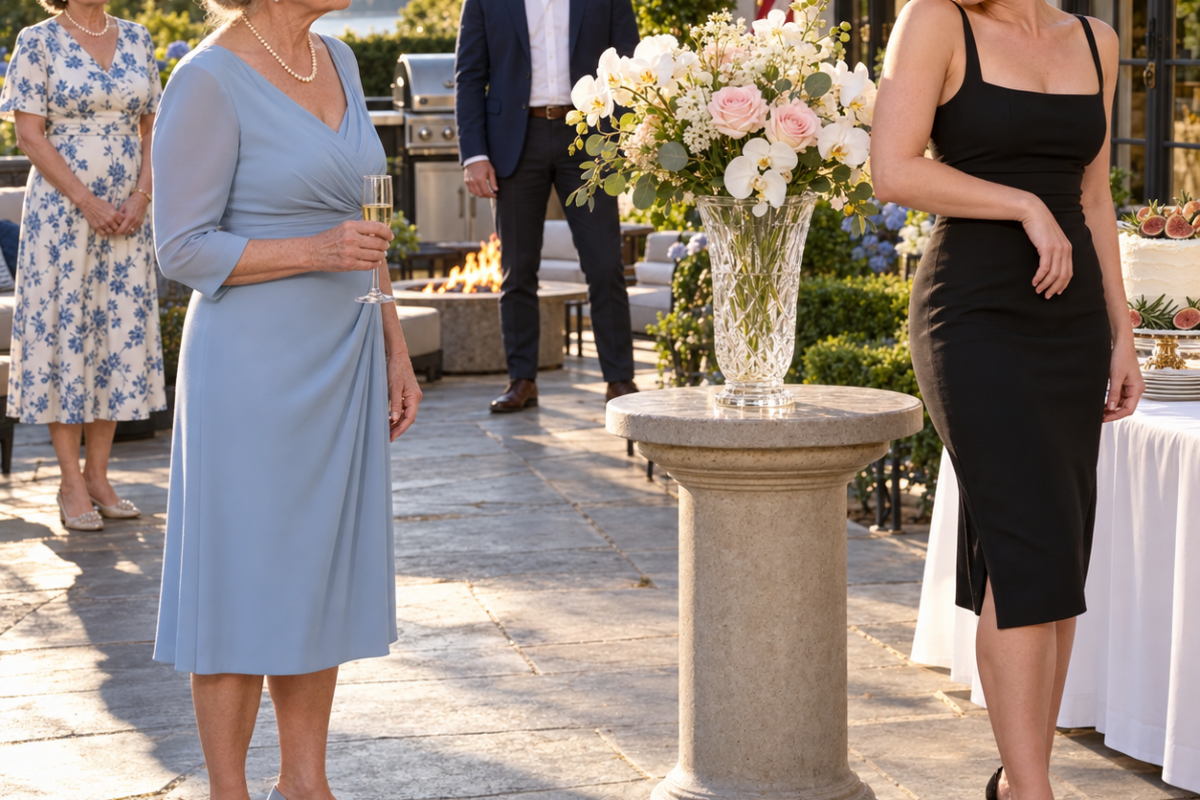
At my seventy-second birthday party, my daughter-in-law knocked a crystal vase off its pedestal with her elbow, watched it shatter, and smiled. “Oops.” Her own parents had given it to her and my son on their wedding day six years earlier. I looked at Frank, waiting for him to say something. All he managed was, “Mom…”
I watched my daughter-in-law break her own parents’ wedding gift with one elbow and a smile. For months afterward, people asked me whether I was…
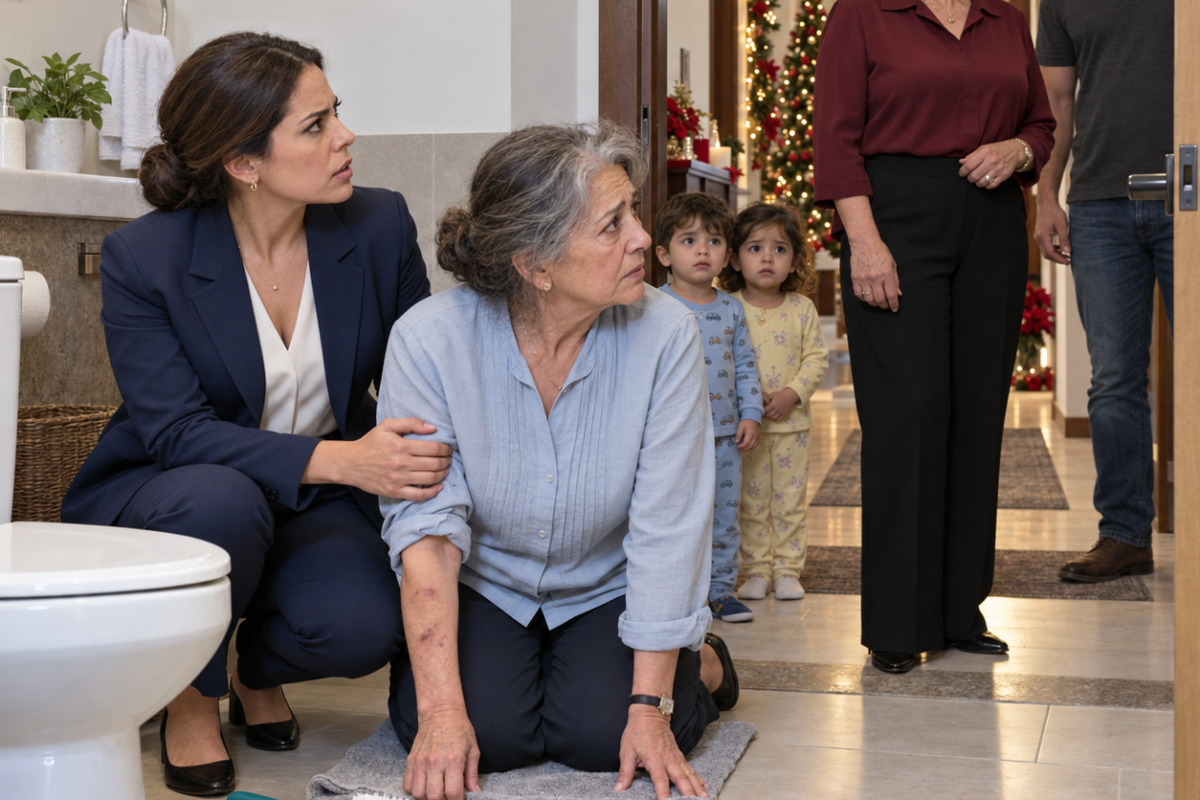
I came home three hours early and found my sixty-eight-year-old mother on her knees scrubbing my mother-in-law’s bathroom. When I helped her stand, her sleeve slipped back, revealing dark marks around her wrist. My husband stepped into the doorway. “Daniela, don’t make a scene.” That was when I remembered my father’s last warning: “If you ever see your mother hurt, don’t argue with anyone. Open the hidden compartment in her sewing machine.”
I came home three hours early and found my sixty-eight-year-old mother on her knees beside a toilet. Her hands were stiff with arthritis. One gripped…
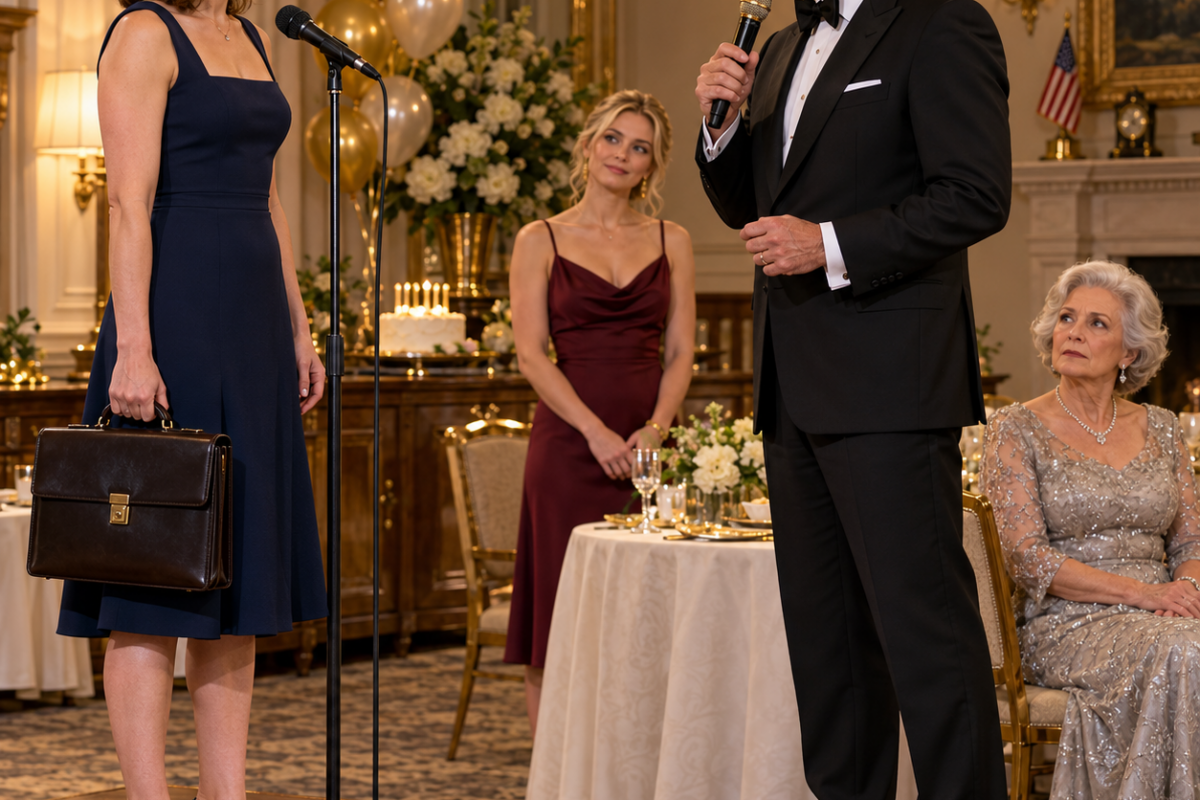
“I already promised your house to your sister,” my father told me four days after I bought it. “They’re moving in Monday. Rent-free for three years.” I was thirty-one, had saved for nine years, and had bought the five-bedroom home entirely in my own name. When I said no, he threatened to tell the family I had abandoned my sister’s children. Days later, he took the microphone at my grandmother’s seventy-fifth birthday dinner and did exactly that.
My father called twelve times in forty minutes after discovering I had bought a house without consulting him. When I answered, he didn’t ask whether…
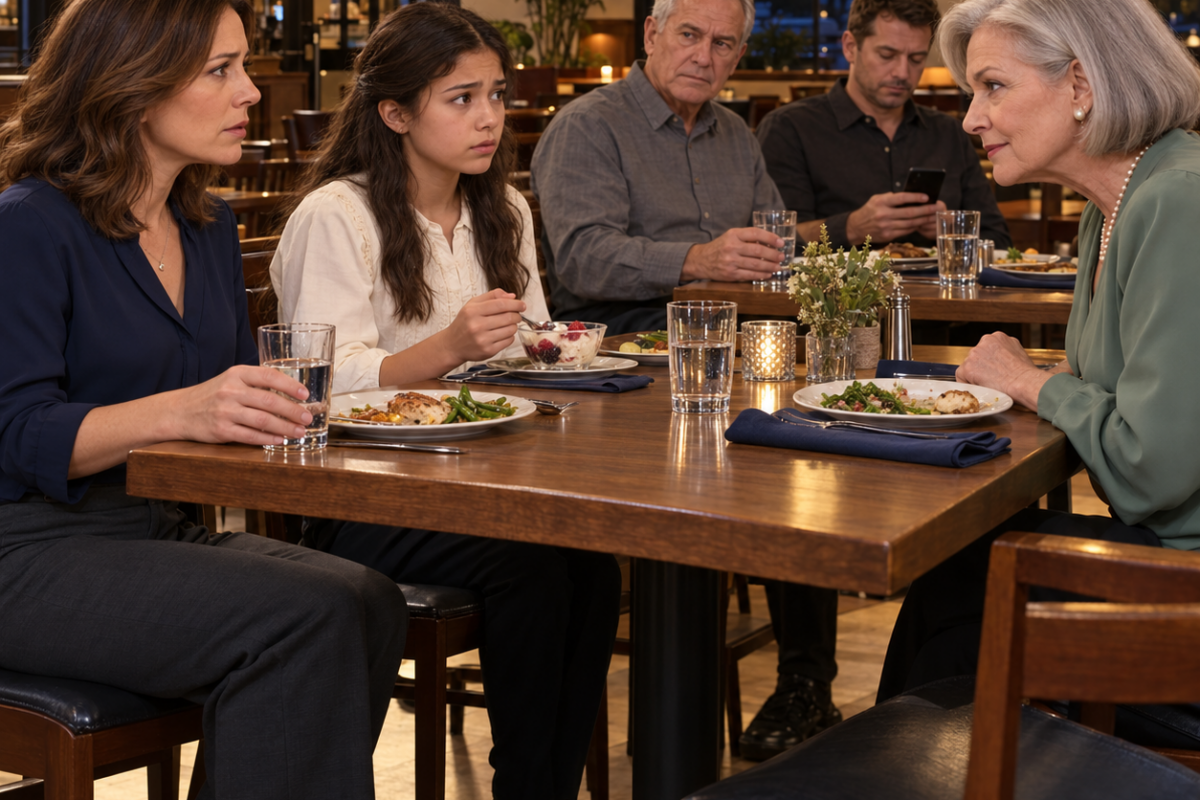
My mother leaned across the restaurant table, looked at my thirteen-year-old adopted daughter, and whispered, “We don’t sit with mistakes.” I took Sole’s hand and walked her out. That night, my father texted, “You’re still making the car payment tomorrow, right?” By midnight, I had canceled the payments I’d been making for my family. Then I remembered something Sole had told me about her grandmother.
My mother looked at my thirteen-year-old daughter and whispered, “We don’t sit with mistakes.” She said it softly enough to avoid attracting attention from the…
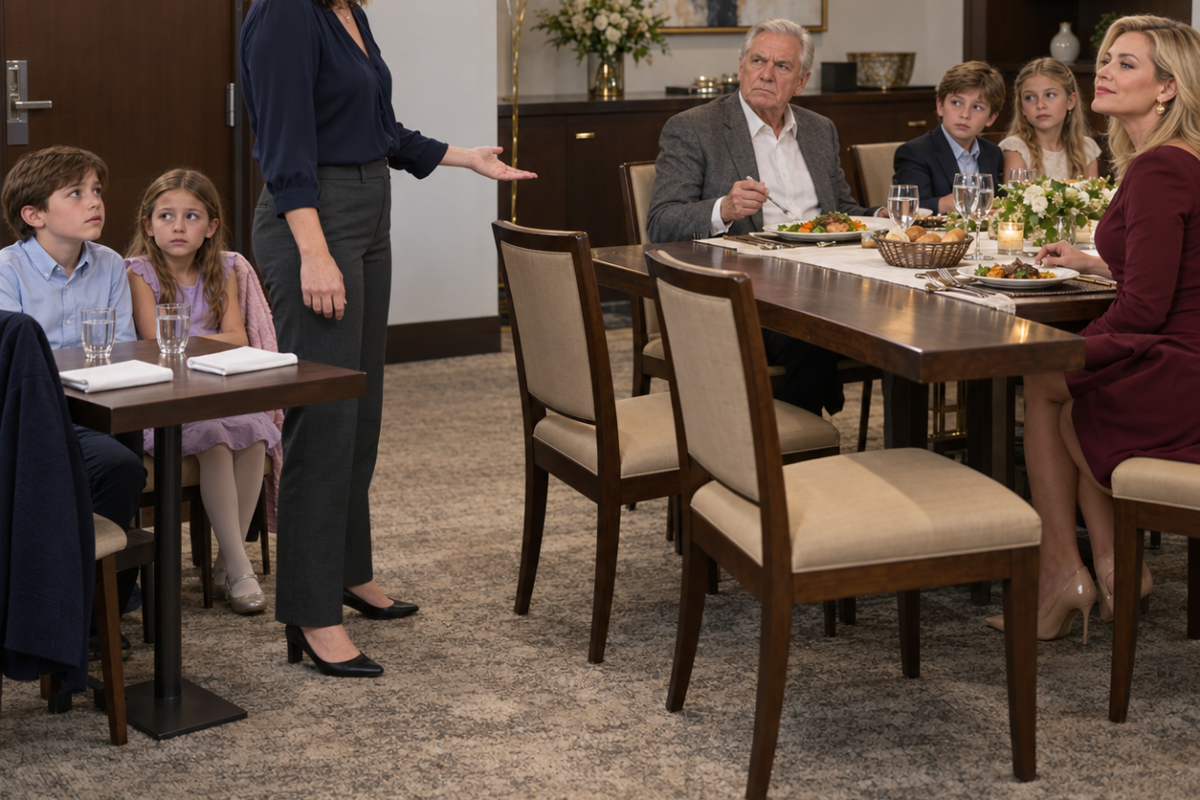
At my father’s seventieth birthday dinner, my eleven-year-old son and eight-year-old daughter were seated beside the service door with water glasses—but no dinner plates. Their cousins sat beside Grandpa with warm bread and full place settings. “They’ll eat after everyone else,” my sister said. I turned to my father, expecting him to object. “They can wait another hour,” he replied. There were two empty chairs at his table.
At my father’s seventieth birthday dinner, the first thing that stopped me wasn’t the cake or the gold balloons. It was my children. Ethan and…
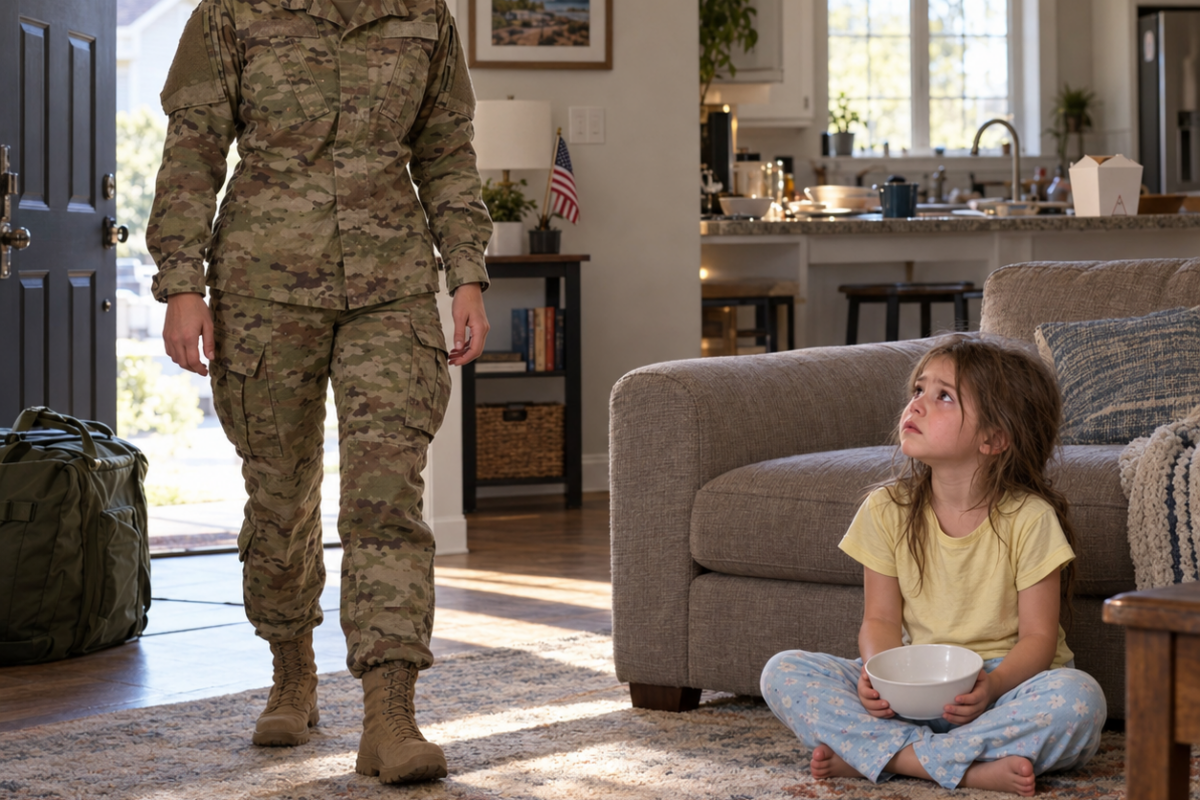
“Mommy, are you real?” my four-year-old daughter whispered when I came home from deployment three weeks early. She was sitting alone on our living room floor with an empty cereal bowl. My husband was on a Caribbean cruise with his mother and sister. Twenty-two minutes earlier, they had posted a photo captioned “Family time.” I was still in uniform when Sophie asked if she could have something to eat.
The first thing my daughter said when I found her was, “Mommy, are you real?” She was sitting cross-legged on our living room floor with…
End of content
No more pages to load