“Start packing. We’re taking the master bedroom,” my mother said as she pushed two suitcases into my new house. I stood in the hallway holding my six-week-old daughter while my sister headed for the stairs. “You’re not moving in,” I told them. Mom was about to answer when someone stepped out of the adjoining room—and she finally let go of her suitcase.
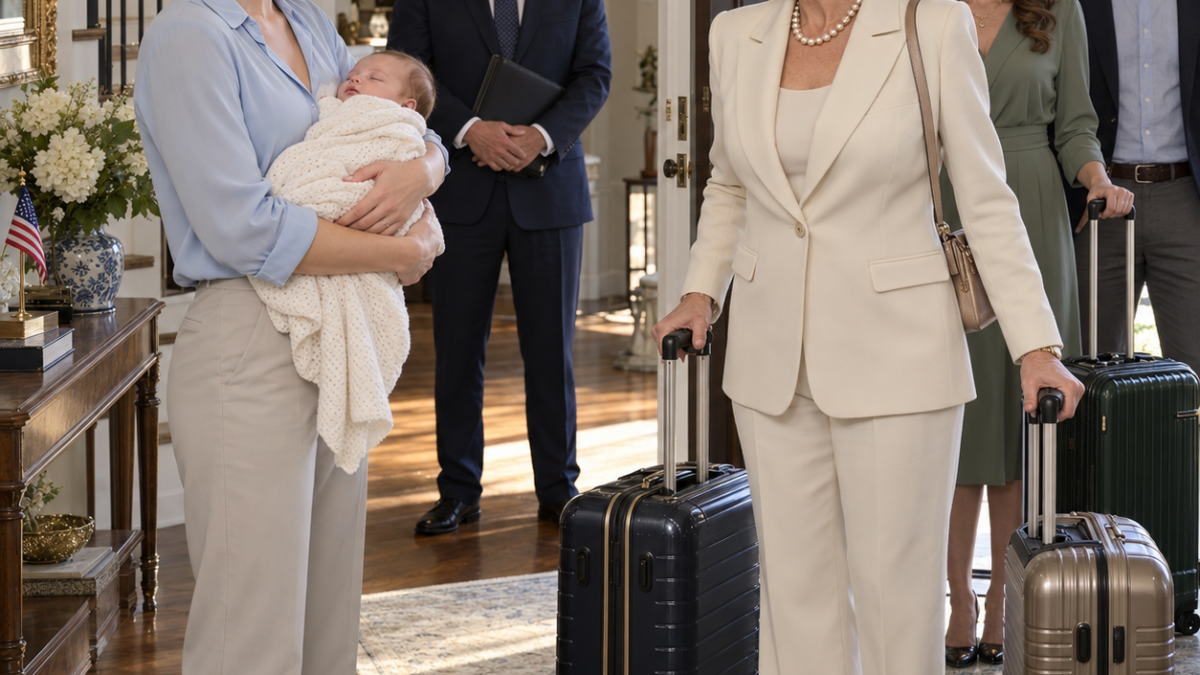

“Start packing,” my mother said as she pushed past me with two suitcases. “We’re taking the master bedroom.”
My six-week-old daughter was sleeping against my chest. One of her tiny hands rested beneath her cheek, and I could feel the warm movement of her breathing through my shirt.
Behind my mother, my sister walked into the house and looked toward the staircase.
“This is nice,” Isabella said. “Way better than our apartment. Thanks, sis.”
She smiled as though I had offered her something.
I had offered nothing.
I closed the front door quietly.
“I’m not packing anything.”
My mother turned.
For a moment, her expression remained amused. She was waiting for the nervous laugh that usually followed my attempts to disagree with her.
It didn’t come.
“What did you say?”
“I said I’m not leaving.”
Isabella stopped rolling her suitcase.
Then someone stepped out of the room behind me.
My mother recognized him immediately.
The confidence left her face so quickly that I almost missed it.
She had arrived believing she was dealing with a tired daughter who would eventually surrender.
I had made sure she was wrong.
My name is Sophia.
When this happened, my husband had been dead for a little more than five months, my daughter was six weeks old, and I had spent exactly one night in the house I had been saving for since before I got married.
It had three bedrooms, a narrow porch, and a kitchen with a window above the sink.
There was nothing extravagant about it.
The upstairs bathroom needed a new faucet. The fence leaned slightly near the back corner. Someone had painted the guest bedroom a shade of yellow that looked pleasant in photographs and startling in person.
But sunlight reached the nursery in the morning.
The neighborhood was quiet.
A maple tree stood outside the bedroom window.
When I first saw the house, I could imagine bringing Lily downstairs on an ordinary day, making coffee, and living without feeling that every wall remembered the moment my life broke apart.
That was why I bought it.
Not to impress anyone.
Not to provide a place where my extended family could reorganize their lives around my finances.
I wanted a home where my baby and I could heal.
Daniel would have understood.
He had always been better than I was at distinguishing kindness from obligation.
When we were dating, he once watched me spend an entire Saturday helping Isabella move while she sat on the floor directing people and complaining about the lack of air-conditioning.
That evening, as I soaked my feet in our bathtub, he asked, “Does she ever help you like that?”
I shrugged.
“She’s busy.”
“So are you.”
“It’s different.”
“How?”
I did not have an answer I liked.
Daniel didn’t press.
He sat beside the bathtub and handed me a glass of water.
That was often his way. He asked a question, then left enough space for me to hear my own answer.
We were married for seven years.
They were not perfect years. We disagreed about money occasionally. He left coffee cups in places where coffee cups had no sensible reason to be. I could turn a small household problem into a planning meeting.
But he listened to me.
When he apologized, he did not require an apology in return.
When he offered help, he did not use it later as evidence that I belonged to him.
I didn’t understand how valuable those things were until I had lived with them for a while.
For years, we wanted a child.
There were appointments, waiting, disappointments we discussed privately, and long stretches when we tried not to make every conversation about the future we hoped for.
When I finally became pregnant, Daniel stared at the test for so long that I asked whether he could see the second line.
“I can see it,” he said.
Then he sat down.
Then he began laughing.
Then I began crying.
He pulled me into his lap, and for several minutes we did both.
He bought a notebook the following weekend.
On the first page, he wrote, “Things we don’t want to forget.”
Most of the entries were small.
The first appointment.
The first time we heard the heartbeat.
The afternoon I demanded peaches and then discovered I hated peaches.
The evening he rested his hand on my stomach and felt our daughter move.
He never got to hold her.
Daniel died when I was twenty-four weeks pregnant.
It was sudden.
One morning, he kissed my forehead before leaving for work. That afternoon, a phone call separated my life into before and after.
People often ask how I managed those months.
I don’t have a noble answer.
I attended appointments.
I ate when someone reminded me.
I answered necessary questions.
I slept badly.
Sometimes I spoke to Daniel while standing in the shower because that was the only place I could cry without anyone hearing.
Lily kept moving.
That was both comfort and heartbreak.
Her father was gone, but part of the life we had made together continued without waiting for me to understand how.
My family helped at first.
I need to acknowledge that because the story is not improved by pretending they had never done anything kind.
My mother brought soup.
My father drove me to one appointment.
Isabella came over and folded laundry.
Those things mattered.
But gradually, help began arriving with instructions.
My mother told me not to make decisions without discussing them with her.
My father said I would need “a proper adult” handling the financial matters.
Isabella wanted to know what Daniel’s life insurance would provide.
At first, she asked indirectly.
“Are you going to be okay?”
“Yes, eventually.”
“I mean financially.”
“I’m working through everything.”
“What did he leave?”
I remember looking at her across the table.
A condolence card was still standing beside the fruit bowl.
“I’m not ready to discuss that.”
She gave me a patient expression.
“I’m your sister. You don’t have to be secretive.”
That was the first time I noticed how quickly my privacy had become something they considered suspicious.
Daniel had left practical protections.
Not a fortune.
There were savings, insurance, retirement accounts that needed to be handled properly, and estate matters requiring advice.
Some belonged to me.
Some would be preserved for Lily’s future.
I had my own savings, too.
For years, I had worked as a project coordinator for a healthcare technology company. I had saved steadily, kept my expenses reasonable, and resisted the temptation to treat every raise as permission to buy something new.
Daniel and I had been preparing to purchase a home before he died.
Afterward, I paused.
I was not going to make a major decision while I could barely remember whether I had eaten lunch.
But the idea remained.
Our rental had become difficult for me.
I kept expecting to hear his key.
I looked at the empty side of the bed before I was fully awake.
His mug remained in the cabinet because putting it away felt like admitting something I already knew.
When Lily was born, I brought her home there.
For the first few weeks, I barely left the bedroom except to heat food, wash bottles, and let in people whose visits were supposed to help.
My mother arrived often.
Sometimes she did help.
Sometimes she rearranged the kitchen and criticized the way I organized Lily’s things.
She said I was creating bad habits when I picked up the baby quickly.
Then, on another day, she said I was letting Lily cry too long while I washed my hands.
There was no consistent rule.
There was only my mother’s certainty that whatever I was doing required correction.
If I asked her not to bring visitors, she said isolation was unhealthy.
If I said I was tired, she said all mothers were tired.
If I wanted a quiet afternoon, she asked whether I was rejecting my family.
I began dreading the sound of the doorbell.
That was when the house became more than a financial plan.
It became a boundary I could imagine standing inside.
I resumed the search with a realtor who understood that I needed patience.
She did not tell me every property was perfect.
She told me which windows needed attention, which roofs were old, and which streets became busy during school pickup.
I appreciated her.
When we found the three-bedroom house, I visited twice before making an offer.
The second time, I brought Daniel’s mother.
Her name was Marianne.
She walked slowly through the rooms, looking at the light and the stairs.
Then she stood in the room that would become the nursery.
“He would like this,” she said.
I nodded because speaking was difficult.
She looked at me.
“But you don’t have to choose it because he would.”
“I know.”
“Do you like it?”
“Yes.”
“Then that matters.”
Marianne had lost her son.
I had lost my husband.
We loved the same man from different places, and grief could have made us compete over who was suffering more.
Instead, she offered me something my own family rarely did.
Room to decide.
When I told my parents I was buying a house, my father asked for the address before asking whether I was happy.
My mother asked how many bedrooms.
Isabella asked whether it had a yard.
I answered all three.
Then my father said, “Good. You need somewhere the family can gather.”
I smiled uncertainly.
“I need somewhere Lily and I can live.”
“Same thing.”
It wasn’t.
But I did not challenge him then.
My father had a habit of taking the first version of an idea and expanding it until it served him.
If someone offered dinner, he invited two more people.
If someone offered a ride, he added errands.
If someone mentioned having room, he assumed that room was available.
My mother handled the emotional enforcement.
Family shared.
Family sacrificed.
Family did not keep score.
The person providing everything was never supposed to notice that sharing had become a one-way arrangement.
Isabella had learned the system early.
She was three years younger than me, with a husband named Owen and two children, Max and Ruby.
Their apartment was cramped.
Their rent had increased.
Owen worked steadily, but Isabella’s employment had been inconsistent since Ruby was born.
There were real pressures in their life.
I understood them.
I had helped with groceries, school supplies, and an overdue utility bill more than once.
I had also learned that helping with one problem often made me the expected solution to the next.
When I stopped answering immediately, my mother called.
“Your sister is struggling.”
“I know.”
“You have more flexibility.”
“I have a newborn.”
“That’s different.”
It was always different when the need belonged to me.
Two weeks before moving day, I met with David Reynolds.
He had been Daniel’s attorney for several routine matters and had helped me navigate the estate after his death.
David was in his early sixties, with an unhurried manner and a habit of reading documents all the way through before discussing them.
He had met my parents once.
That meeting occurred shortly after Daniel died, when my father volunteered to “take over the complicated parts.”
David thanked him for his concern and then asked me directly who I wanted authorized to receive information.
My father was offended.
David did not apologize for the question.
I remembered that when I made the appointment about the house.
Lily slept in her carrier beside my chair while we reviewed the closing paperwork, estate arrangements, and the protections I wanted for her.
David asked, “If something happened tomorrow, who would you want protected first?”
“My daughter.”
“What would that protection look like?”
I looked at the papers.
“A stable place to live. Money that isn’t used to solve everybody else’s problems. Someone responsible making decisions if I can’t.”
He nodded.
“And who would you choose?”
I named Marianne as one of the people I trusted, alongside a close friend, Elena, who had known Daniel and me for years.
We discussed responsibilities carefully.
A preference expressed in a document was not a magic command that could settle every future circumstance. But thoughtful planning could make my wishes clear and give the appropriate people a proper role.
We reviewed beneficiaries.
We reviewed the people authorized to handle certain matters.
We reviewed the trust arrangement used for the house and the separate funds preserved for Lily.
The house would be titled solely to me in my capacity as trustee of the trust we had established. The records identified my authority clearly. There was no ownership interest for my parents, Isabella, or anyone else simply because they were related to me.
The documents also made clear how occupancy could be authorized.
David explained the distinctions patiently.
“The trust is not a force field,” he said. “What protects you is clear ownership, clear authority, and your willingness to act when someone disregards them.”
I nodded.
“Then I need to be willing.”
He looked at me for a moment.
“Do you expect a problem?”
I described the comments.
The questions.
The way my parents had begun calling the house “the family’s new place.”
David listened without treating every difficult relative as a legal emergency.
“Have you invited anyone to live there?”
“No.”
“Promised a room?”
“No.”
“Accepted rent, belongings for storage, or anything that might suggest an arrangement?”
“No.”
“Good. Then don’t let an assumption become an agreement because correcting it feels uncomfortable.”
I signed the documents after reviewing them.
I took copies home in a sealed folder.
I did not tell my family every detail.
Privacy was not deception.
It was the beginning of making decisions without presenting them for approval.
The move itself took two days.
Elena helped coordinate the movers.
Marianne brought food and stayed with Lily while I checked boxes.
My parents said they were busy.
Isabella sent a message asking whether I could pay the deposit on a storage unit she was considering.
I did not answer until evening.
By then, the movers had gone, the crib was assembled, and the house smelled faintly of cardboard and the lemon cleaner Elena had used on the kitchen counters.
I replied that I could not take on the expense.
Isabella sent a disappointed face.
Then she asked for photographs.
I sent one of the nursery.
I would later wish I had sent nothing.
My first night in the house was quiet in a way I had almost forgotten quiet could be.
Lily fed, slept, woke, and fed again.
I ate soup from a bowl while standing at the kitchen counter.
There were boxes everywhere.
I did not mind.
For once, disorder did not mean I had failed.
It meant I had moved.
Around eight, I took Lily upstairs and sat in the chair beside her crib.
The maple tree brushed the window lightly.
I told her about the house.
“This is your room,” I whispered. “That’s your window. We’ll have flowers outside when it gets warm.”
She blinked up at me with the serious expression newborns have when adults are making promises they cannot yet understand.
Then my phone rang.
My father.
I almost let it go to voicemail.
Instead, I answered.
“We’re moving in tomorrow,” he said.
No hello.
No question about the move.
No congratulations.
For several seconds, I said nothing.
Then I asked, “What?”
“Your mother and me. Isabella and her family, too.”
I looked down at Lily.
“Dad, no.”
“The house is big enough.”
“It has three bedrooms.”
“And you only need two.”
The practical absurdity nearly made me laugh.
Six additional people did not become manageable because there was one spare bedroom.
But the number of rooms was not the real issue.
“You’re not moving in.”
“I don’t do rules for my grandchild.”
His tone sharpened.
“Your mother should be there. The baby needs family around.”
“The baby has family. Living here isn’t the same thing.”
He exhaled impatiently.
“Your sister needs a place. We’ve already discussed it.”
“With whom?”
“Don’t start.”
Then I heard my mother in the background.
He handed her the phone.
“We’re coming tomorrow,” she said. “Your father has already arranged transportation.”
“Mom, this is my house.”
“And it’s big enough.”
“I just had a baby. I’m recovering. I need space.”
“I don’t do rules when it comes to my grandchild.”
There it was again, as though neither of them could imagine love existing without control.
Then she said, “We’re family. If you don’t like it, you can leave.”
I stared at the nursery wall.
Daniel and I had once joked about where we would hang the first picture our child brought home from school.
Now my mother was telling me I could leave the house I bought for that child.
“Don’t make this difficult,” she added.
I stayed quiet.
I could hear her breathing.
I knew she interpreted silence as retreat.
Finally, I said, “Okay, Mom. Do what you want.”
Then I ended the call.
Those words bothered me almost immediately.
They were not permission in my mind.
They meant I was done arguing.
But I knew my mother would use whatever meaning served her.
So before doing anything else, I sent a written message to both my parents and Isabella.
“To be clear: no one has permission to move into my house. Do not bring luggage or belongings here. Any visit must be arranged with me first.”
I read it twice.
Then I sent it.
My father responded with one word.
“Ridiculous.”
My mother wrote, “We’ll talk tomorrow.”
Isabella added, “You’re exhausted. Don’t make decisions when you’re emotional.”
I put the phone down.
Then I picked it up again and called David.
He answered after a few rings.
“Sophia?”
I told him what had happened.
He did not sound surprised.
He asked whether anyone already had a key.
“No.”
A code?
“No.”
Belongings in the house?
“No.”
Had I confirmed my refusal in writing?
“Yes.”
“Good.”
I looked at Lily, who had fallen asleep during the call.
“I don’t want them standing in the hallway yelling while I’m holding her.”
“Then you don’t have to face this alone.”
David explained what he could do.
He could be present.
He could bring the ownership records and written notice that there was no authorization to occupy the property.
If I was concerned about a confrontation, we could request assistance through the local police department’s nonemergency process and ask whether a civil standby was available.
It was not a private security service.
An officer would not be there to adjudicate a complicated property dispute or punish my mother for being difficult.
But if people entered after being told they were not welcome and refused to leave, the facts would matter.
“They have never lived there,” David said. “That is important. We’re not discussing removing established occupants through a shortcut.”
“I understand.”
“And you don’t have to open the door.”
I looked toward the stairs.
That was the option I should have preferred.
Keep them outside.
Keep Lily upstairs.
Let documents and a closed door do the work.
But I also knew my parents.
They would arrive early.
They would knock until the baby woke.
They would call.
They would tell neighbors I was refusing help.
I could not control every possible scene.
I could prepare for the one they were already planning.
“I want you here,” I said.
“I can be there in the morning.”
After ending the call, I phoned Elena.
She listened.
Then she said, “I’m coming now.”
“You don’t need to.”
“I know.”
That distinction almost made me cry.
She arrived forty minutes later with an overnight bag and bread.
She did not rearrange anything.
She asked where I wanted her to sleep.
I showed her the guest room.
She looked at the yellow walls.
“This is cheerful in a threatening way.”
I laughed for the first time all evening.
Then she took Lily while I ate.
My phone kept vibrating.
I did not look at every message.
There was no new information in them.
Only pressure.
Later, while Elena washed the bowl, I stood beside the kitchen window.
“I should have handled this years ago.”
She turned off the water.
“You’re handling it now.”
“They’ll say I’ve changed since Daniel died.”
“You have changed. Something terrible happened. That doesn’t mean every decision you make afterward is wrong.”
I stared into the dark yard.
“I don’t want Lily growing up thinking this is what family does.”
“Then show her something else.”
That sentence stayed with me.
At ten, I called the police department’s nonemergency number.
I explained that relatives had announced their intention to move into my newly purchased house against my wishes.
I said there had been no tenancy, no permission to reside there, and no shared ownership.
I said I was postpartum and had a newborn.
The person taking the call asked practical questions.
Were there threats of violence?
Did anyone have a weapon?
Had anyone entered already?
I answered honestly.
No.
No.
No.
I did not exaggerate because I wanted someone to come.
The dispatcher explained that availability depended on other calls and that an officer could speak with me about the situation.
A little later, Officer Miller called.
We discussed the facts.
He said he could stop by the following morning if his assignment allowed, and I should call again if anyone became aggressive or attempted to force entry.
There was no dramatic promise.
Just a calm plan.
That was enough to make the house feel different.
I was no longer waiting helplessly for my family’s decision.
I was preparing to uphold mine.
The next morning, Lily woke before dawn.
I fed her while the room slowly brightened.
Elena brought me toast and asked whether I wanted company.
I did.
We sat quietly until Lily fell asleep.
Then I showered.
It was a small thing, but it mattered.
I wanted to meet the day feeling like a person, not an exhausted shape in yesterday’s shirt.
I put on soft trousers and a clean blouse.
I braided my hair loosely.
There was nothing about my appearance that could make the situation easy.
Still, choosing clothes reminded me that I had choices.
David arrived at nine.
He brought a slim folder, a copy of the recorded ownership documents, and a written notice prepared from the information I had provided.
He reviewed the messages with me.
The brief phone recording I had made during my later call with my mother was handled carefully. David would determine how it could appropriately be used. The written messages alone already showed my refusal clearly.
He did not claim that one angry sentence automatically solved everything.
He asked whether I still wanted him present.
“Yes.”
Then he asked what I wanted to happen.
“I want them to leave.”
“Anything else?”
“No argument. No negotiation about rooms. No discussion of money.”
He nodded.
“That’s clear.”
Officer Miller arrived shortly afterward.
He wore his uniform and carried a notepad.
He greeted me, looked at the documents David offered, and asked a few questions directly.
“Have any of them stayed here overnight?”
“No.”
“Do they receive mail here?”
“No.”
“Have you promised they could move in?”
“No.”
David showed him the written refusal.
Officer Miller nodded.
“If they come, you can keep the door closed. If they are permitted inside briefly and you ask them to leave, make that clear.”
“I will.”
Elena was upstairs, organizing the few things I wanted unpacked in the nursery.
I had told her I wanted Lily near me until I knew how the arrival would unfold.
She said she would stay close.
At a little after ten, my father’s truck pulled into the driveway.
Behind it came Owen’s car.
I saw the suitcases before I saw my mother’s face.
My stomach tightened.
Then I looked at David.
He was sitting in the small front room beside the hallway.
Officer Miller stood near the window, out of view from the porch.
Neither of them told me to be brave.
They were simply there.
My mother rang the bell once.
Then she began knocking.
I opened the door with the security latch still in place.
“You were told not to come with luggage.”
She looked irritated.
“Open this. We’ve driven over.”
“You’re not moving in.”
“Sophia, don’t be ridiculous.”
Behind her, Isabella lifted one suitcase onto the porch.
Owen stood beside his car, looking uncertain.
My father was still unloading.
I repeated, “There is no permission to move in.”
My mother rolled her eyes.
“We’ll discuss it inside.”
“I’ll allow a brief conversation. The luggage stays outside.”
That was the boundary.
I believed I had stated it clearly.
When I removed the latch and opened the door enough to speak, my mother pushed past me with both suitcases.
Not violently.
Not with a shove that knocked me down.
With the practiced certainty of someone who had never expected a doorway to stop her.
“Start packing,” she said. “We’re taking the master bedroom.”
Isabella followed.
“This is nice. Way better than our apartment. Thanks, sis.”
I closed the door.
“I’m not packing anything.”
My mother turned.
“What did you say?”
“I said I’m not leaving.”
She stared at me.
Behind her, Isabella began pulling a suitcase toward the stairs.
The wheels clicked against the floor.
I had imagined that sound the night before.
Hearing it made something inside me become very still.
“You’re not moving in.”
Isabella blinked.
“Mom?”
My mother laughed.
“We already discussed this.”
“No. You announced it.”
“We’re here to help.”
“I didn’t ask you to live here.”
“You’re a single mother with a newborn. You can’t handle a house this size.”
The sentence struck a place that was still tender.
I did need help.
There were evenings when I was exhausted enough to cry over spilled milk.
There were forms I had reread three times because sleep deprivation made ordinary sentences feel complicated.
There were moments I wanted Daniel so badly that I had to sit down.
None of that made my house available for seizure by relatives.
“I can need help and still decide who lives in my home,” I said.
My mother stepped closer.
“This is family property.”
“No, it isn’t.”
Isabella crossed her arms.
“We already told people we were moving.”
I looked at her.
“You told people you were moving into a house you don’t own?”
Her cheeks reddened.
“You know what our situation is.”
“I do. I never agreed to solve it this way.”
My father came through the door then, carrying a bag.
He looked around approvingly.
“Good. Plenty of room.”
I turned toward him.
“Put the bag outside.”
He frowned.
“What?”
“You’re not staying.”
My mother spoke before he could answer.
“She’s trying to make a point.”
“Yes,” I said. “I am.”
My father’s expression hardened.
“I didn’t raise you to behave like this.”
I adjusted Lily slightly against my chest.
She made a soft sound and settled again.
“You raised me. You don’t own me.”
The hallway went quiet.
It was not a sentence I had ever said to him before.
He looked at me as though I had spoken a language he disliked.
“You’re not going to embarrass this family.”
“You arrived with suitcases after being told no.”
“We came to help.”
“Then leave when I ask.”
Owen had come inside by then.
He stood behind Isabella, one hand on the handle of another suitcase.
He looked from me to my parents.
“I thought you wanted us here,” he said.
I turned toward him.
“I sent Isabella a message saying no one had permission to move in.”
He looked at his wife.
“Isabella?”
She gave a dismissive shrug.
“She was upset.”
“That doesn’t make the message disappear,” I said.
My mother interrupted.
“This is between us.”
“No,” I said. “You brought other people into it.”
Owen lowered the suitcase.
For the first time, he looked less like someone participating in a move and more like someone realizing he had been brought into a lie.
My mother noticed.
She changed tactics.
“Fine,” she said. “If you want to play this game, we’ll settle it legally.”
My eyes moved toward the console table.
The folder rested there.
My mother saw it.
“What’s that?”
I walked carefully toward the table, still holding Lily.
“Documents.”
“What documents?”
“You said you wanted to settle this legally.”
I placed my free hand on the folder.
“Good.”
Then David stepped out of the front room.
My mother stopped speaking.
She knew him.
She remembered the man who had asked me—not my father—who should receive information about Daniel’s estate.
“Mrs. Hart,” he said calmly.
Her face changed.
“David?”
My father looked past him.
Officer Miller came into the hallway.
“Good morning,” he said. “I understand there are some people here who need to collect their belongings and leave.”
For a moment, nobody moved.
Isabella looked at the suitcases.
Owen looked at the officer.
My mother looked at me.
“You called the police on your own family?”
“I asked for help keeping my home safe and my wishes clear.”
“We haven’t done anything.”
“You entered with luggage after being told it must stay outside. You announced you were taking my bedroom. I have asked you to leave.”
Officer Miller spoke.
“Ma’am, are you claiming you own an interest in this property?”
My mother opened her mouth.
My father answered.
“She’s our daughter.”
“That isn’t the question.”
David placed the ownership record on the console table.
He explained the title and my authority as trustee without giving my family a tour of Lily’s protected funds.
The house was not jointly owned.
My parents had no authorized occupancy agreement.
Isabella had no right to move her family in.
The written notice stated that permission to remain was withdrawn.
Officer Miller looked at my father.
“You need to take the bags out.”
My father’s face reddened.
“This is a family discussion.”
“It can remain a family discussion somewhere else.”
My mother began crying.
Quickly.
Loudly.
I had seen that transition before.
She turned toward me.
“How could you do this after everything we’ve done?”
I did feel it.
The guilt.
The old pressure to restore her comfort by abandoning my boundary.
Then Lily stirred.
I looked down at her face.
She needed a mother who could tolerate somebody else’s displeasure.
“I’m not discussing that while you refuse to leave,” I said.
Isabella stepped forward.
“You really want Max and Ruby to hear that you threw us out?”
“Max and Ruby aren’t here.”
They were staying with Owen’s parents during the move.
I was grateful for that.
“They need stability,” Isabella said.
“So does Lily.”
Owen picked up the suitcase nearest him.
“We should go.”
Isabella turned.
“You’re taking her side?”
“I’m saying we should leave a house we weren’t invited to move into.”
My father looked at him with open contempt.
“Don’t be weak.”
Owen paused.
Then he said, “This isn’t weakness.”
He carried the suitcase outside.
That simple action broke the stillness.
Officer Miller held the door while my father retrieved his bag.
David handed my mother the written notice.
She refused it.
He explained that a copy would be provided through an appropriate documented method and that refusing to take the page did not create permission to stay.
She glared at him.
“You’ve turned her against us.”
David looked at me.
“She has made her own decision.”
It was the most respectful thing anyone said about me that morning.
I was not being manipulated.
Not by grief.
Not by lawyers.
Not by a man behind a desk.
I had decided.
Isabella dragged her suitcase back toward the door.
The wheels caught briefly on the threshold.
She jerked it hard enough that Owen reached to help.
“Don’t,” she snapped.
He stepped back.
My mother stopped beside me.
“This isn’t over.”
Officer Miller’s expression changed slightly.
“What do you mean by that, ma’am?”
She looked at him.
“I mean she’ll regret treating us like strangers.”
I met her eyes.
“I asked you to respect me as family. You chose not to.”
Then she left.
My father did not look at me as he walked outside.
He slammed the truck door.
The sound startled Lily.
She began crying.
I turned away from the hallway and went upstairs.
Not while the confrontation remained unresolved.
After they were outside, after Officer Miller confirmed they were leaving, after David said he would stay until the vehicles pulled away.
Elena met me on the landing.
She did not ask for a report.
She put one hand gently against my back.
“I’ll bring water.”
I nodded.
In the nursery, I sat down and loosened Lily’s blanket.
She rooted against me.
I fed her while my heart continued beating too quickly.
Outside, engines started.
A car backed out.
Then another.
The house became quiet.
I looked toward the window.
The maple tree moved in the breeze.
For the first time since my father’s call, I cried.
Not delicately.
Not with the controlled tears I had learned to wipe away before anyone noticed.
I cried because I was tired.
Because Daniel should have been there.
Because my family had seen a widow with a newborn and decided she was easier to overrule.
Because I had finally stopped them, and stopping them hurt even though it was necessary.
Elena sat on the floor beside the chair.
She stayed without talking.
When Lily finished feeding, she took the baby so I could drink water.
“I feel terrible,” I said.
“I know.”
“I did the right thing.”
“Yes.”
“Why doesn’t it feel better?”
She looked at me.
“Because the right thing doesn’t erase the fact that they made it necessary.”
I leaned back and closed my eyes.
Downstairs, David and Officer Miller finished their conversation.
The officer left a contact reference and explained what to do if anyone returned and refused to respect the boundary.
He did not promise that every future family conflict would bring an immediate police response.
He gave me practical information.
David checked that the doors and windows were secured.
Then he came upstairs and stood outside the nursery.
“May I come in?”
“Yes.”
He looked at Lily in Elena’s arms.
Then at me.
“They’ve gone.”
“I know.”
“There may be messages.”
“There already are.”
My phone lay facedown on the dresser, vibrating at intervals.
David nodded.
“You don’t have to answer today.”
“What if they tell everyone something else?”
“They may. You can respond to the people who matter without making your private life a public hearing.”
I looked at him.
“Can they do anything to the house?”
“We’ve reviewed the ownership and their lack of authorization. If they make a specific claim, we’ll address the claim.”
He did not tell me I was protected from every possible difficulty.
He told me I was not helpless.
I needed that more.
After he left, Elena made lunch.
I ate at the kitchen table while Lily slept in her bassinet beside me.
The house looked strangely normal.
Boxes remained stacked near the dining room.
A dish towel hung over the oven handle.
Sunlight crossed the floor.
Nothing visible explained what had happened.
That was one of the first things I learned about setting a boundary.
The world does not necessarily change its appearance to mark it.
You still need lunch.
The baby still needs a clean diaper.
The laundry still exists.
But the ordinary tasks begin belonging to you again.
By late afternoon, the family messages had multiplied.
My mother wrote that I had humiliated her.
My father said Daniel would be ashamed.
That one hurt enough that I had to put the phone down.
Isabella accused me of being selfish with “all that space.”
An aunt asked why I had refused the help I clearly needed.
I could see the story taking shape.
I was overwhelmed.
My parents had lovingly offered support.
I had become irrational and called an officer because they brought suitcases.
The fact that I had explicitly refused disappeared from their version.
So did the order to surrender my bedroom.
So did “Don’t like it? Leave.”
I did not send a long defense.
I wrote one message to the family group.
“I did not invite anyone to move in. I stated that clearly in writing before today. They arrived with luggage anyway and instructed me to give up my bedroom. They were asked to leave. Lily and I are safe, and I’m not discussing our finances or home arrangements further.”
Then I muted the conversation.
My aunt called.
I let it ring.
She called again.
Elena looked at the phone.
“You can wait.”
“I know.”
I was learning that knowing and doing were separate skills.
Around dinner, Marianne arrived.
Elena had contacted her with my permission.
She brought a casserole and a small bunch of flowers.
When I opened the door, she looked at my face.
“Oh, sweetheart.”
I began crying again.
She held me carefully.
Then she stepped inside and asked, “Where would you like this?”
Not “I’ll put it here.”
Not “You need to organize this differently.”
A question.
I pointed to the kitchen.
She carried the casserole there.
Later, while Elena folded towels, Marianne sat beside me with Lily asleep on her shoulder.
I told her what my father had written about Daniel.
Her expression changed.
“Daniel would have wanted you safe in your own home.”
“I know.”
“He would not have asked you to prove your love for anyone by surrendering it.”
I looked at the baby.
“She should have him.”
“Yes,” Marianne said softly. “She should.”
We sat with that truth.
Nobody tried to repair it with a cheerful statement.
Then Marianne said, “But she has you.”
I wiped my face.
“I don’t feel very capable.”
“You don’t have to feel capable every hour to be capable of making good decisions.”
That became another sentence I kept.
The first week after the confrontation was difficult.
Not because my family returned immediately.
They didn’t.
Because my body remained prepared for them.
A vehicle slowing outside made me look toward the window.
A knock at the door tightened my chest.
Every unfamiliar number felt like another demand.
I had changed the locks after confirming who had access during the move, reset the temporary contractor code, and added a doorbell camera.
Those were ordinary security decisions.
But ordinary precautions could not instantly persuade my nervous system that the confrontation was over.
At Lily’s next appointment, the pediatrician asked how I was doing.
I almost said fine.
Then I told the truth.
“I’m having a hard time.”
She looked at me carefully.
“With feeding? Sleep?”
“Those, too. But mostly family pressure and grief.”
She listened.
She did not assume that because I had a newborn, every distressing feeling meant I was unable to care for her.
She asked about support.
About rest.
About moments when I felt unsafe or unable to cope.
We discussed resources and arranged follow-up with my own clinician.
I appreciated the seriousness.
I also appreciated that asking for help did not become a judgment against me.
That distinction mattered because my family had begun using the language of concern as a threat.
My mother left a voicemail saying, “Someone needs to make sure that baby is being properly cared for.”
My father wrote, “You’re clearly not yourself.”
Isabella said I had become paranoid.
I sent those messages to David.
He told me to keep records without spending every hour rereading them.
“If they make an allegation, we respond with facts,” he said. “You don’t need to perform perfect motherhood to prove you have a right to your own home.”
I cried after that call.
Perfect motherhood was already an impossible standard I had been carrying.
I did not need my family adding ownership to the list.
A few days later, my mother escalated.
She sent a message claiming I had promised them the use of the house before closing.
I had not.
She said my father had helped make the purchase possible.
He had not contributed money, signed the loan, or held any ownership interest.
He had once told me a house on a different street looked attractive.
That was the extent of his involvement in the search.
I replied through David with the relevant clarification.
No argument about gratitude.
No list of childhood grievances.
Just facts.
My mother became angrier when facts did not give her something emotional to attack.
She called Elena.
Elena told me afterward.
“She said you were shutting everyone out.”
“What did you say?”
“That you were accepting help from people who listened.”
I smiled faintly.
“I’m sure she loved that.”
“She didn’t.”
Then Elena’s face became serious.
“She asked whether I was being paid to stay here.”
I stared at her.
“She couldn’t understand why you’d help without getting something?”
Elena shook her head.
“I think she couldn’t understand help that didn’t create control.”
That sentence explained much of my childhood.
My parents had provided real things.
Food.
School clothes.
A home.
They had worked.
They had worried.
They had sacrificed in ways I could acknowledge.
But the acknowledgment was never enough.
Their sacrifices became an account that could not be paid off, with interest charged whenever I tried to disagree.
I had mistaken that account for love.
Or perhaps I had understood the difference and been afraid to act on it.
Lily changed the calculation.
I could endure things for myself that I could not bear to teach her were normal.
I began seeing a counselor named Rachel Kim.
During our first appointment, I explained the house, the trust, the suitcases, and the officer.
Then I said, “I feel guilty.”
She nodded.
“What do you think the guilt is asking you to do?”
“Let them back in.”
“Would that make the situation safe?”
“No.”
“Would it make them happy?”
“For a while.”
“And then?”
I looked down.
“They’d want something else.”
We talked about the difference between guilt that follows wrongdoing and guilt that follows breaking a familiar family rule.
I was not relieved immediately.
But I had a way to examine the feeling instead of treating it as an instruction.
That was new.
I also had to learn how to accept practical help without fearing I was creating another debt.
Elena stayed two more nights, then returned to her own home.
Before leaving, she helped me make a realistic schedule.
Marianne could visit on certain afternoons.
A postpartum support worker I chose could come twice a week for a short period.
Groceries could be delivered.
Meals did not need to be elaborate.
Laundry could be clean and unfolded.
I did not need six unauthorized relatives in my house to prove I was not isolating myself.
I needed a few dependable people and permission to be human.
The support worker’s name was Tessa.
On her first visit, she asked, “What would make today easier?”
I almost didn’t know how to answer.
Nobody in my family began that way.
They told me what should be done and expected me to appreciate it.
I looked at the kitchen.
“Could you help me organize bottles and wash the things that need washing?”
“Of course.”
“Without moving the cabinets around?”
She smiled.
“Your kitchen. Your system.”
I laughed.
Then I went upstairs and slept for forty minutes while someone competent remained nearby.
When I woke, I felt guilty.
Then I felt rested.
I decided to let the second feeling count.
Owen contacted me about two weeks after the confrontation.
His message was careful.
“I’d like to apologize. You don’t have to reply.”
I read it several times.
Then I asked what he wanted to say.
He called that evening after the children were asleep.
“I knew you hadn’t formally invited us,” he said. “But Isabella and your parents told me you’d agreed in principle and were just nervous about the change.”
I listened.
“I should have asked you directly.”
“Yes.”
He exhaled.
“I’m sorry.”
That apology was different.
He did not add that I should understand their financial pressure.
He did not ask me to waive the boundary because he admitted the mistake.
He said what he had done.
Then he asked whether there was anything he needed to retrieve from my property.
“No. You took everything.”
“Good.”
I asked how Max and Ruby were.
He told me they were staying in their apartment.
Their lease had not ended.
That information made me angry in a different way.
My family had presented the move as though refusing would leave children without a roof.
It had never been that immediate.
There were difficulties.
There were expenses.
There was a preference for free space in my house.
Those were not the same as homelessness.
After the call, I sat quietly in the kitchen.
I had been prepared to feel heartless for leaving my niece and nephew without options.
They had options.
My family had simply decided my option was more convenient.
The next morning, I asked David whether anything further was required.
He said the notices and documentation were in place.
If the situation remained quiet, there was no need to manufacture more legal activity.
I appreciated that.
I did not want to spend my daughter’s infancy turning every family message into a new battle.
I wanted to live.
For several weeks, the house slowly became ours.
I unpacked books.
Elena helped me hang curtains.
Marianne brought a framed photograph of Daniel that I placed on a shelf in the living room.
Not in every room.
Not as a shrine.
As part of the home Lily would grow up in.
I put his notebook in a drawer where I could reach it easily.
Sometimes, during a late-night feeding, I read a page aloud.
“Your dad thought you’d be stubborn,” I told Lily once.
She stared at me.
“I think he may have been right.”
Then she hiccuped.
I laughed softly.
That was how grief and joy began sharing space.
Not neatly.
Not in equal amounts.
But together.
My parents did not accept the change quickly.
My father sent a bill.
Not an actual invoice from a business.
A typed list titled “Support Provided.”
It included childhood expenses, college contributions, and money he claimed he had spent “keeping the family stable.”
At the bottom was a total.
I stared at it until the words blurred.
I had expected anger.
I had not expected him to put a price on raising me.
Some entries were real.
Some were exaggerated.
Some were things he had provided willingly decades earlier.
None created ownership of my house.
I forwarded it to David.
Then I called Rachel’s office and asked whether an earlier appointment was available.
At the appointment, I said, “Maybe I should repay the college money.”
Rachel asked, “Because you want to, or because you believe paying it might make them stop?”
I didn’t answer immediately.
That was answer enough.
There was no amount I could give them that would guarantee respect.
The ledger was not a settlement proposal.
It was an attempt to make adulthood feel like theft.
David responded briefly through the appropriate channel.
There was no agreement creating the debt my father asserted.
Any specific claim would need to be supported properly.
The house remained unavailable for occupancy.
My father wrote back that lawyers were destroying the family.
I did not reply.
A month after the confrontation, my mother made the call I had feared.
A child-welfare worker contacted me concerning a report.
My stomach dropped so sharply that I had to sit down.
The report included claims that I was overwhelmed, refusing family assistance, and living in an unsuitable environment.
I asked what I needed to do.
The worker, Ms. Patel, spoke calmly.
She explained the next steps and asked when we could meet.
I called David.
Then my clinician.
Then Marianne.
I did not call my mother.
There was no point asking someone who had already threatened concern as a means of access whether she had followed through.
I would deal with the facts.
Ms. Patel came two days later.
I was terrified.
I had washed dishes twice.
I had straightened rooms that were already tidy.
I had almost hidden the unopened boxes in the guest room.
Then I stopped.
A newly moved widow with an infant could have boxes.
The house did not need to look like a magazine to be safe.
Ms. Patel looked at Lily, the sleeping arrangements, the supplies, and the ordinary conditions of the home.
She asked questions about support, feeding, healthcare, and my well-being.
I answered.
I told her about Daniel.
I told her about the confrontation.
I provided the messages showing I had not refused all help.
I had refused unauthorized residents.
She did not promise an immediate outcome while standing in my kitchen.
She documented what she needed and explained that she would follow up.
Before leaving, she said, “Accepting support is important.”
“I am.”
She nodded.
“I can see that.”
Those four words loosened something in me.
When the matter was later closed without findings supporting the allegations, I felt relief so intense that I cried again.
But relief did not erase the damage.
My mother had taken one of my greatest fears and used it because she could not have my bedroom.
I knew I could not treat that as an ordinary disagreement.
I wrote to my parents through David.
There would be no visits for the time being.
No unannounced arrival.
No attempts to contact medical providers or caregivers without authorization.
Any necessary communication could come in writing.
I did not call it forever.
I did not offer a date.
I said it was what I needed now.
My mother responded that I was keeping Lily from her grandparents.
I did not argue over the wording.
A grandparent’s relationship with a child did not require unlimited access to the child’s mother or residence.
Whatever future contact might become possible would need to be safe and respectful.
I had stopped confusing a family title with permission.
Isabella called after that.
I almost didn’t answer.
Then I did, because I wanted to hear whether anything had changed.
“Mom is devastated,” she said.
“How am I?”
She went silent.
“What?”
“You began with how Mom feels. Did you wonder how I felt after someone questioned whether my baby was safe with me?”
She exhaled.
“She was worried.”
“She was angry.”
“You don’t know that.”
“I know the messages she sent before the report.”
Isabella was quiet.
Then she said, “You didn’t have to bring an officer into it.”
“You didn’t have to bring suitcases.”
“We were trying to help.”
“No.”
I said it more firmly than I intended.
Then I steadied my voice.
“You wanted a better place to live. That is understandable. It does not make my refusal invalid.”
Her tone hardened.
“You have three bedrooms for two people.”
“And you have an apartment.”
“It’s expensive.”
“So is my home.”
“You have Daniel’s—”
I stopped her.
“Do not finish that sentence.”
There was silence.
Daniel’s death was not a financial opportunity.
His preparations were not permission for everyone else to claim the life he hoped to protect.
I could hear Isabella breathing.
Finally, she said, “I didn’t mean it that way.”
“Then don’t say it that way.”
We ended the call without resolving anything.
I felt shaky afterward.
But I did not apologize for the boundary.
That, too, was practice.
The next months were not dominated entirely by conflict.
Lily began smiling.
At first, I doubted whether it was intentional.
Then one morning, while I made a ridiculous noise beside her changing mat, she looked at me and smiled so clearly that I forgot everything else.
I called Marianne.
“She smiled.”
Marianne began crying on the phone.
Then I began crying.
Then Lily looked startled by both of us.
Elena said the child would eventually believe smiling caused adults to malfunction.
I laughed.
There were vaccinations, growth checks, sleepless nights, and afternoons when I managed nothing except keeping both of us fed.
There were also walks.
I pushed the stroller through the neighborhood, learning which houses had dogs and which gardens would bloom in spring.
An older woman three doors down introduced herself as Ruth.
She admired Lily, then asked whether I needed anything.
I said we were all right.
She nodded.
“No pressure. I’m usually home if you need someone to bring your bins in.”
The offer was so modest that I nearly cried.
Not move in.
Not take over.
Bring the bins in.
That was the kind of help that fit inside my life without trying to own it.
I accepted one rainy week.
Ruth did it.
Then she waved the next morning as though I had not incurred a permanent debt.
I was learning from people I barely knew what my family had failed to teach me.
Receiving kindness did not require surrender.
Around that time, I began planning my return to work.
My employer had been flexible after Daniel died and during maternity leave.
We discussed a gradual schedule, remote days, and childcare arrangements.
I was grateful.
I was also nervous.
The first day I left Lily with the caregiver I had chosen, I sat in the car and cried for five minutes before starting the engine.
It was not evidence that I had made the wrong decision.
It was evidence that I loved her.
At work, people asked about the baby.
They did not ask whether my mother approved of my house.
They needed timelines, meeting notes, and updates.
For several hours, I was not only a widow or a new mother.
I was Sophia, who knew how to organize a complicated project.
That felt good.
Then I felt guilty for feeling good.
Rachel helped me examine that, too.
Loving Lily did not require disappearing into motherhood.
Missing Daniel did not require remaining frozen at the age I was when he died.
Living did not betray him.
Those ideas took repetition.
But repetition is how many truths become usable.
Owen kept his distance respectfully.
Sometimes he sent a photograph of Max or Ruby.
Sometimes I replied.
He did not attach requests.
One afternoon, he asked whether he could drop off a box of baby clothes Ruby had outgrown.
I said no thank you because Lily already had what she needed.
He replied, “Understood.”
I stared at the message for a moment.
No guilt.
No accusation.
Just acceptance.
I told Elena about it.
She smiled.
“It’s remarkable how peaceful a complete sentence can be.”
Isabella did not change as quickly.
But she began noticing the practical consequences of expecting someone else’s house to solve her problems.
Owen insisted they review their own finances.
They reduced expenses.
Isabella accepted a part-time position she had previously dismissed as inconvenient.
They stayed in their apartment.
Eventually, they found a less expensive place.
None of that made their lives easy.
It made their plans their own.
I learned about the move from Owen.
I did not send money.
I sent the children a small housewarming package: sidewalk chalk, a book each, and a plant they could help water.
Isabella texted me a brief thank-you.
I replied.
That was enough.
At Lily’s six-month appointment, I realized I had gone an entire week without expecting my parents to arrive.
The realization happened while I was buckling her into the car seat.
I paused with one strap in my hand.
For months, part of my attention had remained at the front door.
Now it was returning to the child in front of me.
I finished fastening the straps.
Lily grabbed my finger.
I smiled.
That afternoon, I made tea and sat on the porch while she slept in the stroller beside me.
The house was not enormous.
It was not proof of victory.
It was shelter.
I had wanted that from the beginning.
My father contacted David again near the holidays.
He said he wanted to speak with me without “outside interference.”
David passed along the request without advising me to accept it.
I considered it for several days.
Then I said I would meet my parents in a neutral place for a short conversation, without Lily.
Marianne offered to stay with her.
I chose a café near my office.
I arrived early.
My parents came together.
My mother looked older.
Perhaps she was.
Perhaps I had simply stopped seeing her as the person who could determine whether I was good.
My father sat down without greeting me warmly.
“We’ve suffered enough,” he said.
I looked at him.
“Then why begin this meeting by making it about punishment?”
He frowned.
My mother touched his arm.
“We miss you.”
“I miss parts of our relationship, too.”
She leaned forward.
“Then let us come home.”
I was quiet.
The phrase had slipped out naturally.
Home.
My house, still described as theirs.
“You never lived there,” I said.
“You know what I mean.”
“I do.”
She looked frustrated.
“We only wanted to be close.”
“You told me to leave my own house.”
“I didn’t mean that.”
“Then what did you mean?”
She opened her mouth.
Closed it.
Looked at my father.
He said, “You were making things difficult.”
“No. I was saying no.”
“That’s the same thing sometimes.”
I felt the last of my hope for that particular meeting settle into something clearer.
They did not yet understand the difference.
I could not explain it into existence for them.
“I’m willing to have a relationship that includes visits arranged in advance and respect for my decisions,” I said. “I’m not willing to share my home or finances.”
My mother’s eyes filled.
“You’re putting conditions on love.”
“I’m putting conditions on access.”
She stared at me.
My father pushed back from the table.
“You’ve been taught to talk like this.”
“Yes,” I said. “I’ve learned things.”
That answer seemed to anger him more than denial would have.
The meeting ended after twenty-five minutes.
We did not hug.
I walked to my car shaking.
Then I called Marianne.
“How’s Lily?”
“Sleeping.”
I exhaled.
“Can I come home?”
“Of course.”
That was the home I meant now.
Not an argument.
Not a ledger.
A place where my daughter was safe and someone kind had made coffee.
The holidays were quiet.
I decorated a small tree.
I hung one ornament Daniel and I had bought during our first year of marriage.
I cried while placing it.
Then Lily tried to eat the ribbon on a different ornament, and I laughed.
Marianne came for dinner.
Elena came afterward.
Ruth brought cookies.
Nobody expected the master bedroom.
Nobody told me the house was wasted on us.
There were dishes in the sink and toys on the floor.
It was not the family celebration my mother would have planned.
It was the first one in years where I did not spend the whole day monitoring other people’s moods.
I took a photograph of Lily beside the tree.
Then I took one with Marianne holding her.
Then Elena insisted on taking one of me.
I was wearing a sweater with a small stain on the sleeve.
My hair was messy.
I looked tired.
I also looked happy.
I kept that photograph.
In January, Isabella wrote a longer message.
Not an apology polished enough to sound complete.
A beginning.
She said Owen had asked her why she believed I should give up my bedroom.
She admitted she had not had a good answer.
She said she had been worried about money and angry that I appeared to have options she did not.
Then she wrote, “I think I turned that into a reason you should solve things for us.”
I read the sentence slowly.
It was the first time she had named the actual problem.
She did not ask to come over.
She did not mention Lily as leverage.
She said she was sorry for arriving with luggage after I had said no.
I waited until the following day to respond.
“Thank you for saying that clearly. I appreciate the apology. I’m not ready to return to how things were, but I’m willing to talk occasionally.”
She replied, “Okay.”
No argument.
I allowed that to count.
Repair did not have to mean immediate restoration of access.
It could mean a different conversation.
Over the next months, Isabella and I spoke a little.
Sometimes about the children.
Sometimes about work.
Once, about a recipe.
When money entered the conversation, I kept the boundary.
When she accepted it, trust grew slightly.
When she became defensive, I stepped back.
There was no dramatic reconciliation where everyone recognized my value and the past became harmless.
There was effort.
Inconsistent effort.
But some of it was real.
My parents remained harder.
My mother sent photographs from old birthdays.
My father wrote that he hoped I would “come to my senses.”
I did not respond to that wording.
Eventually, my mother asked whether she could meet me for lunch alone.
I agreed, again without Lily.
This time, she began differently.
“I should not have told you to pack.”
I looked at her.
“No.”
“I was angry.”
“About what?”
She stared at the table.
“Your sister needed help. I thought if we all moved in, everything would be easier.”
“For whom?”
She looked up.
That question had become one of my most useful.
Not because every arrangement needed to benefit everyone equally.
Because I needed to stop accepting “easier” as a word that somehow excluded my life.
My mother took a breath.
“For us,” she said.
I felt something shift.
Not enough to erase what had happened.
Enough to make the conversation possible.
“And the report?” I asked.
Her face changed.
“I was worried.”
“Mom.”
She looked away.
“I thought someone would tell you that you needed us.”
There it was.
Not the whole truth, perhaps.
But closer.
“You used my daughter’s safety to try to regain access.”
She began crying.
This time, I did not rush to stop the tears.
After a while, she said, “I didn’t think it would go that far.”
“It went as far as you chose to take it.”
She nodded faintly.
I left the lunch sadder than I expected.
An admission can hurt because it confirms what you hoped was a misunderstanding.
Still, I was glad she had said it.
We could not build anything honest on a denial.
I told her I was not ready for visits with Lily.
She accepted that poorly but did not argue for twenty minutes.
That was progress.
I refused to call it more than it was.
Spring arrived.
The maple tree leafed out.
I planted flowers near the porch while Lily sat in a shaded play area close beside me.
She watched everything with solemn interest.
I told her what I was doing.
“These are marigolds. Your dad would have claimed he knew how to grow them and then asked me what they were.”
She kicked her feet.
I laughed.
The yard was small enough that I could manage it without turning weekends into a burden.
That was one of the things I liked about the house.
It fit our life.
I had not bought it to prove I could manage something large.
I had bought it because it gave us room without swallowing us.
The yellow guest bedroom eventually became softer after Elena and I painted it.
We chose a warm neutral color.
I kept the bed for people I invited.
Marianne stayed occasionally.
Elena used it after a late dinner.
One weekend, a friend from out of town visited and asked whether she should bring her own towels.
I laughed.
The room was not an unused resource waiting for family entitlement.
It was part of my home.
Sometimes empty space is doing its job by remaining available to its owner.
As Lily approached her first birthday, I began planning a small gathering.
That decision brought new questions.
Would I invite my parents?
Isabella?
Could the occasion become another argument?
Rachel asked what I wanted the day to feel like.
“Easy.”
“Then plan for easy.”
It sounded simple.
It required courage.
I invited Marianne, Elena, Ruth, a few friends, and Isabella’s family for a short afternoon gathering.
I did not invite my parents.
I told them privately beforehand.
My mother was hurt.
My father was angry.
I did not change the invitation list to manage those feelings.
Isabella asked whether I was sure she should come.
“Yes. As a guest.”
She replied, “I understand.”
On the day of the party, she arrived with Owen, Max, and Ruby.
No suitcases.
No assumptions.
A wrapped gift and a container of fruit she had asked permission to bring.
I opened the door.
For a second, we both remembered the hallway.
Then she said, “Thank you for inviting us.”
“You’re welcome.”
She stepped aside so Owen and the children could enter.
That small gesture—waiting instead of pushing past—was more meaningful than a dramatic speech.
The party was imperfect.
Lily smeared frosting into her hair.
Max spilled juice.
Ruby cried because someone cut the cake before she had finished looking at it.
Nothing terrible happened.
We wiped the floor.
We washed Lily’s hands.
We gave Ruby a small slice with extra frosting.
I watched the children and thought about how easily adults could teach them that mistakes were dangerous or that love depended on staying convenient.
I wanted something else.
Near the end, Isabella stood beside me in the kitchen.
“I’m sorry,” she said.
“You’ve said that.”
“I know. But being here makes me realize what we tried to do.”
I looked toward the living room.
Lily was sitting on Marianne’s lap, examining a ribbon.
“This is her home,” Isabella said.
“Yes.”
“And yours.”
“Yes.”
She nodded.
For once, there was nothing I needed to explain further.
When they left, Owen thanked me.
Max waved from the porch.
Ruby asked whether she could visit again.
“Another day,” I said.
She accepted it.
Children could understand a boundary adults sometimes refused to hear.
That evening, after everyone had gone, I sat in the nursery with Lily asleep in my arms.
One year.
I had survived a pregnancy without Daniel, a birth without him beside me, and a year of loving our daughter through grief.
I had bought a home.
I had returned to work.
I had learned to ask for help.
I had also learned to refuse it when the word was being used to disguise control.
None of that made me invulnerable.
I still had difficult nights.
I still missed my husband with a force that surprised me.
I still sometimes looked at the front door and remembered my mother’s suitcases.
But the memory no longer owned the hallway.
Other things had happened there.
Lily’s first wave.
Elena dropping groceries.
Marianne laughing when the baby tried to take her glasses.
Isabella waiting to be invited inside.
A home can hold a painful memory without remaining trapped in it.
Several months later, I allowed my mother a brief visit.
I arranged it carefully.
Marianne would be present because I wanted support.
The visit would last an hour.
There would be no discussion of money, housing, or the old confrontation in front of Lily.
My father declined the conditions.
My mother came alone.
She stood on the porch holding flowers.
I looked at her for a moment.
Then I opened the door.
“Come in.”
She waited until I stepped aside.
That mattered.
Inside, she looked around without commenting on furniture or criticizing the way I had organized things.
Lily watched her from the floor beside Marianne.
My mother crouched slowly.
“Hello, sweetheart.”
Lily did not rush toward her.
She did not know her well.
My mother looked hurt.
I let the feeling exist.
The relationship she wanted could not be summoned merely because she held a title.
It would have to grow through safe, patient contact.
During the visit, she asked whether she could hold Lily.
I said, “Let’s see whether Lily wants to.”
Lily preferred remaining beside Marianne.
My mother’s mouth tightened briefly.
Then she nodded.
At the end of the hour, I said we needed to begin Lily’s routine.
My mother stood.
No argument.
No claim that a grandchild exempted her from rules.
At the door, she looked at me.
“I didn’t understand how much I was asking you to give up.”
I could have said she had demanded rather than asked.
It would have been accurate.
Instead, I said, “I hope you understand now.”
She nodded.
Then she left.
I closed the door and stood there for a moment.
Marianne looked at me from the living room.
“How are you?”
“Relieved.”
“Good visit?”
“Good enough for today.”
She smiled.
That became my standard.
Not a miraculous repair.
Good enough for the next honest step.
My father took longer.
He eventually returned the copy of my old apartment key he had kept on his key ring, though it no longer opened anything relevant.
He sent it through my mother without a note.
I did not treat it as an apology.
I treated it as one practical gesture.
Later, he asked to speak with me.
We met in a park.
He spent the first ten minutes discussing the weather, traffic, and a repair he was doing.
Then he said, “I shouldn’t have told you to leave.”
I looked at him.
“No.”
He nodded.
“I thought you would do what you always did.”
“What was that?”
“Make room.”
I was quiet.
He looked older sitting there.
For years, I had imagined his certainty was a form of strength.
Now I could see how much of it depended on other people accommodating him.
“I can love you without making room for everything you want,” I said.
He looked at the path.
After a long time, he said, “I’m learning that.”
I did not know whether he would learn it fully.
I was willing to observe.
I was not willing to bet my home on the promise.
By Lily’s second birthday, our lives had settled into rhythms.
Work.
Childcare.
Dinner.
Bath.
Books.
A small hand reaching for mine.
Some mornings were hurried.
Some nights were long.
There were toys beneath furniture and grocery lists I forgot on the counter.
I no longer interpreted every imperfection as proof I needed someone else to take control.
I was a parent.
A grieving woman.
A homeowner.
A person who could make a mistake and correct it.
Those identities could coexist.
David reviewed the estate and trust arrangements with me periodically.
We updated what needed updating.
Confirmed the people I wanted authorized.
Checked the practical details.
The folder remained in a secure place, not permanently displayed on the hallway table like a weapon.
Its purpose was protection.
Not intimidation.
Sometimes I thought about the version of myself who had sat in his office two weeks before moving.
When he asked who should be protected first, I answered Lily.
I still believed that.
But I understood something more now.
Protecting Lily did not require treating myself as expendable.
Her stability depended partly on mine.
Her home was also my home.
Her peace needed a mother whose voice mattered inside it.
That was not selfishness.
It was responsibility.
The third bedroom became a place for guests, books, and eventually a small desk where I worked occasionally after Lily went to sleep.
Nobody had to occupy every square foot for the house to be worthwhile.
Nobody had to justify the quiet.
One evening, Lily stood at the bottom of the stairs carrying a picture she had made with thick crayons.
Three shapes.
A blue roof.
A yellow circle.
“House,” she announced.
I crouched.
“It is.”
She pointed to one shape.
“Mama.”
Then another.
“Lily.”
The third was a small, uneven figure beside the porch.
“Daddy,” she said.
Marianne and I had spoken about Daniel often enough that his place in her family did not depend on a memory she could not have.
I touched the paper.
“Yes, sweetheart.”
She smiled.
I put the picture on the refrigerator.
For a long time, I stood looking at it.
That was the family the house had been built around.
Not the people who demanded the largest bedroom.
Not the relatives who believed grief had made me available for takeover.
A mother.
A daughter.
A father remembered with love.
And enough room for the people we chose to welcome.
People sometimes ask whether I regret involving David and Officer Miller that morning.
They imagine I might have solved everything by being more patient.
By explaining better.
By letting my parents stay briefly and discussing boundaries after everyone calmed down.
I understand why that version sounds gentler.
It leaves out the part where I had already said no.
It leaves out my baby.
My recovery.
My husband’s death.
The explicit instruction that I could leave if I did not like surrendering my house.
Patience had not prevented the suitcases.
Clarity, witnesses, and the willingness to follow through did.
I regret that my family made those things necessary.
I do not regret protecting our home.
I also do not believe the morning made me strong all at once.
Strength was what happened afterward.
Not replying to every accusation.
Accepting support from people who respected me.
Telling a clinician I was struggling.
Letting a professional see the real house instead of a performance.
Allowing a genuine apology to count without pretending it erased everything.
Continuing to build an ordinary life.
That work was quieter than the officer stepping into the hallway.
It mattered just as much.
The last suitcase left a faint mark near the threshold.
For months, I noticed it whenever sunlight crossed the floor.
One Saturday, I finally cleaned it properly.
I used a soft cloth and the product recommended for the finish.
The mark disappeared after a little patient work.
Lily watched from the doorway.
“What doing?”
“Cleaning the floor.”
“Why?”
“Because there was a mark.”
She considered that.
Then she pointed toward her play area.
“Blocks?”
“Yes,” I said. “Blocks.”
I put away the cloth and sat with her.
We built a tower.
It fell.
She laughed.
I laughed with her.
There was no grand meaning in the moment until later, when I realized I had stopped looking at the doorway.
I was looking at my child.
The house was no longer the place where my family tried to take something.
It was the place where we lived.
That night, I carried Lily upstairs.
She rested her head on my shoulder, heavy with sleep.
At the nursery door, I paused.
The same room where I had answered my father’s call.
The same chair where I had sat shaking after my mother left.
Now there were books beside the bed, a stuffed rabbit on the pillow, and a small lamp casting warm light across the wall.
I kissed Lily’s forehead.
“Home,” she murmured.
“Yes,” I whispered.
Then I laid her down, pulled the blanket over her, and stayed until her breathing settled.
Downstairs, the front door was locked.
The guest bedroom was empty.
The master bedroom was mine.
And for once, none of those things required an explanation.
News
At my seventy-second birthday party, my daughter-in-law knocked a crystal vase off its pedestal with her elbow, watched it shatter, and smiled. “Oops.” Her own parents had given it to her and my son on their wedding day six years earlier. I looked at Frank, waiting for him to say something. All he managed was, “Mom…”
I watched my daughter-in-law break her own parents’ wedding gift with one elbow and a smile. For months afterward, people asked me whether I was…
I came home three hours early and found my sixty-eight-year-old mother on her knees scrubbing my mother-in-law’s bathroom. When I helped her stand, her sleeve slipped back, revealing dark marks around her wrist. My husband stepped into the doorway. “Daniela, don’t make a scene.” That was when I remembered my father’s last warning: “If you ever see your mother hurt, don’t argue with anyone. Open the hidden compartment in her sewing machine.”
I came home three hours early and found my sixty-eight-year-old mother on her knees beside a toilet. Her hands were stiff with arthritis. One gripped…

“I already promised your house to your sister,” my father told me four days after I bought it. “They’re moving in Monday. Rent-free for three years.” I was thirty-one, had saved for nine years, and had bought the five-bedroom home entirely in my own name. When I said no, he threatened to tell the family I had abandoned my sister’s children. Days later, he took the microphone at my grandmother’s seventy-fifth birthday dinner and did exactly that.
My father called twelve times in forty minutes after discovering I had bought a house without consulting him. When I answered, he didn’t ask whether…
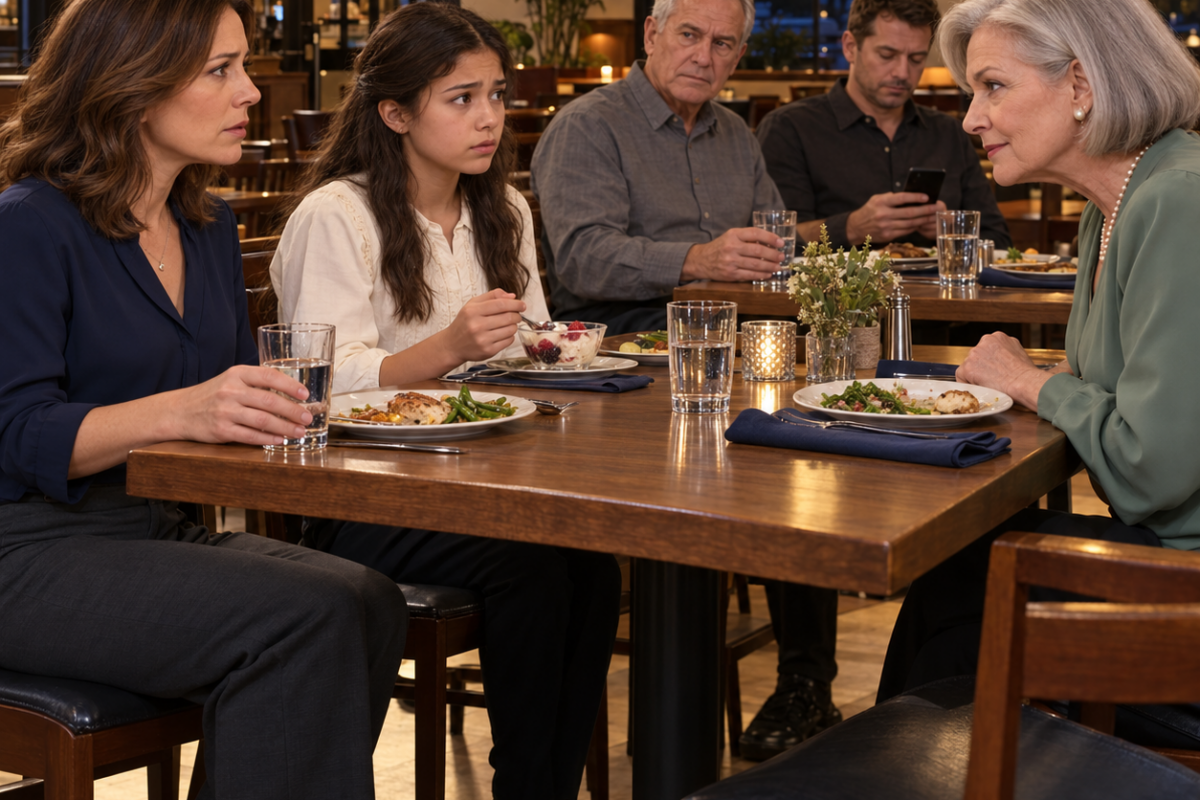
My mother leaned across the restaurant table, looked at my thirteen-year-old adopted daughter, and whispered, “We don’t sit with mistakes.” I took Sole’s hand and walked her out. That night, my father texted, “You’re still making the car payment tomorrow, right?” By midnight, I had canceled the payments I’d been making for my family. Then I remembered something Sole had told me about her grandmother.
My mother looked at my thirteen-year-old daughter and whispered, “We don’t sit with mistakes.” She said it softly enough to avoid attracting attention from the…
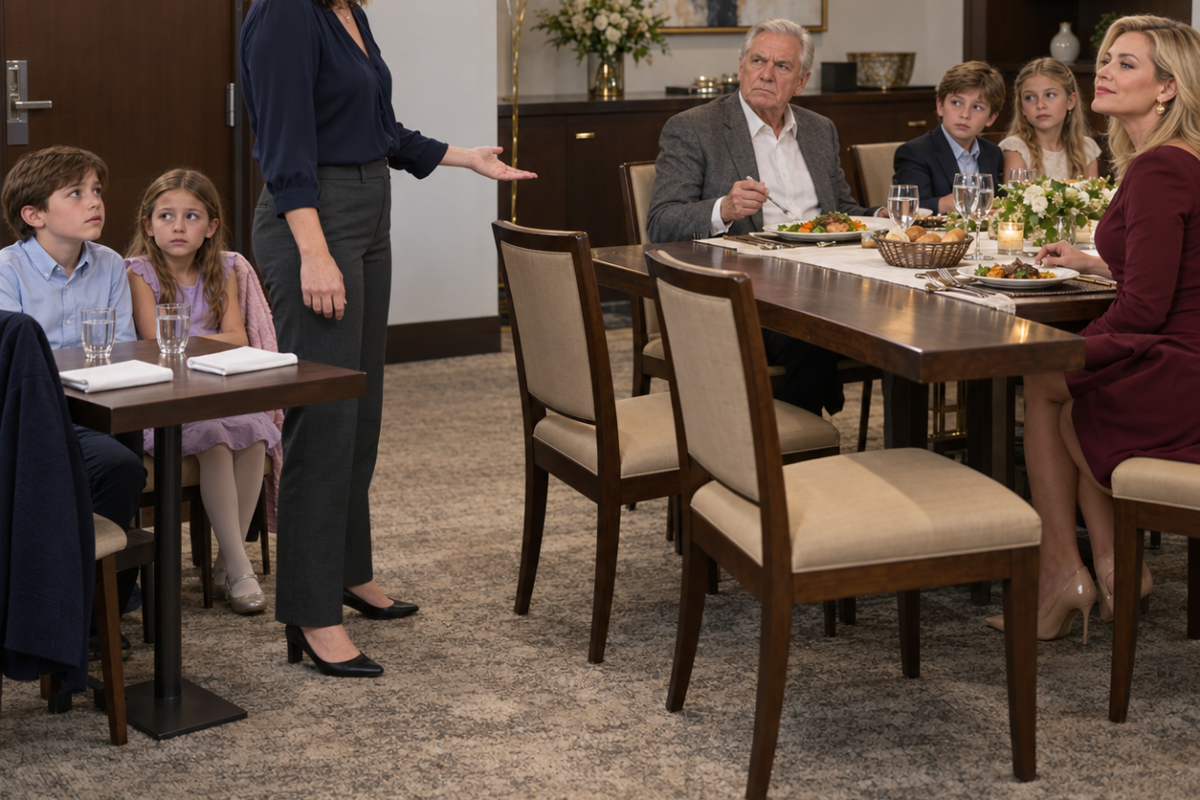
At my father’s seventieth birthday dinner, my eleven-year-old son and eight-year-old daughter were seated beside the service door with water glasses—but no dinner plates. Their cousins sat beside Grandpa with warm bread and full place settings. “They’ll eat after everyone else,” my sister said. I turned to my father, expecting him to object. “They can wait another hour,” he replied. There were two empty chairs at his table.
At my father’s seventieth birthday dinner, the first thing that stopped me wasn’t the cake or the gold balloons. It was my children. Ethan and…
“Mommy, are you real?” my four-year-old daughter whispered when I came home from deployment three weeks early. She was sitting alone on our living room floor with an empty cereal bowl. My husband was on a Caribbean cruise with his mother and sister. Twenty-two minutes earlier, they had posted a photo captioned “Family time.” I was still in uniform when Sophie asked if she could have something to eat.
The first thing my daughter said when I found her was, “Mommy, are you real?” She was sitting cross-legged on our living room floor with…
End of content
No more pages to load