Pack your things. We’re moving your family out so my pregnant daughter can move in,” my mother announced in my kitchen. I had paid the $4,100 monthly mortgage for six years. My eight-year-old son looked up from his sandwich. “Do I have to leave my room?” Mom answered before I could. “It won’t be your room anymore, honey. It’ll be for the baby
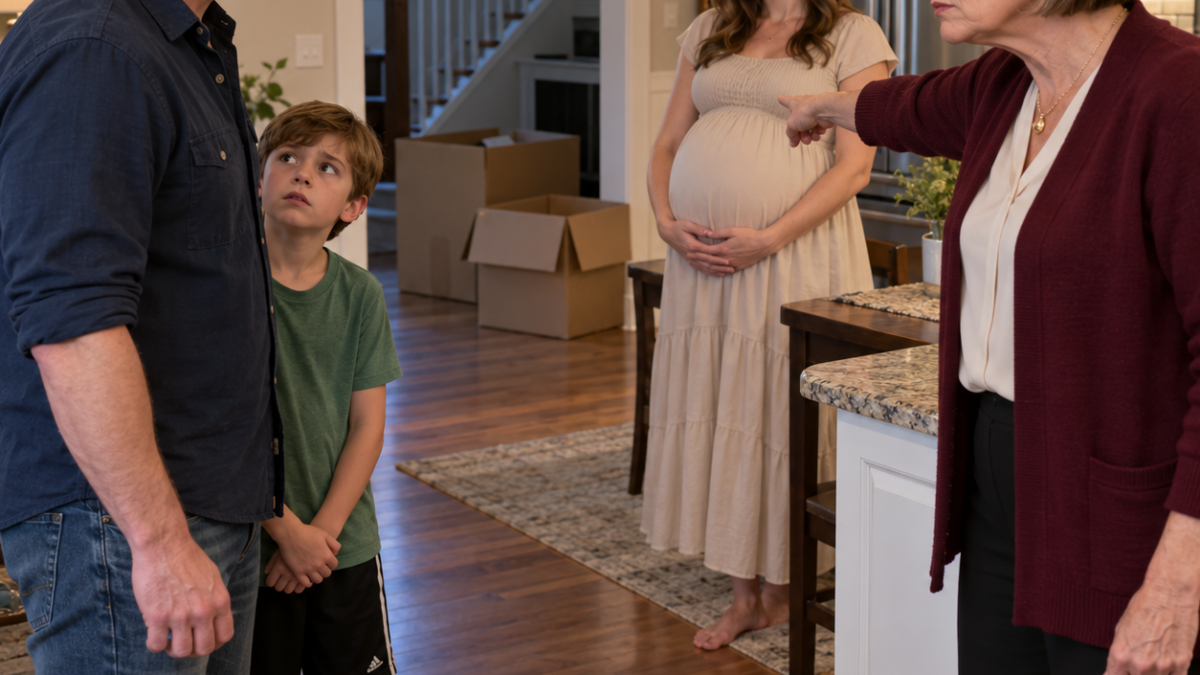
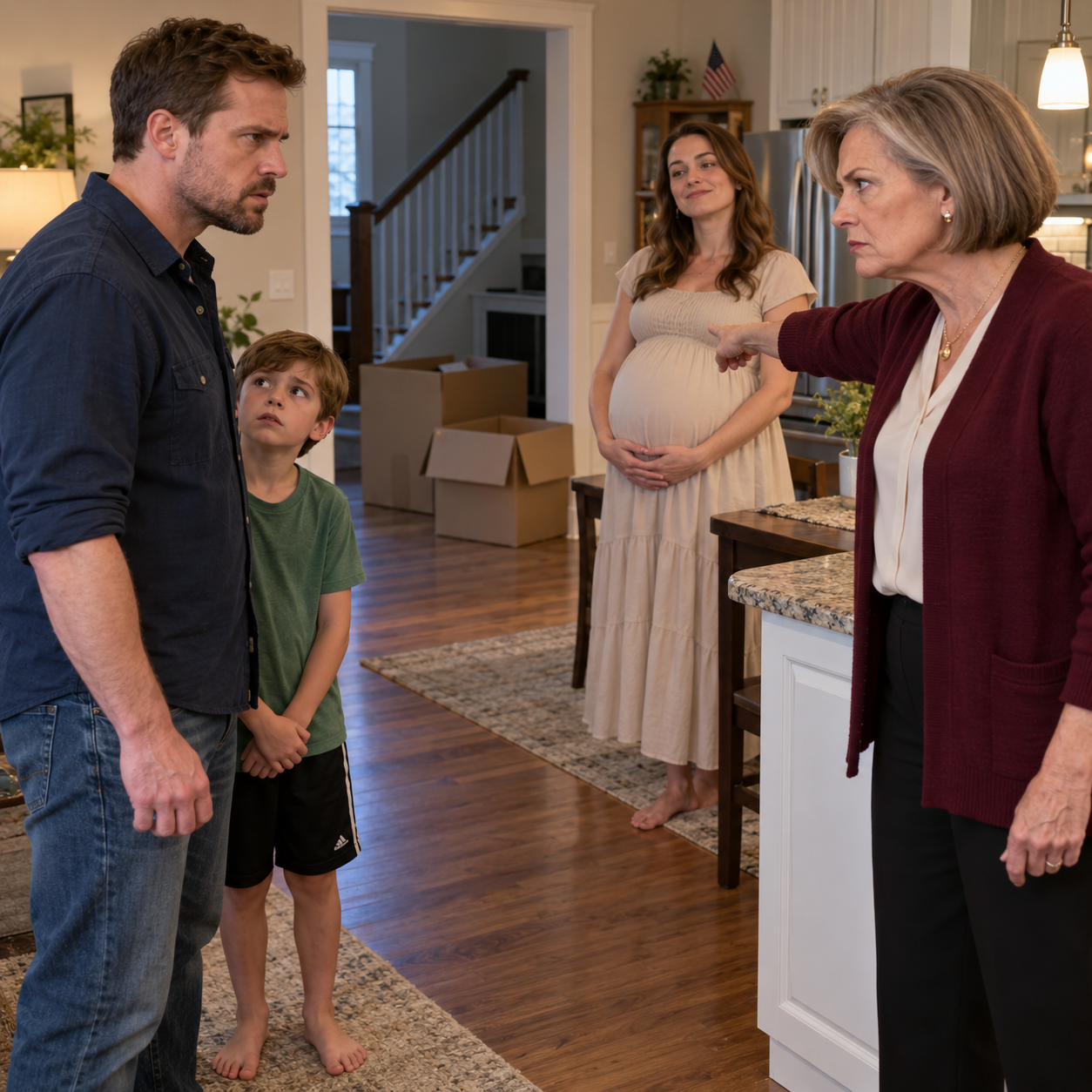
The first thing my mother said when I walked into the kitchen was, “Pack your stuff. We’re moving your family out so Megan can move in before the baby comes.”
She was leaning against the counter beside the coffee maker I had bought, beneath the cabinets I had repaired, in the house whose mortgage left my account on the first business day of every month.
It was 7:18 p.m.
I remember looking at the microwave clock twice. My mind needed something ordinary to hold on to, and those green numbers seemed more believable than the sentence I had just heard.
My wife, Nora, stood beside our eight-year-old son with one hand resting on his shoulder. Eli was barefoot, still wearing his soccer shorts. He held a triangle of grilled cheese that had stopped halfway to his mouth.
My sister Megan stood near the dining table, seven months pregnant. Her husband, Trent, was behind her. Three empty moving boxes leaned against the staircase. Two suitcases waited by the front door.
They had brought luggage.
They had brought boxes.
They had already made a decision about the lives of three people who had not been invited into the conversation.
“Say that again,” I said.
My mother folded her arms.
“Don’t make this harder than it has to be, Calvin.”
My father stood in the hallway. He had positioned himself where he could hear everything without appearing responsible for any of it. He had been doing that for most of my life.
“Harder than what?” I asked.
“Megan needs the extra room,” Mom said. “You and Nora need to start packing tonight. It isn’t fair to make a pregnant woman wait.”
I laughed once.
There was no humor in it. Sometimes a sound escapes before your mind can decide whether the situation deserves anger or disbelief.
“This is our home.”
Mom gave me the little smile she used when she thought someone was being slow.
“No, sweetheart. This is our house. You’ve been staying here because we let you.”
Nora’s hand tightened slightly on Eli’s shoulder.
He looked from my mother to me, then carefully set his sandwich on the edge of the coffee table.
I had spent six years paying $4,100 a month to keep a roof over these people’s heads. I had replaced the heating system, repaired the roof, covered the insurance, and worked weekends when a customer paid late.
Apparently, I had been a guest.
Megan spoke in the calm voice she used when she wanted an unreasonable demand to sound like a compromise.
“We’re not saying you should leave with nothing. Just take what’s yours and be adults about it.”
“What do you think is mine?” I asked.
She shrugged.
“Your clothes. Your tools, maybe. Your personal stuff.”
“Maybe his tools?” Nora repeated.
Mom waved a hand.
“Don’t start itemizing every spoon and lamp. Be practical. We all use what’s here.”
Her gaze moved around the kitchen.
“The coffee maker stays. So does the grill. Trent needs that. Megan won’t have time to cook complicated meals once the baby comes.”
Trent nodded as though his future access to grilled hamburgers had already been settled.
“And don’t take the television from your bedroom,” Mom continued. “That room will need one.”
I looked at her.
“Anything else?”
“The bathroom things stay where they are. Your father uses that trimmer sometimes.”
“My beard trimmer?”
“It’s part of the bathroom setup.”
Trent made a small sound through his nose.
My father finally stepped forward.
“Take your underwear and whatever you bought recently. Everything else is family property now. Don’t be petty.”
For a moment, nobody moved.
Then Eli asked, so quietly that I almost missed it, “Do I have to leave my room?”
My mother answered before I could.
“It won’t be your room anymore, honey. It’ll be for the baby.”
Honey.
She used that soft word while taking away the place where he slept, read, kept his treasures, and believed he belonged.
Something in me went cold.
I put my keys on the counter carefully.
“All right,” I said.
Mom looked relieved.
She thought I had agreed.
What I had actually done was stop trying to persuade people who believed persuasion was another opportunity to take something from me.
“I need everyone to be clear,” I continued. “You’re telling Nora, Eli, and me to leave. You’re telling us we can take our clothes, but you’ll decide what else belongs to us.”
“Oh, for heaven’s sake.”
“Is that what you’re saying?”
Megan rested a hand on her stomach.
“Mom and Dad said it’s time for us to move in. You’re making this sound cruel.”
“You told my son his room isn’t his anymore.”
“A nursery is a real need,” she said.
“So is a child’s bedroom.”
Dad sighed.
“Don’t start competing with an unborn baby.”
I took out my phone.
“What are you doing?” Mom asked.
“Keeping a record.”
“Don’t record family.”
I held the phone where everyone could see it.
“Then let’s put this in writing. You believe you own the house?”
Mom looked directly at me.
“Your father and I do own it.”
I didn’t raise my voice.
I didn’t reach for the deed.
I didn’t tell them that the house had belonged to my company since September 2019.
Instead, I opened my notes and wrote one sentence.
Call Mason in the morning.
Then I looked at my wife.
“Let’s get Eli upstairs.”
That was the first decision I made that night which had nothing to do with keeping my parents comfortable.
It would not be the last.
I was thirty-six then, and I lived outside Knoxville, Tennessee. I made custom furniture for a living, mostly epoxy river tables, restaurant counters, conference tables, and the occasional elaborate piece for a customer who wanted something nobody else had.
Some people imagined that meant I spent my days in a peaceful workshop, admiring beautiful wood.
There was some of that.
There was also dust in my ears, resin on my boots, invoices that went unanswered, delivery schedules that changed overnight, and customers who discovered financial caution only after ordering a twelve-foot walnut table.
I loved the work anyway.
Wood gave you problems you could understand. A board warped because of moisture. A joint failed because it had been rushed or cut badly. If you looked closely enough, you could usually find the cause.
Families were less cooperative.
When my parents got into trouble in 2019, I had been thirty. Nora and I had a toddler, a small rented apartment over a dentist’s office, and a savings account labeled HOUSE.
The label was optimistic.
The account wasn’t empty, but it wasn’t enough for the kind of place we hoped to buy. My business had finally become steady, and we were beginning to believe the next few years might be easier than the previous ones.
Then my parents asked to come to the shop one Sunday.
Dad sat on a stool beside my workbench. Mom kept smoothing the strap of her purse.
They didn’t begin with the foreclosure.
They began with the weather, a neighbor’s new fence, and how nice it was that my business was finally “taking off.”
Then Mom said, “We’ve had a little trouble keeping things lined up.”
“How little?”
Dad stared at the floor.
“The mortgage.”
I put down the sanding block.
“How far behind?”
Neither answered immediately.
That was how I learned it was worse than they wanted to say.
My father had refinanced more than once. My mother had used credit cards to cover gaps and called it bridging, as though the other side of the bridge existed somewhere beyond the next statement.
Fees had accumulated. Payments had been missed. The house they had owned for years was approaching foreclosure.
Mom finally slid a folder across the workbench.
“Just help us smooth this over.”
I opened it.
The numbers were not a small trouble. They were a long series of decisions nobody had wanted to discuss until the consequences arrived.
“How did it get this far?” I asked.
Dad rubbed his forehead.
“We thought we could catch up.”
Mom looked wounded.
“We didn’t want to burden you.”
They had waited until helping required much more than a temporary loan. Somehow that was supposed to count as consideration.
I took the folder home.
Nora read it at our kitchen table after Eli fell asleep.
When she finished, she sat quietly for a moment.
“What are they asking for?”
“I don’t think they know.”
“They know they want you to fix it.”
She wasn’t angry yet. She was tired and careful, which was how she approached problems with the potential to become permanent.
“We can’t empty everything we’ve saved and still call it temporary,” she said.
“I know.”
“And if we pay what’s overdue, what changes next month?”
I didn’t have an answer.
My parents had income, but not enough to support the debts they had built around themselves. Paying the overdue amount without changing the arrangement would have bought time and little else.
I called Mason.
He had handled some contracts for my business and helped me understand which promises belonged on paper. We were close in age, but he had a patience for documents that I would never develop.
He read the information, then leaned back in his chair.
“If you want to give them money, call it a gift and decide what you can afford to lose.”
“I can’t afford to lose enough to solve this.”
“Then don’t make a loan you’ll spend ten years pretending they’re going to repay.”
I looked at him.
“What would you do?”
“I would separate helping them from inheriting their financial habits.”
He explained a possible purchase, a clean closing, proper financing, and an occupancy agreement. He also explained that buying the house would be a major commitment, not a clever way to avoid one.
“Your company would own the property,” he said. “You would be responsible for the debt. They would be occupants under written terms. Everyone needs to understand that before anything is signed.”
My parents understood enough to attend the closing.
They understood enough to sign the documents required of them.
They understood enough to stop receiving foreclosure notices.
What they never accepted was the change in authority that came with the rescue.
I formed a separate property company with Mason’s help. In September 2019, it purchased the house through a conventional closing that paid the existing obligations and transferred title.
The down payment came from the money Nora and I had saved.
The financing was arranged for the company, with my personal responsibility supporting it.
The recorded deed named the company as owner.
My parents signed an occupancy agreement prepared by Mason. Their contributions were modest, and the agreement described which part of the house they would use. It also made clear that they could not give possession of other rooms to somebody else.
There was nothing secret about the transaction.
The secrecy came later, from my willingness to stop mentioning it.
The house was large, with two connected living areas, four bedrooms, a finished room downstairs, and a garage big enough to make my work easier. Nora, Eli, and I moved into one side. My parents stayed in the rooms they had been using.
At the time, it seemed practical.
We were paying for the place anyway. Eli would have a yard. My parents could remain in familiar surroundings. I could move some storage and smaller equipment out of rented space.
My mother called it a blessing.
My father shook my hand.
Megan said, “See? Everything worked out.”
I remember looking around the empty room we planned to make Eli’s bedroom and believing, for a little while, that she was right.
The payment, including taxes and insurance, was $4,100 a month.
That number became as familiar to me as my own phone number.
Every month, it left the account.
Some months Dad gave me $500 and said he was doing what he could. Some months Mom bought groceries and spoke as though that settled a complicated balance.
Most months, I covered almost everything.
I kept records because Mason had told me to, but I didn’t demand explanations at dinner. I didn’t post statements on the refrigerator. I didn’t correct every relative who referred to the property as my parents’ house.
I told myself dignity mattered.
It does.
What I failed to understand was that protecting somebody’s dignity does not require agreeing to a false version of your own life.
The first correction I swallowed involved the garage.
I had installed clamp racks along one wall and moved in several walnut slabs that needed dry storage. Dad invited two friends over one afternoon and gave them a tour.
“Calvin’s got his hobby taking over my garage,” he said.
I was carrying a stack of cutoffs through the doorway when I heard him.
“It’s the business, Dad.”
He waved.
“You know what I mean.”
One of his friends smiled politely.
I didn’t push it.
Later, Mom found me in the kitchen.
“You didn’t have to embarrass your father.”
“I said it was my business.”
“He was just talking.”
“He called it a hobby.”
“Well, you don’t have to correct every little thing.”
That became the arrangement.
They could describe my contribution however they wished. My job was to make sure the description never became uncomfortable for them.
When Nora repainted Eli’s room before we finished moving in, Mom stood in the doorway watching.
“Don’t make it too permanent,” she said.
Nora lowered the roller.
“What does that mean?”
“We don’t know how long you’ll be here.”
I was carrying a dresser up the stairs.
“We bought the house so we could all stay here,” I said.
Mom smiled.
“For now.”
That evening, Nora sat on the edge of our bed.
“Why do they talk like they’re doing us a favor?”
I tried the answers I had ready.
They were adjusting.
It was hard to give up control.
They were embarrassed about the finances.
Nora listened.
Then she said, “I can understand embarrassment. I don’t understand making our place here uncertain.”
I kissed her forehead and promised things would settle.
They didn’t settle.
They became familiar.
That was worse, because familiar problems are easy to mistake for manageable ones.
Mom began referring to the downstairs room as “available space,” even when Nora had set up her sewing machine there. Dad put boxes in front of my garage cabinets, then complained when I moved them to reach my tools.
Megan visited whenever she wanted and used whatever she found.
If Nora asked her to replace something she finished, Mom said we shouldn’t count every carton of milk.
If I asked Trent to put a tool back, Dad said borrowing was part of being family.
There were reasonable versions of those ideas.
We had somehow ended up living inside the unreasonable ones.
One Saturday, when Eli was four, Megan brought a boyfriend she had been seeing and his teenage daughter.
Eli had lined up his toy trucks along the hearth by color. He liked doing that, and he would sit on the rug arranging them while the adults talked.
The girl picked up two trucks and dropped them into her purse.
“I’m taking these,” she told him, smiling.
Maybe she meant it as a joke.
Eli didn’t know that.
His little face went still.
“Put them back,” I said.
She looked at Megan.
“Seriously? I’m kidding.”
“Then the joke’s over.”
She returned them with an exaggerated sigh.
After everyone left, Mom cornered me beside the dishwasher.
“You made that awkward.”
“She took his toys.”
“She wasn’t actually going to keep them.”
“He didn’t know that.”
“You don’t have to turn everything into a confrontation.”
I looked at the trucks, restored to their careful row.
All I had done was ask that something belonging to my son remain his.
Yet somehow I had become the person who disrupted the evening.
That was the rule I had grown up with, though I had never put it into words.
They could take.
I could not object in a way that disturbed anyone.
For years, I followed that rule while congratulating myself on being patient.
I worked Saturdays.
I covered unexpected bills.
I arranged my schedule around appointments my parents announced at the last minute.
Nora cooked holiday meals for a crowd, then listened while Mom explained how fortunate we were to have family support.
Once, when the heating system failed, I paid for the replacement and stayed home to meet the installers.
Dad told a neighbor he had found a good company.
He had found the refrigerator magnet.
I had found the money.
I began making a private joke of these things because it was easier than admitting how angry they made me.
Nora stopped laughing before I did.
“Calvin,” she said one night, “we are paying a very high price for a peace nobody else has to work at.”
I knew she was right.
I also knew that accepting it would require action, and I had built a whole system of reasons to postpone that action.
The school was good.
Eli liked the yard.
My father’s knees were getting worse.
The shop was growing.
Moving would be expensive.
We had equity.
Maybe the next year would be different.
I was good at making a delay sound responsible.
By 2025, my business was steady enough that we could have explored a different home without panicking over every number.
But six years had accumulated around us.
Eli knew the route to school. Nora had planted herbs beside the patio. I had built shelves into the garage and repaired things so thoroughly that the house felt like a record of my own labor.
Leaving seemed wasteful.
Staying had become costly in ways no spreadsheet could show.
Then Megan announced her pregnancy.
At first, I was happy for her.
She had wanted a child, and whatever frustration I felt toward her did not cancel that. Nora helped choose a small gift. Eli asked whether he would be allowed to teach the baby soccer when it got older.
Nobody was competing with the baby.
That story came later.
Megan and Trent rented a two-bedroom place across town. It wasn’t luxurious, but it had a room they could use as a nursery.
Trent wanted a home office. Megan wanted more storage. Mom said stairs would be difficult after the delivery.
Those were ordinary concerns that gradually became reasons somebody else should reorganize an entire life.
“A baby changes priorities,” Mom began saying.
Dad measured the upstairs hallway with a tape measure one afternoon.
“What are you doing?” Nora asked.
“Just seeing what would fit.”
“What would fit?”
“A nursery arrangement.”
He said it casually, but Nora told me about it that evening.
I asked him directly.
“Are you planning for Megan to move here?”
“Your mother’s thinking through options.”
“Our rooms aren’t an option.”
He looked offended.
“Nobody said they were.”
Two days later, Mom said Eli was old enough to “be flexible about space.”
Megan started browsing nursery furniture at our dining table.
Trent looked at the patio and talked about having people over after the birth.
They weren’t asking.
They were rehearsing a decision.
I should have stopped the rehearsals immediately.
Instead, I said no in the mildest way possible and expected them to hear the answer rather than the tone.
“We’re not moving rooms.”
“We haven’t agreed to any of that.”
“You’ll need to plan around your apartment.”
Each answer was treated as an opening offer.
Then, one Sunday, Eli came into the garage while I was changing a sanding disc.
“Dad?”
“Yeah, buddy?”
“When the baby takes my room, can I keep my LEGOs?”
I switched off the machine.
“Who told you the baby is taking your room?”
He picked at the edge of his sleeve.
“Grandma said babies need more things. She said I have too much stuff.”
I sat on an overturned bucket so I could look at him properly.
“Nobody is taking your room.”
“Even the little shelf?”
“Your room and your things stay yours.”
He nodded, but he didn’t look completely convinced.
That should have frightened me more than it did.
I told Mom to stop discussing housing changes with him.
She acted as though I had accused her of something outrageous.
“I’m trying to help him prepare.”
“For something that isn’t happening.”
“We’ll see.”
Those two words stayed in my head.
We’ll see.
She said them about a home I owned, a decision she had no right to make, and a child who should never have been made responsible for understanding it.
A week later, she met me in my kitchen with the moving boxes already waiting.
After her announcement, I took Eli upstairs while Nora followed.
He carried his stuffed fox under one arm.
He hadn’t needed to carry it around the house in months.
That night, he did.
I sat beside him on his bed.
“You are staying here,” I told him. “Mom and I will handle the grown-up conversation.”
“Grandma said it’s her house.”
“Grandma is wrong about who gets to make this decision.”
“Are you mad at her?”
“Yes.”
His eyes widened.
I realized he had almost never heard me say that plainly.
“I can be upset with someone and still speak calmly,” I added. “You don’t have to fix it.”
“Is the baby mad?”
“No, buddy. The baby hasn’t done anything. None of this is the baby’s fault.”
He leaned against me.
“Okay.”
I read him two chapters from the book on his nightstand. By the end, his breathing had slowed.
When I came out, Nora was standing at the far end of the hallway.
She didn’t ask what I planned to say to my parents.
She asked a harder question.
“Are we safe here?”
I looked past her toward the stairs.
“They’re not going to hurt us.”
“That isn’t all I mean.”
I knew.
I had answered the easier question because I had been doing that for years.
“No,” I said finally. “Not the way we should be.”
She looked tired.
“I can’t have him wondering whether his grandmother can put his life in a box every time somebody else wants something.”
“I know.”
“Do you?”
There was no cruelty in it.
There was six years of waiting.
I took her hand.
“I’m calling Mason tomorrow. I’m ending the occupancy arrangement.”
Nora closed her eyes briefly.
When she opened them, she said, “Then I need you to finish it.”
Downstairs, my mother was laughing at something Trent had said.
The normal sound felt almost obscene after the conversation we had just had.
I went down alone.
“You are not moving into our rooms,” I told Megan and Trent. “You are not taking our belongings. The boxes you brought need to go back into your car.”
Mom’s expression tightened.
“We just had this discussion.”
“You announced something. I didn’t agree to it.”
Dad stepped closer.
“Calvin, don’t turn this into a power struggle.”
“You told my child he had to leave his room.”
“He’ll adjust.”
“No. He won’t be asked to.”
Megan shook her head.
“You really want us crowded into that apartment with a newborn?”
“I want you to make housing arrangements that don’t involve taking ours.”
Trent looked toward Dad.
“We were told this was handled.”
That sentence mattered.
Not because it excused him, but because it showed how long the conversation had been happening without us.
“Who told you that?” I asked.
Mom answered immediately.
“We did. Because this is our family home.”
I looked at her.
“We’ll discuss the legal arrangement through Mason.”
Her face changed.
Then she laughed.
“Oh, stop. You’re not going to bring a lawyer into a family conversation.”
“I am.”
I went upstairs before she could turn it into another hour of circular argument.
At 6:41 the next morning, my phone lit up.
Mom: You don’t need to drag legal nonsense into a family adjustment.
Dad: Be a man and don’t stress your pregnant sister out.
Megan sent a longer message.
She said I was being territorial. She said a nursery mattered more than “a woodshop aesthetic.” She said Nora had influenced me to forget my responsibilities.
I read that last part twice.
Apparently, paying $4,100 every month had not been a responsibility.
Surrendering whatever they wanted next was the responsibility.
I put the phone facedown and called Mason as soon as his office opened.
“I need to end my parents’ occupancy agreement,” I said. “And I need to prevent Megan and Trent from moving into our rooms.”
He was quiet for a moment.
“What happened?”
I told him.
He didn’t interrupt.
When I finished, he asked, “Are Nora and Eli there?”
“Yes.”
“Any threats? Any physical confrontation?”
“No. But they’ve brought boxes. They’re treating the move as decided.”
“All right. Don’t change locks. Don’t shut off anything. Don’t remove their belongings. We’ll review the agreement and take the proper steps.”
“I want them out.”
“I understand.”
“I mean it this time.”
“I understand that, too.”
He asked me to bring the occupancy documents, current mortgage records, messages, and anything showing what had been said.
By noon, I had a folder thick enough to make my wrist ache.
The deed.
The closing paperwork.
The occupancy agreement.
Six years of mortgage statements.
Transfers from my personal and business accounts.
Invoices for the roof, heating system, plumbing work, and repairs.
Messages from Mom thanking me for “covering the house again.”
Messages from Dad promising to catch up the next month.
None of those documents made me feel victorious.
They made me feel foolish.
I had kept evidence of the truth while living as though the truth needed their permission.
Mason went through the agreement carefully.
“They signed this,” he said.
“I know.”
“They were represented in the closing process. The transfer wasn’t ambiguous.”
“I know that, too.”
He looked up.
“Then you need to stop saying they didn’t know.”
I rubbed my hands over my face.
“They act like they don’t know.”
“That’s different.”
It was.
I had been giving them the benefit of confusion because deliberate disregard was harder to accept.
Mason explained the steps we could take, the notices required under the arrangement, and what would happen if they refused to leave. He made it clear that removing occupants was a legal process, not something completed by showing a deed at the front door.
“They’ll receive formal notice,” he said. “They’ll have the opportunity to respond. If it goes to court, the judge decides possession. Enforcement comes after the required process.”
“How long?”
“I can give you an expected sequence. I can’t promise a date today.”
The impatience in me wanted a shortcut.
The part of me that had spent years building a business understood why shortcuts failed.
“All right,” I said. “Let’s do it properly.”
He also told me to document interference with our belongings and keep communication brief.
“Don’t argue about who’s the better family member,” he said. “That isn’t the question we need to resolve.”
I almost smiled.
“It’s the only question they want to discuss.”
“Then let them discuss it without you.”
That afternoon, I came home early.
Megan and Trent were upstairs in Eli’s room.
Trent held a tape measure stretched across the wall beneath the window. Megan was looking at a photograph of a crib on her phone.
Eli stood in the hallway with his fox.
The sight stopped me more completely than the moving boxes had.
“Why are you in my son’s room?” I asked.
Trent let the tape retract with a sharp click.
“Relax. We’re just planning.”
“Planning what?”
Megan sighed.
“Calvin, don’t do this again.”
I looked at Eli.
“Go downstairs with Mom.”
He didn’t move immediately.
His eyes stayed on the tape measure.
That pause hurt.
My son wasn’t certain that leaving the room would mean he got to return to it.
“Nobody is changing anything,” I told him.
Only then did he walk toward the stairs.
I waited until he was out of earshot.
“Get out of this room.”
Megan put a hand on her stomach.
“Wow.”
“Get out.”
“You’re being ridiculous.”
“This room is not available. You’ve been told that. Leave it.”
Trent moved past me with his shoulder turned, making the doorway narrower than it needed to be.
“This is why nobody wants to deal with you,” he muttered.
I stepped aside rather than let the moment become physical.
“No one asked you to deal with me,” I said. “You were asked to stop measuring my child’s bedroom.”
They went downstairs.
I photographed the room, not because a tape measure had damaged anything, but because I wanted a record of what happened and when.
Then I sat on the bed for a minute.
There were books under the pillow, a soccer medal hanging from the bedpost, and three carefully folded drawings on the nightstand.
My son’s room was not extra space.
It was a life.
That evening, Nora and I made a plan that should have existed years earlier.
We moved important papers into a locked cabinet in the shop office. I photographed valuable tools and recorded serial numbers where they were available. Nora made a list of personal belongings that had begun disappearing into other parts of the house.
We bought a simple lock for our bedroom door, installed without restricting my parents’ access to their own rooms or shared necessities.
Eli’s belongings stayed where they were.
“I don’t want him living behind locks,” Nora said.
“Neither do I.”
“But I want him to see us protecting something.”
We agreed on that.
I also spoke with him again.
“Your grandmother and grandfather are having a disagreement with me,” I said. “You might hear them sound upset.”
“Did I do something?”
“No.”
“Because of the LEGOs?”
“No, Eli. Not because of your room, your toys, or anything you did.”
He thought about it.
“Then why are they mad?”
“Because I said no to something they wanted.”
“Can you do that?”
I swallowed.
“Yes. I can.”
He nodded slowly, absorbing a rule he should already have known.
The formal notice went out after Mason reviewed the agreement and prepared the documents.
My parents received it in writing.
I was there when Mom opened the envelope.
She read the first page, then looked up at me as though I had brought something dirty into the kitchen.
“You cannot be serious.”
“I am.”
Dad took it from her.
“What is this?”
“The notice ending the occupancy arrangement,” I said.
Mom’s voice sharpened.
“We raised you.”
“I’m aware.”
“We gave you everything.”
“I’m not discussing my childhood in place of this notice.”
She stared at me.
That was new language in our house.
I had always been willing to follow her wherever she moved the conversation. If the subject was a bill, she took us to gratitude. If the subject was a boundary, she took us to sacrifice. If the subject was something she had said, she took us to my tone.
This time, I stayed where the problem was.
Dad pointed at the document.
“We’ll have someone look at this.”
“You should.”
He seemed disappointed by the answer.
I meant it. They were entitled to understand the paperwork and their options. I wanted the situation resolved correctly, even if correct was slower.
Mom folded the pages.
“Megan is pregnant.”
“Yes.”
“This kind of stress isn’t good for her.”
“Then stop telling her she has a right to our rooms.”
“She needs support.”
“She can receive support without taking our home.”
I left for the shop before the argument could start its second lap.
Over the next several days, relatives called.
An aunt asked whether there had been “some confusion about the house.”
A cousin said my parents were devastated.
Another relative wanted to know why we couldn’t “just split everything fairly.”
I kept my answers short.
“The house is owned by my company. My parents have had an occupancy agreement for six years. They tried to remove Nora, Eli, and me and give our rooms to Megan and Trent. I’m ending that arrangement through the proper process.”
Some people became quiet.
Others told me family mattered more than paperwork.
I asked one of them, “Then why was my family the one being told to leave?”
He didn’t answer.
I wasn’t trying to persuade everyone.
That was another thing I had to learn.
A person who listens only to the version that asks least of them may never be convinced by yours. You can spend years arranging evidence for an audience that has already decided comfort matters more than accuracy.
I sent the relevant facts once.
Then I stopped.
The practical interference began after the notice.
One morning, the stainless-steel espresso machine Nora had given me for my thirty-fifth birthday was missing from its usual place.
I found Mom at the table.
“Where’s the espresso machine?”
“Upstairs.”
“Why?”
“Megan needs easier access when she visits.”
“It belongs to me.”
“She’s tired, Calvin.”
“Bring it back.”
Mom set down her spoon.
“You’re becoming very selfish.”
I went upstairs and found it on a cabinet in the room Megan had begun calling hers. I carried it back to the kitchen without making a speech.
Later that day, a note appeared on the grill.
For baby shower prep. Do not move.
Trent’s handwriting.
I took a picture.
Then I removed the note.
My beard trimmer disappeared again. Nora found it in the guest bathroom under folded washcloths.
At first, the absurdity almost made us laugh.
Then she opened a garage cabinet and found two of my tool cases gone.
That was no longer absurd.
Those tools were how I earned money. Missing clamps could delay a commission. Contaminated finishing supplies could ruin a piece. Somebody who didn’t understand the equipment could hurt themselves.
I asked Trent where the cases were.
“Moved them,” he said.
“Where?”
“Out of the way.”
“Where?”
He rolled his eyes.
“The storage shelf. You don’t need to act like we stole them.”
I found one on the shelf behind boxes of nursery furniture. The other wasn’t there.
He said he must have put it somewhere else.
I wrote down the date.
That night, Nora stood in the garage with me while I checked supplies.
“I don’t think they’re looking for a way to stay together,” she said.
I looked at the empty spot in the cabinet.
“No.”
“They’re looking for a way to win.”
I had been slow to understand that.
Once I did, their behavior became painfully consistent.
They weren’t trying to reach an agreement we could all live with. They were testing whether enough inconvenience, embarrassment, and pressure would make me surrender.
The worst day came on a Saturday.
I was delivering a commissioned walnut table to Chattanooga. The customer had waited months for it, and rescheduling would have involved a crew, a truck, and a restaurant preparing to open.
Halfway there, Nora called.
Her voice was controlled.
“They’re packing us.”
I pulled into a gas station.
“What?”
“Your mother, Megan, and Trent. They’re putting our things into boxes.”
“Where’s Eli?”
“With me.”
“Are you safe?”
“Yes. They aren’t touching us. I’ve told them to stop.”
“What are they taking?”
“She says we can have clothes and personal things. The kitchen things belong to the family.”
I stared through the windshield.
“What does that mean?”
“The mixer attachments. Our bedding. The coffee equipment. She says the television stays. Trent is moving things in the garage.”
I could hear voices behind her.
Then Nora lowered hers.
“She told Eli to choose which toys he really needs.”
I closed my eyes.
“Don’t argue with them,” I said. “Keep him with you. I’m calling Mason, then I’m coming back.”
“What about the delivery?”
“I’ll arrange it.”
She was quiet for a moment.
Then she said, “Thank you.”
That thank-you hurt worse than anger would have.
My wife was grateful that I was finally treating the security of our home as more urgent than an appointment.
I called the customer and explained that a family emergency had interrupted the delivery. I arranged for the crew to secure the table until I could complete it.
It cost me time and money.
I remember feeling almost relieved by the simplicity of that cost.
Then I called Mason.
He told me to avoid physical confrontation, preserve evidence, and contact local authorities if the situation became threatening or property was removed.
“They don’t get to decide ownership by putting your belongings into boxes,” he said.
I knew that.
Still, hearing it in another person’s voice helped.
When I arrived home, the entryway looked like the beginning of a move nobody in my household had chosen.
Calvin clothes.
Nora clothes.
Eli toys misc.
The labels were written in thick black marker.
Miscellaneous.
My son’s drawings were miscellaneous.
Nora’s grandmother’s mixing bowl was sitting on the floor beside miscellaneous.
My work apron, stiff with old resin, had been tossed into a box under miscellaneous.
Mom was wrapping mugs in newspaper at the kitchen counter.
I stood in the doorway.
“Stop.”
She looked up.
“Oh, you’re back early.”
“Put that down.”
“We’re helping you get organized.”
“No. You’re handling property after being told not to.”
Megan came in from the hallway.
“You’ve made everything so unpleasant that we thought it would be easier to get started.”
“Started on what?”
“The move.”
“There is no move.”
Dad appeared at the back door.
“You need to stop dragging this out.”
I looked at each of them.
“Show me what you think we’re allowed to take.”
Nora stood beside the staircase with Eli.
She had her phone in her hand.
Mom straightened.
“Your clothes. Your personal bathroom things. Eli’s mattress, if you insist. We’re not stripping the house.”
“The mixer?”
“We use it.”
“The coffee maker?”
“We need it.”
“The grill?”
“Trent uses it.”
“My tools?”
“Don’t exaggerate. Nobody wants your whole workshop.”
Trent leaned against the doorway.
“Some things are just useful to have around.”
“Useful to whom?”
He shrugged.
I looked at my father.
“You signed documents when the house was sold. You know who owns it.”
He glanced at Mom before answering.
“You’re playing games with company names.”
“No.”
“This was our house long before you started acting important.”
“And you sold it.”
Mom spoke over him.
“We never would have done that if we’d known you were going to use it against us.”
That was the first time she acknowledged the sale clearly.
Not as a fact requiring her to reconsider her behavior.
As another thing I had done wrong.
I photographed the boxes. I photographed the items set aside. I photographed the garage shelf, the nursery cartons, and the cabinet where the missing tool case should have been.
Mom followed me.
“Are you really going to make a record of every little thing?”
“Yes.”
“That’s sick, Calvin.”
“No. What’s happening here requires a record.”
Eli came down one step with his backpack on.
It was Saturday.
There was no school.
He had packed his own backpack because the adults around him had made him think he might be leaving.
“Dad?” he asked.
I put down the phone.
“Come here.”
He approached cautiously.
Inside the backpack were his fox, a water bottle, a book, and a small plastic bag of LEGO pieces.
He had chosen essentials.
An eight-year-old had quietly decided what he could carry if his home disappeared.
I knelt in front of him.
“You are not leaving.”
“Grandma said we should be ready.”
I looked up at my mother.
For once, I didn’t try to hide what was on my face.
“You do not discuss this with him again.”
“He needs to understand.”
“He needs adults who don’t frighten him to get what they want.”
She drew back.
Megan said, “That’s an awful thing to say.”
I stood.
“It’s an awful thing to do.”
Nora took Eli into the backyard while I put our things back where they belonged.
I didn’t throw anybody’s belongings away.
I didn’t pack my parents’ clothes in retaliation.
I returned our household to the position it had occupied before they tried to erase it.
That evening, after Eli fell asleep, Nora sat beside me at the kitchen table.
For a while, neither of us spoke.
Then she said, “He asked whether we could live at your shop.”
I stared at the surface of the table.
“He said there’s a couch in the office.”
I had built that table.
I had sanded it by hand, sealed it, carried it into the house, and imagined years of dinners around it.
My son had sat there eating breakfast while learning to read. Nora had wrapped birthday presents on it. I had signed contracts there that paid for the roof above us.
Now Eli was planning where we could sleep because I had allowed other people’s claims to drown out the truth of his life.
“I should have ended this sooner,” I said.
Nora didn’t soften it for me.
“Yes.”
I nodded.
“I’m sorry.”
“I know.”
“I kept thinking I could make them understand.”
She looked at me.
“You can’t make someone understand something they benefit from misunderstanding.”
We sat with that.
Then I asked what she needed during the remaining process.
She said she needed me to handle communication, to stop asking her to absorb remarks because responding would make things difficult, and to keep Eli away from arguments.
“Most of all,” she said, “I need him to see that when you tell him something is his, you mean it.”
“I will.”
This time, the promise had work attached to it.
We changed our routines.
I took Eli to school when I could. Nora arranged for him to spend a couple of afternoons with a trusted neighbor whose son was in his class. We ate dinner earlier, before the kitchen became an arena.
I moved the most valuable portable tools into locked shop storage.
I put a written notice in place that no one had permission to use or remove my equipment.
Mason handled the legal communication.
When Mom tried to corner me in the hallway, I said, “Send it in writing.”
When Dad wanted to “talk man to man” after spending a day calling relatives, I said, “I’m available for practical arrangements. I’m not repeating the argument.”
When Megan sent a photograph of a crib beside the message This is what you’re doing to your niece or nephew, I didn’t respond.
The baby was not being denied a crib.
The adults were being denied someone else’s home.
Three weeks after the kitchen announcement, a deputy came to serve the court papers that followed the formal notice and their refusal to resolve the occupancy issue.
That was the day my mother finally understood that Mason wasn’t a name I had mentioned to frighten her.
He was doing the work I had asked him to do.
The papers gave them information about the proceeding. They were not a sudden order to vanish by lunchtime.
There would be a hearing.
There would be an opportunity to answer.
The process took longer than my mother’s original demand that we start packing that night, because lawful possession did not depend on who spoke most loudly in the kitchen.
Mom called me at the shop after the papers arrived.
“A sheriff came to the house.”
“I know.”
“You sent law enforcement to your own mother.”
“The court papers were served through the proper process.”
“You could have told me.”
“You received the notice. You knew this was coming.”
She breathed hard into the phone.
“We thought you’d come to your senses.”
“I have.”
She hung up.
For a few days, the house became strangely quiet.
Nobody apologized.
Nobody returned the missing tool case.
But the measuring stopped.
Then Dad asked me to meet him on the patio.
He sat in a chair I had repaired twice.
“I want to understand what you think you’re accomplishing,” he said.
“A home where Nora and Eli aren’t threatened with removal.”
“We didn’t threaten anybody.”
“You told us to take our underwear and leave.”
He looked away.
“You’re taking that literally.”
“How should I take it?”
“People say things.”
“And then you helped pack our belongings.”
He tapped the arm of the chair.
“Your mother got carried away.”
“You stood beside her.”
“She was trying to help Megan.”
“You both agreed to remove us.”
He looked older that afternoon.
For a moment, I felt the familiar urge to relieve his discomfort.
Then I remembered Eli’s backpack.
“I’m willing to discuss a practical moving plan,” I said. “I’m not willing to pretend this happened without your participation.”
Dad’s jaw tightened.
“You think paying gives you the right to run everybody’s life.”
“No. Owning the property gives the company the right to decide who occupies it, within the law. And being Eli’s father gives me the responsibility to protect his home.”
“You’ve changed.”
“Yes.”
He meant it as an accusation.
I accepted it as a fact.
My parents consulted an attorney.
That was their right, and I was glad they did. I wanted them to receive an explanation they couldn’t dismiss as something I had invented.
The explanation did not make the deed disappear.
Mason told me their attorney had reviewed the sale and occupancy agreement. There were questions to address, but no plausible basis for claiming that my parents still owned the house.
An orderly departure could still have avoided a contested hearing.
I authorized Mason to offer practical terms for arranging a move, retrieving belongings, and resolving disputed items without another household confrontation.
I did not offer to buy them a new house.
I did not offer to keep paying indefinitely.
They rejected the proposal.
Mom said accepting it would be admitting I had the right to “throw them away.”
Dad said the judge would understand the house had always been his.
Megan said we should wait until after the baby arrived, then reassess once she had recovered.
There was always another event after which I was supposed to be allowed a life.
I stopped waiting for it.
The hearing was held on a morning when the sky looked like rain.
I wore a clean shirt that Nora had ironed and boots without workshop dust on them. Mason met me outside and reviewed what I needed to do.
“Answer the question you’re asked,” he said. “Don’t argue with them across the room.”
“I won’t.”
“Bring your attention back to me if you need to.”
Inside, Mom and Dad sat with their attorney. Megan was there, too, beside Trent.
Mom looked at me as though I had arrived at a family funeral wearing the wrong clothes.
I looked away.
The proceeding was less dramatic than the conversations at home.
That was one of its virtues.
There was a deed.
There was an agreement.
There were notices.
There was testimony about occupancy, refusal to leave, and the attempted reassignment of our living space.
Mason presented the relevant records.
My parents’ attorney did his job.
Nobody asked the court to decide whether I had been a sufficiently grateful son.
Nobody treated pregnancy as a transfer of property rights.
When I was asked why the arrangement had ended, I described the kitchen announcement, the intrusion into Eli’s room, and the packing of our belongings after we had said no.
I didn’t perform anger.
I didn’t need to.
The facts were ugly enough on their own.
Dad said he had owned the property for years before the sale.
That was true.
It was also not the question.
Mom said she had believed the purchase was “something we did as a family.”
The documents showed what it had been.
A sale could save a family home without leaving the former owners free to assign the bedrooms as though nothing had changed.
When the decision came, the court awarded possession in accordance with the ownership and occupancy records. Mason explained the next steps, the time allowed, and the available process for enforcement if they still refused to leave.
I sat quietly while he talked.
I had imagined relief would arrive like a door opening.
Instead, I felt tired.
I was looking at a legal solution to a problem I wished my parents had never created.
Outside, Mom approached me.
“You’re satisfied now?”
“No.”
“Then stop it.”
“I’m not stopping.”
She stared.
I think she had expected the sadness on my face to mean uncertainty.
For years, it had.
This time, I could be sad and certain together.
Megan stood behind her.
“You’ll miss the baby’s birth over this.”
“I hope the birth goes safely. I’m not bargaining over housing to earn an invitation.”
Trent laughed without smiling.
“Listen to yourself.”
I looked at him.
“I am. That’s been overdue.”
Mason stepped beside me, and we left.
There was still time for my parents to move voluntarily.
They could arrange a truck. They could identify their belongings. They could cooperate on a practical schedule.
Instead, they acted as though refusing to plan would force the rest of us to abandon the result.
Dad left a few boxes open in his room but filled none of them.
Mom continued making dinner in the kitchen and saying things like, “When this nonsense settles down.”
Trent came over with nursery deliveries.
I told him through Mason’s written communication that no new household move-in had been authorized.
He said he was only storing things.
We photographed what arrived and where it was placed.
Nora and I did not touch the nursery boxes. We had no interest in damaging or withholding anything belonging to the baby.
That distinction mattered to us even when nobody else respected it.
The child was innocent.
Our refusal to surrender did not need an innocent target.
Eli began asking fewer questions, but that didn’t mean he was unaffected.
One night, I found him counting the drawers in his dresser.
“What are you doing?”
“Seeing what would fit in the backpack.”
I sat on the floor.
“You don’t need to pack.”
“I know.”
But he kept looking at the drawers.
I realized that reassurance repeated without visible change can start to sound like another adult saying something that may not happen.
So I explained what I could in terms he understood.
“Grandma and Grandpa have been told by a judge that they can’t make us leave. They’re going to live somewhere else.”
“Did the judge see my room?”
“No.”
“Then how did the judge know?”
“The grown-ups showed the papers about the house and explained what happened.”
He considered that.
“Do I have to talk to the judge?”
“No.”
“Did Grandma get in trouble?”
“She has to follow the decision.”
He looked at me.
“Are you going to get in trouble?”
“No.”
Then he leaned against my shoulder, and I understood how much he had been carrying.
A child can hear an adult accused often enough to wonder whether love itself is dangerous.
Nora spoke with his teacher privately about the stress at home. We didn’t send a dramatic account or ask the school to take sides. We asked them to let us know if his worry began affecting his day.
His teacher told us he had seemed distracted.
Once, he had asked whether children could bring a suitcase to school.
That was enough.
We arranged a few meetings with a counselor who worked with children. Eli didn’t need a label. He needed a place where a grown-up would listen without turning his questions into a family argument.
The counselor helped us keep our explanations simple and consistent.
The adults had a disagreement.
Eli did not cause it.
His parents were responsible for keeping him safe.
His belongings would not be taken away because another child was arriving.
We said those things until he began to believe them again.
Meanwhile, my parents found somewhere to go.
I learned about it through their attorney, not through them.
They had arranged a rental with room for their own things. It wasn’t the house they wanted, and it did not come with my monthly payments attached.
Megan and Trent still had their apartment.
There was no sudden homelessness caused by an absence of choices.
There was anger that the preferred choice had been refused.
Even after securing the rental, my parents delayed leaving.
Mason arranged enforcement only after the required steps had been completed and possession could lawfully be restored.
He gave me the date.
Thursday.
I looked at the message for a long time.
Then I showed Nora.
She read it, set the phone down, and said, “All right.”
There was no celebration.
We were finishing something.
The night before, I took Eli to dinner at a little place where the servers knew his favorite order.
Nora stayed home to organize documents and make sure anything he might need the next day was ready.
Over chicken strips, Eli asked, “Is tomorrow the moving day?”
“Yes.”
“Will there be yelling?”
“Maybe. That’s why you won’t be here for the grown-up part.”
He dipped a fry in ketchup.
“Where will I be?”
“With Mom, then at school.”
“Can I come home after?”
“Yes.”
“To my room?”
“To your room.”
He nodded.
Then he asked if we could get pie.
It was such an ordinary question that I nearly smiled too much.
We got pie.
On Thursday morning, I was at the shop sanding a black walnut slab when my phone buzzed.
9:14 a.m.
The camera at the front entrance had picked up movement.
Two deputies stood on the porch.
Mason’s message arrived a moment later.
They’re there. Stay available.
I switched off the sander.
The silence that followed was sudden and complete.
I looked at the live image on my phone.
Mom opened the door in a cardigan and slippers.
She smiled automatically.
She always smiled at authority first, before deciding whether charm or indignation would work better.
The deputy identified himself and explained why he was there.
Her smile disappeared.
I put the tools away, locked the shop, and drove home.
Nora had taken Eli to school. We had agreed he would not wait inside the house for the enforcement to unfold.
I was grateful for that decision before I even reached the driveway.
Dad was outside arguing when I arrived.
“This is my house.”
The deputy kept his voice level.
“Sir, there is a court order restoring possession. We’re here to carry it out.”
Dad pointed toward the front door.
“I paid for this place for years.”
“You’ve had the opportunity to address the matter through the court. Right now, we need you to follow the instructions.”
The deputy wasn’t there to debate six years of family history.
He didn’t need to read mortgage statements on the lawn.
The decision had been made through the process designed for that purpose.
Megan stood on the porch crying. Trent paced beside his car with his phone pressed to his ear.
Mom saw me and came down one step.
“You did this?”
“Yes.”
The word felt small.
It also felt complete.
“You actually did this to us.”
“You were given notice. You were given time. You were offered a moving arrangement.”
“You know what I mean.”
I did.
She meant I had stopped letting her refusal determine the outcome.
Dad pointed at me.
“Look what he’s doing to his own family.”
I didn’t answer him.
I asked the deputy where he needed me.
That irritated my father more than an argument would have.
Mom stepped closer.
“Don’t do this to your pregnant sister.”
I looked at Megan.
“Her apartment is still there.”
“She needs this house.”
“You told my wife and son to take their clothes and leave.”
“That is not what happened,” Megan said.
Nora had just pulled into the driveway after dropping Eli off.
She stepped out of the car carrying the folder we had prepared.
“It is what happened,” she said. “And we documented it.”
Mom’s gaze moved to the folder.
For weeks, she had treated records as a personal insult.
Now they were simply there.
The deputies explained the immediate arrangements for leaving and gathering essential belongings. The remaining possessions would be handled according to the order and the practical plan Mason had worked through.
Nobody was told to abandon medicine, identification, or ordinary personal necessities.
Nobody’s things were tossed into the yard.
The process was firm because it had to be, and orderly because we wanted it that way.
Megan complained that moving under stress was impossible.
She was not being asked to move her residence from the house.
She was being asked to take the items she and Trent had brought without permission and stop treating our rooms as theirs.
Trent went toward the patio.
“The grill stays with us,” he said.
I looked at him.
“No.”
He put a hand on the lid.
“We’ve been using it.”
“That doesn’t make it yours.”
A deputy directed him back toward the belongings that had been identified for removal.
“Any unresolved property claim can go through counsel,” he said. “You’re not taking disputed items from this house today.”
Trent lifted both hands.
“This is ridiculous.”
I had spent weeks listening to that word.
It no longer moved me.
Ridiculous had meant refusing to give away my son’s room.
Ridiculous had meant asking where my tools were.
Ridiculous had meant showing the papers everyone signed.
If protecting our home required accepting that description, I could live with it.
Nora and I used our inventory to identify items belonging to us that had been moved into my parents’ rooms.
The espresso machine came downstairs.
The bedroom television stayed in our bedroom.
My trimmer was still tucked beneath washcloths in the guest bathroom.
I held it in my hand and felt an unexpected wave of grief.
Such a small thing.
Not valuable enough to matter in a serious financial dispute.
Personal enough to show what they thought of me.
They had wanted control down to the object I used to shave.
Nora saw my expression.
“Put it where it belongs,” she said softly.
I did.
The missing clamp case turned up in Trent’s trunk.
The other case was beside it.
I photographed them before anything moved.
Through the deputy and the practical arrangements being supervised, Trent returned them rather than turning the morning into another dispute.
“I was going to bring them back,” he said.
“When?” I asked.
He didn’t answer.
I checked the contents later at the shop.
Most of the tools were there.
A few small pieces were missing.
I listed them for Mason and decided I would not spend the next year rebuilding an argument around every screw.
Some losses could be recorded without becoming the center of my life.
My parents’ larger furniture required a mover and a scheduled collection. We followed the arrangements rather than inventing punishments.
Mom packed her purse slowly.
Dad carried a box of framed photographs to the car.
One frame showed me at ten years old holding a fish beside him.
I watched him place it on the seat.
For a moment, I remembered being proud of that fish, though it was barely worth measuring. Dad had told me it counted.
There had been good days.
That truth was part of the pain.
People do not have to be terrible every hour of their lives to make continued access harmful.
I could remember the good without surrendering to the bad.
Mom stopped beside her car.
“You’ll regret humiliating your family.”
I looked at her.
“I regret letting Nora and Eli live with this for so long.”
She shook her head.
“Your wife finally got what she wanted.”
Nora stood beside me.
I felt the old reflex to make the moment less sharp.
Instead, I said, “My wife wanted a secure home. So did I.”
Mom looked from her to me.
Then she got into the car.
Dad lingered.
“I hope you understand what you’ve done.”
“I do.”
He waited, perhaps expecting me to add something softer.
I didn’t.
Megan left with Trent and the nursery boxes.
My parents left separately.
The driveway became quiet.
I stood there for a minute after the last car disappeared.
A ribbon from one of the baby shower decorations lay near the garage, lifting slightly in the breeze.
Nora bent down and picked it up.
Then she took my hand.
“Come inside,” she said.
The locksmith arrived after possession had been restored and the deputies confirmed the immediate process was complete.
We changed the locks.
I reset the garage keypad and alarm codes.
We removed shared access to the cameras and household accounts.
None of those steps was revenge.
They were what should happen when an occupancy arrangement ends, especially after repeated interference with the remaining occupants’ property.
Still, each change felt larger than its mechanical purpose.
A key had always meant my parents could appear.
A code had meant a decision might be waiting for us when we came home.
An account had meant a private moment could remain available to someone who no longer lived there.
We closed those openings.
Then Nora and I sat at the kitchen table.
The house sounded strange.
The refrigerator hummed.
Somewhere upstairs, the heating system clicked.
No one spoke from the hallway.
No one asked why we were sitting instead of helping.
No one told Nora which cupboard she had opened incorrectly.
I looked at the coffee machine.
“Would you like some?”
She stared at me for a second.
Then she laughed.
It was a tired laugh that became more real as it continued.
“Yes,” she said. “I would like coffee in my own kitchen.”
I made two cups.
I didn’t ask where the beans had gone.
I didn’t have to retrieve the machine from another room.
It was there because we had put it there.
That afternoon, we picked Eli up from school together.
He saw both of us and stopped walking for a moment.
“Is it done?”
“The moving part is done,” I said.
“Can we go home?”
“Yes.”
In the car, he talked about a spelling quiz, then went quiet as we turned onto our road.
When we pulled into the driveway, he looked at the house before getting out.
Inside, he went straight upstairs.
We followed at a distance.
He stood in his doorway.
His bed was there.
His desk lamp was there.
His books, trucks, soccer medal, and crooked stack of drawings were there.
He walked to the dresser and opened the top drawer.
Then he turned toward us.
“So my room is still mine?”
“Yes,” I said.
He nodded once.
It wasn’t dramatic.
He didn’t cheer.
He took his fox out of his backpack, placed it on the pillow, and asked whether he could have a snack.
I had never been happier to make a peanut butter sandwich.
The relief did not fix everything at once.
For a while, we still spoke more quietly than necessary.
Nora paused before rearranging a cupboard, as though waiting for commentary.
I caught myself listening for my father’s steps in the hallway.
Eli asked permission for things he had always been allowed to do.
“Can I leave my book here?”
“Can I keep this box?”
“Is it okay if my shoes stay by the door?”
We answered patiently.
Then we tried to make the answers visible.
His book stayed on the table.
His box stayed beneath the shelf.
His shoes stayed by the door until he was ready to put them away.
Ordinary belongings became small lessons in permanence.
A week later, I built the desk I had been promising him for two years.
White oak top.
Steel legs.
A little drawer hidden beneath the right edge.
I had the material already. I had always had a reason to postpone the work.
There were customers to finish, bills to pay, space to clear, other people’s needs to handle first.
This time, I put it on the schedule.
Eli came to the shop after school and watched me apply the finish.
“What’s the little drawer for?”
“Important things.”
“Like papers?”
“Like whatever you decide.”
When we installed it in his room, he opened the drawer three times.
By bedtime, it held Pokémon cards, a smooth rock, a folded drawing, and a granola bar that had clearly traveled through several backpacks.
I asked about the granola bar.
“For emergencies,” he said.
I looked at Nora.
We both understood more than we wished to.
“We have food downstairs for emergencies,” I told him gently.
He thought about that, then took the bar out.
The cards and rock stayed.
Nora repainted the downstairs bathroom.
I offered to do it.
She said she wanted to.
“What color?”
“Something nobody has an opinion about.”
I smiled.
“That might not exist.”
“Then something I like.”
She chose a muted green.
We took down a decorative shelf Mom had insisted belonged there and replaced it with a plain cabinet that actually held what we needed.
The project cost little.
The satisfaction it gave Nora was difficult to measure.
She began making choices without explaining them to an absent audience.
I did, too.
I moved more equipment into the garage, with safe storage and enough room for the car. I hung the clamp cases where I could see them. I built proper shelves instead of stacking supplies around boxes that belonged to someone else.
One evening, I stood in the middle of the garage and realized how much space I had been apologizing for using.
I had paid for the house.
I had maintained it.
Yet I had lived as though every square foot required a defense.
That ended slowly.
Not with one triumphant moment.
With a hundred ordinary decisions made without asking people who no longer had the right to answer.
There were financial changes, too.
The $4,100 payment remained.
The house had not become free simply because my parents left.
I still had the mortgage, taxes, insurance, repairs, and responsibility for a large property.
But the costs became predictable in a way they had never been when every boundary was negotiable.
There were fewer surprise grocery demands.
No requests to cover shortfalls presented as proof of love.
No assumption that my income was available for decisions I hadn’t made.
Nora and I reviewed the household budget together.
We made a maintenance plan.
We talked honestly about whether we wanted to stay long term or eventually choose something smaller.
For the first time, that conversation belonged to us.
“We don’t have to leave just to prove we can,” she said.
“No.”
“And we don’t have to stay because we’ve put so much into it.”
“No.”
She looked around the kitchen.
“I’d like to live here for a while before we decide.”
I understood.
We had occupied the house for six years.
We were only beginning to experience it as our home.
My parents’ belongings were collected under the scheduled arrangements.
We supervised the practical parts without turning every visit into a confrontation. Mason handled disagreements.
A few items remained disputed.
We resolved what could be resolved through records, photographs, and discussion between the attorneys.
I let go of a set of towels.
I did not let go of my tools.
I returned a serving platter that had genuinely belonged to Mom, even though she had spent weeks claiming Nora’s kitchen equipment.
I didn’t want the relief of possession to make me careless about the truth.
Ownership was not supposed to change according to who deserved the object more.
That had been their rule.
It would not become ours.
Once the last collection was finished, the former rooms felt bare.
For days, I avoided them.
I thought empty rooms should feel peaceful.
Sometimes they felt like evidence of a life that had ended.
Nora found me standing in my parents’ old sitting room one evening.
“You don’t have to decide what this becomes tonight,” she said.
“I know.”
“It can just be empty for a while.”
We left it that way.
Later, it became a quiet room with a chair, a lamp, and books. Nobody called it wasted space.
The calls continued.
My mother told relatives we had “evicted our own parents over furniture.”
My father said Nora and I had let lawyers destroy the family.
Megan said the whole thing had been a misunderstanding.
I stopped answering versions that required pretending the kitchen announcement, the packing, and Eli’s backpack had never happened.
One cousin called to lecture me, then paused halfway through when I asked whether he knew whose mortgage payments had kept the property for six years.
“No,” he admitted.
“Then ask before you decide.”
He did.
A few days later, he called back.
“I didn’t know all that.”
“I figured.”
“Your mom said you’d been staying with them.”
“That’s the version she prefers.”
He apologized for taking a side without asking.
I accepted it.
Not every relationship had to be handled like the one with my parents. Some people could hear new information and adjust.
An aunt sent Nora a message saying she was sorry Eli had been put in the middle.
Nora read it twice.
Then she replied, “Thank you for seeing that.”
Other relatives remained certain I had overreacted.
I learned to let certainty exist without treating it as a summons.
I couldn’t run the shop, repair my marriage, help my son feel secure, and also make every person in the extended family comfortable with a boundary they weren’t paying for.
That was too much work for anyone.
Megan gave birth a few weeks after my parents moved out.
The baby was healthy.
When the message arrived, I felt genuine relief.
I sent a brief congratulations and a gift for the child through an ordinary delivery service. Nora helped choose it.
We didn’t send money that could be mistaken for restarting the arrangement.
We didn’t include a speech.
A child’s arrival deserved something simple.
Megan responded with a photograph.
Then she wrote, Hope you can put this misunderstanding behind us now.
I looked at the baby’s little face.
I wanted a future in which our children could know each other without being used in an adult argument.
That future would require more than changing the subject.
I replied once.
I’m glad you and the baby are doing well. What happened at the house wasn’t a misunderstanding. We can discuss future contact when you’re ready to acknowledge that and respect our boundaries.
She didn’t answer.
I was sad.
I was also able to go downstairs and have dinner with my wife and son without handing that sadness the keys.
That was progress.
Nora and I began talking more honestly about the six years before the announcement.
Not every evening.
Not in a way that made the whole house a courtroom.
But when something needed to be said, we said it.
She told me about comments I had dismissed because I hadn’t heard them myself.
About being told she cooked the wrong things.
About Mom rearranging laundry and calling it help.
About Dad referring to her as “the young people” when he wanted to make her needs sound temporary.
About the times she had stayed quiet because she knew I would come home exhausted and she didn’t want another argument waiting for me.
I listened.
Sometimes I wanted to explain why I had been tired, worried, or distracted.
Those explanations were true.
They also weren’t what she needed.
“I should have listened the first time,” I said.
“Yes.”
“I can’t undo it.”
“No.”
“But I can stop asking you to live that way.”
She reached for my hand.
“That’s what I need.”
We attended a few counseling sessions together.
I had spent years thinking counseling was something you did when a marriage was nearly over. I came to understand it could also be a place to stop carrying habits that had followed you into a good marriage.
I learned how quickly I called discomfort an emergency when it belonged to my parents.
I learned how often I expected Nora to be patient because she was reasonable.
Reasonable people are easy to overburden.
They understand context.
They accept explanations.
They make room.
If you aren’t careful, you begin treating that capacity as an endless resource.
I had done that to my wife.
The best apology I could offer was a different pattern.
I started protecting time at home.
I told customers when a deadline wasn’t possible instead of sacrificing every weekend and hoping everyone would understand.
I took Eli to soccer without answering family messages in the parking lot.
I asked Nora what she wanted before deciding what the whole household could absorb.
Those changes were small enough to seem ordinary.
They were large enough to change the shape of our days.
By Thanksgiving, the house sounded different.
We hosted without my parents for the first time.
Nora’s brother and his wife came. Two neighbors brought food. A friend from the shop arrived with rolls and a pie he admitted he had purchased.
There were fewer people at the table than in previous years.
There was more room to breathe.
Nobody complained about the seating.
Nobody used a toast to remind us who had sacrificed most.
Nobody told Nora she should have made another side dish after she had spent two days cooking.
Eli helped arrange the napkins.
He put one on each plate, then moved a chair closer to mine.
“Is this okay?”
“Of course.”
During dinner, he laughed so hard at something Nora’s brother said that he almost slipped off his seat.
Then he stopped.
It was a brief pause, but I saw it.
He looked around, waiting for someone to say he was too loud or taking up too much room.
Instead, my friend asked him to tell the joke again.
Eli laughed harder.
That sound stayed with me long after everyone left.
Later, while we cleaned the kitchen, Nora leaned against the counter.
“I think he forgot for a while.”
“Forgot what?”
“To be careful.”
I looked toward the living room, where Eli was stretched across the rug building something from blocks.
He had taken up as much space as the project required.
No one had told him to make it smaller.
On December 3, Mom sent a text.
I baked your favorite pie. Can we talk like adults?
I read it while standing in the shop office.
The old version of me would have heard an invitation.
The newer version heard an attempt to skip the part where anything was acknowledged.
I didn’t answer immediately.
Dad left a voicemail later that afternoon.
He said enough time had passed for emotions to cool.
He said we should stop letting pride interfere.
He did not mention Eli.
He did not mention Nora.
He did not mention packing our belongings or trying to give our rooms away.
Megan sent another baby photograph.
This time the message was shorter.
Family should be together at Christmas.
I loved the child in the photograph without knowing the child yet.
I missed parts of my family.
I missed the versions of them I had believed I could eventually reach.
None of that meant the house should become available again.
Nora sat beside me that evening while I considered the messages.
“What do you want?” she asked.
“I want them to understand.”
She nodded.
“That makes sense.”
“I also know wanting it doesn’t make it happen.”
“No.”
“I don’t want to punish them forever.”
“You don’t have to decide forever.”
That helped.
Boundaries had always sounded final in my family. If you said no today, they accused you of throwing away every yesterday and rejecting every tomorrow.
I didn’t have to accept that framing.
I could decide what was appropriate now.
Through Mason, I sent one clear response.
Do not come to the property without written permission. For now, communication must remain in writing and be limited to practical matters. Any future discussion about family contact will require acknowledgment of what occurred and respect for the boundaries we have stated.
Mom called it cold.
Dad called it unnecessary.
Megan called it dramatic.
They had used softer words for putting an eight-year-old’s belongings into boxes.
I did not revise the response.
Christmas was quiet.
We hung lights on the porch and let Eli choose the tree even though it leaned slightly.
Nora moved the ornaments where she wanted them.
I made pancakes on Christmas morning.
We stayed in pajamas longer than we ever had when the house was full of people with plans for everyone else.
At one point, Eli asked whether Grandma was coming.
“Not today,” I said.
“Is she mad?”
“She may be.”
He looked down at his plate.
I set down the spatula.
“Someone being mad doesn’t always mean you did something wrong.”
He considered that.
“Like when Max got mad because I wouldn’t trade my good card?”
“Sometimes, yes.”
“He said I wasn’t being a friend.”
“Did you still want to keep your card?”
“Yes.”
“Then you were allowed to say no.”
He nodded.
Later, I wondered whether that conversation would stay with him.
I hoped it would.
Not as a lesson against generosity.
As permission to know the difference between sharing and surrendering because someone threatened to stop loving you.
In January, my father sent a longer message.
For the first time, he mentioned the words he had said.
I shouldn’t have told you to take your underwear and leave. I was angry.
I read it several times.
It was not enough to repair everything.
It was more than he had offered before.
I replied.
Thank you for acknowledging that. It hurt Nora and me, and it frightened Eli. I’m not ready to resume visits. We can keep communicating in writing.
He didn’t like the limit.
But he didn’t deny the sentence.
That was a small opening.
I didn’t enlarge it faster than it could support.
Mom sent a message the following week.
I’m sorry this has all become so painful.
I left it unanswered for a day, then wrote back.
It became painful when you told us to leave and began packing our belongings. I need you to acknowledge those actions before we discuss anything further.
She responded with three paragraphs about the foreclosure, motherhood, and how much she had done when I was young.
I did not argue.
I saved the message and went back to work.
There had been a time when every accusation demanded an immediate defense from me.
Now I understood that not every question was asked to hear the answer.
Not every conversation was a path toward understanding.
Some were simply another way to keep me standing in the kitchen until I became too tired to hold the line.
I had other places to be.
One Saturday afternoon, Eli came into the garage carrying a drawing.
It showed our house, a tall tree, a dog we did not own, and three people holding hands.
“Can we get a dog?” he asked.
I laughed.
“Is that what this is about?”
“Maybe.”
I studied the picture.
There were no moving boxes.
No little figures crowded at the edge.
The three people stood in front of the house as though they belonged there.
“I’ll talk to Mom,” I said.
“You always say that.”
“Because she lives here, too.”
He nodded as if that explanation had finally acquired meaning.
We did talk.
We didn’t get a dog immediately.
We considered our schedules, the yard, the cost, and whether Eli understood that feeding a pet lasted longer than the first exciting week.
It was an ordinary family decision.
Nobody outside the three of us claimed the right to make it.
I began to appreciate those ordinary decisions more than I ever had.
What to eat.
Where to put a shelf.
Whether to invite friends.
How to spend a Saturday.
For years, I had believed the major sacrifice was financial.
The payment certainly mattered. Six years of $4,100 a month had shaped my work, savings, and every plan we made.
But the smaller surrender had been happening daily.
We had been giving away the right to feel settled.
The right to trust a drawer would hold what we put into it.
The right for our son to hear no without fearing he would become less welcome.
The right for Nora to make a home without being told she was only occupying someone else’s space.
Money had funded the arrangement.
My silence had kept it going.
That was the part I could own without accepting responsibility for their choices.
Sometimes people asked whether I regretted buying the house.
The answer was complicated.
The purchase had prevented a foreclosure. It had given us a place to live and allowed my business to grow. The legal structure had protected us when the family arrangement failed.
I regretted letting the social story contradict the written one.
I regretted allowing every correction to seem cruel while every demand seemed like something I should understand.
I regretted waiting until Eli packed a backpack.
Those regrets had work inside them.
They were not reasons to undo the decision that finally made our home secure.
In the spring, I planted a small tree with Eli near the side fence.
We dug the hole together.
He wanted to know how tall it would get.
“Eventually, pretty tall.”
“Before I’m grown up?”
“It’ll grow while you do.”
He pressed the soil around the base with his palms.
“What if we move?”
“Then we’ll decide that together.”
He looked toward the house.
“Not because someone tells us?”
“Not because someone tells us.”
That was the answer he needed.
It was the answer I had needed, too.
Nora came outside with lemonade.
She stood beside us and studied the crooked little tree.
“It needs a name,” Eli announced.
“What kind of name?” she asked.
“A tree name.”
I leaned on the shovel.
“That clears it up.”
He thought hard, then chose a name so strange that Nora and I both laughed.
He laughed with us.
There was no pause this time.
That evening, I went upstairs to tell him good night.
He was at the desk I had built, drawing another picture. The hidden drawer stood open beside his knee.
Inside were the cards, the rock, a small notebook, and a folded birthday invitation.
No emergency food.
No packed essentials.
Just the important things an eight-year-old should be allowed to keep.
He looked up.
“Dad?”
“Yeah?”
“Can I leave this out and finish it tomorrow?”
I looked at the drawing spread across the white oak.
“Yes.”
He turned off the lamp, climbed into bed, and pulled the fox beneath his arm.
I stayed for a minute after his eyes closed.
Downstairs, Nora was moving around the kitchen. A cupboard opened. A spoon touched a glass. The house made its ordinary evening sounds.
There was nothing spectacular about it.
No grand victory.
No speech that changed my parents into different people.
Just a child sleeping in the room he had been told would no longer be his, a wife making choices without bracing for criticism, and a man finally keeping the promises he had made to both of them.
My mother had told me to take my underwear and leave.
For once, I had not mistaken an order for an obligation.
I went downstairs, found Nora at the counter, and put my arms around her.
“What?” she asked, smiling.
“Nothing.”
She leaned back against me.
From upstairs, we heard Eli call out.
“Dad?”
I looked toward the staircase.
“What’s up?”
“Don’t forget we’re finishing the tree thing tomorrow.”
“I won’t.”
And this time, there was nothing waiting in the hallway to make that promise smaller.
News

At my seventy-second birthday party, my daughter-in-law knocked a crystal vase off its pedestal with her elbow, watched it shatter, and smiled. “Oops.” Her own parents had given it to her and my son on their wedding day six years earlier. I looked at Frank, waiting for him to say something. All he managed was, “Mom…”
I watched my daughter-in-law break her own parents’ wedding gift with one elbow and a smile. For months afterward, people asked me whether I was…
I came home three hours early and found my sixty-eight-year-old mother on her knees scrubbing my mother-in-law’s bathroom. When I helped her stand, her sleeve slipped back, revealing dark marks around her wrist. My husband stepped into the doorway. “Daniela, don’t make a scene.” That was when I remembered my father’s last warning: “If you ever see your mother hurt, don’t argue with anyone. Open the hidden compartment in her sewing machine.”
I came home three hours early and found my sixty-eight-year-old mother on her knees beside a toilet. Her hands were stiff with arthritis. One gripped…

“I already promised your house to your sister,” my father told me four days after I bought it. “They’re moving in Monday. Rent-free for three years.” I was thirty-one, had saved for nine years, and had bought the five-bedroom home entirely in my own name. When I said no, he threatened to tell the family I had abandoned my sister’s children. Days later, he took the microphone at my grandmother’s seventy-fifth birthday dinner and did exactly that.
My father called twelve times in forty minutes after discovering I had bought a house without consulting him. When I answered, he didn’t ask whether…
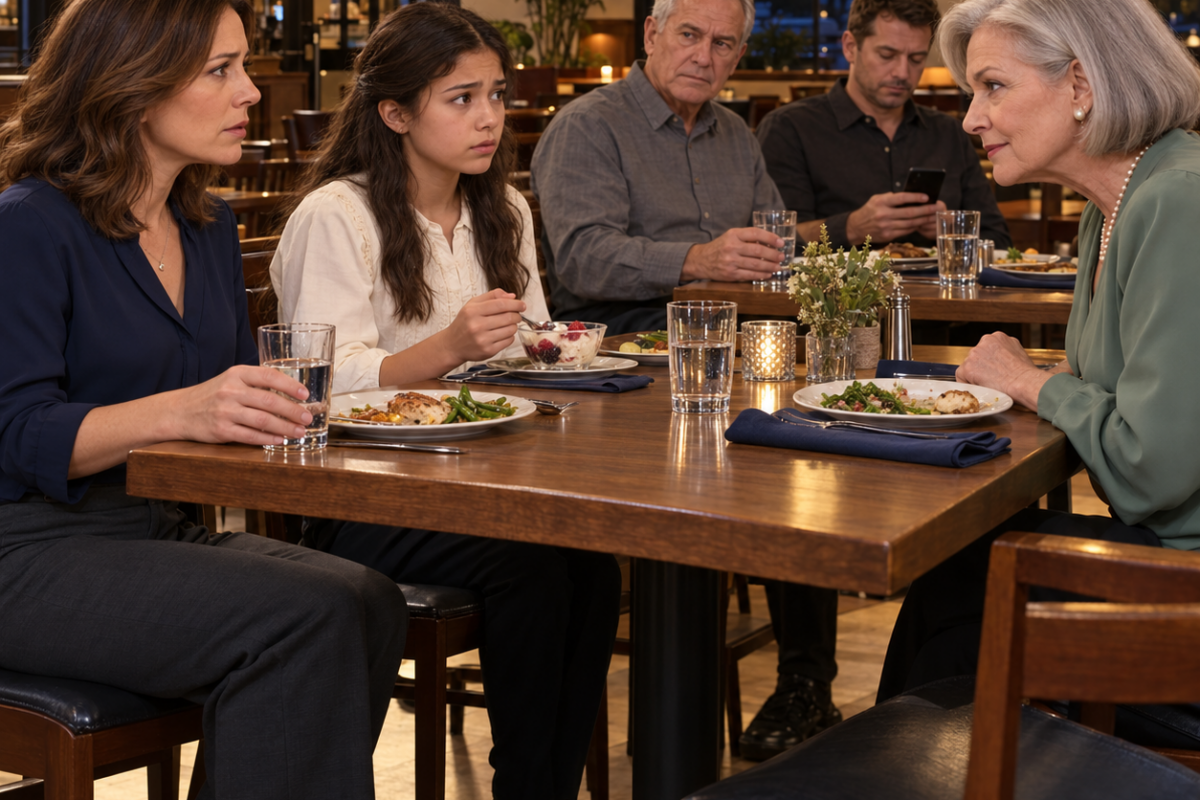
My mother leaned across the restaurant table, looked at my thirteen-year-old adopted daughter, and whispered, “We don’t sit with mistakes.” I took Sole’s hand and walked her out. That night, my father texted, “You’re still making the car payment tomorrow, right?” By midnight, I had canceled the payments I’d been making for my family. Then I remembered something Sole had told me about her grandmother.
My mother looked at my thirteen-year-old daughter and whispered, “We don’t sit with mistakes.” She said it softly enough to avoid attracting attention from the…
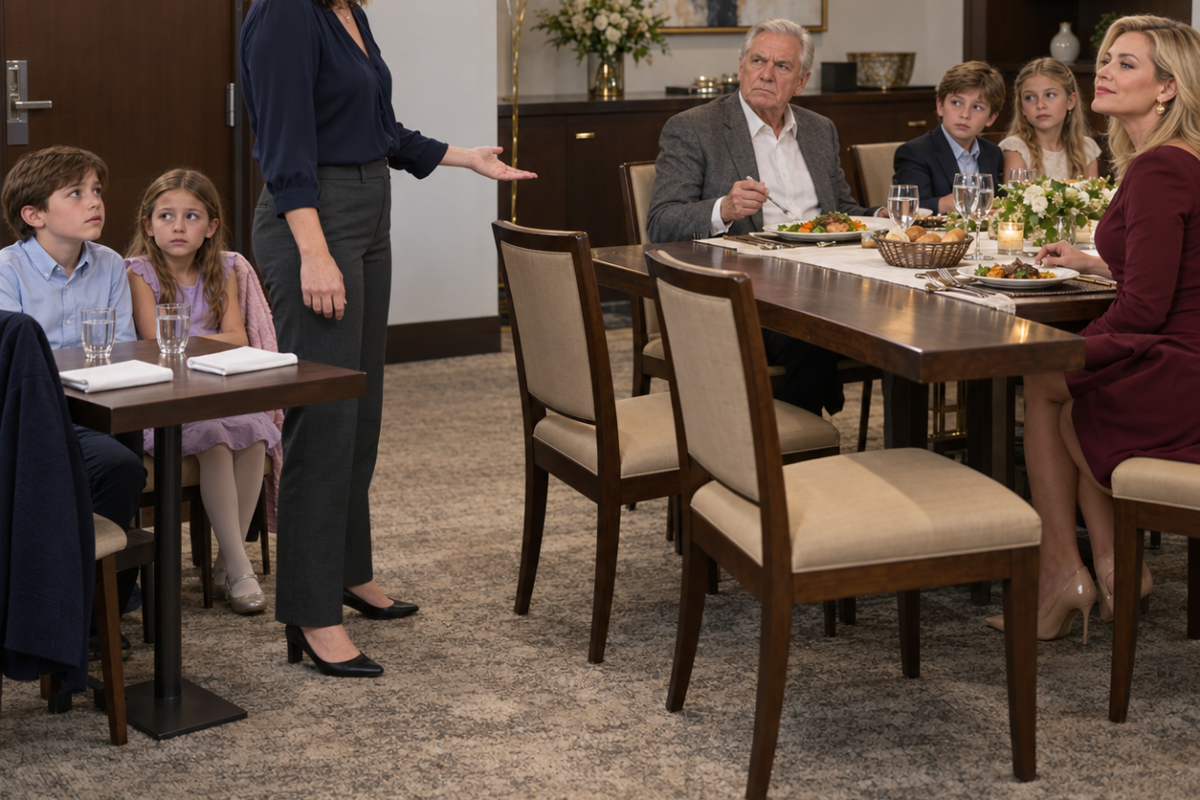
At my father’s seventieth birthday dinner, my eleven-year-old son and eight-year-old daughter were seated beside the service door with water glasses—but no dinner plates. Their cousins sat beside Grandpa with warm bread and full place settings. “They’ll eat after everyone else,” my sister said. I turned to my father, expecting him to object. “They can wait another hour,” he replied. There were two empty chairs at his table.
At my father’s seventieth birthday dinner, the first thing that stopped me wasn’t the cake or the gold balloons. It was my children. Ethan and…
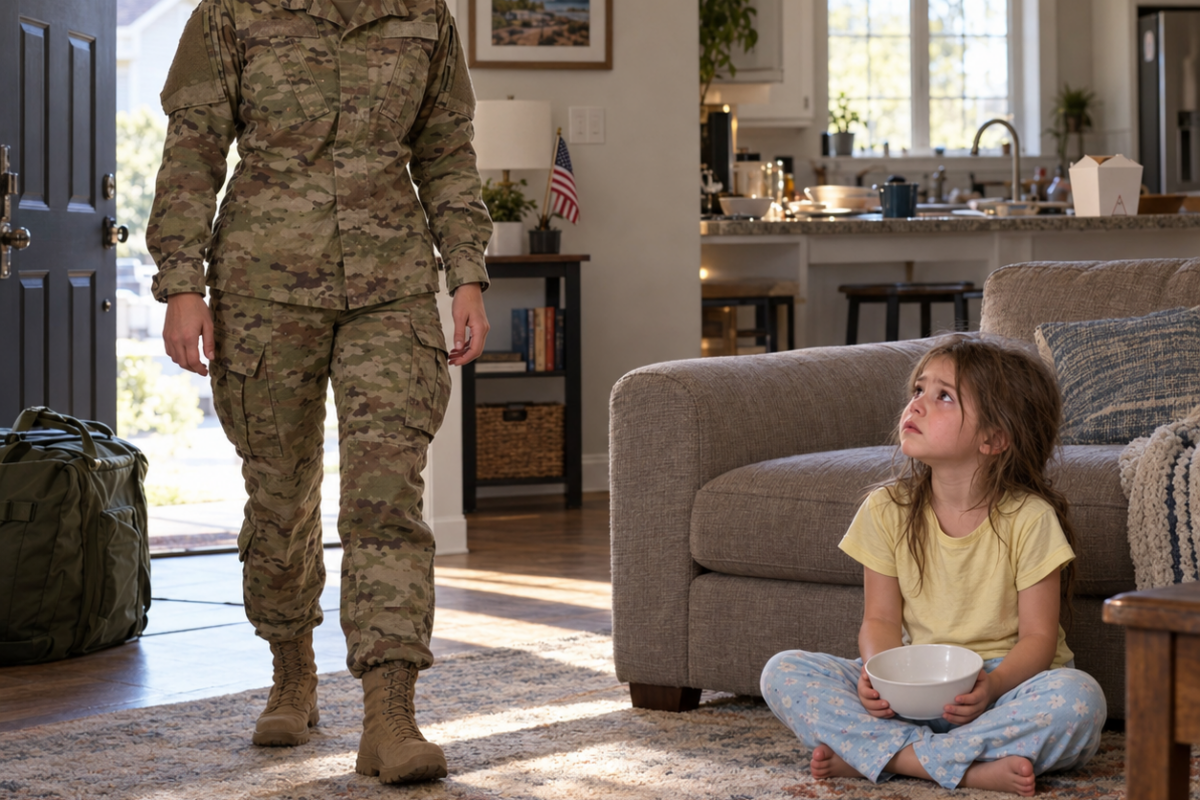
“Mommy, are you real?” my four-year-old daughter whispered when I came home from deployment three weeks early. She was sitting alone on our living room floor with an empty cereal bowl. My husband was on a Caribbean cruise with his mother and sister. Twenty-two minutes earlier, they had posted a photo captioned “Family time.” I was still in uniform when Sophie asked if she could have something to eat.
The first thing my daughter said when I found her was, “Mommy, are you real?” She was sitting cross-legged on our living room floor with…
End of content
No more pages to load