Ninety minutes before my wedding, my son’s nanny caught my arm. “Don’t go downstairs yet. You need to hear what Adrian is saying.” Still in my wedding dress, I listened behind a half-open door as my fiancé discussed taking control of my company and my house. Then he mentioned my eleven-month-old son: “If I have to play Daddy to another man’s kid for a few years, that’s a small price to pay.”
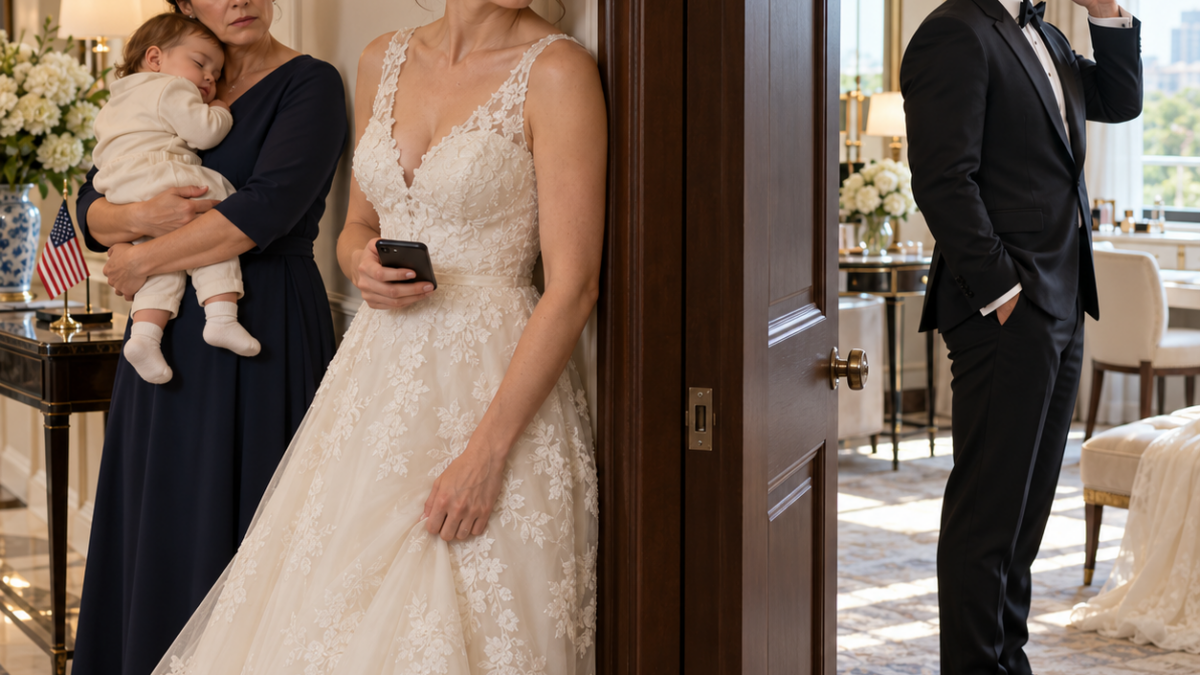
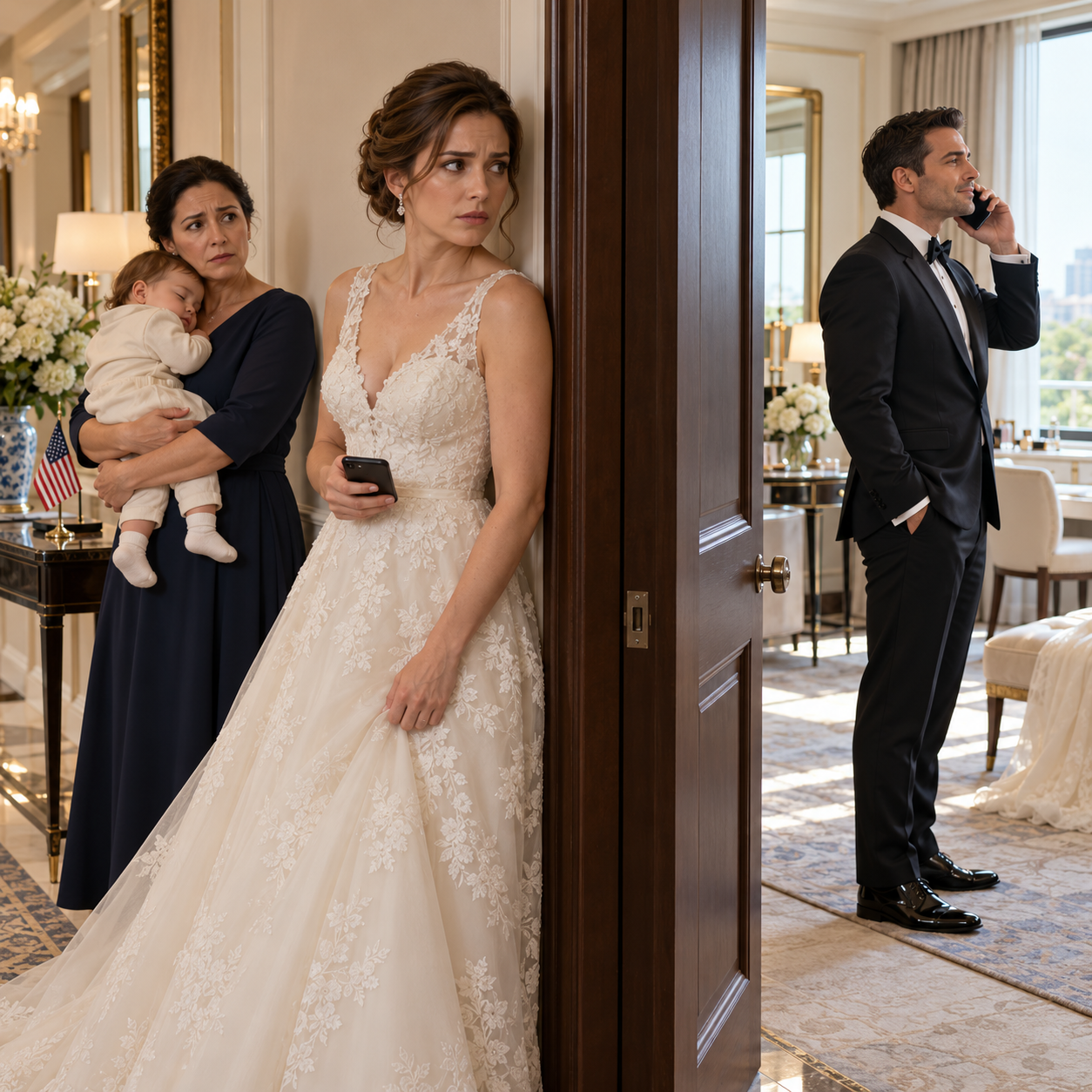
I was barefoot in the hallway outside the bridal suite of the Halcyon Hotel, wearing a twelve-thousand-dollar wedding dress and one diamond earring, when Teresa caught my wrist.
“Elena.”
Something in her voice made me stop. Teresa Alvarez had cared for my son since he was six weeks old. In eleven months, I had watched her handle fevers, delayed flights, a broken furnace, and the sort of sleepless nights that made competent adults forget their own names. She never panicked. She assessed, adjusted, and somehow made the room feel safer.
That afternoon, her face had gone gray.
Leo slept against her shoulder, one tiny fist curled around the collar of her navy dress. Beyond the tall hallway windows, the hotel garden looked almost unreal. White hydrangeas surrounded the ceremony chairs. Strings of lights hung between the trees, waiting for dusk. One hundred eighty guests had gathered to celebrate my marriage to Adrian Hayes.
My chief operating officer had flown in from Singapore. Two senators were attending. Investors representing hundreds of millions of dollars were drinking champagne on the terrace, and my aunt had spent three weeks arguing about where she would sit.
“What happened?” I asked.
Teresa glanced toward the adjoining dressing room.
“Don’t go downstairs yet.”
The orchestra was warming up below us. Somewhere inside the bridal suite, my makeup artist called out that she had found my other earring.
“Adrian is in there,” Teresa whispered.
She pointed toward the dressing room. Its door stood open barely an inch.
“He thinks you already went downstairs.”
I looked at her more closely. Her fingers were still around my wrist, and they were trembling.
“Elena,” she said, “you need to hear this.”
I moved toward the narrow opening.
Adrian’s voice came through clearly.
“I told you not to call me today.”
There was a pause, followed by an irritated breath.
“Everything changes after the wedding.”
I could see a strip of cream carpet and the corner of a mahogany dresser. I couldn’t see his face, but I knew the tone. It was the one he used with people he believed had disappointed him.
“Once the paperwork is done, Elena can’t just wake up tomorrow and decide she wants me gone.”
I stopped breathing.
“The estate is hers right now, obviously. But marriage changes things. And Sterling Developments is worth nine figures.”
He laughed.
“You seriously think I’m walking away from that?”
Teresa’s hand closed around mine.
For a moment, I tried to make what I was hearing fit some harmless explanation. Perhaps Adrian was repeating something someone else had said. Perhaps he was defending our relationship against a cynical friend. Perhaps the sentence before it would have changed everything.
Then he spoke again.
“No. I don’t love Elena the way she thinks I do.”
The music below us seemed to disappear.
“She’s useful.”
Adrian Hayes was thirty-eight years old, handsome, patient, and effortlessly charming. He knew how I liked my coffee. He had rubbed my swollen feet during the last months of pregnancy. He had stood beside me when I gave birth to a child who wasn’t biologically his.
The first time Leo reached toward him and babbled something that sounded like “Dada,” Adrian had cried.
I had held his face and told him how much that meant to me.
Now, ninety minutes before our wedding, he was describing me as useful.
The next words hurt more.
“Elena is terrified of Leo growing up without a father. She’ll forgive almost anything as long as I keep pretending we’re a family.”
My eyes moved to my son. His cheek rested against Teresa’s shoulder. A dark curl had stuck to his forehead, and his lips moved slightly in his sleep.
“Stop worrying about the baby,” Adrian continued. “He’s eleven months old. He doesn’t understand anything.”
Teresa inhaled sharply.
“And later, I’ll convince Elena boarding school is best for him. What matters is getting my name attached to the family first.”
I took out my phone. My fingers felt unfamiliar, but I managed to open the voice recorder.
There was another pause.
Then Adrian delivered the sentence that ended our wedding.
“If I have to play Daddy to another man’s kid for a few years to get control of what Elena owns, that’s a small price to pay.”
I stepped backward.
Teresa looked at me as though she was waiting for me to scream.
I didn’t.
I stopped the recording and called Claire, my wedding coordinator.
She answered immediately. “Ms. Sterling? We’re almost ready for you.”
“Cancel the ceremony.”
Silence.
“I’m sorry?”
“Do not send anyone upstairs. Do not let the officiant begin. And don’t tell Adrian yet.”
“Is someone hurt?”
I looked at Leo.
“Not yet.”
Claire’s voice changed. The cheerful efficiency disappeared, replaced by something steady and practical.
“Where are you?”
“Outside the bridal suite.”
“I’ll keep the guests occupied.”
I ended the call and reached for my son. Teresa transferred him carefully into my arms. He stirred, pressed his face against my chest, and settled again.
The smell of his baby shampoo nearly broke me.
“What are you going to do?” Teresa asked.
“Protect him.”
Her expression changed.
“There’s something else.”
I looked up.
“I found something in Leo’s nursery three nights ago.”
“What?”
“Something hidden inside his night-light.”
That was when I understood that canceling my wedding might be the smallest decision I would make that day.
Teresa locked the bridal-suite door behind us. My makeup artist and bridesmaids looked up, startled by our expressions. I asked them to give us a few minutes, and something in my voice persuaded them not to ask questions.
When they had gone into the adjoining sitting room, Teresa lowered the blinds.
“Sit down.”
“I need to know what you found.”
She studied me, then reached into Leo’s diaper bag. Beneath the wipes and spare clothes was a small clear bag containing a black object about the size of my thumb.
At first glance, it looked like a USB adapter.
“What is that?”
“I thought it was part of the baby monitor.”
She placed the bag on the vanity.
“Where exactly was it?”
“Inside the base of the wooden elephant.”
Adrian had bought that night-light. He had brought it home four months earlier, smiling as he held it up beside Leo’s crib.
Every room needs something cheerful, he had said.
“It has a microphone,” Teresa told me. “And a memory card.”
“How do you know?”
“My nephew repairs electronics. I asked him to look at it.”
I stared at her.
“He only opened enough to identify it,” she added quickly. “When he realized there were recordings, he said we needed professional help.”
“Did he listen?”
“Briefly.”
“To what?”
Teresa looked at Leo.
“Enough to become frightened.”
The nursery was the one place in my house where I felt completely unguarded. I took business calls there while rocking my son. I spoke to Naomi, my attorney. I discussed acquisitions, staffing problems, and family matters.
Sometimes, during the lonely hours before sunrise, I talked aloud to my mother.
My mother had died seven years earlier. My father had been gone almost twelve. I had no siblings that I knew of, and I had spent much of my adult life treating independence as proof that I was strong.
That afternoon, holding my baby beside a hidden recording device, independence felt terribly close to isolation.
A knock sounded at the door.
“Elena?”
Adrian.
Teresa went motionless.
He tried the handle.
“I thought you were downstairs.”
Leo made a small sound against my chest.
Adrian stopped knocking.
For several seconds, we stood in silence.
“Baby? Are you in there?”
I crossed the room and opened the door a few inches.
Adrian stood outside in his tuxedo, wearing the gold cuff links I had given him for his birthday. For one sickening second, he looked exactly like the man I loved.
“There you are.”
He leaned toward me. I shifted Leo, avoiding the kiss.
“Why aren’t you downstairs?”
“He got fussy.”
“You know Teresa can handle him.”
“I wanted a minute.”
Adrian looked past me. Teresa stood beside the window, her hands clasped so tightly that her knuckles had turned pale.
“You okay, Teresa?”
“Yes.”
His gaze lingered on her before returning to me.
“Claire is looking for you.”
“I’ll be down soon.”
He reached toward Leo. I moved back before his hand touched my son.
The movement was small, but Adrian noticed.
“What’s wrong?”
“My dress is tight. I’m tired.”
He gave a soft laugh.
“You’ve been planning this day for a year.”
Actually, Adrian had planned much of it. He had insisted on handling the license appointment, arranging the honeymoon, and discussing what he called the practical adjustments of becoming a family.
Insurance. Estate planning. Adoption.
He had brought up adoption so gently that I had cried.
Now I remembered every conversation differently.
“I need to finish getting ready,” I said.
For a moment, he simply watched me.
Then the familiar smile returned.
“I’ll see you at the altar.”
He touched two fingers to his lips and rested them against my shoulder.
I waited until his footsteps disappeared before locking the door.
Teresa let out a breath.
I stood still, listening to the silence he had left behind.
“He’s not touching Leo again,” I whispered.
My personal attorney, Naomi Chen, arrived twenty-one minutes later through the service entrance. She was forty-six, barely five feet tall, and had spent years making powerful people regret underestimating her.
She entered carrying a laptop.
One look at my face and she skipped the usual greetings.
“Tell me.”
I played the recording from the hallway.
Naomi listened without interrupting. When Adrian’s final sentence ended, she took off her glasses and placed them beside her laptop.
“You’re certain you heard the earlier statements yourself?”
“Yes. Teresa did too.”
“Have you signed anything today?”
“No.”
“Any document this week that you didn’t review?”
“No.”
She turned toward Teresa.
“Tell me about the device.”
Teresa explained where she had found it, when she had removed it, and what her nephew had done. Naomi asked careful questions, recording the answers in a notebook.
I could barely tolerate the pace.
“Can we listen to it?”
“We can preserve it first.”
“What if there’s something on it about Leo?”
“That is exactly why we shouldn’t damage or alter it.”
She reached for her phone.
“I’m calling Owen.”
Owen Pike worked for a cybersecurity firm Sterling Developments had used during two acquisition disputes. Naomi called him from the suite, then contacted Daniel Reeves, my head of security.
Daniel had been a detective before entering private security. He was quiet, observant, and never impressed by a person’s title.
Naomi gave him our location and asked him to coordinate with hotel management.
Then she looked at me.
“We need to keep you and Leo safe. We also need to establish what we actually know.”
“I know Adrian was planning to use my son.”
“Yes.”
“And marry me for money.”
“Yes.”
“Then what else is there?”
Naomi glanced at the device.
“Whether he was acting alone.”
The room seemed to become smaller.
Downstairs, one hundred eighty people were waiting to watch me promise my life to a man who had been counting what that promise might buy him.
Owen arrived carrying a compact equipment case. He photographed the device as it had been handed to him, documented its condition, and worked from a copy rather than the original storage.
While he worked, I changed Leo’s diaper on a folded hotel towel. He woke fully and began reaching for the gold bracelet on my wrist.
My mother’s bracelet.
I had chosen it that morning because I wanted something of hers with me.
Leo pulled it, pleased by the sound of the links.
“Careful,” I murmured.
He smiled.
I had almost given this child to a man who considered him a temporary inconvenience.
Owen looked up.
“There are a substantial number of audio files.”
“How long?”
“The timestamps go back several months. We’ll need to verify them independently, but the sequence appears consistent.”
He played a short file.
Leo crying.
Teresa singing softly in Spanish.
My voice asking whether his fever had gone down.
Then Adrian, warm and reassuring.
“You’ve got your mom’s eyes, buddy.”
I turned away.
It was unbearable to hear tenderness now that I knew how easily he could manufacture it.
Owen moved through selected files, looking for longer adult conversations. The process was incomplete and hurried, but soon he found a recording from an evening I remembered.
I had been sitting in the nursery, discussing a deal.
“Naomi thinks Wilmington could close by September,” my recorded voice said.
Adrian answered, “That’s what, thirty million?”
“Twenty-eight.”
“Not bad.”
“You sound disappointed.”
“I’m kidding.”
The file ended.
In the next recording, the nursery door shut. Adrian spoke quietly.
“Did you get that?”
A man answered through his phone speaker.
“Yes. We need more than deal values.”
“I know.”
“Board strategy. Voting plans. Anything involving the trust.”
I looked at Naomi.
“What trust?”
She didn’t answer.
The man continued.
“The marriage has to happen first.”
“It will.”
“And the boy?”
Adrian sighed.
“Elena won’t separate herself from him voluntarily.”
“So we deal with that later.”
Teresa pressed a hand to her mouth.
Then the other man said, “Malcolm wants this finished before fourth quarter.”
I recognized the name immediately.
Malcolm Price had been my chief financial officer for nine years.
He had helped take Sterling Developments from a regional business valued at twenty-three million dollars to a company worth more than four hundred million.
He had sat beside me at my mother’s funeral.
He had been one of the first people I told about my pregnancy.
He was downstairs, sitting in the second row at my wedding.
Naomi paused the recording.
“Don’t jump ahead,” she said.
But I was already remembering things.
Malcolm introducing Adrian at a charity dinner.
Malcolm telling me that I deserved someone who could share the burden of my life.
Malcolm encouraging me not to let fear keep Leo from having a father.
At the time, I had heard concern.
Now I heard coordination.
I called Daniel.
“I need Adrian and Malcolm watched.”
“Watched how?”
“Discreetly. Keep them away from Leo and from this suite.”
“Understood.”
“And if they try to leave—”
“We can observe and inform the police,” Daniel said. “Hotel security can protect restricted areas. We cannot invent authority we don’t have.”
I closed my eyes.
“Right.”
He softened his voice.
“You don’t need to manage this alone, Elena.”
Owen found another recording.
The timestamp read March 18.
I remembered that night because Leo had been teething and I had fallen asleep on the nursery sofa.
A door opened in the recording.
Then Adrian spoke into his phone.
“I checked the documents she keeps in the study.”
This time, the answering voice was unmistakable.
Malcolm.
“She hasn’t changed the succession structure.”
“What does that give us?”
“Less than we hoped. Her current company documents are restrictive.”
Adrian exhaled.
“Then what are we doing?”
“Marriage gives you a position in the family. Adoption could give you more.”
My hands tightened around Leo.
Malcolm continued.
“If something happens to Elena, a surviving legal parent has a stronger argument than a boyfriend.”
Naomi leaned closer to the computer.
“Who’s controlling the older trust?” Adrian asked.
“That’s what we still need to establish.”
There was a pause.
Then Adrian said, “We’re not doing anything stupid.”
Malcolm laughed.
“You’ve developed morals?”
“I’m serious.”
“Relax. No one is asking you to do anything today.”
Owen stopped the recording.
Nobody spoke.
Finally, I looked at Naomi.
“What older trust?”
“I don’t know yet.”
“You handle my estate.”
“Your current estate. Your parents could have created something separately, with different trustees and records.”
“My father left me the house and an investment portfolio. My mother left jewelry and cash. There wasn’t a hidden fortune.”
Naomi held my gaze.
“Then we find out why they believe there was.”
Owen played another file.
Adrian was speaking to a woman.
“I checked Elena’s office.”
“And?”
“Nothing.”
“Then Teresa may have it.”
Beside me, Teresa became perfectly still.
“Why would the nanny have it?” Adrian asked.
“Because Gabriel trusted her.”
The name seemed to strike the room physically.
Gabriel Cross was Leo’s biological father.
He had disappeared when I was fourteen weeks pregnant. His final email had told me he wasn’t ready to become a husband or father.
I had called. Written. Contacted friends. Hired someone to try to locate him.
Eventually, after months of silence, I had accepted what everyone told me: some men ran when life became real.
Teresa had held Leo while I cried over Gabriel.
Now she couldn’t look at me.
“Why would Gabriel trust you?” I asked.
She lowered her eyes.
“Elena.”
“Answer me.”
Tears gathered along her lower lashes.
“Because he is my son.”
For a moment, I thought I had misunderstood her.
Then she repeated it.
“Gabriel Alvarez Cross is my son.”
I stood so quickly that Naomi reached for my elbow.
“You told me you didn’t know him.”
“I lied.”
“You came into my house six weeks after Leo was born.”
“Yes.”
“You let me tell you his father abandoned us.”
Teresa began crying.
“I didn’t believe he had.”
“Then why didn’t you tell me?”
“Because before he disappeared, he said people were looking for what he had found. He made me promise—”
“Don’t tell me you were protecting me by lying.”
She stopped.
Leo began fussing, responding to the strain in my voice.
I kissed his forehead and forced myself to breathe.
Teresa watched us with an expression I suddenly understood. I had mistaken it for professional affection. It was something older and deeper.
My son’s grandmother had been living in my house.
“Do you know where Gabriel is?”
“No.”
“Did you ever?”
“No.”
“Is he alive?”
“I don’t know.”
That answer hurt more than I expected.
Teresa took a thin chain from beneath the neckline of her dress. A small brass key hung from it.
“The last time I saw him, he gave me this.”
“What does it open?”
“He wouldn’t tell me. He said you might know.”
“Why didn’t you bring it to me?”
“Because I was frightened. Because I kept thinking I could learn enough to explain everything safely.”
She looked at Naomi, then back at me.
“And because I made a terrible decision and kept making it every day afterward.”
It was the first thing she had said that didn’t sound like an excuse.
Naomi pulled another chair closer.
“Start at the beginning.”
Teresa wiped her face.
“Gabriel worked with financial records connected to Vantage Meridian.”
I knew that name.
Vantage Meridian had collapsed fifteen years earlier under allegations of fraud, manipulated land values, hidden partnerships, and questionable redevelopment deals.
Malcolm had always claimed he was a junior executive there who left before the worst happened.
“Gabriel found records people believed had been destroyed,” Teresa continued. “He said your father’s name was in them.”
My father had been an accountant. He had called his career boring corporate work and refused to discuss it at dinner.
“What records?”
“Land holdings. Ownership arrangements. Money that had moved through companies with different names.”
“Did Gabriel know Malcolm?”
“Yes.”
Before Naomi could ask another question, my phone rang.
Claire.
“The guests are getting restless,” she said. “I’ve told them we have a technical delay. Adrian wants to come upstairs.”
“He can’t.”
“I’ve asked him to stay near the garden.”
I looked at the clock.
There was less than an hour until the ceremony we had planned.
I had spent months imagining how I would feel when the garden doors opened.
I had never imagined standing behind them wondering whether the man waiting at the altar had been helping plan my disappearance.
“Claire,” I said, “I need the garden microphone available.”
Naomi looked sharply at me.
“Elena.”
“I’m not marrying him.”
“I know.”
“I’m also not letting him tell everyone I became hysterical and canceled because I was frightened.”
“You don’t have to defend your decision to an audience.”
“No. But I want to make it in front of the audience he chose.”
Naomi studied me for a long moment.
Then she said, “Leo stays here. Daniel assesses the situation first. And you do not improvise accusations beyond what you heard.”
I nodded.
I wasn’t looking for an arrest at the altar. I wanted the wedding stopped clearly, before Adrian could turn it into another private conversation in which he persuaded me to doubt myself.
Claire arranged for the officiant to be told the ceremony would not proceed. Daniel coordinated with hotel management and the officers Naomi had contacted. Nobody promised that the recordings automatically proved every fear we had.
But they proved enough for me.
I handed Leo to Teresa.
He reached back toward me, and I kissed his fingers.
“I’ll be right back.”
At 4:38, the music began.
I stood behind the garden doors holding a bouquet I no longer wanted.
Naomi waited behind me. Daniel was positioned near the side aisle. Leo remained upstairs with Teresa and a hotel security officer outside the suite.
The doors opened.
One hundred eighty people stood.
Sunlight fell across the aisle. Faces turned toward me, smiling with the expectation people bring to weddings. My aunt dabbed at her eyes. My chief operating officer gave me an encouraging nod.
Adrian waited beneath the arch.
He looked happy.
That was almost the worst part.
Had I not stopped in that hallway, I would have walked toward him believing the expression on his face.
I reached the front.
He extended his hands.
I kept mine around the bouquet.
His smile faltered.
“Elena?”
The officiant looked at me, waiting for the signal we had agreed upon.
I turned toward our guests.
“I’m sorry to ask for your attention under these circumstances.”
A small ripple moved through the chairs.
Adrian leaned closer.
“What are you doing?”
“I am not getting married today.”
The garden went still.
“I learned something this afternoon that makes it impossible for me to make the promises we invited you here to witness.”
Adrian’s hand closed around my wrist.
I looked down at it.
“Let go.”
He released me.
“Elena, we should talk privately.”
“We already had private conversations. I simply wasn’t included in yours.”
I nodded toward Claire.
The recording from the hallway played through the speakers.
Adrian’s voice filled the garden.
“If I have to play Daddy to another man’s kid for a few years to get control of what Elena owns, that’s a small price to pay.”
Nobody laughed.
Adrian stared at the speakers, then at me.
“You recorded me?”
“I heard you.”
“You don’t understand the context.”
“Then explain the context in which my son is a price you’re willing to pay.”
He opened his mouth.
Nothing came out.
The first recording continued briefly, including his claim that I would forgive almost anything if he pretended we were a family.
My aunt lowered her handkerchief.
Somewhere near the back, a chair scraped against the grass.
I did not play the nursery recordings. Those involved my child’s private space, business information, and people whose roles still needed to be investigated.
I had heard enough of my life through speakers.
“This ceremony is canceled,” I said. “Claire will help with arrangements for anyone who needs them. Please respect my son’s privacy.”
Adrian stepped toward me.
“I love you.”
Behind him, Malcolm stood.
Daniel moved into the aisle, keeping a clear distance.
Malcolm looked at Adrian with a flash of contempt so naked that several people saw it.
“You idiot,” he said.
The words carried.
Adrian turned toward him.
There was no confusion in that look.
Only recognition.
I set my bouquet on the officiant’s table.
Naomi came forward.
Adrian started to speak again, but I was already walking away.
The garden doors closed behind us.
For the first time all afternoon, I let myself cry.
I didn’t cry gracefully. I bent forward in the service hallway, pressing a hand over my mouth while Naomi stood beside me and waited.
“I almost married him,” I said.
“You didn’t.”
“I almost gave him Leo.”
“You didn’t.”
“I believed him.”
Naomi rested her hand between my shoulders.
“Believing someone who works hard to deceive you is not the same as agreeing to be deceived.”
I wanted that sentence to make me feel better.
It didn’t.
But it gave me something to hold while I walked upstairs.
Teresa stood when I entered.
Leo was awake, chewing the corner of his blanket.
I took him from her and pressed my face against his hair.
For a few seconds, the world narrowed to his warm weight in my arms.
Then I looked at Teresa.
“I’m grateful you stopped me.”
Her eyes filled.
“But we are going to talk about every other thing you didn’t tell me.”
“I know.”
“And you won’t decide what I can handle again.”
“No.”
That evening became a sequence of practical decisions made through shock.
My dress came off. Someone brought a blouse and trousers. I found the missing diamond earring beneath a folded towel and placed both earrings in a hotel envelope.
Adrian and Malcolm were interviewed separately after agreeing to speak with officers at the hotel. Neither was arrested that evening. Both eventually asked for attorneys.
Malcolm also requested that I call him.
I refused.
Naomi contacted Sterling’s board chair and general counsel. They began arranging a lawful preservation of relevant company records and a temporary suspension of Malcolm’s access while the allegations were assessed.
I authorized what I could authorize and stopped where I couldn’t.
There were employees expecting paychecks, tenants expecting repairs, and projects that had nothing to do with the man sitting downstairs in a rented tuxedo.
Daniel arranged for my home to be checked before we returned. Adrian had been staying there, and removing him required more than my anger. Naomi handled the immediate arrangements, documented the situation, and made sure we had a safe place to stay while access and belongings were addressed.
Then she looked again at Teresa’s key.
A tiny number had been engraved into its head.
314.
Something familiar stirred.
“My first office,” I said.
Naomi turned toward me.
“Suite 314.”
Sterling Developments had begun in a tired commercial building on West Monroe Street. I had been twenty-three, full of confidence, and so inexperienced that I didn’t understand half the things I was frightened of.
My father had occasionally worked there with me before he died.
We still owned the building. Suite 314 had become storage because I could never persuade myself to renovate the room completely.
At 7:12 that evening, we went there.
I wore sneakers beneath trousers someone had bought from the hotel boutique. Teresa carried Leo. Daniel remained near the entrance while Naomi and I entered the old office.
It smelled of dust, wood polish, and paper.
My first desk stood beneath the window. A faded mark on the wall showed where a framed development plan had once hung.
I remembered my father standing beside that desk, telling me that a building was never just a building.
Someone works there. Someone sleeps there. Someone owes money on it. Remember the people inside the numbers.
I had used that advice for years.
Now I wondered what had taught it to him.
The brass key didn’t fit the desk.
It didn’t fit the filing cabinet.
Then Teresa noticed a small plate beside the radiator.
“There.”
A narrow section of paneling had a lock so discreet I had never recognized it as a lock.
The key turned.
Inside was a metal box containing a letter, a sealed envelope, and an old flash drive.
My father’s handwriting covered the envelope.
Elena.
I sat at the desk before opening it.
The first sentence made my stomach tighten.
If you are reading this, the past has reached a part of your life I hoped it would leave alone.
I read slowly.
Years before I founded Sterling Developments, my father had worked with Vantage Meridian. He had helped establish ownership structures he believed were ordinary arrangements for redevelopment investments.
Then he discovered what lay beneath them.
Distressed properties. Manipulated valuations. Owners pushed into defaults. Profits concealed through layers of companies.
He admitted that he had been useful before he understood to whom.
The resemblance to Adrian’s description of me made my skin crawl.
My father had copied records when he tried to leave. Malcolm Price, he wrote, had threatened to make sure that leaving damaged both his career and his family.
So my father had retained documents and worked with outside advisers to secure certain ownership interests held in his name.
There was no triumphant language in the letter.
He sounded ashamed.
I should have been more careful before I agreed to things I did not fully understand. I should have spoken sooner after I did.
Naomi read over my shoulder.
My father described a trust holding disputed and undisputed assets connected to the old network. He had not intended to treat money belonging to others as a family prize. The documents required independent review of claims, liabilities, and rightful ownership.
After that process, the beneficial interests remaining were to pass according to the trust’s terms.
I turned the page.
You are an intermediate beneficiary under specific conditions. Your first biological child is the ultimate beneficiary.
Everyone looked at Leo.
He was chewing the ear of his stuffed rabbit.
For a moment, the contrast was so absurd I nearly laughed.
Then I remembered Adrian discussing boarding school.
Naomi opened the sealed summary and found contact information for a trustee and records custodian. The papers were old. They didn’t tell us what the assets were worth now, whether every entity still existed, or what obligations remained.
But they identified a structure.
The Cross-Sterling trust.
“There’s the name,” Naomi said quietly.
“What does Cross have to do with it?”
She looked at Teresa.
Teresa shook her head.
“I don’t know enough.”
Owen later helped preserve the flash drive. That evening, we watched only the files Naomi believed we could safely open from a protected copy.
One was a video.
My father appeared against the wall of the same office.
He looked thinner than I remembered, but his voice was unmistakable.
“Elena.”
I covered my mouth.
For twelve years, I had remembered his voice imperfectly. Hearing it suddenly, in an ordinary room with an ordinary radiator behind him, was almost unbearable.
He explained some of what he had written.
Then he held up a photograph.
A young man with dark hair and gray eyes.
Gabriel.
Teresa made a sound beside me.
My father identified him by his full name: Gabriel Alvarez Cross.
“He found part of the same network through records that passed into his father’s estate,” my father said. “He is younger than he should be for the responsibility he has inherited.”
I stared at the screen.
Gabriel had known my father.
Years before he met me.
My father continued.
“I asked him not to bring this to your door unless he had to. If he does, listen carefully. Then obtain independent advice. Do not substitute trust in a person for understanding what they are asking you to do.”
The video ended.
For a while, I couldn’t speak.
Then I turned to Teresa.
“He knew who I was when we met.”
“Yes.”
“You knew that too.”
“Yes.”
I remembered the charity dinner where Gabriel spilled sparkling water on my sleeve, apologized three times, and made me laugh so hard I stopped being annoyed.
We had talked for two hours.
He had asked about a boarded-up library I wanted to convert into affordable apartments. Unlike most people at that dinner, he seemed interested in the project rather than the value of the land beneath it.
“Was it arranged?” I asked.
Teresa looked directly at me.
“He recognized you. He didn’t expect to meet you there.”
“How do you know?”
“He called me that night.”
“What did he say?”
Her face softened through the tears.
“He said he had met the one person he had promised not to go near.”
I closed my eyes.
“And then?”
“He stayed away for three weeks.”
I remembered those weeks too. I had thought he wasn’t interested.
“He finally called,” Teresa said, “because he wanted to know you. He told himself the past was far enough behind him.”
“And then I got pregnant.”
She nodded.
“And the past stopped being past.”
We left the office after dark.
Daniel drove. Naomi made calls. Teresa sat beside Leo’s car seat, watching his chest rise and fall.
I stared out the window at streets I knew.
People were leaving restaurants. A man walked a dog beneath an umbrella. A teenager carried a pizza box toward an apartment building.
I wanted, with an intensity that embarrassed me, to borrow one of those ordinary lives for an hour.
Instead, I went to a secure apartment Naomi had arranged and lay awake beside my son’s travel crib.
At three in the morning, Leo woke hungry.
I fed him while sitting on the edge of a bed that smelled like hotel detergent.
He rested his hand against my throat.
I looked down at him and understood something I had been trying not to understand.
The men involved had not merely misjudged me.
They had studied me.
They knew that I was lonely. They knew that I missed my parents. They knew that Gabriel’s apparent abandonment had made me frightened for my son.
They had used the tenderest parts of my life as a set of instructions.
Forty-eight hours later, investigators began finding the connection to Gabriel’s disappearance.
The information did not arrive in a single dramatic folder. It came through records, interviews, preservation requests, and documents obtained under proper legal authority.
A photograph showed Gabriel beside a black SUV.
A message connected to Adrian read: FOUND HIM.
Another referred to my pregnancy.
Malcolm’s response was short.
Then move now.
There were payments to a private investigator, addresses, and communications that became increasingly guarded.
One message said Gabriel would not cooperate.
Another, sent shortly before the email I received, said he was gone.
Nobody could tell me what gone meant.
Adrian was arrested four days after the canceled wedding on charges connected to the developing investigation. Malcolm followed after investigators found evidence linking him to concealed financial transfers and the surveillance arrangement.
The charges changed as the case expanded.
I stopped asking Naomi to summarize everything over the phone. I needed written explanations I could read twice, because my mind kept confusing what was alleged with what had been established.
The news moved faster than I could.
Photographs from the wedding appeared online. Reporters called the office, the hotel, and people who had once met me at fundraising dinners.
Sterling Developments’ share price fell eleven percent as the scandal reached the market. Three board members resigned. Twenty-seven reporters requested interviews in the first wave alone.
I gave none.
Our board appointed interim financial leadership and commissioned an independent review. My chief operating officer postponed her return to Singapore and worked beside our general counsel to keep the business functioning.
I spoke to employees in a brief internal meeting.
I told them what I could confirm, what I couldn’t discuss, and that payroll and ordinary operations were being protected.
One project manager asked whether the Wilmington deal would still close.
I almost cried at the normality of the question.
“We’re reviewing it,” I said. “Your team will hear from us directly.”
At home, normal questions were harder.
What should Leo eat?
Where had his spare pajamas gone?
Was the noise outside a delivery or a reporter?
Did I want Teresa to stay?
That last question had no simple answer.
I was furious with her. I was grateful to her. I trusted her with Leo’s routines and distrusted her judgment about the truth.
Those feelings didn’t cancel each other.
Naomi helped us arrange a clear conversation without the urgency of the wedding day.
Teresa sat across from me at the kitchen table.
“I need to know whether there is anything else,” I said.
She placed a notebook between us.
She had written down dates, conversations, and everything Gabriel had told her that she could remember.
“I won’t decide which parts matter,” she said. “You can read all of it.”
“Why did you remove the device and wait three days?”
“I wanted to know whether Adrian would notice it missing. I thought if he noticed, I would know he was responsible.”
“You conducted an experiment in my house.”
She lowered her eyes.
“Yes.”
“With my child there.”
“Yes.”
I pushed the notebook away for a moment.
Teresa did not ask me to comfort her.
“I thought I was being careful,” she said. “I understand now that I was making decisions you had the right to make.”
It didn’t repair everything.
But it allowed us to begin speaking honestly.
I asked her to stay under a revised arrangement while we worked through the next steps. She was Leo’s grandmother. She was also still a person who had deceived me.
Both parts would need time.
Two weeks after the wedding, Daniel called at 6:13 in the morning.
“Elena.”
I sat up before he said anything else.
“We found the private investigator Adrian used.”
“And?”
“He kept records.”
“Daniel.”
“There’s an address in Vermont.”
I gripped the phone.
“For Gabriel?”
“A man matching his description has been receiving treatment near Burlington.”
My heart seemed to stop, then race.
“Is he alive?”
“We believe so. The identification needs confirmation.”
Teresa appeared in my doorway, having heard my voice.
Daniel continued carefully.
“There was a car crash. Serious injuries. He was admitted under another name.”
I looked at Teresa.
She put one hand over her mouth.
“Why didn’t he come home?” I asked.
Daniel was silent for a moment.
“His medical condition may be part of the answer.”
The man at the rehabilitation center was known as Andrew Cole.
He had suffered severe head trauma and significant memory impairment. When he was first admitted, his identity had been uncertain.
Later, someone had appeared with documents, financial arrangements, and a claim to be his brother.
Adrian Hayes.
The facility had followed procedures based on information investigators now believed was false. The details would require careful examination: who had known what, which documents had been accepted, and where ordinary mistakes had become deliberate concealment.
I didn’t need every answer before going.
Teresa came with me.
Leo remained at home with someone Naomi and I trusted, supported by Daniel’s security team. I couldn’t bring my baby into a reunion whose outcome I didn’t understand.
The rehabilitation center had a garden overlooking water. A staff member led us along a path bordered by late-season flowers.
A man sat beneath a maple tree with a book open on his lap.
He was thinner.
A scar crossed the area above his left eyebrow.
But it was Gabriel.
Teresa stopped walking.
For a moment, I thought her legs would give way.
“My baby,” she whispered.
He looked up.
Confusion moved across his face.
Then he stood.
“Mom?”
Teresa made a sound I will never forget.
She crossed the grass and wrapped her arms around him. He held her tightly, his book dropping onto the bench.
I remained on the path.
My body shook so badly I pressed my hands together.
Gabriel looked past his mother.
His eyes found me.
“Elena?”
I had imagined finding him in so many ways.
Angry. Indifferent. Married to someone else. Embarrassed to see the woman he had abandoned.
I had never imagined this.
He walked toward me slowly.
“You’re real.”
I laughed through tears.
“So are you.”
He reached toward my face, stopped as though uncertain whether he was allowed, and lowered his hand.
“I tried to remember where you were.”
“I thought you left.”
His expression changed.
“No.”
“They sent me an email from you.”
“I didn’t send it.”
“I know.”
He looked at my face with a kind of frightened urgency.
“The baby.”
I began crying again.
“You remember?”
“Some things. Not everything.”
His voice broke.
“I remember you telling me.”
I opened a photograph on my phone.
Leo was asleep with one hand beneath his cheek.
Gabriel stared.
For several seconds, he didn’t move.
“That’s my son?”
“Yes.”
He sank onto the bench.
I sat beside him.
“What’s his name?”
“Leo Gabriel Sterling.”
Gabriel covered his face.
Teresa sat on his other side, holding his shoulder while he cried.
I had carried so much anger toward him that I didn’t know where to put it now.
Some of it belonged to a man who had never abandoned me.
Some belonged to a man who had kept important truths from me before anyone hurt him.
I took his hand.
“I’m relieved,” I said. “I’m also angry about things you didn’t tell me.”
He nodded.
“You should be.”
The simplicity of that answer steadied me.
No explanation about protecting me. No insistence that I should be grateful for his intentions.
Just an acknowledgment.
We stayed for two hours.
A clinician explained what Gabriel could manage, what remained difficult, and why emotional intensity could exhaust him even when he appeared physically well.
I didn’t ask her to predict whether he would become exactly the man I remembered.
I asked what he needed now.
When we left, Gabriel walked us to the edge of the garden.
“I want to meet him,” he said.
“We’ll arrange it.”
“And you?”
I looked at him.
“I’m here.”
He nodded, accepting that answer without asking it to mean more.
Gabriel came to the estate six weeks later, after arrangements had been made with his treatment team. He moved into the guesthouse and continued rehabilitation.
He did not move into my bedroom.
He did not become Leo’s father through a dramatic announcement in front of strangers.
He met his son in the nursery on an ordinary afternoon.
Teresa sat near the window. I held Leo until Gabriel settled into the rocking chair.
“Ready?”
Gabriel nodded, though his hands were trembling.
I placed Leo in his arms.
For a moment, both of them simply stared.
Then Leo reached up and touched the scar above Gabriel’s eyebrow.
Gabriel laughed softly.
“Hey, little man.”
Leo grabbed his nose.
We all laughed.
Gabriel adjusted his hold carefully.
“I’m your dad,” he whispered.
Leo responded by pulling at his shirt collar.
After a few minutes, Gabriel looked at me.
“Would you take him? My arms are getting tired.”
I did.
That request meant more to me than a dozen declarations of strength.
He was learning what he could safely do, and he cared more about our child than about appearing capable.
Over the next weeks, fatherhood became a series of small lessons.
Where the bibs were kept. How Leo preferred his food cut. Which song made him settle. Why a baby could laugh at the same dropped spoon seven times.
Gabriel missed things. He became tired. Sometimes noise overwhelmed him, and he needed to step outside.
We adapted.
Teresa helped without pretending she could erase what had happened. I learned not to treat every difficult afternoon as proof that happiness was slipping away again.
Gabriel learned that I no longer wanted reassurance without information.
If he was worried, he told me what worried him.
If he didn’t remember, he said so.
One evening, he sat beside me on the terrace while Leo slept indoors.
“I thought silence would keep you separate from it,” he said.
“From Vantage?”
“Yes.”
“It didn’t.”
“I know.”
“You should have let me decide what to do with the truth.”
He looked down at his hands.
“I know that too.”
We stayed outside until the lights came on across the grounds.
There were things love could not fix.
There were also things honest conversation could begin to repair.
The legal case widened over the following months.
Investigators identified twenty-three companies connected to the financial arrangements under review. Four former Vantage executives were indicted. Two public officials resigned as separate inquiries examined their conduct.
The trust records required their own investigation.
The figure Naomi eventually brought me was larger than anything I had expected.
“Current estimated holdings are approximately two point eight billion dollars.”
I sat back in my chair.
“That can’t be right.”
“It is a valuation, not cash sitting in an account. There are different assets, restrictions, claims to review, and obligations. But yes, the scale is real.”
I looked toward the playroom.
Leo was banging a wooden spoon against a toy saucepan.
“What does it mean for him?”
“That depends on the final verified terms and the resolution of competing claims.”
“Does it make him less safe?”
Naomi didn’t give me an easy answer.
“It makes planning more important.”
For days, I felt as though a number had been attached to my child’s face.
I hated it.
I hated knowing that strangers might look at him and calculate what he could become worth to them.
We changed how information was handled. We separated company matters from home routines. I stopped taking confidential calls in the nursery.
Not because I had done something wrong by comforting my baby while working, but because someone had exploited the arrangement and I refused to leave the same opening.
Naomi brought in independent trust specialists. They explained the documents until I understood them well enough to ask useful questions.
No marriage could simply turn a spouse into the owner of everything I held.
No adoption could automatically give someone unrestricted control of a child’s trust.
But legal protections did not make the people pursuing us harmless.
Their beliefs, however mistaken, had already caused real damage.
Adrian wrote to me through his attorney.
Twelve pages.
He said there had been real moments between us. He said he had cared about Leo. He said Malcolm had frightened him, pressured him, and made it difficult to leave.
I read enough to understand the argument.
Then I gave the letter to Naomi for the case file.
I did not burn it.
For a few seconds, I wanted to.
But I had already learned the difference between destroying something because it hurt and preserving it because it might matter.
Gabriel did not ask to read it.
“What do you need?” he asked.
“Dinner without talking about him.”
He nodded.
“Pasta?”
“Anything.”
He made pasta badly, overcooked the vegetables, and apologized three times.
I ate every bite.
Eight months after the wedding, I sat in a federal courthouse while Malcolm Price testified.
Gabriel sat beside me. Teresa was behind us. Naomi had prepared me for the subjects likely to be covered, but preparation did not prevent my stomach from tightening when Malcolm entered.
He looked older.
Not dramatically ruined. Just diminished by months in which his usual methods no longer worked.
The prosecutor asked how Adrian had become involved with me.
Malcolm described my pregnancy, Gabriel’s disappearance, and what he called my emotional vulnerability.
I kept my hands folded in my lap.
“Did you encourage Mr. Hayes to develop a relationship with Ms. Sterling?”
“Yes.”
“And ultimately marry her?”
“Yes.”
“For financial reasons?”
“Yes.”
The prosecutor asked about the trust.
Malcolm explained that the conspirators believed marriage and adoption would position Adrian to pursue authority if I became unable to manage my affairs.
The language was technical.
The meaning was not.
They had intended to place a man beside my child who could act when I could not.
“Did you expect Ms. Sterling to become incapacitated?” the prosecutor asked.
Malcolm looked down.
“Yes.”
Gabriel’s hand closed around mine.
“By chance?”
“No.”
The courtroom remained quiet.
Malcolm spoke about a staged accident.
He did not describe it in detail in that portion of his testimony. I was grateful for that and furious that there was anything to describe.
The prosecutor asked about Leo.
Malcolm said no physical harm had been intended toward him.
As though that distinction made their plans humane.
The plan involved isolating my son, controlling his access to information, and eventually placing him in a school far from the people who loved him.
I thought of Leo laughing as Teresa pretended to chase him around the kitchen.
They had planned his loneliness before he learned to walk.
Then the prosecutor asked where their understanding of the trust had come from.
Malcolm said my father had left behind misleading succession summaries within the old Vantage records.
Not the operative documents.
Summaries intended to conceal how the real arrangements worked.
Naomi had already confirmed that important terms differed from the versions Malcolm possessed. Independent trustees, restricted distributions, and limits on guardians prevented the easy access they had imagined.
My father’s precautions had been more effective than he knew.
But sitting in court, I could not celebrate them without thinking of the danger created by other people’s mistaken expectations.
“Would marriage to Ms. Sterling have given Mr. Hayes the access you expected?” the prosecutor asked.
“No.”
“Would adoption of her child have done so?”
“No.”
“When did you understand that?”
Malcolm hesitated.
“Three days before the wedding.”
I turned toward Adrian.
He sat beside his attorney, looking at the table.
Three days before the wedding.
Teresa had removed the recorder three nights before the wedding.
The coincidence made my skin tighten.
“Why did the plan continue?” the prosecutor asked.
Malcolm looked toward Adrian.
“Because the company remained valuable.”
“For whose benefit?”
There was a pause.
Then Malcolm said, “Celeste Sterling.”
My mother’s name.
For a moment, I thought he had misspoken.
I had buried my mother seven years earlier.
I had chosen flowers. Sorted her clothes. Kept her bracelet.
The prosecutor moved carefully, establishing what Malcolm claimed to know and what had been documented independently.
The testimony did not prove the impossible simply because he said it.
But investigators had already begun following identities and financial records that led toward a woman believed to be dead.
Naomi had warned me that another deeply personal revelation might be coming.
She had not said the name until there was enough evidence to justify it.
I had asked her if it could be my mother.
She had answered, “It may be.”
I had spent the night pretending those three words could not reach me if I didn’t think about them.
Now Malcolm said them aloud in court.
Celeste Sterling had survived.
Her death had been supported by false information, compromised records, and a funeral I had trusted because grief had given me no reason to become an investigator.
I had never seen her body.
I remembered being told that viewing would be distressing.
I remembered accepting that advice.
Beside me, Gabriel shifted closer.
Then another fact emerged.
Adrian Hayes had been born to Celeste before her marriage to my father.
He had been privately adopted.
He was my maternal half-brother.
I stood without realizing it.
Naomi was beside me immediately. The judge called for order, and I heard my own breathing as though it belonged to someone across the room.
I looked at Adrian.
He did not look surprised.
That hurt with a force I cannot describe.
I had almost married a man who knew he was related to me.
The court recessed.
In a private room, I sat with Naomi and Gabriel while my hands shook uncontrollably.
Naomi spoke slowly.
“We will review what is established. You do not have to understand all of it today.”
I stared at the bracelet on my wrist.
“My mother knew.”
“We are still establishing dates.”
“He knew.”
“Yes. There is evidence he learned the relationship before the wedding.”
“How long?”
“Several months.”
Gabriel knelt in front of my chair.
“Elena.”
I looked at him.
There was no sentence that could make the room safe from that fact.
He seemed to understand.
He stayed without trying to find one.
Further testimony and records showed that Adrian claimed he had substituted false paperwork and never intended the ceremony to create a lawful marriage.
That did not excuse what he had done.
It made the deception larger.
He had planned to stand before our guests, let me make vows, and allow me to believe I had married him.
He had concealed the relationship between us while continuing the performance of a fiancé.
Whether every part of his account was true remained a question for investigators and the court.
Nothing about it required me to forgive him.
Later, Naomi asked whether I wanted to hear his explanation directly.
“No.”
She nodded.
That was the whole conversation.
My mother was found in Lisbon four months later.
She had lived under several identities and controlled offshore assets through arrangements now under investigation.
The nursery recorder was traced through purchases, communications, and access records to the wider operation she directed.
She had entered my property disguised among workers associated with wedding preparations.
I remembered that week.
There had been people everywhere. Flowers. Fabric samples. Lighting equipment. Adrian insisting he could handle the details so I could focus on Leo.
I had passed strangers in my own hallway without asking their names.
One of them had been my mother.
The woman whose absence I had mourned while sitting in the nursery she helped place under surveillance.
I did not watch the news coverage.
When Naomi told me my mother had been brought back to face proceedings, I asked one question.
“Will I have to see her?”
“Not unless required by a particular proceeding or unless you choose to.”
I chose to attend an early court appearance.
Not because I expected closure.
Because part of me still needed to establish that the woman was real.
Celeste looked older.
But she was unmistakably my mother.
The same posture.
The same eyes.
The same small scar beside her mouth.
When she saw me, something changed in her face.
For one irrational second, I expected her to stand and open her arms.
Instead, she gave a small, controlled smile.
“Elena.”
Later, through an approved arrangement with attorneys present, I spoke to her.
“You let me believe you were dead.”
Her gaze moved toward Naomi, then back to me.
“It was necessary.”
“For whom?”
“You don’t understand the position I was in.”
“I understand that I cried over you for seven years.”
Her expression tightened.
“I know.”
“You knew about Leo?”
“Yes.”
“You knew Adrian was living in my home?”
“Yes.”
“You knew what I thought our relationship was?”
She hesitated.
Then she said, “There were things happening beyond what you were told.”
I almost laughed.
“That is not an answer.”
She looked at me as though I had become unreasonable.
“I was trying to recover what belonged to this family.”
I sat very still.
For years, I had treasured the memory of her hands fastening this bracelet around my wrist.
Now I looked at those hands on the table and understood how little a familiar gesture could tell you about a person’s choices.
“What about me?” I asked.
Her eyes filled, but I no longer knew what her tears meant.
“You were always strong.”
I stood.
Strength had become a word people used when explaining why they thought I could survive whatever they chose to do.
Naomi rose beside me.
My mother reached across the table.
“Elena, sit down.”
“No.”
“We should finish this.”
“We have.”
I left without asking her to admit that she loved money more than she loved me.
The answer was already present in what she had been willing to risk.
There were no simple endings to the legal cases.
Adrian, Malcolm, and Celeste faced different proceedings involving different conduct. The investigation into Gabriel’s crash and concealment continued alongside the financial cases. Some people cooperated. Some contested charges. Some tried to shift responsibility onto people whose records contradicted them.
Naomi kept me informed without letting the case become the only structure in my life.
We arranged regular meetings.
Questions that could wait went into a notebook.
Questions affecting immediate safety were addressed immediately.
That system sounds small compared with a conspiracy involving billions of dollars.
It changed my life.
For the first time in months, I could put my phone down without believing that doing so meant neglecting my son’s future.
Sterling Developments survived.
It changed.
We replaced systems that depended too heavily on trusted individuals. The independent review identified misconduct, weaknesses, and ordinary decisions that had been made in good faith. We did not treat every employee who had worked with Malcolm as an accomplice.
Some of the best people in the company had been deceived too.
At the next staff meeting, my chief operating officer spoke about the work ahead.
Then a young analyst asked whether reporting a concern about a senior executive could damage her career.
Our general counsel answered first.
I added, “If a process depends on someone being too frightened to ask a question, it isn’t a process we should keep.”
Later, the analyst emailed me.
She thanked me for saying it plainly.
I read that email twice.
There were repairs money could help make.
There were others that required people to behave differently when no one was watching.
At home, Gabriel continued recovering.
He still had gaps in his memory. Certain kinds of paperwork exhausted him. He became frustrated when a word disappeared halfway through a sentence.
Sometimes he grieved the months he had missed with Leo so intensely that he needed to leave the room.
At first, I worried that leaving meant withdrawing.
Then he explained.
“I’m going outside for ten minutes so I can come back and be his father instead of making him carry my sadness.”
I learned to understand that.
He learned to tell me before disappearing behind a closed door.
Teresa changed too.
She stopped answering questions with what she thought would comfort me.
When she didn’t know, she said she didn’t know.
When she remembered something new, she brought it to me even if it made her look worse.
One afternoon, she sat with me while Leo slept.
“I should have trusted you with the truth,” she said.
“Yes.”
“I confused keeping a promise to Gabriel with caring for you.”
“Yes.”
She folded her hands.
“I don’t expect you to forget.”
“I won’t.”
She nodded.
We sat quietly for a while.
Then I asked her about Gabriel as a little boy.
Her face softened.
“He once filled my shoes with pebbles because he thought it would keep me from going to work.”
I laughed before I could stop myself.
“He thought it was a sound plan,” she said.
Across the lawn, Gabriel was trying to fold a stroller.
I watched him struggle with the latch.
“Some things haven’t changed.”
Teresa laughed too.
Trust returned unevenly.
Sometimes through important conversations.
Sometimes through an ordinary afternoon in which nobody concealed anything.
By late autumn, Gabriel and I had begun finding our way toward each other again.
Not the relationship we had lost.
Something more deliberate.
We had arguments. We misunderstood each other. We learned which old fears were speaking when a conversation became too sharp.
Once, I asked where he had been after he came home twenty minutes later than expected.
He answered honestly, then asked gently, “Are you asking for information, or are you afraid I vanished?”
I sat down.
“Both.”
He sat beside me.
“Then I’ll answer both.”
He told me where he had been.
Then he stayed until I could breathe normally again.
On a quiet November morning, he asked me to marry him.
Leo was in his high chair, smearing oatmeal across the tray.
I stared at Gabriel.
Then I said, “Not yet.”
He nodded.
“Okay.”
“I love you.”
“I know.”
“I’m not saying no forever.”
“I understood.”
“I don’t want another enormous wedding.”
“Neither do I.”
“I don’t want any paperwork I haven’t reviewed myself.”
“That sounds sensible.”
“I don’t want to feel pushed because we have a child or because we lost time.”
Gabriel reached for my hand.
“Then don’t.”
I looked at him.
“Ask me again in six months.”
He waited seven.
By then, Leo was nearly two. He had learned that spoons could become drums, towels could become capes, and adults would usually follow if he pointed confidently enough.
Gabriel’s recovery was still continuing, but his life no longer revolved entirely around what had been taken from him.
He worked part time on research projects with carefully chosen responsibilities. He took Leo to the garden in the mornings. He learned how to make three dinners properly and one dinner almost properly.
When he asked again, we were standing in the kitchen.
No kneeling.
No hidden audience.
He placed the ring box on the counter and said, “Would you like to marry me?”
I opened it.
Then I looked at him.
“Yes.”
He closed his eyes.
From the floor, Leo shouted for a banana.
We laughed so hard that Gabriel had to sit down.
We returned to the Halcyon Hotel almost a year after the wedding that never happened.
I had considered choosing somewhere else.
For a while, I wanted every place associated with Adrian removed from my life.
But the garden belonged to a hotel, not to him. I remembered sunlight there before I remembered his face. I decided I could return if I wanted to.
This time, there were twenty-eight guests.
Wildflowers.
Long wooden tables.
No senators.
No investors invited because their presence looked impressive in photographs.
Naomi sat in the front row. Daniel stood near the back, smiling instead of scanning every doorway. My chief operating officer came because she had become my friend through the worst year of my life.
Teresa held Leo, though he was determined to get down and run.
My aunt complained mildly about the weather.
I found that comforting.
Some things could remain themselves.
Before the ceremony, Claire came into the room where I was getting ready.
“You look happy,” she said.
“I am.”
She adjusted the ribbon on my bouquet.
“Anything you need?”
I thought about the question.
“No.”
Then I smiled.
“Actually, water.”
She laughed and handed me a glass.
I drank it slowly.
There was no need to search a hallway.
No reason to keep a recording app open.
The quiet felt ordinary.
That was what made it precious.
Gabriel waited beneath the same tree where Adrian had stood.
He wore a charcoal suit. When he saw me, his face changed in a way I did not need to study for evidence.
I walked toward him.
Leo called out something incomprehensible, and several guests laughed.
The officiant began.
I listened to every word.
When she asked whether I would take Gabriel as my husband, I looked at him and remembered the rehabilitation garden.
You’re real.
So are you.
“Yes,” I said.
His eyes filled.
Then he made his promise.
There was no mention of rescuing me.
No claim that he would protect me from every difficulty.
He promised to tell me the truth, to share decisions, and to remain present in the life we built.
I could believe those promises because I had already watched him practice them.
Afterward, Leo insisted on being included in every photograph.
He reached for my flowers, took one, and immediately offered it to Teresa.
She accepted it solemnly.
“For me?”
He nodded.
Then he tried to take it back.
Everyone laughed.
Later, while the guests gathered for dinner, Teresa approached with an envelope.
“There’s something I’ve been waiting to give you.”
My stomach tightened before I could help it.
She noticed.
“It’s a letter,” she said. “Gabriel asked me to keep it before he disappeared. I told Naomi about it when we went through everything. She has a copy.”
I looked at Gabriel.
He studied the envelope.
“I remember writing something,” he said. “Not every word.”
Teresa handed it to me.
“You told me to give it to Elena if you came home.”
I opened it carefully.
The paper had been folded twice. Gabriel’s handwriting slanted across the page.
Elena,
If you’re reading this, I came back, and I owe you explanations I should have given before leaving.
I glanced at him.
He lowered his head.
The letter described what he had known about Vantage, the records connected to his father, and my father’s request that he keep the old troubles away from me unless there was no other choice.
He admitted that he had mistaken staying silent for keeping me safe.
Then his handwriting became less orderly.
I met you and forgot, for a little while, that I had learned to be afraid.
You spent twenty minutes talking about a boarded-up library. Everyone else saw valuable land. You kept talking about where the children would do their homework after the apartments were finished.
I knew then that meeting you would matter to me.
I smiled through tears.
The final paragraph was short.
If I come back, I will tell you everything. You can decide whether there is still a place for me in your life. I hope there is. But I know hoping does not give me the right to choose for you.
I lowered the letter.
Gabriel looked at me.
“I was late,” he said.
“Yes.”
“I’m sorry.”
“I know.”
Then I stepped into his arms.
Behind us, the garden filled with the sounds of dinner beginning. Glasses touched. Chairs moved. My aunt asked someone whether the fish contained bones, and Claire hurried over to answer.
Life had become complicated in ways I could never have imagined.
My father had kept secrets.
My mother had chosen money and control over the daughter who mourned her.
My fiancé had known our relationship was something I would never have accepted if I understood the truth.
My trusted CFO had treated my loneliness as an opportunity.
Teresa had protected my child and deceived me at the same time.
Gabriel had survived, returned, and faced the consequences of his own silence.
None of those facts disappeared because I was standing in a garden wearing a wedding ring.
But they no longer filled every room.
Leo escaped Teresa and ran toward us with both arms raised.
“Mommy!”
I crouched.
He collided with me, laughing.
Then he turned toward Gabriel.
“Daddy!”
Gabriel knelt beside us.
Leo put one arm around each of our necks and pulled with all the strength in his little body.
For years, I had believed I could make myself secure by accumulating enough protection around my life.
Contracts.
Property.
Investments.
Careful choices.
Those things mattered. I no longer pretended otherwise.
But the moment I remembered most often was not a balance sheet or a courtroom revelation.
It was Teresa’s trembling hand around my wrist.
A warning I stopped long enough to hear.
Later that evening, after the music softened and the guests began leaving, Gabriel carried Leo toward our room. My son had fallen asleep against his shoulder, his shoes dangling from one hand.
I followed with the letter tucked into my bag.
At the elevator, Gabriel looked back.
“Ready?”
I thought of the woman I had been a year earlier, standing barefoot in a hallway, afraid that losing a wedding meant losing the family she wanted for her son.
I wished I could tell her what waited beyond that afternoon.
Not that everything would become easy.
Not that every person she loved would deserve her trust.
Only that she could open the door, walk away, and still have a life worth coming home to.
I took Gabriel’s free hand.
“Yes,” I said.
And we went upstairs together.
News
At my seventy-second birthday party, my daughter-in-law knocked a crystal vase off its pedestal with her elbow, watched it shatter, and smiled. “Oops.” Her own parents had given it to her and my son on their wedding day six years earlier. I looked at Frank, waiting for him to say something. All he managed was, “Mom…”
I watched my daughter-in-law break her own parents’ wedding gift with one elbow and a smile. For months afterward, people asked me whether I was…
I came home three hours early and found my sixty-eight-year-old mother on her knees scrubbing my mother-in-law’s bathroom. When I helped her stand, her sleeve slipped back, revealing dark marks around her wrist. My husband stepped into the doorway. “Daniela, don’t make a scene.” That was when I remembered my father’s last warning: “If you ever see your mother hurt, don’t argue with anyone. Open the hidden compartment in her sewing machine.”
I came home three hours early and found my sixty-eight-year-old mother on her knees beside a toilet. Her hands were stiff with arthritis. One gripped…
“I already promised your house to your sister,” my father told me four days after I bought it. “They’re moving in Monday. Rent-free for three years.” I was thirty-one, had saved for nine years, and had bought the five-bedroom home entirely in my own name. When I said no, he threatened to tell the family I had abandoned my sister’s children. Days later, he took the microphone at my grandmother’s seventy-fifth birthday dinner and did exactly that.
My father called twelve times in forty minutes after discovering I had bought a house without consulting him. When I answered, he didn’t ask whether…
My mother leaned across the restaurant table, looked at my thirteen-year-old adopted daughter, and whispered, “We don’t sit with mistakes.” I took Sole’s hand and walked her out. That night, my father texted, “You’re still making the car payment tomorrow, right?” By midnight, I had canceled the payments I’d been making for my family. Then I remembered something Sole had told me about her grandmother.
My mother looked at my thirteen-year-old daughter and whispered, “We don’t sit with mistakes.” She said it softly enough to avoid attracting attention from the…
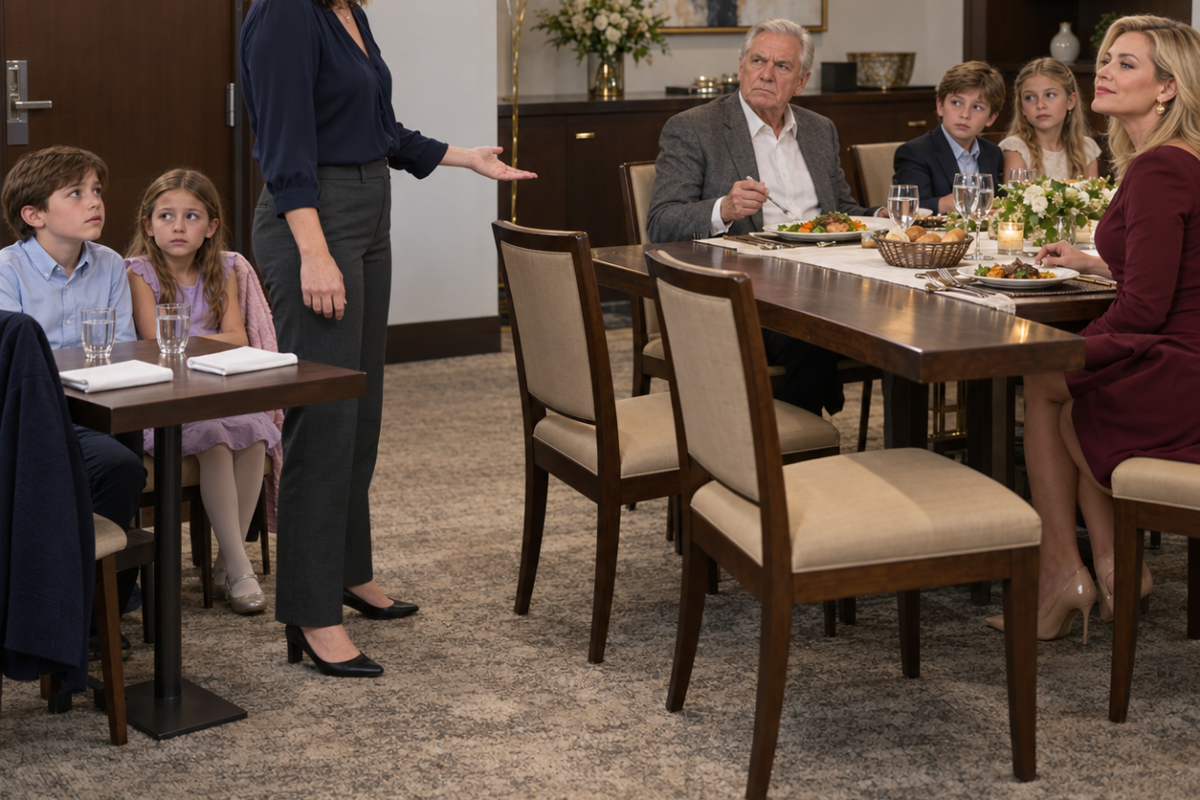
At my father’s seventieth birthday dinner, my eleven-year-old son and eight-year-old daughter were seated beside the service door with water glasses—but no dinner plates. Their cousins sat beside Grandpa with warm bread and full place settings. “They’ll eat after everyone else,” my sister said. I turned to my father, expecting him to object. “They can wait another hour,” he replied. There were two empty chairs at his table.
At my father’s seventieth birthday dinner, the first thing that stopped me wasn’t the cake or the gold balloons. It was my children. Ethan and…
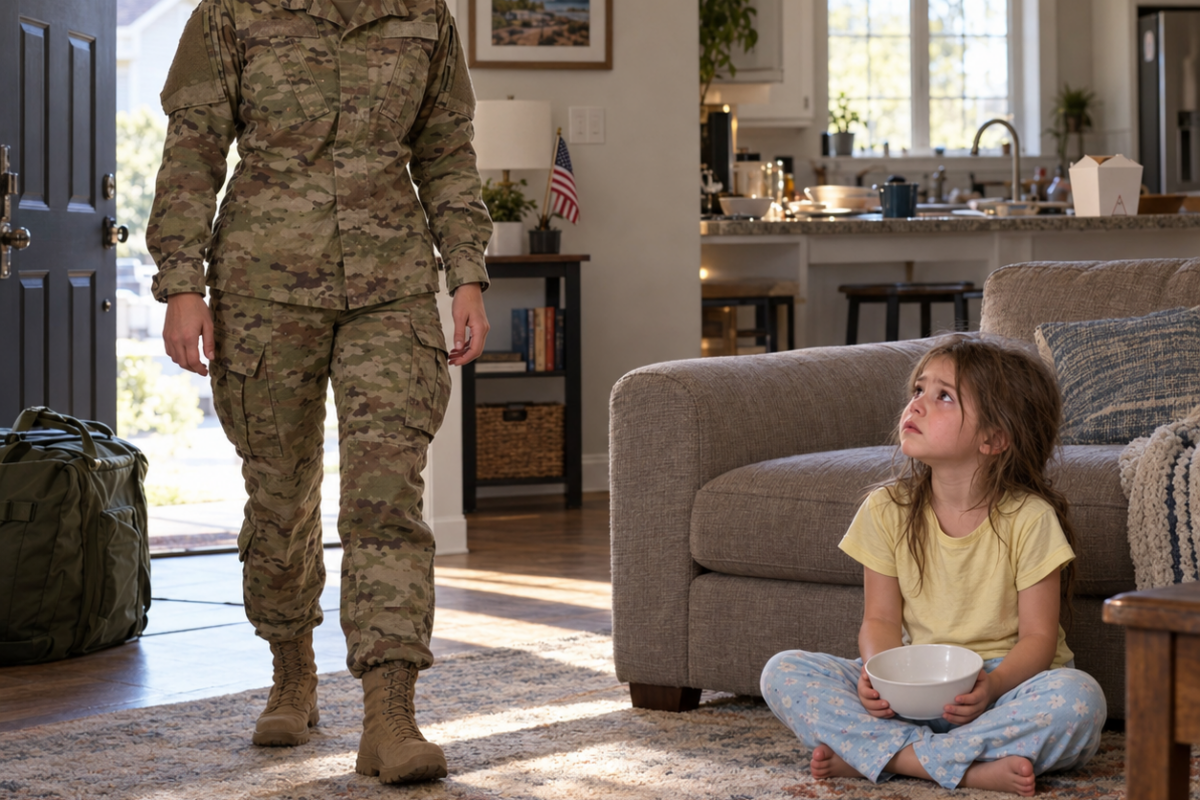
“Mommy, are you real?” my four-year-old daughter whispered when I came home from deployment three weeks early. She was sitting alone on our living room floor with an empty cereal bowl. My husband was on a Caribbean cruise with his mother and sister. Twenty-two minutes earlier, they had posted a photo captioned “Family time.” I was still in uniform when Sophie asked if she could have something to eat.
The first thing my daughter said when I found her was, “Mommy, are you real?” She was sitting cross-legged on our living room floor with…
End of content
No more pages to load