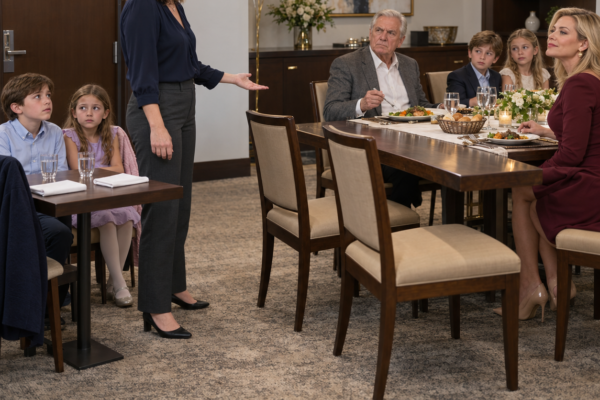
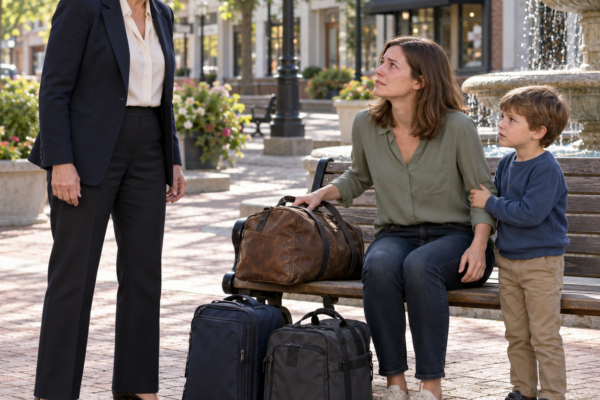
My parents left me at my grandfather’s house when I was five and never came back. Seventeen years later, the morning after his funeral, they arrived with a moving truck, and my sister announced, “I call the master bedroom.” My mother handed me two trash bags and said, “You were his burden. This house is ours now.” I didn’t argue, because a few days before he died, Grandpa had told me what to do when they came.
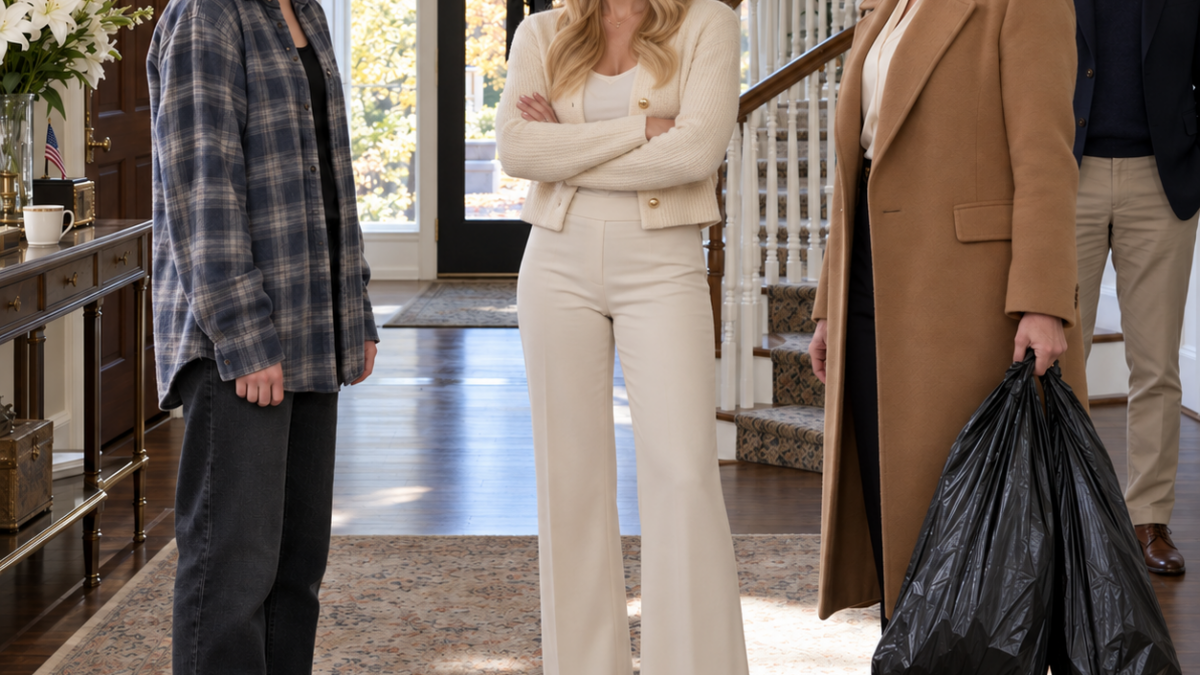
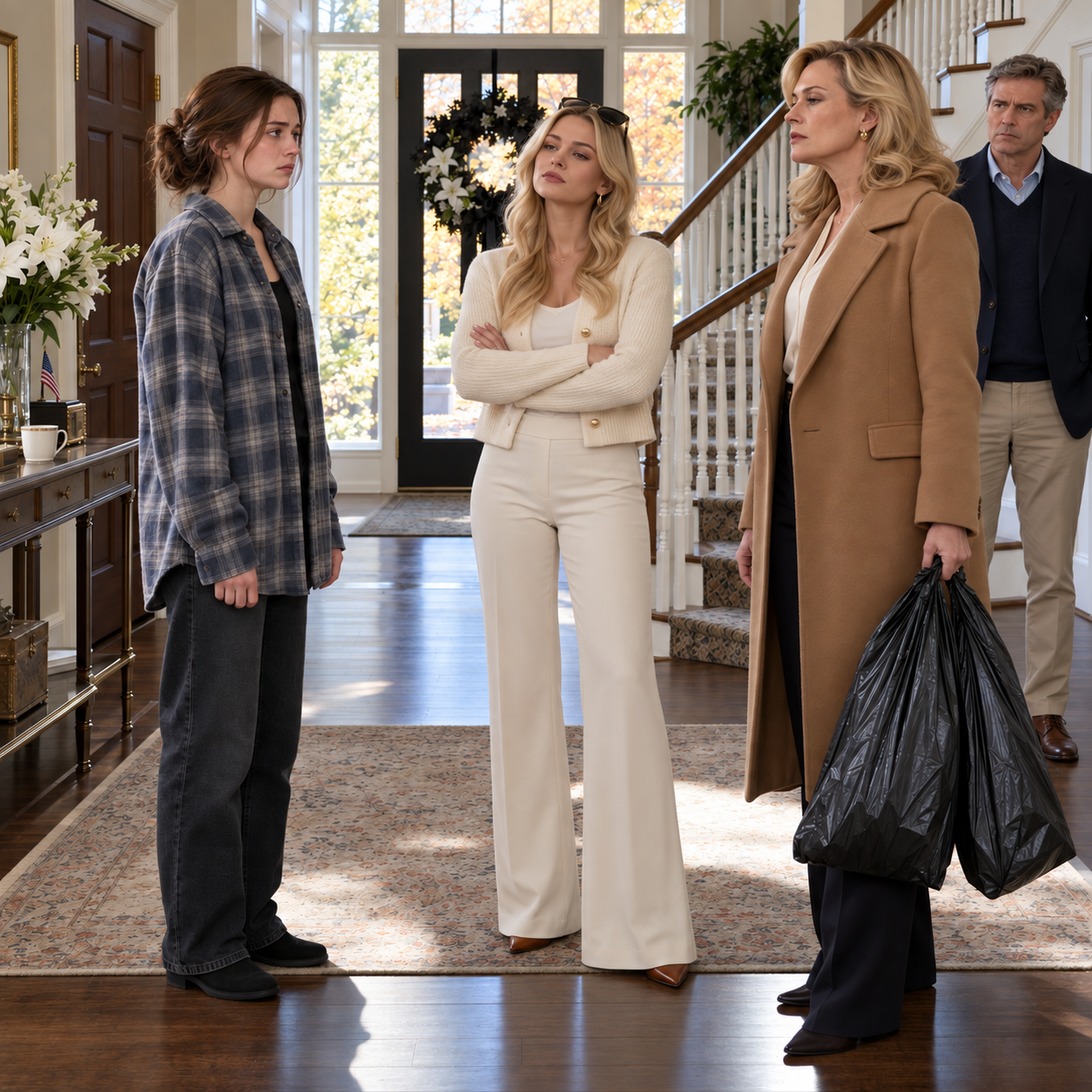
The morning after we buried my grandfather, my parents arrived with a moving truck.
Seventeen years after leaving me at his house for what they called a weekend, they came back as though they had merely been delayed.
Not with flowers.
Not with condolences.
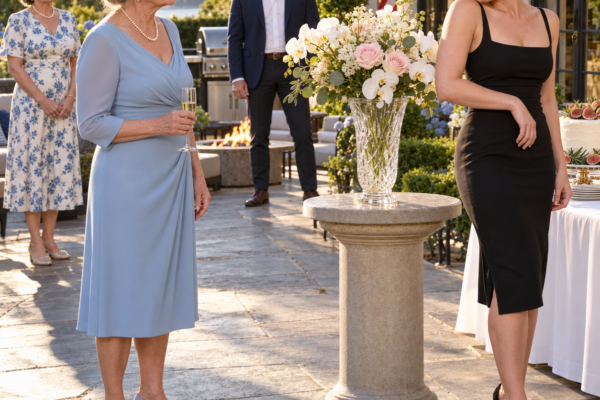
With movers, furniture blankets, and my older sister wearing designer sunglasses beneath a gray October sky.
Vanessa stepped out of the passenger seat, looked past the black funeral wreath on the front door, and glanced toward the upstairs windows.
“I call the master bedroom.”
I stood on the porch in one of Grandpa’s old flannel shirts, holding coffee I had not tasted.
The house smelled of funeral lilies and damp autumn leaves. Beneath that lingered a trace of pipe tobacco, although he had stopped smoking ten years earlier. I could still find it in his coat pockets, in the study curtains, in the drawer where he kept spare buttons and old receipts.
My mother climbed the steps.
“You look awful, Calliope.”
She said it the way someone might criticize a wrinkled blouse.
My father did not hug me. He did not ask whether I had slept. He turned toward the men unloading the truck.
“Start upstairs. Furniture first.”
Vanessa brushed past me.
“Seriously? This place smells like an old man.”
Something inside me went still.
Yesterday, I had watched six men carry my grandfather’s coffin.
Today, the people who left me were discussing which parts of his life should be removed first.
There were nearly twenty people in the house and driveway by then. Two neighbors had come with breakfast. My aunt Miriam was in the kitchen. Several of Grandpa’s friends had arrived to help put away chairs from the gathering after the funeral.
The movers stood near the truck.
My mother snapped her fingers in front of my face.
Then she pushed two black garbage bags into my arms.
“Pack your things. Clothes, toothbrush, that ugly quilt. Whatever’s yours.”
I looked down at the bags.
She caught my wrist.
“You were his burden,” she said loudly. “This house is ours now.”
Someone set a box down.
My aunt stopped moving.
My mother tightened her fingers.
“Don’t make this difficult. Well?”
From upstairs, Vanessa called, “Mom, can I paint the bedroom white? This dark wood is depressing.”
My father finally looked at me.
“Your grandfather always wanted the property to stay in the family.”
Family.
I almost laughed.
Instead, I put the garbage bags on the floor.
Because four days before he died, Grandpa had told me exactly what to do.
“When they come,” he said, “don’t argue with them at the door.”
“When who comes?”
“Your parents.”
He squeezed my hand.
“Let them talk.”
“Why?”
“Let people hear what they mean.”
Then he looked toward the little brass key on his bedside table.
“And open my study.”
So I did not shout.
I did not plead.
I did not ask my mother whether she remembered leaving me.
I let them talk.
Then a soft click came from the hallway.
The study door opened.
My mother turned toward it.
And her hand fell away from my wrist.
My name is Calliope Bennett. I was twenty-two when my grandfather died, old enough to understand that grief was not a single feeling and young enough to discover how completely it could rearrange a room.
Until that week, I had never known a world without Arthur Bennett in it.
He had been my home for seventeen years.
Not merely the man who owned the house where I lived.
Home.
His slippers beneath the kitchen chair. His radio playing quietly before sunrise. His habit of reading the weather forecast aloud even when I could see rain running down the windows.
He was the person who knew I liked the browned edges of a casserole and disliked being asked questions immediately after waking.
He knew which teachers had frightened me, which friends had disappointed me, and when to leave a cup of tea outside my bedroom without expecting a conversation.
He was not a wealthy man.
He had retired after thirty-six years maintaining a public elementary school. His pension covered the essentials. His garden helped. He repaired things other people replaced and treated secondhand furniture as an opportunity rather than an embarrassment.
The house was an old two-story place at the end of a quiet street, with a deep porch, uneven floors, and a maple tree that scattered leaves across the gutters every autumn.
He had bought it with my grandmother long before I was born.
She died when I was three.
Two years later, my parents brought me there.
I remember a yellow backpack.
I remember a stuffed rabbit with one ear shorter than the other because I had chewed it.
I remember my mother fastening the buckle on my coat while looking toward the car rather than at me.
“Just the weekend,” she said.
“Can Vanessa stay too?”
“No. She has things to do.”
Vanessa was eight.
I thought eight-year-olds had important obligations I would understand when I was older.
My father carried my small suitcase inside.
He spoke to Grandpa in the kitchen. Their voices were low, then sharp, then low again.
I sat on the living room rug and lined up wooden blocks.
When they left, my mother kissed the top of my head.
Not my cheek.
The top, where it was quickest.
“Be good.”
I waited by the window on Sunday afternoon.
Grandpa made spaghetti.
“They’ll come after dinner,” I said.
He stirred the sauce.
“We’ll see.”
I waited on Monday.
Then Tuesday.
On Wednesday, he bought me a toothbrush because the one in my suitcase had been dropped behind the radiator.
That seemed like a temporary purchase.
For weeks, everything seemed temporary.
The extra pajamas.
The drawer he cleared.
The little hook he installed beside the back door for my yellow backpack.
Children are skilled at believing a promise longer than the person who made it intends.
I believed theirs for years.
Grandpa did not tell me they had abandoned me.
Not at five.
Not in those words.
He said plans had changed.
He said I was staying with him.
He said I was safe.
I asked when my mother would come.
He answered carefully.
“I don’t know, sweetheart.”
Adults sometimes think uncertainty is the cruelest thing they can give a child.
It is not.
False certainty can be worse.
He never told me tomorrow when he did not know.
Eventually, I stopped waiting at the window every afternoon.
But I kept listening for cars.
There was paperwork.
I understood that later.
Calls unanswered. Letters returned. Meetings with a family lawyer. A court hearing where I stayed with Mrs. Alvarez next door while Grandpa wore the suit he usually reserved for funerals.
He became my legal guardian.
He made certain he could enroll me in school, take me to doctors, and do all the ordinary things a child needed without waiting for adults who could not be found when permission mattered.
My parents did not contest it.
They did not come back.
They did not call on my birthday.
They did not send Christmas cards.
For a long time, I thought the problem was distance.
Perhaps they lived so far away that mail could not find us.
Then, when I was nine, I saw my mother in a grocery store forty minutes from our house.
She stood beside Vanessa, comparing two jars of sauce.
Vanessa wore a bright school sweatshirt. My mother’s hair was shorter. They looked comfortable together.
I froze.
Grandpa was beside me, holding a bag of potatoes.
My mother looked up.
She saw us.
I know she did because her expression changed.
Then she turned the cart down another aisle.
For several seconds, I could not move.
Grandpa put the potatoes in our cart.
“Would you like to go home?”
I nodded.
In the parking lot, I asked, “Did she forget me?”
He turned toward me.
“No.”
“Then why?”
He sat with both hands on the steering wheel.
It was the first time I remember seeing him unable to find words.
Finally, he said, “Some people make choices that children cannot fix.”
I did not understand everything he meant.
I understood enough to cry.
He held me in the car until I could breathe without hiccupping.
Then we went home and made pancakes for dinner.
He did not pretend pancakes solved it.
He simply knew I needed something warm after a cold discovery.
There were difficult years.
I do not want to make our life sound like a collection of perfect afternoons.
Grandpa’s back hurt. The roof leaked one spring. The car failed in December, and we spent three weeks arranging rides until he could afford the repair.
He was tired sometimes.
I was angry sometimes.
At eleven, I accused him of not making my parents come back.
The sentence hurt him.
I saw it immediately.
He sat very still at the kitchen table.
Then he said, “I wish I could.”
That was all.
No guilt.
No list of sacrifices.
No reminder that he could have refused me.
I apologized later.
He told me I was allowed to be angry about what happened.
“Just try not to throw it at the person standing closest,” he said.
It was good advice.
I did not always follow it.
Neither did he.
But we learned to repair ordinary mistakes.
If he snapped because he was hurting, he apologized.
If I slammed a door, I came back.
Our house had rules, but love was never one of the things that could be withdrawn for breaking them.
When I was thirteen, I asked whether I had ruined his retirement.
He looked up from a broken toaster.
“What brought that on?”
A classmate had said grandparents were supposed to travel, not raise children.
I told him.
He considered it.
“I had planned to see the Grand Canyon.”
My stomach sank.
He set down the screwdriver.
“I still might.”
“But you couldn’t because of me.”
“Calliope, there are things I did not expect. That doesn’t mean I regret them.”
“You had to spend money.”
“Yes.”
“And take care of me.”
“Yes.”
“You could have said no.”
He looked at me for a long time.
Then he said, “I could have. I didn’t want to.”
That answer mattered more than telling me it had cost nothing.
It had cost something.
Time. Money. Effort. Sleep.
He loved me with full knowledge of the cost.
Not because I had managed to be a child who needed nothing.
We never reached the Grand Canyon.
By the time I was old enough to help pay for the trip, his heart had become too unreliable for him to enjoy the travel.
We bought a large photograph of it at a thrift store instead.
He hung it in the study.
“Excellent view,” he said. “No lines.”
I laughed.
Then I cried that night because I wanted to give him more than a joke about what he had missed.
He found me at the kitchen table.
When I told him, he sat beside me.
“Do not turn loving me into a debt.”
I kept that sentence.
I would need it later.
I worked through college.
My scholarship covered part of tuition. I took classes at the local university and lived at home, where home was not a place I needed to escape.
I studied accounting.
Grandpa liked to say this meant at least one person in the family would finally understand his system of storing receipts in biscuit tins.
I worked part-time in the campus finance office and weekends at a hardware store.
When his health declined, I reduced my hours.
He argued about that.
Not because he did not want help.
Because he did not want his needs to swallow my plans.
“We can arrange things,” he said.
So we did.
Miriam came twice a week.
Mrs. Alvarez checked in during the day.
A visiting nurse helped after one hospital stay.
I learned to ask for assistance instead of trying to prove devotion through exhaustion.
Still, much of the final year belonged to his appointments.
Medication changes.
Blood tests.
Days when he felt almost himself.
Days when walking to the bathroom required rest afterward.
I learned how quietly a life can narrow.
First, he stopped driving at night.
Then he stopped driving altogether.
The garden became pots near the porch.
His newspaper moved from the study to the living room because the study chair was harder to get out of.
Eventually, a hospital bed stood in the room downstairs where Grandma used to sew.
He apologized for the equipment.
I told him he had once installed a hook for my backpack without asking whether I intended to stay.
“This is our house,” I said. “We make room.”
He smiled.
“Fair argument.”
My parents knew he was ill.
Miriam had told them.
She was my father’s younger sister, and unlike him, she had never entirely vanished from Grandpa’s life.
She visited. She brought casseroles. She sent cards with handwritten messages, not merely signatures.
She also had limits.
For years, I resented her for not confronting my father more forcefully.
Later, I understood that she had tried in ways I never saw.
Trying did not mean she had succeeded.
It also did not erase what she had done for us.
When Grandpa’s condition worsened, she called Richard.
That was my father’s name.
Richard Bennett.
He said work made travel difficult.
He lived less than an hour away.
My mother, Celia, said hospitals frightened her.
Grandpa was at home.
Vanessa said she would “see what her schedule looked like.”
She did not come.
I heard all of this because people became less careful about keeping conversations from me when they needed help managing them.
By then, I no longer expected affection.
I still expected basic decency.
Perhaps that was why the disappointment never became entirely painless.
Four days before Grandpa died, he asked me to bring the brass study key.
I found it in the little bowl beside his chair.
He took it, turned it between his fingers, and handed it back.
“Keep this.”
“I know where it belongs.”
“Keep it with you.”
Something in his tone made me sit down.
He looked tired but clear.
“There are papers in there.”
“I know.”
“And Helen knows what to do.”
Helen Mercer was his attorney.
I had met her several times, usually while making tea and leaving them to discuss things I assumed were ordinary estate matters.
“What papers?”
“The ones people will need.”
“Grandpa.”
He smiled faintly.
“You’re entitled to ask. I’m just entitled to be tired.”
I squeezed his hand.
“All right.”
Then he said, “Your parents may come.”
I looked at him.
“Now?”
“After.”
The word made my throat close.
“Don’t.”
“Calliope.”
I shook my head.
He waited.
Eventually, I looked back at him.
“When they come,” he said, “don’t argue at the door.”
“Why would they come?”
His face grew sad.
“I hope I’m wrong.”
“But you don’t think you are.”
“No.”
He took a breath.
“If they want to talk, let them talk. Not because they’re right. Because you’ve spent your life wondering what they would say if they finally had to stand in front of you.”
I looked down at our hands.
“Then open my study.”
“Will you tell me what’s in it?”
“The truth. Nothing magical.”
That was so much like him that I laughed through my tears.
He smiled.
“Helen will explain the legal things. You don’t have to.”
“Why haven’t you told me already?”
“I have told you the important part.”
“What important part?”
He squeezed my hand.
“You have a home.”
I began to cry.
He waited until I could hear him.
“And you were never my burden.”
At the time, I did not know why he chose those words.
The morning after the funeral, I understood.
He died before dawn on a Thursday.
Miriam was there.
So was the hospice nurse.
I held his hand.
There was no final speech.
No perfectly timed goodbye.
His last clear sentence the previous evening had been asking whether I had eaten.
I had said yes.
It was not true.
I ate afterward because I could almost hear him objecting to grief being used as an excuse to neglect the living.
The funeral happened on Monday.
Rain softened the cemetery soil.
People came who had known him in ways I never had: former teachers from the school, a man whose first job he had helped him find, a woman who remembered him fixing her front steps after her husband died.
Their stories surprised me.
Grandpa had been useful so consistently that people did not always notice how much of his time he gave.
He had not kept a list.
He had not brought it up when someone needed something else.
He simply believed a loose railing should be fixed before someone fell.
My parents attended.
I saw them near the back.
Vanessa wore black and kept her sunglasses on although the day was cloudy.
My mother cried during one hymn.
I did not know whether the tears were real.
I did not try to decide.
My father shook hands with people afterward.
He used phrases such as “a good man” and “great loss.”
He did not come to me.
I stood beside the coffin and thought that people could perform grief without knowing much about the person who died.
Then I felt ashamed for having the thought at all.
Grief made everything sharp.
Back at the house, neighbors brought food.
Miriam handled coffee.
I moved through rooms containing flowers, plates, folded coats, and people speaking softly.
The study remained closed.
Helen had said we would meet the following morning to discuss immediate practical matters.
Not a dramatic reading of the will.
A meeting.
There were bills to manage, documents to identify, and information I needed before making decisions.
She told me to sleep if I could.
I did not.
I lay in bed listening to the house.
The refrigerator motor.
A pipe cooling in the wall.
The wind moving branches against the upstairs window.
For seventeen years, those sounds had existed around another sound: Grandpa.
His cough.
His footsteps.
His chair creaking.
Now the absence of him seemed louder than anything else.
At sunrise, I put on his flannel shirt.
I made coffee.
I went to the porch.
Then the moving truck arrived.
I recognized my father before I understood what the truck meant.
For a moment, my mind reached toward the kindest explanation.
Perhaps they were helping remove rented chairs.
Perhaps someone had asked them to collect donations.
Perhaps this was a practical gesture I had not expected.
Then Vanessa called the bedroom.
My mother criticized my face.
My father instructed the movers.
The kind explanation disappeared.
Helen had arrived fifteen minutes earlier through the side entrance.
She was in the study reviewing the documents Grandpa had arranged and making an inventory with Miriam before people became busy in the rest of the house.
I had let her in, given her tea, and gone to the porch while she worked.
That was why the study door was closed.
That was why I did not tell my parents who waited inside.
I was not setting a trap.
I was too stunned to explain anything.
Then my mother put the bags in my arms.
Then she called me his burden.
Then the word reached the hallway.
And Helen opened the study door.
She stood holding a thin folder.
Miriam stood behind her.
My mother’s expression changed first at the sight of the folder, then at Miriam’s face.
Helen looked at my wrist.
“Celia. Let go of her.”
My mother had already loosened her grip.
She released me completely.
“This is family business.”
“Yes,” Helen said. “And several legal matters.”
My father turned.
“Helen.”
“Richard.”
He knew her.
Of course he did.
She had represented Grandpa for years.
He simply had not expected her to be standing in the house while he attempted to take it.
Vanessa appeared at the top of the stairs.
“What’s going on?”
Helen looked upward.
“Please come down. Nobody is moving furniture.”
One of the movers stopped beside a chair.
My father said, “We’re just getting organized.”
Helen turned toward him.
“You instructed people to remove furniture from a property you do not own.”
“This was my father’s house.”
“It was.”
“And I’m his son.”
“Yes.”
The way she answered made the distinction unavoidable.
Being his son was a fact.
Ownership was another fact.
They were not interchangeable.
My mother folded her arms.
“We’re not going to be lectured in our own family home.”
Helen looked at me.
“Calliope, would you like the movers to wait outside?”
I had been standing still for so long that being asked what I wanted almost felt unfamiliar.
“Yes.”
Helen nodded toward the moving company supervisor.
“Please remove your equipment and wait by the truck until your customer clarifies the situation.”
The man looked at my father.
My father looked angry.
The supervisor did not move.
Then he said, “Sir, we need authorization from the property owner before we take anything.”
“I’m handling it,” Dad replied.
“Then handle it,” the man said quietly. “We’ll wait.”
They went outside.
No confrontation.
No dramatic refusal.
Just professionals who did not want to participate in a disputed removal.
Mrs. Alvarez put down the casserole she had been holding.
Miriam stepped past Helen and stood beside me.
She looked at the red mark on my wrist.
“Are you hurt?”
“No.”
My voice sounded distant.
My mother snapped, “Don’t make this into something it isn’t.”
Miriam looked at her.
“What is it, Celia?”
Nobody answered.
The house became quiet enough to hear Vanessa descending the stairs.
Her sunglasses were now pushed into her hair.
She looked irritated, not frightened.
“I already told them which room I want.”
I looked at her.
“You don’t live here.”
“We will.”
“No.”
She laughed once.
“Calliope, please.”
That tone.
As though I were a stubborn child objecting to an arrangement sensible adults had made.
Helen placed the folder on the hall table.
“Let’s sit down.”
My father said, “We don’t need a meeting.”
“You need information.”
My mother looked at the kitchen.
Too many witnesses.
Too many people who had heard the word burden.
“Everyone else should leave,” she said.
Helen did not respond to her.
She looked at me.
“Would you prefer privacy?”
I considered it.
There had been seventeen years of private explanations.
Seventeen years of people not knowing what to say.
Seventeen years of my father being described as complicated instead of absent.
I did not want a crowd hearing financial details.
I also did not want my parents leaving with another version of what happened.
“Miriam can stay,” I said. “And Mrs. Alvarez, if she wants.”
Mrs. Alvarez nodded.
The others quietly moved toward the porch and kitchen.
Nobody seemed eager to watch.
That mattered.
This was not entertainment.
It was a difficult morning they had accidentally witnessed.
We sat at the dining table.
My parents on one side.
Vanessa beside them.
Helen at the end.
Miriam beside me.
The garbage bags remained in the hallway.
I could see them from my chair.
Helen opened the folder.
“Arthur established a revocable living trust several years ago. The property was transferred into that trust, and the deed was recorded.”
My father frowned.
“He never told me that.”
“He was not required to obtain your permission.”
“He told me the house would stay in the family.”
Helen glanced at me.
“It has.”
Dad’s face changed.
My mother leaned forward.
“What exactly are you saying?”
“The trust provides for Calliope. She is the beneficiary of this property under its terms. The successor trustee will administer the transfer and other required matters.”
Vanessa stared.
“She gets the house?”
Helen kept her voice even.
“Yes.”
My mother turned toward me.
“You knew?”
“I knew Grandpa said I had a home.”
“That isn’t an answer.”
“It’s the answer I have.”
Dad looked at the papers.
“I want to see the will.”
“There is a will,” Helen said. “It addresses matters outside the trust and supports the overall estate plan. The house is not distributed through the assumption you arrived with.”
“I’m his child.”
“Yes.”
“There must be something.”
“There are documents you may receive through the proper process. I can arrange that.”
My mother shook her head.
“This can’t be right.”
Helen slid a copy of the recorded deed toward them.
“Here is the property record.”
Dad read it.
Slowly.
His expression moved from irritation to calculation.
I hated recognizing calculation.
It meant he had not come to ask what Grandpa wanted.
He had come expecting an asset.
Vanessa looked at me as though I had taken something from her.
“You lived here for seventeen years. You already got everything.”
I stared.
“What did I get?”
She gestured around us.
“This. His money. His time.”
My mother said, “Exactly.”
Miriam leaned forward.
“She got raised.”
My mother looked at her.
“Don’t start.”
“No,” Miriam said. “We are starting. You left a five-year-old here.”
“We had difficulties.”
“For seventeen years?”
My father rubbed his forehead.
“Miriam.”
She turned toward him.
“Do not say my name like I’m the one causing this.”
The room went still.
She had spent years trying to avoid losing contact with her brother.
That morning, I watched her decide maintaining that contact was no longer worth helping him hide.
Helen let the silence settle.
Then she said, “The immediate issue is that nobody may remove property, establish residence, or displace Calliope based on an expectation of inheritance.”
My mother sat back.
“Expectation.”
“Yes.”
“Arthur was ill.”
“He was ill when he died. The estate planning was completed and reviewed well before his final decline.”
“People change when someone controls their care.”
The implication made my face burn.
Miriam’s hand closed around mine beneath the table.
Helen looked directly at my mother.
“Please be precise about what you are alleging.”
Celia hesitated.
For years, she had been able to place suspicion in a room and let other people do the work of turning it into fact.
Helen was asking her to own the accusation.
“She influenced him,” my mother said.
“No,” I said.
My voice surprised me.
It was steadier than I felt.
“You don’t get to come here the day after his funeral and turn loving him into something dirty.”
Dad looked at me.
“We’re asking questions.”
“She’s making accusations.”
Helen nodded slightly.
“Arthur received independent advice. His instructions were consistent over time. The relevant records have been preserved.”
My mother looked away.
Vanessa picked at the edge of her sleeve.
Dad stared at the deed.
Outside, a truck engine started, then stopped.
The world had practical concerns even while ours seemed suspended.
Helen took another paper from the folder.
“Arthur also left a letter.”
My throat tightened.
“For me?”
“For you. There is a separate statement concerning his intentions that he authorized me to share where appropriate.”
Dad looked up.
“What statement?”
Helen studied me.
“Would you like me to read it?”
I looked toward the hallway.
The bags.
The flannel cuff over my wrist.
The room where Grandpa had taught me to multiply using pennies.
“Yes.”
Helen unfolded the page.
It was typed, but the signature at the bottom was unmistakably his.
I knew the shape of his name from school forms, birthday cards, and notes left on the counter.
She read slowly.
He had provided a home for his granddaughter because she needed one.
His decision to leave her the house reflected the life they had shared and his wish that she should not lose that home when he died.
No relative had been authorized to promise, sell, occupy, or remove property on his behalf.
Then Helen paused.
The next sentence was shorter.
“Calliope was not a burden. She was my responsibility, my family, and one of the great joys of my life.”
I stopped breathing for a moment.
My mother looked at the table.
My father’s face went pale.
Vanessa’s eyes moved toward me, then away.
The words were not a surprise.
He had told me versions of them for years.
But hearing them after my mother’s accusation, in the house he could no longer protect himself, felt like his hand finding mine.
Miriam cried quietly.
Mrs. Alvarez pressed a tissue to her mouth.
Helen continued.
The statement explained that his choices were deliberate and that disagreements among surviving relatives did not change them.
There was no insult.
No final curse.
No catalog of everything my parents had done wrong.
Grandpa did not need to make himself cruel to become clear.
When Helen finished, I looked at the signature.
For a moment, I could hear him.
Nothing magical.
The truth.
My father said, “He was angry with us.”
Helen folded the statement.
“He was clear.”
“There were reasons.”
Miriam looked at him.
“Then say them.”
Dad opened his mouth.
My mother interrupted.
“This is not the time to discuss ancient history.”
“It became the time when you called her his burden,” Miriam said.
Celia’s jaw tightened.
“We were young.”
“You were adults.”
“We were overwhelmed.”
“He was sixty-eight.”
“We thought she would have stability here.”
Miriam stared at her.
“Then why did you tell him it was a weekend?”
My mother looked toward Dad.
He did not help.
I sat very still.
For years, I had imagined this conversation happening.
I pictured explanations.
Some terrible event that made everything understandable.
A secret I had never been told.
An illness.
A danger.
Something that might not excuse them but would at least make the story less ordinary.
What I heard was overwhelmed.
Young.
Stability.
Words that sounded reasonable until placed beside seventeen years.
“Why didn’t you come back?” I asked.
Nobody spoke.
I looked at my father.
“Not that Sunday. Any Sunday.”
He swallowed.
“Things became complicated.”
“How?”
“Your grandfather was angry.”
“Because you left me.”
“We didn’t know how to fix it.”
“So you didn’t.”
He looked down.
My mother said, “You were doing well.”
I turned toward her.
“How did you know?”
“Miriam told us.”
“Then you knew I was there.”
“Of course we knew.”
The answer was so casual it hurt.
Of course.
They had known.
They had simply not come.
“Did you ever wonder whether I waited for you?”
Celia’s face changed.
It was small.
Perhaps discomfort.
Perhaps something closer to regret.
She said, “Calliope—”
“Did you?”
She looked away.
I nodded.
For a long time, I had thought an answer would close something.
Instead, it opened the final version of the wound.
There had been no mystery big enough to rescue them from their choices.
They had left.
Then leaving became easier than returning.
Then the person they left grew up.
And they came back when the house became available in their imagination.
Helen allowed a moment before returning to the practical matters.
“There are additional assets and obligations to administer,” she said. “These will be addressed through the trustee and executor.”
Dad looked alert again.
“Additional assets?”
The speed of that change made Miriam close her eyes.
Helen said, “Nothing here gives you permission to occupy the house.”
“What obligations?”
“There is a documented loan Arthur made to you several years ago.”
My mother’s face tightened.
“That was help.”
“It was documented as a loan.”
Dad leaned forward.
“How much are you claiming?”
Helen named the principal and explained that the records reflected partial payments, followed by years without further repayment.
I did not know about it.
That surprised me less than it should have.
Grandpa had helped them after they left me.
Not because they deserved my forgiveness.
Because he remained a father who hoped help might become a bridge.
I looked at Dad.
“You asked him for money?”
He said nothing.
“After you stopped coming?”
My mother answered.
“We had a business opportunity.”
Miriam let out a short breath.
“A business opportunity.”
Celia turned on her.
“You don’t know everything.”
“No,” Miriam said. “Apparently none of us do.”
Helen closed that section of the folder.
“The estate will review the obligation through the proper process. No amount will be deducted or demanded informally today. You may obtain advice and respond through counsel.”
She was careful.
There was no instant punishment.
No dramatic demand that they empty their pockets.
Simply another record my parents could not replace with a preferred description.
Dad looked at me.
“Did you ask her to bring this up?”
“No.”
“Then why is it coming up now?”
Helen answered.
“Because you arrived asserting rights to property without understanding the estate plan.”
My mother leaned back.
“This is an ambush.”
I looked at her.
“You brought a moving truck.”
For the first time all morning, nobody had an answer.
Vanessa stood.
“This is ridiculous.”
She took her sunglasses from her hair.
“Fine. Keep the house.”
I looked at her.
“I am.”
Her eyes narrowed.
“You don’t have to act so pleased.”
“I buried the person who raised me yesterday.”
She stopped.
The sentence stripped the argument of the shape she wanted it to have.
This was not a competition over who got the better bedroom.
It was a morning after a funeral.
She sat down again.
More quietly.
My mother looked toward the study.
“What else is in there?”
“His things,” I said.
“Important things.”
“All of them were important to him.”
She gave me a frustrated look.
“You know what I mean.”
I did.
Money.
Documents.
Anything that might still be made available.
Helen said, “The contents will be inventoried as appropriate. Arthur also made specific bequests, including family items. Those will be handled in due course.”
Dad said, “I want his watch.”
I looked at his empty wrist.
Grandpa’s watch had a worn brown strap. He checked it before meals, appointments, and television programs he pretended not to care about.
It had not been on my father’s wrist in decades.
“Helen will handle the bequests,” I said.
“I’m his son.”
“I heard.”
He looked hurt.
For a moment, I felt guilty.
Then I remembered that he had not looked hurt when my mother gave me bags.
He had looked impatient.
I did not need to harden myself against every feeling.
I did need to stop treating his as more urgent than mine.
The meeting ended without reconciliation.
Helen told my parents how to request documents and where to direct questions.
She repeated that no property was to be removed.
The moving truck needed to leave.
My mother asked whether she could at least stay for coffee.
I almost laughed at the sudden reduction in ambition.
From my home.
To my bedroom.
To my displacement.
To coffee.
“No,” I said.
Her face changed.
“Calliope.”
“Not today.”
She looked at Dad.
He stood.
“All right.”
I could not tell whether he finally understood or simply knew there was nothing left to gain that morning.
Either way, he stood.
Vanessa followed.
In the hallway, she looked at the garbage bags.
Nobody picked them up.
My mother paused near the door.
“You’ll regret treating your family like this.”
Miriam stepped beside me.
“She’s been regretting how her family treated her for seventeen years.”
Celia stared at her.
Then she walked out.
Dad stopped on the porch.
He looked back.
“I didn’t know you felt this way.”
I stood in the doorway.
“You didn’t ask.”
He lowered his eyes.
Then he went to the truck.
The movers loaded their unused equipment.
My parents’ furniture remained where it had been packed.
Vanessa got into the car.
The vehicles left.
No police lights.
No handcuffs.
No crowd cheering.
Just tires on wet pavement and a house becoming quiet again.
I closed the door.
Then I locked it.
My hand stayed on the key for several seconds.
Miriam stood beside me.
“Come sit.”
I shook my head.
“I need a minute.”
She nodded.
I went into the study.
The room smelled of paper, old wood, and Grandpa’s aftershave.
His cardigan hung over the back of the chair.
A pencil rested across an open crossword.
There was a photograph of the Grand Canyon on the wall.
Excellent view.
No lines.
I looked at the chair.
Then I began to cry.
Not because I had won.
Nothing about the morning felt like winning.
I cried because he was gone, because they had come, and because even afterward I wanted him to tell me whether I had done the right thing.
Helen remained in the doorway.
“Would you like privacy?”
I nodded.
She closed the door gently.
I sat in his chair.
For years, I had avoided doing that because it was his.
Now it was still his in every way that mattered.
I put my hands on the worn wooden arms.
Then I said aloud, “They came.”
The room gave no answer.
But I could still hear what he had told me.
You have a home.
For a while, I let that be enough.
When I came out, Mrs. Alvarez had reheated breakfast.
Eggs.
Toast.
Coffee that was not cold.
Miriam sat at the kitchen table with her coat off.
Helen had arranged the immediate tasks into a short list.
Nothing overwhelming.
Insurance.
Utilities.
Security.
Copies of essential records.
A scheduled meeting with the successor trustee.
I looked at the list.
There was relief in something practical.
Grief made the future feel like fog.
A task gave me somewhere to place my foot.
“Do I need to leave while everything is processed?” I asked.
Helen shook her head.
“No. Your occupancy was anticipated in the plan. We’ll review the administrative details together, but nobody is asking you to leave.”
I looked toward the hallway.
The bags remained there.
Miriam followed my gaze.
“May I throw those away?”
I considered it.
“Yes.”
She picked them up.
Such a small act.
Such a necessary one.
Mrs. Alvarez put a plate in front of me.
“Eat.”
I smiled weakly.
“That sounds familiar.”
“He trained us well,” she said.
For the first time since the truck arrived, I laughed.
Then I ate.
The aftermath did not remain confined to the house.
By that afternoon, my mother was telling relatives I had used a lawyer to exclude my father from his own father’s estate.
She said I had become greedy.
She said grief had made me unstable.
She said Grandpa’s illness had left him vulnerable to influence.
I learned this through messages.
Some were kind.
Some were cautious.
A few asked whether I intended to “share fairly.”
I stared at that phrase.
Fairly.
I had shared a home, a garden, a kitchen, and the last year of his life.
My parents had shared neither the appointments nor the sleepless nights.
Yet fairness appeared in their vocabulary only when there was property to divide.
Helen advised me not to argue about the documents through a family message chain.
I followed that advice.
I wrote one response.
Grandpa had made an estate plan with independent legal advice. I was not removing anyone from a home they occupied. My parents arrived without permission and attempted to move in the morning after the funeral. Questions about the estate could go through the appropriate representatives.
Then I stopped answering.
I did not publish the loan records.
I did not post photographs of the moving truck.
I did not need to make the whole world a jury.
The people who witnessed the morning knew what happened.
Others would decide what they wanted to believe.
That was painful.
It was also outside my control.
Miriam stayed for three nights.
She slept in the guest room, not Grandpa’s bedroom.
She asked first.
I noticed that.
I noticed every person who treated permission as ordinary after my parents treated it as an insult.
On the second evening, we sat on the porch beneath a blanket.
Leaves scraped along the steps.
Miriam held tea in both hands.
“I owe you an apology.”
I looked at her.
“For what?”
“For not telling you more plainly that what happened wasn’t your fault.”
I stared at the yard.
“You did say that.”
“Sometimes.”
“Yes.”
“But I also tried to keep everyone connected. I thought if I made things less confrontational, Richard might eventually come back.”
“He didn’t.”
“No.”
She looked down.
“I should have stopped organizing your disappointment around his comfort.”
The sentence reached me slowly.
For years, adults had told me my parents were complicated, struggling, ashamed, unsure how to return.
Those explanations may have contained truth.
They had also asked a child to protect the feelings of the people who left her.
“I wanted him back too,” I said.
“I know.”
“I still wanted him to come to graduation.”
She nodded.
“I know.”
“He didn’t.”
“No.”
I pulled the blanket tighter.
“Grandpa never asked me to stop wanting them.”
Miriam’s eyes filled.
“He understood that wanting something isn’t the same as excusing it.”
We sat quietly.
Then I asked why she had not told me about the loan.
“I didn’t know all the details.”
“Grandpa helped them.”
“Yes.”
“Why?”
She thought about it.
“He was their father. Loving someone doesn’t always end when they disappoint you.”
“That sounds dangerous.”
“It can be.”
She looked at me.
“He learned limits too. The estate plan was one of them.”
I looked toward the study window.
The room was dark.
For so long, I had thought Grandpa simply endured everything.
Now I was discovering that he had made decisions quietly, with patience, and without needing an audience.
He had not been passive.
He had been careful.
Helen gave me my private letter a week later.
I had delayed asking for it.
Not because I did not want it.
Because wanting it hurt.
It was handwritten on the paper he used for grocery lists, with the same blue pen he kept beside his telephone.
There was no grand introduction.
Calliope,
If you are reading this, I am no longer available to remind you where the spare lightbulbs are.
I laughed immediately.
Then I cried.
That was how the letter continued.
Ordinary details carrying enormous things.
He told me which drawer held the house maintenance records.
He reminded me not to hire the cheapest person simply because the price was low.
He said the maple tree needed pruning before another winter.
Then he wrote about us.
He remembered my yellow backpack.
He remembered how I slept with my shoes beside the bed for months because I thought my parents might arrive while I was asleep.
I had forgotten the shoes.
He had not.
He wrote that he wished he could have spared me the waiting.
He could not.
He could only make certain waiting was not the only thing I did.
So there had been school plays, garden rows, library cards, pancakes, arguments, birthdays, and evenings when we read in the same room without speaking.
A life.
Not a substitute life.
Our life.
Then came the sentence I read over and over.
I did not save you so you would spend your adulthood proving I was right to keep you.
I put the letter down.
For years, I had worked hard partly because I wanted to become someone who justified his sacrifice.
Good grades.
Useful choices.
No unnecessary expenses.
No trouble he could not afford.
He had known.
Of course he had known.
The next paragraph said he was proud of me, but pride was not the rent I owed for being loved.
He wanted me to finish school.
He wanted me to rest.
He wanted me to make friends, travel if I wished, and someday decide whether the house still suited the life I was building.
If I sold it, he would not be offended.
The home had mattered because of the people inside it.
Wood could not be betrayed.
That sounded so much like him that I laughed again.
At the end, he wrote:
You were never the extra person in my house.
You were the reason it remained a home.
Love,
Grandpa.
I folded the letter carefully.
Then I sat beside the window until the light changed.
There are things grief gives back only by taking something else away.
I had his words.
I did not have him.
Both truths remained.
The estate process took time.
There were documents to review, accounts to close, and ordinary obligations to satisfy.
The house did not become magically mine because Helen made one announcement at the dining table.
It had been planned for me.
Now people had to complete the steps.
I learned more about trusts and estates than I wanted to know during a semester when I was already studying accounting.
I joked about that with my professor.
He suggested the practical exposure might improve my understanding.
I told him I would have preferred a textbook.
He nodded.
Then he helped arrange an extension on one assignment without making me feel incapable.
I appreciated that.
I was grieving.
I was still competent.
Those things could exist together.
The trustee confirmed how expenses would be handled while the administration continued.
I kept records.
I paid bills.
I spoke with the insurer.
I had the locks rekeyed after realizing my father might still have an old key from decades earlier.
The locksmith asked whether I wanted every interior door changed too.
I said no.
The problem was not inside the wood.
It was who believed they could walk through it.
I kept Grandpa’s study intact for a while.
Not as a shrine.
Because I was not ready.
Eventually, I moved the crossword into a folder and dusted the desk.
I used it for coursework.
The chair creaked exactly as it had under him.
That comforted me.
Then, on other days, it made me cry.
I stopped expecting objects to choose one effect.
Vanessa contacted me first.
Her message arrived three weeks after the funeral.
We should talk.
I looked at it.
No apology.
No question.
Still the language of someone announcing what ought to happen.
I replied:
About what?
Several minutes passed.
Then:
That morning.
I asked whether she wanted to meet in a public place.
She said the house would be easier.
I said no.
She agreed to a café.
She arrived late.
Only six minutes, but I noticed because I had spent years waiting for members of my family.
She took off her sunglasses and put them beside her cup.
“I’m not here to argue about the house.”
“All right.”
“I didn’t know the paperwork.”
“That wasn’t the part that hurt.”
She looked at me.
I continued.
“You walked upstairs and chose the room where the man who raised me slept.”
Her face changed.
“Dad said—”
“I know what he said.”
“He said Grandpa wanted everyone together.”
I stared.
“Did he?”
“That’s what Dad told me.”
I sat back.
Of course.
The story had already been arranged before the truck left their driveway.
They were not taking.
They were restoring the family.
I wondered how often good-sounding language had made terrible choices feel easier.
Vanessa looked at her coffee.
“I shouldn’t have said the house smelled like an old man.”
“No.”
“I’m sorry.”
I waited.
She shifted.
“What?”
“I’m letting you finish.”
“That was the apology.”
“For the smell?”
“And the room.”
I nodded.
“Thank you.”
She seemed relieved.
Then she said, “You always had Grandpa.”
I looked at her.
“What does that mean?”
“He liked you best.”
I stared for several seconds.
“He raised me because they left me.”
“I know.”
“Do you?”
Her eyes filled with irritation.
“I’m trying to explain.”
“Then explain without turning my childhood into an advantage you missed.”
She looked away.
I watched her search for a different way to speak.
Eventually, she said, “I was eight.”
“I know.”
“I didn’t decide.”
“I know that too.”
She looked at me.
“I used to ask where you were.”
My throat tightened.
“What did they say?”
“That you liked being there. That Grandpa needed company. That you were staying because it was easier for school.”
I thought about my yellow backpack.
My shoes beside the bed.
Sunday after Sunday.
“I didn’t choose it,” I said.
Vanessa nodded slowly.
“I understand that now.”
“You had years to ask.”
“Yes.”
She did not argue.
That mattered.
“I saw you at that grocery store,” I said.
Her face went pale.
“I remember.”
“You saw me?”
“Yes.”
“Why didn’t you say anything?”
“Mom said we should go.”
I looked at her for a long time.
At twelve, she had followed her mother.
At twenty, she had still not called.
At twenty-five, she walked into my home and chose a bedroom.
Those were different ages.
Different responsibilities.
I could acknowledge the child without excusing the adult.
“I don’t blame you for what happened when you were eight,” I said.
Her shoulders eased.
“I do hold you responsible for how you treated me that morning.”
She nodded.
“I know.”
We sat quietly.
Then she asked whether I thought we could have a relationship.
I considered it.
“I don’t know.”
She looked disappointed.
“I’m not saying never,” I added. “I’m saying I don’t know you.”
That answer seemed to hurt.
It was also true.
We were sisters by history and biology.
We had not been sisters in daily life for seventeen years.
We could not skip that distance merely because she finally wanted it smaller.
My father wrote a letter.
Not a text.
A letter.
It arrived a month after the funeral.
The handwriting was familiar from old birthday cards I kept from before I was five.
I had almost forgotten he once sent them.
He said he was sorry.
He said leaving me had been the worst decision of his life.
He said shame had made returning difficult.
Then he wrote that Grandpa’s anger had made him feel unwelcome.
I stopped there.
I put the letter down.
A few hours later, I returned to it.
The rest acknowledged the moving truck.
He admitted they had assumed he would inherit the house.
He admitted they had planned to sell their current place and reduce expenses.
That surprised me.
They had not been homeless.
They had not been forced from somewhere.
They had seen an opportunity.
He said Celia had become carried away.
I underlined that sentence with a pencil.
Not because I needed evidence.
Because I wanted to see the escape hatch clearly.
My father instructed the movers.
My father called the house theirs.
My father stood beside me while my mother put garbage bags in my arms.
He did not get to become a bystander afterward.
I wrote back.
I told him I appreciated the admission that leaving me was his decision.
I also told him I would not accept my mother as the explanation for everything he did.
If he wanted contact, he needed to discuss his own choices.
I did not want a visit.
I was willing to exchange letters for now.
He replied ten days later.
This time, he did not mention Celia’s behavior.
He wrote about himself.
Fear.
Avoidance.
The relief he felt when Grandpa handled things.
The way one missed call became several, then a year, then something he did not know how to face.
He did not claim those feelings excused it.
He said he understood that they described the harm rather than erased it.
I cried reading that letter.
Not because I forgave him.
Because he finally wrote like a man describing something he had done, rather than something that happened around him.
It was a beginning.
I did not know whether it would become anything more.
My mother did not apologize.
Not then.
She sent a message asking whether I intended to keep “punishing everyone.”
I did not answer.
She called Miriam.
Miriam told her that a request for distance was not punishment.
My mother said I had turned people against her.
Miriam said witnesses had heard her words.
There was no need for me to turn anything.
For a while, Celia tried a softer approach.
She sent a framed childhood photograph.
It showed me at four, sitting on my father’s shoulders.
Vanessa stood beside my mother.
We looked like a family.
I remembered the day vaguely.
A park.
A picnic.
My father laughing.
I stared at the photograph for a long time.
Then I put it in a drawer.
The photograph was real.
So were the seventeen years afterward.
I did not need to destroy one truth to accept the other.
The attached note said:
Remember that we loved you.
I read it twice.
Then I whispered into the empty kitchen, “You were supposed to keep doing it.”
The sentence surprised me.
It was so simple.
Love had become something they pointed backward toward, as though one good afternoon could serve as proof indefinitely.
Children need love that continues.
Food.
Safety.
Attention.
Birthday calls.
Someone who comes back when they say they will.
Grandpa had understood that.
He had lived it.
I put the note away.
Then I made dinner.
There were weeks when grief felt manageable.
Then I would find something ordinary.
His handwriting on a seed packet.
A receipt for shoes he bought me at eleven.
A note reminding himself to ask whether my statistics exam went well.
Those things undid me.
He had kept a folder of school records in the study.
Not because I was an investment he needed to track.
Because he liked having them.
Spelling certificates.
Report cards.
A terrible drawing of a dog.
A photograph from graduation.
Behind it, I found the original guardianship paperwork.
I read slowly.
Dates.
Attempts to contact my parents.
Statements about where I lived.
The dry language of adults arranging a child’s life.
Then I found a copy of a letter Grandpa sent to Dad.
He had written that I was safe.
He had asked Richard to call.
He had said anger between adults should not prevent him from speaking to his daughter.
The letter was dated months after I arrived.
Then another.
A year later.
The same invitation.
Call your daughter.
I sat at the desk with the papers in front of me.
For years, my father’s absence had been explained partly through Grandpa’s anger.
Here was Grandpa, angry and still opening the door to contact.
Those feelings had not canceled one another.
I copied the letters.
Then I put the originals back.
I did not send them immediately.
I wanted to understand what I felt before deciding what to do.
That was something new.
I had spent much of my childhood reacting to choices other people made.
Now I could take time.
Eventually, I sent Dad copies with one sentence.
He made room for you to call me.
Dad’s reply was short.
I know. I should have called.
I stared at those words.
There was no solution in them.
There was truth.
Sometimes that was the first repair available.
I began meeting with a counselor through the university.
I had used the service once before, during Grandpa’s first serious hospital stay.
Now I returned.
The counselor, Dana, asked what frightened me most about keeping the house.
I expected to say bills.
Repairs.
Being alone.
Instead, I said, “That I’ll become selfish.”
She waited.
I looked at my hands.
“They keep calling me greedy.”
“What are you keeping?”
“My home.”
“What are you taking from them?”
I thought about it.
“Something they expected.”
“That is not necessarily something they owned.”
“I know.”
“Knowing and feeling may take different amounts of time.”
I nodded.
We spoke about the child who believed needing less made her safer.
The student who worked too hard to justify being loved.
The young woman who inherited a house and immediately felt guilty for occupying it.
Dana did not tell me to stop caring about my parents.
She helped me separate caring from surrender.
I could be sad about what they had become.
I could hope they changed.
I could even choose some contact.
None of those things required giving them my keys.
That distinction seemed obvious when written down.
Living it took practice.
Winter arrived.
The house felt different under snow.
Quieter.
The maple tree stood bare. The porch boards creaked in the cold. I found myself checking the furnace more often because Grandpa was no longer there to listen and announce whether it sounded right.
I called the technician.
I paid for maintenance.
The technician explained what to watch for.
I wrote it down.
I was allowed to learn.
I did not have to become Grandpa overnight to deserve the home he left.
Mrs. Alvarez invited me for Christmas Eve.
Miriam came too.
We ate too much.
We told stories.
Some were funny.
Some made us cry.
Nobody insisted that grief should be finished because a holiday had arrived.
I went home carrying leftovers.
At the back door, I stopped.
For seventeen years, I had come into the house knowing someone waited inside.
Now I waited for myself.
That sounded lonely.
Sometimes it was.
But there was also peace in knowing the house would not become conditional on how agreeable I remained.
I turned on the kitchen light.
I put the leftovers away.
Then I hung the ugly quilt over the back of the couch.
My mother had called it that.
Grandma made it from scraps.
One square came from Grandpa’s old shirt.
Another from a dress Miriam wore as a child.
The stitching was uneven in places.
I sat beneath it and looked at the Christmas lights Mrs. Alvarez helped me hang.
Ugly was not the word I would have chosen.
Kept was closer.
Belonging.
History.
Something made useful by hands that cared.
In the spring, I finished my degree.
The ceremony was crowded and warm.
Miriam sat beside Mrs. Alvarez.
Helen came, which surprised me.
She said Arthur had spoken so often about graduation that she wanted to see it.
I cried before the procession began.
Then I laughed because crying inside a graduation cap was awkward.
Dad asked whether he could attend.
I considered it for several days.
Then I said yes, provided he came without my mother and understood that this was not an occasion for discussing reconciliation.
He agreed.
He sat several rows behind Miriam.
I saw him when I crossed the stage.
He stood.
I did not know what to feel.
Pride.
Anger.
A child’s old happiness.
All of them.
Afterward, he waited until I approached.
“Congratulations,” he said.
“Thank you.”
“I’m proud of you.”
I looked at him.
“I wish you had known more of the work.”
His face tightened.
“So do I.”
There was no explanation.
No request that I make him feel better.
We took one photograph.
Not because everything was repaired.
Because I was allowed to decide a photograph could be part of the day.
Then I went to lunch with the people who had been there throughout.
Dad did not ask to join us.
That mattered.
He was learning that showing up did not automatically place him at the center.
I found a job with a small accounting firm.
The salary was not enormous.
It was enough to begin.
I wore clothes that fit, carried a lunch, and discovered that working full-time left less room for the kind of grief that arrives whenever the house is quiet.
Less room did not mean less grief.
It meant I needed to notice it rather than wait until I was exhausted.
Sometimes I drove to the cemetery after work.
Sometimes I did not.
I stopped measuring love by attendance.
Grandpa was not more remembered because I stood beside a stone twice in one week.
He was remembered when I repaired a loose handle instead of throwing the drawer away.
When I asked someone whether they had eaten.
When I meant what I promised.
Those were the parts of him still moving through the world.
In June, I painted the small upstairs bedroom.
Not the master.
The little room I had slept in at five.
The wallpaper was faded. A mark near the closet showed where my yellow backpack hook had once been stored before Grandpa moved it downstairs.
I cried taking the paper off.
Then I kept a small piece in the memory folder.
I painted the room pale blue.
I made it a guest room.
For people I invited.
There was satisfaction in that.
Not because I wanted to prove I controlled something.
Because I could make the house support the life I was building.
Grandpa had told me wood could not be betrayed.
I kept his bedroom as it was longer.
Eventually, I washed the curtains, donated some clothes, and moved his bedside table into the study.
I did not need a room untouched forever to prove I missed him.
The first night I slept there, I woke at three and felt guilty.
Then I remembered how often he had told me to use the good blankets instead of leaving them folded.
I pulled the quilt higher.
I went back to sleep.
Vanessa began visiting occasionally.
She asked first.
That remained important.
We met mostly outside the house at first.
Coffee.
A walk.
Lunch.
We talked about small things because small things were how people actually became known.
She worked in sales.
She liked her job more than I expected.
She admitted she had spent years assuming I resented her.
“I didn’t know you,” I said.
“That’s worse.”
“It’s different.”
She nodded.
Sometimes she spoke carelessly.
Sometimes I became sharp before she finished.
We learned to say that.
We did not become best friends.
We became people who could ask questions without immediately turning them into accusations.
One afternoon, she brought a photograph she found while sorting her old things.
We were children on Grandpa’s porch.
She was eight.
I was five.
The yellow backpack stood beside me.
I stared at it.
“Was this that day?”
“I think so.”
My throat tightened.
She looked ashamed.
“I wasn’t sure whether to bring it.”
“I’m glad you did.”
She handed it to me.
In the photograph, Grandpa stood behind us with his hand on my shoulder.
I did not look frightened.
Not yet.
I looked like a child arriving for a weekend.
I put the photograph beside the one from graduation.
Not because it was happy.
Because it belonged to my life.
I was tired of letting other people decide which parts I was allowed to remember.
Dad and I met for breakfast every few weeks.
I chose the place.
He paid once.
I paid once.
We talked.
Some conversations were difficult.
He asked whether I could forgive him.
I told him I was not ready to make that word carry everything he wanted.
He nodded.
He said he understood.
Sometimes he did.
Sometimes I had to explain again.
One morning, he said, “I lost seventeen years.”
I looked at him.
“So did I.”
He went quiet.
Then he said, “Yes.”
That mattered.
He did not get to become the only person grieving the consequences of his absence.
He had chosen it.
I had lived it.
There could be a relationship now only if both facts remained in the room.
He began telling me stories about Grandpa as a younger man.
I listened.
Some were new.
Some contradicted what I had known.
Not because one version was false.
Because people occupy different places in different lives.
Grandpa had been a father before he became my guardian.
He had made mistakes.
He could be stubborn.
He sometimes raised his voice.
None of that diminished what he had been to me.
I did not need him perfect to know he had loved me well.
That was another thing adulthood gave me.
The ability to hold a person in more than one sentence.
My mother finally asked to meet near the first anniversary of the funeral.
Her message was brief.
I would like to talk. I will come alone.
I read it several times.
Then I replied with a place and a time.
Not the house.
A quiet restaurant.
She arrived early.
That surprised me.
She looked older than I remembered, although only a year had passed.
For a while, we talked about nothing.
Weather.
Work.
Vanessa.
Then she said, “I shouldn’t have called you his burden.”
I put down my glass.
“No.”
“I was angry.”
“That explains your state of mind. It doesn’t explain why you believed it was a thing you could say.”
She looked at me.
For a moment, I saw the old irritation.
Then she lowered her eyes.
“I wanted you to leave.”
The honesty was ugly.
It was also necessary.
“Why?”
“Because I thought Richard would inherit. We had plans.”
“I know.”
“When you were standing there, I thought you were making it difficult.”
“I was standing in my home after a funeral.”
“I know that now.”
I looked at her for a long time.
“What about leaving me?”
Her face changed.
“I don’t know how to explain that.”
“Try.”
She spoke haltingly.
Money trouble.
Arguments.
Feeling unable to manage.
Knowing Grandpa would care for me.
Then relief.
Then shame.
Then the convenience of letting a temporary arrangement become permanent.
There was no secret tragedy.
No explanation that made it all necessary.
She said they had told themselves I was better off.
I asked why they did not call.
She cried.
I did not stop the tears.
Finally, she said, “Because calling meant hearing what we had done.”
I sat still.
That was perhaps the truest answer anyone had given.
Not that they did not know.
That they did not want to hear it.
I looked toward the window.
Cars moved through the rain.
Somewhere, a child waited for an adult who had promised to come.
I hoped the adult came.
“I can’t fix what I did,” my mother said.
“No.”
“I would like to know you.”
I turned back.
“I don’t know what I can offer.”
She nodded.
“You don’t have to decide now.”
That sentence surprised me most.
Perhaps she was learning.
Perhaps she was saying what she thought would work.
I did not need to decide immediately.
I was allowed to observe what happened next.
When we left, she did not ask for a key.
She did not ask to see the bedroom.
She did not mention the house.
That did not repair seventeen years.
It made one afternoon possible.
I allowed it to remain one afternoon.
On the anniversary of Grandpa’s death, I invited people to the house.
Miriam.
Mrs. Alvarez.
A few of his friends.
Helen stopped by after work.
We made food from his garden recipes.
There were tomatoes from the beds I had finally learned to maintain.
I burned the first pan of cornbread.
Mrs. Alvarez said Arthur would have called the edges character.
I laughed.
We sat on the porch and told stories.
Not only about what he had done for me.
About the school.
The neighborhood.
Grandma.
His disastrous attempt to repair a radio.
The way he kept screws in labeled jars and still insisted the labels were unnecessary.
I listened.
His life became larger as people spoke.
That helped.
For a year, grief had made him seem contained inside our house, our routines, our last days.
He had belonged to other people too.
Their memories did not take him from me.
They gave him room.
After everyone left, I walked into the study.
The Grand Canyon photograph remained on the wall.
His letter lay in a drawer.
The desk held my laptop and a stack of work papers.
The room was changing.
It was still his.
It was also mine.
I sat in the chair.
For a moment, I imagined the morning after the funeral again.
The truck.
The sunglasses.
The garbage bags.
My mother’s hand.
The study door opening.
People sometimes asked whether Grandpa had known exactly what my parents would do.
I did not think he knew every detail.
He knew them.
He knew me.
He knew that grief might make me too tired to defend what he had carefully arranged.
So he left help.
Documents.
Clear instructions.
People who could explain what I should not have to argue about at a door.
But the most important thing he left was not the deed.
It was seventeen years of evidence that being wanted could be ordinary.
A drawer cleared without complaint.
A coat repaired.
A light left on.
Someone who came when the school called.
Someone who stayed.
The house mattered.
Of course it did.
It gave me security, memories, and a place to begin adulthood without losing every familiar thing at once.
But it was not proof that I had finally become valuable.
I had been valuable at five, standing beside a yellow backpack while adults made choices I could not understand.
I had been valuable at nine, crying in a grocery-store parking lot.
At thirteen, asking whether I had ruined someone’s retirement.
At twenty-two, holding garbage bags the morning after a funeral.
Grandpa had known.
He had spent years teaching me.
The final lesson was learning to believe him when he was no longer there to repeat it.
I turned off the study lamp.
I went to the kitchen.
The ugly quilt lay over the couch.
My coffee cup waited beside the sink.
A few dishes needed washing.
There would be bills tomorrow.
Work.
Ordinary problems.
I could manage some.
I could ask for help with others.
None of them would make me a burden.
At the front door, I checked the lock.
Then I touched the worn wood beside the frame.
Seventeen years earlier, my parents left me there and did not come back.
When they finally returned, they expected to find a girl who could be sent away with two bags.
Instead, they found the woman my grandfather had raised.
I turned off the porch light.
And I stayed home.
News
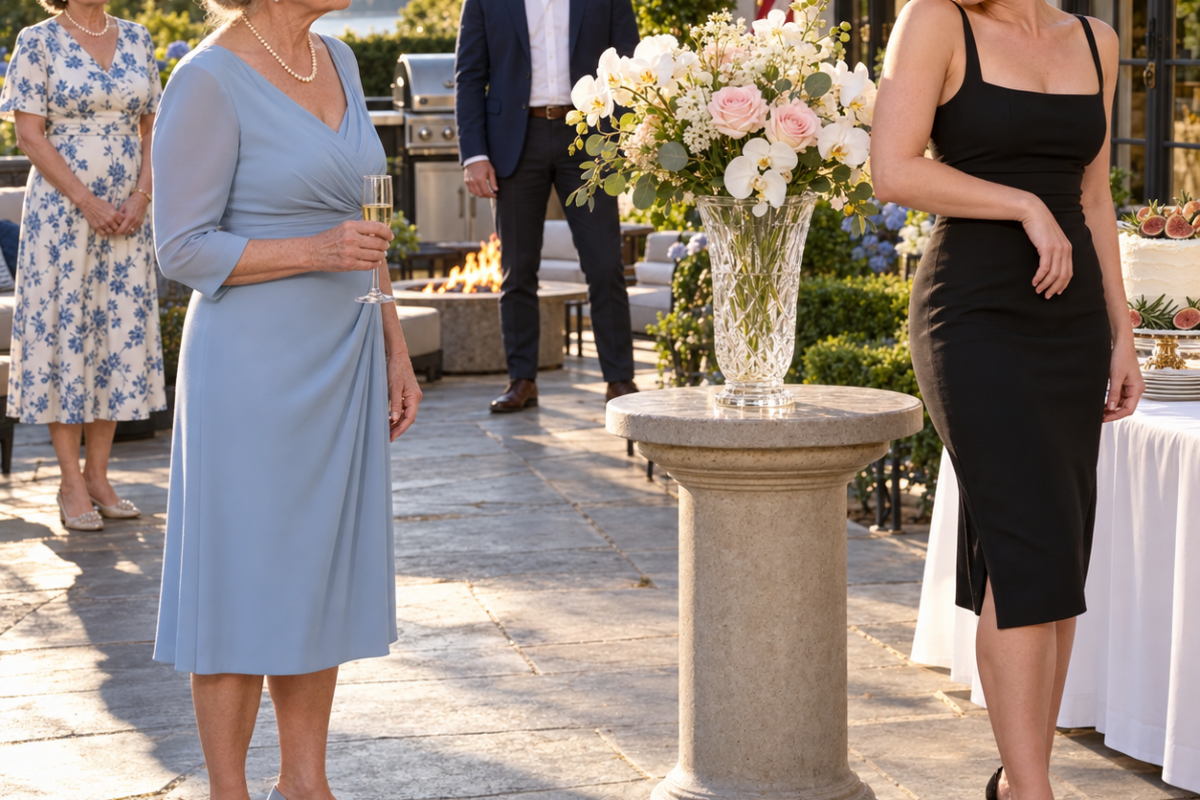
At my seventy-second birthday party, my daughter-in-law knocked a crystal vase off its pedestal with her elbow, watched it shatter, and smiled. “Oops.” Her own parents had given it to her and my son on their wedding day six years earlier. I looked at Frank, waiting for him to say something. All he managed was, “Mom…”
I watched my daughter-in-law break her own parents’ wedding gift with one elbow and a smile. For months afterward, people asked me whether I was…
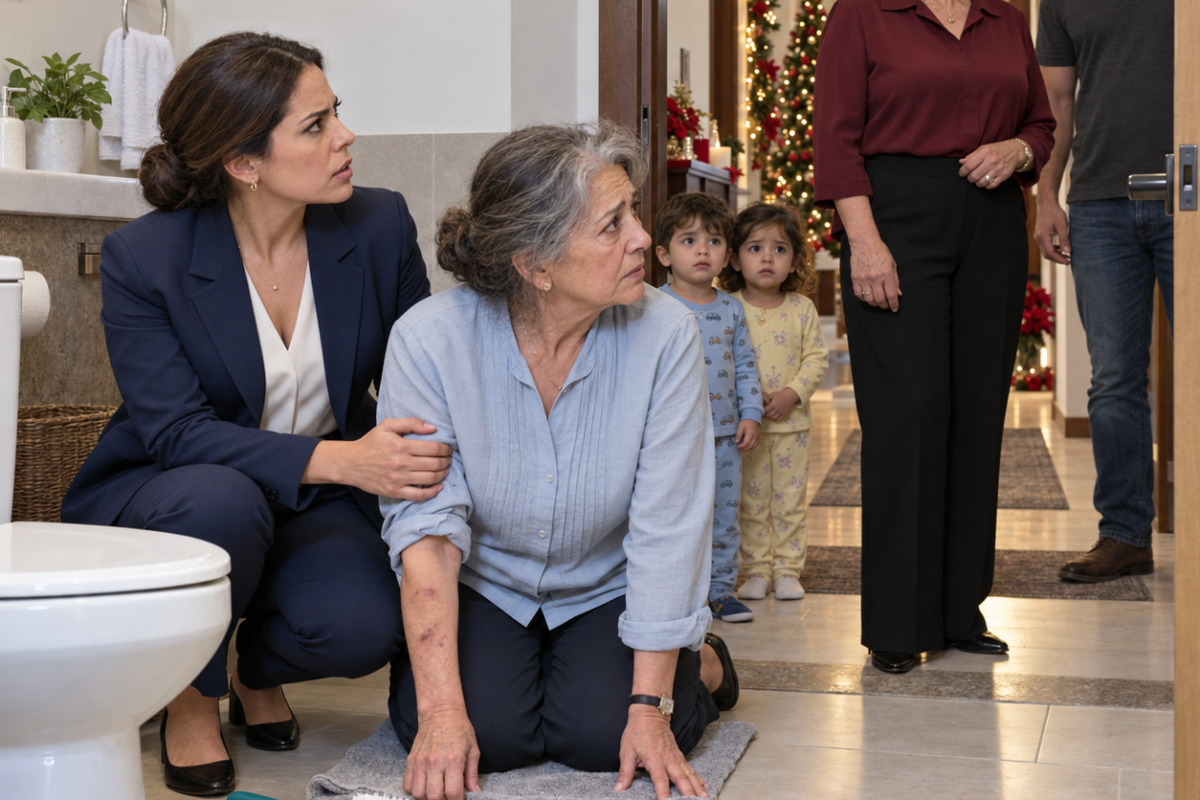
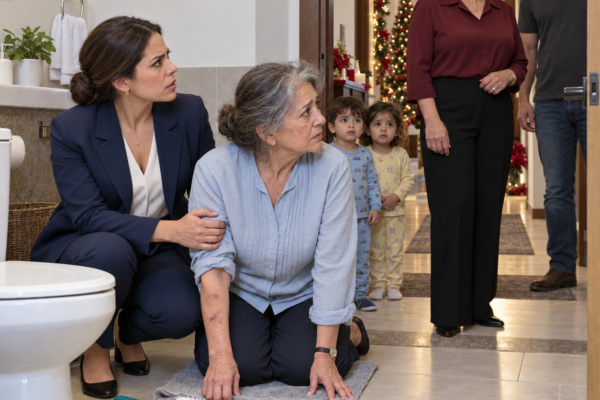
I came home three hours early and found my sixty-eight-year-old mother on her knees scrubbing my mother-in-law’s bathroom. When I helped her stand, her sleeve slipped back, revealing dark marks around her wrist. My husband stepped into the doorway. “Daniela, don’t make a scene.” That was when I remembered my father’s last warning: “If you ever see your mother hurt, don’t argue with anyone. Open the hidden compartment in her sewing machine.”
I came home three hours early and found my sixty-eight-year-old mother on her knees beside a toilet. Her hands were stiff with arthritis. One gripped…
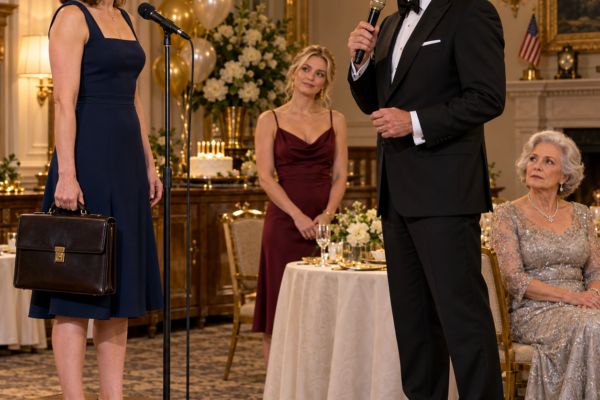
“I already promised your house to your sister,” my father told me four days after I bought it. “They’re moving in Monday. Rent-free for three years.” I was thirty-one, had saved for nine years, and had bought the five-bedroom home entirely in my own name. When I said no, he threatened to tell the family I had abandoned my sister’s children. Days later, he took the microphone at my grandmother’s seventy-fifth birthday dinner and did exactly that.
My father called twelve times in forty minutes after discovering I had bought a house without consulting him. When I answered, he didn’t ask whether…
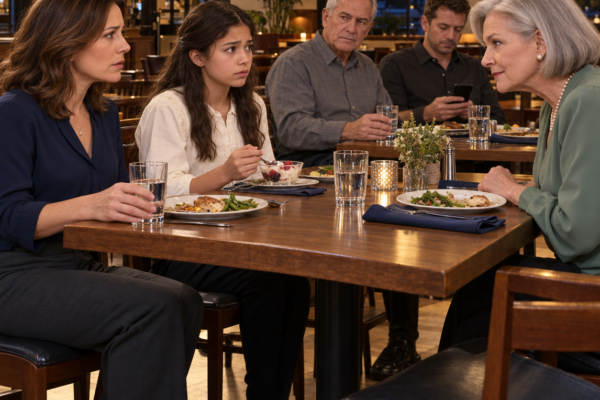
My mother leaned across the restaurant table, looked at my thirteen-year-old adopted daughter, and whispered, “We don’t sit with mistakes.” I took Sole’s hand and walked her out. That night, my father texted, “You’re still making the car payment tomorrow, right?” By midnight, I had canceled the payments I’d been making for my family. Then I remembered something Sole had told me about her grandmother.
My mother looked at my thirteen-year-old daughter and whispered, “We don’t sit with mistakes.” She said it softly enough to avoid attracting attention from the…
At my father’s seventieth birthday dinner, my eleven-year-old son and eight-year-old daughter were seated beside the service door with water glasses—but no dinner plates. Their cousins sat beside Grandpa with warm bread and full place settings. “They’ll eat after everyone else,” my sister said. I turned to my father, expecting him to object. “They can wait another hour,” he replied. There were two empty chairs at his table.
At my father’s seventieth birthday dinner, the first thing that stopped me wasn’t the cake or the gold balloons. It was my children. Ethan and…
“Mommy, are you real?” my four-year-old daughter whispered when I came home from deployment three weeks early. She was sitting alone on our living room floor with an empty cereal bowl. My husband was on a Caribbean cruise with his mother and sister. Twenty-two minutes earlier, they had posted a photo captioned “Family time.” I was still in uniform when Sophie asked if she could have something to eat.
The first thing my daughter said when I found her was, “Mommy, are you real?” She was sitting cross-legged on our living room floor with…
End of content
No more pages to load