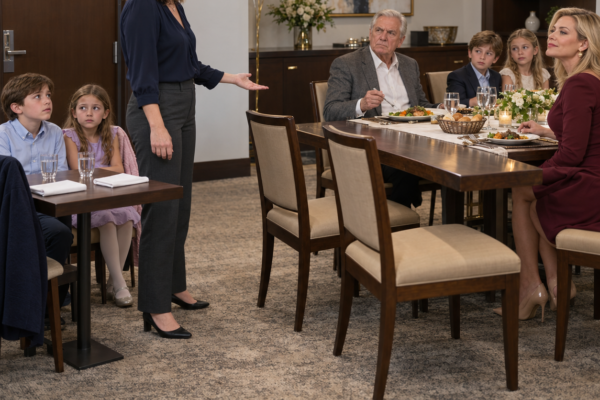
My mother-in-law took the dinner plates out of my daughters’ hands. “These are for real family,” she announced. “Only women who have given this family a grandson get to eat off my good china. Your daughters can use the paper plates in the kitchen.” My husband looked down and said nothing. I took my girls into the kitchen, then texted my lawyer one word: “Proceed.”
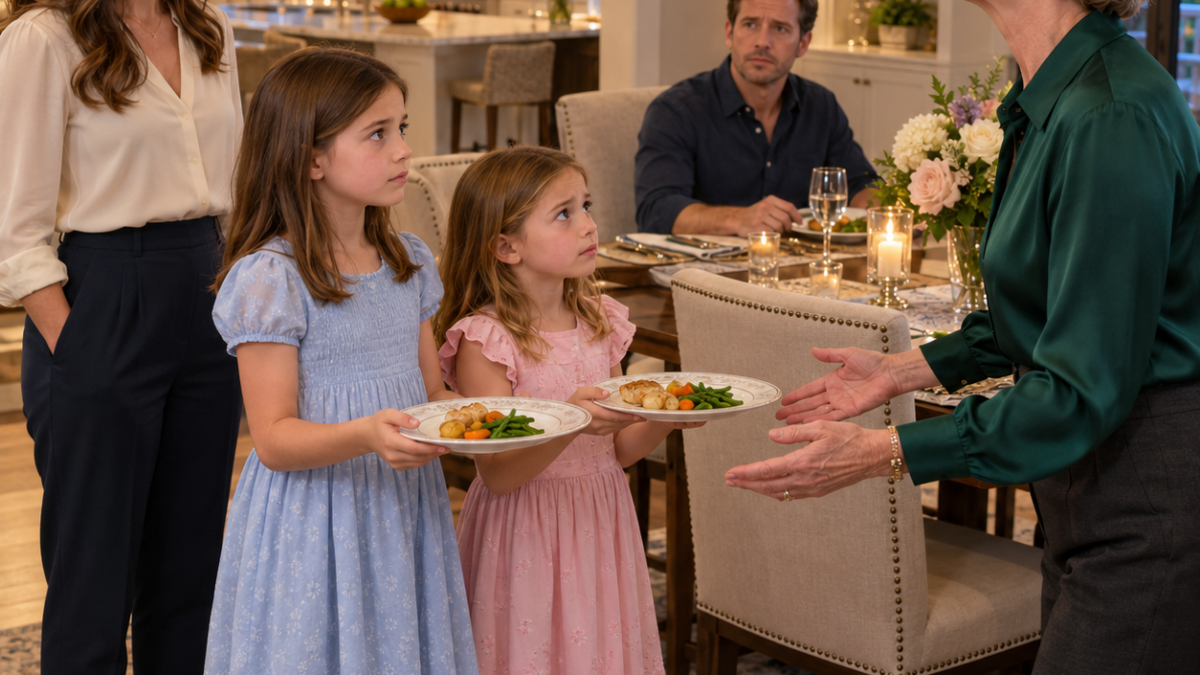

My mother-in-law took the dinner plates directly out of my daughters’ hands.
Not because they had finished eating.
Not because something was wrong with the food.
She took them because they were girls.
“These are for real family,” Ilsa said, holding one plate in each hand. “Only women who have given this family a grandson get to eat off my good china. Girls can use the paper plates in the kitchen.”
My younger daughter’s fork fell to the floor.
Tansy was six. She stared at her grandmother with the bewildered expression children have when someone changes the rules halfway through a game.
Marisette, who was nine, understood enough to look ashamed.
I turned toward my husband.
Griffin sat beside me, looking down at the table.
His brother looked at his food.
My sister-in-law started to move, then stopped when her husband touched her arm beneath the tablecloth.
Nobody spoke.
I stood, walked around the table, and picked up Tansy’s fork.
“Come with me, sweetheart.”
Marisette pushed back her chair.
I led both girls into the kitchen, where the yellow light above the counter made everything look almost ordinary. There was a pot soaking in the sink. A dish towel hung over the oven handle. The kitchen window looked out onto the rose garden my father had planted.
I got my daughters fresh plates and helped them transfer what they wanted to eat.
Then I took out my phone.
My attorney’s name was near the top of my recent contacts.
I typed one word.
Proceed.
By the time Ilsa cut her birthday cake, I had made the decision she had spent two years assuming I would never make.
She did not know it yet.
She was still sitting at the head of the table, in the house she liked to call hers.
The house belonged to me.
My name is Odalis. I was thirty-four when that dinner happened, and I had been married to Griffin for nine years.
For a long time, I thought loving him meant learning to live with his mother.
I did not expect to adore her. I did not expect her to become a second mother to me. I thought families were complicated, people had difficult habits, and a marriage required some patience with the people who came with it.
What I failed to understand was that patience could become an arrangement in which one person kept getting hurt so everyone else could remain comfortable.
I met Griffin through a friend from work.
He had a gentle sense of humor and a way of noticing small things without announcing that he had noticed them. If I was cold, he moved the car before asking whether I wanted the heater. If a waiter forgot something, he reminded them without making it embarrassing.
He was easy to be around.
That mattered to me.
I had grown up with my father and very little extended family nearby. There were birthdays with two plates on the table, holidays when Dad made enough food for six people even though there were only two of us, and summers spent in the yard while he worked on things that never seemed urgent enough to finish.
He was a good father.
He was also the first person who taught me that love usually looked like paying attention.
When I brought Griffin home, Dad liked him.
They stood in the garage discussing a shelf that had been crooked for years.
By the end of the visit, Griffin had helped straighten it.
“He seems decent,” Dad told me later.
“He is.”
Dad nodded.
“Make sure he stays decent when something is difficult.”
At the time, I thought he meant money problems or illness.
I did not understand that difficulty could arrive wearing a cardigan, carrying a serving spoon, and insisting that everyone else accommodate her.
Ilsa welcomed me warmly at first.
At our engagement dinner, she hugged me and said I was the daughter she had never had.
I believed her.
I wanted to belong to a larger family. I liked the noise, the crowded kitchen, the stories told by people who had known one another for decades.
Griffin had a younger brother. There were aunts, cousins, church friends who had become honorary relatives, and neighbors who wandered in without knocking.
I mistook familiarity for safety.
For the first two years, there were enough pleasant moments to make the unpleasant ones seem manageable.
Ilsa called me for help choosing flowers.
She asked whether I could bring a salad to dinner.
She complimented a blouse I wore and then told me the neckline would look better with a different necklace.
Small things.
I laughed them off.
I thought she was particular.
I thought I could learn where to bend and where to remain myself.
The first unmistakable crack came while I was pregnant with Marisette.
We had recently learned we were having a girl.
At a family barbecue, Ilsa asked whether we planned to try again for a boy.
There were twelve people within hearing distance.
I rested my hand over my stomach.
“We’re still waiting for this baby.”
“Of course,” she said. “But it’s good to have a plan.”
Griffin smiled awkwardly.
I laughed because I did not know what else to do in front of everyone.
Later, I told him the comment bothered me.
He apologized privately.
“She gets carried away.”
“With what?”
“Family stuff.”
“Our daughter is family.”
“I know.”
“Does she?”
He sighed.
“Odalis, she’s excited. She just says things badly.”
That was the first version of an answer I would hear for years.
She says things badly.
She is from a different generation.
She does not mean it the way it sounds.
That is just how she is.
Each explanation asked me to become more generous with my interpretation while allowing Ilsa to remain exactly as she was.
When Marisette was born, Ilsa visited the hospital.
She held her for a few minutes.
Our daughter was asleep, wrapped in a blanket, with one tiny hand pressed against her chin.
Ilsa looked at her and said, “Well, she’s beautiful. We’ll try for the real thing next time.”
I had been awake for most of two days.
I was sore, exhausted, and still trying to understand how something so small could make the whole world feel different.
I looked at Griffin.
He took Marisette from his mother and said, “Come on, Mom.”
That was all.
Come on.
A mild correction, delivered with a smile.
Ilsa laughed.
“Oh, don’t be so sensitive. You know I love babies.”
After she left, I asked Griffin whether he had heard what I heard.
“Yes.”
“And?”
“She shouldn’t have said it.”
“But she did.”
“I’ll talk to her.”
He said that often.
Sometimes he even made the call.
Nothing ever changed enough for our daughter to notice.
My father came the next morning.
He washed his hands, sat down, and held Marisette as though he had all the time in the world.
He studied her face.
“Well,” he said softly. “There you are.”
I started crying.
He looked up at me.
“What’s wrong?”
“Nothing.”
He did not believe me, but he did not push.
Instead, he stayed.
He brought food the nurses said I could eat. He made Griffin go home for a shower and some sleep. He walked the hospital hallway with me when I was ready to move.
Later, when we were alone, I told him what Ilsa had said.
Dad looked down at Marisette.
“She’s real enough to me.”
I laughed through the tears.
He touched the blanket.
“Don’t let anybody make her wonder about that.”
I wish I could say I immediately understood what he was asking of me.
I understood the words.
Living by them proved harder.
Three years later, Tansy arrived.
Ilsa did not come to the hospital.
She sent a card.
Congratulations on your daughter. God has a plan.
I read it while Tansy slept beside me.
There was nothing openly insulting in the sentence. That was part of what made it exhausting. If I objected, I could be accused of looking for offense.
Griffin said it was a nice card.
I put it in a drawer.
I did not want to spend the first days of my daughter’s life arguing over what her grandmother might have meant.
My father had died the year before.
Marisette had been two.
He had been ill for a while, but not long enough for me to feel prepared.
I do not think any amount of time would have accomplished that.
After the funeral, I found myself wanting to call him about things I had never considered important.
A loose handle on a kitchen cabinet.
A question about pruning roses.
Something funny Marisette had said.
Grief kept revealing itself in the ordinary places where his presence had been.
He left me his house.
It was not grand.
A comfortable older house with three bedrooms, a broad front porch, a kitchen that always seemed brighter in the afternoon, and a yard he had spent years making beautiful.
The rose garden was his pride.
He built it one bed at a time, saving for good plants, moving stones, testing soil, and arguing with weather as though weather might respond to reason.
He said the point of having a big yard was giving grandchildren somewhere to get their knees dirty.
Marisette remembered him only in pieces.
A hat.
A laugh.
A pocket that sometimes contained crackers.
Tansy never met him.
That hurt me in ways I could not explain.
Griffin and I already owned a home closer to the city, where his job and my work made our daily routine manageable.
We did not move into Dad’s house.
For several years, I maintained it and struggled to decide what should happen next.
I visited on weekends.
I paid the property taxes and insurance.
I checked the plumbing during cold weather.
I kept the garden alive imperfectly.
Sometimes I sat at Dad’s kitchen table with coffee and felt foolish for being comforted by a room.
But it was the one place where I could still remember his movements without trying.
Around the time Tansy turned four, Ilsa’s apartment building raised the rent.
She was seventy by the birthday dinner that eventually ended our arrangement. Two years earlier, she had been living on retirement income and complaining that every bill was becoming impossible.
Griffin worried.
His brother worried.
Ilsa called often.
She said she did not know what she would do.
She had savings, but she hated drawing from them.
Her sons discussed options, none of which satisfied her.
One evening, Griffin said, “Your dad’s house is empty.”
I looked at him.
“Yes.”
He hesitated.
“I’m not asking you to give it to her.”
“What are you asking?”
“Maybe she could stay there for a while.”
I thought about the quiet house.
The rooms.
The yard.
The grandmother my daughters kept trying to love.
I said I would consider it.
That weekend, I went there alone.
The roses needed attention.
I spent an hour pulling weeds, then sat on the porch steps.
I imagined Marisette and Tansy visiting their grandmother there.
I imagined someone telling them about the man who had planted the flowers.
I imagined Dad’s house becoming full of family again.
I did not realize how much of my decision came from that picture.
When I offered Ilsa the house rent-free, Griffin was overjoyed.
He hugged me in the kitchen.
“This will mean so much to her.”
I hoped it would.
We explained that I would retain ownership, that she was not receiving the house as a gift, and that the arrangement would need to work for both of us.
There was no formal lease.
Looking back, I wish I had sought advice before she moved in.
Good intentions do not replace clear terms.
But we were family, and I let that word do work it was not equipped to do.
Ilsa thanked me.
She cried a little.
She said my father would be proud of my generosity.
I wanted to believe that too.
The first few weeks were pleasant.
She called to ask where the fuse box was.
She invited us over for dinner.
She stood in the garden and said the roses were lovely.
I told her how Dad had planted them.
She listened.
I thought something might finally be changing.
Then she began treating the house as though it had always belonged to her.
She redecorated rooms without asking.
She replaced the curtains.
She moved a cabinet my father had built into the garage because it did not suit the dining room.
When I noticed, she said, “You can’t expect me to live in a museum.”
I told her the cabinet mattered to me.
Griffin offered to bring it to our house.
That solved the immediate problem.
It did not address why his mother felt entitled to decide what happened to something she knew was important to me.
She began telling neighbors it was the family house.
Technically, it was.
But she never said whose family had made it one.
At gatherings, she referred to the roses as hers.
I did not challenge every instance.
I knew people often used possessive language about the place where they lived.
I also knew that, with Ilsa, each unchallenged assumption tended to grow roots.
Most painful of all, she did not invite my daughters over to spend time in the garden.
There were family dinners.
There were holidays.
But no afternoons planting flowers, no little gardening gloves, no stories about Grandpa.
I had not explicitly asked her to become the keeper of my father’s memory.
Still, part of me had hoped.
Two years of watching her welcome other people into the house taught me that the absence was a choice.
Griffin’s younger brother and his wife had a son the spring after Tansy was born.
Ilsa adored him.
There was nothing wrong with adoring a grandson.
There was something wrong with making two granddaughters watch while she demonstrated the difference.
She opened a savings account for him.
She framed his photograph in silver and placed it at the center of the mantel.
When I brought school pictures of the girls, she put them in a drawer.
“So they won’t fade in the sun,” she said.
The silver frame remained in the same place.
At Christmas, her grandson received a bicycle, a large set of building blocks, and a remote-control truck.
My daughters received coloring books.
The books themselves were fine.
They liked coloring.
The problem was the ceremony surrounding everything else.
Ilsa called everyone over to watch her grandson open each present.
She knelt beside the bicycle and described how she had chosen it.
When the girls opened their small packages, she was already asking whether someone wanted more coffee.
Marisette looked around the room.
She was seven then.
Old enough to notice.
Not old enough to understand why no adult would name what she was noticing.
My sister-in-law met my eyes across the room.
Her face looked uncomfortable.
Then her son called for her, and the moment passed.
On the drive home, Marisette asked whether Grandma liked her cousin more.
I told her no.
I told her people showed love differently.
The words sounded wrong as soon as I said them.
I could see my daughter trying to make her own experience fit my explanation.
That was the first time I understood I was not simply protecting family peace.
I was teaching my child to distrust what she could see.
I raised it with Griffin after the girls went to bed.
“They notice.”
He sighed.
“I know the presents were different.”
“It isn’t the price.”
“I know.”
“It’s the attention.”
He rubbed his forehead.
“Mom is excited about him.”
“She has two other grandchildren.”
“I know that too.”
“Then tell her.”
“I will.”
The conversation could have been copied from half a dozen others.
I began to dread his agreement almost as much as his excuses.
Agreement made me hope.
Nothing following it made me feel foolish for having hoped again.
Six months before Ilsa’s birthday dinner, she left the girls off the guest list for her grandson’s party.
It was held at my father’s house.
Children from the extended family were invited.
Second cousins my daughters barely knew.
Neighbors.
Church friends.
Marisette and Tansy were not.
Griffin learned about it from his brother.
When he asked Ilsa, she said she assumed we were busy.
We were not.
She had never asked.
Marisette saw photographs afterward.
She recognized the garden.
“Why didn’t we go?” she asked.
I did not lie that time.
“We weren’t invited.”
Her face changed.
“Did Grandma forget?”
“I don’t know.”
She looked at me carefully.
Then she asked, “Can we still go in Grandpa’s garden sometime?”
The question hurt more than the missing invitation.
My daughter was asking permission to enter a place my father had hoped would belong to her childhood.
“Yes,” I said.
“When?”
“Soon.”
I took them the following weekend.
Ilsa was home.
She looked surprised to see us.
I told her we had come to spend some time outside.
She said she had plans.
“That’s fine,” I answered. “We don’t need you to change them.”
The girls walked through the garden while I pointed out things Dad had planted.
Tansy collected fallen petals.
Marisette asked which flower he liked best.
I told her it depended on the day.
We stayed an hour.
Ilsa did not join us.
Afterward, I called an attorney.
She had helped with my father’s estate, and I trusted her to tell me the truth even if it was inconvenient.
I explained the housing arrangement.
I explained that it had become difficult.
I did not spend the first call cataloging every insult.
I asked what my options were as the owner of a house occupied by someone who had lived there with my permission.
She was clear.
The lack of a written lease did not mean I could change the locks, shut off utilities, or remove Ilsa’s belongings.
Occupancy could create legal rights even in a rent-free family arrangement.
The proper steps depended on the applicable law and the facts.
We would need appropriate notice.
We might need further proceedings if she refused to leave.
We would also need to make sure the notice was valid and that my conduct did not undermine the process.
“How long?” I asked.
She gave me a range, with qualifications.
It was longer than I wanted.
It was also a real answer.
“I’m not ready yet,” I said.
“That’s all right.”
“Can we prepare?”
“Yes.”
I gave her the ownership documents, estate records, and correspondence about Ilsa moving in.
She reviewed them.
We discussed practical options.
I made arrangements for a property inspection at the appropriate time and began thinking about what I wanted to do with the house once it was empty.
Then I hesitated.
For months.
I told myself I was overreacting.
I told myself ending the arrangement would damage my marriage.
I told myself an older woman could not simply be expected to move because she was difficult.
Those concerns were not imaginary.
But I used them to avoid another question.
How much more harm was I willing to tolerate while deciding whether I was allowed to act?
I had not told Griffin about the legal consultation.
That omission became something we had to discuss later.
I do not pretend it was ideal.
I also know why I did it.
Every conversation about his mother had become an opportunity for him to talk me out of taking my own judgment seriously.
I needed advice that did not begin with a request to protect Ilsa’s feelings.
The birthday dinner answered what I had been postponing.
It was a Sunday in early spring.
Ilsa had asked the family to gather at the house.
The girls made cards.
Marisette drew a garden.
She used three shades of green and carefully outlined each rose.
Tansy drew the family holding hands.
She labeled every figure in crayon.
Nobody was left out.
They worked on the cards for a week.
They argued about the good markers, then made a system for sharing them.
On the morning of the dinner, Tansy asked whether Grandma would put hers on the refrigerator.
“I hope so,” I said.
Marisette added, “She could put mine by the window.”
I looked at the cards.
I wished they were taking them to someone who would understand what she was being given.
At the house, Ilsa accepted them without opening them fully.
She placed them beside her plate.
Then she turned toward her grandson.
He had brought flowers with help from his parents.
She held those up for everyone to see.
The girls stood beside me.
I put a hand on each of their shoulders.
Dinner began.
Ilsa’s wedding china was set around the table.
It was hers, not my father’s.
I knew that.
She was entitled to care about it.
She was not entitled to use it as a measure of my children’s worth.
I sat between Griffin and Tansy.
Marisette sat beside her sister.
The food moved slowly down the table because Ilsa kept stopping dishes near her grandson.
Did he want more meat?
Would he prefer a different piece?
Had he eaten enough vegetables?
He was old enough to serve himself, but she hovered.
My daughters waited.
They had become very good at waiting.
Eventually, the serving dishes reached us.
Marisette put potatoes on her plate.
Tansy asked whether she could have a small piece of bread before eating everything else.
I said yes.
They were doing nothing unusual.
Nothing disruptive.
Nothing that needed correcting.
Then Ilsa stood.
Her chair scraped against the floor.
She walked down the table and reached for their plates.
Tansy held on for a second because she did not understand.
Ilsa pulled harder.
The fork fell.
Marisette let go immediately.
I saw something close in her expression.
An older child’s effort not to cry in front of people who might make crying another problem.
Ilsa delivered her rule.
Real family.
Grandsons.
Paper plates in the kitchen.
For a moment, I felt the familiar urge to find words that would end the discomfort.
Then I looked at my daughters.
I no longer wanted to end the discomfort.
I wanted to end the arrangement that made their discomfort acceptable.
I picked up the fork and took them out of the room.
At the kitchen counter, Tansy asked, “Did I almost break it?”
“No.”
“Grandma looked scared.”
“She wasn’t taking it because you were going to break it.”
Marisette looked at me.
“Because we’re girls.”
I set down the fresh plates.
“Yes,” I said. “That is what she said.”
“Are girls not real family?”
“You are my family. You are your dad’s family. And being girls does not make either of you less important.”
Tansy watched my face.
“Then why did she take them?”
“Because she was wrong.”
It was the clearest answer I had ever given them about their grandmother.
I should have given it years earlier.
They ate a little.
I sent the text.
My attorney did not respond instantly.
It was Sunday.
I did not need her to interrupt her life at the exact moment I stopped permitting Ilsa to govern mine.
I needed to know that I had finally instructed her to begin.
From the dining room, I heard voices resume.
A cautious attempt at normal conversation.
Then Griffin appeared in the kitchen doorway.
He looked at the girls.
“Everything okay?”
I stared at him.
He glanced down.
That question was an invitation to pretend.
I declined it.
“We’re leaving after they finish.”
“Odalis—”
“Get their coats.”
He stood still.
Then he went.
Ilsa came into the kitchen a few minutes later.
“You’re making too much of this.”
I looked at her.
“The girls are eating.”
“I have always been particular about my china.”
“That wasn’t what you said.”
She crossed her arms.
“You know what I meant.”
“Yes.”
For once, she seemed uncertain what to do with my agreement.
There was no misunderstanding to debate.
No tone to criticize.
No raised voice to point to as evidence that I was unreasonable.
I knew what she meant.
And I was done accommodating it.
She returned to the dining room.
I collected the girls’ cards from beside her place.
They had not been displayed.
Marisette saw me holding them.
“Are we taking those?”
“Yes.”
“Okay.”
Griffin carried the coats to the door.
We left before dessert.
I did not need to watch Ilsa cut cake and praise a family that had just told my daughters they were outside it.
The drive home was quiet.
Tansy fell asleep for part of it, then woke near our street and asked whether she could have cereal.
She had barely eaten dinner.
“Of course,” I said.
Marisette watched the passing houses.
When we stopped at a light, she asked, “Did you get in trouble with Grandma?”
“No.”
“She looked mad at you.”
“People can be mad without you having done something wrong.”
Griffin kept his eyes on the road.
I wondered whether he heard the answer as something meant for him too.
At home, I made the girls a proper meal from leftovers.
They sat at our kitchen table.
On ordinary plates.
Tansy ate slowly, then asked if she should wash hers very carefully.
“We wash all the dishes carefully,” I said. “That doesn’t mean you have to be afraid to use them.”
Marisette looked at the cards on the counter.
“Can we put those somewhere?”
I opened them.
The garden.
The family holding hands.
“Absolutely.”
We put them on our refrigerator.
Later, when I tucked Tansy in, she asked whether she had done something wrong.
“No.”
“Not even a little?”
“Not even a little.”
I stayed until she fell asleep.
Marisette was waiting in her room.
She sat upright against her pillows.
“Grandma doesn’t think we’re real family.”
I sat beside her.
“She said something cruel.”
“But she thinks it.”
I could not promise otherwise.
“I don’t know everything she thinks. I know how she has behaved.”
Marisette looked down.
I took her hand.
“I should have been clearer with you before. When you noticed that she treated you differently, you were noticing something real.”
Her eyes filled.
“So I wasn’t being jealous?”
“No.”
She began crying.
I held her.
Not because she had finally understood her grandmother.
Because she had finally heard an adult acknowledge what she had understood for years.
After the girls were asleep, Griffin sat across from me at our own kitchen table.
“I should have said something.”
“You should have said something years ago.”
He nodded.
I waited for the familiar explanation.
Different generation.
Stress.
Misunderstanding.
It did not come.
“Why didn’t you?” I asked.
He rubbed his hands together.
“I don’t know.”
“That won’t be enough forever.”
“I know.”
I told him about the attorney.
About the consultation six months earlier.
About the prepared steps.
About the text.
He stared at me.
“You’re making her leave?”
“I’m ending the housing arrangement through the proper process.”
His face changed.
“Where will she go?”
“She will need to make another arrangement.”
“She’s seventy.”
“I know.”
“She’s my mother.”
“I know that too.”
He leaned back.
“Why didn’t you tell me?”
“Because I needed to understand my rights without being persuaded that using them would make me cruel.”
He looked hurt.
I did not ignore it.
“I should have told you we were approaching this point. But you also need to understand why I stopped expecting you to help me reach it.”
He looked at the table.
“We could have discussed it.”
“We discussed your mother for nine years.”
There was no satisfaction in saying that.
Only weariness.
He sat quietly.
Then he asked, “Is there any way to slow this down?”
“The legal process already has a timeline.”
“I mean before the letter.”
“No.”
He lifted his eyes.
I held his gaze.
“This is not a sudden reaction to plates. I have been deciding whether the arrangement can continue for months. Tonight answered the last question.”
He swallowed.
I continued.
“I will follow the law. I will not interfere with her belongings. I will not cut off utilities. I will not do anything that makes the process improper. But I am not offering free housing indefinitely to someone who uses my father’s dining room to tell his granddaughters they don’t belong.”
Griffin put his face in his hands.
I let the silence last.
Eventually, he said, “I don’t know how this happened.”
“It happened one dinner at a time.”
He looked up.
“One excuse at a time,” I added. “One car ride where the girls cried and we told ourselves it wasn’t that serious.”
He nodded slowly.
I went upstairs.
He slept in the guest room that night.
Neither of us called it a separation.
Neither of us pretended everything was fine.
My attorney replied Monday morning.
She confirmed the instruction and said we would review the final notice and the required procedure before it was sent or served.
I took the call during my lunch break.
She asked whether anything had changed regarding Ilsa’s occupancy, agreements, or circumstances since we last spoke.
I answered.
She explained the next steps again.
Carefully.
There would be no theatrical eviction by text message.
No overnight loss of housing.
There would be a valid notice, a documented timeline, and further action only if required.
“Are you certain you want to proceed?” she asked.
“Yes.”
She did not ask whether Ilsa deserved it.
That was not the legal question.
The question was whether I was lawfully ending an arrangement I no longer wished to continue.
I was.
For the next several days, Griffin became unusually quiet.
He had always filled silences with observations.
Traffic.
Work.
A funny story.
Now he sat on the back porch with his phone in his hand.
Twice, I saw him begin to call his mother and stop.
I did not ask him to perform distress for me.
I did ask him to remain involved with the girls.
Sadness about his mother did not release him from being their father.
He made lunches.
He checked homework.
He listened when Tansy explained that her drawing of the family needed another person because she had forgotten her teacher.
On the third night, he told me what he had been thinking.
“I keep trying to find a middle ground.”
I set down the towel I was folding.
“What does that mean?”
“Maybe more time. Maybe a conversation before everything becomes formal.”
“There has been time.”
“I know.”
“There have been conversations.”
“I know.”
“Then what would the middle ground ask the girls to do?”
He did not answer.
I waited.
Finally, he said, “Go back.”
“Yes.”
He sat on the couch.
I remained standing.
“The middle ground is where they have been living,” I said. “Close enough to your mother for her to hurt them, far enough from your protection that they don’t expect you to stop it.”
His eyes filled.
I did not make the sentence gentler.
Our daughters had been living the consequences in real time.
He said, “I keep thinking if I say the right thing, she’ll understand.”
“What have you said so far?”
He looked down.
That was the problem.
For years, he had treated his intention to intervene as though it counted as intervention.
The next morning, he called Ilsa.
I was packing Tansy’s lunch in the kitchen.
He told his mother she had been wrong.
I could hear her voice rise, although not the words.
He said, “No, Mom. It wasn’t about protecting dishes.”
A pause.
“They are your granddaughters.”
Another pause.
“I should have stopped you. I’m not making that mistake again.”
I kept placing food into the lunchbox.
I did not turn the call into a moment he could use to prove everything was repaired.
But I listened.
Four days after the dinner, Ilsa received the formal notice.
My attorney had ensured that it followed the required procedures and accurately reflected the arrangement.
Ilsa called Griffin immediately.
He was home when the call came.
He looked at the screen.
Then he stepped into the living room and answered.
There was no cheerful greeting.
“What is this?” she demanded.
“The notice about the house.”
“I can read, Griffin.”
He stayed quiet.
“Your wife is putting me out.”
“Odalis is ending the arrangement.”
“You’re allowing this?”
He looked toward me.
I stood by the kitchen doorway.
“It isn’t my house to give away.”
“I never said you gave it away.”
“You keep acting like Odalis has no right to make a decision about it.”
“I live here.”
“And there is a proper process for ending that. She’s following it.”
Ilsa began crying.
For years, that sound had been enough to make Griffin abandon the original issue.
This time, he listened without changing his answer.
“I have nowhere to go.”
“We can discuss practical options. We are not asking Odalis to withdraw the notice.”
She stopped crying long enough to become angry.
“So you’ve chosen her.”
“I’m choosing to stop treating our daughters as less important.”
“You’re making a family matter into a legal matter.”
“The house is a legal matter. What you said at dinner is a family matter. Both need to be addressed.”
I looked at him.
It was the first time I heard him separate responsibilities instead of blending them into a vague appeal for everyone to get along.
Ilsa hung up.
He put the phone down.
“I feel sick,” he said.
“I’m sorry.”
He looked at me.
I continued.
“But feeling sick doesn’t mean you did something wrong.”
He nodded.
I realized I had said nearly the same thing to Marisette in the car.
The difference was that Griffin had spent decades learning the opposite.
That helped me understand him.
It did not make me responsible for undoing all of it.
Ilsa tried every approach she knew.
First, she accused me of being vindictive.
Then she said the dinner had been misunderstood.
Then she said she had been tired.
Then she said the girls were too sensitive.
Finally, when none of that changed my answer, she said she had misspoken.
I asked what she meant to say.
She did not answer.
On one call, she told me she had never intended to hurt them.
I stood at the kitchen counter, looking at Tansy’s card on the refrigerator.
“You took their plates and told them they weren’t real family.”
“I was upset.”
“About what?”
“The fuss you make.”
“What fuss?”
“Everything has to be equal.”
I let the silence settle.
Then I said, “Yes. Their place in the family does.”
She became angry again.
I ended the call.
After that, I limited communication about the house to the attorneys and practical written exchanges.
I was not going to spend the notice period defending my daughters’ humanity in repeated telephone arguments.
Griffin’s brother called him.
I could hear Griffin listening.
Then he said, “Were you at dinner?”
A pause.
“You heard her.”
Another pause.
“Then stop describing this like Odalis woke up angry and decided to cause trouble.”
His brother did not immediately become supportive.
He worried about housing.
About their mother’s reaction.
About what relatives would say.
Those concerns were easier for him to discuss than what had happened at the table.
Griffin said, “We can help her look for a place. That does not mean she stays in Odalis’s house.”
I supported that distinction.
I was not requiring the sons to stop caring whether their mother found appropriate housing.
I was ending my role as the solution she felt entitled to keep.
About a week after the notice, Ilsa came to our house unannounced.
It was early evening.
The girls were upstairs doing homework.
I saw her car pull into the driveway.
For a moment, I considered not answering.
Then I stepped onto the porch and closed the front door behind me.
She looked at the door.
“You’re not inviting me in?”
“No.”
Her mouth tightened.
“We need to discuss this like family.”
I kept my voice even.
“At dinner, you told my daughters they weren’t real family.”
“You know I didn’t mean—”
“I’m not having that conversation again.”
She looked past me toward the windows.
“Where are they?”
“Doing homework.”
“I would like to see them.”
“Not tonight.”
She stared.
“You can’t keep children from their grandmother because of a disagreement.”
“This is not an invitation to discuss access. Contact needs to be arranged with us.”
Griffin opened the door behind me.
He stayed beside me.
Ilsa turned toward him.
“Tell her.”
He took a breath.
“Mom, you need to leave.”
She looked genuinely shocked.
He had asked her to leave gatherings before.
He had asked her to lower her voice.
He had never stood beside me while refusing her entry to our home.
“I came here to solve this.”
“Then work with your attorney about the move,” he said. “And think about what you need to say to the girls.”
She looked at us for a long time.
Then she turned and left.
Upstairs, Marisette had heard enough to know someone was at the door.
She came down after Ilsa’s car disappeared.
“Was that Grandma?”
“Yes.”
“Was she mad?”
“Yes.”
“Are we going to her house?”
“No.”
Marisette looked relieved.
I put a hand on her shoulder.
“If that changes, we’ll discuss it with you first.”
She nodded.
That was another promise we kept.
My sister-in-law came over with Griffin’s brother about two weeks after the dinner.
They asked to talk while the children played in the backyard.
Their son ran through the gate ahead of them and immediately began chasing Tansy.
There was no hesitation among the cousins.
The adults were the ones carrying the difficult arrangements.
We sat in the kitchen.
My sister-in-law looked at the cards on our refrigerator.
Then she looked at me.
“I’m sorry.”
“For what?”
“For sitting there.”
Her husband shifted.
She glanced at him.
“No. I need to say it.”
He looked down.
She continued.
“I was going to speak. Then I stopped because I didn’t want the whole dinner to fall apart.”
“It had already fallen apart for the girls,” I said.
She nodded.
“I know.”
Her eyes filled.
Then she told me something I had not known.
Before their son was born, they had struggled to have a child.
Ilsa had made comments then too.
About whether her daughter-in-law was doing enough.
About whether Griffin’s brother would ever have a real family.
About how some women did not understand their responsibilities.
“I thought it was just me,” my sister-in-law said.
She gave a small, embarrassed laugh.
“That sounds ridiculous now.”
“It doesn’t.”
She looked at me.
“Once we had him, everything changed. She started treating me like I had passed something.”
I pictured Ilsa taking the plates.
Only women who had given the family a grandson.
“I knew it wasn’t right,” she said. “I told myself accepting the attention wasn’t the same as agreeing.”
Her husband put his hands on the table.
“I should have said something too.”
I looked at him.
“Yes.”
He nodded.
They did not ask me to withdraw the notice.
That mattered.
They asked what they could do to stop repeating the same pattern.
I thought for a moment.
“Don’t make your son responsible for being her favorite.”
My sister-in-law wiped her eyes.
“And don’t ask my daughters to make her feel better about what she did.”
They agreed.
The children came inside asking for water.
Tansy had grass stains on one knee.
Her cousin announced that she had cheated at a game.
She said the game had no rules.
Marisette informed them both that this was the problem.
We gave them water.
The argument continued outside.
I watched them go.
It was good to remember that they could be cousins without being contestants in their grandmother’s ranking system.
The family group chat changed over the next several weeks.
I had never been especially active in it.
Ilsa used it to post her grandson’s photographs and announce plans.
People began discussing what happened at dinner.
I did not start a public campaign.
I did not post private legal documents.
I answered direct questions accurately.
Others spoke.
My sister-in-law acknowledged the incident.
Griffin said plainly that his mother had treated the girls unfairly and that the housing matter was being handled lawfully.
A cousin messaged me privately.
Then another.
Some offered their own stories.
A niece who had always felt overlooked.
A daughter-in-law who had endured comments about her appearance and motherhood.
Someone who had stopped attending dinners years earlier without explaining why.
I did not turn every story into evidence against Ilsa.
Some belonged only to the people telling them.
But I understood that the family’s silence had concealed more than my own experience.
Not everyone supported us.
Ilsa’s sister called.
She was furious.
“You’re humiliating an old woman over hurt feelings.”
I sat in my parked car outside work.
“She humiliated two children.”
“You don’t put someone out of her home because she says something you dislike.”
“I’m ending a rent-free arrangement through the proper process. She has time and options.”
“You should be ashamed.”
I looked at the steering wheel.
For years, being told I should feel ashamed would have sent me into explanation.
That day, I said, “I’m not discussing this with you further.”
I ended the call.
Then I cried.
I want to be honest about that.
Knowing a boundary is right does not always make other people’s disapproval painless.
I had spent years trying to belong to that family.
Losing the approval I had worked for hurt, even after I understood how little protection it had purchased.
Two aunts stopped responding to my messages.
One skipped a cousin’s graduation because, I was told, she did not want to be in the same room as me.
I went anyway.
I congratulated the graduate.
I brought the gift we had chosen.
I smiled in the photographs.
Later, in the car, Griffin asked whether I was okay.
“I’m tired of being the villain in a story I didn’t start.”
He looked at me.
“They don’t get to decide what we accept for the girls.”
“I know.”
“And they don’t get a vote in your house.”
“I know that too.”
He nodded.
Then he added, “I should have said those things before you had to make them this obvious.”
I looked out the window.
“Yes.”
He did not ask me to soften the answer.
That helped.
Ilsa hired an attorney.
She was entitled to do that.
I did not resent her seeking advice about her housing rights.
Her attorney questioned parts of the notice and the circumstances of the arrangement.
My attorney responded.
They exchanged documents and discussed the applicable requirements.
There was no magical rule that family occupancy did not count because there had been no rent.
There was also no evidence that I had given Ilsa permanent ownership or promised she could remain forever.
The deed was in my name.
The inheritance records were clear.
The communications surrounding her move reflected permission to live there, not a transfer of the property.
After reviewing the matter, the attorneys worked toward a documented departure rather than unnecessary litigation.
We agreed on a move-out schedule consistent with the legal process.
Ilsa had time to find housing.
She could remove her own possessions.
I would arrange access and inspection appropriately.
Any unresolved property concerns would be addressed through counsel.
The agreement did not require me to continue subsidizing her indefinitely.
It did not require me to forgive her.
It required both of us to follow the terms.
That was enough.
Griffin and his brother helped their mother look at apartments.
I did not interfere.
I also did not pay the deposit, guarantee the rent, or offer my father’s house as a fallback if she disliked the options.
Ilsa disliked many of them.
Too small.
Too far from church.
Not enough storage.
No garden.
She called Griffin to complain.
He listened.
Then he said, “You’ll need to choose something you can afford.”
The first time he said it, he looked as though he expected the roof to collapse.
It did not.
She became angry.
He remained on the call.
The second time was easier.
Not easy.
Easier.
He began counseling during that period.
I had told him that our marriage could not continue on the basis of him feeling bad whenever his mother hurt us.
He needed to understand why his first response had always been to protect her from being challenged.
At first, he said he did not know what a counselor could tell him that he had not already figured out.
I answered, “Then go and explain why you kept doing it.”
He went.
He did not come home transformed.
He came home quiet.
Later, he said, “I thought disagreeing with her was the same as betraying her.”
I considered that.
“What did she teach you agreeing with her meant?”
“That I was a good son.”
“And what did it make you at that table?”
He looked down.
“A father who didn’t help.”
We had difficult conversations.
Some were productive.
Some ended with both of us too tired to continue.
We also began couples counseling.
I wanted a place where the history could be discussed without the conversation becoming a contest between my memory and his intentions.
He said he wanted to rebuild trust.
I said I wanted to stop being the only person deciding whether our daughters needed protection.
Our counselor asked what that would look like in practice.
I had answers.
He would respond to comments when they happened.
He would not ask the girls to reassure his mother.
He would not arrange visits without discussing them.
He would handle communication with his relatives rather than leaving me to absorb it.
He would learn to tolerate someone being angry with him without treating that anger as proof he had made the wrong choice.
Those were not dramatic conditions.
They were ordinary responsibilities he had avoided because I had kept carrying them.
He began doing them.
One afternoon, he apologized to the girls.
Not while they were going to bed.
Not in the middle of a busy morning.
He asked whether they would sit with him in the living room.
I remained nearby.
He told them he had been wrong at dinner.
Tansy looked at him.
“Because you didn’t get us plates?”
He swallowed.
“Because I didn’t tell Grandma she was wrong to take yours.”
Marisette watched quietly.
He continued.
“You didn’t do anything wrong. You should not have had to leave the table to be treated properly.”
Tansy twisted a corner of the cushion.
“Did Grandma know that?”
“She knows what we have told her.”
“Is she sorry?”
He looked at me briefly, then back at his daughter.
“She hasn’t apologized properly.”
Marisette said, “She’ll say she didn’t mean it.”
Griffin’s face changed.
Our daughter had learned the script.
“I’m not going to use that explanation anymore,” he told her.
She studied him.
“What if she says it again?”
“We leave. And I say something.”
“Before Mom does?”
He nodded.
“Yes.”
Tansy leaned against him.
Marisette did not.
He accepted both responses.
I appreciated that more than a scene in which everyone hugged and declared the problem finished.
Their trust belonged to them.
He could work to earn it.
He could not require them to provide it because he had finally found the right words.
We also changed how we talked about their grandmother.
I stopped saying she loved them differently.
I told them adults could behave unfairly and that we were responsible for making sure unfairness did not become something they had to endure.
When Marisette asked whether Grandma loved her, I did not pretend to know what was inside Ilsa.
“I know you deserve to be treated lovingly,” I said.
She thought about that.
“Even if she doesn’t feel it?”
“Yes.”
Tansy asked whether paper plates were bad.
“No.”
“Then why were we sad?”
“Because of why she gave them to you. Not because of what they were made of.”
She nodded.
“Picnic plates are fine.”
“Exactly.”
I did not want my daughters to leave that dinner believing their dignity depended on china.
We ate pizza from paper plates the following Friday.
Tansy noticed.
“These are for everybody.”
“Yes.”
She looked pleased.
Marisette passed one to Griffin.
He thanked her.
It was a small meal.
A large correction.
As the move-out date approached, I returned to my father’s house for an arranged inspection.
My attorney had advised me about notice and access.
I followed the process.
Griffin came with me.
Ilsa was waiting in the living room.
Some boxes were packed.
Others stood empty.
The silver-framed photograph remained on the mantel.
The girls’ pictures were still not visible.
I walked through the house carefully.
I noted repairs.
A loose cabinet hinge.
A stain near the back door.
Nothing dramatic.
Nothing that changed the reason the arrangement was ending.
In the dining room, I stopped.
The table was Ilsa’s.
So was the china cabinet.
The walls were my father’s familiar pale color beneath the decorations she had added.
I remembered Tansy’s fork hitting the floor.
Griffin stood beside me.
He knew what I was thinking.
“I’m sorry,” he said.
I nodded.
Ilsa followed us.
“I hope you’re satisfied.”
I turned toward her.
“This is an inspection. If you have concerns about the agreement, speak with your attorney.”
She looked at Griffin.
He did not intervene on her behalf.
I went into the garden.
The roses had survived.
They needed attention.
I knelt beside one bed and touched the soil.
Dad had planted the first bushes there while I was in high school.
I remembered him coming inside with dirt on his knees and asking what was for dinner, even though he had not assigned anyone to cook.
I used to roll my eyes.
Now I would have given almost anything to hear the question again.
Griffin stood a few feet away.
“Do you want help?”
“Yes.”
He knelt.
We pulled weeds in silence for ten minutes.
Ilsa watched from the kitchen window.
For once, I did not wonder whether she approved.
She moved into a small apartment across town.
She paid for it herself.
Her sons helped carry boxes.
I did not prevent that.
I wanted Griffin to learn that caring about his mother did not require surrendering my property or our daughters’ safety.
Those were separate decisions.
He came home on moving day looking exhausted.
“She’s angry.”
“I know.”
“She says she’ll never forgive this.”
I set down the book I was reading.
“What did you say?”
“That she doesn’t have to agree with it for the move to be final.”
He sat beside me.
“That was hard.”
“I believe you.”
He leaned back.
For a while, we listened to the girls playing upstairs.
Then he said, “I kept waiting for her to talk about the plates.”
I looked at him.
“She talked about the curtains. The rent. The neighbors. Everything except the girls.”
I nodded.
He closed his eyes.
“I’m starting to understand how much I filled in for her.”
“What do you mean?”
“I kept telling you what she felt. What she meant. What she intended. Sometimes she hadn’t even said those things. I supplied them because I wanted them to be true.”
I thought about nine years of conversations.
“Yes,” I said. “You did.”
He did not argue.
The next weekend, we went to the empty house.
I brought the girls.
I had wanted to wait until the rooms were clean and the emotional weight felt lighter.
Then I realized they did not need to be kept from the place while I tried to make it perfect.
They needed to know they belonged there.
Marisette stood on the porch.
“Is Grandma gone?”
“Yes.”
“For good?”
“She has moved to her apartment.”
Tansy looked through the front window.
“Are we allowed in all the rooms?”
“Yes.”
“Even the dining room?”
My throat tightened.
“Especially the dining room.”
We opened the door.
The house sounded different without furniture.
Their footsteps echoed.
Tansy ran into the kitchen, then stopped.
“The counter’s empty.”
“It is.”
Marisette walked toward the dining room.
I followed her.
There was a lighter rectangle on the floor where Ilsa’s china cabinet had stood.
She looked around.
“This is Grandpa’s house.”
“Yes.”
She touched the window ledge.
“Can we put our pictures here?”
“We can.”
Tansy appeared behind us.
“And the cards?”
I smiled.
“Yes.”
We took the cards from our refrigerator the next day and brought them over.
The garden drawing.
The family holding hands.
I placed them on a shelf where anyone entering the room could see them.
No drawer.
No explanation about sunlight.
Just two things made by children who belonged.
We did not move into the house immediately.
Our jobs and the girls’ school still made our current home practical.
I also did not want to rush into a decision simply because the space was available.
For a while, we used it on weekends.
We cleaned.
We repaired.
We tended the garden.
I considered several options and took advice about the finances.
Whatever I eventually chose, it would be my decision made with clear information.
The house no longer had to prove my generosity.
It could simply be the house my father left me.
One Saturday, I showed the girls how to remove weeds around the roses without disturbing the roots.
Tansy wanted to know why weeds were bad if they were plants too.
I gave an answer that satisfied her for perhaps thirty seconds.
Then she asked another question.
Marisette worked more quietly.
After a while, she said, “Did Grandpa like girls?”
I sat back on my heels.
“Yes.”
“Not just because you were his daughter?”
“He liked you because you were Marisette. He would have liked Tansy because she’s Tansy.”
My older daughter thought about that.
“He wouldn’t have wanted a different one?”
“No.”
She nodded.
Then she resumed pulling weeds.
I remained still for a moment.
That was the inheritance I had almost allowed Ilsa to obscure.
Not the property value.
Not the flowers.
The certainty that these children had been wanted without qualification.
Griffin’s brother and his wife became closer to us.
Their son came for sleepovers.
My daughters went to their house.
We began having Sunday meals together without waiting for Ilsa to establish the date, location, and terms.
At the first dinner, my sister-in-law brought dessert and a stack of mismatched plates because we were short a few.
Tansy looked at them.
“They’re all different.”
“They are,” her aunt said.
“Can I have the blue one?”
“Of course.”
Their cousin wanted it too.
They argued.
Marisette proposed taking turns at the next dinner.
The adults let the ordinary childhood negotiation happen.
Nobody declared one child more deserving.
Nobody made a speech about family lines.
They solved it.
Tansy took the blue plate.
Her cousin took the green one.
He asked for the blue one next time.
She agreed.
I watched Griffin notice the simplicity of it.
Later, my sister-in-law helped me load the dishwasher.
“I wish I had found my voice sooner,” she said.
I nodded.
“So do I.”
She looked at me.
There was no competition in it.
No attempt to claim we had suffered equally.
Just two women recognizing how much we had mistaken endurance for responsibility.
She said, “I don’t want him growing up thinking attention is something he gets because other children don’t.”
I glanced toward the living room, where her son was laughing with my daughters.
“He doesn’t seem to think that now.”
“No.”
“Then keep teaching him.”
She nodded.
We did not need to make him feel guilty for presents he had received.
We needed to stop letting adults use him as justification for hurting other children.
Ilsa remained upset about the changing holidays.
Griffin’s brother told her they would no longer automatically gather at her home.
She said family traditions were being destroyed.
He answered that traditions could change when they stopped working for the family.
It was not a sentence I would have expected from him months earlier.
Griffin told her any relationship with the girls would require a real apology.
To them.
Not a phone call to him about how distressed she felt.
Not a statement that she was sorry if anyone had taken offense.
A recognition that she had treated them as less worthy and that she would not repeat it.
She attempted an apology eventually.
Over the phone, she said, “I’m sorry if the girls were hurt.”
Griffin closed his eyes.
I sat beside him.
He said, “They were hurt because you took their plates and told them they weren’t real family.”
“I said I was sorry.”
“You apologized for their reaction.”
“You’re demanding certain words.”
“I’m asking you to acknowledge what you did.”
She became angry.
The call ended.
I did not feel triumphant.
I felt sad for the girls.
Sad that a woman who could discuss the inconvenience of moving for forty minutes could not spend one honest minute naming what she had done to them.
We did not arrange contact after that call.
Several months passed.
Ilsa sent birthday cards.
We reviewed them before deciding how to handle them.
There were no insults.
There was also no real acknowledgment.
The girls were free to look at them or put them away.
Marisette put hers in a box.
Tansy used the envelope in an art project.
I did not assign meaning beyond what they gave it.
Eventually, Ilsa asked through Griffin for a short meeting.
By then, he had made clear that there would be no private contact and no return to regular family visits.
She provided a more direct written acknowledgment, though it remained brief and uncomfortable.
She admitted taking the plates.
She said it had been wrong to speak about the girls as though they were outside the family.
She did not suddenly become a different person.
We did not suddenly trust her.
But we discussed whether a brief, supervised meeting could be appropriate.
We asked the girls.
Not as a decision they were responsible for making on behalf of the adults.
As an opportunity to express whether they wanted to see her.
Marisette said, “Maybe, if we don’t have to go to her house.”
Tansy asked whether there would be food.
I told her we could meet at a café.
“Can I keep my plate?”
The question was not a joke.
“Yes,” I said.
We arranged a short visit in a public place.
Griffin remained present the entire time.
I was there too for the first one.
Ilsa looked smaller sitting at a café table without the familiar surroundings that had always reinforced her authority.
She asked about school.
Tansy answered.
Marisette listened.
The apology was stiff.
But she did say, “I was wrong to take your plates.”
Marisette looked at her.
“And say we weren’t real family.”
Ilsa paused.
Then she nodded.
“And say that.”
The meeting lasted half an hour.
There were no hugs demanded.
No promises about the next holiday.
No suggestion that the girls should now consider the matter finished.
We left when the agreed time ended.
In the car, Tansy said the muffin was good.
Marisette said, “I don’t want to do that a lot.”
Griffin answered, “You don’t have to.”
I looked at him.
He meant it.
There was one more short meeting later in the year.
It was similarly careful.
Neither visit changed the boundaries.
Ilsa remained in her apartment.
She did not regain access to my father’s house.
The girls did not resume afternoons or dinners with her.
Their relationship with her became limited to what could be managed safely and what they were comfortable participating in.
It was not reconciliation in the way relatives imagined.
It was a small amount of contact governed by behavior, supervision, and the girls’ needs.
I stopped measuring success by whether everyone returned to the same table.
Sometimes the table had been the problem.
Almost a year after the birthday dinner, Marisette was ten and Tansy was seven.
They no longer asked often why their grandmother preferred their cousin.
They had more interesting things to discuss.
A class project.
A book.
An argument over who had borrowed whose sweatshirt.
That did not mean the hurt had never happened.
It meant the hurt no longer occupied the center of their days.
Griffin continued counseling.
We continued working on our marriage.
There were evenings when I still looked at him and remembered his eyes on the table.
He knew.
I did not hide those moments to reward his progress.
He did not tell me I should have moved on by now.
Sometimes he said, “I know what you’re remembering.”
I answered, “Yes.”
Then we talked.
Not always.
Sometimes I needed space.
He learned to respect that too.
One night, after the girls were asleep, he said the hardest part had not been standing up to Ilsa.
“It was admitting what I had been doing.”
I waited.
“I kept telling myself I was trapped between people I loved.”
“And now?”
He looked at me.
“I was asking the people with less power to make it easier for me.”
I thought about Tansy’s fallen fork.
Marisette’s face.
“Yes,” I said.
He nodded.
“I don’t want to do that anymore.”
“Then don’t.”
It was a plain answer.
He accepted it.
We did not need a new promise every week.
We needed repeated choices.
He made more of them correctly.
At a family gathering that spring, someone made a careless remark about girls being expensive and boys being the ones who carried a family forward.
Griffin answered immediately.
“My daughters carry this family just fine.”
The speaker laughed awkwardly.
Griffin did not laugh along.
Marisette looked up from her book.
Then she looked back down.
It was over quickly.
That was how protection should often work.
Before a child had to spend an evening wondering whether the adults had noticed.
Before a mother had to turn the car ride home into a lesson about being worthy.
Before anyone needed to send a word to an attorney.
I thought about my father more often after the house became ours to use freely again.
Not because I missed him less before.
Because grief no longer had to compete with the discomfort of watching someone else occupy his rooms while disregarding the children he had wanted there.
I brought photographs.
One of him holding Marisette.
One of the rose garden when the first bed had been planted.
One of me as a child sitting on the porch with scraped knees.
Tansy studied that last picture.
“You look like Marisette.”
“A little.”
“Were you allowed to get dirty?”
“Grandpa expected it.”
She smiled.
“Good.”
We planted two new rose bushes that spring.
One chosen by each girl.
Marisette selected a pale yellow variety after reading every label at the nursery.
Tansy chose pink because she liked the color.
Neither reason required improvement.
Griffin dug the holes.
The girls helped fill them.
I watered.
Afterward, we sat at a folding table in the yard and ate sandwiches.
We used paper plates because they were convenient.
Tansy held hers up.
“These are real-family plates.”
I smiled.
“They’re lunch plates.”
She considered that.
“Same thing.”
Marisette laughed.
Their cousin arrived later with his parents and immediately asked whether he could help water.
Tansy handed him the hose.
Within five minutes, all three children were wet.
My sister-in-law called out a warning.
Then she laughed.
Griffin stood beside me watching them.
“This is what your dad wanted,” he said.
I looked at the yard.
The rose beds.
The wet shoes.
The children arguing over the hose.
“Yes.”
I had spent two years hoping generosity toward Ilsa would create this.
It had not.
Ending the arrangement had.
That was difficult to accept at first.
I wanted generosity to be enough.
I wanted patience to persuade people.
I wanted family to mean that nobody had to insist on being treated decently.
Sometimes those hopes are answered.
Sometimes continuing to hope becomes another way of refusing to see what is already happening.
I did not become less generous.
I became more careful about what my generosity was supporting.
I did not stop believing in family.
I stopped using the word to excuse behavior that made my children feel they were outside it.
One Sunday, we held dinner at my father’s house.
Not a holiday.
Not a birthday.
Just dinner.
We borrowed chairs, brought food in containers, and set up the dining room with furniture I had chosen slowly rather than trying to replace everything at once.
The girls helped set the table.
There were ordinary plates.
Glasses that did not match perfectly.
A bowl of flowers from the garden.
Marisette placed the cards they had made for Ilsa on the nearby shelf.
I asked whether she wanted to keep them there.
She nodded.
“They’re still good.”
“Yes,” I said. “They are.”
Tansy counted the forks.
One was missing.
She went to the kitchen and found another.
No one watched her as though she needed to prove she could be trusted with it.
No one took it away.
We sat down.
Griffin’s brother passed the potatoes.
His wife asked Marisette about school.
Their son and Tansy argued about whether a worm they had found in the garden needed a name.
Griffin reached for the bread.
I looked around the table.
The room had once held my father’s voice.
Then it had held Ilsa’s rules.
Now it held conversation.
Messy, overlapping, ordinary conversation.
I did not need to be at the head.
I did not need anyone to announce that I had won.
I needed my daughters to reach for what they wanted without first checking whether they were entitled to it.
They did.
After dinner, Tansy helped carry plates to the kitchen.
She held two carefully, one balanced above the other.
For a second, the memory of Ilsa’s hands flashed through my mind.
Then my daughter looked up.
“Mom, where do these go?”
“Right here.”
She set them beside the sink.
Marisette brought the serving bowl.
Their cousin carried the napkins.
Griffin came in behind them with the glasses.
The dishes collected on the counter, all of them waiting to be washed in the same ordinary way.
Tansy leaned against me.
“Can we come again next Sunday?”
I kissed the top of her head.
“We can.”
“With everybody?”
“With whoever we invite.”
She nodded.
Then she ran back outside.
I stood at the kitchen window and watched her join the other children near the roses.
There was dirt on her knees.
My father would have been pleased.
The house was still mine.
But, at last, the girls knew the garden was theirs to enter too.
News

At my seventy-second birthday party, my daughter-in-law knocked a crystal vase off its pedestal with her elbow, watched it shatter, and smiled. “Oops.” Her own parents had given it to her and my son on their wedding day six years earlier. I looked at Frank, waiting for him to say something. All he managed was, “Mom…”
I watched my daughter-in-law break her own parents’ wedding gift with one elbow and a smile. For months afterward, people asked me whether I was…

I came home three hours early and found my sixty-eight-year-old mother on her knees scrubbing my mother-in-law’s bathroom. When I helped her stand, her sleeve slipped back, revealing dark marks around her wrist. My husband stepped into the doorway. “Daniela, don’t make a scene.” That was when I remembered my father’s last warning: “If you ever see your mother hurt, don’t argue with anyone. Open the hidden compartment in her sewing machine.”
I came home three hours early and found my sixty-eight-year-old mother on her knees beside a toilet. Her hands were stiff with arthritis. One gripped…

“I already promised your house to your sister,” my father told me four days after I bought it. “They’re moving in Monday. Rent-free for three years.” I was thirty-one, had saved for nine years, and had bought the five-bedroom home entirely in my own name. When I said no, he threatened to tell the family I had abandoned my sister’s children. Days later, he took the microphone at my grandmother’s seventy-fifth birthday dinner and did exactly that.
My father called twelve times in forty minutes after discovering I had bought a house without consulting him. When I answered, he didn’t ask whether…
My mother leaned across the restaurant table, looked at my thirteen-year-old adopted daughter, and whispered, “We don’t sit with mistakes.” I took Sole’s hand and walked her out. That night, my father texted, “You’re still making the car payment tomorrow, right?” By midnight, I had canceled the payments I’d been making for my family. Then I remembered something Sole had told me about her grandmother.
My mother looked at my thirteen-year-old daughter and whispered, “We don’t sit with mistakes.” She said it softly enough to avoid attracting attention from the…
At my father’s seventieth birthday dinner, my eleven-year-old son and eight-year-old daughter were seated beside the service door with water glasses—but no dinner plates. Their cousins sat beside Grandpa with warm bread and full place settings. “They’ll eat after everyone else,” my sister said. I turned to my father, expecting him to object. “They can wait another hour,” he replied. There were two empty chairs at his table.
At my father’s seventieth birthday dinner, the first thing that stopped me wasn’t the cake or the gold balloons. It was my children. Ethan and…
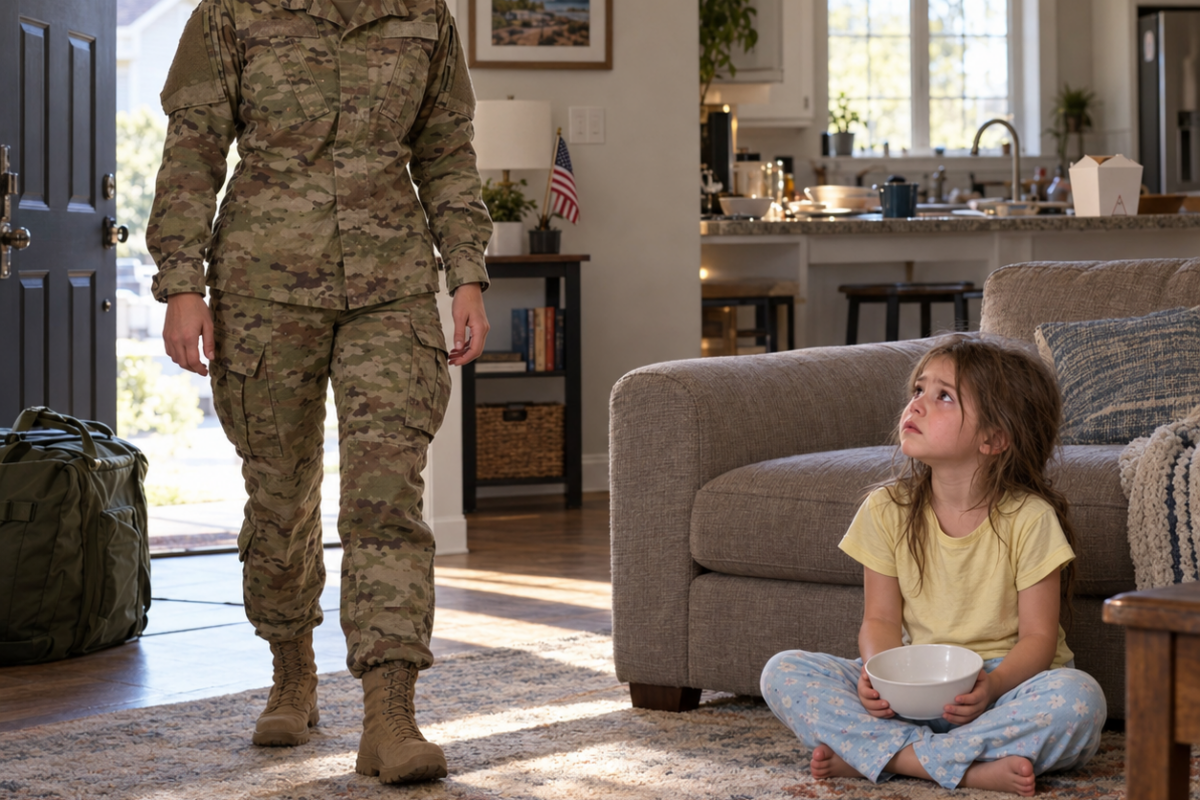
“Mommy, are you real?” my four-year-old daughter whispered when I came home from deployment three weeks early. She was sitting alone on our living room floor with an empty cereal bowl. My husband was on a Caribbean cruise with his mother and sister. Twenty-two minutes earlier, they had posted a photo captioned “Family time.” I was still in uniform when Sophie asked if she could have something to eat.
The first thing my daughter said when I found her was, “Mommy, are you real?” She was sitting cross-legged on our living room floor with…
End of content
No more pages to load