My mother-in-law threw my daughter’s birthday cake on the floor. “No son, no celebration,” she said. I turned to my husband, waiting for him to defend our little girl. “She’s right,” he said. I looked at the ruined cake, then back at them. “Okay.” They thought I had agreed. I had just decided my daughter would never spend another birthday being treated this way.
My daughter had been looking at the cake when her grandmother stepped toward her.
That is the detail I remember first.
Not the sound. Not the ruined frosting. Not the way the other parents stopped moving.
Isla was looking at the little sugar butterflies we had pressed onto her birthday cake the night before, trying to decide which one she wanted on her slice.
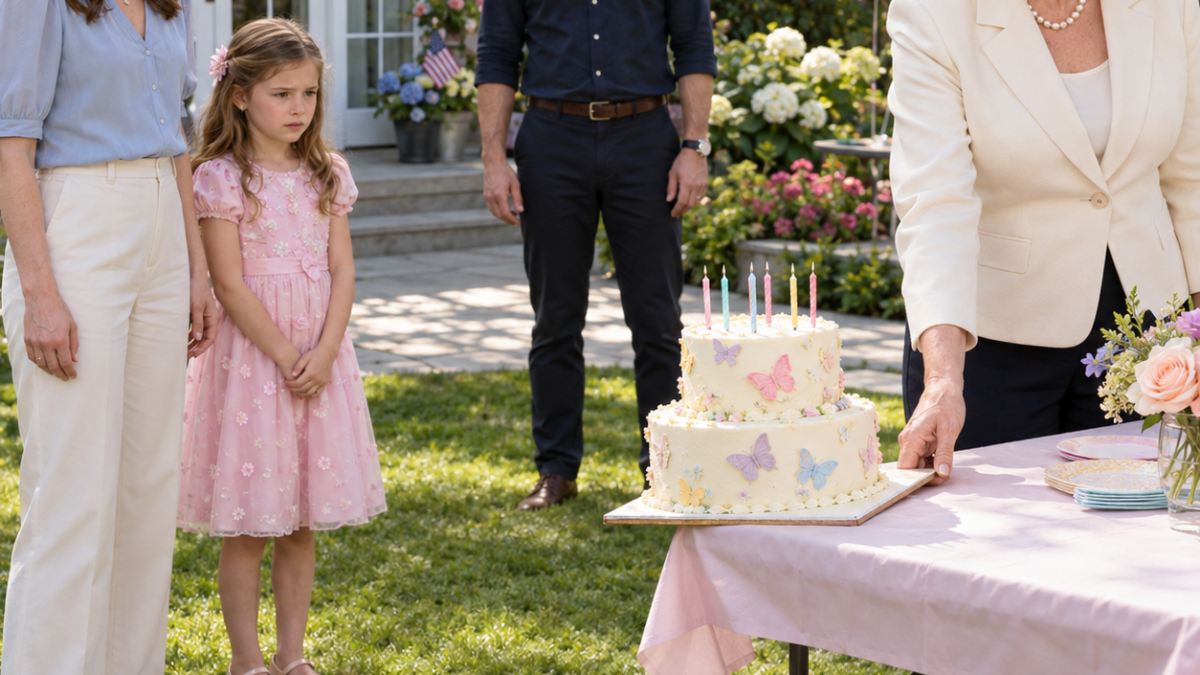
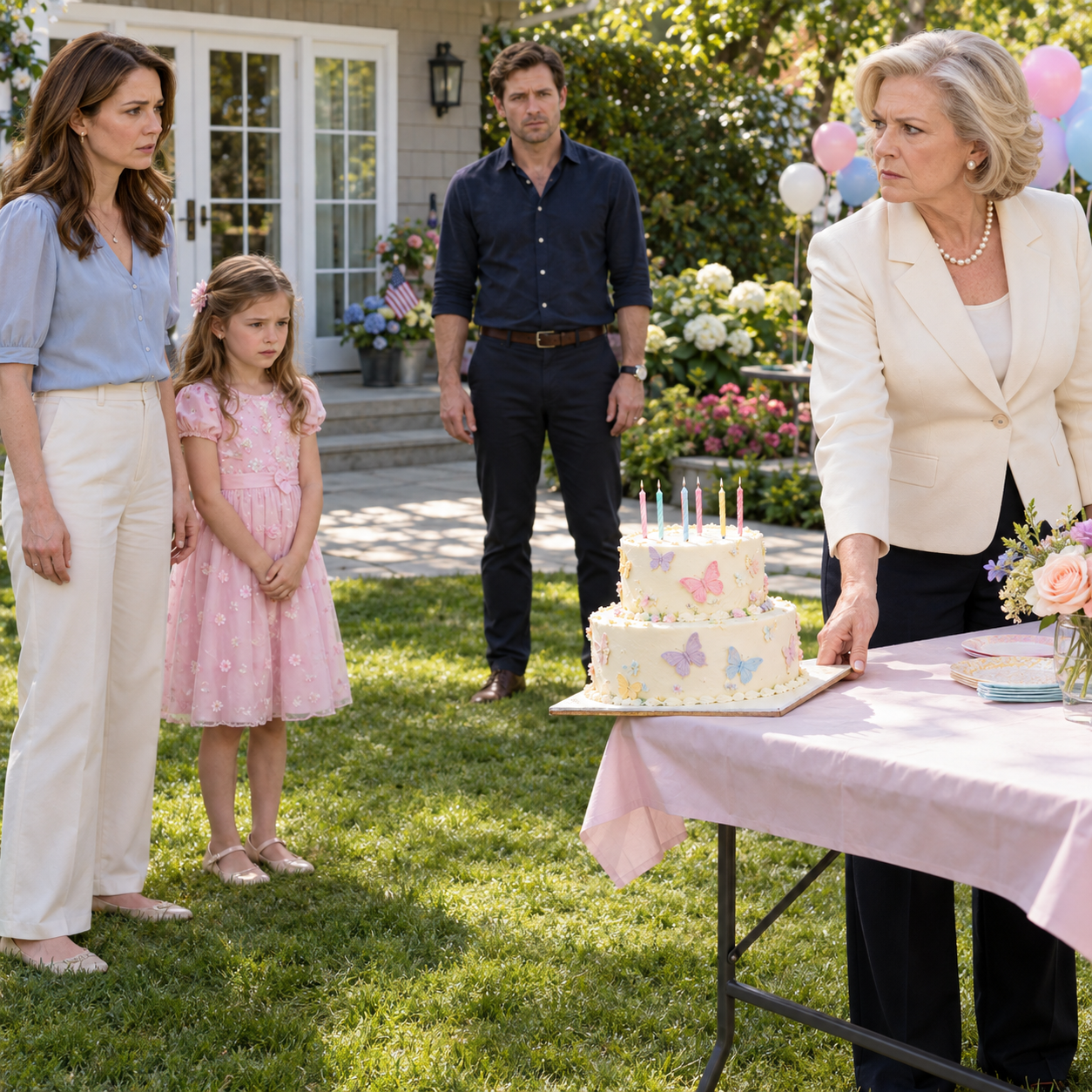
There were seven candles. Alexander had just lit the last one.
Our daughter stood at the end of the folding table with her hands clasped beneath her chin, smiling so hard that her cheeks rounded.
Then Philippa Hartwell struck her.
Before I could reach Isla, my mother-in-law swept the cake off the table. The lemon frosting hit the grass first. One layer broke away from the other, and the sugar butterflies scattered beside the table legs.
“No son,” Philippa said. “No celebration.”
For a moment, the backyard became so quiet that I could hear water dripping from the sprinkler onto the patio.
Isla had one hand against her cheek.
She looked at me, then at her father.
I looked at him too.
Alexander stood beside the table holding a lighter.
He had time to speak. Time to move. Time to put himself between his daughter and the woman who had hurt her.
Instead, he said, “She’s right.”
Two words.
Our daughter heard them.
So did everyone else.
I knelt beside Isla, moved her hand carefully, and looked at the redness spreading across her cheek. I asked whether she could see clearly. She nodded, but her lower lip was trembling.
“We’re going inside,” I told her.
I took her hand.
Then I stood, looked directly at Philippa, and said, “Okay.”
She smiled.
For seven years, she had heard me use that word when I was too tired to argue. Okay, we would change the dinner time. Okay, we would move the holiday plans. Okay, I would overlook another comment because Alexander insisted she had not meant it the way it sounded.
She thought this was another one of those moments.
It wasn’t.
My name is Alyssa Hartwell, and until that afternoon I had confused keeping the family calm with keeping my daughter safe.
The distinction cost me more than I wanted to admit.
Isla had chosen her birthday theme herself.
A garden party.
Not an elaborate one. She wanted pastel balloons, flowers on the table, and a lemon cake because she liked “cake that tastes like sunshine.”
We lived in a modest house with a fenced backyard, a square patch of lawn, and a patio Alexander had repaired two summers earlier. There was enough room for a sprinkler, a few folding chairs, and a blanket beneath the maple tree where the children could open presents.
For three weeks, Isla counted down the days using a paper chain taped to her bedroom door.
Each morning, before brushing her teeth, she tore off one loop.
Some mornings she carried it into the kitchen to show me, as though I might not understand the importance of one day less.
“Only nine.”
“Only six.”
“Mom, tomorrow there will be one.”
The night before the party, we decorated the cake together.
I had baked the layers after work and let them cool on wire racks while Isla hovered beside the counter. She helped squeeze lemon juice into the frosting, then waited impatiently while I stacked the layers.
We had bought the sugar butterflies from a baking shop.
She arranged them according to a plan only she understood.
“That one can’t go there,” she said when I reached for a pale pink butterfly.
“Why not?”
“Because the yellow one is already sitting there.”
“Of course.”
She gave me a serious look.
“They need room.”
I let her place the pink one herself.
There was flour on her nose and frosting on one sleeve of her pajamas. Her tongue slipped between her teeth when she concentrated.
At one point, she asked, “Should we save Grandma Philippa a slice if she comes late?”
I set down the spatula.
“That would be thoughtful.”
“Sometimes she misses the good part.”
I looked at my daughter.
She was trying to be kind.
She had been trying to be kind to her grandmother for as long as she had understood that kindness could be offered.
I had not yet found a way to explain that some people accept kindness without returning it.
Instead, I said, “We’ll make sure there’s enough for everyone.”
That morning, Isla appeared in the kitchen already wearing her party dress.
It was pale green, with small embroidered flowers along the hem.
She turned once, watching the skirt move.
“Do I look like the birthday person?”
“You look exactly like the birthday person.”
She grinned.
Then she asked whether Philippa was coming.
“Yes,” I said.
I had invited her because Alexander wanted his mother included.
I had invited her because Isla still asked about her.
I had invited her because, despite years of evidence, some part of me continued hoping that a grandmother would eventually recognize the child standing in front of her.
Philippa arrived twenty minutes after the party began.
She came through the backyard gate in a cream blazer, sunglasses pushed into her carefully styled hair.
She brought no gift.
That was not unusual.
Two months earlier, she had bought matching remote-control trucks for Alexander’s cousin’s twin boys. They came in silver wrapping paper with elaborate bows, and she insisted everyone watch while the boys opened them.
For Isla, she generally brought advice.
A book she thought Isla should be reading. A correction to her manners. A suggestion that I was encouraging too much excitement over something unimportant.
This time, she brought nothing at all.
She looked across the yard.
The balloons. The flowers. The presents beneath the maple tree.
Then she looked at the cake under its mesh cover.
“All this,” she said, “for a girl.”
I heard her.
I knew what she meant.
But children were running past us, a neighbor was asking where to put a bowl of fruit, and Alexander was carrying drinks from the kitchen.
I told myself I would address it later.
That had become my most expensive habit.
Later.
After the guests left. After dinner. After the holiday. After Alexander was less tired. After Philippa’s latest business problem had settled down.
Later was where I put things I did not know how to fix.
The party continued.
Isla ran through the sprinkler with her cousins. She shrieked when the water hit the back of her neck and came to me laughing because the hem of her dress was wet.
I told her it would dry.
She opened presents on the blanket beneath the tree and thanked each person with earnest attention.
A set of colored pencils. A book about insects. A box of beads. A small gardening kit with gloves that nearly fit.
She held up the wrapping paper from one gift.
“Can we save this?”
“It’s torn,” Alexander said.
“But it has foxes.”
“We can save a piece,” I told her.
She looked satisfied.
For most of the afternoon, Philippa stood near the drink table talking to Alexander’s aunt. She did not join the children. She did not ask Isla about the gifts.
I noticed.
I also noticed Alexander bringing his mother a fresh drink before asking whether I needed help.
Those things had once seemed too small to name.
By the end of that day, I understood how many large problems had been built from small things nobody wanted to discuss.
When it was time for cake, I carried it from the kitchen and placed it at the center of the table.
Alexander lit the candles.
Someone called the children over.
Isla stood waiting.
Philippa moved.
And everything changed.
Afterward, people told me they had frozen because it happened so quickly.
I believed them.
I had frozen too, for a few seconds.
But the seconds after mattered.
A neighbor named Beth put down her phone and came toward us.
Alexander’s sister, Nadia, said her mother’s name in a voice I had never heard from her before.
“Mom.”
Philippa did not look at her.
She watched me take Isla inside.
Alexander remained beside the table.
I did not look back to see what he did with the lighter.
Inside, I took Isla into the bathroom.
She climbed onto the closed toilet seat while I wet a washcloth with cool water.
Her eyes stayed on my face.
“Am I in trouble?”
“No.”
“Grandma looked mad.”
“She was wrong.”
I folded the cloth and held it gently against her cheek.
“She was wrong to hurt you.”
Isla swallowed.
“Daddy said she was right.”
The room seemed to tilt.
I kept my hand steady.
“Daddy was wrong too.”
She stared at me.
Children depend on adults being reliable. Telling her that both her grandmother and her father had failed her felt like pulling away something she should have been able to stand on.
But lying would not put it back.
“Did I make the party too big?” she asked.
“No, sweetheart.”
“Was the cake too much?”
“No.”
She looked toward the bathroom door.
“Should we have waited until there was a boy?”
I put the washcloth down.
Then I took both her hands.
“You do not need a brother to have a birthday. You do not need to be a boy to be loved. This party was for you because you are seven, and we are happy you were born.”
She began crying then.
Not loudly.
Her face crumpled, and she leaned against me.
I held her carefully, keeping pressure away from the sore side of her face.
Outside the bathroom, I heard the back door open.
Beth called my name.
I answered.
She stopped in the hallway, took one look at Isla, and said, “I can help with the guests.”
“Thank you.”
“Do you want me to call anyone?”
I looked at my daughter.
“My sister.”
Beth nodded.
Then she went back outside.
I called the pediatrician’s after-hours line.
The nurse asked questions, including whether Isla had hit her head, whether she was dizzy, and whether there was pain around her eye.
I answered as accurately as I could.
She advised an examination that afternoon and told me what symptoms would require more immediate attention.
I wrote the instructions on the back of an envelope with a pen from the bathroom drawer.
I remember that ordinary little task clearly.
My daughter had just been hurt in our backyard, and I was checking whether a pen worked.
Alexander came to the bathroom doorway.
“Is she okay?”
I turned toward him.
“We’re having her examined.”
He looked at Isla.
“Sweetheart—”
She moved closer to me.
He stopped.
There was something in his expression then, but I had no room to interpret it.
“Your mother needs to leave,” I said.
“She’s already gone.”
“Then tell her not to come back.”
He glanced toward the hallway.
“Alyssa, let’s not—”
“Not now.”
My voice was quiet.
He understood, at least, that this was not a conversation he could soften by asking me to lower it.
Ranata arrived fifteen minutes later.
My sister came through the front door carrying her purse, her car keys, and the kind of focused expression people have when they have decided not to waste time asking useless questions.
She knelt in front of Isla.
“Hey, birthday girl.”
Isla wiped her eyes.
“My cake fell.”
Ranata looked at me briefly.
Then she said, “I heard something very bad happened to your cake.”
“Grandma did it.”
“I know.”
She did not pretend otherwise.
“Can I sit with you?”
Isla nodded.
Ranata sat on the floor beside her while I gathered what we needed for the clinic.
Alexander offered to drive.
I said Ranata would take us.
He looked wounded.
For the first time in our marriage, I did not make that expression my responsibility.
At the clinic, a physician examined Isla and documented the injury.
There was no serious physical damage.
I was grateful.
I also learned how inadequate the word serious could feel when your child kept asking whether she had done something wrong.
The clinician spoke gently to Isla and plainly to me.
She asked who had struck her.
I answered.
She explained her reporting responsibilities and encouraged me to make a clear record of the incident.
I did.
I spoke with the appropriate authorities, gave the names of witnesses, and asked what steps would help protect my daughter.
There was no immediate spectacle.
No one arrived in our backyard with a dramatic speech.
There were forms, questions, and a record.
That record mattered.
So did the message to Isla that an adult hurting a child was something other adults took seriously.
When we returned home, the guests had left.
Beth and Nadia had cleaned up the food and folded the chairs.
Someone had put Isla’s presents in the living room.
The ruined cake was gone.
I was relieved she would not have to see it again.
Then I felt angry that the thing we had made together had disappeared as though it was another bit of party trash.
On the counter sat a small cake from the grocery store.
Nadia had bought it.
There was a note.
For whenever Isla wants it. No need to do anything today.
Isla saw the box.
“Can we have some?”
“Of course.”
“Without singing?”
“Yes.”
We cut three slices.
Ranata sat beside her at the kitchen table and asked which present she wanted to try first.
Isla chose the beads.
For half an hour, we made bracelets.
The one she made for me was too small, so we added more beads and started again.
I wore it for months.
That evening, after Isla fell asleep, Ranata offered to stay.
I wanted her to.
I also needed to speak to Alexander without worrying that Isla might wake up and hear us.
We arranged for my sister to take Isla to her apartment the following morning for a quiet day together.
Then Ranata hugged me in the doorway.
“You don’t have to make this manageable for everyone,” she said.
I nodded.
“I mean it.”
“I know.”
For years, she had called my habit of absorbing Philippa’s behavior my quiet tax.
She said I paid it at every holiday dinner.
At every birthday.
Every time Alexander asked me to understand his mother.
I had always laughed a little when she used that phrase.
I did not laugh that night.
Alexander sat at the kitchen table after Ranata left.
He had not changed out of the shirt he wore to the party.
There was a spot of frosting near one cuff.
“She’s under a lot of stress,” he said.
I remained standing.
“The store in Denton is struggling.”
“Your mother hit our daughter.”
“I know.”
“You said she was right.”
He looked down.
I waited.
“I didn’t mean she was right to hit her.”
“What did you mean?”
He rubbed his forehead.
“That we’d gone overboard. That Mom was upset about all the money—”
“What money?”
“The party.”
I looked around our kitchen.
The cake had been homemade.
The flowers came from the grocery store.
We had borrowed half the folding chairs.
“You thought a sprinkler and a lemon cake were too much for your daughter?”
He did not answer.
I pulled out the chair across from him.
“Look at me.”
He did.
“Isla heard you agree with the woman who hurt her. Whatever you tell yourself now, that is what happened.”
His eyes filled.
“I know.”
“Do you?”
He looked away again.
I leaned back.
“This is not just about your mother. You made a choice.”
“I froze.”
“You spoke.”
That stopped him.
He had been hoping to put himself among the adults who had been shocked into silence.
But he had not been silent.
He had given Philippa the words she wanted.
“I don’t know why I said it,” he whispered.
“Then you need to find out.”
We did not resolve our marriage that evening.
We did not make promises over cooling tea and decide that love would carry us through.
I told him that Philippa would have no contact with Isla.
I told him he would not take our daughter to see her, invite her over, or arrange a call without my knowledge.
He agreed.
I told him agreement was the beginning, not the repair.
Then I went upstairs.
I slept in Isla’s room, in a chair beside her bed.
At some point during the night, she reached for my hand.
I gave it to her.
The history behind that afternoon began long before Isla’s birthday.
Alexander’s father, Warren Hartwell, had built a chain of home furnishing stores across three counties.
It was a successful business, but not the kind that made magazine covers.
He sold sofas, dining sets, lamps, and mattresses to people furnishing their first apartments or replacing furniture they had owned for twenty years.
He knew which warehouse manager had a bad back.
He knew which salesperson needed Tuesday afternoons free for a medical appointment.
He could be stubborn.
He could also be fair in a way that felt deliberate, as though fairness was something you practiced rather than something you simply claimed.
He died when Isla was two.
One of my favorite photographs shows him holding her on his lap, studying the toy she had placed in his hand.
He had no idea what it was.
She looked delighted that he was pretending to take it seriously.
Warren adored his grandchildren.
Not just the boys.
Not just the ones whose names looked a particular way on paper.
All of them.
During his final years, he created a trust to help fund their educations and provide a modest inheritance when each reached twenty-five.
The original disclosure letter explained that each grandchild, regardless of the family line they came through, would receive an equal share.
I remembered that sentence.
At the time, I had thought it was simply clear wording.
Later, I wondered how much of Philippa’s thinking Warren had already understood.
Philippa was named a trustee with responsibility for day-to-day administration.
Alexander was named co-trustee, and certain changes affecting the grandchildren’s designated interests required his independent approval.
The arrangement made sense to us then.
Philippa was organized.
She had color-coded files and a confident way of discussing finances.
Alexander trusted her.
He once told me, “My name is on the paperwork too, in case anything needs approving.”
I asked whether that meant he reviewed transactions.
He shrugged.
“Mom handles the details.”
That answer became familiar.
When I asked about Isla’s account, he said his mother was careful.
When I asked whether we should be receiving regular statements, he said he would check.
When I asked again, he said there was no reason to worry.
I stopped asking as often.
It was not because I stopped caring.
It was because every question became a discussion about whether I distrusted his mother.
And, by then, I had been trained to recognize that as a discussion I would be expected to lose politely.
Philippa’s preferences were never entirely hidden.
At our wedding, she changed the seating arrangement so some of my relatives ended up at the back of the room.
When I objected, Alexander told me there had been confusion with the venue.
When Isla was born, Philippa congratulated us and then said, “Next time, we’ll hope for the family heir.”
I told her our daughter was already part of the family.
She smiled.
“You know what I mean.”
I did.
That was the problem.
Later, she referred to Isla as the practice run.
She said it in front of guests, with a laugh, making disagreement seem humorless.
Alexander called it an old-fashioned expression.
I asked what exactly was old-fashioned about telling a little girl she was preparation for someone more important.
He said I was taking it too literally.
Philippa treated Alexander’s sister Nadia differently, but not better.
Nadia had learned to anticipate her mother’s disapproval and arrange her life around it.
For years, we were friendly without being close.
There were too many things neither of us said.
At family dinners, she sometimes met my eyes after a comment.
Then she looked away.
I did too.
Silence had become a family language.
After Isla’s birthday, I could no longer pretend I did not understand it.
The morning Ranata took Isla for the day, I opened the small filing drawer in our home office.
I was not hunting for a way to punish Philippa.
I was looking for every place where my daughter’s welfare depended on adults who had proved willing to disregard it.
The trust was one of those places.
I pulled out the folder with Isla’s name on it.
Her birth certificate was there.
A savings bond.
Some medical records.
And the original trust disclosure letter.
I read it slowly.
Each grandchild.
Equal share.
Educational benefit.
I read it again.
Then I found the contact number for Hallbrook and Vance, the firm that had assisted with Warren’s estate and continued providing administrative services connected with the trust.
The woman who answered was polite.
I explained who I was and said I wanted information about my minor daughter’s beneficial interest.
She asked for identification and documentation of my authority to make the inquiry on Isla’s behalf.
I sent what she requested through the secure process she provided.
I did not receive an immediate accounting.
That would have been too easy.
There were procedures.
There was verification.
There were questions about what could be disclosed and to whom.
I expected those things.
What I did not expect was the change in her voice when she called back.
“Mrs. Hartwell,” she said, “there is a matter in the file that needs review before we can respond fully.”
“What kind of matter?”
“A requested reallocation affecting the designated interest you’re asking about.”
I sat down.
“When?”
“Eleven months ago.”
“Requested by whom?”
“Philippa Hartwell, in her capacity as trustee.”
I looked at the letter in front of me.
“What was reallocated?”
She chose her words carefully.
“I’m going to refer this to our compliance team. I don’t want to give you an incomplete explanation.”
She gave me a contact name.
Delphine Okafor.
And a reference number.
I wrote them down.
Then I sat very still.
Eleven months earlier.
At a family dinner the previous Christmas, Philippa had talked about the store in Denton needing an infusion of money.
“Family takes care of family,” she had said.
I remembered a statement I had glimpsed on her kitchen counter about eighteen months earlier.
It came from a wealth management firm I did not recognize.
When I asked Alexander about it, he said his mother had personal investments.
Perhaps she did.
A separate statement was not proof of anything.
But I also remembered how her attention had changed toward Weston, the grandson of her late sister.
Weston was a perfectly pleasant boy.
He was not Warren’s grandchild.
His mother had been having financial difficulties, and Philippa had begun speaking about helping with his education.
There would have been nothing wrong with that if she used her own money.
But the way she talked about him had made me uncomfortable.
“He’ll carry things forward,” she said once.
What things, I wondered.
He did not carry the Hartwell name.
He was not part of the group Warren had identified in his trust.
But he was a boy.
Philippa’s affection for him seemed to satisfy a grievance she had never stopped holding against my daughter.
I called Alexander at work.
He answered on the second ring.
“How’s Isla?”
“With Ranata.”
“Good.”
“I called the trust administrators.”
He was quiet.
Then he said, “Why?”
“Because I need to know her money is protected.”
“Alyssa—”
“There was a reallocation request eleven months ago.”
“What?”
I repeated what I had been told.
His first response was the one I expected.
“There has to be an explanation.”
“Yes,” I said. “There does.”
He waited.
“And we’re going to get the actual one.”
Delphine called two days later.
Her voice was calm, precise, and entirely uninterested in the emotional vocabulary our family had used for years.
She did not ask whether Philippa meant well.
She asked who had authority.
Which documents existed.
What had been approved.
What records we had.
I liked her immediately.
She explained that the trust’s administrative provisions allowed certain expenses and distributions, but that discretion was bounded by the trust’s terms and the trustees’ duties.
“The existence of a discretionary clause doesn’t make every requested transfer appropriate,” she said.
“Was Isla’s share transferred?”
“Some funds were moved to a holding arrangement pending the stated purpose. We’re tracing the transaction and the authority supporting it.”
“Can you stop anything else happening?”
“We’re working with the relevant institutions and counsel to preserve the disputed funds while the review proceeds.”
She did not promise that the entire problem could be solved with a phone call.
She did not pretend that being appalled was the same as having legal authority.
She told us what was being reviewed and what steps were available.
I learned to appreciate that kind of answer.
Alexander sat beside me for the call.
For once, he took notes.
Delphine asked whether he had signed any reallocation authorization during the previous year.
He looked at me.
“No.”
“Are you certain?”
“I would remember.”
“We’ll send the document through our secure portal. Please review it independently and tell us whether you recognize it.”
After the call, he stared at his notebook.
“What if Mom did something she didn’t realize she couldn’t do?”
I looked at him.
“Then the records will show it.”
He nodded.
I did not offer the reassuring version he wanted.
That night, he asked if he could speak to Isla.
She was sitting on the living room floor arranging beads by color.
I asked whether she wanted to talk to Daddy.
She shrugged.
He sat down a few feet away.
“Can I help?”
She handed him a container.
“Put the blue ones in there.”
He did.
For a while, they sorted quietly.
Then he said, “I need to tell you something.”
Her hands stopped.
“I was wrong at your party.”
She looked at him.
“What Grandma did was wrong. And when I said she was right, I was wrong too.”
She stared at the beads.
“Because she dropped the cake?”
“Because she hurt you. And because she said your birthday didn’t deserve celebrating.”
He took a breath.
“You deserved your party. You deserved your cake. You deserved for me to protect you.”
Isla’s eyes filled.
“Why didn’t you?”
Alexander did not answer immediately.
I stood near the kitchen doorway, resisting the instinct to help him.
Finally, he said, “I made a bad choice. I was used to agreeing with Grandma when she was upset. That doesn’t excuse it.”
“Are you going to do it again?”
“No.”
Children ask for promises in the form of questions.
Adults make promises in the form of words.
The distance between them is behavior.
I watched him understand that.
“You don’t have to feel better about me right now,” he added.
Isla looked at him for a long moment.
Then she pushed the container of blue beads closer.
“There are still some under the couch.”
He got down on his hands and knees and retrieved them.
It was a small beginning.
I did not mistake it for the end.
Through our pediatrician, I found a children’s counselor named Marta Ibsen.
Marta had a quiet office with books, art supplies, and chairs that did not look designed for an interrogation.
At the first appointment, Isla asked whether she was there because she had cried too much.
“No,” Marta told her. “You’re here because something frightening happened, and you get to have help with it.”
Isla seemed to consider the phrase get to have.
I did too.
I had been thinking of counseling as something necessary.
Marta made it sound like something Isla was entitled to receive.
During one session, Isla drew the party.
The maple tree.
The sprinkler.
The balloons.
A cake with butterflies.
She drew the people as simple figures, each standing somewhere around the table.
Marta asked which part of the picture felt the loudest in her memory.
Isla pointed to the space just after the cake fell.
“Everybody stood there.”
Marta waited.
“Even Daddy.”
When Marta told me about that conversation, I had to sit down.
I had been focused on the physical act.
The mark.
The cake.
The words.
My daughter had been focused on the absence of help.
That did not mean we could go back and change the seconds in the yard.
It meant we had to stop treating those seconds as incidental.
We worked on making adult responses predictable.
If Isla said something hurt, we listened.
If she asked whether someone could come to the house, we gave a clear answer.
We told her the school knew who could pick her up.
We told her Philippa would not be visiting.
We did not tell her everything about the trust.
She was seven.
She did not need to worry about signatures and bank accounts.
She needed to know that grown-up responsibilities belonged to grown-ups.
Alexander began individual counseling.
I insisted that it was necessary if our marriage was going to continue.
He did not argue.
But I also made clear that counseling was not a receipt he could produce in exchange for forgiveness.
He had to change how he responded when his mother was upset.
He had to stop placing his need to remain a good son above his responsibility to be a father.
There were days when I did not know whether we would stay married.
I said that aloud.
He looked devastated.
I let him.
I had spent too long making every difficult truth more comfortable for him than it was for me.
A few days later, Delphine sent the authorization document.
Alexander opened it at the dining table.
I watched him read.
Then he stopped moving.
“What?” I asked.
He enlarged the signature.
His name appeared at the bottom.
Alexander Hartwell.
He stared at it.
“I didn’t sign this.”
I moved closer.
“Are you sure?”
“Yes.”
He said it immediately.
No hesitation.
No effort to make the fact less painful.
He read the document again.
The request cited a provision concerning family need and discretionary administration.
But the attached instructions directed a portion of funds designated for Isla into a separate holding account associated with an educational arrangement benefiting Weston.
Alexander put his hand flat against the table.
“She used my name.”
I sat beside him.
He looked at the screen again.
“She used my name to take money from Isla.”
I let the words remain.
Then I said, “Call Delphine.”
He did.
He told her he did not recognize the authorization and had not approved it.
She asked him to provide a formal statement and cooperate with verification.
He agreed.
He asked what else she needed.
When the call ended, he looked at me with an expression I had not seen before.
Not because he was newly capable of shame.
He had been ashamed since the birthday.
This was grief.
He was losing the version of his mother he had defended.
I understood that it hurt.
I also refused to let that pain become the center of the story.
“Isla needed you to believe what your mother did before it happened to your signature,” I said.
He lowered his head.
“I know.”
“I need you to keep knowing that.”
He nodded.
Two days later, Delphine called again.
Alexander’s denial had widened the review.
The administrative team would examine other transactions, signature records, and correspondence from the trust’s establishment onward.
There were questions about how the initial authorization had passed through the process.
There were questions about whether a familiar trustee had been given too much benefit of the doubt.
Delphine did not hide those questions.
“If controls failed, that has to be addressed too,” she said.
“How long?” I asked.
“We can take protective steps now. A full review will take longer.”
“Weeks?”
“Possibly months.”
I closed my eyes.
“I know that’s difficult,” she said.
“It is.”
“But speed cannot be the only measure of whether this is handled properly.”
I understood.
I did not like it.
Those were different things.
The disputed account was restricted while the appropriate institutions and legal representatives reviewed the matter.
No one could simply move the balance again because Philippa made another confident request.
We sought our own legal advice about Isla’s rights and the steps required to change trustees.
I kept copies of everything.
Emails.
Statements.
Dates of calls.
The birthday incident remained a separate matter, with its own records and concerns.
I was careful not to combine them into one dramatic accusation.
Hitting a child was wrong.
Misusing a trust was wrong.
The fact that the same person had done both did not eliminate the need to establish each clearly.
Philippa’s reaction came in waves.
First, she called Alexander repeatedly.
Eleven times in one afternoon.
He showed me the missed calls.
Then came messages.
This is absurd.
Your father would be ashamed of this division.
I am being treated like a stranger in my own family.
You need to tell your wife to stop.
Alexander replied once.
The review concerns transactions affecting Isla. We are cooperating. Do not contact Alyssa to pressure her to withdraw the request.
Philippa did not respond to that message.
Instead, she came to our house.
I saw her car through the front window.
She wore the same cream blazer she had worn to the party.
For a second, seeing it made my stomach tighten.
Isla was at school.
That was fortunate.
Alexander was home, having taken part of the afternoon off for a call with our attorney.
He stood when the doorbell rang.
“We don’t have to open it,” I said.
“I know.”
We looked at each other.
Then I said, “I’ll speak through the doorway. Stay with me.”
He nodded.
I opened the door with the storm door still closed between us.
Philippa looked at Alexander first.
“This is absurd.”
He said nothing.
“I am allowed to make decisions about that money. I was Warren’s wife for thirty-one years.”
I looked at her.
“He wrote down what he wanted.”
“I knew him better than a firm reading documents.”
“Then you know he wanted his grandchildren treated equally.”
Her mouth tightened.
“Weston needed help.”
“Then help him with money you have authority to use.”
“His mother is barely keeping her head above water.”
“I’m sorry they’re struggling.”
“You have a house. Two incomes.”
“That doesn’t make Isla’s money yours to give away.”
Philippa looked past me into the hallway.
I could see her taking in the family photographs, the shoes near the stairs, the drawing Isla had taped to the wall.
For years, she had entered this house as though her relationship to Alexander gave her authority over every room.
Now she stood outside a closed door.
“You’ve turned my son against me,” she said.
Alexander moved beside me.
“No.”
She looked at him.
“I did not sign that document.”
“You don’t understand the circumstances.”
“Then explain them to the people reviewing it.”
“Alexander.”
He did not move.
“You put my name on something I didn’t approve.”
Her voice softened.
“I was trying to help the family.”
“You took from my daughter.”
“She will be fine.”
I felt my jaw tighten.
Alexander answered before I could.
“That is not yours to decide.”
Philippa looked between us.
Then she said, “You’ll regret humiliating me.”
I thought about Isla at the birthday table.
I thought about the children watching.
I said, “We’re ending this conversation.”
She remained on the porch for a few seconds.
Then she turned and walked to her car.
It was the last time she came to our house.
That did not mean the pressure stopped.
Relatives called.
Some asked questions.
Some repeated Philippa’s explanations as though the fact that she had offered one made it true.
One of Alexander’s uncles said family matters should stay inside the family.
I asked whether that included striking a child in front of guests.
He said I was making it sound worse than it was.
I ended the call.
Alexander took responsibility for answering his relatives after that.
He told them what had happened.
Not all of it.
Not confidential financial details.
But enough.
“My mother struck Isla.”
“Yes, I said she was right. I was wrong.”
“No, Alyssa did not create the problem by asking for records.”
Some people became uncomfortable when he admitted his own part.
They preferred a story in which I had overreacted and he had been caught in the middle.
He stopped letting them tell it.
Nadia called me directly during the third week of the review.
We had exchanged messages since the birthday, mostly about practical things.
This call was different.
“I need to apologize,” she said.
I sat on the edge of the bed.
“For what?”
“For standing there.”
“You were shocked.”
“I was. But after that, I let you carry everything.”
I looked out the window.
She continued.
“I should have come inside. I should have told Alexander what I thought. I should have said it in front of Mom.”
I did not rush to absolve her.
“I appreciate you saying that.”
There was a pause.
Then she said, “There’s something else you should know.”
I waited.
Years before Warren’s death, Philippa had attempted to redirect money from a smaller family account.
Warren discovered the instructions before the transaction was completed.
He handled it privately.
Nadia had known because she happened to be visiting when they argued.
“I didn’t hear everything,” she said. “But I heard Dad say, ‘You do not get to sign for me.’”
I sat straighter.
“Did Alexander know?”
“I don’t think so.”
“Do you have any records?”
“No. But Dad may have kept them.”
I wrote down what she said.
Then I asked whether she would speak with the investigators if they requested it.
“Yes.”
Her answer was immediate.
“Why didn’t you tell anyone before?”
She exhaled.
“Because Dad said he had handled it. Because Mom acted like nothing happened. Because I wanted to believe that meant it was over.”
I understood more than I wanted to.
“Did Warren change anything afterward?”
“I think that was around the time he insisted on additional signatures for some decisions.”
I looked at the disclosure letter on the dresser.
Perhaps the structure had been more intentional than any of us understood.
We did not treat Nadia’s recollection as proof by itself.
She gave it to the people conducting the review.
They searched for records.
Eventually, archived correspondence from Warren’s advisers confirmed there had been a prior concern about unauthorized instructions involving a household account.
The circumstances were not identical.
The pattern was troubling.
Delphine explained that carefully.
“We’re distinguishing what can be documented from what is recalled,” she said.
I appreciated that.
I did not need an embellished version of Philippa to justify protecting Isla.
The real one had done enough.
Meanwhile, life continued.
I went to work.
Alexander went to work.
Isla brought home spelling lists and complained about a classmate who insisted green was not a proper favorite color.
The dishwasher stopped draining.
The car needed new tires.
One afternoon, I found myself standing in the grocery store trying to remember whether we had bread while thinking about trustee removal.
I bought two loaves.
We already had one.
For a while, that was what my mind felt like.
Too many ordinary responsibilities crowded beside a problem that refused to become ordinary.
Ranata helped without making me ask for every task.
She took Isla to the library.
She brought dinner.
She sat with me while I organized documents, reading dates aloud so I could enter them into a list.
One evening, she found me staring at the same email for ten minutes.
“You need to stop for tonight.”
“I have to answer.”
“It can wait until morning.”
“What if I miss something?”
She sat beside me.
“That’s why you have professionals helping you.”
I rubbed my eyes.
“I keep thinking if I had asked questions sooner—”
“Then you might have learned sooner.”
I looked at her.
She did not give me the comforting lie that timing never mattered.
Then she added, “But you are asking now. Don’t turn what she did into something you owe her.”
I closed the laptop.
We watched half a movie and understood almost none of it.
It helped.
Alexander and I began couples counseling after several weeks of individual work.
At the first appointment, the counselor asked what we hoped would change.
Alexander said he wanted to rebuild trust.
I said I wanted to know whether he could protect Isla without first needing evidence that his mother had also wronged him personally.
He looked at me.
I looked back.
The counselor did not move us away from that question.
We discussed his childhood.
Philippa’s disapproval.
The way she withheld warmth when challenged.
The way Warren often settled problems quietly rather than openly confronting her.
Those things explained something.
They did not excuse what Alexander had said in the yard.
Our counselor was clear about that.
So was he, eventually.
“I learned to end the discomfort,” Alexander said one evening. “Not to ask whether the thing causing it was wrong.”
I considered that.
“Your daughter was the discomfort that day.”
He closed his eyes.
“Yes.”
I let him sit with it.
There were sessions when I left angry.
There were sessions when he left discouraged.
There were evenings when we spoke more honestly afterward than we had in years.
He asked what I needed.
I stopped answering with whatever would be easiest for him to provide.
I needed him to know the school pickup procedures.
I needed him to communicate with our attorney.
I needed him to tell his mother no without asking me to write the sentence.
I needed time when I was not responsible for monitoring his progress.
He began doing those things.
Not perfectly.
But consistently enough that I could notice.
He also spent time with Isla without making it an apology performance.
They worked on her bike.
They planted seeds from the gardening kit.
They read the insect book and argued about which creatures were most alarming.
He told her he was proud when she learned something.
But he also listened when she said she was disappointed or afraid.
One day, she asked him whether grandmothers were supposed to be nice.
He thought before answering.
“They should treat you kindly.”
“Even if they’re mad?”
“Yes.”
“Even if you’re a girl?”
His face changed.
“Especially not because of that. Being a girl is never something you need to apologize for.”
She looked at him.
Then she returned to the seed packet in her hand.
“Do marigolds have anything to do with my name?”
“No.”
“They should.”
He laughed softly.
“We can make a connection.”
He knelt beside her while they planted them.
For the first time, I saw him giving our daughter his full attention without looking over his shoulder for his mother’s approval.
The financial review produced answers slowly.
The disputed reallocation had moved money out of the category designated for Isla into a holding arrangement described as administrative.
The stated reason did not match the eventual intended beneficiary.
The authorization bearing Alexander’s name could not be supported by independent evidence that he had approved it.
Other transactions required explanation.
Some were proper.
Some were poorly documented.
Some reflected Philippa’s habit of treating the trust as a family resource she could direct according to her own judgments.
There was also the question of administrative oversight.
Why had the transaction proceeded?
Which safeguards should have caught it?
What needed to change so another familiar face could not bypass the same controls?
The review addressed those questions too.
I did not let my anger at Philippa make me grateful for institutions simply doing what they should have done earlier.
But I was relieved that they were finally doing it.
On the advice of counsel, the parties pursued protective measures and a formal change in administration.
Philippa’s access to the disputed funds remained restricted.
Within two months of the review becoming formal, the necessary legal arrangements removed her from trustee control.
A neutral professional administrator, Karin Blaylock, took over under the approved structure.
The complete review continued after that.
Those were separate milestones.
Removing access did not require pretending every question had already been answered.
Karin introduced herself over the phone.
Her voice was brisk, warm, and practical.
“My responsibility is to administer the trust according to its terms,” she said. “We’ll provide clear reporting and explain the process for any request.”
I nearly cried.
Not because she promised generosity.
Because she promised predictability.
She did not care whether Isla was a girl.
She did not have a favored branch of the family.
She did not believe she knew Warren’s wishes better than the written instructions.
She had a job.
She intended to do it.
The redirected amount was restored to the proper accounting for Isla’s interest, and the settlement arrangements addressed the financial responsibility for correcting the transaction.
We received records.
Actual records.
Clear statements.
Dates.
Balances.
An explanation of oversight.
Alexander reviewed them with me.
He asked questions.
Not to undermine the process.
To understand it.
For years, he had treated his signature as a ceremonial detail.
Now he understood that responsibility did not disappear because someone else was more confident.
He stepped back from discretionary trustee authority under the revised arrangement and supported independent administration.
He did not ask to be rewarded for doing that.
It was appropriate.
Philippa lost control of the money.
She lost the ability to make family members grateful to her for benefits Warren had already intended them to receive.
She lost the quiet authority that came from being the only person who seemed to understand the paperwork.
Those consequences mattered more than public humiliation.
There was no dramatic courtroom confession.
No scene in which everyone rose to applaud me.
There were meetings, legal documents, account restrictions, and a woman who could no longer rearrange children’s futures according to her preferences.
I stopped waiting for justice to look cinematic.
In October, Philippa went to Isla’s school.
She tried to pick her up early from an after-school program.
We had already updated the school’s authorized pickup list after the birthday incident.
Philippa brought an old form from when she had occasionally been allowed to collect Isla.
The front office called me.
Mr. Howerin, the administrator, spoke quietly.
“Mrs. Hartwell, Philippa Hartwell is here requesting release of Isla.”
“No.”
“We have your current instructions.”
“Please do not bring Isla to the office.”
“We haven’t.”
I stood in the parking lot outside my workplace, one hand pressed against the side of my car.
“Is my daughter aware she’s there?”
“Not at this point.”
“Good.”
He confirmed that Isla would remain with the program staff.
Philippa was told she was not authorized.
She left.
When Mr. Howerin called me afterward, he said something that made me uneasy.
“She said she would come back another time.”
I wrote that down.
Then I contacted our attorney.
We sent a clear written notice reinforcing the lack of authorization and the requirement that Philippa not attempt to collect or contact Isla through the school.
Alexander signed it too.
He did not ask whether it was necessary.
In November, she tried again.
This time, she waited outside the pickup gate.
She did not enter the office.
One of the after-care staff noticed her.
Miss Reyes kept Isla inside and contacted the administrator.
They arranged for me to collect my daughter through a side entrance.
I arrived to find Isla holding her backpack and talking about a drawing she had made.
She seemed unconcerned.
“Why did we use the back door?” she asked in the car.
“Grandma Philippa was near the usual pickup area.”
Isla looked at me.
“She was coming for me?”
“She wanted to see you. But she wasn’t allowed to arrange that without us.”
“Did you tell her?”
“Yes.”
“Then why did she come?”
“I don’t know. But the school followed the rules and kept you with the people who were supposed to be looking after you.”
Isla considered that.
Then she asked whether we could get ice cream.
I said yes.
At the counter, she took a long time choosing a flavor.
I let her.
There were responsibilities waiting for me.
Emails.
Calls.
More documentation.
For ten minutes, I could let my daughter decide whether she wanted strawberry or mint.
That evening, Alexander and I met with the school.
We provided the relevant records and legal guidance.
The school’s counsel helped clarify the instructions within its authority, including pickup restrictions, communication procedures, and the response to another unauthorized visit.
Our attorney advised us about additional protective options based on the documented pattern.
We followed that advice.
I did not rely on a single sentence in a school file and call the problem solved.
We coordinated.
We checked that the staff responsible for dismissal had the current information.
We made sure Isla knew she did not have to leave with someone simply because that person was family.
We also made sure she did not feel responsible for monitoring the adults.
“Your job is to go with the staff and the people we’ve arranged,” I told her. “The grown-ups handle the rest.”
She nodded.
“Can I tell Miss Reyes if Grandma talks to me?”
“Yes.”
“Will Grandma get mad?”
“She might.”
Isla looked worried.
I took her hand.
“Her feelings are not your job.”
The sentence was for my daughter.
It was also one I had needed to hear for seven years.
Philippa called Alexander that night.
He let the call go to voicemail.
He played the message once.
She said I was holding a grudge.
She said she wanted a few minutes with her granddaughter.
She said children should not be kept from people who loved them.
Alexander sat on the edge of our bed afterward.
“She still won’t say what she did.”
“No.”
“She wants us to discuss access without discussing why access stopped.”
“Yes.”
He rubbed his palms against his knees.
“I spent my whole life trying to make her version of things work.”
I waited.
“I thought that was peacekeeping.”
“What do you think now?”
He looked toward Isla’s room.
“That I made everyone else pay for it.”
I nodded.
He was quiet for a long time.
Then he said, “I told her she was right.”
I had heard him say it before.
This time, it did not sound like a fact he wanted to move past.
It sounded like one he intended to keep understanding.
“In front of Isla,” he added.
“Yes.”
“I can’t undo it.”
“No.”
He looked at me.
“You can be different from now on,” I said. “But you don’t get to decide how quickly she trusts you.”
He nodded.
For once, neither of us tried to make the truth smaller.
Thanksgiving that year was at Nadia’s house.
It was the first time in a decade that Philippa had not hosted the family gathering.
Nadia called me to ask whether we wanted to come.
“Small group,” she said. “No surprises.”
I appreciated the last part more than the invitation.
“Does everyone know she won’t be there?”
“Yes.”
“Are you sure?”
“Yes, Alyssa.”
I apologized for asking twice.
Nadia said, “Don’t.”
We went.
Ranata joined us.
Nadia’s children greeted Isla with the kind of ordinary excitement that made me relax a little.
They wanted to show her a game.
They wanted her opinion about a fort.
They did not look at her as though she carried the family’s latest scandal.
The kitchen smelled of butter, onions, and roasting turkey.
Nadia wore an apron with a torn pocket and complained that the potatoes were taking forever.
I helped.
For the first time, our conversation did not feel like we were both avoiding something.
We discussed work.
Children.
A repair her house needed.
Then, while she drained the potatoes, she said, “Mom called.”
I looked at her.
“I told her she wasn’t invited.”
“How did that go?”
“Badly.”
She smiled without humor.
“She said I was being disloyal.”
“What did you say?”
“That I wasn’t going to host a meal where Isla had to wonder whether she was safe.”
I put down the towel I was holding.
“Thank you.”
Nadia nodded.
“I should have said things like that sooner.”
“Yes,” I said.
She accepted it.
That was how our friendship began.
Not with a sweeping promise to be sisters.
With room for an honest answer.
At dinner, nobody discussed the trust in front of the children.
There was no empty seat theatrically left for Philippa.
We had arranged the table for the people who were there.
Halfway through the meal, Isla asked whether Grandma Philippa no longer liked Thanksgiving.
One of Nadia’s younger children began answering with something overheard and only partly understood.
Nadia gently interrupted.
“Grandma isn’t joining us today. The adults are handling some problems.”
Isla nodded.
Then she asked for more mashed potatoes.
I passed the bowl.
Alexander watched her scoop a generous serving.
He smiled.
The conversation moved on.
I realized how much work had gone into giving my daughter the freedom to care more about potatoes than adult conflict.
That was not a small result.
Later, the children played in the living room.
Ranata sat beside me on the couch.
“How are you?” she asked quietly.
I looked at Isla.
“Tired.”
“I know.”
“And better.”
She nodded.
We stayed there listening to the children argue over game rules.
Nobody asked me to be reasonable.
I was already being reasonable.
I had simply stopped allowing the word to mean accepting whatever Philippa wanted.
The final financial review took longer than the initial change in administration.
Delphine remained careful in her updates.
There were records to reconcile.
Questions to close.
Corrective controls to implement.
The report eventually documented improper allocations inconsistent with the trust’s purpose, the unsupported authorization bearing Alexander’s name, and administrative weaknesses that had allowed the transaction to proceed without sufficient independent confirmation.
The historical account issue was addressed as background where supported by records, not treated as though it were automatically part of the same trust transaction.
I read the report slowly.
Then I read the section confirming Isla’s restored interest.
I put the pages down.
Alexander sat across from me.
“Is it done?” he asked.
“The review.”
He nodded.
Not everything.
We both knew that.
Karin continued sending professional updates.
We had a secure place to keep them.
We knew whom to contact.
We understood the procedures for future educational requests.
Isla’s fund no longer depended on whether her grandmother considered her worth the investment.
Weston did not lose my goodwill.
I want to be clear about that.
He was a child.
He had not drafted the request.
He had not put Alexander’s name on the document.
He had not asked to become proof that Philippa’s preferred version of the family deserved more.
His mother contacted us once through the appropriate channels after learning what had happened.
She said she had not understood where the proposed support originated.
I had no reason to turn her statement into an argument with a child in the middle.
The adults and advisers dealt with the funds.
I hoped Weston would receive honest help from people authorized to give it.
I also hoped someone would stop describing him as the boy who would carry everything forward.
That was a heavy assignment to place on any child.
Being favored can distort a life too.
Months later, Philippa sent a letter through her attorney.
It expressed regret for the misunderstanding.
It said she hoped to resume a relationship with her granddaughter.
It referred to family healing.
It did not acknowledge striking Isla.
It did not acknowledge the words at the party.
It did not acknowledge the authorization bearing Alexander’s name.
I read it once.
Alexander read it twice.
Then he placed it on the table.
“What do you think?” he asked.
“I think she regrets the consequences.”
He nodded.
We had our attorney respond.
There would be no change to contact arrangements based on a letter that avoided the conduct creating the concern.
Any future discussion would need to account for Isla’s welfare, the established restrictions, and genuine responsibility.
We did not promise an eventual reunion.
We did not promise permanent hatred either.
We made the decision required by the facts in front of us.
For now, no contact.
Philippa did not send another letter.
I sometimes wondered what she told herself.
That I had taken her family.
That Alexander had become weak.
That institutions had misunderstood her intentions.
I could imagine the explanations because I had spent years listening to them.
Then I stopped imagining.
I had enough real responsibilities.
Alexander’s relationship with his mother changed in ways he could not have predicted.
He stopped answering repeated calls.
He kept communication limited and written when necessary.
He grieved.
He also began noticing how much energy had previously gone into anticipating her reactions.
One Saturday, he took Isla to buy supplies for a school project.
They came home with cardboard, markers, and a plant neither of them had intended to purchase.
“It looked lonely,” Isla explained.
Alexander shrugged.
“I couldn’t argue with the logic.”
I laughed.
For the rest of the afternoon, they worked at the dining table.
At one point, the cardboard structure collapsed.
Isla looked frustrated.
Alexander said, “Let’s figure out why.”
He did not tell her to stop being upset.
He did not turn the mistake into a lecture.
He sat beside her and rebuilt it.
I watched from the kitchen.
Those were the moments that slowly changed what I believed about him.
Not declarations.
Not guilt.
Ordinary choices made without an audience.
Our marriage improved, but it did not become innocent again.
There were days when his mother’s name on an email made my shoulders tense.
There were days when I remembered the lighter in his hand and could not bear a casual remark about how far we had come.
I told him.
He listened.
Sometimes he became defensive.
Then he caught it and tried again.
Sometimes I became so afraid of another failure that I treated a small disagreement as a warning of everything returning.
We discussed that too.
Neither of us was the same person who had stood in the backyard.
I did not want to be.
I stopped waiting until I had a perfect explanation before saying something was wrong.
I stopped turning every boundary into a request.
I stopped apologizing for taking an issue seriously when my child’s safety was involved.
That did not make me loud.
It made me clear.
Isla’s progress was harder to measure and easier to see.
For a while, she startled when an adult raised a hand near her face.
I noticed it when brushing her hair.
Alexander noticed it when reaching for something on a shelf behind her.
We slowed down.
We told her what we were doing.
We did not make her embarrassed about the reaction.
Marta helped us understand that healing did not always look like a child talking at length about what happened.
Sometimes it looked like a child returning to play.
Sometimes it looked like asking the same question several times because the answer needed to remain the same.
Sometimes it looked like anger.
One afternoon, Isla said, “I don’t want Grandma’s flowers if she ever brings any.”
I asked why.
“Because she ruined my butterflies.”
I sat beside her.
“That makes sense.”
“Do I have to forgive her?”
“You don’t have to decide that now.”
“Can I be mad?”
“Yes.”
She leaned against me.
Then, ten minutes later, she asked for a snack.
Both things could be true.
She could carry hurt and still want crackers.
She could remember and still enjoy a day.
We did not require her recovery to look meaningful enough for adults to recognize it.
At school, she became more willing to tell a teacher when something was bothering her.
She made a new friend.
She joined a soccer group and spent most practices following the ball with determination and very little strategy.
When she scored her first goal, Alexander crouched to her height afterward.
“You stayed with it,” he told her. “I’m proud of you.”
She grinned.
“Did you see?”
“I saw.”
He said it carefully.
I wondered whether he heard the difference too.
Seeing a child is not just witnessing an accomplishment.
It is recognizing what is happening while there is still time to respond.
He began doing that more often.
When Isla struggled with a spelling word, he noticed the frustration.
When she was overwhelmed by a noisy room, he asked whether she wanted a break.
When she said something hurt her feelings, he did not immediately explain why the other person probably meant well.
He asked what happened.
It should not have taken a disaster for us to learn those things.
But learning them late was better than refusing to learn them at all.
As Isla’s eighth birthday approached, I worried.
She seemed excited.
I was the one who hesitated whenever she mentioned cake.
I wondered whether she would want something entirely different.
A party somewhere else.
No candles.
No family gathering.
Instead, she asked for the backyard.
“And lemon cake.”
I looked at her.
“The same kind?”
“Yes.”
“With butterflies?”
She nodded.
“More yellow ones this time.”
I took a breath.
“All right.”
She watched me.
“Grandma Philippa isn’t coming.”
It was not quite a question.
“No.”
“Okay.”
Then she ran upstairs to find a notebook so she could make the guest list.
I stood in the kitchen for a moment.
For months, I had worried that the backyard would always belong to the memory of what happened there.
My daughter was already asking to use it again.
I followed her lead.
Ranata came early on the morning of the party.
She carried bags of ice, paper napkins, and more practical competence than most people could fit into one person.
“Where do you want the table?” she asked.
I looked at the spot where it had stood the previous year.
Then I pointed beneath the maple tree.
“There.”
We moved it.
Not because the old spot was forbidden.
Because this arrangement worked better.
Nadia arrived with her children and a bowl of fruit.
She hugged me.
“How are we doing?”
I smiled.
“We have enough cups.”
“That wasn’t what I meant.”
“I know.”
She looked toward the kitchen window, where Isla was helping Alexander arrange candles.
Then she said, “It’s going to be a good day.”
I believed she meant it.
I also knew we had done more than hope.
The guest list included people we trusted.
The school arrangements remained clear.
The financial matters were under professional oversight.
Philippa did not have access to our home or our daughter.
Alexander understood that keeping his mother satisfied was not the purpose of fatherhood.
Those were practical facts.
They helped make room for joy.
Isla wore a yellow dress that year.
She said green had been last year’s color.
Her hair refused to stay behind one ear.
She let Ranata fix it twice, then gave up.
The children ran through the sprinkler.
Someone complained about getting wet while standing directly in the spray.
A boy spilled juice and looked frightened until I handed him a towel and said accidents happened.
Isla opened presents.
She saved another piece of wrapping paper.
This one had tiny birds.
I put it beside the piece with foxes that still lived in her art box.
When I carried out the cake, I felt my pulse quicken.
I could not stop it.
The body remembers things even when the mind has planned carefully.
Ranata saw my face.
She stepped beside me and took the other end of the cake board.
“Together,” she said quietly.
We set it down.
The sugar butterflies remained exactly where Isla had placed them.
Alexander lit eight candles.
Then he set the lighter well away from the children and knelt beside our daughter.
He was at her eye level when we began singing.
Isla looked around the table.
At her friends.
At Nadia.
At Ranata.
At me.
Then she smiled.
Nobody interrupted.
Nobody corrected the joy.
Nobody asked whether she deserved it.
She closed her eyes for a wish and blew out all eight candles in one breath.
The children cheered.
Alexander laughed.
I put my hand against the edge of the table because I needed somewhere to put it.
Isla looked at me.
“Mom, can I have the yellow butterfly?”
“Which one?”
“The big one.”
“Absolutely.”
I cut her a slice.
The cake held together.
The frosting stayed on the plate.
A small, ordinary thing.
I had never been more grateful for one.
Later, after the guests left, Isla sat on the patio step with a second, smaller piece of cake.
Alexander was collecting paper plates.
Ranata and Nadia were folding the blanket.
I sat beside my daughter.
“Good birthday?”
She nodded enthusiastically.
“Better cake.”
I smiled.
“It was the same recipe.”
“I know.”
She took another bite.
Then she said, “This one got eaten.”
I looked toward the yard.
The balloons moved gently in the evening breeze.
“Yes,” I said. “It did.”
She leaned against my arm.
For a while, we said nothing.
I thought about the word I had used the year before.
Okay.
At the time, I had not had a grand plan.
I had not known about the reallocation request.
I had not known about the signature.
I had not known how long the legal work would take or whether my marriage would survive the truth.
I had known only that my daughter needed me to stop standing in the same place, doing the same thing, and hoping someone else would finally understand.
Philippa had heard surrender.
What I meant was that I had seen enough.
Enough to leave the yard.
Enough to get Isla examined.
Enough to make records, ask questions, and refuse access.
Enough to tell my husband that his words had consequences too.
The money mattered.
It was Isla’s future, and it deserved protection.
But the most important thing we restored could not be listed on a statement.
It was the right to be a child at her own birthday party.
To choose lemon cake.
To run through a sprinkler.
To want a butterfly made of sugar without wondering whether someone more deserving should have received it instead.
Isla finished her cake and handed me the plate.
“Can I help clean up?”
“Of course.”
She gathered napkins from the patio while I carried the plate inside.
Alexander stood at the kitchen sink.
He turned when I entered.
“You okay?”
I looked through the window at our daughter.
She had found a balloon that had come loose from a chair and was holding it by the ribbon.
“Yes,” I said.
He followed my gaze.
Then he nodded.
We did not need to make a speech about what the day meant.
We needed to wash the dishes.
Put away the chairs.
Help Isla change out of a dress damp at the hem.
There was school on Monday.
There would be another spelling list, another missing sock, another evening when somebody forgot to take the meat out of the freezer.
I wanted those things.
The ordinary work of a family in which a little girl did not have to earn the right to belong.
That night, I tucked Isla into bed.
The paper chain from her birthday countdown lay on the dresser, now reduced to one short strip she wanted to keep.
She had placed a yellow sugar butterfly in a small container beside it.
“I thought you ate that one,” I said.
“There was another.”
“You saved it?”
She nodded.
“For next year.”
“It might not last that long.”
“That’s okay. We can make more.”
I brushed the hair away from her forehead.
She did not flinch.
I kissed her good night.
At the door, she called my name.
“Mom?”
“Yes?”
“When I’m nine, can we have lemon cake again?”
I looked back at her.
“Yes.”
“With butterflies?”
“As many as you want.”
She smiled and settled beneath the blanket.
I turned off the light.
Downstairs, Alexander was putting the last folding chair away. Ranata had sent a message saying she was home. Nadia had sent a picture of her children asleep in the car.
The house was quiet.
This time, the quiet did not come from swallowing something that should have been said.
It came from a day that had ended safely.
I went downstairs and put the leftover cake in the refrigerator.
There was plenty.
Nobody had to be persuaded that my daughter deserved her share.
News
At my seventy-second birthday party, my daughter-in-law knocked a crystal vase off its pedestal with her elbow, watched it shatter, and smiled. “Oops.” Her own parents had given it to her and my son on their wedding day six years earlier. I looked at Frank, waiting for him to say something. All he managed was, “Mom…”
I watched my daughter-in-law break her own parents’ wedding gift with one elbow and a smile. For months afterward, people asked me whether I was…
I came home three hours early and found my sixty-eight-year-old mother on her knees scrubbing my mother-in-law’s bathroom. When I helped her stand, her sleeve slipped back, revealing dark marks around her wrist. My husband stepped into the doorway. “Daniela, don’t make a scene.” That was when I remembered my father’s last warning: “If you ever see your mother hurt, don’t argue with anyone. Open the hidden compartment in her sewing machine.”
I came home three hours early and found my sixty-eight-year-old mother on her knees beside a toilet. Her hands were stiff with arthritis. One gripped…
“I already promised your house to your sister,” my father told me four days after I bought it. “They’re moving in Monday. Rent-free for three years.” I was thirty-one, had saved for nine years, and had bought the five-bedroom home entirely in my own name. When I said no, he threatened to tell the family I had abandoned my sister’s children. Days later, he took the microphone at my grandmother’s seventy-fifth birthday dinner and did exactly that.
My father called twelve times in forty minutes after discovering I had bought a house without consulting him. When I answered, he didn’t ask whether…
My mother leaned across the restaurant table, looked at my thirteen-year-old adopted daughter, and whispered, “We don’t sit with mistakes.” I took Sole’s hand and walked her out. That night, my father texted, “You’re still making the car payment tomorrow, right?” By midnight, I had canceled the payments I’d been making for my family. Then I remembered something Sole had told me about her grandmother.
My mother looked at my thirteen-year-old daughter and whispered, “We don’t sit with mistakes.” She said it softly enough to avoid attracting attention from the…
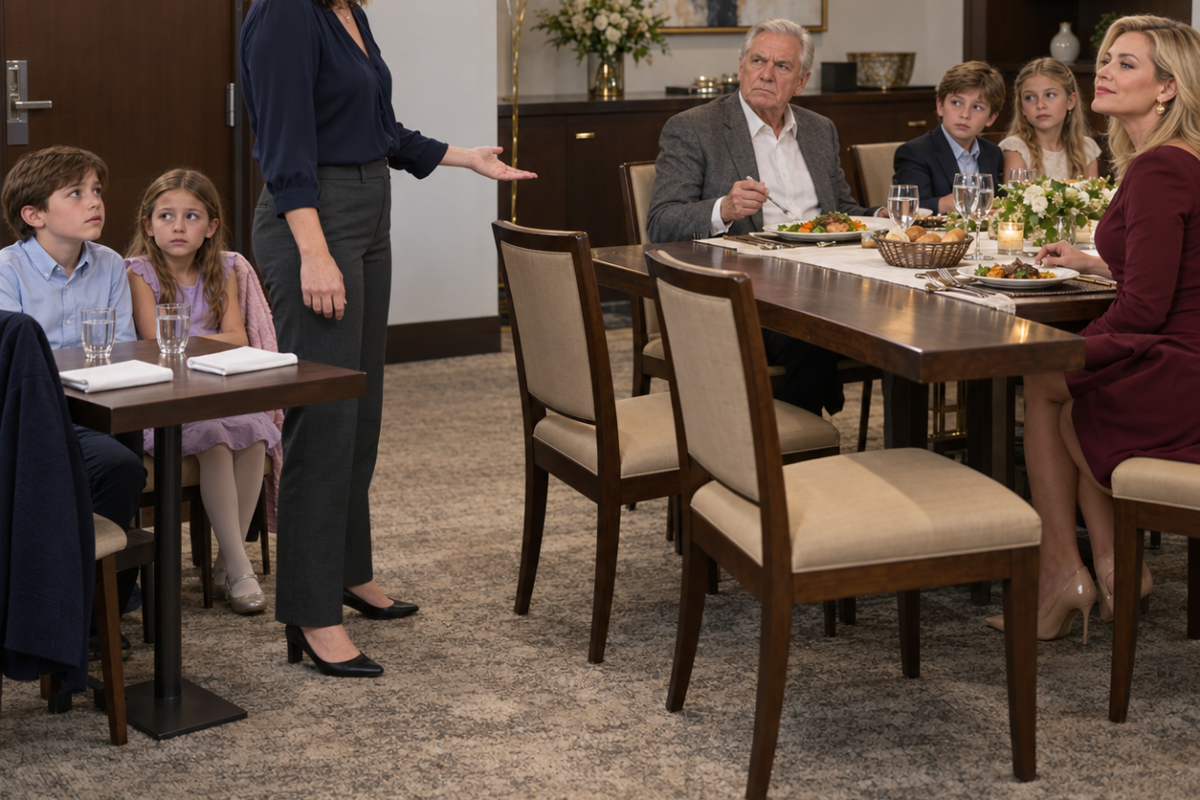
At my father’s seventieth birthday dinner, my eleven-year-old son and eight-year-old daughter were seated beside the service door with water glasses—but no dinner plates. Their cousins sat beside Grandpa with warm bread and full place settings. “They’ll eat after everyone else,” my sister said. I turned to my father, expecting him to object. “They can wait another hour,” he replied. There were two empty chairs at his table.
At my father’s seventieth birthday dinner, the first thing that stopped me wasn’t the cake or the gold balloons. It was my children. Ethan and…
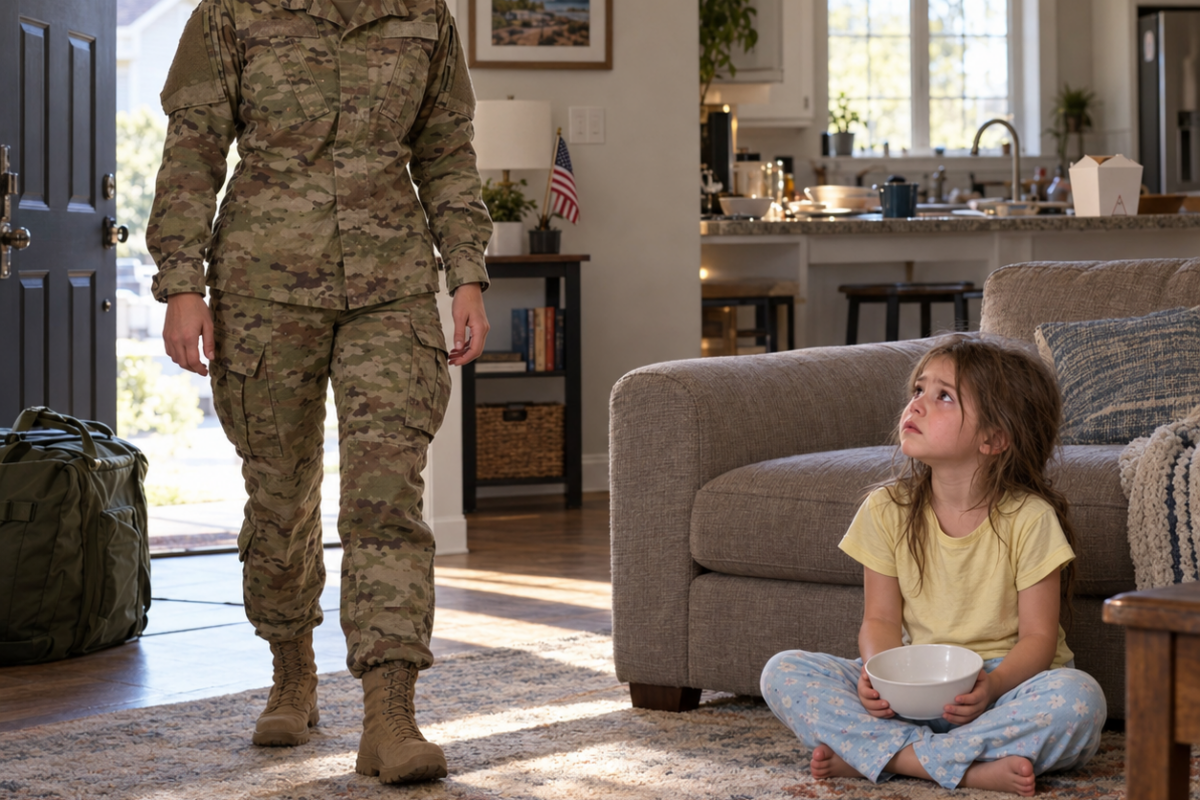
“Mommy, are you real?” my four-year-old daughter whispered when I came home from deployment three weeks early. She was sitting alone on our living room floor with an empty cereal bowl. My husband was on a Caribbean cruise with his mother and sister. Twenty-two minutes earlier, they had posted a photo captioned “Family time.” I was still in uniform when Sophie asked if she could have something to eat.
The first thing my daughter said when I found her was, “Mommy, are you real?” She was sitting cross-legged on our living room floor with…
End of content
No more pages to load