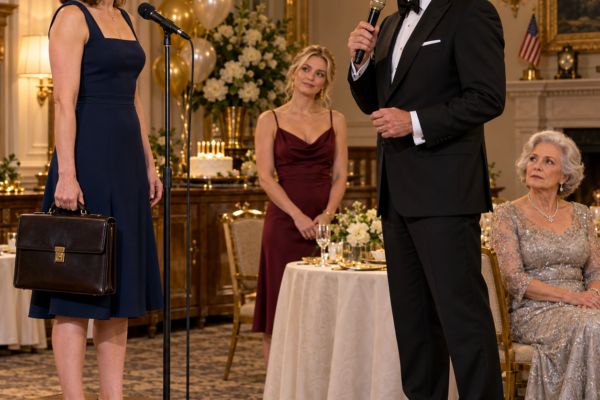
My husband raised his champagne glass before nearly four hundred guests and called me “the most expensive mistake I ever made.” Then he kissed his mistress onstage while his mother laughed and his brother applauded. I opened my clutch and made one call. Thirty minutes later, the company’s chairman walked through the ballroom doors carrying a leather folder—and Adrian stopped smiling.
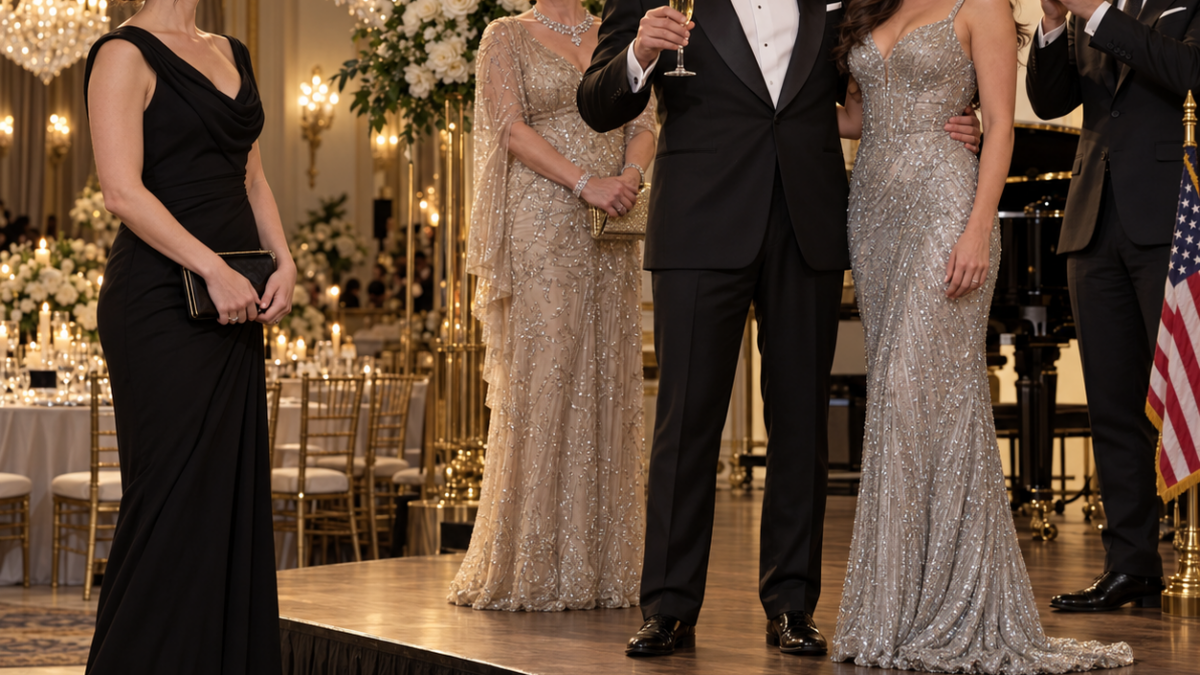

My husband raised his champagne glass in front of nearly four hundred people and called me “the most expensive mistake I ever made.”
For a moment, I thought I had misunderstood him.
The room was too beautiful for what had just happened. White orchids rose from silver bowls. Candlelight moved across crystal glasses. Beyond the ballroom windows, the city looked clean and distant, as though none of its ordinary disappointments could enter a room that expensive.
Then Adrian smiled directly at me.
His mother laughed.
His brother began applauding.
And Vanessa Cole walked onto the stage.
Adrian put one arm around her waist, pulled her against him, and kissed her in front of our employees, investors, clients, and people who had eaten dinner in our home.
Someone near the back of the room gasped.
Someone else laughed uncertainly.
I sat at the head table with my hands resting beside my untouched dessert and understood that this had been planned.
Not the affair. That had been underway for some time.
The audience.
The humiliation.
The camera in Marcus’s hand.
Adrian had chosen every part carefully.
What he had not planned was the folder coming through the ballroom doors thirty minutes later.
My name is Eleanor Ashcroft Vale. I was forty-four that evening, and I had been married to Adrian for twelve years.
For most of those years, he believed my silence meant he had won.
He was wrong about the silence.
He was wrong about several other things, too.
The banquet was supposed to celebrate his fifth anniversary as chief executive officer of Vale Meridian Group. He called it a leadership celebration. The invitations described “five years of extraordinary vision.”
Our communications department had prepared a film showing headquarters, construction sites, regional offices, and Adrian shaking hands with men who looked pleased to be standing beside him.
There were no photographs of my father.
No reference to the capital that had kept the company solvent during its first serious expansion.
No mention of the shareholder structure that made Adrian’s position possible.
I had not objected.
That omission would later trouble me almost as much as the toast.
Not because I needed my father’s name on a screen.
Because I had allowed Adrian’s version of our history to become the company’s public memory.
He was the visionary.
I was the wife.
Everything underneath that arrangement had been treated as an embarrassing collection of details best left to accountants.
Adrian and I met at a charitable dinner when I was thirty-two.
My father, Charles Ashcroft, was still alive then. He had spent decades building a commercial property business, beginning with a small warehouse he bought with two partners and ending with a group of holdings spread across several states.
He was wealthy, but he did not enjoy talking about wealth.
He enjoyed asking whether a roof had been repaired properly.
He noticed unpaid invoices, loose stair rails, and employees who had been working too many weekends.
At dinners, he often looked more comfortable speaking with the catering manager than with the people seated beside him.
Adrian was different.
He could make a room feel as though something important was about to happen simply by entering it.
He remembered names. He spoke confidently. He could take an ordinary business idea and describe it as an opportunity nobody else had been intelligent enough to recognize.
When he approached me that first evening, he asked about the foundation program I had been helping administer.
I was surprised.
Most men who knew my family asked about real estate within ten minutes.
Adrian asked about the literacy grants.
He seemed interested in the work.
Perhaps he was.
I have stopped trying to decide whether every good moment in our marriage was false. People are more complicated than the stories we tell after they hurt us.
He could be generous.
He could be funny.
He once stayed up half the night helping me assemble auction materials because a printer had delivered the wrong pages. He made coffee, spread documents across the dining table, and convinced me we would finish.
For a while, we were a team.
Then, little by little, being a team came to mean helping Adrian accomplish what Adrian wanted.
My work became flexible.
His became essential.
My family obligations became interruptions.
His professional obligations became explanations for why he could not be expected to remember a birthday, attend a doctor’s appointment, or answer a difficult question at dinner.
He never announced that the marriage had changed.
He simply behaved as though the new terms had always existed.
Vale Meridian was smaller when we married.
Adrian was an ambitious executive overseeing business development, with a modest equity interest and a talent for making people believe growth was close enough to touch.
The company needed financing for an expansion.
My father’s investment organization participated, alongside other investors.
The initial arrangement was carefully documented. More capital followed during a difficult acquisition. Share classes changed. Voting rights were consolidated within a trust established years earlier as part of my father’s estate planning.
Adrian had attorneys.
He had financial advisers.
He attended meetings where the structure was explained.
There was no secret document hidden from him in a drawer.
What existed was a document he disliked remembering.
The Ashcroft trust eventually controlled sixty-eight percent of Vale Meridian’s voting shares.
That did not mean it managed the company’s daily operations.
It did not mean I could call a department head and rearrange a budget because I was unhappy.
It meant the trust could exercise substantial shareholder authority through the procedures established in the company’s governing documents.
My father insisted on an independent board.
He also insisted that management and ownership remain distinguishable.
“An executive’s confidence is useful,” he once told me. “It is not a substitute for accountability.”
Adrian smiled when my father said things like that.
Later, in the car, he called them old-fashioned.
When Adrian became CEO five years before the banquet, I was proud of him.
He had worked hard.
He had helped win major contracts.
He understood customers and could persuade talented people to join the company.
I wanted his appointment to succeed.
So did the board.
My father had one year left to live.
He attended Adrian’s appointment dinner wearing a navy suit and the watch he had owned since before I was born.
Afterward, he asked me to walk with him through the hotel garden.
“You love him,” he said.
“Yes.”
“Good.”
We walked a little farther.
Then he said, “Make sure loving him doesn’t prevent you from seeing him.”
I was annoyed.
I heard criticism where he had meant caution.
“Adrian understands the responsibilities.”
“I hope so.”
“He doesn’t need everyone expecting him to fail.”
My father stopped beside a low stone wall.
“That isn’t what I’m doing, Ellie.”
He had called me Ellie since childhood.
“I’m asking you not to confuse support with surrender.”
I remembered that sentence at the banquet.
Four years too late.
After my father died, I became chair of the trust’s governing committee. I served alongside an independent trustee, Judith Rowe, and another experienced fiduciary selected under the trust documents.
Our authority was defined.
Our decisions were recorded.
Our investments were reviewed.
Adrian dismissed all of it as estate administration.
He liked to say I “looked after family paperwork.”
I let him.
Sometimes I corrected him privately.
Sometimes I did not have the energy.
There were years when I had grief, work, and a marriage to manage, and I chose the appearance of peace over the exhaustion of insisting on an accurate description.
Adrian treated those choices as proof that I did not understand the structures beneath his success.
Celeste encouraged him.
She had welcomed me warmly at first.
Very warmly.
She complimented my clothes, praised my father, and said she had always known Adrian would marry someone exceptional.
Later, she began speaking of my family’s resources as though they were a set of conveniences that had naturally become hers.
A car for a charity committee event.
A property for a weekend gathering.
Jewelry for an important dinner.
The requests were rarely phrased as requests.
“Eleanor will arrange it.”
“Charles would have wanted us to use it.”
“It’s all in the family.”
The diamonds she wore to the banquet belonged to a collection held by my family office. They had been loaned to her for the evening under the same inventory process used for other valuable items.
She complained that signing the acknowledgment made the arrangement feel unfriendly.
Our asset manager explained that documentation was required for insurance.
Celeste signed.
Then she spent the evening telling people Adrian had given her the necklace.
Marcus was less polished.
He had worked for Vale Meridian in a series of positions whose responsibilities became less clear whenever someone tried to describe them.
He was good at being available when Adrian needed applause.
He was not good at meeting deadlines.
The company Range Rover he drove was leased through an Ashcroft fleet entity under a corporate-use agreement. His fuel card was connected to that arrangement.
Vanessa’s Bentley came from the same fleet, though her allocation had raised questions before the banquet.
Adrian described it as necessary for client presentation.
Our finance team asked whether the cost complied with the vehicle policy.
Adrian approved an exception.
That was how he handled many questions.
If a rule inconvenienced him, he called it inflexible.
If someone insisted on following it, he accused them of lacking initiative.
Vanessa had joined Vale Meridian three years earlier.
She was capable. I will not deny that because she became involved with my husband.
She spoke clearly, understood markets, and could build a persuasive presentation from incomplete information.
What I did not recognize quickly enough was how useful incomplete information had become to both of them.
Adrian praised her constantly.
She was decisive.
She was bold.
She understood where the company needed to go.
He contrasted those qualities with mine without always mentioning my name.
Some people thought carefully, he said.
Others acted.
Some people worried about appearances.
Others built the future.
I had watched enough of those conversations to understand the intended comparison.
I also understood that he would deny it if challenged.
“You’re making everything about yourself,” he would say.
Eventually, I stopped arguing about tone and began paying closer attention to facts.
That happened six months before the banquet.
A quarterly report showed unusual changes in the timing of several strategic-development expenditures.
They were not enormous in isolation.
But the descriptions were vague, and the expected supporting schedules had not been included.
I asked our family office to review the trust’s investment exposure.
The answer was cautious.
There were legitimate reasons payments could move between periods.
There were also reasons we should obtain better documentation.
I requested it through the appropriate channels.
Adrian called me that evening.
“Why are your people asking questions about my department?”
“Because the trust has an investment in the company.”
“They’re creating unnecessary work.”
“Then provide the schedules and make the questions unnecessary.”
He was silent for a moment.
Then he laughed.
“Listen to you.”
I knew that laugh.
It was meant to return me to the role he preferred.
The wife who had briefly wandered into business.
I did not apologize.
The schedules arrived two weeks late and answered less than they should have.
A month later, the audit committee received a confidential concern from an employee in treasury.
I did not know her name at the time.
The concern involved payments routed through entities connected to acquisition projects and strategic partnerships.
Some approvals appeared incomplete.
Some descriptions did not match the underlying records.
The committee began a preliminary review.
Adrian was informed that additional information was required.
He responded through management, emphasizing urgency, commercial sensitivity, and the risk of slowing growth.
Then he replaced the person who had been preparing the schedules.
Not formally dismissed.
Moved.
A different reporting line. A different title. Less access to the records in question.
That was when Thomas Whitcomb, the board chairman, called me.
We spoke for nearly an hour.
“I don’t want to overstate what we know,” he said.
“Then don’t.”
“But we have enough concern to prepare for a management intervention if the explanations remain inadequate.”
I stood by my office window, watching rain move down the glass.
“What does that mean?”
“It means we need to be ready to protect the company without giving anyone time to compromise records or move funds.”
I asked about employees.
About pending payroll.
About customers.
About the minority shareholders.
Thomas answered each question.
There would be no theatrical shutdown.
No public accusation unsupported by evidence.
If action became necessary, the board would act under documented authority, appoint interim management, preserve records, and retain independent advisers.
Judith and I discussed the trust’s position.
We reviewed the governing documents with Daniel Ross, my family attorney of more than twenty years.
Daniel had known my father when his office consisted of two rooms and a receptionist who also handled bookkeeping.
He had known me as a young woman who thought being agreeable was an excellent way to avoid conflict.
He was careful with me because he knew I would accept a difficult truth if it was stated plainly.
“Your authority is real,” he told me. “It is also specific. We will use the documents as written, not as anyone wishes they had been written.”
I nodded.
Prepared shareholder consents were drafted.
Board resolutions were prepared for the directors’ consideration.
An interim succession plan was updated.
The trust authorized defined steps to protect Ashcroft-owned assets if corporate access was suspended.
Nothing was executed then.
We were preparing.
Adrian noticed the change in me before he understood its source.
He asked why I was spending so much time with Daniel.
I said we were reviewing estate and investment matters.
That was true.
He said I had become suspicious.
I said clear records should make suspicion unnecessary.
He left the room.
At home, Vanessa’s name became even more frequent.
She understood pressure.
She did not second-guess him.
She was willing to make sacrifices.
I knew what those sentences meant.
I did not yet know the full extent of the affair.
Three weeks before the banquet, I found a reservation confirmation on a shared household email account.
A suite in another city.
Two guests.
The dates matched a trip Adrian had told me he was taking alone.
I did not confront him immediately.
I contacted a divorce attorney who had no connection to Vale Meridian and no role in the corporate review.
Her name was Rebecca Sloan.
She listened while I described the marriage.
Then she asked, “What do you want your life to look like six months from now?”
I did not know.
That frightened me more than the legal questions.
For twelve years, I had organized my future around managing Adrian’s.
I knew where he wanted to travel.
Which clients he hoped to win.
Which dinner invitations mattered.
I was less certain what I wanted to do on an ordinary Tuesday when nobody was waiting for me to make something easier.
Rebecca did not rush me.
“We can protect your options while you decide.”
So we began.
Personal documents.
Account records.
Property arrangements.
A place where I could stay if I chose to leave.
I did not turn the business review into a divorce weapon.
I did not tell the audit committee about the hotel suite.
The two matters were painful and connected through the same man, but they required separate decisions.
By the week of the banquet, the board had received another inadequate response concerning the strategic-development expenditures.
Several records had been withheld under claims of commercial confidentiality that did not justify withholding them from the company’s own oversight bodies.
Thomas called again.
“We need the trust’s consent available.”
“It is.”
“And if there’s a material event?”
“We won’t wait.”
The morning of the banquet, Daniel asked whether I still intended to attend.
“Yes.”
“You don’t need to subject yourself to anything.”
“I know.”
I looked at the navy evening dress hanging on my bedroom door.
“I want to see what he does when he believes nobody will stop him.”
Daniel was quiet.
Then he said, “We are not relying on that dinner to establish financial misconduct.”
“I understand.”
“But his conduct toward the company and its officers may tell us something important.”
“It already has.”
We agreed that he would remain available.
Thomas and two directors were nearby that evening because they had meetings scheduled the following morning. General counsel, Miriam Hale, had declined to attend the banquet itself while the unresolved review was ongoing.
That decision had irritated Adrian.
He told people she was unwell.
She was not.
She was preparing to do her job.
At the hotel, I arrived before Adrian.
He had flown in on the corporate jet owned by an Ashcroft entity and allocated to Vale Meridian under a services arrangement.
I had traveled by car.
When he saw me near the ballroom entrance, he looked briefly disappointed.
“You’re wearing that?”
I glanced down.
“Yes.”
“It’s a celebration, Eleanor.”
“It is a formal dress.”
He looked past me toward a client.
“Try to enjoy yourself.”
I watched him walk away.
For a moment, I felt the old impulse to change something.
My earrings.
My expression.
My presence.
Then I let the impulse pass.
Celeste found me during the reception before dinner.
She was wearing the diamonds.
“Adrian has worked so hard for tonight,” she said.
“I’m aware.”
“He deserves people who believe in him.”
I looked at her.
“Is there something you want to say?”
Her smile tightened.
“Only that it would be nice if you made an effort.”
I had made twelve years of effort.
I did not list them.
I said, “Enjoy your evening, Celeste.”
Marcus arrived shortly afterward, smelling faintly of expensive cologne and already holding his phone.
He asked whether I had seen the display outside the ballroom.
A portrait of Adrian beneath the words “Vision. Courage. Leadership.”
“Yes.”
“Pretty impressive.”
“The photographer did good work.”
He laughed because he thought I was joking.
I let him.
Dinner began with speeches from clients and senior executives.
Some were sincere.
Adrian had done good work in earlier years, and people had benefited from it.
I listened without trying to erase that history.
Then the film played.
The room applauded.
Adrian went to the microphone.
He spoke about ambition, sacrifice, and the people who made success possible.
I knew something was wrong when he looked toward our table.
Celeste’s smile had arrived too early.
Marcus lifted his phone.
Adrian raised his glass.
“And of course,” he said, “we should acknowledge Eleanor.”
People turned toward me.
I sat a little straighter.
For one brief, foolish second, I thought he might offer a gracious sentence because he understood how much was already failing between us.
Then he smiled.
“The most expensive mistake I ever made.”
A few people laughed before realizing nobody had told them whether this was a joke.
The silence afterward was worse.
Adrian held it deliberately.
He wanted the room to know he meant it.
Vanessa approached the stage in a silver dress.
He drew her close.
The kiss lasted long enough to remove any possibility of misunderstanding.
Celeste laughed.
Marcus applauded.
I looked around the ballroom.
A junior employee stared down at her plate.
An investor’s wife put one hand over her mouth.
Our chief operating officer, Leah Brennan, stood halfway out of her chair, then stopped when Adrian returned to the microphone.
He announced Vanessa’s promotion to Executive Vice President of Strategic Development.
The appointment had not gone through the required committee process.
I knew that immediately.
So did several executives in the room.
People still applauded.
A CEO had told them something had happened.
They were afraid to be the first person who behaved as though it had not.
Vanessa looked down at me.
Her expression was confident.
She believed the evening had clarified a hierarchy.
Adrian at the top.
Her beside him.
Me somewhere below, expected to leave before dessert and spend the night discovering how replaceable I was.
I stood.
The movement drew attention.
Adrian watched with open anticipation.
I walked toward the stage and stopped below it.
“Congratulations,” I said.
Vanessa’s smile flickered.
She had expected outrage.
My composure made it harder to know what came next.
Celeste reached me before I turned.
She leaned close enough for only me to hear.
“Leave quietly, Eleanor. At least keep some dignity.”
I looked at the necklace around her throat.
The clasp had been inspected that afternoon by our asset manager.
The inventory acknowledgment was in a file.
So many things they had treated as gifts were documented arrangements.
So many things they called theirs had never belonged to them.
I opened my clutch.
Adrian noticed the phone and laughed.
“Don’t call your father’s lawyers because your feelings got hurt.”
My father had been dead for four years.
Adrian knew that.
He also knew the sentence would hurt if I let it enter the place where grief lived.
I did feel it.
I simply did not give him the reaction he wanted.
Daniel answered on the second ring.
“Eleanor?”
“I’m ready.”
There was no confusion in his voice.
“Confirm the instruction.”
I looked at Adrian.
“Execute the voting consent. Remove Adrian Vale as CEO effective immediately. Suspend his executive access and secure every Ashcroft-controlled vehicle, aircraft account, payment card, and property credential currently assigned to him or his relatives.”
Those were the words I said.
What they initiated was the prepared governance process Daniel, the trustees, and the board had reviewed.
The trust would exercise its voting authority.
The directors would act through their resolutions.
The company and the Ashcroft entities would suspend the access each had authority to suspend.
I was not personally declaring myself above procedure.
I was finally allowing procedure to reach the man who had treated it as something for other people.
Daniel said, “Understood. Stay in the ballroom. Miriam is on her way.”
I ended the call.
Marcus laughed first.
Then Celeste.
“Have you lost your mind?” she asked.
Adrian stepped down from the stage.
“You can’t fire me, Eleanor.”
I looked at him.
“No. But the trust controlling sixty-eight percent of the voting shares can.”
His smile disappeared.
“You don’t control sixty-eight percent.”
“I chair the trust that does.”
For the first time that night, nobody nearby laughed.
Adrian looked toward the investors’ tables, as though somebody might intervene and explain that this was an amusing misunderstanding.
No one did.
His phone began buzzing.
He looked down.
A notification.
Then another.
He tapped his email application.
The screen asked him to sign in again.
He tried.
It did not accept his access.
Marcus checked his own phone.
“Why has my fuel card been suspended?”
Because our asset administrators had been instructed to pause the privileges connected to his allocation.
He was not being stranded on a highway.
He was standing in a hotel ballroom, with a working personal phone and more than enough ability to arrange transportation.
But the suspension frightened him because it was specific.
A joke could not explain it.
Celeste turned toward the valet entrance.
Two men in dark suits had appeared there with the hotel’s event manager. They were speaking quietly, checking assignments and making sure the relevant vehicles would remain secured.
They did not block the exits.
They did not touch guests.
Nobody was trapped.
The room simply began to understand that authority had arrived without raising its voice.
Vanessa moved a small step away from Adrian.
I noticed.
So did he.
“What have you done?” he demanded.
“Nothing tonight that wasn’t authorized years ago.”
“This is my company.”
“You manage it.”
“I built it.”
“Then you should have read the documents that financed it.”
His face reddened.
There was an ugly temptation to say more.
To remind him of every contribution he had minimized.
To give the room a speech as cruel as his, only better prepared.
I resisted.
Employees were watching.
Clients were watching.
The company did not need a second person treating its future as a stage for private revenge.
Leah came toward us.
Her voice was low.
“Eleanor, Thomas asked me to wait for his call.”
“He’ll contact you.”
She nodded.
Adrian turned on her.
“Get the program moving.”
She looked at him.
Then at me.
“I’m going to wait for the chairman.”
It was the first direct refusal I had ever heard her give him.
He seemed more shocked by it than by anything I had said.
During the next twenty minutes, the ballroom shifted gradually from celebration to uncertainty.
The orchestra stopped.
Hotel staff continued serving water and coffee.
The event manager quietly paused the remaining program.
Guests talked in small groups.
Nobody announced a financial scandal.
Nobody asked employees to choose sides.
I remained near the head table, refusing to be pulled into an argument.
Adrian tried calling directors.
He called an outside adviser.
He called a senior banker who did not answer.
Then he called Daniel.
I could tell from his expression when Daniel answered.
Whatever was said, it did not help him.
Celeste grabbed my arm.
Not hard enough to injure me.
Hard enough to remind me she expected access to my body as well as my compliance.
I removed her hand.
“Don’t touch me.”
Her eyes widened.
“You’re destroying him.”
“No. I’m no longer protecting him from questions.”
“You can’t do this because you’re jealous.”
“The board’s concerns began before tonight.”
She looked toward Vanessa.
For a moment, her expression changed.
Then she recovered.
“This is a marriage matter.”
I shook my head.
“My marriage is ending. The company is a separate matter.”
She opened her mouth.
I turned away.
Thirty minutes after my call, the ballroom doors opened.
Thomas Whitcomb entered with Miriam Hale, two board members, and corporate security.
He carried a leather folder.
There was nothing theatrical about him.
He looked like a man arriving for difficult work.
Adrian went toward him immediately.
“Thomas, this is absurd.”
Thomas stopped a few feet away.
“The board has adopted resolutions suspending you from executive duties pending review. Leah Brennan has been appointed interim chief executive.”
“You can’t—”
“Your employment and management authority are addressed in the documents. Counsel will provide them to you.”
Adrian looked at the folder.
Then at Miriam.
“You work for me.”
Her answer was quiet.
“I work for the company.”
That sentence seemed to remove the last comfortable surface beneath him.
Miriam handed him a formal notice.
She explained that he was not to instruct staff, access company systems, or contact employees concerning the review except through the designated process.
He would have an opportunity to respond.
He could retain his own counsel.
His personal belongings would be handled respectfully.
The company would not tolerate destruction of records or interference with witnesses.
Every sentence was measured.
Every sentence made him angrier.
Then Miriam turned toward Vanessa.
“Your access is suspended as well.”
Vanessa did not protest.
That was when I knew she was afraid of something beyond losing the promotion.
Her hands were very still.
Her eyes kept returning to the folder.
Marcus pushed forward.
“What about me?”
Miriam looked at him.
“Your corporate privileges are suspended pending clarification of your role and the relevant asset arrangements.”
“That’s ridiculous.”
“You’ll receive written instructions.”
Celeste said, “This is humiliating.”
I nearly turned toward her.
Instead, I looked at the employees standing near the bar.
A woman who had worked for the company for eleven years was crying quietly.
She was not crying for Adrian.
She was frightened for her job.
That was the moment the evening stopped being about anything I had suffered.
I walked toward Leah.
“People need to know payroll and operations are continuing.”
She nodded.
“Thomas and I will make a short statement.”
“Please.”
Thomas addressed the room without discussing the unresolved allegations.
He said leadership changes had been implemented.
Operations would continue.
Employees would receive guidance through established channels.
Clients would be contacted where necessary.
The company remained committed to meeting its obligations.
It was not a speech that made anyone cheer.
It was a speech that gave people something solid to hold.
As he finished, Miriam touched my arm.
“We need to go upstairs.”
I studied her face.
“What is it?”
“During the preservation of Adrian’s executive accounts, the team identified a restricted financial directory attached to Strategic Development.”
She held another folder.
“This isn’t a completed analysis. But the contents are material.”
I opened it.
The first page was a transaction index.
Seventeen entries.
Dates.
Entity names.
Payment references.
A total near the bottom.
Forty-seven million, seven hundred sixty thousand dollars.
Nearly $47.8 million.
For a moment, the numbers did not seem real.
I read them again.
Then I looked across the ballroom.
Adrian was not watching me.
He was watching Vanessa.
That frightened me more than his anger.
Upstairs, the hotel had provided a private meeting room away from the guests.
Thomas, Miriam, Leah, Daniel, and I sat around a plain conference table.
Judith joined by secure call.
An independent forensic accounting firm had been retained under the board’s prepared response plan. Its lead partner, Olivia Chen, was already reviewing the initial materials remotely.
The folder contained records that had been copied from company systems through authorized preservation procedures.
Nobody had hacked anything.
Nobody had opened a private account because I was Adrian’s wife.
The company was securing its own records.
The restricted directory had not been completely invisible. It had been concealed within a permissions structure and described in a way that discouraged routine review.
What made it alarming was the gap between the records inside it and the explanations management had supplied.
“Seventeen transactions,” Thomas said.
Miriam nodded.
“Across fourteen months.”
“Are they losses?” I asked.
“We cannot say that yet,” she replied.
That restraint steadied me.
I needed facts.
Not the most frightening interpretation of them.
Olivia’s voice came through the speaker.
“Some amounts appear to have been routed through project entities. We need bank confirmations, underlying agreements, and beneficial ownership information. The total is exposure under review, not a final loss figure.”
“Can more money leave tonight?” Leah asked.
“Appropriate payment controls are being implemented,” Miriam said. “Routine operating disbursements will continue under dual authorization.”
Daniel looked at me.
“You should have your own adviser review any implications for the trust.”
“I will.”
We went through the first pages.
Several entity names were unfamiliar.
Others resembled names I had seen in earlier reports, but not exactly.
A proposed acquisition appeared to have received two substantial payments under different descriptions.
A consulting entity had received a success fee before the underlying project reached the stage at which such a fee should have been earned.
There were references to escrow.
Some records suggested that funds supposed to remain restricted had been moved elsewhere.
I pressed my hands flat against the table.
“Who approved these?”
“Different approval trails,” Miriam said. “Adrian appears in several. Vanessa’s department prepared or coordinated many of the submissions.”
“Did finance know?”
“Finance had fragments. We’re establishing who saw what and when.”
I appreciated that she did not turn a department into a villain because its name appeared on a record.
People inside companies often know only the portion they are permitted to see.
That limitation can be accidental.
It can also be designed.
Daniel leaned back.
“Do Adrian and Vanessa know this directory was preserved?”
“Not yet,” Miriam said.
“Then preserve the communications connected to it before discussing details.”
“It’s underway.”
I looked at the total again.
The champagne toast had been cruel.
The kiss had been humiliating.
But nearly $47.8 million was not a marriage insult.
It represented employees, creditors, investors, obligations, and decisions that could reach people who had never met any of us.
I felt suddenly cold.
Thomas noticed.
“You can step out.”
“No.”
“You don’t need to absorb everything tonight.”
“I need to understand enough not to make it worse.”
He nodded.
We stayed in the meeting room until after midnight.
By then, most guests had left.
The hotel had arranged personal transportation for anyone whose assigned corporate vehicle was being secured. Expenses were documented. Nobody’s safety depended on making an immediate argument about ownership.
Celeste was furious that the diamonds could not simply leave with her without a clear return arrangement.
Our asset manager contacted her.
The loan had ended.
A private appointment was offered for the collection to be returned and checked.
Nobody removed jewelry from her body in the ballroom.
There was no public search.
Even then, I wanted the difference between a lawful recovery and a performance to remain clear.
Marcus demanded access to the Range Rover because his bag was inside.
Security accompanied him to retrieve it.
Vanessa left with her own lawyer’s phone number in her hand and none of the confidence she had worn onstage.
Adrian asked to speak with me alone.
I declined.
He called me a coward.
I did not respond.
At one in the morning, Daniel drove me to the apartment I had arranged through Rebecca weeks earlier.
It was quiet, comfortably furnished, and unfamiliar.
A grocery delivery had been placed in the kitchen that afternoon.
I stared at the bananas on the counter.
That ordinary detail undid me.
I had held myself together through the toast, the kiss, the board notices, and the financial folder.
But somebody had made sure I would have breakfast.
I began to cry.
Daniel stood near the doorway without trying to stop it.
After a while, he said, “Your father would have wanted you protected.”
I wiped my face.
“He would have been disappointed I waited so long.”
Daniel shook his head.
“Your father understood people better than that.”
I sat at the kitchen table.
The chair was comfortable.
The room was silent.
For the first time in years, I did not have to wonder what mood would come through the door.
The following morning, the public story began.
Someone had recorded Adrian’s toast.
Marcus’s video was not the only one.
Guests had phones.
There were photographs of the kiss, footage of the board’s arrival, and enough speculation to make certainty seem available to anyone with an internet connection.
By breakfast, I had messages from people I had not heard from in a decade.
Some were kind.
Some were hungry for information.
Some wanted to tell me they had always disliked Adrian.
I did not read all of them.
Rebecca came to the apartment at ten.
She brought a notebook, not a speech.
“We’ll handle your personal situation separately,” she said. “You don’t have to decide every emotional question today.”
I nodded.
“What about the house?”
“We’ll address access and occupancy through the proper process.”
“What about our accounts?”
“We’ll confirm what is joint, what is separate, and what temporary arrangements are appropriate.”
“What about him telling people I stole his company?”
“That is an allegation. Documents answer it better than arguments.”
I exhaled slowly.
She looked around the apartment.
“Have you eaten?”
I had not.
She waited while I made toast.
That week became a sequence of meetings, phone calls, and moments when I realized my hands were trembling even though my voice sounded normal.
Vale Meridian issued a restrained public statement.
Adrian had been suspended.
An independent review was underway.
Leah was leading operations.
The company would not speculate on findings.
It was less dramatic than the rumors.
It was also the only responsible thing to say.
At an employee meeting, Leah stood beside Thomas and Miriam.
I attended because the trust’s ownership had become part of the public conversation and I believed I owed employees more than an invisible position behind documents.
I did not describe my marriage.
I said the shareholders supported continuity, proper oversight, and the review.
A man near the back raised his hand.
“Are we going to get paid Friday?”
Leah answered immediately.
“Yes.”
Another employee asked whether benefits would continue.
“Yes.”
Someone asked about layoffs.
Thomas said there was no immediate plan connected to the leadership change, but he would not promise that the company could avoid every consequence before the review was complete.
That honest answer made the room quieter.
Then a woman asked, “Did you know?”
The question was directed at me.
I could have interpreted it narrowly.
I could have said I did not know about seventeen transactions totaling nearly $47.8 million.
Instead, I answered the harder version.
“I knew there were unanswered questions. I supported the review. I did not know the full extent of what we are examining now.”
She kept looking at me.
I continued.
“And I should have required clearer answers earlier.”
Thomas shifted slightly.
Not because the statement was untrue.
Because it was uncommon for someone in my position to say it in front of employees.
I was not accepting responsibility for transactions I had not approved.
I was acknowledging that ownership carried obligations.
If I demanded accountability from Adrian, I could not treat my own years of deference as irrelevant.
The review progressed carefully.
Olivia’s team obtained records from banks, counterparties, and internal departments through authorized channels.
They interviewed employees.
They compared agreements with payment instructions.
They built timelines.
The first major finding concerned an acquisition vehicle Adrian had described as essential to an expansion.
Money had moved into it.
Some had remained where it should.
Some had been transferred onward.
The onward transfers went to entities with ownership connections that had not been disclosed in the materials supplied to the board.
One was linked to a company in which Marcus held an interest.
Another had ties to a property arrangement benefiting Celeste.
A third was connected to Vanessa through a person whose name appeared repeatedly in her personal and professional correspondence.
Adrian’s role emerged through approvals, instructions, and messages.
Nothing depended on a single dramatic confession.
There was a pattern.
Documents that looked ordinary separately became troubling when placed beside one another.
An approval described as urgent.
A fee described as standard.
A question redirected.
A schedule delayed.
A staff member reassigned after asking for clarification.
Adrian had relied on people being too busy, too compartmentalized, or too afraid to assemble the pieces.
The seventeen transactions were not all identical.
Some represented legitimate business expenditures.
Some included amounts that could be traced and recovered.
Some were still subject to dispute.
The total remained nearly $47.8 million under examination, but the investigators were careful not to call every dollar stolen.
That distinction frustrated people who wanted a simple headline.
It mattered to me.
Accuracy was not a courtesy we owed Adrian.
It was a duty we owed everyone else.
Vanessa retained counsel quickly.
Within two weeks, her attorney requested a structured interview process.
Miriam would not tell me everything she said.
Nor should she have.
I was a shareholder representative, not an investigator entitled to every witness’s private account.
But the company eventually confirmed that Vanessa had provided records supporting parts of the review.
Adrian called that betrayal.
I heard about it through lawyers.
He had expected her loyalty to survive the collapse of the system that rewarded it.
She had expected his confidence to mean safety.
Both expectations failed.
One evening, Daniel came to the apartment after a long meeting.
He looked tired.
“There’s something you should know before it appears in a report,” he said.
I sat opposite him.
“What?”
“Some communications discussed you.”
“My involvement?”
“No. How to keep you from becoming more involved.”
I felt an old, familiar heaviness.
He placed a summary on the table.
It had been prepared for my independent advisers because the communications could affect trust governance and my personal legal position.
Adrian had described me as cautious, emotionally dependent, and unlikely to challenge him publicly.
Celeste had encouraged him to keep me occupied with foundation work.
Marcus had referred to the trust as “Ellie’s inheritance paperwork.”
Vanessa had asked whether I could interfere with management.
Adrian had replied that I would not.
There were also discussions of presenting certain family-office assets as gifts and allowing that description to remain uncorrected.
I read slowly.
The worst line was not the cruelest.
It was the most casual.
“She won’t want a scene.”
I put the paper down.
For years, they had not needed to overpower me.
They had relied on my desire to avoid embarrassment.
Daniel waited.
“I thought keeping the peace was a strength,” I said.
“It can be.”
“I used it to disappear.”
He did not contradict me with easy reassurance.
“You don’t have to keep doing that.”
Adrian’s response to the investigation was aggressive.
He accused the board of staging a hostile takeover.
He described the trust’s intervention as punishment for the breakdown of our marriage.
He claimed the transactions were commercially justified and that records had been misunderstood by people unfamiliar with fast-moving business.
His attorneys sent detailed objections.
Those objections were reviewed.
Where they raised valid points, the review considered them.
Where they contradicted documents, the contradictions remained.
I did not attend meetings designed to determine his employment outcome.
There were conflicts of interest to manage.
The board’s independent members, counsel, and advisers handled those matters.
My role in the trust did not entitle me to turn every corporate process into a personal hearing.
That separation frustrated Adrian because his preferred defense required everything to be about my feelings.
He could not explain an undisclosed related-party payment by saying his wife was jealous.
He tried anyway.
Celeste contacted me six weeks after the banquet.
By then, the diamonds had been returned.
The asset manager documented their condition.
Her vehicle access had ended under the relevant arrangement.
The property connected to the investigation was under review, but no one had simply changed locks without addressing the legal rights involved.
She called from a number I did not recognize.
I answered because I was expecting a contractor.
“Eleanor.”
I closed my eyes.
“Celeste.”
“I hope you’re satisfied.”
I sat down.
“No.”
“You’ve humiliated the entire family.”
“Adrian did that in the ballroom.”
“You could have handled it privately.”
“The board review was already underway.”
“He made a mistake.”
“Which one?”
She went silent.
I had never asked her that before.
Usually, I understood which version of events she wanted me to accept and helped her avoid stating it plainly.
“The toast was unkind,” she said finally.
“And the kiss?”
“He was upset.”
“About what?”
“His marriage.”
“Then he could have discussed it with his wife.”
She sighed as though I had become difficult for no reason.
“You always had more than enough. Why are you taking everything from him?”
I looked around the apartment.
My father’s photograph stood on a shelf beside a vase I had bought at a street market.
“I am not taking everything from him. I am ending arrangements he had no right to treat as permanent ownership.”
“You know what I mean.”
“Yes,” I said. “I do.”
She began crying.
For a moment, I felt the reflex to comfort her.
Then I remembered her laughter.
That did not make her pain unreal.
It simply meant I was not the person required to resolve it.
“I hope you speak with your attorney about your position,” I said.
Then I ended the call.
Marcus sent a different kind of message.
He wanted to know whether I could tell the investigators his company had performed real services.
I replied through Daniel.
He should provide records supporting the services.
Invoices were not enough by themselves.
Neither was being Adrian’s brother.
Marcus called me vindictive.
The review continued.
The most difficult meeting I attended concerned the company’s future.
It was held at headquarters, in a building owned by Ashcroft Commercial Properties.
Adrian had often described that headquarters as something he had created through his determination.
The lease told a more precise story.
The company occupied the building under a commercial agreement.
The landlord had rights.
The company had rights.
The leadership change did not justify abandoning those obligations.
Our property team proposed adjustments that could provide temporary flexibility while the review established the company’s financial position.
Judith asked hard questions.
Minority shareholders needed to be treated fairly.
The trust could not casually subsidize a company without understanding whether doing so protected or endangered beneficiaries.
Employees needed stability.
Creditors needed accurate information.
I listened as people discussed options that did not fit the satisfying simplicity of the ballroom.
There was no single signature that repaired every consequence.
There was work.
Independent work.
Patient work.
By the end of the meeting, we had agreed on a limited support arrangement with conditions, reporting requirements, and a clear review date.
It protected immediate operations without pretending uncertainty had disappeared.
When I left, I passed the reception desk.
A woman named Denise stood.
She had worked there for nine years.
“I’m glad you came in,” she said.
“Thank you.”
She hesitated.
Then she added, “People were worried the building would be taken away.”
I understood.
My instruction to secure Ashcroft-controlled credentials had been repeated online as though I had ordered the entire company locked out of headquarters.
“I know,” I said. “That wasn’t what we did.”
“I told them.”
“Thank you.”
She smiled.
That conversation reminded me how easily dramatic stories become frightening rumors for people whose livelihoods sit inside them.
I became more careful about the words I used.
Meanwhile, the divorce moved forward.
Rebecca handled it with a calmness I began to depend on.
There were disclosures.
Valuations.
Questions about property.
Arguments about accounts.
Adrian’s first proposed settlement included claims that treated family-office assets as though years of use had transformed them into his.
Documents answered some questions.
Others required negotiation.
I did not expect the court to punish him for the toast by giving me everything.
Nor did Rebecca promise that.
We pursued what the law and evidence supported.
Some days, I hated the process.
Not because I feared losing an argument.
Because every document seemed to reduce twelve years of marriage to categories that could not describe what had actually happened.
A shared home.
A joint account.
A photograph from a trip.
A contribution.
A liability.
Nobody could assign a figure to the years I had spent making myself smaller.
That was not the purpose of the settlement.
I had to learn to stop asking it to deliver emotional justice.
I began seeing a therapist named Dr. Mara Ellis.
At our first appointment, I spent twenty minutes explaining the trust structure.
She listened.
Then she said, “You’ve told me how the company was protected. How are you sleeping?”
I stared at her.
“Badly.”
“What happens at night?”
“I replay the dinner.”
“The insult?”
“The moment before it.”
She waited.
“I still wonder why I didn’t know.”
It was a question I had asked myself repeatedly.
How could I have missed the plan?
How could Celeste have smiled at me?
How could Marcus have raised his phone?
How could the man who once helped me assemble auction papers have decided that humiliating me was entertainment?
Dr. Ellis did not tell me I should have recognized every sign.
She asked what knowing earlier would have changed.
I thought about it.
“I might not have gone.”
“Would that have made you responsible for his conduct?”
“No.”
“Then perhaps the question you keep asking isn’t really about the dinner.”
She was right.
It was about trusting my judgment.
About fearing that twelve years of misplaced loyalty meant I should never trust anyone again.
We worked on that slowly.
I learned that rebuilding judgment did not require becoming suspicious of every kind gesture.
It required allowing questions.
It required observing what happened when I said no.
It required noticing whether a person’s warmth survived disagreement.
There were evenings when I felt strong.
There were mornings when I cried while choosing cereal.
Both were part of leaving.
Three months after the banquet, Adrian asked for a meeting.
His request came through Rebecca.
He wanted to speak without lawyers.
I declined that condition.
We met in a conference room with Rebecca nearby and his attorney present for the beginning and end.
He looked older.
Not ruined.
Just tired in a way I had rarely seen him permit other people to notice.
For a few minutes, he talked about the investigation.
He said people had misunderstood decisions made under pressure.
He said Vanessa had exaggerated her authority.
He said Marcus had not followed instructions.
He said the board wanted someone easier to control.
I listened.
Then I asked, “Why did you do it?”
“The transactions?”
“The toast.”
He looked away.
“I was angry.”
“At me?”
“At everything.”
“That isn’t an answer.”
He rubbed his forehead.
“You had been questioning me for months.”
“I had been asking for records.”
“You were pulling away.”
“Yes.”
“I knew you’d spoken to lawyers.”
“I had.”
He looked at me.
“For years, everything came through your family. I wanted one thing that was mine.”
I sat quietly.
That was the closest he had come to a truth I recognized.
Then he added, “You have to understand how that felt.”
“I tried to understand it for twelve years.”
He looked wounded.
“I built that company.”
“You helped build it.”
“I made it successful.”
“You contributed to its success.”
“You can’t even give me that.”
I leaned forward.
“Adrian, I can acknowledge your work without agreeing that everyone else’s contribution disappears.”
He was silent.
Then he said, “The toast was a mistake.”
I waited.
“I shouldn’t have said it.”
“And Vanessa?”
He looked down.
“I handled that badly.”
There was no apology for the affair.
Only for its presentation.
I realized then how much time I had spent hoping he would eventually arrive at the sentence that would make the marriage comprehensible.
He might never say it.
I could still leave.
“I’m not meeting with you to decide whether the marriage continues,” I said. “That decision is made.”
He looked up.
“You’re throwing away twelve years.”
“No. I lived them. I’m deciding what happens next.”
He studied my face.
For the first time, he seemed to believe me.
At the end of the meeting, he asked whether I had ever loved him.
“Yes.”
He swallowed.
“Then how can you do this?”
I stood.
“Because loving you was never supposed to mean losing myself.”
The board eventually received an interim report with enough substantiated findings to terminate Adrian’s employment under the applicable terms.
The decision was made by independent directors.
Vanessa’s employment ended as well.
The promotion announced onstage had never become effective through the required approval process.
Marcus’s role was eliminated after the company established that several duties assigned to him were either not performed or duplicated elsewhere.
That did not answer every financial question.
It did stop the people involved from continuing to exercise executive authority.
The company pursued recovery where records supported it.
Some funds were frozen through appropriate legal steps.
Some counterparties agreed to return disputed amounts.
Other matters entered litigation.
Counsel provided information to the relevant authorities where the findings required it.
I was told not to speculate publicly about criminal outcomes.
I agreed.
There would be no instant arrest timed for my satisfaction.
No guarantee that every person would receive the consequence I imagined.
The facts would proceed through their own processes.
That was less dramatic than revenge.
It was also more durable.
One of the treasury employees who had first raised concerns asked to meet me after her identity became known through the review.
Her name was Hannah Price.
She was thirty-eight, with two children and a husband recovering from surgery.
She had been afraid of losing her job.
She had also been afraid of signing a schedule she believed was wrong.
We met in a small conference room.
She began apologizing.
I stopped her.
“You don’t owe me an apology.”
“I thought I should have spoken sooner.”
I looked at her.
“I’ve said the same thing about myself.”
She smiled sadly.
“I kept thinking there must be something I didn’t understand.”
“I know.”
That shared sentence mattered.
Adrian had relied on competent people doubting themselves because they assumed confidence must indicate knowledge.
Hannah had finally trusted the mismatch she could see.
“I’m sorry you were moved after raising the concern,” I said.
She looked down.
“They said it was an opportunity.”
“It wasn’t handled appropriately.”
She nodded.
Leah had already restored her access under a clarified reporting structure and ensured that the company’s protections for raising concerns were not merely words in a policy manual.
That change mattered more than any speech I could give.
Before Hannah left, she said, “I saw what he did to you at the dinner.”
I stiffened slightly.
She noticed.
“I’m not asking about it.”
“Thank you.”
“I just wanted to say I understood why you stayed calm.”
I looked at her.
“Why?”
“Because you were done arguing with someone who only heard himself.”
For a moment, I could not speak.
Then I nodded.
“Yes.”
As months passed, the company began to look different.
Not suddenly transformed.
Not free of mistakes.
But less dependent on one person’s moods.
Leah did not have Adrian’s appetite for a stage.
She had an appetite for useful information.
She met department heads individually.
She asked what they needed.
She made decisions she could explain.
Some employees missed Adrian’s energy.
Some clients preferred his confidence.
Not every opinion changed overnight because a board report existed.
But the work continued.
A major customer renewed after a careful review.
Payroll remained on time.
Two delayed projects were restructured.
The finance team strengthened approval controls without making ordinary purchases impossible.
The trust reduced its direct involvement in operating decisions and formalized how it would exercise oversight.
I supported that.
My lesson was not that I should become Adrian with a different surname.
It was that proper authority should not depend on personality.
At our next shareholder meeting, I attended in a gray suit.
There were no orchids.
No film about visionary leadership.
Just reports, questions, and answers.
Someone asked why the trust had not intervened earlier.
Judith answered the governance portion.
I answered the personal one.
“I allowed a relationship to influence how quickly I pressed for clarity. That was a mistake. The structures now in place are designed to make oversight less dependent on personal judgment.”
I could feel people considering the answer.
There was no applause.
I was grateful.
I wanted accountability, not another performance.
At home, life became quieter.
I moved from the temporary apartment into a house near a park.
Not because it was smaller than the marital home, though it was.
Because I liked the light in the kitchen.
I bought furniture I wanted to sit on.
I planted herbs outside the back door.
I learned that dinner could be soup without becoming evidence that I lacked sophistication.
Some friends returned easily.
Others had only liked being invited to the right rooms.
Their absence was painful at first.
Then it became useful information.
My oldest friend, Caroline, came over one Sunday with grocery bags and no intention of discussing Vale Meridian.
We cooked.
She burned the bread.
I overwatered the basil.
We laughed.
Halfway through dinner, she said, “You seem more like yourself.”
I looked at her.
“Which version?”
“The one who used to have opinions before checking whether they were convenient.”
I smiled.
“I missed her.”
“So did I.”
The divorce was finalized thirteen months after the banquet.
By then, the corporate review had produced substantial findings, though recovery actions and other proceedings were continuing.
The final financial consequences were complicated.
Nearly $47.8 million had been the total exposure examined in the original seventeen transactions, not a simple amount recovered or lost.
Some money had legitimate underlying uses.
Some was returned.
Some remained disputed.
Some losses were likely permanent.
The company disclosed what it was required to disclose and continued cooperating with the appropriate processes.
I did not stand outside a courthouse with a statement.
Rebecca called me at eleven in the morning.
“It’s entered,” she said.
I sat down at my kitchen table.
For a moment, I waited to feel triumphant.
Instead, I felt tired.
Then relieved.
Then sad for the woman who had believed the marriage would last.
Rebecca seemed to understand the silence.
“You don’t have to celebrate today.”
“I know.”
“Do something kind for yourself.”
After we ended the call, I walked to the park.
Children were playing near the fountain.
A man was teaching his dog to sit.
An older couple argued gently about which path had more shade.
Nobody knew that a chapter of my life had just closed.
I liked that.
I bought coffee and sat beneath a tree.
Then I called Caroline.
“It’s done.”
She exhaled.
“How do you feel?”
“Like I should have a dramatic answer.”
“You don’t.”
“I think I want lunch.”
“That I can help with.”
She met me at a small restaurant.
We ate sandwiches.
I told her I wanted to travel somewhere I had chosen myself.
She asked where.
I did not know yet.
For once, not knowing felt like possibility.
Celeste sent a letter several weeks later.
It was handwritten.
She said the family had suffered.
She said Adrian had made mistakes.
She said she regretted laughing.
That sentence was the only one I read twice.
Then she asked whether I could help resolve a remaining financial problem connected to one of the property arrangements.
I put the letter down.
The apology and the request were so closely tied that I could not tell where one ended and the other began.
I gave it to Daniel.
“Respond to the legal issue,” I said. “I’m not responding personally.”
He nodded.
I did not need to prove I had forgiven her.
I did not need to prove I hadn’t.
I needed to decide what access she would have to my life.
The answer was very little.
Marcus continued blaming the board.
Adrian continued contesting some findings.
Vanessa provided additional cooperation through her counsel and addressed her own exposure through the relevant proceedings.
I heard those developments when I needed to.
I stopped asking for updates merely because I was curious.
That was another form of leaving.
For a long time, I had thought the opposite of attachment was hatred.
It wasn’t.
It was the ability to let a day pass without organizing it around the person.
On the second anniversary of my father’s death after the divorce—six years since we lost him—I visited the small office building where his business had begun.
The original structure had been renovated, but the stairwell still felt familiar.
Daniel met me there.
He had brought an old file my father had once asked him to keep.
Not a hidden fortune.
Not a dramatic letter predicting everything.
Just copies of early agreements, photographs, and notes in my father’s handwriting.
One page contained a list of repairs.
Roof flashing.
Loading-door hinge.
Office heater.
Another had a reminder to ask an employee whether his wife had returned home from the hospital.
I ran my thumb over the handwriting.
For years, I had treated my father’s estate as something to administer correctly.
That morning, I remembered the person who created it.
A man who understood that buildings mattered because people used them.
That money mattered because it could provide stability.
That authority mattered because someone eventually had to answer for decisions.
Daniel stood beside me.
“He would have liked Leah,” he said.
“Yes.”
“And he would have liked your kitchen.”
I laughed.
“He would have inspected the windows.”
“Immediately.”
I closed the folder.
For the first time, thinking about my father did not make me hear Adrian’s cruel sentence from the banquet.
It made me hear the quieter one from the garden.
Support is not surrender.
I finally understood it.
The following autumn, Vale Meridian held an employee dinner.
Nothing like the anniversary banquet.
No leadership film.
No elaborate stage.
Leah wanted to recognize teams who had kept projects moving during the transition.
There were about a hundred people in a restaurant with a private room.
I nearly declined.
The memory of four hundred faces still carried weight.
Then I decided I did not want Adrian’s conduct to determine which rooms I could enter.
I went.
Leah thanked finance, operations, legal, project managers, administrative staff, and the people who had worked late to keep ordinary obligations from becoming extraordinary failures.
She did not call anyone a visionary.
She called them dependable.
Hannah received an award alongside several colleagues.
When she returned to her table, her daughter hugged her.
I looked away because my eyes had filled.
Thomas sat beside me.
“This feels healthier,” he said.
“It does.”
He raised his water glass.
“To boring governance.”
I laughed.
“To clear records.”
We touched glasses.
Nobody filmed it.
Nobody needed to.
Near the end of the evening, a young employee approached me.
She had joined the company after Adrian left.
“I hope you don’t mind me asking,” she said.
“I might. But you can ask.”
She smiled nervously.
“Was it difficult to make the call?”
I knew which call she meant.
“Yes.”
“Even after what he said?”
“Yes.”
She looked surprised.
I considered how to answer without turning my life into a speech.
“Knowing something is necessary doesn’t always make it easy.”
She nodded.
“I think people assume you must have felt powerful.”
I looked around the room.
At the employees.
At the tables.
At Leah speaking with a project manager.
“I felt responsible,” I said.
That was the answer I had not possessed in the ballroom.
Responsibility was heavier than power.
It also lasted longer.
Years later, people still describe the banquet as the night I took Adrian’s company away.
I correct them when it matters.
The trust had never surrendered voting control.
The board removed an executive under documented authority.
The company belonged to its shareholders and depended on the labor of people Adrian had treated as scenery.
It was never merely his.
It was never merely mine.
But I did reclaim something that night.
Not the jet.
Not the cars.
Not the diamonds Celeste wore while she laughed.
I reclaimed the right to stop participating in a lie about who I was.
I was not an expensive mistake.
I was not a decorative wife whose family paperwork occasionally interfered with a great man’s plans.
I was a woman who had loved someone, trusted him too long, and still possessed the ability to act when the truth became impossible to ignore.
That ability did not make the pain disappear.
It did make a future possible.
The last time I saw Adrian in person was at a legal meeting connected to a remaining recovery matter.
He sat across the table, flanked by advisers.
There were no cameras.
No champagne.
No audience waiting to be entertained.
He looked at me for a moment before the meeting began.
“I never thought you’d go this far,” he said.
I considered him.
For twelve years, he had interpreted my patience as a limit on my courage.
He had mistaken my discretion for ignorance.
He had mistaken every arrangement that benefited him for proof of permanent ownership.
“I know,” I said.
Then the lawyers began.
I did not need another final sentence.
I did not need him to admit that I had been right.
The documents were on the table.
The company was functioning.
My home was waiting.
When the meeting ended, I stepped outside into cool afternoon light.
Caroline had sent a message asking whether I wanted to come for dinner.
Daniel had sent an update about a routine trust matter.
My gardener had asked whether I wanted the lavender replaced.
Ordinary questions.
Questions with answers I could choose.
I stood on the sidewalk for a moment, letting that freedom settle.
Then I replied to Caroline.
“Yes. I’ll bring dessert.”
The ballroom had once held nearly four hundred people who watched my husband try to make me small.
My life afterward did not require four hundred people to witness it.
It required honest work, clear boundaries, a few dependable friends, and a home where silence meant peace.
That evening, I went home first to change.
On the kitchen counter lay a folder from the family office.
I opened it, reviewed the pages, signed where my signature was needed, and closed it again.
Nothing dramatic happened.
No one laughed.
No one told me I lacked authority.
I put the folder beside my keys, picked up the cake I had ordered, and left for dinner.
News
At my seventy-second birthday party, my daughter-in-law knocked a crystal vase off its pedestal with her elbow, watched it shatter, and smiled. “Oops.” Her own parents had given it to her and my son on their wedding day six years earlier. I looked at Frank, waiting for him to say something. All he managed was, “Mom…”
I watched my daughter-in-law break her own parents’ wedding gift with one elbow and a smile. For months afterward, people asked me whether I was…

I came home three hours early and found my sixty-eight-year-old mother on her knees scrubbing my mother-in-law’s bathroom. When I helped her stand, her sleeve slipped back, revealing dark marks around her wrist. My husband stepped into the doorway. “Daniela, don’t make a scene.” That was when I remembered my father’s last warning: “If you ever see your mother hurt, don’t argue with anyone. Open the hidden compartment in her sewing machine.”
I came home three hours early and found my sixty-eight-year-old mother on her knees beside a toilet. Her hands were stiff with arthritis. One gripped…
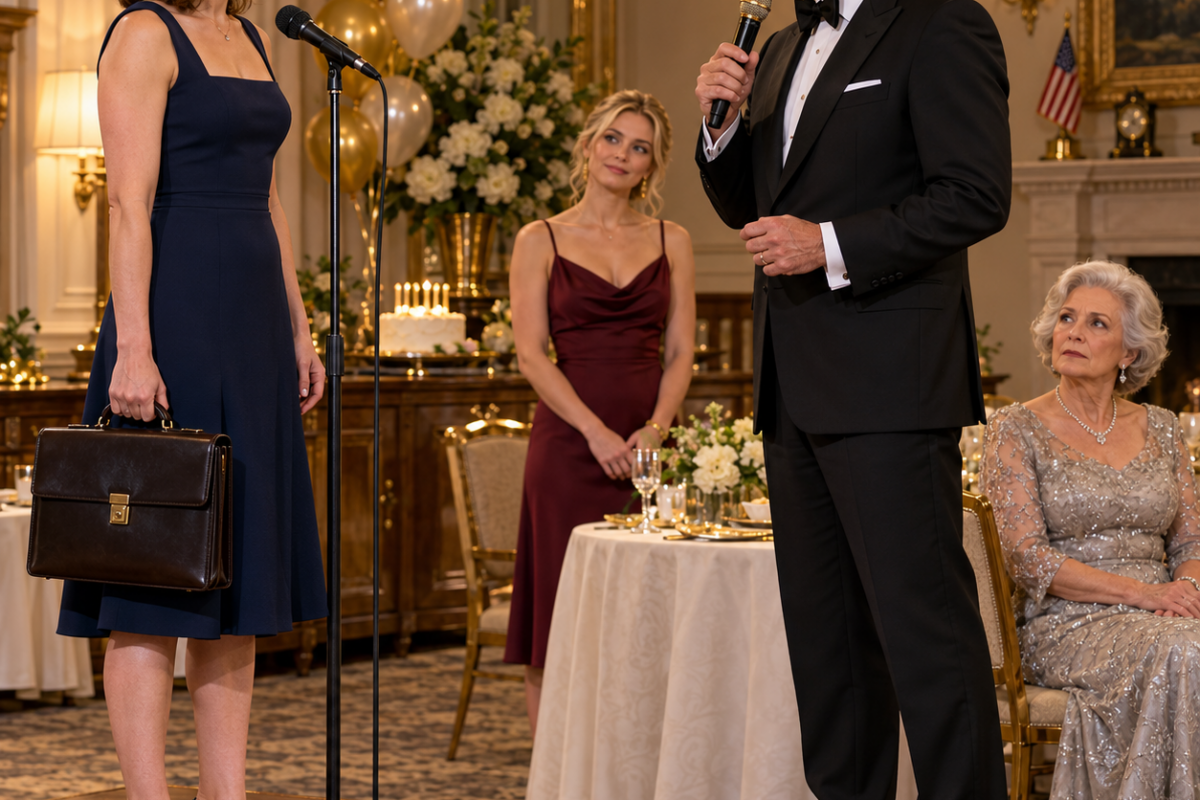
“I already promised your house to your sister,” my father told me four days after I bought it. “They’re moving in Monday. Rent-free for three years.” I was thirty-one, had saved for nine years, and had bought the five-bedroom home entirely in my own name. When I said no, he threatened to tell the family I had abandoned my sister’s children. Days later, he took the microphone at my grandmother’s seventy-fifth birthday dinner and did exactly that.
My father called twelve times in forty minutes after discovering I had bought a house without consulting him. When I answered, he didn’t ask whether…
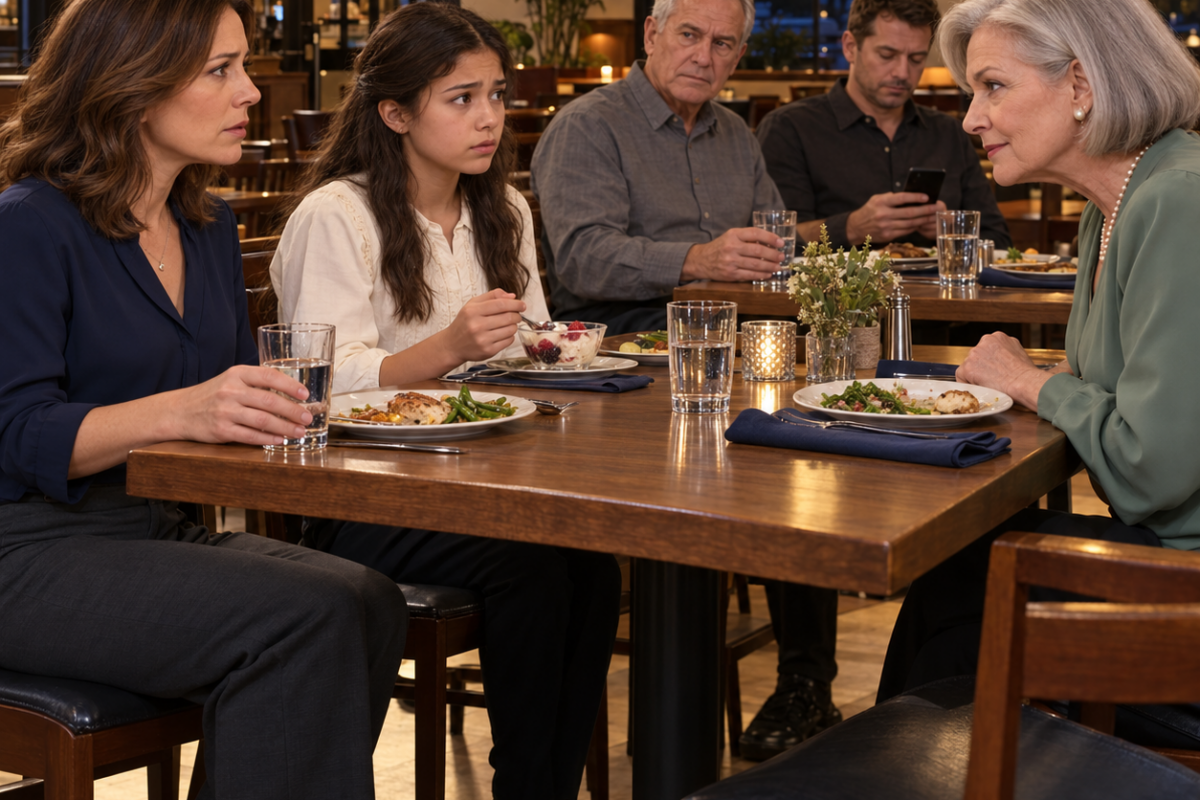
My mother leaned across the restaurant table, looked at my thirteen-year-old adopted daughter, and whispered, “We don’t sit with mistakes.” I took Sole’s hand and walked her out. That night, my father texted, “You’re still making the car payment tomorrow, right?” By midnight, I had canceled the payments I’d been making for my family. Then I remembered something Sole had told me about her grandmother.
My mother looked at my thirteen-year-old daughter and whispered, “We don’t sit with mistakes.” She said it softly enough to avoid attracting attention from the…
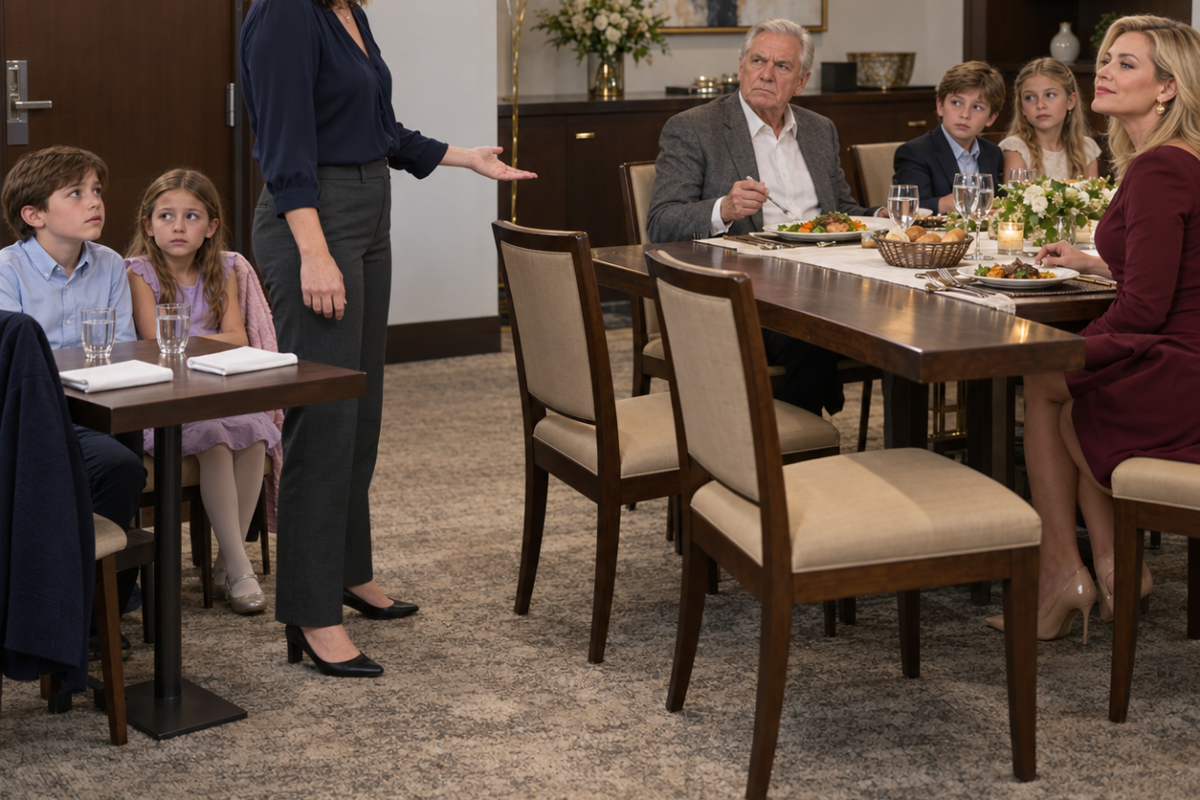
At my father’s seventieth birthday dinner, my eleven-year-old son and eight-year-old daughter were seated beside the service door with water glasses—but no dinner plates. Their cousins sat beside Grandpa with warm bread and full place settings. “They’ll eat after everyone else,” my sister said. I turned to my father, expecting him to object. “They can wait another hour,” he replied. There were two empty chairs at his table.
At my father’s seventieth birthday dinner, the first thing that stopped me wasn’t the cake or the gold balloons. It was my children. Ethan and…
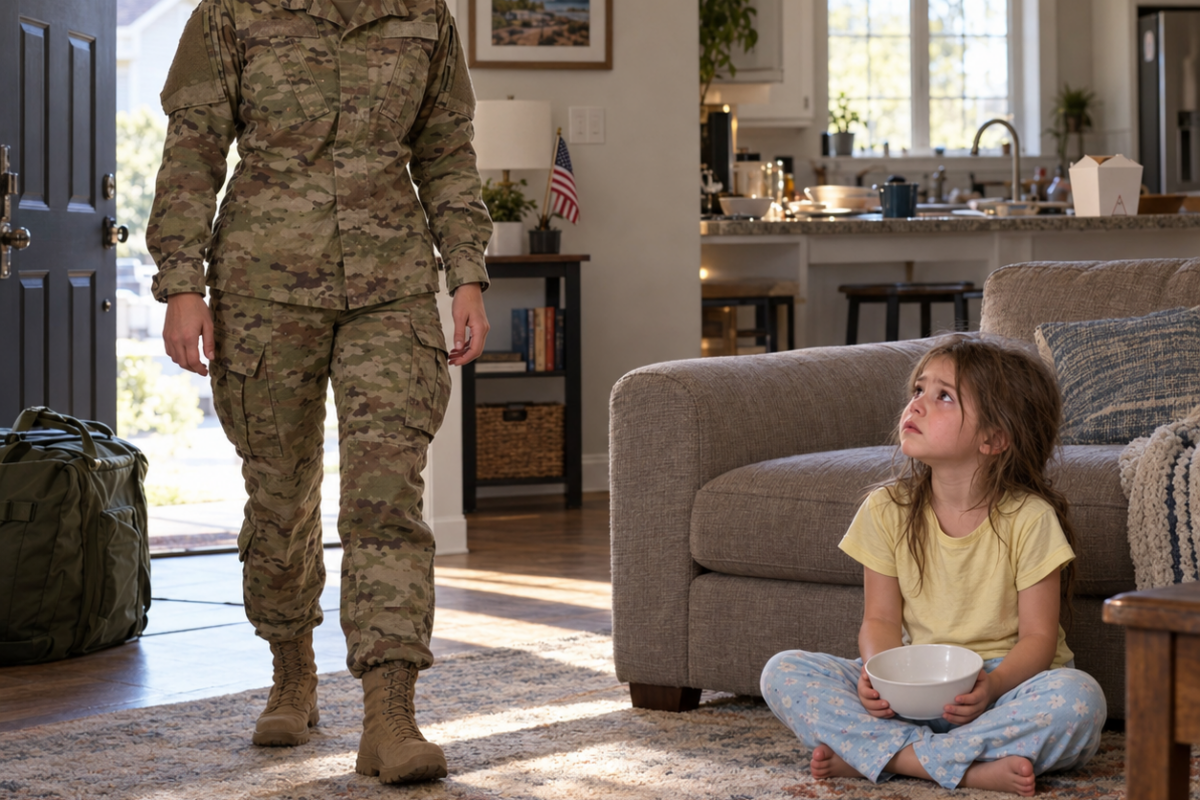
“Mommy, are you real?” my four-year-old daughter whispered when I came home from deployment three weeks early. She was sitting alone on our living room floor with an empty cereal bowl. My husband was on a Caribbean cruise with his mother and sister. Twenty-two minutes earlier, they had posted a photo captioned “Family time.” I was still in uniform when Sophie asked if she could have something to eat.
The first thing my daughter said when I found her was, “Mommy, are you real?” She was sitting cross-legged on our living room floor with…
End of content
No more pages to load