My husband kissed my forehead and left for an “emergency meeting.” Twenty-four minutes later, his car stopped outside a jewelry store, and our eight-year-old son whispered, “Dad said telling you about Vanessa would make you sad.” That afternoon, Daniel brought her home to find us gone. A yellow envelope was waiting beneath the dining-room chandelier.


At 9:12 on Tuesday morning, my husband kissed my forehead, lied directly to my face, and walked out of our marriage wearing the navy suit I had bought him for our tenth anniversary.
“I have an emergency meeting,” Daniel said.
He stood in the marble entryway, adjusting his silver cuff links in the mirror beside the door. Behind him, our eight-year-old son sat at the kitchen island, watching a bowl of cereal become soft enough that even hunger could not make it appealing.
“Will you be home for dinner?” Noah asked.
“Probably not, buddy. Big project.”
“You said we could finish the model plane.”
Daniel glanced at his watch.
“We’ll do it this weekend.”
“You said that last weekend.”
For half a second, Daniel’s expression tightened.
“Work pays for that model plane, Noah.”
He did not shout. He did not have to. Noah lowered his eyes and moved his spoon through the cereal.
“I know.”
I watched from the doorway. During the previous six months, I had seen my son learn how to make disappointment smaller before his father noticed it. He no longer argued when a promise was broken. He simply stopped asking as often.
Daniel came toward me and placed a distracted kiss against my forehead.
“Don’t wait up.”
I met his eyes.
“I won’t.”
He smiled, satisfied with an answer he had misunderstood.
Through the window, I watched his black sedan move down the driveway and disappear behind the trees. Then I opened the location application connected to our shared family account.
At 9:36, the marker stopped outside Bellamy Jewelers.
The movers would arrive in fourteen minutes.
By the time Daniel came home that afternoon, our clothes, our family keepsakes, and Noah’s unfinished model plane would be gone. His watches would remain in their drawer. His business awards would remain on the walls.
Under the dining-room chandelier, a yellow envelope would be waiting.
My name was Claire Carter, and for eleven years I had been married to a man who gradually convinced himself that everything I did for our family was evidence that I could no longer do anything else.
Before the marriage, I had been a forensic accountant.
I reviewed corporate records, traced money through accounts that had been designed to confuse people, and explained complicated financial findings to attorneys, investigators, and occasionally a jury.
I knew dishonest people could be charming.
I knew an explanation could sound reasonable while answering none of the questions being asked.
I knew that when someone told you not to worry about the details, the details were often exactly where you should look.
Still, knowing how deception worked professionally did not protect me from wanting to believe the man I loved.
Daniel and I met through mutual friends. He was ambitious, funny, and impatient with anything that seemed unnecessary. He could walk through an unfinished building and describe it so clearly that I could almost see the walls before they existed.
He admired my work then.
“You’re the smartest person in the room,” he once whispered after a dinner where a man had spent twenty minutes explaining a financial structure I had helped review.
I laughed.
“You’re only saying that because you want me to go out with you again.”
“That, too.”
At the beginning, I did not have to reduce myself to make him comfortable. We talked about work, money, travel, and the life we imagined building.
He listened.
I listened.
When he proposed, we were alone in the dining room of the house we had recently chosen. The furniture had barely arrived. There was one lamp, a folding table, and takeout food because neither of us had yet found the box containing plates.
My father came the following weekend and insisted the chandelier was too elaborate for a room that still smelled of cardboard.
Daniel said we would grow into it.
For a while, we did.
Carter Construction Group was small then. Daniel had experience, a promising list of clients, and more confidence than capital.
My father helped him examine the business plan. He asked difficult questions. He wanted realistic margins, not hopeful speeches.
Daniel answered most of them well.
After my father died, part of the inheritance he left me became the capital that allowed the company to expand.
Six hundred thousand dollars.
It was not an informal gift to a husband whose gratitude I trusted would make everything fair. We obtained independent advice. The investment and shareholder agreement gave me fifty percent ownership.
Daniel owned the other fifty percent.
We both signed.
He knew what the agreement said.
Years later, he behaved as though the signature had faded because I no longer sat in the office.
At first, I participated in the company’s financial planning. I reviewed reports, helped establish controls, and asked questions Daniel sometimes found irritating but usually admitted were useful.
Then Noah arrived six weeks early.
The first weeks of his life were filled with monitors, careful explanations, and fears I could not organize into a spreadsheet.
He had respiratory complications. We spent long hours beside him, learning the rhythms of a hospital unit and the peculiar exhaustion of being frightened without being able to do anything more useful than remain present.
When we finally brought him home, I wanted time.
Time to hold him.
Time to believe he was safe.
Time to stop waking at every sound.
I left my work temporarily.
One year became two.
Two became eight.
There were genuine reasons at first. Noah needed additional care. Daniel traveled. Childcare was complicated. I was tired, and I wanted to be with my son.
But whenever I began discussing a return, Daniel offered the same loving language.
We were a team.
Noah needed stability.
The company was demanding.
There would be plenty of time later.
Eventually, later became a word that meant not while my plans might inconvenience his.
The argument about childcare costing almost as much as I earned appeared often, though the calculation rarely included the long-term value of my career or the unpaid work I was already doing.
I handled school forms, medical appointments, household schedules, birthdays, relatives, meals, and the thousand small tasks that keep a family’s life from falling into disorder.
Daniel began referring to it as “being home.”
When people asked what I did, he answered before I could.
“Claire takes care of Noah.”
That was true.
It was not complete.
I did not object every time. I was proud of being Noah’s mother. I also did not want to turn a dinner conversation into a correction of my husband.
But small descriptions become large assumptions when they are repeated often enough.
Daniel stopped asking what I wanted.
I stopped expecting him to.
Our marriage did not collapse in one dramatic moment. It narrowed gradually.
A conversation interrupted because his phone rang.
A plan postponed because a client needed him.
A question treated as criticism.
A disappointment explained as my failure to understand pressure.
He still brought flowers sometimes.
He still knew how to be affectionate when other people were watching.
On birthdays, he bought expensive things and seemed puzzled when I wanted an evening without his phone more than another necklace.
“You’re difficult to please,” he said once.
I almost believed him.
Then Noah began noticing.
At six, he asked why Daddy always had to finish one more call.
At seven, he asked whether work was more important than birthdays.
At eight, he stopped asking some of those questions aloud.
That worried me more than any argument Daniel and I had.
A child who complains is still expecting someone to hear him. A child who quietly rearranges his expectations may have already decided nobody will.
I tried to compensate.
I attended games, helped with projects, and listened when he talked about things Daniel dismissed as small.
I did not tell him his father did not care.
I told him adults could be busy and still love their children.
But I began understanding that my explanations were becoming a cover over something Noah could see for himself.
Six months before the Tuesday I left, I was organizing tax documents in Daniel’s home office.
That was not unusual. He disliked administrative work and expected me to make sure the accountants received what they needed.
A payment appeared in one of the supporting schedules.
Harrison Site Solutions.
The name meant nothing to me.
The invoice described project coordination and site preparation services. The amount was substantial enough that I wanted to know which project it concerned.
The address was a rented mailbox.
That did not prove anything by itself. Legitimate businesses used mailing services. New subcontractors could work from small offices. A single unusual invoice was a question, not a conclusion.
I asked Daniel about it over dinner.
He barely looked up.
“New subcontractor.”
“Which project?”
“Several.”
“What services?”
“Claire, it’s in the description.”
“The description is broad.”
He set down his fork.
“Do you need to audit everything I do?”
I looked at him.
“I’m asking about a payment.”
“And I’m telling you it’s legitimate.”
Once, that might have ended the conversation.
This time, his irritation made me more curious.
I reviewed the records available to me as a shareholder and the financial materials I had been authorized to handle. I did not steal a password, enter someone else’s private account, or assume marriage gave me unlimited access to everything.
I used what I could lawfully review.
The company had paid Harrison Site Solutions more than $400,000.
Then I found Westfield Materials.
Brightline Consulting.
Northbridge Procurement.
The names looked ordinary. The descriptions sounded professional. Together, they formed a pattern that did not.
The supporting work was difficult to identify. Certain payments had been approved outside the usual sequence. Vendor information had changed shortly before disbursements. Several transfers moved in amounts that fit beneath a review threshold.
I knew the feeling that came when a set of records wanted to look simple.
I had not forgotten how to read it.
That evening, Daniel came home late.
He smelled of perfume I did not own.
When I asked about his day, he said he had spent it at a project site.
There was a hotel receipt in the papers he left on the counter.
I stood in the kitchen holding it for so long that the ice in my glass melted completely.
I cried that night.
Not because I had proof of every suspicion.
Because I understood I had been working hard to avoid asking questions I already knew mattered.
The first call I made was to Evelyn Hart.
She was sixty-one, with silver hair cut in a neat bob and a calm manner that became especially precise when someone tried to substitute confidence for evidence.
We had worked together before I left my career. She had represented clients in complicated financial disputes and knew exactly how useful, and how dangerous, an angry person with access to records could become.
I did not begin by saying my husband was a criminal.
I said I had concerns.
She asked what I had seen.
Then she said, “Don’t confront him yet. Don’t collect anything you are not entitled to collect. Bring me the documents you already have, and let’s determine what they actually show.”
I appreciated the restraint.
I needed a professional, not someone who would turn fear into certainty because the story sounded compelling.
We met two days later.
I described the financial pattern, the hotel receipt, and the changes in Daniel’s behavior.
Evelyn took notes.
Then she asked, “What do you want to protect first?”
“Noah.”
“And after Noah?”
I thought for a moment.
“My ability to support him. The company’s employees. My legal position.”
“And yourself?”
I looked down.
That answer should have been easier.
For years, I had placed myself at the end of every practical list.
Evelyn waited.
Finally, I said, “Yes. Myself.”
For three months, we prepared.
Independent advisers reviewed the company records through proper channels.
An investigator gathered information about the affair without involving Noah.
We preserved copies of documents with attention to where they came from, who had access, and what they could establish.
Hotel receipts.
Invoices.
Bank records.
Vendor information.
Messages that had appeared in shared or company systems and could appropriately be reviewed.
We did not treat every piece as equally reliable.
We did not assume a photograph proved a financial offense.
We built a timeline.
The four vendors were connected through records involving Lucas Cole.
Vanessa Cole’s brother.
I knew Vanessa.
She worked around Daniel’s business relationships, sometimes appearing at events as a consultant or project liaison.
She had been polite to me.
Once, she complimented Noah’s manners.
I remembered that while examining records linked to her family.
The total transferred through the vendors exceeded $2.4 million over eighteen months.
That was the amount under review, not a final finding that every dollar had been stolen.
Some payments had underlying work.
Some had no support we could identify.
Some appeared connected to luxury travel, jewelry, apartment costs, and transfers involving people associated with a government redevelopment contract.
The distinction mattered.
The company’s money could not become my personal divorce weapon simply because I was angry.
Employees, creditors, other parties, and public obligations were involved.
Evelyn retained an independent forensic accountant, Owen Shaw, to validate the patterns I had identified. I welcomed that.
I was capable.
I was also Daniel’s wife.
A professional review needed to withstand more than my confidence in my own conclusions.
Owen’s work confirmed enough concern to justify formal action.
At the same time, the investigator confirmed the affair.
There were photographs.
Dates.
Repeated meetings.
One photograph showed Daniel and Vanessa leaving a downtown hotel with Marcus Vale, a contractor connected to a government redevelopment project whose bribery investigation had recently become public.
The photograph established contact.
It did not prove bribery.
The financial records would need to speak for themselves.
Still, it contradicted Daniel’s claims about where he had been.
And it connected parts of his life he had insisted had nothing to do with one another.
I sat in Evelyn’s office looking at the image.
Daniel was wearing a coat I had helped him choose.
Vanessa was smiling.
Marcus was holding a folder.
The ordinariness of it hurt.
Nobody in the photograph looked troubled by the family waiting elsewhere.
Evelyn watched me.
“You don’t have to make a decision this minute.”
“I already have.”
“About the marriage?”
“Yes.”
She nodded.
“Then we plan carefully.”
Planning did not mean I became emotionless.
I cried while folding Noah’s laundry.
I cried after Daniel fell asleep beside me.
I cried in the shower because running water gave me something to hide inside.
There were mornings when I wondered whether I should confront him and let him explain.
There were evenings when he was kind enough that I almost wished I had not learned anything.
Then he would dismiss Noah’s disappointment or call me overdramatic for asking an ordinary question, and the truth would return.
I was not leaving because I had stopped loving every part of him.
I was leaving because love had become something I was expected to supply while he stopped being accountable for what he did with it.
Evelyn helped me separate the personal and business issues.
The divorce filing would address the marriage.
The ownership dispute and concerns about company funds would follow the procedures available under the shareholder agreement and the relevant legal process.
I could not remove a fifty-percent co-owner from the business by announcing that he had betrayed me.
I could seek protections against disputed transfers, request records, enforce rights, and ask for independent oversight.
We did.
Some measures required agreement.
Others required court review.
Nothing was frozen simply because Evelyn typed a notice.
The documents prepared for that Tuesday reflected actions already filed, orders obtained where supported, and restrictions carefully directed at disputed transactions.
Payroll and ordinary business operations were not supposed to stop because my marriage was ending.
I insisted on that.
People who had never sat at our dining table should not miss a paycheck because Daniel and I were in conflict.
We also prepared for Noah.
That was the part I found hardest.
Financial documents had categories.
Children had questions.
I consulted a child therapist, Dr. Helen Ruiz, before telling him about the separation.
She asked what Noah had seen.
I described tension and disappointment.
I did not yet know what he had witnessed at the soccer game.
She advised me to keep explanations honest, simple, and free of adult accusations.
He did not need details of an affair or financial misconduct.
He needed to know he had not caused the separation, that both parents remained responsible for him, and that the adults would handle the decisions.
I practiced saying those things aloud in my car.
Even then, they sounded inadequate.
How did you tell a child his family was changing without making him feel the floor had disappeared?
You could not make the change painless.
You could make sure he did not have to carry responsibility for it.
A temporary home was arranged within reach of his school and ordinary activities.
I did not want to move him across the country, hide him from his father, or make a dramatic disappearance that would create legal problems and more fear.
Evelyn coordinated the timing with the family-law process.
Daniel would receive notice.
Parenting arrangements would be addressed through the temporary orders and agreements.
My location would be protected appropriately while the initial conflict unfolded, but the plan was not to erase his father.
Leaving the marriage and ending a child’s relationship with a parent were separate matters.
I needed to remember that even when I was angry.
The evening before Tuesday, I told Noah we would be staying somewhere else for a while.
We sat on his bedroom floor.
The unfinished model plane rested on the desk.
He looked at it while I spoke.
“Are we going on a trip?”
“No.”
“Is Dad coming?”
“Not with us.”
He was quiet for a long time.
Then he asked, “Is this because you fight?”
“We’ve been having problems we haven’t been able to solve. Living separately is something the adults need to do.”
“Did I make it worse?”
“No.”
He looked at me.
I repeated it.
“Noah, you did not cause this.”
He nodded without seeming convinced.
I held his hand.
“You can ask questions. You can be sad. You can be angry. You don’t have to make me feel better.”
That made his eyes fill.
“I don’t want you to cry.”
“I know. But my feelings are mine to take care of.”
He leaned against me.
We sat there until he was ready to begin choosing what to pack.
I left his ordinary routine as intact as possible that night.
Bath.
Book.
A glass of water.
The familiar argument about whether one more page meant one more page or the entire chapter.
After he slept, I stood in the hallway looking at the family photographs.
I would take the ones that belonged to me or could appropriately be moved, with copies preserved where needed.
I was not going to strip Daniel’s relationship with his son from the walls as punishment.
But I was not going to leave my own family memories behind because the house contained them.
The Disney World photograph mattered to Noah.
His kindergarten picture mattered to me.
My father’s final Christmas photograph mattered more than I could explain.
They would come with us.
At 9:12 the following morning, Daniel lied and left.
I had known he was likely to be gone for several hours.
The tracking application confirmed his route, but it was not the foundation of my decision. He had insisted on the shared system two years earlier after his car was stolen from an airport garage.
We had both knowingly used it since.
I looked once that morning.
Then I put the phone down.
I did not need to watch every turn.
I needed to help my son leave his home.
Noah came into the kitchen carrying his backpack.
“Are we really leaving today?”
“Yes.”
“Before Dad comes home?”
“Yes.”
“Does he know?”
“Not yet. The adults are handling the notice today.”
His fingers tightened around the strap.
“Will he be mad?”
“He may have a lot of feelings.”
“At me?”
I knelt immediately.
“No. None of this is because of you.”
“Did I do something?”
“No.”
“Did you?”
I took a breath.
“I made a decision because the marriage isn’t healthy the way it is. That is an adult decision. You don’t have to decide who is right.”
He studied me.
Then he said, “Is this because Dad has a girlfriend?”
Everything inside me stopped.
I had never spoken Vanessa’s name to him.
“What makes you think that?”
He looked toward the front door.
“I saw them.”
“When?”
“At my soccer game last month. When you were helping Grandma.”
My mother had undergone a medical procedure in Cincinnati. Daniel had taken Noah to the game.
I had been grateful he was doing it.
“What did you see?”
Noah swallowed.
“Dad kissed her beside her car.”
I kept my expression as steady as I could.
“Did he know you saw?”
“Yes.”
“What did he say?”
“He said Vanessa was his work friend and I misunderstood.”
Tears filled his eyes.
“Then he said telling you might make you sad.”
I took both his hands.
“You should never have been asked to keep that secret.”
“I didn’t want you to cry.”
“Oh, sweetheart.”
I pulled him close.
At first, he held himself rigid.
Then his arms closed around my neck.
“I’m sorry.”
“You have nothing to apologize for.”
“I should have told you.”
“Your father was responsible for telling me the truth. You were not responsible for protecting either of us.”
I wanted to say more.
I wanted to go after Daniel and make him hear what he had done.
But Noah was in my arms.
My anger could wait.
His safety could not.
The doorbell rang.
He jumped.
“That’s Evelyn,” I said.
She entered with a leather briefcase and two cups of coffee.
Three movers followed, carrying equipment and wearing the quiet professionalism of people who understood they had arrived in a home where speed mattered but noise did not help.
Evelyn handed me a cup.
“How are you holding up?”
“I’m moving.”
“That wasn’t my question.”
“It’s the only answer I have.”
She looked at me for a moment.
Then she nodded.
“Fair enough.”
I told her privately what Noah had said.
Her expression changed.
“We’ll address it appropriately. Don’t ask him to repeat it to everyone.”
“I won’t.”
She contacted the people who needed to know.
Dr. Ruiz would speak with Noah in the proper setting.
The parenting concerns would be raised through counsel.
My son would not become a witness I carried from room to room to strengthen my case.
The movers worked from a prepared inventory.
My belongings.
Noah’s belongings.
Clearly identified family keepsakes.
Authorized copies of records.
No deliberate destruction.
No dramatic sweep of Daniel’s drawers.
His watches stayed where they were.
His golf clubs stayed in the garage.
His framed awards remained in the office.
I wanted an accurate record of what left.
I did not want to spend the next six months arguing about a missing belt because anger had made me careless.
Noah helped pack his books until he became overwhelmed.
Then Evelyn sat with him at the kitchen table and asked about the model plane.
He explained it seriously.
She listened as though nothing more important could be happening.
I loved her for that.
By noon, the truck was loaded.
The house had begun to echo.
Rooms I had barely noticed for years suddenly looked unfamiliar.
A sofa without the blanket.
A shelf without photographs.
The kitchen counter without the fruit bowl Noah and I had chosen at a market.
At twelve thirty, he stood in the living room looking at the pale rectangles on the wall.
“Are we taking the Disney picture?”
“It’s packed.”
“And my kindergarten picture?”
“Packed.”
“What about Dad’s pictures?”
“He’ll have pictures of you, too. We made copies of the ones you wanted.”
His mouth trembled.
“Does Dad still belong to us?”
I crouched beside him.
“People don’t belong to one another.”
“You know what I mean.”
I did.
“He will always be your father.”
“But he won’t live with us?”
“Not now.”
“Forever?”
“I don’t know what every future arrangement will be. I do know we’ll make sure you know what’s happening.”
He began crying.
I held him while the movers carried a box past us.
Leaving did not feel like triumph.
It felt like helping my child cross a bridge I had chosen because staying on the other side had become unsafe for us emotionally, while knowing he could only feel the distance.
At one fifteen, the final box left.
Evelyn placed the yellow envelope beneath the dining-room chandelier.
Daniel’s name was written across the front in my handwriting.
Inside were copies of the divorce filing, notices concerning the temporary protections for disputed funds, selected financial records, and the photograph from the hotel.
Formal service would be handled properly.
The envelope was not a substitute for the legal process.
It was an unmistakable explanation waiting in the house.
The original evidence was preserved elsewhere.
Evelyn looked at me.
“Are you ready?”
I looked around.
Daniel had proposed here.
Noah had taken his first steps across the polished floor.
My father had sat beneath the chandelier during his final Christmas, laughing because Noah insisted everyone wear paper crowns.
Memories are persuasive.
They can make a familiar room seem safer than an honest future.
For one moment, I wanted to stay—not because the problems had changed, but because I knew where every light switch was.
Then I remembered a message the investigators had lawfully preserved from the relevant records.
Vanessa had described me as a woman with no career, no money of her own, and nowhere to go.
Daniel had agreed.
He had not said I would stay because he loved me.
He had said I would stay because I could not leave.
“Yes,” I told Evelyn. “I’m ready.”
We walked out.
Noah held my hand.
I locked the door.
The drive afterward was not immediately peaceful.
We stopped at Evelyn’s office to complete necessary paperwork and coordinate the remaining notices.
Then we collected keys for the temporary house and met the person handling the delivery.
Noah became quiet.
He ate half a sandwich.
He asked whether he would still go to school the next day.
“Yes.”
“Will you pick me up?”
“Yes.”
The repeated questions were not requests for information anymore.
They were tests of whether anything ordinary remained dependable.
I answered each one.
Near four, after another practical stop and a long day of holding himself together, he fell asleep in the back of Evelyn’s car with his head against my shoulder.
At the same time, Daniel returned to the marital house.
The existing security system recorded the entrance and common areas. Access to that footage had been preserved appropriately. I did not sit watching him in real time.
I saw it later because it became part of the record concerning his return and the envelope.
He entered carrying shopping bags.
Vanessa followed with two more.
He called my name.
No answer.
He walked into the living room.
Stopped.
Looked at the wall.
Vanessa removed her sunglasses.
“Where is everything?”
Not everything was gone.
Only the parts that made the rooms look like a family lived there.
Daniel went upstairs.
He opened closets.
Called again.
Then he came down and saw the envelope.
My phone rang at 4:11.
Noah was still sleeping.
I looked at Evelyn.
She glanced toward him.
“Keep it brief.”
I answered softly.
“Where are you?” Daniel demanded.
“Somewhere safe.”
“What did you do?”
I heard paper moving.
“Which document are you looking at?”
“These divorce papers?”
“Yes.”
“The account notices?”
“Yes.”
Then silence.
He had found the photograph.
“Where did you get this?”
“The information has been handled through counsel.”
“This is not what it looks like.”
“It shows you leaving a hotel with Vanessa and Marcus Vale. The financial questions are documented separately.”
“Marcus was discussing business.”
“Then provide the relevant records to the appropriate people.”
Vanessa’s voice rose in the background.
“What did she send?”
Daniel lowered his voice.
“Claire, come home. We can talk.”
“You’ve had months to talk.”
“You’re confused.”
“No. I was confused when your explanations didn’t match what I could see.”
“You cannot take Noah away from me.”
“The temporary parenting arrangements are being addressed through the legal process. You’ll receive the documents.”
“You planned this.”
“Yes.”
“For how long?”
“Three months.”
He became very quiet.
Then he asked, “What do you want?”
“A safe separation, accurate financial records, and proper arrangements for Noah.”
“You’re trying to destroy me.”
“I’m refusing to keep protecting you from your own decisions.”
“Claire—”
“Speak to Evelyn. Don’t contact Noah about this conversation.”
I ended the call.
The phone rang again.
I silenced it rather than turning off every possible route for necessary communication. Evelyn’s office remained available. The agreed channels were in place.
Noah stirred.
“Are we there?”
“Almost.”
He nodded and closed his eyes.
Outside, the city moved past.
I pressed my cheek lightly against his hair.
Daniel thought the envelope was my revenge.
It was the point at which my refusal to participate became impossible to ignore.
The temporary house was modest, bright, and close enough to school that Noah would not need a new morning routine.
A tree stood outside his bedroom window.
The movers had assembled his bed.
His books were on a shelf.
The model plane rested on the desk.
He went straight to it.
“Can we finish it?”
“Not tonight.”
His shoulders lowered.
I saw the disappointment and recognized the danger of using the same vague promises his father had used.
Then I added, “Tomorrow after dinner, we can work on it for half an hour. We’ll put it on the calendar.”
He looked at me.
“Really?”
“Really.”
We wrote it down.
That evening, I made scrambled eggs because the kitchen boxes were not fully unpacked and neither of us wanted a complicated meal.
Noah sat on a stool and watched.
“Is Dad eating?”
“I don’t know.”
“Maybe he’s hungry.”
“He can take care of dinner.”
“But—”
I turned off the stove for a moment.
“You can care about Dad without being responsible for him.”
He looked down.
“I know.”
He did not know yet.
He would need to hear it many times.
After he went to sleep, I sat on the floor beside a box of towels and cried.
The house was quiet.
There was no Daniel to ask why I was being dramatic.
There was also no Daniel to remember the good years with.
Leaving freed me from one kind of loneliness and introduced another.
I had expected that.
I still wasn’t prepared for how it felt.
Evelyn called around nine.
“Any immediate concerns?”
“No.”
“How’s Noah?”
“Asleep.”
“And you?”
“Tired.”
“Eat something. Then sleep if you can.”
“I already ate.”
“Good.”
She gave me the necessary updates without turning the call into a complete review of the day.
Formal notice had been served.
The relevant orders and restrictions were communicated.
The business matters had been directed through the appropriate channels.
Daniel had retained counsel.
None of that meant the next weeks would be easy.
It meant the process had begun.
The following morning, Noah woke early.
For a moment, he forgot where he was.
I watched the realization move across his face.
Then he asked whether the bus still came.
“We’re driving today.”
“Will everyone know?”
“No. You don’t have to explain anything you don’t want to.”
“What do I say if someone asks?”
“You can say you’re staying in a different house right now.”
“Is that lying?”
“No.”
He considered it.
Then he asked whether his teacher knew.
“I told her there are changes at home so she can help if you need it. I didn’t tell her private details.”
He nodded.
At school, his teacher, Ms. Bennett, greeted him normally.
That mattered.
She did not bend down with a tragic expression or ask whether he wanted to talk in front of other children.
She said good morning and asked whether he had brought his library book.
He had.
He walked inside.
I sat in the car afterward, holding the steering wheel.
For years, I had performed ordinary tasks while something inside me waited for a crisis.
Now the crisis had become visible, and ordinary tasks were helping me remain steady.
I went to Evelyn’s office.
Daniel’s first written response had arrived.
He claimed I had misunderstood the vendor payments.
He claimed the account protections interfered with legitimate projects.
He claimed the separation was impulsive.
He claimed I had removed property without permission.
The inventory answered some of that.
The documents answered more.
The rest would require review.
Evelyn looked at me.
“Don’t read every accusation as a description of who you are.”
“I know.”
“Knowing will not prevent it from hurting.”
“I know that, too.”
We discussed the next steps.
My fifty-percent interest did not give me sole control.
His fifty-percent interest did not give him sole control either.
The shareholder agreement contained mechanisms for disputes, records access, and certain protective actions.
Where those were insufficient, court involvement would be necessary.
An independent person would help oversee the disputed financial areas under the arrangement being established.
The company needed continuity.
The employees needed clarity.
Neither Daniel nor I could treat it as a household object to divide in anger.
At the first company meeting, I attended with counsel and the independent advisers.
Some employees looked surprised to see me.
Others remembered when I had been involved years earlier.
Daniel was not present for that session because the scope concerned the review process and the temporary arrangements approved through the appropriate channels.
Lena Brooks, the operations manager, sat beside me.
She had worked at Carter Construction Group for ten years.
“I’m glad you’re here,” she said quietly.
“I wish the circumstances were better.”
“So do I.”
The meeting focused on practical matters.
Which payments required additional review.
Who could authorize what.
How payroll would continue.
How vendors should submit supporting records.
What employees should do if they were asked to alter or delete anything.
Nobody announced that Daniel was guilty of every suspicion.
Nobody asked staff to become my allies.
I told them I was there to protect my ownership rights and support an accurate process.
Then I listened.
A project manager raised his hand.
“Are sites going to shut down?”
Lena answered.
“Not because of this review. We’re addressing the specific issues while keeping authorized work moving.”
A woman from accounts payable asked whether previous approvals were going to be treated as misconduct by staff.
Owen answered carefully.
“We’re looking at what each person knew and what authority they had. An approval in a record is not automatically proof that everyone involved understood the entire arrangement.”
Her relief was visible.
I remembered why professional discipline mattered.
Anger wanted a villain in every line.
Evidence required patience.
Daniel’s calls changed during the first week.
At first, he was furious.
Then affectionate.
Then frightened.
He left messages about our history, Noah’s needs, and the risk of public embarrassment.
He said we could work through anything.
He did not begin by telling the truth.
I let counsel handle the legal matters.
Necessary parenting communication moved to a documented channel.
I did not have long late-night conversations in which he could exhaust me into uncertainty.
That boundary was difficult.
Once, after hearing his voice soften the way it used to when he wanted me to forgive something, I nearly called back.
Then I looked at the message where he had described me as unable to leave.
I put the phone down.
I did not need to make every feeling disappear before honoring my decision.
Noah met with Dr. Ruiz that week.
I stayed in the waiting room.
When he came out, he looked tired but not distressed.
On the drive home, he said, “She told me I can love Dad and be mad at him.”
“Yes.”
“Both?”
“Yes.”
He watched the houses passing outside.
“Can you?”
The question caught me.
“I can have more than one feeling about him, too.”
“Do you hate him?”
I took a breath.
“I’m hurt and angry. But you don’t need to hate him because I feel those things.”
Noah nodded slowly.
Then he asked what we were having for dinner.
“Chicken.”
“With the crispy potatoes?”
“Yes.”
He smiled faintly.
The conversation moved on.
Children do that.
Adults sometimes remain standing inside a painful question after the child has already walked toward supper.
I began learning to follow him.
The model plane took longer than half an hour.
We worked on it in small sessions.
I read instructions.
Noah sorted pieces.
We discovered we had attached one section incorrectly and had to begin again.
He became frustrated.
“Dad would know.”
“He might. We can figure it out, too.”
“I want Dad.”
“I know.”
I did not make the moment a contest.
I did not tell him I was doing the work his father had refused.
I set down the part.
“Would you like to stop for today?”
He nodded.
We stopped.
The plane remained unfinished.
The promise had still been kept.
I had sat with him when I said I would.
That was the part he needed more than a completed object.
Daniel’s first contact with Noah under the temporary arrangements happened a few days later.
The conversation was supposed to be simple and focused on their relationship.
Daniel began well.
He asked about school.
About soccer.
About the plane.
Then he said, “Your mother and I need to talk, buddy. Tell her you want to come home.”
Noah looked toward me.
I felt anger rise so quickly that my hands went cold.
The call ended soon afterward.
I documented what happened and informed counsel.
I did not ask Noah whether he had recorded it in his mind correctly.
I did not tell him his father was manipulating him.
I said, “You don’t need to deliver messages between us.”
“But he asked.”
“I know. The adults will handle it.”
“He’ll be sad if I don’t.”
“He can talk to his lawyer or another grown-up. You’re his child, not his messenger.”
Noah began crying.
I held him.
That evening, I understood more clearly why the soccer-game secret mattered.
Daniel had placed adult emotional responsibility on an eight-year-old because it was convenient.
The parenting arrangements would need to address that pattern, not merely the affair.
Dr. Ruiz helped us with appropriate language.
The attorneys addressed it through the process.
There was no automatic conclusion that Daniel could never be a good father again.
There was a clear need for boundaries.
His access would depend on conduct, safety, and the arrangements established by the court and agreements—not on my desire to reward or punish him.
Those distinctions were exhausting.
They were necessary.
The financial review advanced.
The four vendors had been structured through entities associated with Lucas Cole.
Some subcontracted work to legitimate suppliers.
Some charged inflated amounts.
Some transferred funds quickly into accounts that did not correspond to the claimed project expenses.
More than $2.4 million moved through the network over eighteen months.
A portion could be matched to real services.
A substantial portion could not.
The records connected certain funds to Daniel’s and Vanessa’s personal expenses.
Travel.
Jewelry.
Apartment payments.
There were also transfers connected to the redevelopment contract that required separate attention.
Owen’s team traced what could be traced and identified what remained unclear.
Relevant information went to the appropriate authorities through counsel.
I did not make public accusations.
I did not post the hotel photograph.
I did not contact every client to announce what my husband had done.
The company had obligations to confidentiality, accuracy, and the people whose information appeared in the records.
My anger did not remove those obligations.
One evening, Evelyn called.
“Lucas’s attorney has made contact.”
“About what?”
“Providing documents and discussing his position.”
“Is he blaming Daniel?”
“He’s making claims. We’re checking them.”
I appreciated that answer.
In a complicated financial dispute, everyone has a story.
Documents are what allow the stories to be tested.
Vanessa also began separating herself from Daniel’s explanations.
Some communications showed she had known about specific payments.
Others suggested she had been misled about the company’s ownership and my role.
I did not care whether she had thought I was unimportant.
I cared whether relevant information was accurate.
Still, one message hurt more than I expected.
Daniel had told her my investment was “family money” and that the agreement could be dealt with later.
As though inheritance meant it was not mine.
As though years of unpaid labor had somehow canceled a legal interest.
As though my father’s death had made his contribution available for Daniel to rename.
I sat at the temporary house kitchen table after reading the summary.
My father had asked for real answers.
I wished I could tell him I had finally started asking again.
My mother came from Cincinnati once she was well enough to travel.
She stayed for five days.
She did not ask why I had waited.
She did not say she had never liked Daniel.
She helped Noah with homework, made soup, and sat with me after he went to bed.
One evening, I said, “I should have returned to work years ago.”
She looked at me.
“Would that have made him honest?”
“No.”
“Then be careful about putting all the responsibility on the decision you made to care for your child.”
I leaned back.
“I let my life become too small.”
“Yes,” she said gently. “You can make it larger now.”
It was the answer I needed.
Not denial.
Not blame.
Permission to begin.
I contacted a former colleague.
Her name was Maya, and she had remained in forensic accounting while I stepped away.
We met for coffee.
I expected to feel outdated.
I did.
I also discovered I remembered more than I feared.
We talked about changes in software, reporting standards, case management, and the realities of returning after years away.
She did not promise I could step directly into my old role.
She also did not treat eight years of parenting as intellectual decay.
“You’ll need to update some things,” she said. “You’re still you.”
I smiled.
“I’m trying to remember that.”
We made a practical plan.
Courses.
Professional requirements.
A limited project when the timing was right.
No heroic attempt to rebuild a career while Noah was frightened and legal matters were consuming my attention.
I wanted sustainable work.
I had spent enough years arranging my life around other people’s urgency.
Three weeks after I left, Daniel asked for a meeting.
We met in Evelyn’s office with counsel available.
He arrived wearing another navy suit.
Not the anniversary one.
He looked tired.
For several minutes, he spoke about the business.
The payments were misunderstood.
Lucas handled details.
Vanessa had introduced people.
The redevelopment project involved practices everyone knew about but nobody wanted to admit.
I listened.
Then I said, “You need to provide those explanations to the people reviewing the records.”
“I’m trying to explain to my wife.”
“Your wife is not the person who can resolve the financial findings.”
He looked frustrated.
Then he changed direction.
“We had a good life.”
“We had good years.”
“Eleven years.”
“Yes.”
“You’re willing to throw that away?”
I looked at him.
“You brought Vanessa into the house after telling Noah you had an emergency meeting.”
His expression shifted.
“She came to discuss something.”
“Daniel.”
He stopped.
I had said his name that way before.
But this time I did not sound as though I was asking him to help me believe.
I sounded as though I was done assisting.
For a long moment, neither of us spoke.
Then he said, “The affair was a mistake.”
“One?”
He looked down.
“I’m not proud of it.”
“What did you tell Noah at the soccer game?”
His head lifted.
“What?”
“He saw you.”
Daniel’s face changed.
“I explained—”
“You told him he misunderstood. Then you told him telling me would make me sad.”
“He was confused.”
“No. He was eight.”
The silence afterward was heavy.
I continued.
“He spent a month believing it was his job to protect me from something you had done.”
Daniel rubbed his forehead.
“I didn’t think of it that way.”
“That is the problem.”
He looked at me.
“I love my son.”
“Then stop asking him to manage your consequences.”
For the first time, he did not immediately argue.
I wanted that pause to mean understanding.
I had learned to wait for behavior.
Near the end, he asked whether I had ever considered staying.
“Yes.”
His eyes brightened.
Then I added, “Before I understood what staying required.”
He looked away.
I did not enjoy hurting him.
I also did not mistake discomfort for proof that I was wrong.
The legal process continued through the summer.
There were hearings.
Financial disclosures.
Requests for documents.
Disputes about valuations and the marital home.
The temporary protections on disputed accounts were refined as the review established what needed restriction and what could proceed ordinarily.
Daniel could not use the entire business as his personal account.
I could not claim the entire business simply because he had breached our trust.
Independent oversight helped protect operations while ownership and misconduct issues were addressed.
The company’s legitimate projects continued.
Some were delayed.
Some clients became cautious.
There were costs.
I did not pretend my action produced a painless rescue.
What it did was stop secrecy from remaining the operating system.
Lena kept people focused.
At one meeting, she said, “We need fewer promises and better schedules.”
I nearly laughed.
It was true in the business.
It had been true in my marriage.
The parenting schedule also evolved.
Daniel was required to communicate appropriately, comply with the arrangements, and avoid involving Noah in adult disputes.
Support from professionals helped establish how contact could proceed.
Early transitions were difficult.
Noah sometimes returned quiet.
Sometimes angry.
Sometimes happy, which unsettled me until I recognized that his happiness with his father did not diminish what had happened to me.
He needed room to have his own relationship.
I needed room to have my own truth.
Those could exist without making him choose.
Once, after a visit, he said, “Dad was nice.”
“I’m glad.”
“He helped with my soccer shoes.”
“Good.”
“He said he misses you.”
I paused.
“How did that feel?”
“Like I should tell you.”
“You can tell me. You don’t have to fix it.”
He nodded.
Then he went to find a snack.
I stood in the kitchen and let my anger pass without placing it in his hands.
That became one of my most important forms of work.
Not every feeling needed an audience.
Especially not my child.
Vanessa contacted me once through a new number.
I did not answer.
She left a message saying Daniel had misrepresented the state of our marriage.
She said she had thought we were already separated emotionally.
I forwarded it to Evelyn because any relevant claim needed to be evaluated through counsel.
I did not call back.
Even if Daniel had lied to her, she had walked into the house we shared carrying shopping bags after he left his wife and child there that morning.
She had enough information to ask questions.
What she believed about the marriage did not address the financial records.
What she knew about the finances did not require a personal conversation with me.
I kept the matters where they belonged.
That boundary spared me an argument I might once have mistaken for closure.
Lucas provided records that filled gaps in the vendor network.
Some supported his claims.
Some contradicted them.
He had participated in arrangements that were more deliberate than his first explanations suggested.
The investigation involving Marcus Vale widened through channels entirely beyond my divorce.
Our company’s records became part of that process.
A photograph had been the visible clue.
It was not the strongest evidence.
The strongest evidence was the kind that did not look dramatic to anyone outside the field: dates, approvals, amounts, ownership records, and communications that showed why particular transfers occurred.
I had always known that.
Daniel had forgotten I knew it.
Months after leaving, I began a small professional project under supervision and with a scope I could manage.
It did not involve Carter Construction Group.
I needed work that belonged to me rather than another version of my marriage.
The first morning, I dressed carefully and drove to an office carrying a laptop bag that had spent years in storage.
I sat in the parking lot for a moment.
Then I went inside.
The work was familiar enough to comfort me and changed enough to keep me humble.
I asked questions.
I took notes.
I learned the new systems.
At lunch, nobody asked whether Daniel approved.
I had not realized how much I missed that.
When I picked up Noah, he looked at my clothes.
“Did you go to work?”
“Yes.”
“Was it good?”
“It was.”
“Did you find stolen money?”
I laughed.
“Today I reviewed records. Most days are less exciting than that sounds.”
He considered it.
“Did you have lunch?”
“Yes.”
“What?”
“A sandwich.”
He nodded, satisfied.
The ordinary questions pleased me more than admiration would have.
He was beginning to see me as a person with a day of my own.
We finally finished the model plane in early autumn.
Not in one dramatic evening.
Piece by piece.
Sometimes Daniel helped during his time with Noah.
Sometimes I helped.
Sometimes Noah worked alone.
At first, I resented that Daniel could contribute after months of broken promises.
Then I looked at my son’s face when the final pieces fit.
The plane did not need to become a monument to which parent had done more.
It needed to be his plane.
He placed it on the shelf in his room.
“Done.”
“Yes.”
He stood back.
“It looks good.”
“It does.”
Then he smiled.
There were still difficult days.
A birthday brought memories.
A school event placed Daniel and me in the same room.
A financial filing raised an issue I thought had been settled.
A client rumor made me worry about the company’s reputation.
Progress did not arrive as a clean upward line.
It came as the ability to recover more quickly when something hurt.
The temporary house began to feel like a home.
I hung photographs.
Bought curtains.
Learned which floorboard creaked.
Noah made friends with a child down the street.
We had a routine for Tuesdays.
Soup when the weather cooled.
Homework at the table.
A game afterward if time allowed.
Sometimes we argued about screen time.
Sometimes I was impatient.
When I apologized, I did not explain that stress entitled me to be unkind.
I said I was sorry.
Then I tried to behave differently.
I wanted Noah to know adults could make mistakes without making the child responsible for repairing them.
The divorce took more than a year.
By the time it was finalized, the business matters had reached a structured resolution concerning management, ownership, and the recovery claims.
Daniel’s operational authority had been limited and eventually ended under the agreements and decisions reached through the proper process.
My interest was valued independently.
I did not receive every dollar I believed had been misused simply because I believed it.
Recoveries, liabilities, settlement terms, and remaining proceedings all affected the outcome.
Some money came back.
Some did not.
Some issues remained with the company and authorities.
I accepted a fair arrangement that protected my future and allowed the business to continue under independent management rather than insisting on keeping my life tied indefinitely to every unresolved dispute.
There were days when that felt like surrender.
Evelyn reminded me what I had said I wanted.
Safety.
Stability.
Accurate records.
A future for Noah.
Not permanent residence inside Daniel’s consequences.
The marital house was sold as part of the resolution.
I went once to collect a final item and confirm what remained.
The rooms looked larger than I remembered.
The chandelier still hung over the dining table.
I stood beneath it.
Eleven years.
Good dinners.
Bad conversations.
A proposal.
First steps.
My father’s paper crown.
The yellow envelope.
A house can hold all of those things without belonging to the future.
I did not take the chandelier.
I took a small framed photograph I had overlooked.
Then I left.
Daniel’s financial conduct led to consequences beyond the divorce.
The relevant proceedings took time and depended on records, admissions, and decisions made by the appropriate authorities.
There was no instant arrest arranged to satisfy me.
No final scene where every person confessed in exactly the words I needed.
Some responsibility was formally acknowledged.
Some remained contested.
Daniel’s professional standing changed significantly.
He could no longer describe the entire matter as a misunderstanding caused by a jealous wife.
I did not follow every public development.
When information affected Noah or me, counsel told me.
Otherwise, I tried to let the world proceed without requiring my attention.
That was harder than I expected.
For months, I had organized myself around discovering the truth.
Stopping the investigation inside my own mind required a different discipline.
I had to choose a book instead of a search.
A walk instead of another message review.
A conversation about Noah’s day instead of wondering what Daniel was telling someone.
The truth had been established sufficiently for my decisions.
I did not need to live in it forever.
Daniel’s relationship with Noah changed slowly.
There were professional supports, parenting requirements, and periods when his contact depended on meeting the established conditions.
He did not become a perfect father because consequences frightened him.
He did begin arriving on time more often.
He stopped asking Noah to carry messages.
He learned to answer disappointment without mentioning the cost of the child’s toys.
One afternoon, after a school event, he approached me.
Noah was talking with a friend nearby.
“I owe him an apology,” Daniel said.
“Yes.”
“I’ve said it.”
“Then keep showing him.”
He looked at me.
“I owe you one, too.”
I waited.
“I treated you as though the life you made possible belonged only to me.”
For a moment, I did not know what to say.
I had wanted that sentence for years.
Hearing it did not restore the marriage.
It did not undo the records.
It did not erase Noah’s secret.
But it was more honest than anything Daniel had said in the first months after I left.
“Thank you for acknowledging it,” I said.
He nodded.
Then he asked whether we could ever be friends.
“I don’t know.”
He looked disappointed.
I let him.
I was no longer required to make the answer easier than the truth.
Noah turned nine.
Then, not long afterward, ten.
He still loved airplanes.
He became less careful about protecting adults from his feelings.
If a promise was broken, he said so.
If he was angry, he could name it.
Dr. Ruiz helped him learn that his feelings did not need to be either hidden or explosive to deserve attention.
I learned the same lesson alongside him.
One evening, he asked, “Were you scared when we left?”
“Yes.”
“Of Dad?”
“Of a lot of things. Change. Arguments. Not knowing exactly what would happen.”
“But you still did it.”
“Yes.”
He looked at the model plane.
“Does that mean brave people are scared?”
“Often.”
He considered that for a while.
Then he said, “I was scared, too.”
“I know.”
“I’m less scared now.”
I reached for his hand.
“So am I.”
That conversation mattered more than any legal victory.
The business had been protected.
My ownership had been recognized.
The finances had been examined.
But the child who once believed a secret kiss was his responsibility had begun to understand that adults could carry their own lives.
My career grew gradually.
I completed the necessary updates and took on more work.
Not the schedule I had kept before Noah.
A schedule that fit the life I had now.
I liked the work.
I liked being useful in a way that did not depend on silently anticipating someone else’s needs.
There were days I came home tired and ordered dinner.
There were days the laundry remained in a basket.
I stopped treating those things as evidence that working meant I was failing as a mother.
Noah learned to help.
Not because he needed to replace Daniel.
Because children can contribute appropriately to a household without becoming responsible for the parent.
He set the table.
Packed part of his lunch.
Watered a plant that survived largely because it was forgiving.
We became a team in a way that did not require one of us to disappear.
A year and a half after that Tuesday, I bought a home of my own.
Smaller than the house with the marble entryway.
Warm.
Bright.
Close to school.
There was a dining area with an ordinary ceiling fixture and a kitchen where I could hear Noah from the next room.
No chandelier.
No mirror designed to make arriving guests feel impressed.
The first night, we ate takeout on the floor because the table had not arrived.
Noah looked around.
“Remember when Dad said work paid for the plane?”
I put down my food.
“Yes.”
“Your work pays for things, too.”
“It does.”
“And mine will someday?”
“Probably.”
He nodded.
“Then I hope I still have time to finish planes.”
I smiled, though my throat tightened.
“I hope so, too.”
Later, after he fell asleep, I stood at the kitchen window.
The yard was dark.
The house was quiet.
For years, I had believed safety meant keeping the family looking intact.
I had learned that a house could remain full while a child grew lonelier inside it.
I had learned that leaving could hurt and still be the responsible choice.
I had learned that professional knowledge did not vanish because someone called it irrelevant.
Most importantly, I had learned that I did not need Daniel to admit my value before I could act as though it existed.
The yellow envelope remained in a file.
Not on display.
Not as a trophy.
It contained copies of a day when documents finally said aloud what I had been afraid to insist on.
I did not look at it often.
There was too much living to do.
Sometimes people asked about Daniel coming home to the empty spaces.
They wanted to know whether he panicked.
Whether Vanessa stayed.
Whether I felt satisfied when he found the photograph.
I understood the appeal of that scene.
It was visible.
A man who believed his wife could not leave discovering she had.
But it was not the most important part.
The important part happened earlier, in the kitchen, when my son apologized for knowing a truth his father had asked him to hide.
It happened when I told him the secret was not his to carry.
It happened when I refused to let the affair turn him into evidence.
It happened every time I answered an ordinary question honestly instead of making a vague promise.
And it happened each time I chose a future over the familiar shape of a life that was hurting us.
Daniel left at 9:12 believing I would remain where he had placed me.
He returned at four believing the house would contain his wife, his son, and the explanations he had trained us to accept.
Instead, he found a yellow envelope.
The envelope did not destroy the marriage.
The marriage had been damaged by choices made long before it reached the table.
The envelope marked the day I stopped volunteering to hide the damage.
On a Tuesday evening years later, Noah sat at our new kitchen table building another model.
I was reviewing a report beside him.
He looked up.
“Mom?”
“Yes?”
“Can you help me hold this piece?”
I closed the laptop.
“Of course.”
He handed it to me and leaned over the instructions.
We worked quietly for a few minutes.
Then the pieces fit.
“There,” he said.
“There.”
He smiled.
I returned to my report.
He returned to his plane.
Neither of us needed to be silent to keep someone else comfortable.
Neither of us needed to leave.
We were already somewhere safe.
News

At my seventy-second birthday party, my daughter-in-law knocked a crystal vase off its pedestal with her elbow, watched it shatter, and smiled. “Oops.” Her own parents had given it to her and my son on their wedding day six years earlier. I looked at Frank, waiting for him to say something. All he managed was, “Mom…”
I watched my daughter-in-law break her own parents’ wedding gift with one elbow and a smile. For months afterward, people asked me whether I was…
I came home three hours early and found my sixty-eight-year-old mother on her knees scrubbing my mother-in-law’s bathroom. When I helped her stand, her sleeve slipped back, revealing dark marks around her wrist. My husband stepped into the doorway. “Daniela, don’t make a scene.” That was when I remembered my father’s last warning: “If you ever see your mother hurt, don’t argue with anyone. Open the hidden compartment in her sewing machine.”
I came home three hours early and found my sixty-eight-year-old mother on her knees beside a toilet. Her hands were stiff with arthritis. One gripped…
“I already promised your house to your sister,” my father told me four days after I bought it. “They’re moving in Monday. Rent-free for three years.” I was thirty-one, had saved for nine years, and had bought the five-bedroom home entirely in my own name. When I said no, he threatened to tell the family I had abandoned my sister’s children. Days later, he took the microphone at my grandmother’s seventy-fifth birthday dinner and did exactly that.
My father called twelve times in forty minutes after discovering I had bought a house without consulting him. When I answered, he didn’t ask whether…
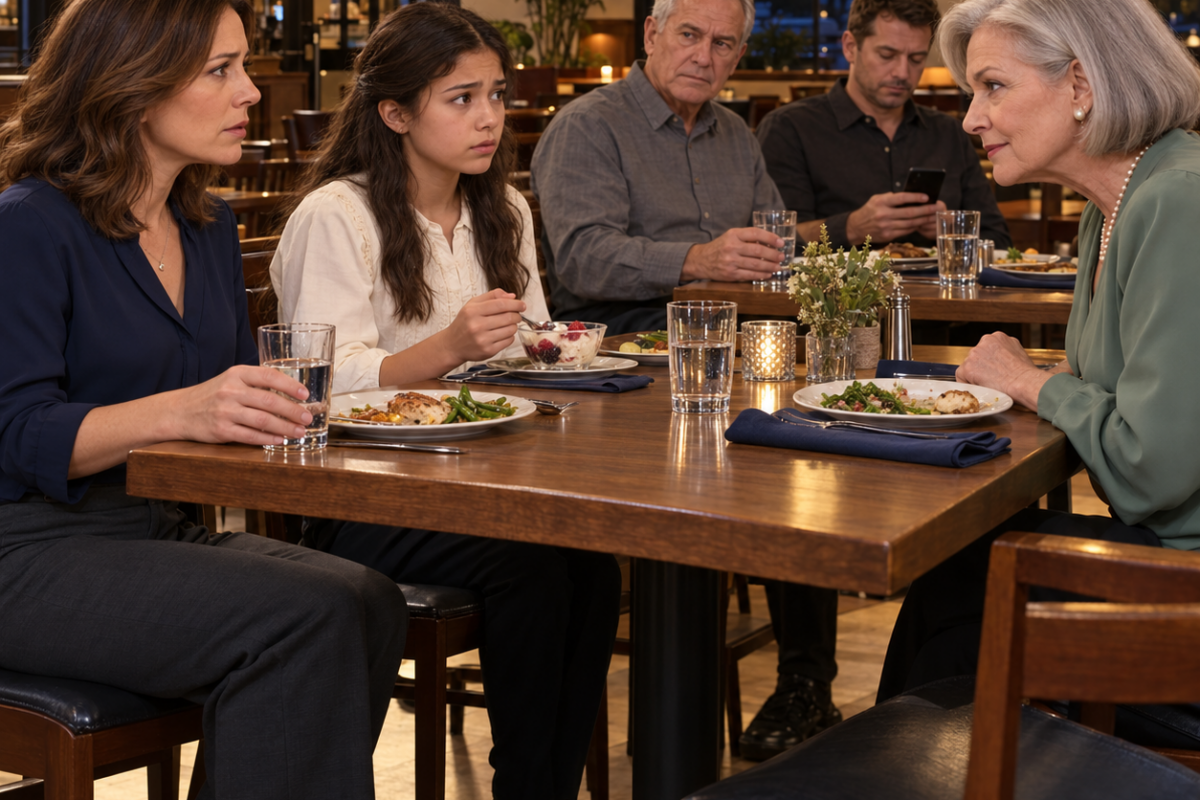
My mother leaned across the restaurant table, looked at my thirteen-year-old adopted daughter, and whispered, “We don’t sit with mistakes.” I took Sole’s hand and walked her out. That night, my father texted, “You’re still making the car payment tomorrow, right?” By midnight, I had canceled the payments I’d been making for my family. Then I remembered something Sole had told me about her grandmother.
My mother looked at my thirteen-year-old daughter and whispered, “We don’t sit with mistakes.” She said it softly enough to avoid attracting attention from the…
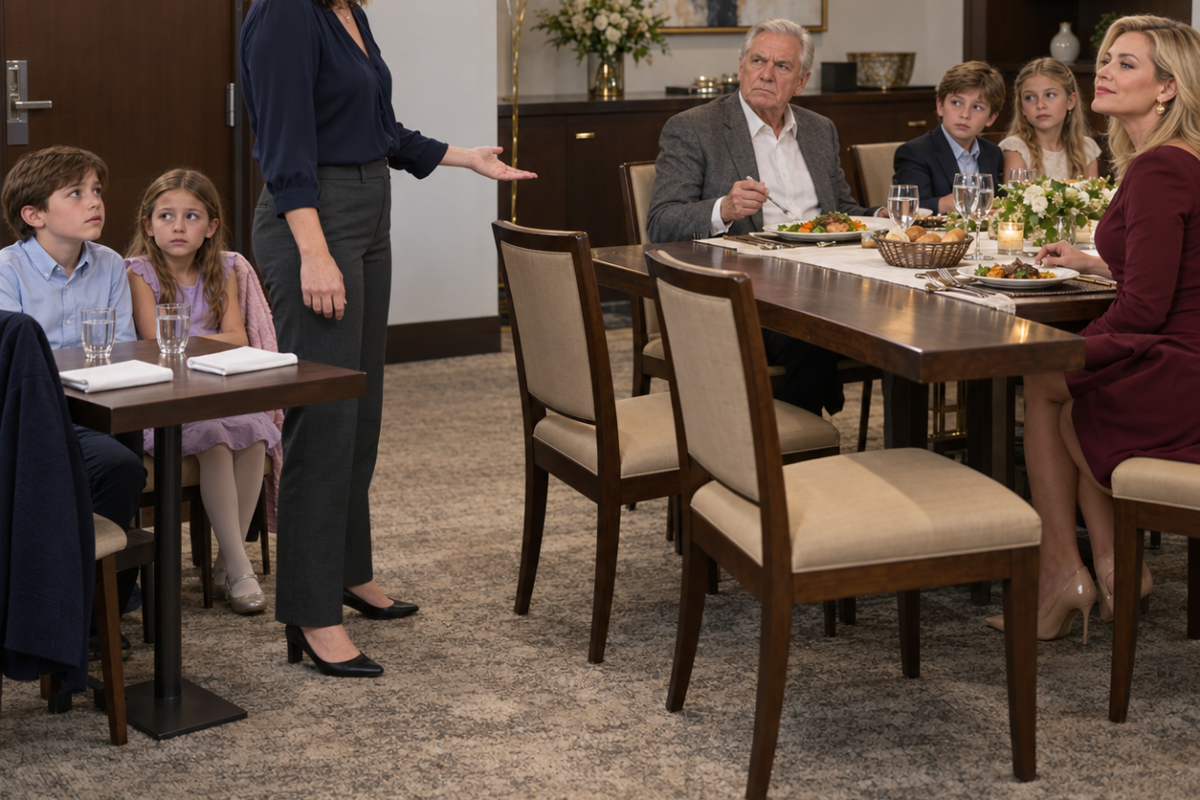
At my father’s seventieth birthday dinner, my eleven-year-old son and eight-year-old daughter were seated beside the service door with water glasses—but no dinner plates. Their cousins sat beside Grandpa with warm bread and full place settings. “They’ll eat after everyone else,” my sister said. I turned to my father, expecting him to object. “They can wait another hour,” he replied. There were two empty chairs at his table.
At my father’s seventieth birthday dinner, the first thing that stopped me wasn’t the cake or the gold balloons. It was my children. Ethan and…
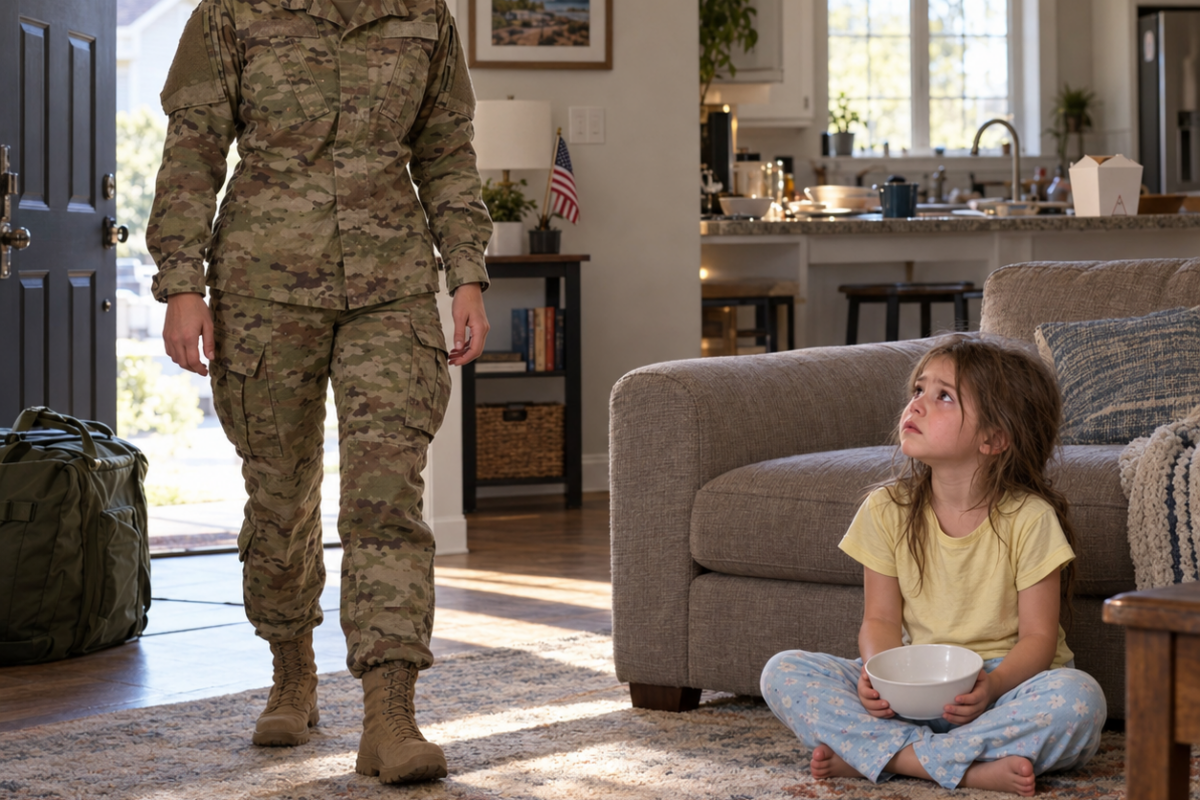
“Mommy, are you real?” my four-year-old daughter whispered when I came home from deployment three weeks early. She was sitting alone on our living room floor with an empty cereal bowl. My husband was on a Caribbean cruise with his mother and sister. Twenty-two minutes earlier, they had posted a photo captioned “Family time.” I was still in uniform when Sophie asked if she could have something to eat.
The first thing my daughter said when I found her was, “Mommy, are you real?” She was sitting cross-legged on our living room floor with…
End of content
No more pages to load