My future mother-in-law called my father “trash” in front of five hundred wedding guests, and Fiona laughed. I stood up and told her the wedding was over. As I reached for Dad’s shoulder, an executive near the stage dropped his champagne glass. He was staring at the man her family had seated near the back.
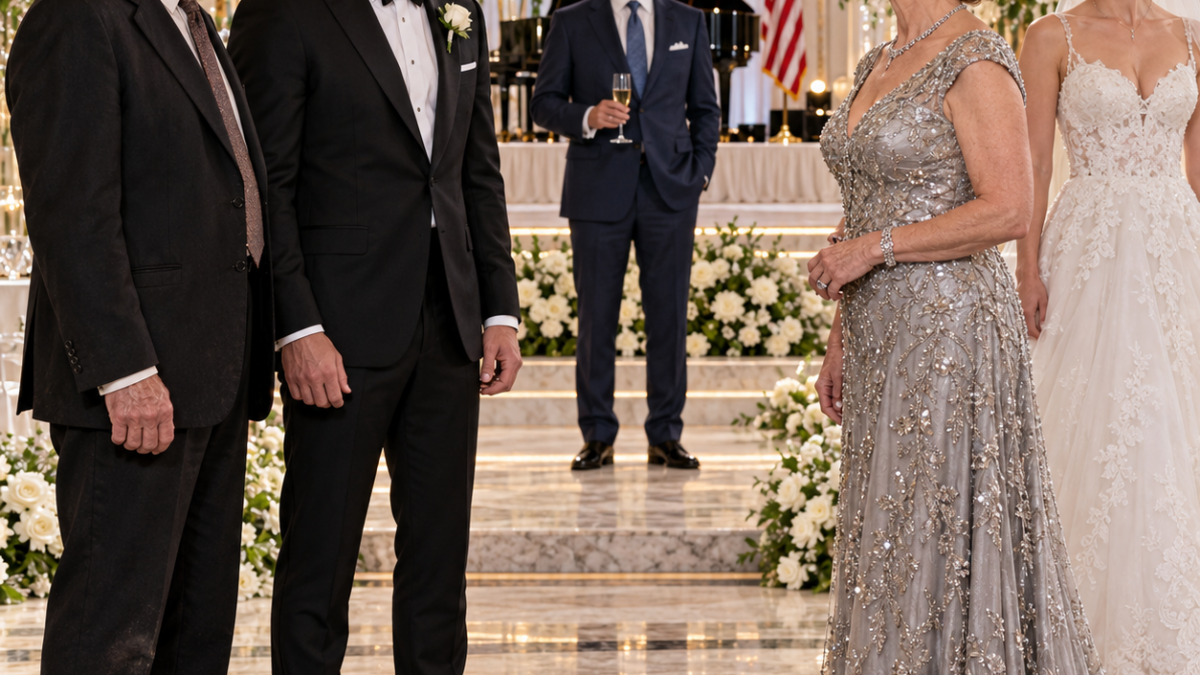
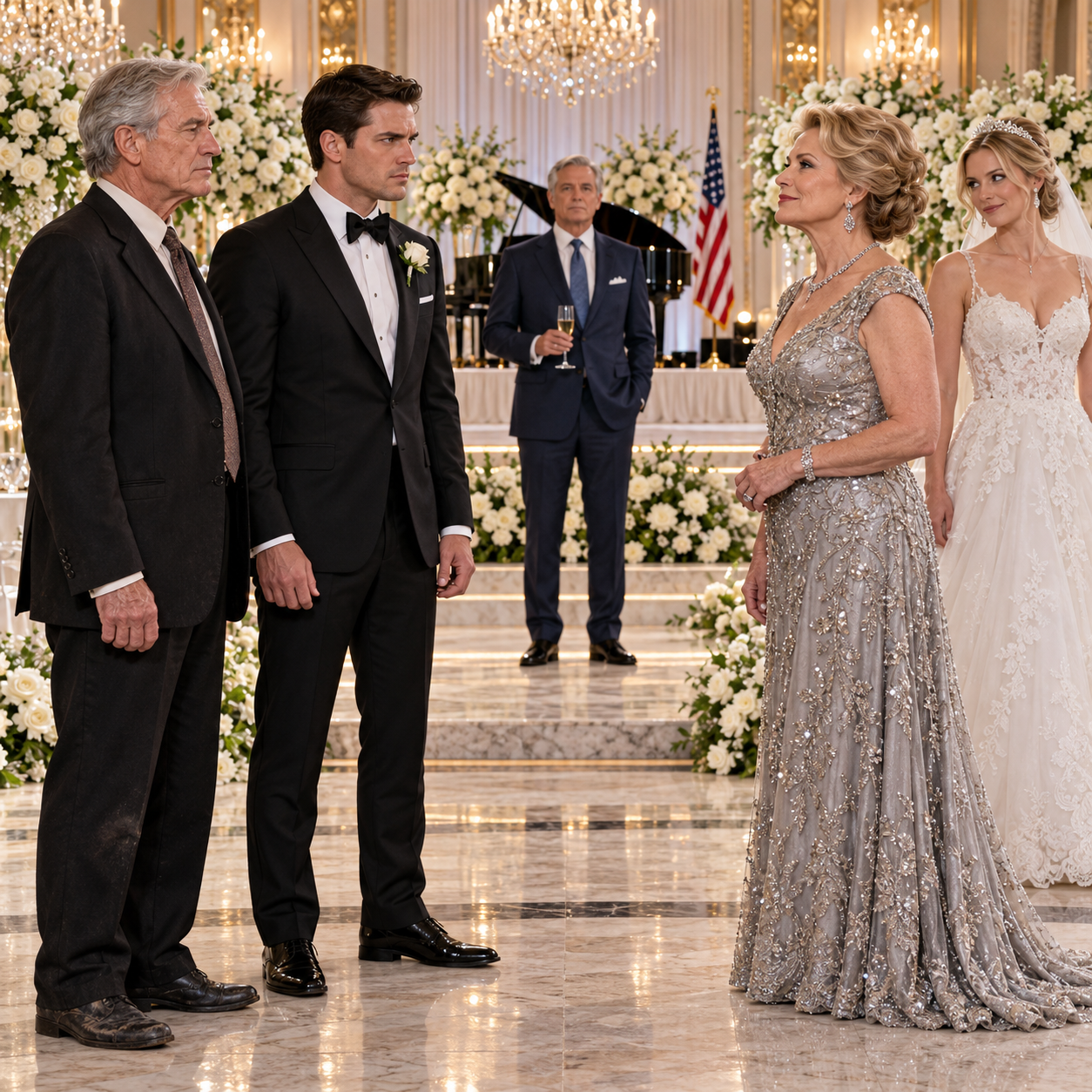
My future mother-in-law pointed at my father in front of five hundred guests and said, “That’s not a father. That’s trash someone forgot to take out.”
For a second, I thought the room might reject the words.
Someone might object.
A friend might look embarrassed enough to stop the laughter.
My fiancée might stand beside me and say her mother had gone too far.
Instead, Fiona laughed.
She lifted a hand to cover her mouth, as though Beverly had made a slightly inappropriate joke rather than stripped a decent man of his dignity.
“Mom,” she giggled, “stop. You’re going to embarrass him.”
Him.
Not yourself.
Not us.
Him.
My father stood beside the aisle in his old charcoal suit. His shoes were polished. His grandfather’s tie was straight. His hands, permanently marked by decades of work, rested loosely in front of him.
He did not defend himself.
Then a champagne glass fell near the stage.
The sound cut through the laughter.
Victor Raines, one of the most powerful executives at the celebration, was staring at my father.
His face had gone pale.
Dad noticed him too.
He took one step forward.
Victor came toward us so quickly that people moved out of his way before they understood why.
“Mr. Henderson,” he said quietly. “I didn’t know you were here.”
My future father-in-law stopped smiling.
And before the evening was over, I would discover that the cruelest sentence spoken in that ballroom was not the most dangerous thing my future in-laws had prepared.
My name is Blake Henderson.
Until that night, I thought I understood the difference between compromise and surrender.
I was thirty-three, engaged to a woman I loved, and about to marry into a family whose version of hospitality came with enough conditions that I had stopped noticing most of them.
Fiona Martinez could be warm.
That is important to say, because if she had been cruel all the time, the story would have been easier.
She remembered how I took my coffee. She brought food to my office when I worked late. She could make an ordinary walk feel like something worth remembering, and for almost two years, I believed we were building a life that belonged to both of us.
Her parents were different.
George Martinez liked people to understand his importance before they understood his name.
He ran a property development company, sat on several charitable boards, and spoke about investors with the casual confidence of a man who assumed everyone else wished to become one.
Beverly treated presentation as a form of morality.
If something looked expensive, it deserved respect.
If it looked ordinary, she wanted it moved somewhere less visible.
At first, their comments about my father seemed small enough to dismiss.
George repeatedly asked whether Dad needed help “keeping up with the wedding schedule.”
Dad could read a schedule.
He had spent decades coordinating contractors, service calls, deliveries, and jobs where a mistake could cost somebody heat in the middle of winter.
Yet George spoke to him as though the presence of expensive paper and several different venues required a kind of intelligence he might not possess.
Beverly asked whether he owned another suit.
Dad said the charcoal one was fine.
She smiled tightly.
“Of course. We’ll make it work.”
Fiona suggested seating him farther back.
“The executives, investors, and board members should probably have the best tables.”
I looked at her.
“My father is my family.”
“I know. I’m only talking about logistics.”
That word became useful to her.
Logistics could explain nearly anything.
Why her parents chose the venue.
Why their guests filled most of the room.
Why my friends were scattered instead of seated together.
Why Dad’s name kept moving down the seating chart.
I objected sometimes.
Not enough.
I told myself a wedding brought out peculiar behavior in people. I told myself Fiona was caught between me and her parents. I told myself the important thing was what our life would look like afterward.
I was postponing the question I should have answered before agreeing to marry her.
If she would not stand beside me when her parents diminished someone I loved, why did I think marriage would make that easier?
My father’s name was Thomas Henderson.
Most people called him Tom.
He raised me alone after my mother, Ellen, died when I was eight.
There are years of my childhood I remember through ordinary details rather than important dates.
His truck starting before dawn.
A lunch packed in a reused paper bag.
The sound of him washing his hands at the kitchen sink, scrubbing around nails that never seemed entirely clean.
The smell of furnace dust on his jacket.
He worked construction jobs, repaired heating systems, and fixed engines on weekends when somebody needed help and the extra money would make a difference.
He was not a man who described sacrifice.
He simply organized his life around what had to be done.
There were bills on the kitchen counter.
There were winters when a broken appliance became a calculation.
There were meals when he said he had eaten earlier, although I later understood that he had not.
I used to believe adults were less hungry than children.
That was one of the small, merciful misunderstandings he allowed me to keep.
At school events, other fathers arrived in cars that looked newer than anything we owned.
Dad sometimes parked farther away because he did not want his old truck to become something other children noticed.
I learned that years later.
At the time, I thought he liked walking.
He never told me to be ashamed of where we came from.
But he worked hard enough to protect me from shame that I almost missed how much of it he carried himself.
When I wanted to study engineering, he encouraged me.
When I worried about cost, he helped me make a plan.
He did not promise that everything would be easy.
He said, “We’ll work out what we can do, and you’ll do the work that’s yours.”
That was the way he approached most things.
Responsibility without theatrics.
Help without ownership.
By the time I was in college, his circumstances had improved.
He had moved from taking whatever jobs were available to managing a small mechanical contracting business with two partners.
Later, he sold his operating interest and remained involved in a few investments.
He told me enough that I knew he was comfortable.
Not enough that I understood the scale.
I knew there were business meetings.
I knew he occasionally traveled.
I knew the house no longer made him worry every time something needed replacing.
When I asked, he said, “I’ve done all right.”
I took that literally.
I did not imagine the man who still repaired his own porch rail could hold a decisive ownership interest in the investment company George needed to impress.
I also did not know Dad had spent years asking other people not to make a public story out of him.
That privacy was his choice.
Some of the consequences of it would become ours.
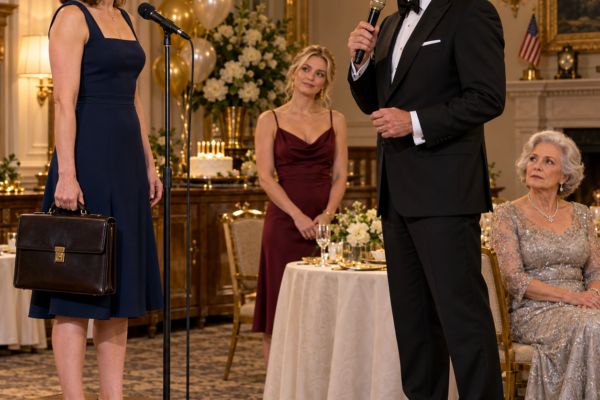
The wedding celebration took place in a hotel ballroom George loved because it could hold five hundred people without making anyone feel crowded.
The evening had been arranged around dinner, speeches, and photographs before the formal ceremony later that night.
I had questioned the order.
Beverly said their important guests preferred it.
The legal paperwork would be completed according to the arrangements we had made. Additional business documents, presented as part of the family’s wedding gifts and future plans, were waiting in a private room.
I had been told they were routine.
That word should have made me more cautious.
Routine documents do not require pressure.
Routine documents can be sent to an independent attorney before an event.
Routine documents do not become urgent merely because five hundred people are already dressed for photographs.
The ballroom looked like something Beverly would have chosen from a magazine and then improved by making everything larger.
Crystal chandeliers scattered light across polished floors.
White roses rose from every table.
Champagne moved through a carefully constructed glass display near the entrance.
A live orchestra played music soft enough for conversation and expensive enough for people to mention it.
Beverly walked through the room examining details.
“Appropriate,” she said when something pleased her.
The flowers were appropriate.
The table settings were appropriate.
The guest list was appropriate.
I would understand later that the word meant less about suitability than permission.
Whatever reflected her family belonged.
Whatever reflected mine required explanation.
Dad arrived early.
He had called me twice that morning.
The first time, I was having photographs taken.
The second, Fiona was standing beside me discussing a problem with the schedule.
I silenced the call.
He sent a message.
Need ten minutes with you before any paperwork. Important.
I read it.
Then I put the phone away.
I assumed he wanted to discuss money, a practical concern, or something about the ceremony.
There was always another moment ahead.
I thought I would find him after the welcome photographs.
Then after dinner.
Then before signing.
That was one of the choices I had to acknowledge afterward.
My father tried to speak.
I decided the schedule mattered more.
When I finally saw him, he was standing near the back of the room.
His suit was old but spotless.
He had polished his shoes so carefully that the leather shone where it was not worn.
The tie belonged to my grandfather. Dad wore it only on days he believed deserved a connection to the people who had come before us.
I walked over.
“You look good.”
He smiled.
“So do you.”
Then his expression changed.
“Blake, before we get caught up—”
Beverly appeared beside us.
“There you are. The photographer needs you.”
I said, “One minute.”
She looked at Dad.
“We really do need to keep things moving.”
Dad stepped back.
“I’ll be here.”
I should have stayed.
That fact does not become less true because of what happened next.
I followed Beverly.
The photographer arranged Fiona and me beneath an arch of roses.
She looked beautiful.
She smiled at me.
For a moment, I let the feeling carry me.
That was the difficulty.
The tenderness was real enough that I kept using it to explain away what contradicted it.
I had imagined marriage as something we would build privately.
Her family had imagined it as a public arrangement with private advantages.
I did not yet understand those advantages.
My company, HarborWorks, developed software used in building operations and energy management.
We were small.
Twelve people.
Several good clients.
A product that had taken years to become reliable enough for me to feel confident saying it worked.
I had built it with two colleagues after leaving a larger engineering firm.
Dad helped at the beginning.
He lent money under terms we discussed clearly, then accepted repayment as the business stabilized.
He did not use that help to demand control over the company.
George, on the other hand, became interested in HarborWorks almost immediately.
He said his developments could benefit from the software.
He introduced potential clients.
He spoke about strategic partnerships.
At first, that felt encouraging.
Then his suggestions became assumptions.
We would make certain products available to his companies.
We would combine purchasing.
We would “keep things in the family” once Fiona and I married.
I repeatedly said business arrangements needed their own agreements.
George smiled.
“Of course. We’ll have the lawyers handle it.”
Fiona said I was overthinking.
“My father wants to help us.”
I wanted to believe that.
I also wanted our relationship to exist without every disagreement becoming a question about whether I appreciated her family.
Weeks before the wedding, George mentioned a package of documents.
A residence arrangement.
A family investment opportunity.
A development partnership that would give HarborWorks access to larger projects.
He described them as practical foundations for our future.
I asked to see them.
He said the lawyers were still finalizing details.
I asked again.
Fiona said I should relax.
“You’ll have time.”
The documents were not delivered to me with meaningful time for independent review.
Instead, they appeared at the hotel, tied to a moment when refusing to sign would look like a refusal to join the family.
That was not an accident.
I would learn how deliberately it had been arranged.
Dinner began.
Dad’s place was no longer at the table we had originally agreed on.
I noticed when I stood to look for him.
He was seated farther back, beside a group of people who did not know him.
I turned to Fiona.
“What happened to his place?”
She glanced toward the seating chart.
“Mom had to make a few changes.”
“He’s my father.”
“I know.”
“He should be here.”
“Blake, we can fix it after the toast.”
I looked at her.
She touched my hand.
“Please don’t start something.”
That sentence should have told me everything.
My father’s exclusion was a problem.
My noticing it was the danger.
I stood anyway.
Then George rose with a champagne glass.
The orchestra softened.
Conversation diminished.
People turned toward the head table.
He smiled with the easy confidence of someone who rarely heard no in a room he had paid to arrange.
“Before we officially welcome Blake into our family,” he said, “perhaps we should acknowledge where he actually came from.”
There was scattered laughter.
The kind that appears when people sense a powerful man expects amusement.
I felt my stomach tighten.
George looked toward Dad.
Several guests followed his gaze.
Dad stood because he thought he was being acknowledged.
That part still hurts to remember.
He thought the attention might be kind.
George continued with a few remarks about hard work, humble beginnings, and how far a person could rise through the right opportunities.
The words were polished.
The message was not.
I had arrived from somewhere lesser.
His family was generously allowing me upward.
Then Beverly rose.
She looked at Dad’s shoes.
At the sleeves of his suit.
At the tie he had chosen because he loved his father.
“That’s not a father,” she said.
The room quieted enough for the pause to become deliberate.
“That’s trash someone forgot to take out.”
Laughter broke across several tables.
Not all five hundred people laughed.
Some looked shocked.
Some stared at their plates.
Some watched me.
Their hesitation mattered, but nobody spoke quickly enough to prevent the next sound.
Fiona laughing.
“Mom, stop. You’re going to embarrass him.”
Everything inside me became still.
I looked at my father.
He had lowered his eyes slightly.
Not in anger.
In the old habit of absorbing something unpleasant so the person he loved would not have to deal with it.
I recognized the expression immediately.
Bills on the kitchen counter.
An empty place where his dinner should have been.
The truck parked farther from the school.
He had spent years making discomfort disappear for my benefit.
Now he was doing it at my wedding celebration.
I stood.
Fiona looked up.
“Blake?”
“The wedding is over.”
For a moment, the words seemed too simple for the room around them.
Then the room reacted.
Fiona grabbed my wrist.
“Have you lost your mind?”
I looked at her hand.
“Let go.”
“Not over a joke.”
“It wasn’t a joke.”
George pushed his chair back.
“Sit down.”
I turned toward him.
“No.”
“Do you know what this evening cost?”
“Yes.”
He stared.
I looked around at the flowers, glassware, musicians, photographers, and guests.
“I know exactly what it cost.”
Beverly folded her arms.
“You’re making an emotional mistake. A man like you doesn’t get many opportunities to marry into a family like ours.”
That sentence removed the last uncertainty.
She had not merely insulted Dad.
She had described the arrangement she believed I was accepting.
Opportunity in exchange for obedience.
I pulled my wrist free.
Then I walked toward my father.
The room went quiet in uneven stages.
A chair moved.
Someone whispered.
The orchestra stopped completely.
I reached Dad and placed a hand on his shoulder.
“Let’s go.”
He looked at me.
“Blake—”
“No. You didn’t ruin anything.”
I said it before he could apologize.
He swallowed.
Then he nodded.
We began moving toward the entrance.
That was when Victor’s glass fell.
I knew his face from business publications and from the list of people George repeatedly mentioned.
Victor Raines was the managing executive at Alderbridge Holdings, an investment company involved in several large commercial enterprises.
He was not the wealthiest man in every room.
But in that room, most people treated him as though his attention could change their future.
He was staring at Dad.
Then he came toward us.
“Mr. Henderson.”
Dad looked at him.
“Victor.”
The familiarity stopped me.
Not a polite recognition.
Not a name remembered from a chance introduction.
They knew each other.
Victor looked distressed.
“I didn’t know you were attending.”
“I’m here for my son.”
Victor glanced at me.
Then toward George.
Something changed in his face.
“The board is waiting,” he said quietly. “We need to discuss the revised agreement.”
Dad looked at me.
“There’s something about this marriage you need to hear before you sign anything.”
Behind us, George had gone white.
Beverly looked from Victor to Dad.
“I’m sorry,” she said, abruptly changing her voice. “Do you two know each other?”
Neither answered her.
I looked at Dad.
“What is happening?”
“We’ll talk somewhere quiet.”
He did not sound pleased.
That mattered.
He was not enjoying a reveal.
He was trying to prevent something.
Victor signaled to a hotel manager.
The manager arranged privacy near the adjoining conference rooms and asked staff to keep cameras away.
The ballroom doors were closed to reduce the spectacle, but exits remained available. Nobody was detained. Guests could leave, collect coats, or move to the lobby.
This was not a room of prisoners.
It was a room full of adults who had just discovered that the man they watched being insulted might matter to somebody they feared disappointing.
I did not want my father’s value reduced to that discovery.
I said so before we entered the conference room.
“Dad mattered before Victor walked over.”
A few nearby guests looked down.
Beverly began, “Of course he did—”
I stopped her.
“You said what you said.”
Then I followed Dad.
The conference room was smaller than the ballroom and smelled faintly of coffee.
Five people were waiting.
Two directors from Alderbridge.
Its counsel, Marian Price.
A finance officer.
Another representative involved in the proposed development partnership.
There was a stack of documents on the table.
My name appeared on the first page.
So did HarborWorks.
I sat down.
Dad remained standing until Victor asked whether he wanted a chair.
He took one beside me.
Marian introduced herself.
Then she said, “Blake, before anything else, you are not required to sign any of these documents tonight.”
“I know.”
I heard how defensive I sounded.
She did too.
“I’m saying it because you have been placed under pressure.”
I looked at the papers.
Dad rested his hands on the table.
“I asked to see the proposal when I learned George intended to connect your company to the development financing.”
“You knew?”
“I knew something was being discussed. I did not know the final terms until today.”
“Why?”
“Because the final version was sent late.”
Victor looked uncomfortable.
Marian opened a folder.
“The revised package differs substantially from the outline previously discussed.”
I waited.
She explained the documents in plain language.
There was a proposed transfer of rights associated with HarborWorks’ software.
There were commitments that would bind the company to certain projects under terms that favored George’s businesses.
There was a personal guarantee tied to financing for a development venture.
There were provisions presented as family planning that had nothing to do with the legal requirements for marriage.
My face grew hot.
“George said these were wedding gifts and a partnership.”
“Some parts were described that way,” Marian said. “The obligations are considerably more significant.”
I looked at Dad.
“How did you get involved?”
He breathed slowly.
“Because Alderbridge is involved in the financing.”
“And you know Victor.”
“Yes.”
“How?”
Dad looked at the people around the table.
Then back at me.
“I hold a substantial ownership interest in Alderbridge.”
The room remained quiet.
Nobody looked surprised except me.
I stared.
“What does substantial mean?”
“Enough that certain decisions require my approval.”
I looked at Victor.
He nodded.
My mind moved through old conversations.
Business trips.
A meeting Dad could not postpone.
The way he said he had done all right.
The house repairs.
His insistence that I repay the early business loan on the agreed schedule even though he had not seemed to need the money.
“You own part of this company.”
“Yes.”
“For how long?”
“Several years.”
“Several?”
“Blake.”
I looked at him.
He was not asking me to stop.
He was asking me to separate the immediate problem from the conversation we would need later.
I could see that.
I was still angry.
“At some point,” I said, “you and I are going to discuss what you didn’t tell me.”
“Yes,” he replied.
No excuse.
No smile.
“Yes.”
That answer helped me stay at the table.
Dad explained enough to give me the outline.
His contracting business had become profitable after years of difficult work. A sale, retained interests, and later investments had grown into something much larger than the business I remembered from childhood.
He had not always been wealthy.
The years when he skipped dinner were real.
The overdue bills were real.
He had not pretended to be poor while hiding a fortune from his son.
The money came later.
The habits stayed.
He liked repairing things.
He liked ordinary clothes.
He disliked publicity.
He had convinced himself that keeping financial details separate protected us.
Some of that was reasonable.
Some of it had become avoidance.
We would examine both.
For the moment, the documents mattered.
Marian showed me where the personal guarantee appeared.
Then where the software rights were described.
I read.
Asked questions.
Read again.
I was an engineer and a business owner.
I was not incapable of understanding a contract.
But I had allowed the promise of later review to become a substitute for actual review.
George had relied on that.
More dangerously, he relied on the setting.
A wedding.
Five hundred people.
An expectation that I would not create a scene.
My father had tried to interrupt before the pressure became complete.
I had silenced his calls.
That did not make George’s conduct acceptable.
It did make my own choices part of the story.
Victor said the financing had not been approved on those terms.
George had attempted to connect the family event to a business commitment that still required examination.
One director shook his head.
“This should not have been brought here.”
Marian agreed.
“There should have been independent counsel for Blake and his company.”
I looked at the page.
There was a place for my signature.
A clean line.
Simple enough to cross before understanding the weight attached to it.
Dad said, “You won’t sign tonight.”
I turned toward him.
“I will decide that.”
He held my gaze.
Then nodded.
“You’re right.”
I appreciated that correction more than anything else he had said.
I had spent enough time in a family that believed protection meant deciding for someone else.
I did not need a different powerful person to take over.
I needed information.
Time.
My own counsel.
“I’m not signing tonight,” I said.
Marian nodded.
“Good.”
That was my decision.
It mattered that the room understood the difference.
George arrived at the conference-room door.
He had recovered enough to sound angry.
“This is an absurd overreaction.”
Victor stood.
“George, we need to address the revised documents.”
“There is nothing unusual in them.”
“Then why were they not provided for independent review?”
George looked at me.
“Blake has had every opportunity to ask questions.”
“I asked for copies twice.”
“They were being finalized.”
“And you wanted me to sign tonight.”
“After review.”
“With five hundred guests waiting for a ceremony.”
He spread his hands.
“I cannot be responsible for how you interpret hospitality.”
Dad looked at him.
“You described obligations as gifts.”
George’s expression tightened.
“With respect, Tom—”
“Then speak respectfully,” Dad said.
The words were quiet.
I had rarely heard him use that tone.
Not aggressive.
Finished with accommodation.
George sat down without being asked.
He began explaining strategic advantages, family cooperation, and how valuable the arrangement would be for HarborWorks.
Marian let him speak.
Then she asked about the guarantee.
He called it standard.
She asked about the transfer of software rights.
He called it necessary alignment.
She asked why Fiona had been involved in arranging the signature timing.
George stopped.
I looked up.
“What?”
Marian paused.
“We need to be careful about what the records establish.”
I nodded.
“Then be careful. Tell me what they establish.”
She showed me a correspondence chain relevant to the proposed signing arrangements.
It had been supplied as part of the business review, not discovered by someone breaking into a private account.
Fiona had participated.
She had discussed keeping the documents until the event so everything could be handled “as part of the family celebration.”
One message said I would be less likely to object if the arrangements were presented together.
Another referred to avoiding “outside complications” before the ceremony.
My stomach turned.
Not because the words contained a perfect confession.
Because they contained a familiar attitude.
My hesitation was a problem to manage.
My request for independent advice was a complication.
My consent was something that could be organized through timing.
I looked at George.
“Did she know what was in the final documents?”
He said, “Fiona is not a lawyer.”
“That wasn’t the question.”
“She trusted the people preparing them.”
“So did I.”
He looked away.
The room remained quiet.
I had thought the laugh in the ballroom was the moment our relationship ended.
Now I understood that it revealed something already present.
Fiona had not only failed to defend my father.
She had helped arrange a situation in which I might sign away obligations without time to think because she believed keeping her parents comfortable mattered more than my questions.
I asked to speak with her.
Privately.
Marian said I should have independent legal advice before discussing commitments or making any agreement.
I understood.
I was not planning to negotiate the documents.
I wanted to hear Fiona’s answer.
She entered a few minutes later.
Her face was pale.
The beautiful composure from the photographs was gone.
For a moment, I felt the old impulse to comfort her.
Then I remembered Dad standing beside the aisle.
I asked everyone else to leave us alone except that the door would remain accessible and no one would be far away.
Fiona sat across from me.
“This has gotten completely out of control.”
“No,” I said. “It has become clear.”
She looked at the documents.
“Dad said you’d be excited about the partnership.”
“I asked to review it.”
“I know.”
“You helped arrange for me not to have the time.”
“That isn’t fair.”
I slid the relevant correspondence toward her.
She read.
Then she closed her eyes.
“I didn’t mean it that way.”
“How did you mean it?”
She rubbed her forehead.
“I knew you would worry.”
“Yes.”
“And I knew you would bring other people into it.”
“An attorney.”
“Yes.”
“That is what a person should do before signing a guarantee.”
She looked at me.
“My father has done this for years.”
“That isn’t an answer.”
She became quiet.
Then she said, “I thought we could trust him.”
“We could have discussed that before the wedding.”
“I didn’t want everything turning into a fight.”
“So you made it something I would have to accept in front of an audience.”
Her eyes filled.
I did not enjoy that.
I had loved her.
Part of me still did.
That made the conversation painful, not uncertain.
“Did you know about the software rights?”
“Not the details.”
“The guarantee?”
“He said it was protection for the project.”
“And you didn’t ask what it would mean for me.”
She looked down.
“No.”
I breathed slowly.
Then I asked about the ballroom.
“Why did you laugh?”
She covered her face.
“I don’t know.”
“Yes, you do.”
She lowered her hands.
“I was nervous.”
I waited.
“I’m used to Mom saying things.”
“Cruel things.”
“She doesn’t always mean—”
“Fiona.”
She stopped.
For a while, neither of us spoke.
Then she said, “I laughed because disagreeing with her in front of everyone felt impossible.”
I looked at her.
“And agreeing with her felt possible.”
Her face crumpled.
“I didn’t think of it as agreeing.”
“My father heard you.”
She cried quietly.
I let her.
Not as punishment.
Because feelings do not require immediate rescue from the person they have harmed.
She asked whether we could postpone rather than cancel.
I considered the words.
Not the practical question.
The hope beneath it.
I could imagine a version of our lives where therapy, distance from her parents, and honest conversations led somewhere different.
I could also see that imagining it did not obligate me to marry her while waiting.
“I’m not marrying you,” I said.
She stared.
“Because of tonight?”
“Because tonight showed me decisions you have been making for a long time.”
“I love you.”
“I believe you love parts of the life we could have.”
“That’s cruel.”
“I’m trying to be accurate.”
She wiped her face.
“Your father is apparently some powerful man and now everything changes.”
I felt anger return.
“No.”
She looked up.
“The wedding was over before I knew.”
She said nothing.
“I asked Dad to leave with me before Victor recognized him.”
Her expression shifted.
I continued.
“If my father had nothing but that suit and the truck he drove when I was a child, your mother would still have been wrong. You would still have been wrong.”
Fiona looked at the table.
The silence finally felt like an answer.
I removed the engagement-related ring she had given me and placed it beside the folder.
I would not make a dramatic gesture with something legally complicated or financially valuable.
The rest would be handled through appropriate advice and arrangements.
For that moment, I wanted the symbol off my hand.
“I’ll speak with my own attorney,” I said. “We’ll arrange the practical matters.”
She nodded slowly.
Then she asked whether I would let her apologize to Dad.
“That is his decision.”
For the first time that evening, I did not promise to make the conversation easier.
She left.
I remained in the room for several minutes.
The chair felt too soft.
The flowers visible through the glass wall looked absurdly elaborate.
Somewhere outside, staff were trying to determine what to do with a wedding dinner that no longer led to a wedding.
People would still need to be paid.
Food would still exist.
Guests would still need coats.
The world would continue with practical tasks.
I found that comforting.
My father returned.
He sat beside me.
For a while, he said nothing.
Then he asked, “Are you all right?”
“No.”
He nodded.
“Do you want to stay here or go somewhere else?”
“Somewhere else.”
“Then we’ll go.”
I looked at him.
“I’m angry with you too.”
“I know.”
“You should have told me more.”
“Yes.”
“And I should have answered the phone.”
He did not use that admission to absolve himself.
“We’ll talk about both,” he said.
I nodded.
That was what I needed.
Not a father suddenly transformed into an untouchable figure because an executive bowed his head.
The father I knew, willing to stay beside me while something hurt.
Before we left, I asked the hotel manager whether I could speak briefly to the guests.
He arranged access to the microphone.
I did not want the last public account to come from Beverly.
Nor did I want to announce private financial details to five hundred people.
I stood near the stage.
The room quieted.
Some guests had already left.
Others remained seated, uncertain whether food or explanations were coming next.
I said, “The ceremony will not take place.”
A murmur moved through the room.
I continued.
“I’m sorry for the inconvenience to those who traveled and to the staff who worked hard tonight. Arrangements for the rest of the evening will be handled by the hosts and hotel.”
I looked toward my father.
Then back at the room.
“What was said about my father was unacceptable.”
Nobody laughed.
“He raised me. He worked for years to give me opportunities. Nothing about his clothing or occupation made him less deserving of respect.”
I paused.
“Nothing about anyone’s money makes them more deserving of it.”
Beverly looked away.
I did not say her name again.
The room knew.
I thanked the people who had shown kindness, then put down the microphone.
No speech about secret ownership.
No announcement of how powerful Dad was.
No promise that George would be ruined by morning.
That would have turned the entire evening into the wrong lesson.
I wanted people to understand that a construction worker mattered.
Not that they should be careful because one might secretly own their lender.
Dad and I left through a side entrance.
It had begun raining.
Not heavily.
Enough to darken the pavement and make the lights look blurred.
A car waited.
Victor had arranged it.
Dad asked whether I wanted to use it.
I said no.
“I’d like to walk for a minute.”
He nodded.
We stood beneath the hotel awning until I was ready.
Then we walked along the covered edge of the building, away from the photographers and guests.
For several minutes, we did not speak.
Finally, Dad said, “You didn’t need to defend me.”
I looked at him.
“Yes, I did.”
He stopped.
I continued.
“You spent my whole life making things easier for me. I should have stood beside you before tonight.”
He looked toward the wet pavement.
“I didn’t want to make trouble.”
“I know.”
“That has been a habit of mine.”
“It has.”
He nodded.
Then he said, “Maybe not always a good one.”
I felt something loosen.
We were both learning.
I did not need him to become a perfect father in order to love him.
I needed us to stop using love as a reason not to speak.
We ate later at a diner a few blocks from the hotel.
The contrast would have been funny if I had not felt so hollow.
No roses.
No chandeliers.
No orchestra.
Just coffee, a menu with laminated edges, and a server who asked whether we wanted something hot.
Dad ordered a sandwich.
I ordered soup.
Neither tasted much of the food.
Then I asked him about Alderbridge.
He told me the fuller story.
Not a dramatic inheritance.
Not hidden royalty.
Work, ownership, timing, risk, and luck.
His contracting business had developed a reputation for solving difficult building-system problems. One partner was good at sales. Another understood project financing. Dad understood the work well enough to know when a promise was nonsense.
Over time, they built something valuable.
When the operating business was sold, part of the consideration remained invested.
Some investments did poorly.
Others did well.
Alderbridge emerged from several related holdings and expanded under professional management.
Dad retained a significant interest.
He did not run every company.
He did not control every decision.
He had influence and responsibilities that required more attention than I realized.
“Why keep it from me?” I asked.
He stirred his coffee.
“At first, there wasn’t much to tell beyond doing better.”
“And later?”
“I wanted you to build your own life.”
“I did.”
“Yes.”
“That doesn’t explain why you thought knowing would prevent it.”
He looked at me.
“It doesn’t.”
I appreciated that.
He had reasons.
Not all of them were good.
He said he worried money would change our relationship.
He worried people would approach me.
He worried I would feel obligated to work with him.
He also admitted he had become accustomed to privacy and used it to avoid conversations he did not know how to have.
“I told myself I was protecting you,” he said.
“Sometimes protection needs permission.”
He nodded.
“I know that now.”
I looked at his hands.
The marks were still there.
Money had not erased them.
It had not changed the fact that he preferred repairing a hinge to calling someone because the repair gave him satisfaction.
It had not made the years of sacrifice false.
But secrecy had costs.
We would need to address them.
I asked whether George knew who he was.
“Not fully.”
“How is that possible?”
“Alderbridge’s interests are held through structures managed by people he dealt with. He knew the institution. He didn’t know the person behind part of it.”
“And you knew he was Fiona’s father.”
“Yes.”
“Did you investigate him because of me?”
Dad shook his head.
“The business proposal already required review. When the connection became clear, I stepped back from personal assumptions and asked counsel to examine the terms.”
That was reasonable.
I still wished he had told me sooner.
He said he had intended to discuss it when he first called.
I acknowledged the calls I ignored.
Then I said, “Next time, don’t make an important family conversation sound like another practical detail.”
He smiled sadly.
“Fair.”
We finished dinner.
He paid.
Not because he was wealthy.
Because he was my father and had always liked buying me a meal when he could.
That distinction felt worth keeping.
The following morning, I spoke with an attorney who represented me and HarborWorks independently.
Her name was Lena Ortiz.
She reviewed the documents, correspondence, and what had happened.
She did not describe everything as a crime simply because it was troubling.
She separated issues.
What had been proposed.
What had not been signed.
What obligations already existed.
What representations had been made.
What practical steps would protect my company and clarify the end of the engagement.
I appreciated the restraint.
I wanted help, not a performance designed to match my anger.
The wedding ceremony had not occurred.
The relevant legal status was clear.
The engagement and celebration had practical consequences, including contracts, gifts, and arrangements that needed to be addressed carefully.
The business documents had not been executed.
That made certain decisions simpler.
It did not mean everything disappeared.
We sent written confirmation that I would not sign the proposed package and that HarborWorks would not participate on those terms.
We preserved relevant correspondence.
We reviewed existing connections with George’s companies.
We made sure employees were not left wondering whether their jobs depended on my personal life.
That last part mattered most to me.
Twelve people had trusted me to build a workplace that functioned.
They had not signed up to become collateral in a wedding dispute.
I spoke with them the next working day.
I gave a concise explanation.
The planned family business arrangement would not proceed.
Existing work would be reviewed professionally.
Our operations would continue.
Questions could be asked directly.
I did not tell the room everything about Fiona, Dad, or Alderbridge.
I told them what affected their work.
My cofounder, Daniel, stayed afterward.
“How are you?”
“Not good.”
He nodded.
“What do you need from us?”
“Help keeping the week ordinary.”
He smiled faintly.
“That we can do.”
Ordinary became valuable.
Tasks.
Meetings.
Decisions based on actual information.
The company gave me somewhere to be that was not entirely defined by the broken engagement.
I was grateful.
Fiona sent several messages.
At first, they asked me to talk.
Then they explained.
Then they apologized.
The best one came almost two weeks later.
She wrote that she had participated in delaying my review because she prioritized avoiding conflict with her parents over respecting my judgment.
She wrote that she laughed because she was accustomed to treating her mother’s cruelty as something everyone should accommodate.
She wrote that neither explanation made it acceptable.
I read the message more than once.
It was the first one that named the choices.
I answered.
I appreciated the apology.
I was not resuming the engagement.
We could communicate through the appropriate channels about practical matters.
She said she understood.
I did not know whether understanding had fully arrived.
I did not need to supervise it.
That was another choice I had to learn to make.
Beverly’s response was different.
She said everyone was under stress.
She said humor had been misunderstood.
She said she had not known Dad’s position.
That last phrase made me angrier than the others.
I told her his position did not make the insult wrong.
It had already been wrong.
She sent a longer apology afterward.
I did not answer.
I was allowed to decide that some conversations had reached their useful end.
George contacted me through lawyers.
He described the partnership as an opportunity I had rejected emotionally.
Lena responded with facts.
No obligation to proceed.
No executed guarantee.
No permission to use the engagement as authority for HarborWorks.
No agreement to transfer rights.
The correspondence became clearer once I stopped participating in conversations where George could substitute confidence for terms.
Dad did not call George to shout.
He did not order Alderbridge to destroy him.
The financing proposal was reviewed through the company’s procedures.
Independent people examined the revised terms and discrepancies.
Certain commitments were not approved.
Other matters were referred for further review.
George’s businesses faced consequences related to their actual position and conduct.
Not because Beverly insulted a man with money.
That distinction was important to Dad.
It became important to me.
If we used corporate power as personal revenge, we would confirm the same belief Beverly had expressed: that dignity came from the ability to make other people obey.
We did not need to do that.
We needed accurate records and responsible decisions.
Some developments continued under revised arrangements.
Employees and contractors who had nothing to do with the wedding still needed to be considered.
I was glad the process did not become a fantasy in which hundreds of ordinary people lost work so one arrogant man could be publicly humbled.
The situation was serious enough without making innocent people part of the punishment.
Victor met with me once after the business review began.
He apologized for not realizing the wedding connection sooner.
I accepted that he had not known everything.
I also asked why the revised documents had reached a wedding venue at all.
He looked uncomfortable.
“Several people assumed someone else had completed the necessary review.”
“That is not a good system.”
“No.”
He described changes they were making.
Independent confirmation.
Clearer approval procedures.
No reliance on a family connection as a substitute for counsel.
I listened.
Then I said, “My father’s name should not have been the thing that made everyone stop.”
Victor nodded.
“You’re right.”
He did not try to turn Dad into a legend.
I appreciated that.
I had seen enough public mythology for one month.
Dad and I took longer to find an ordinary rhythm.
For a while, every conversation threatened to become about what he had not told me.
I was angry.
He accepted the anger better than I expected.
Sometimes he explained too much.
Sometimes I interrupted too quickly.
We learned.
He began giving me a clearer picture of his financial and business responsibilities, not because I needed to manage them, but because we were family and secrecy had become a barrier.
I told him more about my work.
Not just the successful parts.
The worries.
The questions.
The times I felt uncertain.
He listened.
I realized I had hidden some things too.
Not money.
Vulnerability.
I had spent years wanting him to see that the sacrifices worked.
I wanted to be the son who no longer needed rescue.
That made it harder to admit when I was accepting treatment I should have rejected.
We had both confused love with protecting the other person from difficult information.
The correction was not to tell each other everything.
It was to stop using protection as an excuse to avoid what mattered.
One Saturday, I went to his house.
He was repairing a chair in the garage.
I looked at him.
“You could hire someone.”
“I know.”
“You own part of an investment company.”
“I know that too.”
I smiled.
He held up the damaged joint.
“This annoys me.”
“So you’re fixing it.”
“Yes.”
I sat on the workbench stool.
For a while, we talked about the chair.
The glue.
The old wood.
Whether it would hold.
It was a relief to discuss a problem small enough that both of us understood the solution.
Then he said, “I’ve been thinking about your mother.”
I looked at him.
“So have I.”
“She would have told Beverly to leave.”
I laughed.
“She would have said it before dinner.”
He smiled.
Then he looked down.
“I shouldn’t have waited for you to defend me.”
I considered that.
“You were trying to protect the wedding.”
“Yes.”
“I was doing the same thing for months.”
He nodded.
We sat quietly.
Then he said, “Maybe we both need to stop protecting things that only work if someone gets hurt quietly.”
I looked at him.
“That seems right.”
He went back to the chair.
I stayed.
It was one of the better afternoons we had had in years.
The wedding gifts were returned or handled according to the arrangements Lena helped clarify.
I did not keep presents as compensation for humiliation.
I did not send notes accusing every guest of complicity.
People had behaved differently.
Some laughed.
Some stayed silent.
Some apologized.
Some had not understood what was being said until it was too late.
I could distinguish among those things without pretending silence had felt good.
A few people contacted me.
An older woman wrote that she wished she had spoken.
A man I barely knew said he had laughed because others did and was ashamed afterward.
I accepted the sincerity where I heard it.
I did not promise a friendship.
I did not need every apology to become a relationship.
The hotel manager sent a note about the staff.
I thanked him for handling the evening professionally.
The musicians were paid.
The food arrangements were resolved.
The people who worked had not caused the cruelty.
I wanted that recognized.
The photographs were more difficult.
There were beautiful images from before dinner.
Fiona smiling at me.
Dad standing beside the flowers.
My hand near hers.
For a while, I could not look at them.
Then I chose one photograph of Dad and me, taken early, before anyone had moved his chair.
He was adjusting my collar.
I was laughing.
I kept that one.
The rest went somewhere I did not have to see them.
The picture did not prove the day was good.
It preserved a good moment inside a bad day.
I was allowed to keep it.
I began therapy after realizing I was replaying the laugh more often than the legal documents.
A therapist helped me examine why I had ignored comments that hurt.
The answer was not simply that I had been foolish.
I wanted to be accepted.
I wanted the relationship to succeed.
I liked Fiona’s warmth enough that I treated its absence around her parents as temporary.
I also carried old shame about being the boy whose father drove an old truck.
I hated admitting that.
Dad had done nothing shameful.
But children absorb messages from the world before they know how to reject them.
Part of me still wanted to enter a room full of wealthy people and be told I belonged.
George’s family offered that belonging conditionally.
I had mistaken the condition for a challenge I could meet.
The therapist asked what it would have cost to keep meeting it.
I thought about Dad’s chair.
My friends scattered across the seating chart.
The documents waiting behind the ballroom.
My questions described as complications.
“A lot,” I said.
“Yes.”
The work was not about learning to hate Fiona.
It was about learning to recognize when affection did not make a relationship safe enough to continue.
Those were different things.
Several months later, Fiona asked through the agreed channel whether she could send a letter to Dad.
He considered it.
Then said yes.
He did not read it to me.
It was his letter.
Later, he told me she had apologized for laughing and for failing to challenge her mother.
“Did you answer?”
“Yes.”
“What did you say?”
“That I hoped she would do better the next time someone was being treated that way.”
I nodded.
“Did you forgive her?”
Dad looked thoughtful.
“I don’t want to carry the anger forever.”
“That isn’t quite the same answer.”
“No.”
He smiled faintly.
“I’m still deciding what the word means.”
I appreciated that.
He did not need to provide a neat ending for my benefit.
I did not need to decide it for him.
HarborWorks continued.
We lost some proposed work connected to George.
That was painful.
It also clarified how much of the opportunity had depended on obligations we did not want.
We focused on clients who understood what we offered and what we did not.
Daniel helped review our procedures.
We became more careful about proposals presented through personal connections.
Not suspicious of every introduction.
Careful.
There was a difference.
We required written terms.
Independent review.
Time.
No signature because someone important was waiting.
No agreement because a family member said we should trust them.
Those were sensible rules for a business.
They were useful rules for life too.
Dad attended a small demonstration at our office later that year.
He wore the same charcoal suit.
This time, nobody asked whether he needed help with the schedule.
My colleagues knew who he was.
Not as the investor behind Alderbridge.
As my father.
The person who lent early money, asked clear questions, and once helped repair a broken shelf when he visited because it bothered him.
One of our younger engineers spent fifteen minutes asking him about older heating systems.
Dad became animated.
He explained.
Listened.
Drew something on a piece of paper.
I watched from across the room.
He was not impressive in the way Beverly valued.
He was useful, knowledgeable, and interested.
Those things were enough.
Afterward, he asked whether I was pleased with the demonstration.
“Yes.”
“Good.”
Then he added, “That young man had sensible questions.”
“He does.”
“You should keep him.”
I laughed.
“I’m trying.”
We went for lunch.
No executive recognition.
No board waiting.
Just father and son discussing work.
It felt better than the reveal had.
People sometimes hear a simplified version of the wedding story.
They ask whether Beverly looked frightened when she learned who Dad was.
She did.
They ask whether George lost the deal.
Certain arrangements did not proceed.
They ask whether I felt vindicated.
Partly.
But the satisfaction is not where the story ended for me.
If Dad had been wealthy from the beginning and secretly watched us struggle as a test, I would have been angry.
If Victor’s recognition had been the only reason I defended him, I would have been ashamed.
If the entire outcome depended on my father being powerful enough to punish the people who insulted him, the lesson would have been ugly.
The real turning point came before I knew.
I heard Fiona laugh.
I looked at Dad.
I stood.
That was the decision I needed to make.
Everything afterward mattered, but none of it created his dignity.
He had it in the worn suit.
He had it when he skipped dinner.
He had it when he parked farther from the school.
He had it when nobody important was watching.
I was the one who needed to stop treating other people’s approval as evidence of it.
A year after the cancelled wedding, Dad and I spent the evening at his house.
He cooked.
I brought bread.
The repaired chair held.
We ate at the kitchen table where bills had once gathered in uneven stacks.
The room looked ordinary.
It had always been ordinary.
That was where most of the important parts of my life happened.
Dad asked whether I had started seeing anyone.
“A little.”
He nodded.
“Kind?”
“I think so.”
“Good.”
I smiled.
“That’s your first question?”
“It should be.”
I thought about it.
“Yes.”
He did not ask about her parents.
Her money.
Her connections.
He asked whether she was kind.
Later, while we washed dishes, he said, “I’m glad you walked away.”
“So am I.”
“I hated what it cost you.”
“I know.”
“But I’m glad.”
I handed him a plate.
“So am I,” I repeated.
We were quiet for a while.
Then he asked whether I wanted to keep the old tie someday.
I looked at him.
“Grandpa’s?”
“Yes.”
“I’d like that.”
He nodded.
“It’s a little faded.”
“I know.”
He smiled.
The tie was not an embarrassment.
It was a connection.
A piece of family history that had survived people who mistook expensive fabric for worth.
I would wear it one day because it belonged to men I loved.
Not because it made a statement to anybody else.
When I left, Dad stood on the porch.
The air was cool.
The street was quiet.
He asked me to call when I got home.
I said I would.
He believed me.
At my own front door, I paused before going inside.
For months, I had thought of that ballroom whenever I pictured the future I had lost.
The roses.
The laughter.
Fiona’s hand around my wrist.
Now another image was beginning to take its place.
Dad at the kitchen table.
Bread between us.
A chair repaired because he liked repairing things.
A question about kindness.
I had not escaped one powerful family by discovering I belonged to another.
I had returned to the person who loved me before power entered the conversation.
I called him.
“Home.”
“Good.”
“Thanks for dinner.”
“Anytime.”
Then, after a moment, he said, “Sleep well, son.”
I looked around the quiet room.
No guests waiting.
No papers on a private table.
No one asking me to make a decision quickly so their plans could continue.
“I will,” I said.
And for the first time in a long while, I knew I meant it.
News
At my seventy-second birthday party, my daughter-in-law knocked a crystal vase off its pedestal with her elbow, watched it shatter, and smiled. “Oops.” Her own parents had given it to her and my son on their wedding day six years earlier. I looked at Frank, waiting for him to say something. All he managed was, “Mom…”
I watched my daughter-in-law break her own parents’ wedding gift with one elbow and a smile. For months afterward, people asked me whether I was…
I came home three hours early and found my sixty-eight-year-old mother on her knees scrubbing my mother-in-law’s bathroom. When I helped her stand, her sleeve slipped back, revealing dark marks around her wrist. My husband stepped into the doorway. “Daniela, don’t make a scene.” That was when I remembered my father’s last warning: “If you ever see your mother hurt, don’t argue with anyone. Open the hidden compartment in her sewing machine.”
I came home three hours early and found my sixty-eight-year-old mother on her knees beside a toilet. Her hands were stiff with arthritis. One gripped…
“I already promised your house to your sister,” my father told me four days after I bought it. “They’re moving in Monday. Rent-free for three years.” I was thirty-one, had saved for nine years, and had bought the five-bedroom home entirely in my own name. When I said no, he threatened to tell the family I had abandoned my sister’s children. Days later, he took the microphone at my grandmother’s seventy-fifth birthday dinner and did exactly that.
My father called twelve times in forty minutes after discovering I had bought a house without consulting him. When I answered, he didn’t ask whether…
My mother leaned across the restaurant table, looked at my thirteen-year-old adopted daughter, and whispered, “We don’t sit with mistakes.” I took Sole’s hand and walked her out. That night, my father texted, “You’re still making the car payment tomorrow, right?” By midnight, I had canceled the payments I’d been making for my family. Then I remembered something Sole had told me about her grandmother.
My mother looked at my thirteen-year-old daughter and whispered, “We don’t sit with mistakes.” She said it softly enough to avoid attracting attention from the…
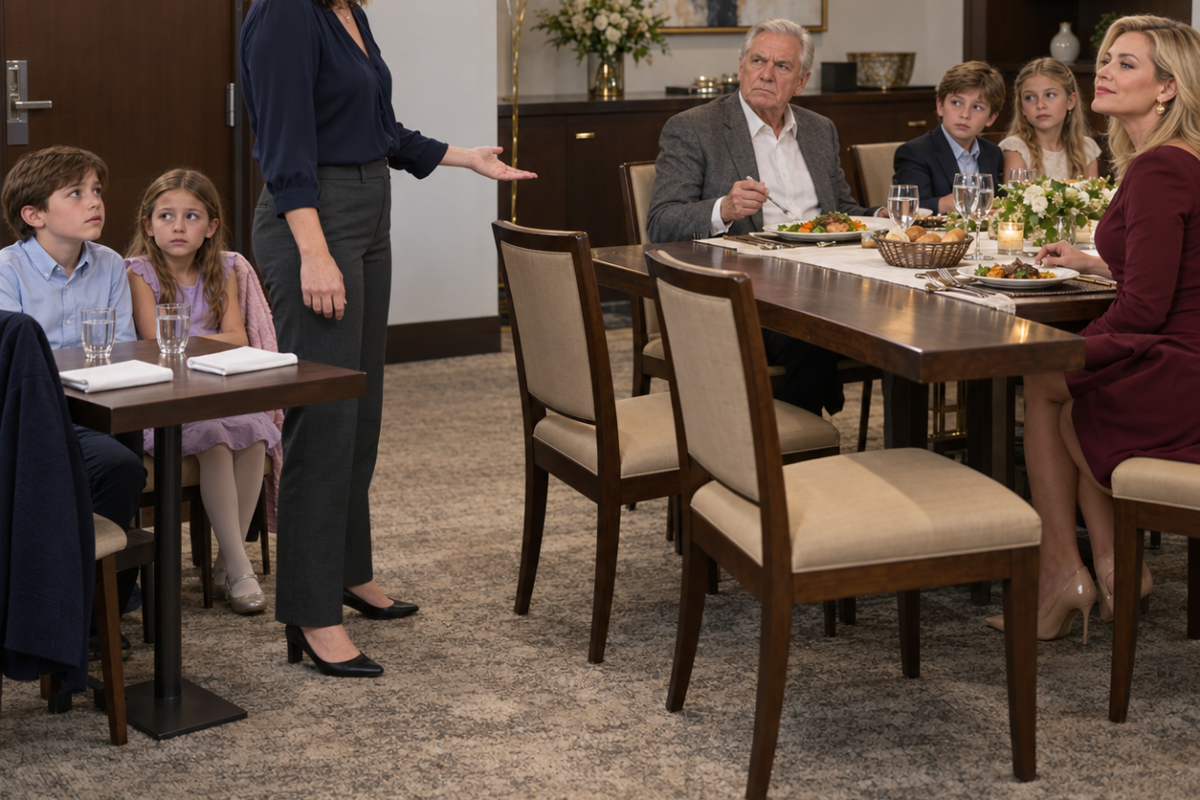
At my father’s seventieth birthday dinner, my eleven-year-old son and eight-year-old daughter were seated beside the service door with water glasses—but no dinner plates. Their cousins sat beside Grandpa with warm bread and full place settings. “They’ll eat after everyone else,” my sister said. I turned to my father, expecting him to object. “They can wait another hour,” he replied. There were two empty chairs at his table.
At my father’s seventieth birthday dinner, the first thing that stopped me wasn’t the cake or the gold balloons. It was my children. Ethan and…
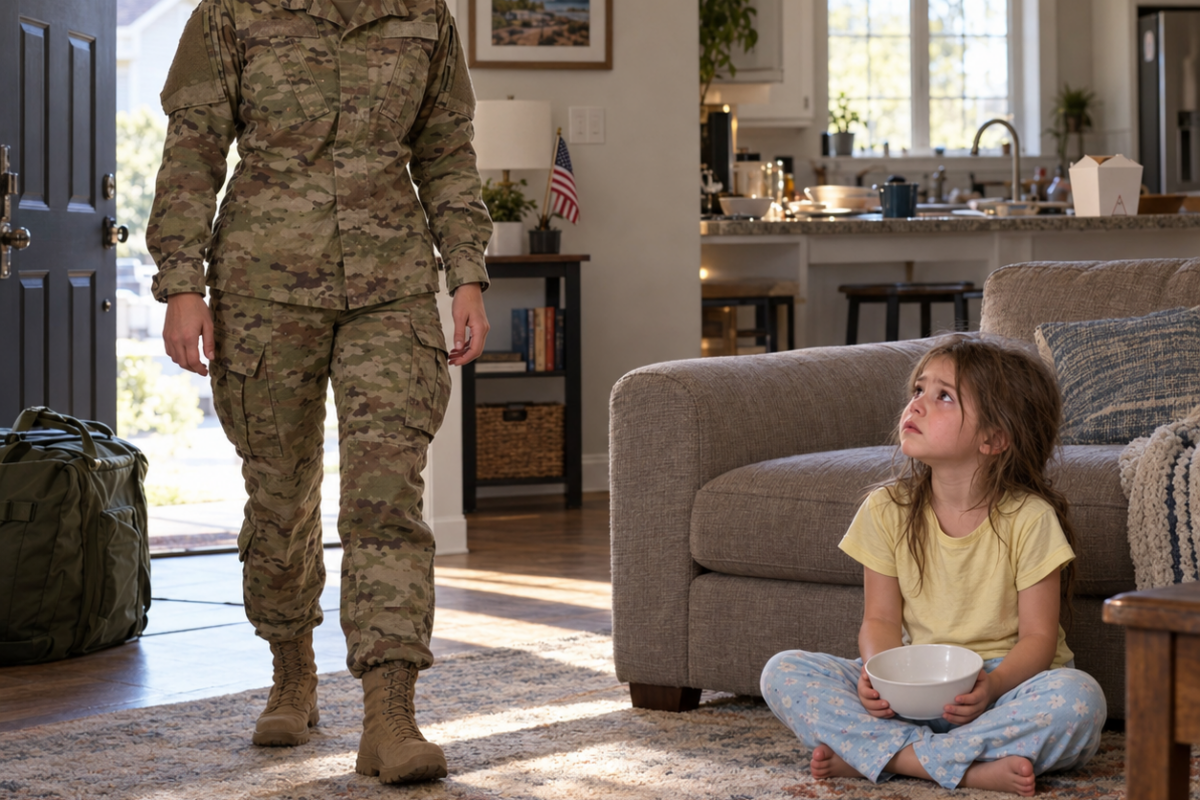
“Mommy, are you real?” my four-year-old daughter whispered when I came home from deployment three weeks early. She was sitting alone on our living room floor with an empty cereal bowl. My husband was on a Caribbean cruise with his mother and sister. Twenty-two minutes earlier, they had posted a photo captioned “Family time.” I was still in uniform when Sophie asked if she could have something to eat.
The first thing my daughter said when I found her was, “Mommy, are you real?” She was sitting cross-legged on our living room floor with…
End of content
No more pages to load