My father dropped my diaper bag onto the hospital floor. “Take the baby. You’re not coming home with us.” My husband had died before meeting our daughter, and I was still recovering from giving birth. Twenty minutes later, Colonel Marcus Hale entered my room carrying a sealed envelope, and the father who had never backed down from anyone couldn’t meet his eyes.
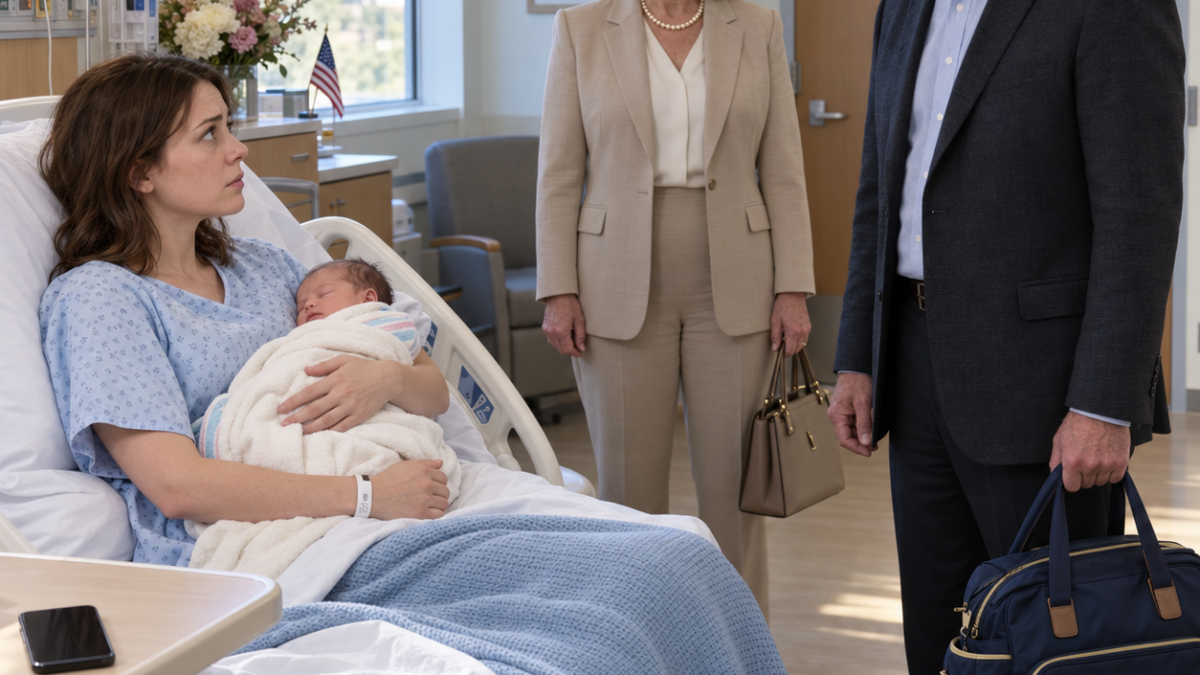

My father dropped the navy diaper bag onto the hospital floor and said, “Take the baby. You’re not coming home with us.”
The bag landed on its side beside the bed. A package of newborn diapers slid halfway out of the front pocket.
For a moment, I watched it as if picking it up were the only problem I had.
Then Wren moved against my chest, warm and impossibly small, and I looked up at my father.
“What?”
Frank Holloway stood at the foot of my hospital bed in the charcoal blazer he wore whenever he wanted to be taken seriously. My mother stood beside him with her purse tucked beneath her elbow. Neither of them had taken off their coats.
“You heard me,” he said. “We’ve talked about it. This arrangement isn’t going to work.”
I had given birth three days earlier. My husband had been dead for five weeks. Until that morning, the plan had been simple: my parents would take me to their house, where I could recover and learn how to care for our daughter without having to do everything alone.
My mother had brought a casserole to the apartment after Daniel died and told me the guest room was ready.
My father had said, “We’ll handle things.”
I had believed them.
“What arrangement?” I asked.
Dad glanced at my mother. She looked toward the window.
“You staying indefinitely,” he said.
“We said two weeks.”
“That was before we understood the situation.”
Wren made a soft rooting sound against the neckline of my gown. I adjusted the blanket around her, careful of the tenderness that seemed to reach from my ribs to my knees.
“What situation?”
My mother finally looked at me.
“You made your choices when you married Daniel.”
The room was bright with October sunlight. A paper cup of water stood on the rolling tray beside a breakfast plate I had barely touched. Across the hall, somebody laughed, and a cart rattled over the seam in the floor.
Everything outside that room kept moving.
Inside it, my life had stopped again.
“I married a good man,” I said.
Dad’s mouth tightened.
“That isn’t the discussion.”
“Then tell me what the discussion is.”
“We’re not responsible for fixing the consequences of your decisions.”
I looked down at my daughter.
She wore the little cream cap Daniel and I had packed in the hospital bag together. He had held it in the palm of his hand and said there was no way a human head could be that small.
Now her whole head fit beneath my chin.
“Are you calling Wren a consequence?”
“Oh, Emily,” my mother said, with the weary patience she used when she wanted me to feel unreasonable. “Don’t make this ugly.”
My father checked his watch.
“We have somewhere to be.”
I had spent thirty-one years learning the meaning of that gesture. The conversation was over because he said it was over. Whatever I felt about it could be dealt with privately, preferably without inconveniencing him.
But there was a baby in my arms.
I could not swallow this one and go upstairs.
“I don’t even know if I can carry the car seat,” I said.
“The nurses will help.”
“And after that?”
“You have options.”
“What options?”
He picked up the handle of my small suitcase, moved it closer to the door, and let go.
“You’ll have to figure that out.”
He did not kiss Wren.
My mother had held her once, briefly, the afternoon she was born. That morning, she kept both hands on her purse.
I reached for my phone.
Dad watched me.
“Who are you calling?”
I opened the contact Daniel had saved under Colonel Hale.
Beneath the name, in the notes field, he had written: If you need help and I’m not there, call Marcus. Any time. I mean it.
At the time, I had rolled my eyes.
“You’re going to be there,” I had told him.
Daniel had kissed my forehead and said, “Then you’ll never need the number.”
I pressed it.
My father took one step toward the bed.
“Emily.”
The call connected.
“Marcus Hale.”
I had met him twice, both times at unit events where Daniel seemed younger and older at once, joking with soldiers while watching everything around him.
“Colonel,” I said. “It’s Emily Carter.”
His voice changed immediately.
“Emily. Is the baby here?”
“Yes.”
“How are you?”
I looked at my parents.
“I need help getting out of the hospital.”
There was a brief silence.
“Are you safe right now?”
“Yes. I’m in my room.”
“Stay there. I’m coming.”
I lowered the phone.
For the first time that morning, my father looked uncertain.
“That was unnecessary.”
I settled Wren more securely against me.
“You told me to figure it out.”
Twenty minutes later, Colonel Marcus Hale walked through the door carrying a sealed Army document envelope.
Two military police officers remained in the hall. They had accompanied him from the installation, but even exhausted as I was, I understood that this was a civilian hospital and my father was a civilian man. Whatever happened next would not be solved by rank alone.
Still, Dad saw the uniform and went very still.
“Colonel,” he said.
Marcus looked at him, then at my mother, then at the diaper bag on the floor.
Finally, he looked at me.
The severity left his face.
“Emily.”
He crossed the room and removed his cap.
“I’m sorry it took twenty minutes.”
“You came.”
“Of course I came.”
My voice broke before I could stop it.
“Daniel said you would.”
Marcus pulled a chair beside the bed.
“He was right.”
Only then did I notice the writing on the envelope. Daniel’s name appeared across the front, followed by mine. Beneath it, in darker ink, someone had written a number.
$86,400.
I stared at it without understanding.
My father understood.
I could see that in his face.
Until then, I had thought my parents had come to abandon me.
Now I began to understand that they had come afraid.
***
Daniel Carter had never looked like a man with secrets.
He looked like a man who needed a haircut two days before he admitted it, who bought the same brand of coffee for years, and who believed every squeaky hinge could be repaired with the small can of oil he kept under the sink.
He burned grilled cheese because he refused to turn down the stove.
He left his boots beside the kitchen table.
He called me from the grocery store to ask whether the plain yogurt was the one with the blue lid or the green lid, despite buying it every week.
We had met at a friend’s backyard cookout in Fayetteville. I was twenty-six, teaching second grade, and determined not to spend another evening being introduced to somebody’s unmarried cousin.
Daniel was standing beside a grill that had stopped working.
While three other men argued over the propane tank, he quietly checked the connection, fixed it, and stepped back without announcing that he had saved dinner.
Later, he brought me a hamburger on a paper plate.
“No onions,” he said.
“How did you know?”
“You took them off the first one.”
That was Daniel.
He noticed things.
When we married two years later, my father shook his hand for the photographs and asked him, out of my hearing but not Daniel’s, whether he had considered what it would cost to support a family.
Daniel told me about it on our honeymoon.
I was embarrassed.
“He worries.”
“He does,” Daniel said.
“He can be difficult.”
Daniel looked out at the water beyond our rented room.
“I noticed.”
Dad had never liked that Daniel could remain calm without becoming submissive. He preferred men he could impress or intimidate. Daniel was neither.
We rented a two-bedroom apartment twenty minutes from the installation. We bought store-brand cereal. Daniel drove a nine-year-old pickup with a dent beside the tailgate, and my classroom supplies occupied more of the spare bedroom than his clothes did.
When I became pregnant, he cleared the room in one weekend.
He assembled the crib on a Saturday afternoon with a baseball game playing quietly on the television. Halfway through, he discovered he had put one side on backward.
I laughed so hard I had to sit on the floor.
“Tell nobody,” he said.
“I’m telling our child.”
“Our child will respect operational security.”
He kept the little instruction booklet anyway.
When we chose Wren’s name, he wrote it on the back of a grocery receipt and put it on the refrigerator.
We had considered names that belonged to our families. My mother wanted Margaret, after her mother. Dad suggested Frances, apparently believing nobody would notice.
But Daniel liked Wren.
“Small bird,” he said. “Big opinions.”
“You’re describing me.”
“Exactly.”
At night, he rested his hand on my stomach and spoke to her as if she were already listening.
He told her about the weather, the truck, the neighbor’s dog.
He promised to teach her how to skip stones.
Once, I woke to hear him whispering, “You don’t have to be impressive. You just have to come home.”
I pretended to be asleep because the tenderness of it felt too private to interrupt.
Five weeks before her birth, a chaplain and two officers came to our apartment.
I understood before they spoke.
Daniel had died in a vehicle accident during training.
There were explanations afterward, reports and procedures and people with careful voices. At first, none of them stayed in my mind.
I remembered the doorway.
I remembered the chaplain saying my name.
I remembered sitting on the kitchen floor because my legs no longer seemed capable of holding me.
When my father arrived two hours later, he moved through the apartment with the purposeful air of a man responding to a household emergency.
He took Daniel’s laptop from the desk.
He collected the mail.
He put a folder of documents under his arm.
I thought he was helping.
My mother sat beside me and stroked my hair while I cried.
“You come home with us,” she said. “We’ll take care of everything.”
I did not know then that taking care of everything could mean making sure I saw nothing.
***
Marcus noticed me looking at the envelope.
Before I could ask, he glanced at Wren.
“Is this her?”
I nodded.
“She has his mouth.”
His eyes shone.
“He talked about that name every day.”
I pressed my lips together.
“Would you like to hold her?”
“I’d be honored.”
He washed his hands at the little sink before returning to the bed. That ordinary act, the soap dispenser clicking beneath his palm, nearly undid me.
Everybody had been talking around Wren for days.
Marcus was treating her as a person worth preparing for.
I eased her into his arms.
The man who had commanded hundreds of soldiers suddenly looked concerned about the angle of one tiny elbow.
Wren yawned.
He smiled.
“Your daddy had a lot of plans for you.”
My father cleared his throat.
“We were leaving.”
Marcus looked up.
“You’re free to do that.”
Dad reached for my mother’s arm.
“But before you leave,” Marcus continued, “Emily may want to ask why you contacted the casualty assistance office two days after Daniel’s death.”
My father’s hand stopped.
I looked at him.
“What?”
“Emily,” Dad said, “there are details you don’t understand.”
“What did you contact them about?”
Marcus answered carefully.
“He asked about survivor benefits and whether they could be directed through him while you recovered.”
My mother’s fingers tightened on her purse.
Dad’s expression hardened.
“She was in no condition to deal with paperwork.”
“I was his wife.”
“You were eight months pregnant and hysterical.”
The word struck harder than I expected.
Hysterical.
Not grieving. Not shocked. Not a woman whose husband had died while their daughter was still moving beneath her ribs.
Hysterical.
Marcus set Wren gently back in my arms.
“The office did not accept Mr. Holloway as your representative,” he said. “They explained that they needed to speak directly with you or with someone you had properly authorized.”
Dad gave a dismissive little shrug.
“Exactly. Nothing happened.”
“But you tried,” I said.
“I tried to help.”
“You just told me to leave the hospital alone.”
“That is a separate issue.”
It was always a separate issue when the connection made him look bad.
Marcus opened the envelope.
“Daniel made arrangements for you, Emily. Some are straightforward. Others will take time to verify and settle. Your casualty assistance officer will walk you through the military benefits, and Daniel’s attorney can explain the private accounts and his instructions.”
“Attorney?”
“Yes.”
“I didn’t know he had one.”
“He had recently consulted her about a financial concern.”
Dad laughed.
“Soldiers fill out paperwork all the time.”
Marcus looked at him.
“This includes life insurance, savings, investments, and other assets totaling approximately eight hundred and sixty thousand dollars.”
I heard the number.
I could not make it belong to us.
We had argued about a $260 stroller.
Daniel had worn the same running shoes until I pointed out that I could see his sock through the side.
We were the people who compared prices on laundry detergent.
“How?”
“A large portion is life insurance,” Marcus said. “The rest includes money Daniel had before your marriage, retirement savings, and investments. It isn’t all cash available tomorrow. The attorney will explain the details.”
“That’s what I’ve been saying,” Dad interrupted. “It isn’t all immediately available.”
Marcus turned toward him.
So did I.
“How would you know?”
Dad opened his mouth, then closed it.
“I looked into things.”
“Without telling me?”
“Somebody had to.”
I remembered the laptop disappearing beneath his arm.
“What did you take from our apartment?”
“I secured valuables.”
“What else?”
“Emily, lower your voice.”
I was not shouting.
That made me angrier.
“What else did you take?”
My mother stepped forward.
“Your father was trying to protect you.”
“From what?”
Neither answered.
Marcus closed the folder halfway.
“I’ve spoken with the hospital social worker. They’re working with your care team on a safe discharge plan. Nobody is putting you outside with a newborn and a suitcase.”
Relief came so suddenly that I almost sobbed.
“I have my apartment.”
He hesitated.
My father looked toward the door.
“What?” I asked.
“There may be a problem with access,” Marcus said. “We’re checking.”
“What kind of problem?”
Dad picked up my mother’s elbow again.
“This is getting absurd.”
I looked directly at him.
“Did you do something to my apartment?”
He did not answer.
That silence told me more than any explanation could have.
***
The next person to enter was a woman in navy scrubs with reading glasses hanging from a cord around her neck.
Her name was Carla.
She had introduced herself the previous afternoon as a hospital social worker, but I had barely remembered the conversation. She had asked about help at home, and I had said my parents were taking me.
Now she looked at them, then at me.
“Emily, I understand the discharge plan has changed.”
My mother gave a tight smile.
“There’s been a misunderstanding.”
Carla pulled another chair toward the bed.
“All right. Emily, tell me what you need.”
The question was so direct that I did not know how to answer.
Nobody had asked me that in the past five weeks.
They had asked whether I had signed something, whether I had eaten, whether I understood, whether I could manage.
What did I need?
“A place to take her,” I said.
Carla nodded.
“And help getting there.”
“Yes.”
“Then that’s where we start.”
My father shifted his weight.
“This is a family matter.”
Carla looked at him with the calm expression of a woman who had heard those words many times.
“It’s also a discharge matter.”
Marcus stepped aside to speak quietly with her. I could hear fragments: an additional night if medically appropriate, transportation, a trusted family friend, the apartment manager.
Dad watched them.
I looked at the number on the envelope again.
“What’s eighty-six thousand four hundred?”
Marcus stopped speaking.
My father’s face changed.
There it was again.
Fear.
Marcus returned to my bedside.
“Daniel came to see me eleven days before the accident,” he said. “He wanted me to witness a statement and keep copies of some records until he could resolve a problem.”
“What problem?”
“He believed there had been unauthorized withdrawals from an account connected to you.”
I shook my head.
“I don’t have an account with that much money.”
Then I remembered Grandma Rose.
Her small white house. Her careful handwriting. The envelopes of cash she slipped into birthday cards, always with a note telling me to spend some and save some.
She died when I was twenty-two.
Dad handled everything.
He told me she had left money for my education, that expenses had eaten up most of it, and that what remained was invested somewhere he could watch it.
Whenever I asked, he said there was nothing worth worrying about.
“My grandmother’s account?”
Marcus nodded.
“Daniel found an old statement while you were sorting things for the nursery. He asked your father about it, then requested more information with your permission.”
I remembered signing a page Daniel had brought home.
He had explained that he wanted to get a complete picture of our finances before Wren arrived.
I had laughed.
“Good luck. My father has a complete picture, and he won’t show it to anybody.”
Daniel had not laughed.
I had forgotten that.
“How much was there?”
“The original account held approximately one hundred and forty thousand dollars,” Marcus said.
Dad spoke immediately.
“That paid for her education.”
“No,” I said.
Everyone looked at me.
“I had scholarships.”
“And living expenses.”
“I worked.”
“You don’t understand what things cost.”
I remembered closing shifts at the campus bookstore. I remembered choosing between replacing a broken pair of glasses and paying the summer fee for a required class.
I remembered Dad telling me responsibility meant making sacrifices.
“What’s the number?”
Marcus touched the envelope.
“Daniel’s preliminary review suggested that at least eighty-six thousand four hundred dollars needed to be accounted for. That’s not a final finding. It’s the amount he was trying to trace.”
“Where is it?”
Dad looked away.
“Investments fluctuate.”
“That wasn’t my question.”
My mother whispered, “Frank.”
He turned on her so sharply that she stepped back.
For the first time in my life, I saw something in her face I had always mistaken for agreement.
Fear.
But recognizing her fear did not erase what she had just said to me.
She could be afraid of him and still have hurt me.
Both things could be true.
Marcus said, “This can wait until you’ve rested.”
“No.”
Wren stirred. I softened my voice and placed my hand over her blanket.
“No. I want to understand.”
Dad stared at me.
I had spent most of my life becoming younger in his presence.
Daniel used to say it gently, usually after my father left.
“You turn twelve when he walks in.”
I hated hearing it.
Mostly because it was true.
But Wren was three days old.
Somebody in that room had to be an adult for her.
“Did you take my money?” I asked.
“That was family money.”
“She left it to me.”
“She trusted me to manage it.”
“Then show me how you managed it.”
His jaw tightened.
“You have no idea what we’ve done for you.”
I looked at the diaper bag on the floor.
“I’m beginning to.”
Dad walked out.
This time, my mother followed without him taking her arm.
At the door, she turned.
For one foolish second, I expected her to come back. To touch Wren. To bend over me the way she had when I was little and had a fever.
Instead, she whispered, “You should have left this alone.”
Then she was gone.
***
Carla picked up the diaper bag.
She put the package back in the pocket and set the bag on the chair beside me.
That small kindness broke something loose.
I started crying so hard I could not speak.
Marcus did not tell me to calm down.
Carla did not tell me my parents loved me in their own way.
She brought tissues and asked whether I wanted her to take Wren while I caught my breath.
I nodded.
She held my daughter near the window while Marcus sat quietly beside the bed.
When I could speak again, I asked, “Did Daniel know?”
“About the money?”
“About them.”
Marcus considered the question.
“He knew there were problems. I don’t think he understood all of them.”
I wiped my face.
“Why didn’t he tell me?”
“He was gathering records. He hoped to come to you with something clear, instead of an accusation he couldn’t support.”
I looked at the envelope.
“He should have told me.”
“Yes,” Marcus said.
The answer surprised me.
He did not try to make Daniel perfect because he was dead.
“He was trying to spare you stress,” he continued. “That doesn’t mean he made every decision correctly.”
For some reason, that helped.
I loved my husband. I wanted him back. I did not need to believe that every choice he had made was beyond question.
Marcus took out a photograph.
It showed Daniel outside our apartment, facing my father. The image was grainy, copied from an exterior security camera, but I recognized the set of Daniel’s shoulders.
His hands were open at his sides.
My father was pointing at him.
“Twelve days before the accident,” Marcus said. “The apartment manager located it after Daniel asked about footage from that evening.”
“What were they arguing about?”
“The account, we believe. Daniel also left a recording.”
He removed a small protective sleeve containing a flash drive. A strip of masking tape ran across it.
FOR EMILY ONLY.
Daniel’s handwriting.
I reached for it.
Marcus placed it in my hand.
“There’s a copy with his attorney. You can listen when you’re ready.”
“What does he say?”
“He names people involved in handling the account.”
“My father.”
“And your mother.”
I closed my eyes.
I had still been hoping for one parent.
Not a good explanation. Not innocence, exactly.
Just one person who might have chosen me if the other had not been standing there.
Marcus’s phone vibrated.
He read the screen, and his expression sharpened.
“What?”
“The apartment manager just received an alert from the camera Daniel installed.”
I remembered the small camera facing the front door. Daniel had bought it after a package disappeared from the hallway.
“Is something wrong?”
“Someone has entered the apartment.”
“My parents?”
“The image isn’t clear enough yet.”
He showed me the screen.
A man moved through the narrow strip of living room visible beyond the doorway. He wore a dark cap and carried a reusable shopping bag.
He went straight to Daniel’s desk.
I knew the slope of his shoulders before I saw his face.
“That’s my uncle,” I said.
Marcus looked at me.
“Your father’s brother?”
I nodded.
“Russell.”
On the little screen, Uncle Russell opened the top drawer, took out a stack of papers, and began sorting through them.
Then he pulled the drawer all the way out.
He was not there to bring food or make sure the heat was on.
He was looking for something.
***
Uncle Russell had been a part of every Sunday dinner I could remember.
He owned a small bookkeeping business and always wore shirts with a pen clipped neatly into the pocket.
At family gatherings, he corrected people’s math before they finished a sentence.
He and Dad had a shorthand that excluded everybody else. Half a joke, a lifted eyebrow, a reference to some deal or customer, and the two of them would smile while my mother carried plates from the kitchen.
I had thought that was what competent adults looked like.
Now I watched him kneel beside my husband’s desk and search behind a drawer.
Marcus stepped into the hall to call the apartment manager. One of the officers stayed nearby, but it was the local police dispatcher the manager contacted about the unauthorized entry.
There was no dramatic announcement.
No one promised arrests.
They asked practical questions.
Had I given Russell permission to enter?
“No.”
Did he have a key?
“Not from me.”
Was anything dangerous stored there?
“No.”
Could I identify him?
“Yes.”
Carla wrote down my answers because my hands were shaking.
I kept looking at the drive.
Whatever Russell hoped to find in the apartment, Daniel had already sent away.
That realization steadied me.
My husband was gone, but he had anticipated enough to leave me something my father could not simply carry off.
Marcus came back into the room.
“The manager is meeting the officers,” he said. “You don’t need to handle that from here.”
“What if he takes something?”
“They’ll document what they can. The camera recording is being preserved.”
I looked at Wren in Carla’s arms.
“I don’t want to go back there tonight.”
“You don’t have to,” Carla said.
The relief I felt made me ashamed.
It was our home.
Daniel’s mug was still beside the coffee maker. His gray sweatshirt hung on the hook behind the bedroom door.
The nursery waited exactly as we had left it.
But the thought of carrying our daughter through that door while my father still had a key made my whole body tighten.
Marcus said, “My wife has offered our guest room. No obligation. You’ll meet her first, and Carla can help us make another arrangement if you’d rather.”
I had met Anne Hale once at a holiday reception. She had asked about my classroom and listened to the answer.
“Does she know about all this?”
“She knows you need somewhere quiet.”
“Not somewhere to be grateful?”
Marcus looked at me for a long moment.
“Quiet,” he repeated.
That was the first promise I believed all day.
***
That afternoon, Anne came to the hospital carrying a canvas tote.
She wore jeans, a soft green sweater, and shoes sensible enough for walking through a parking deck.
She did not enter with the energy of someone arriving to rescue a helpless person.
She knocked.
“May I come in?”
I nodded.
She set the tote on the chair.
“I brought a couple of things. A clean robe, phone charger, some crackers. Marcus said you hadn’t eaten much.”
“I don’t know what I need.”
“That’s fine. We’ll find out.”
She looked at Wren.
“May I?”
I handed her over.
Anne tucked her comfortably against her shoulder and seemed to know, without asking, how much support her little head required.
“How many children do you have?” I asked.
“Two. Both grown. Neither came with instructions worth reading.”
I laughed.
It hurt, but it was the first real laugh I had managed in weeks.
Anne looked pleased without making a fuss.
“We have a room upstairs,” she said. “But you won’t need the stairs. Marcus is moving the guest bed into the den.”
“He doesn’t have to do that.”
“He’s already doing it. He likes a job with bolts and a measurable outcome.”
The simple description sounded so much like Daniel that my smile disappeared.
Anne saw it.
She did not rush to fill the silence.
Finally, she said, “You can miss him at our house. You won’t have to act better than you feel.”
I cried again.
This time, it was quieter.
***
I listened to Daniel’s recording after dinner, when the room had dimmed and Wren was asleep in the clear hospital bassinet.
Marcus brought a laptop. Carla stayed because I asked her to. Anne sat beside me with a cup of tea cooling in her hands.
Nobody else touched the drive until I said they could.
The first sound was a chair moving.
Then Daniel cleared his throat.
“Em.”
One syllable.
I pressed my hand over my mouth.
He sounded alive.
Not the formal voice I had heard in a memorial video. Not a fragment remembered in a dream.
My husband, close enough that I almost looked toward the bathroom, expecting him to come out with a towel around his neck.
“If you’re listening to this, I probably owe you an explanation.”
A pause.
“I was going to talk to you this weekend. I wanted the bank records first. That was the plan, anyway.”
He exhaled.
“I found discrepancies in the account Rose left you. The statements your dad gave us don’t match the statements the institution sent after you signed the authorization.”
I stared at the bed rail.
“The amount I can identify right now is eighty-six thousand four hundred dollars. There may be more questions, but I’m not putting a number on anything I can’t trace.”
That was Daniel.
Even frightened, he was careful.
“I asked your dad to explain. He said the money had been spent on your education. Some expenses were legitimate. A lot of transfers weren’t described that way in the records.”
Another pause.
“Russell helped prepare the summaries your dad showed you. Your mom knows there were withdrawals. She told me she thought you’d never need to find out.”
Anne’s hand settled gently over mine.
Daniel continued.
“I don’t know how much she understood at the beginning. I know what she said this week. I wrote it down afterward so I wouldn’t rely on memory.”
His voice changed then, less controlled.
“The part I need you to hear is this: you didn’t do anything wrong by trusting your parents.”
I shook my head as tears fell onto the sheet.
“You didn’t fail some test because you weren’t suspicious enough. They were the people who taught you what trust meant.”
I could not breathe properly.
Carla moved the tissue box closer.
“I’m sending copies to Marcus and to the attorney. Her name is Leah Bennett. Her information is in the folder labeled household. I’ve asked her to help us get a full accounting.”
Daniel was quiet for several seconds.
Then he said, “I also updated everything for you and Wren. Insurance, beneficiaries, the will. Boring husband paperwork. You’re welcome.”
The old humor was there.
So faint.
So unmistakably his.
“If your dad tells you he has authority over any of it, check with Leah before you sign anything. If somebody says it has to be done immediately, that’s a good reason to slow down.”
I looked toward the envelope on the table.
“I’m sorry I didn’t bring you into this sooner. You’ve been tired, and I kept telling myself one more document would make the conversation easier.”
He breathed out.
“That was probably me avoiding a hard conversation and calling it protection.”
Marcus lowered his eyes.
“Anyway. I love you. I love our little bird. I’ll tell you this in person, and then you can be mad at me for making a recording like somebody’s dramatic uncle.”
There was a small rustle.
Then, softer, “I just wanted you to hear it from me.”
The recording ended.
Nobody spoke.
I sat with my hands over my face while my daughter slept beside me and my husband’s voice remained trapped in a machine.
He had not known he was making a goodbye.
That hurt more than if he had.
***
At midnight, my mother sent a text.
Your father is very upset. Please don’t make decisions while you’re emotional.
I read it three times.
For years, that sentence had been enough to stop me.
Don’t decide while you’re emotional.
Don’t answer while you’re upset.
Don’t bring it up until everyone has calmed down.
Somehow, calm had always arrived after the thing I needed to challenge had become permanent.
I wrote: I will speak with an attorney tomorrow. Do not enter my apartment or contact anyone on my behalf.
My thumb hovered over the screen.
Then I sent it.
My mother replied almost immediately.
We are your parents.
I put the phone facedown.
Wren woke a few minutes later.
I fed her awkwardly, trying to remember what the lactation nurse had shown me. Milk dripped onto the clean blanket. My shoulder cramped. Wren pulled away and cried, then tried again.
Nothing about it was graceful.
I wished Daniel were there to bring water and make some ridiculous comment that would loosen the fear in my chest.
Instead, I reached for the pitcher myself.
When the nurse came in, I asked for help.
That was harder than it should have been.
But she adjusted the pillow, watched Wren settle, and told me I was learning.
Not failing.
Learning.
I held on to that word.
***
Leah Bennett came the next morning.
She was in her forties, with short dark hair, a plain black briefcase, and the measured manner of someone who did not confuse confidence with volume.
Marcus introduced us and left when she asked whether I wanted to speak privately.
I did.
Leah pulled a chair close enough that I would not have to raise my voice.
“Before we talk about money,” she said, “I want to be clear about my role. Daniel consulted me about the account and about planning for his family. You can decide whether you want me to represent you. You don’t owe me that because he chose me.”
“I want you to.”
“All right.”
She placed a notepad on her knee.
“What would help you most this morning?”
“I want to know whether I’m imagining this.”
“You aren’t imagining discrepancies. We have records that require explanation.”
“Did my father steal from me?”
“We’re not going to decide that from one stack of papers. We can say that money left an account belonging to you, that the explanations you received don’t match all the available records, and that you’re entitled to a proper accounting.”
I let out a breath.
Her caution did not feel like evasion.
It felt like a floor.
Something solid beneath the awful things I had heard.
She explained that Grandma Rose’s money had been placed in an account I inherited as an adult. My father had helped establish access and later persuaded me to let him continue managing it.
Some of the spending had been for me.
There were tuition gaps, a used car, and a summer housing payment I recognized.
But other transfers went to a business account associated with Dad and Russell.
Several statements Dad had shown me were summaries Russell prepared, rather than statements issued directly by the institution.
“So when Dad said there wasn’t much left—”
“He may have been describing what remained after withdrawals,” Leah said. “That doesn’t establish that the withdrawals were authorized.”
I thought about my first apartment after college.
The thrift-store table. The window unit that rattled. The second job I took tutoring children on Saturdays because my teaching salary did not stretch far enough.
I had asked Dad once whether any of Grandma’s money could help with a security deposit.
He told me she would have wanted me to stand on my own feet.
I stared at Leah.
“She left it so I could have choices.”
Leah nodded.
“That’s what her letter says.”
“There’s a letter?”
“In the documents Daniel obtained.”
She removed a copy.
Grandma’s handwriting was uneven near the bottom. I recognized the way she crossed her t’s, low and firm.
My dear Emily, it began.
I could not read the rest aloud.
The letter said the money was meant to help with education, a home, or whatever life required when I was old enough to know my own needs.
She hoped it would give me room to make a good decision without fear pushing me into a bad one.
She had not left it to the family.
She had left it to me.
Leah waited while I read.
Then she said, “We can take steps to secure the accounts and records. We can revoke any authority you previously gave your father. We can request the return of property taken from your home. The inheritance issue will take longer.”
“Will I have to see him?”
“Possibly. Not today.”
That was enough for the morning.
Not today.
***
The apartment manager’s name was Mr. Alvarez.
He called after lunch, while Anne helped me dress Wren in the soft yellow outfit Daniel had chosen.
The sleeves were too long.
Daniel had insisted babies grew fast and we should plan ahead.
I folded the cuffs back while Mr. Alvarez spoke.
“My first concern is that you and the baby are safe,” he said. “We’ve secured the unit. We can arrange new keys before you return.”
“Did my father tell you I was moving out?”
There was a pause.
“Yes.”
“What did he say?”
“That you were going to live with your parents and wouldn’t be returning. He asked about ending the lease and collecting your belongings.”
“Did he sign anything?”
“We didn’t accept him as someone authorized to terminate it. We told him we needed to speak with you.”
I closed my eyes.
Another door my father had tried.
Another person who had refused to open it.
“Thank you.”
“I’m sorry we didn’t reach you sooner.”
“My phone was off a lot.”
“We understand.”
“What happened with my uncle?”
“The officers spoke with him. He said your father had asked him to collect paperwork. I can’t tell you what happens next, but we preserved the recording and provided the information requested.”
“Did he take anything?”
“We’re comparing what we saw with the items he had. You’ll need to tell us what belongs there.”
After the call, I sat on the edge of the bed with Wren dressed and sleeping.
If the manager had believed Dad, if the benefits office had accepted him, if Daniel had left the records only in our desk, the world my father described might have become the only world I knew.
I might have left the hospital believing I had no money, no home, and no right to ask questions.
The thought made me cold.
Anne knelt to fasten the last snap at Wren’s ankle.
“You all right?”
“I don’t know how many people had to say no before I could say it.”
She looked up at me.
“You’re saying it now.”
***
Leaving the hospital should have been a happy day.
I had imagined Daniel carrying the car seat with exaggerated seriousness while I followed slowly behind him.
I had imagined him driving ten miles an hour below the speed limit, checking the rearview mirror, asking whether Wren was too hot.
Instead, Marcus carried the car seat.
Anne walked beside me.
Carla came down to the entrance and handed me a folder containing the follow-up appointments, support numbers, and notes we had discussed.
There was no speech.
She simply said, “Call if the plan stops working.”
I hugged her.
My father’s car was not in the pickup lane.
I had been watching for it despite myself.
Some childish part of me still wanted him to arrive and announce that everything had gone too far, that he had been tired, that of course his daughter and granddaughter were welcome.
But the curb remained clear.
Marcus waited until I was settled before placing Wren’s seat in the back.
He checked it twice.
Anne sat beside her.
As we pulled away, I looked back at the hospital windows.
Three days earlier, I had entered as a widow about to become a mother.
I was leaving as both.
There would be no simple version of that.
***
The Hales lived on a quiet street with mature trees and mailboxes gathered at the corner.
A small pumpkin sat beside their front steps. Somebody had drawn a face on it in black marker, then apparently changed their mind about one of the eyes.
The house smelled of coffee and laundry detergent.
In the den, the guest bed stood beneath a window overlooking the backyard. A bassinet waited beside it. Anne had put a lamp, a pitcher of water, and a basket of snacks on a little table within reach.
There were no decorative pillows to remove.
No scented candles.
No framed quotation about strength.
Just a clean bed and a place for my baby.
I stood in the doorway and cried.
Marcus quietly took the suitcase into the room.
Anne touched my shoulder.
“You can close this door whenever you want. You can leave it open whenever you want. If you need help at two in the morning, knock.”
“How long can we stay?”
“Let’s get through tonight,” she said. “Then we’ll talk about the next night.”
That was kinder than telling me forever.
Forever was too large.
I could manage tonight.
***
The first week at the Hales’ house passed in pieces.
A feeding.
A shower.
A phone call I could tolerate for twelve minutes.
A load of tiny clothes.
Sometimes I woke convinced that Daniel had come home and was in the kitchen.
Once, I heard Marcus laugh in the hall and called my husband’s name before I remembered.
Anne found me sitting upright in bed, shaking.
She sat beside me until it passed.
Nobody told me to be strong for Wren.
Wren needed food, warmth, clean diapers, and a mother who kept coming back after she cried.
She did not need me to be made of stone.
Leah worked with the casualty assistance officer and the institutions involved. She kept the different matters separate because they required different processes.
Daniel’s death benefits were one thing.
His estate and private accounts were another.
Grandma Rose’s missing money was another still.
I appreciated that more than I expected.
In my father’s house, everything had become one large debt I supposedly owed him.
Food, love, college, obedience, forgiveness.
Leah put each document in its own folder.
A signature meant something specific.
A number could be checked.
A question could have an answer.
I began to feel my mind returning.
***
My father called on the sixth day.
I watched his name appear until the call went to voicemail.
The message lasted forty-three seconds.
“Emily, this has gone far enough. Your mother is upset. Russell’s business is being dragged into something he was only trying to help with. We need to sit down privately and straighten this out before strangers turn it into a mess.”
He did not ask how Wren was.
He did not ask whether I was healing.
I played it for Leah.
She listened once.
“Do you want me to respond?”
“Yes.”
“What do you want the response to say?”
I thought about it.
“All communication about money and property goes through you. He doesn’t get to come here.”
She wrote it down.
No argument.
No suggestion that I might regret being harsh.
Just the boundaries I had chosen, expressed clearly enough that he could not pretend to misunderstand them.
Afterward, I asked Marcus whether my parents knew where he lived.
“They can find out,” he said. “But knowing an address doesn’t give anyone permission to come inside.”
It sounded obvious.
In my family, it had never been obvious.
***
My mother came anyway.
Not to the house.
To the parking lot outside the pediatrician’s office.
Anne had driven us to Wren’s first appointment. I was standing beside the car, adjusting the blanket over the seat, when I heard my name.
Mom stood two spaces away.
She wore the camel coat I had helped her choose the previous winter.
For a second, the sight of something so familiar nearly softened me.
“Emily.”
Anne closed the rear door and remained beside me.
“How did you know we were here?”
“Your appointment was on the discharge paperwork.”
Of course.
The folder Dad had glanced through while I was feeding Wren.
Mom looked at the car seat through the window.
“May I see her?”
“Not right now.”
Her face tightened.
“She’s my granddaughter.”
“She’s my daughter.”
The words came out before I had time to be afraid of them.
Mom looked at Anne.
“Could you give us a moment?”
Anne turned to me.
I shook my head.
She stayed.
My mother’s eyes filled.
“Your father said some things badly.”
“He left my diaper bag on the floor and told me not to come home.”
“He was under pressure.”
“From what?”
“Business problems. You wouldn’t understand.”
“Then explain them.”
She glanced around the parking lot.
A woman pushed a stroller toward the office. A man leaned into a minivan to buckle a toddler.
Normal life happening within a few feet of ours.
“Not here,” Mom said.
“Then you shouldn’t have come here.”
She looked genuinely shocked.
I had never spoken to her that way.
“Daniel had no right to go digging through your father’s affairs.”
“It was my money.”
“We raised you.”
“That didn’t make my grandmother’s inheritance yours.”
Her mouth trembled.
“Your father always intended to put it back.”
There it was.
Not an explanation, but an admission she had not meant to give.
I held the car door handle.
“Did you know how much?”
“Emily—”
“Did you?”
She looked down.
“I knew there were transfers.”
“For what?”
“To keep things going.”
“Whose things?”
“Our house. The business. Bills.”
I thought of Dad’s kitchen renovation. The new truck. The annual trip my parents took while I graded papers on weekends to earn a little extra money tutoring.
“You let me think Grandma left almost nothing.”
“I didn’t want you angry with him.”
“So you let me be disappointed in her.”
Mom looked at me then.
I watched the sentence reach her.
Grandma had been dead nine years, and my mother had allowed me to believe that the woman who saved twist ties and reused gift bags had somehow spent away the help she promised.
“I never thought of it that way,” she whispered.
“I did. For nine years.”
Wren began crying inside the car.
I turned toward her immediately.
Mom reached for my arm.
“Please. We can fix this as a family.”
I moved out of her reach.
“You can start by telling Leah the truth.”
Then I got into the car.
Anne waited until we had left the parking lot before speaking.
“Do you want to go straight home?”
I looked back at Wren.
“Yes.”
I had used the word without thinking.
Home.
For that week, at least, I knew where it was.
***
Returning to the apartment took longer.
Marcus came with me. So did a friend from school named Beth, who had been leaving messages since Daniel’s death.
I had avoided calling her because I could not bear another conversation in which I had to reassure someone that I was surviving.
When I finally answered, she said, “You don’t have to make me feel better. Tell me a job.”
I asked her to help me sort the apartment.
She brought cardboard boxes and no questions I could not answer.
The new key turned smoothly.
Inside, everything smelled faintly of Daniel’s soap.
His coffee mug was still beside the machine.
A pair of socks lay beneath the bedroom chair.
I picked them up and sat on the bed.
For several minutes, nobody came in.
That was what I needed.
Not privacy forever.
Just time enough to hold two ordinary socks and understand that their owner would never ask where they had gone.
Eventually, Beth appeared in the doorway.
“Keep box or wash basket?”
I wiped my face.
“Keep.”
She nodded as if that were a perfectly reasonable answer.
It was.
We found gaps where papers had been.
Daniel’s laptop was gone. So was the folder from the bottom desk drawer.
The nursery was untouched.
I stood beside the crib and ran my hand over the smooth rail.
A little board book waited on the dresser.
Daniel had bought it on his way home from work and written inside the cover.
For Wren. Your mom does the voices better. Love, Dad.
I pressed it against my chest.
On the closet shelf, behind a box of spare lightbulbs, Marcus found a sealed envelope with my name on it.
This one contained no accusation.
It held three photographs, a printout of our beneficiary information, a list of account contacts, and a page in Daniel’s handwriting.
Things I keep forgetting to tell you.
The first item was the location of the water shutoff.
The second was that the truck sometimes needed the key turned back once before it would start.
The third was that he loved the way I touched the back of his neck when I passed him in the kitchen.
I sat on the nursery floor and read the page twice.
The financial betrayal had begun to take up so much room that I had feared it would swallow everything else.
But Daniel was still there.
Not in a mysterious fortune or a confrontation.
In a list that moved from plumbing to love because that was how his mind worked.
***
We did not move back into the apartment.
I thought about it carefully.
There was nothing wrong with the place. Mr. Alvarez had been decent. The locks had been changed. The rooms held the life Daniel and I had built.
But I wanted a smaller place near my school and near people I could call without rehearsing an apology.
Leah helped me understand what resources were available before I committed to anything.
I did not buy a house.
I did not quit teaching.
I did not turn the insurance payout into a promise that I would never worry again.
Money could create room.
It could not raise Wren, bring Daniel back, or teach me how to sleep through the fear that I had forgotten something important.
I rented a townhouse with two bedrooms, a little fenced patio, and a kitchen window over the sink.
Beth came to see it.
“The light’s good,” she said.
That settled something for me.
After weeks of documents and questions, I wanted a home with good light.
Anne helped me measure for curtains. Marcus carried boxes. Three teachers from my grade level stocked the freezer with meals labeled in masking tape.
Nobody called it charity.
Nobody asked what I had done to earn it.
When I thanked them too much, Beth handed me a stack of paper plates.
“Someday one of us will be a mess,” she said. “You’ll bring lasagna. That’s how this works.”
***
The money investigation moved slowly.
At first, I hated that.
I wanted one meeting, one revelation, one moment when my father would admit everything and the damage would become something we could put behind us.
Instead, there were requests, deadlines, incomplete responses, and records that had to be compared.
Leah warned me not to spend my recovery trying to become my own investigator.
“You can give us information without living inside the file,” she said.
I tried.
Some evenings, I failed.
After Wren fell asleep, I opened statements on the laptop and stared at dates.
A transfer in June, when I had been working summer school.
Another in November, when Dad told me he could not help with a car repair because finances were tight.
I matched the dates with memories until the numbers stopped being numbers.
They became hours.
Hours tutoring.
Hours worrying.
Hours apologizing to Daniel because I thought I had brought nothing into our marriage but student debt and a stubborn family.
One night, I called Leah and left a message asking whether the eighty-six thousand four hundred was definitely the amount.
She called the next morning.
“It’s the amount we can currently support as disputed withdrawals after accounting for documented expenses and the remaining balance,” she said. “There are still details to reconcile.”
“I keep thinking about what I could have done with it.”
“That’s understandable.”
“Then I feel greedy.”
She was quiet for a moment.
“Wanting an honest account of money left to you is not greed.”
I wrote that sentence on a sticky note.
I put it inside the folder, not on the refrigerator.
I did not want the betrayal to become the decoration of my new life.
***
My father finally returned Daniel’s laptop through Leah’s office.
The folder came with it.
Several pages were missing.
He said they had never been there.
I had no way to prove what I remembered seeing, and Leah did not pretend otherwise.
But the digital records Daniel had preserved mattered more.
Russell’s role became clearer as the account statements and business records were compared. He had prepared misleading summaries and moved some funds at Dad’s direction.
My mother had signed paperwork and participated in requests for transfers. She had not merely overheard a conversation and failed to stop it.
I learned that on a Tuesday while Wren slept in her swing.
I had been holding a bottle brush.
I set it down carefully.
Then I sat on the kitchen floor.
The tile was cool through my jeans.
It reminded me of the day the chaplain came, and for a moment the two losses folded together.
My husband, gone because of an accident.
My parents, gone from the place in my life where I had believed them to be.
I did not stay on the floor long.
Wren made a small questioning sound, and I got up.
Grief did not end.
It simply began sharing space with things that had to be done.
***
Leah arranged a meeting six weeks after we left the hospital.
Not at my parents’ house.
Not at a restaurant where Dad could use his church voice and make me look unreasonable.
At her office.
I asked Anne to come with me. She waited in the reception area while I went into the conference room.
Dad was already there.
He wore the same charcoal blazer.
My mother sat beside him, smaller somehow, though I could not tell whether that was because she had lost weight or because I had stopped seeing her through a child’s eyes.
Russell attended with his own attorney.
There were no raised voices at first.
Documents lay on the table.
People referred to dates.
My father looked bored.
I recognized that expression. He used it when he wanted the rest of us to understand that our feelings were less important than his time.
Leah asked him to explain a transfer to his business account.
He said it was a loan.
“Where is the loan agreement?” she asked.
“It was family.”
“Did Emily agree to lend the money?”
“She understood I was managing things.”
“That wasn’t the question.”
Dad looked at me.
“You know I would never deliberately hurt you.”
I had imagined this moment so many times that I expected anger to rise like a wave.
Instead, I felt tired.
“You left me at the hospital.”
His eyes narrowed.
“We are discussing finances.”
“I’m discussing why I don’t believe you.”
My mother looked down.
Dad leaned back.
“You were provided for.”
“I didn’t know that.”
“Daniel made arrangements.”
“And you knew?”
He did not answer.
“Was that why you thought you could leave me there? Because somebody else would handle it?”
“You weren’t going to be on the street.”
“I didn’t know where I was going to sleep.”
Leah let the silence remain.
I looked at my mother.
“You watched me ask.”
Her lips trembled.
“I know.”
“You watched me hold Wren and ask what options I had.”
“I know.”
“Why didn’t you tell me?”
Dad interrupted.
“Because you turn everything into an emotional performance.”
My mother lifted her head.
“No, Frank.”
He turned toward her.
She gripped the edge of the table.
“No. Let her finish.”
It was a small sentence.
It had arrived thirty-one years late.
I did not mistake it for enough.
But I heard it.
Mom looked at me.
“I was afraid you’d find out about the account.”
The room became very quiet.
Dad said her name sharply.
She kept looking at me.
“I thought if you stayed with us, you’d start asking about bills and paperwork. Your father said Daniel had already turned you against us.”
“He hadn’t told me.”
“I know that now.”
“So you pushed me away because you were afraid I would discover what you’d done.”
Tears moved down her face.
“Yes.”
Nobody tried to soften the word.
For once, the truth stood in the room without my father dressing it in a better suit.
***
The meeting did not end with forgiveness.
It ended with next steps.
A full accounting.
The preservation of records.
A discussion between attorneys about repayment.
The separate question of whether the evidence would be referred for further investigation remained with the people handling it. I did not have to make threats to make the records real.
Outside the conference room, my father caught up with me.
“Emily.”
Anne stood from the reception chair.
I raised my hand slightly to tell her I was all right.
Dad lowered his voice.
“You need to think about what this will do to your mother.”
I looked at him.
“I am thinking about her.”
“She could lose her home.”
“I nearly lost mine.”
“That’s not the same.”
“No,” I said. “It isn’t.”
He waited.
Usually, I would fill a silence with explanations.
I would reassure him that I understood his side.
I would find a way to make my refusal sound temporary.
This time, I said nothing.
He looked toward Anne, then back at me.
“Daniel has done a fine job making sure you distrust your own family.”
I felt the old instinct to defend my husband rise.
Then I realized Dad wanted an argument about Daniel because it would move us away from the documents on the table.
“My husband asked for records,” I said. “You chose what they would show.”
I walked away.
My legs shook by the time I reached the elevator.
Anne pressed the button.
“Do you need to sit?”
“No.”
“All right.”
She did not call me brave.
She stood beside me until the doors opened.
***
That winter, I learned how to be Wren’s mother in a home Daniel had never seen.
I learned that she hated having one arm tucked inside the swaddle.
I learned that she could sleep through the vacuum but woke the instant I opened a bag of crackers.
I learned to shower in seven minutes and to keep a clean shirt in the car.
I also learned that grief was not orderly.
I could discuss insurance without crying and then fall apart over a brand of barbecue sauce.
I could put away Daniel’s formal uniforms and spend half an hour holding a faded T-shirt because it still smelled like him near the collar.
At Thanksgiving, Anne invited us to dinner.
I almost said no.
I did not want to be the widow at the table, the person everybody watched carefully before they mentioned next year.
But Anne said, “Come for dinner. Leave whenever you’re tired.”
So I did.
There were eight of us, including one of their grown sons and his wife. Somebody overcooked the green beans. Marcus carved the turkey too thick. Wren slept through most of the meal and woke just as dessert arrived.
Nobody made a toast about resilience.
Nobody called her a blessing sent to replace Daniel.
When I said his name, people answered naturally.
Marcus told a story about him fixing a broken office chair with a part from his truck.
I laughed.
Then I cried.
Then I ate pie.
All of it belonged at the same table.
***
My parents’ repayment agreement took months.
The business had less money than Dad had implied, and the house had more debt.
For years, I had believed him to be secure because he spoke with certainty. I learned that certainty could be maintained long after the numbers stopped supporting it.
The attorneys worked through what could be recovered, what property could be sold, and what obligations needed to be documented.
I did not receive eighty-six thousand four hundred dollars in one satisfying check.
There was an initial payment.
There were scheduled payments after that.
Some came late.
Leah handled the notices.
I made a separate account for the recovered money. Part would help with the future Grandma had intended for me. Part would be preserved for Wren.
I wanted the account to have a purpose beyond proving my father wrong.
Russell’s business suffered because other clients began asking questions of their own. I heard that through a cousin and refused to become the family clearinghouse for rumors.
I did not know what other records might show.
I knew what ours showed.
That was enough.
Dad stopped leaving messages after Leah made it clear that attempts to discuss the case with me directly would be documented and answered through her office.
He sent one letter.
It contained five pages about everything he had sacrificed as a father.
There was no sentence that said he had been wrong.
I put it in a folder.
I did not answer.
***
My mother’s letter was shorter.
She wrote it by hand.
At first, I nearly refused to read it.
I was tired of learning new versions of the same injury.
But one evening, after Wren fell asleep, I opened the envelope at the kitchen table.
Mom did not blame stress.
She did not blame Daniel.
She wrote that she had known more than she admitted.
She wrote that she had allowed Dad’s needs to become the measure of everybody else’s obligations.
She wrote that when she told me to leave the account alone, she was asking me to protect her from the consequences of choices she had made.
Then she wrote the sentence I had needed at the hospital.
I should have picked up your bag.
I sat very still.
It did not fix the money.
It did not erase the parking lot or the guest room I never reached.
But it was specific.
She knew where she had stood.
She knew what she had failed to do.
At the bottom, she asked whether I would someday allow her to apologize in person.
I did not answer for three weeks.
During those weeks, she did not send another letter.
She did not appear at an appointment.
She did not use cousins to ask whether I had read it.
For the first time, she left a decision with me.
That mattered.
***
I met her in March at a coffee shop near my school.
Beth watched Wren.
I arrived in my own car and chose a table near the door.
Mom was already there.
She stood when she saw me, then seemed unsure whether she should hug me.
I sat down.
She sat too.
For a moment, we looked like any mother and daughter meeting for coffee.
Two paper cups.
A small table.
Rain moving down the window.
Then she said, “I’m sorry.”
I waited.
“I’m sorry I helped hide the withdrawals. I’m sorry I let you believe the money had been used for you. I’m sorry I stood in that hospital room and didn’t stop him.”
Her hands shook.
I watched them without reaching across the table.
“Why didn’t you?”
She took a breath.
“I spent so long keeping him calm that I started thinking calm was the same thing as right.”
I looked at her.
“It wasn’t.”
“I know.”
“Do you?”
“Yes.”
I believed she knew something now.
I did not know how long it would last.
“Are you still living with him?”
“Yes. For now.”
“Then you understand I won’t bring Wren there.”
She nodded.
“And you won’t give him information about us.”
“I understand.”
“You said that before.”
“I know.”
The conversation was painful in a quieter way than the meeting at Leah’s office.
There was no one to expose.
No dramatic fact left to reveal.
Just a woman who had made terrible choices and a daughter deciding how much room, if any, to give her afterward.
I told her we could begin with occasional phone calls.
Not visits with Wren.
Not holidays.
Calls.
She cried.
Then she said, “Thank you.”
I almost told her not to thank me.
Instead, I let the words stand.
She was being offered something she had not earned by simply being my mother.
I was allowed to know that.
***
Spring came to the little patio behind our townhouse.
I bought two planters and filled them with flowers I could keep alive even if I forgot to water them for a day.
Wren watched from her bouncy seat, waving her hands as if supervising.
Daniel would have teased me about the amount of soil I spilled.
I told Wren that.
“Your dad thought every job needed a supervisor,” I said. “Usually him.”
She smiled at the sound of my voice.
I was beginning to see his expressions in her.
Not constantly.
Not in a way that turned her into a memorial.
She was herself.
But sometimes she lifted one eyebrow before deciding whether to cry, and I had to sit down for a moment.
I kept photographs of Daniel where she would see them as she grew.
One beside the bookshelf.
One in her room.
One of the three of us, though she was still beneath my dress, taken at a summer cookout.
In it, Daniel had one hand on my stomach and the other holding a paper plate. He was looking at me instead of the camera.
I used to think that made it an imperfect picture.
Now it was my favorite.
***
When I returned to teaching, I cried in the car before the first day.
Not because I wanted to stay home forever.
Because returning meant the world was asking me to be a person I recognized, and I was no longer sure how she would feel.
Beth met me at the classroom door with coffee.
My students had made a welcome-back banner.
The letters were uneven.
One child had drawn Wren with a full head of purple hair.
I laughed, and something in my chest loosened.
The work was still mine.
The room was still mine.
For six hours a day, I helped children understand subtraction, settle arguments, and find books they could read with confidence.
I was not only the woman whose husband died.
I was not only the daughter whose parents betrayed her.
I was Ms. Carter, who knew where the extra pencils were and remembered which child needed a quiet word before a spelling test.
That did not diminish the other parts.
It gave them somewhere to rest.
***
Marcus came by one Saturday to fix a loose latch on the patio gate.
I told him I could call the landlord.
He held up the screwdriver.
“I’m already here.”
Wren sat on a blanket in the living room, investigating a cloth book with the seriousness of someone reviewing a contract.
After he finished, Marcus washed his hands and sat on the floor near her.
She looked at him.
He looked back.
“Still small,” he said.
“Getting opinionated.”
“Her father predicted that.”
I smiled.
For a while, we listened to her crinkle a page.
Then I asked the question I had been afraid to ask since the hospital.
“Was the accident connected to any of this?”
Marcus became still.
“No, Emily.”
“You’re sure?”
“The training accident was investigated. The evidence supports what you were told. Nothing we’ve found about the financial dispute changes that.”
I nodded.
He waited.
“I keep trying to make it all one thing,” I admitted. “As if understanding the money could somehow explain losing him.”
“I know.”
“It doesn’t.”
“No.”
The simplicity hurt.
It also freed me from a fear I had carried without naming.
Daniel had found something wrong.
Then something terrible had happened to him.
The two events belonged in the same terrible month.
They did not have to belong to the same cause.
I looked at Wren.
She had managed to get the corner of the cloth book into her mouth.
Marcus gently traded it for a teether.
“He should be here,” I said.
“Yes,” he answered.
There was nothing better to say.
***
By summer, my mother and I had spoken six times.
Some conversations were easier than others.
Once, she began a sentence with “Your father feels—” and I stopped her.
“I’m not discussing his feelings.”
She went quiet.
Then she said, “All right.”
She did not argue.
Another time, she asked whether she could send Wren a book.
I said yes.
The package arrived with one board book and a short note.
No expensive clothes.
No request for a photograph.
No message tucked into the gift about family unity.
I appreciated the restraint.
Trust, if it returned at all, would return through things that looked unimpressive from the outside.
A boundary remembered.
A question asked rather than a decision announced.
A conversation that ended when I said I was tired.
I did not promise her more.
She stopped asking for promises.
***
Wren turned one on a bright Saturday in October.
I bought a small grocery-store cake with white frosting and asked the bakery clerk to write her name in yellow.
There were twelve people in our living room.
Beth brought balloons.
Anne brought a tray of sandwiches.
Marcus arrived carrying a wooden birdhouse, then admitted it was mostly for me until Wren was old enough to notice.
My mother came for one hour.
I had decided that after months of careful conversations, I was willing to try.
She came alone.
My father was not invited.
She asked before picking Wren up.
I said yes.
Watching them together was harder than I expected.
Mom looked at my daughter with real tenderness.
I had no doubt she felt it.
But tenderness had not stopped her at the hospital.
I was learning to let affection matter without allowing it to overrule evidence.
When her hour was nearly over, she handed Wren back to me.
“I should go.”
I nodded.
At the door, she looked at the little gathering behind me.
The crowded table. The paper plates. The people laughing while Beth tried to keep a balloon away from the ceiling fan.
“I’m glad you have them,” she said.
For once, there was no bitterness beneath it.
“I am too.”
She left quietly.
That was the gift she gave us that day.
***
After everyone went home, I sat on the floor with Wren.
She wore pajamas with little blue stars.
There was frosting dried near one ear, despite my best effort with a washcloth.
The house smelled of coffee, sandwiches, and the flowers Beth had put in an old pitcher.
On the bookshelf, Daniel’s photograph faced the room.
I lifted Wren onto my lap.
“Your daddy would have made a terrible mess today,” I told her.
She grabbed my sleeve.
“He would have said one balloon wasn’t enough and come home with twenty.”
She leaned against me.
“He would have let you taste frosting before anybody else.”
I kissed the top of her head.
For a while, we sat without moving.
A year earlier, I had been holding her in a hospital bed, wondering where we would sleep.
Now her toys were scattered across our rug.
Her high chair stood beside our kitchen table.
Her clean pajamas waited in a drawer I could reach without asking anyone’s permission.
It was not the life Daniel and I had planned.
I still mourned that life.
I probably always would.
But this one belonged to us.
***
The repayment continued.
So did the grief.
Neither arrived in a form I could finish neatly and put away.
Some months, a payment came on time and I barely thought about it.
Other months, a notice from Leah brought back the hospital room so sharply that I could almost hear the diaper bag hitting the floor.
My father never offered the apology I wanted.
Eventually, I stopped arranging my future around the possibility that he might.
He had been given enough opportunities to tell the truth.
I did not need to stand in front of him forever, waiting to become worth the effort.
I used a portion of the recovered money to begin the education fund Daniel and I had talked about.
When the confirmation arrived, I printed it and placed it beside Grandma Rose’s letter.
Two women, separated by generations, connected by a decision my father had tried to interrupt.
I thought Grandma would have liked that.
Not the paperwork.
The continuity.
Something meant for me was finally helping create choices for someone I loved.
***
One evening, when Wren was fifteen months old, she found the little board book Daniel had signed.
She brought it to me while I was folding laundry.
“Book,” she said.
I sat on the rug.
She climbed into my lap with the determined awkwardness of a child who believed every chair was available if she worked hard enough.
I opened the cover.
For Wren. Your mom does the voices better. Love, Dad.
I ran my thumb beneath the words.
Then I read.
I did the voices.
All of them.
Wren laughed at the smallest bird and demanded the page again.
When I finished, she turned toward the photograph on the shelf.
“Daddy,” I said.
She looked at me, then at him.
“Daddy.”
The word was soft and imperfect.
I held her a little closer.
There were so many things I would have to explain someday.
Why he could not come home.
Why Grandma visited and Grandpa did not.
Why some people who loved us had still made choices that hurt us.
I would explain them when she was old enough, in words she could carry.
For now, there was a book.
A photograph.
A warm child in my lap.
And a home where no one’s place depended on keeping someone else’s secrets.
***
I still have the navy diaper bag.
For a while, I wanted to throw it away.
I hated the sight of it.
The shape reminded me of the floor beside the hospital bed, of my father’s watch, of my mother’s hand tightening around her purse.
Then one morning, I needed a bag for Wren’s extra clothes, and it was the right size.
I washed it.
I emptied the pockets.
In the small inner compartment, I found a folded receipt from the day Daniel bought it.
On the back, he had written a list.
Diapers.
Wipes.
Little socks.
Snacks for Em.
I stood at the kitchen counter holding it.
My father had dropped the bag.
But he had not chosen it.
He had not packed it.
He had not been the person who thought I might need something to eat while I took care of our daughter.
I put the receipt in the box where I kept Daniel’s letters.
Then I filled the bag with clean clothes, a cup, a board book, and a packet of crackers.
The next morning, I carried it to the car.
Wren waited in her seat, watching me through the open door.
She had one hand wrapped around her stuffed bird and the other reaching toward me.
I leaned in and kissed her cheek.
“Ready?”
She smiled.
I set the bag beside her, checked the straps, and closed the door.
Then I walked around to the driver’s seat and took us home.
News
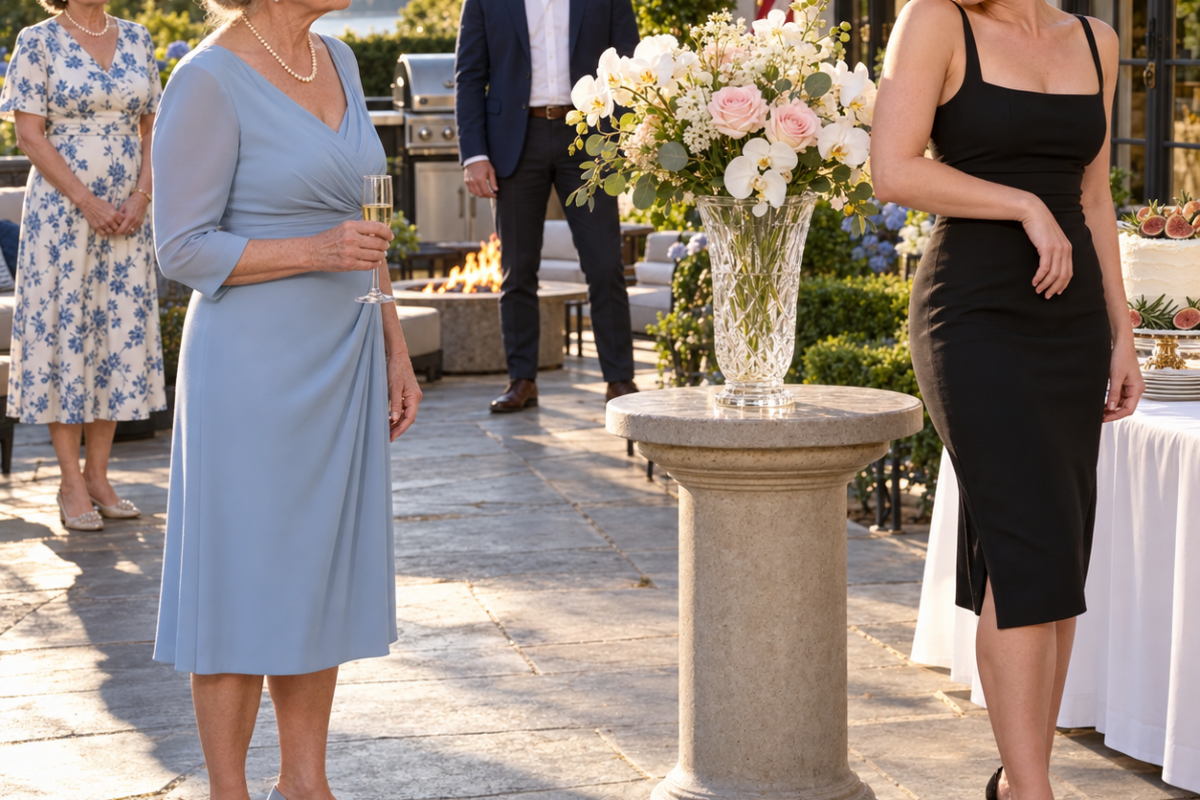
At my seventy-second birthday party, my daughter-in-law knocked a crystal vase off its pedestal with her elbow, watched it shatter, and smiled. “Oops.” Her own parents had given it to her and my son on their wedding day six years earlier. I looked at Frank, waiting for him to say something. All he managed was, “Mom…”
I watched my daughter-in-law break her own parents’ wedding gift with one elbow and a smile. For months afterward, people asked me whether I was…
I came home three hours early and found my sixty-eight-year-old mother on her knees scrubbing my mother-in-law’s bathroom. When I helped her stand, her sleeve slipped back, revealing dark marks around her wrist. My husband stepped into the doorway. “Daniela, don’t make a scene.” That was when I remembered my father’s last warning: “If you ever see your mother hurt, don’t argue with anyone. Open the hidden compartment in her sewing machine.”
I came home three hours early and found my sixty-eight-year-old mother on her knees beside a toilet. Her hands were stiff with arthritis. One gripped…
“I already promised your house to your sister,” my father told me four days after I bought it. “They’re moving in Monday. Rent-free for three years.” I was thirty-one, had saved for nine years, and had bought the five-bedroom home entirely in my own name. When I said no, he threatened to tell the family I had abandoned my sister’s children. Days later, he took the microphone at my grandmother’s seventy-fifth birthday dinner and did exactly that.
My father called twelve times in forty minutes after discovering I had bought a house without consulting him. When I answered, he didn’t ask whether…
My mother leaned across the restaurant table, looked at my thirteen-year-old adopted daughter, and whispered, “We don’t sit with mistakes.” I took Sole’s hand and walked her out. That night, my father texted, “You’re still making the car payment tomorrow, right?” By midnight, I had canceled the payments I’d been making for my family. Then I remembered something Sole had told me about her grandmother.
My mother looked at my thirteen-year-old daughter and whispered, “We don’t sit with mistakes.” She said it softly enough to avoid attracting attention from the…
At my father’s seventieth birthday dinner, my eleven-year-old son and eight-year-old daughter were seated beside the service door with water glasses—but no dinner plates. Their cousins sat beside Grandpa with warm bread and full place settings. “They’ll eat after everyone else,” my sister said. I turned to my father, expecting him to object. “They can wait another hour,” he replied. There were two empty chairs at his table.
At my father’s seventieth birthday dinner, the first thing that stopped me wasn’t the cake or the gold balloons. It was my children. Ethan and…
“Mommy, are you real?” my four-year-old daughter whispered when I came home from deployment three weeks early. She was sitting alone on our living room floor with an empty cereal bowl. My husband was on a Caribbean cruise with his mother and sister. Twenty-two minutes earlier, they had posted a photo captioned “Family time.” I was still in uniform when Sophie asked if she could have something to eat.
The first thing my daughter said when I found her was, “Mommy, are you real?” She was sitting cross-legged on our living room floor with…
End of content
No more pages to load