My ex-mother-in-law poured a bucket of freezing, dirty water over my head at dinner. “At least you finally took a bath,” Diane said as my ex-husband and his new girlfriend laughed. Pregnant and shivering, I reached for my phone and sent three words: “Activate Protocol 7.” None of them knew I owned the multibillion-dollar company where they all worked.


Diane lifted the bucket with both hands.
For one second, I thought she intended to show someone the water inside it. A housekeeper had left it near the service corridor while cleaning the conservatory floor, and Diane had complained about it twice during dinner.
Then she stepped behind my chair.
Freezing water struck the back of my head, ran beneath my collar, and spread across the dress covering my pregnant stomach.
The shock took my breath away.
Across the table, my ex-husband laughed.
Diane set the empty bucket down.
“Look on the bright side,” she said. “At least you finally took a bath.”
Jessica, Brendan’s new girlfriend, covered her mouth. Her shoulders shook with laughter.
I sat still while water dripped from my hair onto my hands.
Nobody reached for a towel.
Nobody asked whether I was hurt.
My daughter moved sharply inside me, and I placed a palm against my stomach.
That was the only reaction I gave them.
I had come to dinner because Brendan said we needed to discuss arrangements for the baby. Instead, his mother had decided to turn my presence into entertainment.
They expected tears. An argument. An apology for making the room uncomfortable.
What they got was silence.
I reached into my bag, took out my phone, and typed three words.
Activate Protocol 7.
Ten minutes later, the people laughing at me would be asking what I had done.
My name is Cassidy Ashford.
For nearly six years, Brendan Morrison’s family knew me as Cassidy Morrison, the quiet wife who dressed simply, worked at a nonprofit conservatory, and supposedly had little to contribute beyond making Brendan’s life convenient.
They knew I had inherited a family trust.
They assumed it was modest.
They knew the trust was protected by agreements prepared before our marriage and reviewed again during our divorce.
They did not read those documents with much curiosity.
Most importantly, they never connected my maiden name to the holding company controlling the multibillion-dollar business where they all worked.
Ashford Meridian Holdings.
The Morrison family had spent years confusing their positions inside that company with ownership of it.
Diane chaired the company-supported charitable foundation and held a consulting contract connected to executive events. Her husband, Richard, occupied a senior finance position. Brendan was chief commercial officer. Jessica worked in strategic partnerships.
Their income, homes, vehicles, travel privileges, and social importance were closely connected to Ashford Meridian.
They spoke about the company as though it were their family’s achievement.
The controlling interest belonged to the trust I chaired.
I had never used that fact to impress them.
That Sunday, I finally used it to protect something more important than their opinion.
The dinner took place at an executive residence owned by an Ashford Meridian property subsidiary. It stood behind wrought-iron gates on a wooded estate, with a conservatory, a formal dining room, and enough guest bedrooms that Diane called it a house while other people called it a venue.
The Morrisons had access under documented corporate arrangements.
It was not their private property.
But Diane entertained there so often that visitors assumed it was.
She rarely corrected them.
I had been inside before. I remembered reviewing photographs of the Persian rug during a headquarters renovation three years earlier. The rug had later been reassigned to the residence, with the transfer recorded in the company’s furnishing inventory.
That rug now lay beneath my soaked shoes.
The water spread across it.
An asset I had approved was absorbing an insult directed at me by someone who believed I could not afford to stand in the room.
“Oops,” Diane said.
Her smile made it clear she was not apologizing.
Brendan laughed again.
Jessica looked at the floor.
“Someone bring her an old towel. We don’t want that smell on the expensive linen.”
I took a careful breath.
I did not feel powerful.
I felt cold.
I felt the weight of my daughter beneath my hand.
I felt something in me stop bargaining with people who had made cruelty into a family habit.
“Who are you calling?” Jessica asked. “A charity? It’s Sunday, honey.”
Diane poured more wine.
“Brendan, give her twenty dollars for a cab and make her disappear.”
I looked at my ex-husband.
He reached toward his wallet.
That movement was the last ordinary thing I remember about the room.
Then my phone rang.
Arthur.
I answered.
“Cassidy?” he said. “Are you all right?”
“No. Execute Protocol 7. Now.”
There was a short silence.
Arthur Bennett was executive vice president of legal affairs and had worked with my family for more than two decades. He knew exactly which authorization I meant.
“Cassidy, the protective measures will take effect immediately,” he said. “The investigation and employment decisions will still require their process.”
“I understand.”
“This will affect the Morrisons’ executive access and privileges. Depending on the findings, they could lose the positions those arrangements depend on.”
“They have already lost my trust,” I said. “Make it effective.”
I placed the phone on the glass side table beside me.
Brendan frowned.
“Protocol 7? What is that? Another one of your dramas?”
I met his eyes.
“No.”
Outside, we heard a vehicle stop.
Footsteps followed.
Then the front door opened.
The head of corporate security entered the dining room, took in the bucket, my wet clothes, and the people standing around the table.
He did not look at Brendan first.
He looked at me.
“Ms. Ashford,” he said. “I’m Samuel Reed. Arthur sent me. We need to get you somewhere warm.”
Brendan stopped laughing.
Jessica’s hand lowered from her mouth.
Diane looked from Samuel to me as though someone had changed the language spoken in her house.
“Ms. Ashford?” she repeated.
I stood carefully.
“Yes.”
Samuel did not offer a dramatic salute or announce my financial worth. He asked whether I wanted help walking.
I said I could walk.
A female member of his team brought a clean blanket from the guest facilities and held it open without touching me until I nodded.
She wrapped it around my shoulders.
Only then did Brendan move toward me.
“Cassidy, what’s going on?”
I stepped away.
“Don’t touch me.”
He stopped.
Samuel positioned himself nearby without making the moment into a physical confrontation.
Arthur’s voice came through my phone.
“Cassidy, transport is ready. Medical care first. We can discuss the company after you’re safe.”
Diane recovered enough to speak.
“This is a private family matter.”
Samuel looked at the bucket.
“Ma’am, I’m here to assist Ms. Ashford and secure company property under the instructions I’ve received.”
“This is my home.”
“The occupancy arrangements will be addressed separately.”
His restraint seemed to irritate her more than an argument would have.
She wanted someone to challenge.
He gave her a boundary.
I picked up my bag.
Brendan stared at me.
“You’re Ashford?”
“I have always been Ashford.”
“But the trust—”
“Was disclosed where it needed to be disclosed.”
Richard pushed his chair back.
He had been silent through the water, the laughter, and the conversation about a cab. Now he was looking at his phone.
Something had arrived on it.
His face changed.
“What have you authorized?”
I held the blanket closed.
“Protection. Preservation. Review.”
Those words did not sound impressive.
They were more consequential than impressive words.
I walked out.
Nobody followed me past Samuel.
In the car, the blanket began absorbing water from my dress. My teeth chattered despite the heat.
The woman beside me introduced herself as Naomi. She asked whether I wanted to call someone.
My friend Maya.
I gave her the number.
Then I looked through the rear window.
Brendan stood on the steps with his mother.
They were speaking quickly.
For the first time that evening, I was not the person trying to explain why something was wrong.
The emergency department smelled of disinfectant and warm plastic. A nurse took one look at me and asked what happened.
I told her.
I did not say the water had fallen accidentally.
I did not say my mother-in-law had become upset.
I said Diane Morrison deliberately poured dirty water over me while I was pregnant.
The sentence felt blunt.
It was accurate.
A clinician assessed me. The obstetric team checked my daughter and explained what they wanted to monitor. They did not treat the incident as harmless merely because the immediate findings were reassuring.
I changed into dry clothes brought from a nearby store with my permission.
Nothing elaborate.
Soft trousers.
A loose shirt.
Socks.
The clean fabric against my skin nearly made me cry.
Maya arrived while I was waiting.
She looked at the damp dress folded inside a hospital bag.
Then she looked at me.
“Oh, Cassidy.”
I began crying before she sat down.
She did not tell me I was strong.
She did not say everything happened for a reason.
She took my hand and stayed.
Arthur arrived later, after asking whether I wanted him there.
He carried a thin folder.
He did not open it immediately.
“How are you?”
“The baby is being monitored. So far, they’re reassured.”
“And you?”
I looked at Maya.
Then at the blanket over my legs.
“I don’t know yet.”
Arthur nodded.
“We can wait.”
For a while, we did.
The company did not require my attention more urgently than my body did.
That distinction was one of the things Protocol 7 existed to preserve.
It had been prepared months earlier after independent concerns about executive spending, conflicts of interest, and misuse of corporate property. It was not a secret legal spell. It was a documented response plan authorized through the company’s governance structure.
It allowed specified officers to preserve records, restrict certain systems and privileges, arrange security support, and notify the appropriate directors.
It did not permit me to confiscate private property, empty personal accounts, or fire everyone I disliked by text message.
The Morrisons’ positions would be reviewed according to their contracts and the evidence.
That had always been the plan.
Until Sunday, I had resisted activating it.
Part of me wanted more certainty.
Part of me was still trying to separate Brendan’s treatment of me from his professional behavior.
Part of me feared being accused of using ownership to punish a failed marriage.
At the dinner, those distinctions did not disappear.
What disappeared was my willingness to let fear of their accusations prevent reasonable protective action.
Diane had assaulted me inside a corporate residence.
Brendan had laughed and encouraged the humiliation while using benefits attached to his executive role.
Jessica had participated.
Richard had watched.
The event itself required review.
The financial questions already existed.
I did not create them that evening.
I stopped postponing the response.
Arthur opened the folder when I asked.
“The interim measures are active,” he said. “Executive system access for the individuals covered by the authorization has been restricted pending review. Records are preserved. The board has been notified.”
“Payroll?”
“Ordinary payroll continues.”
“Employees?”
“No general disruption. Operations are under Elena’s authority.”
Elena Park was the company’s chief operating officer and one of the people whose quiet competence kept the business functioning while others took photographs at conferences.
I trusted her judgment.
Arthur continued.
“The residence’s occupancy and access agreements are being reviewed. No one is being put on the street tonight. Any change will follow the terms and applicable process.”
I nodded.
“The vehicles?”
“Company-controlled benefits are being secured through the appropriate channels. Private vehicles are private vehicles.”
That mattered.
I wanted the truth addressed.
I did not want anger to become an excuse for pretending ownership gave me authority over everything.
Arthur handed me a copy of the initial notice.
Richard had received it before I left the dining room.
Brendan received his while he stood on the front steps.
That was why they began asking me to stop.
The access they treated as permanent had become conditional again.
The next morning, I woke in Maya’s guest room.
I had chosen her house rather than returning alone to my townhouse. The hospital had discharged me with instructions and follow-up arrangements after the observation period.
My daughter moved beneath my hand.
I lay still until my breathing settled.
Then I heard Maya in the kitchen, arguing softly with a toaster.
It was the most comforting sound I could imagine.
I had sixty-three missed calls.
Some came from numbers I recognized.
Others did not.
I did not listen to all the messages.
Arthur arranged a secure way to preserve them, and my personal attorney would help me decide what required a response.
My personal attorney was not Arthur.
That distinction had become important.
He represented the company in his corporate role and advised the trust within the appropriate arrangements. My divorce, pregnancy, privacy, and personal legal decisions required independent counsel.
Her name was Miriam Shaw.
She had guided me through the divorce.
She knew how much I preferred quiet solutions.
That morning, she called.
“I heard from Arthur that something serious happened. Are you ready to tell me?”
I told her.
She listened without interruption.
Then she said, “You do not have to make every decision today.”
“I’ve already made one.”
“Yes. And we will keep the personal matters and corporate matters properly addressed.”
I looked at my phone.
“Brendan wants me to reverse it.”
“Brendan wants many things. That doesn’t make them urgent for you.”
I smiled faintly.
Maya placed tea beside me.
For the first time in months, someone else’s urgency did not automatically become my responsibility.
I met Brendan six years earlier at a fundraiser for the conservatory where I worked.
He was charming in the practiced way of a man who could remember names, ask the right questions, and make a crowded room feel briefly personal.
He asked about the plants.
Most guests asked about the wine.
I liked that.
He returned a week later to volunteer for an event. He helped carry tables. He arrived early. He listened when I talked about the old glasshouse needing repairs.
When we began dating, he knew my father’s family had investments.
He knew I preferred working with living things to sitting through formal dinners.
He knew I could pay my own rent.
What he did not know was the exact structure of my family’s controlling interest in Ashford Meridian.
At the time, my father still managed much of it.
I was involved, but quietly.
The company had a professional management team. Beneficial ownership sat within trusts and entities whose legal names did not appear on the front door.
I was not pretending to be poor.
I simply did not introduce myself by a valuation.
Before we married, our attorneys handled the agreements. Brendan had independent advice. The trust interests were identified and treated according to the documents.
He signed.
Later, during the divorce, the necessary disclosures were made again.
Nothing relevant was hidden from the legal process.
Brendan’s lack of curiosity was not the same as my concealment.
He knew I had protected assets.
He assumed they were insufficient to matter in his world.
That assumption suited his mother.
Diane liked stories in which her family supplied the importance.
Richard had spent years rising through finance positions at Ashford Meridian. Brendan joined after working elsewhere. Diane’s foundation role and consulting arrangements followed formal approvals long before our marriage.
I did not hire the entire Morrison family to keep a boyfriend happy.
They were already inside the company’s orbit.
I met Brendan in a different part of life.
That separation seemed healthy at first.
Eventually, it became convenient for him.
At dinners, he spoke about investors as though they were distant figures with no connection to me.
Diane called our conservatory work sweet.
“Some people need a hobby with meaning,” she once said.
I told her it was my job.
She smiled.
“Of course.”
I could have corrected their picture of me.
Sometimes I considered it.
Then I imagined the conversation changing.
Their affection becoming more attentive.
Their questions becoming more specific.
Their interest moving from who I was to what I controlled.
I wanted to know whether I could belong without supplying a reason they respected.
That desire kept me quiet longer than it should have.
It also made me excuse things I would have challenged in another setting.
Diane disliked my clothes.
Brendan said she had a particular taste.
Diane called me impractical.
Brendan said she worried about my future.
Diane suggested I did not understand the demands of a successful man.
Brendan said she was old-fashioned.
Each explanation made her behavior smaller and my objection less convenient.
I began choosing dinner outfits according to what would avoid commentary.
I smiled at remarks I disliked.
I left conversations feeling tired without understanding why I always blamed myself for the exhaustion.
When my father died, the structure of my role changed.
I became chair of the controlling trust and took greater responsibility for oversight.
The professional executives continued running daily operations.
I did not suddenly become the person approving every stapler.
But the voting authority and stewardship responsibilities were real.
Arthur helped me understand the transition.
Independent advisers reviewed the trust’s obligations.
I attended meetings, asked questions, and learned what required my attention.
Brendan knew my father died.
He knew I had more paperwork.
He did not ask what changed.
He was busy.
That became the answer to many things.
He was busy when I wanted company at dinner.
Busy when I mentioned the medical appointment.
Busy when Jessica started appearing in conversations that previously concerned only his work.
He called her ambitious.
Then helpful.
Then the only person who understood the pressure he was under.
I recognized the progression before I admitted what it meant.
By the time he asked for a separation, I was pregnant.
He said the timing was difficult.
I thought that was an astonishing description of carrying his child while he moved toward someone else.
We divorced through lawyers, with the pregnancy and future parenting questions acknowledged in the appropriate arrangements.
The marriage ended.
The baby’s life had not begun.
Those realities existed beside each other, and I could not force them into a simpler story.
I moved to a townhouse I could afford comfortably.
I continued working, though I reduced hours as the pregnancy progressed.
Brendan’s family called the place small.
Diane described it as a temporary situation.
Jessica once asked whether I needed help finding discounted maternity clothes.
I told her I was fine.
She heard what she wanted.
To them, plain furniture meant lack of money.
A modest car meant defeat.
A woman who did not argue about status must have none.
I allowed those assumptions to remain because I was tired of explaining myself.
I did not realize how far they would take them.
The invitation to Sunday dinner came from Brendan.
He said we needed to discuss the baby.
Visiting arrangements.
Who would be available after the birth.
Practical communication.
I suggested a private meeting with counsel where necessary.
He said his mother wanted to help and that a family conversation would be less formal.
I should have declined.
I can say that now without making the later assault my fault.
Accepting a dinner invitation did not authorize cruelty.
Still, I knew the family’s patterns.
I went because some part of me wanted our daughter’s grandparents to begin differently.
I wanted Brendan to look at the pregnancy and remember it involved a child rather than an inconvenience to his new life.
I wanted something ordinary.
A meal.
A conversation.
A plan.
Miriam suggested keeping the discussion limited and not signing anything.
I agreed.
I wore a green maternity dress and brought a notebook.
Diane greeted me by looking at my shoes.
Jessica was already there.
That surprised me.
Brendan said she might eventually be involved in the baby’s life, so I should get used to including her.
I sat down because leaving immediately felt like refusing the future.
Now I understood how easily that fear could be used.
The first hour was uncomfortable rather than openly hostile.
Diane spoke about newborn routines as though she had already been appointed to manage them.
Jessica asked whether I planned to return to work quickly.
Richard wanted to know what the divorce arrangements said about financial support.
I told him those matters belonged with the appropriate professionals.
Brendan said I was making a simple question difficult.
I looked at him.
“I’m keeping the discussion where it belongs.”
Diane’s mouth tightened.
After dinner, she began talking about having the baby stay with her for several nights once feeding was established.
I said no.
Not angrily.
Not dramatically.
Simply no.
She asked whether I did not trust her.
I said plans would be made according to the baby’s needs and the legal arrangements, not promised at dinner.
Brendan sighed.
Jessica smiled into her wine.
Then Diane said, “You should remember how much this family has already tolerated.”
I closed the notebook.
That was the moment I knew the dinner had not been arranged to hear my position.
It had been arranged to wear it down.
I stood to leave.
Diane asked where I thought I was going.
“Home.”
“You’re embarrassing us.”
“No. I’m ending a conversation.”
She moved toward the service corridor.
I thought she was calling someone to bring my coat.
Instead, she returned with the bucket.
The rest happened quickly.
Quickly enough that the body remembered before the mind organized it.
The water.
The laughter.
My daughter moving beneath my hand.
The phone.
The message.
At Maya’s kitchen table the following morning, I told Miriam all of it.
She asked whether I wanted to report the assault.
I said yes.
I did not want the only response to be corporate.
What happened to me mattered as a personal act, not merely as misconduct involving company property.
A report was made.
I provided my account.
Medical documentation was preserved appropriately.
The soaked dress was retained according to advice.
The security team documented what they observed when they arrived.
Their report did not pretend they saw the pouring itself.
They saw the aftermath.
They heard certain statements.
They recorded the condition of the room.
The difference mattered.
There were also people who worked at the residence.
A service employee heard laughter and saw Diane carrying the bucket before the incident.
Another saw me wet and shaking.
They had jobs to protect.
They deserved a process that did not require them to confront the Morrisons personally.
Arthur ensured the review used independent channels.
No one was told that helping me meant risking ordinary employment.
No one was instructed to produce a particular version.
I wanted the truth.
A flattering story built around my authority would have been another form of the same problem.
The first emergency board call took place Monday afternoon.
I joined from Maya’s study after a medical appointment.
Elena Park was already on screen.
So were the independent directors and legal advisers.
I wore the loose shirt bought after the hospital visit.
No pearls.
No carefully arranged backdrop.
I was tired.
I said so.
Then we worked through the situation.
Arthur described the immediate measures and their authority.
Elena explained operational continuity.
The independent directors asked about the existing financial concerns and the incident at the residence.
We separated what was established from what remained under review.
Brendan’s role was suspended pending investigation.
Richard’s access to certain finance systems was restricted, with responsibilities reassigned.
Diane’s foundation duties and consulting activities were placed under review.
Jessica’s work connected to the affected executives was restricted while conflicts were assessed.
Those actions were documented.
They were not a family vote on whether I had been sufficiently insulted.
The company needed decisions it could defend.
I needed the same thing.
At the end, one director asked whether I wanted to make a statement to employees.
“Not about my personal life,” I said.
“Understood.”
“We should explain operational changes and where people can direct questions. They don’t need the details of my pregnancy.”
Elena nodded.
“I’ll handle that.”
The call ended.
I sat quietly for several minutes.
Maya brought water.
“How did it go?”
“Like a meeting.”
“That sounds good.”
“It was.”
I had expected authority to feel louder.
Mostly, it felt like making careful choices while exhausted.
Brendan arrived at Maya’s house that evening.
He had not been invited.
Maya answered through the closed door.
He asked for me.
She told him I was not accepting visitors.
He said it was urgent.
She said he could contact my attorney.
I remained in the study, listening to a conversation that did not require me to appear.
That was a new experience.
For years, Brendan’s urgency summoned me.
Now a door could remain closed.
He left after several minutes.
He sent a message.
You can’t destroy my career because you’re jealous.
I saved it.
Then another.
I had no idea who you were.
I stared at that one.
He had known me for years.
He knew how I took coffee, what frightened me, which books I reread, and how I cried when my father died.
He did not know what my trust controlled.
That was what he meant.
The distinction hurt.
It also clarified something I had resisted understanding.
To him, the fact that I could matter financially changed the person he believed he had hurt.
I did not answer.
Jessica sent a different message.
She said she had been uncomfortable and laughed from nervousness.
She said she did not want to be involved in a family dispute.
She said she respected me.
I remembered her comment about the linen.
I forwarded the message to the appropriate people and left it there.
I did not need to conduct an argument in which she revised the memory until I doubted it.
Diane called Arthur.
He did not discuss my personal decisions with her.
She asked whether the trust could reverse the restrictions.
He explained that the company’s process was underway and that she should speak with her own adviser.
She insisted she had known him for years.
He said familiarity did not change his obligations.
Later, he told me only what I needed to know.
I thanked him.
He looked uncomfortable.
“For doing your job,” I added.
He nodded.
That was the correct reason.
The residence became a practical issue.
The Morrisons had occupied part of it under a corporate agreement tied to executive duties and approved use.
Their counsel reviewed the agreement.
The company reviewed its own records.
Restrictions on events and access were implemented first. Any change in occupancy proceeded through the contract and lawful process.
There was no midnight eviction.
No clothes thrown onto the driveway.
No security guard instructed to seize Diane’s jewelry.
Some furnishings belonged to the company.
Some belongings belonged to the Morrisons.
An inventory distinguished them.
They disliked that.
For years, the difference had benefited from being blurred.
When the company asked for documentation of private ownership, Diane called it degrading.
I remembered the bucket.
I did not say that to the inventory team.
They did not need my anger to do their work.
They needed records.
The review uncovered more than an ugly dinner.
Not every expense was improper.
Some travel served genuine business.
Some entertainment had legitimate purposes.
Some reimbursement questions came from poor documentation rather than deliberate misconduct.
Those distinctions were maintained.
But there were also expenditures difficult to explain.
Private events billed through executive hospitality budgets.
Vehicles used beyond approved terms.
Consulting charges connected to relatives.
Payments for work that did not match the descriptions provided.
Diane’s foundation had spent more on presentation than some directors realized.
Jessica’s team had submitted partnership proposals involving companies whose connections had not been disclosed properly.
Richard had approved items that should have received independent review.
Brendan had signed explanations that overstated business purposes.
The investigation did not turn every Morrison purchase into a crime.
It did show that access had been treated as ownership in ways the company could not continue accepting.
Independent counsel and accountants assessed what required repayment, employment action, referral, or further inquiry.
I did not sit at a desk adding damages because I disliked someone.
I received reports.
I asked questions.
I let qualified people identify what the records supported.
That was slower than revenge.
It was also harder for them to dismiss.
Meanwhile, I prepared for my daughter.
That part of life had become too small during the divorce.
My townhouse nursery still contained unopened boxes.
Maya helped me sort them one afternoon.
We assembled a lamp incorrectly, laughed, and tried again.
I folded tiny clothes.
I chose where to place the chair.
No one told me the color looked cheap.
No one described my preferences as hormones.
I cried unexpectedly while putting blankets in a drawer.
Maya sat on the floor beside me.
“What is it?”
“I thought the room would feel lonely.”
“Does it?”
I looked around.
“No.”
She smiled.
We continued folding.
A few days later, I moved back to my townhouse.
I did not want to stay at Maya’s indefinitely because gratitude did not have to become another arrangement without clear edges.
She lived nearby.
We made a plan.
People I trusted could come when invited.
They could help with meals, errands, and company.
They did not receive unrestricted access because they cared about me.
I had learned something about keys from watching other people assume doors were theirs.
Miriam helped address communication with Brendan concerning the pregnancy and future parenting issues.
I did not use company control to decide custody.
That would have been improper and ineffective.
His role as a prospective parent involved a different process and different standards.
The incident, his behavior, and relevant evidence could be considered where appropriate.
Employment consequences did not replace those questions.
We used counsel to arrange necessary communication.
I provided medical information that needed to be shared.
I did not provide access to my private life beyond that.
Brendan disliked the boundaries.
At first, he treated them as another business restriction I could reverse.
Then he began to understand that money could not turn my home into an office where he remained entitled to an audience.
Our first personal meeting after the dinner took place at Miriam’s office.
Brendan had his own counsel.
I had requested a controlled setting because I wanted to hear what he intended concerning the baby without sitting through another attempt to negotiate his career.
He arrived wearing a suit.
He looked thinner.
I noticed.
I did not let that become my responsibility.
He began by saying he never expected his mother to do something like that.
I waited.
“She got upset,” he said.
Miriam looked toward his counsel.
Brendan stopped.
I asked one question.
“Why did you laugh?”
He looked at the table.
“I didn’t think it was serious.”
“I was soaked and shaking.”
“I know.”
“You reached for your wallet when she told you to make me disappear.”
He closed his eyes.
“I’m sorry.”
I considered the apology.
Then I said, “What are you sorry for?”
He looked up.
“For the way it happened.”
The way.
I had heard enough passive phrases to recognize a place to hide.
“For laughing?” I asked.
“Yes.”
“For inviting me to discuss our child and allowing that conversation to become a way to pressure me?”
He looked at his lawyer.
Then back at me.
“Yes.”
It was not transformation.
It was the first time he named actions instead of circumstances.
I listened.
Then we discussed what needed to be discussed.
The baby.
Communication.
Medical updates.
The plans that would be finalized through the proper process after her birth.
When he tried to ask about the company, Miriam stopped the conversation.
“That is a separate matter.”
For once, separate meant something protected rather than something concealed.
Afterward, I sat in the car and cried.
Not because I wanted him back.
Because I remembered the man who carried tables at the conservatory and listened to me describe broken windows.
I had loved someone real.
I had also loved a version of him that did not survive pressure and opportunity.
Both facts could exist without requiring another marriage.
The employees became a concern I could not ignore.
Rumors spread.
Some believed the Morrisons had been removed because of an ordinary divorce dispute.
Others heard exaggerated stories about me.
Some feared that discovering the controlling owner meant every department would be reorganized immediately.
Elena suggested a company-wide message addressing what people actually needed to know.
We prepared it carefully.
Operations would continue.
Ordinary payroll and benefits were unaffected by the executive review.
Leadership responsibilities had been reassigned.
Employees could use independent channels for questions or relevant information.
No one should participate in speculation about private medical matters.
I approved that approach.
Later, I attended a scheduled employee forum with Elena and several directors.
It was not a theatrical unveiling.
People already knew the company had controlling investors.
Now they would meet the person whose role had become more visible.
I introduced myself.
Cassidy Ashford.
Chair of the controlling trust.
I explained that professional management remained responsible for operations and that my oversight role did not mean every employee suddenly reported to me.
Then I thanked them for continuing their work during uncertainty.
A woman from procurement asked whether contracts under review would delay supplier payments.
Elena answered.
A supervisor asked whether team travel had been canceled.
We explained the distinction between ordinary operations and restricted executive benefits.
Those questions were more important than whether anyone thought my entrance was impressive.
At the end, an employee approached quietly.
“I’m sorry about what happened,” she said.
“Thank you.”
“I worked at the residence once. I know how people can get treated there.”
I directed her to the independent channel if she wanted to provide information.
I did not ask her to tell me everything in a hallway.
She nodded.
Then she asked whether I still worked at the conservatory.
“I do.”
“My son loves the winter display.”
I smiled.
“Tell him the gardeners deserve the credit.”
For a moment, I was myself again.
Not a victim.
Not a revelation.
A woman whose work somebody appreciated.
As the due date approached, my world became smaller in a useful way.
Appointments.
Meals.
Rest.
A bag packed near the door.
Maya checked in without requiring an answer every time.
My sister, Elena, who happened to share a first name with the company’s chief operating officer, flew in to stay for a week before the birth. We joked that I now had enough Elenas in my life to handle any problem except assembling the stroller.
The stroller defeated all of us briefly.
We read the instructions.
That solved it.
I wanted to remember ordinary things like that.
My daughter deserved a beginning containing more than legal files.
I chose her name after several evenings of writing possibilities in the notebook I had taken to the Morrison dinner.
That notebook had contained a page of practical questions and no answers.
I turned past it.
On a clean page, I wrote:
Lily.
The name felt right.
I told Brendan through the agreed communication channel.
He said he liked it.
That response required nothing more.
The night labor began, rain tapped the bedroom window.
For a while, I was uncertain.
Then the pattern became clear enough that I followed the plan given by my medical team.
Maya drove.
My sister carried the bag.
At the hospital, the staff knew my visitor preferences.
Brendan was notified according to the arrangements we made.
Diane was not invited.
Jessica was not part of the birth.
No one asked me to demonstrate generosity by including people who made me feel unsafe.
Labor was tiring and difficult.
I will not pretend I moved through it calmly because I had handled a corporate crisis.
There were moments when I was frightened.
Moments when I regretted every decision involving pain.
Moments when I wanted my father, who was no longer alive, because he had always made hard things feel manageable.
Maya held my hand.
My sister brushed hair from my face.
The nurses explained what they were doing.
I listened when I could.
Then Lily arrived.
Small.
Warm.
Angry at the interruption.
The sound of her crying made everything in the room briefly simple.
She was here.
I held her against me and looked at her face.
No one had to give me permission to love her.
No family needed to approve the beginning.
I cried until a nurse handed me tissues and smiled.
Brendan saw Lily later under the arrangements in place.
He stood beside the bed looking at her with an expression I had not seen in months.
Something unguarded.
I let him have that moment.
It did not erase the dinner.
It did not restore the marriage.
It belonged to the child.
When he held her, he sat in the chair and followed the nurse’s instructions carefully.
I watched.
There were questions about the future still to be resolved.
I did not answer all of them by watching him hold a newborn.
I also did not deny what was tender in the moment merely because other things were wrong.
Lily would need decisions based on behavior over time.
So would I.
The first weeks at home were exhausting.
Feeding.
Laundry.
Appointments.
Sleep measured in pieces.
The company continued functioning without my constant attention.
Elena Park and the professional team handled operations.
Arthur sent concise updates when something required review.
He did not call merely to make me feel important.
That was one of the reasons I trusted him.
Maya stocked the freezer.
My sister washed dishes and refused to let me apologize for needing help.
I learned that accepting care did not make me a burden.
It made me a person recovering from childbirth.
That distinction should have been obvious.
After years with the Morrisons, it was not always easy to feel.
One afternoon, I began crying because I could not find a clean shirt.
My sister handed me one.
“Here.”
“I’m sorry.”
“For what?”
“I’m a mess.”
“You have a newborn.”
I laughed through the tears.
She sat beside me.
“Nothing about this is evidence that you’re failing.”
I needed to hear that.
I needed to hear it again some days.
Postpartum recovery did not become simple because I had money.
Money bought useful help.
It did not create sleep where a baby did not want to sleep.
It did not remove grief.
It did not tell me which worry was reasonable at three in the morning.
I obtained support.
I followed medical advice.
I allowed people to help without treating their help as proof that they owned my decisions.
That was new.
The corporate investigation reached conclusions in stages.
Some issues were resolved through documentation.
Some involved repayments.
Others supported termination decisions.
Brendan’s employment ended following the review and the process required by his agreement. The findings involved conduct, misuse of company arrangements, and explanations that did not withstand scrutiny.
Richard’s position ended as well, with separate issues concerning approvals and oversight.
Diane’s consulting contract was terminated, and she left the foundation role through the appropriate governance process.
Jessica’s employment was reviewed independently. Her participation in the incident and the conflicts uncovered in her work were addressed. She did not remain in the position she expected to use as a platform for advancement.
Their personal assets remained theirs.
Their investments were not confiscated.
Their bank accounts did not empty because I sent a message.
What changed was the steady supply of company-funded privileges and income they treated as permanent.
That was enough to expose how much of their wealth depended on continued access.
The executive residence was vacated according to the agreed and lawful process.
Company furnishings stayed.
Private belongings left.
Vehicles assigned through corporate programs were returned.
Travel privileges ended.
Credit arrangements tied to executive authority were closed or restricted as appropriate.
They still had choices.
They had fewer people available to absorb the cost of those choices.
Diane called it losing everything.
Arthur’s warning had been practical, not literal.
They lost the structure around which they built their identity.
That can feel like everything to people who mistake a position for themselves.
I did not rejoice at every loss.
I also did not intervene to make consequences comfortable.
Some matters from the financial review required further assessment by outside authorities or independent advisers.
Those processes continued separately.
I did not promise employees a perfect conclusion.
I promised the company would cooperate and preserve records.
That was the promise I could keep.
The personal assault matter proceeded on its own track.
My account.
The witnesses.
Medical records.
Messages.
The circumstances.
Diane’s counsel challenged aspects of it.
That was part of the process.
Eventually, the matter concluded through the appropriate legal resolution, with consequences and restrictions reflecting the established conduct.
I did not need to watch her humiliated in a courtroom to believe what happened to me.
I did need the record to stop describing deliberate harm as a family joke.
It did.
For a long time, that was enough.
Brendan’s relationship with Jessica ended before Lily was old enough to recognize either of them as part of her routine.
I learned through counsel because changes could affect parenting arrangements.
I did not ask for the reason.
People offered guesses.
Career pressure.
Money.
Blame.
Disappointment.
I did not collect them.
Their relationship had occupied enough of my emotional life while I was not part of it.
I was finished giving it space.
Brendan began working elsewhere in a less prominent role.
He disliked the comparison.
He also had to learn that a smaller title did not prevent him from earning an honest income.
His parenting developed slowly under the arrangements established through the appropriate process.
There were structured visits.
Communication.
Expectations.
Adjustments according to Lily’s needs and professional guidance where relevant.
I did not use my position at the company to decide those things.
I did not turn Lily into a reward for Brendan apologizing.
He had responsibilities as a parent.
He would be assessed by what he did with them.
Sometimes he did well.
Sometimes he disappointed me.
I addressed the practical issue rather than reopening the marriage in every conversation.
That took discipline.
I was not always graceful.
I was learning.
Diane requested contact with Lily.
The request did not arrive as a question at first.
It arrived as an assertion.
I am her grandmother.
Miriam handled the response.
A title did not settle safety, access, or the applicable legal questions.
I did not agree to visits.
I did not send photographs to soothe her.
I did not ask Lily to become a bridge between adults while she was still learning to hold her head up.
Later, Diane wrote me a letter.
It was longer than the earlier messages.
She said she had been ashamed.
She said she thought I looked down on her family.
She said she lost control.
Then she said she wished she had known who I was.
I stopped reading for a moment.
That sentence contained the reason I had remained quiet for years.
She should not have needed my ownership to decide whether pouring dirty water over a pregnant woman was wrong.
She should not have needed my real surname to treat me as a person.
I read the rest.
There were parts that sounded sincere.
There were parts that still asked me to understand her before she understood what she did.
I kept the letter.
I did not answer immediately.
When I finally responded, I acknowledged receiving it and stated that contact remained limited.
I did not argue about whether she deserved another chance.
A chance was not something she could obtain by making me responsible for proving forgiveness.
I had a daughter to raise.
A life to restore.
A body that still remembered sudden cold.
There were days the memory returned unexpectedly.
A bucket in a cleaning aisle.
Wet hair against my neck.
A joke about someone needing a bath.
I could be doing something ordinary and feel my chest tighten.
I spoke about those reactions with a therapist.
She helped me understand them without making them the center of my identity.
We worked on practical ways to return to the present.
The floor beneath my feet.
The room around me.
Lily breathing nearby.
The fact that the event ended.
I was not still at that table.
Some days that knowledge felt clear.
Other days it took longer.
I let healing be uneven.
I did not owe anybody an inspiring schedule.
At the company, I continued making changes with the board.
Not changes designed to memorialize the Morrisons.
Changes designed to make the business less dependent on private understandings.
Executive benefits were documented more clearly.
Conflicts required better disclosure.
Event spending received independent review.
Employees had channels that did not depend on approaching a powerful family member.
The foundation refocused on its actual purpose.
The residence’s use was clarified.
None of those improvements required my personal story to appear in a slide deck.
The company was large enough to need strong systems regardless of what happened to me.
I wanted reforms that would matter after people stopped discussing the incident.
Elena Park became chief executive officer following the board’s full process.
She did not perform victory.
She asked for the resources necessary to do the work well.
I respected that.
At her first major presentation in the role, she credited teams by name.
Procurement.
Operations.
Finance staff who had kept ordinary processes moving during the review.
People whose work rarely appeared in executive photographs.
I sat near the back.
Not hidden.
Simply not needing the front row to prove something.
Afterward, an employee asked whether I intended to become more visible permanently.
“In the ways the role requires,” I said.
She nodded.
That answer suited me.
I could stop concealing authority without making authority my whole personality.
I returned to the conservatory on a reduced schedule when I was ready.
The first day, the glasshouse smelled of damp soil and leaves.
A gardener handed me a pair of gloves.
“We’ve got a problem with the irrigation schedule.”
I smiled.
A problem with pipes and plants.
Something that could be examined without interpreting another person’s cruelty.
We walked through the beds.
I listened.
The work welcomed me without asking for my net worth.
I needed that.
At home, Lily began smiling.
Then rolling.
Then objecting loudly whenever I moved outside her preferred field of vision.
She developed opinions before language.
Maya said she inherited that from me.
I said my opinions were usually more quietly expressed.
“Usually,” Maya answered.
We laughed.
The townhouse became fuller.
Books on the sofa.
Bottles drying by the sink.
A blanket on the floor.
Nothing matched the executive residence.
I loved it.
One afternoon, Brendan arrived for a scheduled visit and looked around the living room.
I braced for a comment.
Instead, he picked up a toy that had rolled under a chair.
“Where does this go?”
“In the basket.”
He put it there.
It was a small thing.
I noticed because for years he had treated domestic order as something that existed through me rather than work someone performed.
I did not praise him as though he had completed a heroic act.
I let him help.
That was more respectful to both of us.
Months later, he apologized in a way that sounded different.
We were discussing Lily’s schedule in the presence of the appropriate support arrangements.
He paused.
“I kept thinking about the fact that I didn’t know you controlled the company.”
I looked at him.
He continued.
“That became the part I obsessed over. What I lost. What you could do.”
I waited.
“I avoided the part where I laughed while you were being hurt.”
I said nothing.
He looked down.
“I’m sorry for that. Even if you had no money. Even if I’d kept my job. It should have mattered.”
I studied him.
“Yes,” I said.
“It should have.”
That apology did not restore trust all at once.
It did name the missing truth.
For the first time, he was not apologizing mainly because humiliation had reached him.
I accepted hearing it.
I did not promise reconciliation.
He did not ask.
We returned to discussing our daughter.
That was the relationship available to us.
Lily’s first birthday happened in my backyard.
There was a small cake, a folding table, and paper decorations that refused to remain where we taped them.
Maya came.
My sister came.
Friends from the conservatory.
A few people who had helped us through the year.
Brendan attended according to arrangements we had discussed in advance.
He brought a gift for Lily and asked where to put it.
No one announced that the occasion required inviting Diane.
No one asked me to make the day easier for a person absent because of her own conduct.
Lily put cake on her cheeks.
She looked pleased.
I laughed so hard that my sister took a photograph.
For once, I did not worry how the picture would appear to someone who might judge it.
It was my daughter’s birthday.
That was enough.
After the guests left, I sat on the grass while Lily slept inside.
The evening light warmed the fence.
Maya sat beside me.
“Good day?”
“Very.”
She nodded.
I looked toward the house.
“I thought the year would feel like a victory when I got here.”
“Does it?”
I considered that.
“It feels like a life.”
She smiled.
“That sounds better.”
It did.
There were still unresolved things.
Financial matters took time.
Family relationships remained limited.
Certain records stayed in folders I did not enjoy opening.
I still disliked sudden cold water.
I still had moments of grief for the marriage I wanted.
But those things no longer occupied every room.
Lily needed breakfast.
Plants needed attention.
Work required decisions.
Friends called about ordinary plans.
My life grew around the pain rather than waiting for the pain to disappear before beginning again.
The orchid from the Morrison dinner did not exist in my house because Diane never brought one.
There was no sentimental object from that evening I wanted to preserve for comfort.
The notebook remained.
I used it for practical things.
Appointments.
Groceries.
Ideas for the garden.
The page from dinner stayed where it was.
I did not tear it out.
Later pages contained more useful answers.
One winter evening, Arthur came by with documents requiring my review.
He had asked first.
Lily was asleep.
We worked at the kitchen table.
No glass conference table.
No formal service.
Just tea and a plate of biscuits Maya had left.
Arthur noticed the notebook beside the documents.
“Is that the one?”
“Yes.”
He nodded.
We did not spend the evening discussing the dinner.
We reviewed the decisions before us.
A capital plan.
A trust matter.
A change in oversight procedures.
I asked questions.
He answered.
When we finished, he put the papers in his folder.
“Your father would be proud of how you’ve handled the responsibility.”
I looked down.
For a moment, I wanted to cry.
Then I said, “I hope he would also be glad I’m sleeping better.”
Arthur smiled.
“He would consider that the more important report.”
I believed him.
After he left, I checked on Lily.
She lay asleep with one hand open beside her face.
I watched her for a minute.
Then I went downstairs and put the cups in the sink.
The house was quiet.
Not the tense quiet of a room waiting for me to make someone else comfortable.
A quiet I could inhabit.
I thought about the three words I sent that Sunday.
Activate Protocol 7.
People later treated them as the clever part of the story.
The secret ownership.
The sudden reversal.
The laughter stopping when security said my name.
Those things were memorable.
They were not the most important change.
The important change happened before I touched the phone.
I stopped wondering how to make the people hurting me feel better about stopping.
I stopped preparing an apology for their discomfort.
I stopped treating my daughter’s future as something that required their approval.
The message activated a plan already authorized.
The decision activated something less visible.
My willingness to act on what I knew.
I had authority before the water struck.
I had dignity before anyone learned my surname.
I had a right to leave before Samuel entered the room.
Their discovery did not create those things.
It made them harder to ignore.
I no longer needed the Morrisons to understand that.
Some understood more with time.
Some did not.
My life did not have to remain a hearing in which I presented evidence until every member of the family agreed.
I could close the folder.
I could go upstairs.
I could be Lily’s mother.
That night, before bed, I stood by the window and looked into the backyard.
The birthday decorations were long gone.
The garden rested for winter.
A small light glowed above the back door.
Nothing about the house announced billions.
It announced that someone lived there.
Someone who could choose who entered.
Someone who could set a cup down without expecting laughter to turn cruel.
Someone whose daughter would learn that kindness was ordinary, apologies named actions, and family did not make harm acceptable.
I turned off the downstairs lights.
Then I went to bed.
In the morning, Lily woke before sunrise and called for me in the language she was still inventing.
I went to her.
She reached up.
I lifted her, held her against me, and carried her toward the kitchen.
There would be breakfast.
A little spilled water.
A clean towel.
And no one would use the spill as a reason to make either of us feel small.
News

At my seventy-second birthday party, my daughter-in-law knocked a crystal vase off its pedestal with her elbow, watched it shatter, and smiled. “Oops.” Her own parents had given it to her and my son on their wedding day six years earlier. I looked at Frank, waiting for him to say something. All he managed was, “Mom…”
I watched my daughter-in-law break her own parents’ wedding gift with one elbow and a smile. For months afterward, people asked me whether I was…

I came home three hours early and found my sixty-eight-year-old mother on her knees scrubbing my mother-in-law’s bathroom. When I helped her stand, her sleeve slipped back, revealing dark marks around her wrist. My husband stepped into the doorway. “Daniela, don’t make a scene.” That was when I remembered my father’s last warning: “If you ever see your mother hurt, don’t argue with anyone. Open the hidden compartment in her sewing machine.”
I came home three hours early and found my sixty-eight-year-old mother on her knees beside a toilet. Her hands were stiff with arthritis. One gripped…

“I already promised your house to your sister,” my father told me four days after I bought it. “They’re moving in Monday. Rent-free for three years.” I was thirty-one, had saved for nine years, and had bought the five-bedroom home entirely in my own name. When I said no, he threatened to tell the family I had abandoned my sister’s children. Days later, he took the microphone at my grandmother’s seventy-fifth birthday dinner and did exactly that.
My father called twelve times in forty minutes after discovering I had bought a house without consulting him. When I answered, he didn’t ask whether…

My mother leaned across the restaurant table, looked at my thirteen-year-old adopted daughter, and whispered, “We don’t sit with mistakes.” I took Sole’s hand and walked her out. That night, my father texted, “You’re still making the car payment tomorrow, right?” By midnight, I had canceled the payments I’d been making for my family. Then I remembered something Sole had told me about her grandmother.
My mother looked at my thirteen-year-old daughter and whispered, “We don’t sit with mistakes.” She said it softly enough to avoid attracting attention from the…
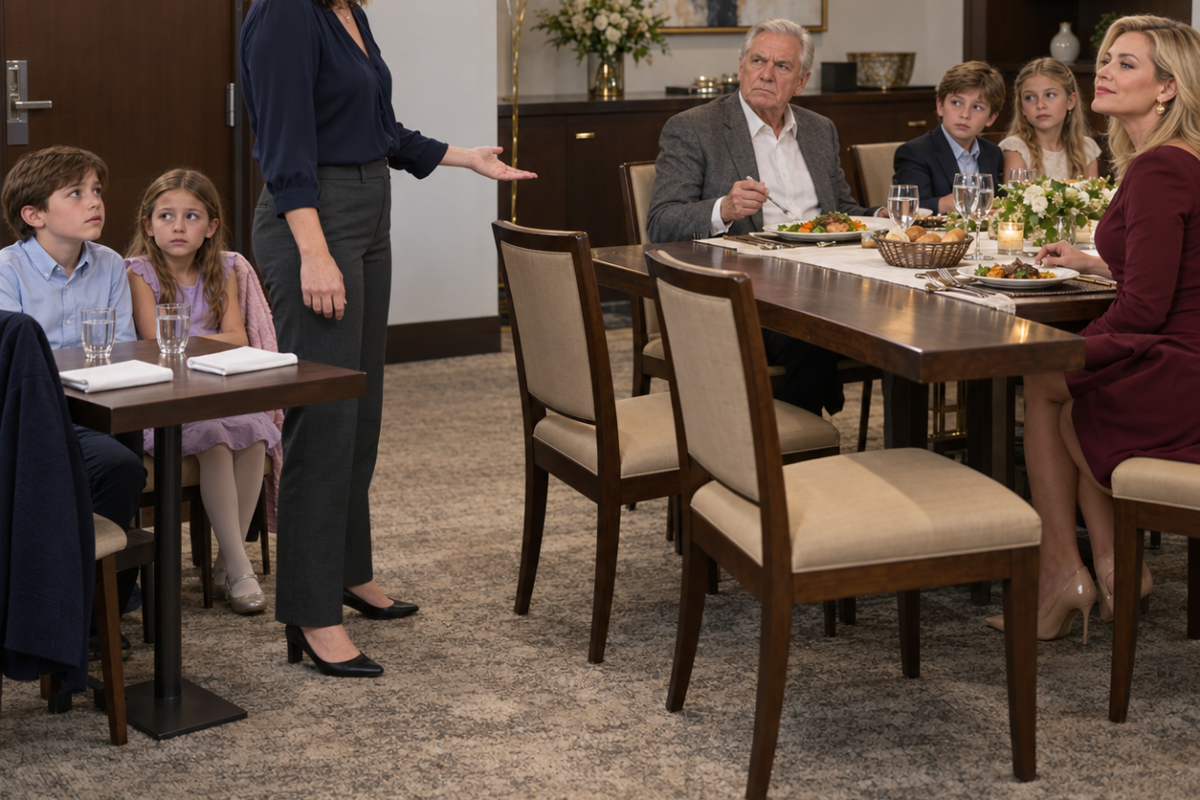
At my father’s seventieth birthday dinner, my eleven-year-old son and eight-year-old daughter were seated beside the service door with water glasses—but no dinner plates. Their cousins sat beside Grandpa with warm bread and full place settings. “They’ll eat after everyone else,” my sister said. I turned to my father, expecting him to object. “They can wait another hour,” he replied. There were two empty chairs at his table.
At my father’s seventieth birthday dinner, the first thing that stopped me wasn’t the cake or the gold balloons. It was my children. Ethan and…
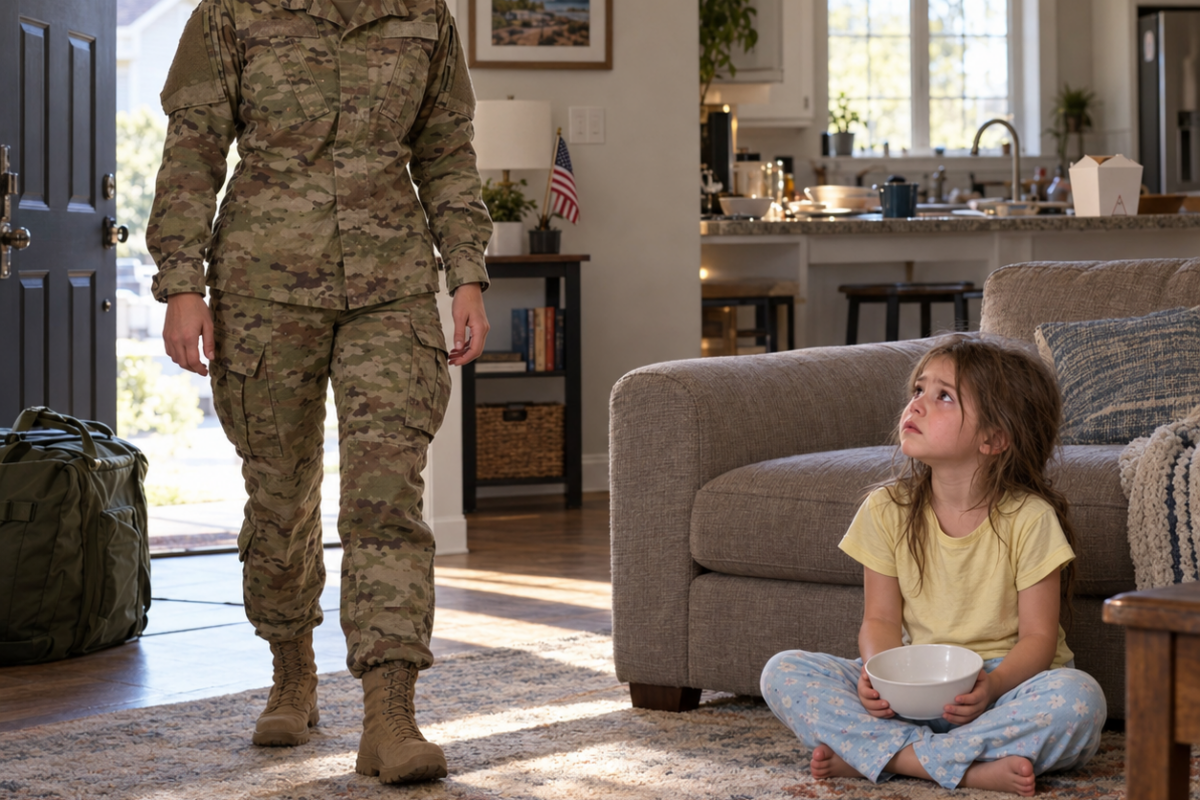
“Mommy, are you real?” my four-year-old daughter whispered when I came home from deployment three weeks early. She was sitting alone on our living room floor with an empty cereal bowl. My husband was on a Caribbean cruise with his mother and sister. Twenty-two minutes earlier, they had posted a photo captioned “Family time.” I was still in uniform when Sophie asked if she could have something to eat.
The first thing my daughter said when I found her was, “Mommy, are you real?” She was sitting cross-legged on our living room floor with…
End of content
No more pages to load