My bride pulled my seventy-seven-year-old mother out of our wedding photo because she said Mom made it “look cheap.” When Mom lost her footing and fell onto the platform, Brittany called security to remove her. But the man who stepped forward walked past my wife and stopped beside my mother. Every member of the event staff waited for his instructions.
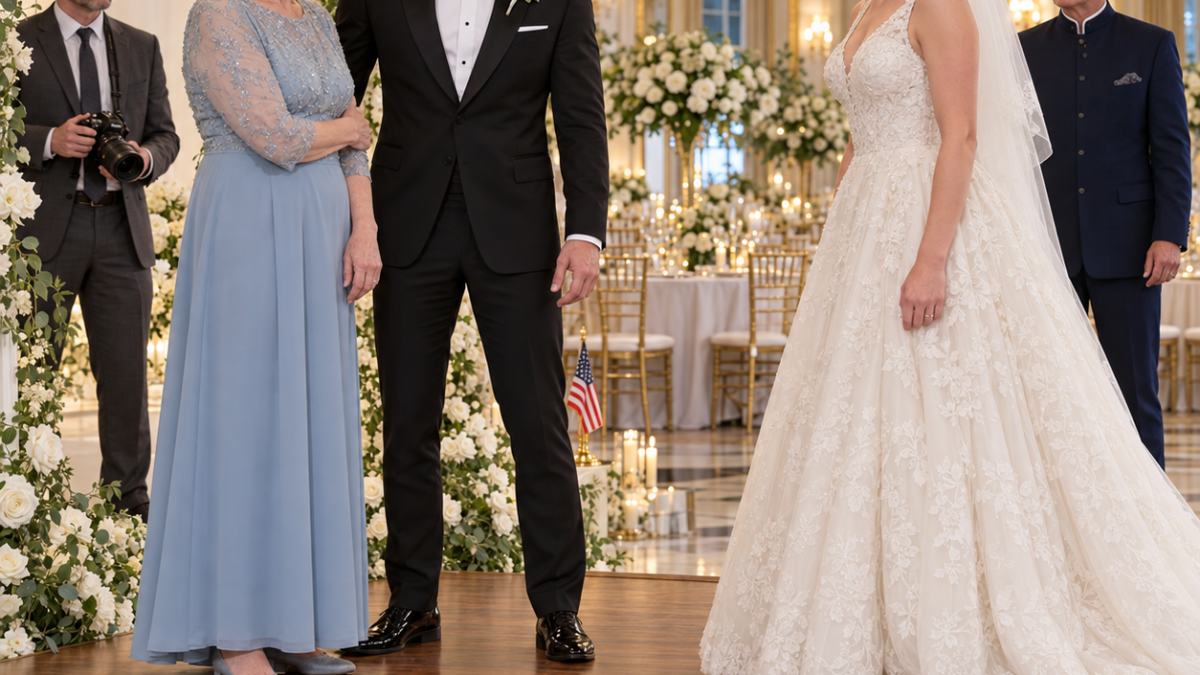
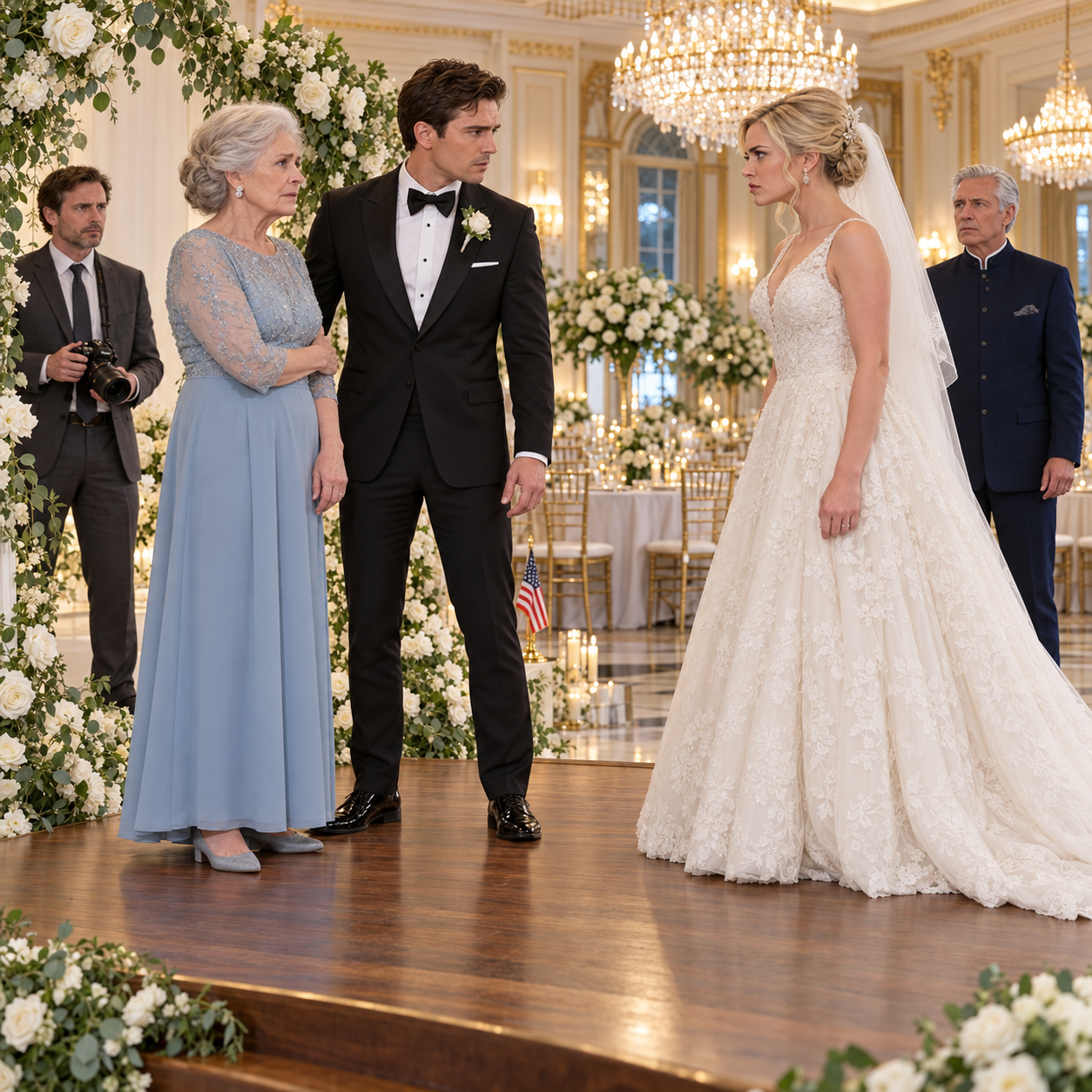
The photographer had just asked for the groom’s family when Noah extended his hand toward his mother.
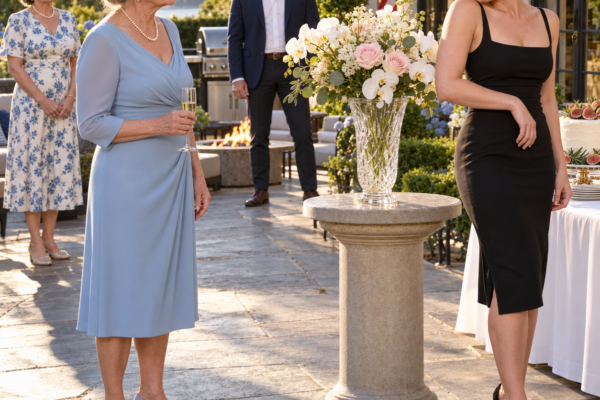
Grace was waiting at the edge of the platform in the pale blue dress they had chosen together. She smiled, almost shyly, and took a step toward him.
Brittany moved between them.
“We don’t need her in this one.”
The photographer lowered his camera.
Noah looked at his wife, then past her at Grace.
“That’s my mother.”
Brittany leaned closer, keeping the pleasant expression she had worn for most of the afternoon.
“She makes the picture look cheap.”
Grace heard her.
Noah knew because his mother’s eyes dropped to her dress. Her fingers touched the fabric near her hip, and the small smile disappeared from her face.
Then she did what she had done for most of his life when someone treated her badly.
She tried to make it easier for everyone else.
“It’s all right,” she said. “You two take your picture.”
“No,” Noah replied. “It isn’t.”
Grace began turning toward the steps.
Brittany caught her arm.
“Then please move out of the frame.”
The movement was quick and impatient. Grace twisted in surprise. Her heel slipped near the platform’s edge, and she reached for something that wasn’t there.
She fell onto the wooden floor beside the steps.
A glass shattered somewhere behind the front tables.
Noah dropped to his knees.
And less than an hour after saying his wedding vows, he began to understand the marriage he had entered.
That morning, Grace had spent almost twenty minutes deciding whether to wear the small silver earrings Noah bought her the previous Christmas.
They weren’t expensive.
He had chosen them because they looked like something she would wear rather than something a salesperson had persuaded him a mother ought to own.
She put them on, took them off, and put them on again.
Then she stood in front of the bedroom mirror and looked at the dress.
Pale blue.
Modest neckline.
Sleeves she liked.
Nothing that required her to spend the afternoon worrying about whether a strap had moved or a seam was sitting correctly.
Three months earlier, she rejected several dresses because they were “too fancy for an old woman.”
Noah told her there was no such thing as too fancy for his mother at his wedding.
She laughed.
“Wait until you see the prices.”
They finally found the blue one.
When she stepped out of the fitting room, Noah said, “That’s it.”
Grace looked at herself.
“You think?”
“I do.”
She bought it.
At home, she hung it where nothing would crush the fabric and kept the receipt in an envelope, although she had no intention of returning it.
That morning, she pressed the sleeves again.
She wanted to look nice.
Not impressive.
Nice enough that Noah would be pleased to see her.
That was the part he would think about later: the care she had taken for a day on which someone decided she lowered the value of a photograph.
Noah called before leaving for the venue.
“You ready?”
“Nearly.”
“You’ve been nearly ready since yesterday.”
“I don’t want to forget anything.”
“You only need yourself.”
“That sounds like something a man says before asking whether his mother brought safety pins.”
He laughed.
“Did you?”
“Of course.”
She had packed a small sewing kit, tissues, and the reading glasses she was always misplacing.
She also brought an old handkerchief that belonged to her mother.
There were things she wanted to carry into the day that no photographer would notice.
Her neighbor, Ruth, drove her.
Grace’s sedan was reliable, but Ruth said a woman should not have to worry about parking at her son’s wedding.
Grace protested once.
Then accepted.
She was trying to get better at that.
Accepting ordinary help without immediately calculating how she would repay it.
On the drive, Ruth told her she looked beautiful.
Grace glanced down at the dress.
“It’s simple.”
“I didn’t ask for a description.”
Grace smiled.
The weather was clear. The roads were quiet enough that they arrived early, and for a few minutes, Grace stood beneath the venue’s trees looking at the flowers near the entrance.
White roses.
Eucalyptus.
Small arrangements placed along the stone path.
It was lovely.
She wanted the day to be lovely.
That desire had made her overlook things she should have spoken about sooner.
Noah had met Brittany almost three years earlier.
He worked as a structural engineer. She worked in brand consulting, helping businesses present themselves clearly and attract customers who might otherwise pass them by.
At first, her attention to appearance seemed like part of her professional skill.
She noticed lighting.
Color.
The way a room made people feel.
She could take an ordinary gathering and make it look considered.
Noah liked that she saw possibilities he missed.
He also liked her energy.
Brittany could walk into a restaurant where she knew nobody and leave with the name of the manager, a recommendation for a better table, and three ideas about how the place could improve its website.
She made him laugh.
She remembered stories.
When he had a difficult week, she sent messages that made the day feel less heavy.
Those things had been real.
That mattered to him afterward, because remembering only cruelty would have made him feel foolish for loving her.
He had loved a woman who could be thoughtful and affectionate.
He had also explained away the places where her thoughtfulness stopped.
The first time Brittany visited Grace’s house, she stood on the porch a moment longer than Noah expected.
The house was small.
The neighborhood was ordinary.
Some lawns were neat. Some weren’t. Cars sat in driveways with repairs their owners had not yet completed.
Inside, Grace had cleaned, cooked, and put flowers in a jar because she did not own a vase she liked.
Brittany was polite.
She praised the food.
Asked about Noah as a child.
Smiled at the photographs.
On the way home, she said, “Your mom is sweet.”
Noah was pleased.
Then she added, “I don’t know how comfortable I’d be spending much time in that neighborhood.”
He frowned.
“What’s wrong with it?”
“Nothing. It’s just different from what I’m used to.”
He told himself that was reasonable.
People grew up differently.
Not every discomfort was contempt.
That was true.
It was also a useful truth to hide behind when the pattern became harder to ignore.
Brittany rolled her eyes when Grace called during dinner.
Sometimes Grace called too often.
Noah could acknowledge that.
His mother had spent years being the person he contacted whenever something went wrong. Learning to become less central in his daily life had not happened automatically.
When Brittany said they needed more time alone, he understood.
He spoke to Grace.
Grace apologized.
She began asking whether it was a good time.
The calls became shorter.
That should have helped.
Instead, Brittany found other things.
Grace’s old sedan.
The way she saved containers.
The leftovers she sent home.
The cardigan she wore to a restaurant because she worried she would be cold.
Each comment was small enough that challenging it felt disproportionate.
Noah said, “She’s practical.”
Brittany said, “I know.”
Then she made the same kind of comment again.
He called it a difference in personality.
Grace told him not to worry.
Brittany apologized just enough that the next evening could feel normal.
The engagement intensified everything.
The wedding needed to be perfect.
That was Brittany’s word.
Perfect invitations.
Perfect flowers.
Perfect timing.
Perfect photographs.
Noah wanted the wedding to be meaningful.
He thought those aims could coexist.
Often they did.
Then a decision would arrive in which meaning was treated as something appearance had to accommodate.
Grace offered to make a few small things for the reception.
Brittany said the event already had a design plan.
Noah understood that homemade decorations might not fit.
Grace withdrew the offer without complaint.
Then Brittany questioned her dress.
“You should help her choose something.”
“I did.”
“Something appropriate.”
“It is appropriate.”
Brittany smiled.
“I’m only trying to make sure she feels comfortable.”
Noah accepted the explanation because it sounded kind.
Now, kneeling beside his mother on the floor, he could hear how often comfort had meant making Grace less visible.
“Mom.”
Grace was holding her upper arm close to her body.
“I’m all right.”
“You fell.”
“I know.”
He moved closer without pulling her upright.
“Did you hit your head?”
“No.”
“Are you dizzy?”
“No. Just embarrassed.”
The answer hurt him.
Brittany remained beneath the floral arch.
Her hand was still half raised.
The photographer had put his camera against his chest and was looking toward the event coordinator.
A staff member hurried forward.
“I’m trained in first aid,” she said. “May I help?”
Noah moved enough to give her space.
Grace nodded.
The woman introduced herself as Dana and crouched beside her. She asked calm questions, checked what Grace could comfortably move, and made clear that an examination by a clinician would be sensible if pain continued.
Grace tried to dismiss it.
“It’s just sore.”
Dana did not argue about whether soreness was important.
She said, “Then let’s take our time.”
Noah looked up at Brittany.
“What did you just do?”
She glanced toward the guests.
“I was trying to get one family picture.”
“She was moving.”
“She was taking forever.”
“She was leaving because you told her to.”
Brittany straightened.
“She wasn’t supposed to be in that picture.”
“According to whom?”
Her expression hardened.
“We have a schedule.”
Noah stared.
The schedule.
Flowers.
Dinner.
Photographs.
His mother was sitting on the floor holding an arm she could not comfortably use, and Brittany was talking about the schedule.
Grace touched his sleeve.
“Honey, please.”
He turned toward her.
“It’s your wedding day. Don’t make this bigger.”
He almost laughed.
There was no humor in him.
This was not the first time his mother had tried to shrink her own injury so someone else could remain comfortable.
He remembered being nine when the electricity was shut off during a cold week.
Grace called it an adventure.
She found blankets, borrowed what she needed safely from a neighbor, and made sure he did not understand how frightened she was.
Years later, he learned that the problem had not been a forgotten payment.
It had been too many expenses and not enough money after his father left.
He remembered being seventeen and wanting to go on a school trip.
Grace said she had found extra in an envelope.
Only later did he learn she sold a necklace her mother gave her.
She had not told the story to make him feel indebted.
He discovered it through an aunt who assumed he knew.
Grace had said, “It was a necklace. You had a good trip.”
He had.
That did not make her choice insignificant.
She worked nights at a grocery store, accepted extra shifts, and learned how to sound cheerful when people treated service workers as though exhaustion proved incompetence.
Noah had seen the way customers spoke to her.
He had also seen her keep smiling because losing a job would cost more than swallowing the insult.
Now she was asking him to swallow one for her.
He could not.
Dana helped Grace assess whether she could move safely to a chair.
Noah stayed close.
They did not hurry.
When Grace stood, her face tightened with pain she tried to conceal.
He saw it.
Brittany saw it too.
She still did not step forward to help.
“You’re making a scene,” she said.
Noah looked at her.
“I’m making a scene?”
“You know what I mean.”
“No.”
She folded her arms.
“She doesn’t know her place.”
Several guests reacted.
A bridesmaid lowered her eyes.
Someone near the aisle said Brittany’s name softly.
Noah heard the hum of the air-conditioning and very little else.
He looked at the woman he had married less than an hour earlier.
Then he moved beside his mother.
“I know her place,” he said. “It’s beside me.”
The words carried farther than he intended.
Grace looked down.
He could feel her hand tremble.
Brittany stared at him as though he had disrupted a conversation whose ending she already knew.
She expected a private correction.
A request that she apologize.
A little discomfort followed by dinner.
Noah did not offer that ending.
Brittany inhaled sharply.
“Fine.”
She turned toward the guards who had moved nearer after Grace’s fall.
“Security. I want her removed.”
Noah’s anger became immediate and hot.
“What?”
“She’s disrupting the wedding.”
Grace’s shoulders lowered.
It was a small movement.
That made it worse.
Noah could almost see her preparing to become less present, to leave quietly, to let everyone say afterward that the incident had been unfortunate but manageable.
“She is my mother.”
“And I’m your wife.”
“That doesn’t excuse this.”
Brittany pointed toward the doors.
“Please escort her outside.”
The nearest guard did not move.
He looked toward Dana, who was arranging a chair, and then toward the coordinator.
There was an injured guest.
There was no reason to treat her as a threat.
Brittany’s voice sharpened.
“Did you hear me?”
Before he answered, a man stepped from a table near the back.
He was broad-shouldered, in his late fifties, with silver at his temples.
Noah recognized him from the reception line.
They had exchanged a brief greeting.
Brittany recognized him immediately.
“Mr. Ellis.”
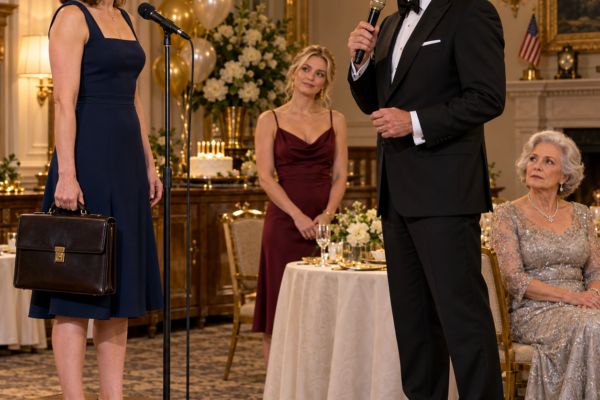
Martin Ellis owned the event company responsible for the reception and operated the venue with a professional staff.
He was not there to supervise every plate.
He had accepted the invitation after learning whose son was getting married.
Brittany knew him through professional connections and the planning process. She respected his company’s reputation and had been pleased he would attend.
Now she looked uncertain.
“There’s been a misunderstanding.”
Martin passed her without responding.
He stopped in front of Grace.
“Are you all right?”
She gave him the same small, embarrassed smile she had given Noah.
“Yes. It’s just sore.”
He looked at Dana.
“Do we need anything?”
“A quiet place to sit and an assessment if the pain continues,” Dana said.
“Of course.”
Then Martin looked at Noah.
“May we help your mother to the side lounge?”
Noah turned to Grace.
“What would you prefer?”
The question mattered.
For the first time since Brittany stepped between them, someone was asking Grace rather than assigning her a position.
“A chair,” she said. “I’d like a chair.”
They helped her sit nearby.
Martin asked staff to bring water and an appropriately wrapped cold pack while they arranged further care.
Brittany watched.
“Why are you asking her?”
The question came out before she seemed to understand what it revealed.
Martin turned.
“Because she was injured.”
“She fell.”
“I saw what happened.”
Brittany became quiet.
Noah looked from Martin to Grace.
“Do you know my mother?”
“Yes.”
Grace shifted uncomfortably.
“A long time ago.”
Martin’s expression softened.
“Not so long that I’ve forgotten.”
Noah remembered holiday cards.
A name his mother mentioned when he asked about a small business arrangement years earlier.
He remembered her dismissing it as though she had helped someone carry groceries.
He had not understood the scale of the gratitude.
Brittany looked at the guards.
“So you’re not going to remove her?”
Martin’s expression changed.
“No.”
“This is our event.”
“It is. And my staff will not remove an injured guest because you dislike her appearance.”
Her face reddened.
“That is not what I said.”
Noah looked at her.
“You said she made the picture look cheap.”
Several nearby guests went still.
Brittany glanced around.
She was becoming more aware of the audience than of Grace.
Martin asked the coordinator to pause formal proceedings.
Not to throw away meals.
Not to send employees home.
Not to make guests suffer for the bride’s behavior.
The scheduled speeches and photographs would stop while the situation was addressed. Staff would continue looking after guests and keep the area calm.
The coordinator nodded.
Brittany said dinner was due in ten minutes.
Martin replied, “We can manage ten minutes.”
Noah heard the quiet authority.
It was not power used to punish.
It was competence used to prevent the event from pushing past an injury simply because the timeline expected it.
Grace held the cold pack against her arm.
“I’m sorry,” she told Martin.
He looked at her.
“You have nothing to apologize for.”
“This is a lot of trouble.”
“It is not trouble to care for someone.”
Brittany turned away.
Noah watched her.
He wanted her to come back with a real understanding.
A question.
Concern.
Something that showed the woman he loved could see beyond the collapse of her plans.
Instead, she said, “We should talk privately.”
He looked at her.
“About what?”
“About how this has been handled.”
“You grabbed my mother.”
“I didn’t mean for her to fall.”
“But you meant to move her.”
She pressed her lips together.
“I wanted one picture.”
“Without her.”
The answer came quickly.
“Yes.”
Then Brittany seemed to hear it.
Her expression changed.
Noah felt something settle.
The fall had been frightening.
Calling security had been cruel.
But the intention beneath them was clear.
She looked at Grace and saw a person whose presence damaged an image.
Not a mother.
Not a guest.
Not a woman who loved her son.
An undesirable detail.
Grace said quietly, “I was leaving.”
The simplicity stopped Brittany.
There was no performance in Grace’s voice.
No effort to win.
She was correcting the story.
Brittany opened her mouth, then closed it.
Martin stayed near Grace.
He asked whether she wanted him to arrange transportation for medical care.
She began refusing.
Noah said, “Let’s have it checked.”
“Honey—”
“I’m asking, not deciding for you.”
Grace looked at him.
He waited.
Finally, she nodded.
“All right.”
That decision did not need to prove how serious the injury was.
It was enough that she was hurt.
Brittany stepped closer.
“Noah, we’re married.”
“I know.”
“We just said our vows.”
“I remember.”
“You said forever.”
He looked at her.
“I did.”
“Then don’t do something permanent because you’re upset.”
The sentence reached him.
He was upset.
He was also clear that the reception could not continue as though Grace had merely stumbled and everyone had been a little stressed.
He did not have to decide the entire marriage in front of two hundred guests.
He did have to decide what happened next.
He looked toward his mother.
Then toward Martin.
“Please stop the formal reception.”
Brittany inhaled sharply.
“You can’t.”
“I can stop participating.”
“My parents paid for half of this.”
“The contracts will be handled.”
“You’re humiliating me.”
Noah looked at Grace sitting in the chair.
Brittany followed his gaze.
For a moment, her expression faltered.
Then she said, “I’ll apologize.”
“Because you’re sorry?”
She looked toward the guests.
The hesitation was brief.
It was enough.
Noah removed the boutonniere from his jacket carefully so the pin did not catch the fabric.
He placed it on a nearby table.
The small white rose had been chosen because Brittany wanted symmetry in the photographs.
He had agreed.
It had seemed harmless.
Now he did not want to wear it while standing beside his mother’s pain.
Brittany began crying.
“What do you want from me?”
“I wanted you to respect her.”
“I do.”
“You described her as something that made the picture cheap.”
“That isn’t the same—”
“You told me she didn’t know her place.”
“I was angry.”
He looked at her.
“Then we need to understand why anger took you there.”
He did not deliver a neat sentence about anger revealing every person’s true nature.
He knew people could say things they regretted.
He also knew regret did not arrive simply because consequences did.
There was a pattern.
He had seen parts of it.
He could no longer pretend the parts were unrelated.
Martin looked at Grace.
“May I say something?”
She frowned slightly.
“You don’t need to.”
He waited.
Noah recognized the question beneath the words.
Permission.
Grace gave a small, reluctant nod.
Martin turned toward Brittany.
“Years ago, this company almost failed.”
Brittany stared.
“Two large clients cancelled within weeks. We were trying to keep employees paid and satisfy suppliers. Grace learned about it through someone we both knew.”
Grace looked at the cold pack.
Martin continued.
“She asked to see the records. She took advice. Then she made a carefully documented loan that allowed us time to recover.”
Noah remembered the conversation now.
His mother had called it an investment.
A modest business arrangement.
Something that worked out.
He had never known how close the company came to closing.
Brittany looked at Grace.
“You invested in this company?”
“A long time ago.”
“How much?”
Grace raised her eyes.
“That isn’t something I want discussed here.”
Martin nodded immediately.
“The amount is private. The arrangement was repaid. She has no ownership authority over this event company.”
Brittany looked almost relieved.
“Then—”
Martin stopped her with his expression.
“That does not change my gratitude.”
He looked at Noah.
“Your mother helped preserve jobs at a time when we had very few options. She never asked for public credit.”
Grace sighed.
“Martin.”
“I know.”
Noah looked at his mother.
He remembered the years after he finished college.
She worked fewer nights.
Saved more.
Finally had enough money that a broken appliance did not become a crisis.
He had worried about her investing any of it.
She told him she had not put everything at risk and had taken independent advice.
Now he understood the arrangement better.
She had not become secretly wealthy.
She had not owned the venue.
She had made a measured choice to help a business whose employees she knew about, and the choice succeeded.
That history explained Martin’s gratitude.
It did not explain why she deserved dignity.
Nothing needed to explain that.
Noah turned to Brittany.
“This changes nothing.”
She looked at him.
“What?”
“What you’ve just learned.”
“I didn’t know.”
“You didn’t need to.”
He could see the difference in how she was looking at Grace.
Interest replacing dismissal.
A question about money replacing the question she should have asked about pain.
Noah shook his head.
“She deserved respect before anyone in this room knew her name.”
Grace’s eyes filled.
Martin stepped back.
He understood.
The revelation was not supposed to become a rescue based on status.
Noah asked the coordinator whether guests could be informed that the formal program had ended.
She said yes.
Meals already prepared could still be handled according to the arrangements, and staff would assist people with practical needs.
There would be no first dance.
No speeches.
No cake cutting.
No family photograph completed by removing the groom’s mother.
Brittany stood beneath the flowers.
For the first time, the space looked too large around her.
Noah helped Grace toward the exit after Dana confirmed the immediate plan.
Ruth came forward.
She had been watching from several tables away and looked shaken.
“I can drive.”
Noah thanked her.
He would go with them.
Near the door, Grace stopped.
“You don’t have to choose me.”
He looked at her.
“I’m not choosing between you.”
“It feels like it.”
“I’m choosing what I’m willing to continue.”
She was quiet.
He lowered his voice.
“If I go back and pretend this was ordinary wedding stress, what happens next time?”
Grace looked down.
“What happens when you visit? When we have children? When somebody else doesn’t fit the picture?”
She said nothing.
“I should have asked those questions earlier.”
She touched his cheek with her uninjured hand.
“You’re asking now.”
Behind them, Brittany called his name.
He turned.
She had stepped down from the platform.
Her parents stood nearby, uncertain.
Her younger sister, Lena, held the bouquet.
Brittany looked at Grace.
“I’m sorry.”
Nobody spoke.
This time, she did not look toward Martin.
She did not check the guests.
“I was cruel.”
Grace held her gaze.
“Yes.”
Brittany swallowed.
“I don’t know why I let myself act like that.”
Grace’s expression softened without becoming forgiving.
“You’ll need to find out.”
The words were quiet.
They hurt Brittany because they were not an escape.
Noah looked at his wife.
“I’ll speak to you tomorrow.”
She nodded.
He did not promise to return to the reception.
He did not promise the marriage would recover.
He promised a conversation.
Then he opened the door.
The evening air was cool.
Grace walked slowly beside him.
Ruth brought the car closer.
Martin stayed near the entrance until they were safely on their way.
Inside, two hundred people began gathering coats and asking questions they would later answer differently depending on what they had seen.
The photograph remained unfinished.
At urgent care, Grace insisted the staff were busy and she could wait.
The receptionist told her they would determine that.
Noah sat beside her.
Ruth filled out the parts of the paperwork Grace asked her to fill out.
Nobody took the form from her simply because she was older or hurt.
Grace answered questions.
Noah supplied the sequence when asked.
His voice sounded unfamiliar when he described Brittany’s hand on his mother’s arm.
He tried not to exaggerate.
He did not need to.
The clinician examined Grace and arranged imaging because of where she hurt and how she had fallen.
No fracture was found.
There was bruising and a soft-tissue injury that would need care and follow-up if pain or movement problems persisted.
Grace looked relieved.
Noah did too.
Then he realized relief could become another way of minimizing.
No fracture did not mean nothing happened.
Pain was still pain.
Humiliation was still humiliation.
They received instructions specific to Grace’s examination.
Noah listened.
Grace asked questions.
The clinician spoke to her directly.
Afterward, while waiting for discharge information, she said, “Well. Not the evening we planned.”
Noah laughed once.
Then his face changed.
“I’m sorry.”
Grace looked at him.
“For what?”
“For not stopping it before today.”
She sat quietly.
He expected her to reassure him.
Instead, she said, “You saw some things.”
“Yes.”
“And I told you not to worry.”
“Yes.”
She looked toward the hallway.
“I was trying to keep peace.”
“So was I.”
“Maybe we were both using the word too easily.”
Noah swallowed.
He was grateful.
Not because she accepted blame for Brittany’s behavior.
Because she was willing to talk honestly about how they had both helped the warnings become background noise.
Ruth returned with water.
She took one look at them and said, “You can finish solving your lives after you eat.”
Grace smiled.
Noah nodded.
They stopped for food on the way home.
Not a grand symbolic dinner.
Takeout soup and sandwiches.
Something warm.
Something they could eat without wearing wedding clothes at a table full of strangers.
At Grace’s house, Noah helped carry the bags.
Ruth arranged to stay for a little while.
Grace asked him to sit rather than keep moving things that did not need moving.
He obeyed.
The small kitchen looked almost painfully familiar.
The table where he did homework.
The cupboard with mismatched mugs.
A repaired drawer that still caught if pulled at the wrong angle.
Brittany once said the room felt dated.
Noah had agreed that it could use updating.
Now he wished he had said it also held a life.
Grace ate slowly.
Her arm hurt more as the evening settled.
She did not hide it as well anymore.
That was good.
It meant he did not have to search every expression for the truth.
Ruth asked whether she wanted help changing into something comfortable.
Grace said yes.
Noah went into the living room.
His phone held enough messages to make the screen feel crowded.
Brittany.
Her mother, Linda.
Her father, Paul.
Friends.
A cousin.
The photographer.
The coordinator.
He answered only the messages that required practical information.
His mother had been evaluated.
He would contact people about arrangements.
No, he would not discuss the marriage by text that night.
He did not publish anything.
No photograph.
No account designed to win the first version of the story.
His mother’s fall had already become public enough.
He did not want the internet to turn her injury into entertainment.
When Grace returned, wearing a soft cardigan over comfortable clothes, she looked tired.
Noah stood.
“Sit.”
She gave him a look.
“You don’t need to become bossy because I’ve had a bad evening.”
He stopped.
Then he smiled faintly.
“Would you like the chair?”
“Yes.”
He moved it.
The difference was small.
It mattered.
He had spent the evening objecting to someone treating Grace as an object to arrange.
He could not protect her by arranging every next choice without asking.
After Ruth left, he told Grace he would stay the night.
She looked at him.
“Because I need help?”
“Partly.”
“And partly?”
He sat on the edge of the opposite chair.
“Because I don’t want to go home.”
She nodded.
Their apartment was now a home he shared with a woman he had married that afternoon.
The legal fact had not disappeared because the reception ended.
Neither had the practical problem.
He needed somewhere to sleep.
Grace was willing to offer it.
She was not willing to pretend that staying with her solved everything.
“You can stay tonight,” she said.
“Thank you.”
“Tomorrow, make a plan that isn’t just protecting me.”
He looked at her.
“I know.”
“Your marriage is yours to think about.”
“I know.”
She studied his face.
Then she reached for his hand.
“I love you.”
“I love you too.”
He slept badly in his old room.
The bed was shorter than he remembered.
The ceiling had a faint crack he recognized from childhood.
At three in the morning, he woke and reached for his phone.
He stopped before reading the messages.
Instead, he lay in the dark and remembered Brittany walking toward him during the ceremony.
Her smile.
The vows.
The way he had believed the difficult planning would be worth it once they were married.
He still loved pieces of her.
That did not make the pieces enough.
The next morning, Brittany called at nine.
He answered.
“How is she?”
“Sore. No fracture.”
Brittany exhaled.
“That’s good.”
“Yes.”
“I’m glad.”
He waited.
Then she said, “Can we talk?”
“Yes. Somewhere quiet.”
“Home?”
He considered it.
“All right.”
Grace was drinking tea when he came downstairs.
He told her where he was going.
She did not ask for details.
She said, “Listen carefully.”
He nodded.
“To her and to yourself.”
He looked at her.
“That second part has been harder.”
“I know.”
He kissed her cheek and left.
At the apartment, wedding bags sat near the door.
A garment bag hung over a chair.
Flowers stood on the counter, beautiful in a room where neither of them seemed to know what to do.
Brittany wore jeans and a sweater.
Without the dress, the situation felt more real.
There was no stage.
No audience.
No schedule to blame.
She looked at him.
“I’m sorry.”
He nodded.
“I need more than the word.”
“I know.”
They sat across from each other.
For a while, she described the day.
The pressure.
The timing.
A problem with the flowers.
Her mother’s concerns.
The photographs.
Noah listened.
Then he said, “Those things explain why you were stressed. They don’t explain why my mother looked cheap to you.”
Brittany lowered her eyes.
“I didn’t mean she was cheap.”
“You meant she made the picture look cheap.”
“Yes.”
He waited.
She looked up.
“I hear how bad that sounds.”
“Then what did you mean?”
She pressed her hands together.
“I had an image in my head.”
“An image where she wasn’t present.”
“In that photograph.”
“It was the groom’s family photograph.”
“I know.”
The admission was quiet.
Noah felt grief again.
Not sudden.
Heavy.
She said she wanted the photographs to look polished.
She thought Grace’s dress, posture, and uncertainty would stand out.
She thought she could redirect her without making a problem.
Then Grace moved slowly.
Brittany became impatient.
She reached for her arm.
“I didn’t want her to fall.”
“I believe that.”
Relief crossed her face.
He continued.
“But you decided her body was something you could move because she wasn’t moving fast enough.”
Brittany looked away.
“Yes.”
He let the silence remain.
Then he asked about security.
She cried.
“I wanted the situation to stop.”
“So you wanted her removed.”
“Yes.”
“After she was hurt.”
“I wasn’t thinking clearly.”
“What were you thinking?”
She struggled.
Finally, she said, “That everyone was looking at me.”
Noah looked at her.
There was the center of it.
Not the only thing wrong.
The thing that organized the rest.
His mother was injured.
Brittany was watched.
The watched person became more urgent than the injured one.
He said that.
She covered her face.
Then lowered her hands.
“Yes.”
He appreciated the honesty.
It did not make him comfortable.
It made the question more serious.
“What happens when something else goes wrong?” he asked.
“I’ll do better.”
“How?”
“I don’t know yet.”
That answer was better than a promise she could not explain.
He told her he would stay elsewhere for a while.
Not at Grace’s indefinitely.
With his friend Evan until he arranged something more stable.
Brittany looked frightened.
“Are you ending the marriage?”
“I’m not making every decision today.”
She nodded quickly.
He continued.
“But I’m not returning to normal because the X-ray was okay.”
“I understand.”
“I need to find out whether we can have a relationship where dignity doesn’t depend on who is watching.”
Brittany cried quietly.
He did not hold her.
Not because he wanted distance to hurt.
Because comfort could too easily become the part they remembered instead of the problem.
They discussed practical things.
Clothes.
Work.
The apartment.
Who would contact the venue about remaining matters.
Noah said he would speak to an attorney to understand his position.
Brittany flinched.
He explained that asking for advice did not decide the outcome.
It prevented confusion.
They were married.
That fact required clear thinking.
He would not pretend the reception had ended the legal relationship.
When he left, she said, “I do love you.”
He stood near the door.
“I know there is love here.”
Her face lifted slightly.
“I’m trying to understand what else is here.”
He went to Evan’s apartment.
Evan opened the door, took one look at him, and stepped aside.
The guest room was small.
There were books on the bed and a laundry basket in the corner.
Evan moved both.
“You can stay.”
“Thank you.”
“Do you want to talk?”
“Not yet.”
“Good. I’m terrible at wedding advice.”
Noah laughed despite himself.
It was the first laugh that did not immediately turn into pain.
Evan ordered food.
They watched a game neither cared much about.
The ordinary evening helped.
Noah did not need every person around him to turn his life into a lesson.
He needed somewhere to sit where nobody expected an immediate answer.
The venue contacted him the next day.
Martin wanted to know how Grace was doing.
The coordinator needed to discuss remaining arrangements.
Noah separated the conversations.
First, Grace’s health.
Then contracts and practical matters.
Staff had been paid.
Guests were served or assisted appropriately after the formal program ended.
Unused portions were handled according to the arrangements rather than thrown away in a symbolic act.
Noah appreciated that.
The people who cooked, carried plates, arranged flowers, and played music had not caused the harm.
Their work deserved payment and respect.
Martin also explained that the incident had been documented.
Statements from staff.
The sequence of events.
The response to the injury.
Any relevant recordings would be preserved under the venue’s procedures.
Noah asked that Grace be consulted about anything involving her image or account.
“Of course,” Martin said.
Then he added, “I want to be clear. My staff should have responded the same way if I had never met your mother.”
Noah sat straighter.
“Thank you.”
“We’re reviewing that with them.”
“I appreciate it.”
Martin had gratitude.
He also had responsibilities.
Noah wanted those kept separate.
His mother should not receive care because she once saved a business.
An injured guest should receive care because she was injured.
Grace’s arm remained painful during the following week.
She attended follow-up care.
There was bruising.
Some movement was uncomfortable.
She needed help with tasks she normally completed without thinking.
Ruth checked in.
Noah visited.
Grace accepted more assistance than she liked.
She also became increasingly clear about what she did not need.
“Please stop watching me lift my teacup.”
“I’m not.”
“You are.”
He smiled.
“It looks heavy.”
“It contains tea, Noah.”
He laughed.
She wanted him to understand that she was hurt, not transformed into a fragile object.
He tried.
The incident had frightened him enough that concern arrived before judgment.
He learned to ask.
Would she like groceries?
Help carrying laundry?
Company at an appointment?
Sometimes she said yes.
Sometimes she said no.
He accepted both.
That became part of the repair between them.
He had not grabbed her at the wedding.
But he had often decided she was fine because accepting her reassurance made life easier.
Now he needed to stop using reassurance as a substitute for attention.
One afternoon, he found her standing beside the wardrobe with the blue dress in her hands.
She looked startled.
“I was just putting it away.”
He looked at the fabric.
There was a faint mark near the hem from the floor.
“Do you want it cleaned?”
“I can arrange that.”
“I know. I’m offering.”
She nodded.
Then she sat down.
For a while, neither spoke.
Finally, she said, “I keep thinking about the moment I looked down.”
He swallowed.
“At the dress?”
“Yes.”
He waited.
“I knew I liked it. Then she said that, and suddenly I wondered whether I’d been foolish.”
Noah sat beside her.
“You weren’t.”
“I know.”
Her voice wavered.
“I know it now. But for a moment…”
She did not finish.
He understood.
Humiliation can make a person borrow the humiliator’s eyes.
It can make a familiar body, a chosen dress, or an ordinary room appear wrong.
Noah hated that Brittany had done that to her.
He also knew hatred would not remove the memory.
He asked whether she wanted to talk more.
Grace nodded.
They talked about the old comments.
The neighborhood.
The containers.
The calls.
Noah apologized for the times he explained them away.
Grace acknowledged how often she told him not to worry.
“I thought if I complained, you’d feel you had to choose.”
“I wish you had told me.”
“I did, sometimes.”
He looked down.
“Yes.”
“I also stopped sometimes.”
He nodded.
They could both be honest.
That did not divide responsibility for Brittany’s choices.
It clarified how those choices found room.
Brittany began individual counseling.
She told Noah, then did not send him summaries as though attending appointments should earn trust.
He appreciated that.
They met twice in public before agreeing to one session with a couples therapist.
The therapist, Dr. Mara Sullivan, made clear that the purpose was not to force reconciliation.
It was to understand what happened, what patterns existed, and whether continuing together could be chosen honestly.
Noah liked the clarity.
Brittany looked nervous.
During the first session, she described her need for the wedding to look right.
The photographs would be seen by colleagues.
Friends.
People whose approval mattered to her.
Dr. Sullivan asked what would happen if the photographs looked ordinary.
Brittany gave a small, embarrassed laugh.
“Nothing, probably.”
The therapist waited.
Then Brittany began crying.
She talked about growing up in a family where presentation often came before experience.
Her mother worried about what people would say.
Her father preferred that problems stay private.
A messy room could feel like failure.
An inexpensive choice could become a story about not trying hard enough.
Noah listened.
He could understand the history.
He also felt wary.
An explanation could become another way of making Grace’s injury secondary.
Dr. Sullivan seemed to understand.
“That may help explain why appearance carries so much weight for you,” she said. “It does not excuse how you treated Grace.”
Brittany nodded.
“I know.”
Then the therapist turned to Noah.
“What did you do before the wedding when you noticed the comments?”
He answered.
Explained.
Minimized.
Asked Brittany to be kinder without staying in the conversation long enough to understand what she actually believed.
Dr. Sullivan asked why.
“I wanted us to be happy.”
“And what did you decide happiness required?”
He thought.
“Not making things difficult.”
The therapist nodded.
“That can become a dangerous definition.”
Noah looked at Brittany.
For a moment, they recognized something they shared.
She avoided discomfort by controlling appearance.
He avoided it by translating harm into something manageable.
The pattern did not make their actions equal.
It made the relationship more complicated than one bad afternoon.
They attended several sessions.
Some were useful.
Some were painful.
Brittany became more honest.
She acknowledged that she had looked down on Grace’s way of living.
Not always consciously.
Not every moment.
But often enough that the wedding exposed a judgment already present.
Noah needed to hear that.
She also said there were legitimate concerns she had failed to express directly.
She wanted more privacy as a couple.
Fewer unplanned calls.
Clearer expectations about visits.
Noah acknowledged those concerns.
Grace could be loving and still need boundaries.
Brittany could want boundaries and still have no excuse for contempt.
The therapist kept those truths separate.
Noah was grateful.
He did not want reconciliation built on pretending his mother had never been difficult in any ordinary way.
He also did not want ordinary difficulty used to explain physical force and attempted exclusion.
During one session, Brittany said, “I thought if your mother were less present, we would feel more like our own family.”
Noah looked at her.
“There were ways to ask for that.”
“I know.”
“You chose to make her smaller.”
Brittany lowered her eyes.
“Yes.”
He felt grief again.
The honesty was meaningful.
It also confirmed something.
The problem was not that he failed to use the right reassurance.
It was that she had chosen a method he could not imagine trusting.
At the end of the session, they sat in the car separately for a while before speaking.
Then Noah said, “I don’t think I can continue the marriage.”
Brittany stared through the windshield.
“Because I’m admitting it?”
“No.”
He chose the next words carefully.
“Because I understand it better.”
She closed her eyes.
He continued.
“I’m glad you’re doing the work. I hope it changes your life. But I don’t think that work requires me to stay married while I wait to feel safe again.”
Brittany cried.
He did too, quietly.
The decision did not feel triumphant.
There had been love.
Plans.
Good days.
The fact that ending was right did not make the loss painless.
They spoke with separate attorneys.
Noah met Elena Ruiz, who explained the practical process without promising an easy shortcut because the marriage was brief.
An ugly reception did not make a legal marriage disappear.
The appropriate steps depended on their actual circumstances.
They would handle them.
There were no children.
No long accumulation of shared assets.
There was an apartment, purchases, accounts, and a future they had begun arranging.
Those things still required decisions.
Noah did not demand a dramatic punishment through the separation.
Brittany did not try to make Grace responsible in the legal process.
They disagreed about some costs.
The attorneys helped clarify them.
It took months.
Not two hours.
Not three days.
Real endings involve forms, waiting, signatures, and moments when a mundane question unexpectedly hurts.
Who would keep the dining table?
Who would close an account?
What should happen to gifts?
Noah learned that grief could arrive through a utility bill.
He also learned that resolving a bill could make the next day easier.
Grace did not celebrate when he told her the decision.
She sat quietly.
Then she asked, “Are you sure?”
“Yes.”
She nodded.
“I’m sorry it hurts.”
“So am I.”
“You can love someone and still know you shouldn’t live this way.”
He looked at her.
“You sound like you’ve had time to think about that.”
She smiled sadly.
His father had left years earlier.
Grace had never given him every detail.
She did not need to.
Noah understood that she knew something about the difference between love and a workable life.
He asked whether she blamed herself.
She hesitated.
“Sometimes.”
“It wasn’t because of you.”
“I know that when I think carefully.”
“And when you don’t?”
“I remember you standing in a tuxedo, looking hurt.”
He moved closer.
“I was hurt because of what happened. Not because you were there.”
She nodded.
He continued.
“If it hadn’t happened at the photograph, it might have happened somewhere else.”
Grace looked at him.
He did not say that to make the fall useful.
The fall should not have happened.
He wished it hadn’t.
But the relationship’s problems existed before it.
That truth helped both of them stop treating Grace’s presence as the cause.
Martin visited Grace once during her recovery.
He called first.
Asked whether the timing suited her.
Brought flowers she actually liked rather than a large arrangement she would have to find somewhere to put.
Noah was there.
For a while, they talked about ordinary things.
Martin’s wife.
The company.
Employees who had stayed through the difficult years.
Then Noah asked about the loan.
Grace sighed.
“You two are determined to make that sound larger than it was.”
Martin smiled.
“It was large to us.”
He explained the business crisis more clearly.
Grace’s friend Ruth knew someone employed by the company.
When cancellation and debt threatened closure, word reached Grace.
She did not write a check because a sad story frightened her.
She asked questions.
Reviewed records with someone who understood them.
Insisted on clear terms.
Provided a limited amount she could afford to put at risk without sacrificing her basic security.
It had still been a risk.
She knew that.
The company recovered.
Repaid the loan according to the arrangement.
Continued sending cards because Martin did not think repayment erased gratitude.
Noah looked at his mother.
“You never told me you asked to see the books.”
Grace looked mildly offended.
“I wasn’t going to hand somebody money because he looked worried.”
Martin laughed.
Noah did too.
For years, he had described her as kind.
He was beginning to remember that kindness could also be practical, skeptical, and firm.
She was not simply the woman who sacrificed.
She was a person who made choices.
Sometimes cautious.
Sometimes brave.
Sometimes stubborn.
He wanted to know more of that person.
After Martin left, Grace said, “I didn’t like everyone finding out at the wedding.”
“I know.”
“It made it sound as though that was why he stopped Brittany.”
“He said his staff should have responded the same way regardless.”
“Good.”
She nodded.
Then she added, “I don’t want to be somebody’s surprise important woman.”
Noah smiled.
“You’re already important.”
“To you.”
“To yourself, I hope.”
Grace looked at him.
That was not a question he had asked before.
She thought for a moment.
“I’m working on it.”
“So am I.”
The photographer contacted Noah about the images.
His name was Alex.
He had stopped photographing when the incident occurred, though relevant material from the event had been preserved appropriately.
He asked what Noah wanted done with the wedding photographs.
Noah did not know.
Alex offered time.
There was no requirement to choose an album immediately.
Noah appreciated that.
Weeks later, he reviewed a small selection.
The ceremony photographs hurt.
Brittany looked joyful.
He did too.
He could not pretend the joy had been entirely false.
There were other pictures.
Grace arriving.
Ruth beside her.
Noah adjusting a place card.
A candid image of him laughing while Grace fixed something near his cuff.
He saved those.
Then he found the photograph taken seconds before the family arrangement.
His hand was extended.
Grace was looking toward him.
The pale blue dress caught the light.
She looked beautiful.
Not because the lighting had transformed her.
Because it showed the warmth in her expression before someone told her to disappear.
Noah kept that photograph.
He did not post it with a long account of what followed.
He printed it.
Put it in a simple frame.
The picture did not need revenge attached to it.
It contained the thing he wanted to remember.
His mother moving toward him because she believed she belonged.
A few guests apologized.
Some admitted they had remained silent because the moment seemed too strange to interrupt.
Noah understood shock.
He also knew silence had felt lonely from the floor.
He accepted sincere apologies without pretending the response had been ideal.
He did not demand everyone take a public side.
He asked that they not circulate recordings or photographs of Grace’s fall.
Most respected that.
Where material appeared, he and the venue took appropriate steps to request its removal.
Grace deserved privacy.
Her pain was not a useful wedding story for strangers.
That became one of Noah’s firmest decisions.
He did not want dignity protected in the room and then traded away online.
Brittany sent Grace a letter after several months.
She asked first through Noah whether Grace would be willing to receive it.
Grace considered.
Then said yes.
The letter did not describe stress as an excuse.
It acknowledged the comments before the wedding.
The judgment about the dress.
The grab.
The fall.
The security demand.
Brittany wrote that Grace had been treated as a problem to remove and that this had been cruel.
She did not ask Grace to help save the marriage.
She did not ask for an answer.
Grace read it twice.
Then put it away.
Noah asked how she felt.
“Tired.”
He nodded.
“And relieved that she finally described it accurately.”
“Do you want to answer?”
“Not yet.”
He accepted that.
A month later, she wrote back.
The response was short.
She appreciated the acknowledgment.
She hoped Brittany continued the work she had begun.
She was not ready for a meeting.
Noah did not read more than Grace chose to share.
The relationship between the two women was not his to manage into a neat ending.
He had spent too long smoothing things over.
Now he could allow some matters to remain incomplete.
Grace’s physical recovery went well overall.
There were uncomfortable weeks.
Exercises and appointments.
Days when the arm reminded her of what happened before her mind had gone there.
Eventually, ordinary movement became easier.
She could carry groceries without calculating which side would hurt.
She could brush her hair comfortably.
She could sleep without waking because she turned awkwardly.
She told Noah each improvement.
He tried not to make them into celebrations she had to perform.
Sometimes he said, “Good.”
Sometimes they simply moved to another subject.
Life needed room to become larger than recovery.
Grace started attending a weekly community class she had considered before the wedding.
Watercolor.
She said she wanted something where the result did not need to be useful.
Noah liked that.
For decades, her time had been organized around utility.
Work.
Food.
Bills.
His needs.
A painting could exist because she enjoyed making it.
The first one looked like a field interrupted by an accident involving blue paint.
She showed him.
He looked carefully.
“Is that a river?”
“It was supposed to be.”
“I like it.”
“You’re being kind.”
“I can be kind and still like it.”
She smiled.
Then she put it on the refrigerator.
The blue dress was cleaned.
The mark near the hem came out.
For a while, it stayed in the wardrobe.
Then Grace wore it to a dinner celebrating Ruth’s retirement.
Noah saw her before they left.
He stopped.
She noticed.
“What?”
“Nothing.”
She looked down.
“This dress doesn’t belong to that day forever.”
His throat tightened.
“No.”
“It fits. I like it. I’m wearing it.”
He smiled.
“You look beautiful.”
She accepted the compliment.
No waving it away.
No description of how simple it was.
“Thank you.”
That answer pleased him more than he expected.
At the retirement dinner, nobody thought the dress made anything look cheap.
People complimented the color.
Grace laughed.
Talked.
Ate dessert.
The evening did not erase the wedding.
It gave the dress another memory.
Noah needed those kinds of memories too.
After the legal separation was finalized, he moved into a modest apartment of his own.
He did not rush into dating.
He worked.
Spent time with friends.
Learned how much of his previous life had been organized around preventing disagreement.
A disagreement with a colleague could now feel less threatening.
He asked questions.
Said when he did not understand.
Stayed in conversations instead of reaching for the quickest way to restore calm.
Therapy helped.
So did ordinary practice.
He could disagree without being cruel.
He could set a boundary without making the other person a villain.
He could acknowledge his mother’s needs without allowing her to decide every part of his life.
Those skills belonged together.
Grace practiced too.
She called less automatically.
Asked before visiting.
Stopped treating his disappointment as something she needed to fix.
When he had a bad day, she asked whether he wanted advice or company.
Sometimes he wanted neither.
She learned not to hear that as rejection.
Their relationship became less dependent on the old arrangement in which she protected him by making herself small.
He could be her son without remaining her entire purpose.
She could be his mother without absorbing every cost.
One afternoon, he visited and found her at the kitchen table with a notebook.
“What’s that?”
“A trip.”
“Where?”
She told him.
A short trip with Ruth and two friends.
Nothing elaborate.
Nothing that required permission.
Noah smiled.
“That sounds good.”
“It does.”
“When?”
She gave the dates.
He checked his own calendar automatically.
Then stopped.
She noticed.
“You’re not going.”
“I know.”
“I wasn’t asking whether it worked for you.”
“I know.”
They laughed.
For years, their plans had involved each other so thoroughly that separate enjoyment still required adjustment.
They were making it.
Brittany’s parents contacted Noah only about remaining practical matters.
Linda initially described the incident as a terrible wedding misunderstanding.
Noah corrected that once.
Grace had been insulted, physically moved, injured, and told to leave.
Those were actions.
Not a misunderstanding.
Paul eventually acknowledged that.
He wrote that he was sorry he had not intervened sooner.
Noah appreciated the admission.
He did not build a new relationship around it.
Some people belonged to a chapter that had ended.
He could wish them well without keeping every door open.
Brittany continued counseling.
Noah heard that through the limited communication required while matters were finalized, then stopped receiving updates.
He hoped she changed.
He did not need the hope to become an obligation.
That was one of the hardest distinctions.
A person can sincerely regret harm.
The relationship can still end.
Both can be true without making the apology meaningless.
One evening, months after the divorce, he saw her by chance outside a café.
They stopped.
For a moment, each looked as though they were deciding whether to pretend they had not noticed.
Then Brittany said hello.
He answered.
She asked how Grace was.
“Much better.”
“I’m glad.”
He nodded.
She looked different.
Not transformed.
Simply less composed in the careful way he remembered.
She said, “I still think about that day.”
“So do I.”
“I wish I had understood before I hurt her.”
He looked at her.
“I hope you understand now.”
She nodded.
“I’m trying.”
He believed her.
He did not feel the need to test the belief by returning.
They spoke for another minute.
Then said goodbye.
Noah walked away feeling sad but steady.
That was new.
The memory no longer required either anger or reunion.
It could remain a loss he had survived.
Near the anniversary of the wedding, Martin invited Grace and Noah to a small dinner with several longtime employees.
Not a public honoring ceremony.
Not a promotional event.
A meal.
Grace was hesitant.
Martin told her there would be no speeches about the loan unless she wanted them.
She said she did not.
He kept the promise.
They ate in a room far smaller than the wedding hall.
People discussed children, work, repairs, and one employee’s disastrous attempt to grow tomatoes.
Grace laughed.
Noah watched her.
The company connection no longer needed to make her important.
It was one relationship among several.
At the end, Martin asked privately whether she had felt comfortable.
“Yes.”
“Good.”
She looked at him.
“Thank you for not making me explain myself.”
He smiled.
“I learned something about that.”
“So did we,” Noah said.
They left together.
The night was warm.
Grace moved easily now.
No cold pack.
No guarded arm.
No need for him to hover.
He stayed beside her anyway.
Not because she might fall.
Because he liked walking with his mother.
Later, she asked whether he wanted to take a new photograph.
He looked surprised.
“What kind?”
“Nothing fancy.”
“Where?”
She glanced toward the garden outside her house.
“There.”
He agreed.
Ruth came over the following weekend.
She brought her phone and said she refused to become responsible for professional lighting.
Noah said ordinary light would be fine.
Grace wore the pale blue dress.
He wore a clean shirt.
They stood near the flowering shrub she had planted years earlier.
At first, Grace positioned herself slightly away from him.
Noah noticed.
He did not pull her closer.
He held out his hand.
She looked at it.
Then took it.
Ruth lifted the phone.
“Ready?”
Grace looked toward Noah.
He smiled.
“Yes.”
The photograph showed a small garden.
A modest house in the background.
Two people standing close enough that the relationship between them was obvious.
Nothing looked expensive.
Nothing needed to.
When Ruth showed them the image, Grace studied it.
Then she said, “That’s a good picture.”
Noah nodded.
“It is.”
She looked at him.
“I don’t look awkward?”
He smiled.
“You look like yourself.”
She considered that.
Then nodded.
“That will do.”
He printed the photograph and placed it beside the earlier one from the wedding.
For a while, he wondered whether keeping both made sense.
Then he understood that they showed different things.
The first showed the hand he offered before he knew what would happen.
The second showed his mother taking it after they had both learned how much could change.
Neither needed a bride, a floral arch, or a company owner to complete it.
At the next family gathering, Grace sat comfortably at the table.
Someone asked about her trip.
She told a story in which she was funny, annoyed, and entirely separate from being Noah’s mother.
He enjoyed hearing it.
Later, she caught him watching her.
“What?”
“Nothing.”
“You keep saying that.”
“I’m glad you went.”
“So am I.”
She turned back to the conversation.
He let her.
There had been a time when he thought protecting Grace meant keeping her close enough that nothing unpleasant could happen.
Now he understood that protection had limits.
He could intervene when harm occurred.
He could listen.
He could refuse to normalize contempt.
He could not make her life free of every risk.
He did not need to.
She had lived a full, difficult, capable life before he understood how much of it existed beyond him.
Respecting her meant seeing that.
The wedding remained part of their history.
They did not pretend otherwise.
Sometimes a raised platform made Grace cautious.
Sometimes an impatient hand on someone’s arm made Noah react before he could think.
They talked when they needed to.
They moved on when they could.
There was no final day when the memory disappeared.
There were more days when it did not dominate.
That was enough.
One Sunday, Noah came for dinner and found Grace setting the table.
He asked whether she wanted help.
“Yes. Glasses.”
He took them from the cupboard.
The mismatched ones.
She had never replaced them simply because they did not form a perfect set.
He placed them beside the plates.
Then looked around the kitchen.
The room still needed updating in practical ways.
A drawer stuck.
One light was unreliable.
The floor showed years of use.
He could help with those things without pretending age or wear made the room unworthy.
Grace brought food to the table.
They sat.
Halfway through dinner, she asked whether he was happy.
He thought about it.
“More often.”
She nodded.
“That’s a good answer.”
“What about you?”
She smiled.
“More often too.”
They ate.
Talked about work.
Discussed the trip she wanted to take next.
When he left, he hugged her carefully, though her arm no longer required the caution.
She laughed.
“I’m not made of glass.”
“I know.”
“Do you?”
He smiled.
“I’m learning.”
She kissed his cheek.
He walked to his car.
Before getting in, he looked back.
Grace stood in the doorway, one hand resting on the frame.
The house behind her was small.
The porch light was ordinary.
Her cardigan was old.
Nothing about the scene looked like a photograph designed to impress strangers.
It looked like home.
Noah raised a hand.
Grace raised hers.
Then he got into the car and drove away, carrying the quiet certainty that had taken him far too long to recognize.
His mother had never been the person who did not belong in the picture.
She had been the person who made the picture possible.
News
At my seventy-second birthday party, my daughter-in-law knocked a crystal vase off its pedestal with her elbow, watched it shatter, and smiled. “Oops.” Her own parents had given it to her and my son on their wedding day six years earlier. I looked at Frank, waiting for him to say something. All he managed was, “Mom…”
I watched my daughter-in-law break her own parents’ wedding gift with one elbow and a smile. For months afterward, people asked me whether I was…

I came home three hours early and found my sixty-eight-year-old mother on her knees scrubbing my mother-in-law’s bathroom. When I helped her stand, her sleeve slipped back, revealing dark marks around her wrist. My husband stepped into the doorway. “Daniela, don’t make a scene.” That was when I remembered my father’s last warning: “If you ever see your mother hurt, don’t argue with anyone. Open the hidden compartment in her sewing machine.”
I came home three hours early and found my sixty-eight-year-old mother on her knees beside a toilet. Her hands were stiff with arthritis. One gripped…
“I already promised your house to your sister,” my father told me four days after I bought it. “They’re moving in Monday. Rent-free for three years.” I was thirty-one, had saved for nine years, and had bought the five-bedroom home entirely in my own name. When I said no, he threatened to tell the family I had abandoned my sister’s children. Days later, he took the microphone at my grandmother’s seventy-fifth birthday dinner and did exactly that.
My father called twelve times in forty minutes after discovering I had bought a house without consulting him. When I answered, he didn’t ask whether…
My mother leaned across the restaurant table, looked at my thirteen-year-old adopted daughter, and whispered, “We don’t sit with mistakes.” I took Sole’s hand and walked her out. That night, my father texted, “You’re still making the car payment tomorrow, right?” By midnight, I had canceled the payments I’d been making for my family. Then I remembered something Sole had told me about her grandmother.
My mother looked at my thirteen-year-old daughter and whispered, “We don’t sit with mistakes.” She said it softly enough to avoid attracting attention from the…
At my father’s seventieth birthday dinner, my eleven-year-old son and eight-year-old daughter were seated beside the service door with water glasses—but no dinner plates. Their cousins sat beside Grandpa with warm bread and full place settings. “They’ll eat after everyone else,” my sister said. I turned to my father, expecting him to object. “They can wait another hour,” he replied. There were two empty chairs at his table.
At my father’s seventieth birthday dinner, the first thing that stopped me wasn’t the cake or the gold balloons. It was my children. Ethan and…
“Mommy, are you real?” my four-year-old daughter whispered when I came home from deployment three weeks early. She was sitting alone on our living room floor with an empty cereal bowl. My husband was on a Caribbean cruise with his mother and sister. Twenty-two minutes earlier, they had posted a photo captioned “Family time.” I was still in uniform when Sophie asked if she could have something to eat.
The first thing my daughter said when I found her was, “Mommy, are you real?” She was sitting cross-legged on our living room floor with…
End of content
No more pages to load