“Move your things upstairs. I need you out of my room by eleven,” my mother-in-law told me three days after we bought our new house. My husband said, “She’s my mother, Linda. Show some respect.” At 10:55, Carol arrived with a moving truck, expecting our primary bedroom to be ready. Then she saw the man waiting beside my dining table. “Why is he here?”


At 8:17 on a Thursday morning, my mother-in-law called to tell me I had less than three hours to empty my bedroom.
Not a guest room. Not a room we had discussed lending her for a weekend.
The downstairs primary bedroom in the house my husband and I had bought three days earlier.
“The upstairs room will be perfectly fine for you and Mark,” Carol said. “I need you to have everything moved before eleven.”
I stood among half-open boxes, holding a pillowcase I had been looking for since the previous afternoon.
“Move everything where?”
“Upstairs, Linda. Please listen.”
“Why?”
There was a brief silence, the kind Carol used when she thought someone was being slow on purpose.
“Because I’m moving in today.”
At that moment, my husband appeared in the doorway carrying two cups of coffee. I put his mother on speaker and watched his expression change.
He did not look surprised.
He looked caught.
By 10:55, a moving truck was parked outside our house. Carol walked through the front door carrying her purse and a small orchid, expecting to find her furniture going into my bedroom.
Instead, she saw a man waiting beside the dining table.
She stopped so abruptly that the orchid tilted in her arms.
“Why is he here?”
That was the moment my husband’s carefully separated stories finally entered the same room.
My name is Linda Mercer. I was fifty-three, and until that Thursday, I had believed buying a new house would be one of the happiest milestones of my life.
The house was not extravagant. It had four bedrooms, a fenced backyard, a screened porch, and a bright kitchen with enough counter space that I could make dinner without moving the toaster twice.
The downstairs primary bedroom had been the deciding factor. After years of carrying laundry upstairs and living around a bathroom barely wide enough for two people, I wanted a bedroom that felt calm. It had two windows facing the backyard and a bathroom with a shower large enough that I would no longer bang my elbow against the glass.
There was another downstairs bedroom, smaller, near the hall bathroom. Upstairs were two rooms we planned to use as an office and a guest room.
Nothing about that arrangement had been mysterious.
Mark and I had walked through the house together. I had stood in the primary bedroom and said, “This is the one.”
He had smiled.
“Then let’s make it happen.”
I found the property, negotiated the offer, worked through the inspection, and communicated with the lender. Mark came to the appointments he could manage between construction jobs, but most of the paperwork came through me.
Three days before Carol’s call, I sat at closing signing documents until my wrist hurt.
Much of the money came from an inheritance.
Years earlier, my aunt had left me a small duplex. It was not glamorous. One unit had a kitchen floor that never quite looked clean, no matter how often it was washed. The other needed a new water heater almost immediately after I inherited it.
But it was mine.
I maintained it, rented it, and saved what I could. Eventually, I sold it and combined the proceeds with my own savings to help purchase our new home.
Mark contributed to our household too. He owned Mercer Custom Building LLC and had worked hard throughout our eighteen-year marriage. I would not pretend otherwise merely because I was angry later.
He knew his trade. He could look at a wall and tell you why a crack had appeared. He remembered customers’ children and helped neighbors with small repairs without always sending an invoice.
I loved those things about him.
We had also agreed that the money from my inheritance would remain protected as mine. Before closing, I made sure that agreement was reflected in the paperwork prepared for our particular situation.
I did not think that made me distrustful.
I thought it made us adults.
The morning Carol called, I was looking forward to unpacking the kitchen after work. I had taken a few days off from my administrative job at a medical practice, and that Thursday was supposed to be my final day at home before returning.
I planned to find the casserole dishes, buy groceries, and perhaps sit on the screened porch that evening.
I did not plan to defend my right to sleep in the room I had chosen.
Carol explained that her knee had been bothering her. Stairs were inconvenient. The primary bathroom had the nicest shower. She was tired of living alone.
Therefore, the room should be hers.
I looked at Mark.
He set the coffee cups on a box.
“Did you know about this?” I asked.
Before he answered, Carol did.
“Of course he knew.”
Mark sighed.
“Linda, she’s my mother. Show some respect.”
For a few seconds, I could only stare at him.
“I am showing respect. I’m asking why your mother believes she can move into our new house and take our bedroom without discussing it with me.”
Carol made an impatient sound.
“We don’t need to make this complicated. Have it ready by eleven.”
“What happens at eleven?”
“The movers arrive.”
I stood.
“Movers?”
“I’m not carrying a bed myself, Linda.”
Her tone suggested the practical problem was my failure to anticipate furniture delivery, rather than the fact that she had scheduled an entire move without asking me.
“Carol, you own a condo.”
“And I’m tired of being there by myself.”
“That doesn’t explain this.”
“Mark said it was handled.”
I turned toward my husband.
He looked at the floor.
For eighteen years, Mark had handled things in a particular way.
His mother changed Thanksgiving plans after we had already bought groceries.
“Just go with it.”
She invited relatives to stay without asking me.
“It’s only a few nights.”
She reorganized the kitchen and threw away containers she considered unnecessary.
“She was trying to help.”
She criticized the curtains, the food, the way I planned a holiday.
“She means well.”
Each incident had been small enough that objecting could be made to look unreasonable.
A meal.
A weekend.
A drawer.
A preference.
Over time, I became skilled at surrendering those things before the argument fully formed.
But now I was standing in a bedroom surrounded by boxes that contained my life, while my husband’s mother instructed me to move aside.
I did not move.
“Carol, I have not agreed to this.”
“Then speak to your husband. I have a truck scheduled.”
She ended the call.
I looked at Mark.
“Why does she think she’s entitled to live here?”
He picked up one of the coffee cups, then put it down without drinking.
“She helped us.”
“With what?”
“Money.”
The room seemed to become smaller.
“What money?”
He rubbed his forehead.
“It’s not as simple as you’re making it.”
“I haven’t made it anything. I asked a question.”
“Her situation is changing. She wants to be near us.”
“What money, Mark?”
He tried again to talk about her knee, the size of the house, and the fact that family helped family.
I called Carol back.
She answered on the first ring.
“Now what?”
“How much money did you give Mark?”
“Seventy-five thousand dollars.”
I looked directly at him.
Carol continued speaking. She said he had promised that if she contributed seventy-five thousand dollars toward the house, she would never have to worry about housing again.
She had understood the money to secure a permanent place with us.
The downstairs bedroom was part of that understanding.
I knew every dollar involved in the closing.
Earnest money.
Down payment.
Fees.
Taxes.
The transfers had been documented, verified, and reviewed.
Carol’s money had never touched the purchase.
“Mark,” I said, “where is your mother’s money?”
He stood very still.
Then he answered.
“My business needed it.”
I did not shout.
That surprised me later.
I had imagined, over the years, that a serious betrayal would make me loud. Instead, I felt my thoughts become precise.
“Needed it for what?”
“Payroll. Suppliers. A project stalled. Two clients are late. I had to keep things moving.”
“Did your mother know she was financing your company?”
He said nothing.
Carol was still on speaker.
“Mark?”
He closed his eyes.
“I was going to put it back.”
That sentence told me more than the explanation before it.
He had taken money his mother believed would purchase housing security and used it to cover business expenses.
Then he promised her space in our house because he assumed I could be pressured into supplying the part of the arrangement he had not paid for.
I looked around the bedroom.
The room had become collateral in a conversation I had never attended.
Carol demanded an explanation.
Mark asked her to wait until she arrived.
She said the movers were already loading.
“Don’t bring furniture into the house,” I told her. “We need to sit down first.”
“I have paid for those movers.”
“And I haven’t agreed to a move.”
“Linda—”
“Bring your records. The wire receipt. The messages.”
She went quiet.
Then she said, “I keep everything.”
Naturally.
After she hung up, Mark began talking faster.
He said the company had temporary cash-flow problems. He said a commercial renovation had been delayed by decisions outside his control. He said people depended on him.
I knew some of that could be true.
Construction work could leave a business waiting for payment while wages, insurance, equipment costs, and supplier bills continued.
What I did not understand was why I had heard none of it.
“How long has the company been struggling?”
“It’s not struggling.”
“You just used seventy-five thousand dollars of your mother’s retirement money.”
“It was a bridge.”
“Then why did you call it money for the house?”
“I didn’t use those exact words every time.”
“Did you let her believe it?”
He looked toward the hallway.
That was answer enough for the moment.
I gathered the closing folder from the kitchen counter. I had kept it there because we were still unpacking the office.
Then I asked Mark for the messages he had sent his mother.
He said he could not find them quickly.
I waited.
He found his phone.
He did not open the conversation.
“She’ll have them,” he said.
I placed the folder on the dining table.
It was the only large table in the house, surrounded by boxes marked KITCHEN, BOOKS, and things I had written too quickly to read afterward.
I cleared enough space for three people.
Then I remembered Dennis.
Carol’s accountant, Dennis, had helped her understand the tax implications of withdrawing the money. He also did bookkeeping work for Mark’s company under a separate engagement.
I had met him at family events and once at Mark’s office. He was quiet, practical, and the only person I had seen tell Carol that a receipt did not become deductible simply because she disliked paying tax.
I called him.
I explained what Carol had told me and what Mark had just admitted.
“I’m not asking you to disclose anything confidential,” I said. “But your name came up, and I think we need to understand who was told what.”
There was a long silence.
Then Dennis said, “If Carol authorizes me to discuss the advice I gave her, I can be present for that. Mark would need to authorize anything concerning his company. I won’t act as counsel for either side.”
“That’s fair.”
“Have you told Carol you’re calling?”
“No.”
“Then tell her.”
I did.
She sounded irritated at first.
“Why would Dennis need to be involved?”
“Because you discussed the withdrawal with him, and we need the same information in the same room.”
She considered that.
Then she said, “Fine.”
Dennis arrived at 10:42 carrying a leather portfolio.
Mark opened the door and went pale.
“What is he doing here?”
I glanced at the clock.
“Your mother is going to ask that too.”
Dennis did not smile.
He shook Mark’s hand and came inside.
Before discussing anything, he clarified his role. He was there to help compare the information the parties chose to provide, not to decide legal rights or resolve the marriage.
He also made clear that if the financial issues became disputed, Carol and Mark would need independent advice.
I appreciated his restraint.
I did not need someone to perform outrage.
I needed someone who could keep a number from changing meaning every time Mark explained it.
At 10:55, the moving truck stopped outside.
Carol’s SUV pulled in behind it.
She stepped out carrying a purse, the orchid, and the confidence of someone expecting a household to rearrange itself before her arrival.
I met her at the door.
“Have the movers wait,” I said.
“They’re on the clock.”
“I understand.”
She walked past me.
Then she saw Dennis beside the dining table.
Her expression changed instantly.
“Why is he here?”
Dennis answered calmly.
“Because I think you and Linda were promised different things, and we need to establish what those things were.”
Carol looked at him.
Then at me.
Then at Mark.
The orchid remained tilted in her arms until I gently took it and set it on the counter.
“Let’s sit down.”
She did not want to sit.
Eventually, she did.
Outside, one of the movers approached the front steps. I went out, explained that there was a problem with the planned move, and asked them not to unload anything into the house.
The man looked relieved to have a clear instruction.
He called his office.
I accepted that the delay would cost money.
That was still better than allowing a truckload of furniture to establish a situation I had never agreed to.
Back inside, Carol placed a printed wire receipt on the table.
I opened my closing folder beside it.
Her receipt showed:
Seventy-five thousand dollars.
Recipient: Mercer Custom Building LLC.
My records showed the money used to purchase the house.
There was no transfer from Carol.
Dennis reviewed the documents we provided and asked simple questions about dates, accounts, and descriptions.
He did not need to raise his voice.
The facts were uncomfortable enough.
Carol looked at Mark.
“Where is my money?”
He sat forward.
“Mom, I told you there were expenses.”
“You told me there were expenses connected to the house.”
“There were a lot of expenses happening at once.”
“That isn’t an answer.”
Mark rubbed his face.
“Payroll. Suppliers. Insurance. Equipment payments.”
Carol stared at him.
“You used my retirement money to run your company?”
“I borrowed it.”
“Borrowing usually involves telling somebody they’re making a loan.”
He tried to explain the delayed project.
She interrupted.
“Did I agree to invest in your business?”
He did not answer.
“Mark.”
“No.”
The word came quietly.
Carol removed her glasses.
I had spent years watching her direct conversations with certainty. Seeing that certainty collapse did not give me satisfaction.
I was angry at her.
I was also watching a woman discover that her son had taken advantage of her trust.
Those were separate facts, and both required room.
Then she took out printed messages.
She had highlighted several lines.
One read:
Once you put the seventy-five in, you’ll never have to worry about where you live again.
Another:
The downstairs room makes sense with your knee.
And another:
Linda will come around. Leave that part to me.
I read the last one twice.
Mark had not misunderstood my position.
He knew I had never agreed.
He had considered my agreement something he could obtain after the promises and the payment were complete.
Carol pushed the papers toward him.
“Did Linda know I was giving you the money?”
“No.”
“Did Linda promise me the downstairs bedroom?”
“No.”
“Did Linda tell me I could move in today?”
“No.”
“Did my money purchase this house?”
He looked at the table.
“No.”
Then Carol asked the question that made the room go completely quiet.
“Did you deliberately let me believe it guaranteed me a place here?”
Mark stared at his hands.
Finally, he said, “Yes.”
The moving truck’s engine hummed outside.
Somewhere in the kitchen, my phone vibrated against the counter.
Nobody reached for it.
Carol looked at him for a long time.
“You sold me a bedroom you couldn’t promise.”
Mark began to object.
She raised a hand.
“No. You do not get to tell me what I meant. I know what I asked you. I know what you said.”
Dennis closed his portfolio halfway.
“I think the immediate misunderstanding has been clarified. The repayment and any legal implications need independent review.”
That was a measured way to describe what had happened.
For me, the central issue was already clear.
Mark told his mother a story in which I would eventually cooperate.
He told me a story in which his mother had merely helped us.
He expected each of us to argue with the other until we exhausted ourselves.
Meanwhile, he remained the man trying to keep everyone happy.
I looked at him.
“How long were you going to wait before telling me?”
“I wanted us settled first.”
“Before or after her bed was in my room?”
He had no answer.
Carol leaned back.
“I should have spoken to you directly,” she said to me.
“Yes.”
She pressed her lips together.
“But he said—”
“I understand what he said. You still called and ordered me to move.”
She looked away.
For once, Mark did not immediately rush to defend her.
He had run out of room to stand between us.
The practical aftermath took longer than the confrontation.
Carol’s condo was still hers. She had arranged for some furniture to be moved out and for painting to begin while she expected to settle with us. Her building also had a scheduled interruption affecting elevator access, which had made the timing seem convenient when Mark encouraged the move.
She was not homeless.
She was embarrassed, angry, and temporarily surrounded by disrupted plans.
We called the moving company’s office and worked out where the furniture could go without entering our house. Some items returned to the condo. Others went into short-term storage while she canceled the painting arrangements.
Carol paid the immediate charges associated with her booking.
Later, repayment discussions addressed costs Mark’s assurances had caused.
I did not argue about those numbers that morning.
I wanted the truck gone and the front door closed.
Then I offered Carol the downstairs guest room for a short, clearly discussed stay while she restored her condo to order and attended an appointment already scheduled nearby.
The primary bedroom remained ours.
The distinction mattered.
A temporary invitation was something I could make.
A permanent arrangement imposed by other people was something I could refuse.
Carol looked toward the smaller room.
“It’s rather plain.”
“We moved three days ago.”
She glanced at me.
Then, to my surprise, she said, “I suppose it is.”
Mark asked where he should sleep.
I looked at him.
“Somewhere else tonight.”
He started to argue.
I told him I needed space and that any longer-term arrangement would be discussed with proper advice.
I did not claim the right to erase his legal interests with one angry sentence. I asked him to leave voluntarily because I could not imagine lying beside him that night.
After a difficult conversation, he agreed.
His brother, Paul, lived nearby.
Mark packed a bag.
As he carried it through the hallway, I noticed the coffee cups still sitting on the unopened box in our bedroom.
Both were cold.
He paused at the door.
“I was trying to keep everything together.”
“Then you should have told the truth.”
He looked as though he wanted to say something else.
Instead, he left.
Carol stood in the kitchen holding a glass of water.
For the first time in eighteen years, neither of us had Mark between us.
I did not know whether that would make things easier.
I knew it would make them different.
That evening was awkward.
We ate sandwiches because I had not unpacked the cookware.
Carol asked whether I always bought that brand of mustard.
I looked at her.
She looked at the plate.
“It’s fine,” she said.
After dinner, she sat at the dining table with her printed messages spread before her. I heard her sigh several times.
I wanted to comfort her.
I also wanted her to understand that I had been threatened in my own home before breakfast.
I did not know how to do both.
Finally, I sat across from her.
“Are you all right?”
“No.”
“Neither am I.”
She nodded.
That small acknowledgment was the most honest conversation we had managed all day.
She told me the money had come from retirement savings accumulated over years. Dennis had explained the withdrawal and the tax consequences, and she had accepted them because she believed she was arranging long-term stability.
“I thought I was being sensible,” she said.
“You should have asked to see the arrangement.”
“I trusted my son.”
I looked down.
“I trusted my husband.”
We sat quietly.
Neither statement repaired the other.
Before bed, I texted Mark that Carol was safe in the guest room and that we would discuss next steps after I had obtained advice.
He replied immediately.
Thank you. I’ll fix this.
I wanted to believe him.
I had believed similar promises before.
The next morning, my phone displayed a banking alert.
TRANSFER REQUIRES APPROVAL: $22,000.
The transfer had been initiated from our joint savings account, which had an approval arrangement we established for large outgoing payments.
Destination: Carol.
I sat on the edge of the bed, staring at the screen.
Then I called Mark.
“Why are you trying to send your mother twenty-two thousand dollars?”
“I’m fixing things.”
“With our savings?”
“We owe her.”
There it was.
When he secretly took the money, it was his company’s urgent need.
When repayment became necessary, it became our obligation.
“What did I agree to?” I asked.
“Linda, this is not the moment to divide everything into yours and mine.”
“You divided the information that way before taking the money.”
“I can’t let her think I stole from her.”
“Then work with her on what you owe. Don’t move joint savings without a discussion.”
“I knew you’d approve once you understood.”
“You knew I hadn’t approved when you initiated it.”
He exhaled sharply.
“You’re making this harder.”
I looked around the bedroom I had almost been told to leave.
“No, Mark. I’m making you include me.”
I declined the transfer.
Then I called the bank to confirm exactly what had and had not happened and what authority each of us had. I did not assume one alert protected every account.
I took notes.
I requested statements.
I changed access credentials that were mine to change.
I left business accounts alone because I did not have authority to decide how they should operate.
By noon, I had scheduled a private consultation with a family-law attorney.
Her name was Rebecca Shaw.
I was not ready to file for divorce.
I was ready to understand my situation before someone else explained it to me after the fact.
Rebecca listened without rushing me.
She asked about the house, the inheritance, the documents signed before closing, joint funds, business interests, debts, and the arrangement under which Mark had left.
I brought everything I could find.
She did not promise that the house was entirely mine because I had contributed most of the purchase money.
She did not promise that my inheritance could never become entangled in a dispute simply because we had called it separate.
She reviewed what had actually been documented and explained what needed to remain clear.
That was reassuring in a way simple certainty would not have been.
I needed advice that could survive Mark disagreeing.
“What do you want right now?” she asked.
“Time.”
“Then let’s help you take time without leaving important financial questions unattended.”
We discussed a temporary written understanding, account information, household bills, and communication.
She told me not to sign repayment promises for obligations I did not understand.
She also told me that obtaining advice did not force me to choose a divorce.
“You can learn your options before deciding which one to use.”
I left her office with a folder and the uncomfortable awareness that I knew less about my marriage’s finances than I should have.
I had managed our household carefully.
I had mistaken that for knowing everything important.
When I returned home, Carol was sitting on the porch with a cardigan over her shoulders.
“Where were you?” she asked.
“Meeting with an attorney.”
Her face changed.
“For divorce?”
“For advice.”
She looked toward the yard.
“I never wanted you two separated.”
“I don’t think that was your decision to make.”
She pressed her lips together.
Then she said, “No.”
It was not an easy word for her.
I noticed that.
Mark called that night.
“Mom said you saw a lawyer.”
“Yes.”
“You could have told me.”
“You could have told me you took seventy-five thousand dollars.”
He went silent.
I did not enjoy the answer.
I was tired of having to make him hear the original problem before discussing the latest one.
Eventually, he asked what the lawyer had said.
“That I need complete information.”
“I can get it.”
“Then get it.”
He wanted to come over immediately.
I said no.
We arranged a time with a clear purpose.
For the first time, I put the plan in writing afterward.
He complained that it felt formal.
It was formal.
The informal system had failed.
Over the following days, Mark’s family began calling.
His sister, Denise, asked why I had taken Carol’s money and then refused to let her live with us.
I was standing beside the washing machine when she said it.
I turned it off so I could hear clearly.
“Who told you that?”
“Mark said Mom helped buy the house.”
“No.”
“He said she gave you both seventy-five thousand.”
“No.”
“He said you got upset because she wanted the downstairs room.”
“I got upset because she announced she was moving in and Mark had used her money for his company.”
Denise went quiet.
Then she said, “That’s not what he told me.”
“I know.”
Carol was sitting at the kitchen table while I spoke.
She looked up.
“Is that Denise?”
“Yes.”
“Put her on speaker.”
I did.
Carol explained where the money went.
Then she told her daughter that I had not promised her housing.
Denise asked whether Carol was staying with me.
“In the guest room,” Carol said.
“Then Linda didn’t throw you out?”
“No.”
I looked at Carol.
She looked at her cup.
The conversation ended differently from how it began.
An hour later, Paul called.
He had heard another version.
Mark had said I was controlling the finances, that his mother had contributed toward the purchase, and that I was refusing a reasonable family arrangement.
Paul was letting Mark stay with him because he believed his brother had been caught between a demanding mother and an angry wife.
That was familiar territory.
It was also inaccurate.
I explained what had happened, then offered to arrange a conversation where everyone could hear the same information.
Paul accepted.
Mark did not like that suggestion.
“This doesn’t need to become a family meeting.”
“It already became one when you told the family your version.”
“I was upset.”
“So was I. I still managed not to tell them your mother’s money bought the house.”
He asked whether I thought he was a liar.
I stared at the phone.
“I think you told different people things that could not all be true.”
He did not respond.
That week, Carol and I learned how little we had spoken directly.
We had talked for years, certainly. Weather. Food. Holidays. Her opinions about whether I should replace shoes that looked perfectly fine.
But when something mattered, Mark had usually served as the messenger.
Carol would tell him what she wanted.
He would tell me she expected it.
I would object.
He would return to her with some version of my response.
Sometimes the response changed on the journey.
Sometimes he left out the part that made him responsible.
I began revisiting old incidents cautiously, unwilling to assume that everything had been manipulated but aware that some things probably had.
“Did you really say I should cancel my sister’s birthday dinner because you wanted us at your house?” I asked one afternoon.
Carol looked surprised.
“No. I said I wished you could come. Mark told me you were still deciding.”
“I told him immediately that we had plans.”
She folded the towel in her hands.
“I thought you waited until the last minute to make a point.”
“I thought you knew we had plans and didn’t care.”
Neither of us spoke for a moment.
Then Carol said, “He told me you didn’t want visitors after my surgery.”
“I told him I couldn’t take a week off work without planning. I offered weekends.”
“He said you wanted your privacy.”
“I did want privacy. I also offered help.”
We found other examples.
Not every disagreement belonged to Mark.
Carol had said unkind things directly. She had pushed without asking. I had sometimes gone quiet until resentment accumulated, then answered more sharply than necessary.
We owned those facts.
But we also discovered a pattern in the spaces between us.
Mark had called himself the person keeping the peace.
He had often kept the conversation from happening at all.
Carol’s temporary stay ended after her condo arrangements were restored.
I did not let the invitation drift into an indefinite occupancy because discussing a departure date felt awkward.
We agreed on a date.
She returned home.
Before she left, she stood in the guest-room doorway and looked at the folded bedding.
“I appreciate you letting me stay.”
“You’re welcome.”
She adjusted her purse strap.
“I should have asked.”
“Yes.”
“I don’t usually hear that word so many times in one week.”
I almost smiled.
“It’s been an unusual week.”
She nodded.
Then she carried the orchid downstairs.
I assumed she was taking it home.
Instead, she placed it on the kitchen counter.
“That was meant to be a housewarming gift.”
“Before or after taking my bedroom?”
She looked at me.
Then she gave a short, unwilling laugh.
“Apparently after.”
I kept the orchid.
On Sunday, we gathered at Paul’s house for a cookout.
I had suggested a setting that did not make Carol’s home or mine the stage for another ownership argument. Paul already planned to grill, and he offered the backyard.
There were no neighbors invited to watch.
No children recruited to take sides.
Just the adults involved and the siblings who had received conflicting accounts.
Carol brought the printed messages.
I brought copies of the closing summary and a short list of what I had personally been told.
Dennis did not attend. He had helped clarify the initial transaction and recommended independent advice. He was not going to become the family’s permanent referee.
Mark arrived last.
He looked tired.
I had sympathy for that.
I did not confuse tiredness with accountability.
For the first twenty minutes, everyone behaved as though we were attending an ordinary meal.
Paul asked whether anybody wanted more corn.
Denise commented on the weather.
Carol criticized the potato salad for needing salt.
Then Paul placed his plate on the table.
“All right. We need to talk.”
Mark leaned back.
“I don’t want everybody attacking me.”
“Nobody’s attacked you,” Denise said.
Carol laid the messages on the table.
“I want you to explain what you told each of us.”
He said he had made promises before he fully understood how difficult the finances would become.
I asked which promise he made to me.
He looked at me.
“You knew we needed to get the house.”
“I knew we were buying the house. I did not know you had taken your mother’s money for the company.”
He looked toward Paul.
“I told you there was tension about Mom moving.”
“You told me she helped with the down payment,” Paul said.
Mark shifted in the chair.
“I was speaking generally.”
Carol tapped the receipt.
“Seventy-five thousand dollars is not general.”
Denise asked whether Carol knowingly invested in the business.
“No,” Carol said.
“Did Linda know about the transfer?”
“No.”
“Did Linda agree to permanent housing?”
“No.”
The questions were ordinary.
Their answers dismantled the story.
Mark tried to return to his intentions.
He wanted to help his mother.
He wanted to protect employees.
He wanted the house purchase to go smoothly.
I waited until he finished.
Then I said, “You weren’t keeping the peace, Mark. You were moving the conflict.”
He looked at me.
“When your mother wanted something I would question, you promised it and assumed I would accept it afterward. When I objected, you made her the problem. When she objected, you made me the problem.”
“That’s not fair.”
“What part is inaccurate?”
He opened his mouth.
Then closed it.
I pointed to the messages.
“You told her I would come around. You did not ask whether I agreed. You decided the conversation was an obstacle you could manage later.”
Carol looked down.
Paul rubbed his chin.
Denise said, “You told me Linda took the money.”
Mark stared at the table.
Finally, he said, “I shouldn’t have said that.”
“No,” she answered. “You shouldn’t.”
The cookout did not end with everyone embracing.
Paul put away leftovers.
Carol gathered her papers.
Mark left before dessert.
But for the first time, no one could continue holding a version in which I had taken seventy-five thousand dollars and expelled the woman who supplied it.
The truth had witnesses.
I did not need to tell it twenty different ways.
Afterward, Denise apologized.
“I should have asked before calling.”
“Yes.”
“I believed him.”
“I did too.”
She nodded.
That helped more than a speech about how strong I was.
I did not want to be admired for surviving a situation somebody could have helped prevent.
I wanted people to stop adding pressure based on incomplete information.
The repayment process was not quick.
Carol obtained independent legal and financial advice. Mark’s company records were reviewed separately, and the arrangement was documented.
I did not sign as a borrower.
I did not agree to secure the obligation with my inheritance.
I did not let the urgency of restoring family harmony become a substitute for clarity.
Mark sold equipment and a spare work truck to provide an initial repayment. Before selling anything, he had to confirm what was unencumbered, what the company could operate without, and what selling would actually net.
There were expenses.
There were balances.
There were numbers smaller than the impressive sale prices people mentioned casually.
I learned more about business reality during that month than I had learned from eighteen years of hearing, “Things are fine.”
A written repayment schedule followed.
Carol did not receive every dollar immediately.
She did receive a clear obligation, independent advice, and payments that could be tracked.
That was different from a promise about a bedroom.
Mark had to address the business too.
The underlying problem did not vanish when the family discovered the transfer.
Some clients were late. One project was stalled. He had also accepted work with thinner margins than he admitted and used money expected from the next job to cover problems from the last.
An independent accountant, Ruth Ellis, helped review the situation because Dennis’s work for both Carol and the business made it sensible to avoid relying on him to settle disputed obligations.
Ruth did not tell me every confidential business detail.
Mark provided information through the arrangements we established with our advisers.
What mattered to me was that he stopped using vagueness as a protective wall.
He had to show what existed.
He had to distinguish a temporary delay from a pattern.
He had to stop saying that hard work alone made every risk reasonable.
One evening, he called after meeting Ruth.
“I should have changed how I was operating sooner.”
“Yes.”
“I thought if I could just finish two more jobs—”
“I know.”
He went quiet.
I realized that was the first time I had interrupted one of those explanations without feeling guilty.
We remained separated.
Mark stayed with Paul at first, then rented a small furnished place while we worked through what the separation would mean.
We documented the temporary arrangements through counsel so neither of us could later claim the other had promised something different.
Bills were allocated.
Account access was reviewed.
Large decisions required discussion.
He disliked all of it.
I disliked needing it.
Neither feeling made it unnecessary.
The house became quieter.
At first, I did not enjoy that quiet.
I had bought the place imagining morning coffee with my husband, dinners on the porch, and ordinary evenings without the inconveniences of our old house.
Instead, I unpacked alone.
One night, I sat on the bedroom floor beside a box labeled LINENS and cried because I had finally obtained the room I wanted and could not feel happy inside it.
I felt foolish for grieving a domestic picture when no one had died.
Then I remembered that a future could be lost without a funeral.
I was allowed to mourn the one I expected.
The next morning, I opened the box.
I put sheets in the closet.
It was a small task.
It helped.
At work, I told my supervisor only what she needed to know.
There might be appointments.
I was dealing with a family matter.
I preferred not to discuss details with everyone.
She nodded and asked whether I needed flexibility the following week.
I did.
No one demanded the full story in exchange.
That kindness reminded me how often I had accepted explanations from family that I would not have accepted from a colleague.
Respect could be ordinary.
It did not need to arrive through a struggle.
I spent more time with my sister, who had listened for years when I mentioned little problems with Carol and Mark.
She did not say, “I told you so.”
She came over with dinner and helped me unpack books.
“What do you want here?” she asked, pointing to an empty shelf.
“I don’t know.”
“Then leave it empty.”
I laughed.
“I’ve never heard anyone recommend that.”
“An empty shelf isn’t an emergency.”
That became something I repeated to myself whenever I felt compelled to fill every gap immediately.
An unanswered question was not always a crisis.
A marriage decision did not have to be made because relatives wanted a tidy ending.
I could wait.
Mark asked to begin counseling.
I said I would consider it after we had established basic financial information and after he corrected the stories he had told.
He was frustrated.
“I’m asking for help.”
“I am asking for a foundation where help might work.”
He wanted the counseling appointment to serve as proof he was doing enough.
I wanted him to do things that did not depend on my sitting beside him.
Eventually, he called each sibling and corrected his account.
He did not ask Carol to do it for him.
He did not say I had misunderstood.
He told them he had used her money for his business without making the purpose clear, that I had not received it, and that I had not promised her housing.
Paul confirmed the conversation without adding pressure for reconciliation.
Denise did too.
Mark also apologized to Carol in a meeting arranged through their advisers.
I was not present.
I did not need to supervise every act of accountability.
For the first time, I allowed a problem between him and his mother to remain theirs.
When we began counseling, our therapist was Dr. Evan Brooks.
He asked each of us what brought us there.
Mark spoke about family pressure, business stress, and wanting to save the marriage.
I spoke about being excluded from decisions that used my money, my home, and my expected cooperation.
Dr. Brooks asked Mark a question.
“What did you believe Linda would do when the truck arrived?”
Mark looked at me.
“Be upset.”
“And then?”
He hesitated.
“Eventually agree.”
“Why?”
Mark shifted in his chair.
“Because she usually does.”
The honesty hurt.
It also gave us something real to discuss.
I had spent years treating eventual agreement as evidence that the conflict was solved.
He had treated it as evidence that the method worked.
Dr. Brooks did not let us replace that fact with intentions.
“What did it cost her to agree?” he asked.
Mark said he did not know.
I answered.
Sometimes it cost sleep.
Sometimes a plan.
Sometimes the feeling that my preferences were worth considering.
Sometimes it cost a full weekend spent resentfully hosting people while my husband described me as accommodating.
He looked at me as though hearing a history he had lived beside without reading.
I resisted the urge to comfort him for feeling bad.
That was another old habit.
Counseling was not always productive.
Some sessions became frustrating.
Mark defended himself. I repeated things I thought I had already explained. We left exhausted and drove to different homes.
Once, he said I had become impossible to satisfy.
I stood to leave.
Dr. Brooks asked whether I wanted to take a break or end the session.
I took a break.
Outside, I called my sister.
“He still thinks the problem is how much I’m asking.”
“Then don’t lower the request just to make the session feel successful.”
I returned.
Mark was quieter.
He apologized for the sentence.
I accepted the apology without pretending the session had become good.
Progress was uneven.
So was my willingness to believe it.
Carol changed in smaller, more visible ways.
She called before visiting.
At first, the calls sounded strange.
“I was thinking of stopping by Tuesday.”
“What time?”
“Would two work?”
I looked at the phone.
“Yes.”
She arrived at two.
She left after an hour.
She did not open cupboards looking for something to rearrange.
I noticed every part of that visit.
Later, she asked whether she could stay overnight after an early appointment.
I checked my schedule.
Then I said yes to one night.
She thanked me.
She brought a bag instead of a truck.
That made us both laugh, carefully.
Her knee still hurt.
Her coffee opinions remained strong.
She did not become a different woman.
She began acknowledging that discomfort did not give her authority over another person’s home.
One afternoon, she stood in the kitchen while I watered the orchid.
“I was angry with you before I understood what happened,” she said.
“I know.”
“I believed you were changing an arrangement.”
“I know.”
She looked at the plant.
“I should have heard you when you said there wasn’t one.”
“Yes.”
She nodded.
“I’m sorry for calling you that morning and giving orders.”
It was the first apology from her that named the action without immediately referring to Mark.
I believed that one too.
We did not become instant friends.
There were still moments when she said something sharp and expected me to let it pass.
Sometimes I did, because not every opinion deserved a dispute.
Sometimes I answered.
When she said the upstairs office should become a room for her visits, I told her the office served a purpose and would remain an office.
She raised an eyebrow.
“All right.”
Two words.
No telephone call to Mark afterward.
No family campaign.
I went back to work at the desk that evening and realized I had spent no time defending the decision.
That felt unexpectedly luxurious.
Mark’s business began stabilizing after changes that were not particularly dramatic.
He declined jobs priced badly.
He revised payment terms where appropriate.
He reduced expenses.
He stopped treating every available contract as an opportunity he could not afford to miss.
Ruth helped him understand the difference between revenue and money available to spend.
I had heard him dismiss that distinction before.
Now he repeated it to me as something he was learning.
I wanted to be encouraged.
I stayed cautious.
Financial stability did not automatically repair the marriage.
But instability had been part of the pressure, and addressing it honestly mattered.
Carol received payments according to the agreement.
Sometimes Mark wanted to make an additional payment because a client finally paid.
That was discussed within the documented arrangement.
It no longer appeared as an unexplained request against our joint savings.
He sold fewer things than people expected because dismantling the ability to earn would not repay anyone efficiently.
The plan was less satisfying than an instant reckoning.
It was more useful.
Months passed.
I settled into the house.
I learned where the afternoon sun landed on the porch.
I planted herbs in containers rather than beginning a garden I could not yet manage.
I found the kitchen drawers I liked and left them organized the way I wanted.
The bedroom gradually stopped feeling like the site of an argument.
It became the room where I read before sleeping, folded laundry, and opened the windows on mild mornings.
One Saturday, Mark came over at an agreed time to discuss repairs.
He knocked.
I almost laughed when I saw him standing outside holding a toolbox.
He had a legal interest in the home, and our temporary arrangements did not erase that. But he was respecting the separation and the plan we made rather than arriving as though access settled every emotional question.
That mattered.
He repaired a loose latch in the porch door.
Then he asked whether I wanted him to stay for coffee.
I considered it.
“Yes.”
We sat at the table.
For twenty minutes, we discussed the neighborhood and work.
Nothing was solved.
Nothing was made worse.
I was grateful for a conversation that did not demand an immediate decision.
Later, I asked him what he remembered about the morning Carol called.
He looked at the coffee cup.
“I remember thinking you were going to ruin the plan.”
I waited.
“Not that the plan was wrong. That you were going to make it difficult.”
I nodded slowly.
“That sounds accurate.”
He looked at me.
“I’m ashamed of that.”
I did not answer quickly.
“Shame isn’t the part I need you to bring me.”
“I know.”
“What is?”
“Different decisions before you have to stop me.”
I looked at him for a long time.
That was the clearest answer he had given.
We continued counseling.
Mark began individual sessions too.
I did not ask for a report on every appointment. I did not want to become the manager of his improvement.
He had to choose the work when I was not watching.
I chose my own work as well.
I learned to state a preference before it became a grievance.
I learned to ask direct questions rather than accepting soothing language.
I learned that saying no did not require producing a courtroom-quality argument.
Sometimes I simply did not want to host.
Sometimes I wanted the weekend quiet.
Those reasons were sufficient for a discussion between adults.
They had always been sufficient.
I had not always treated them that way.
There were setbacks.
One afternoon, Mark told me Carol wanted us at her condo for dinner the following weekend.
“What time did you tell her?” I asked.
“Six.”
“Did you ask whether I was available?”
His face changed.
The old pattern had returned in a smaller form.
He started to say it was only dinner.
Then he stopped.
“No.”
“I have plans.”
“All right. I’ll tell her.”
He called her in front of me, not as a performance, but because she needed the correction.
He said he had answered before checking.
He did not say I refused.
He did not say I was being difficult.
Carol said she could choose another evening.
The conversation lasted less than a minute.
For years, the same issue would have occupied an entire weekend.
I noticed that difference more than any speech.
As autumn approached, we discussed whether Mark might return.
I did not set a deadline to satisfy the family.
He did not get to move home because Paul thought the separation had lasted long enough.
We reviewed practical arrangements with our advisers.
We discussed finances, business boundaries, communication, guests, and decisions involving either parent.
It was not romantic.
It was necessary.
I asked one question during counseling.
“If your mother asks for something involving our house and you know I might object, what will you do?”
“Tell her we have to discuss it.”
“And if she’s upset?”
“Let her be upset.”
Carol would have disliked hearing that.
She could survive it.
I asked another.
“If the business needs money?”
“I disclose the situation. I do not treat household savings as an available business account.”
“And if I say no?”
“Then the answer is no unless we reach a different agreement.”
I did not expect perfect future behavior because he answered correctly in an office.
I expected those answers to become ordinary choices.
That was what returning required.
The apology I believed came on a quiet evening on the porch.
We had been discussing something else, and Mark stopped.
“I kept calling it keeping the peace,” he said. “But I was making both of you think the other person was the problem.”
I looked at him.
He continued.
“I wanted Mom’s money without the conversation. I wanted you to accept the housing arrangement without the choice. I wanted the business to look healthier than it was. And then I wanted our savings to erase what I’d done.”
He did not add that he was under pressure.
He did not say anybody misunderstood.
“I used the trust both of you had in me.”
The porch was quiet.
I could hear a dog barking somewhere behind the fence.
“Yes,” I said.
He nodded.
“I know.”
That was the first time the apology did not seem designed primarily to end my anger.
It named the choices.
It left me room to respond however I needed.
I did not forgive everything that night.
I did believe he finally understood what he was asking me to forgive.
Mark returned months after he left.
He carried his bag through the front door without assuming the act restored every part of the marriage.
We had agreed on the return.
We had discussed what remained unresolved.
Counseling continued.
Financial review continued.
Carol’s repayment continued.
The house did not become a reward for completing a program.
It became a place where we were trying to live differently.
The first morning, he made coffee.
Two cups.
He brought them into the bedroom.
For a moment, I remembered the Thursday when he stood in the same doorway holding coffee while his mother told me to move.
He saw something change in my face.
“What is it?”
I told him.
He sat beside me.
He did not insist I should stop remembering because he was home now.
“I understand,” he said.
I believed he was beginning to.
There were good mornings afterward.
There were difficult ones too.
Trust did not return evenly.
Sometimes a vague answer made me alert in a way I could not quickly quiet.
Sometimes Mark became frustrated by needing to explain things he once expected me to accept.
We talked about that.
We did not use frustration as permission to return to the old system.
I wanted a marriage in which information was shared before a decision, rather than revealed as a reason I should cooperate afterward.
That remained the standard.
Not perfection.
Participation.
Carol’s relationship with us changed as well.
She asked before bringing someone.
She called about dates.
She accepted that an overnight invitation did not become a standing claim on the guest room.
Once, she called Mark about a holiday meal.
I was beside him when he answered.
He listened.
Then he said, “Let me check with Linda. We’ll get back to you.”
The sentence was so ordinary that it should not have meant much.
It meant a great deal.
Carol responded, “Fine. Ask her what she wants to bring.”
There was no wounded silence.
No accusation that marriage had made him less devoted.
They finished the call.
Mark looked at me.
I smiled.
“See? Everyone survived.”
He laughed.
“So far.”
We arranged dinner.
I chose a dish I liked.
That was the entire conflict.
Months later, Carol arrived carrying a small housewarming gift.
I opened the door.
She stood on the porch with a little paper bag.
“Is this a good time?”
“Yes.”
“I did call.”
“I know.”
She looked pleased with herself.
I let her have that.
Inside, she handed me the bag.
The gift was a cheap brass plaque engraved with two words.
MASTER BEDROOM.
I stared at it.
Carol folded her arms.
“I thought you might forget which one belongs to you.”
For a second, I could not speak.
Then I laughed so hard I had to sit down.
Mark looked over from the kitchen, uncertain whether he should join in.
Carol waved at him.
“It’s a joke, Mark. You can recognize those without managing them.”
That made me laugh harder.
The plaque was not an apology by itself.
It worked because the apology had come before it, and the behavior had changed enough for the subject to become something we could approach without pretending it had been harmless.
I hung it inside my closet.
No guest needed to see it.
It was mine to find when I opened the door.
Carol still criticized my coffee.
One afternoon, she took a sip and said, “A little weak.”
“Then make yours stronger next time.”
She looked at me.
“All right.”
We went on discussing something else.
I did not spend the evening explaining to Mark why the comment annoyed me.
He did not explain Carol to me.
She had an opinion.
I had an answer.
Neither required a family system.
The seventy-five thousand dollars remained a serious matter until repayment was complete.
There were written records.
There were dates.
There were taxes and practical consequences that no apology could erase.
Carol understood those consequences more clearly after independent advice.
Mark accepted that repayment did not purchase automatic forgiveness.
He could return money.
He could not return the time during which she believed her housing was secure because of a transaction she did not understand.
He could not erase the morning I almost lost my bedroom through a promise I never made.
What he could do was stop adding new misunderstandings.
For a long time, that was enough work.
I think about the moving truck sometimes.
How easily its arrival could have turned the argument into an established fact.
Furniture carried inside.
A bed assembled.
Carol settled.
Mark telling me it was too late to make everyone uncomfortable.
I had lived through smaller versions of that process for years.
The holiday already promised.
The relatives already invited.
The arrangement already made.
By the time I heard about it, my choice had become an inconvenience.
That Thursday, I finally refused to treat other people’s completed planning as my consent.
I did not need to hate Carol to refuse her.
I did not need to decide the marriage was over before protecting the accounts.
I did not need every relative to understand before consulting a lawyer.
I could act while still uncertain about the ending.
That was something I wish I had learned earlier.
The house eventually became what I had hoped it would be, although the route there was nothing like the one I imagined at closing.
We used the porch.
I unpacked the casserole dishes.
The kitchen remained organized in a way that made sense to me.
Mark planted a tree in the backyard after asking where I wanted it.
Carol visited, criticized the choice, then admitted later that it looked nice.
We laughed.
Life became ordinary again, but ordinary was no longer an excuse to leave important things unspoken.
On the anniversary of moving in, I found the old closing folder while organizing the office.
The papers looked less frightening than they once had.
I remembered sitting beside them at the dining table while Carol placed the wire receipt down.
Two sets of documents.
Two entirely different promises.
One man who expected nobody to compare them.
I put the folder in the cabinet where it belonged.
Then I walked downstairs.
Mark was preparing dinner.
He asked whether I wanted to invite Carol the following Sunday.
“Maybe,” I said. “What did you have in mind?”
We discussed it.
He had not already promised.
She had not already packed.
No truck was coming.
That was how a household decision should begin.
That night, I went into the bedroom and opened the closet.
The little brass plaque caught the light.
MASTER BEDROOM.
I smiled.
For eighteen years, I had believed peace meant becoming easier to move aside.
My plans.
My privacy.
My money.
My preferences.
Eventually, there would always be something else I was asked to surrender because everyone would feel better if I did.
The morning Carol ordered me upstairs, I stayed where I was.
The room remained mine to occupy.
The larger change took longer.
It happened through records, uncomfortable conversations, advice, counseling, repayment, and the repeated choice to ask before assuming.
I closed the closet.
Mark knocked lightly on the bedroom door, although it was open.
“Tea?”
“Yes, please.”
He brought two cups and sat beside me.
Outside, the house settled into its evening noises.
Nothing had been promised on my behalf that day.
Nothing was waiting to be explained after the fact.
We drank our tea in the bedroom we had chosen together, and for once, together meant I had actually been included.
News

At my seventy-second birthday party, my daughter-in-law knocked a crystal vase off its pedestal with her elbow, watched it shatter, and smiled. “Oops.” Her own parents had given it to her and my son on their wedding day six years earlier. I looked at Frank, waiting for him to say something. All he managed was, “Mom…”
I watched my daughter-in-law break her own parents’ wedding gift with one elbow and a smile. For months afterward, people asked me whether I was…

I came home three hours early and found my sixty-eight-year-old mother on her knees scrubbing my mother-in-law’s bathroom. When I helped her stand, her sleeve slipped back, revealing dark marks around her wrist. My husband stepped into the doorway. “Daniela, don’t make a scene.” That was when I remembered my father’s last warning: “If you ever see your mother hurt, don’t argue with anyone. Open the hidden compartment in her sewing machine.”
I came home three hours early and found my sixty-eight-year-old mother on her knees beside a toilet. Her hands were stiff with arthritis. One gripped…

“I already promised your house to your sister,” my father told me four days after I bought it. “They’re moving in Monday. Rent-free for three years.” I was thirty-one, had saved for nine years, and had bought the five-bedroom home entirely in my own name. When I said no, he threatened to tell the family I had abandoned my sister’s children. Days later, he took the microphone at my grandmother’s seventy-fifth birthday dinner and did exactly that.
My father called twelve times in forty minutes after discovering I had bought a house without consulting him. When I answered, he didn’t ask whether…

My mother leaned across the restaurant table, looked at my thirteen-year-old adopted daughter, and whispered, “We don’t sit with mistakes.” I took Sole’s hand and walked her out. That night, my father texted, “You’re still making the car payment tomorrow, right?” By midnight, I had canceled the payments I’d been making for my family. Then I remembered something Sole had told me about her grandmother.
My mother looked at my thirteen-year-old daughter and whispered, “We don’t sit with mistakes.” She said it softly enough to avoid attracting attention from the…

At my father’s seventieth birthday dinner, my eleven-year-old son and eight-year-old daughter were seated beside the service door with water glasses—but no dinner plates. Their cousins sat beside Grandpa with warm bread and full place settings. “They’ll eat after everyone else,” my sister said. I turned to my father, expecting him to object. “They can wait another hour,” he replied. There were two empty chairs at his table.
At my father’s seventieth birthday dinner, the first thing that stopped me wasn’t the cake or the gold balloons. It was my children. Ethan and…
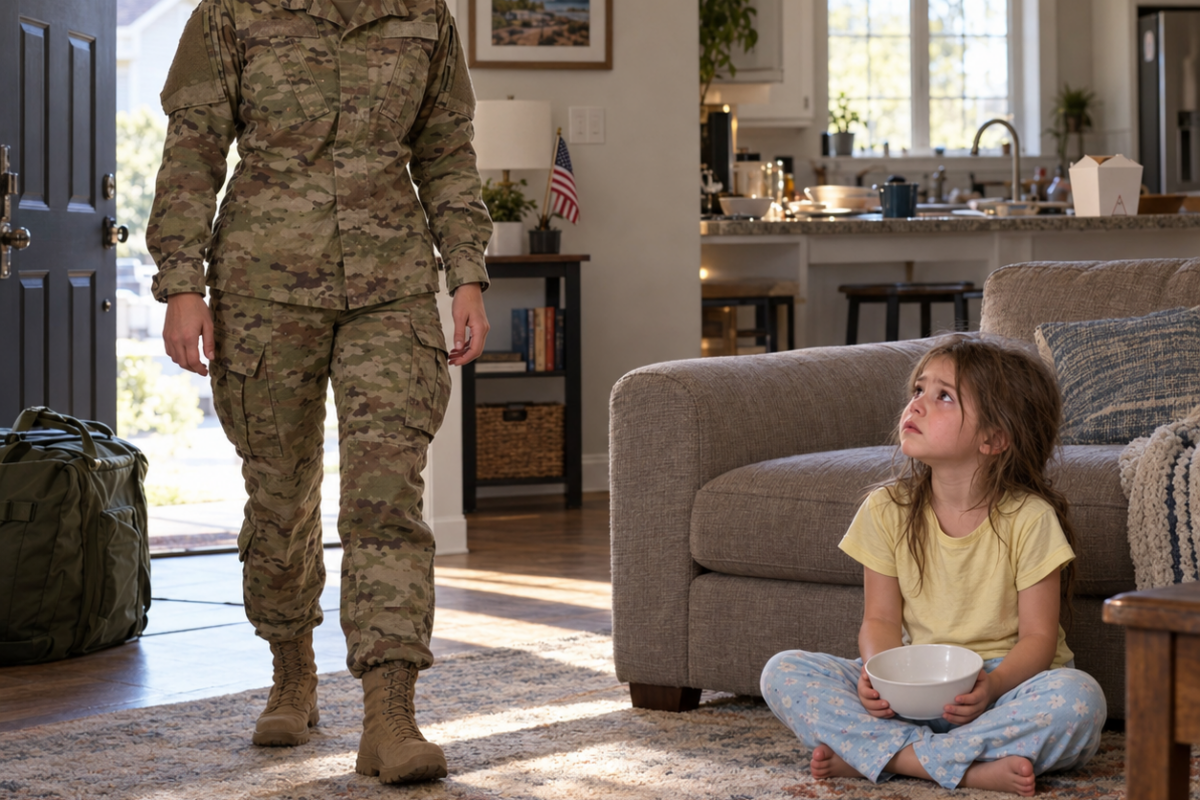
“Mommy, are you real?” my four-year-old daughter whispered when I came home from deployment three weeks early. She was sitting alone on our living room floor with an empty cereal bowl. My husband was on a Caribbean cruise with his mother and sister. Twenty-two minutes earlier, they had posted a photo captioned “Family time.” I was still in uniform when Sophie asked if she could have something to eat.
The first thing my daughter said when I found her was, “Mommy, are you real?” She was sitting cross-legged on our living room floor with…
End of content
No more pages to load