“Leave now or I’ll call the police! My son bought this apartment for me!” my mother-in-law shouted when I came home after six weeks away. She stood in my living room wearing a satin robe, holding my late grandmother’s favorite mug. My family photographs were gone, and her belongings were everywhere. I set down my suitcase and called building security.


I knew something was wrong before I saw her.
My key worked. The lock turned with the same small resistance it always had, and the door opened onto the narrow entryway where I usually dropped my bag after work. But the photograph above the console table was gone.
It had been a picture of my grandmother standing on a beach in Maine, holding her sandals in one hand and laughing at something outside the frame. I had lived with that photograph for nine years. Even when I stopped noticing it consciously, its presence was part of the way I recognized home.
Now a gilt-framed mirror hung in its place.
Beneath it stood a bowl of artificial roses.
I remained in the doorway with my suitcase behind me, trying to understand why the apartment smelled of unfamiliar perfume.
Then my mother-in-law appeared from the kitchen.
Lorraine wore a pale pink satin robe. Her hair was pinned neatly, her feet were inside slippers I had never seen, and in her right hand she held my late grandmother’s favorite ceramic mug.
For a second, I honestly thought I had entered the wrong apartment.
Then she saw me.
Her expression changed from mild surprise to anger.
“Leave now or I’ll call the police! My son bought this apartment for me!”
I looked past her.
My books were gone from the shelves. A large vase stood where I kept the small wooden box containing my grandmother’s letters. The armchair beside the window had been moved, and a stack of fashion magazines covered the table where I usually left whatever I was reading.
“Lorraine,” I said, “what are you doing in my apartment?”
She laughed.
Not nervously. Not as though there had been an unfortunate misunderstanding.
She laughed because she thought the answer should humiliate me.
“Daniel bought this place for me. You’re trash, and I’m just taking the trash out.”
I stood very still.
Six weeks earlier, I had left for a temporary assignment in Seattle. My husband kissed me at the elevator, took my laptop bag from my shoulder, and told me not to worry about anything at home.
Now his mother stood inside the apartment I had bought before we married, holding the mug I trusted no one to put in the dishwasher.
I did not scream.
I did not call Daniel.
I reached into my coat pocket and took out my phone.
“Building security? This is Claire Bennett in Unit 12B. There is an unauthorized intruder in my residence.”
Lorraine’s smile disappeared.
“You can’t call security on me! This is my home!”
I kept my voice steady while answering the woman on the phone.
“Yes, I’m inside the doorway. No, she hasn’t touched me. I would like someone to come up.”
Lorraine stepped toward me.
I stepped back into the hall.
“Don’t you dare make a scene,” she said.
I looked at the mug.
“Put that down.”
She glanced at it, then tightened her fingers around the handle.
“What?”
“The mug. Please put it on the table.”
“You don’t give orders here anymore.”
The elevator chimed.
Our building manager stepped out with two security guards.
Marina Reyes had managed the building for almost twelve years. She knew me, knew Daniel, and knew exactly which resident had spent three winters asking the board to repair a leak in the corridor outside the laundry room.
She looked from my suitcase to Lorraine’s robe.
“Claire?”
“I came home and found her living here.”
Lorraine straightened.
“My son purchased this apartment for me.”
Marina’s expression remained neutral.
“We need to understand what’s happened.”
“There’s nothing to understand.”
One of the guards, Ellis, moved far enough into the hallway to give me space beside the door. The other, Jonah, stayed near the elevator.
Neither touched Lorraine.
Neither told her she was under arrest.
Marina asked her name, then looked back at me.
“Have you transferred ownership or authorized a new resident?”
“No.”
Lorraine gave a sharp laugh.
“She wouldn’t know.”
Marina turned toward her.
“Why wouldn’t she know?”
My mother-in-law lifted her chin.
“Daniel said he handled the title.”
I stopped cold.
Until that moment, I had thought I was dealing with a woman who misunderstood a promise.
Now I wondered what my husband had done while I was away.
Marina asked us to remain where we were while she checked the building’s records.
Lorraine tried to speak over her.
“My son is an owner.”
“He is listed as a resident,” Marina said. “Those are different records.”
“He pays for everything.”
I almost laughed.
The mortgage had been paid off before Daniel moved in.
The condominium fees came from my account.
The property taxes came from my account.
We shared household expenses according to an arrangement we had made when we married, but Daniel had never purchased this apartment for anyone.
Marina made a call to the management office.
I watched Lorraine’s face.
She looked annoyed, but beneath the annoyance I saw something I had not expected.
Uncertainty.
Perhaps she believed Daniel.
Perhaps she knew more than she wanted to admit.
Both possibilities frightened me.
“Claire,” Marina said after ending the call, “our ownership records still identify you as the owner. We have no completed transfer in our files.”
Lorraine waved a hand.
“Then your files are wrong.”
“Possibly incomplete,” Marina replied. “Which is why we will not make a legal determination in this hallway.”
I appreciated that sentence.
I wanted her to tell Lorraine to leave immediately. I wanted the building to become what it had been six weeks earlier simply because someone competent arrived.
But Marina was a building manager, not a judge.
She could verify access permissions, protect common areas, and document what happened. She could not erase an occupancy dispute by deciding which of us sounded more convincing.
“How long have you been here?” she asked Lorraine.
“Three weeks.”
I looked at her.
“Three weeks?”
“My son said I could move in.”
“Did he tell you I agreed?”
“He told me the apartment was mine.”
“And you believed that?”
Lorraine turned toward me.
“Why wouldn’t I?”
I glanced into the living room.
My grandmother’s letters were still missing.
I could not trust myself to answer her calmly.
Marina asked whether Daniel was available.
Lorraine immediately reached for her phone.
“He’ll settle this.”
I said nothing.
For the first time, I did not want Daniel to settle anything.
I wanted to know what required settling.
While Lorraine called him, Ellis asked whether I wanted to sit in the building lounge.
“No,” I said. “I want to see what’s happened to my belongings.”
Marina looked at me.
“We can accompany you while you check for immediate concerns. We should avoid removing anything until we understand the situation.”
Lorraine lowered her phone.
“He’s not answering.”
“That doesn’t surprise me,” I said.
She gave me a hostile look.
I stepped inside with Marina.
The apartment looked familiar in dimensions and foreign in every detail.
My sofa remained, but the cushions were covered with decorative pillows I had never chosen. The rug was gone. A smaller one with gold scrollwork covered part of the floor.
My dining table had a lace runner.
The balcony held two large plastic planters where my herbs used to be.
In the kitchen, the cupboard doors stood open.
My dishes had been moved to the top shelf, beyond Lorraine’s easy reach. Her own plates occupied the lower shelves.
She had not merely stayed.
She had arranged my home around the assumption that I would not return.
I walked toward the bedroom.
Lorraine moved quickly.
“You can’t go in there.”
I looked at her.
“Why?”
“That’s my room.”
The words landed harder than the insult.
I opened the door.
Her clothes filled the wardrobe.
My side was empty.
A framed photograph of Daniel as a child sat on the dresser. My wedding photograph was gone. The quilt my grandmother made had been replaced by a pale pink comforter.
The bed was made with the precision of someone expecting an inspection.
I stood in the doorway.
For a moment, I could hear my own heartbeat.
“Where are my things?”
Lorraine folded her arms.
“Daniel packed them.”
“Where?”
“In storage.”
“What storage?”
“I don’t know.”
I turned toward Marina.
“Please document that.”
She nodded.
I walked into the bathroom.
My toiletries were gone.
So were my medications, the small jar of earrings beside the sink, and the photograph I kept inside the medicine cabinet door because my grandmother once told me everyone needed something that made them smile before brushing their teeth.
Lorraine stood behind me.
“You always had too much clutter.”
I looked at her reflection.
“You mean evidence that I lived here.”
She said nothing.
I left the bedroom and went to my office.
The door was locked.
It had never been locked before.
I turned the handle once.
Then I looked at Lorraine.
“Who has the key?”
“Daniel.”
I took out my phone.
For the first time since arriving, I called my husband.
He answered after four rings.
“Claire?”
“Where are my belongings?”
There was a pause.
“What?”
“I’m home.”
Another pause.
Much longer.
“I thought you weren’t coming back until Monday.”
“My assignment ended early.”
I heard movement on his end, then a door closing.
“Okay. Listen. Don’t get upset.”
That phrase changed something inside me.
He had known there would be a reason for me to be upset.
He had simply counted on having more time before I discovered it.
“Your mother says you bought her my apartment.”
“She didn’t mean it like that.”
“She said you handled the title.”
Silence.
“Daniel.”
“It’s complicated.”
“No. Tell me what you did.”
He exhaled.
“Mom needed somewhere to stay.”
“Then you could have asked me.”
“I was going to.”
“When?”
“When you got back.”
I looked toward Lorraine.
She watched my face with growing concern.
“You moved her into our bedroom, packed my belongings, and locked my office. That isn’t a temporary stay you forgot to mention.”
“You’re making this sound worse than it is.”
“What should it sound like?”
He did not answer.
Marina remained beside the dining table, taking notes.
The guards stayed outside.
I was grateful for the witnesses.
Not because I wanted a dramatic confrontation.
Because I knew how quickly Daniel could make a private conversation become something I remembered incorrectly.
“Come home,” I said.
“I’m at work.”
“Then tell them you have an urgent matter.”
“Claire—”
“Your mother threatened to call the police on me in my own apartment. The building manager is here. I need you to explain what she means about the title.”
He swore quietly.
Then he said, “I’ll be there.”
I ended the call.
Lorraine approached.
“What did he say?”
“He’s coming.”
“Good. Then we can stop this nonsense.”
I looked at her.
“You might want to stop calling it nonsense.”
I had met Daniel seven years earlier at a friend’s birthday dinner.
He was attentive without seeming rehearsed. He listened when I spoke about my work, asked questions about my grandmother, and remembered details the next time we met.
I worked on software implementation projects for hospital systems. Much of the work involved coordination, deadlines, training, and explaining why a change that looked simple to an executive could disrupt an entire department.
Daniel worked in commercial sales.
He was good with people.
I thought that meant he understood them.
During our first year together, he cooked dinners badly and laughed when I corrected him. He helped me paint the office, assembling shelves while I complained that the instructions made no sense.
When my grandmother died, he sat beside me on the kitchen floor while I sorted her letters.
He did not try to make the grief smaller.
He handed me tissues and let me read aloud.
That was the man I married.
Lorraine had always been more difficult.
She called it honesty.
At our first dinner together, she told me that women who traveled for work often struggled to maintain a marriage.
Daniel laughed and said she worried too much.
Later, she criticized the apartment.
Too small for a family.
Too modern.
Too many books.
Too much evidence that I had a life before her son.
I did not need her to love my choices.
I needed Daniel to stop treating each criticism as a harmless quirk.
He usually said the same thing.
“She’s lonely, Claire.”
“She doesn’t mean it.”
“She just wants to feel included.”
I included her.
I invited her to dinners.
I took her to appointments when Daniel couldn’t.
I helped her compare housing options after she decided the condominium she owned was inconvenient.
The more I accommodated her, the more she seemed to resent the fact that I could choose when to stop.
Three months before the Seattle assignment, Lorraine announced that she wanted to move closer to us.
I helped research buildings.
She rejected them.
Too expensive.
Too noisy.
Too far from Daniel.
Then she looked around my living room and said, “This would be ideal for one person.”
I smiled politely.
“It works well for us.”
She looked at Daniel.
He looked away.
I noticed.
I did not understand what it meant.
Two weeks before I left, Daniel asked whether I would consider a larger home someday.
“Someday, yes.”
“What about sooner?”
“Why?”
He shrugged.
“Just thinking.”
I said we could discuss it after my assignment.
He agreed.
I thought that ended the conversation.
Apparently, it began another one without me.
Daniel arrived forty minutes after our call.
He stepped out of the elevator and stopped when he saw security.
For a moment, he looked like a man arriving at the wrong address.
Then he put on the calm expression he used with difficult clients.
“Everyone okay?”
I stood near the doorway.
“No.”
Lorraine moved toward him.
“Tell them.”
He looked at his mother.
Then at Marina.
“Mom’s staying with us temporarily.”
Lorraine’s face changed.
“Temporarily?”
Daniel did not look at her.
“Claire’s been away. I thought this would be a good arrangement.”
Marina folded her hands.
“We need clarity about what you represented to management.”
He frowned.
“What do you mean?”
“You submitted a resident access request for your mother.”
“Yes.”
“You indicated the owner approved it.”
I looked at him.
“I didn’t.”
Daniel rubbed his forehead.
“I assumed she would.”
“That isn’t approval,” Marina said.
Lorraine’s voice rose.
“You said you bought it.”
Daniel turned sharply.
“Mom.”
“No. You said it was mine.”
The hallway became silent.
I watched him decide whom to disappoint.
That decision should never have existed.
He had created it.
“Come inside,” he said.
Marina looked at me.
“Would you like us to remain?”
“Yes.”
Daniel’s jaw tightened.
“Claire, we don’t need an audience.”
“We already have one because your mother threatened to call the police.”
He walked into the living room.
Lorraine followed.
Marina remained near the entrance.
I stayed standing.
Daniel looked at the furniture as though seeing the changes for the first time.
He had approved every one of them.
I knew that now.
“Where are my things?” I asked.
“In storage.”
“Which facility?”
He named one across the city.
“Whose account?”
“Mine.”
“Send me the information.”
“Of course.”
“And the office key?”
He took a small key from his pocket.
I held out my hand.
He hesitated.
Then gave it to me.
I unlocked the office.
Boxes stood against the wall.
Some were mine.
Some were empty.
The laptop docking station had been moved. A stack of papers sat where my calendar used to be.
On the desk lay a folder with a title company’s name.
I looked back at Daniel.
“What is this?”
He came toward me too quickly.
“It’s nothing.”
I placed my hand on the folder.
“Then you won’t mind if I read it.”
His face changed.
Marina asked whether I wanted privacy.
“No,” I said. “I want clarity.”
I opened the folder.
Inside were draft documents, printed emails, a copy of the deed, and a page that appeared to authorize Daniel to act on my behalf in connection with the property.
My name was printed beneath a signature.
It looked enough like mine to frighten me.
I had never signed it.
I looked at Daniel.
“What did you do?”
He swallowed.
“It wasn’t completed.”
“That isn’t what I asked.”
Lorraine moved closer.
“You told me it was.”
Daniel closed his eyes.
“I was trying to work something out.”
“For whom?”
“For everyone.”
I stared at him.
“I don’t appear to have been included.”
He looked toward Marina.
“This is a private marital issue.”
She answered calmly.
“Some of it may be. Statements made to building management are not.”
I looked at the authorization again.
I had signed a limited document before leaving Seattle to permit Daniel to coordinate access for maintenance and receive certain building communications if necessary.
It had been practical.
It did not authorize him to transfer ownership.
This page was different.
The language was broader.
The signature was not mine.
I did not accuse him of a specific crime in that moment.
I did not need to.
I took photographs of the pages, leaving them where they were.
Then I called my attorney.
Avery Price had handled the apartment purchase and my grandmother’s estate.
She answered on the second ring.
“Claire?”
“I need help with something urgent.”
I explained slowly.
The robe.
The missing belongings.
The title claim.
The folder.
When I reached the signature, Avery stopped me.
“Do not sign anything. Do not let anyone remove those documents. Photograph what you can without altering them. I’ll send you instructions for preserving copies, and we’ll review the actual public records.”
Daniel stared at me.
Lorraine sat down.
For the first time, she seemed to understand that the conversation had moved beyond whether she liked my furniture.
Avery asked where I intended to sleep.
I looked at the apartment.
My home.
My bedroom occupied.
My office altered.
My husband standing beside a document I didn’t recognize.
“I don’t know.”
“Then arrange somewhere safe for tonight. Leaving temporarily does not require you to surrender your position. We’ll document why you’re leaving.”
I hated that advice for a moment.
I wanted to stay.
I wanted Lorraine gone.
I wanted the apartment to become mine again before dinner.
But I had been awake since four that morning. I had flown across the country, driven from the airport, and entered a situation I could not resolve through willpower.
I needed rest.
I needed advice.
I needed to stop treating staying physically inside the apartment as the only proof that it belonged to me.
Marina called the police after consulting with me about the disputed documents and the earlier threat.
The responding officer, Vega, arrived with a colleague.
They asked questions.
They did not announce that a deed had changed hands merely because Lorraine said so.
They also did not promise that they could remove someone who claimed residence without reviewing the facts and the applicable process.
They documented what I reported, examined the material available, and advised us about the immediate options.
I appreciated their restraint even while it frustrated me.
Daniel grew quieter with every question.
Lorraine continued insisting that she had been promised a home.
I began to believe that part.
It did not excuse the word trash.
It did not excuse threatening me at my own door.
But Daniel had clearly told her something she wanted to believe.
When Officer Vega asked whether she had seen a completed deed, she looked at Daniel.
He looked at the floor.
That answer was enough for the moment.
I called my friend Nina.
She lived twenty minutes away.
“Can I come over?”
“Of course. What happened?”
“I’ll explain when I get there.”
“Do you want me to come get you?”
“Yes.”
The simplicity of her answer nearly made me cry.
While I waited, I opened the cupboard and took my grandmother’s mug from the table where Lorraine finally put it down.
It was brown ceramic with a thin yellow line near the rim. My grandmother bought it at a craft fair and used it so often that the handle had become smoother than the rest.
Lorraine watched me.
“You’re taking things?”
I looked at her.
“Yes. Mine.”
Daniel said, “Claire, please.”
I turned toward him.
“Please what?”
He did not answer.
I carried the mug, my suitcase, and the folder copies to the hallway.
Marina walked with me.
“I’m sorry,” she said.
“You didn’t do this.”
“No. But I want to review how the access request was processed.”
“Thank you.”
She nodded.
“We’ll preserve the records.”
Nina arrived.
She hugged me without asking for an explanation in front of everyone.
Then she took the suitcase.
I left the building with my grandmother’s mug wrapped in my scarf.
At Nina’s apartment, I sat at her kitchen table while she made toast and scrambled eggs.
I had not eaten since the flight.
For the first time all afternoon, there was nothing I needed to say immediately.
She put a plate in front of me.
“Eat first.”
I did.
Then I told her everything.
She listened without interrupting.
When I finished, she looked at the mug.
“At least that’s safe.”
I nodded.
Then I started crying.
Not because of the apartment’s value.
Not because my mother-in-law had worn a robe in my kitchen.
Because six weeks earlier, Daniel told me not to worry about home.
I had believed him.
While I trained staff, managed deadlines, and called him from hotel rooms, he had packed my life into boxes and promised the space to someone else.
Nina stayed beside me.
She did not say she had always disliked him.
She did not tell me I was lucky to find out.
Eventually, she asked, “What do you need tonight?”
“A door I can close.”
“You’ve got one.”
“And no advice until morning.”
“Done.”
I slept in her guest room with my suitcase unopened.
At three in the morning, I woke and reached for my phone.
Daniel had sent eleven messages.
At first, they were apologetic.
Then defensive.
Then frightened.
You’re making this bigger than it is.
Mom misunderstood.
I was going to explain.
Nothing was finalized.
Please don’t let lawyers destroy us.
The last one made me sit up.
He had done something involving lawyers, title documents, and a signature that was not mine.
Now he wanted me to believe asking a lawyer for help was the destructive act.
I put the phone down.
In the morning, Avery met me at her office.
She had already obtained the current recorded ownership information.
The apartment remained in my name.
There had been no completed transfer in the public records.
I closed my eyes.
For several seconds, I simply breathed.
Then she said, “That does not mean there is nothing to investigate.”
I nodded.
We reviewed the copies.
The supposed authorization.
The draft transfer.
Emails between Daniel and a title company.
A request for additional proof of authority.
A note indicating that direct confirmation from me was required before the transaction could proceed.
The company had not accepted his first explanation.
That refusal may have prevented something worse.
“Did you authorize any of this?” Avery asked.
“No.”
“Did you sign this page?”
“No.”
“Has your signature appeared on any document electronically during the last six weeks?”
“I signed work documents. Nothing about the apartment.”
She nodded.
“We’ll separate those facts.”
I told her about the limited maintenance authorization.
She compared it with the document from the office.
The wording was different.
The signature appeared to have been reproduced.
We did not know yet how.
Avery arranged for the original materials to be preserved properly and for a specialist to review the document history.
Then she asked whether I wanted to remain married.
I looked at the wall behind her.
There was a photograph of a forest path.
For a moment, I wished I could walk into it and postpone the question.
“I don’t know.”
“All right. We can protect your immediate position without asking you to decide the rest today.”
That was exactly what I needed.
Over the next forty-eight hours, we did practical work.
We reviewed account access.
We preserved emails and messages.
We contacted the title company.
We obtained copies of the resident request Daniel submitted to management.
We clarified what the building knew and what it should have verified before accepting a statement that the owner approved a new occupant.
Marina cooperated.
She did not pretend the building had handled everything perfectly.
A staff member had processed Lorraine’s access request based on Daniel’s submission because he was an established resident and the request appeared routine.
The form said I consented.
Nobody had contacted me directly.
I had been reachable.
My number had not changed.
I had replied to building emails during the trip.
The failure was avoidable.
Marina apologized in writing.
Then she reviewed the process with the board.
I appreciated the apology.
The changed process mattered more.
Daniel asked to meet.
I agreed only after Avery helped establish the purpose and the arrangements.
We met in a quiet conference room at her office.
He arrived carrying flowers.
Avery’s assistant placed them in a vase outside the room.
I did not want them on the table between us.
Daniel noticed.
His face fell.
Good, I thought.
Then I disliked that I had thought it.
The meeting began with facts.
He acknowledged that he moved Lorraine into the apartment without asking me.
He acknowledged packing my belongings.
He said he believed I would eventually agree because we had discussed moving to a larger home.
“We discussed someday,” I said.
“I know.”
“Not giving my apartment to your mother.”
“I didn’t think of it that way.”
“Then how did you think of it?”
He rubbed his forehead.
“She sold her condo.”
I stared at him.
“What?”
“She accepted an offer. The closing was three weeks ago.”
I looked at Avery.
Then back at him.
“Because you told her she could have my apartment?”
He nodded.
“That’s why she moved?”
“Yes.”
“Where did you think I would live?”
“With me.”
“Where?”
He hesitated.
“In a larger place.”
“Which one?”
“I hadn’t finalized it.”
The room went silent.
He had finalized moving his mother into my home.
He had not finalized where I would live.
I leaned back.
“You made my life the flexible part.”
He looked at me.
“I thought you’d understand.”
“Understand what?”
“That Mom needed stability.”
“So did I.”
He closed his eyes.
I had heard enough of that particular explanation.
Avery asked about the title documents.
Daniel said he had been exploring options.
He said the authorization was intended to help him obtain information.
He said he never planned to complete anything without talking to me.
I looked at him.
“Then why does your mother believe the apartment is hers?”
He said nothing.
“Why did you pack my clothes?”
Silence.
“Why were my photographs removed?”
He swallowed.
“She wanted to settle in.”
“And why was my office locked?”
“I didn’t want anyone going through things.”
I stared.
“You mean me.”
“No.”
“I’m the only person you expected to return.”
He looked down.
Avery asked whether he created the signature page.
He said he wanted legal advice before answering further.
That was his right.
It also answered the question of whether I could treat this as a simple misunderstanding.
I stood.
Daniel rose immediately.
“Claire, wait.”
“I’m finished for today.”
“I love you.”
I looked at him.
“I don’t know what that means if you can do this.”
His eyes filled.
I left before he could explain his intentions again.
Lorraine called that evening.
I almost ignored it.
Then I answered because there were belongings I still needed to locate.
“Claire.”
“What?”
“Daniel says you’re refusing to cooperate.”
“With what?”
“With making this easier.”
I sat at Nina’s kitchen table.
“Lorraine, where are my grandmother’s letters?”
There was a pause.
“I don’t know.”
“The wooden box from the shelf.”
“Oh. He packed that.”
“Was anything thrown away?”
“I don’t think so.”
“You don’t think so?”
“You had so many things.”
I looked at the mug beside me.
“I need a complete list of what was removed and where it went.”
“I’m not your employee.”
“No. You are someone occupying my home after threatening me at the door.”
Her voice sharpened.
“My son promised me.”
“I believe that.”
She stopped.
Perhaps she had expected me to argue with the fact.
I continued.
“He had no right to promise you my apartment.”
“That’s between you and him.”
“No. The promise may be between you and him. Your conduct toward me belongs to you.”
She said nothing.
“You called me trash.”
“I was shocked.”
“So was I.”
“You appeared without warning.”
“I returned to my home.”
She exhaled angrily.
“You’ve always made everything about ownership.”
I looked around Nina’s apartment.
“Ownership is relevant when someone is trying to give away what I own.”
Then I ended the call.
The storage facility became my next priority.
Avery arranged access without allowing Daniel to remain the sole gatekeeper. The contents were photographed and inventoried.
Nina came with me.
The unit smelled of cardboard and dust.
Boxes were stacked unevenly.
My books filled three large cartons. Clothes had been folded without care. Framed photographs stood inside a box with no padding between them.
I knelt.
The beach photograph of my grandmother was near the bottom.
The glass had cracked.
I lifted it carefully.
Nina stood beside me.
“We can replace the glass.”
“I know.”
But I did not mean the glass when I began crying.
The wooden box of letters was there.
So was my quilt.
My medications had been placed in a bag with bathroom supplies rather than disposed of.
Nothing appeared missing from the most important categories, though it took days to confirm everything.
That was a relief.
It did not make the packing kind.
Inside one box, I found a note in Daniel’s handwriting.
Claire’s office. Hold.
He had labeled my life as something to be stored until he decided what came next.
I folded the note and gave it to Avery later.
I wanted it preserved.
I did not want it in my home.
My neighbor, Mrs. Kessler, called when she heard I had returned.
She lived in 12A and had been friendly with me for years.
“I thought your plans changed,” she said.
“What plans?”
“Moving.”
I closed my eyes.
“Who told you I was moving?”
“Daniel. He said you found a larger place and were working remotely until everything was ready.”
I listened.
She told me she saw movers carrying boxes from my apartment.
She asked Daniel whether I needed help.
He said I was handling it from Seattle.
There it was again.
A complete explanation supplied in my absence.
Not just to Lorraine.
To the people who might have noticed something wrong.
Mrs. Kessler apologized.
“You had no reason to know,” I said.
“I should have called.”
“Maybe. But he gave you a reasonable explanation.”
She was quiet.
Then she asked whether I wanted her to write down what she remembered.
“Yes.”
She did.
Her statement was factual.
Dates.
Conversations.
What she saw.
What she did not see.
I was grateful for the care.
I did not want a neighborhood chorus describing Daniel as a villain.
I wanted records that could withstand questions.
The financial review produced another layer.
Daniel had used eighteen thousand six hundred dollars from our joint savings account for costs connected to Lorraine’s move, storage, furnishings, and what he described in one message as housing transition.
Some of that account consisted of shared funds.
Some contributions were mine.
The exact treatment required review.
I did not announce that every dollar was theft because I was angry.
But he had concealed the spending, and his explanations changed depending on whom he was addressing.
To me, the account balance had been reduced because of routine expenses and a delayed commission.
To Lorraine, he said he was investing in her future.
To a housing agent, he said the apartment transfer was expected to complete shortly.
Expected.
The word did not make the statement true.
We also found messages in which Lorraine asked whether I agreed.
Daniel replied:
She’ll be fine once it’s done. Don’t let her worry you.
I read that sentence several times.
It made me feel physically cold.
He did not simply fail to ask.
He anticipated my refusal and planned to make it irrelevant.
Avery let me sit quietly before continuing.
“I’m sorry,” she said.
I nodded.
Then I asked the question I had been avoiding.
“What do I need to do if I want a divorce?”
She referred me to a family attorney, Rachel Morgan, who had no prior relationship with Daniel.
Rachel met me the following day.
She asked practical questions without making the decision feel like a test of my loyalty.
Marriage length.
Assets.
Accounts.
Property.
Agreements.
What I wanted immediately.
What I needed time to consider.
I told her I wanted my home back without living alongside people who treated it as a prize.
She nodded.
“We’ll pursue that through proper arrangements.”
I appreciated the phrase.
I had watched too many people use certainty as a substitute for authority.
I did not want to become one of them.
Lorraine’s housing situation required its own resolution.
She had been living in the apartment for three weeks.
She had sold her condominium.
She believed Daniel’s promise.
Those facts did not give her title.
They also meant the answer was more complicated than two guards taking her by the elbow.
Through attorneys and written arrangements, Daniel accepted responsibility for securing alternative accommodation for her. Lorraine agreed to leave by a defined date.
The agreement did not transfer any part of my apartment to her.
It did not require me to pay her ongoing housing costs.
It established how belongings would be removed, how keys and access credentials would be returned, and how we would avoid another confrontation.
I wanted that.
I did not need to watch her humiliated.
I needed her out of my home.
Before she left, Lorraine asked for a meeting.
I initially said no.
Then I agreed to one, with clear limits and Avery available if needed.
We met in the building lounge.
Lorraine wore a tailored navy suit.
Without the satin robe, she looked more like the woman I knew before the trip.
She sat with her handbag on her knees.
“I was lied to.”
I looked at her.
“Yes.”
“I sold my home.”
“I know.”
“He told me everything was settled.”
“I know.”
She seemed frustrated that I was not disputing those facts.
“Then you understand why I was upset.”
“I understand why you were upset after discovering the truth.”
She looked away.
“What you said to me before that was different.”
Her fingers tightened around the bag.
“You should have told me you were coming.”
“I didn’t need to warn you before returning to the apartment you knew was my home.”
She opened her mouth, then closed it.
For a while, we sat in silence.
Then she said, “I thought he had chosen me.”
The sentence startled me.
“Chosen you?”
“He said you wouldn’t mind living somewhere else.”
I looked at her.
“This should never have been a choice between us.”
Her eyes filled.
I did not know whether she understood.
I knew I could not make understanding the condition of recovering my home.
Finally, I said, “You can be angry with Daniel. You can feel hurt about what he promised. But you still owe me responsibility for how you treated me.”
She looked down.
“I shouldn’t have used that word.”
“Trash?”
She winced.
“Yes.”
“And threatened to call the police.”
She nodded.
“And used my belongings while telling me I no longer belonged there.”
Her face tightened again.
“Claire—”
“No. I’m not asking you to apologize only for the part you think sounds bad.”
She remained silent.
The meeting ended without a complete apology.
That was disappointing.
It was also information.
I no longer needed to keep arranging conversations until Lorraine supplied the response I wanted.
She left the apartment four days later.
A neutral moving service handled her belongings. Building staff documented the return of access credentials.
Daniel stayed elsewhere while the separation arrangements proceeded.
He did not have the right to be erased from the building’s resident history simply because I wanted him gone. But he agreed in writing to leave, and the practical steps followed that agreement.
Only then did I arrange the changes appropriate to the new situation.
Keys.
Access permissions.
Passwords.
Contacts.
The locks did not solve the betrayal.
They solved the locks.
That distinction helped me stop expecting one practical act to make everything feel safe.
When I entered the apartment alone again, I did not feel the relief I expected.
The rooms were empty of Lorraine’s things.
They were not yet full of mine.
The gilt mirror remained because it had been overlooked.
I took it down carefully and set it against the wall.
Then I sat on the floor.
For a long time, I did nothing.
I could hear the refrigerator.
A neighbor’s television.
Traffic below.
The ordinary noises of the home I had left six weeks earlier.
But I was not the same woman who had left.
That was what I needed to grieve.
The next weekend, Nina helped me unpack.
We began with the kitchen.
My plates returned to the shelves I could reach.
The mug went beside the kettle.
The artificial roses disappeared.
We put my herbs back on the balcony, replacing the plants that had died while Lorraine rearranged everything.
Nina asked whether I wanted the living room restored exactly as it had been.
I considered it.
“No.”
She nodded.
“What do you want?”
“I don’t know yet.”
“Then we can leave some things unfinished.”
That answer was a gift.
I had been trying to recover the apartment as though it were a photograph I could recreate.
But the old arrangement belonged to a marriage I no longer trusted.
I could keep what I loved.
I could change the rest.
We moved the armchair to a different corner.
We placed the reading lamp near it.
We left one shelf empty.
For once, an empty space did not feel like something someone had taken.
It felt like room.
The document investigation continued.
The specialist’s review established that the supposed authorization did not match the limited document I signed before leaving. Elements had been copied or altered.
The title company supplied its records through the appropriate process.
Its staff had asked for direct owner confirmation and additional documentation. The transaction had not been completed.
That mattered.
It prevented the apartment from being transferred.
It did not make Daniel’s conduct harmless.
He eventually acknowledged that he had created the broader page using material from the legitimate authorization.
He said he intended it only to begin discussions.
The records showed he presented it as authority he did not possess.
There were consequences connected to those representations and the disputed signature.
They were handled through attorneys, investigators, and the relevant institutions.
I did not control them by deciding whether I was sad enough or forgiving enough.
Daniel repeatedly asked whether I could stop the process.
I told him I would not lie.
That was the only promise I made.
At one point, he sent me a message.
You know I’m not a criminal.
I stared at it.
Then I wrote:
I know what you did. The appropriate people will decide how it is classified.
He did not answer.
I began counseling during the separation.
My counselor, Elena, asked what frightened me most.
I expected to say losing the marriage.
Instead, I said, “That I could be gone for six weeks and come back to discover someone else had written my life.”
She waited.
“He told people I was moving. He told his mother I agreed. He put a signature beneath words I never approved.”
I looked at my hands.
“If I hadn’t come back early, what would have happened?”
“We may not be able to answer every version of that question,” she said.
“I know.”
“What can you answer?”
I thought.
“That I came back.”
“Yes.”
“That I asked for help.”
“Yes.”
“That the records still identified me.”
“Yes.”
She nodded.
“Then we can begin there.”
I did not feel repaired after one appointment.
I went back.
Over time, I stopped treating uncertainty as proof that I should have prevented everything.
I had taken a work assignment.
I had trusted my husband.
Neither was permission for him to deceive me.
Daniel asked for counseling together.
I declined at first.
Later, I agreed to one structured conversation because there were questions I wanted answered without the apartment papers between us.
The counselor asked Daniel what he believed he had done.
He spoke about stress, his mother’s housing needs, and trying to find a larger place for us.
The counselor waited until he finished.
Then she asked, “What did Claire consent to?”
He looked at me.
“Nothing specific.”
I gave a short laugh.
“Nothing.”
He nodded.
“Nothing.”
The counselor asked why he proceeded.
Daniel rubbed his face.
“I thought if I made it practical, she would accept it.”
I stared at him.
“Accept it because you left me no easy way to refuse?”
He closed his eyes.
“Yes.”
The answer was ugly.
It was also more honest than anything he had said before.
He continued.
“Mom wanted certainty. Claire was away. I thought I could arrange everything and explain afterward.”
“You arranged certainty for her,” I said. “You arranged uncertainty for me.”
He nodded.
“I know.”
“Do you?”
He looked up.
“I packed your things. I told people you agreed. I used a document you didn’t authorize. I let Mom think she owned your home.”
Tears ran down his face.
For the first time, he described the actions without making them sound like circumstances.
I cried too.
I had wanted that clarity.
It did not make me want the marriage back.
The counselor asked whether I wanted to say anything.
I took a breath.
“You made me the person whose opinion could be managed.”
Daniel looked at me.
“You knew I might say no. Instead of having that conversation, you tried to make my no arrive too late.”
He bowed his head.
“Yes.”
I sat quietly.
Then I said, “I can understand that you were afraid of disappointing your mother. I cannot live with a husband who solves that fear by deceiving me.”
He did not argue.
That was progress.
It was not reconciliation.
The divorce proceeded.
There were ordinary complications.
Shared accounts.
Property claims that had to be examined.
Furniture we bought together.
Expenses from the marriage.
My separate ownership of the apartment was documented clearly. That did not mean every other financial question vanished.
Rachel handled the details.
I answered questions, supplied records, and tried not to turn each disagreement into another trial of whether Daniel had loved me.
The relevant facts were enough.
Some things were settled by agreement.
Others required more discussion.
The result was not a dramatic scene in which he lost everything.
It was a careful unwinding of a shared life.
That was painful enough.
Lorraine eventually rented an apartment near a friend.
The sale proceeds from her condominium had not disappeared. She had wanted a more comfortable arrangement than she could afford while preserving the rest of her money.
Daniel’s promise appealed to her.
She still believed I had been inflexible.
I heard that from someone who thought I should know.
I asked them not to relay more.
I did not need Lorraine’s opinion to supervise my recovery.
She sent one letter.
It said she regretted how things happened and hoped we could someday remember that everyone had been under pressure.
I put it in a folder.
I did not answer.
Pressure explained the setting.
It did not sign the document.
It did not pack my clothes.
It did not speak the word trash.
Daniel later sent a different letter.
He did not ask me to stop the divorce.
He did not ask me to reassure him that he was a good person.
He wrote that he had confused avoiding conflict with caring for people, and that he had treated my trust as something he could spend.
I read that sentence twice.
It was accurate.
He apologized for the specific things he did.
I appreciated the letter.
I did not resume contact beyond what was necessary.
An apology could matter without becoming a key.
The building changed its procedures.
Resident requests involving a new long-term occupant required direct confirmation from the owner through verified contact information when the requesting resident was not the owner.
Title changes required documents from the appropriate sources rather than assurances made by someone who sounded confident.
Marina invited me to review the description of the process, not because I needed to approve every building decision, but because my experience had exposed a weakness.
I did.
I made a few comments.
Then I stepped back.
I did not want to become the building’s permanent example.
I wanted to be a resident again.
A woman who complained about a slow elevator, waved to security, and received packages without every interaction carrying the history of her marriage.
That took time.
Ellis greeted me one morning and asked whether I was settling back in.
“Mostly.”
He nodded.
“Good.”
No speech.
No pity.
I liked him for that.
Mrs. Kessler brought me soup.
She stood at the door with a container and looked embarrassed.
“I know you can cook.”
“I can.”
“This isn’t a statement about your abilities.”
I laughed.
“Good. Then come in.”
We sat in the kitchen.
She admired the mug.
“My grandmother’s.”
“It looks comfortable.”
“That’s exactly what she liked about it.”
Mrs. Kessler nodded.
We talked about her daughter, the building garden, and a book she couldn’t finish.
For an hour, nobody discussed Daniel.
I felt better afterward.
Not because I forgot.
Because remembering did not need to occupy every conversation.
At work, I returned to ordinary competence slowly.
The Seattle assignment had gone well. The client wanted me involved in a follow-up project.
At first, I nearly refused.
The thought of traveling again made me anxious.
I imagined leaving the apartment and returning to another changed room.
Then I recognized what I was doing.
I was allowing Daniel’s choices to decide the future shape of my work.
I discussed the assignment with my manager.
We arranged a shorter trip with clear support, and I made practical plans for home.
Mrs. Kessler agreed to check the apartment.
Management had current contact details.
My documents were secure.
Access permissions were clear.
These were sensible precautions.
They were not a promise that life could never surprise me again.
I went.
I spent five days in Seattle.
On the final evening, I walked near the water and bought a small print from a local artist.
I had liked it.
That was enough.
When I returned, I opened the apartment door.
The beach photograph hung above the console again.
The rug was where I left it.
The kitchen smelled faintly of the basil plant on the balcony because the window was open.
My mug sat beside the kettle.
I stood in the entryway for a long time.
Then I set down my suitcase.
Nothing extraordinary had happened.
That was the extraordinary part.
The divorce became final in autumn.
Rachel called while I was working from home.
I listened, asked two practical questions, and wrote down the remaining tasks.
When the call ended, I looked around the office.
The door was open.
No lock.
No boxes waiting for someone else’s decision.
On the wall hung the print I bought in Seattle.
I had framed it myself.
I called Nina.
“It’s final.”
She was quiet.
Then she asked, “Dinner?”
“Yes.”
“Should I bring something?”
“Bread.”
“I can handle bread.”
That evening, we ate soup and talked about nothing important until I wanted to talk about something important.
Then she listened.
“What do you miss?” she asked.
I considered the question.
“The man who sat with me while I read my grandmother’s letters.”
Nina nodded.
“And what don’t you miss?”
“Wondering whether saying no makes me cruel.”
She reached across the table and squeezed my hand.
After dinner, we washed the dishes.
She picked up the ceramic mug.
“Hand wash?”
“Always.”
She nodded.
She did not question whether that was excessive for an old piece of pottery.
She simply washed it carefully.
Later that month, I opened the wooden box of letters.
For weeks, I had avoided it.
I was afraid the objects Daniel moved would feel contaminated by the experience.
Some did.
The letters did not.
They belonged to my grandmother.
Her handwriting leaned to the right. She underlined ordinary instructions as though mailing a recipe required the same seriousness as drafting a contract.
One letter included advice after I moved into my first apartment.
Make a home you can live in when no one is visiting.
I smiled.
I had forgotten that sentence.
My grandmother did not mean expensive furniture or perfect rooms.
She meant a chair you wanted to sit in.
Food you liked.
A lamp where you needed light.
Things you did not have to defend.
I looked around the apartment.
There was the armchair.
The lamp.
The mug.
The new print.
The shelf I had left empty.
I was finally doing what she suggested.
Winter arrived.
I bought a small tree and decorated it with ornaments that mattered to me.
Some were old.
Some were new.
I did not use the ones Lorraine selected during the Christmases she insisted our tree needed a more consistent theme.
My tree had no theme.
It had a wooden bird, a crooked star, a tiny glass lighthouse, and a paper ornament my niece made when she was six.
I liked it.
Nina came over and laughed.
“It looks like several decades had a disagreement.”
“They resolved it peacefully.”
“Excellent.”
We drank tea from mismatched cups.
Outside, snow moved past the windows.
I did not wonder whether Daniel would approve.
I did not feel guilty for enjoying an evening without him.
There were still difficult days.
I occasionally found an object he chose and felt grief arrive without warning.
Sometimes a familiar song hurt.
Sometimes a title-related envelope made my hands shake before I opened it.
Healing was less tidy than the legal documents.
I stopped expecting it to become tidy.
I kept going to counseling.
I maintained friendships.
I worked.
I traveled again.
I learned to distinguish a reminder from a new emergency.
The apartment remained mine.
More importantly, my decisions began to feel like mine again.
Almost a year after I returned from Seattle, Marina called to ask whether I could stop by the office.
I felt an immediate flash of anxiety.
Then she said, “Nothing serious. We’re updating emergency contacts, and I wanted to confirm yours directly.”
I laughed before I could help it.
“Thank you.”
“You’re welcome.”
At the office, she handed me the form.
I completed it.
She checked my identification.
The process was ordinary, careful, and slightly tedious.
I appreciated every minute.
As I left, she said, “Claire, I hope things feel settled.”
“They do.”
She smiled.
“Good.”
The elevator took me to the twelfth floor.
I stepped out and walked toward 12B.
For a moment, I remembered Lorraine in the pink robe.
The mug in her hand.
The phrase my son bought this apartment for me.
The fear that something could happen to my home without me knowing.
I stood outside the door.
Then I took out my key.
The lock turned.
Inside, the apartment was quiet.
The photograph of my grandmother hung above the console. She was still laughing on the beach, sandals in hand, her hair blown sideways by the wind.
I smiled at her.
I put my bag down.
In the kitchen, I filled the kettle and took the brown ceramic mug from its shelf.
The yellow line near the rim had faded a little.
The handle felt warm before the tea was even poured, perhaps because I remembered how often my grandmother held it.
I carried it to the armchair.
The city moved beyond the windows.
Traffic.
Lights.
People heading home.
For months, I had thought recovering the apartment meant restoring every object to its former place.
Now I understood that I did not need the former place of everything.
I needed the right to choose its next place.
My mother-in-law had stood here and called me trash.
My husband had tried to make my consent an inconvenience he could work around.
Neither of them had succeeded in deciding who I was.
That did not make me invulnerable.
It made me informed.
It made me careful.
It made me less willing to confuse a person’s confidence with their authority.
I drank the tea slowly.
There was no one I needed to confront that evening.
No document waiting to be explained.
No suitcase beside the door.
Just my grandmother’s mug.
My chair.
My home.
And the quiet pleasure of returning to a life nobody else had permission to give away.
News

At my seventy-second birthday party, my daughter-in-law knocked a crystal vase off its pedestal with her elbow, watched it shatter, and smiled. “Oops.” Her own parents had given it to her and my son on their wedding day six years earlier. I looked at Frank, waiting for him to say something. All he managed was, “Mom…”
I watched my daughter-in-law break her own parents’ wedding gift with one elbow and a smile. For months afterward, people asked me whether I was…

I came home three hours early and found my sixty-eight-year-old mother on her knees scrubbing my mother-in-law’s bathroom. When I helped her stand, her sleeve slipped back, revealing dark marks around her wrist. My husband stepped into the doorway. “Daniela, don’t make a scene.” That was when I remembered my father’s last warning: “If you ever see your mother hurt, don’t argue with anyone. Open the hidden compartment in her sewing machine.”
I came home three hours early and found my sixty-eight-year-old mother on her knees beside a toilet. Her hands were stiff with arthritis. One gripped…

“I already promised your house to your sister,” my father told me four days after I bought it. “They’re moving in Monday. Rent-free for three years.” I was thirty-one, had saved for nine years, and had bought the five-bedroom home entirely in my own name. When I said no, he threatened to tell the family I had abandoned my sister’s children. Days later, he took the microphone at my grandmother’s seventy-fifth birthday dinner and did exactly that.
My father called twelve times in forty minutes after discovering I had bought a house without consulting him. When I answered, he didn’t ask whether…

My mother leaned across the restaurant table, looked at my thirteen-year-old adopted daughter, and whispered, “We don’t sit with mistakes.” I took Sole’s hand and walked her out. That night, my father texted, “You’re still making the car payment tomorrow, right?” By midnight, I had canceled the payments I’d been making for my family. Then I remembered something Sole had told me about her grandmother.
My mother looked at my thirteen-year-old daughter and whispered, “We don’t sit with mistakes.” She said it softly enough to avoid attracting attention from the…

At my father’s seventieth birthday dinner, my eleven-year-old son and eight-year-old daughter were seated beside the service door with water glasses—but no dinner plates. Their cousins sat beside Grandpa with warm bread and full place settings. “They’ll eat after everyone else,” my sister said. I turned to my father, expecting him to object. “They can wait another hour,” he replied. There were two empty chairs at his table.
At my father’s seventieth birthday dinner, the first thing that stopped me wasn’t the cake or the gold balloons. It was my children. Ethan and…
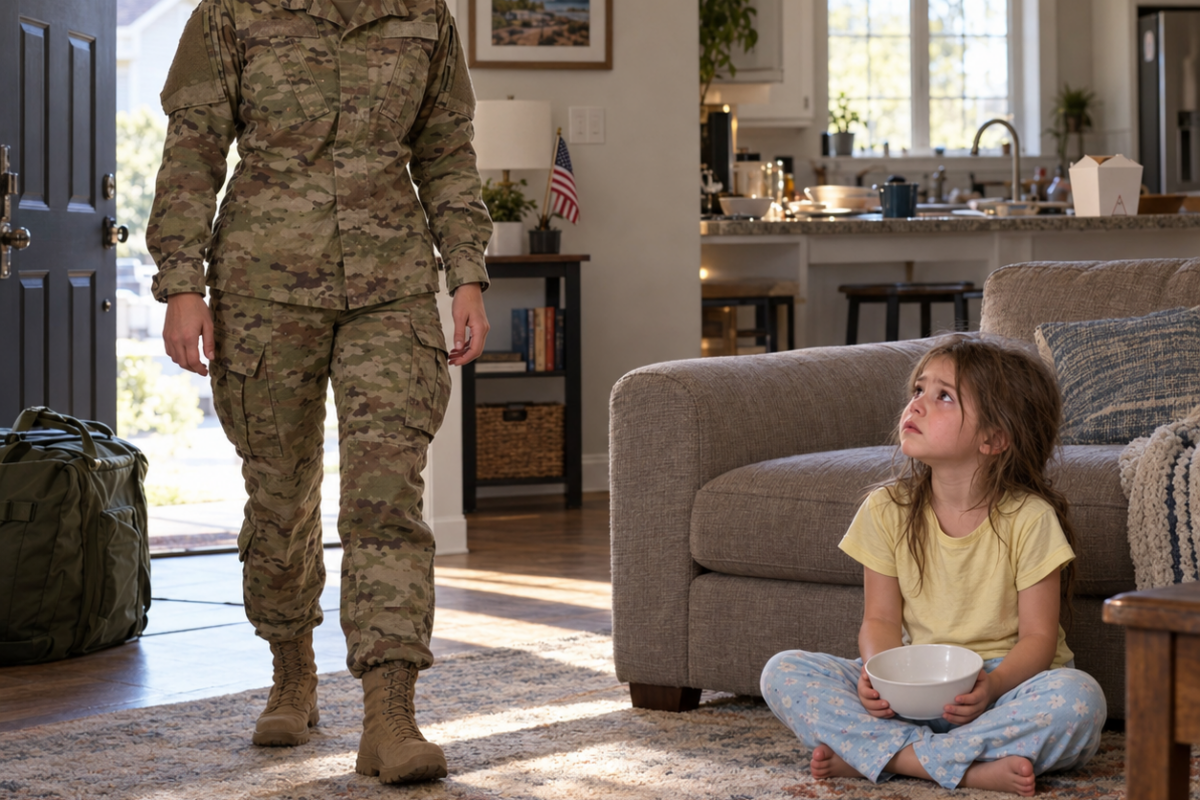
“Mommy, are you real?” my four-year-old daughter whispered when I came home from deployment three weeks early. She was sitting alone on our living room floor with an empty cereal bowl. My husband was on a Caribbean cruise with his mother and sister. Twenty-two minutes earlier, they had posted a photo captioned “Family time.” I was still in uniform when Sophie asked if she could have something to eat.
The first thing my daughter said when I found her was, “Mommy, are you real?” She was sitting cross-legged on our living room floor with…
End of content
No more pages to load