“I canceled your son’s procedure. Too expensive,” my mother texted while I stood at the children’s hospital with my nine-year-old son beside me. Evan had waited six months for surgery to help him walk without pain. Now the receptionist was telling me someone had used my information to cancel it. Evan looked up, clutching his stuffed T-Rex. “Am I too expensive?” he whispered.


The receptionist looked at her screen, then at my son, then back at me.
“I’m sorry, Mr. Meyer. It says the procedure was canceled.”
Evan stood beside my chair in a faded dinosaur sweatshirt, holding his stuffed T-Rex under one arm. We had arrived before sunrise because the hospital asked us to be early. He had been fasting since midnight. I had packed clean clothes, his favorite blanket, the paperwork, and the charger I somehow forgot at every appointment except this one.
For six months, we had been waiting for that Friday.
I thought I had checked everything.
“What do you mean, canceled?”
The receptionist moved her hand toward the mouse.
“There was a call on Tuesday. The note says the father requested cancellation because of the expense and wanted to continue with medication and follow-up care.”
Evan looked up at me.
“You canceled it?”
“No, buddy.”
My answer came immediately.
Then my phone vibrated.
A message from my mother.
I canceled your son’s procedure. Too expensive. You can just deal with it. No need to waste $8,400.
I read the words twice.
The first time, they did not seem possible.
The second time, I understood exactly what they meant.
My mother had called the hospital without my permission and interfered with my son’s care.
The receptionist asked whether I wanted her to get a supervisor.
I barely heard her.
Evan was still looking at me.
“Am I too expensive?”
That was the moment I stopped thinking about the schedule.
Not the operating room.
Not the deposit.
Not the hours I had taken off work.
My nine-year-old son had just asked whether caring for him cost more than he was worth.
I put the phone facedown.
Then I crouched beside him.
“No,” I said. “You are not too expensive. Something is wrong with the paperwork, and I’m going to find out what happened.”
He watched my face carefully.
Evan had spent enough time in medical buildings to recognize when adults were trying to sound calmer than they felt.
I could not fool him completely.
But I could make one thing clear.
“You didn’t do anything wrong.”
He nodded.
His fingers tightened around the T-Rex.
My name is Carl Meyer. I was thirty-six that winter, a single father in Wichita, Kansas, and a mechanic with hands that never looked entirely clean, no matter how much soap I used.
I fixed cars for a living.
I diagnosed noises, replaced worn parts, argued with bolts, and occasionally explained to customers that a warning light was not a decoration.
I liked the work.
Most problems had a cause.
Most repairs had a process.
You could test what you had done.
My family was different.
In my family, the same problem could remain unresolved for years because anyone who mentioned it was accused of making things worse.
My mother, Linda, was sixty-one.
My older brother, Rick, lived with her in a two-bedroom bungalow about fifteen minutes from my rented house.
They called me the responsible one.
For a long time, I thought that meant they trusted me.
Eventually, I understood it meant they expected me to pay.
Evan was born with a vascular malformation in his leg.
It was not something you could see clearly in every photograph. Some days, if he sat quietly, he looked like any other boy with a book in his lap and a question waiting behind his teeth.
But walking could hurt.
Standing too long could hurt.
There were afternoons when he came home from school trying to hide a limp because he did not want me to worry.
His specialists monitored the condition as he grew. We had been through imaging, appointments, medication changes, orthotics, and an earlier procedure when he was five.
The treatment scheduled for that Friday was specialized and outpatient, though outpatient never sounded small to me.
It meant anesthesia.
It meant trusting people I respected with someone I loved more than anything.
It meant hope, offered carefully and without guarantees.
The surgeon had explained what the procedure was intended to do: address part of the malformation, reduce pressure and pain, and help manage risks as Evan continued growing.
We understood there might be future treatment.
We understood this was not a promise of a different body by Monday.
Evan understood the part that mattered most to him.
It might hurt less to walk.
He had asked the surgeon whether he could eventually run around with his cousin Joey without needing to sit down halfway through.
The surgeon said they would work toward the activities he wanted, step by step, and follow the recovery plan.
Evan took that seriously.
For weeks, he referred to the procedure as our next step.
Not a miracle.
A step.
We had already lost two dates.
The first delay involved insurance authorization that took longer than expected.
The second happened when Evan developed the flu.
Nobody was at fault for that.
But he cried when we told him.
Then he apologized for being sick, which nearly broke me.
I told him bodies did not owe anyone an apology for needing care.
Apparently, I should have told my mother the same thing much earlier.
The hospital’s estimate for the procedure was $8,400 before insurance.
That was not the amount I was simply expected to hand over in cash.
There were covered portions, patient costs, and details I had spent a great deal of time discussing with billing staff.
But the number became my mother’s favorite weapon.
Eight thousand four hundred dollars.
She used it as though saying it slowly made the medical decision obvious.
There was also a preoperative MRI bill of $1,150 after insurance, which I needed to address separately.
I had paid it.
I had set aside the remaining money we expected to need.
I had discussed payment arrangements where necessary.
We were not wealthy.
We were prepared.
That distinction mattered to me.
It did not matter to Linda.
To her, money spent on Evan’s care was money unavailable for the needs she considered more urgent.
Usually hers.
Sometimes Rick’s.
My father died three years earlier.
The funeral costs came up short by $4,200.
I paid the difference.
I did not resent that at the time.
We were grieving.
There were decisions to make.
I had some savings, and I wanted to spare my mother another worry.
Then there were utility bills.
Two hundred dollars a month.
Then Rick’s vehicle insurance.
Usually around a hundred and fifty dollars, though the recurring transfer had settled at $145.
Then tires.
Repairs.
Eighty dollars until Friday.
A little help before the next check.
A card for emergencies that gradually became a card for whatever felt inconvenient to pay for.
I kept telling myself I could manage.
I worked extra hours.
I put off things.
I bought less for myself.
Those choices were mine.
But they were made inside an arrangement where saying no carried a cost nobody else seemed willing to pay.
My mother became hurt.
Rick became angry.
I became the man who had forgotten what family meant.
So I sent the money.
And the next request arrived.
Evan learned some of the rhythm before I realized he was listening.
“Is Grandma having another emergency?” he asked once when my phone kept ringing during dinner.
I told him she needed help with a bill.
He nodded.
Then he asked whether we still had money for his new shoes.
We did.
I made sure we did.
But I hated that the question existed.
My mother rarely asked how much energy it took to keep his life steady.
She did not ask how I managed appointments around work.
She did not ask whether I was sleeping.
She asked whether I could send the utility money a few days early.
At Evan’s first procedure, she came to the hospital and looked at the billing folder on my lap.
“All this for a leg?”
I looked at her.
“He has pain, Mom.”
“In my day, people prayed and learned to live with things.”
I said prayer and medical care did not need to compete.
She smiled as though I had missed the point.
Rick made jokes.
When Evan needed custom orthotics, he said the boy had expensive feet.
Evan laughed because adults were laughing.
Later, he asked whether there were cheaper feet.
I told him his were fine.
I did not tell Rick what his joke had become in a five-year-old’s mind.
I should have.
There were birthdays remembered late.
Visits where Linda talked around Evan rather than to him.
Comments about children being resilient, usually made when resilience would save somebody else an inconvenience.
Still, I kept visiting.
I kept inviting.
I kept hoping that if I made everything easy enough, my family would stop treating my son as the difficult part of my life.
That hope lasted longer than it deserved.
The first clear break came the previous fall.
Rick called while I was closing the shop.
He had been arrested after another incident involving drinking and driving.
It was not the first.
He needed five hundred dollars for bond, he said, and at least two thousand for a lawyer to begin.
I stood beside a workbench with the MRI invoice in my hand.
The shop smelled like warm rubber and oil.
My shoulder hurt from the day.
“I can’t,” I said.
He laughed.
“Can’t or won’t?”
“I have Evan’s imaging and treatment costs.”
“You’ve always got something.”
“Yes. I have a child.”
Rick made a sound of disgust.
“So you pick a leg over your own brother.”
I closed my eyes.
Not because the argument was persuasive.
Because I had heard enough versions of it to know the next ten minutes before they happened.
My mother got on the phone.
She was gentle at first.
“Carl, sweetheart, your brother is having a hard time.”
“I know.”
“Family doesn’t abandon people.”
“I’m not paying his legal bills with Evan’s medical money.”
“You can get another date.”
“We’ve already been delayed.”
“This is immediate.”
“So is my son’s care.”
Her tone changed.
“That boy has you wrapped around his little finger.”
I looked at the invoice again.
There was nothing manipulative about a child wanting less pain.
“Don’t say that about him.”
“Children are resilient.”
“He shouldn’t have to prove that because Rick drove drunk.”
Silence.
Then she said I was being selfish.
I said no again.
She hung up.
I paid the MRI bill.
I went home.
Evan was working on a drawing of a dinosaur driving a tow truck.
He had made the arms longer because a regular T-Rex would struggle with the steering wheel.
I sat beside him and admired the practical adjustment.
For a little while, the world made sense.
After that call, Linda’s comments became more pointed.
“If you didn’t spend so much on doctors, you wouldn’t be stressed.”
“He can walk.”
“Some people have it worse.”
Once, when I did not answer a message quickly, she asked whether I was too busy counting surgery money to respond to my own mother.
I wrote a reply.
Deleted it.
Went back to work.
That was how I dealt with most things then.
Finish the job.
Get through the day.
Do not give the argument more oxygen.
I thought I was protecting Evan from conflict.
I did not see how much conflict was already reaching him in quieter forms.
Three days before the scheduled treatment, my mother called the hospital.
I was at work.
Evan was at school.
Neither of us knew.
She had enough information to sound credible.
My full name.
Date of birth.
Phone number.
Address.
Evan’s details.
The procedure date.
The estimate she had repeated so often.
Some of that information came from ordinary family knowledge. Some came from the access I had given her when I believed she might need to help in an emergency.
Knowledge was not authority.
The hospital would eventually have to examine how its staff had treated the difference.
Linda presented herself as calling with my authorization.
The internal scheduling entry had been recorded as a father-requested cancellation.
Other notes reflected that the caller was a family representative who claimed to be relaying my decision.
That discrepancy was important.
The receptionist’s screen did not show a complete or perfectly accurate account of the call.
It showed enough to stop the process when we arrived.
My mother had counted on the rest.
She thought that if the slot was gone, I would accept the result.
Then the money I had protected for Evan might become available for the family emergencies she preferred.
She later denied that part.
I could not read her mind.
I could read the messages asking about bills immediately after she interfered with the treatment.
Those told their own story.
At the admissions desk, I asked whether Evan and I could sit somewhere while the issue was reviewed.
The receptionist pointed to blue chairs nearby.
I thanked her.
She looked genuinely concerned.
There were people waiting behind us.
I could feel attention gathering.
I did not want my son’s fear to become a lobby event.
I sat him down.
“Stay here for a minute. I’m going to talk to the desk.”
“Are they still doing it?”
“I don’t know yet.”
He looked frightened.
I put a hand on his shoulder.
“I’m finding out. We’re not giving up.”
I walked back.
Kept my voice low.
“The person who called did not have my permission.”
The receptionist nodded.
“Do you have anything we can show the supervisor?”
I turned the phone toward her.
The text.
Then the voicemail my mother had left from Rick’s phone.
I had not listened to it earlier because we were checking in.
Now I played it.
Linda sounded pleased.
“Carl, I fixed it. You were too proud to admit the expense was too much, so I made the call. They said you could keep doing the medications and appointments. You’re welcome. We’ll talk later.”
I stopped the recording.
The receptionist’s expression changed.
She did not diagnose a crime.
She did not promise the whole problem would be solved.
She said, “I’m going to get patient relations.”
That was the right next step.
Ten minutes later, I sat in a small office with a woman from patient relations and a man from compliance.
Evan was nearby with a child-life staff member, building a car from plastic bricks.
I could see him through the doorway.
He had the T-Rex seated beside him.
The compliance representative introduced himself and explained that they needed to understand the event clearly.
I showed the messages.
The voicemail.
The missed calls.
My identification.
The procedure information.
I confirmed that Linda had no legal authority to consent, cancel, or alter Evan’s treatment on my behalf.
He asked whether she was listed as an emergency contact.
“Yes.”
“That is different from having authority to make treatment decisions.”
“I know.”
He nodded.
“We need to make sure the record reflects that clearly.”
The woman from patient relations apologized for the distress.
Then she asked what I wanted most urgently.
“The care,” I said. “I need to know what happens to his care.”
She nodded.
They had already contacted the clinical team.
The canceled Friday arrangement could not simply be recreated while I sat there. Staffing and scheduling had changed, and the surgeon’s team needed to confirm an appropriate opening.
But they could offer Monday with the same surgeon and the same planned procedure, subject to completing the necessary checks again.
I stared at her.
“Monday?”
“Yes.”
“Not another six months?”
“No.”
The relief was so strong that it made me dizzy.
I pressed both hands against my knees.
“Okay.”
The compliance representative waited a moment.
Then he said they also needed to preserve the records, review the call and verification process, and determine whether referrals or reports were appropriate.
He used careful language.
Potential unauthorized impersonation.
Interference with treatment arrangements.
Possible misuse of identifying information.
He did not say the hospital had already convicted my mother of medical fraud.
Hospitals do not do that.
They document.
They investigate their own processes.
They consult legal advisers and, when appropriate, refer matters to other authorities.
I understood little of the terminology at first.
I understood the practical meaning.
They were taking it seriously.
“Do what you need to do,” I said.
They asked me to provide a written statement.
I did.
They preserved copies of the messages with my consent.
They explained how the chart would be corrected and how future scheduling changes would require stronger verification.
Linda would no longer be treated as someone who could speak for me.
Her emergency-contact status would be removed at my request.
Any access rights previously associated with family assistance would be reviewed and revoked where I had authority to do so.
I signed forms.
Read them carefully.
Asked questions.
For years, I had signed family-related things quickly because I wanted the issue finished.
Not that morning.
When the surgeon’s nurse joined us, she spoke about Monday’s preparations.
What to repeat.
What remained valid.
What time to arrive.
Medication instructions.
Fasting.
She wrote everything down.
Then she looked at me.
“This administrative incident doesn’t change the clinical recommendation. The team still considers the planned treatment appropriate.”
I needed to hear that.
Linda had filled the morning with doubt.
The nurse gave me facts.
I asked whether waiting through the weekend created an urgent concern.
She answered specifically about Evan’s condition and the plan, not in broad reassuring phrases.
The team considered the short delay acceptable.
If symptoms changed, we had instructions.
I wrote down the number.
Then I went to get my son.
He held up the little car.
“It has a dinosaur seat.”
“I noticed.”
“Are we going home?”
“Yes. We’re coming back Monday.”
He watched my face.
“Because of Grandma?”
I sat beside him.
“Yes.”
I did not want to hide behind “a grown-up” when he already knew who.
“She called without asking me. That was wrong. The hospital is fixing the schedule.”
“Did she think I didn’t need it?”
I swallowed.
“She made a decision she wasn’t allowed to make. Your doctor and I have talked about what you need.”
He looked at the little car.
“Okay.”
I touched his shoulder.
“And you are not too expensive.”
He nodded, but not as though the sentence had completely settled inside him.
It would take more than one answer.
On the way to the parking lot, he walked slowly.
Partly because he was tired.
Partly because his leg hurt.
I matched his pace.
There was no reason to hurry him after the morning he had already endured.
In the truck, my phone began vibrating again.
Linda.
Rick.
Linda.
An unfamiliar number.
I set it where I could see the navigation and not the messages.
Evan asked whether I was answering.
“Not while I’m driving.”
“Are they mad?”
“Probably.”
He looked worried.
“That isn’t your responsibility,” I said.
He stared through the windshield.
I could see how quickly children turned adult conflict into something they might have caused.
I had done the same thing when I was young.
I did not want that habit becoming his inheritance.
We stopped for breakfast.
He had been fasting for a procedure that was no longer happening that morning.
I bought him eggs and toast.
He asked whether he could have pancakes instead.
“Yes.”
He smiled a little.
That small request felt important.
He was still allowed to want something.
Still allowed to ask.
Still allowed to receive care without presenting a financial defense.
While he ate, I called the shop.
My manager knew about the procedure.
He expected me to be away.
I explained the change.
He swore quietly, then apologized when he remembered where I was.
“I’m not coming in today,” I said.
“You shouldn’t.”
“I need Monday off too.”
“We’ll handle it.”
I stared at the table.
“Thanks.”
He said we would discuss the rest later.
Not every favor required a speech about what family meant.
Some people simply helped.
After breakfast, I drove to the credit union.
I had spent years treating financial boundaries as things that could wait until everyone calmed down.
I did not want the hospital to protect Evan’s care while my own accounts remained arranged around Linda’s convenience.
A banker took us into a small cubicle.
There was a fake plant.
A poster about saving for retirement.
A bowl of candy Evan examined before asking permission.
I said yes.
Then I explained that I needed to secure my finances and remove access I had previously given family members.
The banker reviewed the accounts.
One was a joint savings account.
The balance was $4,380.
I had started it when Evan was born.
At some point, after my mother said she might need to help during an emergency, I had added her.
I intended it to be temporary.
Temporary had lasted years.
“I want it in my name only,” I said.
The banker was careful.
She could not simply erase a joint owner because I was upset.
The legal ownership structure and the account agreement mattered.
We discussed what could be done that day, what required additional authorization, and how to protect funds going forward.
The deposits had come from me.
I had records.
Following the credit union’s procedures, I established a new sole account and moved the funds I was entitled to move, while arranging the proper closure and access restrictions for the old setup.
I received written confirmation of the changes.
The exact process took longer than clicking a box.
That was fine.
I wanted it done properly.
Evan read a comic while I signed.
The banker asked whether I needed to review passwords, contact information, and telephone verification.
“Yes.”
We did.
I made sure no one could use familiar biographical details as a substitute for actual authorization.
I did not ask for an impossible promise that nobody could ever attempt something again.
I asked for the available safeguards.
Then I called the credit card company.
Linda was an authorized user on an account for which I was responsible.
She had a card.
I paid the bill.
The balance was $1,972.
I looked at the number while Evan sat in the back seat, moving his T-Rex along the window ledge.
There were groceries in that balance.
There were also purchases that had nothing to do with an emergency.
I had seen them.
Questioned a few.
Accepted explanations that made the conversation shorter.
I removed the authorized-user access immediately.
Then I arranged to pay the balance and close the account according to the issuer’s process.
I reviewed the contact details and asked what verification would be required for future changes.
The representative explained it.
I wrote it down.
Finally, I canceled two recurring transfers.
Two hundred dollars to Linda’s utilities.
One hundred forty-five dollars toward Rick’s vehicle insurance.
The confirmation screen asked whether I was sure.
I was.
I saved the records.
Then I sat in my driveway for a minute before getting out.
The house looked ordinary.
A little rental with paint that needed attention and a patchy lawn I never had enough time to improve.
It was ours.
The money I had just protected was not a fortune.
It was stability.
Groceries.
Medication.
Rent.
Appointments.
A repair when the truck needed one.
The ability to say yes to a school trip without first hoping Linda had no emergency that week.
I went inside and made lunch.
Grilled cheese.
Tomato soup.
Evan helped place napkins on the table.
He asked whether he could use the blue bowl.
“Yes.”
He did not need to know that almost every ordinary thing I said yes to that day felt like a correction to the morning.
After lunch, I sent one message to Linda.
You contacted Evan’s hospital without my permission and caused his treatment to be canceled. They have rescheduled him for Monday and are documenting and reviewing what happened. You are not authorized to contact his doctors, school, or insurer on my behalf. I have secured my accounts and ended the financial arrangements supporting you and Rick. I will not discuss this while Evan is preparing for treatment.
I read it once.
Removed a sentence written mostly from anger.
Sent it.
Then I put the phone facedown.
The response arrived quickly.
Rick said I had snitched.
Linda said she had made one call to protect me from debt.
Then came the familiar accusation.
After everything I’ve done for you.
I did not answer.
Another message said hospitals only saw money.
Another said family looked out for family.
Then she reached the subject that seemed to frighten her most.
What do you mean the transfers are canceled? The electric is due. Rick’s insurance is next week. We’re counting on you.
I read that line several times.
They were not counting on me to sit beside Evan in recovery.
They were not counting on me to help him through the first difficult walk.
They were not asking how he felt after arriving at the hospital and hearing his care had been canceled.
They were counting on the deposits.
I did not need to turn that observation into a speech.
I needed to act on it.
That afternoon, my friend and coworker Jenna called.
She worked at the shop and had known Evan since he was little.
He liked her because she answered his questions seriously, even the strange ones.
I told her what happened.
She was quiet.
Then she asked what I needed.
I almost said nothing.
An automatic answer.
She heard the pause.
“Carl.”
I looked at the sink.
“I need Monday to go right.”
“Then I’m driving you.”
“You don’t have to.”
“I know. I’m offering.”
I sat down.
“All right.”
She asked whether we had food for the weekend.
I said yes.
She asked whether Evan wanted company.
I asked him.
He said she could come if she wanted to see the dinosaur tow truck drawing.
She said that sounded like a professional obligation.
He smiled.
Later, she arrived with groceries I had not requested and a calmness that made my own house feel less tense.
She did not call my family names in front of Evan.
She asked about his drawing.
She admired the longer dinosaur arms.
She played a short game with him while I returned the hospital’s call.
The contrast was so plain it hurt.
Support did not need to be loud.
It needed to be useful.
That evening, Evan took a bath.
I folded towels.
The phone kept lighting up.
I listened to one voicemail from Rick.
He was trying to sound reasonable.
“Yeah, what Mom did was out of line. But he’s still getting the thing, right? It’s not like he died. Just tell them it was a misunderstanding and turn my insurance back on.”
I stood in the hallway holding a towel.
For years, I had accepted a family measurement in which harm counted only if it was catastrophic.
If nobody died, I should let it go.
If the money eventually came back, I should stop asking.
If a remark could be called a joke, Evan should forget it.
That measurement protected whoever caused the harm.
It did not protect my son.
I saved the voicemail.
Then I finished folding the towel.
Evan went to bed early.
He was exhausted.
I read beside him until his eyes grew heavy.
Before sleeping, he asked, “Are you sure Monday?”
“Yes. The hospital confirmed it.”
“Can Grandma call again?”
“They have new instructions. She doesn’t have permission.”
He nodded.
I did not promise that no system could ever fail.
I promised what I knew.
“And I’m checking everything with them myself.”
That seemed to help.
Around nine, the doorbell rang.
I looked through the peephole.
Linda and Rick.
Together.
Angry.
For a moment, I thought about not answering.
Then I decided I wanted one clear conversation that could not be mistaken for uncertainty.
I stepped outside and closed the door behind me.
“We’re not doing this inside. Evan is asleep.”
Linda began immediately.
“You went too far.”
I stayed near the door.
“The hospital called and asked questions. They talked to me like I was some kind of criminal.”
“You called without permission and changed his treatment arrangements.”
“I was helping.”
“No.”
She stared.
I continued.
“You don’t get to decide what care he receives.”
“It was too expensive.”
“The estimate wasn’t the same as my final cost. I had discussed the finances with the hospital.”
“You were still spending money we need.”
There it was.
I looked at her.
“Money you expected from me.”
She folded her arms.
“Family helps.”
“Family does not interfere with a child’s care because it wants access to his father’s savings.”
Rick stepped forward.
“Just tell them it was a misunderstanding.”
“It wasn’t.”
“You’re making it bigger.”
“She made it big enough for Evan to ask whether he was too expensive.”
Linda looked away.
For a second, I thought that might reach her.
Then she said, “Children say things.”
“Yes,” I answered. “Because they hear things.”
Rick shook his head.
“You always act like nobody can joke about the kid.”
“This wasn’t a joke.”
My mother’s eyes filled.
“You’re abandoning us over one mistake.”
I had heard the word mistake used for everything from missed bills to broken promises.
I was no longer willing to let it erase sequence.
“You knew the date. You knew what you were saying. You called. You told them I wanted to cancel. Then you sent me a message about it.”
She looked at me.
“That isn’t one careless moment.”
Rick muttered something.
I did not ask him to repeat it.
I said, “You need to leave.”
Linda changed tactics.
“The electric is due.”
“You’ll need to make arrangements with the utility company.”
“Rick needs insurance.”
“He needs to decide whether he can afford his vehicle.”
“You think you’re better than us.”
“No.”
I took a breath.
“I think I have responsibilities I haven’t protected well enough.”
She looked toward the door.
“When that boy grows up and leaves, you’ll remember who was there for you.”
I thought of Evan in the hospital lobby.
His hand around the T-Rex.
His voice.
Am I too expensive?
“I hope he grows up and has a life,” I said. “That’s what I’m working for.”
Linda stared.
I added, “He isn’t supposed to remain small so I have someone to control.”
Rick looked uncomfortable.
My mother’s face hardened again.
“You’ll regret this.”
“Maybe I’ll regret not doing it sooner.”
I did not raise my voice.
I did not need to.
“You can go now.”
I stepped inside.
Locked the door.
Waited until their car left.
Then I turned toward the hallway.
Evan’s bedroom door was partly open.
He stood there in pajamas.
“Was that Grandma?”
“Yes.”
“Is she mad?”
“She’s upset I said no.”
“Did you say it mean?”
I crouched, slowly, because my knees were tired.
“I said it clearly.”
He thought about that.
Then he asked, “Are we still doing the treatment?”
“Monday morning.”
He nodded.
I walked him back to bed.
He climbed under the blanket.
I sat beside him until he slept.
Afterward, I remained in the hallway, listening to the house settle.
For the first time that day, there was no task immediately in front of me.
No form.
No call.
No conversation.
Just the weight of what happened.
I leaned against the wall and cried.
Quietly.
I was angry.
I was frightened.
I was ashamed of how long I had allowed my family to make Evan feel like a cost rather than a person.
Those feelings did not cancel what I had done that day.
They told me why I needed to keep doing it.
Saturday was slow.
I wanted it to be calm.
Evan wanted to know every detail of Monday.
What time.
Which nurse.
Whether the T-Rex could come.
Whether he would have the same surgeon.
I answered what I knew.
For the rest, I checked.
The hospital called to review instructions again.
I spoke directly with the nurse.
We confirmed the updated safeguards.
No scheduling changes from anyone claiming to represent me without the required verification.
Linda removed from the relevant contact permissions.
A clear note documenting the dispute and the correct decision-maker.
I asked what I should do if I received another concerning message.
They gave me the appropriate contact.
I saved it.
Then I called Evan’s school.
The office already knew about the planned absence.
I updated emergency contacts and clarified who could receive information or collect him.
I did not ask the school to decide a family dispute.
I provided clear instructions within my authority and asked them to follow their procedures.
The secretary said she would confirm the changes.
She did.
Evan watched part of that call.
“Can Grandma still come to school?”
“Not to pick you up unless I arrange it.”
“Okay.”
He returned to his book.
The relief in that small word made me wish I had reviewed every form sooner.
Sunday afternoon, Jenna stopped by again.
She brought a little Hot Wheels car.
“For your recovery collection,” she told Evan.
He examined it.
“Is this the one I take Monday?”
“You can.”
“What if I lose it?”
“We’ll try not to. But a car getting lost isn’t the end of the world.”
He looked at her.
Then at me.
She seemed to realize there was more behind the question.
So she added, “And you don’t have to protect a gift by being afraid to use it.”
He smiled.
We ate an early dinner.
I packed the hospital bag again.
The same blanket.
The same T-Rex.
The same charger.
This time, I put the written confirmation of the new date in the folder.
Not because I expected another failure.
Because evidence steadied me.
Before bed, Evan asked if I was scared.
I considered lying.
Then I said, “A little.”
His eyes widened.
“Because of Grandma?”
“Because I love you, and I want everything to go well.”
He thought.
“Doctors know what they’re doing.”
“Yes.”
“You said that.”
“I did.”
He nodded.
Then he leaned against me.
I held him.
Sometimes reassurance traveled both directions.
That did not mean he was responsible for taking care of me.
It meant we were allowed to be honest without making fear a secret.
Jenna arrived at 5:30 Monday morning.
She brought coffee for me.
No dramatic speech.
She helped carry the bag.
Evan climbed into the back seat slowly.
I checked the instructions one last time.
The streets were quiet.
The hospital lights looked familiar before we reached the entrance.
I felt my body tighten.
Friday had left its mark.
Jenna noticed.
“We’re here,” she said.
I nodded.
Inside, check-in was smooth.
Identification.
Forms.
Confirmation.
No surprise cancellation.
A nurse greeted Evan by name.
He looked at me.
I smiled.
“We’re good.”
The compliance representative came by briefly.
He said the administrative review was continuing, the records had been preserved, and the care team was proceeding with the confirmed plan.
He did not discuss consequences for Linda in front of Evan.
I appreciated that.
My son did not need to carry the investigation into the treatment room.
The clinical team explained the next steps.
Evan changed.
Held the T-Rex.
Asked whether the toy could stay with him until the last possible moment.
The nurse said yes.
I sat beside him.
His small hand rested in mine.
He looked at the folder.
“They didn’t listen to Grandma this time.”
“They’re following the right instructions.”
He nodded.
Then he asked whether he could have grilled cheese later.
“If the team says your stomach is ready.”
“Okay.”
Ordinary wishes.
I loved them.
When it was time, he hugged me.
Not long.
He was trying to be brave in the particular way children often are: not because they feel no fear, but because they want the adults they love to feel better.
I told him he did not have to perform bravery.
“You can tell them if you’re worried.”
“I know.”
The nurse wheeled him away.
He held up the T-Rex.
I waved.
Then the doors closed.
I sat in the waiting area with Jenna.
There was nothing to fix.
That was difficult for a mechanic.
At work, when something was wrong, I could inspect, test, replace, adjust.
Here, I had to trust people and wait.
Jenna gave me the coffee.
It had cooled enough to drink.
I took a sip.
She asked how I was doing.
“I keep thinking about Friday.”
“I know.”
“About him asking whether he was expensive.”
She looked down.
“That was a terrible thing for him to have to wonder.”
I nodded.
For a while, we watched the clock.
Then I said, “I thought if I helped enough, they would eventually show up differently.”
Jenna did not give me a slogan.
She said, “You were trying to make a family work.”
“Yes.”
“That doesn’t make you foolish.”
“It feels foolish.”
She looked at me.
“You changed what you were doing when the truth became clear.”
I thought about that.
It helped more than being told I should have known all along.
The surgeon came out about two hours later.
The procedure had gone as planned.
He explained what had been done and what the team would watch during recovery.
There was no guarantee of an effortless future.
There was a reasonable expectation that the treatment would help, with follow-up and time.
I listened.
Asked questions.
Wrote down what I could.
Then he said Evan was in recovery and we would be brought back when appropriate.
I exhaled.
It felt as though I had been holding the same breath since Friday.
Jenna touched my shoulder.
Neither of us spoke for a moment.
When I saw Evan, he was sleepy.
His leg was dressed.
The monitors made soft, regular sounds.
His hair stood up on one side.
The T-Rex was near his arm.
I sat beside him.
“Hey, buddy.”
His eyes opened slightly.
“Did we do it?”
“Yes.”
He studied my face.
“You didn’t cancel.”
My throat tightened.
“No.”
He nodded.
Then drifted again.
I stayed.
There were instructions before discharge.
Medication.
Rest.
Warning signs.
Follow-up.
Activity restrictions.
The team explained everything clearly, and I asked them to repeat what I needed repeated.
I did not pretend exhaustion made me less in need of information.
Jenna listened too, with my permission, so we had another person who understood the plan.
At home, we settled Evan on the sofa with pillows and the blanket.
The new car rested beside the T-Rex.
He ate a little.
Drank.
Slept.
I set alarms.
Kept the paperwork where I could reach it.
Checked the medication schedule.
The day became a series of small responsibilities I was grateful to have.
My phone remained quiet because I had silenced the people who were not helping.
That was not avoidance.
It was prioritizing.
The first week of recovery was not a picture of instant transformation.
Evan was sore.
He was frustrated.
He wanted to move more than he was allowed.
Then he wanted help with things he normally did himself.
I reminded him both were understandable.
We followed the clinical instructions.
When I was uncertain, I called.
The nurse answered.
When symptoms needed discussion, we discussed them.
There was no virtue in guessing.
Jenna helped with groceries and a few work arrangements.
My manager adjusted shifts so I could manage the early follow-up.
I used leave and made practical plans for income.
Stopping the family transfers did not make us wealthy.
It made the numbers less frightening.
I could look at the coming month without subtracting money other adults had already assumed they would receive.
That was a different kind of relief.
Linda continued calling.
At first, the messages were angry.
Then hurt.
Then practical.
The electric bill.
Rick’s insurance.
A property expense.
She said I wanted her to lose her home.
She said I was letting strangers turn me against family.
I listened to only what was necessary.
Saved messages relevant to the hospital matter.
Did not debate the rest.
I sent one clear notice that the recurring support had ended and that she needed to make other arrangements.
I did not offer a final month.
I had already paid more final months than I could count.
Rick asked me to float them until tax season.
He promised to repay me.
The same promise that had followed the transmission repair and the parts I supplied at cost.
I answered once.
I’m not funding you. You need to make arrangements based on your own income and resources. My priority is Evan’s care and our household.
He replied with insults.
I did not answer.
There was something strange about not defending myself.
For years, I had treated every accusation as a bill that required immediate payment.
Selfish.
Ungrateful.
Abandoning family.
Now I let the words remain theirs.
They did not become true because I failed to argue.
A hospital representative followed up about the administrative review.
They had examined the recorded information and how the cancellation was accepted.
They confirmed the record had been corrected to show that I had not requested it.
The matter had been referred to the appropriate internal legal and compliance staff.
Where external reporting was warranted, that would occur through the proper channels.
They could not promise a particular criminal result.
I did not ask them to.
I wanted accurate records.
Protection for Evan.
A process that did not allow family familiarity to substitute for permission.
They also acknowledged that their verification process needed review.
I appreciated that.
Linda had done something wrong.
The system still needed to ask how one unauthorized call had disrupted a child’s scheduled care.
Blaming only the caller would leave the same opening for somebody else.
I provided the information they needed.
Then I returned to helping Evan with homework.
That was the order I wanted my life to have.
Necessary administrative work.
Then my son.
Not an endless campaign centered on my mother.
A week later, an aunt called.
I braced myself.
She began with, “I heard something happened.”
I almost gave the short answer I had prepared for people seeking gossip.
Then she said, “How is Evan?”
I paused.
“He’s recovering.”
“Good.”
She waited.
There was no rush toward Linda.
No request that I explain why I had hurt my mother.
I told her some of what happened.
She listened.
Then she said, “I would have shown the hospital those messages too.”
I looked at the table.
“You would?”
“Yes.”
We talked for nearly an hour.
About Evan.
About Dad.
About the money arrangements she had only partly understood.
She did not say she knew every side.
She did say she had watched me carry more than seemed fair.
“I thought you wanted to help,” she said.
“I did.”
“That doesn’t mean you wanted to be used.”
I nodded.
Before hanging up, she asked whether she could send Evan a card.
“Yes.”
It arrived three days later.
His name on the envelope.
A little note about getting well.
No comment about cost.
He put it on his bedside table.
I noticed how often he looked at it.
Lisa called too.
She was my cousin, though Evan called her Aunt Lisa because she had been part of his life since he was small.
Her son Joey was a year older.
They were close.
She asked whether they could visit when Evan was up to it.
I checked with him.
He said yes immediately.
They brought comic books and sour gummy worms.
Joey sat on the floor beside the sofa.
He asked practical questions.
Did it hurt?
Could Evan bend his knee?
When could they play outside?
I stepped in where the medical answers needed care.
Otherwise, I let the boys talk.
Evan did not need every conversation softened until it stopped sounding like childhood.
He needed friendship.
Joey handed him a comic.
“I kept this one for you.”
Evan smiled.
That was another kind of generosity.
Something saved because a person mattered.
Not something withheld until he behaved correctly.
Recovery progressed.
Some days were better.
Some were harder.
The follow-up appointment about a month later was encouraging.
The surgeon said Evan was healing well.
The medication plan changed.
Activity could increase gradually within the guidelines.
We would keep monitoring the condition.
The treatment was not an eraser.
It was part of ongoing care.
Still, when we walked back to the truck, Evan’s movement looked easier than it had before.
He noticed too.
“It feels different.”
“How?”
“Not perfect.”
I smiled.
“That’s a fair description.”
“But different good.”
I nodded.
“I’m glad.”
In the truck, he asked about Easter.
“Do we have to go to Grandma’s?”
I kept my voice calm.
“No.”
He looked out the window.
“Can we stay home?”
“Yes.”
“Maybe invite Aunt Lisa and Joey?”
“That sounds good.”
He smiled.
Then he asked whether we could have lasagna instead of ham.
“Yes.”
He looked almost surprised by how easy the answer was.
I wanted him to grow accustomed to that.
Not every decision needed to be a conflict.
Not every family tradition was an obligation worth preserving.
Sometimes dinner could simply be food people liked, shared with people who treated them well.
Before Easter, Linda tried one more direct appeal.
She sent an old screenshot of a transfer I made.
Circled the amount.
This is what real family does.
I looked at it for a long time.
The old guilt rose.
Then I imagined sending her a screenshot of the hospital message.
I could have.
It would have created another argument.
I saved her message where I kept the others and did not respond.
There was nothing left to establish.
I had already told her the boundary.
She did not need a new explanation every time she disliked it.
Grief arrived unexpectedly during those weeks.
Not grief for the living people exactly.
Grief for the family I kept hoping they might become.
A grandmother who asked whether Evan was excited or scared.
A brother who helped carry a bag instead of asking why the money was unavailable to him.
A mother who understood that protecting my child was not a rejection of her.
I had waited years for those people.
Letting go of the waiting hurt.
Jenna noticed one afternoon at the shop.
I had returned to a more regular schedule, though I still worked around appointments.
She asked whether I was tired.
“Yes.”
“Just tired?”
I wiped my hands on a rag.
“I miss something I don’t think I actually had.”
She nodded slowly.
“I get that.”
I did not need her to solve it.
The acknowledgment helped.
I considered counseling.
Then I made an appointment.
I had spent enough time telling myself I should be able to manage without help.
A counselor asked about the phrase responsible one.
I laughed.
Then I stopped laughing.
We talked about how useful labels could become traps.
About the way I felt calm solving another person’s problem and uneasy protecting my own resources.
About how quickly I tried to make Linda’s disappointment disappear.
She did not tell me every part of my childhood explained everything.
She asked how the habits functioned now.
That was useful.
I began noticing the impulse before acting on it.
A request arrived.
My body prepared to say yes.
I paused.
Sometimes I still helped people.
A coworker needed a ride.
Lisa needed a hand moving a table.
Evan’s school needed a volunteer for something I could manage.
I did those things because I wanted to.
Not because someone had made guilt the price of declining.
Generosity remained.
The automatic access ended.
Easter Sunday arrived with mild weather and a kitchen full of garlic and tomato sauce.
I made lasagna.
It was not elegant.
The top browned a little more than intended.
Evan said the crispy part was the best part, which was either kindness or an excellent personal preference.
Lisa brought salad.
Joey brought a board game and a soccer ball.
We had checked what activities fit Evan’s current restrictions and recovery.
The boys could play outside carefully.
No heroic race to prove the procedure worked.
Just movement.
Fresh air.
A chance to do a little more.
I watched them through the kitchen window.
Joey rolled the ball.
Evan moved toward it.
Not as quickly as he wanted.
More easily than before.
He passed it back.
Then he laughed.
I rested both hands on the counter.
Lisa stood beside me.
“You okay?”
“Yes.”
She looked toward the yard.
“They’re having fun.”
“They are.”
The simplest sentence.
The most important one that afternoon.
Evan tried a short run later.
Awkward.
Careful.
He stopped when he needed to.
I did not tell him to push through.
He did not apologize for stopping.
That was progress too.
At dinner, I realized I had placed two extra chairs near the end of the table.
Habit.
I had not set places for Linda and Rick.
But my hands apparently remembered leaving room.
Joey asked who the chairs were for.
I looked at them.
“No one today.”
Evan studied my face.
“Can we move them?”
“Sure.”
We moved one against the wall and used the other for the bowl of plastic eggs.
No speech.
No symbol the children were required to understand.
Just making the room work for the people in it.
We ate.
Talked.
Laughed.
Joey described a school project with an ending that made no sense.
Evan interrupted to correct him.
Lisa told both boys to finish chewing before defending their positions.
They did.
Ordinary parenting.
Ordinary noise.
I did not miss a table where my son had to sit quietly so nobody noticed what he needed.
After dinner, the boys opened eggs and traded candy.
Evan offered Joey something he liked.
Joey offered something back.
Neither needed a lesson about gratitude.
They were practicing it through friendship.
Later, they disappeared into Evan’s room with the comics.
Lisa helped me clean the kitchen.
She said Linda had been telling relatives I was being influenced by coworkers and hospital staff.
I rinsed a plate.
“Of course.”
“She says you’re angry because they made it sound worse than it was.”
I set the plate down.
“It sounds bad because of what she did.”
“I know.”
Lisa dried a bowl.
Then she said several cousins had expressed support.
I looked at her.
“For what?”
“For saying enough.”
The phrase felt strange.
I had spent years believing enough was a selfish word.
Now it sounded like a useful measurement.
Enough pressure.
Enough access.
Enough money diverted from the household I was responsible for.
I did not need everyone to agree.
But hearing that somebody understood made the loneliness smaller.
After Lisa and Joey left, Evan was tired in a good way.
We followed his evening routine.
Medication where prescribed.
A check of the leg.
Teeth.
A story.
He held the T-Rex while I read.
Near the end, he asked, “Are we going to see Grandma again?”
I closed the book gently.
“I don’t know yet.”
He watched me.
“Do you want to?”
I thought before answering.
“I want her to understand what she did and behave differently. That hasn’t happened enough for me to arrange a visit.”
He nodded.
“What if she says sorry?”
“Then we’ll listen. But an apology isn’t the only thing that matters.”
“What else?”
“What she does afterward.”
He looked at the T-Rex.
“Like when I say sorry for leaving toys and then leave them again.”
I smiled.
“Something like that.”
He considered it.
“I’m working on it.”
“I know.”
Then he asked, “Do I have to hug her?”
“No.”
“Okay.”
He settled back.
I returned to the book.
He fell asleep before the last page.
That night, I sat at the kitchen table and emptied my wallet.
Receipts.
A loyalty card for a place I rarely visited.
The credit union confirmation.
The hospital identification band I had kept after Monday.
I laid the last two side by side.
One represented money I finally understood belonged to a purpose.
The other represented the person that purpose protected.
I did not need to carry them forever.
I put them in an envelope.
Stored it with the important documents.
The bank records did not belong on the refrigerator where Evan might feel responsible for our finances.
But the crooked car magnet he made in second grade stayed there.
KRL, he had written beneath it, because he had run out of patience for vowels.
I looked at that little magnet.
Then at the room.
The house was quiet.
Not because I had paid somebody to stop being upset.
Not because I had agreed to something I could not afford.
Because Evan was asleep.
Because his care was back on track.
Because I had stopped inviting the argument into every corner of our day.
The long-term situation with Linda remained unresolved.
The hospital’s review did not turn into the immediate arrest she accused me of arranging.
There were questions.
Documentation.
Referrals where appropriate.
I cooperated.
I did not make promises about outcomes.
I also did not withdraw the truth so she could avoid discomfort.
The facts stayed the facts.
She had called without authority.
She had caused the cancellation.
She had admitted it in writing and in a voicemail.
I had not agreed.
Nothing about being my mother changed those things.
Rick found ways to manage without my insurance transfer.
Some involved complaints.
Some involved selling things.
Some involved working more regularly.
I heard only what others told me and stopped asking for updates.
His finances were no longer a project assigned to me.
Linda made arrangements too.
The electricity did not disappear simply because I stopped paying.
There were payment plans and choices she had not wanted to consider while my transfers remained available.
That did not mean her life was easy.
It meant her difficulty did not automatically belong to my child’s medical budget.
Months after the treatment, Evan had another follow-up.
The progress remained encouraging.
He still needed monitoring.
There were still days when his leg hurt.
We adjusted to the information as it came.
At the appointment, the doctor asked him what he wanted to do more of.
“Play outside.”
“What kind of play?”
“Stuff where I don’t have to pretend I’m tired because I’m bored.”
I looked at him.
The doctor did too.
Evan shrugged.
“Sometimes I told people I didn’t like games because I didn’t want to say my leg hurt.”
I had not known that.
We talked about it on the drive home.
He said he did not want children to think he was different.
I said everyone had things they needed help with, but that did not mean the feeling was easy.
He nodded.
Then he asked if I had ever pretended something was okay when it wasn’t.
“Yes.”
“A lot?”
I kept my eyes on the road.
“Too often.”
“Did it work?”
“Not really.”
He thought about that.
Then said, “Maybe we should stop.”
I smiled.
“Yes.”
It was not a promise that either of us would become perfectly honest about every feeling.
It was a direction.
A better one.
At the shop, I kept working.
Cars still needed repair.
Bills still needed paying.
My life did not become a triumphant montage because I finally set a boundary.
I got tired.
I miscalculated grocery costs.
I worried about the next appointment.
I had days when I wanted to call my mother and discuss something ordinary before remembering that ordinary contact could become another request.
I let myself feel that.
Then I called someone else.
Jenna.
Lisa.
My aunt.
People who asked about Evan before asking for anything.
People whose affection did not become more available when I opened my wallet.
Over time, Evan grew less worried about the treatment being taken away.
He stopped asking whether Grandma could cancel the next appointment.
He began asking about other things.
A school trip.
A bicycle adjustment.
Whether a T-Rex would be good at basketball if the hoop were low enough.
I welcomed those questions.
They meant his mind had room for childhood again.
One afternoon, we were at the grocery store.
He saw a toy he wanted.
It was not expensive, but I had already bought enough extras that week.
I said no.
He looked disappointed.
Then he asked, “Because I’m expensive?”
The old question.
Quieter now.
Still there.
I stopped the cart.
“No. Because we’re choosing what to spend today. Every person has limits. That does not mean you are a burden.”
He nodded slowly.
I added, “Medical care isn’t the same as an extra toy.”
“I know.”
“You don’t have to feel guilty because I say no to something.”
He looked at the toy again.
Then at me.
“Can I save for it?”
“Yes.”
He smiled.
We continued shopping.
It was a small conversation.
One I might have rushed through before Friday at the hospital taught me how much meaning a child could attach to money.
I could not erase that morning.
I could keep answering accurately.
Needs.
Choices.
Limits.
Worth.
Different things.
Linda sent a message near the end of spring.
I’m sorry if Evan was upset. I was worried about you.
I read it.
Then I put the phone down.
Later, I answered.
He was upset because you interfered with his care and told me it was a waste of money. Any future discussion needs to acknowledge that directly. The boundaries remain.
She did not reply.
I did not chase the conversation.
Perhaps she would eventually understand.
Perhaps not.
I no longer made my son wait for safety while I waited for her understanding.
That was the change.
Not a final declaration that I would never feel love for my mother.
Not a wish that her life become difficult.
A practical decision that her place in ours would depend on behavior, not title.
One evening, Jenna stayed for dinner after helping with a small repair at my house.
Evan talked almost the entire meal.
About school.
About Joey.
About an enormous dinosaur he believed had been unfairly overlooked in a documentary.
Jenna listened.
Asked questions.
Disagreed with one conclusion.
Evan defended it.
We laughed.
Afterward, he carried his plate to the sink.
“Thanks for dinner,” he said.
“You’re welcome.”
Then he turned to Jenna.
“Thanks for Monday.”
She looked surprised.
“That was a while ago.”
“I know.”
He shrugged.
“I remembered.”
She smiled.
“I’m glad I could help.”
He went to his room.
Jenna looked at me.
“He’s a good kid.”
“Yes.”
No qualification.
No comment about what he cost.
Just a good kid.
Later, after she left, I checked on him.
He had fallen asleep with a book partly open and the T-Rex beside the pillow.
His leg rested comfortably.
I moved the book.
Adjusted the blanket.
For a moment, I thought about the hospital lobby.
The blue chairs.
The text.
The question.
Am I too expensive?
I wished I could go back and spare him the moment.
I could not.
What I could do was make sure the answer did not remain something I said once while frightened.
It had to become the shape of his life.
Care arranged.
Money protected.
Help accepted.
Harm named.
A home where he did not need to apologize for needing something.
I turned off the lamp.
In the kitchen, I checked the next appointment date.
Confirmed the transportation plan.
Put the paperwork away.
Then I sat down at the table.
There were no transfers waiting for approval.
No messages I needed to answer to prove I was a good son.
No financial emergency that belonged to somebody else and had already been assigned to me.
There was rent.
Work.
Follow-up care.
Groceries.
A future I could not predict but could finally plan for honestly.
I had spent years being called responsible.
That night, the word meant something different.
It meant that when my son asked whether he was worth the trouble, I would not merely tell him yes.
I would live as though the answer had never been in doubt.
News

At my seventy-second birthday party, my daughter-in-law knocked a crystal vase off its pedestal with her elbow, watched it shatter, and smiled. “Oops.” Her own parents had given it to her and my son on their wedding day six years earlier. I looked at Frank, waiting for him to say something. All he managed was, “Mom…”
I watched my daughter-in-law break her own parents’ wedding gift with one elbow and a smile. For months afterward, people asked me whether I was…
I came home three hours early and found my sixty-eight-year-old mother on her knees scrubbing my mother-in-law’s bathroom. When I helped her stand, her sleeve slipped back, revealing dark marks around her wrist. My husband stepped into the doorway. “Daniela, don’t make a scene.” That was when I remembered my father’s last warning: “If you ever see your mother hurt, don’t argue with anyone. Open the hidden compartment in her sewing machine.”
I came home three hours early and found my sixty-eight-year-old mother on her knees beside a toilet. Her hands were stiff with arthritis. One gripped…

“I already promised your house to your sister,” my father told me four days after I bought it. “They’re moving in Monday. Rent-free for three years.” I was thirty-one, had saved for nine years, and had bought the five-bedroom home entirely in my own name. When I said no, he threatened to tell the family I had abandoned my sister’s children. Days later, he took the microphone at my grandmother’s seventy-fifth birthday dinner and did exactly that.
My father called twelve times in forty minutes after discovering I had bought a house without consulting him. When I answered, he didn’t ask whether…
My mother leaned across the restaurant table, looked at my thirteen-year-old adopted daughter, and whispered, “We don’t sit with mistakes.” I took Sole’s hand and walked her out. That night, my father texted, “You’re still making the car payment tomorrow, right?” By midnight, I had canceled the payments I’d been making for my family. Then I remembered something Sole had told me about her grandmother.
My mother looked at my thirteen-year-old daughter and whispered, “We don’t sit with mistakes.” She said it softly enough to avoid attracting attention from the…
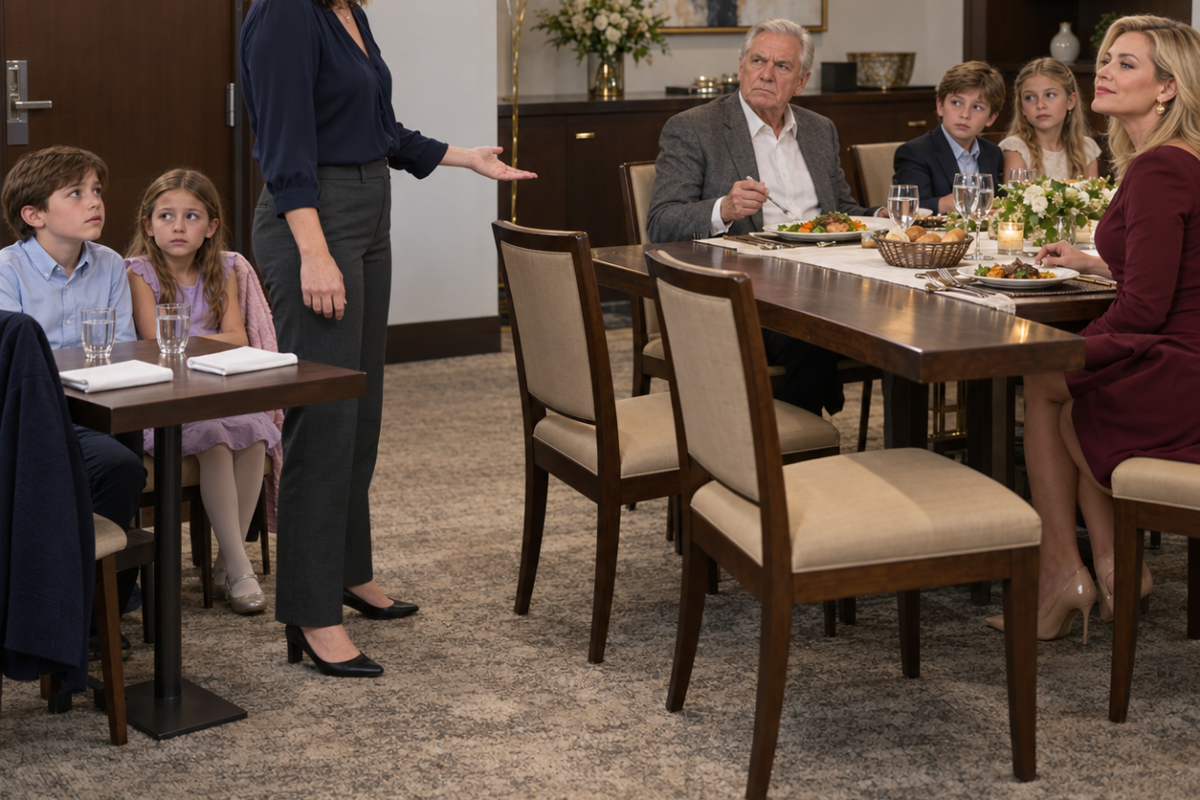
At my father’s seventieth birthday dinner, my eleven-year-old son and eight-year-old daughter were seated beside the service door with water glasses—but no dinner plates. Their cousins sat beside Grandpa with warm bread and full place settings. “They’ll eat after everyone else,” my sister said. I turned to my father, expecting him to object. “They can wait another hour,” he replied. There were two empty chairs at his table.
At my father’s seventieth birthday dinner, the first thing that stopped me wasn’t the cake or the gold balloons. It was my children. Ethan and…
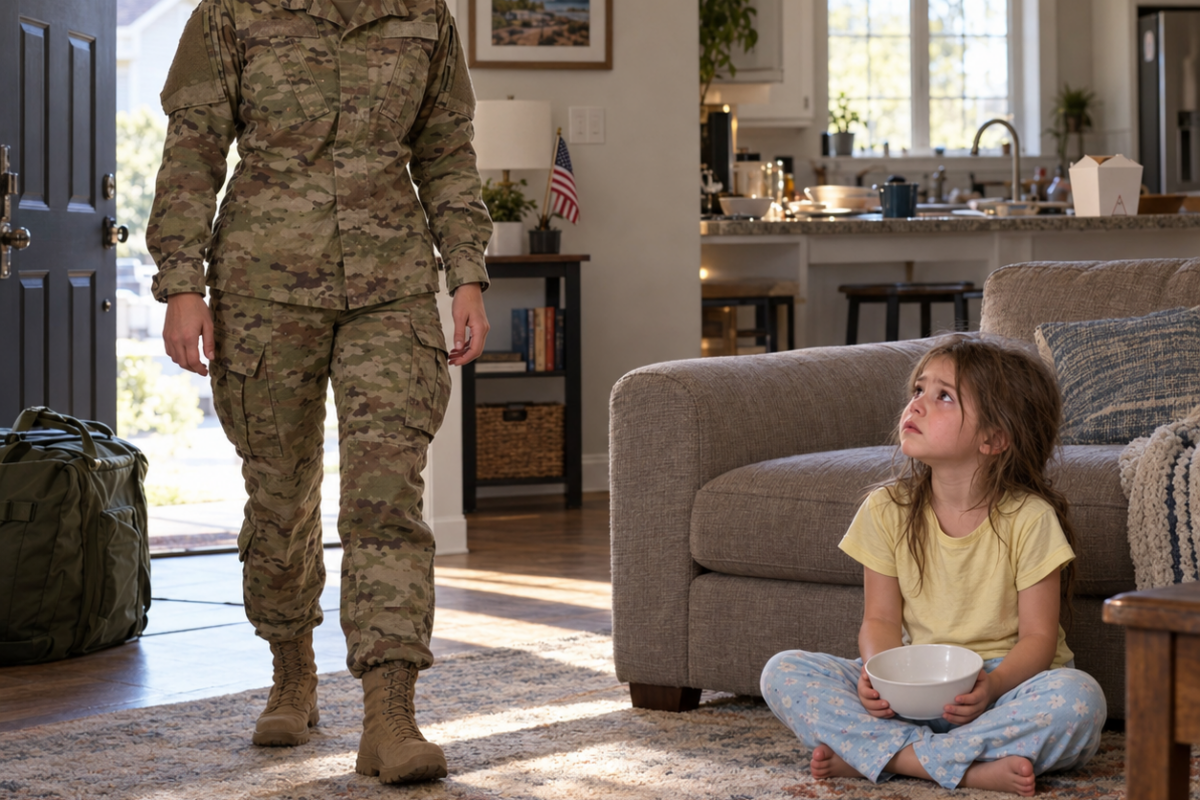
“Mommy, are you real?” my four-year-old daughter whispered when I came home from deployment three weeks early. She was sitting alone on our living room floor with an empty cereal bowl. My husband was on a Caribbean cruise with his mother and sister. Twenty-two minutes earlier, they had posted a photo captioned “Family time.” I was still in uniform when Sophie asked if she could have something to eat.
The first thing my daughter said when I found her was, “Mommy, are you real?” She was sitting cross-legged on our living room floor with…
End of content
No more pages to load