I came home to pick up a work folder and found my eight-month-pregnant wife hiding beneath the dining table. My mother was trying to force fish bones into her mouth while six relatives stood watching. “She needs to learn,” Mom said. I got my wife out and took her straight to the ER. Three hours later, the doctor examined an older injury, looked at me, and asked, “Does your mother have a key to your house?”
I turned the car around because of a folder.
A plain blue work folder, left on the kitchen counter beside the fruit bowl. I needed the inspection records inside it for a meeting that evening, and I was irritated with myself for forgetting them.
That was all.
I had been away from the house less than twenty minutes. My wife, Emma, was eight months pregnant. When I left, she had been resting on the sofa with a pillow beneath her knees, telling me not to worry about dinner.
“I’ll heat something up,” she said.
I kissed her forehead.
“Call if you need anything.”
She smiled.
I carried that smile with me until I unlocked our front door and heard her crying.
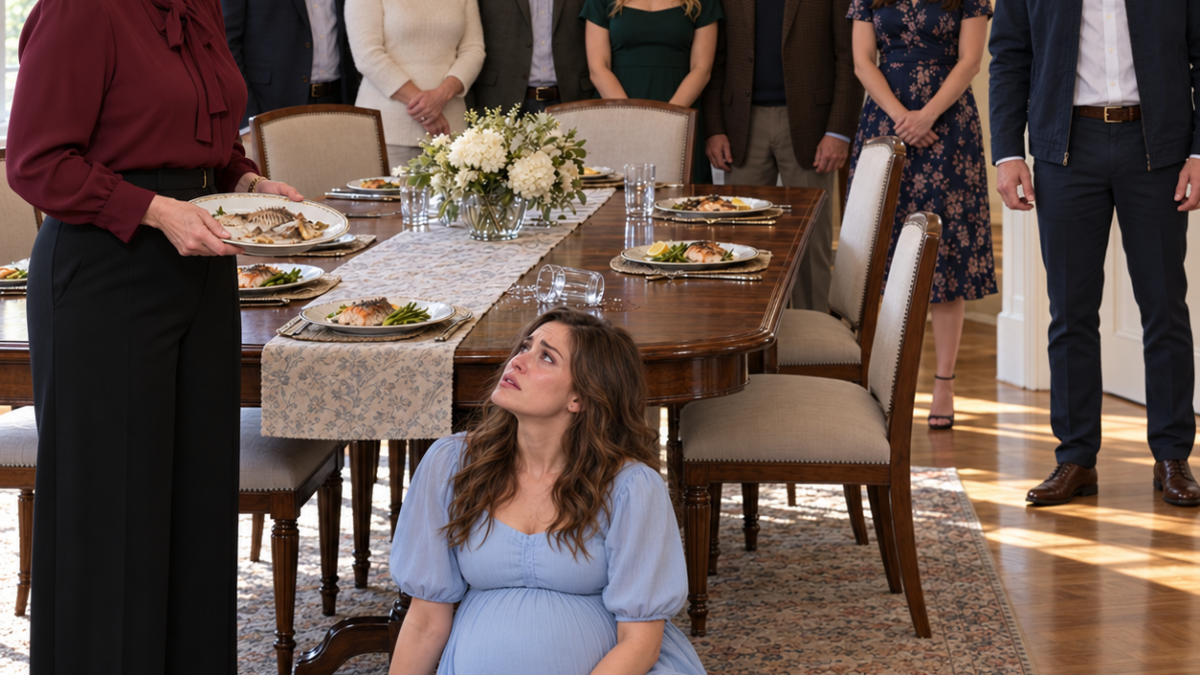
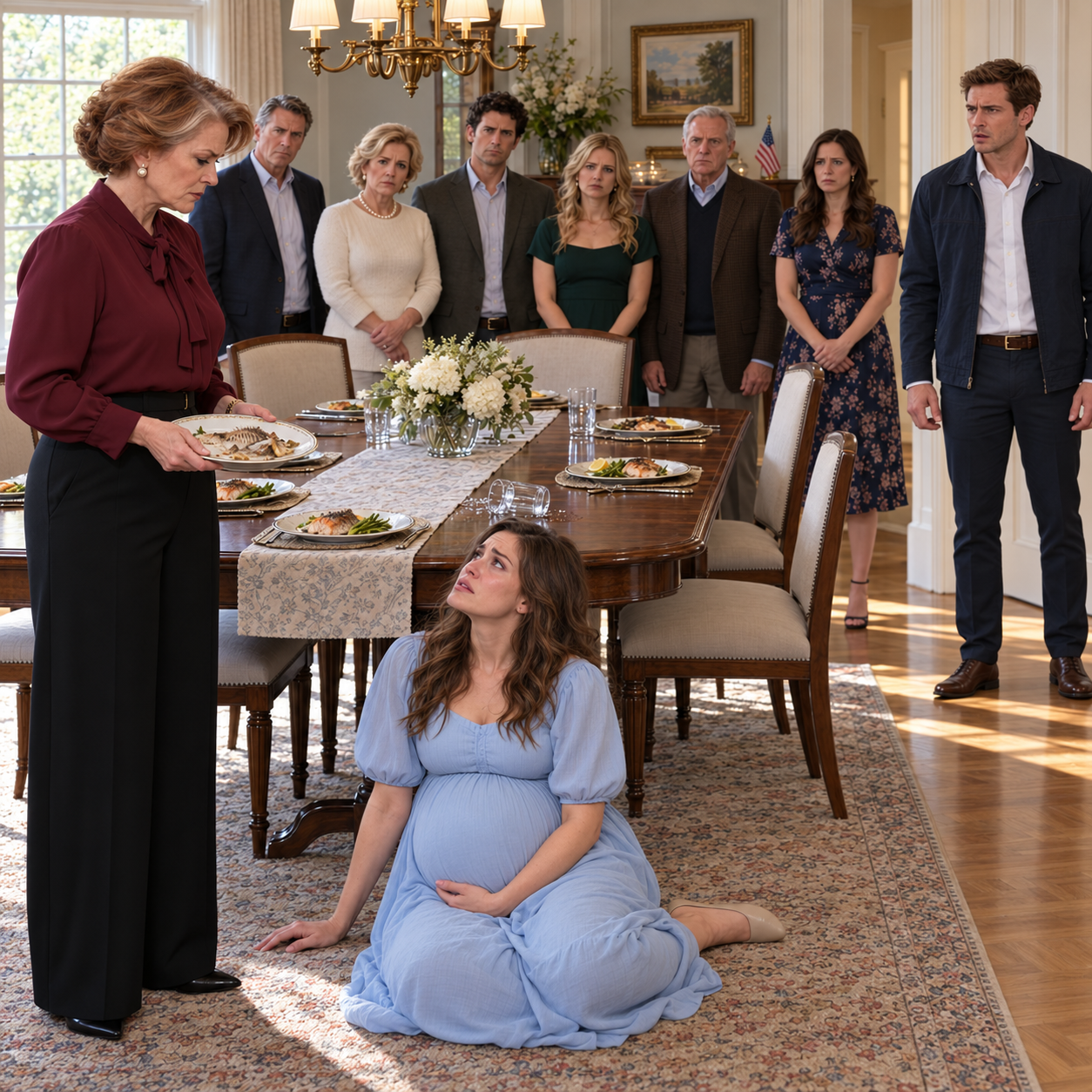
At first, I could not understand the scene in the dining room.
My mother stood beside the table. Six relatives were gathered around it: my father, my brother Caleb, my aunt Lydia, my uncle Frank, and my cousins Rebecca and Owen.
Emma was beneath the table.
Her shoulder pressed against a table leg. One hand covered her mouth. The other rested protectively over her stomach.
My mother leaned toward her, holding a plate.
“She needs to learn what happens when she embarrasses this family,” she said.
Then Emma tried to speak and choked on the attempt.
I saw blood on her dress.
Everything inside me became very quiet.
I did not ask what had happened. I did not argue with my mother about whether she meant well. I moved a chair, crouched beside my wife, and said her name.
“Emma. It’s me.”
She looked up as though she did not entirely believe I was there.
I helped her out, lifted her when her legs would not hold her, and carried her toward the door.
Caleb stepped into the hallway.
I looked at him.
“Move.”
He moved.
My mother began speaking behind me. I heard my name, then the word misunderstanding.
I kept walking.
I settled Emma in the car, returned only as far as the dining-room doorway, and took a few photographs before anyone could clear the table. Then I picked up the phone lying near Caleb’s place and recognized my wife’s pale blue case.
I took it too.
The blue work folder remained on the counter.
Three hours later, in an emergency department examination room, a doctor looked at a healing mark on Emma’s body and asked a question that made my blood run cold.
“Does your mother have a key to your house?”
“Yes,” I said. “An emergency key.”
He turned toward Emma.
“Is she using that key with your permission?”
Emma gripped the edge of the blanket.
Then she shook her head.
That small movement changed everything I thought I understood about our home.
My name is Nathan.
For most of my life, I believed being a good son meant finding a reasonable explanation for whatever my mother had done.
Diane worried.
Diane spoke sharply when she felt ignored.
Diane wanted the family together.
Diane had a difficult childhood.
Those explanations were offered so often that they became automatic. I heard them from my father, from relatives, and eventually from myself.
By the time I married Emma, I could soften my mother’s behavior before anyone asked me to.
“She doesn’t mean it that way.”
“Just give her a little time.”
“It’s easier if we don’t argue.”
I thought I was protecting my marriage from unnecessary conflict.
What I was often doing was asking my wife to absorb the conflict quietly.
I understand that now.
At the hospital that night, understanding came in pieces.
A nurse brought water, then checked whether Emma was allowed to drink it yet. A specialist examined the injury in her mouth. Another team assessed the pregnancy and monitored our baby.
People explained before touching her.
They asked who she wanted in the room.
They spoke to Emma rather than discussing her as though she were absent.
I had never been so grateful for ordinary professional care.
My wife sat against raised pillows, pale and exhausted. Her eyes moved toward the door whenever footsteps passed outside.
I wanted to stand in the doorway and prevent the entire world from entering.
Instead, I sat where she could see me.
The doctor’s name was Dr. Morgan. He did not tell me he could determine the age of every mark by looking at it. He asked Emma about something that appeared to be healing and listened to her explanation.
Then he asked about the key.
When she shook her head, he nodded once.
“All right. We’re going to make sure you have a chance to speak privately with someone.”
He looked at me.
“Would you step outside for a few minutes?”
Every instinct in me resisted leaving.
I wanted to be the person who protected her.
But being useful did not mean being present for every word.
I stood.
“Of course.”
Emma looked at me.
“I’ll be right outside,” I said. “You don’t have to worry about where I am.”
For the first time since we entered the hospital, she let go of the blanket.
I waited in the corridor with my hands clasped so tightly that the knuckles hurt.
My phone began vibrating.
Mom.
Then Dad.
Then Caleb.
I silenced it.
Across from me, a vending machine displayed snacks beneath fluorescent light. Someone at the nurses’ station laughed quietly at something a coworker said.
The ordinary sounds felt impossible.
My entire life had split open, and the building continued functioning around me.
A nurse named Alicia came out after a while.
“Emma would like you back.”
I followed her.
Dr. Morgan was speaking with another clinician. A woman in a navy cardigan stood near the foot of the bed and introduced herself as Nora Mills, a patient advocate.
Emma reached toward me.
I approached slowly enough that she could change her mind.
She took my hand.
That was when I looked down and saw how badly she was trembling.
I wanted to tell her everything would be all right.
I could not honestly promise that.
So I said, “I’m here.”
She nodded.
Nora explained that she could help Emma think through immediate safety, communication, discharge arrangements, and the people Emma wanted involved.
She also explained that the hospital had its own responsibilities. Some reports and emergency decisions were not something a husband could approve or prevent.
I listened.
Then I realized I had made a promise I needed to correct.
Earlier, I had told Emma I would not call the police or anyone else until she gave the word.
I meant that I would not seize control of her decisions.
I had not thought through the limits of what I could promise.
“I’m not going to make personal decisions over your head,” I told her. “But I can’t speak for the hospital or stop people from doing what they’re required to do. I should have said that more clearly.”
She looked at Nora, then back at me.
“I just don’t want everyone deciding what happens to me.”
“I understand.”
Nora nodded.
“We’ll explain what we can. And we’ll ask whenever the decision is yours.”
Emma closed her eyes briefly.
That simple commitment seemed to help her more than anything I had said.
While they consulted with the specialists, I opened the photographs on my phone.
The dining table.
Six plates with neatly portioned pieces of fish.
Emma’s place was different.
The meat had been scraped away. Bones lay on the plate before her chair. Her water glass was overturned. A heavy chair had been placed behind hers, making it difficult to pull back from the table.
The photographs could not tell me which relative moved every object.
They could not record every word said before I arrived.
They did show that the room was not arranged like an ordinary meal interrupted by an accidental choking episode.
I saved the originals.
Then I backed them up without editing or posting them.
I placed the phone facedown.
“Tell me what you need me to do.”
Emma stared at the blanket.
“Change the locks.”
“Yes.”
“Save every picture somewhere they can’t get to.”
“I’ve started.”
“Don’t tell your mother where I’m going when they discharge me.”
“I won’t.”
She swallowed carefully.
It hurt.
I waited.
Then I asked the question I had been afraid to ask.
“Was that older injury from her?”
Emma looked at the hospital band on her wrist.
For several seconds, I thought she would not answer.
Then she said, “Six weeks ago.”
I felt the room tilt.
Six weeks.
I tried to remember every evening I worked late during that period. Every time Emma said she was tired. Every time she changed position carefully on the sofa.
My mind rushed toward blame.
Why had I not noticed?
Why had she not told me?
I stopped the second question before it reached my mouth.
She had already endured enough adults treating her silence as the problem.
Emma said my mother let herself into the house while I was working late.
She had started criticizing the nursery.
The crib was in the wrong place.
The changing table was impractical.
The clothes were arranged foolishly.
Emma asked her to stop moving things.
My mother accused her of excluding the family.
The disagreement moved into the hallway.
Then my mother shoved her against the corner of a heavy dresser.
Emma paused.
I could hear the monitor beside her.
“She said being hurt proved I was too emotional,” Emma whispered. “That I was too weak to be a mother.”
I looked at our joined hands.
I wanted to squeeze them.
I did not.
I was afraid of adding another pressure she had to endure.
“She said you would believe her,” Emma continued. “That everyone already knew pregnancy had made me unstable.”
I closed my eyes.
I had heard that language before.
At a family dinner, my mother had said Emma seemed unusually sensitive.
I had laughed awkwardly and changed the subject.
I had not realized I was hearing part of a story being built around my wife.
Emma reached for her phone that evening.
She nearly called me.
My mother told her that the family would support her account. That I would have to choose between the people who raised me and a wife who was imagining things.
“She made it sound like I’d lose everything,” Emma said. “The house. You. The baby’s family.”
“You never had to protect me from the truth.”
Emma’s eyes filled.
“I wasn’t protecting you.”
I stopped.
“I was trying to survive until the delivery without losing our home or you.”
There was nothing I could say that made that sentence smaller.
I had thought our marriage was safe because I loved her.
She had been making decisions under the belief that telling me the truth might cost her the marriage.
Love had existed.
Safety had not followed automatically.
I sat beside her until she was ready to continue.
Then I asked why that evening had been different.
Why so many people were there.
Why nobody had stopped my mother.
Emma looked toward the door.
“Because they weren’t just watching.”
I waited.
“Caleb took my phone.”
The name landed like a blow.
My brother.
The boy who shared a bedroom with me.
The man who stood beside me when I married her.
“He blocked the back door,” she said. “I tried to go out. He said I needed to sit down and apologize first.”
I felt an urge to leave the hospital and drive directly to his house.
It was so strong that I stood halfway before realizing what I was doing.
Emma tightened her hand around mine.
I sat again.
She watched my face.
“Don’t go.”
“I’m not going.”
“Promise.”
“I’m staying here.”
That was a promise I could keep.
My brother did not merely fail to help.
According to Emma, he had helped prevent her from getting help.
That changed the questions investigators would need to ask.
It changed nothing about my immediate job.
My wife needed me beside her, not somewhere else making the situation more dangerous.
Nora asked Emma whether she wanted to speak with law enforcement.
Emma looked at me.
I did not answer for her.
“Yes,” she said.
Then she added, “But I don’t want to tell it to ten people.”
Nora explained that they would try to coordinate what they could, while acknowledging that different professionals might need different information.
No one promised an effortless process.
They offered a careful one.
Emma accepted.
I called my manager.
I told him there had been a serious family emergency and I would not be coming in.
He asked whether he needed to arrange anything at work.
“No,” I said. “Just cover the meeting.”
“Done.”
I looked at the empty chair beside the bed.
The meeting I had been anxious about an hour earlier now belonged to a different world.
When I told him I had forgotten the folder, he said, “Then I’m glad you forgot it.”
I was too tired to respond.
Later, that sentence would make me cry.
Two officers came after the immediate medical concerns had been addressed.
They spoke with Emma privately first, with support she requested.
Then they spoke with me.
I described what I personally saw when I entered.
Where my mother stood.
Where Emma was.
Where Caleb moved.
What I heard.
I showed them the photographs and explained when I took them.
I did not turn suspicion into observation.
I did not claim to know what happened during the minutes before I arrived.
When asked who was present, I named every person.
My father, Robert.
Caleb.
Aunt Lydia.
Uncle Frank.
Rebecca.
Owen.
My mother.
Writing their names felt different from saying family.
Family was a word large enough to hide inside.
Names made individual choices harder to avoid.
The officers asked about the house.
Ownership.
Access.
Who lived there.
Whether my mother had belongings or any arrangement beyond occasional visits.
She did not live with us.
The key was for emergencies.
I had given it to her when we first moved in.
At the time, it seemed sensible.
She lived nearby.
She could let a repair person in if we were both at work.
She could check something during travel.
I had never imagined needing to explain that key in a hospital corridor.
They asked whether she had permission to enter that evening.
I did not know until Emma told them.
“No.”
My wife had declined a visit earlier that day.
My mother came anyway.
With six people.
That fact did not explain every part of the incident.
It did explain why the word misunderstanding was inadequate.
I checked my phone again.
There were seventeen calls and a growing collection of messages.
Mom said Emma had overreacted.
Dad said we needed to calm down before making anything permanent.
Caleb said he did not know why I was acting like he hurt anyone.
Lydia said my mother was distraught.
Frank told me to come back so the family could discuss it.
Rebecca asked whether the baby was all right.
Owen said nothing at all.
I did not answer the group.
I sent one message after discussing communication with the people helping us.
Emma and I were receiving medical care. No one had permission to visit. Further communication about the incident should go through the appropriate channels. They were not to enter our house.
I kept the message factual.
Then I muted the conversation.
I did not tell them which room we occupied.
I did not provide medical details.
Concern, even genuine concern, did not entitle them to information Emma had not agreed to share.
My father called from another number.
I recognized his voice immediately.
“Nathan. Your mother is having a terrible night.”
I stood in the corridor so Emma would not hear.
“So is my wife.”
“You know what I mean.”
“No, Dad. I’m not sure I do.”
“She got carried away.”
I looked at the wall.
I had heard that phrase throughout my childhood.
When Mom humiliated Caleb in front of friends.
When she threw away something she disliked.
When she said words nobody wanted to repeat afterward.
Carried away suggested movement without intention.
Like weather.
Like a thing that happened to her.
“What did you do?” I asked.
He was silent.
“When she hurt Emma, what did you do?”
“I didn’t realize it was that serious.”
“You saw her under the table.”
“Nathan—”
“What did you do?”
He exhaled.
“I told Diane to stop making a scene.”
I closed my eyes.
A scene.
Not harm.
Not fear.
A scene.
“I’m ending the call.”
“You can’t shut out your own father.”
“I can end a conversation that is making tonight worse.”
I ended it.
When I returned, Emma was asleep.
Alicia adjusted a blanket without waking her.
I sat beside the bed.
My anger had nowhere useful to go.
So I stayed still.
The baby’s monitoring was reassuring, though the clinicians wanted to continue observation and follow-up because of the circumstances.
I listened carefully.
I asked questions when I did not understand.
I did not interpret reassurance as permission to minimize what happened.
Emma had been hurt.
Our baby needed care.
Both things remained true even when a screen showed something encouraging.
Her obstetrician, Dr. Lee, came the next morning.
She explained the plan and spoke directly to Emma.
There would be follow-up.
There were symptoms Emma should report.
They would coordinate care.
I watched Emma ask questions.
Her voice was still hoarse and hesitant, but she was asking.
I felt grateful that someone answered without judging the question.
That morning, I called Emma’s sister, Julia.
Emma asked me to.
Julia lived an hour away.
She answered cheerfully at first, then went quiet while I explained only what Emma authorized.
“I’m coming,” she said.
“She wants you here.”
“Then I’m coming.”
She arrived carrying a small bag, a charger, and the expression of a woman holding herself together through force.
She did not ask Emma why she failed to tell her sooner.
She did not announce what she would do to my mother.
She sat beside the bed and said, “I’m sorry you were alone with that.”
Emma began crying again.
Julia held her hand.
I stepped outside because that moment did not need me at its center.
In the hallway, Nora helped me think through the house.
Changing locks was straightforward because my mother was not a resident. But I wanted the process documented and the access issues reviewed rather than assuming a new front-door key solved everything.
There was also a garage remote.
An old keypad code.
A spare key I once left with Caleb.
I had forgotten that one until the officer asked me to list access.
I stood with the phone in my hand, ashamed by how many doors I had opened for people who now made my wife afraid.
We arranged for a reputable locksmith and a security technician to secure the access points.
A trusted neighbor agreed to meet them, with my authorization.
I did not send my father.
I did not ask Caleb to return the key as though his possession of it remained negotiable.
Access was revoked.
The work would be completed before Emma chose whether to return.
That last part mattered.
I had promised we would not go home before the locks changed.
I also needed to understand that changing locks did not make her ready to go home.
A door could be secure while the room behind it still felt frightening.
Julia offered her apartment.
Emma looked relieved before she answered.
“Yes.”
I felt a small, selfish disappointment.
I wanted our home to become safe immediately because I could not bear what happened there.
I kept that disappointment to myself.
The house was not a test of whether she trusted me.
Her choice was about where she could rest.
We would go to Julia’s when she was discharged.
I told work I needed leave.
There were forms and practical questions.
I completed them.
I told the hospital not to share information beyond Emma’s preferences and the applicable rules.
I checked what could be done about visitors.
Nora explained the arrangements.
I did not merely stand at the door making vows.
I followed the process that helped the staff protect her privacy.
My mother arrived at the hospital later that day.
She did not reach Emma’s room.
I learned she was at an entrance asking where her daughter-in-law had been taken.
Staff did not direct her to us.
She called me repeatedly.
Then she sent a message.
I am her baby’s grandmother. You have no right to do this.
I stared at the sentence.
Grandmother.
The role she had invoked as authority even before the child was born.
I saved the message.
I did not argue with it.
I informed the people handling safety.
Then I returned to Emma.
She knew something had happened.
“Was it her?”
“Yes.”
“Is she coming up?”
“No.”
“Are you sure?”
“I’ve spoken with the staff. She is not being brought here.”
Emma looked toward the door.
I waited until her breathing slowed.
Promises were becoming something she needed to see working.
I could not resent that.
When we left the hospital, no one announced our destination to my family.
Julia drove.
I sat beside Emma and let her decide whether she wanted conversation.
She watched the road.
At a traffic light, she touched her stomach.
“The baby’s moving.”
I looked at her.
She gave a faint smile.
For a moment, we were two parents noticing our child rather than two people fleeing an incident.
Then the light changed.
We went to Julia’s.
Her apartment had two bedrooms and a sofa that folded out badly.
She gave us her room.
I objected once.
She told me to stop making the helpful part difficult.
I stopped.
Emma slept for several hours.
I sat at the kitchen table and wrote down everything I remembered from returning home.
I included times I could verify and noted estimates as estimates.
I described the photographs without interpreting beyond what they showed.
I saved messages.
I did not send them to relatives to win arguments.
There would be an investigation.
Evidence belonged where it could be handled properly.
Julia brought me a plate of food.
I realized I had not eaten since the previous morning.
“Eat,” she said.
“I don’t know how I missed this.”
She sat across from me.
“I don’t either.”
I appreciated that she did not offer absolution merely because I was upset.
Then she added, “You can be honest about that without making Emma take care of your guilt.”
I looked at the bedroom door.
“I know.”
“Do you?”
I put down the fork.
“I’m trying.”
That became my work.
Not the dramatic part.
The part that continued after the emergency department.
The following morning, I met with an attorney recommended through a local service.
His name was Aaron Patel.
He listened to the situation and explained what his role could be. He would help us understand protective options, property access, communication, and the legal process affecting us as individuals.
He did not decide criminal charges.
He did not promise that every person in the dining room would be arrested.
He did not tell me the photographs proved every part of Emma’s account.
I was angry enough that certainty would have been tempting.
I was glad he did not sell it.
“Your wife’s account, your observations, medical documentation, messages, and other evidence will be considered by the appropriate investigators,” he said. “Our task is to help with her safety and your practical decisions.”
Emma spoke with him separately too.
I waited outside.
I was learning that supporting her did not mean sharing every private conversation.
Sometimes she wanted me present.
Sometimes she did not.
Neither choice required an explanation designed to protect my feelings.
Later, she told me she wanted legal protection from my mother and Caleb.
I agreed to help with whatever steps were appropriate.
I did not insist on adding every relative as a way to express anger.
Each person’s conduct would be considered.
Safety measures were sought through the available process.
There were statements, hearings, documentation, and questions.
It took time.
The word immediate had limits outside an emergency room.
We used temporary arrangements while the longer decisions were addressed.
My mother hired counsel.
Caleb did too.
The messages from family changed.
They became more careful.
Less direct.
Some stopped entirely.
Aunt Lydia called Julia because I was not answering.
Julia did not discuss Emma’s health.
She said Emma was resting and did not want contact.
Lydia insisted she only wanted to help.
Julia asked, “What help is she asking you for?”
There was no answer.
Eventually, Lydia hung up.
I heard about it afterward.
For years, help in my family meant whatever the person offering it wanted to do.
Emma was teaching me that help could begin with a question.
Investigators interviewed people separately.
They examined what happened that evening and the earlier incident Emma described.
They requested the photographs and original files.
They asked about messages and access.
They considered the roles of the people present rather than treating everyone as one indistinguishable group.
That was difficult for me.
I wanted the circle itself to be enough.
Six adults.
My wife beneath a table.
No one helping.
Morally, I had my answer.
Legally, the questions were more specific.
Who did what?
What did they know?
What could be established?
I had to let that work happen without trying to fill every uncertainty with my anger.
A neighbor, Mrs. Alvarez, contacted me after hearing there had been police at the house.
She had seen several relatives arrive shortly after I left.
Her exterior camera covered part of the street.
She offered the relevant footage to investigators through the proper process.
It did not show the dining room.
It showed timing.
Cars.
People entering.
An ordinary piece of evidence that made some later explanations less flexible.
My mother had claimed she came alone to check on Emma and that others arrived only after hearing an argument.
The footage showed a different sequence.
That mattered.
It did not tell the entire story.
Few things did.
The case developed through pieces supporting other pieces.
Emma’s phone contained messages she had not shown me.
Some were from my mother.
Advice that became criticism.
Criticism that became instructions.
Instructions followed by accusations when Emma did not comply.
There were messages asking her to remove nursery furniture because my mother disliked the arrangement.
Messages telling her she should stop involving Julia in pregnancy decisions.
Messages suggesting I was tired of how emotional she had become.
I read only what Emma chose to share and what was necessary for the practical matters we handled together.
I did not take her phone and search through everything because I now considered myself responsible for discovering the truth.
She had already lost control of that phone once.
I would not repeat the act under a kinder description.
One message hurt more than I expected.
My mother had written:
Nathan understands me. You should remember who has known him longer.
I sat with the phone in my hand.
Emma watched me.
“Did you believe that?” I asked.
“Sometimes.”
I wanted to protest.
I wanted to tell her she should have known how much I loved her.
Instead, I thought of every time I had told her to let something go because my mother was difficult.
“What did I do that made it seem possible?” I asked.
Emma looked down.
“You always asked me to be the reasonable one.”
I could not deny it.
“When your mom got upset, you asked what I could change. When I got upset, you explained why she was upset.”
The words were quiet.
They did not need force.
I sat beside her.
“You’re right.”
She looked at me, surprised.
“I should have listened differently.”
She nodded.
That did not make her relax immediately.
It gave us a beginning.
We began seeing a counselor who worked with people recovering from family violence and serious breaches of trust.
Emma had individual support as well.
I attended my own sessions.
I needed somewhere to put the anger, guilt, and grief without placing them on her hospital pillow or beside her breakfast.
My counselor asked what I believed a good son owed his mother.
I gave a long answer.
Respect.
Gratitude.
Help.
Loyalty.
She asked whether those duties included giving my mother access to someone she hurt.
“No.”
“Then why does refusing access feel like betrayal?”
I did not answer quickly.
Because my mother had taught me that any limit was rejection.
Because my father had modeled peace as agreement.
Because I had confused discomfort with wrongdoing.
Those answers emerged over time.
They did not excuse me.
They helped me stop making the same choices automatically.
I remembered incidents from childhood.
My mother ordering Caleb to apologize for making her angry after she had shouted at him.
Dad saying it was easier to give her time than challenge her.
Relatives joking that Diane always got her way.
I had treated those memories as family personality.
Now I saw the training inside them.
Keep quiet.
Make it pass.
Protect the person who could make the room unbearable.
Emma had entered a family in which everyone knew the method.
She had been asked to learn it.
When she resisted, they called her the problem.
I had not taught them to behave that way.
I had helped preserve the environment by refusing to challenge it.
That was mine to face.
At Julia’s, ordinary life returned in fragments.
Emma wanted oatmeal.
Then she could not tolerate it.
She wanted the curtains open.
Then the afternoon light gave her a headache.
She was tired of being asked whether she needed anything.
She was also frightened when she woke and did not immediately know where I was.
We learned routines.
I told her when I stepped outside.
I did not require her to explain every change of mind.
Julia kept the refrigerator stocked and refused to let me turn every meal into a discussion about how grateful we were.
“Thank me by putting the containers back,” she said.
I did.
One afternoon, Emma laughed at something on television.
It was sudden and small.
I looked toward her too quickly.
Her smile disappeared.
“What?”
“Nothing.”
She studied me.
“You don’t have to make it a moment.”
I nodded.
She was right.
Not every laugh needed to become proof of healing.
Sometimes something was simply funny.
I learned to let those moments stay ordinary.
After a week, I went to our house with a trusted friend while Emma remained with Julia.
The locks had been changed.
The access codes reset.
The house had been checked through the arrangements we made.
I brought a list Emma prepared.
Clothes.
Medication.
A particular pillow.
The pregnancy journal from her nightstand.
She did not ask for the blue maternity dress she wore that evening.
It had been handled as necessary through the medical and investigative process.
I did not replace it with an identical one.
She did not need that memory hanging in a closet.
Inside, the dining room looked ordinary again.
The chairs were in place.
The table was clean.
That frightened me more than disorder would have.
A room could hide what happened simply by being tidied.
I stood beside the chair where she had been trapped.
My friend, Daniel, waited near the doorway.
“You don’t have to stay in here.”
“I know.”
I looked under the table.
There was nothing to see.
I had spent years repairing buildings for work. I knew how to identify broken hinges, damaged pipes, and structural problems.
The damage in that room had no visible repair point.
I left it.
Upstairs, the nursery was half finished.
A small stack of baby clothes sat beside the dresser.
The crib stood where Emma wanted it.
I touched the edge, then stopped.
I packed only what she requested.
Before leaving, I picked up the blue folder from the kitchen counter.
It had remained beside the fruit bowl.
I stared at it for a long time.
Then I put it in my work bag.
A thing so ordinary had changed the timing of my life.
I would never feel irritated about that forgotten folder in the same way again.
When I returned to Julia’s, Emma asked how the house looked.
“Like a house.”
She nodded.
“That’s strange, isn’t it?”
“Yes.”
“Did you go in the dining room?”
“Yes.”
She watched my face.
I did not describe how I felt beneath the table.
That was not something she needed.
“I got everything on your list.”
“Thank you.”
We unpacked together.
My father asked to meet me privately.
Aaron advised me about communication in relation to the ongoing process. I followed that advice and agreed to a limited conversation in a public place, without Emma and without discussing details that should remain with investigators.
Dad looked older.
I noticed that.
I did not let it become the central fact.
He began by saying my mother was not sleeping.
I held up a hand.
“I’m not here to manage her condition.”
He looked down.
“I know.”
“Then talk about your own choices.”
He sat still.
Finally, he said, “I should have stopped it.”
“Yes.”
“I thought she was trying to scare Emma.”
“You say that as though it makes sense.”
“No.”
He rubbed his hands together.
“I didn’t think she would actually hurt her.”
“She was already frightened enough to hide under the table.”
“I know.”
“Did you tell her she could leave?”
“No.”
“Did you tell Caleb to give back her phone?”
He closed his eyes.
“No.”
I stared at him.
He had heard more than I knew.
He had understood more than he admitted that night.
“Why?”
He gave the answer he had given in different forms my whole life.
“I was trying not to make it worse.”
I leaned back.
“For whom?”
He had no answer.
I did not tell him he was forgiven.
I did not tell him I would never speak to him again.
I told him Emma wanted no contact and that I would respect it.
He asked whether he could see the baby after the birth.
“Not now.”
“She’s my granddaughter.”
“She is going to be a child who needs safe adults.”
He nodded slowly.
The conversation ended there.
Caleb sent a message through his attorney asking whether we could resolve the situation privately.
There were things I could decide privately.
The criminal process was not mine to trade away in exchange for a family apology.
Emma did not want a meeting.
We declined.
His personal message, sent earlier, remained in my mind.
I didn’t think Mom would go that far.
Go that far.
As though there had been an acceptable distance.
As though taking a phone and blocking a door were neutral acts until someone else exceeded an invisible line.
I had loved my brother all my life.
I did not know what to do with that love.
I took it to counseling.
I did not bring it to Emma as a reason she should reconsider what happened.
Aunt Lydia wanted to send flowers.
Emma declined.
Uncle Frank told a relative that the whole situation had been blown out of proportion.
That relative repeated it to me.
I asked them not to pass along comments unless they involved safety or something requiring action.
I did not need to hear every person minimize my wife.
Rebecca wrote a letter.
She described what she had seen, what she failed to do, and her willingness to speak truthfully with investigators.
She did not ask us to reassure her.
Emma read it later.
Then she placed it in a folder.
“I’m glad she told the truth,” she said.
I nodded.
“I don’t want to see her.”
“That’s all right.”
Owen eventually provided his account too.
The six people in the room did not remain a single circle once investigators asked individual questions.
Some minimized.
Some contradicted earlier statements.
Some became more honest.
Their legal situations differed according to the evidence and their conduct.
Their relationship with us remained restricted because Emma had not felt safe with any of them that evening.
A court did not have to punish everyone identically for us to decide who could enter our home.
Those were different decisions.
I had to learn the distinction.
As the due date approached, Emma began worrying about the hospital.
Who would be told?
Who could arrive?
Would my mother find out from someone else?
Would she insist that becoming a grandmother entitled her to enter?
We discussed a birth plan with the medical team that included privacy and visitors.
Julia was included.
My family was not.
I checked the arrangements more than once, but I tried not to turn preparation into another source of anxiety.
Emma wanted to think about the baby too.
Names.
Clothes.
Whether we had enough diapers.
One evening, she said, “I don’t want every conversation about becoming a mother to be about your mother.”
I put down the list I was making.
“You’re right.”
She touched a folded baby blanket.
“What if we just talk about names tonight?”
So we did.
We had considered several for months.
That evening, we chose Lucy.
Emma said it softly.
“Lucy.”
I repeated it.
For a while, the name belonged only to possibility.
No relatives.
No conflict.
Just the child we hoped to meet.
Four weeks after the incident, Emma went into labor.
We were still staying with Julia.
It began early in the morning, quietly enough that Emma was uncertain at first.
Then she looked at me and said, “I think we need to call.”
We followed the medical plan we had been given.
Julia drove us.
I carried the bag.
At the hospital, the staff followed the arrangements established for Emma’s privacy.
Nobody demanded she greet a family member because labor should bring everyone together.
Nobody told her she would regret excluding people.
She was the patient.
Her needs mattered.
Labor was long.
I will not turn it into a perfect scene.
Emma became tired and frightened. I said the wrong thing once and corrected it. She wanted my hand, then wanted space. Julia reminded me to drink water.
The medical team helped her.
I followed where I was useful.
When Lucy arrived, the room changed.
Our daughter was small and warm and furious about the inconvenience of being born.
Emma cried.
I cried too.
Then I looked at my wife holding her child and understood something with unusual clarity.
Lucy’s family did not have to resemble the one I inherited.
We could choose what she learned from the adults around her.
When Emma was ready, she let me hold the baby.
I sat in a chair, afraid of doing something wrong.
A nurse adjusted my arm.
“There you go.”
Lucy settled.
I looked at her face.
She knew nothing about our arguments, our shame, or our family’s insistence on appearances.
She needed care.
That was enough of a beginning.
We did not announce the birth publicly.
We told the people Emma wanted told.
I informed my manager.
Julia informed a few close friends.
Others learned later, when we were ready.
My mother found out through a relative.
She sent a message demanding a photograph.
I saved it.
I did not answer.
My father sent congratulations without a demand.
I read it.
Then I returned to changing a diaper.
I was beginning to understand that a message did not require immediate action simply because it came from a parent.
Lucy mattered more than the phone.
The first weeks were exhausting.
Feeding.
Appointments.
Sleep broken into pieces too small to recognize.
Emma’s recovery continued.
Her fear did not disappear because the baby was healthy.
Sometimes footsteps outside the apartment made her stiffen.
Sometimes a telephone ringing at an unexpected hour upset her.
Sometimes she woke from a dream and needed a moment to recognize the room.
I learned not to say, “But she can’t get in.”
Facts mattered.
So did the body’s slower understanding of them.
I would say, “You’re here. I’m beside you. Julia’s in the other room.”
Then I waited.
Some nights that helped.
Some nights she needed more support.
We obtained it.
I also had difficult nights.
I dreamed about arriving too late.
I woke angry at a sound that did not exist.
I imagined the folder remaining on the counter while I continued toward work.
Those thoughts were not useful to Emma at three in the morning.
I spoke about them with my counselor.
He reminded me that frightening possibilities could consume every ordinary moment if I let them.
Lucy needed a father who could be present in the life that existed.
Not one permanently living in the version that nearly happened.
I practiced returning.
A diaper.
A bottle.
A load of laundry.
A walk around the block.
Work small enough to do.
We eventually discussed the house again.
Emma wanted to see it before deciding whether to live there.
We arranged a visit.
Julia came.
Lucy stayed with someone we trusted for the short period so Emma could focus on herself.
At the front door, I handed Emma the new key.
She looked at it.
Then she unlocked the door.
I did not touch her shoulder or guide her inside.
She entered when she was ready.
The house smelled faintly of cleaning products and the flowers Julia brought earlier.
The dining room remained unchanged except that the table was empty.
Emma stood in the doorway.
“I don’t want this table.”
“All right.”
“I mean it.”
“I know.”
She looked toward the chair.
“I don’t want those either.”
We had already preserved and provided the information investigators required. Before removing anything, we confirmed that doing so would not interfere with the process.
Then we arranged to dispose of the dining furniture appropriately.
I did not keep one chair because it had sentimental value to my mother.
I did not ask Emma to sit there once so she could prove the memory had lost power.
Furniture was replaceable.
Her sense of control was not.
Upstairs, she entered the nursery.
She touched the crib rail.
Then she sat on the little chair beside the window.
I waited outside until she called me.
“It still feels like ours,” she said.
I nodded.
“I was afraid it wouldn’t.”
We stayed for another hour.
Then she asked to leave.
We left.
A week later, she wanted another visit.
Eventually, she decided to return.
There were alternatives available.
We had discussed moving, temporary housing, and what each choice would involve.
Returning was not forced by a lack of imagination or a need to make the past disappear.
She chose it with support.
We made the house different in ways that helped.
The dining room became a sitting room for a while.
Meals happened in the kitchen.
The nursery remained where she wanted it.
We placed the spare keys with people we both trusted and agreed on access together.
No family member received a key because a role made the question seem impolite.
I had learned that emergency access was not a reward for being related.
It was a responsibility.
The investigation continued after Lucy’s birth.
There were interviews, records, hearings, and delays.
The case did not disappear merely because our household began functioning again.
My mother was charged in connection with the assaultive conduct established through the investigation.
Caleb faced consequences for his own actions, including interfering with Emma’s ability to leave and seek help.
Their attorneys challenged the accounts and evidence.
That was part of the process.
I did not attend every proceeding.
Emma did not either.
We followed advice and participated when needed.
We also continued living.
Lucy smiled.
She outgrew clothes.
She developed an opinion about being put down that was difficult to misunderstand.
Those things deserved space even while legal matters remained unresolved.
My mother’s explanation changed over time.
At first, Emma was dramatic.
Then the meal was misunderstood.
Then my mother had been stressed.
Then she had intended to teach respect but things went wrong.
None of those explanations restored the trust she destroyed.
One statement reached me through counsel.
She said she had never intended to endanger the baby.
I read it twice.
Then I put it away.
Emma was a person before she was carrying my child.
Hurting her did not become less serious because someone claimed a different intention toward the pregnancy.
I wanted that distinction preserved.
In my own mind.
In our home.
In every conversation that tried to make Lucy the only reason the incident mattered.
Caleb eventually acknowledged more of what he had done.
His legal resolution addressed his own conduct.
He admitted taking Emma’s phone and preventing her from using the back door.
He had called it calming the situation.
The words no longer hid the act.
His consequences differed from my mother’s.
I did not consider that proof that one was harmless.
I considered it a result of separate conduct being handled separately.
He requested a chance to apologize.
Emma declined.
I declined contact too.
I did not need to hear him explain his childhood with our mother while my wife was still recovering from his choices as an adult.
Understanding pressure could matter in treatment.
It did not grant access.
My mother’s case took longer.
The evidence included Emma’s account, my observations, medical documentation, photographs, communications, witness statements, and the circumstances surrounding access to the house.
No single piece carried everything.
Together, they supported the case that proceeded.
There were moments when I feared a delay meant nothing would happen.
Aaron explained that movement in a legal process did not always resemble movement visible to the family.
I tried to listen.
I also tried to stop checking my phone constantly for updates.
Emma asked once whether I could put it away during dinner.
I did.
Lucy was asleep nearby.
We had ten quiet minutes.
They were worth more than another unanswered question on a screen.
When the case concluded, my mother received a custodial sentence and restrictions addressing contact.
I do not remember the exact feeling I expected.
Vindication, perhaps.
Relief.
Something clean.
What I felt was sadness for the harm that made the proceeding necessary and gratitude that there were consequences beyond our family’s excuses.
Emma heard the outcome with her advocate beside her.
Later, we walked outside.
She stood in the daylight for a moment.
“Can we go home?” she asked.
“Yes.”
So we did.
We did not celebrate by making the case into a family spectacle.
Julia brought dinner.
Lucy tried to grab my spoon.
Emma laughed.
That was the evening.
My father struggled with the outcome.
He sent a letter rather than calling repeatedly.
He said he loved my mother.
He said he understood why Emma wanted distance.
He said he was ashamed of remaining silent.
I read it.
Then I discussed it with my counselor.
I did not ask Emma to tell me whether I was allowed to miss him.
She was not responsible for organizing my grief around the people who failed her.
After some time, I agreed to limited contact with him by myself, under conditions consistent with the legal arrangements and our safety decisions.
Emma did not participate.
Lucy did not participate.
My father had to accept that.
Sometimes he did.
Sometimes he asked whether things would ever become normal.
I told him the old normal was part of what went wrong.
He did not like that answer.
I did not change it.
Rebecca remained the relative whose response seemed most grounded in what she had actually done.
She did not send cheerful messages pretending time had settled everything.
She wrote once more, acknowledging that watching without intervening had been a choice.
Emma kept the letter.
She did not invite her over.
There was no required timetable.
Lydia and Frank remained defensive.
Owen became quieter.
The family gatherings continued without us.
I heard about them through people who meant well.
Eventually, I asked not to receive updates unless they affected safety or practical matters.
I did not need to picture every dinner where someone might describe me as changed.
I had changed.
That was not an accusation I needed to defeat.
The largest change happened in small conversations with Emma.
When she said she did not want visitors, I did not ask whether she could manage just one hour.
When she disliked a plan, I did not explain why someone else would be disappointed.
When I needed to make a decision involving the house, I included her before acting.
I thought those things would feel like effort forever.
Eventually, they became ordinary.
That was what I wanted.
Not a permanent performance of being a better husband.
A different way of living.
Emma noticed.
She did not reward every ordinary act with reassurance.
I learned not to require that.
One evening, several months after Lucy’s birth, Emma asked me to take the baby while she showered.
Then she closed the bathroom door.
I stood in the bedroom holding our daughter and realized Emma had not checked whether I would allow privacy.
She had simply taken it.
The thought stayed with me.
Later, I told my counselor.
He nodded.
“Let it be ordinary.”
So I did.
I did not tell Emma the closed door moved me.
I handed her Lucy when she returned and asked whether she wanted tea.
She said yes.
We drank it while the baby studied the ceiling.
Our new dining table arrived the following spring.
It was smaller.
Emma chose it.
I helped assemble it and managed to attach one bracket incorrectly before she pointed out the diagram.
We laughed at me.
I fixed it.
Then we ate dinner there.
For a moment, I watched her pull out the chair.
She noticed.
“Nathan.”
I looked up.
“It’s a table.”
“I know.”
“Let me have this one.”
I nodded.
She sat down.
I sat across from her.
Lucy banged a spoon against the high-chair tray.
The room belonged to that sound now.
I stopped looking beneath the table.
The old memory remained.
It no longer had to occupy every meal.
On the first anniversary of the incident, I woke anxious.
I did not announce the date to Emma as though she needed reminding.
She remembered.
After breakfast, she said she wanted to walk by the lake with Lucy.
We went.
There were families, dogs, bicycles, and people arguing gently about directions.
Lucy watched ducks.
Emma leaned against my arm.
For a long time, we said nothing about the date.
Then she said, “I used to count the weeks.”
“Until the delivery?”
She nodded.
“I thought if I could get there, everything might change.”
I looked at our daughter.
“What do you count now?”
Emma considered it.
“Teeth.”
I laughed.
Lucy had been trying to grow several at once and informing us of the difficulty every night.
Emma smiled.
Then she became quiet again.
“I’m glad I don’t have to count that other thing anymore.”
I took her hand.
We stayed until Lucy became tired.
Then we went home.
There were setbacks after that day too.
A nightmare.
An unexpected message routed through someone who had not respected the boundaries.
A medical appointment that brought memories closer.
Healing was not a clean progression.
Neither was trust.
What changed was that Emma no longer had to handle those moments alone while pretending nothing was happening.
She could tell me.
She could tell Julia.
She could ask for professional support.
She could say she did not want to discuss it that evening.
Her choices existed.
We protected them.
As Lucy grew, we talked about what she would learn.
Not in dramatic speeches.
In ordinary decisions.
Could she refuse a hug?
Yes.
Would we make her responsible for an adult’s hurt feelings?
No.
Would an apology be required from the person harmed merely to calm the person who caused the harm?
No.
Would family be an excuse to ignore a closed door, a refusal, or a frightened child?
No.
We would not get everything right.
No parent does.
We could still choose to correct ourselves without insisting our intentions made the mistake disappear.
That was one of the lessons I wished my father had taught me.
I would teach it by practicing.
Lucy’s first birthday was small.
Julia came.
A few friends.
People Emma felt comfortable having in our home.
There was cake on the kitchen counter and a paper decoration that kept falling off the wall.
Daniel taped it up three times.
Lucy put frosting on her face and seemed pleased with the result.
No one complained that the guest list was disrespectful.
No one insisted a relative’s title entitled them to enter.
The afternoon was messy and cheerful.
Emma stood beside the high chair, laughing.
I watched her for a moment.
Then I went to get a towel.
I did not need to make every happy scene into a comparison with the worst day.
I could be part of it.
Later, after everyone left, Emma sat on the sofa with Lucy asleep against her.
The house was quiet.
“Good day,” she said.
“Yes.”
She looked toward the dining room.
“I like it here now.”
I felt something loosen in my chest.
“I’m glad.”
She nodded.
Then she asked whether I had put the leftovers away.
I had not.
I got up.
That was the next useful thing.
My mother wrote from custody.
The letter came through the channels permitted for communication with me. It did not go to Emma.
She said she missed me.
She said she was receiving treatment.
She said the family had suffered.
She asked whether I remembered how much she sacrificed when I was a child.
I did remember.
I remembered good things too.
Birthday cakes.
School mornings.
A hand on my forehead when I was sick.
Those memories did not disappear.
Neither did the dining room.
I did not answer immediately.
When I did, I kept the response short.
I acknowledged receiving the letter.
I did not agree to visits.
I did not provide photographs of Lucy.
I did not debate whether her earlier sacrifices outweighed what she did.
Parenthood was not a bank account from which a person could withdraw permission to hurt someone later.
I also did not pretend that refusing contact was easy.
It hurt.
I could make a necessary decision while grieving it.
That became a lesson I used often.
My father eventually asked whether I hated my mother.
We were sitting outside a coffee shop.
I considered the question.
“Sometimes I’m angry enough that it feels like that.”
“And other times?”
“I miss the mother I thought I had.”
He looked down.
I watched traffic pass.
“That doesn’t change what I’m doing.”
He nodded.
He had begun to understand that feelings were not instructions.
He could love her.
He could regret his silence.
He could not use either feeling to require Emma’s participation.
Our relationship remained limited.
It might always remain that way.
I stopped treating a smaller relationship as proof of failure.
Sometimes smaller was the only form that could remain honest.
Caleb and I did not resume contact.
People asked me whether I would reconsider one day.
I said I did not know.
They seemed dissatisfied with that answer.
I let them be dissatisfied.
I did not owe a permanent forecast.
Emma owed even less.
Her life was not an assignment in forgiving everyone before she could be considered well.
She was allowed to live it.
The blue work folder stayed in my office.
I used the records inside it.
Then the project ended, and I archived the papers.
The folder itself remained.
For a while, I considered throwing it away.
Then I decided there was nothing wrong with an ordinary object carrying an extraordinary memory.
I did not frame it.
I did not tell guests about it.
Sometimes, when I saw it on the shelf, I remembered turning the car around.
The irritation.
The quick calculation that I would still make the meeting.
The belief that returning home was merely an inconvenience.
I could not change the timing of the past.
I could honor what it required of me afterward.
People who learned part of the story sometimes called me a hero.
I disliked that.
I had walked into an obvious emergency and taken my wife for care.
That was what a husband should do.
The harder questions concerned everything before it.
The key.
The excuses.
The way I repeatedly asked Emma to tolerate behavior I did not want to confront.
I did not hurt her that evening.
I also could not claim I had always made it easy for her to tell me she was afraid.
Both truths belonged in my understanding.
If I discarded the second because the first made me look good, I would repeat my family’s habit in a more flattering form.
So I kept working.
I listened.
I asked.
I accepted answers that did not immediately reassure me.
I shared information before making decisions.
I stopped calling my mother’s demands needs simply because she expressed them strongly.
I stopped describing Emma’s limits as conflict.
Those changes were less dramatic than carrying her from the house.
They mattered every day.
One evening, when Lucy was old enough to walk unsteadily between pieces of furniture, she wandered toward the dining room and dropped her toy beneath the table.
Emma watched her crouch to retrieve it.
For a second, her face changed.
I noticed.
I did not rush toward her.
Lucy stood again holding the toy and announced her success in a language mostly known to herself.
Emma smiled.
Then she looked at me.
“I’m all right.”
I nodded.
“Okay.”
She came beside me.
We watched our daughter continue across the room.
The table was furniture.
The house was ours.
The door was locked against people who had lost permission to enter.
None of that erased what happened.
It gave the present something different to become.
That night, after Lucy fell asleep, Emma and I sat in the kitchen.
She asked whether I ever thought about what would have happened if I had not forgotten the folder.
“Yes.”
She looked down at her cup.
“Me too.”
I waited.
“I don’t want to live there,” she said.
“In that thought?”
She nodded.
“Neither do I.”
Outside, a car passed. The porch light cast a pale square across the steps.
Emma reached for my hand.
This time, there was no trembling.
There were still things we did not know about the future.
How much contact I might someday have with my father.
Whether Caleb would ever fully understand his choices.
How long certain memories would remain sharp.
Whether some days would always require more care.
We did not need to settle all of that before going upstairs.
Emma finished her tea.
I washed the cups.
Then I checked the door.
The key on my ring opened our house.
There were only a few other keys, held by people we had chosen together.
That was not a small detail anymore.
It was part of the life we were building.
When I returned to the kitchen, Emma was waiting.
“Ready?”
“Yes.”
We turned off the lights and went upstairs.
Our daughter slept in the nursery arranged the way her mother wanted.
No one was coming to rearrange it.
No one would use family as permission to cross the threshold.
And if Emma needed to tell me something difficult, she would not have to begin by wondering whether the truth might cost her home.
She already had one.
I intended to keep earning my place in it.
News
At my seventy-second birthday party, my daughter-in-law knocked a crystal vase off its pedestal with her elbow, watched it shatter, and smiled. “Oops.” Her own parents had given it to her and my son on their wedding day six years earlier. I looked at Frank, waiting for him to say something. All he managed was, “Mom…”
I watched my daughter-in-law break her own parents’ wedding gift with one elbow and a smile. For months afterward, people asked me whether I was…
I came home three hours early and found my sixty-eight-year-old mother on her knees scrubbing my mother-in-law’s bathroom. When I helped her stand, her sleeve slipped back, revealing dark marks around her wrist. My husband stepped into the doorway. “Daniela, don’t make a scene.” That was when I remembered my father’s last warning: “If you ever see your mother hurt, don’t argue with anyone. Open the hidden compartment in her sewing machine.”
I came home three hours early and found my sixty-eight-year-old mother on her knees beside a toilet. Her hands were stiff with arthritis. One gripped…
“I already promised your house to your sister,” my father told me four days after I bought it. “They’re moving in Monday. Rent-free for three years.” I was thirty-one, had saved for nine years, and had bought the five-bedroom home entirely in my own name. When I said no, he threatened to tell the family I had abandoned my sister’s children. Days later, he took the microphone at my grandmother’s seventy-fifth birthday dinner and did exactly that.
My father called twelve times in forty minutes after discovering I had bought a house without consulting him. When I answered, he didn’t ask whether…
My mother leaned across the restaurant table, looked at my thirteen-year-old adopted daughter, and whispered, “We don’t sit with mistakes.” I took Sole’s hand and walked her out. That night, my father texted, “You’re still making the car payment tomorrow, right?” By midnight, I had canceled the payments I’d been making for my family. Then I remembered something Sole had told me about her grandmother.
My mother looked at my thirteen-year-old daughter and whispered, “We don’t sit with mistakes.” She said it softly enough to avoid attracting attention from the…
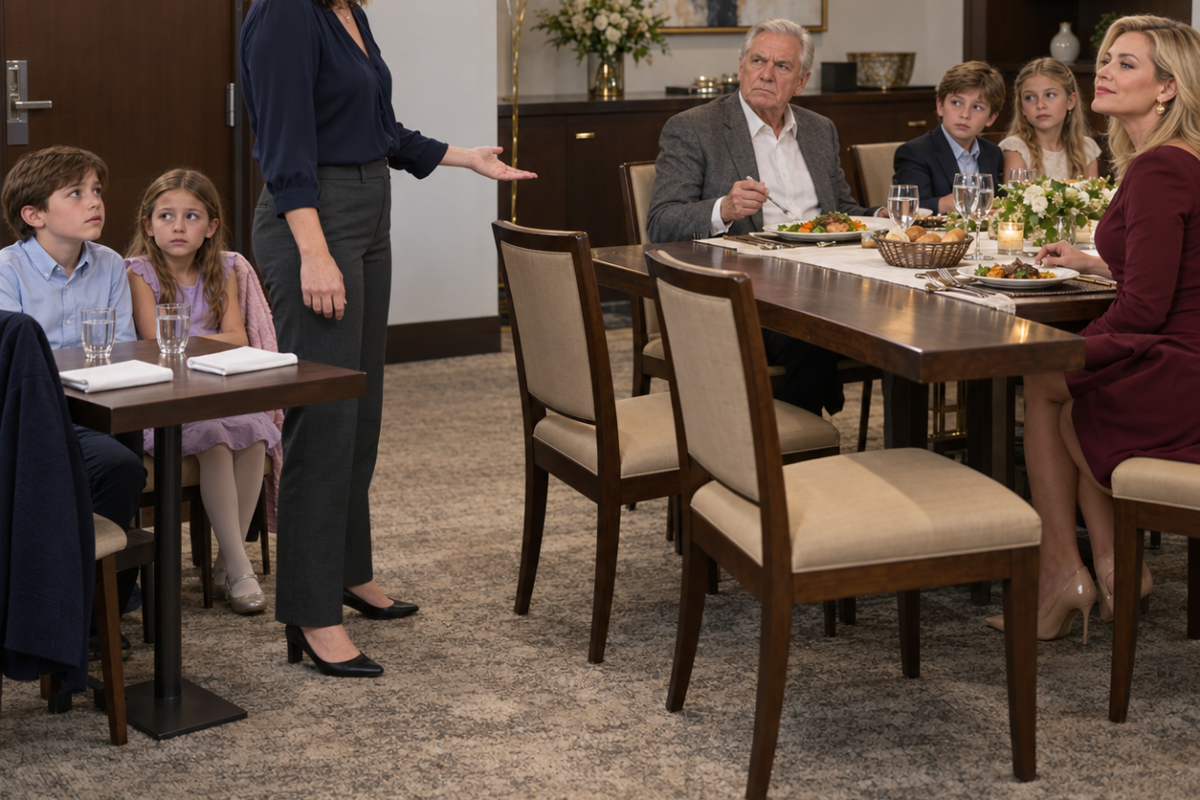
At my father’s seventieth birthday dinner, my eleven-year-old son and eight-year-old daughter were seated beside the service door with water glasses—but no dinner plates. Their cousins sat beside Grandpa with warm bread and full place settings. “They’ll eat after everyone else,” my sister said. I turned to my father, expecting him to object. “They can wait another hour,” he replied. There were two empty chairs at his table.
At my father’s seventieth birthday dinner, the first thing that stopped me wasn’t the cake or the gold balloons. It was my children. Ethan and…
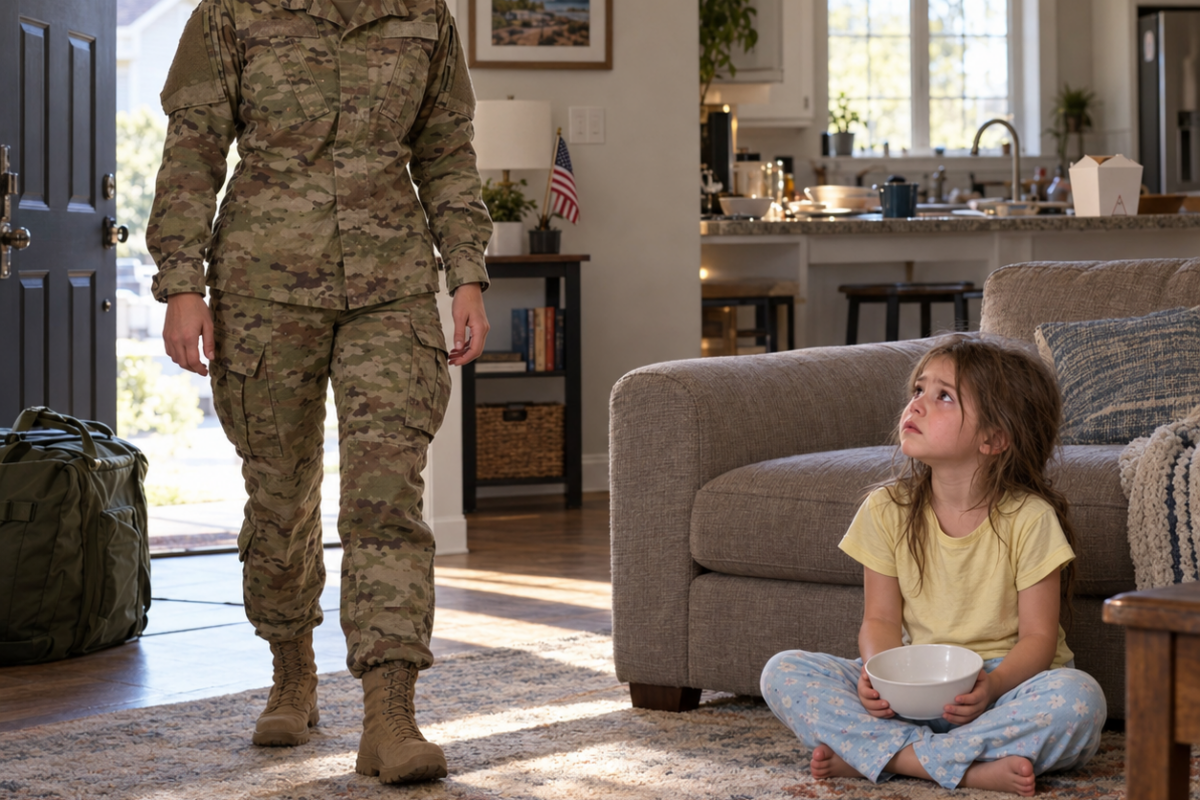
“Mommy, are you real?” my four-year-old daughter whispered when I came home from deployment three weeks early. She was sitting alone on our living room floor with an empty cereal bowl. My husband was on a Caribbean cruise with his mother and sister. Twenty-two minutes earlier, they had posted a photo captioned “Family time.” I was still in uniform when Sophie asked if she could have something to eat.
The first thing my daughter said when I found her was, “Mommy, are you real?” She was sitting cross-legged on our living room floor with…
End of content
No more pages to load