I came home from Army duty and found eighteen strangers partying inside my lake house. My brother-in-law ordered me off my own property while my sister stood behind him and said, “Please don’t make this difficult.” I picked up my bag and left. Twenty-eight minutes later, Jessica called to ask why an Army vehicle had pulled into my driveway.
The officer’s voice came through my sister’s phone.
“Colonel Carter, we have a problem.”
I stopped looking at the water.
“What kind of problem?”
“One sealed case is missing.”
Behind him, I heard a chair scrape across the floor. Someone asked where the children were. My brother-in-law began talking too loudly, explaining something nobody had asked him to explain.
I tightened my grip on the phone.
“Which case?”
“The serialized communications component listed on your custody inventory. The case should have been behind the cabinet’s inner panel.”
For several seconds, the lake and the house beyond it seemed unnaturally still.
Twenty-eight minutes earlier, Ryan had ordered me off my own property.
Now he was standing inside it, facing two uniformed Army personnel who were trying to account for equipment he had no authority to touch.
“Are you certain?” I asked.
“We’ve checked the cabinet and the immediate area. The outer transport container is present. The sealed inner case is not.”
I closed my eyes once.
Then I opened them.
“Don’t discuss the contents with anyone there. Secure what remains. I’m coming back.”
My sister took the phone again.
“Emily, please tell me what’s happening.”
I watched the house through the trees.
“I asked who opened the cabinet.”
“I know.”
“You didn’t answer.”
Her breathing sounded shallow.
“I didn’t think—”
“Jessica.”
She stopped.
“That sentence is not going to help you today.”
My name is Emily Carter.
I had seventy-two hours of leave, an aching shoulder, and a duffel bag that had spent more time in military vehicles than in my own closet.
I wanted coffee, silence, and sleep.
My lake house was supposed to provide all three.
It stood on a quiet stretch of water within driving distance of the installation where I was assigned. I had bought it years earlier, back when it needed a roof, a reliable furnace, and someone willing to see past the peeling paint.
I had been that someone.
Over time, I repaired the dock, replaced the windows, and turned the small room facing the lake into a place where I could sit without hearing a telephone ring.
It wasn’t a mansion.
It was a home I had paid for, maintained, and returned to whenever my schedule allowed.
The morning I came back, I was already imagining the first hour.
Put the bag down.
Start the coffee.
Open the lake-facing windows.
Leave the phone on the counter and let the world function without me for a little while.
Then I turned into the driveway and found seven vehicles.
A red pickup stood across the space where I usually parked. Two SUVs were crowded near the garage. A minivan had backed onto the edge of the lawn.
Music shook the windows.
A folding chair sat beneath the front maple.
Someone had tied balloons to the porch railing.
I stopped the car and looked at the house.
For one absurd second, I wondered whether I had turned into the wrong driveway.
Then a child ran past the window carrying the wooden model boat my father had made for me when I was thirteen.
I got out.
The front door was open.
Inside, there were people everywhere.
Beer bottles on the coffee table.
Paper plates beside the fireplace.
Children moving through the hallway.
A woman I had never met was using my kitchen to arrange trays of food, while a man in a baseball cap stood at my back door telling someone that the dock was “part of the place.”
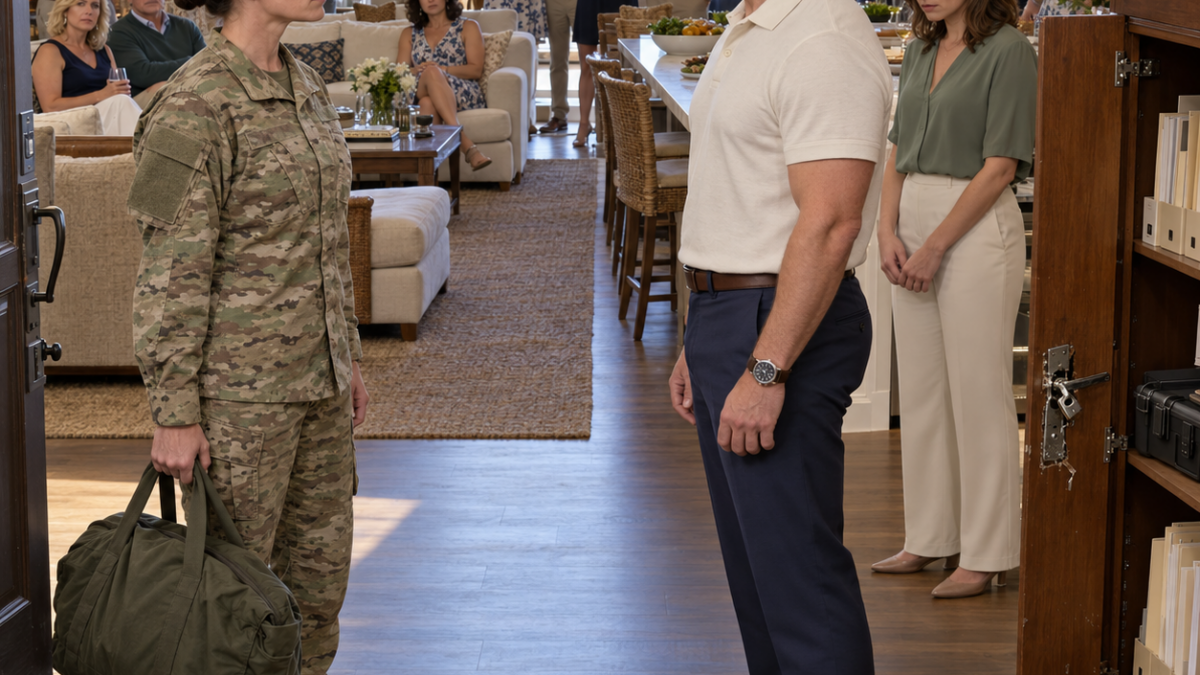
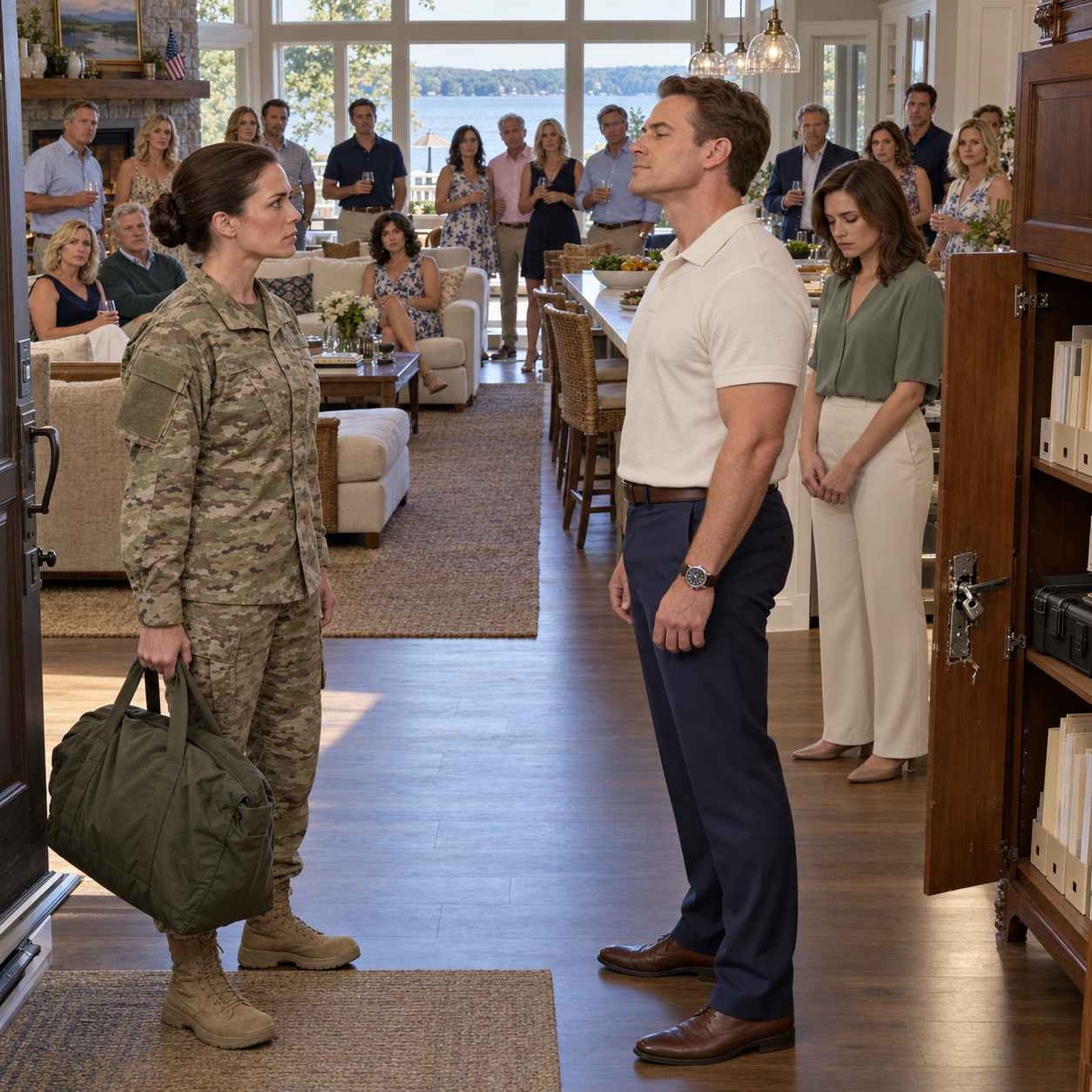
There were eighteen visitors in the house, including my sister and her husband. Most of them were strangers to me.
Nobody greeted me.
A few looked at my uniform, then at the duffel over my shoulder.
Finally, Ryan appeared beside the kitchen island.
“What are you doing here?”
I looked at him.
“I live here.”
He laughed, as though I had offered a weak excuse.
“Jessica said we could use the place for the family reunion.”
My sister stood behind him.
She was holding a serving spoon.
She did not meet my eyes.
I looked from her to the room.
“You gave him my keys?”
“Emily, it’s one weekend.”
“That wasn’t my question.”
Ryan stepped closer.
“There are eighteen people here and one of you. Go stay somewhere else.”
I almost laughed.
Not because it was funny.
Because there are moments when another person’s confidence becomes so detached from reality that you have to check whether you heard correctly.
“You’re ordering me out of my house?”
“Exactly.”
He folded his arms.
“You can’t come barging in and ruin something people have traveled for.”
I looked toward my sister.
Jessica finally raised her eyes.
“Please don’t make this difficult.”
That hurt more than Ryan’s arrogance.
I had expected him to be unpleasant. Ryan had a gift for treating other people’s resources as though they existed to reward his ingenuity.
But Jessica knew me.
She knew what returning home meant after weeks of work.
She knew the house was mine.
She knew I had trusted her with access for emergencies.
And she was standing in my kitchen asking me to protect her husband from the consequences of what they had done.
Then I noticed the cabinet beside the back hallway.
Its door was open.
The lock had been forced.
A strip of damaged wood lay near the baseboard.
My stomach dropped.
“Who opened that?”
Ryan glanced over his shoulder.
“I needed towels.”
“There are towels in the bathroom.”
“We couldn’t find enough.”
“That cabinet was locked.”
He shrugged.
“It was a cheap lock.”
The music continued playing.
Someone laughed in the dining room.
I looked inside the cabinet.
Personal records had been pushed aside. A folder lay partly beneath a stack of table linens someone had carried out. The protective transport container on the lower shelf had been moved.
I could not verify the inventory from where I stood.
I could verify that the storage arrangement had been breached.
Inside that cabinet were personal documents and accountable government-issued equipment temporarily in my custody. The equipment was awaiting collection under an approved arrangement after a schedule change. It was not a collection of souvenirs, and it was not something a guest could move because he wanted more towels.
I looked at Jessica.
She said nothing.
Something in me became very calm.
“All right.”
Ryan grinned.
“Finally.”
I picked up the duffel I had set near the door.
“Enjoy the weekend.”
He laughed again.
“There you go. No need to make everything a military operation.”
I walked outside.
I did not slam the door.
I did not argue about the title to the property in front of people holding beer bottles.
I got into my car and drove less than a mile to a public turnout beside the lake.
Then I made three calls.
The first went to my attorney.
Mara Bennett answered on the second ring.
“Emily?”
“I need to revoke permission for people occupying my house without my consent.”
She became quiet.
“What happened?”
I explained the visitors, the keys, and Ryan ordering me out.
Then I described the cabinet.
“The house issue and the equipment issue need to be handled separately,” she said.
“I know.”
“Don’t let anyone turn the first into an argument that obscures the second.”
“I won’t.”
She asked whether I was safe.
“Yes.”
“Good. Stay where you are while you make the necessary reports. I’ll confirm the property documents and help with the civilian side.”
My second call went to Thomas Reed, the property manager who checked the house when I was away.
He managed a few properties around the lake and knew mine better than most people who had visited it.
“Thomas, there are people inside.”
“What people?”
“My sister and her husband brought a reunion.”
He said something under his breath.
Then he opened the security-system records.
“Colonel Carter, someone changed your keypad code yesterday.”
I went still.
“When?”
He gave me the time.
Then he added, “One exterior camera went offline at 6:43 p.m.”
“Equipment failure?”
“I can’t tell from the status alone. I need to see it.”
I looked across the water.
The house stood beyond a line of trees, ordinary and sunlit.
Nothing about it looked like a place where control had quietly changed hands.
“Preserve the logs,” I said.
“Already doing it.”
My third call went to my command.
I reported the breached cabinet, the accountable equipment, and the fact that I could not immediately confirm the inventory.
The duty officer asked practical questions.
What was in my custody.
Where it was supposed to be.
Whether I was at the location.
Whether there was an immediate threat.
I answered each one.
Personnel already nearby could come to verify the inventory and secure what remained. They were not coming to evict civilians or settle a family dispute. Any suspected theft involving guests would require civilian law enforcement.
I understood that.
I had no desire to turn a rank into a private police force.
I wanted the equipment accounted for.
“Yes,” I said when asked whether I needed inventory assistance.
“Understood, ma’am. Remain available.”
I ended the call and sat with both hands on the steering wheel.
The water moved slowly.
For the first time since arriving, I could hear myself think.
I called the local sheriff’s office as well and explained the unauthorized visitors, damaged cabinet, and possible interference with government property.
The dispatcher took information and told me a deputy would follow up.
Then I waited.
Twenty-eight minutes after I left the house, Jessica called.
“Emily…”
She sounded frightened.
“Why is there an Army vehicle outside?”
“Because Ryan opened something he had no right to touch.”
Behind her, I heard him saying, “This is ridiculous. Nobody stole anything.”
Jessica lowered her voice.
“What exactly was in the cabinet?”
“That depends.”
“On what?”
“On whether everything is still there.”
A pause.
Then the phone changed hands.
And Captain Lewis told me a sealed case was missing.
I returned to the house without rushing.
That was harder than rushing would have been.
My mind wanted immediate answers. My body wanted to move quickly. But urgency does not improve judgment merely because it feels productive.
I parked on the road because the driveway was still crowded.
The music had stopped.
A woman stood near the minivan with two children. Another guest was carrying disposable cups to a trash bag as though cleaning might make the situation look less serious.
The Army vehicle was a plain fleet SUV.
No sirens.
No dramatic convoy.
Captain Lewis stood near the front door. Lieutenant Park was inside, documenting the cabinet and checking the remaining items against the custody inventory.
Ryan hovered near the kitchen.
His face had lost its earlier amusement.
“Emily,” he said as I entered, “you’ve taken this way too far.”
I did not look at him.
“Captain.”
“Ma’am.”
Lewis gave a concise summary.
The outer container was there.
The sealed inner case was missing.
Other items appeared present but would need a controlled inventory and inspection.
No one had been permitted to handle the cabinet further.
I looked at the broken lock.
Then at the lower shelf.
The empty space was small.
The consequences were not.
Lieutenant Park showed me the relevant line on the inventory without discussing unnecessary details in front of guests.
I confirmed it.
“That case was there when I secured the cabinet.”
“When was that, ma’am?”
I gave the date and time.
“Who had authorized access afterward?”
“No one.”
Ryan threw out his hands.
“We didn’t know.”
I turned toward him.
“You knew the cabinet was locked.”
“We were looking for towels.”
“You broke a lock.”
“It wasn’t like—”
“You broke a lock.”
He stopped.
Jessica stood near the dining-room doorway, still holding the serving spoon.
She seemed unaware of it.
I looked at her.
“Put that down.”
She glanced at her hand and placed it on the table.
The gesture made her look suddenly younger.
Not innocent.
Just frightened.
Captain Lewis asked whether I had contacted civilian authorities.
“Yes.”
“Good. We’ll secure the remaining equipment and coordinate appropriately. We’re not conducting the guest interviews.”
I nodded.
That mattered.
The people in my house needed to understand the seriousness of the situation without being misled about who had authority over them.
A deputy arrived several minutes later.
His name was Nolan.
He introduced himself to me, then asked who owned the property.
“I do.”
Ryan interrupted.
“It’s a family house.”
Nolan looked at him.
“Are you an owner?”
Ryan hesitated.
“No, but—”
“Do you have a lease?”
“No.”
“Did the owner give you permission to hold this gathering?”
Jessica stepped forward.
“I gave permission.”
Nolan looked at her.
“Are you an owner?”
She swallowed.
“No.”
I watched the answers remove the fog Ryan had created around the situation.
Not because my rank mattered.
Because the facts were simple when someone asked direct questions.
Mara had already sent the relevant property information.
Thomas was on his way.
I told Nolan I wanted the gathering ended, the damage documented, and the missing case located.
He explained that suspected theft and the property-access dispute would be addressed through the proper processes. He would speak with people individually. Nobody needed to create an argument in the kitchen.
Ryan said he had done nothing wrong.
Nolan asked him to begin with the cabinet.
“What did you use to open it?”
Ryan glanced at Jessica.
“A screwdriver.”
“Where is it?”
“In the garage.”
“Did you remove anything?”
“Towels. A box. Some papers.”
“What box?”
Ryan rubbed the back of his neck.
“The one in there.”
“The outer container?”
“I guess.”
“Where did you put it?”
“On the table.”
“Who handled it afterward?”
For the first time, Ryan had no immediate answer.
He looked around the room.
I followed his gaze.
A man who had been standing beside the refrigerator was no longer there.
I had noticed him earlier only because he looked related to Ryan: same broad jaw, same restless way of holding his shoulders.
“Who was that?” I asked Jessica.
She stared.
“Derek.”
“Who is Derek?”
“Ryan’s brother.”
“Where is he?”
“He left.”
“When?”
She looked toward Ryan.
He answered too quickly.
“Before any of this.”
Nolan watched him.
“What does that mean?”
Ryan swallowed.
“Before the officers came.”
“What was he carrying?”
Ryan said nothing.
A teenage boy near the hallway shifted his weight.
Nolan noticed.
“What’s your name?”
“Andrew.”
“Did you see something you think might help?”
The boy looked toward Ryan.
That look told me enough to become concerned for him.
I said, “Nobody is asking you to take responsibility for what an adult did.”
Andrew looked at me.
Then at the deputy.
“He had a black bag.”
Ryan snapped, “Andrew.”
Nolan turned.
“Let him answer.”
The boy’s mother moved closer.
“What bag?” she asked.
Andrew spoke more quietly.
“The one he put in the pickup.”
The red pickup.
The vehicle that had blocked my usual parking place when I arrived.
I looked outside.
It was gone.
Nolan asked Andrew whether he had seen what was inside.
“No.”
“Did you carry it?”
Andrew’s face reddened.
“From the back steps to the truck.”
Ryan started talking again.
“It was just helping unload. People moved things all day.”
Nolan held up a hand.
Andrew’s mother put her arm around him.
The boy looked miserable.
I knew that expression.
The fear of discovering that an ordinary favor has placed you near something you do not understand.
“What did Derek tell you?” Nolan asked.
Andrew swallowed.
“That it was old electronics Ryan was getting rid of.”
I looked at Ryan.
He looked away.
The missing case had stopped being an abstract inventory problem.
Someone had described it as rubbish.
Someone had carried it to a vehicle.
Someone had left.
“Call Derek,” Nolan told Ryan.
Ryan reached for his phone.
Then stopped.
“Maybe Jessica should.”
“No,” I said.
He looked at me.
“You told everyone you were in charge of the house. Call your brother.”
He dialed.
The call went to voicemail.
He tried again.
Voicemail.
Jessica pressed both hands against her mouth.
Captain Lewis moved to the hallway to make a call of his own.
Lieutenant Park finished securing the remaining equipment.
The room seemed full of people who wanted to become invisible.
I understood the impulse.
I also understood that leaving eighteen people inside my house while each invented an explanation would make everything worse.
Nolan asked for the names and contact information of the adults who might have witnessed the cabinet being opened or the case being moved.
Parents took the children outside.
Those not needed for immediate questions began packing their things.
I did not help them.
That was a conscious choice.
My instinct was to apologize for the inconvenience, make sure people had food for the drive, and offer plastic containers for leftovers.
Hospitality is a difficult habit to interrupt.
But I had not invited them.
I had been expelled from my own house.
I did not need to make the ending comfortable enough for everyone to forget the beginning.
Thomas arrived while Nolan was speaking to Ryan.
He came through the garden entrance and stopped when he saw the cabinet.
“Good Lord.”
I walked him outside.
“What happened with the security system?”
He showed me the preserved records.
The keypad code had been changed using the owner-level access information.
That information was stored in a sealed emergency envelope I had once given Jessica for a genuine maintenance crisis.
She was supposed to use it if a pipe burst, if a contractor needed access during an emergency, or if Thomas could not reach me.
Not to host a reunion.
Not to replace my code.
The camera had not failed.
Its connection had been physically unplugged.
Thomas had checked the unit beneath the rear overhang.
Someone had moved a ladder beneath it.
I looked toward the yard.
The ladder was still leaning beside the shed.
“Can you establish who did it?”
“Not from the camera after it was disconnected. There may be earlier footage.”
“Preserve everything.”
“I have.”
He looked at me.
“I should have called when the camera went offline.”
“What was the alert?”
“It came through with intermittent network notices. I checked remotely and assumed it would reconnect.”
I nodded.
That was not the same as Jessica’s breach.
It was still a failure in a system I relied on.
“We’ll review the notification settings later.”
“Yes.”
“And nobody else gets owner-level access.”
“Understood.”
He did not defend himself.
I appreciated that.
When we returned inside, Jessica was sitting alone at the dining table.
Her bag lay beside her.
The serving spoon had disappeared.
“Did you change the code?” I asked.
She closed her eyes.
“Yes.”
“Why?”
“We thought people would be coming and going.”
“That explains creating a temporary guest code. It doesn’t explain replacing mine.”
“Ryan said it would be simpler.”
“Did you know he unplugged the camera?”
She looked up.
I waited.
Finally, she said, “He said people deserved privacy.”
“It points at the driveway and side entrance.”
“I know.”
“Then why did you agree?”
Her eyes filled.
“Because I didn’t think you’d come home.”
The sentence hit harder than I expected.
Not because it revealed a sophisticated plot.
Because it revealed how thoroughly my absence had been mistaken for permission.
“You didn’t think I’d come home,” I repeated.
“Your schedule changes.”
“So you decided mine didn’t matter.”
“That isn’t what I meant.”
“What did you mean?”
She had no answer.
I looked around the room.
My dining chairs had been dragged into the living room. A serving platter lay on Arthur’s old sideboard—
No.
Not Arthur.
That belonged to another family, another life.
Mine was the sideboard my father had refinished when I bought the house. I had to remind myself how quickly old family habits can make every possession feel communal, as though nobody is allowed a separate life once the people who knew them as children arrive.
I looked back at Jessica.
“When did you plan this?”
“About a month ago.”
“A month.”
She nodded.
“You had a month to ask.”
“I knew you’d say no.”
There it was.
Plain enough that neither of us could pretend otherwise.
“Yes,” I said. “I probably would have.”
She began crying.
I did not comfort her.
Not yet.
Outside, a car door closed.
The house was emptying.
My sister sat in the middle of the room and faced the consequence she had tried to avoid by never asking the question.
Nolan returned with an update.
Derek had finally answered Ryan’s call, then ended it when told a deputy wanted to speak.
Ryan had provided the vehicle description and his brother’s number.
A local officer had located the pickup at a public recreation lot on the road out of town.
Derek had not yet left the area.
I felt my shoulders loosen slightly.
“Did they find the case?”
“They’re speaking with him.”
That was all Nolan would say.
I respected it.
I did not need a promise while the facts were still being checked.
Captain Lewis took me into the hallway.
“Ma’am, the remaining inventory is accounted for. We’ll transport it back for inspection and secure storage.”
“Good.”
“The missing component will need technical assessment if recovered.”
“I understand.”
He looked toward the damaged cabinet.
“You’ll need to provide a full statement on the custody arrangement and discovery.”
“I will.”
That part mattered too.
I could be the victim of unauthorized access and still have responsibilities to examine.
Rank did not exempt me from accounting for equipment.
Ownership did not make every decision I had made beyond question.
I had trusted my sister with a key and emergency information. I had not authorized her to breach storage, but the review would still ask whether the arrangements had been adequate and whether anything should have been handled differently.
I intended to answer.
I had no interest in demanding accountability from Ryan while treating my own role as untouchable.
Jessica overheard enough to look alarmed.
“Could this hurt your career?”
I turned toward her.
“It requires a review.”
“But you didn’t do anything.”
“I am responsible for what was in my custody.”
Her face changed.
Perhaps she was beginning to understand that the cabinet was not merely a prop in an argument between siblings.
I had to document every item.
Every access point.
Every decision.
The house had been a place where I expected privacy.
That expectation had professional consequences when someone else decided privacy was a luxury I did not deserve.
Ryan came into the hallway.
“Derek says this is a misunderstanding.”
I looked at him.
“What exactly did he misunderstand?”
“He thought it was spare stuff.”
“Why?”
Ryan rubbed his mouth.
“He buys and sells electronics.”
“That doesn’t explain why he took mine.”
“I said he could look at some things.”
I became still.
“What things?”
Ryan glanced toward Nolan.
“Old equipment.”
“Which old equipment?”
He did not answer.
I waited.
Finally, he said, “The stuff in the cabinet.”
Jessica made a small sound.
I looked at her.
She seemed as shocked as I was.
That did not excuse the keys, code, camera, or gathering.
It did separate one action from another.
I could see the distinction and still be furious.
“Did you tell Derek he could take it?” Nolan asked.
Ryan’s voice became quieter.
“I said if it was useful, he could deal with it.”
“What did you expect in return?”
“No, it wasn’t—”
“What did you expect?”
Ryan stared at the floor.
“He owed me money.”
The room was silent.
I had been tired when I arrived.
Now the exhaustion felt cold.
“You used my property to settle your brother’s debt.”
“He thought it was mine.”
“Did you tell him it wasn’t?”
Ryan looked toward Jessica.
She stood.
“Don’t.”
He blinked.
“Don’t look at me,” she said. “Answer him.”
For the first time that afternoon, she was not trying to make me easier for Ryan to manage.
She was asking him a question.
It came too late to prevent the damage.
It still mattered.
Nolan stepped outside to speak with the officer at the recreation lot.
I walked into the kitchen and poured water into a glass.
My hands were steady.
That surprised me.
I was angry enough that I expected them to shake.
Instead, everything had narrowed into a sequence.
Locate the case.
Secure the house.
Document the damage.
Tell the truth.
Rest afterward.
Jessica stood in the doorway.
“I didn’t know he told Derek to take anything.”
“I believe you.”
Relief crossed her face.
I continued.
“You still gave him the house.”
The relief vanished.
“I know.”
“You changed my access.”
“Yes.”
“You let him tell me to leave.”
She lowered her eyes.
“Yes.”
“Those are yours to answer for.”
“I know.”
I drank the water.
For once, she did not ask me to stop because she felt bad.
The update came a few minutes later.
The case had been recovered.
I closed my eyes.
Then I asked the next question.
“Condition?”
“The outer seal has been disturbed,” Nolan said. “The component appears present. The Army personnel will verify it.”
Relief did not erase the problem.
It changed its shape.
Derek had arranged to meet someone who had responded to an online listing. The sale had not been completed. The prospective buyer was waiting in the same recreation lot when officers arrived.
The item had been described as surplus communications hardware.
It was not surplus.
It was not Derek’s.
It was not Ryan’s.
The buyer said he had not been told otherwise.
Nolan would not speculate beyond the information confirmed so far.
I did not ask him to.
Derek cooperated with recovery of the case after being questioned. The officers documented the item, the listing, and the circumstances. The case would be transferred appropriately for inspection.
I felt the first real breath leave my chest.
Then I thought about the word surplus.
The clean little word that had made theft sound like opportunity.
Ryan had called me a freeloader in the house I paid for.
Then he had treated government property as something available to settle a debt.
His version of ownership seemed to depend entirely on whether he wanted something.
Derek returned with an officer later to provide additional information and collect belongings left inside.
He looked less like Ryan once he was frightened.
His voice was thin.
“I didn’t know it was government property.”
I looked at him.
“There were identifying labels.”
“Ryan said it was old.”
“Old is not the same as yours.”
He swallowed.
“I know that now.”
I did not respond.
I had no desire to make him feel better about a distinction most adults understand without a deputy explaining it.
He admitted photographing the case, opening the protective packaging, and posting it for sale. He had not completed the sale, and the inspection would determine what had happened to the component.
I listened from a distance while Nolan handled the conversation.
I did not interrogate him.
I did not threaten military consequences he might not face.
I did not enjoy watching him frightened.
Mostly, I wanted him out of my kitchen and my equipment somewhere secure.
By early evening, the last guests had left.
Some apologized.
Some avoided me.
One woman told me they had been invited and thought Jessica owned the house.
I believed her.
I gave her the deputy’s contact information because she had seen Ryan working at the cabinet the day before.
She agreed to provide what she knew.
Andrew’s mother thanked me for not blaming her son.
“He should have asked.”
“He was carrying a bag for an adult,” I said. “The adults need to answer for what they put in it.”
She nodded.
Andrew stood beside her, pale and embarrassed.
I told him, “If someone asks you to describe what happened, say what you saw. You don’t need to fill in the parts you didn’t.”
He looked relieved.
That was enough.
Children should not have to carry the moral weight of adults’ decisions merely because they happen to be nearby.
Captain Lewis and Lieutenant Park left after the recovered case and remaining equipment were accounted for and transported for the next stage of inspection.
Lewis reminded me whom to contact in the morning.
I thanked them.
They had been professional, restrained, and focused on the actual task.
Their uniforms had frightened Ryan because he knew he had crossed a boundary.
They had not needed to turn that fear into a performance.
Nolan stayed long enough to complete the initial reports.
He explained that the suspected property offenses and the circumstances surrounding the missing case would be reviewed. More interviews might follow.
I gave him my number.
Then I looked at Jessica and Ryan.
Their overnight bags were still by the stairs.
“You need to leave.”
Ryan’s face hardened again.
It was remarkable how quickly anger returned once immediate fear began receding.
“After what you put us through?”
I looked at him.
“You are standing in my house.”
“We’re family.”
“No,” I said. “That sentence is not a key.”
Jessica reached for her bag.
“Come on.”
He looked at her.
“You’re just going to let her—”
“Yes,” Jessica said.
He stopped.
“She asked us to leave.”
“You started this.”
“I did,” she replied. “And now I’m leaving.”
They carried their bags outside.
Ryan did not apologize.
Jessica paused on the porch.
“I’ll call.”
“Not tonight.”
She nodded.
Then they were gone.
Thomas changed the access settings with me present.
A locksmith secured the damaged cabinet temporarily and arranged the repair.
I changed the codes.
Recovered the emergency information.
Restricted permissions.
Then Thomas walked through the house and made a factual list of damage and cleanup needs.
There were scratches on the floor, a broken lamp, food stains on the rug, and a loose railing near the dock.
The model boat was unharmed.
I picked it up from the windowsill and held it for a moment.
My father’s hands had shaped it.
I remembered him sanding the hull while I sat on the garage floor asking whether it would actually float.
“It’s a model, Emily.”
“That’s not an answer.”
He laughed.
I set it on a higher shelf.
Not because I never wanted children in the house.
Because I wanted to be the person deciding when they came.
Thomas asked whether he should arrange a cleaning crew.
“Yes.”
“Tomorrow?”
“Late morning.”
He nodded.
“Do you want me to stay?”
“No. Thank you.”
He studied my face.
“You’re sure?”
“I’m sure.”
After he left, I locked the doors.
Then I stood in the center of the kitchen.
The house was quiet.
I had finally obtained one of the three things I wanted.
I did not yet have coffee.
I did not think I could sleep.
My phone rang.
Mom.
I watched the screen until it stopped.
Then a message appeared.
Jessica says there was an incident. Please call me before you do anything else.
I stared at the words.
Before you do anything else.
As though my next decision required family supervision.
As though the person whose house had been invaded was the one likely to make trouble.
I put the phone face down.
Then I made coffee.
I drank half a cup at the kitchen table, looking at the marks on the floor.
I had bought that table after my first long assignment away from home. It was solid oak, too large for my old apartment, and one of the first things I purchased when I realized I could build a life that wasn’t temporary.
Ryan had leaned against it while telling me to leave.
I looked at the chair where Jessica had sat crying.
Then I looked toward the cabinet.
The broken lock was no longer the most painful part of the day.
The most painful part was that my sister knew I would say no and decided that meant she should avoid asking.
She had not misunderstood my wishes.
She had worked around them.
I slept four hours that night.
Not well.
But enough.
In the morning, I gave the required statement and began the professional review.
I described the approved temporary custody arrangement, the storage, the access I had allowed for emergencies, and the discovery.
I did not leave out the fact that Jessica possessed information she could misuse.
I did not exaggerate the security measures.
I did not minimize what happened because the equipment had been recovered.
The component was quarantined for inspection. Its condition and any handling would be assessed by people qualified to do that.
The fact that it was not a cache of classified documents did not make unauthorized removal harmless.
The fact that I was angry with my family did not change the reporting requirements.
I understood both.
Afterward, I called Mara.
She had already reviewed the house documents and initial information from Thomas.
“The title is clear,” she said.
“I know.”
“I’m saying it because someone tried to make you feel like a guest.”
I sat quietly.
Then I said, “Yes.”
She explained the practical steps for revoking access, preserving evidence, and recovering documented losses. She would communicate with Jessica and Ryan regarding property matters.
I did not need to conduct every argument myself.
That was a relief.
“Do you want compensation for the cleanup and damage?” she asked.
“Yes.”
“Anything else?”
“The actual costs caused by their actions. Not a number designed to punish them.”
“Good.”
I wanted accountability.
I did not want a fantasy invoice large enough to make the story satisfying.
A broken cabinet had a repair cost.
Cleaning had a cost.
Replacement locks had a cost.
The invasion of my peace did not become a simple dollar amount.
It would have to be addressed another way.
My mother called again.
This time, I answered.
“Emily.”
“Hi, Mom.”
“What happened?”
I gave her a concise account.
Visitors.
No permission.
Forced cabinet.
Missing case.
Recovery.
Reports.
She listened.
Then she said, “Jessica says she thought you wouldn’t mind.”
I closed my eyes.
“She told me she knew I would say no.”
My mother went quiet.
“Did she tell you that?”
“No.”
“Then ask her.”
“She’s very upset.”
“So am I.”
“I know, but you’re stronger.”
I looked toward the lake.
That sentence had followed me through much of my life.
You’re stronger.
You can handle it.
Let it go.
It had often meant that my discomfort was easier for the family to ignore.
“Being stronger doesn’t mean I volunteered for this.”
“I didn’t say that.”
“You’re asking me to absorb it because Jessica is crying.”
My mother sighed.
“I’m asking you to remember she’s your sister.”
“I did. That’s why she had a key.”
The line stayed quiet.
My mother had no immediate answer.
I told her I would talk later.
She did not like that.
I ended the call anyway.
Jessica and I had not always been distant.
As children, we were close in the uneven way siblings can be close when one is older and more serious.
I was the one who checked whether the back door was locked.
She was the one who forgot her coat.
I made lists.
She made friends.
When our father was ill, I handled appointments and records while she sat beside him, making him laugh.
Both kinds of care mattered.
I had never believed my way was the only useful one.
But over time, my reliability became something the family used without noticing.
If a plan changed, Emily would manage.
If someone needed money, Emily would find a way.
If Jessica was overwhelmed, Emily would understand.
Then I joined the Army, built a career, and became physically absent more often.
The family began treating absence as evidence that I did not need the things other people needed.
I had a steady paycheck.
I had discipline.
I had travel.
Surely I could surrender a weekend, a room, a car, a holiday.
Surely my house could be used while I was away.
The lake house became especially tempting because it was beautiful and sometimes empty.
Jessica had asked to visit before.
I had said yes on specific occasions.
A birthday afternoon.
A quiet weekend with her husband.
A few days when their home needed repairs.
Each permission had come with ordinary conditions.
Let me know.
Don’t invite additional people.
Leave the secured cabinet alone.
Use the guest spaces.
Jessica had agreed.
That history made what happened worse.
She knew permission existed.
She knew how to obtain it.
She had simply decided that asking would inconvenience the plan.
Ryan had encouraged that decision.
He liked presenting himself as the person who could arrange things.
Discounts.
Favors.
Access.
He told stories in which he always knew someone.
The people he “knew” were often relatives who had not agreed to the role.
I had challenged him before.
Usually, Jessica asked me not to embarrass him.
This time, his performance had reached a cabinet containing property he could not dismiss as family clutter.
The official response exposed the facts.
It did not create them.
He had been wrong when he told me to leave.
He would have been wrong if the cabinet contained nothing but towels.
That distinction became important in every conversation afterward.
On the second day of my leave, Jessica sent a long message.
She was sorry things became so serious.
She had not intended trouble.
She thought I would be away.
Ryan had misunderstood the cabinet.
Derek had misunderstood Ryan.
Everyone had been tired.
Everyone had been embarrassed.
I read it once.
Then I replied.
I am willing to discuss what you chose to do. I’m not willing to discuss this as a series of misunderstandings.
She did not answer immediately.
A few hours later, she asked whether she could come over.
I said no.
We could meet somewhere public after I returned to duty and had time.
That was not punishment.
I had barely begun to feel at home again.
I was not ready to invite the source of the intrusion back through the door.
The cleaning crew arrived late that morning.
I walked them through the house and explained what needed attention.
They asked where I wanted things placed.
I nearly laughed at how reassuring that was.
Permission had become extraordinary after one afternoon of people acting as though everything was available.
While they worked, I sat on the dock.
The boards were warm beneath my shoes.
A pair of ducks moved through the reeds.
My phone was inside.
For half an hour, nobody needed an answer.
Nobody demanded an explanation.
I looked toward the house and felt a kind of grief.
It was still mine.
It had never stopped being mine.
But safety can be disturbed without ownership changing.
I had to learn how to feel at ease there again.
I did not want to solve that by turning the place into a fortress.
I wanted sensible access controls, clear expectations, and the freedom to invite people because I wanted them there.
That was different from permanently living as though every visitor might become a threat.
The professional review continued over the following weeks.
The component had been recovered before the proposed sale. Technical assessment found it intact, though the disturbed packaging and unauthorized handling required documentation and corrective action.
The case did not contain the sort of dramatic secrets Ryan later implied to make the situation sound like my fault.
It was accountable equipment.
That was enough.
No one needed to invent a dangerous mystery to justify securing it.
The review examined the temporary storage arrangement and my reporting.
It also examined the broader procedures that had allowed collection to be delayed.
I was asked direct questions.
I answered them.
The conclusion did not treat my sister’s unauthorized actions as something I had personally ordered. It did identify access practices that needed tightening.
I accepted that.
I changed them.
The entire experience was a reminder that trust and verification have different jobs.
Trust explains why you give someone emergency access.
Verification helps prevent that access from quietly becoming unlimited.
I could love my sister without building systems that depended entirely on her never disappointing me.
Civilian investigators interviewed guests and reviewed the listing Derek had created.
Andrew’s account was consistent with the adults who saw the bag moved.
The prospective buyer provided messages.
Ryan’s involvement became clearer.
He had opened the cabinet.
He had described the contents as old equipment.
He had told Derek to see whether anything was worth selling.
Derek had taken the case.
Neither had obtained permission.
Jessica had not directed the removal.
She had authorized the gathering, changed the code, and allowed the camera to be disconnected.
Those distinctions stayed in the record.
I was glad.
Anger can tempt you to make everyone equally responsible.
That may feel satisfying.
It does not make the account more accurate.
Ryan and Derek needed to answer for what they did.
Jessica needed to answer for what she did.
Thomas needed to improve the monitoring he had failed to follow up on.
I needed to revise the access arrangements I had trusted.
Different responsibilities.
Same requirement for honesty.
Mara sent the documented property costs.
Jessica called me the next day.
“Ryan says you’re charging us for revenge.”
“What does he believe the locksmith should charge?”
She was silent.
“What does he believe cleaning costs?”
“I don’t know.”
“Then he can review the receipts.”
“He says the cabinet shouldn’t have been there.”
I sat back.
“In my house?”
“He says government equipment should be on base.”
“The custody arrangement is being reviewed by the people responsible for it. Ryan doesn’t get to break a lock because he dislikes where something is.”
“I know.”
“Does he?”
She began crying.
“I don’t know anymore.”
I let the silence remain.
She was my sister.
I wanted to help.
But helping did not require pretending she had not made choices of her own.
After a while, she said, “I told people it was our family’s lake house.”
I looked toward the window.
“I thought so.”
“I made it sound like we all had a right to use it.”
“Yes.”
“They asked why I never brought anyone there. I felt stupid saying I needed permission from my sister.”
I closed my eyes.
There was the small, ordinary embarrassment beneath the larger betrayal.
She did not want to admit that something beautiful belonged to me.
So she borrowed ownership along with the keys.
“You could have said it was mine,” I told her.
“I know.”
“You could have asked whether I wanted company.”
“I know.”
“You could have rented a place.”
“We couldn’t afford something that size.”
“Then the plan needed to be smaller.”
She cried quietly.
I did not rush to fill the silence.
Then she said, “I knew you’d be angry if you found out.”
“That should have stopped you.”
“Yes.”
It was the first answer she gave that did not try to make my reaction the problem.
We met two weeks later at a coffee shop.
She arrived early.
That surprised me.
Jessica was usually late in a way everyone had learned to accommodate.
She stood when I entered.
For a moment, we looked at each other.
Then we sat.
No hug.
Not because I wanted to be cruel.
Because I didn’t know what kind of closeness I could honestly offer.
She wrapped both hands around her cup.
“I’m sorry I gave Ryan access.”
I waited.
“I’m sorry I changed the code.”
I waited again.
“And I’m sorry I let him tell you to leave.”
My throat tightened.
“That part hurt most.”
She nodded.
“I know.”
“I don’t think you knew then.”
“No,” she said. “I knew you’d be upset. I didn’t let myself think about what it meant.”
I looked at her.
She was trying.
I could see that.
She was also still frightened of the consequences.
The two did not cancel each other.
“What did you think I would do?” I asked.
“Get angry. Call Mom. Maybe refuse to lend us the house again.”
“And then?”
“Eventually let it go.”
I sat quietly.
That was the arrangement in a single sentence.
Eventually, I would absorb the cost.
Eventually, my desire for family peace would become more important than my right to decide.
Eventually, my sister could depend on my forgiveness before offering respect.
“I’m not lending the house again,” I said.
She looked down.
“I understand.”
“I’m not giving you new access information.”
“I understand.”
“I’m willing to have a relationship with you. I don’t know what it looks like yet.”
Her eyes filled.
“Thank you.”
“Don’t thank me for forgiving something I haven’t finished understanding.”
She nodded.
We talked for another hour.
Some of it was painful.
Some of it was surprisingly ordinary.
She asked whether I had slept.
I asked whether she had gone back to work.
For a few minutes, we were sisters without the house between us.
Then the subject returned, because it needed to.
She said Ryan believed I had humiliated him.
I looked at her.
“He called me a freeloader in my kitchen.”
“I know.”
“He ordered me out.”
“I know.”
“He broke a lock and allowed property to be taken.”
She nodded.
“His embarrassment is not the central injury.”
“No,” she said.
The word came slowly.
I believed she meant it.
My mother took longer.
She invited us both to dinner and said it was time to put the matter behind us.
I declined.
She called.
“You can’t keep avoiding each other forever.”
“I met with Jessica.”
“Then why not dinner?”
“Because you’ve already decided what the dinner is supposed to accomplish.”
“I want my daughters together.”
“I want my sister to respect my decisions.”
“Family isn’t about property.”
I breathed slowly.
“Then Jessica could have held the reunion without using mine.”
My mother was quiet.
I did not enjoy arguing with her.
I also did not accept the idea that property became unimportant only when someone else wanted it.
The house represented years of work.
It represented the place where I could return and stop being useful for a little while.
More importantly, it represented a decision that belonged to me.
The problem was not that a rug got stained.
The problem was that my no had been anticipated, bypassed, and then treated as an obstacle when I arrived.
“I know you’re upset,” Mom said.
“I need you to stop describing this as my mood.”
She sighed.
“What do you want me to say?”
“The truth.”
“Which is?”
“That Jessica should have asked. That Ryan should not have broken the cabinet. That I was allowed to come home.”
The line remained quiet.
Then, finally, she said, “You were allowed to come home.”
I swallowed.
It should not have mattered so much to hear that.
It did.
She apologized several weeks later.
Not elegantly.
She began with an explanation, stopped herself, and tried again.
“I asked you to make it easier because I thought you could handle it.”
“Yes.”
“That wasn’t fair.”
“No.”
“I’m sorry.”
I thanked her.
Then we talked about something else.
I did not need every conversation afterward to become a ceremony of regret.
I needed the arrangement to change.
Ryan sent no apology.
He sent accusations through Jessica and, once, directly to me.
He said I had overreacted.
He said I had used the Army to intimidate civilians.
He said the equipment had been recovered, so there was no real harm.
I forwarded the relevant messages to Mara and did not argue.
The Army personnel had secured and inventoried equipment.
Civilian law enforcement had handled the suspected offenses involving civilians.
The division was clear.
Ryan disliked it because neither side had accepted his story merely because he spoke loudly.
That was not intimidation.
It was accountability.
Derek’s attorney contacted the appropriate authorities.
The legal process moved at its own pace.
I did not receive every update, and I did not ask for every detail.
Eventually, the evidence supported consequences for the unauthorized removal and attempted sale. The outcome included restitution and formal conditions.
Ryan also faced the consequences of his role and the documented property damage.
There was no sweeping sentence that made the entire family gasp.
There were records, agreements, findings, and obligations.
Mara explained what affected me.
I signed what required my review.
I collected the payments when they came.
I did not confuse the legal outcome with the repair of my relationship with Jessica.
A payment could replace a lock.
It could not make the moment in the kitchen disappear.
That needed different work.
Jessica separated from Ryan later that year.
She told me herself.
I listened.
I did not say I had always known.
I had never lived inside their marriage.
I had seen pieces.
The lake house had shown her pieces she could no longer explain away.
She said he was angry that she had admitted changing the code and letting him disconnect the camera.
“He wanted me to say I didn’t know.”
“But you did.”
“Yes.”
I waited.
“He kept saying we needed to be on the same side.”
“What did you say?”
“That the same side couldn’t mean lying.”
I looked at my sister.
There was a steadiness in her voice I had not heard for a while.
I was glad.
I did not treat it as proof that everything was solved.
She needed time.
So did I.
She moved into a small apartment near her work.
When she asked whether I could help carry boxes, I said I could come for two hours.
Not the entire weekend.
Not to organize the move.
Two hours.
She thanked me and arranged other help.
That was new.
I went.
We carried kitchen things upstairs.
She had bought a cheap table that wobbled when she leaned on it.
I looked at the legs.
“Wrong screw.”
She sighed.
“Of course you know that.”
I smiled.
“Give me the instructions.”
For a few minutes, we were back in our childhood kitchen, working on something neither of us understood until we stopped guessing.
I fixed the table.
Then I left when I said I would.
She did not call me selfish.
She stood at the door and said, “Thank you for coming.”
I believed she meant that too.
The lake house began feeling like mine again gradually.
I returned for short stays.
At first, I checked the cabinet even though the equipment was no longer there and the storage arrangements had changed.
I checked the camera status.
I looked at the code settings.
Then I went outside.
Over time, the checking became shorter.
Eventually, it became ordinary maintenance rather than a ritual I needed before I could breathe.
I had the damaged floor repaired.
Replaced the lamp.
Cleaned the rug.
The model boat returned to its shelf.
I invited a friend from work for dinner.
She asked whether she should bring anything.
I said bread.
She brought bread.
No additional guests.
No assumption that the invitation extended to anyone she could fit in a car.
We ate on the porch.
She looked at the lake and said, “This is a good place.”
“Yes,” I said.
Then, after a moment, “It is.”
I needed to say that.
The house was not ruined because someone had violated it.
I could make new memories there without pretending the old ones had never happened.
Thomas and I reviewed the security procedures.
We changed how alerts were handled.
We separated guest access from owner access.
We clarified what would trigger a direct call rather than a remote check.
He apologized again.
I told him the improvements mattered more than repeating the apology.
He agreed.
That was how I wanted to handle most things afterward.
Name the failure.
Make a concrete change.
Follow through.
Not endless explanations.
Not dramatic promises.
Work.
Jessica asked once whether she could visit the lake.
The question arrived in a message several months after our coffee-shop conversation.
Would you be comfortable having lunch together there sometime? If not, we can meet elsewhere.
I read it twice.
The last sentence mattered.
She had left me room to say no without turning the no into an accusation.
I did not answer immediately.
Then I wrote back.
Lunch next Sunday. Just us. I’ll meet you at the house.
She replied.
Thank you. I’ll bring what you ask for.
I told her to bring nothing.
I wanted to host her because I chose to.
Not because she earned entry by carrying groceries.
That Sunday, she parked where I suggested and waited on the porch instead of trying the door.
I opened it.
For a moment, she looked past me into the hallway.
Then she looked at my face.
“Hi.”
“Hi.”
She stepped inside when I moved aside.
We ate soup and sandwiches at the kitchen table.
Neither of us mentioned the cabinet at first.
Eventually, she looked toward the repaired door.
“I’m sorry.”
“I know.”
She nodded.
“I think about you coming home and seeing all of us.”
I looked at her.
“What do you think about?”
“The fact that you were tired.”
I waited.
“And that you came home.”
The last words were quieter.
Not came to the house.
Came home.
She was beginning to understand the difference.
“I kept thinking about the reunion,” she said. “Who would bring food. Where people would sleep. Whether Ryan would be embarrassed if it didn’t work.”
“And not whether I wanted it.”
“No.”
I nodded.
She did not ask me to reassure her.
We finished eating.
Then we walked to the dock.
She stood beside me for a while.
“I used to think you didn’t need anyone,” she said.
“I need people.”
“You never seem to.”
“I don’t always ask well.”
She looked at me.
I had my own habits to examine.
I had built a life where competence sometimes made loneliness easier to hide.
That did not excuse what she did.
It did give us something honest to discuss that was not only her guilt.
“I can get better at asking,” I said. “You can get better at hearing no.”
She smiled sadly.
“That seems fair.”
We stayed by the water until the wind became cool.
When she left, she did not ask for a key.
I did not offer one.
The visit counted.
The boundary remained.
Both could be true.
Later, Andrew’s mother wrote to tell me her son had been worried that his statement caused family trouble.
I asked whether he wanted a brief call.
He did.
I told him the trouble began when adults took property without permission.
Telling the truth did not create it.
He was quiet.
Then he said, “Derek told me I should have minded my business.”
I closed my eyes.
“I’m sorry he said that.”
“He said I made it worse.”
“Did you describe what you saw?”
“Yes.”
“Then you did what you should.”
He breathed out.
I did not give him a speech about bravery.
He did not need another role to perform.
He needed permission to stop carrying responsibility that was not his.
His mother thanked me afterward.
I told her to keep him out of the adults’ arguments.
She said she would.
I hoped she did.
The story traveled through the extended family in several versions.
In one, I had arrived with armed soldiers and thrown everyone out.
In another, Ryan had accidentally opened a box of classified secrets.
In a third, Jessica had merely borrowed an empty vacation property and I had reacted because I disliked sharing.
I corrected the record when it directly affected me.
I did not pursue every conversation.
Mara handled the claims that mattered legally.
The official records handled the facts that mattered professionally.
The people who wanted my version could ask me.
I began to understand how much energy can be lost trying to make everyone agree.
Agreement was not necessary for ownership.
It was not necessary for a boundary.
It was not necessary for the truth to remain true.
I had returned home.
I had found unauthorized visitors.
A locked cabinet had been forced.
Equipment had been taken.
I reported it.
Those facts did not become less real because someone preferred a story where I was difficult.
Near the anniversary of the incident, I took another period of leave.
Three days.
Seventy-two hours again.
This time, I drove toward the lake without imagining what might be waiting.
The driveway was empty.
The camera was active.
My code worked.
Inside, the house smelled faintly of clean wood and the coffee beans I had left in the cupboard.
I put down my bag.
Opened the windows.
Made coffee.
Then I sat in the chair facing the water.
Nothing happened.
No music.
No argument.
No urgent telephone call.
The absence of an event felt like a gift.
I slept that afternoon.
Long enough that the light had changed when I woke.
For a moment, I did not know what time it was.
Then I looked at the clock and laughed.
I had finally gotten all three things.
Coffee.
Silence.
Sleep.
Jessica called that evening.
“Is this a good time?”
“Yes.”
“How’s the lake?”
“Quiet.”
“Good.”
We talked about her work and a repair she needed in the apartment.
Then she said, “I’m glad you’re home.”
I looked through the window.
The dock was turning gold in the low sunlight.
“Thank you.”
She did not ask whether I could lend the house.
She did not ask whether someone else could stop by.
She simply said she was glad.
The conversation ended without a negotiation.
I sat for a while afterward.
That was the sort of change I trusted.
Not a declaration that we were healed.
An ordinary call that respected where I was.
My mother visited later that summer.
I invited her for lunch.
She asked whether Jessica was coming.
“No.”
“All right.”
No complaint.
No suggestion that I should make the visit into a reconciliation gathering.
She arrived with a pie.
We sat on the porch.
After a while, she looked toward the driveway.
“I should have told Jessica to ask you.”
“Yes.”
“I should have listened when you said you didn’t give permission.”
“Yes.”
She nodded.
“I’m sorry.”
I looked at her.
“I know you wanted peace.”
“I did.”
“I wanted peace too. In my home.”
Her eyes filled.
She had not thought of it that way before.
Or perhaps she had finally allowed herself to.
We ate pie.
Talked about the weather.
Watched a boat move slowly across the far side of the lake.
She asked before taking a photograph.
I said yes.
When she left, she hugged me and said, “You’ve made a lovely place here.”
I thanked her.
She had always liked the house.
That day, she seemed to understand that liking it did not give anyone a claim on it.
I still think about Ryan sometimes.
Not constantly.
Usually when I hear someone say, “It’s family,” as though the words settle every question.
They do not.
Family can explain why you help.
It can explain why a betrayal hurts.
It can explain why you keep trying after a conversation that would have ended a different relationship.
It cannot turn someone else’s property into yours.
It cannot make a locked cabinet an invitation.
It cannot transform a person’s expected refusal into permission to proceed without them.
Ryan learned that through consequences he did not choose.
Jessica began learning it through choices she could make afterward.
I learned something too.
I had mistaken being willing to help for being required to keep access open.
I had believed that making boundaries explicit would imply I distrusted people I loved.
Now I understood that clear boundaries could protect the relationship from becoming a place where resentment and entitlement quietly accumulated.
Jessica could be my sister without holding my keys.
My mother could visit without arranging other guests.
I could offer lunch without offering ownership.
Those were not small distinctions.
They made ordinary kindness possible again.
One evening, months after Jessica’s first return visit, she and I sat on the porch with takeout food.
I had invited her.
She had asked what time to arrive.
The lake was calm.
A moth kept circling the porch light.
She watched it, then smiled.
“Dad would have complained about that bulb.”
“He would have replaced it.”
“And then complained.”
“Definitely.”
We laughed.
The sound surprised me.
Not because we had never laughed since the reunion.
Because, for the first time, I did not feel the broken cabinet standing invisibly between us.
The memory was there.
It simply wasn’t occupying every chair.
Jessica looked toward the doorway.
“I don’t expect things to be exactly how they were.”
“Good.”
She nodded.
“I don’t want them to be.”
I looked at her.
“Why?”
“Because how they were let me think you would eventually make everything okay.”
The words were quiet.
I believed them.
She had named the arrangement without asking me to restore it.
That mattered.
I reached for another piece of bread.
Then I asked about her week.
We stayed outside until it grew dark.
When she left, I walked her to the car.
She hugged me.
I hugged her back.
There was no promise hidden inside it.
No key.
No invitation for the next weekend.
Just affection between two people who were learning how to keep it honest.
After she drove away, I returned to the house.
I checked the lock because it was nighttime and that was sensible.
Then I left it alone.
The repaired cabinet stood beside the back hallway.
It held personal records now, organized in folders where I wanted them.
The government equipment had long since been returned to its proper custody.
The professional review was complete.
The legal matters had reached their outcomes.
The costs had been paid.
Nothing about the cabinet looked dramatic.
That pleased me.
I had no desire to turn it into a monument to the day Ryan stopped laughing.
I wanted it to be furniture.
I wanted the lake house to be a home.
I wanted my rank to belong to my work and my front door to belong to me.
I went into the kitchen and filled the kettle.
The house settled around me.
A small sound in the wall.
The refrigerator humming.
Water touching the dock outside.
Once, those sounds would have been lost beneath music I did not choose and people I did not invite.
Now I could hear them clearly.
My phone lit up on the counter.
A message from Jessica.
Home safely. Thank you for dinner.
I replied.
Glad you came.
Then I set the phone down.
The kettle began to boil.
I made tea, carried it to the window, and sat in the chair I had bought for exactly that purpose.
There were no vehicles crowding the driveway.
No one telling me where I should go.
No locked door standing open because someone believed my absence made everything available.
I looked across the dark water.
For the first time in a long while, I did not feel the need to explain why I belonged there.
I was home.
News

At my seventy-second birthday party, my daughter-in-law knocked a crystal vase off its pedestal with her elbow, watched it shatter, and smiled. “Oops.” Her own parents had given it to her and my son on their wedding day six years earlier. I looked at Frank, waiting for him to say something. All he managed was, “Mom…”
I watched my daughter-in-law break her own parents’ wedding gift with one elbow and a smile. For months afterward, people asked me whether I was…
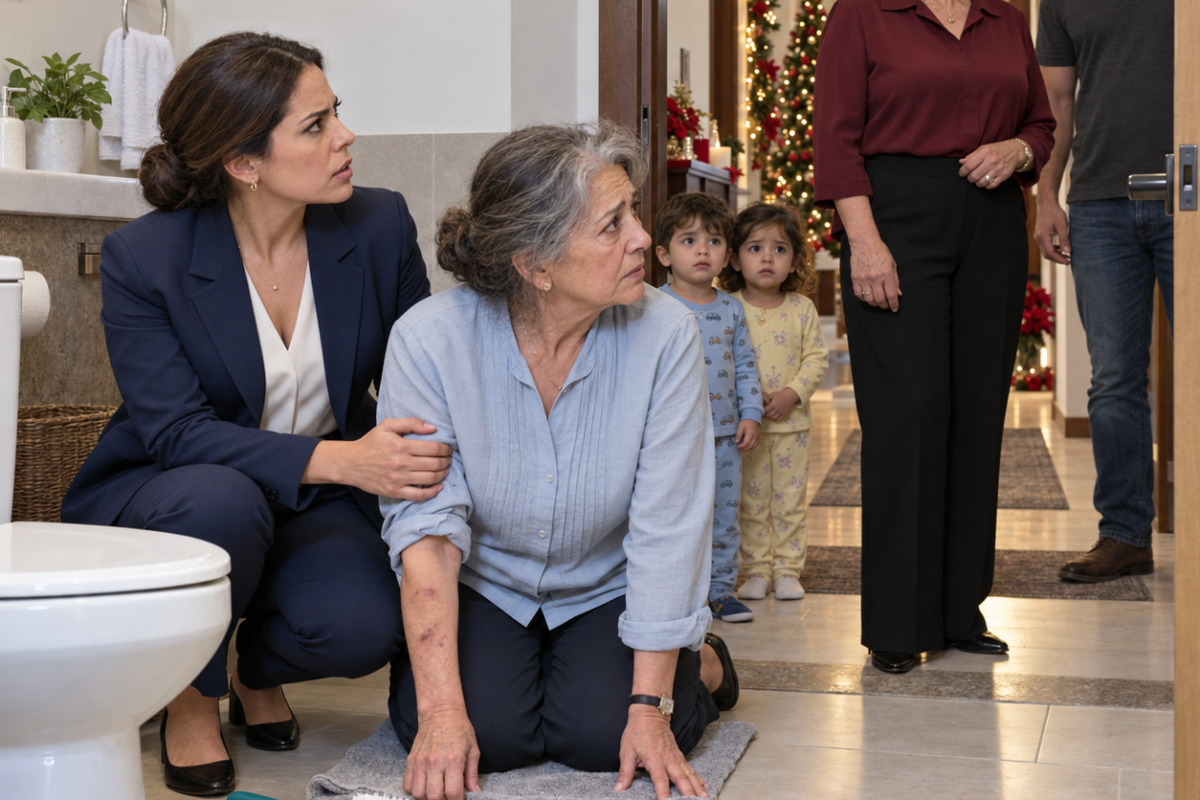
I came home three hours early and found my sixty-eight-year-old mother on her knees scrubbing my mother-in-law’s bathroom. When I helped her stand, her sleeve slipped back, revealing dark marks around her wrist. My husband stepped into the doorway. “Daniela, don’t make a scene.” That was when I remembered my father’s last warning: “If you ever see your mother hurt, don’t argue with anyone. Open the hidden compartment in her sewing machine.”
I came home three hours early and found my sixty-eight-year-old mother on her knees beside a toilet. Her hands were stiff with arthritis. One gripped…

“I already promised your house to your sister,” my father told me four days after I bought it. “They’re moving in Monday. Rent-free for three years.” I was thirty-one, had saved for nine years, and had bought the five-bedroom home entirely in my own name. When I said no, he threatened to tell the family I had abandoned my sister’s children. Days later, he took the microphone at my grandmother’s seventy-fifth birthday dinner and did exactly that.
My father called twelve times in forty minutes after discovering I had bought a house without consulting him. When I answered, he didn’t ask whether…
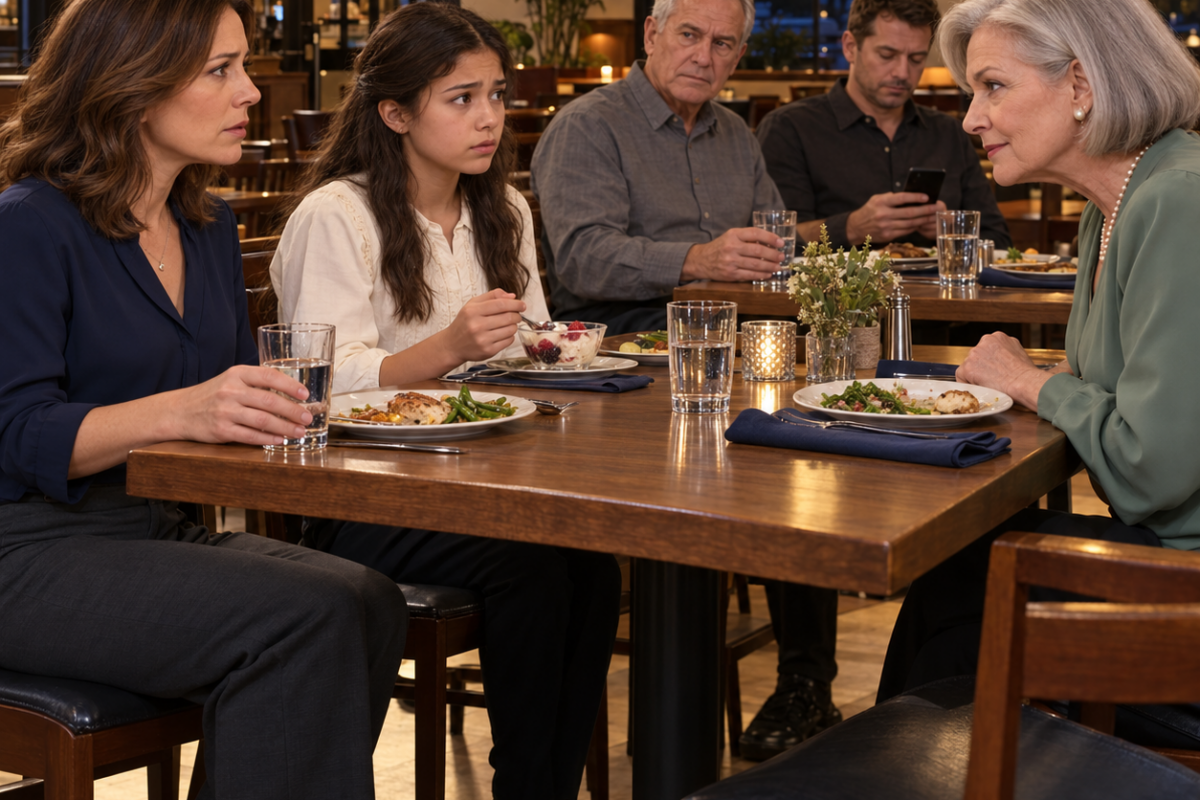
My mother leaned across the restaurant table, looked at my thirteen-year-old adopted daughter, and whispered, “We don’t sit with mistakes.” I took Sole’s hand and walked her out. That night, my father texted, “You’re still making the car payment tomorrow, right?” By midnight, I had canceled the payments I’d been making for my family. Then I remembered something Sole had told me about her grandmother.
My mother looked at my thirteen-year-old daughter and whispered, “We don’t sit with mistakes.” She said it softly enough to avoid attracting attention from the…

At my father’s seventieth birthday dinner, my eleven-year-old son and eight-year-old daughter were seated beside the service door with water glasses—but no dinner plates. Their cousins sat beside Grandpa with warm bread and full place settings. “They’ll eat after everyone else,” my sister said. I turned to my father, expecting him to object. “They can wait another hour,” he replied. There were two empty chairs at his table.
At my father’s seventieth birthday dinner, the first thing that stopped me wasn’t the cake or the gold balloons. It was my children. Ethan and…
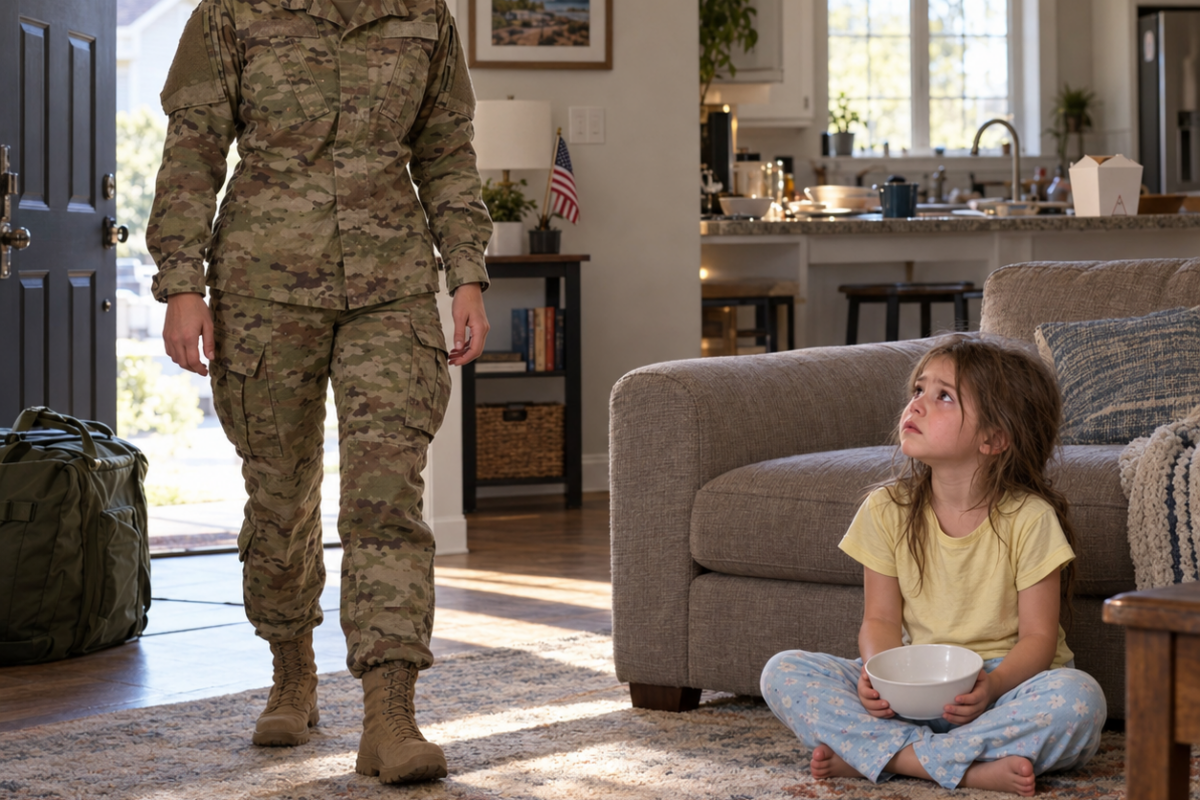
“Mommy, are you real?” my four-year-old daughter whispered when I came home from deployment three weeks early. She was sitting alone on our living room floor with an empty cereal bowl. My husband was on a Caribbean cruise with his mother and sister. Twenty-two minutes earlier, they had posted a photo captioned “Family time.” I was still in uniform when Sophie asked if she could have something to eat.
The first thing my daughter said when I found her was, “Mommy, are you real?” She was sitting cross-legged on our living room floor with…
End of content
No more pages to load