I brought roses and two first-class tickets to Paris to surprise my husband on Valentine’s Day. Instead, two hundred employees were applauding his engagement to the company’s CEO. “Claire, not here,” he whispered when he saw me. I left the flowers on the reception desk, walked out, and called the attorney who handled my eighty-three percent stake in that company.


The first thing I saw was my husband kissing another woman beneath a silver banner that read HAPPY ENGAGEMENT.
The second thing I saw was two hundred employees applauding as though I had never existed.
I stood just beyond the glass doors of Whitmore Dynamics with twelve red roses in one hand and two first-class tickets to Paris in the other. I had wrapped the tickets in a cream envelope and written a small note inside.
Ten years. Let’s remember what we love.
On the other side of the room, Daniel lifted a champagne glass.
“To new beginnings.”
Vanessa Cole, the company’s new chief executive officer, raised her left hand. The diamond on her finger caught the light beneath the chandeliers.
People cheered.
Then the woman nearest the reception desk noticed me.
Her smile disappeared.
Daniel followed her gaze.
For one long second, his face was empty.
Vanessa turned, saw the flowers, and laughed.
“Oh,” she said. “You came.”
I looked at my husband.
“You’re engaged?”
He moved toward me immediately, lowering his voice.
“Claire, not here.”
I looked past him at the banner.
“Interesting choice of words.”
Vanessa folded her arms.
“Daniel said your marriage was basically over.”
“Basically?”
He glanced at the people around us.
“We were going to talk tonight.”
I looked at the ring.
“Before or after Paris?”
His eyes dropped to the envelope in my hand.
The room went silent.
Vanessa’s smile sharpened.
“This is embarrassing.”
Something inside me became clear with a force that felt almost physical.
I had spent years treating confusion as a reason to keep listening to Daniel.
Now there was nothing confusing left.
I placed the roses on the reception desk.
“Congratulations.”
Daniel reached toward me.
“Claire, wait.”
I turned and walked out.
By the time I reached the parking garage, I had canceled the Paris trip.
By the time I started my car, I had contacted the bank to place the agreed restrictions on every joint personal account that required my authorization.
By the time I reached home, I had called Miriam Shaw.
And thirty minutes after I left that office, my phone showed 152 missed calls.
Then the doorbell rang.
My name is Claire Whitmore Bennett.
Daniel had spent years telling people he built Whitmore Dynamics from nothing.
That was his favorite lie.
My father founded the company when I was nine. For the first several years, his office consisted of two rooms, a conference table that wobbled, and a filing cabinet whose bottom drawer required patience and occasionally a kick.
His name was Arthur Whitmore.
He did not resemble the men Daniel admired in business magazines. He wore practical suits, repaired things he could easily have paid someone else to repair, and asked employees about their children without turning the question into a demonstration of leadership.
Whitmore Dynamics began as a small supplier of specialized systems for industrial clients. It grew slowly, then more quickly, then cautiously again after a period when several customers delayed orders at the same time.
My father never described that history as destiny.
He described it as work.
“People like stories about one brilliant decision,” he told me once. “Usually it’s a thousand ordinary decisions, and several you wish you could make again.”
He expected people to know what they were signing.
He expected invoices to be paid.
He expected bad news to arrive early enough that something could be done about it.
I grew up around those expectations.
I also grew up loving him enough that, after he died, anything connected to the company could make me feel responsible for preserving more than a business.
That was the opening Daniel eventually used.
When I married him, Whitmore Dynamics was already successful.
Daniel worked in commercial strategy. He was capable, ambitious, and unusually skilled at making a room believe the next opportunity was the one that would change everything.
I admired that.
I had studied business and worked outside the company before returning to help with long-term planning and community partnerships. I understood financial reports, governance, and the difference between a good presentation and an actual contract.
But I was less comfortable than Daniel with being visibly important.
He enjoyed a stage.
I preferred a discussion where people answered questions honestly and then did what they had agreed to do.
At first, those differences felt complementary.
He said I gave his ideas structure.
I said he made me less afraid of taking risks.
We believed we were helping each other grow.
For several years, we were.
Daniel could be thoughtful then.
He remembered small things. He brought soup when I was ill. When my mother died, he sat on the bedroom floor with me while I sorted photographs and did not try to improve my grief by making it sound temporary.
I loved him.
I will not rewrite every good memory as fraud because of what happened later.
He had been a husband I loved.
He also became a husband who learned that love made me willing to accept explanations I would have questioned from anyone else.
The shift was gradual.
His career became the subject that organized our days.
A dinner was interrupted because a client needed him.
A weekend was canceled because an opportunity could not wait.
A question became an indication that I did not understand pressure.
If I wanted him home, he said I was limiting him.
If I asked why a decision had not been discussed, he said I was treating him like an employee rather than a partner.
That sentence worked on me for years.
I did not want to be the wealthy wife who made her husband feel dependent.
I did not want him to believe the company would always belong to my father’s memory rather than the people building its future.
So I stepped back in ways I thought were generous.
I let Daniel lead meetings.
I declined some public appearances.
I allowed introductions that described me as involved with the family foundation while describing him as the force behind Whitmore Dynamics.
My father noticed.
He never openly disliked Daniel. He appreciated his abilities. He also knew confidence could become a substitute for accountability if people were too eager to preserve it.
One evening, after a company dinner, he asked whether I still received the reports I had previously reviewed.
“Yes.”
“Do you read them?”
“Of course.”
“All of them?”
I smiled.
“Dad.”
He looked at me calmly.
“Then don’t let anyone tell you questions are disloyal.”
I remembered that sentence much later than I should have.
My father died five years before the engagement celebration.
His estate plan was careful.
After the necessary administration, eighty-three percent of Whitmore Dynamics passed to me.
The remaining shares were held by a combination of employees, long-standing investors, and interests established through the company’s earlier arrangements.
Daniel did not own the controlling stake.
He knew that.
He had attended meetings where the ownership structure was explained. He had advisers. He had signed documents acknowledging the limits of his authority.
Nothing was hidden from him.
What he ignored was the distinction between being allowed to exercise authority and owning it permanently.
During my father’s final illness and the difficult period afterward, I authorized a defined, revocable arrangement under which certain voting and administrative functions could be exercised on my behalf.
It was intended to let the company operate while I handled family matters and grief.
It did not transfer my shares.
It did not erase my rights.
It did not make Daniel the owner because he became accustomed to speaking first.
There were clear limits.
There were circumstances requiring disclosure.
There were provisions allowing me to withdraw the authority.
Miriam helped prepare them.
She had represented our family in business and estate matters for years, but she was not someone who treated my surname as a reason to stop explaining.
She asked questions.
She expected answers.
She made sure I understood the documents before I signed.
When Daniel complained that the protections implied distrust, she said, “Protections are useful precisely when trust has been extended.”
He smiled politely.
Later, he called her difficult.
I should have paid closer attention to how often he used that word for women who did not make his wishes effortless.
Daniel became executive vice chairman and head of commercial expansion. He was influential, well compensated, and highly visible.
The board had independent members.
Jonathan Reed served as nonexecutive chairman.
The company had a general counsel, Audrey Lin, and experienced operating executives.
Daniel’s power was real.
It was also bounded.
He preferred the first fact and treated the second as administrative clutter.
Over time, he began saying he had built Whitmore Dynamics.
At first, the statement was casual.
A dinner conversation.
A speech about the future.
A line in an interview.
I corrected it privately.
He said I was taking it literally.
Then I corrected it in a meeting.
He said I had embarrassed him.
Eventually, I noticed I had begun preparing explanations for why I would not correct him.
Everyone knew what he meant.
It was only a phrase.
The company had changed so much since my father founded it.
Daniel had worked hard.
All those things could be true.
They did not make his statement true.
Vanessa Cole arrived at Whitmore Dynamics during the previous year.
She was sharp, confident, and experienced in presenting a compelling plan for expansion. Daniel advocated for her appointment as CEO after the previous chief executive retired.
I reviewed the proposal.
The board reviewed her background.
She gave a strong presentation.
There were questions, but no obvious reason to reject her.
I approved the appointment through the proper process.
That decision was mine, too.
I did not want to evade responsibility for it later by pretending I had been entirely absent.
Vanessa and Daniel began working together constantly.
Late meetings.
Travel.
Urgent discussions.
Daniel called it restructuring.
“Aggressively,” he added whenever I asked why another evening had disappeared.
I believed him for a while.
Then I began noticing contradictions.
A meeting that did not appear on the executive calendar.
A dinner described as a client event when the client’s assistant mentioned being out of town.
A message that arrived on a household tablet Daniel had once used and never properly disconnected.
I did not search every device in the house.
I did not yet want to know enough to make knowing unavoidable.
That is an uncomfortable truth.
I was not fooled only because Daniel was persuasive.
I was also tired, grieving, and afraid of what an honest answer would require.
Three weeks before Valentine’s Day, I asked whether he wanted to take a few days away together.
He said it sounded wonderful.
He touched my cheek.
“We need that.”
I believed him.
I booked the flights.
First class, because the trip was supposed to feel like a celebration rather than another itinerary squeezed between obligations.
A hotel in Paris with a small balcony.
Dinner reservations.
A few plans, leaving room to wander.
I bought the roses that morning.
Twelve, though there had been ten years of marriage.
The florist asked whether I wanted a message.
I said I had already written one.
I remember smiling.
That is the detail that still hurts.
Not the cost.
Not the tickets.
The sincere, unguarded smile I wore while preparing to surprise a man who was preparing to replace me in public.
Daniel left home before eight.
He kissed me goodbye and said he expected a demanding day.
I asked whether he would be home for dinner.
“Of course,” he said. “It’s Valentine’s Day.”
Then he looked at his watch.
“I may be a little late.”
I told him not to worry.
I had planned to visit the office in the afternoon, give him the flowers and tickets, and leave before I became an interruption.
I rarely arrived without calling.
That day, the surprise seemed harmless.
At reception, the young woman behind the desk recognized my name but did not seem to know what to do with me.
Her name was Elise.
I had met her briefly two months earlier.
“Mrs. Bennett?”
“Claire is fine.”
I lifted the roses.
“I’m surprising Daniel.”
Her face changed.
Not enough that I understood immediately.
Enough that I noticed.
“He’s in the atrium.”
“I know the way.”
She looked toward the glass doors.
Then she said, “Let me check—”
The cheering interrupted her.
I turned.
That was when I saw the banner.
The kiss.
The ring.
The two hundred people.
For a second, I thought the scene could not be what it appeared to be.
A promotional event.
A joke.
Some strange announcement I had not understood.
Then Daniel raised the champagne glass.
“To new beginnings.”
Vanessa’s hand remained lifted.
There was no innocent version.
Elise whispered, “I’m so sorry.”
I did not answer because I could not yet speak.
Daniel saw me.
Everything happened quickly after that, but my memory holds the details with painful clarity.
The champagne glass lowering.
The way Vanessa looked at the flowers before looking at my face.
Someone stepping away from the center of the room as though embarrassment could be avoided by changing position.
Daniel coming toward me.
“Claire, not here.”
Here.
In the building my father created.
At a celebration my husband and the CEO had apparently decided was appropriate for company employees.
In front of people who had been given a story about my marriage and had no reason to question it.
Vanessa said Daniel had told her the marriage was basically over.
I asked what basically meant.
He said we were going to talk that night.
Then I asked about Paris.
The tickets in my hand made the contradiction visible.
Daniel could no longer imply that I had arrived to disrupt an arrangement we both understood.
I had arrived with a gift.
He had arrived with a ring.
Vanessa called the scene embarrassing.
I looked at her.
I wanted to say something cruel.
Something that would make the room remember my answer more clearly than her laughter.
Instead, I placed the roses on the reception desk.
“Congratulations.”
Then I left.
In the elevator, I stood alone with the empty envelope against my palm.
My hands had been shaking.
They stopped.
Not because I felt calm.
Because there was suddenly a decision inside the pain.
I had no reason to protect Daniel’s version of events anymore.
The travel arrangements were refundable under the terms I had selected. I canceled the flights and the hotel before I reached the garage.
The confirmation emails arrived while I was sitting in my car.
Paris would have to exist without us.
Then I contacted the bank.
Daniel and I maintained several joint personal arrangements, some governed by an agreement requiring my approval for specified transfers and access to certain funds.
The bank could place the restrictions available under those arrangements.
It could not erase every legal right Daniel had because I was angry.
I did not ask it to.
I asked for the agreed protections to be applied, unauthorized movement prevented where possible, and the records preserved.
Other account issues would be addressed through counsel and any required legal process.
I did not touch payroll.
I did not stop company vendor payments.
My marriage and the company were connected through Daniel.
That did not make every person working there responsible for what he had done.
Then I called Miriam.
She answered on the second ring.
“What happened?”
I told her.
Not elegantly.
Not with the composure I had maintained in the atrium.
I told her about the banner, the ring, Vanessa’s laughter, and Daniel’s claim that we were going to talk tonight.
Miriam was silent for several seconds.
Then she said, “Are you alone?”
“Yes.”
“Are you driving?”
“No.”
“Good. Stay parked for a moment.”
I stared through the windshield.
“I need the marital protection agreement activated.”
“Which protections are you instructing us to pursue?”
That question steadied me.
The agreement was not a switch that could turn anger into unlimited authority.
It defined measures concerning separate property, disclosures, financial access, and representation that could be taken when circumstances changed.
I needed to be clear.
“My personal assets. The account protections. The authority I delegated over my shares.”
Miriam’s voice became more formal.
“You want the voting authorization revoked.”
“Yes.”
“Immediately?”
“Yes.”
“And separate family counsel for the marital issues.”
“Yes.”
She paused.
“Claire, this will create a governance event. The company will need to respond.”
“I understand.”
“We will not make decisions solely because your husband has had an affair.”
“I know.”
“But the public engagement of two senior officers while one remains married, the apparent use of company resources, and any related nondisclosures are matters the board can review. Your ownership authority is separate and real.”
I closed my eyes.
“Then use it correctly.”
“We will.”
When I later told people I withdrew my eighty-three-percent share, that was the phrase I used in anger.
What I withdrew was Daniel’s ability to exercise authority over it.
I did not pull $558 million out of a bank account.
That was the recent estimated value of my stake, based on an independent valuation. It was equity, with obligations, limitations, and a business beneath it.
I did not liquidate it in half an hour.
I retained it.
And I revoked the permissions Daniel had been treating as ownership.
That distinction was the reason the company could be protected instead of destroyed.
Miriam contacted the necessary people.
Audrey.
Jonathan.
The advisers holding the original documents.
The administrators responsible for the authorizations.
A record was created.
Notices were transmitted.
The board was asked to convene urgently.
Daniel had believed my distance from daily operations meant the authority could never return.
It returned while he was still standing beneath an engagement banner.
My phone began ringing before I reached home.
Daniel.
Then Vanessa.
Then Daniel again.
An executive assistant.
An unfamiliar number.
A board member.
A banking contact responding to the restrictions.
Several calls were legitimate and would be returned through the appropriate people.
Others were frantic attempts to reach me before someone else did.
I answered none while driving.
When I parked in my driveway, the screen showed an absurd number.
152 missed calls in the half hour since I left.
Some came from repeated attempts.
Some from numbers belonging to assistants calling on behalf of people who no longer knew which instructions would be valid.
A few came from concerned colleagues who had witnessed the event.
The number did not make me powerful.
It made me tired.
I put the phone on silent, kept the necessary contacts available, and walked inside.
The house looked unchanged.
A pair of Daniel’s shoes near the stairs.
The bowl where he dropped keys.
A magazine on the sofa.
This morning, those details had belonged to my marriage.
Now they belonged to a place where I needed to make decisions.
I went into the kitchen.
I poured water.
I drank half of it.
Then the doorbell rang.
I looked at the camera.
Daniel stood on the porch.
Vanessa stood beside him.
For a moment, I could not believe he had brought her.
Then I understood that neither of them yet comprehended how completely the rules had changed.
I did not open the door immediately.
I called Miriam.
“They’re here.”
“Who?”
“Both of them.”
Her voice sharpened.
“You do not need to have that conversation. I’m on my way. If you feel threatened, contact the appropriate assistance immediately.”
“They’re not threatening me. They’re ringing the bell.”
“Then tell them I will be there shortly and keep the door closed.”
I did.
Daniel called.
This time I answered.
“Open the door.”
“No.”
“Claire.”
“Miriam is coming.”
“We don’t need lawyers.”
“You celebrated an engagement at our company while married to me. We need several things. Lawyers are among them.”
Vanessa moved closer to the door.
“Claire, we should talk like adults.”
I looked at the screen.
“We are. I am telling you that you do not have permission to enter my home.”
Daniel said, “It’s my home, too.”
The ownership and occupancy questions concerning the marital residence would need proper treatment.
I did not pretend a painful afternoon erased his rights.
But I did not have to admit Vanessa.
And I did not have to hold a private negotiation while overwhelmed.
“Miriam will discuss the immediate arrangements,” I said.
He stepped away and made another call.
They remained outside.
I stood in the hallway, looking at the reflection in the mirror.
I looked exactly like the woman who left that morning with flowers.
That seemed impossible.
Miriam arrived twenty minutes later.
She had called a colleague experienced in family-law matters, and she had already coordinated with the corporate advisers.
She did not walk up the driveway carrying vengeance.
She carried a briefcase and the expression of someone arriving for work.
Daniel approached her before she reached the porch.
“This is out of control.”
Miriam looked at him.
“Then you should stop attempting to control it through repeated calls.”
He glanced toward Vanessa.
“She misunderstood.”
“The engagement?”
“The situation.”
Miriam did not debate the marriage on the driveway.
She told Vanessa the personal discussion was between the spouses and their advisers.
Vanessa looked offended.
“I’m the CEO.”
“Then you should be responding to general counsel’s request and the board’s instructions.”
Vanessa’s expression changed.
“What instructions?”
Miriam held her gaze.
“Check your email.”
I watched from inside.
For the first time since the atrium, Vanessa looked less certain that a title would settle the room.
Miriam came in.
I let Daniel enter only after the immediate conditions were clear and Vanessa had returned to their vehicle.
We sat in the dining room.
The same room where Daniel and I had celebrated anniversaries.
No champagne.
No roses.
No ring held up for applause.
Miriam sat beside me.
Daniel remained standing for several seconds.
Then he took the chair opposite.
“What did you do?” he asked.
I looked at him.
“I canceled Paris. I applied the available protections to our personal financial arrangements. I revoked your authority over my shares.”
“You can’t just withdraw the company’s money.”
“I didn’t.”
“You’ve created panic.”
“You created a public engagement while concealing that your wife believed she was taking you to Paris.”
He looked away.
“This is why I wanted to talk privately.”
“You wanted to talk privately after making an announcement in front of two hundred people.”
His jaw tightened.
Miriam spoke.
“The corporate notices are specific. The company is not being stripped of operating funds. Your delegated authority has ended. The board is reviewing management issues.”
Daniel stared at her.
“She doesn’t understand what that will do.”
I had heard him speak about me in that way before.
To advisers.
To friends.
To employees.
As though understanding lived somewhere I could only visit under his supervision.
I leaned forward.
“I understand what I signed. I understand what I own. And I understand what you did.”
He looked at me.
For a moment, I saw genuine surprise.
Not guilt.
Surprise that the woman he had placed outside the difficult conversations had retained the ability to participate in them.
“Vanessa and I made a mistake in how we handled the announcement,” he said.
I sat back.
Not a mistake in the relationship.
Not a lie.
A mistake in handling.
The phrasing told me what kind of conversation he wanted.
One in which the central problem was my reaction to the presentation.
“What did you tell her about me?” I asked.
He hesitated.
“That we had grown apart.”
“That our marriage was over?”
“That we were discussing changes.”
“We weren’t.”
He looked toward Miriam.
“This is personal.”
“Yes,” I said. “It is.”
He rubbed his forehead.
“I didn’t know how to tell you.”
“So you told two hundred employees first.”
He said nothing.
For several minutes, the only sound was the faint movement of air through the house.
Then Miriam asked practical questions.
Did he intend to stay elsewhere that evening?
Would he agree not to move assets beyond ordinary expenses until counsel reviewed the arrangements?
Would he communicate through the appropriate channels concerning the company?
He resisted at first.
Then he agreed to certain immediate steps in writing, with his own attorney to review the broader matters.
Nothing about that evening resolved the divorce.
It created enough order that I could sleep without wondering what would happen before morning.
As he stood to leave, Daniel looked at me.
“We’ve been together ten years.”
“Yes.”
“You can’t decide everything in one afternoon.”
“I’m not deciding everything. I’m deciding I will not spend tonight pretending this did not happen.”
He swallowed.
“Do you still love me?”
The question hurt because it had once mattered so much.
“Yes,” I said honestly. “That is part of why this hurts.”
Hope moved across his face.
Then I added, “It is not a reason to give you back control.”
He left.
Vanessa was waiting in the car.
I watched them drive away.
Then I turned to Miriam and finally began crying.
She did not tell me to be strong.
She moved a box of tissues closer and waited.
Later, she made me eat toast.
It was nearly midnight.
I had not eaten since breakfast.
The simplest tasks had become difficult because my mind kept returning to the same image.
His hand at Vanessa’s waist.
Her ring.
The employees cheering.
The roses in mine.
Miriam stayed until I had made arrangements for the following day and a friend was on her way.
My friend’s name was Grace.
She had known me since college.
When she arrived, she put a bag on the counter and hugged me.
“I brought pajamas,” she said.
“For me?”
“For me. I’m staying.”
I laughed through tears.
She did not ask permission to take over my life.
She asked where I wanted her things.
I showed her the guest room.
That distinction mattered more than I could explain.
The next morning, I woke before dawn.
For several seconds, I forgot.
Then I remembered everything at once.
I lay still.
I could have spent the day replaying the scene.
Instead, I got up and showered.
Not because I felt composed.
Because I needed one ordinary action I could complete.
Grace made coffee.
We sat at the kitchen table.
“What do you need today?” she asked.
“I don’t know.”
“That’s acceptable.”
I looked at her.
“I keep thinking about the note in the tickets.”
She waited.
“I wrote that we should remember what we love.”
Grace closed her eyes briefly.
Then she said, “You meant it.”
“Yes.”
“That is not something to be ashamed of.”
I began crying again.
The public humiliation had made tenderness feel foolish.
I needed someone to remind me the shame belonged elsewhere.
By nine, the company had become a different problem.
The board convened.
Audrey reviewed the immediate governance implications of the revoked authorization.
Jonathan directed the meeting.
Daniel and Vanessa were informed of the questions concerning their conduct and potential conflicts.
There would be a review.
They would have an opportunity to respond.
The company would preserve relevant records.
Neither of them could use executive authority to direct employees concerning the review.
Temporary measures were adopted through the board’s proper process.
Vanessa was placed on administrative leave.
Daniel’s management responsibilities were suspended pending review.
Rachel Hsu, the chief operating officer, became interim chief executive.
I was not appointed CEO.
I did not want to be.
Ownership did not make me the best person to manage every operational question.
It made me responsible for ensuring appropriate people could do their jobs without my husband treating the company as an extension of his private life.
Miriam kept my role separate from the board’s independent decisions.
Audrey was careful about conflicts.
That care was not bureaucracy getting in the way of justice.
It was how the result would remain defensible after the anger passed.
The company issued a restrained internal statement.
Leadership changes.
An independent review.
Operations continuing.
Further information through established channels.
No public account of the kiss.
No speech calling Vanessa a homewrecker.
No demand that employees prove loyalty to me.
Two hundred people had applauded because a company event had told them what they were witnessing.
Some knew Daniel was married.
Some had been told the marriage had ended.
Some were new and had no idea who I was.
Others had sensed something wrong and remained quiet because a room full of executives can make an employee feel there is no safe response.
I was hurt by the applause.
I did not intend to make workers pay for my hurt.
Elise wrote to me that afternoon.
She apologized for not stopping me at reception.
I read the message twice.
Then I replied.
“You did nothing wrong. You were not responsible for managing information senior executives chose to conceal.”
She sent a brief thank-you.
A few days later, Audrey told me Elise had provided a useful factual account of what she had been instructed to say about the event.
I did not contact her for details.
She needed the company’s process, not personal gratitude that could feel like pressure.
The first significant finding was not financial theft.
It was a chain of misrepresentations.
Daniel had told selected colleagues that our marriage had ended privately.
Vanessa had repeated that claim.
Communications staff had been asked to keep references to me out of certain company materials, supposedly because I preferred not to be associated publicly with the business.
Some of that had once been partly true.
I had declined publicity after my father died.
Daniel had stretched a preference for privacy into a story that my role was insignificant and my marriage was over.
The engagement event had been described internally as a personal celebration supported by leadership.
Invoices showed company resources had been used.
Not an amount that could destroy Whitmore Dynamics.
An amount that still required explanation and authorization.
The ring raised other questions.
Its purchase was not automatically a company expense merely because Daniel wore it into the building.
But the review examined how it had been funded and whether any related reimbursements were improper.
I did not assume every luxury item was evidence.
I waited for records.
That was difficult.
Anger can make uncertainty feel unbearable.
I wanted to know.
I also wanted the conclusions to be correct.
Several days after the event, Miriam arranged a meeting with a former finance executive, Thomas Reed.
He had left Whitmore Dynamics earlier than planned, citing a difference in management approach.
At the time, Daniel said Thomas had been resistant to change.
I accepted that explanation too easily.
Now Thomas sat across from me in Miriam’s office with a folder.
“I should have contacted you directly,” he said.
“Why didn’t you?”
He looked uncomfortable.
“I was told you wanted everything handled through Daniel.”
“That was not accurate.”
“I know that now.”
We reviewed the questions he had raised before leaving.
Executive expenses.
Approval exceptions.
Consulting arrangements.
Information presented to the board in summaries that obscured rather than clarified.
Thomas had not uncovered a secret catastrophe.
He had identified a pattern of increasing resistance to scrutiny.
The pattern mattered.
A business can tolerate mistakes.
It has a harder time tolerating a culture where questions become disloyalty.
I listened.
Then I said, “I should have read the concerns more closely.”
He shook his head.
“You weren’t given the full concerns.”
“I still should have insisted on fuller information.”
Miriam looked at me.
“That can be true without making you responsible for their conduct.”
I nodded.
I was learning to hold both facts.
They had misled me.
I had become too willing to let distance protect me from difficult truths.
I could correct my part without accepting theirs.
My personal legal matters moved separately.
Miriam coordinated with independent family counsel, Rebecca Sloan.
Rebecca did not promise that infidelity would erase every financial right Daniel held.
She reviewed the marital agreement, separate-property history, shared assets, and the practical questions about the residence.
My inherited shares remained mine under the established arrangements.
Other matters required disclosure and negotiation.
The protection agreement gave us defined options.
It did not turn hurt into a universal entitlement.
I appreciated her clarity.
I had no desire to receive a comforting version of law that would later become another betrayal.
Rebecca asked whether I wanted to remain in the marital house.
I said I did not know.
Every room contained a memory.
Some were good.
Some now felt altered.
“You don’t need to decide permanently,” she said.
So I arranged temporary accommodation elsewhere for a short period while the immediate occupancy questions were handled.
I took clothes, personal documents, and things I knew I would need.
I did not destroy photographs.
I did not throw Daniel’s possessions outside.
I did not invite reporters to watch him collect a jacket.
We handled property through documented arrangements.
It was less satisfying than the dramatic scenes people imagined.
It was also less damaging.
The first time I sat alone in the temporary apartment, I expected relief.
Instead, I felt empty.
The rooms were pleasant.
The furniture was comfortable.
The refrigerator contained food Grace had helped choose.
Still, I could not stop thinking that a marriage had occupied so much of my mind I did not know what to put in the space after it.
I had work.
Friends.
Resources.
Choices.
None of those things answered the question of whom I had believed I was beside Daniel.
I began seeing a therapist named Dr. Elaine Porter.
At the first appointment, I explained the ownership structure for nearly twenty minutes.
She listened.
Then she asked, “What was the moment that hurt most?”
I stopped.
“The laughter.”
“Vanessa’s?”
“Yes.”
I looked down.
“She laughed because she thought I was a problem arriving late.”
Dr. Porter waited.
“And I had flowers.”
I began crying.
The detail I had tried to keep small was the center of the grief.
I had arrived loving him.
He had arranged a room where that love could be treated as embarrassing.
We talked about shame.
About how public betrayal can make a person question the dignity of their own tenderness.
About the difference between having trusted someone and having been foolish.
I did not leave the office healed.
I left with a question that helped.
Would I judge a friend as harshly for arriving with flowers?
No.
Then perhaps I could stop judging myself.
Daniel’s messages changed during the first month.
At first, he demanded access and explanations.
Then he asked to talk.
Then he said we should protect the company from private drama.
I wondered why private drama had seemed less concerning beneath the engagement banner.
He blamed Vanessa for pushing the timing.
He blamed pressure at work.
He blamed our emotional distance.
He blamed my grief after my father’s death.
That last explanation hurt because it took something vulnerable and used it as an argument against me.
I forwarded relevant messages to counsel.
I did not answer each one.
Some nights, I wanted to.
I wanted to write enough words that he would finally understand.
Grace helped me resist.
“He understands you were hurt,” she said. “He’s arguing about what that should allow you to do.”
I sat with that.
For years, I had mistaken his refusal to accept my experience for failure to hear it.
Perhaps he had heard more than I thought.
Perhaps he simply preferred the version that kept him comfortable.
Vanessa requested a private conversation through her attorney.
I declined.
Any information relevant to the company could go to Audrey and the review team.
Any information relevant to my marriage could go through counsel.
I did not need to sit across from the woman who laughed and hear whether she now believed Daniel had lied.
He had lied to me.
That was enough for my decision.
I did not need to establish which of us had been deceived more.
The corporate review continued.
Independent advisers examined executive expenditures, disclosures, conflicts, and the decisions made around Vanessa’s appointment and Daniel’s authority.
Some expenses were legitimate.
Some were not properly authorized.
Some descriptions were misleading.
Certain consulting arrangements required deeper examination.
The findings were serious enough to support changes, but they were not the fictional version of events people began circulating online.
No one had emptied the company of $558 million.
I had not pulled out money and left employees unpaid.
I had not ordered every department shut down.
The value referred to my ownership stake.
The authority change had triggered governance protections.
Those facts were less exciting than the rumors.
They mattered to the people working there.
At an employee meeting, Rachel explained continuity.
Orders would be fulfilled.
Payroll would continue.
Clients would receive accurate communication.
The review would not turn ordinary workers into suspects merely because their names appeared in a process.
I attended briefly.
Not to make a speech about betrayal.
To confirm the ownership support for stable operations and appropriate review.
A man near the back asked whether the majority shareholder planned to sell.
It was a reasonable question.
I said no immediate sale decision had been made.
The company’s future would be reviewed carefully, with qualified advisers and consideration of the people and obligations involved.
I did not promise never to change anything.
I did not give vague reassurance because it sounded compassionate.
I gave the answer I could support.
Afterward, a woman from customer service approached.
“I’m sorry about what happened.”
“Thank you.”
“We didn’t know.”
I looked at her.
“You don’t need to explain.”
Her relief was visible.
I understood then how many employees had been carrying embarrassment that belonged to executives.
That was another cost of Daniel’s performance.
He had made other people witnesses without giving them truthful information.
Jonathan and Audrey made sure the board’s decisions were based on documented concerns and appropriate procedures.
Daniel’s executive responsibilities were eventually terminated.
Vanessa’s appointment ended as well.
They received the notices, contractual treatment, and opportunity to raise objections they were entitled to receive.
Their personal relationship was not itself the only issue.
The nondisclosures, conflicts, use of resources, misrepresentations, and failures in executive judgment had created a broader problem.
Rachel remained interim CEO while the board considered the long-term appointment.
I did not fill the empty roles with friends who would flatter me.
I wanted the company to recover from a culture of personality.
That required more than changing the people whose photographs hung in reception.
I resumed a more active ownership role.
Not daily management.
Oversight.
Reading.
Questions.
Meetings I attended because I had prepared, not because someone had decided I should appear for a photograph.
At first, I felt embarrassed by what I had missed.
Then I realized embarrassment could either make me retreat again or make me better.
I chose better.
I asked for full reports.
I listened to uncomfortable answers.
I distinguished concern from obstruction.
I learned where my understanding needed updating.
The eighty-three percent had not made me infallible.
It made the consequences of my passivity larger.
That was a responsibility I could no longer delegate casually.
Two months after Valentine’s Day, Daniel and I met in Rebecca’s office.
He wanted to discuss the marriage.
I agreed because I wanted certain questions answered directly, with clear boundaries.
He looked tired.
The confidence he had carried through rooms for years had become more careful.
For a while, he spoke about the good years.
The trips.
The dinners.
The time my mother died.
I remembered all of it.
I also knew memory could be used as a rope pulling me back toward a decision already made.
Then he said, “I never meant for you to find out that way.”
I looked at him.
“How did you mean for me to find out?”
He hesitated.
“I don’t know.”
“Then what did you expect when you put up the banner?”
He rubbed his forehead.
“Vanessa wanted the announcement.”
“You bought the ring.”
“Yes.”
“You kissed her.”
“Yes.”
“You toasted new beginnings.”
He looked down.
“Yes.”
I let the facts remain between us.
For once, I did not help him arrange them into something less painful.
He said he had been unhappy.
I said unhappiness could have been discussed.
He said I had become distant.
I said distance could have been addressed honestly.
He said he was afraid of hurting me.
I looked at him for a long time.
“You were afraid of having a conversation that might make you uncomfortable.”
He did not answer.
Then I asked why he had let Vanessa believe the marriage was over.
He said he had described it as over emotionally.
“What does that mean?”
“That we weren’t close anymore.”
“Did you tell me?”
“We both knew.”
“No. I booked Paris.”
That sentence ended the explanation.
He stared at the table.
I had not planned it as a weapon.
It was simply the clearest fact in the room.
One person had purchased tickets for an anniversary trip.
The other had purchased an engagement ring.
Whatever else he said, those decisions had not been made inside a shared understanding.
Near the end of the meeting, he asked whether I could forgive him.
“I don’t know what forgiveness will mean for me,” I said.
“Could we try?”
“To stay married?”
“Yes.”
“No.”
He looked as though the word had struck him.
I felt sad.
I did not feel uncertain.
The answer had taken months to become clear, though it began in an atrium with flowers.
It did not need to become cruel to be final.
Daniel and Vanessa separated before the divorce concluded.
I learned it through counsel because it affected some practical matters.
I did not ask for details.
Part of me was curious.
Part of me wanted to know whether he had finally experienced the instability he created.
I let those feelings exist without feeding them.
Their separation did not repair my marriage.
It did not make my decision unnecessary.
I was not leaving because Vanessa had won.
I was leaving because I no longer wanted a partnership where honesty arrived only after consequences.
That distinction protected me from the temptation to mistake his return for restoration.
The divorce took time.
There were valuations, disclosures, negotiations, and ordinary disagreements that felt extraordinary because every document carried ten years beneath it.
The inherited shares remained separate under the established arrangements.
Other property was divided through the process.
Some financial issues were resolved by agreement.
Others required additional review.
The marital protection agreement helped clarify the options.
It did not remove the need for careful work.
I did not receive a court document declaring I had been the better person.
That was not what the process was for.
It established rights, obligations, and the practical ending of a marriage.
The emotional ending required something else.
Time.
Friends.
Therapy.
Work that did not exist only to respond to Daniel.
I began making choices small enough that nobody could mistake them for revenge.
I took a cooking class because I wanted to learn something without a business application.
I walked in the mornings.
I bought a coat Daniel would have called impractical.
I stopped explaining why I liked it.
I visited a museum alone and stayed in one room for nearly an hour because no one was waiting impatiently near the exit.
Those ordinary freedoms helped me understand how much energy I had spent anticipating someone else’s reaction.
Grace noticed.
“You answer more quickly now,” she said one evening.
“About what?”
“What you want.”
I thought about it.
She was right.
I no longer began every preference by imagining how it might inconvenience Daniel.
At Whitmore Dynamics, the recovery was gradual.
Some clients were uneasy.
Some staff had been hurt by the uncertainty.
Some management practices needed more repair than anyone wanted to admit.
Rachel proved steady.
The board eventually appointed her permanently after a proper process.
She did not have Vanessa’s appetite for spectacle.
She had a talent for asking the question everyone else was stepping around.
I liked that.
More importantly, the company functioned under it.
We strengthened reporting.
Reviewed conflicts.
Clarified authority.
Made it easier for concerns to reach the appropriate people without first passing through the person being questioned.
The business did not become perfect.
No business does.
But the appearance of confidence stopped being treated as a reason to ignore uncertainty.
At the next annual meeting, my father’s role in the company’s history was described accurately.
So was the work done by people after him.
Daniel’s genuine contributions were not erased.
They were placed in context.
History did not need a replacement myth.
It needed the truth.
I attended in a blue suit.
Jonathan opened the meeting.
Rachel presented the operational report.
Audrey addressed governance.
I asked questions.
Nobody laughed.
Nobody told me it was embarrassing that I had arrived.
The meeting was, in the best possible way, ordinary.
Afterward, Thomas Reed spoke with me.
He had agreed to provide consulting support during the transition without returning to the exact role he left.
“I think your father would approve of the questions,” he said.
I smiled.
“He would ask more.”
Thomas laughed.
“Yes. He would.”
That evening, I took out an old photograph of my father standing beside the first Whitmore Dynamics sign.
The lettering was uneven.
The building looked tired.
He looked proud.
I had spent years trying to preserve his legacy by not appearing too controlling.
Now I understood that stewardship required attention.
It was not disloyal to Daniel to ask whether an invoice made sense.
It was not unkind to Vanessa to require a disclosure.
It was not unfeminine to own the authority that already belonged to me.
My father had not left me eighty-three percent so I could spend the rest of my life pretending it was impolite to notice.
The divorce was finalized more than a year after Valentine’s Day.
Rebecca called in the late morning.
“It’s entered.”
I sat at the table in the temporary apartment.
For several seconds, I felt nothing.
Then I felt relief.
Then sadness.
Then a strange quiet that seemed almost too large.
I did not celebrate with champagne.
Grace came over.
We ordered lunch.
We talked about ordinary things until I wanted to talk about the marriage.
Then she listened.
“I keep thinking there should be a moment when I feel completely different,” I said.
“Maybe there isn’t.”
“Maybe.”
“You’re already different in the ways that matter.”
I looked at her.
I hoped that was true.
The marital house was sold after the necessary arrangements were completed.
I did not want to remain there permanently.
Too much of the space had been organized around a life that no longer existed.
I bought another home.
Not as large.
Not designed for entertaining people Daniel wanted to impress.
It had good light, a garden, and a room where I could work without hearing the echo of old arguments.
I chose the furniture.
I chose the art.
I put my father’s photograph on a shelf.
I put one photograph from my marriage in a box rather than destroying it.
The good years had happened.
I did not need them on the wall.
I did not need to deny them either.
The first night, I ate dinner on a small table near the window.
No one asked whether the room looked finished.
No one wanted to know which guests we should invite first.
I looked outside and felt something I had not expected.
Not triumph.
Belonging.
Valentine’s Day returned.
For weeks beforehand, I dreaded it.
The date appeared in advertisements, menus, and flower displays.
I could smell roses and feel the atrium come back.
Dr. Porter helped me plan the day without treating it as a test of whether I had recovered enough.
I did not need to reclaim the holiday publicly.
I did not need to avoid it completely.
I could make choices that fit the person I was now.
I went to work in the morning.
I left early.
Grace and I had dinner with two friends.
Nobody ordered champagne.
Nobody made a speech about new beginnings.
We laughed about a terrible restaurant experience one of them had recently survived.
I went home tired and content.
The date had passed.
That mattered.
A few weeks later, I booked Paris again.
One first-class ticket.
Not because I needed to prove I could travel alone.
Because I had wanted to go before Daniel turned the idea into a wound.
The hotel was different.
The plans were different.
I left space.
Miriam smiled when I told her.
“Good.”
“Are you going to ask whether I’m sure?”
“No.”
I laughed.
She looked at me.
“You’ve become much better at knowing.”
Paris was not a transformation.
I arrived tired.
I got lost.
I ordered something I did not enjoy and pretended for five minutes that I did because old habits traveled with me.
Then I stopped.
I asked for something else.
I walked.
Sat in cafés.
Visited museums.
Bought a book I could only partly read because I liked the illustrations.
One afternoon, I stood on a bridge and thought about the note I had placed in the tickets the previous year.
Let’s remember what we love.
I had written it for Daniel.
Now I could ask the question for myself.
What did I love?
My father’s memory.
My friends.
Work done carefully.
Quiet mornings.
Rooms where people told the truth.
The possibility of a life whose value did not depend on being chosen by someone who had already chosen deception.
I returned home with photographs.
Not one contained Daniel.
That did not make the trip empty.
It made it mine.
Occasionally, people still asked about the 152 calls.
They wanted to know whether I enjoyed watching powerful people panic.
The honest answer was complicated.
A small part of me had felt vindicated.
A much larger part had been overwhelmed.
Calls were not proof of love.
They were proof that a system built around my compliance had encountered an unexpected refusal.
The company had needed order.
My marriage had needed honesty.
My life had needed room.
The calls did not provide those things.
Decisions did.
I also corrected people who said I withdrew $558 million and destroyed the company.
I had not.
The estimated value belonged to my eighty-three-percent interest.
I withdrew delegated authority.
I retained ownership.
The company continued.
Employees kept working.
Clients received service.
The board did its job.
Those distinctions were less dramatic than the story people preferred.
They were the reason the ending was something I could live with.
The last time Daniel and I spoke privately, it was after a meeting concerning a remaining financial matter.
He looked older.
So did I.
Not ruined.
Changed.
He said, “I never thought you would leave.”
I considered him.
“That was part of the problem.”
He nodded.
For once, he did not argue.
Then he said he was sorry.
I believed he felt regret.
I did not know whether he understood every part of the harm.
I no longer needed to determine that before moving on.
“Thank you for saying it,” I replied.
We parted.
I walked toward my car.
I did not look back because there was nothing left to watch.
At home, a small package waited on the porch.
A book Grace had recommended.
Inside, she had written, “For your next trip.”
I smiled.
I carried it inside.
The house smelled faintly of the bread I had baked that morning.
The kitchen was untidy.
A coat hung over a chair.
My laptop waited with a report I needed to review.
There was work to do.
There were ordinary things to enjoy.
I had once believed the worst part of betrayal would be losing the man.
The deeper wound was discovering how long I had allowed his version of me to shape what I thought possible.
The healing was not only separation.
It was learning to answer for myself again.
Yes, I understood the documents.
Yes, I owned the shares.
Yes, I could ask questions.
No, I would not give back authority to preserve his comfort.
No, I would not turn employees into casualties of my pain.
No, I would not spend the rest of my life explaining why arriving with flowers had not made me foolish.
I had loved sincerely.
He had lied.
Those facts could stand without apology from me.
One afternoon, Miriam came to my new house with papers requiring signatures.
We sat at the kitchen table.
She explained the updates.
I read them.
Asked two questions.
Signed.
Then I made tea.
There was no emergency.
No banner.
No camera.
No husband waiting for me to misunderstand what belonged to me.
Miriam looked around the room.
“This feels like you.”
I smiled.
“I’m starting to think so.”
After she left, I opened the book Grace had sent.
A folded travel itinerary lay beside it.
Another place I wanted to see.
Another decision I could make.
Outside, the light shifted across the garden.
I thought of the woman who stood at reception holding twelve red roses.
I wished I could tell her she would survive the humiliation.
That she would still have tenderness afterward.
That she would not need to become cruel to become clear.
That the company would remain standing.
That the marriage would end.
That her life would continue in rooms where she did not have to ask permission to belong.
But I could not reach back.
I could only live forward.
So I put down the book, stepped into the garden, and began making plans.
News
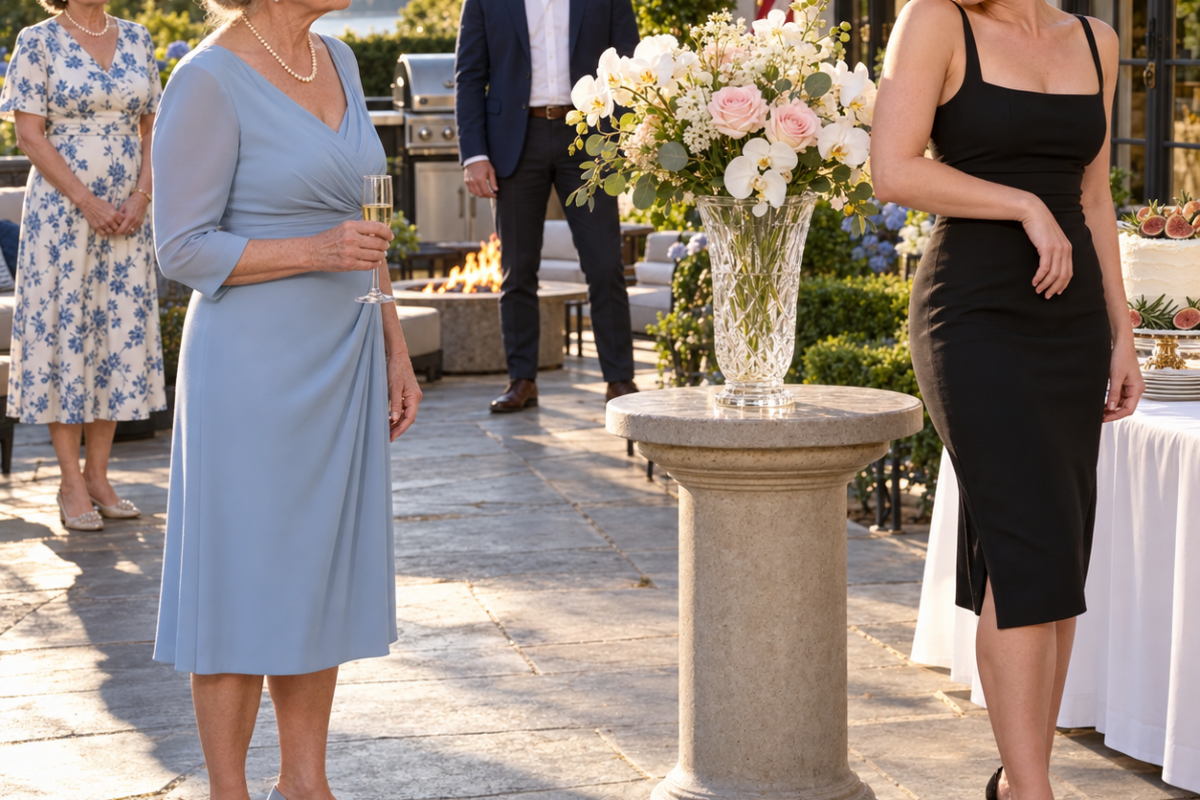
At my seventy-second birthday party, my daughter-in-law knocked a crystal vase off its pedestal with her elbow, watched it shatter, and smiled. “Oops.” Her own parents had given it to her and my son on their wedding day six years earlier. I looked at Frank, waiting for him to say something. All he managed was, “Mom…”
I watched my daughter-in-law break her own parents’ wedding gift with one elbow and a smile. For months afterward, people asked me whether I was…

I came home three hours early and found my sixty-eight-year-old mother on her knees scrubbing my mother-in-law’s bathroom. When I helped her stand, her sleeve slipped back, revealing dark marks around her wrist. My husband stepped into the doorway. “Daniela, don’t make a scene.” That was when I remembered my father’s last warning: “If you ever see your mother hurt, don’t argue with anyone. Open the hidden compartment in her sewing machine.”
I came home three hours early and found my sixty-eight-year-old mother on her knees beside a toilet. Her hands were stiff with arthritis. One gripped…
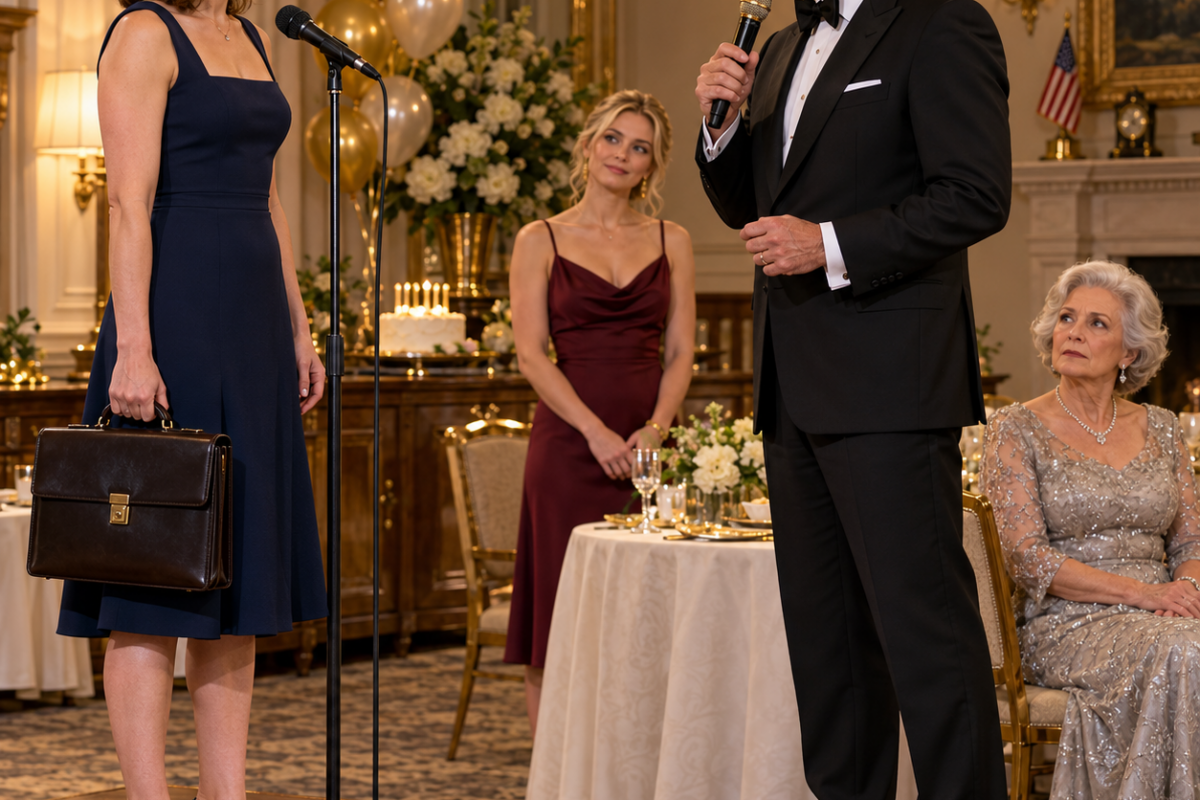
“I already promised your house to your sister,” my father told me four days after I bought it. “They’re moving in Monday. Rent-free for three years.” I was thirty-one, had saved for nine years, and had bought the five-bedroom home entirely in my own name. When I said no, he threatened to tell the family I had abandoned my sister’s children. Days later, he took the microphone at my grandmother’s seventy-fifth birthday dinner and did exactly that.
My father called twelve times in forty minutes after discovering I had bought a house without consulting him. When I answered, he didn’t ask whether…
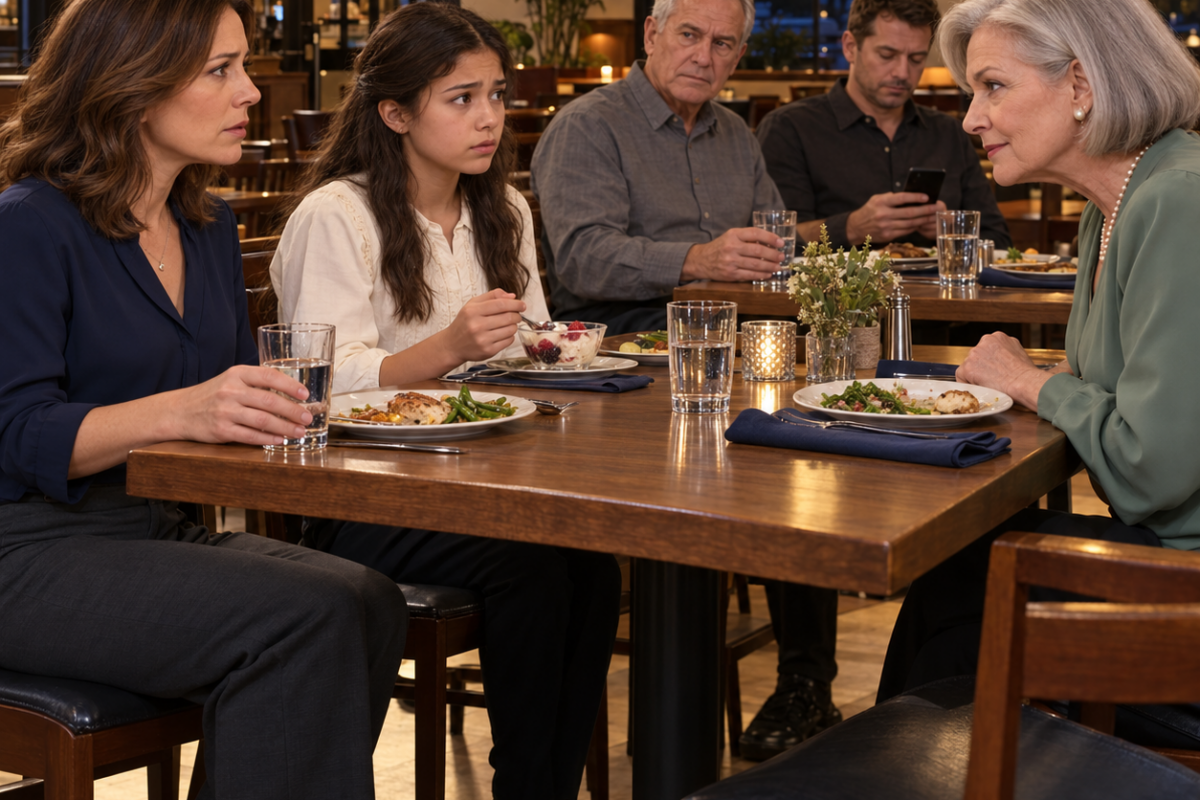
My mother leaned across the restaurant table, looked at my thirteen-year-old adopted daughter, and whispered, “We don’t sit with mistakes.” I took Sole’s hand and walked her out. That night, my father texted, “You’re still making the car payment tomorrow, right?” By midnight, I had canceled the payments I’d been making for my family. Then I remembered something Sole had told me about her grandmother.
My mother looked at my thirteen-year-old daughter and whispered, “We don’t sit with mistakes.” She said it softly enough to avoid attracting attention from the…
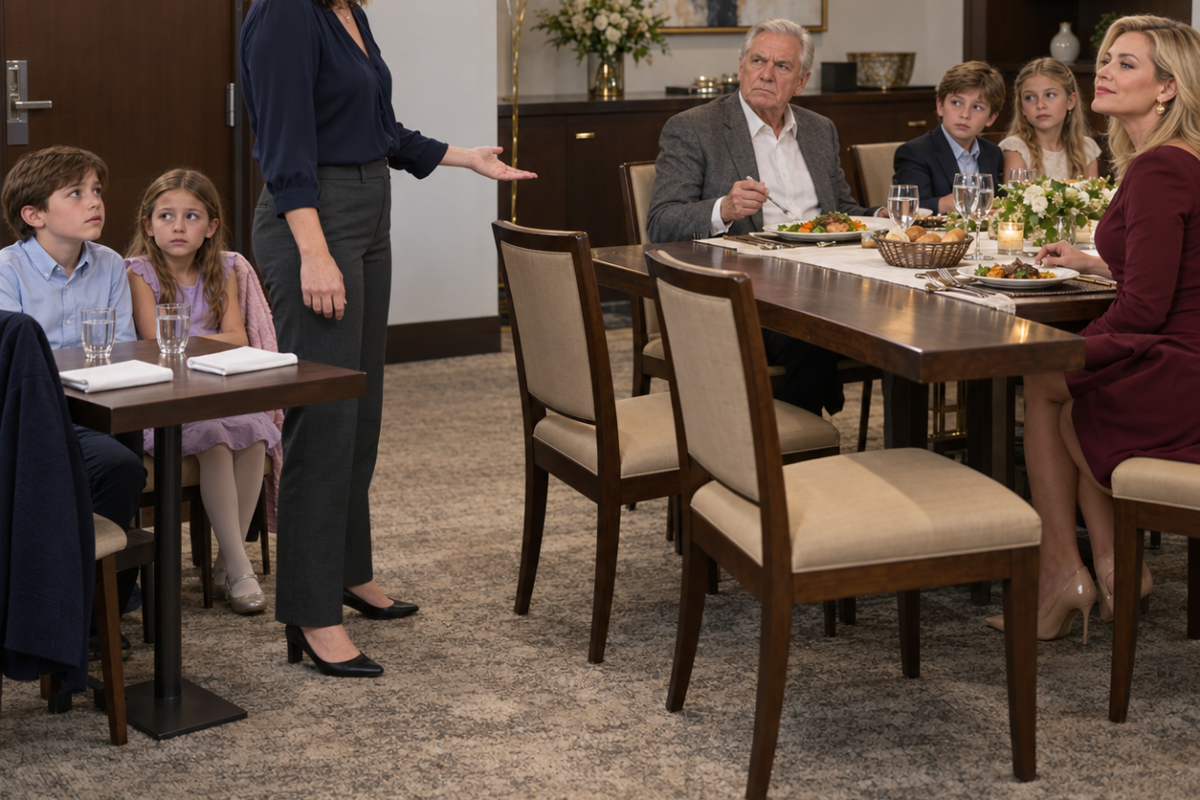
At my father’s seventieth birthday dinner, my eleven-year-old son and eight-year-old daughter were seated beside the service door with water glasses—but no dinner plates. Their cousins sat beside Grandpa with warm bread and full place settings. “They’ll eat after everyone else,” my sister said. I turned to my father, expecting him to object. “They can wait another hour,” he replied. There were two empty chairs at his table.
At my father’s seventieth birthday dinner, the first thing that stopped me wasn’t the cake or the gold balloons. It was my children. Ethan and…
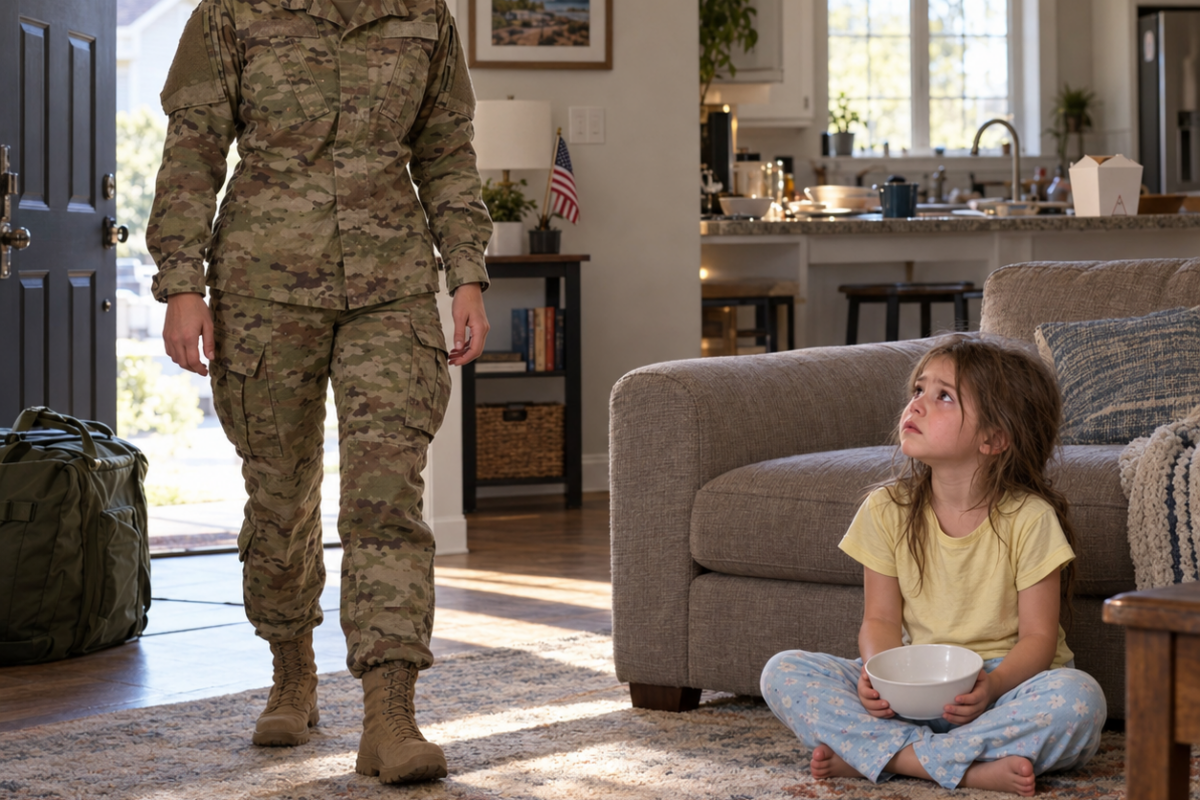
“Mommy, are you real?” my four-year-old daughter whispered when I came home from deployment three weeks early. She was sitting alone on our living room floor with an empty cereal bowl. My husband was on a Caribbean cruise with his mother and sister. Twenty-two minutes earlier, they had posted a photo captioned “Family time.” I was still in uniform when Sophie asked if she could have something to eat.
The first thing my daughter said when I found her was, “Mommy, are you real?” She was sitting cross-legged on our living room floor with…
End of content
No more pages to load