“Get out, you lowlife,” my daughter-in-law said while my son hid behind his newspaper. I was seventy years old, standing in the kitchen of a house I had bought, listening to people whose bills I paid tell me I was a burden. I picked up my purse and left. Before the week was over, they would be paying for their own comfortable life, and I would be heading somewhere Melanie never imagined I could afford.
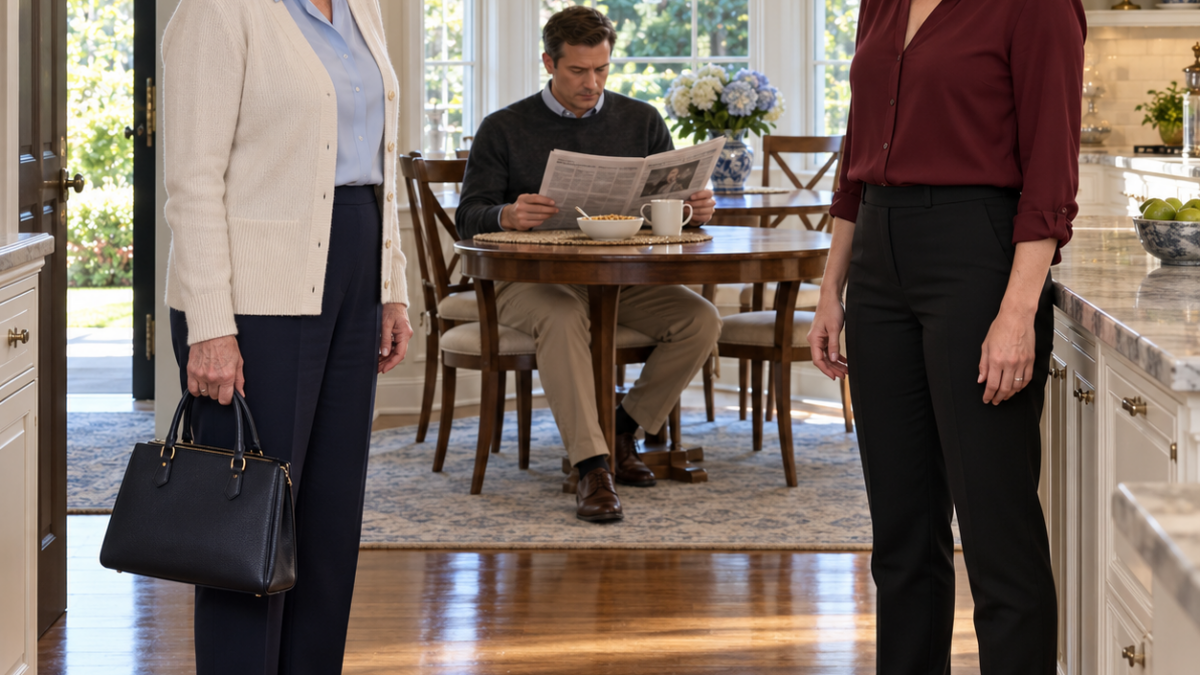
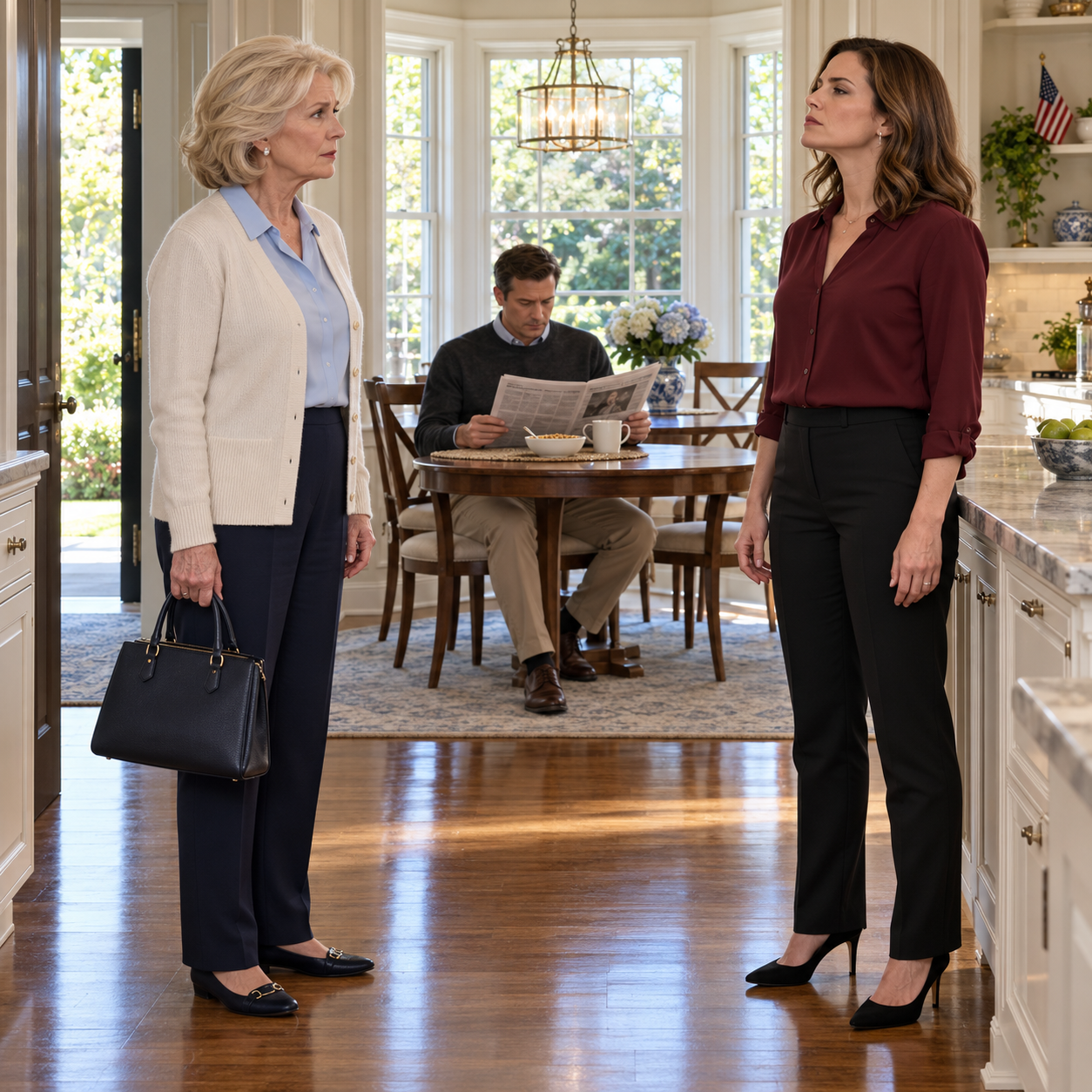
“Get out, you lowlife.”
Melanie’s voice carried across the kitchen so sharply that I looked toward the window before I looked at her. A hummingbird hovered beside the feeder on the patio, undisturbed by the shouting inside. For a moment, I envied it.
My daughter-in-law stood across the marble island with one hand flat against the countertop. Her face was flushed, her shoulders rigid. She looked like a woman waiting for someone to obey an instruction that should never have been questioned.
My son sat at the breakfast table with a newspaper open in front of him.
Travis was less than eight feet away.
He did not defend me.
He did not even look up.
I was seventy years old, a widow, and apparently a lowlife in the house I had purchased.
I looked down at the coffee cup in my hands. It was one of mine, white with a narrow blue rim, part of a set Edward and I had bought on a rainy afternoon twenty years earlier. Melanie had complained that the cups were old-fashioned. She used them anyway.
“Travis,” I said.
His eyes moved toward me and then dropped to the paper.
That tiny movement settled something I had spent years trying not to understand.
My son heard her. He understood her. He was choosing to remain seated.
I put the cup beside the sink.
“What exactly do you want me to get out of, Melanie?”
She gave an impatient laugh.
“Don’t start. You know what I mean.”
“No,” I said. “I would like you to say it.”
Travis shifted in his chair.
Melanie pointed toward the hallway.
“This house. This kitchen. Our lives, if you can’t learn to respect how we do things.”
I looked at my son again.
He folded one corner of the newspaper, though he had not turned a page in several minutes.
For years, I had mistaken keeping the peace for keeping a family together. That morning, watching his hands carefully occupy themselves, I finally saw the difference.
I picked up my purse from the chair beside the island.
Melanie smiled.
“Good.”
I walked past Travis.
“Mom,” he whispered.
I stopped.
For one foolish second, I hoped he would stand. I hoped he would say that whatever disagreements existed between us, nobody had the right to speak to me that way.
He remained seated.
So I left.
The argument had begun three days earlier over a bowl of organic granola.
I had bought the groceries, as I did every Thursday. Melanie kept a list on her phone, and I usually asked her to send it before I drove to the store. She preferred certain brands, certain produce, certain cleaning supplies. I had learned the names without remembering when accommodating her preferences became my responsibility.
On Friday morning, I poured a little granola into a bowl.
Melanie came into the kitchen, saw the box, and stopped.
“That’s mine.”
“I bought it yesterday.”
“That isn’t the point.”
“What is the point?”
She folded her arms.
“The point is that you live here, Ruth, and behave as though everything belongs to you.”
I nearly said, Technically, it does.
Instead, I closed the box and put it back.
That was how most of our disagreements ended. I moved something, changed something, paid for something, or apologized for misunderstanding a rule nobody had mentioned before.
When Edward died six years earlier, I had moved into the suburban house with Travis and Melanie because I was lonely. There were other places I could have lived. I owned property. I had savings. I had people I could call.
But grief narrowed my imagination.
My only son said I should be near family, and I wanted to believe that being near family would make the empty hours less frightening.
For a while, it did.
Travis drove me to appointments. Melanie left flowers in my room. We ate dinner together and talked about Edward without rushing to change the subject.
Gradually, the arrangement changed.
My contributions became expectations. Their requests became instructions. My room became the place I was supposed to remain when they had guests.
By the time Melanie objected to my granola, I had become a woman asking permission to use groceries I bought in a kitchen I owned.
That afternoon, she came into my bedroom without knocking.
“I need your Social Security check.”
I was sorting photographs at Edward’s walnut writing desk. He had given it to me for our twenty-fifth anniversary, and the drawer still held the note that came with it.
“What for?”
“The sectional I showed you.”
The sectional cost eleven thousand dollars.
“You want my Social Security payment for a sofa?”
“It’s furniture for the family.”
“I paid for the sofa downstairs.”
“That thing is eight years old.”
“So am I supposed to replace myself next?”
She did not smile.
“You make everything difficult.”
I put down the photograph in my hand.
“No, Melanie. I asked a question.”
She stepped farther into the room.
“You’re a burden, Ruth.”
I looked at her. I had heard irritation before, and sarcasm, and little jokes about my habits. This was different. She had decided the word described me accurately.
“If you can’t follow our rules,” she continued, “Travis and I may have to consider putting you somewhere.”
“Somewhere?”
“A state-run home.”
The certainty in her voice was almost astonishing.
She believed that growing older had made me available for reassignment.
“You don’t have the authority to decide where I live.”
She smiled thinly.
“Don’t make this harder than it needs to be.”
Then she left my bedroom with the door open.
I sat for a long time, looking at the photograph I had put down.
Edward stood beside a much younger Travis, holding the back of his bicycle. Our son was grinning, certain he could ride without help. Edward looked just as happy, though I remembered that he had spent the afternoon running behind that bicycle in uncomfortable shoes.
I wondered what he would have said about our house now.
Then I wondered why I was waiting for a dead man to tell me what I already knew.
There was something Melanie did not understand about my finances.
Thirty-four years earlier, I had started a freight brokerage company in a rented office with two telephones and a folding table. I knew enough about shipping to understand that people paid heavily for mistakes someone could have prevented with a few timely calls.
At first, I was that someone.
I answered the phones before dawn. I followed shipments through snowstorms, port delays, and breakdowns. I negotiated with carriers while making dinner and returned calls after Travis went to bed.
Edward kept his own job and supported me without treating my ambition as a temporary inconvenience.
He packed lunches. He took our son to school. He listened when I described problems he could not solve and asked useful questions when I needed them.
The company grew slowly, then faster.
By the time I was sixty-two, it operated across four continents.
I sold my controlling interest for ninety million dollars.
That did not mean ninety million dollars appeared in my personal checking account untouched. There were taxes, transaction costs, trusts, investments, charitable commitments, and obligations I took seriously.
But I had more than enough.
Travis knew I had done well. He had grown up around the company and watched it expand. He knew I had sold it, though he never asked for the details of the transaction, and I did not offer them at family dinners.
Melanie saw department-store clothes, a twelve-year-old Lexus, and a woman who still clipped coupons.
She interpreted my habits as evidence of need.
I did not mind that she misunderstood my wealth.
I minded that she believed a woman without wealth would deserve the way she treated me.
Outside the house that morning, I sat in the Lexus and opened the black notebook I had carried for years.
I had always recorded significant family payments. It was a habit from business, but also a way of keeping track of commitments I otherwise forgot I had made.
Travis’s graduate school: seventy-eight thousand dollars.
The money I supplied at the original house purchase: one hundred eighty thousand dollars, described within the family as their down payment.
Emergency roof repairs: twenty-three thousand dollars.
Then there were car payments, vacations, medical deductibles, property taxes, insurance, landscaping, cleaning services, pool maintenance, groceries, and Melanie’s temporary expenses that somehow never ended.
The total had crossed half a million dollars long before I stopped adding it.
I did not look at the number to calculate what they owed me.
Most of that money had been given willingly.
I looked at it because I wanted to understand how I had become a burden while carrying so much of the weight.
Then I called my bank.
I removed Melanie as an authorized user from my credit account. I changed passwords, reviewed permissions, and asked that no new authority be granted without direct confirmation from me.
Next, I called the companies whose services I paid for.
I ended future cleaning visits and landscaping extras. I canceled premium cable and arranged to close the internet account after its existing billing period, which happened to end that evening.
The ordinary household services required more care. I did not tell anyone to switch off essential utilities in anger. I paid what was due and requested written instructions for transferring future responsibility.
It took longer than a few dramatic taps on a phone.
That was fine.
I wanted the decisions to hold after the satisfaction wore off.
Before I returned home, I called my attorney.
Daniel Mercer had handled my business affairs for nineteen years. His assistant recognized my voice and put me through.
“Ruth,” he said. “How are you?”
“I need to change some arrangements.”
He listened while I explained.
When I finished, he asked, “Are you safe going back there?”
“Yes. But I don’t intend to stay.”
“Where are you going?”
“Carmel.”
For a moment, he was quiet.
Then he said, “Good.”
That evening, Travis knocked on my bedroom door.
“Mom?”
“Come in.”
He opened it slowly.
“The Wi-Fi isn’t working.”
“I know.”
“Did you cancel it?”
“The account was mine. The service period ended today.”
“But I have work.”
“Then you’ll need to open an account.”
He stared at me as though I had suggested he build the internet himself.
Melanie appeared behind him in a thick robe.
“Turn everything back on.”
“No.”
“The hot water isn’t working properly either.”
I looked at Travis.
“Then call the repair company. I’ll cover any repair I’m responsible for as the property owner. But the additional services you’ve been using need to become your expenses.”
Melanie tightened her arms around herself.
“I don’t pay to live like this.”
I looked directly at her.
“You don’t pay rent either.”
Her mouth opened.
For once, no answer followed.
Travis looked between us.
“Can we please talk about this calmly?”
“We could have done that this morning.”
He lowered his eyes again.
I recognized the movement.
I was beginning to hate it.
“I’m packing,” I said. “Anything about accounts or the house can be sent to Daniel. I’m not discussing it in my bedroom tonight.”
Melanie laughed.
“Fine. Run away.”
I turned toward the desk.
“No,” I said. “I’m making arrangements.”
Over the next three days, I discovered how much work I had been doing without calling it work.
Bills arrived that Travis had never opened. Notices lay on the counter because everyone assumed I would handle them. A cleaning company called to confirm that Melanie had tried to reverse my cancellation.
I told them my decision stood.
A landscaper asked who should approve the next seasonal planting.
I gave him Travis’s number and made clear that no future charges should come to me without written authorization.
The ordinary maintenance of the property remained my responsibility until another arrangement was reached. Their private preferences did not.
I put those distinctions in writing.
Melanie said I was becoming bureaucratic.
I had never liked that word when people used it to describe clarity they found inconvenient.
While they were at work, movers arrived.
They packed my books, paintings, clothes, and the antiques Edward and I had collected over our marriage. I had prepared an inventory and photographs so nobody could later claim I had taken something that belonged to them.
The walnut writing desk went last.
I stood in the doorway while two men wrapped it carefully.
For six years, that desk had anchored my room.
Seeing it move frightened me more than anything Melanie had said.
Without it, the bedroom looked temporary.
Then I realized that was the truth.
Travis came home early and found the movers loading the truck.
“What are you doing?”
“Moving my things.”
“Where?”
“Somewhere else.”
He looked at the truck, then at me.
“Mom, this is getting out of hand.”
I waited until the movers carried the desk past us.
Then I said, “Your wife threatened to put me in a home because I wouldn’t buy an eleven-thousand-dollar sofa. Where did you think this was going?”
He looked toward the street.
“I didn’t know she said that.”
“Now you do.”
He rubbed his face.
“I’ll talk to her.”
“You should. But I’m not waiting to see whether that makes living here bearable.”
That evening, he found property-tax and insurance notices on the kitchen counter.
“You’ve always handled these.”
“Yes.”
“What happens now?”
“Daniel will explain the property arrangements. You and Melanie need to understand what you’ve been relying on.”
Melanie stood near the dishwasher.
“We’ll survive without you.”
“I hope you do.”
She sneered.
“Go find some cheap motel.”
I studied her face.
There had been a time when that sentence would have sent me into my room feeling ashamed.
Instead, I smiled.
“No, Melanie.”
She frowned.
“I think I’ll go home.”
Neither of them understood what I meant.
I drove south before sunrise the following morning.
The road was nearly empty. I stopped for coffee, checked a message from the moving company, and continued beneath a pale California sky.
Three hours later, Monterey cypress trees appeared along the coast.
Then Carmel.
Edward and I had purchased the property twenty-one years earlier, after walking past it during an anniversary trip. A stone wall surrounded the garden, and the gate had been open because someone was pruning the lavender.
Edward slowed as we passed.
“That looks peaceful.”
“It looks expensive.”
“Both can be true.”
We laughed.
A month later, it was ours.
White stucco. Terracotta roofs. A courtyard filled with afternoon light. Windows facing the Pacific.
Melanie would have called it a villa.
Edward called it our hiding place.
We used it when work allowed. After his death, I let it remain a place managed by other people because I could not face being there without him.
Samuel Ortiz cared for the property. He and his wife, Rosa, lived nearby, and they treated the house with a steadiness I had come to depend on.
Almost nobody in my daily life knew I still owned it.
I pulled through the gates and stopped before reaching the garage.
Edward’s brass wind chime hung beside the courtyard.
The breeze moved it.
I heard the same uneven notes that had irritated him when we first bought it.
He said one tube was out of tune.
I said he was imagining things.
He spent two afternoons trying to adjust it, then gave up and decided its imperfection was part of the charm.
I sat in the car and cried.
Not neatly.
Not with the quiet dignity people like to imagine in older women.
I cried because I had spent six years believing the safest place for my grief was near people who needed things from me.
Samuel came around the side of the house.
He stopped when he saw the Lexus.
“Mrs. Bennett?”
I opened the door.
“Hello, Sam.”
His face brightened.
“I thought that was your car.”
He came toward me, then hesitated when he saw my face.
“Are you all right?”
“I will be.”
He took my overnight bag.
“Welcome home.”
Those two words nearly undid me again.
Inside, the house smelled faintly of citrus polish and the ocean.
My movers had arrived the previous afternoon. The desk stood in the library beneath the window where Edward once kept a small telescope.
My books were unpacked.
A vase of flowers sat on the kitchen counter.
Rosa had left soup in the refrigerator with a note saying I should heat it slowly.
Nobody had demanded that I explain why I was hungry.
Nobody had told me which cup I could use.
I went upstairs, opened the bedroom windows, and sat on the edge of the bed.
The ocean was audible through the trees.
For the first time in years, silence did not feel like evidence that I had been forgotten.
It felt like space.
During the first week, I did very little.
I walked every morning, sometimes only as far as the end of the street. I cooked scrambled eggs and ate them while looking out at the courtyard.
I unpacked slowly.
One box contained Edward’s sweaters. I put them in a closet without deciding whether I would ever wear them or give them away.
Another held photographs from the company’s early years.
I looked at the woman standing beside a loading dock in a winter coat, holding a clipboard and smiling into the camera.
I remembered her.
I had not felt like her in a long time.
Then the calls began.
Travis called eleven times.
Melanie called twenty-three.
Their messages changed quickly.
At first, Travis wanted account information.
Then he wanted reassurance that I would pay an insurance premium.
Then he accused me of making a point.
Melanie’s messages were less restrained.
You cannot abandon financial obligations.
That one made me laugh.
I sent a single reply to both of them.
All necessary property matters are being handled through Daniel. My personal support has ended. Please contact the relevant service providers about your own accounts.
Travis replied almost immediately.
Where are you?
I considered answering.
Then I wrote:
I am safe.
For the moment, that was enough.
Daniel came to Carmel two days later.
We sat in the library at the walnut desk. He placed a leather folder in front of me and looked around the room.
“Edward liked it here.”
“He did.”
Daniel nodded.
Then he opened the folder.
“We need to clarify the suburban house.”
“I know I bought it.”
“Yes. But the title is still entirely in your name.”
I looked at him.
“I thought we arranged a transfer after Edward died.”
“We discussed it. I prepared drafts. You wanted certain terms considered before signing. The final transfer was never completed.”
I remembered fragments.
A meeting.
A conversation about tax consequences.
Travis saying he would send information.
Me saying we could deal with it later because I was tired.
Later became years.
“Why didn’t anyone follow up?”
Daniel’s expression changed.
“I should have made the status clearer to you.”
“Yes,” I said. “You should have.”
He accepted that.
“It remains your property. We’ll obtain current title information and review everything before deciding what comes next.”
I looked at the papers.
I had always known I paid for the house.
I had not understood how much uncertainty had grown around the details while I was grieving.
“There’s another issue,” Daniel said.
He removed a separate document.
“A lender contacted our office while confirming information related to a proposed refinancing.”
My stomach tightened.
“Refinancing by whom?”
“The initial inquiry lists Travis as the owner.”
I leaned forward.
“Did he apply?”
“That isn’t established yet.”
Then he showed me an authorization bearing my name.
The signature resembled mine enough to pass a quick glance.
It was not mine.
“I didn’t sign that.”
“I know your signature,” he said. “But we’ll document your statement and obtain the underlying records properly.”
I touched the edge of the paper.
Melanie asking for my Social Security payment.
Melanie threatening a home.
Melanie asking, months earlier, where I kept copies of important documents because she wanted to help me organize.
Those incidents no longer felt separate.
“Was a loan issued?”
“Not from what we’ve confirmed. The inquiry raised questions before it progressed.”
I exhaled.
“Good.”
Daniel looked at me.
“Have you given either of them power of attorney?”
“Not broad authority. Travis had permission for a few practical things after Edward died.”
“Then we review every authorization and revoke what is no longer appropriate. We’ll also ask your banks to flag unusual requests.”
“Do it.”
“We need your signatures on the actual documents.”
I picked up the pen.
For the next hour, he explained.
I asked questions.
When I became tired, we stopped for tea.
No one told me that being tired meant I could no longer decide.
Three days later, two vehicles appeared outside the gates.
A black SUV arrived first. Travis’s car pulled in behind it.
Samuel called from the courtyard.
“Your son is here.”
I looked through the library window.
Travis stepped out.
Melanie emerged from the SUV and stopped when she saw the house.
Her mouth actually opened.
I went down the stone steps.
For a few seconds, she looked past me at the courtyard, the roofline, and the ocean beyond the trees.
“This is yours?”
“Yes.”
“How much is it worth?”
Not hello.
Not are you comfortable.
Not I’m sorry.
I looked at her.
“Enough.”
Travis looked pale.
“Mom, we need to talk.”
“I’ve been waiting for that.”
Melanie turned toward him.
“You knew about this?”
He said nothing.
His silence looked different now.
Not passive.
Frightened.
“Travis?”
He swallowed.
“There’s something I should have told you years ago.”
Melanie’s head turned sharply.
“What are you talking about?”
He looked at her, then at me.
“Dad made me promise.”
I stood still.
Edward had been dead six years.
I had spent those years carrying his absence as though it were a room I entered every day.
Now my son was telling me Edward had left instructions I knew nothing about.
“What promise?”
“Can we go inside?”
Melanie laughed.
“Absolutely. I’d love to see the rest.”
I looked directly at her.
“You’re entering my home because I’m inviting you to this conversation. You will speak respectfully to everyone here.”
Her face tightened.
Travis surprised me.
“Melanie, stop.”
She turned.
“Excuse me?”
“Please. Just stop.”
His voice shook.
But he did not take it back.
I led them to the library.
Edward’s photograph stood above the fireplace. Travis looked at it for a long time before sitting.
Then he took an envelope from his jacket.
My name was written across it in Edward’s handwriting.
I reached for it.
“Where did you get this?”
“Dad gave it to me before he died.”
“Six years ago?”
“Yes.”
I held the envelope so tightly that the paper bent.
“Why didn’t you give it to me?”
“He told me to wait unless someone tried to take control of your money.”
I looked at Melanie.
She had gone still.
Then I opened the letter.
Ruth,
If Travis gives you this, something has gone wrong.
There is a second file with Daniel.
Please read everything before deciding what you think of us. I believed I was protecting you. I am no longer sure I chose the right way.
Love always,
Edward.
I read it twice.
Then I put it on the desk.
My husband’s handwriting was familiar.
The uncertainty in his words was not.
I called Daniel.
He answered immediately.
“Ruth?”
“I have a letter from Edward.”
There was a pause.
“Travis brought it?”
“Yes.”
“I’ll come.”
He arrived ninety minutes later. During that time, nobody left.
Melanie asked for coffee.
I told her where the kitchen was.
She looked offended that I did not fetch it.
Travis remained beside the fireplace, his hands clasped behind his back.
I did not ask him to explain further without Daniel.
I had spent too long allowing people to give me fragments and call them enough.
When Daniel arrived, he carried a second folder.
He looked at Edward’s letter, then at me.
“Before we begin,” he said, “some of these instructions came from Edward when I represented him separately. That does not make every decision to withhold information wise. It also does not remove the questions you may have about my role.”
“I have several.”
“I expect that.”
He sat.
The first documents concerned the company.
Before his death, Edward had discovered evidence of irregular transfers connected to transactions that occurred before the sale.
Millions had moved through entities that did not match legitimate operating expenses.
“Who?” I asked.
Daniel looked toward Travis.
My son answered.
“Uncle Raymond.”
My younger brother.
Raymond had helped me build the company. He handled international operations because he was good with languages, understood the complexity of cross-border shipments, and seemed most comfortable when he was traveling.
I trusted him.
Edward trusted him less.
I had accused Edward of being unfair when he questioned a few of Raymond’s decisions.
Now I looked at the documents.
“How much?”
“Nearly fourteen million dollars,” Daniel said.
For a while, I could only hear the wind chime outside.
Raymond had died two years after Edward.
I remembered standing at his funeral, holding his widow’s hand and telling her he had been a good brother.
“Was it investigated?”
“There was an independent accounting review, followed by a negotiated restitution arrangement. The purchaser’s interests and the relevant transaction obligations were addressed.”
“And I wasn’t told?”
Daniel lowered his eyes briefly.
“Edward believed you would be devastated. He was ill. Raymond admitted enough to agree to repayment terms. Edward asked that the matter be handled without adding it to what you were already carrying.”
I stared at him.
“Adding it to what I was carrying?”
He did not answer.
“My business. My brother. Fourteen million dollars. He thought I shouldn’t be told?”
Travis moved closer.
“Mom—”
“No.”
He stopped.
I turned a page.
The restitution involved transferred assets and a trust arrangement with specific obligations. Some assets were intended to satisfy restitution. Other provisions dealt with life-insurance proceeds and future interests.
Travis was named in parts of the arrangement.
That made it look, at first glance, as though money taken from my company had been quietly redirected toward my son.
Daniel explained the sequence and the distinctions.
I listened.
Then I said, “I want someone independent to review this.”
“Of course.”
“Not someone selected to agree with you.”
“Someone you choose.”
I looked at Travis.
“When did you know?”
“After Dad died.”
“And you kept it from me.”
“Yes.”
“Because he asked you?”
“At first.”
“At first?”
He looked toward Melanie.
Her expression had hardened.
Daniel said, “There is a family connection we need to discuss.”
I gave an exhausted laugh.
“Apparently there are several.”
He looked at Melanie.
“Raymond believed Melanie was his daughter.”
The room seemed to tip slightly.
I looked from Daniel to my son’s wife.
“No.”
Melanie stood.
“I don’t have to sit through this.”
“You came here,” I said. “You can leave. But you will not interrupt the explanation.”
She remained standing.
Daniel spoke carefully.
“Raymond had a relationship outside his marriage. Melanie’s mother told him he was the father. He provided support privately.”
I turned toward Travis.
“You knew?”
“Not when we met.”
“When?”
“Before we married.”
I stared at him.
Raymond was my brother.
At that moment, the implication was unavoidable.
“You believed you were marrying your cousin?”
Travis closed his eyes.
“I was told things were more complicated. Dad said there were facts I didn’t understand and that we weren’t biologically related.”
“Your father told you that?”
“Yes.”
“Did he explain why?”
“Not fully.”
My hands went cold.
Another secret stood behind the one we had just opened.
Melanie looked at Travis.
“You never told me that.”
He turned toward her.
“You never believed the documents when I said there were questions.”
“That isn’t the same.”
“No,” he said. “It isn’t.”
Daniel intervened.
“We are not going to establish biological relationships from assumptions or old family statements. There are documents that require verification, and independent specialists will need to review them.”
I looked at him.
“Then why are you bringing this up now?”
“Because it helps explain the conflict Melanie believes exists. It does not make her belief accurate.”
Melanie’s face flushed.
“My father died believing you stole his life.”
I stared at her.
“What?”
“He helped build your company. Then you took the credit, the money, everything.”
“He stole fourteen million dollars.”
“He said you forced him out.”
“He remained involved until after I sold.”
“He said you made sure he got nothing.”
Daniel moved a document toward her.
“The records do not support that.”
She pushed it away.
“I don’t care about your records.”
Her voice filled the room.
There it was.
The anger beneath years of polished manners.
I had spent so much time wondering why nothing I did satisfied her.
The house.
The vacations.
The bills.
Every gift appeared to have been received as a partial payment toward a debt she believed I owed.
“When did you know who I was?” I asked.
She looked at the fireplace.
“When I met Travis.”
“Did you seek him out?”
“Not the first time.”
“What does that mean?”
“We met at an event. I recognized the surname. Then I asked questions.”
I remembered her interest during those first dinners.
The company history.
The places Raymond traveled.
The sale.
I had thought she wanted to understand the family she was joining.
In a way, she did.
Just not in the way I imagined.
I looked at Travis.
“Why did you let her speak to me that way?”
His answer came slowly.
“I was afraid.”
“Of her?”
“Of what she said she could do.”
Melanie’s head snapped toward him.
“Don’t.”
He continued.
“She had Raymond’s files. Copies of manifests, account records, correspondence. She said they showed you knew what he was doing.”
“Did you believe that?”
“I didn’t know what to believe.”
“You could have asked me.”
“I know.”
“No, Travis. You could have asked me before letting me spend years wondering why you wouldn’t meet my eyes.”
He began crying.
I did not soften the question.
“What did she threaten?”
“To give the documents to investigators. To reporters. She said if I challenged her, you would lose everything.”
Daniel sat forward.
“Did she make specific demands?”
Travis nodded.
Melanie reached for her purse.
“This is ridiculous.”
My son looked at her.
“No. It’s what happened.”
“I wanted what my family was owed.”
“You wanted Mom to keep paying.”
I watched him.
For the first time, his words did not retreat before hers.
He continued.
“I told myself I could get the files. That I could understand them and protect her.”
“For how long?” I asked.
“Three years.”
I looked away.
Three years of meals.
Three years of bills.
Three years of hearing that I was difficult while my son carried a fear he never gave me the chance to address.
“You didn’t protect me,” I said.
He covered his face.
“I know.”
Melanie moved toward the door.
Nobody blocked her.
Then there was a knock at the entrance.
Samuel came into the library.
“There are two people asking to speak with Melanie.”
She stopped.
A woman introduced herself as an investigator from the California Department of Financial Protection and Innovation. Beside her stood a Carmel police detective.
They displayed identification and explained that they were following up on information associated with the refinancing inquiry.
Melanie turned toward me.
“You called them?”
I shook my head.
Daniel said he had reported the disputed document through the appropriate channels, but had not arranged this visit.
Travis stepped forward.
“I gave them the location.”
We all looked at him.
“I called,” he said. “I told them we were coming here.”
Melanie stared.
“You had no right.”
He looked exhausted.
“I had every reason.”
The investigators did not arrest her in the hallway because a dramatic family conversation had occurred.
They asked questions, confirmed arrangements through counsel, and explained the next steps. Melanie said she wanted an attorney.
That was her right.
She left with the detective’s contact information, furious and pale.
Travis stayed.
After the cars pulled away, I sat at the desk.
For a while, nobody spoke.
Then I looked at my son.
“You should have called me first.”
He nodded.
“I know.”
“You should have trusted me.”
“I know.”
“You should have stood up in the kitchen.”
His face crumpled.
“Yes.”
I watched him cry.
Part of me wanted to comfort him.
Another part was tired of being the person who absorbed everyone’s guilt.
So I stayed where I was.
Eventually, he said, “What do you want me to do?”
“Tell the truth. To your attorney. To investigators. To me. And stop using your father’s instructions as a reason not to think.”
He nodded slowly.
Then he asked, “Can I come back?”
“Yes.”
I paused.
“But you need to call first.”
The investigation took four months to reach the first substantial conclusions.
During those months, I learned how much a story can change when each person is asked to provide dates, documents, and a complete explanation.
The refinancing attempt involved a forged authorization. Investigators traced communications, account access, and submitted records. Melanie’s role became clearer.
The old company files were more complicated.
Some were authentic.
Some were incomplete.
Some had been presented in a way that suggested connections the original records did not support.
Independent accountants reviewed the transactions. They compared the old files with the company’s preserved records and the sale documentation.
Raymond’s conduct did not become harmless because he was dead.
My lack of knowledge did not become guilt because Melanie insisted that it must.
The review also forced me to confront my own failures.
I had trusted my brother too broadly. I had allowed international operations to depend on relationships and habits instead of insisting on controls that would have protected everyone.
That did not make me responsible for his theft.
It meant I had things to learn from it, even after the company was no longer mine.
I chose a new independent attorney to review matters in which Daniel’s earlier role could create a conflict.
Her name was Elaine Porter.
She was direct, patient, and unimpressed by the phrase he meant well.
At our first meeting, she said, “Your husband’s intentions are part of the history. Your right to information is a separate question.”
I liked her immediately.
She reviewed the restitution arrangements, the property records, the trust documents, and the limits of Daniel’s prior representation.
Some things had been handled properly.
Others had been communicated badly enough to damage my confidence in people I had depended on.
We clarified them in writing.
I did not need everyone punished to feel respected.
I needed to understand what had happened and to decide who would handle my affairs going forward.
Daniel remained involved in areas where that was appropriate. Elaine handled others.
He did not argue when I told him the old arrangement would not simply resume.
“I understand,” he said.
“I hope you do.”
Travis filed for divorce.
I did not celebrate.
A marriage ending is still a loss, even when remaining in it would do more damage.
He moved into a small apartment.
The first time he told me about it, he described the kitchen as though he was trying to convince himself it was adequate.
“One counter,” he said. “But enough space.”
“Enough space for what?”
“To make dinner.”
“That seems important.”
He smiled weakly.
I offered to help with the deposit.
He shook his head.
“No.”
“Are you sure?”
“Yes. I need to learn how to pay for my own life.”
I looked at him.
For years, I had heard apologies followed by requests.
This was different.
“All right.”
We began meeting for lunch on Sundays.
Not every Sunday was pleasant.
Some conversations stalled. Some ended with tears. Sometimes we spoke about ordinary things because neither of us had the strength to revisit the past.
I did not mistake ordinary conversation for avoidance if we returned to the difficult questions later.
One afternoon, he said, “I keep replaying the kitchen.”
“So do I.”
“I thought if I stayed quiet, the moment would pass.”
“It did pass.”
He looked up.
“It passed through me,” I said. “Then there was another one.”
He sat very still.
I continued.
“Silence wasn’t neutral. She heard permission. I heard agreement.”
“I didn’t agree.”
“I believe you. But I couldn’t hear what you didn’t say.”
He nodded.
A few weeks later, he called to tell me Melanie had sent a threatening message about the old records.
“What did you do?”
“Forwarded it to my attorney.”
“And?”
“I didn’t answer.”
“Good.”
“I wanted to explain.”
“I know.”
He laughed sadly.
“I’m starting to see where that habit came from.”
I laughed too.
There was relief in being able to admit that I had taught him some of the same habits I was trying to change.
Edward became harder to remember simply.
For forty-three years, he had been my husband, my partner, the person who knew which parts of my courage were real and which were improvised.
He had loved me.
He had also decided, during his final illness, that love gave him permission to withhold facts about my business and family.
I could not reconcile those things by declaring one false.
In the evenings, I sometimes sat beneath his photograph and spoke aloud.
“You should have told me.”
The house did not answer.
The wind chime moved.
I missed him.
I was angry with him.
Both feelings belonged to the marriage we had actually lived, not the easier version I had preserved after his death.
One afternoon, Rosa found me standing in the courtyard, staring at the brass tubes.
“Would you like Sam to take it down?” she asked gently.
“No.”
She waited.
“Not today.”
“All right.”
She went back inside.
That small response moved me more than a speech would have.
She did not tell me what Edward would want.
She left the decision with me.
By autumn, the legal and financial questions were becoming more manageable.
My banks had clear instructions. My estate documents were updated. Trusted contacts were identified without giving anyone broad authority merely because they were related to me.
I arranged practical support for things I did not want to handle alone.
That was different from surrendering control.
Samuel helped with property matters. Rosa came when I asked. A financial adviser reviewed investments on a schedule that allowed time for questions.
I could still forget where I put my glasses.
I could still become tired during long meetings.
Neither meant my life should be handed to somebody else.
Then, one November afternoon, Daniel called.
“Ruth, there’s another matter that needs your attention.”
I closed my eyes.
“Of course there is.”
“It concerns Raymond.”
“More company records?”
“No.”
His tone made me sit down.
“What is it?”
“A letter and supporting information. I would prefer Elaine be present.”
That request told me he understood how much confidence had been lost.
We arranged a meeting in Monterey.
Travis was already there when I arrived. Elaine sat beside him. Daniel stood near a table with several sealed envelopes.
A woman I had never met was seated across the room.
“This is Dr. Caroline Hayes,” Daniel said. “She treated Raymond during the final year of his life.”
She stood.
“Mrs. Bennett, I’m sorry to meet you under these circumstances.”
I shook her hand.
“What has my brother left now?”
She looked uncomfortable.
“A letter he asked me to help place with his estate records. It was not a medical instruction, and I was not asked to decide what it proved. I recently learned that the circumstances he described had occurred.”
Elaine nodded.
“We’ve reviewed how the material was held and transferred. You should know that a letter is not proof by itself. The supporting records need independent examination.”
I sat.
“Thank you for saying that.”
Caroline placed an envelope before me.
Raymond’s handwriting was messier than Edward’s. I recognized the way he crossed his t’s.
Ruth,
I told Melanie you took the company from me.
That was a lie.
I could not bear to tell her what I had done. I wanted her to think I had been wronged rather than ashamed.
I stole the money. You trusted me, and I betrayed you.
I stopped reading.
For a moment, the room seemed easier to breathe in.
Not because the confession repaired anything.
Because somebody had finally used the correct words.
Then I continued.
There is something else. I believed Melanie was my daughter for twenty-eight years. During my illness, information came to light that challenged that belief.
The testing showed that I was not her biological father.
I looked up.
Travis leaned forward.
Caroline remained silent while Elaine said, “We have records consistent with that conclusion, but we’re obtaining an independent review of the testing and identities.”
I returned to the letter.
Her mother eventually told me the truth.
Edward was her father.
The paper slipped from my hands.
Nobody moved.
I heard the clock on the wall.
Then Travis said, “No.”
I looked at him.
My husband’s daughter.
My son’s wife.
For several seconds, I could not make those facts occupy the same room.
Elaine spoke firmly.
“Ruth, there is additional information. We are not going to draw a conclusion about Travis and Melanie from that sentence alone.”
I pressed both hands against the table.
“What additional information?”
Daniel looked at me.
“Edward had kept records concerning a concern about Travis’s identity at birth.”
I stared.
“His identity?”
Daniel nodded.
“What are you saying?”
Travis’s face had gone white.
“Mom?”
I looked at my son.
Then an old memory returned.
A storm.
A hospital.
An electrical fire in part of the building.
Newborns moved to another floor.
Nurses exhausted and apologetic.
Weeks later, a question about blood type that Edward said was probably a clerical error.
I had trusted the explanation.
I had been a new mother, tired and frightened, with a baby who needed me.
Daniel placed a report on the table.
“Edward arranged private testing when Travis was seventeen.”
I could barely speak.
“Why?”
“Because he believed the original hospital records contained a serious error.”
Travis stared at the document.
“What kind of error?”
Elaine answered.
“The material suggests you were switched with another infant during the emergency relocation.”
The room became silent.
I reached for Travis.
He took my hand.
It was shaking.
So was mine.
I looked at the report.
Numbers.
Names.
Dates.
A comparison I did not understand.
“You’re saying he isn’t my son.”
Elaine’s expression softened.
“I’m saying this document concerns biological relationships. It does not decide your family.”
I gripped his hand more tightly.
“Then tell us what it actually establishes.”
The answer took time.
The old report indicated that Travis was not biologically related to Edward. Additional records suggested he was not biologically related to me either. There had been efforts to identify the other infant and the families involved.
Some documents were clearer than others.
Edward appeared to have learned that the other child, the baby he believed was ours, had died at nine months from an undiagnosed heart condition.
I sat without moving.
Somewhere in the past, there was a baby I had never held after those first confused days.
A child who had died while I was buying clothes for Travis, singing to him, watching him learn to crawl.
Grief arrived for someone I had not known existed.
It felt unfamiliar and terrible.
Travis turned toward me.
“Mom?”
I looked at him.
“I’m here.”
He began crying.
I put my other hand over his.
No report could make him a stranger.
But the report could still change the world around us.
Elaine slowed the meeting.
She asked whether we wanted a break.
We did.
Travis and I walked outside to a bench near the building.
For a while, we said nothing.
Then he asked, “Did you know?”
“No.”
“You’re sure?”
I turned toward him.
“Travis.”
“I’m sorry.”
“No. You’re allowed to ask.”
He stared at the pavement.
“Dad knew?”
“Apparently.”
“And never told us.”
“Apparently.”
He covered his face.
I watched cars pass on the street.
A woman pushed a stroller toward the corner. A man carried flowers from a shop. Ordinary life continued with an indifference I found both cruel and comforting.
Then Travis said, “Am I still—”
He stopped.
I moved closer.
“Finish the question.”
He shook his head.
“You don’t need to ask whether you’re still my son.”
His breath caught.
I held him as I had when he was small.
Not because he had become a child again.
Because he was my son, frightened by a truth neither of us had chosen.
When we returned inside, Elaine explained the next steps.
Independent verification.
New testing, if we consented.
A specialist who could interpret the historical records.
Careful treatment of private medical information.
No declarations based solely on Raymond’s letter or Edward’s assumptions.
We agreed.
Over the following weeks, the central findings were confirmed.
Travis had no biological relationship to me or Edward.
He and Melanie were not biologically related.
Edward’s paternity of Melanie was supported by the old testing and corroborating records reviewed through counsel.
The hospital error was supported by records that had survived, though not every detail could be reconstructed after so many years.
The other family had suffered the death of the child they raised.
Their privacy mattered too.
We did not turn their loss into a footnote to ours.
When information about Travis’s biological parents became available, Elaine helped him decide how to approach it. He did not want an announcement, a surprise visit, or a reunion planned by other people.
He wanted time.
I understood.
The question of Edward’s conduct remained.
He had fathered Melanie during a troubled period involving Raymond and Melanie’s mother. The details were painful, untidy, and nothing like the marriage I believed I knew.
Edward had learned enough over the years to understand more than he ever told me.
He knew about Travis.
He knew about Melanie.
He had allowed his belief that silence would preserve the family to become a reason for withholding truths that belonged to other people as well.
I did not defend him.
I also did not decide that forty-three years of love had been imaginary.
It had been real.
So had the betrayal.
I began meeting with a counselor named Judith, a woman close enough to my age to understand that grief after a long marriage was not a simple list of feelings.
At our first appointment, I told her I felt foolish.
“Because you trusted your husband?”
“Because I thought I knew him.”
She considered that.
“You knew a great deal about him. You did not know everything.”
“Apparently I missed some rather important things.”
“Yes.”
I liked that she did not hurry to soften it.
Then she said, “The question now is how you want to live with what you know.”
I thought about it for weeks.
I did not remove every photograph.
I did not preserve every object.
I put some things away because seeing them hurt too much. I kept others because they represented parts of my life I refused to surrender.
Edward’s wind chime stayed.
Not as a declaration that all was forgiven.
Because I liked its sound, and it belonged to my home now.
Melanie deserved the truth too.
That was not a difficult conclusion.
It was a difficult action.
I could still hear her calling me a lowlife. I still remembered her demanding my Social Security payment and threatening to put me somewhere.
Her cruelty had not become harmless because her father lied to her.
But Raymond’s lie had shaped her life.
Edward’s silence had shaped it too.
“She should be told,” I said.
Elaine nodded.
“Through her attorney, with the documents and a clear explanation of what has been independently verified.”
“No surprise confrontation.”
“Agreed.”
Travis looked down at the table.
“I don’t know what she’ll do.”
“We can’t decide whether she deserves information based on whether she’ll react well,” I said.
He nodded.
It was a lesson all of us should have learned much earlier.
Three weeks later, Melanie received the material.
I did not see her reaction.
I was grateful for that.
I did not need to become a witness to every collapse the family’s secrets produced.
Her attorney acknowledged receipt. Some questions followed. The independent reports were supplied through appropriate channels.
The financial case continued separately.
Biological revelations did not erase forged documents.
A painful childhood story did not make a refinancing attempt lawful.
Melanie eventually accepted a plea agreement on the financial charges. The terms were handled by the court, not negotiated around my willingness to forgive her.
The divorce became final.
She moved out of California.
Before leaving, she mailed me an envelope.
Inside was one sheet of paper.
I expected an accusation.
Instead, there were four words.
I am sorry, Ruth.
I sat at the kitchen table holding the note.
For a long time, I felt nothing I could easily name.
Relief.
Anger.
Sadness.
A small, wary acknowledgment that she had finally addressed me as a person rather than an obstacle.
I kept the note.
I did not answer immediately.
Weeks later, I wrote a short reply.
I received your apology. I hope you build a life in which you do not pass these harms on to someone else.
I did not promise renewed contact.
She did not request it.
That was enough.
The suburban house took longer to resolve than I expected.
Travis moved out before the sale process began. Melanie removed her belongings under documented arrangements. Anything disputed was handled through counsel rather than left for us to argue about in the driveway.
I walked through the empty house once.
The marble island shone.
The breakfast table was gone.
A pale rectangle on the wall showed where Melanie had hung a large mirror.
My bedroom looked smaller without the walnut desk.
For a moment, I could hear the word burden.
Then I opened the curtains.
The room filled with light.
I did not need to prove I had never been a burden by returning to live there.
I needed to leave it behind.
The following spring, I sold the house.
Travis did not receive the proceeds.
He did not ask.
After taxes and transaction costs, I donated half the net proceeds to a nonprofit helping older adults recover from financial exploitation. The rest went into a charitable trust supporting causes I had valued for years, including some Edward and I once supported together.
I reviewed the organizations carefully.
I had spent enough money trying to solve feelings.
This money needed a defined purpose.
At a meeting with the nonprofit’s director, she described clients who had lost homes, savings, and the confidence to trust their own judgment.
“People often think the money is the only thing we’re helping recover,” she said.
“What else?”
“The ability to make a decision without being frightened that someone will punish them for it.”
I thought of the granola box.
The bedroom door.
The threat of somewhere.
“Yes,” I said. “I understand that.”
I did not give her permission to use my story publicly.
She did not ask twice.
That told me something useful about the organization.
Life in Carmel became fuller.
I joined a walking group. At first, I worried that everyone would ask what I had done for a living, and that answering would turn me into a person evaluated by a number.
Some asked.
Most moved on to discussing the weather, a restaurant, or why the path near the beach needed repair.
I liked them.
I took a cooking class and discovered that I had spent forty years preparing meals without knowing how to properly sharpen a knife.
The instructor showed me.
I thanked him.
There was no shame in learning something late.
Rosa persuaded me to help with a small community garden project. I said I knew very little about gardens.
“That’s why we need help,” she said. “Nobody knows everything.”
We planted herbs.
I got dirt beneath my nails.
I went home tired in a way that made me sleep well.
Travis visited on Sundays.
Sometimes he came for lunch. Sometimes we walked. Sometimes he stayed only an hour because he had work or errands he needed to handle himself.
He learned to cook.
The first meal he made for me was chicken with rice.
The rice was unevenly cooked.
I ate it anyway.
He watched my face.
“You’re being polite.”
“I’m enjoying dinner.”
“Those aren’t always the same thing.”
“No,” I said. “They aren’t.”
We laughed.
Later, he asked whether I wanted him to fix a loose cupboard handle.
“Yes.”
He fixed it.
Then he left without borrowing money.
I noticed that too.
He began discussing his finances more honestly. Not reporting every purchase, not asking me to approve his life, but admitting when something was difficult.
“I underestimated the apartment costs,” he told me once.
“What will you do?”
“Cut some things.”
“Which things?”
He explained.
I listened.
I did not offer a check before he finished.
That was a change for me as much as for him.
One Sunday, he brought a folder.
I felt my stomach tighten before I could help it.
He noticed.
“Nothing bad.”
I smiled faintly.
“You may need to warn me before bringing folders for a while.”
He set it down.
“It’s my budget. I wanted to show you because I finally have an emergency fund.”
I looked at the page.
The amount was modest.
He was proud.
I was proud too.
“Good work.”
His face changed at the words.
I wondered how often I had given him money when what he needed was the chance to feel capable.
We talked about his biological family carefully.
He learned names.
He learned a little history.
He decided, after consulting people who understood the emotional complexity, to make contact through a respectful channel.
There was no instant replacement family.
No dramatic certainty.
There were adults with their own memories, losses, and unanswered questions.
I did not attend every conversation.
That information belonged to Travis.
I remained available.
Once, after a difficult call, he came to Carmel and sat beside me on the terrace.
“I don’t know where to put all of it,” he said.
“You don’t have to put it anywhere permanently today.”
He nodded.
Then he asked, “Does it hurt you when I want to know them?”
I thought before answering.
“It makes me sad about things we lost. It doesn’t make you less mine.”
He looked toward the ocean.
“Thank you.”
“You don’t need permission to know yourself.”
He gave a small, tired smile.
“We’re getting better at that.”
“Yes.”
The business history also settled into something I could understand.
The independent review confirmed the central facts about Raymond’s theft and the restitution arrangements. It found no evidence that I participated in the concealed transfers.
There were weaknesses in oversight, mistakes in judgment, and people who should have raised concerns sooner.
I accepted the parts that were mine.
I refused the parts that weren’t.
Elaine said that distinction was important.
It was.
I had spent too many years believing love required absorbing every accusation without protest.
Now I wanted accuracy, even when accuracy was uncomfortable.
I changed my estate plans once more.
Travis remained part of them.
But the provisions were considered, documented, and separated from the constant rescue that had shaped our old life.
There were charitable commitments.
There were safeguards.
There were explanations written in language people could understand.
I asked Elaine one question before signing.
“Could any of this become a secret someone claims they’re keeping for my protection?”
She looked at me.
“Not if we handle it the way you’re directing.”
“Then handle it that way.”
I wrote letters explaining decisions that might otherwise confuse people later.
Not hidden letters triggered by a catastrophe.
Letters shared with the people affected while I was alive to answer questions.
Travis read his at the kitchen table.
When he finished, he looked up.
“You don’t have to justify everything.”
“I’m not justifying. I’m explaining.”
He nodded.
Then he asked questions.
I answered them.
It was almost disappointingly ordinary.
That was what made it good.
On what would have been Edward’s and my forty-ninth wedding anniversary, I sat alone on the terrace overlooking the Pacific.
The day had been warm. By evening, the air cooled enough that I put a sweater around my shoulders.
Edward’s wind chime sounded from the courtyard.
I had placed a photograph of us on the table.
We were younger, laughing at something neither of us could remember later.
For a long time, I looked at it.
“I wish you had trusted me,” I said.
The words no longer came only from anger.
They came from grief too.
I wished we had argued about the truth while he was alive.
I wished he had let me be upset, ask questions, and decide what I could bear.
I wished I had been given the dignity of knowing my own life.
Then I put the photograph inside.
Not because the anniversary was over.
Because dinner was coming, and I wanted to make room on the table.
Travis arrived near sunset carrying two grocery bags.
“No organic granola,” he announced.
I laughed harder than the joke deserved.
“What did you bring?”
“Actual dinner.”
“Promising.”
He went to the kitchen, washed his hands, and began working.
I offered help.
He assigned me the salad.
We moved around each other comfortably, passing plates and finding utensils without anyone claiming ownership of a box of food.
After a while, he said, “The pan’s hot.”
“I know.”
“Just telling you.”
“Thank you.”
It was such a small exchange.
I noticed anyway.
We ate outside while the sky turned orange over the water.
The chicken was better than the first time.
The rice was properly cooked.
I told him.
He smiled.
“Practice.”
“An underrated method.”
He laughed.
Then he became quiet.
I waited.
“Mom?”
“Yes?”
“After everything you learned, do you still think of me exactly the same way?”
I looked at him.
There was the boy who had cried when he fell off his bicycle.
The teenager who left shoes in the hallway.
The young man who called from college to ask questions he could have answered himself.
The husband who stayed silent while his wife humiliated me.
The frightened adult who finally began telling the truth.
All of them belonged to my son.
“No,” I said.
His face changed.
I reached across the table before he could misunderstand.
“I know more about you now. I’m angry about things you did. I’m proud of things you’re doing. That changes how I understand you.”
He swallowed.
“But not whether I’m your son?”
“No.”
His eyes filled.
“Travis, biology did not make you my son.”
He looked down at our hands.
“Forty-three years did.”
He squeezed my fingers.
For a while, we sat without speaking.
Then he laughed through his tears.
“So what happens now?”
I looked toward the courtyard, where the wind chime moved.
“Now we stop making people live inside secrets they didn’t choose.”
He nodded.
“And we do the dishes,” I added.
He laughed again.
“That too.”
After dinner, he washed while I dried.
We put the plates away.
He checked the loose cupboard handle, pleased that it remained firm.
Then we returned to the terrace with tea.
There was no bill waiting for me to pay to prove that I loved him.
No threat hidden beneath a request.
No suggestion that my age made my decisions less important.
My son stayed because he wanted to stay.
I did not have to purchase the evening.
Later, when he left, he hugged me at the door.
“Call if you need anything.”
“I will.”
He paused.
“Really.”
I smiled.
“I know how to ask for help, Travis.”
“I’m learning that.”
“So am I.”
I watched his car disappear down the drive.
Then I closed the door.
Inside, the house was quiet.
My books stood on their shelves. My desk waited beneath the window. A blue-rimmed cup rested beside the sink because I had left it there.
Nobody would reprimand me for using it.
I went upstairs and opened the windows.
The ocean moved beyond the trees.
For years, I had believed growing older meant becoming increasingly dependent on whoever remained. I had let fear make ordinary affection feel conditional. I had confused being needed with being welcome.
Leaving the suburban house had not solved everything.
It had exposed things I would rather never have learned.
It had cost me illusions about my husband, my brother, my son, and myself.
But it had also returned decisions to their proper owner.
I could choose where to live.
I could choose what to give.
I could choose who entered my home.
I could love my son without financing every part of his adulthood.
I could remember Edward without defending every choice he made.
And I could keep Melanie’s apology without inviting her back into my life.
Down in the courtyard, the wind chime sounded again.
One tube was still slightly out of tune.
I smiled.
Then I turned off the light and went to bed in my own home.
News
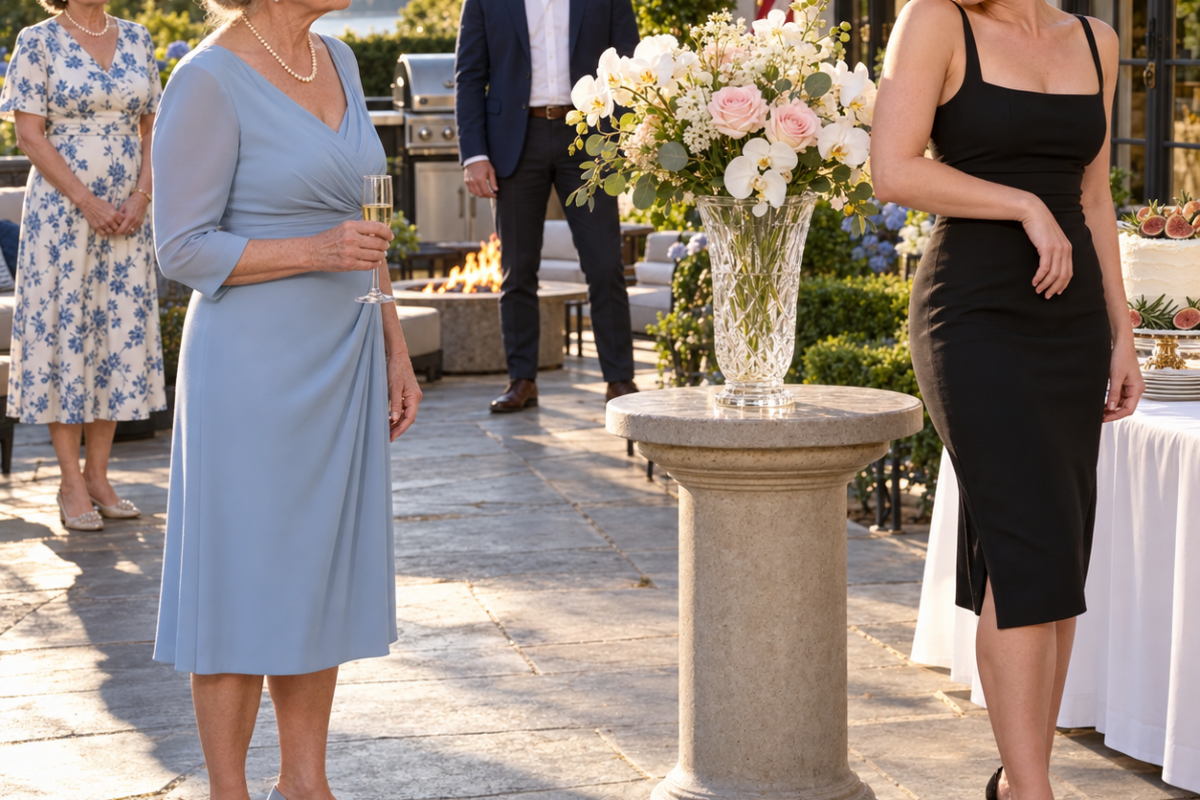
At my seventy-second birthday party, my daughter-in-law knocked a crystal vase off its pedestal with her elbow, watched it shatter, and smiled. “Oops.” Her own parents had given it to her and my son on their wedding day six years earlier. I looked at Frank, waiting for him to say something. All he managed was, “Mom…”
I watched my daughter-in-law break her own parents’ wedding gift with one elbow and a smile. For months afterward, people asked me whether I was…
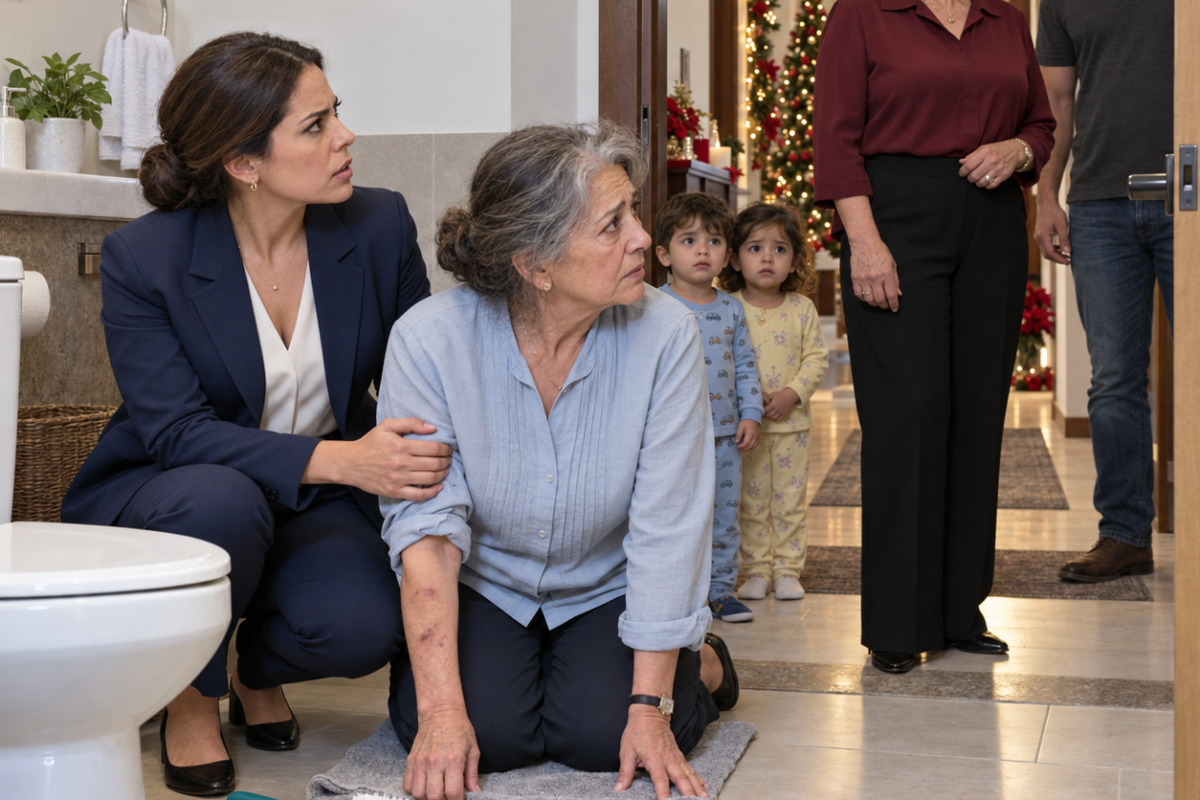
I came home three hours early and found my sixty-eight-year-old mother on her knees scrubbing my mother-in-law’s bathroom. When I helped her stand, her sleeve slipped back, revealing dark marks around her wrist. My husband stepped into the doorway. “Daniela, don’t make a scene.” That was when I remembered my father’s last warning: “If you ever see your mother hurt, don’t argue with anyone. Open the hidden compartment in her sewing machine.”
I came home three hours early and found my sixty-eight-year-old mother on her knees beside a toilet. Her hands were stiff with arthritis. One gripped…
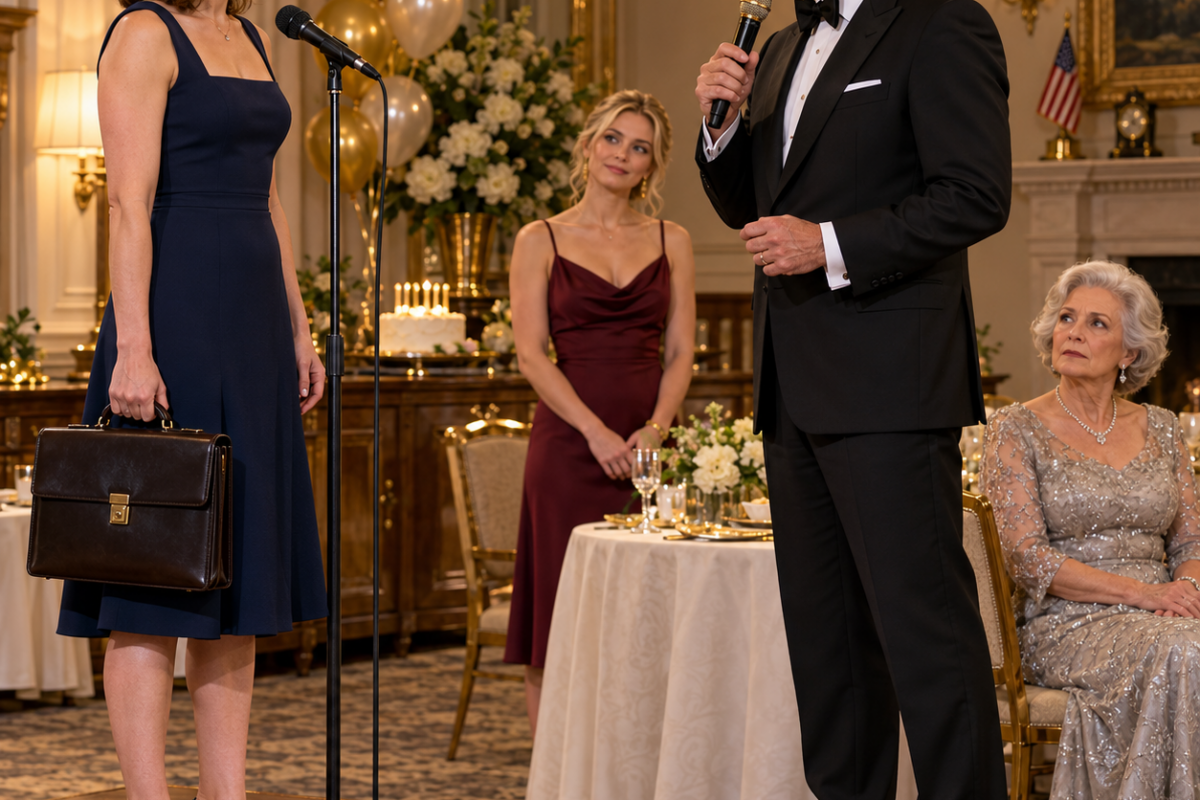
“I already promised your house to your sister,” my father told me four days after I bought it. “They’re moving in Monday. Rent-free for three years.” I was thirty-one, had saved for nine years, and had bought the five-bedroom home entirely in my own name. When I said no, he threatened to tell the family I had abandoned my sister’s children. Days later, he took the microphone at my grandmother’s seventy-fifth birthday dinner and did exactly that.
My father called twelve times in forty minutes after discovering I had bought a house without consulting him. When I answered, he didn’t ask whether…
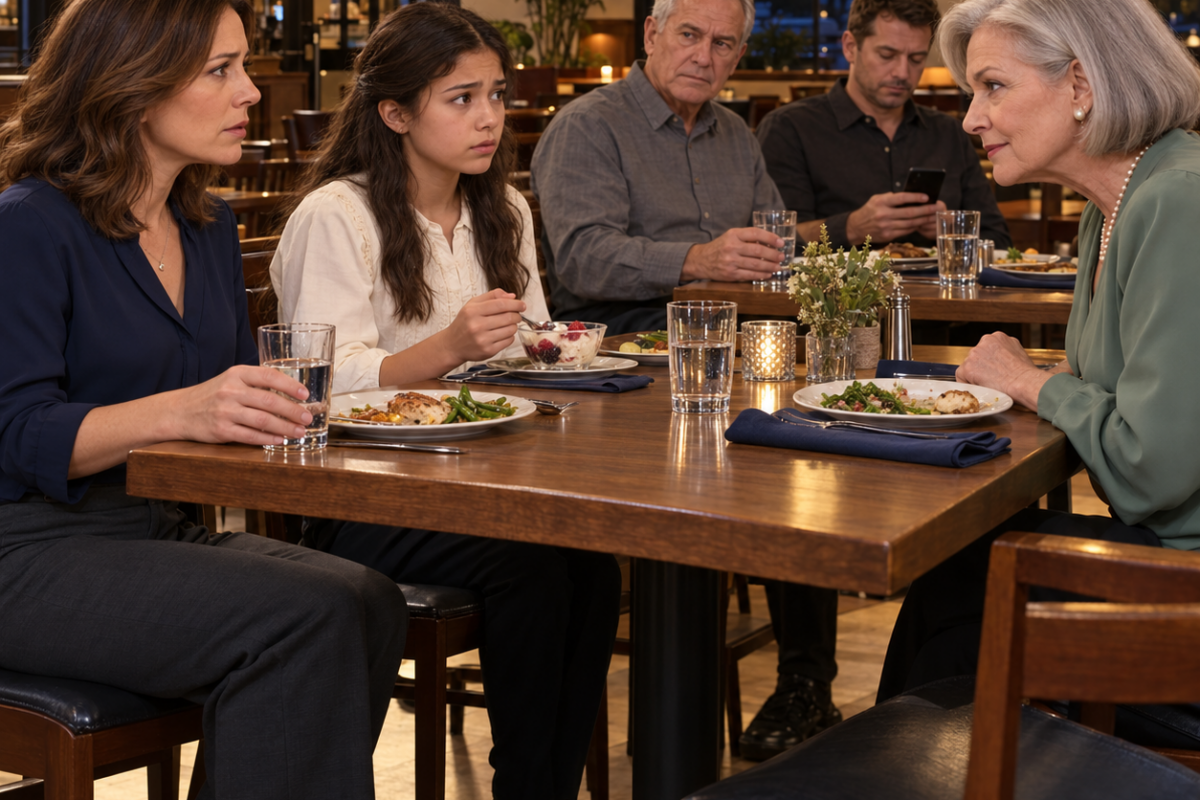
My mother leaned across the restaurant table, looked at my thirteen-year-old adopted daughter, and whispered, “We don’t sit with mistakes.” I took Sole’s hand and walked her out. That night, my father texted, “You’re still making the car payment tomorrow, right?” By midnight, I had canceled the payments I’d been making for my family. Then I remembered something Sole had told me about her grandmother.
My mother looked at my thirteen-year-old daughter and whispered, “We don’t sit with mistakes.” She said it softly enough to avoid attracting attention from the…
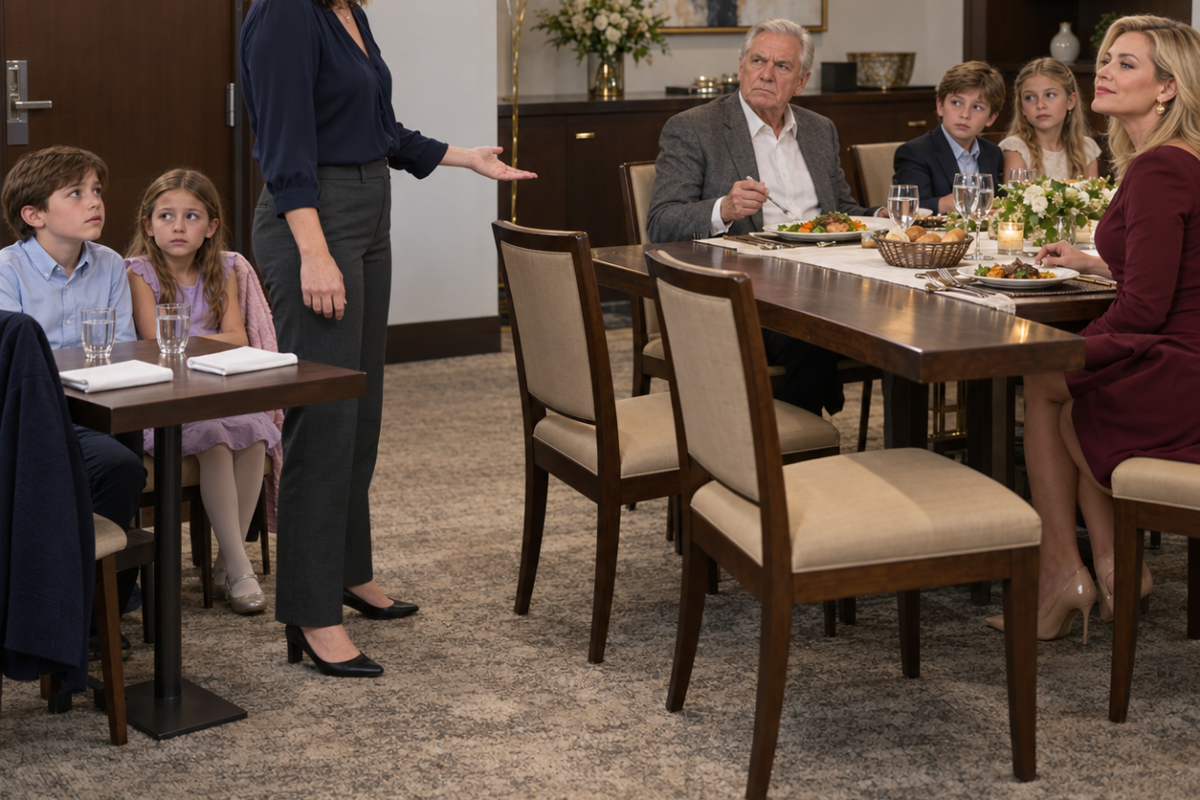
At my father’s seventieth birthday dinner, my eleven-year-old son and eight-year-old daughter were seated beside the service door with water glasses—but no dinner plates. Their cousins sat beside Grandpa with warm bread and full place settings. “They’ll eat after everyone else,” my sister said. I turned to my father, expecting him to object. “They can wait another hour,” he replied. There were two empty chairs at his table.
At my father’s seventieth birthday dinner, the first thing that stopped me wasn’t the cake or the gold balloons. It was my children. Ethan and…
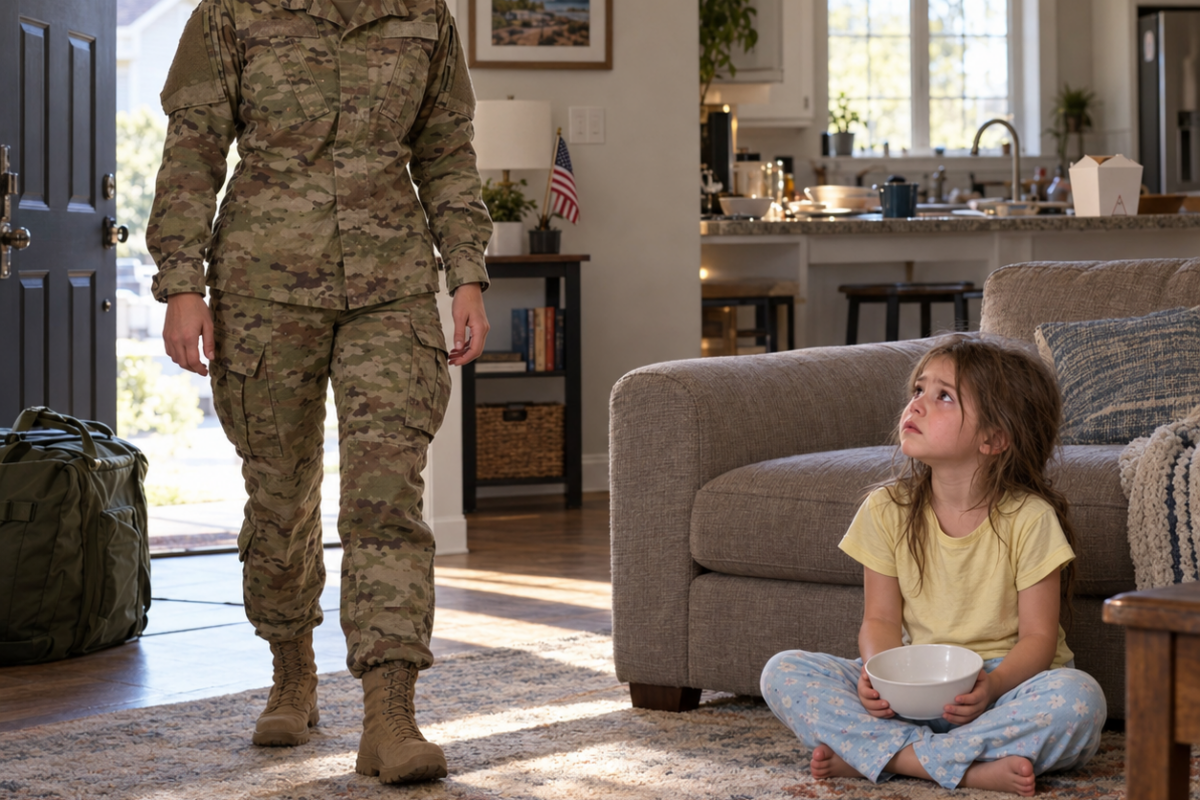
“Mommy, are you real?” my four-year-old daughter whispered when I came home from deployment three weeks early. She was sitting alone on our living room floor with an empty cereal bowl. My husband was on a Caribbean cruise with his mother and sister. Twenty-two minutes earlier, they had posted a photo captioned “Family time.” I was still in uniform when Sophie asked if she could have something to eat.
The first thing my daughter said when I found her was, “Mommy, are you real?” She was sitting cross-legged on our living room floor with…
End of content
No more pages to load