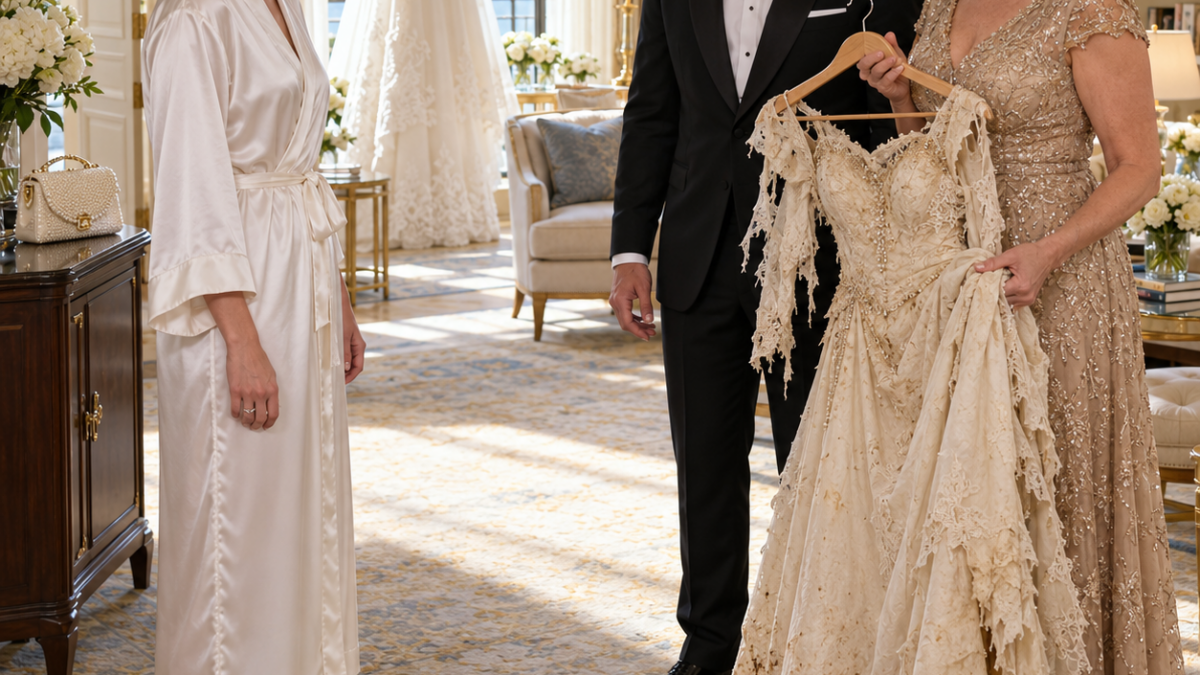
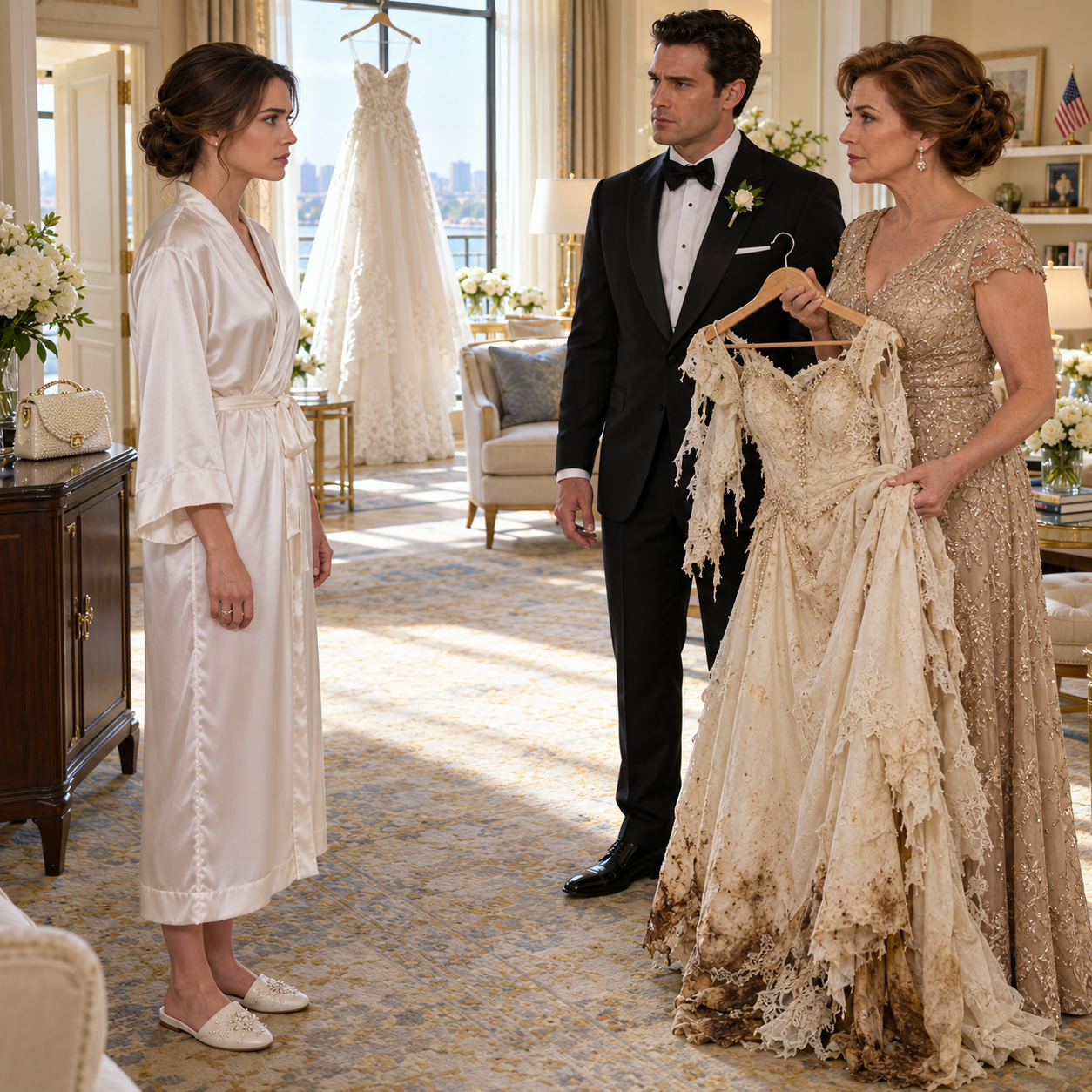
“Get on your knees, apologize to my mother, and wear her dress. Or get out,” my fiancé ordered three hours before our wedding. His mother stood beside him holding a bridal gown with torn sleeves and a brown-stained hem. I took off my engagement ring and placed it beside the dress. For once, I wasn’t going to give him the answer that kept his mother happy.
Larry called while I was halfway to the elevator.
I had just left the bridal suite, where his mother stood holding a ruined wedding gown and he had pointed at the carpet as though he were instructing a badly behaved dog.
“Get on your knees,” he had said. “Apologize to my mom, and wear the dress. Or get out.”
So I got out.
Now his name lit up my phone.
For a few seconds after I answered, I heard only breathing.
Then he whispered, “Elizabeth, please. Come back. Something happened.”
I stopped beneath the hallway lights.
“What happened?”
Behind him, someone was crying. Someone else was speaking sharply enough that I could hear the anger without understanding the words.
Larry swallowed.
“It’s your dress.”
I looked back toward the bridal suite.
“What about it?”
He didn’t answer immediately.
Then I heard Jenna.
“Don’t tell her to come back so she can calm your mother down.”
Larry moved away from her. His voice became quieter.
“Mom did something. I need you here.”
Seven years earlier, I would have heard the last sentence as proof that he loved me.
That morning, I heard it for what it was.
His mother had created another crisis.
And once again, he wanted me to become the solution.
My name is Elizabeth. Most people who loved me called me Liz.
I was twenty-six when I walked away from the wedding I had spent eighteen months planning and the man I had loved since I was nineteen.
There were flowers downstairs.
There were place cards arranged in alphabetical order.
There was a cake waiting in a refrigerated room, a photographer checking batteries, and relatives driving toward a hotel where they expected to witness the beginning of my marriage.
Upstairs, my engagement ring lay on a table beside a yellowed dress that smelled of dust, old perfume, and sour plastic.
At the time, the scale of what I had done was beginning to frighten me.
Not enough to make me return.
Enough to make my knees feel unreliable as I stood in the hallway.
“Tell me exactly what happened,” I said.
Larry exhaled.
“She tore it.”
For a moment, the words had no meaning.
“My dress?”
“Yes.”
I looked down at the small clutch in my hand.
Inside were a lipstick, tissues, my phone charger, and the room key Jenna had reminded me to bring.
Such ordinary things to be holding while the life I had planned rearranged itself.
“How?”
“She was upset.”
“That isn’t how.”
He hesitated.
“She pulled it off the hanger. The lace caught, and then—”
I could hear him searching for the version that would make it an accident.
“Did she do it deliberately?”
“Elizabeth.”
“Did she?”
Silence.
Then he said, “Yes.”
I leaned against the wall.
My gown had been hanging beside the window.
Ivory silk.
Clean lines.
A small lace detail at the back.
I had chosen it after twelve try-ons and a FaceTime call with my mother that made both of us cry.
I had saved for it.
More importantly, I had felt like myself in it.
Kathleen had disliked that from the first photograph.
Now she had found a way to make my refusal cost me something visible.
“Where is Jenna?” I asked.
“With your mom.”
“My mother is there?”
“She arrived just after you left.”
That explained some of the voices.
My mother, Caroline, had been staying on a lower floor. She was supposed to come up once her hair appointment was finished.
I had expected her to walk into a room filled with nerves and happiness.
Instead, she had found my bridesmaid holding the pieces of my wedding dress.
Larry said, “Dad’s here, too. Everyone’s overreacting.”
I closed my eyes.
There it was.
A destroyed gown.
A demand that I kneel.
My mother crying.
And the problem, in Larry’s description, remained everyone else’s reaction.
“I’m not coming back to manage this,” I said.
“Liz, please.”
“Give Jenna the phone.”
“She’s busy.”
“Then tell her to call me.”
“Can we talk first?”
“No.”
I ended the call.
A hotel employee had appeared near the service door at the end of the hallway. She had seen enough of my face to understand I was not simply a bride looking for ice.
“Are you all right, ma’am?”
I almost said yes.
The habit was strong.
Instead, I said, “I need somewhere quiet. And I need to make sure a few people can find me without everyone else following.”
She nodded immediately.
“My name is Dana. Let me help.”
For the first time that morning, someone offered help without telling me what I should become grateful for.
Three hours earlier, I had woken with the kind of nervous happiness people tell you to expect on your wedding day.
Jenna was already awake, sitting cross-legged on the sofa in our adjoining room with a coffee cup and a list.
She had been my friend since freshman year of college. She knew when I needed encouragement and when I needed someone to say a situation was ridiculous.
That morning, she began by informing me that the weather was good, the flowers had arrived, and nobody had yet lost a shoe.
“A promising start,” I said.
“Don’t get overconfident. There’s still time.”
We laughed.
I ate toast while she checked messages.
There was a text from Larry.
Big day. Love you.
I smiled at it.
That detail matters.
I did not wake intending to cancel a wedding.
I woke believing the difficult parts of planning were over and that whatever remained between Larry and his mother could be handled more easily once we were married.
I know how that sounds now.
At the time, I called it hope.
My makeup artist, Tessa, arrived at nine.
Another bridesmaid, Molly, joined us shortly afterward.
There was music from someone’s phone, coffee on the table, and a bottle of sparkling wine Jenna said we could open once I had eaten something more substantial than nerves.
My actual gown hung beside the window.
The late-morning light made the fabric look almost warm.
I remember standing in front of it for a moment before sitting down for makeup.
This is real, I thought.
After seven years, we were finally here.
Kathleen arrived without knocking.
She carried a yellowed garment bag with both hands, holding it carefully enough that I first assumed it contained a veil or some family accessory she wanted to show me.
Tessa paused with the brush near my cheek.
Jenna lowered her glass.
Kathleen looked around the room, then at my gown.
Her smile tightened.
“Elizabeth,” she said, “I brought your wedding dress.”
I looked toward the window.
“My dress is there.”
She did not acknowledge it.
She placed the garment bag on the table and unzipped it.
The smell emerged first.
Then the fabric.
A brown-stained hem.
Yellowed lace.
Torn sleeves.
Beads hanging from loose threads.
There was something sad about it.
An object once loved, stored badly, and brought into a room where it was expected to become more than it could possibly be.
I might have responded kindly if she had simply wanted to show it to me.
I might have asked whether a small piece could be preserved, or whether she wanted a photograph beside her son.
But she lifted it toward me.
“Today, you should wear this. It’s our tradition.”
Jenna looked at me.
I looked toward the doorway.
Larry stood there.
He was not surprised.
That was the first thing I understood.
He knew.
He had allowed his mother to arrive with a decision that would overturn mine less than three hours before the ceremony.
“I’m not wearing that,” I said.
My voice sounded small in the room.
It was still clear.
Kathleen’s smile disappeared.
“What did you say?”
“I respect what it means to you. But I already have my dress.”
Her expression hardened.
“You selfish little girl.”
Tessa lowered the brush.
“After everything this family has done for you?”
The phrase should have surprised me less.
Kathleen had been using it for years.
Her family had not done everything for me.
I had worked two jobs through college.
I had paid my own bills.
I had helped Larry when he lost his apartment after a period of unstable work.
I had bought groceries when he was embarrassed to ask his father for help.
I had listened to him describe his ambitions and encouraged him through the months when ambition was easier than progress.
Still, Kathleen spoke as though my presence in their family was an opportunity I should spend the rest of my life repaying.
Larry entered the suite.
“Elizabeth, just put it on.”
I turned toward him.
“Larry, look at it.”
“I said put it on.”
The tone was different from the one he used when we were alone and he wanted to be forgiven.
Low.
Clipped.
Certain.
I felt my chest go cold.
“You knew she was bringing this.”
He glanced at his mother.
“She wanted to surprise you.”
“This is not a gift.”
Kathleen gasped softly.
“Listen to how she speaks to me.”
Jenna said, “Liz—”
“Stay out of family business,” Kathleen snapped.
Family business.
I was not yet his wife, and already the room had been divided into people permitted to direct me and people expected to remain silent.
I looked at Larry.
“You want me to take off the dress I chose and wear your mother’s damaged gown because she says so?”
“You’re embarrassing her.”
“She brought this here and told me I had to wear it.”
“She’s trying to include you.”
“Then why is saying no being treated as an insult?”
His face darkened.
Kathleen pressed a hand against her chest.
Her eyes filled.
I had seen those tears before.
They often appeared at the moment someone asked a question she did not want to answer.
Larry pointed at the carpet.
“Get on your knees. Apologize to my mom, and wear the dress. Or get out.”
No one moved.
The music continued for several seconds before Molly reached over and stopped it.
Tessa set down her brush.
Jenna stood.
I looked at Larry’s hand.
Then at his face.
The future became visible.
Not every detail.
Enough.
Disagreement would become disobedience.
His mother’s feelings would become my responsibility.
My humiliation would be described as the price of keeping the peace.
And if I refused, I would be told to leave the life I had helped build.
Something inside me became very quiet.
I slipped off my engagement ring.
Larry blinked.
“What are you doing?”
I walked to the table and placed it beside the old dress.
“I’m getting out.”
He reached for my wrist.
I stepped back before his fingers closed.
It was not dramatic.
I simply did not allow him to take hold of me.
Jenna moved beside me.
I picked up my clutch.
Then I walked through the door.
The hotel hallway seemed too bright.
My heartbeat was louder than my shoes.
Behind me, Kathleen began saying my name as though I had forgotten how to obey it.
I kept walking.
That was the moment Larry called.
Dana brought me to a small meeting room away from the bridal floor.
It had a round table, comfortable chairs, and a window looking over a courtyard.
Nothing about it resembled a place where a wedding was meant to end.
I was grateful for that.
She brought water and asked whether I wanted someone contacted.
“My bridesmaid. Jenna.”
I gave her the name.
Then I called Jenna myself.
She answered immediately.
“Where are you?”
“I’m safe. Dana helped me find a room.”
“Good.”
“What happened to the dress?”
Jenna took a breath.
“She pulled it down after you left. She said if you wouldn’t respect her dress, you didn’t deserve to wear yours.”
I stared at the table.
“She said that?”
“Yes.”
“What did Larry do?”
“He told her to calm down. Afterward.”
The word afterward carried everything.
Jenna continued.
“Your mom arrived while she was pulling at it. Larry’s dad came because he heard shouting from the hall.”
I closed my eyes.
“Is Mom all right?”
“She’s upset. But she’s all right.”
“Tell her where I am.”
“We’re coming.”
Before ending the call, Jenna said, “Liz, I need you to hear something.”
“What?”
“This isn’t your fault.”
I nodded even though she could not see me.
Then I said, “I know.”
I did know.
I also knew that in an hour, or a day, or a week, guilt might try to rearrange the facts.
I would need people who remembered them clearly.
My mother arrived first.
Her hair was pinned neatly.
She wore the soft green dress we had chosen together.
She looked at me and stopped in the doorway.
For a moment, neither of us spoke.
Then she came across the room and held me.
I began crying against her shoulder.
Not because I wanted Larry back.
Because my mother had traveled to watch me marry him.
Because she had helped me choose a gown that now lay torn upstairs.
Because I had spent seven years trying to believe love could make Larry braver than he was.
Because I was twenty-six and had just discovered that walking away could be the right decision and still feel like losing the ground beneath me.
She held me until I could breathe.
Then she sat beside me.
“Are you hurt?”
“No.”
“Did he touch you?”
“He reached. I stepped back.”
She nodded slowly.
“Do you want to go back?”
“No.”
“Then we’re not going back.”
I looked at her.
“You don’t think I should talk to him first?”
“We can arrange whatever conversations you want later. You don’t owe him a wedding while you decide.”
That sentence steadied me more than anything else.
A ceremony was not a deadline for surrender.
Jenna arrived carrying my overnight bag and a pair of flat shoes.
“I figured the heels had done enough,” she said.
I laughed once through tears.
She knelt to help me change shoes, then stopped and looked up at me.
We both understood the position.
She stood quickly.
“Actually, put your feet on that chair. We’re retiring kneeling from the day.”
My mother laughed softly.
So did I.
It was a small, ridiculous moment.
I needed it.
Tessa came by briefly.
She asked whether I wanted the unfinished makeup removed or completed.
I chose completed.
Not because I still intended to marry.
Because I did not want Kathleen’s behavior to decide how I looked for the rest of the day.
Tessa nodded.
“Then sit.”
She worked quietly.
Nobody told me I needed to be beautiful to prove anything.
She simply helped me feel less undone.
While she finished, Jenna began handling practical questions.
The ceremony was scheduled for early afternoon.
Guests would arrive soon.
The hotel coordinator needed instructions.
The officiant needed to know.
Vendors needed a clear contact rather than rumors spreading through staff corridors.
I had signed several contracts.
Larry had signed others.
Some were joint.
Some deposits were not refundable.
There was no magic phrase that would cancel every obligation without cost.
But money already spent could not become a reason to enter a marriage I no longer wanted.
I told Jenna I needed to speak to the coordinator.
Dana returned with her.
Her name was Melissa.
She sat opposite me with a notebook.
“Tell me what you want us to do.”
I took a breath.
“The wedding is canceled.”
She did not ask whether I was sure in a way that implied I needed persuasion.
She asked practical questions to confirm the instruction.
Was there any ceremony proceeding?
No.
Should arriving guests be informed discreetly?
Yes.
Did I want a private room for immediate family?
Yes.
Should Larry and Kathleen be directed away from my room unless I agreed to a meeting?
Yes.
Melissa explained what the hotel could do and what would need to be handled under the contracts.
We agreed the staff would continue to be paid for their work.
Food already prepared could be served to guests who had traveled and needed a place to gather, but not as a disguised reception.
There would be no cake cutting.
No first dance.
No announcement inviting people to watch me turn a canceled wedding into a performance.
I wanted dignity.
I wanted people fed.
I wanted the ceremony stopped.
Those wishes could coexist.
The officiant called next.
I told her briefly.
She said, “I’m sorry.”
Then she added, “A wedding is something people should choose. You do not owe anyone a ceremony to protect them from disappointment.”
I thanked her.
I would remember that sentence whenever someone later said I should have gone through with the day and handled things afterward.
Marriage was not a costume I could put on for photographs and quietly correct later.
The decision mattered before the vows.
Larry called repeatedly.
I silenced the phone but kept it available for the people helping me.
He left messages.
At first, he wanted me to return.
Then he said his mother was unwell.
Then he said his father was threatening to leave.
Then he said guests were arriving and I was making everything worse.
Finally, he said he loved me.
The order mattered.
I listened to the last message twice.
I wanted to hear the man I had loved.
I also heard a man who still seemed to believe love should bring me back into the room before accountability could begin.
I did not call him.
His father, Peter Martinez, asked whether he could speak with me.
I had known Peter for years.
He was quiet in a way I had once interpreted as kindness.
Sometimes it was kindness.
Sometimes it was avoidance.
He often left Kathleen’s behavior unchallenged, then approached me afterward to say she did not mean it badly.
That had helped preserve the family’s peace.
It had not helped me.
I agreed to a brief conversation with my mother present.
Peter arrived looking shaken.
He sat down slowly.
“I’m sorry, Elizabeth.”
I waited.
“I heard what happened.”
“Which part?”
He looked at me.
“The demand. The dress. What Larry said.”
“Did you know she was bringing the gown?”
“I knew she had taken it out of storage. She said she wanted a photograph with you.”
I believed that was possible.
It did not explain everything.
“Has anyone else in the family been required to wear it?”
He shook his head.
“No.”
“Then it wasn’t a tradition.”
“No.”
The word settled between us.
Kathleen had used tradition because tradition sounded larger than a preference.
Older.
More respectable.
More difficult to refuse.
Peter looked down at his hands.
“I should have stepped in years ago.”
My mother remained silent.
I appreciated that she let him answer me rather than turning the meeting into a fight between parents.
“I don’t need you to make a speech about all the years,” I said. “I need people not to tell me this was a misunderstanding.”
He nodded.
“It wasn’t.”
I felt my shoulders lower slightly.
That admission did not repair the damage.
It kept someone from adding another layer to it.
He said Kathleen had been instructed by hotel management to remain in another room while the incident was addressed.
Security had documented the disturbance and the damage.
There was no need for anyone to stand in the hallway arguing.
Larry was downstairs.
He wanted to speak to me.
“I’m not ready,” I said.
Peter nodded.
“I’ll tell him.”
At the door, he stopped.
“You don’t owe us your life because we expected to be at a wedding today.”
My eyes filled.
I wished he had said something like that years earlier.
I was grateful he said it now.
Not long afterward, Larry’s aunt arrived.
Her name was Rosa.
She had always been friendly to me, though we rarely spoke privately.
She asked whether she could come in.
I said yes.
She sat beside Jenna and looked at my mother.
“I’m sorry this happened.”
Then she turned to me.
“I heard Kathleen called the dress a family tradition.”
“Yes.”
Rosa shook her head.
“It was her wedding dress. It was not required of anyone else.”
She explained that years earlier, Kathleen had offered it to another relative, who declined because it did not fit.
There had been an argument.
No one wore it.
The story had apparently changed over time until an old disappointment became something the next young woman was expected to correct.
I listened.
It was not the ruined fabric that made me angry.
It was the way Kathleen had dressed control in the language of belonging.
Wear this and you are family.
Refuse and you are selfish.
Kneel and the argument ends.
I looked at Rosa.
“Why didn’t Larry tell me?”
She sighed.
“Because he thought you would give in.”
I nodded.
That was the answer I already knew.
The first guests began arriving.
I did not see them immediately.
Melissa’s team directed people discreetly.
A short message was sent through the appropriate contacts.
“The wedding will not take place today. Elizabeth and Larry ask that immediate arrangements be coordinated through the hotel staff. Guests who have traveled are welcome to gather in the reserved room for food and refreshments.”
I removed the phrase about Larry asking.
He had not asked.
We changed it to a factual notice without pretending we were jointly managing the decision.
I did not include the demand to kneel.
Not because I wanted to hide it.
Because I did not owe every guest the details of my humiliation before I had eaten lunch.
There were people who needed the truth.
They received it.
There were people who only needed to know not to wait for a ceremony.
They received that.
My uncle called my mother.
My cousin texted Jenna.
Friends asked whether I was safe.
One guest sent a message saying we had inconvenienced everyone.
Jenna looked at it and put my phone facedown.
“Not today.”
I agreed.
The fact that other people had traveled mattered.
It did not outweigh the fact that I was being asked to enter a marriage under a threat.
I would handle disappointment.
I would not kneel to prevent it.
Around noon, Amelia, our photographer, requested a few minutes.
She had been scheduled to photograph preparations and had entered the suite shortly before Kathleen arrived.
I had barely noticed her because Tessa was finishing my makeup.
Amelia explained that she had begun recording a short preparation clip while I was fully dressed in my robe and discussing earrings with Jenna.
When the interaction changed, she stopped focusing on the bridal details and retained what had been recorded.
She had not published anything.
She wanted to know whether I wanted a copy preserved.
I looked at her.
“What is on it?”
“Enough of the exchange to establish what was said. Not the entire incident afterward.”
My mother took my hand.
I told Amelia to preserve it privately and provide it through the appropriate process if needed.
No social media.
No promotional use.
No sharing with curious guests.
She agreed immediately.
I did not watch it then.
I had been there.
I did not need to relive Larry pointing at the floor simply because a camera had captured it.
But later, when someone claimed I had misunderstood his tone, I would be glad the record existed.
Truth should not require a video to deserve belief.
Still, people who insist on revising events can make a record useful.
Jenna retrieved the damaged gown with hotel staff present.
It remained in the garment bag, handled carefully.
The damage was photographed for documentation and to allow the designer to assess it.
Kathleen had pulled at the lace and the fastening area in a way that tore part of the back and damaged the seam beneath it.
The gown was not reduced to theatrical scraps.
It was still recognizably my dress.
That made it sadder.
Something chosen with care had been harmed because another person could not bear my refusal.
When Jenna placed the bag on a chair, I stared at it.
“Do you want to look?” she asked.
“Not yet.”
“Okay.”
No one unzipped it for me.
No one told me confronting the damage would help.
I was beginning to notice how often respectful help started with asking.
Kathleen requested a meeting.
I declined.
Then she called my mother.
My mother let it go to voicemail.
The message began with an apology.
Then it became an explanation.
Then it became blame.
She had been emotional.
The dress was precious.
I had rejected her.
Jenna had interfered.
Larry had been under pressure.
I had always been difficult about wedding decisions.
By the end, the apology had disappeared beneath a list of reasons her behavior was understandable.
My mother played only enough for me to know what it was.
Then she stopped.
“You don’t have to answer that.”
“I know.”
I looked at the gown bag.
“I keep thinking I should have seen it earlier.”
My mother sat beside me.
“You saw things. You hoped they would change.”
“That sounds foolish.”
“It sounds human.”
She looked at me.
“But now you know what happens when you don’t give her what she wants.”
Yes.
Now I knew.
That was the knowledge I could not carry into a ceremony and pretend away.
We ate sandwiches in the meeting room.
Mine tasted like nothing at first.
Then I realized I was hungry.
Jenna told me to take another bite before making any more decisions.
My mother removed a pin from her hair that had begun hurting.
Tessa packed her kit.
Molly returned with water.
The day had become practical.
That helped.
Shock wanted to make the entire situation enormous.
A sandwich required one bite.
A room required a door.
A phone required a boundary.
I could handle those things one at a time.
At one o’clock—the hour guests expected the ceremony to begin—I was sitting beside the window with my shoes off.
The courtyard below was bright.
Two hotel employees were moving chairs.
A child crossed the path holding a parent’s hand.
Life continued with an indifference I found both painful and comforting.
I had imagined walking toward Larry.
Instead, I was deciding where I would sleep that night.
My mother offered her room.
I wanted to leave the hotel altogether.
Jenna agreed to come with me.
We arranged transportation.
My things would be collected with staff assistance.
The gown would come with us.
The ring remained with the appropriate person for later handling through advice and agreement. I did not want a hallway argument about ownership or a sentimental exchange that might be mistaken for reconsideration.
There were shared items in the apartment Larry and I rented.
Those would need sorting.
We had a lease.
Bills.
Furniture.
Years of possessions mixed together.
Walking away from the wedding was one clear action.
Leaving the relationship would require many smaller ones.
I knew that.
I still preferred the work to the marriage I had glimpsed in the suite.
Before I left, Larry asked one final time for a conversation.
I agreed to ten minutes in a hotel meeting room, with my mother and Jenna nearby and the understanding that either of us could end it.
I did not want Kathleen present.
He arrived alone.
His suit was immaculate.
The boutonniere had been removed.
He looked like a man whose plan had failed publicly.
I wondered whether he understood that my plan had failed, too.
For several seconds, he said nothing.
Then he whispered, “I’m sorry.”
I waited.
He looked at me.
“You know how Mom gets.”
The sentence undid the apology.
I had heard it for seven years.
When she criticized my clothing.
When she changed our holiday plans.
When she told me I laughed too loudly.
When she complained that my cooking was unfamiliar.
When she said I held a wineglass incorrectly.
You know how Mom gets.
It was supposed to explain why I should adapt.
I looked at him.
“Yes. I do.”
He rubbed his forehead.
“She’s old-fashioned.”
“She told me to wear a damaged dress. You told me to kneel.”
“I didn’t mean it like that.”
“How did you mean it?”
He hesitated.
“I wanted the argument to stop.”
“By making me smaller.”
“No.”
“Then why on my knees?”
His face changed.
He had no answer that could make the gesture ordinary.
I let him feel that.
For years, I had helped him move past difficult questions by offering a kinder interpretation.
This time, he had to supply his own.
“I was angry,” he said.
“At me?”
“At the situation.”
“I was the person you ordered.”
He looked down.
Then he said, “I shouldn’t have done that.”
“No.”
“I know.”
“What do you know?”
He looked up, frustrated.
“Liz, do we have to do this like an interview?”
“Yes,” I said. “Because the wedding is not happening just because you say you’re sorry.”
He became quiet.
I could see him finally recognizing that he was not negotiating a delay.
He was facing an ending.
He said his mother had been wrong to damage the dress.
I asked why he had not prevented it.
He said it happened quickly.
That might have been true.
I had not been there.
But the more important moment happened before any fabric tore.
He had chosen her side.
He had pointed at the floor.
He had told me to leave.
“I did what you told me,” I said.
His eyes filled.
“I didn’t think you would.”
There it was.
The truth underneath every explanation.
He had not expected obedience because the demand was reasonable.
He had expected it because I loved him enough to tolerate unreasonable things.
“I loved you,” I said.
“You still do.”
“Yes.”
He leaned forward.
“Then we can fix this.”
I shook my head.
“Love is not the part that needs fixing.”
He looked confused.
I continued.
“I need a partner who can disagree with his mother without asking me to be humiliated. I need someone who will not threaten the relationship because I make a decision about my own body and my own clothes. I need someone who knows an apology is not the same thing as surrender.”
He stared at me.
For years, I had expressed those needs one at a time.
Softly.
With context.
With reassurance.
Now they sounded like a list because he had never allowed them to become conditions.
He asked whether we could postpone.
Take a few weeks.
Get counseling.
Tell guests there had been a family emergency.
I considered it.
Not because I wanted to marry him that afternoon.
Because seven years do not vanish when a person finally sees the problem clearly.
Then I remembered his hand pointing toward the carpet.
“I’m ending the engagement,” I said.
He went still.
“I’m not deciding every future feeling today. I’m deciding I will not marry you.”
He covered his face.
I felt sad.
I did not feel responsible for making him stop.
After a moment, he said, “Mom will never forgive this.”
I looked at him.
“That is no longer the question.”
The meeting ended.
He did not reach for me.
I was glad.
I walked out with my mother beside me.
Jenna carried the bag.
We left through a side entrance because I did not want to pass a room full of relatives before I had enough strength to speak.
There was no crowd cheering.
No dramatic exit beneath flowers.
Just a hotel employee holding the door and asking whether we had everything.
I thanked her.
Outside, the air felt cool against my face.
I had expected to leave that hotel as a wife.
I left in a robe under a coat, carrying the shoes I had planned to wear down the aisle.
For a moment, the difference felt unbearable.
Then Jenna opened the car door.
My mother touched my back.
I got in.
We drove to my mother’s house.
The road looked ordinary.
A grocery store.
A bus stop.
A man walking a dog.
I watched people living through a Saturday that would not remain in their memories.
Mine would.
At my mother’s house, I changed into clothes Jenna had packed.
Sweatpants.
A soft shirt.
Nothing bridal.
Then I sat on the edge of the bed and looked at my bare ring finger.
The skin beneath it was slightly pale.
A small physical record of a promise I had stopped wearing.
I cried again.
Jenna sat beside me.
She did not say I had dodged a bullet.
People used that phrase later.
Sometimes it helped.
Sometimes it made seven years sound like something I should be able to shrug off because I had escaped the worst ending.
I had escaped something.
I had also lost something.
The man I thought Larry could become.
The future I had pictured.
The ordinary plans that had not involved his mother at all.
Those losses deserved grief.
My mother brought tea.
We ate soup.
Jenna went home after I promised not to spend the night answering messages.
My phone remained on the dresser.
It did not stop lighting up.
There were kind messages.
Confused messages.
Angry messages.
People asking for details.
People insisting I should forgive.
People describing the event as a dispute over a dress.
That description hurt.
If it had only been a dress, I could have found another one.
The dress was the object.
The marriage was the decision.
I wrote a short statement for the people who needed clarity.
“The wedding did not take place because I ended the engagement after conduct I will not accept in a relationship. I appreciate your concern and understand the inconvenience to those who traveled. I’m handling practical matters privately and won’t be discussing details widely.”
I sent it.
Then I turned the phone over.
The first night, I slept for two hours.
Woke.
Slept again.
At four in the morning, I went to the kitchen.
My mother found me there.
“Tea?”
“Yes.”
We sat at the table while the house remained dark.
“I feel like I failed,” I said.
She looked at me.
“At what?”
“At making it work.”
“You could not make Larry choose differently.”
“I tried for seven years.”
“I know.”
She took my hand.
“That does not mean the eighth year was owed.”
I looked down.
For so long, time invested had felt like a reason to remain.
I had not considered that time could also be evidence I had already given the relationship enough opportunity.
The next weeks were harder than the wedding day in some ways.
The hotel had deadlines.
Vendors had invoices.
The apartment had possessions.
Larry had messages.
I had grief that did not arrive only during convenient hours.
I consulted an attorney named Rebecca Lin to handle the practical questions.
Not because I wanted to punish Larry with every possible claim.
Because the engagement ring, shared lease, property, wedding contracts, and damaged gown needed accurate advice.
Different items had different rules.
I did not assume returning the ring meant I owed the dress.
I did not assume paying a deposit meant I could recover it.
I did not assume being wronged made every legal question simple.
Rebecca reviewed the documents.
She explained options.
Some costs were lost.
Some contracts allowed partial refunds.
Some could be adjusted.
The damaged gown could be addressed through a documented claim against the person responsible, with invoices and expert assessment rather than inflated demands.
I wanted the actual loss recognized.
Not a number designed to make Kathleen feel the amount of pain she had caused.
Pain was not something an invoice could measure.
The apartment arrangements required cooperation.
Larry and I had both lived there.
I did not change locks and pretend he no longer had rights because the wedding was canceled.
We arranged collection times.
Inventories.
A clear plan concerning the lease.
Friends accompanied me when I collected belongings.
Larry stayed elsewhere during the visit.
Kathleen was not permitted to insert herself into the arrangement.
She tried.
Rebecca responded through the appropriate channel.
I was grateful for that distance.
It allowed me to handle the facts without having to withstand another speech about gratitude.
The first time I entered the apartment after the wedding, I nearly stopped at the door.
There were mugs in the sink.
A pair of Larry’s shoes near the sofa.
The blanket we used while watching films.
The life looked paused.
I knew it was over.
I packed slowly.
Books.
Clothes.
Photographs.
The lamp my father had repaired years earlier.
I took what was mine.
I left what was his.
Shared things were handled according to the agreement we reached.
Nothing about the process was romantic.
That helped.
A relationship can become clearer when practical objects replace the story you have told about it.
Who bought the table?
Who used the account?
Who signed the lease?
Who paid what?
Who is agreeing now?
The questions did not erase love.
They removed the illusion that love had already made everything fair.
Larry wrote a letter two weeks later.
It began well.
He apologized for telling me to kneel.
He said he had watched the preserved clip and felt ashamed.
He said his father had confronted him.
Then the letter shifted.
He asked whether I could understand the pressure he felt.
He described Kathleen’s fear of losing him.
He said I knew how much she had struggled.
He asked me not to judge his whole character from one moment.
I read it twice.
Then I put it away.
The problem was not one moment.
It was seven years of smaller moments gathering behind it.
The wedding morning made them impossible to dismiss.
It did not create them.
I replied briefly.
“I appreciate the acknowledgment. I am not reconsidering the engagement. Please direct practical matters through Rebecca.”
He called it cold.
I did not answer.
Kathleen’s letter arrived through Peter.
She said she had wanted me to honor the family.
She said the gown was emotionally important.
She said she had been frightened by the thought of losing her son.
She said she regretted the damage.
Then she wrote that Jenna had encouraged me to overreact.
I stopped reading for a while.
There was still someone else responsible.
Someone else making me difficult.
Someone else explaining why her actions should be treated as understandable.
Later, I finished the letter.
She offered to pay part of the repair costs if I agreed not to discuss the incident with relatives.
I declined that condition.
The financial matter would be handled properly.
I was not selling silence.
I also had no intention of publishing a campaign against her.
Privacy was my choice.
Not something she could purchase after humiliating me.
Rebecca addressed the offer.
The gown was assessed by its designer, Sofia.
I went to her studio with my mother.
For several minutes, I could not open the garment bag.
Sofia waited.
Finally, I unzipped it.
She examined the damage carefully.
There was no dramatic gasp.
Just professional concentration.
She explained what could be repaired, what would need replacing, and what alterations might make the damage less visible.
The gown could not become exactly what it had been before.
It could become something good.
I began crying.
Sofia handed me tissues.
“We don’t have to decide today.”
I nodded.
“I don’t know whether I ever want to wear it.”
“You don’t have to.”
She folded the fabric gently.
“It can remain a dress you chose. You are allowed to decide what happens next.”
That mattered.
Kathleen had tried to take the meaning of the gown.
I did not need to prove she had failed by wearing it immediately.
I could wait.
My mother paid for lunch afterward, though I protested.
She smiled.
“Let me do one motherly thing without turning it into a contract.”
I laughed.
We sat at a small restaurant.
I ate properly for the first time in several days.
Then I told her something I had kept quiet through the engagement.
“I was scared of disappointing her.”
“Kathleen?”
“Yes.”
“More than you were scared of being unhappy?”
I looked down.
“Sometimes.”
My mother was quiet.
Then she said, “I wish you had told me.”
“I thought you would dislike Larry.”
“I already worried about some things.”
“Why didn’t you say more?”
She sighed.
“Because I wanted you to know I trusted you. And because when I asked gently, you explained everything.”
She was right.
I had defended him.
Explained his mother.
Described the good days.
Insisted the future would be different.
We had both been trying not to push the other away.
That had left some truths unspoken.
“I don’t want to do that anymore,” I said.
“Then we can be more honest.”
We began.
I returned to work three weeks after the canceled wedding.
I had taken leave for the ceremony and honeymoon.
There was no honeymoon.
I could have stayed away longer.
But I wanted routine.
I worked in program coordination for a community healthcare organization. The job required planning, patience, and the ability to make several imperfect systems cooperate long enough that people received services.
I liked it.
During the engagement, I had sometimes treated work as something to fit around Larry’s needs.
Now I began noticing how much of myself existed there.
Colleagues knew me as reliable.
Thoughtful.
Occasionally stubborn.
None of those qualities became selfish because Kathleen disliked them.
My supervisor, Dana, asked what I wanted shared.
I told her only that the wedding had not taken place and I would prefer not to discuss details widely.
She respected that.
One coworker left a small note on my desk.
Glad you’re here.
No advice.
No questions.
I kept it.
There were moments at work when grief arrived unexpectedly.
A calendar invitation for a wedding-related appointment I had forgotten to cancel.
A photograph someone sent before realizing what happened.
A patient mentioning her anniversary.
I would step into a quiet room, breathe, and return.
I was not pretending the pain had ended.
I was learning it did not have to occupy every hour.
I began seeing a therapist named Dr. Helen Martin.
At the first appointment, I spent most of the time explaining why I had stayed with Larry for seven years.
He had been kind.
He had supported me at times.
He had been funny.
He loved me.
His mother had a strong personality.
He was trying to keep the peace.
Dr. Martin listened.
Then she asked, “Who was expected to pay for that peace?”
I went quiet.
The answer was immediate.
Me.
Not always.
Enough.
We talked about how I had learned to make objections soft enough that nobody could accuse me of being unkind.
About how being calm did not mean I was comfortable.
About the difference between compromise and being asked to abandon a decision because someone else disliked my independence.
I had confused those things.
Not because I lacked intelligence.
Because love, habit, and fear can turn unreasonable expectations into familiar ones.
Dr. Martin did not tell me I should never trust again.
She helped me identify what trust should include.
The ability to say no.
The ability to ask a question.
The ability to disagree without the relationship becoming a threat.
The ability to remain fully standing while someone apologizes.
Those standards seemed obvious once spoken.
They had not been obvious inside my relationship.
Jenna and I took a weekend trip two months after the wedding.
Not to the honeymoon destination.
We chose somewhere inexpensive and quiet.
There was a beach.
A small inn.
A restaurant whose chairs did not match.
The first evening, she asked whether I wanted to talk about Larry.
“No.”
“Excellent. I have opinions about the menu.”
We spent twenty minutes discussing food.
I laughed more than I expected.
Then I cried in the hotel room later because happiness still felt like something I was borrowing while grief waited outside.
Jenna sat beside me.
“You’re allowed to have a good hour.”
“I know.”
“You don’t have to earn it by having a bad one afterward.”
I smiled through tears.
“That sounds useful.”
“Write it down. I’m wise when I’m tired.”
We watched a terrible film.
We slept.
The next morning, I walked by the water alone.
I had once believed independence would feel lonely.
Sometimes it did.
That morning, it felt like breathing.
The financial consequences were eventually resolved.
Not perfectly.
Not without lost money.
The hotel honored the parts of the contract it could adjust.
Other vendors retained deposits for work already done.
Some offered credits.
I accepted the losses I could not fairly avoid.
Kathleen paid the documented amount agreed for the gown damage after advice and negotiation.
There was no public courtroom scene.
No sudden arrest timed to satisfy me.
The hotel’s documentation and witness accounts made the facts difficult to deny.
That was enough to reach a practical outcome.
I did not mistake payment for remorse.
It paid for damage.
Remorse would have required something else.
Peter contacted me once afterward.
He asked whether I was well.
I answered honestly.
“Better in some ways. Still sad.”
He said he understood.
Then he told me he had begun examining his own habit of allowing Kathleen to dominate difficult situations.
I wished him well.
I did not become his counselor.
I had spent enough time helping members of that family explain one another.
He had his own work to do.
Larry eventually began counseling.
I learned it from him in a letter.
He did not ask to meet immediately.
That was different.
He said he was beginning to understand how often he had treated my patience as proof that I was fine.
He said the clip of him pointing at the carpet had been painful to watch.
He said he had believed making his mother happy was the quickest way to end conflict, and had not fully considered what that demanded of me.
I read the letter slowly.
There was more responsibility in it than there had been before.
I appreciated that.
I did not return.
Growth does not require the person harmed to resume the relationship as evidence that the growth counts.
I wrote one reply.
“I’m glad you’re examining it. I hope you continue. My decision about us remains the same.”
He accepted the answer.
At least, he did not argue in the reply.
I allowed that to be enough.
Months passed.
I moved into an apartment of my own.
Small.
Bright.
Affordable.
Jenna helped carry boxes.
My mother brought food.
I chose the curtains without considering Kathleen’s opinion.
I bought a table I liked.
I hung a photograph from the weekend at the beach.
There were no wedding pictures.
There was also no need to make every room look like proof I had escaped.
It was simply my home.
The first night, I cooked pasta and ate on the sofa because the table had not yet been assembled.
I dropped sauce on my shirt.
I laughed.
Nobody corrected the way I held the bowl.
Nobody told me I should be more elegant.
Ordinary freedom can be surprisingly moving after years of being supervised.
Sofia called about the gown in early autumn.
She had completed the repair plan we eventually agreed on.
I could collect it whenever I was ready.
I waited two weeks.
Then I went with Jenna.
The dress was beautiful.
Different in small ways.
The damaged lace panel had been replaced with a simpler treatment that suited the clean lines I loved.
The fastening had been rebuilt.
The seams were sound.
Sofia showed me the work.
I touched the fabric.
For a moment, the bridal suite returned.
Then I looked at the dress again.
It was no longer only evidence.
It was something I had chosen and retained the authority to change.
“Do you want to try it?” Sofia asked.
I said yes.
When I stepped out, Jenna put a hand over her mouth.
I looked in the mirror.
I did not see a bride waiting for Larry.
I saw myself.
The difference was quiet.
It was enormous.
I did not decide immediately what to do with the gown.
I brought it home.
Stored it properly.
Let it exist without requiring it to teach me something every time I opened the closet.
Later, I had it altered further into an evening dress I could wear to a formal event.
Not because I needed to reclaim it publicly.
Because I liked the fabric and did not want someone else’s cruelty to determine that it would never be useful again.
The first time I wore it was to a benefit dinner for the organization where I worked.
My mother came as my guest.
Jenna took a photograph before we left.
No veil.
No ring.
No man waiting at the end of an aisle.
Just a woman wearing a dress she had chosen.
At the dinner, someone complimented it.
“Thank you,” I said.
I did not explain the entire history.
The dress was allowed to be beautiful without becoming a story.
The anniversary of the canceled wedding frightened me more than I admitted at first.
I remembered the date whenever I opened a calendar.
I wondered whether I would feel foolish all over again.
Whether the morning would return with the same force.
Dr. Martin suggested I make plans that felt supportive rather than symbolic.
I did not need to spend the day proving I had recovered.
I could simply avoid spending it alone with a phone full of old messages.
So I had breakfast with my mother.
Worked for a few hours on something I enjoyed.
Then met Jenna for dinner.
We talked about the wedding briefly.
I said I still remembered Larry’s hand.
She said she remembered me putting down the ring.
Those were different parts of the same moment.
I had spent months remembering the threat.
She remembered the choice.
I wanted to learn to remember that, too.
After dinner, I walked home.
The air was cool.
My apartment windows glowed.
I unlocked the door.
Inside, my shoes stood where I had left them.
A book lay on the table.
A plant needed water.
There was no one waiting to tell me where I belonged.
I belonged there because I lived there.
That was enough.
People continued offering opinions.
Some said I had been brave.
Some said Larry deserved another chance because seven years was a long time.
One woman told me a mother-in-law could be managed.
I asked whether she thought a husband ordering his fiancée to kneel could be managed in the same way.
She changed the subject.
I did not require everyone to agree.
I required myself to stop treating their uncertainty as a reason to doubt what I had experienced.
The strongest version of me was not the one who could withstand unlimited disrespect without crying.
It was the one who could cry and still leave.
I also learned not to make the old dress the villain.
It had once belonged to a bride.
It had once been chosen with hope.
Its damage was sad.
Its age was not shameful.
Kathleen could have asked to share a memory.
She could have offered a piece of lace.
She could have requested a photograph.
I might have said yes.
What I refused was the demand that her memory replace my choice.
What ended the engagement was Larry making humiliation the condition of staying.
That distinction mattered.
I did not want my story to become a lesson that old things were worthless or family traditions were oppressive.
Traditions can be loving when participation is chosen.
A gift becomes something else when refusing it brings punishment.
Years later, I would still know that.
About dresses.
About holidays.
About relationships.
About all the small decisions people call unimportant until a woman tries to make one for herself.
I did date again eventually.
Slowly.
Without treating every kind man as proof that the past had been wrong.
Without making marriage an urgent task I needed to complete to show I had not lost.
I watched how people responded to ordinary disagreement.
A changed plan.
A preference.
A no.
Those moments told me more than a grand apology after someone crossed a line.
I did not become suspicious of love.
I became more interested in the behavior that allowed love to remain safe.
My mother noticed.
“You don’t explain yourself as much,” she said one afternoon.
“I’m trying not to explain things that don’t require permission.”
She smiled.
“That sounds healthy.”
“Sometimes it feels rude.”
“New muscles ache.”
I laughed.
She was right.
The skill was still new.
It became stronger with use.
Larry’s name eventually stopped making my heart race.
Kathleen’s opinion stopped appearing in my mind whenever I chose clothes.
The hotel became a building I could drive past without feeling the hallway beneath my feet.
Not because I forgot.
Because the memory found a place among other memories rather than occupying the whole future.
I had more days now.
Workdays.
Birthdays.
Ordinary Sundays.
A weekend with friends.
A dinner that went well.
A dinner that did not.
A plant I kept alive.
A class I took because I wanted to.
The life after the wedding was not one long declaration of strength.
It was a life.
That was what I had wanted before I understood the marriage would require me to make it smaller.
The question I am asked most often is whether Larry’s phone call almost changed my mind.
“Something happened.”
It was such a familiar invitation.
Return.
Help.
Calm everyone.
Make the damage manageable.
Prove love by becoming useful again.
For one brief second, I wanted to.
Not because I thought kneeling was acceptable.
Because I knew how to handle a crisis in that family.
I knew which voice to use with Kathleen.
Which reassurance to give Larry.
How to make my own disappointment smaller while everyone else recovered.
I had practiced for seven years.
Then Jenna said, “Don’t tell her to come back so she can calm your mother down.”
She named the role before I stepped into it.
I am grateful she did.
But the decision remained mine.
I did not return.
I asked what had happened.
I arranged support.
I stopped the ceremony.
I handled the documents.
I grieved.
I began again.
The gown was repaired.
The wedding was not.
That was the correct order.
One evening, long after the practical matters had ended, I was preparing for another formal event.
The altered ivory dress hung beside my mirror.
I put it on carefully.
Fastened it.
Looked at myself.
For a moment, I remembered the woman in the bridal suite trying to keep her voice even while someone called her selfish.
I wished I could tell her she did not need to win the argument.
She only needed to hear what the argument revealed.
The dress was never the real question.
The question was whether she would be allowed to remain a person once she became a wife.
Larry answered.
I answered, too.
I picked up my bag.
Turned off the bedroom light.
And walked out of my apartment standing exactly as I was.
News
At my seventy-second birthday party, my daughter-in-law knocked a crystal vase off its pedestal with her elbow, watched it shatter, and smiled. “Oops.” Her own parents had given it to her and my son on their wedding day six years earlier. I looked at Frank, waiting for him to say something. All he managed was, “Mom…”
I watched my daughter-in-law break her own parents’ wedding gift with one elbow and a smile. For months afterward, people asked me whether I was…
I came home three hours early and found my sixty-eight-year-old mother on her knees scrubbing my mother-in-law’s bathroom. When I helped her stand, her sleeve slipped back, revealing dark marks around her wrist. My husband stepped into the doorway. “Daniela, don’t make a scene.” That was when I remembered my father’s last warning: “If you ever see your mother hurt, don’t argue with anyone. Open the hidden compartment in her sewing machine.”
I came home three hours early and found my sixty-eight-year-old mother on her knees beside a toilet. Her hands were stiff with arthritis. One gripped…
“I already promised your house to your sister,” my father told me four days after I bought it. “They’re moving in Monday. Rent-free for three years.” I was thirty-one, had saved for nine years, and had bought the five-bedroom home entirely in my own name. When I said no, he threatened to tell the family I had abandoned my sister’s children. Days later, he took the microphone at my grandmother’s seventy-fifth birthday dinner and did exactly that.
My father called twelve times in forty minutes after discovering I had bought a house without consulting him. When I answered, he didn’t ask whether…
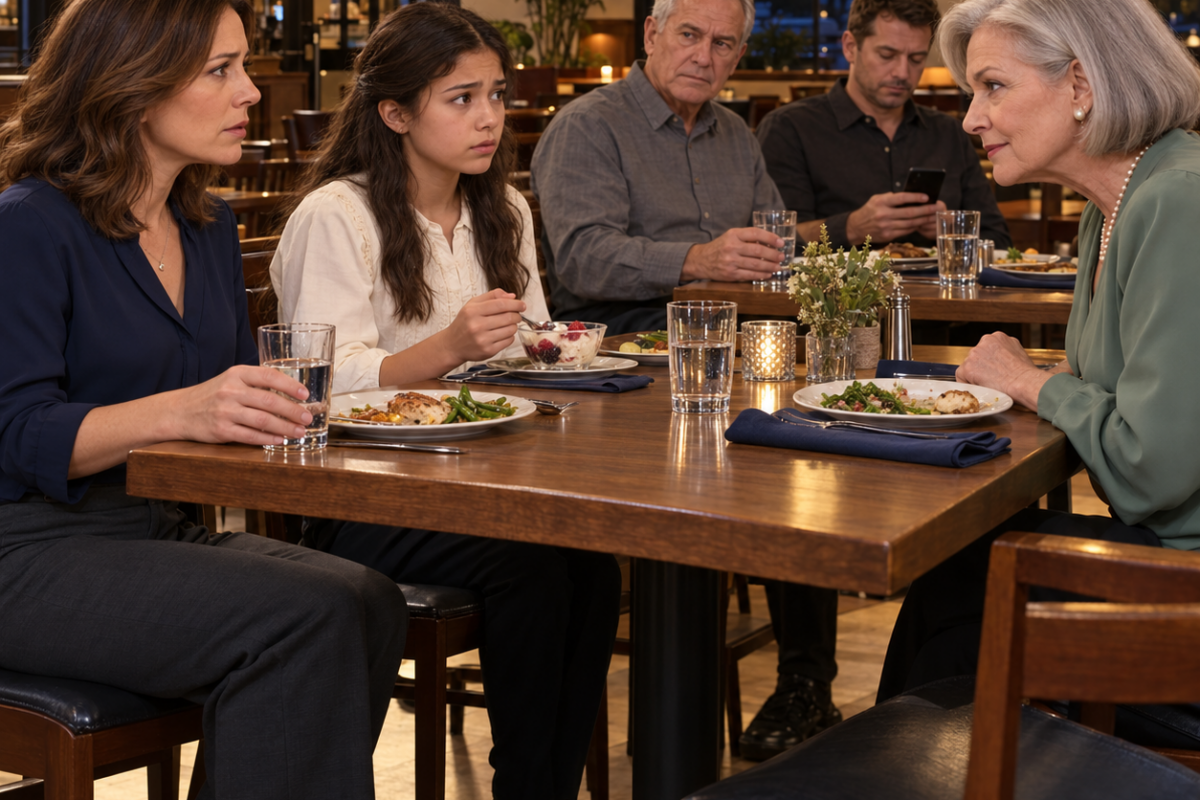
My mother leaned across the restaurant table, looked at my thirteen-year-old adopted daughter, and whispered, “We don’t sit with mistakes.” I took Sole’s hand and walked her out. That night, my father texted, “You’re still making the car payment tomorrow, right?” By midnight, I had canceled the payments I’d been making for my family. Then I remembered something Sole had told me about her grandmother.
My mother looked at my thirteen-year-old daughter and whispered, “We don’t sit with mistakes.” She said it softly enough to avoid attracting attention from the…
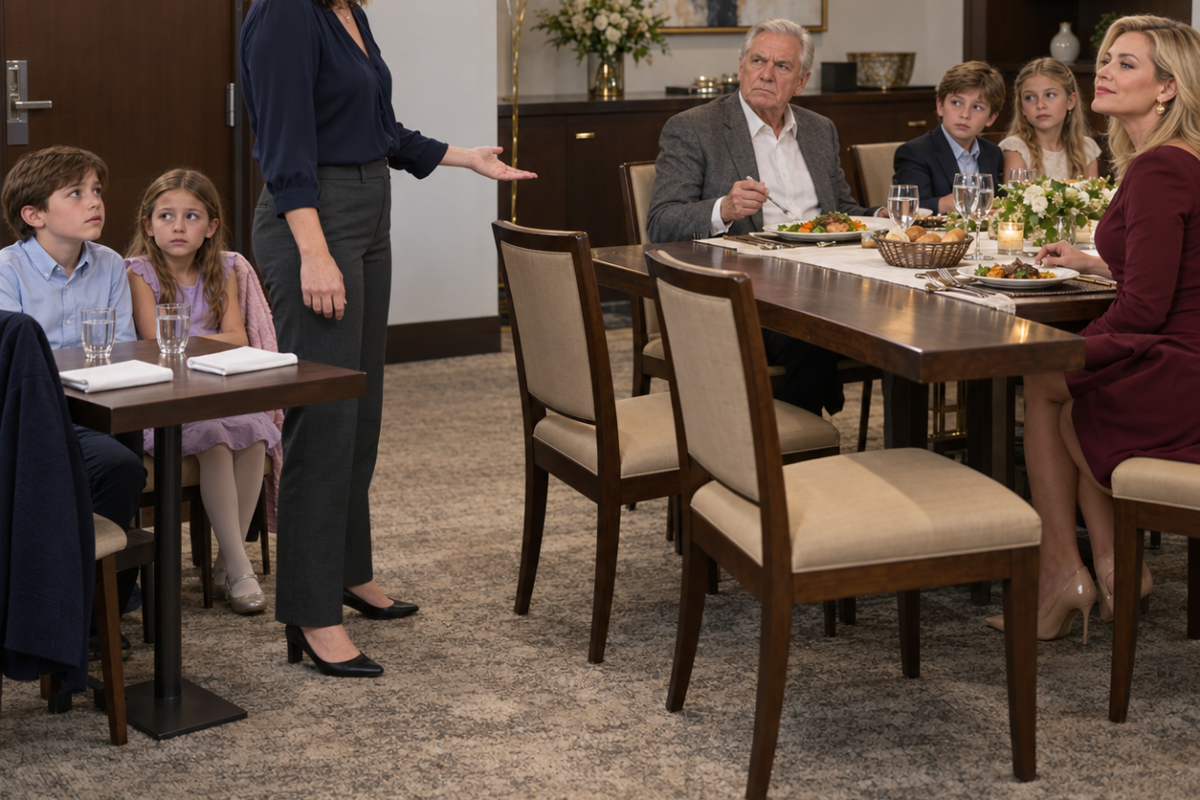
At my father’s seventieth birthday dinner, my eleven-year-old son and eight-year-old daughter were seated beside the service door with water glasses—but no dinner plates. Their cousins sat beside Grandpa with warm bread and full place settings. “They’ll eat after everyone else,” my sister said. I turned to my father, expecting him to object. “They can wait another hour,” he replied. There were two empty chairs at his table.
At my father’s seventieth birthday dinner, the first thing that stopped me wasn’t the cake or the gold balloons. It was my children. Ethan and…
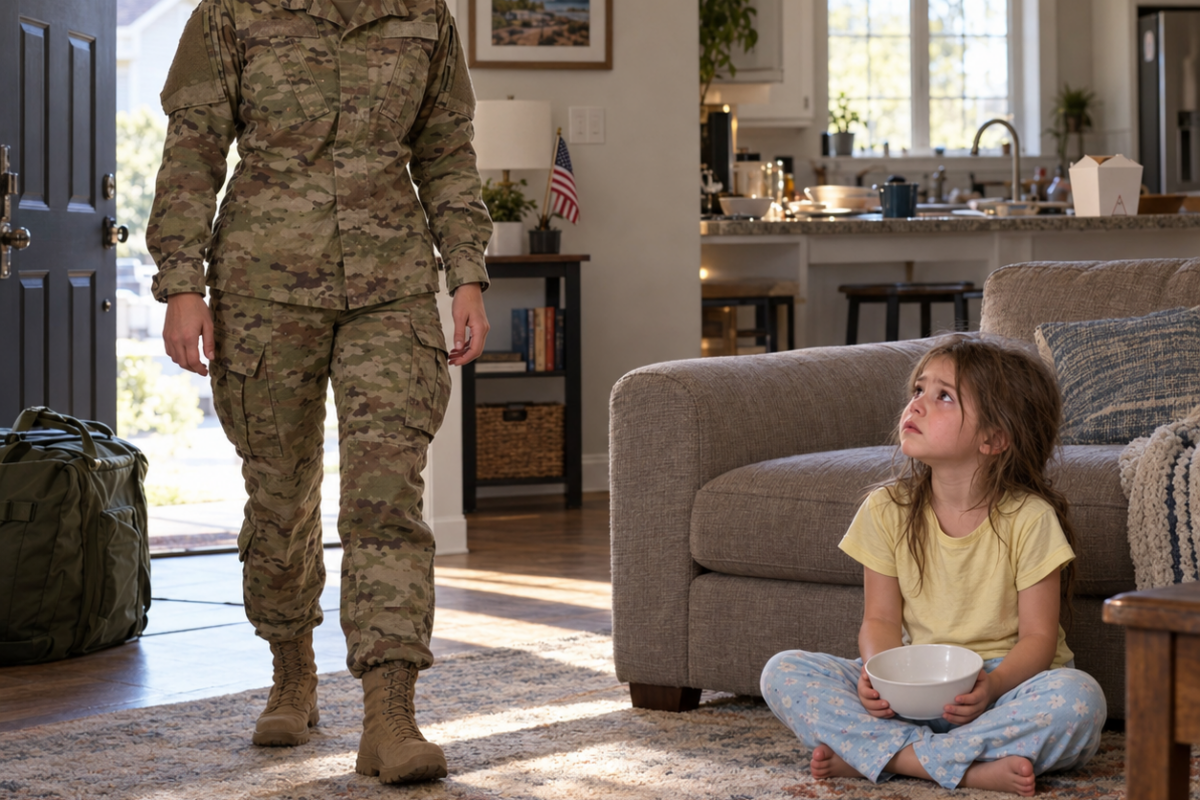
“Mommy, are you real?” my four-year-old daughter whispered when I came home from deployment three weeks early. She was sitting alone on our living room floor with an empty cereal bowl. My husband was on a Caribbean cruise with his mother and sister. Twenty-two minutes earlier, they had posted a photo captioned “Family time.” I was still in uniform when Sophie asked if she could have something to eat.
The first thing my daughter said when I found her was, “Mommy, are you real?” She was sitting cross-legged on our living room floor with…
End of content
No more pages to load